World

Deadly Russian strikes target military bases in central Ukraine

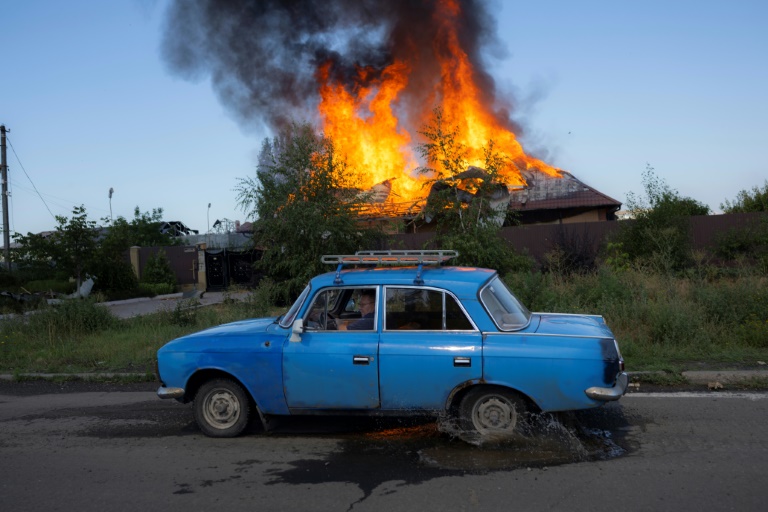
Russian strikes on military facilities and residential buildings across war-scarred Ukraine Thursday left several dead in attacks President Volodymyr Zelensky described as “missile terrorism”.

The deadliest attacks, which struck the central Kyrovograd region, came as the country was marking its first Day Of Ukraine Statehood that was announced by Zelensky earlier.

Russia’s invasion has morphed into a gruelling war of attrition and frontline artillery battles. Both sides are striking targets behind the frontlines to dent the others ability to fight a protracted conflict.

“Twenty-five people have been transferred to medical facilities and are receiving treatment. Five are dead,” the region’s governor Andriy Raikovich said in a video on his social media.

The Interfax-Ukraine news agency quoted Raikovich as saying that there were 12 servicemen among the wounded.

City officials said the attacks on the region’s administrative centre, Kropyvnytskyi, damaged “aviation equipment,” aircraft and nearby buildings, Interfax-Ukraine reported.

Kropyvnytskyi lies some 300 kilometres (186 miles) south of the capital Kyiv and three people, including one Ukrainian serviceman were killed in Russian strikes on railway and military infrastructure over the weekend.

Russian strikes reported earlier on Thursday meanwhile destroyed one building at a military base north of Kyiv.

Senior Ukrainian military official Oleksiy Gromov said the missiles that hit the town 30 kilometres (19 miles) north of Kyiv were fired from the Crimea peninsula, annexed by Russia in 2014.

– ‘Troubled morning’ –

At least one person was also killed and two more injured in a strike on the central Dnipro region, its governor Valentin Reznichenko said on social media.

“It’s a troubled morning. Again there is missile terror. We will not give up,” Ukraine’s President Volodymyr Zelensky said on social media.

Russia launched its full-scale invasion of Ukraine in February, displacing millions and killing thousands more. 

Moscow’s forces first tried and failed to wrest control of Kyiv and the country’s second-largest city of Kharkiv, and have since turned their attention to capturing the eastern Donbas region.

There, in the town of Toretsk, Russia launched deadly strikes on a five-story residential building.

“Rescue workers today found and removed the remains of two people — a man and a woman. In total two people died and three were rescued,” regional emergency services said.

They added separately that the toll from strikes on a hotel one day earlier in the Donbas town of Bakhmut under Ukrainian control had increased to four.

AFP journalists in the area reported Bakhmut and nearby Siversk had also been experiencing electricity cuts following strikes in the area.

While fighting since February has centred on the eastern Donbas region, Ukraine’s forces are also building momentum in their counter-offensive for the southern Kherson region.

In the neighbouring southern region of Mykolaiv — key for supplying efforts to recapture Kherson — one person was injured and a school building was destroyed following “extensive” shelling, governor Vitaliy Kim said.
Wall Street shrugs off US economy contracting

Wall Street stocks rose on Thursday despite data showing the US economy contracted for a second straight quarter as investors took it as a signal the Federal Reserve may slow interest rate hikes.

The increase follows a surge in Wall Street’s main stock indices on Wednesday, after investors welcomed comments by US Federal Reserve chief Jerome Powell suggesting its next super-sized increase could be its last.

The Fed hiked interest rates by three-quarters of a percentage point, its second hike in a row of that magnitude and the fourth increase this year.

“The reported basis for the positive response was a belief that the Fed Chair effectively lowered the temperature on the future pace of rate hikes,” said market analyst Patrick J. O’Hare at Briefing.com.

In late morning trading, the Dow and S&P 500 were both 0.6 higher. Meanwhile, the tech-heavy Nasdaq Composite — which jumped 4.1 percent on Wednesday, added 0.4 percent.

US gross domestic product (GDP) fell at an annual rate of 0.9 percent in the April-June quarter, following a 1.6 percent decline in the first quarter.

Two consecutive quarters of contraction in GDP is generally accepted as the technical definition of a recession.

Powell also said that future hikes will depend on economic data, and the markets took the GDP data as an indication that rate hikes will slow.

“Well, GDP was quite poor, so there won’t be a hattrick of 75 basis point hikes in September, that’s for sure,” said Fawad Razaqzada at City Index and FOREX.com.

“The US GDP data has re-affirmed my view that the Fed will have to slow down the pace of the hikes and potentially go in reverse in early 2023,” he added.

Meanwhile, a key inflation measure, the personal consumption expenditures price index, rose 7.1 percent in the latest three months, the same pace as in the first quarter, data showed.

The Fed and other central banks have been raising interest rates to rein in soaring inflation, but that risks slowing growth or even tipping the economy into recession.

Stephen Innes at SPI Asset Management said the market is “far too over-focused on the September 50 vs 75 debate, and not enough on the Fed’s underlying message.”

He said Fed policymakers have been clear they are “unequivocally prepared to allow a deeper economic slowdown and even a short-dipped recession if that is the price to be paid to get underlying inflation under control.”

European stock markets finished mostly higher.

Europe’s energy sector was in particular focus with Britain’s Shell and France’s TotalEnergies posting bumper second-quarter profits on elevated oil and gas prices. 

Asian indices mostly climbed following a surge on Wall Street, fuelled by hopes that the US central bank could slow its pace of inflation-fighting interest rate hikes.

The dollar bounced back against the euro and pound from a sell-off that came in response to Powell’s comments, but slumped to a month low against the yen. 

Oil prices pushed on data showing a big drop in US stockpiles, as well as the market expectations that the Fed will slow interest rate hikes.

– Key figures at around 1530 GMT –

New York – Dow: UP 0.6 percent at 32,377.88 points

EURO STOXX 50: UP 1.2 percent at 3,652.20

London – FTSE 100: DOWN less than 0.1 percent at 7,345.25 (close) 

Frankfurt – DAX: UP 0.9 percent at 13,282.11 (close)

Paris – CAC 40: UP 1.3 percent at 6,339.21 (close)

Tokyo – Nikkei 225: UP 0.4 percent at 27,815.48 (close)

Hong Kong – Hang Seng Index: DOWN 0.2 percent at 20,622.68 (close)

Shanghai – Composite: UP 0.2 percent at 3,282.58 (close)

Euro/dollar: DOWN at $1.0164 from $1.0200 Wednesday

Pound/dollar: DOWN at $1.2128 from $1.2158 

Euro/pound: DOWN at 83.80 pence from 83.89 pence

Dollar/yen: DOWN at 134.46 yen from 136.57 yen

Brent North Sea crude: UP 0.9 percent at $107.58 per barrel

West Texas Intermediate: UP 0.8 percent at $98.04 per barrel

burs-rl/har

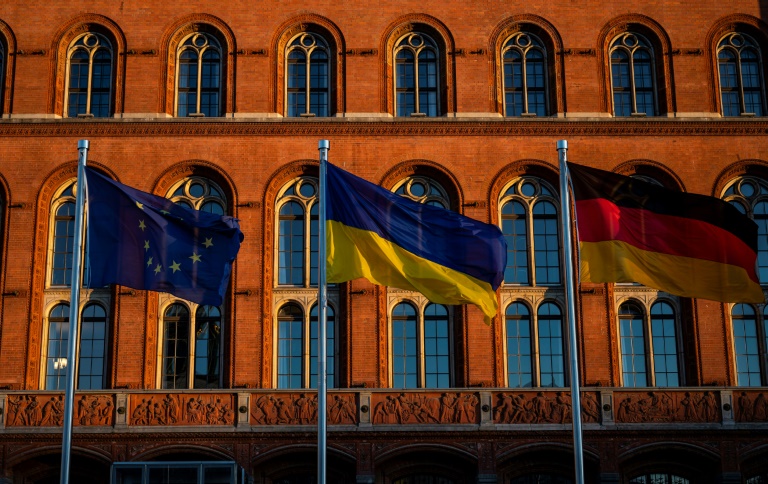
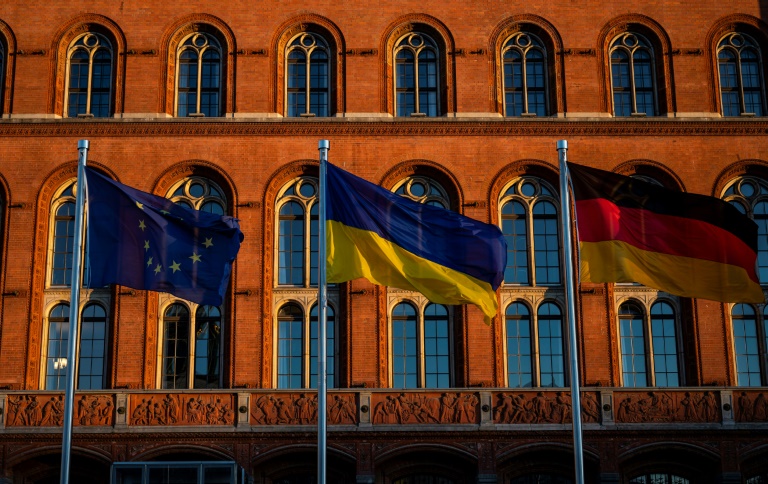
Berlin monuments fall dark to save energy

The city of Berlin started switching off spotlights illuminating its historic monuments as part of a national effort to save energy in the face of Russian gas shortages.

Some 200 buildings and landmarks including Berlin’s red-brick city hall, State Opera House and Charlottenburg Palace will fall dark at night, officials in the German capital said this week.

“Given the war against Ukraine and the energy policy threats by Russia, it’s important that we be as careful as possible with our energy,” the city’s chief official for the environment, Bettina Jarasch, said on Wednesday.

Jarasch of the Green party said that included consumers and industry but also public institutions, calling the move “the right thing to do to make a visible contribution”.

The policy affected six monuments from Wednesday night and will eventually encompass 200 buildings and landmarks along with their 1,400 spotlights over the next four weeks, Jarasch’s office said.

An electrical services firm will shut off 100-120 lights per day without dismantling them, keeping the policy temporary.

The cash-strapped capital will not save money as the labour costs are expected to match the benefit of cutting energy use.

President Frank-Walter Steinmeier said this week he wanted to set an example by keeping the facade of his official residence, Bellevue Palace in Berlin’s sprawling Tiergarten park, dark at night. 

– Cold showers –

Several German cities have said they would step up efforts to limit the use of energy, with Hanover in the north announcing plans this week to only offer cold showers at public pools and sports centres.

Chancellor Olaf Scholz’s centre-left-led government has launched a national drive to save energy amid soaring prices due to the Russian invasion of Ukraine, and the EU agreed this week to reduce Russian gas use across the bloc.

Officials have warned that the Kremlin could cut off supplies this winter in retaliation for biting Western sanctions against Moscow over the war.  

The German efforts include reducing the use of air conditioning, promoting public transport and pushing for more efficient shower heads.

Before the Ukraine war, Germany bought 55 percent of its natural gas from Russia. 

Although the rate had fallen to 35 percent by early June, Europe’s top economy is still heavily dependent on Russia for its energy, and says Moscow is using it as a “weapon”.

On Wednesday, Russian state-run energy giant Gazprom slashed deliveries of gas through the Nord Stream pipeline to Germany to 20 percent capacity from the previous 40 percent. 

Berlin monuments fall dark to save energy

The city of Berlin started switching off spotlights illuminating its historic monuments as part of a national effort to save energy in the face of Russian gas shortages.

Some 200 buildings and landmarks including Berlin’s red-brick city hall, State Opera House and Charlottenburg Palace will fall dark at night, officials in the German capital said this week.

“Given the war against Ukraine and the energy policy threats by Russia, it’s important that we be as careful as possible with our energy,” the city’s chief official for the environment, Bettina Jarasch, said on Wednesday.

Jarasch of the Green party said that included consumers and industry but also public institutions, calling the move “the right thing to do to make a visible contribution”.

The policy affected six monuments from Wednesday night and will eventually encompass 200 buildings and landmarks along with their 1,400 spotlights over the next four weeks, Jarasch’s office said.

An electrical services firm will shut off 100-120 lights per day without dismantling them, keeping the policy temporary.

The cash-strapped capital will not save money as the labour costs are expected to match the benefit of cutting energy use.

President Frank-Walter Steinmeier said this week he wanted to set an example by keeping the facade of his official residence, Bellevue Palace in Berlin’s sprawling Tiergarten park, dark at night. 

– Cold showers –

Several German cities have said they would step up efforts to limit the use of energy, with Hanover in the north announcing plans this week to only offer cold showers at public pools and sports centres.

Chancellor Olaf Scholz’s centre-left-led government has launched a national drive to save energy amid soaring prices due to the Russian invasion of Ukraine, and the EU agreed this week to reduce Russian gas use across the bloc.

Officials have warned that the Kremlin could cut off supplies this winter in retaliation for biting Western sanctions against Moscow over the war.  

The German efforts include reducing the use of air conditioning, promoting public transport and pushing for more efficient shower heads.

Before the Ukraine war, Germany bought 55 percent of its natural gas from Russia. 

Although the rate had fallen to 35 percent by early June, Europe’s top economy is still heavily dependent on Russia for its energy, and says Moscow is using it as a “weapon”.

On Wednesday, Russian state-run energy giant Gazprom slashed deliveries of gas through the Nord Stream pipeline to Germany to 20 percent capacity from the previous 40 percent. 

Pope celebrates mass at North America's oldest Catholic shrine

Pope Francis celebrated mass Thursday at the oldest Catholic shrine in North America, preaching reconciliation on the fourth day of a visit to Canada as he seeks to reset the Church’s relationship with Indigenous people.

Thousands of people, many of them Indigenous, were on hand as the 85-year-old pontiff arrived at the shrine of Sainte-Anne-de-Beaupre under heavy security and greeted them from his popemobile.

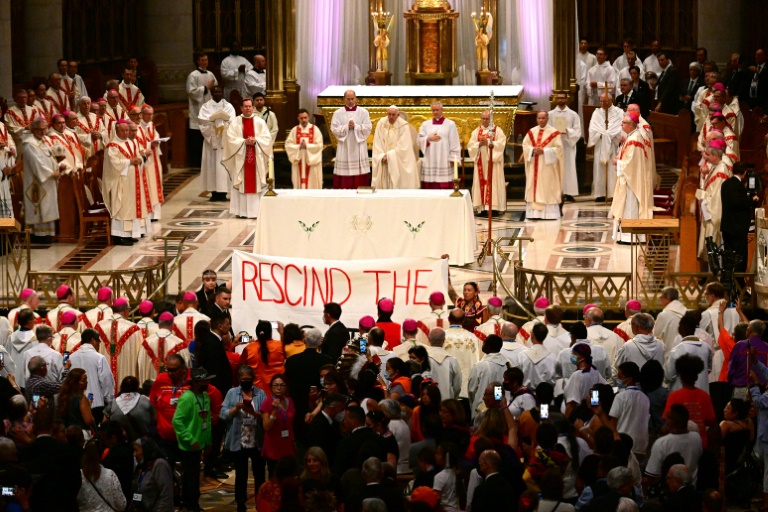
Inside the shrine, just in front of the altar and a few feet away from Francis as mass began, demonstrators unfurled a sign which read: “Rescind the doctrine” — referring to the Doctrine of Discovery, the 15th century papal edicts that empowered European powers to colonize non-Christian lands and people.

The writing was only on the side facing away from the pope, and it was calmly removed shortly after.

But it was demonstrative of the work that many Indigenous people, while hailing the pope’s trip as historic, say the Church has left to do.

Francis came to Canada to apologize for the Church’s role in the abuse of Indigenous children in Catholic-run schools.

From the late 1800s to the 1990s, Canada’s government sent about 150,000 children into 139 residential schools run by the Church, where they were cut off from their families, language and culture in a failed policy of forced assimilation.

Many were physically and sexually abused, and thousands are believed to have died of disease, malnutrition or neglect.

The pope apologized for the abuse as his trip began on Monday. For many Indigenous people, his plea for forgiveness has been overwhelming.

Desneiges Petiquay said his visit was a “message of hope.”

The 54-year-old housewife from the Manawan reserve was in the front row at Sainte-Anne-de-Beaupre. 

“This pope, he knows we exist here, he recognizes us,” she told AFP. “Yesterday, I saw him up close, it touched me here,” she added, putting her hand on her heart.

But many others say there is more to do. “Personally, it wasn’t enough,” said Abigail Brook, a 23-year-old member of Saint Mary First Nations, regretting in particular that the pope did not specifically mention sexual abuse.

During the mass at Sainte-Anne-de-Beaupre, on the shores of the St Lawrence River some 30 kilometers (18 miles) from Quebec City in Canada’s east, the pope said the Church was asking “burning questions… on its difficult and demanding journey of healing and reconciliation.”

“In confronting the scandal of evil and the Body of Christ wounded in the flesh of our Indigenous brothers and sisters, we too have experienced deep dismay; we too feel the burden of failure,” he said.

“Why did all this happen? How could this happen in the community of those who follow Jesus?”

Later, the pope will deliver a homily at the Notre Dame Cathedral in Quebec City.

On Friday, the last day of his six-day trip, he will stop in Iqaluit, in the Arctic territory of Nunavut.

Francis has appeared weakened since the beginning of this trip, and is using a wheelchair because of knee pain.

Macron defies rights criticism to host Saudi strongman

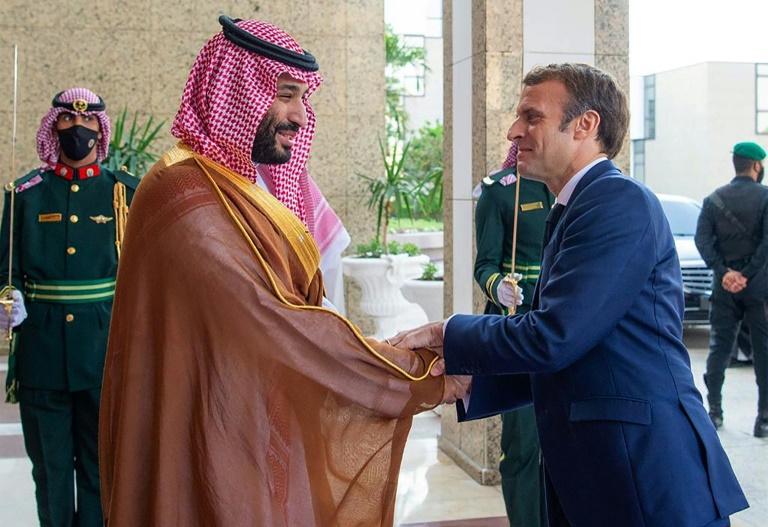
French President Emmanuel Macron was set to host Saudi Arabia’s Crown Prince Mohammed bin Salman for talks in Paris on Thursday, outraging rights groups and the fiancee of slain Saudi journalist Jamal Khashoggi.

The meeting is the latest step in the diplomatic rehabilitation of the de facto leader of the Saudi kingdom who became a pariah in the West following the Khashoggi killing.

The bearded leader known as “MBS” arrived in France after a stop in Greece and following a visit from US President Joe Biden to Riyadh earlier this month.

An aide to Macron defended the working dinner at a time of a global energy and food crisis, while promising that human rights would be raised.

“He will talk about it (rights) in a general way, but will also take the chance to raise individual cases,” the aide said on condition of anonymity. 

“For the president to have an influence and tackle the problems that European countries and France face… the only way is to talk with all of our partners,” the aide added.  

He repeated France’s longstanding demand that the gruesome dismemberment of Khashoggi be investigated and those responsible be “brought to justice”. 

French Prime Minister Elisabeth Borne denied claims that the country was undermining its public commitments to defend human rights.

“It obviously does not cast doubt on our principles. It does not cast doubt on our commitment to human rights,” she told reporters during a trip to eastern France.

– ‘Outraged’ –

MBS’ stop in Greece on Tuesday was his first trip to the EU since the murder of Khashoggi by Saudi agents at the kingdom’s consulate in Istanbul in 2018.

The crime was described by a UN probe as an “extrajudicial killing for which Saudi Arabia is responsible”.

US intelligence agencies determined that MBS had “approved” the operation that led to Khashoggi’s death, although Riyadh denies this, blaming rogue operatives.

“I am scandalised and outraged that Emmanuel Macron is receiving with all the honours the executioner of my fiance, Jamal Khashoggi,” Hatice Cengiz told AFP on Thursday.

“All the international investigations carried out up to this point… recognise the responsibility of MBS in the assassination,” Cengiz said.

Amnesty International secretary general Agnes Callamard told AFP she felt “profoundly troubled by the visit, because of what it means for our world and what it means for Jamal (Khashoggi) and people like him.”  

MBS is a man who “does not tolerate any dissent,” she added.

But for Western countries desperate to find new sources of energy, the 36-year-old de facto leader of the world’s biggest oil producer has become an essential figure.

The Kremlin’s invasion of Ukraine in February sent energy prices soaring, with Western nations scouring the globe to find supplies to replace oil and gas from Russia. 

Macron and Biden were caught on camera discussing their efforts — and possible spare production capacity in Saudi Arabia — at a G7 summit at the end of June in Germany.

“The war in Ukraine has put the energy-producing countries back in the spotlight, and they are taking advantage of it,” said Camille Lons, research associate at the International Institute for Strategic Studies (IISS).

The Saudi strongman stayed overnight at his Louis XIV chateau in Louveciennes west of Paris which he acquired in 2015, according to a source who asked not to be named.

Despite its name, the 7,000 m2 castle was only built in 2009, by a company headed by Khashoggi’s cousin Emad.

– ‘Open investigation’ –

The killing of Khashoggi, a Washington Post journalist, drew outrage not just over the elimination of a prominent critic of the Saudi regime, but also for the manner in which it was carried out. 

He was lured into the Saudi consulate on October 2, 2018 before being strangled and dismembered, reportedly with a bonesaw.

Three rights groups, including the Democracy for the Arab World Now (DAWN) group created by Khashoggi, on Thursday filed a criminal complaint in Paris accusing MBS of being an accomplice in the crime.

“French authorities should immediately open a criminal investigation against” MBS, said Sarah Leah Whiston, executive director of DAWN.

There has also been criticism within France, with the Greens presidential candidate Yannick Jadot asking “will Khashoggi’s dismembered body be on the menu? Climate? Human rights? 

“No — it will be oil and weapons. The exact opposite of what should be done.” 

The French president first hosted MBS in 2018, when he took him to an art exhibition at the Louvre museum, and travelled to the kingdom in December 2021 for further talks. 

War in Ukraine: latest developments

Here are the latest developments in the war in Ukraine:

– Five killed in Russian strikes –

Russian strikes on the central Ukrainian region of Kyrovograd leave five people dead and injure more than two dozen others, the region’s governor says.

Governor Andriy Raikovich says the strikes on the city of Kropyvnytskyi, about 300 kilometres (186 miles) south of the Ukrainian capital Kyiv, damaged two aircraft hangars. He said 12 servicemen were among the wounded.

Over the weekend, Russia carried out strikes on the city’s railway infrastructure and a military airfield, leaving three dead, including a soldier, and nine servicemen injured, authorities said.

– US-Russia discuss prisoner swap –

Moscow confirms it is in talks with Washington on a possible prisoner swap but says there is no concrete agreement “yet” on a deal that reportedly involves trading a notorious Russian gun runner for a US basketball star and a former Marine.

US Secretary of State Antony Blinken says Washington has made a “substantial proposal” to Moscow to free basketball star Brittney Griner and former Marine Paul Whelan.

He declines to confirm reports the US is offering to trade them for Russian arms trafficker Victor Bout.

Blinken says he will speak to his Russian counterpart Sergei Lavrov “in the coming days” — in what would be their first telephone call since Moscow sent troops to Ukraine on February 24.

– Ukraine’s Kherson push ‘gathering momentum’ – 

Britain’s military intelligence says Ukraine’s counter-offensive in the occupied southern Kherson region near the Crimea peninsula is “gathering momentum.”

Russian forces “should leave Kherson while it is still possible. There may not be a third warning,” Ukrainian presidential advisor Mykhaylo Podolyak says on Twitter.

Earlier this week, Ukrainian forces used new long-range weapons to damage a key bridge into the city of Kherson, one of the first to fall to Russian forces in the early days of the war.

Britain’s defence ministry says that Kherson city is now “virtually cut off from the other occupied territories.”

– Russia anti-war journalist fined –

Russian journalist Marina Ovsyannikova, who shot to global prominence in March after interrupting a Russian TV broadcast to denounce the invasion of Ukraine, is ordered to pay a fine for “discrediting” the Russian army.

A district court in Moscow orders Ovsyannikova, a former editor at state-controlled Channel One, to pay a fine of 50,000 rubles (around $800).

Ovsyannikova famously barged onto the set of Channel One’s evening news programme in the early days of the war, holding a sign reading “No War” in English.

She was detained but spared punishment and left Russia for a few months before returning this month and being detained again for speaking out in defence of jailed opposition politician Ilya Yashin.

Her lawyer said she was fined over that incident, and not her TV outburst.

– Kyiv to boost Europe’s power supply –

Ukrainian President Volodymyr Zelensky announces plans to boost Ukrainian electricity supplies to European consumers to help it avert an energy crisis sparked by a gas war with Russia.

“Our export not only allows us to generate foreign currency revenues, but also help our partners withstand the energy pressure from Russia,” Zelensky says in his daily address to the nation.

Russia’s Gazprom this week cut gas deliveries to Europe through the Nord Stream pipeline to about 20 percent of capacity.

burs-eab/cb/kjm

W. Mediterranean hit by 'exceptional' heatwave: experts

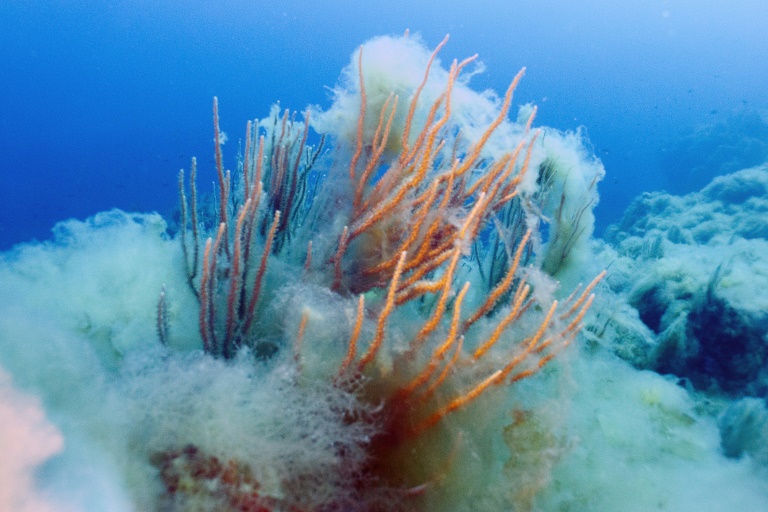
An “exceptional” marine heatwave is gripping the western Mediterranean with surface temperatures up to five degrees Celsius (41 degrees Fahrenheit) hotter than average, according to experts contacted by AFP. 

Although the record-breaking heatwave that baked northern Europe and Britain this month has subsided, the experts said the persistently hotter-than-normal temperatures in the Mediterranean posed a threat to the entire marine ecosystem.

“This huge marine heatwave began in May in the Ligurian sea” between Corsica and Italy, said Karina von Schuckmann, an oceanographer at the non-profit research group Mercator Ocean International.

It then spread to the Gulf of Taranto in the Ionian Sea, she said. 

By July, the heatwave had engulfed the Balearic Islands, Sardinia, and the Tyrrhenian Sea. 

“The surface temperature anomaly map shows higher than normal values, in the order of +4 to +5C from the east of the Balearic Islands to the east of Corsica,” Mercator said in a statement. 

While humans might find the warmer water temperatures pleasant in the tourist hotspots of the western Mediterranean, the group warned that “ocean warming impacts the entire ecosystem.” 

“It is important to be aware of the possible consequences for local fauna and flora, as well as the occurrence of extreme weather events that could result in natural disasters,” it said.

Von Schuckmann said that unusually warm temperatures could cause irreversible migration for some species and “mass die-offs” for others.

She noted knock-on effects for industries such as tourism and fishing which rely on favourable water conditions.

According to the UN’s climate science body, marine heatwaves have already doubled in frequency globally since 1980.


– Die-offs, invasive species – 

Although the Mediterranean only counts for one percent of Earth’s ocean surface area, it contains nearly 20 percent of all known marine species.

A study published this month in the journal Global Change Biology found that the Mediterranean had experienced five consecutive years of mass mortality events between 2015-2019.

France’s CNRS research centre has noted that marine heatwaves in 1999, 2003 and 2006 caused mass die-offs for some species, notably the posidonia, a genus of flowering plants.

“We can predict the main impact will be on fixed organisms such as plants or corals,” said Charles-Francois Boudouresque, a marine ecologist at Aix-Marseille University. 

Some species of fish such as the barracuda could become more abundant in warming northern Mediterranean waters, however.

Boudouresque said some species coming through the Suez Canal from the Red Sea could become problematic “within five to 10 years”.

These include the rhopilema, a herbivore jellyfish Boudouresque described as “extremely greedy”, and which could disrupt marine food chains.

Already abundant in the eastern Mediterranean, its appearance in western waters would threaten the algae forests that serve as nurseries for myriad varieties of fish. 

Rhopilema can also sting swimmers with enough severity to require hospital treatment.

Another invasive species is the rabbit fish, which is native to the Red Sea but is increasingly found in the Mediterranean. 

As there is little governments can do once a marine heatwave takes hold, Von Schuckmann said the best course of action is to reduce the greenhouse gas emissions that contribute to warming.

“Even if we stopped emitting today, the oceans, which contain 90 percent of Earth’s heat, will continue to warm,” she said.

“Since at least 2003 (marine heatwaves) have become more common and in future they will last longer, cover more sea, and be more intense and severe,” said Von Schuckmann.

Biden, Xi hold talks on Taiwan, trade dispute

President Joe Biden and Chinese counterpart Xi Jinping spoke by phone for well over two hours on Thursday on mounting tensions over Taiwan, a festering trade dispute and their bid to keep the superpower rivalry in check.

The White House said that the call lasted two hours and 17 minutes. A statement was expected later.

While this was Biden’s fifth talk with Xi since becoming president a year and a half ago, it’s getting hard to mask deepening mistrust between the two countries.

Already stuck in a trade war, Beijing and Washington increasingly risk open conflict over Taiwan, with little sign of resolution on either front.

“Tensions over China’s aggressive, coercive behavior in the Indo-Pacific” will be high on the agenda, said White House National Security Council spokesman John Kirby.

The latest flashpoint is a possible trip by Biden ally and speaker of the House of Representatives, Nancy Pelosi, to the island, which Beijing claims is part of China but has its own distinct, democratic government.

Although US officials frequently visit Taiwan, separated by a narrow strip of water from the Chinese mainland, Beijing considers a Pelosi trip as a major provocation. She’s second in line to the US presidency and given her position may travel with military transport.

Washington will “bear the consequences” if the trip, which Pelosi has yet to confirm, goes ahead, China warned Wednesday.

General Mark Milley, chairman of the US joint chiefs of staff, told reporters that if Pelosi asks “for military support, we will do what is necessary to ensure a safe, safe conduct of their business.”

And the dispute around Pelosi is the tip of an iceberg, with US officials fearing that Xi is mulling use of force to impose control over democratic Taiwan.

Once considered unlikely, an invasion, or lesser form of military action, is increasingly seen by China watchers as possible — perhaps even timed to boost Xi’s prestige when he moves later this year into a third term.

Biden’s contradictory comments on whether the United States would defend Taiwan — he said in May that it would, before the White House insisted there was no change in the hands-off “strategic ambiguity” policy — have not helped the tension.

– No face-to-face –

Biden prides himself on a close relationship with Xi going back years but — in large part due to Covid travel restrictions — the two have yet to meet face-to-face since he took office.

According to the White House, Biden’s chief goal is to establish “guardrails” for the two superpowers.

This is meant to ensure that while they sharply disagree on democracy, and are increasingly rivals on the geopolitical stage, they can avoid open conflict.

“He wants to make sure that the lines of communication with President Xi on all the issues, whether they’re issues again that we agree on or issues where we have significant difficulty with — that they can still pick up the phone and talk to one another candidly,” Kirby said.

Where to place the guardrails, however, is challenging amid so many unresolved disputes, including a simmering trade war begun under Donald Trump’s presidency.

Asked whether Biden could lift some of the 25 percent import duties placed on billions of dollars of Chinese products by Trump, Kirby said there was still no decision.

“We do believe… that the tariffs that were put in place by his predecessor were poorly designed. We believe that they’ve increased costs for American families and small businesses, as well as ranchers. And that’s, you know, without actually addressing some of China’s harmful trade practices,” Kirby said.

But “I don’t have any decision to speak to with respect to tariffs by the president. He’s working this out.”

Recession fears deepen as US economy contracts again

The US economy contracted for a second straight quarter between April and June, government data showed Thursday, adding fuel to recession fears in a headache for President Joe Biden ahead of midterm elections.

Gross domestic product declined at an annual rate of 0.9 percent in the second quarter, following a bigger drop in the first three months of the year, according to the Commerce Department.

While not the official definition, two quarters of negative growth is commonly viewed as a strong signal that a recession is underway, and a downturn in the world’s largest economy would have global consequences, as well as domestic political costs.

Biden insisted that the US economy is “on the right path,” despite the slowdown, but his critics are sure to seize on the report as proof of the veteran Democrat’s mismanagement.

After a 1.6 percent decline in the first three months of the year, the report said the slowdown in the latest quarter was largely due to drops in government spending at all levels and in private investment on goods, including autos, and on residential buildings, despite an increase in exports.

But personal consumption expenditures (PCE) continued to increase, though at a slower rate than the prior quarter, the data showed.

The US economy also continues to battle sky-high inflation, as a result of supply chain snarls due to Covid lockdowns, as well as the fallout from Russia’s war in Ukraine which has sent food and fuel prices soaring.

Consumer prices topped nine percent in June, the highest in more than four decades, while the GDP data showed another key inflation measure, the PCE price index, rose a still-high 7.1 percent in the latest three months, the same as in the January-March period.

The US central bank has been raising interest rates aggressively — with the latest big hike on Wednesday — to try to cool the economy and tamp down price pressures.

“It’s no surprise that the economy is slowing down as the Federal Reserve acts to bring down inflation,” Biden said in a statement shortly after the GDP report was released. 

“But even as we face historic global challenges, we are on the right path and we will come through this transition stronger and more secure,” he said, noting the US “job market remains historically strong” and the economy created more than a million jobs in the past three months.

– Recession debate –

It would be highly unusual for an economy still adding jobs at a rapid pace and with near record-low unemployment, to fall into recession, but even so many economists say the discussion of a downturn is more a matter of when, not if.

That poses a major political headache for the president, who has seen his approval ratings plummet in recent months as American families struggle to make ends meet due to surging inflation.

Fed Chair Jerome Powell agreed with Biden and other economists who say the GDP figures are inconsistent with other strong data.

Powell on Wednesday said he does not think the country is currently in a recession because “there are too many areas of the economy that are performing too well.”

Mike Fratantoni, chief economist of the Mortgage Bankers Association, was among those who echoed Powell’s view, saying “the ongoing strength in the job market and other signs of growth make it unlikely that this will be categorized as a recession.”

Powell also said it is possible to cool price pressures without causing a downturn or a big jump in joblessness, although he acknowledged the path to thread that needle is narrowing.

But economist Mohamed El-Erian said on Twitter that the data point to “Deepening stagflation and flashing red recession risk.”

That impression may be the one that sticks in the minds of investors and consumers.

Wall Street was not happy with the data. After big jumps in the wake of the Fed rate hike, all three major stock indices were lower in mid-morning trading.

Close Bitnami banner
Bitnami