World

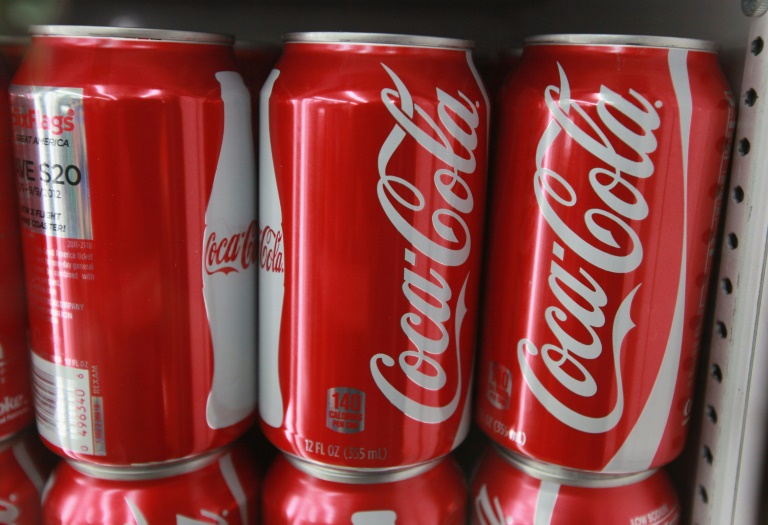
Higher prices boost Coca-Cola's Q2 results

Higher prices for soda helped Coca-Cola score better-than-expected quarterly profits in spite of higher operating costs and the drag of the strong US dollar in international markets, the company announced Tuesday.

The soft drink brand benefited from a 12 percent increase in global pricing, with the biggest price increases in Europe/Middle East Africa, Latin America and North America.

An exception was Asia Pacific, where the company flagged China’s Covid-19 lockdowns as a weak area in spite of higher sales in India and the Philippines. 

Coca-Cola executives have said they are monitoring the response to higher prices. When the company last reported results in April, executives said they had yet to see a meaningful pullback from consumers to the price changes made to that point.

Results also were boosted by resurgent sales in away-from-home venues such as entertainment and professional sports locales. 

But the beverage giant pointed to a drag from higher operating costs and marketing spending compared to the prior year. The strong US dollar also dented revenues in overseas markets.

Net income fell to $1.9 billion, a 28 percent decline from the same period of last year, in part due to strong sales in the current quarter from goods with lower profit margins. 

Revenues rose 12 percent to $11.3 billion.

“Our results this quarter reflect the agility of our business, the strength of our streamlined portfolio of brands, and the actions we’ve taken to execute for growth in the face of challenges in the operating and macroeconomic environment,” said Chief Executive James Quincey.

Coca-Cola shares climbed 1.1 percent to $62.87 in pre-market trading.

Record number of French regions face water restrictions

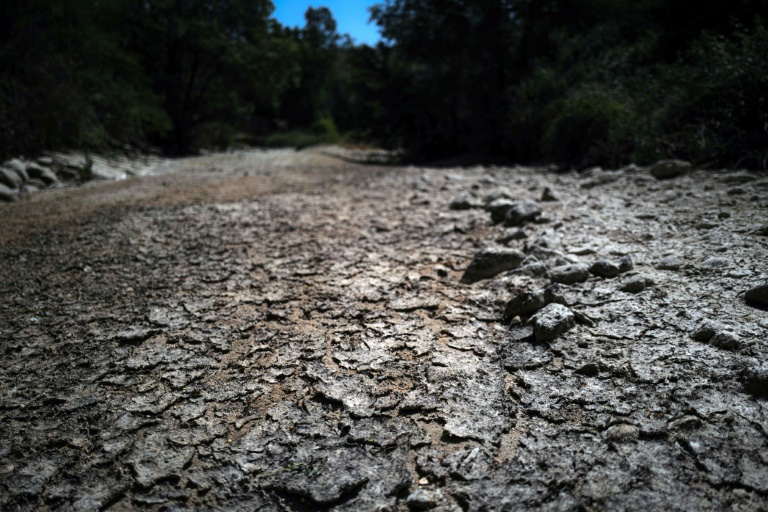
A record 90 out of 96 mainland French regions face water restrictions due to an ongoing drought, official figures showed on Tuesday, as scorching temperatures and low rainfall cause supply shortages in many areas.

Only a handful of “departments” around the country are exempt from the restrictions, including the Paris area, the government’s drought website Propluvia shows.

A colour-coded map indicates that the most severe measures — including a ban on irrigation for farmland — are in place in the northwest in the Loire river basin, as well as the southeast around the Rhone.

Areas in the southwest around the Tarn and Lot rivers are also in the highest red category, while even the normally verdant Alps are suffering from severe aridity.

“We have a record number of departments with restrictions,” the environment ministry said in a statement.

France experienced its third-driest spring on record this year after 2011 and 1976, according to the national weather service, with rainfall 45 percent below average levels.

Two severe heatwaves in May and latterly in July — when temperatures soared above 40 Celsius (100 degrees Fahrenheit) — have further reduced water levels while searing farmland and forests.

Two huge blazes near Bordeaux in southwest France over the last fortnight have destroyed more than 20,000 hectares of tinder-dry forest and required around 2,000 firefighters to bring them under control.

Local authorities are restricting access to many wooded areas as a precaution, including the Calanques National Park along the Mediterranean coast near Marseille which is popular with tourists.

burs-adp/spm

War in Ukraine: latest developments

Here are the latest developments in the war in Ukraine:

– EU members vote to cut gas use –

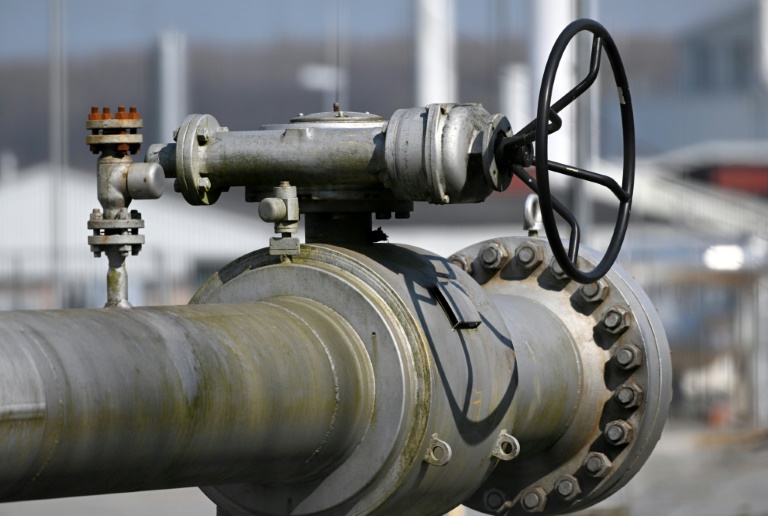
EU members with the exception of Hungary agree on a plan to cut gas consumption by 15 percent and reduce their dependence on Russian supplies, a day after Russian energy giant Gazprom announced plans to further limit flows to Europe.

Gazprom says it will cut daily gas deliveries through the Nord Stream pipeline to 33 million cubic metres a day, about 20 percent of its capacity, continuing the progressive constriction of supplies begun after the West imposed sanctions over Russia’s invasion of Ukraine.

The move, for which Gazprom has cited technical problems, has been slammed by the EU and Ukraine as an attempt by Moscow to blackmail Europe.

To show solidarity with Germany, the main beneficiary of the gas, EU members voted to voluntarily reduce their gas use by 15 percent starting next month, with some exceptions for islands and countries with limited access to shared supplies.

– New strikes on south Ukraine –

Russian forces launch new missile strikes at targets near Odessa, days after an attack on the strategic port city that jeopardised a hard-won deal on unblocking Ukrainian grain shipments.

Ukraine’s southern military command says Russian forces launched a “massive” strike from the Black Sea that hit residential buildings near Odessa.

Ukrainian President Volodymyr Zelensky publishes a video showing heavy damage to a popular resort village. A local official says one person was injured.

Officials in the port of Mykolaiv, another grain-exporting hub, also report attacks on infrastructure in that city.

The strikes come as Ukraine steps up preparations to resume shipping grain around the world under a deal brokered by the United Nations and Turkey with Russia, which has blockaded Ukraine’s Black Sea ports.

– Russia to quit ISS ‘after 2024’ –

Russia has decided to quit the International Space Station “after 2024”, the newly appointed chief of Moscow’s space agency tells President Vladimir Putin.

“Of course, we will fulfil all our obligations to our partners, but the decision to leave this station after 2024 has been made,” Roscosmos chief Yury Borisov tells Putin in comments released by the Kremlin.

“I think that by this time we will start putting together a Russian orbital station,” Borisov adds, calling it the space programme’s main “priority”.

Russia and the United States have worked side by side on the ISS, which has been in orbit since 1998.

– Kremlin defends closing Jewish agency –

The Kremlin attempts to limit the diplomatic fallout of its decision to close down the Russian chapter of the agency that handles Jewish immigration to Israel.

A Moscow court said last week the justice ministry had requested the Jewish Agency be dissolved because of unspecified legal violations.

The move will not prevent Russian Jews from emigrating to Israel but will make it harder. 

Kremlin spokesman Dmitry Peskov says the decision, seen by analysts as a warning to Israel’s Prime Minister Yair Lapid, who has been more critical of Russia than his predecessor, “should not be politicised or projected onto the entirety of Russian-Israeli relations”.

“There are issues from the point of view of complying with Russian law,” he says.

Lapid has called Russia’s decision a “serious event”.

More than one million of Israel’s 9.4 million residents have roots in the former Soviet Union.

burs-cb/raz/lcm

Executed Myanmar prisoners deserved 'many death sentences' says junta

Myanmar’s junta lashed out Tuesday against international condemnation of the country’s first use of capital punishment in decades, saying the four executed prisoners — two of them prominent democracy fighters — “deserved many death sentences”.

The executions announced Monday sparked condemnation from around the globe, heightened fears that more will follow and prompted calls for sterner international measures against the already-isolated junta.

But the military authorities were defiant, with spokesman Zaw Min Tun insisting the men were “given the right to defend themselves according to court procedure”.

“If we compare their sentence with other death penalty cases, they have committed crimes for which they should have been given death sentences many times,” he said at a regular press briefing in the capital Naypyidaw.

“They harmed many innocent people. There were many big losses which could not be replaced.”

The prisoners, who included a former lawmaker from ousted civilian leader Aung San Suu Kyi’s party, had been allowed to meet family members through video conferencing, he said, without providing details. 

The junta had previously rejected criticism from the UN and western countries over the death sentences.

– ‘Extremely troubled’ –

Phyo Zeya Thaw, a former lawmaker from Suu Kyi’s National League for Democracy (NLD) was arrested in November and accused of orchestrating several attacks on regime forces, including a gun attack on a commuter train in Yangon that killed five policemen.

He was sentenced to death in January for offences under anti-terrorism laws.

Democracy activist Kyaw Min Yu — better known as “Jimmy” — received the same sentence from the military tribunal.

The junta had previously issued an arrest warrant, alleging he had incited unrest with his social media posts.

It would be up to prison authorities to decide whether their families would be permitted to retrieve their bodies, Zaw Min Tun said. 

The two other men were sentenced to death for killing a woman they alleged was an informer for the junta in Yangon.

The junta has sentenced dozens of anti-coup activists to death as part of its crackdown on dissent after seizing power last year, but Myanmar had not carried out an execution in decades.

After a chorus of international condemnation on Monday, including from the UN, the United States and European countries, there was fresh criticism of the junta on Tuesday.

The Association of Southeast Asian Nations (ASEAN) bloc, which has led diplomatic efforts to end the crisis, said it was “extremely troubled and deeply saddened” by the executions.

In a statement issued by current chair Cambodia, it accused the junta of a “gross lack of will” to engage with ASEAN’s efforts to facilitate dialogue between the military and its opponents.

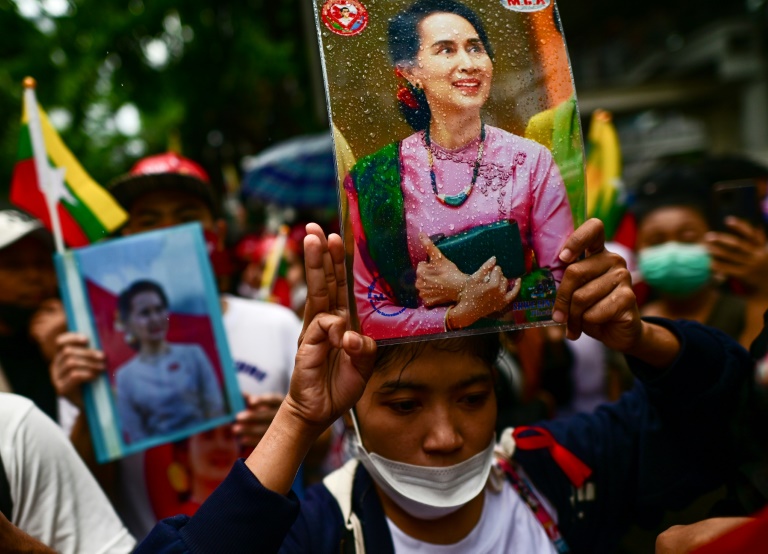
In Bangkok, hundreds of people staged a noisy protest outside the Myanmar embassy. 

Some held photos of Ko Jimmy and Phyo Zeya Thaw alongside Aung San Suu Kyi as they chanted “We want democracy.”

And Malaysia’s foreign minister Saifuddin Abdullah slammed the executions calling it a “crime against humanity”.

He called for a review of the so-called five-point consensus agreed by Southeast Asian leaders last year aimed at defusing the political crisis in Myanmar following a coup.

A spokesperson from the foreign affairs ministry of Thailand — another ASEAN member — said it regretted “the loss of four lives which aggravates the vexing problems of Myanmar”.

5 killed as anti-UN protesters spread in east DR Congo

At least five people have been killed and dozens injured during anti-UN protests in eastern DR Congo, a government spokesman said Tuesday as the unrest spread.

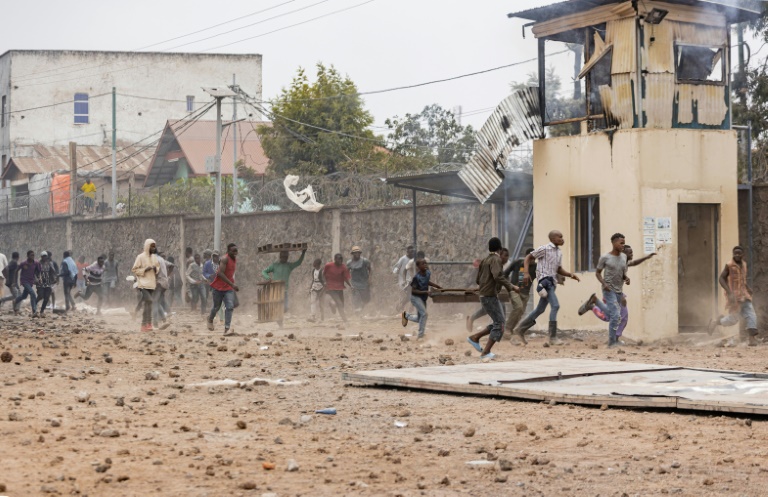
On Monday, hundreds of people blocked roads and chanted hostile slogans before storming the UN peacekeeping mission’s headquarters and a supply base in Goma, the main city in North Kivu province.

Protesters smashed windows and looted valuables, while helicopters airlifted UN staff from the premises and security forces fired teargas in a bid to push them back. 

In a post on Twitter, government spokesman Patrick Muyaya said”at least five people (were) dead, about 50 wounded” in the unrest.

The security forces had fired “warning shots” at protesters to stop attacks on UN personnel, he said. 

The unrest continued on Tuesday, with the fatal shooting of a man near the supplies base, an AFP correspondent saw.

The security forces were pushing back crowds outside the depot as protesters waved placards bearing slogans such as “bye bye MONUSCO”.

Anti-UN protesters also took to the streets in the North Kivu towns of Beni and Butembo, according to witnesses. 

Soldiers were deployed on the road leading to the MONUSCO base in Beni, which lies about 350 kilometres (215) miles north of Goma, while protesters burned tyres. 

Security forces also dispersed protesters who had gathered in front of a MONUSCO base in Butembo, another provincial hub, local sources said. 

– Anger –

The UN mission in the Democratic Republic of Congo, known as MONUSCO, is one of the world’s biggest peacekeeping operations.

But it has regularly come under criticism in the troubled east, where many accuse it of failing to do enough to stem decades-long bloodshed.

More than 120 armed groups roam the volatile region, where civilian massacres are common and conflict has displaced millions of people. 

The killings have continued despite the presence of thousands of UN peacekeepers, sparking bouts of anger among local people. 

In late 2019, nine anti-UN protestors were killed as Beni and Butembo were terrorised by the Allied Democratic Forces (ADF), which the Islamic State group describes as its central African affiliate.

In a statement on Monday, Khassim Diagne, the deputy special representative of the UN secretary general to MONUSCO, said the peacekeepers were there to protect civilians.  

“The incidents in Goma are not only unacceptable but totally counterproductive,” he said. 

– M23 –

The latest protests come after the president of the senate, Modeste Bahati, told supporters in Goma on July 15 that MONUSCO should “pack its bags.”

They coincide with the resurgence of the M23 — a militia that lay mostly dormant for years before resuming fighting last November. 

The rebels have since made significant advances in eastern Congo, including capturing the North Kivu town of Bunagana on the Ugandan border. 

The UN first deployed an observer mission to eastern Congo in 1999. 

In 2010, it became the peacekeeping mission MONUSCO — the United Nations Organization Stabilization Mission in the Democratic Republic of the Congo — with a mandate to conduct offensive operations.

It has a current strength of about 16,300 uniformed personnel, according to the UN. 

The peacekeepers have suffered 230 fatalities during the course of their mission. 

Eurozone stocks slide, gas prices soar

Eurozone equities sank Tuesday, as natural gas prices surged after Russia tightened the screw on supplies in fresh Ukraine fallout.

Investors digested also major earnings updates on the eve of another likely large US interest rate hike aimed at tackling soaring inflation.

General Motors reported a big drop in second-quarter profits owing to a semiconductor shortage.

Google parent Alphabet, Coca-Cola, Microsoft and McDonald’s are also publishing results Tuesday.

In Europe, stock markets “are under pressure as investors absorb what the news from Gazprom is likely to mean when it comes to gas supplies over the next few days”, noted CMC Markets analyst Michael Hewson.

Europe gas reference Dutch TTF surged more than ten percent to 197.97 euros per megawatt hour, one day after Russia’s Gazprom said it would cut daily gas deliveries to Europe via the Nord Stream pipeline.

Oil prices also leapt on concerns of a broader squeeze on global energy supplies, while the euro remained on the back foot against the dollar.

Gazprom will cut the gas deliveries to 33 million cubic metres a day — about 20 percent of the pipeline’s capacity — from Wednesday.

That has heightened market worries over supplies during the northern hemisphere winter later this year.

At the same time, European Union member states have reached agreement on how to cut their consumption of gas by 15 percent and reduce their dependence on Russian energy.

Gas prices remain way below the record March peak of 345 euros struck after Russia launched its assault on Ukraine.

Markets.com analyst Neil Wilson predicted a “big push to fill (gas) stockpiles in what is left of the summer, at any price, to avert a winter crisis”.

EU states have accused Russia of squeezing supplies in retaliation for Western sanctions.

Elsewhere Tuesday, Asian stock markets closed mixed.

Investors welcomed news that e-commerce giant Alibaba would seek a primary listing in Hong Kong, which could pave the way for it to be traded by mainland Chinese investors.

– Key figures at around 1100 GMT –

Frankfurt – DAX: DOWN 1.1 percent at 13,064.82 points

Paris – CAC 40: DOWN 0.7 percent at 6,196.57

London – FTSE 100: UP 0.4 percent at 7,335.10

EURO STOXX 50: DOWN 0.8 percent at 3,575.41

Tokyo – Nikkei 225: DOWN 0.2 percent at 27,655.21 (close)

Hong Kong – Hang Seng Index: UP 1.7 percent at 20,905.88 (close)

Shanghai – Composite: UP 0.8 percent at 3,277.44 (close)

New York – Dow: UP 0.3 percent at 31,990.04 (close)

Euro/dollar: DOWN at $1.0148 from $1.0223 Monday

Pound/dollar: DOWN at $1.1998 from $1.2046 

Euro/pound: DOWN at 84.59 pence from 84.83 pence

Dollar/yen: DOWN at 136.59 yen from 136.65 yen

Brent North Sea crude: UP 1.3 percent at $106.47 per barrel

West Texas Intermediate: UP 1.9 percent at $98.56 per barrel

Croatia opens bridge around Bosnia to get to Dubrovnik

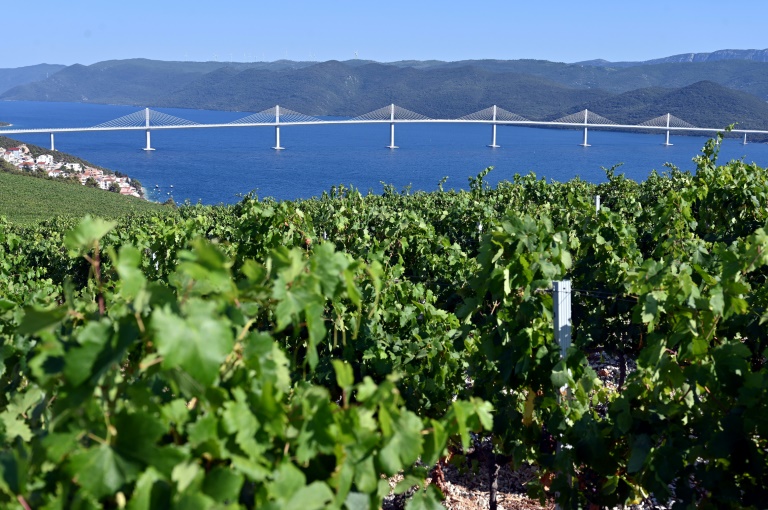
Croatia celebrated Tuesday the opening of a long-awaited bridge linking its southern Adriatic coast including Dubrovnik with the rest of the country, bypassing a narrow strip of Bosnian territory.

The 2.4-kilometre (1.5-mile) span reaches out from the Croatian mainland to the Peljesac peninsula that connects with the southern part of Croatia’s coastline nestled between the sea and the Dinaric Alps.

Festivities started early Tuesday with musical performances and a boat race, while dozens of pedestrians snapped pictures on the bridge ahead of a ceremony this evening featuring a speech by Croatian Prime Minister Andrej Plenkovic and a video address by Chinese Premier Li Keqiang.    

“It is a major thing for people here since they did not even feel like they were living like in their own country,” said Joso Miletic, 75, who travelled from his village near the city of Zadar on the central coast to watch the opening of the bridge.

“This is the merging of Croatia into a whole,” he added. 

The link will bring an end to the untold hours spent by commuters, merchants, and tourists at the Bosnian border and is one of the country’s most ambitious infrastructure projects since Croatia declared independence from Yugoslavia in 1991.

It was the bloody dissolution of the federation, however, that left a patchwork of divisions across the Balkans, with the frontiers between its six former republics transformed into international borders.

Bosnia maintained its coastal access in the end, but its small outlet leading to the Adriatic Sea cut right through Croatia. 

As a result, around 90,000 people, including residents in the country’s tourism hotspot of Dubrovnik, remained cut off from the rest of the country until now. 

The hard border brought lines and red tape for traders, and headaches for tourists hoping to get south by road.

“It is indeed a historic project for Croatia,” said Sabina Mikulic, owner of a hotel, glamping site, and winery in Orebic — the peninsula’s largest town.

Inhabitants of the picturesque region of red vines, pebble beaches and oyster farms are looking forward to the end of their geographic isolation caused by the Bosnian border.

The hours-long waits at the border and fears over missing the day’s last ferry will now become a thing of the past, they say.  

“It was really exhausting and made people living here bitter,” Mikulic told AFP.

– EU funded, Chinese made –

The opening of the bridge has been a long time coming and not without controversy. 

Croatia took its first stab at building the bridge in 2007 only for the project to stall five years later due to budgetary constraints.

In 2017, the European Union — which Croatia joined in 2013 — allocated 357 million euros ($365 million), roughly 85 percent of the cost.

A Chinese firm was selected in 2018 to build the bridge — marking the first significant Chinese involvement in an infrastructure project in Croatia.

But not all were happy with the bridge’s construction, with officials in Bosnia claiming it would hamper its maritime access by preventing high-tonnage vessels from entering its lone port. 

Zagreb eventually agreed to increase the height of the bridge to 55 metres (181 feet) in an attempt to quell the dispute.

The opening of the bridge comes as Croatia is angling for a tourism rebound this year as it hopes to attract pre-pandemic levels of visitors.

The country of 3.8 million people attracts millions of tourists every year hoping to soak up the sun along its stunning coast dappled with more than 1,000 islands and islets.

For retired piano teacher Smilja Matic, who has vacationed for years in the Croatian village of Komarna near the entrance to the new bridge, the link to the mainland is a win for locals and tourists alike.

“It means a new life for locals and for people who travel by plane to Dubrovnik, like me. It’s major progress,” she told AFP.

Outside of tourism, the bridge will likely serve as a boon for businesses and traders as well. 

For decades, oyster farmer Mario Radibratovic was subjected to hours of extra travel to bring his perishable shellfish north to market due to waiting times at the border.

But with the opening of the bridge, the journey north will shrink dramatically. 

For the 57-year-old, the opening of the bridge will bring “immeasurable relief”.

“We are finally becoming part of Croatia,” Radibratovic told AFP who farms oysters and mussels in the village of Mali Ston.

“Until now we felt like second-class citizens.”

General Motors Q2 profits fall 40% on supply woes, confirms forecast

General Motors reported a big drop in second-quarter profits Tuesday due to the grinding semiconductor shortage, although the automaker confirmed its full-year forecast amid strong pricing.

Profits fell 40 percent to $1.7 billion as the Detroit giant was unable to deliver more than 90,000 vehicles unfinished due to missing parts.

But the car manufacturer said production in the second half of 2022 would be “up sharply.”

Revenues rose 4.7 percent to $35.8 billion.

GM reported sharply lower auto deliveries in all regions, including China, where government restrictions connected to the latest Covid-19 outbreak dented sales.

A silver lining has continued to be limited dealership inventories that has kept pricing strong. In the United States, the average price was up $6,600 compared with the year-ago period.

GM alluded to strong customer demand “with most vehicles turning immediately as they arrive at dealers,” the company said in a powerpoint.

“We have been operating with lower volumes due to the semiconductor shortage for the past year, and we have delivered strong results despite those pressures,” said GM Chief Executive Mary Barra in a statement.

Barra alluded to worries about a slowdown or recession, saying “we have modeled many downturn scenarios and we are prepared to take deliberate action when and if necessary.”

Shares fell 1.3 percent to $34.08 in pre-market trading.

Tunisia president hails vote set to bolster rule

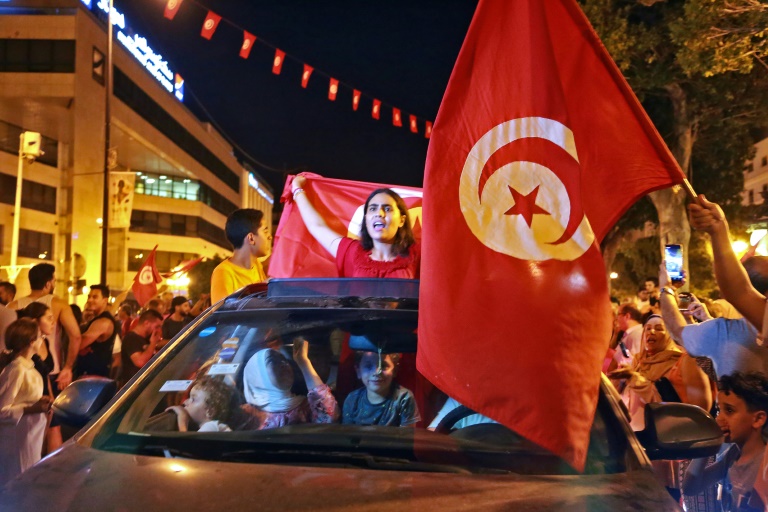
President Kais Saied said Tunisia had “entered a new phase” on Tuesday with a new constitution almost certain to pass in a referendum, concentrating almost all powers in his office.

Monday’s referendum came a year to the day after Saied sacked the government and suspended parliament in a dramatic blow to the only democracy to have emerged from the 2011 Arab Spring uprisings.

There had been little doubt the “Yes” campaign would win, and an exit poll suggested that votes cast — just a quarter of the 9.3 million electorate — were overwhelmingly in favour.

Most of Saied’s rivals called for a boycott, and while turnout was low, it was higher than the single figures many observers had expected — at least 27.5 percent according to the electoral board, controlled by Saied.

“Tunisia has entered a new phase,” Saied declared as he addressed celebrating supporters in downtown Tunis hours after polling stations closed.

“What the Tunisian people did… is a lesson to the world, and a lesson to history on a scale that the lessons of history are measured on,” he said.

The National Salvation Front, a coalition of Saied’s main opponents, said the draft constitution would enshrine in a “coup d’etat” and that “75 percent of Tunisians have refused to approve a putschist project”.

Saied, a 64-year-old law professor, dissolved parliament and seized control of the judiciary and the electoral commission on July 25 last year.

His opponents say the moves aimed to install an autocracy over a decade after the fall of dictator Zine El Abidine Ben Ali, while his supporters say they were necessary after years of corruption and political turmoil.

– Unchecked powers –

A poll of “Yes” voters by state television suggested “reforming the country and improving the situation” along with “support for Kais Saied/his project” were their main motivations for backing the constitution.

Thirteen percent cited being “convinced by the new constitution”.

Rights groups and legal experts have warned that the draft gives vast, unchecked powers to the presidency, allow him to appoint a government without parliamentary approval and make him virtually impossible to remove from office.

The charter “gives the president almost all powers and dismantles any check on his rule,” Said Benarbia, regional director of the International Commission of Jurists told AFP.

“None of the safeguards that could protect Tunisians from Ben Ali-type violations are there anymore,” he added.

Saied has repeatedly threatened his enemies in recent months, issuing video diatribes against unnamed foes he describes as “germs”, “snakes” and “traitors”.

On Monday, he promised “all those who have committed crimes against the country will be held accountable for their actions”.

Tunisia expert Youssef Cherif tweeted Tuesday that “most people voted for the man, or against his opponents, but not for his document.”

– ‘Back on the rails’ –

Analyst Abdellatif Hannachi said the results meant Saied “can now do whatever he wants without taking anyone else into account.”

“The question now is: what is the future of opposition parties and organisations?”

As well as remaking the political system, Monday’s vote was seen as a gauge of Saied’s personal popularity, almost three years since the political outsider won a landslide in Tunisia’s first democratic direct presidential election.

Hassen Zargouni, head of the Sigma Conseil group that gave the exit poll, said of the 7,500 voters questioned, 92-93 percent of them were in the “Yes” camp.

The turnout, projected at around 22 percent, was “quite good” given about two million people have been automatically added to electoral rolls since the 2019 legislative elections, he told AFP.

Participation in elections has gradually declined since the 2011 revolution, from just over half in a parliamentary poll months after Ben Ali’s overthrow to 32 percent in 2019.

Those who voted “Yes” on Monday did so primarily to “put the country back on the rails and improve the situation,” Zargouni said.

par/dv

Executed Myanmar prisoners deserved 'many death sentences': junta spokesman

Myanmar’s junta lashed out Tuesday against international condemnation of the country’s first use of capital punishment in decades, saying the four executed prisoners — two of them prominent democracy fighters — “deserved many death sentences.”

The executions announced Monday sparked condemnation from around the globe, heightened fears that more will follow and prompted calls for sterner international measures against the already-isolated junta.

But the military authorities were defiant, with spokesman Zaw Min Tun insisting the men “were given the right to defend themselves according to court procedure”.

“If we compare their sentence with other death penalty cases, they have committed crimes for which they should have been given death sentences many times,” he said at a regular press briefing in the capital Naypyidaw.

“They harmed many innocent people. There were many big losses which could not be replaced.”

The prisoners, who included a former lawmaker from ousted civilian leader Aung San Suu Kyi’s party, had been allowed to meet family members through video conferencing, he said, without providing details. 

The junta had previously rejected criticism from the UN and western countries over the death sentences.

– ‘Extremely troubled’ –

Phyo Zeya Thaw, a former lawmaker from Suu Kyi’s National League for Democracy (NLD) was sentenced to death in January for offences under anti-terrorism laws.

Democracy activist Kyaw Min Yu — better known as “Jimmy” — received the same sentence from the military tribunal.

The two other men were sentenced to death for killing a woman they alleged was an informer for the junta in Yangon.

The junta has sentenced dozens of anti-coup activists to death as part of its crackdown on dissent after seizing power last year, but Myanmar had not carried out an execution in decades.

After a chorus of international condemnation on Monday, including from the UN, the United States and European countries, there was fresh criticism of the junta on Tuesday.

The Association of Southeast Asian Nations (ASEAN) bloc, which has led diplomatic efforts to end the crisis, said it was “extremely troubled and deeply saddened” by the executions.

In a statement issued by current chair Cambodia, it accused the junta of a “gross lack of will” to engage with ASEAN’s efforts to facilitate dialogue between the military and its opponents.

In Bangkok, hundreds of people staged a noisy protest outside the Myanmar embassy. 

Some held photos of Ko Jimmy and Phyo Zeya Thaw alongside Aung San Suu Kyi as they chanted “We want democracy.”

And Malaysia’s foreign minister Saifuddin Abdullah slammed the executions calling it a “crime against humanity”.

He called for a review of the so-called five-point consensus agreed by Southeast Asian leaders last year aimed at defusing the political crisis in Myanmar following a coup.

Close Bitnami banner
Bitnami