World

Airbus tests A400M military plane as water bomber

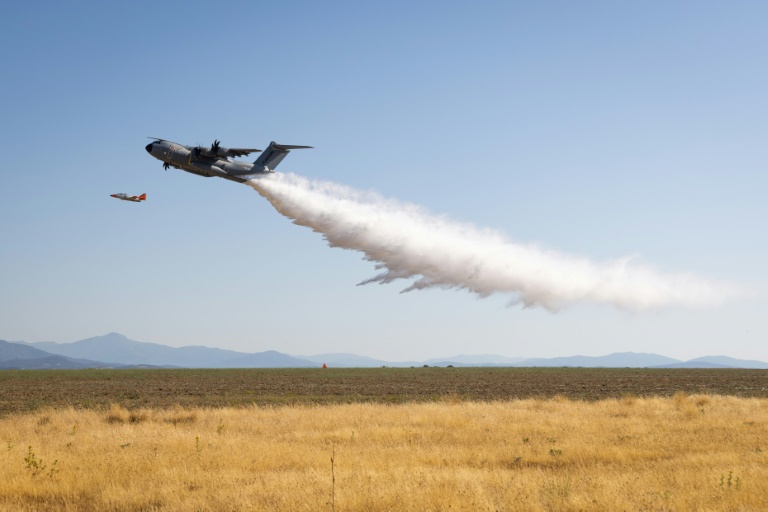
Airbus said Tuesday it had successfully tested its A400M military transporter as a water bomber as heatwaves cause an increasing number of wildfires during the summer in Europe. 

“Airbus has successfully tested a removable firefighting demonstrator kit on the A400M new generation airlifter during a flight test campaign in Spain,” the European plane maker said in a statement.

The test involved dropping 20 tonnes of water in less than 10 seconds, the statement said.

Airbus said that the roll-on/roll-off kit requires no modification to the A400M aircraft. 

The water is stored in a fixed tank in the cargo hold, and retained by two independent doors. These doors are connected to two flood pipes, so when the discharge is triggered, the water is expelled through two sections at the end of the ramp.  

Because of its low-level flight capability and manoeuvrability at low speeds, the A400M can accurately drop payloads of water at very low heights, down to 150 feet (50 metres), Airbus said.

“The development of this firefighting kit is an intrinsic part of our journey towards helping to create a more sustainable and safer world, not only by our actions but also through our products,” said Mike Schoellhorn, head of Airbus Defence and Space.

“We strongly believe the A400M can play a vital role in the fight against the ever-increasing threat posed by wildfires and support the restoration of social and environmental systems.”

Airbus’s deputy head of military aircraft, Jean-Brice Dumont, said that the aim of using the A400M as a water bomber was not to compete with those of rival Canadair, but to complement them. 

Canadair’s water bombers have capacity of 6,000 litres — only a third of that of the A400M. But while the Canadair water bomber can scoop up water from a lake, the A400M needs to land to refill its water tanks. 

Scientists say human-induced climate change is amplifying extreme weather — including the heatwaves, droughts and floods seen in several parts of the planet in recent weeks — and say these events will become more frequent and more intense.

EasyJet hit by aviation disruption but slashes loss

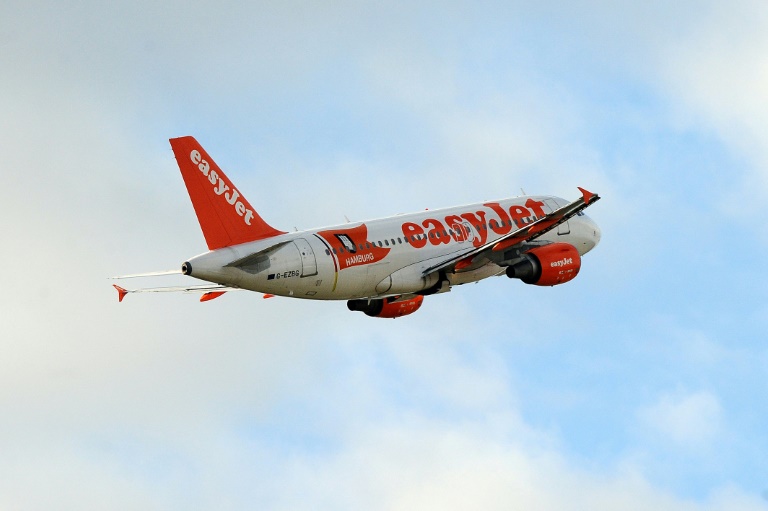
British airline EasyJet on Tuesday said it took a sizeable financial hit from sector-wide disruptions, notably staff shortages, but still slashed quarterly losses as demand recovers.

As airport staff shortages spark flight cancellations, EasyJet said in a statement that it booked a one-off charge totalling £133 million ($160 million).

That saw the airline post a pre-tax loss of £114 million in the group’s third quarter, or the three months to the end of June.

However, that marked a major improvement from a loss of around £318 million for the same period of last year, as travel demand picked up from a Covid-induced downturn.

Third-quarter revenue increased more than eight-fold to £1.8 billion, while traffic rebounded close to pre-Covid levels. 

EasyJet chief executive Johan Lundgren said the carrier was hit by “short-term disruption issues”, but that it was experiencing “the return to flying at scale”.

Traffic surged more than seven-fold to 22 million passengers in the quarter after the lifting of Covid travel curbs.

That was almost 90 percent of the group’s 2019 capacity, before the pandemic ravaged the global aviation sector by grounding planes worldwide.

EasyJet said “the unprecedented ramp-up across the aviation industry, coupled with a tight labour market” had caused “widespread operational challenges culminating in higher levels of cancellations than normal”.

Despite the disruption, EasyJet operated 95 percent of its planned schedule in the quarter.

Airlines and airports are struggling to recruit staff having sacked thousands of workers as the world entered Covid pandemic lockdowns. 

'Never surrender': Myanmar's executed activists

A hip-hop pioneer who vowed to “never surrender” and a democracy activist who said prison was his second home — Myanmar’s execution of two prominent democracy fighters will only keep the flame of defiance burning, their families say.  

AFP looks at lives of Kyaw Min Yu — better known as “Ko Jimmy” — and Phyo Zeya Thaw, whose executions sparked shock and anger in Myanmar and around the world.

– ‘Never surrender’ –

Phyo Zeya Thaw burst on to the public stage in the early 2000s as a dragon-tattooed hip-hop pioneer whose subversive rhymes targeted the then-ruling junta.

The band skirted the military’s notorious censors by circulating bootlegged copies of songs recorded in underground studios or performing in private stage shows.

“We will never change, never give up, never surrender,” his band “Acid” rap in one song.  

“We will come out in full force in every tomorrow.”

He was jailed in 2008 for membership of an illegal organisation and possession of foreign currency and later told AFP that democracy figurehead Aung San Suu Kyi — his “real life hero” — helped him get through three years in jail.

He later became close to Suu Kyi, travelling with her to Europe in 2012 where she finally collected the Nobel prize that thrust her into the international limelight two decades earlier.

In the 2015 elections won by her National League for Democracy, the former junta prisoner won a seat in the military-built capital of Naypyidaw.

“You’re very young, you’re a hip-hop artist and you’re an ex-prisoner. How can you be an MP?” he told AFP in an interview after his election win. 

“That’s something I hear quite a lot.”

He was arrested by the junta in November last year and accused of orchestrating several attacks on regime forces, including a gun attack on a commuter train in Yangon that killed five policemen.

Following a closed trial, he was sentenced to death in January.

“My son was not a thief or a thug,” his mother told Radio Free Asia after news of the executions.

“I am proud of him for giving his life for the country… If I could get his ashes or remains, I would like to make a tomb for him and then put an inscription on it.” 

– ‘Never die in our hearts’ –

Kyaw Min Yu — known as “Ko Jimmy” — rose to prominence during Myanmar’s 1988 student uprising against the country’s previous military regime.

The writer and organiser spent more than a dozen years in prison under the previous junta for his pro-democracy activism, calling detention his “second home”.

But jail only made him more of a steadfast champion of democracy for his people.

“The government tries to keep them out,” he told AFP in 2006 as he organised a campaign during a rare stretch of freedom. 

But “they are always looking for a way to participate in politics”. 

Prison love letters saw romance blossom with fellow activist Nilar Thein, and led to their marriage shortly after they were released in 2004.

Months after their daughter was born he was arrested again during the monk-led “Saffron” protests in 2007, and the pair were not reunited until they were both pardoned in a 2012 amnesty. 

His death was “blatant murder,” his wife told RFA.

“He has written a good record for himself and he will never die in our hearts.”

Alibaba seeks dual-primary listing in Hong Kong

E-commerce giant Alibaba said Tuesday it will seek a primary listing in Hong Kong, potentially giving access to China’s vast pool of investors, as mainland officials indicate a long-running crackdown on the tech sector could be coming to an end.

The move also comes as Chinese tech companies traded in New York grow increasingly worried about a regulatory drive by United States authorities as tensions simmer between the superpowers.

While Alibaba has a secondary listing in Hong Kong, it does not allow it to join a popular Stock Connect programme that links to bourses in Shanghai and Shenzhen.

The primary listing, which is expected to take place before the end of the year, would open that door.

News of the plan sent shares in Alibaba soaring 4.8 percent Tuesday, boosting other tech firms and helping drag the broader Hang Seng Index higher.

The Hangzhou-based group is one of a number of tech behemoths ensnared in a wide-ranging regulatory crackdown on alleged anti-competitive practices since late 2020.

The campaign to rein in big tech is driven by fears that massive internet companies control too much data and have expanded too quickly.

But officials appear to be taking a lighter touch as they grapple with a slowing economy. And in May, Premier Li Keqiang urged support for tech companies to list both domestically and abroad.

CEO and group chairman Daniel Zhang said on Tuesday the primary listing aimed to foster “a wider and more diversified investor base to share in Alibaba’s growth and future, especially from China and other markets in Asia”.

“Hong Kong is also the launch pad for Alibaba’s globalisation strategy, and we are fully confident in China’s economy and future.”

Alibaba said on Tuesday it had an average daily trading volume of $3.2 billion in the United States in the first six months of the year, while its Hong Kong secondary listing saw around $700 million.

– Mainland access –

Hong Kong’s Stock Connect programme allows firms to take advantage of liquidity from mainland China for easier financing and higher valuations, but to qualify they must conduct a majority of their annual trading in the Chinese finance hub.

Alibaba is among a category of “innovative” Chinese firms with weighted voting rights or variable interest entities that would be eligible for dual-primary listing in Hong Kong, following a rule change by the bourse in January.

Analyst Willer Chen, at Forsyth Barr Asia, told Bloomberg that the move would be “massive” for Alibaba, adding that inclusion in Stock Connect could lead to a “more diversified investor base”.

Beijing has opposed an attempt by US regulators to inspect the audit papers of Chinese firms listed there, and Alibaba is one of 250 companies facing potential removal if no deal is reached.

Domestically, Alibaba is still reeling from the tech crackdown as well as China’s slowing economy caused by the fallout from strict Covid curbs.

The firm has lost around two-thirds of its value since a 2020 peak, according to Bloomberg, and in May the firm reported that profit fell 59 percent in the last fiscal year.

– Shake-up at Ant –

News of plans for the dual-primary listing came as Alibaba announced it had removed all executives linked to its digital payments arm Ant Group from a joint governing body.

Seven Ant Group executives including CEO Eric Jing and Chief Technology Officer Ni Xingjun were removed from Alibaba Partnership, a group that can nominate the majority of Alibaba’s board, as of May 31, according to an annual report Tuesday.

It is part of a lengthy state-guided restructuring process after a planned 2020 share offering by Ant Group — which would have been the world’s largest IPO at the time — was scuttled last minute, according to a spokesman for the company.

Ant Group has terminated its data sharing agreement with Alibaba and reshuffled its board recently, filling half the seats with independent directors and reducing the number of non-executive directors from the Alibaba Group to two from three.

But Beijing last month rebuffed reports it had started discussions on the potential revival of the IPO.

Asia stocks rise as Alibaba boosts tech, eases pre-Fed nerves

Asian markets rose Tuesday as an Alibaba-fuelled surge in Hong Kong provided a much-needed boost to sentiment ahead of a slew of earnings reports from the world’s biggest firms and an expected Federal Reserve interest rate hike.

A shock cut in US retail titan Walmart’s profit outlook fanned concerns that surging inflation and rising borrowing costs are hammering consumer spending and could send the economy into recession.

The news left markets concerned about what’s to come from other Wall Street giants this week — including Apple, Amazon, McDonald’s and General Motors.

Adding to the unease was news that Russia’s Gazprom will cut back gas deliveries to Germany, citing a faulty turbine, less than a week since restarting flows after 10 days of maintenance work.

But after a cautious start to the day, most Asian markets enjoyed a healthy run-up.

Hong Kong led the way in reaction to news that market heavyweight Alibaba will seek a primary listing in the city, which could pave the way for it to be traded by mainland Chinese investors.

The move from a secondary listing would come as several Chinese firms listed in the United States grow increasingly worried about a regulatory crackdown by authorities as part of a stand-off in the tech sector between Washington and Beijing.

It also further indicated the firm is more confident that a long-running period of clampdowns by China on the industry is coming to an end.

“This could boost its liquidity after a year-long sell-off triggered by China’s economic slowdown and Beijing’s crackdown on its most potent internet firms,” said Stephen Innes at SPI Asset Management.

The over five percent surge in Alibaba gave a boost to other tech giants — with JD.com, Tencent, NetEase and Bilibili all up.

– ‘Significant risks’ –

There were also gains in Shanghai, Sydney, Seoul, Singapore, Manila and Jakarta, though Tokyo, Taipei and Wellington slipped.

London was on the front foot in the morning, though Paris and Frankfurt dipped.

Analysts were cautious about the outlook for world markets, despite a positive run-up in July.

“This is most likely a bear market rally and there are significant risks still facing this market,” Katerina Simonetti, at Morgan Stanley Private Wealth Management, told Bloomberg Television.

“We’re probably going to be seeing a lot of choppiness and potentially some further declines in the market before the year-end.”

For now, there will be little respite for investors from the Fed as it continues to ramp up borrowing costs, with another 75 basis point lift expected this week, and more before the end of the year.

Several officials at the bank, including boss Jerome Powell, have suggested they are determined to bring inflation down from four-decade highs, even at the expense of economic growth.

Still, market strategist Louis Navellier said they could start to loosen monetary policy in the new year when the economy shows strains.

“Uncertainty is high as to the Fed’s willingness to keep tightening if the economy slows significantly, with many forecasts projecting that the Fed will reverse and start cutting rates by the summer of 2023 as the economy slows and inflation wanes,” he said in a note. 

– Key figures at around 0810 GMT –

Tokyo – Nikkei 225: DOWN 0.2 percent at 27,655.21 (close)

Hong Kong – Hang Seng Index: UP 1.7 percent at 20,905.88 (close)

Shanghai – Composite: UP 0.8 percent at 3,277.44 (close)

London – FTSE 100: UP 0.5 percent at 7,338.96

Euro/dollar: UP at $1.0220 from $1.0223 Monday

Pound/dollar: UP at $1.2047 from $1.2046 

Euro/pound: UP at 84.86 pence from 84.83 pence

Dollar/yen: DOWN at 136.62 yen from 136.65 yen

West Texas Intermediate: UP 1.9 percent at $98.53 per barrel

Brent North Sea crude: UP 1.8 percent at $107.03 per barrel

New York – Dow: UP 0.3 percent at 31,990.04 (close)

Ukraine frontline town just wants 'peace and silence'

There is little left of Soledar. A church, a few food shops and an ironmonger in a basement.

Located right next to the front line, this mining town in eastern Ukraine’s Donetsk region — where several thousand people still live — has been under constant shelling for more than three months.

The terrifying sounds of explosions break the silence at regular intervals in the now ghostly town, whose name translates as “Gift of Salt” after a giant salt mine on the outskirts.

The mine, managed by Ukrainian company Artemsol, normally produces millions of tons a year and is also a tourist attraction known for its “fairytale salt sculptures” according to the brochures.

Soledar, which had 15,000 inhabitants before the war, is also known for an underground sanatorium to treat pulmonary diseases.

That was before the invasion.

Soldar found itself on the path of Russian troops  pushing to take over the Donetsk region and came under fire from both sides.

The mine, struck several times, is now closed.

Many inhabitants have fled. According to the local residents who have remained, there are only some 2,000 people left fending for themselves.

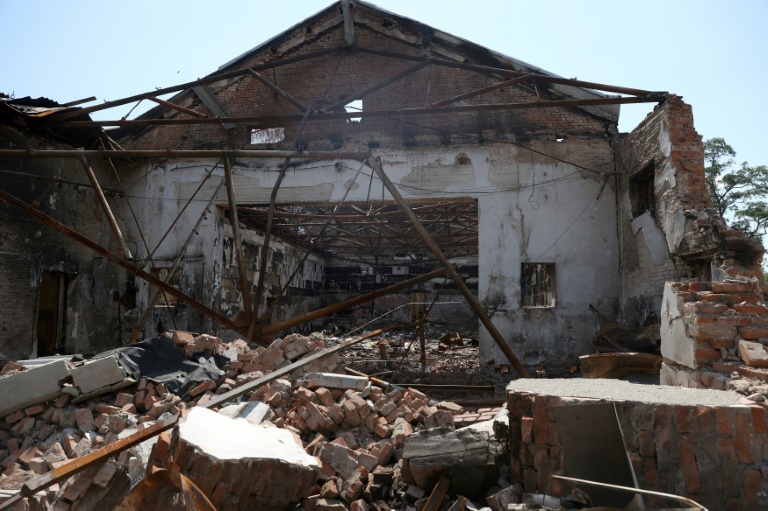
The houses along the main street are half destroyed or blackened by smoke.

The cultural centre has been destroyed and its ruins still smell of smoke. Papers can be seen scattered in the ruins and a phone handset lies on a desk.

“It happened on the night of July 9th to 10th. That night, a dozen missiles struck Soledar,” said Tetyana, a woman walking past with her five-year-old daughter and 67-year-old mother.

The centre burned for several days with no firefighters to extinguish the flames.

“There are no more local authorities, no police, no doctors, no pharmacy. Everyone has left. We’ve been abandoned,” Tetyana said.

– ‘I can’t leave them’ –

Like an apparition, an elegant woman with short white hair walks along a deserted street with five cats.

Smiling but frightened, Lyudmyla explained that her husband is disabled and cannot move.

“And then there are the abandoned cats. I can’t leave them,” said the former schoolteacher, heading towards one of the few food shops left open.

The shop is supplied by volunteers who come twice a week, braving shelling and missile strikes.

Under the shop, in the basement, is a large ironmonger which has become a relatively safe meeting place for the town’s inhabitants.

Residents come to buy gas canisters, nails, crockery and bed linen. It is one of the few places left where neighbours can interact.

Yury, the 59-year-old shopkeeper, who has a long grey ponytail and wears a baseball cap and overalls, leans on his walking stick behind the counter.

Despite everything, his eyes still sparkle.

“If I let myself get depressed, it’s not good for my old bones,” he said.

But his gaze darkens when he talks about his two grandchildren aged eight and 12 who still live in Soledar.

What do they do with their days? “They create stress,” sighed the grandfather.

He said he keeps them busy by building a heating unit with zinc plates “to prepare for winter”.

– ‘We are not separatists!’ –

Like in all the towns on east Ukraine’s front line, those who stay cannot or do not want to evacuate.

“We just want to stay where we live. We are not separatists! Write this down — we are not separatists!” Larysa, a former bank employee, leaning out from her balcony.

Regional authorities regularly urge people to evacuate and those that remain are often considered as harbouring pro-Moscow views and awaiting the arrival of Russian troops.

Sitting in front of her home, Liya Cherkashyna, 84, does not care about either side — she just wants someone to fill five bottles of water for her from the town’s one working pump.

Yesterday, someone promised to bring her water in exchange for a bottle of vodka which she does not have.

From her balcony, Larysa said: “We just want peace. And silence”.

Japan executes man over 2008 stabbing rampage

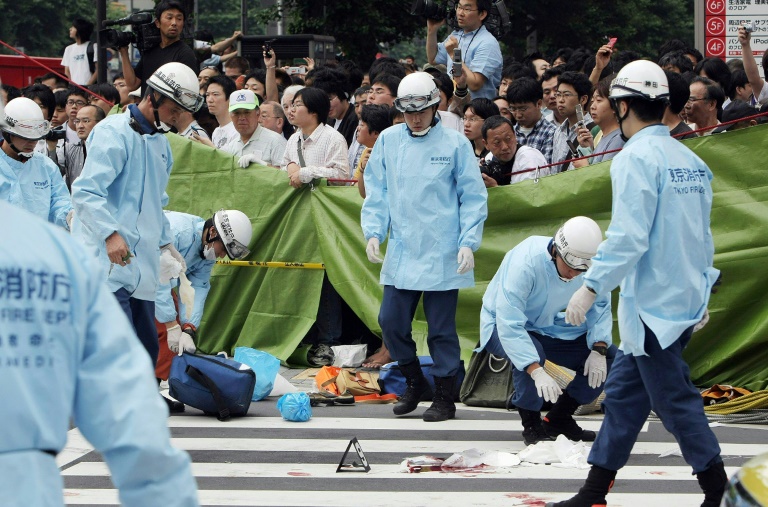
Japan on Tuesday executed a man convicted of killing seven people in a truck ramming and stabbing rampage in Tokyo’s popular Akihabara electronics district in 2008, the justice ministry said.

Justice Minister Yoshihisa Furukawa said Tomohiro Kato had undertaken “meticulous preparation” for the attack and displayed a “strong intent to kill”.

Furukawa said he “approved the execution after extremely thorough scrutiny,” noting that Kato’s death sentence had been upheld by the court system.

Kato went on the rampage on June 8, 2008, telling police: “I came to Akihabara to kill people. It didn’t matter who I’d kill.”

He was arrested on the spot shortly after the attacks, in which he rammed a rented two-tonne truck into a crowd of pedestrians before getting out and randomly stabbing people.

“This is a very painful case that led to extremely grave consequences and shocked society,” Furukawa said Tuesday.

Police said Kato documented his deadly journey to Akihabara on Internet bulletin boards, typing messages on a mobile phone from behind the wheel of the truck and complaining of his unstable job and his loneliness.

Prosecutors said his self-confidence plummeted after a woman he chatted with online abruptly stopped emailing him when he sent her a photograph of himself.

His anger against the general public grew when his comments on an Internet bulletin board, including his plans to go on a killing spree, were met with no reaction at all, prosecutors said.

While awaiting trial, Kato wrote to a 56-year-old taxi driver whom he injured in the stabbing spree, expressing his remorse.

The victims “were enjoying their lives, and they had dreams, bright futures, warm families, lovers, friends and colleagues,” Kato wrote according to a copy published in the Shukan Asahi weekly.

And in court, he offered remorse for the attack.

“Please let me use this occasion to apologise,” he said about the bloody rampage that also left 10 people injured.

– Support for death penalty –

After the 2008 rampage, Japan banned possession of double-edged knives with blades longer than 5.5 centimetres (about two inches), punishable by up to three years in prison or a 500,000 yen fine.

The attack was Japan’s worst mass killing in seven years and Kato was sentenced to death in 2011, a decision that was upheld by Japan’s top court in 2015.

Kato’s execution is the first in Japan this year and comes after three prisoners were hanged in December 2021. Those executions ended a two-year hiatus and were the first under Prime Minister Fumio Kishida’s administration.

Japan is one of the few developed countries to retain the death penalty, and public support for capital punishment remains high despite international criticism.

Executions are carried out by hanging, generally long after sentencing. More than 100 people are currently on death row in Japan.

International advocacy groups have denounced the Japanese system, under which death row inmates can wait for their executions for many years in solitary confinement and are only told of their impending death a few hours ahead of time.

But Furukawa defended the death penalty on Tuesday.

The government believes it is “not appropriate” to abolish capital punishment, given “heinous crimes such as mass killings and robbery-murders still repeatedly occur”, he told reporters. 

Junichi Kuwabara, a 54-year-old Tokyo resident, told AFP he was thinking of “how the families of the victims must be feeling.”

“I think it would have been better if it had been done earlier,” he said.

And while he expressed discomfort with the idea of the death penalty, he said “if it can bring justice to relatives of the victims, I think it’s good.”

Tuesday’s execution comes on the anniversary of another major stabbing attack — the 2016 Sagamihara rampage at a disabled care facility, in which 19 people were killed.

Japan also carried out the executions of six members of the Aum Shinrikyo cult responsible for the 1995 sarin attack and other crimes on July 26, 2018.

Croatia opens bridge around Bosnia to get to Dubrovnik

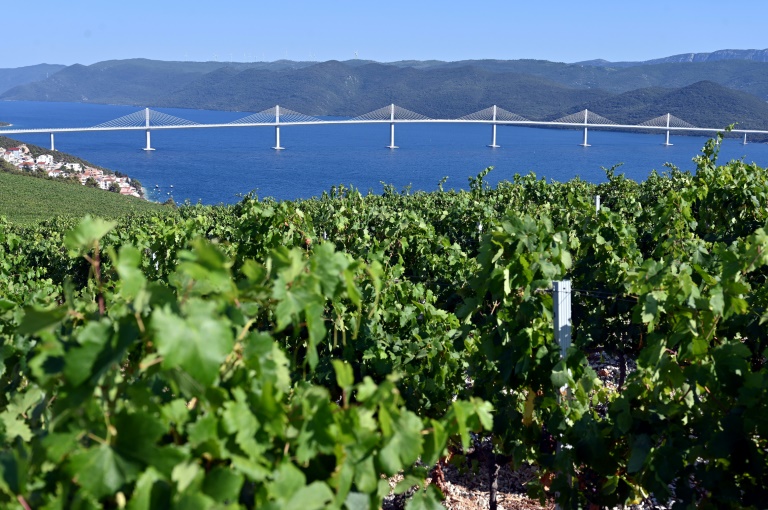
Croatia opens Tuesday a long-awaited bridge linking its southern Adriatic coast including Dubrovnik with the rest of the country, bypassing a narrow strip of Bosnian territory.

The 2.4-kilometre (1.5-mile) span reaches out from the Croatian mainland to the Peljesac peninsula that connects with the southern part of Croatia’s coastline nestled between the sea and the Dinaric Alps.

“The importance of the bridge is enormous, and it’s not only emotional due to the connection of Croatia’s territory, but also for tourism and the economy in general,” said transportation minister Oleg Butkovic earlier this month.

The link will bring an end to the untold hours spent by commuters, merchants, and tourists at the Bosnian border and is one of the country’s most ambitious infrastructure projects since Croatia declared independence from Yugoslavia in 1991.

It was the bloody dissolution of the federation, however, that left a patchwork of divisions across the Balkans, with the frontiers between its six former republics transformed into international borders.

Bosnia maintained its coastal access in the end, but its small outlet leading to the Adriatic Sea cut right through Croatia. 

As a result, around 90,000 people, including residents in the country’s tourism hotspot of Dubrovnik, remained cut off from the rest of the country until now. 

The hard border brought lines and red tape for traders, and headaches for tourists hoping to get south by road.

“It is indeed a historic project for Croatia,” said Sabina Mikulic, owner of a hotel, glamping site, and winery in Orebic — the peninsula’s largest town.

Inhabitants of the picturesque region of red vines, pebble beaches and oyster farms are looking forward to the end of their geographic isolation caused by the Bosnian border.

The hours-long waits at the border and fears over missing the day’s last ferry will now become a thing of the past, they say.  

“It was really exhausting and made people living here bitter,” Mikulic told AFP.

– EU funded, Chinese made –

The opening of the bridge has been a long time coming and not without controversy. 

Croatia took its first stab at building the bridge in 2007 only for the project to stall five years later due to budgetary constraints.

In 2017, the European Union — which Croatia joined in 2013 — allocated 357 million euros ($365 million), roughly 85 percent of the cost.

A Chinese firm was selected in 2018 to build the bridge — marking the first significant Chinese involvement in an infrastructure project in Croatia.

But not all were happy with the bridge’s construction, with officials in Bosnia claiming it would hamper its maritime access by preventing high-tonnage vessels from entering its lone port. 

Zagreb eventually agreed to increase the height of the bridge to 55 metres (181 feet) in an attempt to quell the dispute, even though this increased the cost of the structure.

The opening of the bridge comes as Croatia is angling for a tourism rebound this year as it hopes to attract pre-pandemic levels of visitors.

The country of 3.8 million people attracts millions of tourists every year hoping to soak up the sun along its stunning coast dappled with more than 1,000 islands and islets.

For retired piano teacher Smilja Matic, who has vacationed for years in the Croatian village of Komarna near the entrance to the new bridge, the link to the mainland is a win for locals and tourists alike.

“It means a new life for locals and for people who travel by plane to Dubrovnik, like me. It’s major progress,” she told AFP.

Outside of tourism, the bridge will likely serve as a boon for businesses and traders as well. 

For decades, oyster farmer Mario Radibratovic was subjected to hours of extra travel to bring his perishable shellfish north to market due to waiting times at the border.

But with the opening of the bridge, the journey north will shrink dramatically. 

For the 57-year-old, the opening of the bridge will bring “immeasurable relief”.

“We are finally becoming part of Croatia,” Radibratovic told AFP who farms oysters and mussels in the village of Mali Ston.

“Until now we felt like second-class citizens.”

Firefighters tackle California wildfire as heat grips parts of US

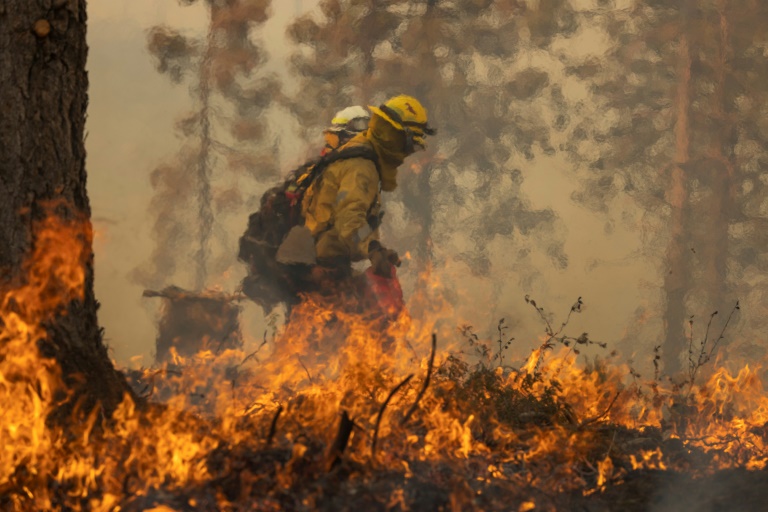
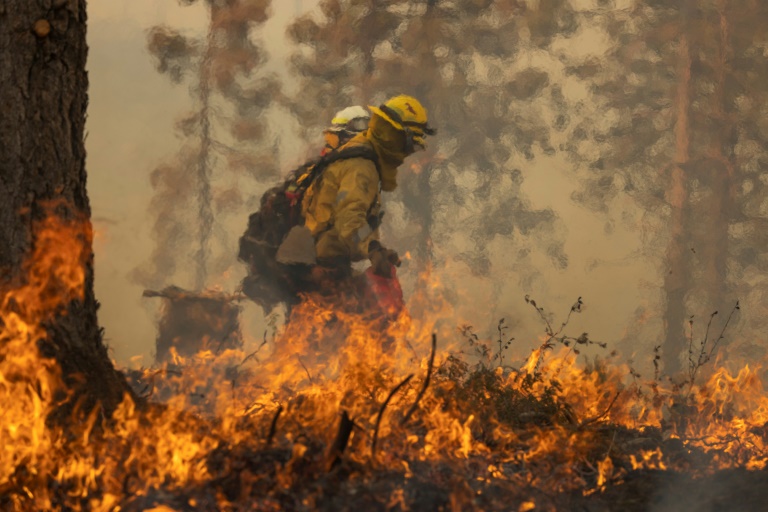
Firefighters were battling California’s largest wildfire of the summer on Monday, a blaze near famed Yosemite National Park that has forced thousands of people to evacuate, officials said.

The Oak Fire in central California broke out on Friday and is raging while parts of the United States swelter through a heat wave, including the usually cool Pacific Northwest.

The fire in Mariposa County has engulfed 17,241 acres (6,977 hectares) and is 16 percent contained, Cal Fire, the state fire department, said.

“Fire crews are working aggressively using bulldozers, hand crews and aircraft,” with only “minimal growth on the fire” seen on Monday, the department said.

It is the most destructive blaze so far this fire season, according to Cal Fire, destroying more than three times the acreage of the nearby Washburn Fire, which has been nearly 90 percent contained.

But it remains much smaller than last year’s Dixie Fire, which burned nearly one million acres.

Jon Heggie, a Cal Fire battalion chief, told CNN the latest wildfire was “very indicative” of other blazes seen in the region over the last two years.

“These fires are burning with just such a velocity and intensity, it makes it extremely challenging and extremely dangerous for both the public and the firefighters,” Heggie said.

“It’s moving so quickly it’s not giving people a lot of time, and they sometimes are just going to have to evacuate with just the shirts on their back.”

One such couple, Jane and Wes Smith, lost their home and everything in it to the inferno, CNN reported.

“It’s pretty sad to see the house that I grew up in and was raised in gone,” their son Nick Smith told the broadcaster. “It hits hard.”

Cal Fire said 55 residential, commercial and other structures had been destroyed.

– ‘Direct result’ of climate change –

Jonathan Pierce, a spokesman for the fire department, said low humidity and high temperatures were stoking the blaze, worsened by the high number of dead trees and steep slopes in the area.

The Oak Fire has forced the evacuation of around 3,000 people so far, officials said.

Nearly 3,000 firefighters backed by 24 helicopters have been deployed near the southwestern edge of Yosemite National Park.

In recent years, California and other parts of the western United States have been ravaged by huge and fast-moving wildfires, driven by years of drought and a warming climate.

“What I can tell you is this is a direct result of what is climate change,” Heggie told CNN.

“You can’t have a 10-year drought in California and expect things to be the same,” he said. “That drought is what drives what we are calling megafires.”

Extreme temperatures could be seen elsewhere in the country, as 60 million Americans were under a heat advisory on Monday.

The National Weather Service said heat advisories were in place in the Southern Plains and Lower Mississippi Valley, while stifling temperatures would ease on Tuesday in the Northeast and mid-Atlantic.

The usually cool Pacific Northwest will see temperatures surpassing 100 or more degrees Fahrenheit (37 degrees Celsius) in the Columbia River Gorge and Basin.

The NWS said daily record highs will likely be broken from northern California to the Portland, Oregon and Seattle, Washington areas on Tuesday.

Cities have opened cooling stations and increased outreach to at-risk communities such as the homeless and those without air conditioning.

The world has been hit by extreme heat waves in recent months, including Western Europe in July and India in March and April — incidents that scientists say are an unmistakable sign of a warming climate.

The extreme weather prompted former US vice president Al Gore, a long-time climate advocate, to issue a stark warning on Sunday about “inaction” by US lawmakers.

Asked whether he believes US President Joe Biden should declare a climate emergency, which would grant him additional policy powers, Gore was blunt.

“Mother Nature has already declared it a global emergency,” Gore told ABC.

Firefighters tackle California wildfire as heat grips parts of US

Firefighters were battling California’s largest wildfire of the summer on Monday, a blaze near famed Yosemite National Park that has forced thousands of people to evacuate, officials said.

The Oak Fire in central California broke out on Friday and is raging while parts of the United States swelter through a heat wave, including the usually cool Pacific Northwest.

The fire in Mariposa County has engulfed 17,241 acres (6,977 hectares) and is 16 percent contained, Cal Fire, the state fire department, said.

“Fire crews are working aggressively using bulldozers, hand crews and aircraft,” with only “minimal growth on the fire” seen on Monday, the department said.

It is the most destructive blaze so far this fire season, according to Cal Fire, destroying more than three times the acreage of the nearby Washburn Fire, which has been nearly 90 percent contained.

But it remains much smaller than last year’s Dixie Fire, which burned nearly one million acres.

Jon Heggie, a Cal Fire battalion chief, told CNN the latest wildfire was “very indicative” of other blazes seen in the region over the last two years.

“These fires are burning with just such a velocity and intensity, it makes it extremely challenging and extremely dangerous for both the public and the firefighters,” Heggie said.

“It’s moving so quickly it’s not giving people a lot of time, and they sometimes are just going to have to evacuate with just the shirts on their back.”

One such couple, Jane and Wes Smith, lost their home and everything in it to the inferno, CNN reported.

“It’s pretty sad to see the house that I grew up in and was raised in gone,” their son Nick Smith told the broadcaster. “It hits hard.”

Cal Fire said 55 residential, commercial and other structures had been destroyed.

– ‘Direct result’ of climate change –

Jonathan Pierce, a spokesman for the fire department, said low humidity and high temperatures were stoking the blaze, worsened by the high number of dead trees and steep slopes in the area.

The Oak Fire has forced the evacuation of around 3,000 people so far, officials said.

Nearly 3,000 firefighters backed by 24 helicopters have been deployed near the southwestern edge of Yosemite National Park.

In recent years, California and other parts of the western United States have been ravaged by huge and fast-moving wildfires, driven by years of drought and a warming climate.

“What I can tell you is this is a direct result of what is climate change,” Heggie told CNN.

“You can’t have a 10-year drought in California and expect things to be the same,” he said. “That drought is what drives what we are calling megafires.”

Extreme temperatures could be seen elsewhere in the country, as 60 million Americans were under a heat advisory on Monday.

The National Weather Service said heat advisories were in place in the Southern Plains and Lower Mississippi Valley, while stifling temperatures would ease on Tuesday in the Northeast and mid-Atlantic.

The usually cool Pacific Northwest will see temperatures surpassing 100 or more degrees Fahrenheit (37 degrees Celsius) in the Columbia River Gorge and Basin.

The NWS said daily record highs will likely be broken from northern California to the Portland, Oregon and Seattle, Washington areas on Tuesday.

Cities have opened cooling stations and increased outreach to at-risk communities such as the homeless and those without air conditioning.

The world has been hit by extreme heat waves in recent months, including Western Europe in July and India in March and April — incidents that scientists say are an unmistakable sign of a warming climate.

The extreme weather prompted former US vice president Al Gore, a long-time climate advocate, to issue a stark warning on Sunday about “inaction” by US lawmakers.

Asked whether he believes US President Joe Biden should declare a climate emergency, which would grant him additional policy powers, Gore was blunt.

“Mother Nature has already declared it a global emergency,” Gore told ABC.

Close Bitnami banner
Bitnami