World

Macron seeks to calm concerns over Paris 2024 Olympics

French President Emmanuel Macron on Monday met senior ministers to calm concerns that preparations for the Paris 2024 Olympics are beset by security and budget worries, almost two years to the day before the sporting extravaganza opens.

The Olympics should be a centrepiece of the freshly re-elected Macron’s second term, projecting an image of a France comfortable in its modern identity and open to the world.

But as the opening ceremony on July 26, 2024 draws closer, concerns have grown not just over costs but also security preparations.

France’s reputation as a reliable host of sporting events took a major battering following the chaos that marred the Champions League final between Liverpool and Real Madrid in Paris on May 28, which critics blamed on heavy-handed policing.

A particular subject of anxiety is the ambitious vision — in a typical Macron flourish — of an opening ceremony which will not take place as is customary in the athletics stadium, but as a flotilla down the River Seine.

The meeting at the Elysee Palace included key ministers such as Interior Minister Gerald Darmanin and Sports Minister Amelie Oudea-Castera as well as the head of the Paris organising committee, the three-time Olympic slalom canoe champion Tony Estanguet.

“The president emphasised that we are only 24 months away from the Olympics, and constant mobilisation is needed,” said a presidential official, asking not to be named.

Organisers also revealed their official slogan — “Games Wide Open” — and said 13 million tickets will be sold for the Olympics and Paralympics, with nearly half of those reserved for the public set to be sold at less than 50 euros ($51).

Macron also met International Olympic Committee president Thomas Bach after the gathering, the Elysee said.

– ‘Very tight’ –

Paris mayor Anne Hidalgo and Paris region boss Valerie Pecresse were not invited. Both were unsuccessful candidates in the April presidential election, and on Friday issued a joint statement complaining about being excluded.

The Olympics organising committee COJO has a budget of four billion euros, as does its partner organisation SOLIDEO, which is charged with building the peripheral infrastructure.

But rising inflation means savings have to be made and so far not enough sponsors have been found to plug the gaps.

“Everything is very tight concerning the budget,” said a source close to the issue who asked not to be named, adding the extent of the challenge would be clear in the autumn.

The Elysee official said that a “dialogue had now started” with the International Olympic Committee over where savings can be made.

Security is a particular headache, especially as the vision of the Games is to hold many events in the centre of Paris. This includes events around the Eiffel Tower and the central Place de la Concorde, which is close to the president’s Elysee Palace.

In addition to the French security forces, over 20,000 private security agents need to be hired to ensure the Games can proceed.

Estanguet insisted that Macron had been preparing “from the first day”.

But he acknowledged: “In recent months, the situation distanced him a bit away from the Games project, so he wanted to reconnect with the different subjects,” he said.

– ‘Becoming urgent’ –

France’s top audit body, the Cour des Comptes, has warned in a report that it is “imperative” to ramp up preparations to deal with the “considerable” security challenge.

“A more precise definition of security needs is becoming urgent,” said the report, the initial version of a study that will be published later this year. It was first revealed by the Canard Enchaine weekly and then seen by AFP.

The report also suggests scaling down the opening ceremony, which is set to feature an armada of 200 boats and some 600,000 spectators.

The Le Monde daily said the prospect of the river opening ceremony — with spectators packed on the banks of the Seine — was giving the organisers “cold sweats”.

The Games will pose a unique challenge. The showcase athletics and swimming events are due to be held in Seine-Saint-Denis north of Paris, one of the lowest-income areas in France, with a cluster of events in the centre of the capital.

Sailing events will take place at the other end of the country in the Mediterranean city of Marseille, while the surfing will be in the Pacific territory of French Polynesia, on the other side of the world.
Greek firefighters battle inferno 'disaster' at natural park

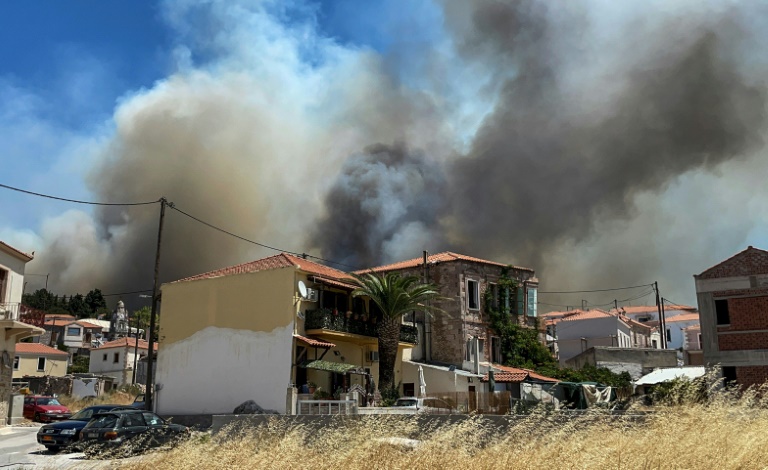
Greek firefighters battled wildfires on three fronts Monday as flames destroyed around 2,200 hectares (5,400 acres) of woodland in one of the country’s most important protected habitats.

Around 320 firefighters, ten water-bombing planes and 13 helicopters were deployed to contain the fire, now raging for a fourth day, at the Dadia National Park, known for its black vulture colony.

Some villages in the area have been evacuated. The flames have already destroyed some 2,200 hectares of woodland, according to a local mayor.

“It’s an uphill battle, a fight to ensure the survival of this exceptional ecosystem,” said the minister for climate crisis and civil protection, Christos Stylianidis, after visiting the affected area.

“It’s an ecological disaster, the damage is incalculable,” Soufli mayor Panagiotis Kalakikos told Star TV.

Dadia, around 900 kilometres, (560 miles) northeast of Athens, calls itself one of the most important protected areas in Europe, offering ideal habitat for rare birds of prey, and says it is home to the only breeding population of black vultures in the Balkans.

“If the black vulture colony is lost, the catastrophe will be immense,” Sylvia Zakkak, an ornithologist and head of monitoring at the park, told state TV ERT.

She added that the tall pine trees of Dadia which are vital for nesting would take “decades” to replace.

Greece is particularly vulnerable to fires during the summer season. Wildfires last year destroyed 103,000 hectares and claimed three lives, driven by drought and a warming climate.

Scientists say human-induced climate change is amplifying extreme weather events — including heatwaves, droughts and fires seen in several parts of Europe and California in recent weeks — and say these events will become more frequent and more intense.

– ‘Redressing the problems’ –

Nearly 60 forest fires have broken out in Greece in the last 24 hours according to the country’s fire service. 

Last week saw temperatures of up to 42 degrees Celsius (107.6 degrees Fahrenheit) in parts of the country, although temperatures dipped slightly on Monday.

The civil protection agency said, however, that the risk of forest fires remained high given the temperatures and strong winds.

“Experts must look into redressing the problems sparked by the fire,” said Stylianidis, underscoring the need to buttress the “resistance of the ecosystem in the future”.

Dadia hosts three out of the four vulture species of Europe — the black vulture, the griffon vulture and the Egyptian vulture — and 36 of Europe’s 38 species of raptors.

Its varied habitats also support 104 butterfly species, 13 amphibian species, 29 reptile species and about 65 mammal species, 24 out of which are bats.

Fires have raged in the north, east and south of Greece, including on the tourist island of Lesbos, where around 200 people were ordered to leave the village of Vrisa on Sunday to escape the flames.

For fires in the southern Peloponnese peninsula, Citizens’ Protection Minister Takis Theodorikakos said arson was at least one factor in causing the blazes.

A major fire continued to burn Monday in Krestena, in the west of the peninsula.

“It’s evident that arson is involved,” Theodorikakos said, adding that 15 fires had broken out in 20 days alone in the Peloponnese prefecture of Elis, home to Olympia, the birthplace of the ancient Olympic Games.

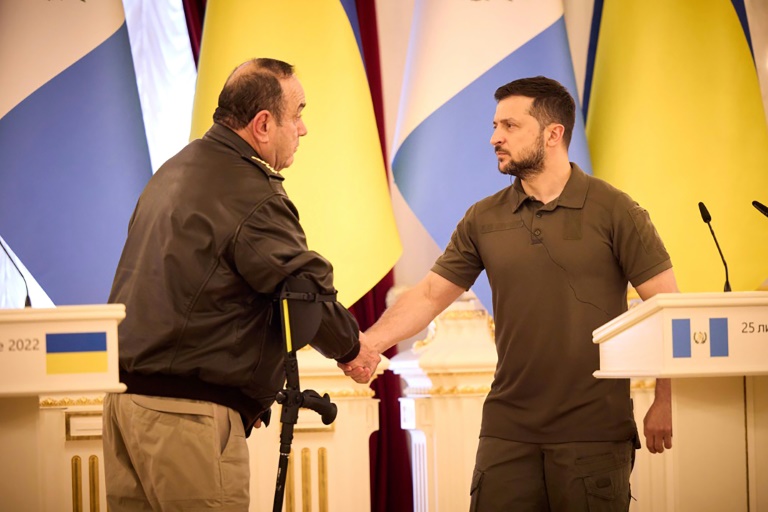
Guatemala president visits Ukraine at Zelensky's request

Guatemala President Alejandro Giammattei visited Ukraine on Monday at the invitation of his counterpart Volodymyr Zelensky to view the damage caused by Russia’s invasion, the Central American country’s government said.

The invitation to visit Ukraine came in June during a telephone conversation between the two presidents.

In a brief press release, Guatemala’s communication secretariat for the presidency gave no details on when the visit began or how long it would last.

Following Russia’s initial invasion of Ukraine, Giammattei closed Guatemala’s embassy in Moscow.

The Central American country exports nickel to Ukraine while importing iron and steel.

Despite breaking off diplomatic relations with Russia, Guatemala continues to export coffee and bananas to the Eurasian powerhouse, while importing fertilizer, medical supplies and paper.

Following the June phone conversation, Giammattei said Zelensky wanted him to “see first hand the damage done in Ukraine and to be able to tell the world about it.”

“We spoke about reconstruction in Ukraine, where they need laborers, and so he asked that Guatemalans travel to work in Ukraine,” added Giammattei in a statement published by the state news agency.

Russian troops invaded Ukraine on February 24 following months of rising tensions between the neighbors.

Like many countries affected by the war, Guatemala has since seen fuel prices shoot up.

Myanmar junta executes two leading pro-democracy figures

Myanmar’s junta has executed four prisoners including a former lawmaker from Aung San Suu Kyi’s party and a prominent activist, state media said Monday, in the country’s first use of capital punishment in decades.

The executions sparked widespread condemnation — including from the United States and France — heightened fears that more death sentences will follow, and prompted calls for the international community to take sterner measures against the already-isolated junta.

The four were executed for leading “brutal and inhumane terror acts”, the Global New Light of Myanmar newspaper said, without saying when or how the men were killed.

The junta has sentenced dozens of anti-coup activists to death as part of its crackdown on dissent after seizing power last year, but Myanmar had not carried out an execution for decades.

Phyo Zeya Thaw, a former lawmaker from Suu Kyi’s National League for Democracy (NLD) who was arrested in November, was sentenced to death in January for offences under anti-terrorism laws.

Democracy activist Kyaw Min Yu — better known as “Jimmy” — received the same sentence from the military tribunal.

Family members of the two men gathered outside Yangon’s Insein prison after news of the executions was published, in the hope of retrieving their bodies, local media reported.

The two other men were sentenced to death for killing a woman they alleged was an informer for the junta in Yangon.

The NLD — which won a landslide in 2020 elections before being ousted by the military months later — said it was “devastated” by the news.

Responding to media enquiries on reports of the executions, a junta statement said “it is as stated in the state media”. 

– Diplomatic condemnation –

The executions drew condemnation from the United States, as Secretary of State Antony Blinken, who met activists from Myanmar in Bangkok earlier this month, voiced confidence the killings would not hinder the country’s movement for democracy.

“These reprehensible acts of violence further exemplify the regime’s complete disregard for human rights and the rule of law,” Blinken said in a statement.

“The regime’s sham trials and these executions are blatant attempts to extinguish democracy; these actions will never suppress the spirit of the brave people of Burma,” Blinken said, using Myanmar’s former name.

Japan’s government — a major provider of economic assistance to Myanmar — said it “seriously deplores” the executions.

And the European Union’s Josep Borrell said the bloc “strongly condemns” the killings. 

“These politically motivated executions represent yet another step towards the complete dismantling of the rule of law and a further blatant violation of human rights in Myanmar,” Borrell said in a statement.

Myanmar expert Richard Horsey of the International Crisis Group (ICG) said on Twitter that the executions were “an outrageous act. And one that will create political shockwaves, now and for a long time to come”.

The United Nations’ Special Rapporteur on Myanmar Tom Andrews said the “depraved acts must be a turning point”. 

“What more must the junta do before the international community is willing to take strong action?” he said.

– A history of activism –

According to Amnesty International, around 100 other people are currently on death row after being convicted in junta courts. 

But Phyo Zeya Thaw and Kyaw Min Yu were among the most prominent. 

A hip-hop pioneer whose subversive rhymes irked the previous junta, Phyo Zeya Thaw was jailed in 2008 for membership of an illegal organisation and possession of foreign currency.

He was elected to parliament representing the NLD in the 2015 elections, which ushered in a transition to civilian rule.

The junta accused him of orchestrating several attacks on regime forces, including a gun attack on a commuter train in Yangon in August that killed five policemen.

Kyaw Min Yu rose to prominence during Myanmar’s 1988 student uprising against the country’s previous military regime, and had spent more than a dozen years in and out of prison under the previous junta for his pro-democracy activism.

The 53-year-old was arrested in an overnight raid in October.

The country’s military alleged voter fraud during the 2020 elections as justification for its coup on February 1 last year. 

Suu Kyi has been detained since then and faces a slew of charges in a junta court that could see her face a prison sentence of more than 150 years. 

The Nobel laureate, 77, learned of the executions at her latest hearing on Monday, a source with knowledge of the matter said.

She did not comment on the news but “looked sad”, the source said.

European satellite firms eye tie-up to create 'global champion'

French satellite operator Eutelsat said on Monday it was in talks with British counterpart OneWeb for a tie-up to create a “global champion” in broadband internet, rivalling US services like Elon Musk’s Starlink.

Satellite broadband promises to bring coverage to the most remote areas of the planet by doing away with the need for antennas and other infrastructure.

It will also supply internet on commercial aircraft and to products like connected cars.

While Starlink heads the market with more than 2,000 tiny satellites orbiting just a few hundred kilometres above the Earth, OneWeb has 428 low-orbiting satellites.

Eutelsat already provides some internet services through a deal with telecoms firm Orange, but its network of 35 larger satellites orbit thousands of kilometres from Earth and are more commonly used for TV and other communications.

Eutelsat said the tie-up with OneWeb, if it goes through, would be the first of its kind allying lower and higher orbiting satellites.

The French firm said it would be “uniquely positioned” to exploit a market that it expected to be worth $16 billion by 2030.

The “potential all-share combination” would “create a global leader in connectivity”, Eutelsat said in a statement.

– ‘Logical next step’ –

However, the European firms face stiff competition.

Musk is not the only tech billionaire with plans to dominate the market — Amazon founder Jeff Bezos recently announced he intended to launch some 3,200 satellites.

Money is pouring into the sector, with Bezos apparently pledging $10 billion to his so-called Project Kuiper.

Public institutions are also looking to get in on the act.

China has a plan to launch a constellation of 13,000 satellites called Guowang and the European Union wants to deploy roughly 250 by 2024.

EU Internal Market Commissioner Thierry Breton said the satellites would help eliminates gaps in coverage, offer redundancy in case of cyberattacks on ground networks as well as providing for encrypted communications of European governments. 

“Low orbit constellations are a market which could potentially become strategic for governments,” said Romain Pierredon, an analyst at independent equity analysis firm AlphaValue.

He said national security interests were coming to the forefront in numerous industries, pointing to semiconductors.

“The goal is not to become dependent upon anyone, thus Europe is potentially a big client for OneWeb,” he added.

And the French and British governments are both involved in the potential merger — the UK owns a stake in OneWeb and a state-run French investment bank owns almost 20 percent of Eutelsat.

The UK’s Financial Times newspaper reported that both governments would have board seats at the new company.

The transaction would represent a “logical next step in the successful partnership”, said the French firm, highlighting that it already owned 20 percent of OneWeb. 

The potential deal has several hurdles to clear though, including the need to be approved by Eutelsat shareholders and regulators. 

“There can be no assurance that these discussions will result in any agreement,” said the French firm.

Eutelsat’s shares plunged 18 percent on the Paris stock exchange.

War in Ukraine: latest developments

Here are the latest developments in the war in Ukraine:

– Gazprom to drastically slash deliveries –

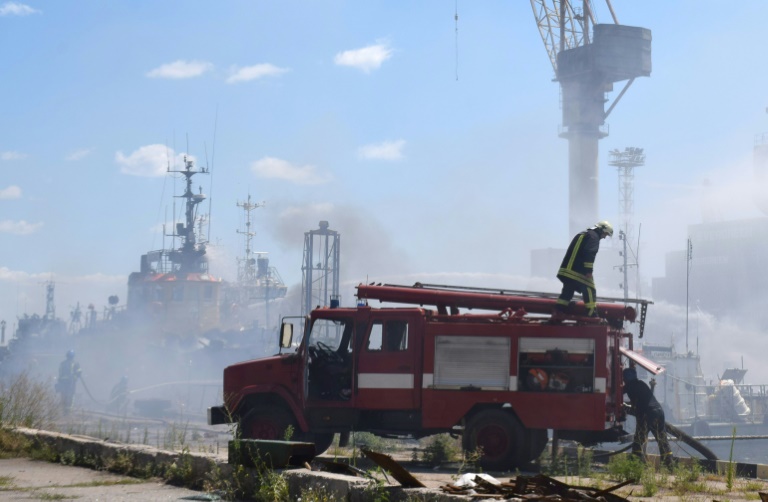
Russian energy giant Gazprom says it is cutting daily gas deliveries via the Nord Stream pipeline to 33 million cubic metres a day — about 20 percent of the pipeline’s capacity — from Wednesday.

It says in a statement that it is halting the operation of one of the last two operating turbines due to the “technical condition of the engine”. 

The German government says there is “no technical reason” for Gazprom’s announcement.

Heavily dependent upon Russian gas, Germany has accused Moscow of using energy as a “weapon”, and EU states accuse it of squeezing supplies in retaliation for Western sanctions over the war in Ukraine.

– Grain deliveries to start ‘this week’ –

Ukraine expects the first grain shipments under a UN-Turkey brokered deal to leave its ports “this week”, its infrastructure minister says, despite Russian strikes on the Black Sea port of Odessa, which is crucial for grain exports.

“We are preparing for everything to start this week,” says Oleksandr Kubrakov, who led the Ukrainian delegation that reached a deal last week with Russia on unblocking Ukraine’s grain exports.

The future of the agreement, seen as crucial to relieving a global food crisis, had appeared in jeopardy after Russian forces launched strikes on Odessa a day after the agreement was signed.

Kremlin spokesman Dmitry Peskov says the missile strikes “should not affect the start of shipment”.

Ukrainian President Volodymyr Zelensky says the strikes on Odessa show Moscow cannot be trusted to keep its promises.

– Russia fights for Donbas, Ukraine for Kherson –

The Ukrainian presidency says that a Russian strike trapped seven people under a collapsed cultural centre in the northeastern Kharkiv region. Three were pulled out alive and the rescue operation was ongoing. 

In the eastern Donbas region, where Russian troops are pressing on having made gains, shelling continues across the entire front line and at least one person was killed in the town of Soledar.

In the south — where Kyiv has vowed a major counter-offensive to retake the strategic Kherson region — the authorities said Ukrainian forces stopped a Russian push in several villages as fighting raged elsewhere.

A local official said Sunday that a Ukrainian operation to retake the region Russia captured early in the invasion would be over by September.

– UK to host 2023 Eurovision –

Britain agrees to take Ukraine’s place as hosts of next year’s Eurovision song contest after the European Broadcasting Union (EBU) ruled out Ukraine hosting it itself.

Ukraine won this year’s contest, held in Italy, ahead of Britain’s entry in second place. The winner traditionally organises the next year’s show.

But the EBU ruled that out in view of the war, and Ukrainian broadcaster UA:PBC acquiesced to a UK-hosted event infused with “Ukrainian spirit”.

Ukraine’s Culture Minister Oleksandr Tkachenko welcomes the news, saying Ukraine had “received assurances… that they will hold Eurovision… with an extremely high integration of Ukrainian contexts and presenters.”

burs-jmy/kjm

UK to host 2023 Eurovision as Ukraine bows out

Britain said Monday it had reluctantly agreed to host next year’s Eurovision song contest, after organisers said there was no prospect of the pop extravaganza going ahead in war-torn Ukraine.

The BBC will now produce the world’s biggest live music event, taking in performers from across Europe and Central Asia as well as Israel and Australia, in a UK city yet to be determined.

Ukraine won this year’s contest, held in Italy, ahead of Britain’s entry in second place. For the past month, it had insisted it could host next year’s despite the Russian invasion.

But after the European Broadcasting Union (EBU) ruled that out on security grounds, the government in Kyiv acquiesced to a UK-hosted event with a strongly Ukrainian flavour.

Culture Minister Oleksandr Tkachenko said that after “several rounds” of discussion, the EBU had given assurances of an “extremely high integration of Ukrainian context and presenters”.

British Prime Minister Boris Johnson said that in phone talks last week with President Volodymyr Zelensky, they “agreed that wherever Eurovision 2023 is held, it must celebrate the country and people of Ukraine”. 

“As we are now hosts, the UK will honour that pledge directly -– and put on a fantastic contest on behalf of our Ukrainian friends,” Johnson tweeted.

Johnson’s spokesman added it had been the soon-to-depart prime minister’s “strong wish” for Ukraine to host the 2023 edition, and found it “deeply regrettable” that was no longer possible.

In May, Ukrainian folk-rap group Kalush Orchestra won in Turin, on a wave of support for their country following Russia’s invasion. 

Its lead singer Oleh Psiuk, whose bubblegum-pink bucket hat helped make him one of the breakout stars of the night, thanked Britain for stepping in.

“We hope Eurovision 2023 will have a Ukrainian flavour and celebrate our beautiful, unique culture,” he said in a statement to Britain’s PA news agency. 

“We, in turn, will make all efforts to help Ukraine win next year as well, so that Eurovision 2024 can take place in a peaceful country.”

– Cities wait in wings –

By convention, the winning country hosts the kitsch celebration of music the following year. Britain last hosted it in 1998.

But last month, the EBU said Ukraine could not guarantee the safety of more than 10,000 people involved in the production and a further 30,000 fans expected to attend.

The broadcasting union stuck to its line despite protests from Zelensky’s government, and rejected one proposal to shift the contest to a border location within Ukraine, away from the frontlines.

The EBU said Ukraine was still guaranteed a place in the 2023 grand final along with the organisation’s “top five” countries: Britain, France, Germany, Italy and Spain.

The other finalists will be selected via national votes by viewers and judges, typically ranging from mainstream pop to the rather odd.

BBC director-general Tim Davie said it was “of great regret” that Ukraine could not host next year.

“The BBC is committed to making the event a true reflection of Ukrainian culture alongside showcasing the diversity of British music and creativity,” he said.

But the cash-strapped BBC also has to contend with footing a multi-million-euro bill for staging the show, unless the UK government stumps up extra support.

The broadcaster said it aimed to select a UK host venue by the autumn, in collaboration with the EBU.

Whichever city wins will need to have an international airport, a sizeable conference venue and thousands of hotel rooms.

London, Manchester and Sheffield all said they were ready to step in. Glasgow had previously expressed interest.

This year’s contest vaulted Britain’s second-placed entrant Sam Ryder to stardom. 

Last month, before another global TV audience, Ryder performed his quirky song “Space Man” in front of Buckingham Palace as part of Platinum Jubilee celebrations for Queen Elizabeth II.

Firefighters battle California wildfire as heat wave grips much of US

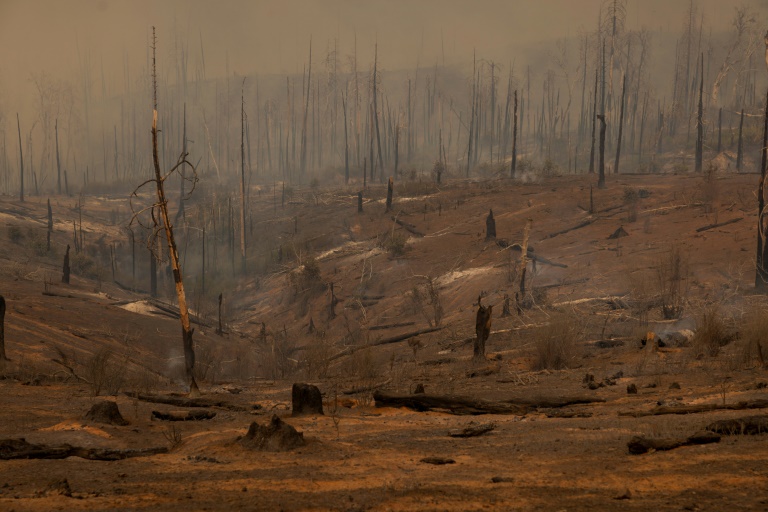
California firefighters were making slow progress Monday battling a raging wildfire near Yosemite National Park that will force some residents to evacuate with “just the shirts on their back,” officials said.

The latest blaze — which has already forced thousands to evacuate — comes as much of the United States remain in the grip of a sweltering heat wave.

The Oak Fire in Mariposa County has burned 16,791 acres (6.795 hectares) and is so far 10 percent contained, Cal Fire, the state fire department, said Monday.

“What we’re seeing on this fire is very indicative of what we’ve seen in fires throughout California, in the West over the last two years,” Jon Heggie, a Cal Fire battalion chief, told CNN.

“These fires are burning with just such a velocity and intensity it makes it extremely challenging and extremely dangerous for both the public and the firefighters,” Heggie said.

“It’s moving so quickly it’s not giving people a lot of time and they sometimes are just going to have to evacuate with just the shirts on their back,” he said.

The Oak Fire has forced the evacuation of several thousand people so far, officials said, and the hot and dry conditions and steep, rugged terrain are complicating firefighting efforts.

More than 2,000 firefighters backed by 17 helicopters have been deployed against the Oak Fire, which broke out on Friday near the vast Yosemite National Park in central California.

– ‘Direct result’ of climate change –

California Governor Gavin Newsom on Saturday declared a state of emergency in Mariposa County, citing “conditions of extreme peril to the safety of persons and property.”

In recent years, California and other parts of the western United States have been ravaged by huge and fast-moving wildfires, driven by years of drought and a warming climate.

“What I can tell you is this is a direct result of what is climate change,” Heggie told CNN.

“You can’t have a 10-year drought in California and expect things to be the same,” he said. “We’re now paying the price for that 10-year drought.

“That drought is what drives what we are calling megafires.”

Evidence of global warming could be seen elsewhere in the country, as 60 million Americans were under a heat advisory on Monday.

Temperatures of 100 or more degrees Fahrenheit (37 degrees Celsius) are forecast across parts of eastern Kansas and Oklahoma into southern Missouri and northern Arkansas.

Not even the usually cool Pacific Northwest will escape the far-reaching heat, with temperatures forecast to reach record highs in some areas.

Cities have opened cooling stations and increased outreach to at-risk communities such as the homeless and those without air conditioning.

Various regions of the globe have been hit by extreme heat waves in recent months, such as Western Europe in July and India in March to April, incidents that scientists say are an unmistakable sign of a warming climate.

The extreme weather prompted former vice president Al Gore, a tireless climate advocate, to issue a stark warning on Sunday about “inaction” by US lawmakers.

Asked whether he believes US President Joe Biden should declare a climate emergency, which would grant him additional policy powers, Gore was blunt.

“Mother Nature has already declared it a global emergency,” Gore told ABC.

Stocks wobble as markets begin big week

European and American stocks moved in mixed directions Monday as markets began a busy week, with the US Federal Reserve poised to lift interest rates again and some of the world’s biggest companies scheduled to publish their latest earnings reports.

Asian markets ended lower.

The Fed is widely tipped to hike borrowing costs by 0.75 percentage points Wednesday as it battles soaring inflation.

US second-quarter gross domestic product data are due Thursday, with some observers warning it could show a second successive contraction — which is considered a technical recession.

Investors are also awaiting the release of earnings from business titans Apple, Amazon and Google parent Alphabet.

“Recent risk-on moves appear to be on thin ice as markets gear up for another bout of earnings and a crucial Fed rate decision,” said market analyst Joshua Mahony at trading platform IG.

Despite the deluge of market-moving news on the calendar, European stocks had been trading higher across the board until an announcement by Russia’s Gazprom that it was cutting back gas deliveries to Germany due to a faulty turbine, which pulled down the DAX index in Frankfurt.

It ended the day down 0.3 percent, while the CAC in Paris climbed 0.3 percent and London’s FTSE 100 rose 0.4 percent.

“Gazprom and turbine problems aside, today’s more resilient tone appears to suggest that the prospect of further economic weakness might act as a catalyst that could prompt central banks to pare back some of their more hawkish rhetoric when it comes to raising rates,” said Michael Hewson at CMC Markets.

On Wall Street, both the Dow and S&P 500 were showing modest gains in late morning trade, while the tech-heavy Nasdaq Composite was lower.

Markets were roiled last week when the European Central Bank finally began ramping up interest rates to tackle runaway consumer prices in the eurozone.

The ECB had surprised investors Thursday with a bigger-than-expected rate increase of 0.5 percentage points.

Consumer prices are soaring worldwide after economies reopened from pandemic lockdowns and as the war in Ukraine keeps energy prices elevated.

That, in turn, has sparked aggressive rate hikes from major central banks to try and dampen inflationary pressures.

Federal Reserve chiefs have already said their main priority was bringing inflation down from four-decade highs, even at the expense of growth.

“We still see further downside for risky assets as recession fears accumulate and central banks remain committed to fighting inflation at the expense of growth,” said Standard Chartered strategist Eric Robertsen.

Others warned that while inflation could begin to ease, the Fed could still push borrowing costs to around five percent and was unlikely to lower rates as soon as many traders hope.

– Key figures at around 1530 GMT –

New York – Dow: UP 0.3 percent at 31,996.90 points

EURO STOXX 50: UP 0.2 percent at 3,604.16

London – FTSE 100: UP 0.4 percent at 7,306.30 (close) 

Frankfurt – DAX: DOWN 0.3 percent at 13,210.32 (close)

Paris – CAC 40: UP 0.3 percent at 6,237.55 (close)

Tokyo – Nikkei 225: DOWN 0.8 percent at 27,699.25 (close)

Hong Kong – Hang Seng Index: DOWN 0.2 percent at 20,562.94 (close)

Shanghai – Composite: DOWN 0.6 percent at 3,250.39 (close)

Euro/dollar: UP at $1.0214 from $1.0213 Friday

Pound/dollar: UP at $1.2041 from $1.1999 

Euro/pound: DOWN at 84.82 pence from 85.11 pence

Dollar/yen: UP at 136.70 yen from 136.12 yen

Brent North Sea crude: UP 1.7 percent at $104.90 per barrel

West Texas Intermediate: UP 1.6 percent at $96.25 per barrel

burs-rl/raz

Panama govt, protesters edge closer in talks to end road closures

The Panamanian government and protesters edged closer Monday to an agreement to end a weeks-long living cost revolt that has blocked roads, interrupted food supplies and damaged the economy.

Authorities agreed in the early morning hours to reduce the price of 72 basic consumer items by some 30 percent on average.

“The national government has every intention of continuing dialogue and today has shown it also has the will to reach agreements,” Labor Minister Doris Zapata said on the fifth day of marathon talks in Penonome, 150 kilometers (93 miles) southwest of the capital Panama City.

“There is already the first step on the road to solving the problems of the social crisis that this country is experiencing,” said Fernando Abrego, a spokesman for one of the demonstrators. 

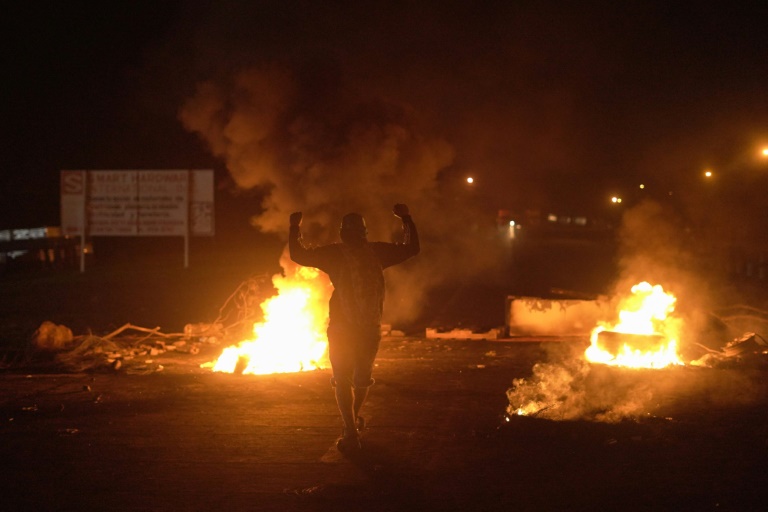
For three weeks, amid worsening economic woes for Panama, protesters demanding lower fuel, food and medicine prices have blockaded the crucial Pan-American Highway and other major roads with stalled trucks and burning tires. Some have clashed with police.

Despite its dollarized economy and impressive growth figures, the country of 4.4 million people has one of the world’s highest rates of social inequality, with poor access to health services, education and clean drinking water in some areas.

The demonstrations have triggered food and fuel shortages in some parts of the country, and the business sector says some $500 million has been lost.

Even before the talks started, the government had lowered the price of 18 basic products and that of fuel from $5.20 per gallon to $3.25 in an unsuccessful bid to end the standoff.

Protesters had demanded a lowering of the price of 82 products and want a limit to be imposed on company profits, a measure the government has rejected.

Other demands include reducing the price of medicines and electricity, increasing investment in education and the public health system, and measures against government corruption.

Luis Sanchez, another spokesman for the protesters, said some roads have been opened in a gesture of good faith.

But the government asked for all blockades to be ended.

“There is a population distressed by the closures,” said Zapata.

Close Bitnami banner
Bitnami