World

Chinese astronauts set up new lab on space station

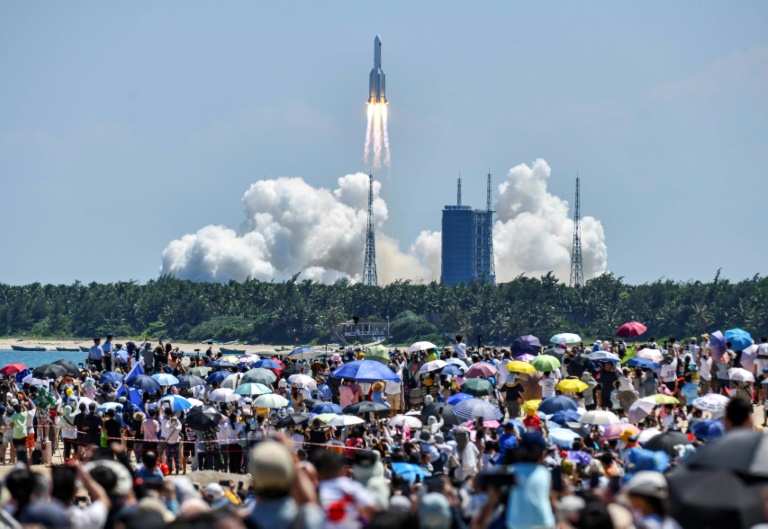
Astronauts entered the new lab module of China’s space station for the first time Monday, in a major step towards completing the orbital outpost by the end of the year.

The station is one of the crown jewels of Beijing’s ambitious space programme, which has landed robotic rovers on Mars and the Moon, and made China only the third nation to put humans in orbit.

Once completed, Tiangong — or “heavenly palace” — will be constantly crewed by rotating teams of three astronauts, who will conduct scientific experiments and help test new technologies.

Wentian, the second of Tiangong’s three main sections, docked with the station’s core module Tianhe on Monday after successfully launching from southern China a day earlier, state media reported.

A few hours after docking, the three astronauts — who have been living in the core module since June — opened the hatch and entered Wentian, footage from state broadcaster CCTV showed.

The crew, dressed in blue jumpsuits, were seen floating around the brightly lit module before facing the camera and saluting.

Wentian will focus on life sciences and biotechnology research, according to official news agency Xinhua, including cell research and growth experiments on plants, fruit flies and zebrafish.

The module will have living space for three additional astronauts, housing up to six people during crew transitions, state media said.

The third and final module, another lab named Mengtian, is scheduled for launch in October.

Tiangong, once completed, is expected to remain in low orbit 400-450 kilometres (250-280 miles) above Earth for at least 10 years.

Next year, China is also planning to launch a space telescope with a field of view 350 times that of NASA’s Hubble Space Telescope.

The telescope will be positioned in the same orbit as Tiangong, allowing the station to dock with it for refuelling and servicing when needed.

China has poured billions of dollars into space flight and exploration as it seeks to build a programme that reflects its stature as a rising global power.

The programme has rapidly yielded successes in the last two decades, including launching the first Chinese astronauts, a historic first controlled landing on the far side of the Moon, and delivering a rover to the surface of Mars.

And after several missions to test the technologies needed for a constantly crewed outpost, it is set to finish Tiangong this year.

The station when completed is expected to have a mass of 90 tonnes, around a quarter of the International Space Station — from which China has been excluded by the United States.

The ISS — a collaboration between the United States, Russia, Canada, Europe and Japan — is due to be retired after 2024, although NASA has said it could potentially remain functional beyond 2028.

Chinese astronauts set up new lab on space station

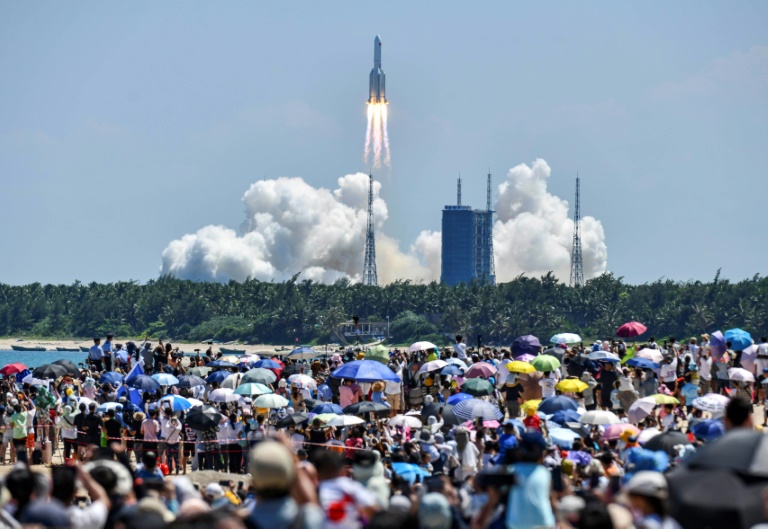
Astronauts entered the new lab module of China’s space station for the first time Monday, in a major step towards completing the orbital outpost by the end of the year.

The station is one of the crown jewels of Beijing’s ambitious space programme, which has landed robotic rovers on Mars and the Moon, and made China only the third nation to put humans in orbit.

Once completed, Tiangong — or “heavenly palace” — will be constantly crewed by rotating teams of three astronauts, who will conduct scientific experiments and help test new technologies.

Wentian, the second of Tiangong’s three main sections, docked with the station’s core module Tianhe on Monday after successfully launching from southern China a day earlier, state media reported.

A few hours after docking, the three astronauts — who have been living in the core module since June — opened the hatch and entered Wentian, footage from state broadcaster CCTV showed.

The crew, dressed in blue jumpsuits, were seen floating around the brightly lit module before facing the camera and saluting.

Wentian will focus on life sciences and biotechnology research, according to official news agency Xinhua, including cell research and growth experiments on plants, fruit flies and zebrafish.

The module will have living space for three additional astronauts, housing up to six people during crew transitions, state media said.

The third and final module, another lab named Mengtian, is scheduled for launch in October.

Tiangong, once completed, is expected to remain in low orbit 400-450 kilometres (250-280 miles) above Earth for at least 10 years.

Next year, China is also planning to launch a space telescope with a field of view 350 times that of NASA’s Hubble Space Telescope.

The telescope will be positioned in the same orbit as Tiangong, allowing the station to dock with it for refuelling and servicing when needed.

China has poured billions of dollars into space flight and exploration as it seeks to build a programme that reflects its stature as a rising global power.

The programme has rapidly yielded successes in the last two decades, including launching the first Chinese astronauts, a historic first controlled landing on the far side of the Moon, and delivering a rover to the surface of Mars.

And after several missions to test the technologies needed for a constantly crewed outpost, it is set to finish Tiangong this year.

The station when completed is expected to have a mass of 90 tonnes, around a quarter of the International Space Station — from which China has been excluded by the United States.

The ISS — a collaboration between the United States, Russia, Canada, Europe and Japan — is due to be retired after 2024, although NASA has said it could potentially remain functional beyond 2028.

Droupadi Murmu sworn in as India's first tribal president

Droupadi Murmu was sworn in as India’s president on Monday, making her the first person from one of the country’s marginalised tribal communities to serve as head of state.

The former school teacher and state governor was elected to the largely ceremonial position last week with 64 percent of the vote by members of India’s parliament and state assemblies.

Murmu, who is from the Santhal tribe and was born in eastern Odisha state, paid her respects before her inauguration at a memorial dedicated to India’s independence hero Mahatma Gandhi in New Delhi.

“I started my life journey from a small tribal village,” Murmu, 64, said after taking the oath of office in parliament.

“From the background I come from, it was like a dream for me to even get elementary education,” she added.

“But despite many obstacles, my resolve remained strong and I became the first daughter from my village to go to college.”

Murmu’s win was considered a certainty because of the strength of the ruling Bharatiya Janata Party and its allies in the parliament and state assemblies.

Analysts said the move will likely help Prime Minister Narendra Modi extend his base among the poor tribal communities ahead of his re-election bid in 2024.

“Her assuming the Presidency is a watershed moment for India especially for the poor, marginalised and downtrodden,” Modi said on Twitter after Murmu’s address. 

Murmu said her election would give hope to those left behind by India’s recent economic growth.

“It is a matter of great satisfaction to me that those who have been deprived for centuries, who have been away from the benefits of development… are seeing their reflection in me,” she said.

India’s prime minister wields executive power, but the president can send back some parliamentary bills for reconsideration and also plays a guiding role in the process of forming governments.

Murmu is the country’s second woman president after Pratibha Patil, who held the position for five years from 2007.

She succeeds Ram Nath Kovind, the second president from the Dalit community, the bottom of the Hindu caste system.

Indonesia foot and mouth outbreak prompts NZ, Australia restrictions

Prime Minister Jacinda Ardern warned an outbreak of foot-and-mouth disease in Indonesia could cost thousands of New Zealand jobs, as her nation and neighbouring Australia stepped up border biosecurity restrictions.

“While not a threat to humans, it would devastate our national herd. Essentially, all animals that are of cloven hoof are at risk,” Ardern told reporters in Wellington.

Ardern warned that the disease, first detected in Indonesia in April, has the potential to threaten up to 100,000 jobs in New Zealand’s agriculture sector.

Foot and mouth disease is a severe, highly contagious viral disease of livestock.

It can have a significant economic impact, especially on a country like New Zealand which exported around 17 million sheep and two million cattle in the eight months up until May 2022. 

A foot-and-mouth outbreak has ripped through two Indonesian provinces, killing thousands of cows and infecting hundreds of thousands more.

Ardern said New Zealand has never had an outbreak — and wants to keep it that way by tightening border restrictions.

“We want to make sure that we’ve got all our settings in place to protect ourselves from this emerging threat,” she added.

There are currently no direct flights from Indonesia to New Zealand, but Ardern said it is important to stop it from entering the country, potentially via Australian tourists who had visited south-east Asia.

Travellers from Indonesia will not be allowed to bring meat products into New Zealand, baggage will be screened and there will be disinfectant mats at airports to clean footwear.

In Australia, parcels and baggage from China and Indonesia are now being checked and there are also foot mats at airports in response to the disease.

Canberra has so far rejected opposition calls to close the border to Indonesia completely, but further measures have not been ruled out.

Ardern said her government is working with Australian authorities to try to further reduce the risk.

New Zealand is set to fully open its borders at midnight on Sunday to all visitors.

New Zealand’s Biosecurity Minister Damien O’Connor said “vigilance is absolutely crucial” as the disease could also affect up to 77 percent of the country’s wildlife population, including wild deer, pigs and sheep.

He referred to how foot and mouth devastated British farming in 2001 when millions of cattle and sheep had to be slaughtered.

China swelters under record heat

Cities across China were on red alert for heatwaves on Monday, as tens of millions of people were warned to stay indoors and record temperatures strained energy supply.

Swathes of the planet have been hit by extreme and deadly heatwaves in recent months, from Western Europe in July to India in March to April.

Scientists say the extreme weather has become more frequent due to climate change, and will likely grow more intense as global temperatures continue to rise.

China is no exception and is sweating through one of its hottest summers on record.

In the eastern provinces of Zhejiang and Fujian, the mercury rose above 41 degrees Celsius (106 degrees Fahrenheit) over the weekend, reaching all-time highs in two cities.

People in areas under red heat alerts — mostly concentrated in the southeast and northwest — are being ordered to “cease all outdoor activities” and “pay special attention to fire prevention,” the national meteorological service said in multiple notices over the weekend.

Saturday marked the “Great Heat” day on China’s traditional calendar, long recognised as the hottest period of the year, but this summer has been exceptionally warm.

Earlier this month Shanghai recorded its highest air temperature — 40.9C — since records began in 1873.

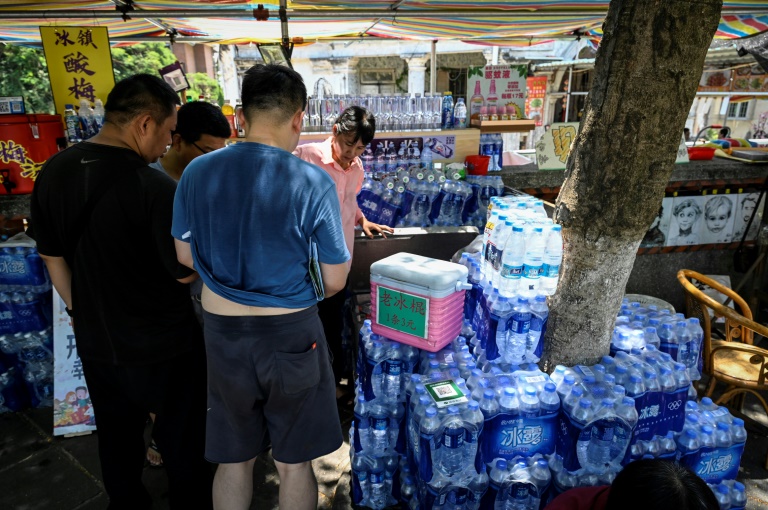
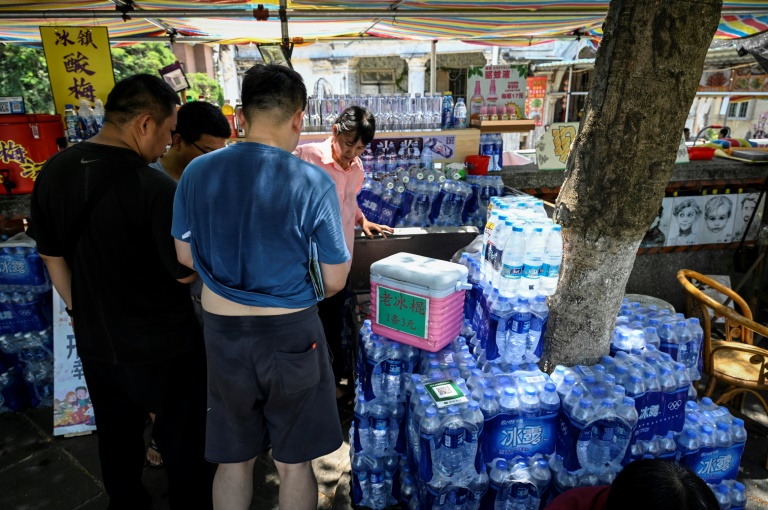
The scorching heat sent hundreds of people to the beach in Fujian’s Xiamen city on Sunday, while others hid from the sun under hats and face coverings.

China’s power grid is also feeling the strain from increased demand for air conditioning, with the country’s largest power plants generating at a record capacity in mid-July, according to energy industry publication Sxcoal.

Some local governments have resorted to turning off street lamps and raising peak period electricity tariffs for factories this month.

The ongoing heat wave, which has struck the lower reaches of the Yangtze River especially hard, will also “adversely affect local crops,” warned Fu Jiaolan, chief forecaster at the National Meteorological Centre.

China swelters under record heat

Cities across China were on red alert for heatwaves on Monday, as tens of millions of people were warned to stay indoors and record temperatures strained energy supply.

Swathes of the planet have been hit by extreme and deadly heatwaves in recent months, from Western Europe in July to India in March to April.

Scientists say the extreme weather has become more frequent due to climate change, and will likely grow more intense as global temperatures continue to rise.

China is no exception and is sweating through one of its hottest summers on record.

In the eastern provinces of Zhejiang and Fujian, the mercury rose above 41 degrees Celsius (106 degrees Fahrenheit) over the weekend, reaching all-time highs in two cities.

People in areas under red heat alerts — mostly concentrated in the southeast and northwest — are being ordered to “cease all outdoor activities” and “pay special attention to fire prevention,” the national meteorological service said in multiple notices over the weekend.

Saturday marked the “Great Heat” day on China’s traditional calendar, long recognised as the hottest period of the year, but this summer has been exceptionally warm.

Earlier this month Shanghai recorded its highest air temperature — 40.9C — since records began in 1873.

The scorching heat sent hundreds of people to the beach in Fujian’s Xiamen city on Sunday, while others hid from the sun under hats and face coverings.

China’s power grid is also feeling the strain from increased demand for air conditioning, with the country’s largest power plants generating at a record capacity in mid-July, according to energy industry publication Sxcoal.

Some local governments have resorted to turning off street lamps and raising peak period electricity tariffs for factories this month.

The ongoing heat wave, which has struck the lower reaches of the Yangtze River especially hard, will also “adversely affect local crops,” warned Fu Jiaolan, chief forecaster at the National Meteorological Centre.

Marauding monkeys injure 42 in Japanese city

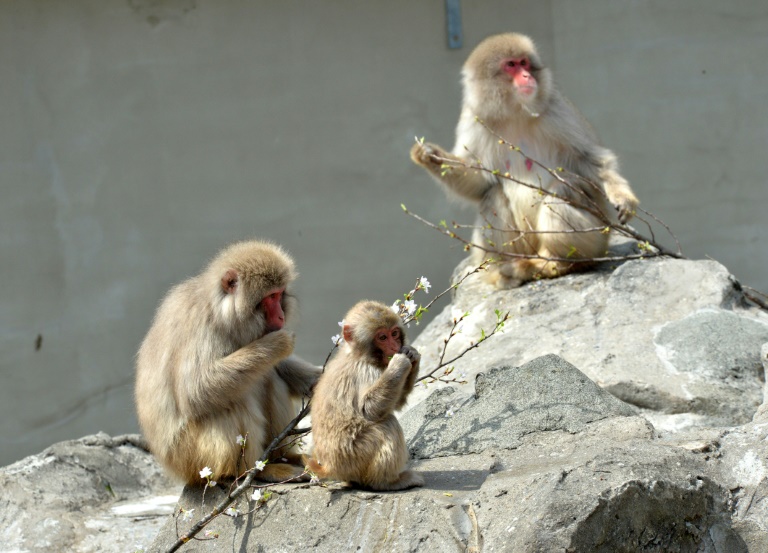
Local authorities in Japan’s Yamaguchi city said Monday they are turning to tranquiliser guns to confront marauding monkeys that have injured 42 people in recent weeks.

Japanese macaques are seen commonly across large parts of the country, and are a pest in some areas, eating crops and even entering homes.

But a spate of monkey attacks in the city in western Japan has been unusual, with adults and children suffering wounds including scratches and bites.

“All of Yamaguchi city is surrounded by mountains and it’s not rare to see monkeys,” a city official from the agricultural department told AFP, declining to give her name.

“But it’s rare to see this many attacks in a short period of time.”

The injuries have so far been largely mild, but authorities are now turning to tranquiliser guns after traps they set failed to snare any of the pesky primates.

“Initially only children and women were attacked. Recently elderly people and adult men have been targeted too,” the official said.

The city isn’t even sure if the attacks are the work of multiple monkeys or a single aggressive individual. The intruders have in some cases entered by sliding open screen doors, or entering through windows.

City officials and police have been patrolling the area since the first attacks around July 8, but have yet to snare any monkeys.

The story has made headlines in Japan in recent weeks, with local residents reporting regular invasions.

“I heard crying coming from the ground floor, so I hurried down,” one local father told the Mainichi Shimbun daily.

“Then I saw a monkey hunching over my child.”

Russia says Odessa strikes hit Western arms

Russia said its missile barrage on a Ukrainian port central to a landmark grain export deal had destroyed Western-supplied weapons, after the attack sparked an outcry from Ukraine’s allies.

Russian Foreign Minister Sergei Lavrov was embarking on a tour of several countries in Africa and on his first stop in Egypt Sunday sought to reassure Cairo that Russian grain supplies would continue.

Ukrainian President Volodymyr Zelensky denounced Saturday’s strike on the Odessa port as “Russian barbarism” and said it amounted to desperation after the warring sides struck a deal to release exports from the facility.

“Even the occupiers admit that we will win. We hear it in their conversations –- all the time, in what they tell their loved ones when they contact them,” he said Sunday in his nightly address.

Turkey helped broker the accord and said immediately after the double cruise missile hits that it had received assurances from Moscow that Russian forces were not responsible.

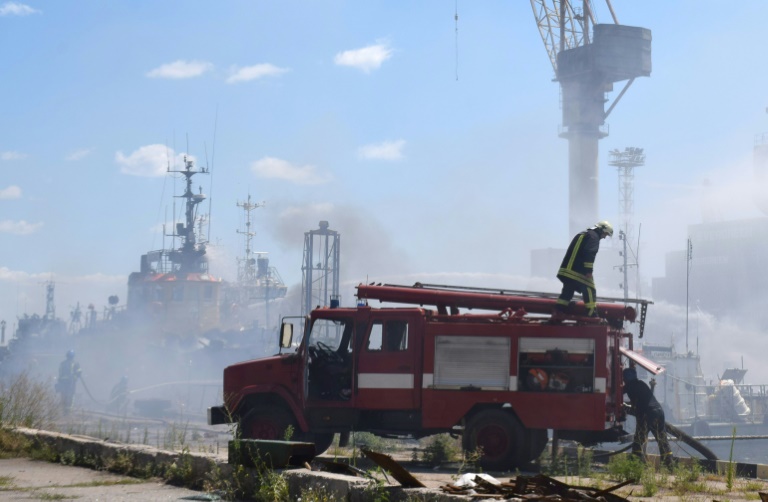
But Russia’s defence ministry rolled back on the denial Sunday, saying the strikes had destroyed a Ukrainian military vessel and arms delivered by Washington.

“High-precision, long-range missiles launched from the sea destroyed a docked Ukrainian warship and a stockpile of anti-ship missiles delivered by the United States to the Kyiv regime,” it said.

“A Ukrainian army repair and upgrade plant has also been put out of order.”

The strikes have cast a shadow over the milestone accord — that was hammered out over months of negotiations and signed in Istanbul — to relieve a global food crisis.

– ‘Order of peace’ –

United Nations chief Antonio Guterres, who presided over the signing ceremony Friday, “unequivocally” condemned the attack. The United States meanwhile said it “casts serious doubt” over Russia’s commitment to the deal.

Western nations repeated their condemnation of Russia’s military assault on Ukraine after the strikes.

German President Frank-Walter Steinmeier called the invasion a war against the unity of Europe.

“We must not let ourselves be divided, we must not let the great work of a united Europe that we have begun so promisingly be destroyed,” he said in a speech Sunday.

Cereal prices in Africa — the world’s poorest continent where food supplies are critically tight — surged because of an exports slump.

Lavrov, who will visit Uganda, Ethiopia and Congo-Brazzaville on the tour, told his Egyptian counterpart Sameh Shoukry that Russia would meet grain orders.

“We confirmed the commitment of Russian exporters of cereal products to meet their orders in full,” he said in a press conference.

Zelensky said the strikes on Odessa showed Moscow could not be trusted to keep its promises.

Under the deal brokered by Turkish President Recep Tayyip Erdogan and Guterres, Odessa is one of three designated export hubs.

Ukrainian officials said grain was being stored in the port at the time of the strike, but food stocks did not appear to have been hit.

There was no response from Moscow until Sunday, but Turkish Defence Minister Hulusi Akar said before that Russia had denied carrying out the attack.

– Kherson ‘liberated’ by September –

Huge quantities of wheat and other grain have been blocked in Ukrainian ports by Russian warships and the mines Kyiv laid to avert a feared amphibious assault.

Zelensky has said around 20 million tonnes of produce from last year’s harvest and the current crop would be exported under the agreement, estimating the value of Ukraine’s grain stocks at around $10 billion.

Diplomats expect grain to only start fully flowing by mid-August.

The agreement in Istanbul has brought little reprieve on the battlefield where Russian forces were carrying out bombardments across the sprawling front line over the weekend, Ukraine’s presidency said Sunday.

It said among attacks in the industrial east and south, four Russian cruise missiles Saturday had hit residential areas in the southern city of Mykolaiv, injuring five people, including a teenager.

In a devastated village near Ukraine’s southern front line Stanislav, a 49-year-old who joined Ukraine’s armed forces after Russia’s invasion, said many people were afraid.

“But what can we do, we need to defend our homeland, because if I don’t do it then my children will be forced to do it,” he said.

An official in the nearby Kherson region in the south said a Ukrainian counter-offensive for the territory Russia captured early in the invasion would be over by September.

“We can say that a turning point has occurred on the battlefield. We are switching from defensive to counteroffensive actions,” Sergiy Khlan, an aide to the head of Kherson region, said in an interview with Ukrainian television.

burs-jbr/jfx/mtp

The centuries-old mines stirring Japan-South Korea tensions

Under a split-top mountain on the Japanese island of Sado lies a network of centuries-old mines that have sparked a new diplomatic row with South Korea.

Some of the gold and silver mines of Sado, off Japan’s west coast, are believed to have started operating as early as the 12th century and produced until after World War II.

Japan believes that lengthy history and the artisanal mining techniques used there at a time when European mines had turned to mechanisation merit recognition on UNESCO’s World Heritage List.

But in Seoul, the focus is on what isn’t mentioned in the bid: the use of conscripted Korean labour during the Second World War, when Japan occupied the Korean peninsula.

Japan is seeking recognition of three sites — the Nishimikawa gold mine, the Tsurushi silver mine, and the Aikawa gold and silver mines — for the period between 1603 and 1867.

Officials and supporters of the bid say that era was when the mines were the world’s most productive and mining was done by hand.

But it also stops short of the period when conscripted Koreans toiled in conditions that even some backers of the UNESCO bid call “extremely harsh”.

The World Heritage effort has been years in the making, inspired in part by the successful recognition of a silver mine in western Japan’s Shimane region.

Ryo Usami, from Sado city’s World Heritage Promotion section, said locals hoped the recognition would highlight the mine’s contributions to the unique culture and history of the island.

“Many people migrated to Sado to mine gold and silver… They came from all over Japan and brought their local cultures,” Usami told AFP.

“Sado’s history is basically the history of these gold mines, and its culture formed in part thanks to the mining operations. That’s what Sado city wants to preserve.”

– ‘Discrimination did exist’ –

Production at the sites petered out by the 1960s, when mine operator Mitsubishi Materials began accepting tourists.

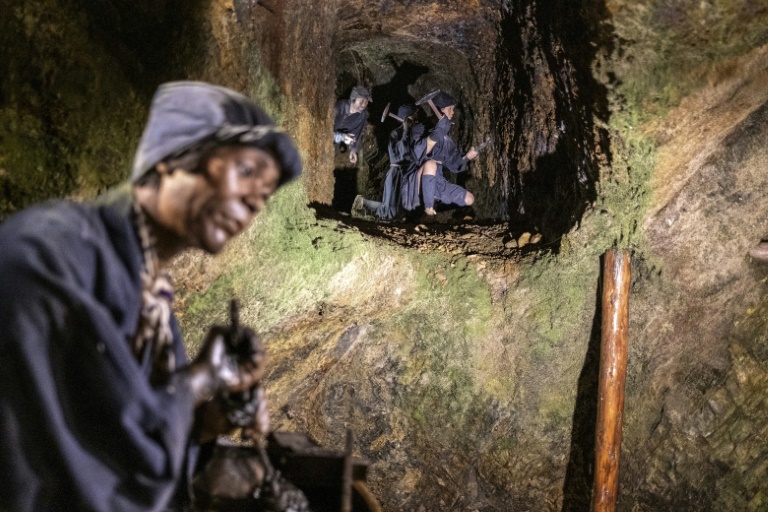
In the 1970s, animatronic robots were installed in some mining tunnels to give a sense of what life there was like.

The eerie, rundown figures remain, their heads swivelling side-to-side and arms mechanically swinging pickaxes up and down in a forlorn fashion.

Groups of domestic tourists file through the frigid tunnels and read panels that explain the history of Sado’s mining industry.

The panels note that Edo-era miners were often homeless or unregistered people who were captured and forced to work, and that child labour was used at times.

But there is little to testify that an estimated 1,500 Koreans worked at the sites during World War II.

Their status is disputed, with some arguing around two-thirds signed contracts voluntarily, while the remainder were conscripted during war-time mobilisation.

“The working conditions were extremely harsh, nevertheless the pay was very high, that’s why lots of people, including many Japanese, applied,” said Koichiro Matsuura, a former UNESCO director-general who is backing Sado’s bid.

Others argue the recruitment conditions effectively amounted to forced labour, and that Korean workers faced significantly harsher conditions than their Japanese counterparts.

“Discrimination did exist,” said Toyomi Asano, a professor of history of Japanese politics at Tokyo’s Waseda University.

“Their working conditions were very bad and dangerous. The most dangerous jobs were allocated to them.”

– ‘A part of our history’ –

Wartime issues like forced labour have soured ties between Japan and South Korea, and Seoul has formed a task force to push back against the UNESCO bid.

After the bid was announced, the government summoned Tokyo’s ambassador and issued a statement saying it “strongly regrets” the nomination and “sternly urges Japan to stop its attempt”.

The issue of forced labour affects other Japanese heritage sites, including the “Sites of the Meiji Industrial Revolution” inscribed in 2015.

UNESCO last year demanded an information centre for the sites properly explain that a “large number of Koreans and others (were) brought against their will and forced to work under harsh conditions”.

Matsuura believes Japan must “avoid making the same mistake” at Sado.

“We must say in a more concrete and more honest manner how the Korean workers lived and worked at the Sado gold mines.”

It’s a view shared by some visitors, including 79-year-old Hideji Yamagami.

“Of course they should (explain), I didn’t know about it at all,” he told AFP after a trip through the Aikawa site.

“I thought it was Japanese who had done all the hard work.”

Asano hopes UNESCO will insist the full history of Sado’s mines is on display if the site gets World Heritage status, and believes Japan “should not fear” recognising a part of its history.

“Every nation has its dark history, those nations who are completely exempt do not exist.”

Pope on 'penitential' visit to Canada Indigenous school survivors

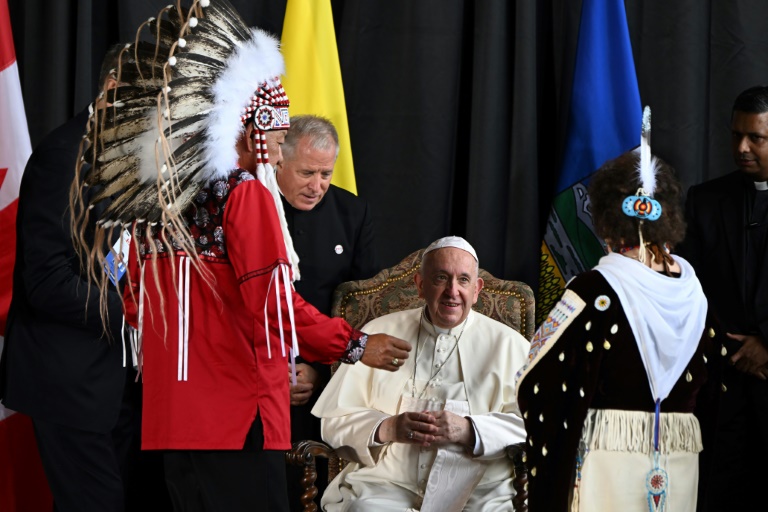
Pope Francis will visit a former residential school in Canada on Monday, where he is expected to make a historic personal apology to Indigenous survivors of abuse committed over decades at the Catholic-run institutions.

The leader of the world’s 1.3 billion Catholics arrived the previous day in Edmonton for a six-day visit, which has long been awaited by the First Nations, Metis and Inuit communities.

The 85-year-old pontiff’s trip, which he has described as a “penitential journey,” is primarily to apologize to survivors for the Church’s role in the scandal that a national truth and reconciliation commission has called “cultural genocide.”

From the late 1800s to the 1990s, Canada’s government sent about 150,000 First Nations, Metis and Inuit children into 139 residential schools run by the Church, where they were cut off from their families, language and culture.

Many were physically and sexually abused by headmasters and teachers, and thousands of children are believed to have died of disease, malnutrition or neglect. 

A delegation of Indigenous peoples traveled to the Vatican in April and met the pope — a precursor to Francis’ six-day trip — after which he formally apologized.

But doing so again on Canadian soil will be of huge significance to survivors and their families, for whom the land of their ancestors is of particular importance.

Francis is to arrive at 10:00 am (1600 GMT) Monday at the community of Maskwacis, about 100 kilometers (62 miles) south of Edmonton, where the former Ermineskin residential school — one of the largest in Canada — was located until its closure in 1975.

After a silent prayer in the cemetery, he will deliver his first speech, in Spanish, to an estimated crowd of 15,000, expected to include former students from across the country.

At 4:30 pm, Francis will go to the Sacred Heart Catholic Church of the First Peoples in Edmonton, one of the city’s oldest churches, where he will deliver a second speech to Indigenous communities.

“I hope that this visit is the beginning of a change in history, a change in the way business is going to be done, and a way for us to begin our healing journey,” George Arcand Jr, the grand chief of the Confederacy of Treaty Six First Nations, said on national television.

“I asked the Pope to walk with us and create this new road that needs to be created.”

– ‘Healing journey’ –

Since May 2021, more than 1,300 unmarked graves have been discovered at the sites of the former schools, sending shockwaves throughout Canada.

The country has slowly begun to acknowledge this long, dark chapter in its history.

The papal visit, though highly anticipated, is also a source of controversy for some survivors and their families. Many expect Francis to make symbolic gestures, such as returning some of the Indigenous artifacts that have been held in the Vatican for decades.

“It means a lot to me” that he came, said Deborah Greyeyes, 71, noting her “entire reserve” was going to hear Francis speak.

Greyeyes, an Edmonton resident, is a member of the Muskeg Lake Cree Nation, the largest Indigenous group in Canada.

“I think we have to forgive, too, at some point,” she told AFP. But “a lot of stuff was taken away from us.”

After a mass before tens of thousands of faithful in Edmonton on Tuesday, Francis will head northwest to an important pilgrimage site, the Lac Sainte Anne. 

Following a July 27-29 visit to Quebec City, he will end his trip in Iqaluit, capital of the northern territory of Nunavut and home to the largest Inuit population in Canada.

There he will meet with former residential school students, before returning to Italy.

The flight to Edmonton constituted the longest since 2019 for Francis, who has been suffering from knee pain that has forced him to use a cane or wheelchair in recent outings.

The pope was in a wheelchair Sunday and used a lifting platform to board the plane in Rome, and was also in a wheelchair on the tarmac in Edmonton.

Francis is the second pope to visit Canada, after John Paul II, who did so twice in the 1980s and again in 2002. 

Close Bitnami banner
Bitnami