World

Forest fires rage in scorching southwest Europe

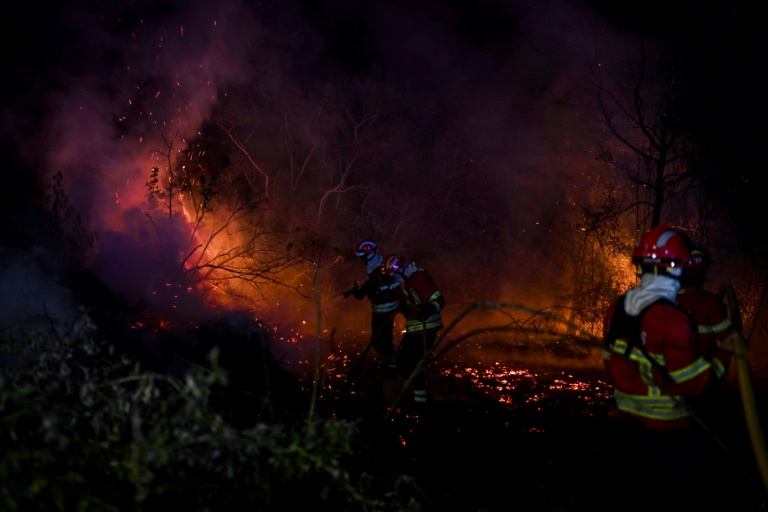
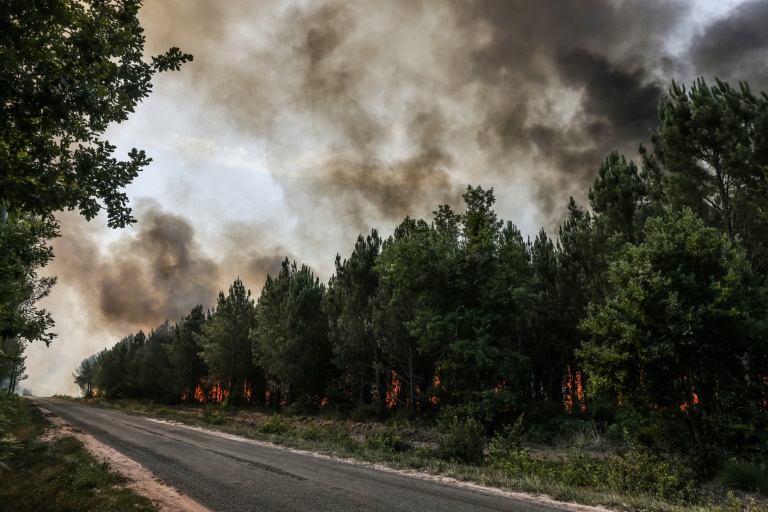
Firefighters battled to contain wildfires sweeping across southwest Europe on Sunday as a heatwave showed no sign of abating, with Britain poised to set new temperature records this coming week.

Blazes raging in France, Greece, Portugal and Spain have destroyed thousands of hectares of land, forced thousands of residents and holidaymakers to flee and killed several emergency personnel since last week.

It is the second heatwave to engulf parts of southwest Europe in weeks. Scientists blame climate change and predict more frequent and intense episodes of extreme weather such as heatwaves and drought.

The situation deteriorated in France’s southwestern Gironde region where firefighters were fighting to control forest blazes that have devoured nearly 11,000 hectares (27,000 acres) since Tuesday.

The wildfires forced more than 16,000 people — residents and tourists combined — to decamp. Seven emergency shelters have been set up for evacuees.

France’s interior ministry announced it would send an extra three firefighting planes, 200 firefighters and more trucks.

Meteo France forecast temperatures of up to 40 degrees Celsius (104 degrees Fahrenheit) in parts of southern France on Sunday, with new heat records expected on Monday.

“In some southwestern areas, it will be a heat apocalypse,” meteorologist Francois Gourand told AFP.

France placed 15 departments, mainly down its western seaboard, on red alert — the highest on the scale — on Sunday while 51 were on orange high alert.

– ‘Exceptional’ conditions –

The chapel of a historic hospital in the southeastern city of Lyon, Grand Hotel Dieu, offered refuge to tourists on Sunday including Jean-Marc, 51, who was visiting from Alsace.

“We came back to admire the place but we can’t leave, it’s too hot outside. We say a prayer before the fire!” he quipped.

French cyclist Mikael Cherel, taking part in the Tour de France’s 15th stage between Rodez and Carcassonne in southern France on Sunday, described “very, very difficult conditions”.

“I’ve never known such a hot day on a bike. It really was no picnic.”

Authorities in the French Alps urged climbers bound for Mont Blanc, Europe’s highest mountain, to postpone their trip due to repeated rock falls caused by “exceptional climatic conditions” and “drought”.

The call comes after a section of Italy’s biggest Alpine glacier gave way at the start of the month, killing 11 people — a disaster officials blamed on climate change.

– Deaths –

Spanish authorities reported around 20 wildfires still raging out of control in different parts of the country from the south to Galicia in the far northwest, where blazes have destroyed around 4,500 hectares of land. 

Firefighters managed to stabilise a wildfire that ravaged 2,000 hectares of woods and bushes in the southern region of Andalusia, regional leader Juan Manuel Moreno said.

The blaze started on Friday in the Mijas mountain range inland from the southern coastal city of Malaga and it spurred the evacuation of about 3,000 people.

Around 2,000 people had since returned home and now that the blaze has stabilised, Moreno said the remaining evacuees may do the same.

The eastern town of Don Benito recorded Spain’s highest temperature on Sunday, with the mercury hitting 43.4C.

A 50-year-old man in Torrejon de Ardoz just outside of Madrid died on Sunday after suffering heat stroke while out for a walk, local emergency services said.

It is the latest death after a 60-year-old street cleaner in Madrid died on Saturday after suffering heat stroke while working the previous day.

The fight against the flames has also claimed the lives of several emergency personnel, including a pilot killed when his plane crashed in northern Portugal and two who died in Greece when their helicopter fell into the sea.

– ‘Risk to life’ in UK –

In Portugal, almost the entire country remained on high alert for wildfires despite a slight drop in temperatures, after hitting 47C — a record for the month of July — on Thursday.

Only one major fire was burning on Sunday in the north.

The fires have killed two, injured around 60 and destroyed between 12,000 and 15,000 hectares of land in Portugal.

In the United Kingdom, the weather office issued a first-ever “red” warning for extreme heat, cautioning there was a “risk to life”.

The Met Office said temperatures in southern England could exceed 40C on Monday or Tuesday for the first time, leading some schools to say they would stay closed next week.

Organisers of a four-day march in the Netherlands cancelled the first day of the mass event due to start on Tuesday because of extreme heat. 

The mercury is set to reach 38C in parts of the Netherlands on Tuesday.

burs-bcr-bt/raz/pvh
All eight crew killed in Ukrainian cargo plane crash in Greece

All eight crew members were killed when a Ukrainian-operated cargo plane crashed in Greece en route from Serbia to Bangladesh carrying military goods, the Serbian defence minister said Sunday.

All eight bodies were found and are being recovered.  

During a briefing by the Greek Fire Brigade earlier in the afternoon, its spokesman, Ioannis Artopoios stressed that experts at the crash site haven’t found any ‘dangerous materials’. 

“Sadly, according to the information we have received, the eight members of the crew died in the crash,” Serbian Defence Minister Nebojsa Stefanovic told a news conference.

The Antonov An-12 took off from Nis airport in southern Serbia at 8:40 pm (1840 GMT) on Saturday, carrying “around 11 tonnes of military industry goods” namely mines from Valir, a private Serbian company, to the Bangladeshi defence ministry, Stefanovic said.

Ukraine’s foreign ministry said the eight flight crew were Ukrainian citizens. “The preliminary cause of the accident is the failure of one of the engines,” said spokesman Oleg Nikolenko on Facebook.

Denys Bogdanovych, general director of Meridian, the Ukrainian airline operating the plane, also told German broadcaster Deutsche Welle that the crew were all Ukrainian.

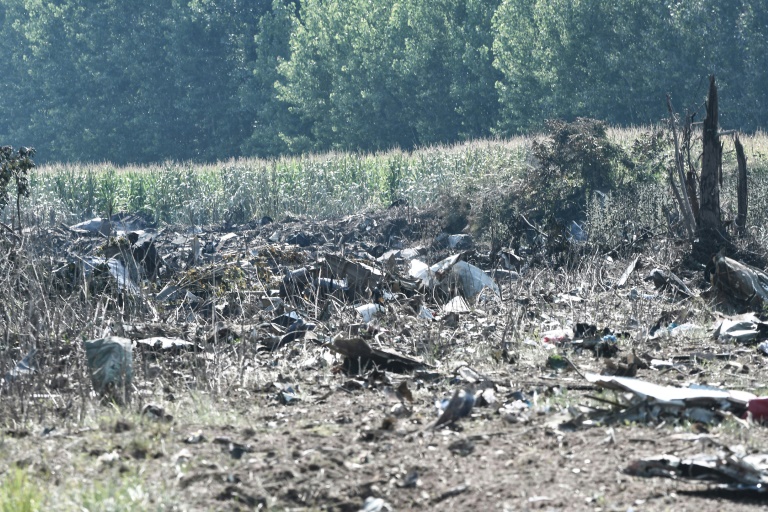
Witnesses said they saw the privately operated Antonov on fire and heard explosions. Videos shared on social media showed the plane engulfed by a giant fireball as it hit the ground late Saturday.

Debris scattered across a wide area and the crash site, surrounded by fields, was visible from the air, an AFP photographer said.

“We heard a deafening noise (and saw) a fireball approaching the ground. Then came the explosion,” Sofia, a mother of three from the nearby village of Antifilipi told Athens News Agency (ANA).

The Greek fire brigade said the plane crashed at around 11:00 pm (2000 GMT) near Paleochori village around 23 kilometres (14 miles) northwest of the city of Kavala in northern Greece.

– Toxic fumes –

Greek air traffic control said the plane had requested clearance for an emergency landing at the airport in Kavala but did not make it.

The Bangladesh military confirmed that they had been the intended recipients of the cargo.

The aircraft had been carrying “training mortar shells procured from Serbia for the Bangladesh Army” and border guard, said the military’s public relations office.

“There was no weapon in the shipment and the shipment was covered by insurance,” it added.

Biological and chemical weapons experts from the Greek army combed the crash site on Sunday, giving the “all clear” to rescue teams, said fire service spokesman Artopoios. The service then opened safe passages for the rescuers to recover the bodies, he added.

Two firemen were taken to hospital early on Sunday with breathing difficulties because of toxic fumes.

Villagers were forbidden from going into the nearby fields until authorities could remove the wreckage and unexploded munition.

People living within a two-kilometre radius of the crash site were asked to stay inside and wear face masks late Saturday.

– ‘Engine on fire’ –

ANA said an investigation would be launched into the cause of the accident while late Sunday afternoon there were reports that search teams had located the black box flight recorder. 

Local resident Giorgos Archontopoulos told Greek state broadcaster ERT he had sensed something was wrong as soon as he heard the aircraft overhead.

“I went outside and saw the engine on fire,” he said. 

“If it had crashed some seconds earlier, it would have hit our house,” 80-year-old Michalis Emmanouilidis, visibly shaken, told ANA.

Ukraine’s consul in Thessaloniki, Vadim Sabluk, visited the area on Sunday and the Greek foreign ministry expressed its “sincere condolences” to the victims’ families.

ANA said Sabluk had confirmed the identities of the crew and the plane’s destination. 

Serbia’s defence minister said the weapons shipment was not linked to Russia’s war in Ukraine.

“Unfortunately, some media have speculated that the plane was carrying weapons destined for Ukraine but that is completely untrue,” he said.

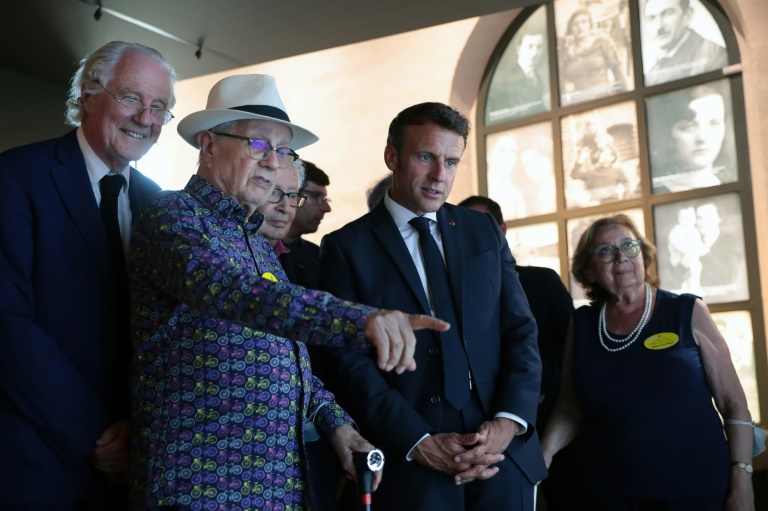
France's Macron marks 80th anniversary of WWII round-up of Jews

French President Emmanuel Macron on Sunday marked the 80th anniversary of the wartime round-up of Jews in France by calling for redoubled vigilance against the growing anti-Semitism in the country.

Macron delivered his speech at the former railway station in Pithiviers, 100 kilometres (60 miles) south of Paris, where 8,100 French Jews, including 4,400 children, were deported to Auschwitz.

Also attending the ceremony were some of the few survivors of those deported on the convoys sent to the Nazi camp.

“Eight decades ago, Vichy France betrayed these children by delivering thousands of them to their executioners,” said Macron, referring to the French wartime regime that collaborated with the Nazi occupiers.

“It is the duty of France, to be true to itself, to recognize this and to concede nothing to this contemporary fight against anti-Semitism.”

On July 16 and 17, French police rounded up 13,000 Jews in Paris and its suburbs on the orders of the Nazis.

The incident has become known as the Vel d’Hiv round-ups because many of those arrested, including the elderly and sick, were initially held at the Velodrome d’Hiver, a cycle racing track in Paris’s 15th arrondissement. 

From there, they were taken to camps at Pithiviers and other locations then onto the Nazi concentration camps. Only a few dozen ever returned.

– ‘Dark hours’ – 

“We are not done with antisemitism, and we must make a lucid assessment of it,” said Macron.

“This anti-Semitism is even more burning, rampant, than it was in 1995, in our country, in Europe, and in so many places in the world,” he stressed.

Macron was referring back to the words of one of his predecessors Jacques Chirac, who in 1995 acknowledged France’s responsibility for the Vel d’Hiv round ups.

“These dark hours stain our history forever,” said Chirac in a landmark speech. “On that day, France accomplished the irreparable”.

After Chirac, Francois Hollande went further during his presidency, speaking in a 2012 speech of a crime “committed in France, by France”.

Then in 2017 Macron, newly elected as president, reaffirmed France’s responsibility for the round-up in a speech marking its 75th anniversary and in the presence of then Israeli premier Benjamin Netanyahu.

But Macron was himself criticised for saying in 2018 that France’s Philippe Petain, who headed the Vichy regime, had been a “great soldier” during World War I, even if he had subsequently made “fatal choices”.

– ‘Persistent’ anti-Semitism –

On Sunday Macron warned that in the modern world anti-semitism “can take on other faces, drape itself in other words, other caricatures”.

“But the odious anti-Semitism is there, it prowls around, always alive, persistent, stubborn, coming back”, he continued, citing “terrorist barbarity”, “murders and crimes”, resurgences on “social networks” and the desecration of graves.

It is found, the French leader added, in debates on television, “It plays on the complacency of certain political forces. It also thrives on a new form of historical revisionism, even negationism,” he said.

He did not make any direct reference to far-right presidential candidate Eric Zemmour, who had argued that Petain had “saved” French Jews.

That claim is contested by most historians, who point to the wartime leader’s well-documented anti-Semitism.

Pithiviers railway station, which has not served passengers since the end of the 1960s, has been converted into a memorial to the Holocaust which opened earlier this month.

“This station is the place where the French event becomes European genocide,” said Jacques Fredj, the director of the Shoah Memorial, which commemorates the French deportations.

“It is a place of memory unique in France.”

'Thor' rules again at North American box office

Marvel’s latest superhero flick “Thor: Love and Thunder” pounded opponents for a second straight week to top the North American box office with an estimated $46 million haul, industry watcher Exhibitor Relations reported Sunday.

The comedic follow-up to 2017’s “Thor: Ragnarok” stars a muscle-clad, self-parodying Chris Hemsworth as the space viking who wields the mallet Mjolnir, but also finds himself pining for his ex-girlfriend Jane Foster (Natalie Portman), whose help he enlists to battle god butcher Gorr (Christian Bale).

The take was down sharply from its $144 million debut last weekend, but Thor still easily beat out “Minions: The Rise of Gru,” which scored second spot for the second straight week after a phenomenal opening weekend over the July 4th holiday. 

The latest goofy installment in Universal’s animated “Despicable Me” franchise about the reformed super-villain Gru and his yellow Minions took in $26 million in the Friday-to-Sunday period.

Third place went to “Where the Crawdads Sing,” the adaptation of Delia Owens’ novel about an abandoned girl who grows up in marshland of 1950s and 60s North Carolina and, at a murder trial years later, looks back on that rough and violent upbringing. The take was $17 million.

“This is a very good opening for a movie that combines young adult romance and suspense crime drama. Where the Crawdads Sing’s weekend number is above average, in spite of weak reviews,” said analyst David A. Gross of Franchise Entertainment Research.

“These films have never been strong overseas, and that will be the case here as well,” he added.

Dropping from third to fourth was Paramount’s “Top Gun: Maverick,” the crowd-pleasing sequel to the original 1986 film that once again features Tom Cruise as cocky US Navy test pilot Pete “Maverick” Mitchell.

The fighter ace feature, in its eighth week in theaters, has now grossed $618 million worldwide.

Baz Luhrmann’s music biopic “Elvis” — starring Austin Butler as the King alongside Tom Hanks as his exploitative manager, Colonel Tom Parker — slipped one spot to fifth in the Warner Bros film’s fourth weekend of release, at $7.6 million.

Another movie making its debut — Paramount’s animated comedy “Paws of Fury: The Legend of Hank” — scored a haul of $6.3 million for sixth place. It tells the tale of a hapless dog who is assigned to protect a village of cats.

Completing the top 10 were:

“The Black Phone” ($5.3 million)

“Jurassic World: Dominion” ($4.95 million)

“Mrs Harris goes to Paris” ($1.9 million)

“Lightyear” ($1.3 million)

Sudan forces fire tear gas at protests as death toll from tribal clashes rises

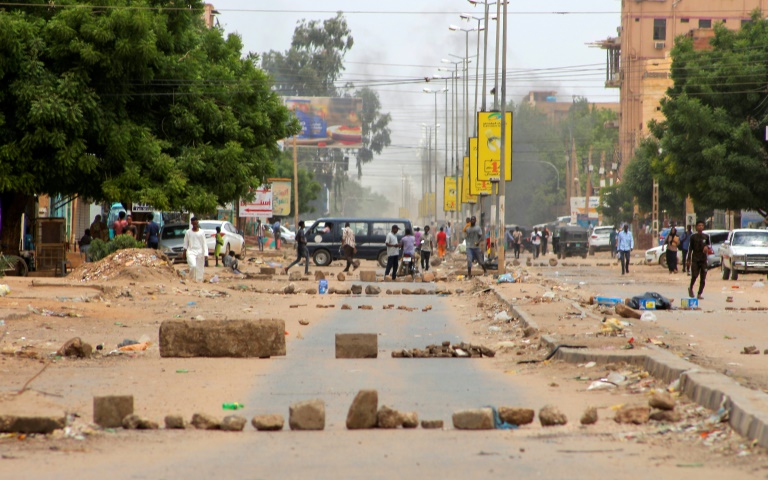
Police fired tear gas in Sudan’s capital Khartoum Sunday against hundreds of anti-coup protesters who also called attention to increasingly deadly tribal clashes in the country’s south.

The capital has been the scene of near-weekly protests since army chief General Abdel Fattah al-Burhan launched a power grab in October last year that derailed a transition to civilian rule.

The coup saw key donors pull the plug on funding, exacerbating a long-running economic crisis and feeding into inter-communal unrest in remote parts of the country.

Blue Nile state, bordering Ethiopia, is the latest crucible of tribal clashes — and on Sunday, authorities there raised the death toll to 60, from 33 the previous day, in fighting that began nearly a week ago.  

“Al-Damazin is bleeding,” read a sign held up by a Khartoum protester, referring to the provincial capital of Blue Nile.

Other demonstrators in the capital chanted: “Sudan is one nation” and “No to racism, no to tribalism.”

In the city of Wad Madani, some 200 kilometres (around 125 miles) south of Khartoum, protesters diverted their demonstration to the local hospital to “donate blood to our brothers wounded in tribal clashes in Blue Nile”, protest organiser Ammar Mohammed told AFP.

– ‘Violence not a solution’ –

The clashes in Blue Nile state, between the Berti and Hawsa tribes, first erupted last Monday. 

The violence came after the Berti tribe rejected a Hawsa request to create a “civil authority to supervise access to land”, a prominent Hawsa member had told AFP on condition of anonymity.

But a senior member of the Bertis had said the tribe was responding to a “violation” of its lands by the Hawsas.

Dozens of Hawsas blocked the western entrance to the western city of Kassala with burning tyres and stones “in solidarity with our people in the (Blue) Nile, to stop their murder and displacement”, said protester Mohammed Abkar.

The revised death toll of 60 was provided by Blue Nile health minister Jamal Nasser, who also told AFP that 163 people have been wounded.

“Violence is never a solution,” UNICEF tweeted Sunday, in a country where the UN estimates half the population will be pushed into extreme hunger by September.

– Post-coup security vacuum –

The Sudan People’s Liberation Movement-North, the main armed faction in Blue Nile, denied Sunday any involvement in the clashes.

Pro-democracy demonstrators accuse Sudan’s military leadership and ex-rebel leaders who signed a 2020 peace deal of exacerbating ethnic tensions in Blue Nile for personal gain.

Security forces had erected road blocks on bridges crossing the Nile linking Khartoum to its suburbs, AFP reporters said, to deter protesters who vowed to take to the streets in large numbers to protest against Burhan.

Sudan’s latest coup sparked regular protests and an ongoing crackdown by security forces that has killed at least 114, according to pro-democracy medics.

Nine were killed on June 30, the medics said, when tens of thousands gathered against the military.

Early this month, Burhan vowed in a surprise move to make way for a civilian government.

But the country’s main civilian umbrella group rejected his move as a “ruse” and protesters have continued to press the army chief to resign.

The rallies on Sunday follow a period of relative calm in Khartoum in recent days.

Experts say last year’s coup created a security vacuum that has fostered a resurgence in tribal violence, in a country where deadly clashes regularly erupt over land, livestock, access to water and grazing.

Guerrillas in Blue Nile battled former strongman president Omar al-Bashir during Sudan’s 1983-2005 civil war, picking up weapons again in 2011.

Prompted by enormous protests against his rule, the army ousted Bashir in 2019. 

The following year, a civilian-military power-sharing government reached a peace deal with key rebel groups, including from Blue Nile as well as the war-ravaged western Darfur region.

Both areas remain underdeveloped and awash with weapons and there has also been an increase in violence in Darfur in recent months.

Forest fires rage in scorching southwest Europe

Firefighters struggled to contain wildfires sweeping across southwest Europe on Sunday as a heatwave showed no sign of abating, with Britain poised to set new temperature records this coming week.

Blazes raging in France, Greece, Portugal and Spain have destroyed thousands of hectares of land, forced thousands of residents and holidaymakers to flee and killed several emergency personnel since last week.

It is the second heatwave to engulf parts of southwest Europe in weeks. Scientists blame climate change and predict more frequent and intense episodes of extreme weather such as heatwaves and drought.

Firefighters in France’s southwestern Gironde region were fighting to control two forest blazes that have devoured nearly 11,000 hectares (27,000 acres) since Tuesday.

The wildfires have forced more than 14,000 people — residents and tourists combined — to decamp. Seven emergency shelters have been set up to take in evacuees.

Meteo France forecast temperatures of up to 40 degrees Celsius (104 degrees Fahrenheit) in parts of southern France on Sunday, with new heat records expected on Monday.

“The heat is intensifying. The heatwave is spreading across the country,” the weather office said.

France placed 15 departments, mainly down its western seaboard, on red alert — the highest on the scale — on Sunday while 51 were on orange high alert.

The neighbouring chapel of a historic hospital in the southeastern city of Lyon, Grand Hotel Dieu, offered refuge to tourists on Sunday including Jean-Marc, 51, who was visiting from Alsace.

“We came back to admire the place but we can’t leave, it’s too hot outside. We say a prayer before the fire!” he quipped.

Authorities in the French Alps urged climbers bound for Mont Blanc, Europe’s highest mountain, to postpone their trip due to repeated rock falls caused by “exceptional climatic conditions” and “drought”.

The call comes after a section of Italy’s biggest Alpine glacier gave way at the start of the month, killing 11 people — a disaster officials blamed on climate change.

– Deaths –

Spanish authorities reported around 20 wildfires still raging out of control in different parts of the country from the south to Galicia in the far northwest, where blazes have destroyed around 4,500 hectares of land. 

Another fire burning in the Mijas mountain range inland from the southern coastal city of Malaga has so far destroyed about 2,000 hectares of land, local officials said.

The fire forced the evacuation of just over 3,000 people but around 2,000 people have since been allowed to return to their homes.

Firefighters, backed by 18 water-dropping planes, said the steep terrain of the area combined with strong winds and low humidity levels were complicating their battle against the blaze.

“We didn’t stop working all night,” regional agriculture minister Carmen Crespo told Spanish public television of efforts to quench the flames.

Spain’s national weather office, AEMET, forecast “significantly high” temperatures for most of mainland Spain and the Balearic Islands in the Mediterranean on Sunday.

The eastern town of Don Benito recorded Spain’s highest temperature on Sunday, with the mercury hitting 43.4C.

A 60-year-old street cleaner in Madrid died on Saturday after suffering heat stroke while working the previous day, local officials said.  

The fight against the flames has also claimed the lives of a number of emergency personnel, including a pilot killed when his plane crashed in northern Portugal and two who died in Greece when their helicopter fell into the sea.

– ‘Risk to life’ –

In Portugal, almost the entire country remained on high alert for wildfires despite a slight drop in temperatures, after hitting 47C — a record for the month of July — on Thursday.

Only one major fire was burning on Sunday in the north.

The fires have killed two, injured around 60 and destroyed between 12,000 and 15,000 hectares of land in Portugal.

In Greece, the civil defence service had brought a wildfire raging on the Mediterranean island of Crete since Friday under control. 

In the United Kingdom, the weather office issued a first-ever “red” warning for extreme heat, cautioning there was a “risk to life”.

The Met Office said temperatures in southern England could exceed 40C on Monday or Tuesday for the first time, leading some schools to say they would stay closed next week.

London Mayor Sadiq Khan advised people in the capital to use public transport only if “absolutely necessary”. National train operators also warned passengers to avoid travel.

Organisers of a four-day march in the Netherlands cancelled the first day of the mass event due to start on Tuesday because of extreme heat. 

The mercury is set to reach 38C in parts of the Netherlands on Tuesday.

burs-bcr-bt/ds/raz/pvh

Protesters in Panama leave part of key highway

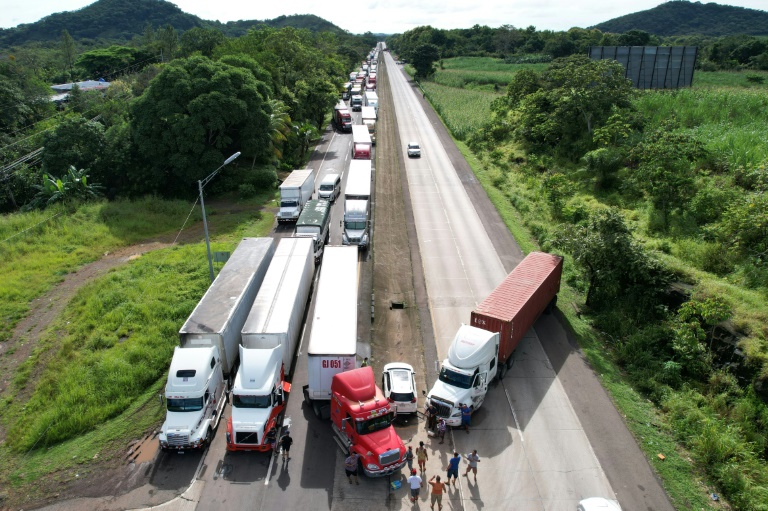
Panama’s government and indigenous leaders reached a deal Sunday to clear demonstrators from part of the Panamerican Highway in exchange for lower fuel prices, but other stretches of the strategic route remained blocked by protesters demanding more concessions.

The government released footage of the agreement being signed in a church in far west Chiriqui province, where most of the Central American country’s food is produced, and of a blocked section of the highway being cleared.

Two weeks of revolt in Chiriqui and elsewhere in Panama over high prices and corruption have made it hard to feed the country.

Despite this deal, most of Panama’s part of the Panamerican Highway, which links the country of 4.4 million people to the rest of Central America, remained clogged with large trucks and banner-waving demonstrators on Sunday.

Delegations from the government and demonstrators met again in a school in the town of Santiago de Veraguas, 250 kilometers (155 miles) southwest of Panama City.

“We ask all sides that today we be able to reach an agreement and above all clear the roads,” government ombudsman Eduardo Leblanc said at the talks.

A deal was reached Saturday to lower the price of gasoline, but the demonstrators are holding out for cuts in the prices of some 40 consumer products and medicines.

“We are keeping up the fight,” protesting farmer Juan Morales said in Capira, near Panama City.

Year-on-year inflation in Panama of 4.2 percent was recorded in May, along with an unemployment rate of about 10 percent and fuel price hikes of nearly 50 percent since January. 

Despite its dollarized economy and high growth figures, the country has a high rate of social inequality. 

Economic woes have led to a shortage of fuel in some parts of the country, and stalls at food markets in the capital have run out of products to sell. 

EU mulls tightening Russia sanctions, Ukraine says cities hit

The European Union will discuss tightening sanctions against Russia on Monday, as Kyiv accused Moscow of launching fresh strikes on multiple residential areas in eastern and southern Ukraine.

The fresh strikes came after Moscow announced that it would step up its military operations and Kyiv accused Russia of installing missile launchers at Europe’s largest nuclear plant.

With the conflict grinding on and increasingly spilling out into global energy and food crises, EU foreign ministers are considering banning gold purchases from Russia, which would align with sanctions already imposed by G7 partners.

More Russian figures could also be placed on the EU’s blacklist. 

“Moscow must continue to pay a high price for its aggression,” European Commission President Ursula von der Leyen said after forwarding the proposed measures. 

Brussels is expected to hold initial sanctions discussions Monday, but not make a same-day decision, according to a senior EU official.

On Sunday, Donetsk region governor Pavlo Kyrylenko accused Moscow of shelling “civilian infrastructure, especially education institutions”.

“I was scared,” says 23-year-old chef Igor Besukh of a nearby missile attack on Friday in Kramatorsk, where his sushi place is one of the few restaurants open just 20 kilometres (12 miles) from the frontline.

Coming back to work the next day was not easy, he admitted, however “war is war, but lunch must be served on time,” he said, quoting a popular saying with a smile.

– ‘Massive shelling’ –

Near the coast of the Black Sea, the southern city of Mykolaiv came under “massive shelling” in the early hours of Sunday, regional governor Vitaliy Kim said.

Kim added that several residential areas were shelled in the region a day earlier, with three people killed in the village of Shevchenkove and one woman killed in Shyrokiv where a “residential building was destroyed”.

In a BBC television interview broadcast on Sunday, the head of Britain’s armed forces, Admiral Tony Radakin, estimated that 50,000 Russian soldiers had been killed or wounded in the invasion with nearly 1,700 Russian tanks and some 4,000 armoured fighting vehicles destroyed.

Radakin suggested that Russia’s land forces may pose less of a threat now, but more than 20 weeks since the invasion began, Moscow said on Saturday that it would step up its military operations.  

Defence Minister Sergei Shoigu “gave the necessary instructions to further increase” military pressure, according to his ministry.

The orders come after Ukraine’s atomic energy agency accused Russians of installing missile launchers at the Zaporizhzhia nuclear plant and using the facility to shell the Dnipro region.

The heaviest fighting continues to focus on the industrial Donbas region in the east, where several villages were hit by strikes Sunday with no casualties so far.

In Warsaw, nearly 2,000 demonstrators gathered on Sunday in front of Russia’s embassy to protest the invasion of Ukraine, an AFP journalist reported.

– ‘Enough death’ –

Carrying yellow and blue Ukrainian flags and chanting “enough death!” the Ukrainian and Polish protesters demanded that Russia is recognised as a “terrorist state”.

In his Saturday evening address, Ukrainian President Volodymyr Zelensky pledged that his country would “endure”.

Zelensky said Ukraine has “withstood Russia’s brutal blows” and managed to take back some of the territory it lost since the start of the war and will eventually recapture more occupied land.

Russia’s defence ministry said in its daily briefing Sunday that it destroyed a “warehouse for Harpoon anti-ship missiles delivered to Ukraine by NATO” in the port city of Odessa.

Ukraine denied the claim, saying the destroyed the “storage facility” of a company with no military links.

Hundreds of kilometres from the frontline, Ukraine said missile strikes earlier in the week left 24 dead in the central city Vinnytsia and triggered international condemnation.

The Russian defence ministry said it had targeted a meeting in Vinnytsia of the “command of the Ukrainian Air Force with representatives of foreign arms suppliers”. 

But a senior US defence official said on condition of anonymity that he had “no indication” there was a military target nearby.

Speaking to the BBC on Sunday, Radakin said Russia poses “the biggest threat” to the United Kingdom and the challenge would endure for decades.

All eight crew killed in Ukrainian cargo plane crash in Greece

All eight crew members were killed when a Ukrainian-operated cargo plane crashed in Greece en route from Serbia to Bangladesh carrying military goods, the Serbian defence minister said Sunday.

According to a briefing by the Greek Fire Brigade Sunday afternoon two bodies were found. 

‘One body was retrieved while another one was located’, Fire Brigade spokesman, Ioannis Artopoios said. 

He also stressed that the experts haven’t found any ‘dangerous materials’. 

“Sadly, according to the information we have received, the eight members of the crew died in the crash,” Serbian Defence Minister Nebojsa Stefanovic told a news conference.

The Antonov An-12 took off from Nis airport in southern Serbia at 8:40 pm (1840 GMT) on Saturday, carrying “around 11 tonnes of military industry goods” namely mines from Valir, a private Serbian company, to the Bangladeshi defence ministry, Stefanovic said.

Ukraine’s foreign ministry said the eight crew were Ukrainian citizens. “The preliminary cause of the accident is the failure of one of the engines,” said spokesman Oleg Nikolenko on Facebook.

Denys Bogdanovych, general director of Meridian, the Ukrainian airline operating the plane, also told German broadcaster Deutsche Welle that the crew were all Ukrainian.

Witnesses said they saw the privately operated Antonov on fire and heard explosions. Videos shared on social media showed the plane engulfed by a giant fireball as it hit the ground late Saturday.

Debris was scattered across a wide area and the crash site, surrounded by fields, was visible from the air, an AFP photographer said.

“We heard a deafening noise (and saw) a fireball approaching the ground. Then came the explosion,” Sofia, a mother of three from the nearby village of Antifilipi told Athens News Agency (ANA).

The Greek fire brigade said the plane crashed at around 1100 pm (2000 GMT) near Paleochori village around 23 kilometres (14 miles) northwest of the city of Kavala in northern Greece.

– Toxic fumes –

Greek air control said the plane requested clearance to make an emergency landing at the airport in Kavala but did not make it.

The Bangladesh military confirmed that they had been the intended recipients of the cargo.

The aircraft had been carrying “training mortar shells procured from Serbia for the Bangladesh Army” and border guard before it crashed in Greece, said the military’s public relations office.

“There was no weapon in the shipment and the shipment was covered by insurance,” it added.

Biological and chemical weapons experts from the Greek army combed the crash site on Sunday, giving the “all clear” to rescue teams, according to Artopoios who added that they opened safe passages for the rescuers to recover the bodies.

Two firemen were taken to hospital early on Sunday with breathing difficulties because of toxic fumes. 

Villagers were forbidden from going into the nearby fields until authorities could remove the wreckage and unexploded munitions.

People living within a two-kilometre radius of the crash site were asked to stay inside and wear face masks late Saturday.

– ‘Engine on fire’ –

ANA said an investigation would be launched into the cause of the accident.

Local resident Giorgos Archontopoulos told Greek state broadcaster ERT he sensed something was wrong as soon as he heard the aircraft overhead.

“I went outside and saw the engine on fire,” he said. 

“If it had crashed some seconds earlier, it would have hit our house,” 80-year-old Michalis Emmanouilidis, visibly shaken, told ANA.

Ukraine’s consul in Thessaloniki, Vadim Sabluk, visited the area on Sunday and the Greek foreign ministry expressed its “sincere condolences” to the victims’ families. 

ANA said Sabluk confirmed the identities of the crew and the plane’s destination. 

Serbia’s defence minister said the weapons shipment was not linked to Russia’s war in Ukraine.

“Unfortunately, some media have speculated that the plane was carrying weapons destined for Ukraine but that is completely untrue,” he said.

Bulgaria, N.Macedonia sign deal clearing way for EU membership talks

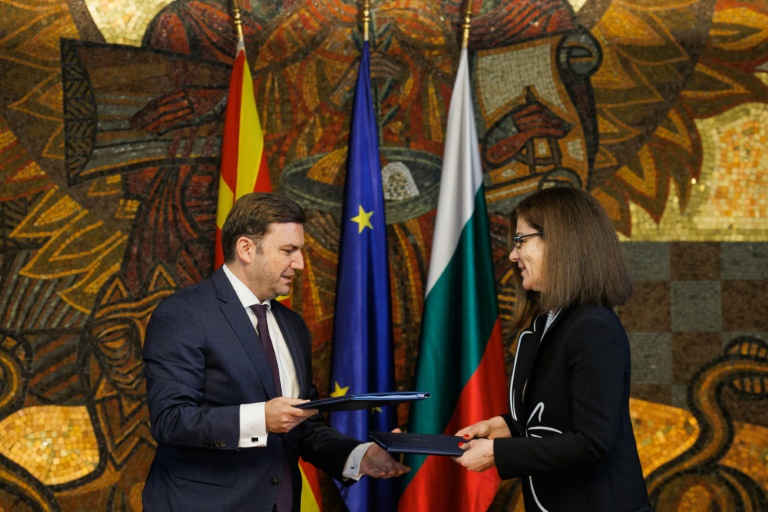
EU member Bulgaria and North Macedonia on Sunday signed a deal in Sofia opening the way for European Union membership talks for the tiny Balkan nation and its Albanian neighbour.

North Macedonia’s Prime Minister Dimitar Kovacevski announced Saturday that Skopje had reached a compromise with Bulgaria in a long-running dispute, allowing them to start the membership talks.

EU member Bulgaria had until recently blocked any progress for such talks because of a dispute between the countries over linguistic and historical issues.

The dispute also stalled Albania’s bid to join the 27-nation bloc.

But last month the Bulgarian parliament agreed to lift its veto in exchange for EU guarantees that North Macedonia will meet certain demands on contentious issues.

North Macedonian Foreign Minister Bujar Osmani on Sunday hailed the “historic opportunity” at the signing ceremony for his country to start EU membership talks. 

Czech Foreign Minister Jan Lipavsky, whose country holds the rotating EU presidency, said on Twitter: “We will do our best to start the intergovernmental conferences on accession negotiations in Brussels with North Macedonia as well as Albania as soon as possible.”

“The agreement contains ambitious measures to sort out unresolved bilateral issues,” said Bulgarian Foreign Minister Teodora Genchovska, who warned that ironing out those issues could take “months or years”.

The strategic importance of the Western Balkans to the EU has increased since Russia invaded Ukraine on February 24.

Close Bitnami banner
Bitnami