World

Forest fires rage in scorching southwest Europe

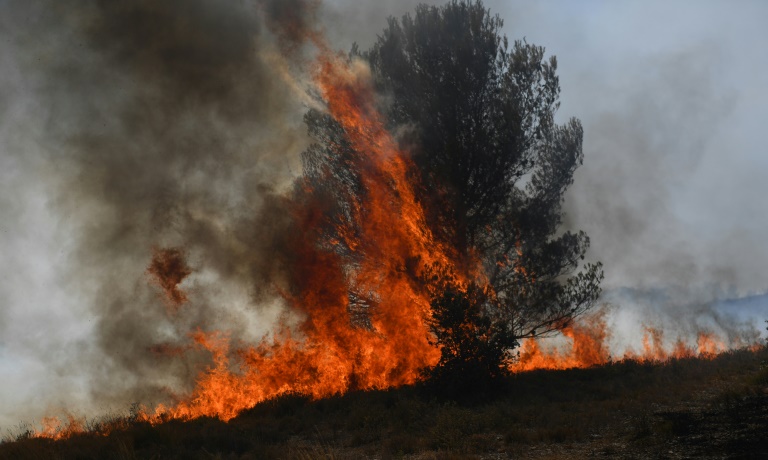
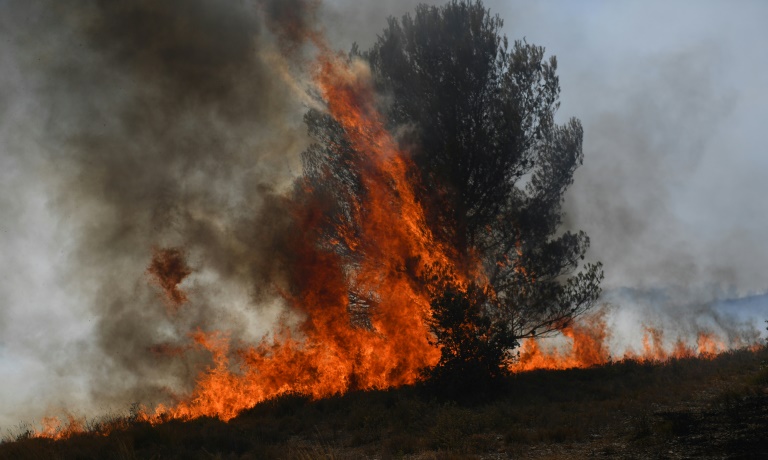
A summer heatwave that has triggered devastating forest fires across southwest Europe showed no signs of abating Sunday, as parts of the continent readied for new temperature records early next week.

Firefighters in France, Portugal, Spain and Greece are battling forest blazes that have ravaged thousands of hectares of land and killed several personnel since the start of the week.

It is the second heatwave engulfing parts of southwest Europe in weeks as scientists blame climate change and predict more frequent and intense episodes of extreme weather.

Firefighters in the coastal town of Arcachon in France’s southwestern Gironde region were fighting to control two forest blazes that have devoured more than 10,000 hectares (24,700 acres) since Tuesday.

“It’s a Herculean job,” said Lieutenant-Colonel Olivier Chavatte from the fire and rescue service, which has 1,200 firefighters and five planes in action.

Further evacuation orders were given on Saturday for a few hundred residents, firefighter spokesman Arnaud Mendousse told AFP.

“Several fires are still active in France,” interior minister Gerald Darmanin said in a tweet.

“Our firefighters are fighting the flames with remarkable courage,” he added.

Since Tuesday, more than 14,000 people — residents and tourists combined — have been forced to decamp with seven emergency shelters set up in order to receive evacuees.

Meteo France forecast temperatures of up to 41 degrees Celsius (105 degrees Fahrenheit) in parts of southern France on Sunday, as well as up to 35 in the northwest, with new heat records expected on Monday.

France late on Saturday placed 22 more departments, mainly down its Atlantic seaboard, on high orange alert, taking the current total to 38.

– ‘Extreme vigilance’ –

Authorities in the French Alps urged climbers bound for Mont Blanc, Europe’s highest mountain, to postpone their trip due to repeated rock falls caused by “exceptional climatic conditions” and “drought”.

The call comes after a section of Italy’s biggest Alpine glacier gave way at the start of the month, killing 11 people, in a disaster officials blamed on climate change.

In Portugal, the meteorological institute forecast temperatures of up to 42C with no respite before next week.

The civil defence, however, took advantage of a slight drop in temperatures after a July record of 47C on Thursday to try to stamp out one remaining major fire in Portugal’s north.

“The risk of fires remains very high,” civil defence chief Andre Fernandes warned, although media reports said mainland fires still active were down to 11 from 20 earlier.

“This is a weekend of extreme vigilance,” he added after a week which saw two people killed and more than 60 injured, and up to 15,000 hectares of forest and brushwood incinerated.

The Lisbon government was to decide on Sunday whether to extend a week-long state of contingency. 

In Spain, the national meteorological agency maintained various levels of alert across the nation, warning of up to 44C in some regions.

Dozens of forest fires were raging on Saturday in different parts of the country from the sweltering south to Galicia in the far northwest, which saw blazes lay waste to some 3,500 hectares, the regional government said.

The fight against the flames has claimed the lives of a number of personnel, from a pilot killed when his plane crashed in northern Portugal to two who died in Greece when their helicopter fell into the sea.

– ‘So sad’ –

“So sad to see part of our natural heritage ablaze,” tweeted Spain’s Economy Minister and Deputy Prime Minister Nadia Calvino.

One blaze in the south caused the authorities to cordon off for more than 12 hours a section of a key highway connecting Madrid to the Portuguese capital Lisbon, before the road reopened.

The fires have scorched thousands of hectares in the Spanish region of Extremadura, while one near the southern city of Malaga forced the preventive evacuation of more than 3,000 people, rescue services said.

In Greece, the civil defence rushed to douse flames raging on the Mediterranean island of Crete, while Morocco was battling a forest fire in its northern mountains that killed at least one person and forced the evacuation of more than 1,000 families.

In the United Kingdom, government ministers were to hold crisis talks after the state meteorological agency issued a first-ever “red” warning for extreme heat, cautioning there is a “risk to life”.

The Met Office said in southern England temperatures could exceed 40C on Monday or Tuesday for the first time, leading some schools to say they will stay closed next week.

Mayor Sadiq Khan advised Londoners to use public transport only if “absolutely necessary”. National train operators also warned passengers to avoid travel.

burs-cdw/raz/oho/reb
Biden's fist-bump with Saudi crown prince seen as undermining rights pledges

It took less than 24 hours in Saudi Arabia for US President Joe Biden to tarnish an image he has long cultivated: that of a fierce defender of human rights. 

The life of any politician is dotted with campaign pledges that ultimately backfire, and for Biden that list now includes his 2019 vow to make the desert kingdom a “pariah” over its human rights record. 

Similarly his solemn description, delivered last year on US Independence Day, of Washington’s role on the global stage: “We stand as a beacon to the world.”

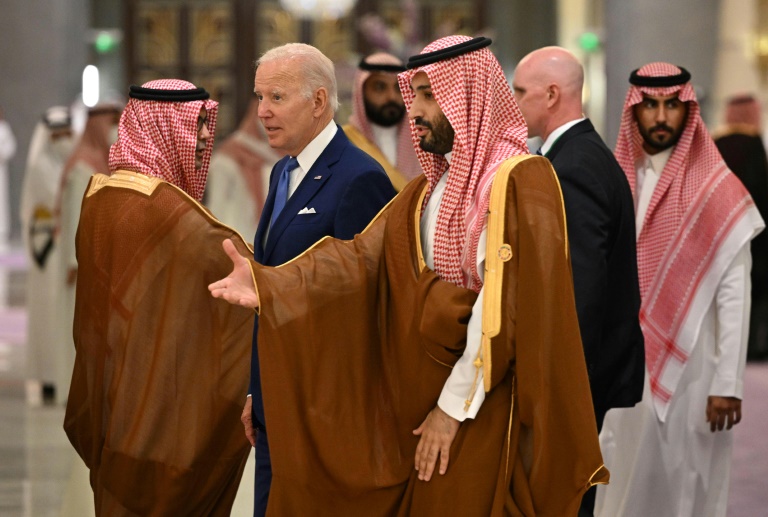
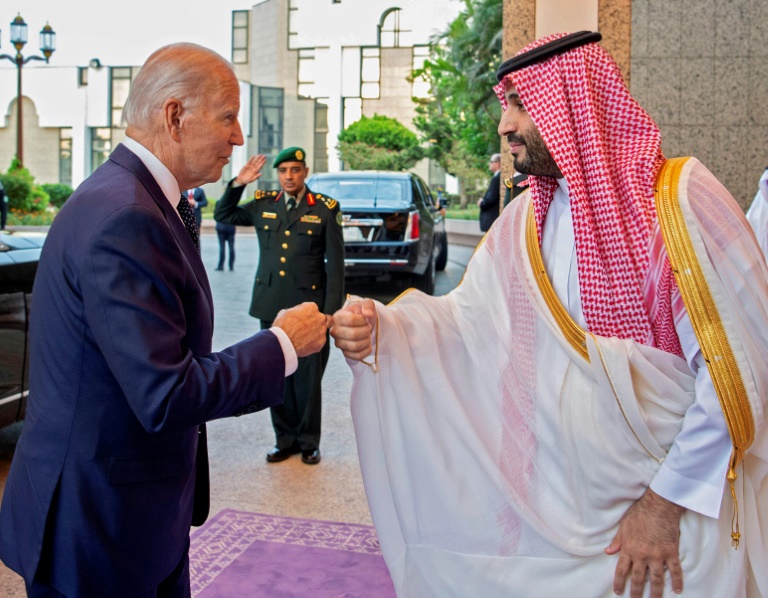
It was difficult for many to reconcile those words with the single-most searing image from Biden’s first visit to the Middle East as president: his fist-bump with Saudi Crown Prince Mohammed bin Salman.

US intelligence officials believe the crown prince, Saudi Arabia’s de facto leader, “approved” the 2018 operation that led to the killing and dismemberment of journalist Jamal Khashoggi. 

Taken outside a palace in the Red Sea coastal city of Jeddah, the fist-bump image was immediately distributed by official Saudi news outlets before doing the rounds on social media.

It eventually landed on the front page of The Washington Post, where Khashoggi was a contributing columnist.

– ‘Shameful’ –

Prior to Biden’s arrival in Jeddah, the White House took several measures to try to mitigate blowback from an encounter it knew was coming. 

Biden published a column in the Post explaining his reasons for making the trip, saying he wanted to “strengthen a strategic partnership” while insisting that “fundamental freedoms are always on the agenda when I travel abroad”. 

At the start of the tour, which took him to Jerusalem and Bethlehem before Jeddah, his communications team said Biden would limit physical contact with those he met, citing coronavirus concerns. 

Some journalists immediately speculated that the measures — which Biden ended up not fully adhering to — were motivated less by public health and more by fear of an awkward photo-op with Prince Mohammed, often referred to by his initials, MBS. 

In the end, the first-bump in Jeddah “was worse than a handshake — it was shameful”, the Post’s CEO Fred Ryan said in a statement. 

“It projected a level of intimacy and comfort that delivers to MBS the unwarranted redemption he has been desperately seeking.” 

The travelling press corps wasn’t present for the scene. By the time they arrived at the palace in Jeddah, the two leaders had already gone inside. 

But soon the “fist-bump” was inescapable, broadcast on a seemingly constant loop by state media and Saudi government social media accounts.

White House-accredited journalists faced further restrictions as Biden held his meetings with the Saudi leadership. 

They were only allowed in briefly for a meeting of the American and Saudi government delegations, and they were kept some distance from the negotiating table. 

Brief statements from Biden and Prince Mohammed were rendered inaudible as boom microphones were not permitted. 

– ‘Autocrats are smiling’ –

After his meetings with Saudi royals ended Friday evening, the White House hastily arranged for Biden to deliver brief remarks and take a few questions. 

Biden told journalists he had raised the Khashoggi case “at the top” of his meeting with Prince Mohammed, adding that he’d made clear “what I thought of it at the time and what I think of it now”. 

On Saturday, Biden told leaders from nine Arab nations assembled for a summit that “the future will be won by countries that unleash the full potential of their populations… where citizens can question and criticise leaders without fear of reprisal”. 

But the fist-bump had already become the tour’s defining shot. 

Earlier, in Israel, Biden explained his decision to go to Saudi Arabia by appearing to allude to the political compromise it represented. 

“My views on Khashoggi have been absolutely, positively clear, and I have never been quiet about talking about human rights,” he told a press conference. 

But beyond human rights, Biden said the trip was intended “to promote US interests”, a likely nod to the need to push for more oil production from the world’s biggest crude exporter, as rising gas prices hurt his party’s prospects ahead of November mid-term elections. 

Back home in the US, Biden got no sympathy from human rights activists. 

“The autocrats of the world are smiling,” Kenneth Roth, the executive director of Human Rights Watch, said on Twitter. 

“Biden’s support for human rights can be sold for a smidgen of oil.”

California's Portuguese community keeps bullfighting alive without bloodshed

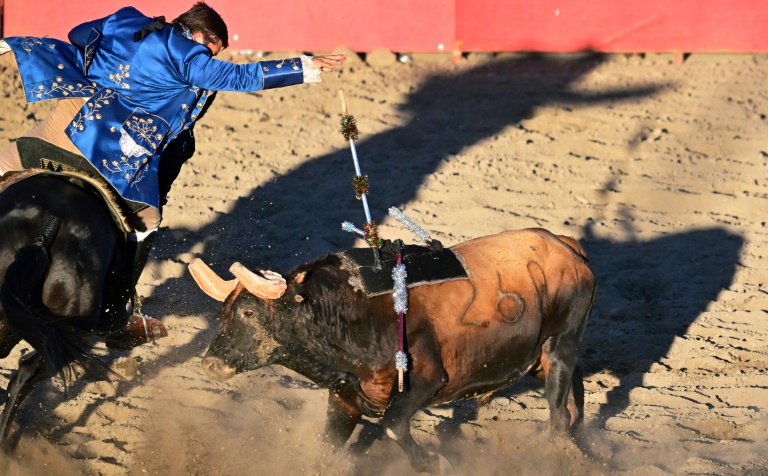
Just like any other Portuguese bullfight, the elegant rider deftly guides his horse around the charging bull’s horns, before bending down to plant a bandarilha in its spine.

Except that no blood is spilled — the small spear is velcro-padded, and sticks to a cushion attached to the bull’s back — and most of the spectators’ cheers are in English.

The scene takes place in Turlock, a small town in the heart of rural California, where tens of thousands of Portuguese-Americans have lived for decades, keeping the traditions of their ancestral homeland alive, not least bullfighting.

But due to Californian law, there can be no bloodshed. 

“The first time I came here in California, 15 years ago, it was like ‘woah, amazing’ because they have everything like Portugal,” said Joao Soller Garcia, a “cavaleiro” or horse rider, who travelled from Lisbon to take part in the bullfight.

“Go to a bullfight in Portugal and it’s the same thing,” he said shortly before entering the arena to be applauded by some 4,000 spectators.

The majority of the crowd are of Portuguese descent — mainly immigrants from the Azores islands, who began to settle this agricultural area in the early 20th century.

The community has been growing ever since, with its own newspapers, radio stations and associations.

– ‘Our lifestyle’ –

Some 350,000 Californians proudly claim Portuguese heritage, and often remain fiercely attached to their culture and language.

This is the case for Jose, 30, who came to watch the bullfight with friends.

Born in California, he switches from English to Portuguese seemingly without noticing.

“It comes naturally to me. A lot of people here speak Portuguese in their daily life, even the younger ones, ” he said.

“Sometimes it is easier for me to express my feelings or to joke in Portuguese. Portuguese is a very emotional language,” he added.

Above the arena, the Portuguese flag flies alongside the American flag, and the Portuguese national anthem strikes up before its US counterpart.

The bullfight itself is organized by a religious group, led by Antonio Mendes, a cattle breeder in his 70s who revived the tradition in 1993.

“We’re Portuguese and that’s part of our lifestyle, especially the island that I’m from — it’s just rooted,” he said.

– Grab by the horns –

Portuguese bullfights differ from the Spanish style, in that the animal is never killed in the arena.

But in traditional Portuguese events, the bull has been weakened by several bandarilha strikes by the time the “forcados” — eight men with no horses or protection — enter the arena to tackle the animal with their bare hands.

Because the bulls in Turlock are not hurt, breeders like Mendes have created a bloodline which is just as combative, but less heavy.

“Here the bulls weigh about 900 to 1000 pounds, because it’s bloodless. In Portugal, they are 1300, 1400 pounds. Big bulls,” said George Martins, a “forcado” captain.

Teams like Martins’ are often dubbed “suicide squads” for a reason — one of them literally has the task of grabbing the bull by the horns, suffering powerful headbutts to the stomach as his companions wrestle with the animal.

“It’s not just brute strength… it takes a lot of technique,” he said.

– ‘It sucks!’ –

Joao Soller Garcia, the “cavaleiro,” enjoys both the classic Portuguese style and its Californian adaptation.

“Compared to Portugal, it is a little bit more danger because the bull is not hurt,” he said.

“It’s completely bloodless and we have to be more careful… the bull is at full strength.”

But for Maxine Sousa-Correia, from a family of cattle breeders who have produced bulls for Californian fights since the 1970s, the use of velcro bandarilhas diminishes the spectacle.

“Unfortunately, this is a mere imitation… We invented the velcro pad and the Velcro on the end of the stick just so that it would at least add some color and some pageantry,” she said. 

“But at the same time, we’re not doing justice to this animal, because this is what this breed is all is for.

Her husband Frank Correia added: “I think it sucks!”

“It should be done the way it is in Portugal. But we can’t because we’re in the United States of America and, you know, they don’t appreciate the art.”

'Fire of Love' charts romance and death of volcano-chasing scientists

French scientists Maurice and Katia Krafft were brought together, and eventually killed, by their shared love of volcanoes.

Now the married couple are the subject of “Fire of Love,” a new film constructed from hours of dazzling, terrifying and occasionally quirky footage they shot close to — and even inside — erupting craters.

Playing in a limited number of US theaters, the documentary from National Geographic and prestigious indie distributor Neon (“Parasite”) is earning rave reviews and generating early awards buzz.

Director Sara Dosa first stumbled upon the pair’s “spectacular imagery” while researching another documentary about Icelandic volcanoes — but was drawn more to the “love that just radiates behind the lens, unlike anything else.”

For 25 years, the Kraffts had traveled the world together in search of active volcanoes, writing some 20 books and making five feature films, plus countless television programs and lectures.

But they are perhaps best remembered today for their deaths side-by-side on Japan’s Mount Unzen volcano, which erupted in 1991 after nearly two centuries dormant, sending a fatal cloud of gas and ash surging down its eastern flank.

“Fire of Love” begins and ends with this tragic information — yet it spends the bulk of its running time on the “love triangle” between the couple and their lifelong obsession.

“Once we really learned about them as people… and the fact that they were married and also seemed to be in love with volcanoes — that’s when we thought, ‘okay, we want to make a film of these people,'” Dosa told AFP.

“We wanted to tell kind of a mythic love story that was told through the language of volcanoes,” she added.

“That’s what drew them together in the first place, and that was the propulsive material, the fuel of their relationship.”

– ‘Reckless love’ –

While Maurice was the more extroverted and ostensibly thrill-seeking of the pair — he paddles in an acid lake and plots to kayak down an active lava stream — Katia was similarly courageous in the face of peril.

Their gung-ho approach drew criticism from some of their scientific peers, but “I don’t think that we ever found them reckless, quite honestly,” said Dosa.

“They ultimately did lead a deeply meaningful life and die a meaningful death. And so much of that was this pursuit of love,” she added.

“I’m sure many people will say perhaps it was a reckless love, but for us, it was the way for them to live.”

After witnessing the staggering 1980 eruption of Mount St Helens in the northwestern United States, and the Nevado del Ruiz disaster that killed up to 25,000 Colombians five years later, the pair reoriented their work to lobby governments for better evacuation planning.

“Since they were some of the only people really capturing those images, they were uniquely suited to do that advocacy work,” said Dosa.

“And that is literally what they were trying to do as they died on mountains in 1991.”

– ‘Salve’ –

Aside from informing modern audiences about the pair’s work, Dosa hopes the film can remind viewers that the planet is not simply “a resource to be capitalized upon.” 

“These kinds of stories about the aliveness, the sentience of the Earth, are all the more important to counteract the exploitation,” she said.

Making the film during the pandemic and “having these guides, Katia and Maurice, teaching you how to navigate the unknown, and who knew how to reconcile fear — that was such a salve and a refuge for us.”

And then there is the aesthetic beauty of the footage itself, full of glowing red lava and alien-looking volcanic landscapes, all captured in a distinctive style with “the hallmarks of the French New Wave.”  

“For example, in the cinematography, there was a lot of playful snap zooms, which reminded us of films in France from the 60s and 70s,” she said.

“And their own writing — they authored nearly 20 books — almost recalled the bombastic and playful spirit of narration in Truffaut films.”

Dosa herself drew on that style, including the documentary’s own, breathy narration.

“One of the great narrative devices of the French New Wave was love triangle stories,” said Dosa.

“And for us, that was something that felt appropriate. Katia and Maurice truly did seem to have a third in their relationship — volcanoes.”

US won't 'walk away' from Middle East, Biden tells Arab leaders

President Joe Biden on Saturday assured Arab leaders the United States would remain fully engaged in the Middle East, as he wrapped up his first tour of the region since taking office.

“We will not walk away and leave a vacuum to be filled by China, Russia or Iran,” Biden said during a summit in Jeddah, on the Red Sea coast of Saudi Arabia.

US ties to Gulf powers in particular have been roiled by multiple issues in recent years, notably Washington’s push for a deal to curb Iran’s suspect nuclear programme and its tepid response to attacks on Saudi oil facilities in 2019 claimed by Yemen’s Iran-backed Huthi rebels.

The summit, the final stop of Biden’s Middle East tour, brought together the six members of the Gulf Cooperation Council as well as Egypt, Jordan and Iraq.

Biden had been looking to use the trip to discuss volatile oil prices and outline his vision for Washington’s role in the region.

On Friday he met Saudi King Salman and Crown Prince Mohammed bin Salman, the kingdom’s de facto ruler who US intelligence agencies assess “approved” the 2018 operation that killed journalist Jamal Khashoggi.

After a fist-bump with Prince Mohammed, Biden said he raised the Khashoggi case and warned against future attacks on dissidents.

Prince Mohammed, who chaired the opening of Saturday’s summit, has denied any role in the death of Khashoggi, who was dismembered in the kingdom’s Istanbul consulate and whose remains have never been found.

Biden told the assembled Arab leaders that “the future will be won by countries that unleash the full potential of their populations… where citizens can question and criticise leaders without fear of reprisal”.

– Ukraine tensions –

Air Force One took off from Jeddah at around 5:00 pm (1400 GMT) on Saturday, bringing Biden’s four-day visit to a close.

Hours later a joint statement was released in which the leaders committed to “preserve regional security and stability” and deepen their defense and intelligence cooperation.

It also underscored diplomatic efforts to prevent Iran from developing a nuclear weapon, and notably called for enhanced joint deterrence capabilities “against the increasing threat” posed by unmanned aerial vehicles — a likely reference to Tehran, which on Friday unveiled ships capable of carrying armed drones.

Biden said Washington would commit $1 billion in food aid to the Middle East and North Africa amid rising food insecurity induced by the war in Ukraine.

Russia’s invasion of Ukraine has exposed a once unthinkable divergence between Washington and key Middle East allies Saudi Arabia and the United Arab Emirates, the oil giants that are increasingly independent on the international stage.

The wealthy Gulf nations, which host US forces and have dependably backed Washington for decades, have notably refrained from supporting the Biden administration as it tries to choke Moscow’s lifelines, from energy to diplomacy.

Analysts say the new position reveals a turning point in Gulf relations with the United States, long the region’s protector against neighbour Iran.

In their joint statement, the leaders “recognized ongoing efforts of OPEC+ towards stabilizing the global oil market,” and welcomed the recent announcement by the Organization of Petroleum Exporting Countries to “increase supply over the course of July and August.”

– Push for oil –

Saturday brought some conciliatory gestures, with Biden inviting Emirati leader, Sheikh Mohamed bin Zayed Al-Nahyan, to visit the White House before the year is up.

And in his summit remarks, Saudi Prince Mohammed said he hoped it would “establish a new era of joint cooperation to deepen the strategic partnership between our countries and the United States of America, to serve our common interests and enhance security and development in this vital region for the whole world.”

Riyadh and Washington signed 18 agreements Friday on areas including energy, space, health and investment, including developing 5G and 6G technology, a Saudi statement said.

The two nations, in a joint statement, also voiced a “commitment to the stability of global energy markets,” while acknowledging the importance of cooperation “in light of the current crisis in Ukraine and its repercussions.”

Saudi Arabia agreed to link the electricity networks of the Gulf Cooperation Council to Iraq, which relies heavily on energy from Iran, “in order to provide Iraq and its people with new and diversified electricity sources,” the White House said.

Washington wants Riyadh to open the oil floodgates to bring down soaring gasoline prices, which threaten Democratic chances in November mid-term elections.

But Biden on Friday tried to tamp down expectations his trip would yield immediate gains.

“I’m doing all I can to increase the supply for the United States of America,” he said.

– Israeli ties –

White House officials used the trip as a bid to promote integration between Israel and Arab nations.

That process appeared to get a boost Friday when Saudi Arabia announced it was lifting restrictions on civilian air carriers, a move that allows flights to and from Israel to use its airspace for the first time.

But Saudi foreign minister Prince Faisal bin Farhan told reporters after Biden’s departure that the move had nothing to do with Israel and was “not in any way a precursor to any further steps”.

G20 chair Indonesia says 'many' nations condemned Russia at talks

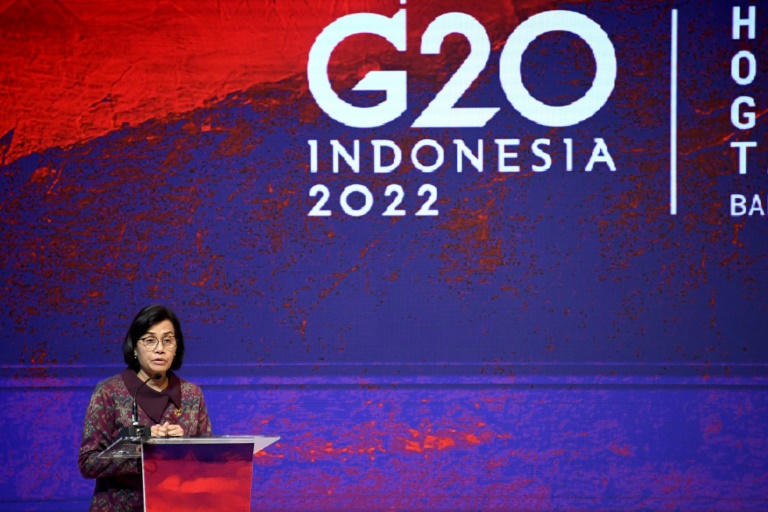
Many nations in the Group of 20 major economies condemned Russia’s invasion of Ukraine and called for it to end the war during ministerial talks in Indonesia, the host said in its closing statement early Sunday.

A two-day gathering of finance ministers and central bank governors on the resort island of Bali ended without a joint communique because of disagreements with Russia about the war.

But Western nations pressed Russia over the military assault, accusing Moscow of sending a shockwave through the global economy and its technocrats of complicity in alleged war crimes committed during the invasion.

“Many members agreed that the recovery of the global economy has slowed and is facing a major setback as a result of Russia’s war against Ukraine, which was strongly condemned, and called for an end to the war,” Indonesia said in the declaration.

Jakarta, which has been balancing its neutral foreign policy stance with hosting the G20 summit in November, replaced a joint communique with a 14-paragraph chair’s statement that did not fall under the forum’s banner and included two sections on members’ differences.

“One member expressed the view that the sanctions are adding to existing challenges,” it said, in an apparent reference to Russia, which has denied blame for the current global economic headwinds.

There was also no G20-wide consensus on the global food crisis exacerbated by Russia’s invasion, which is threatening to leave millions in developing nations at risk of hunger.

“The majority of members agreed that there is an alarming increase of food and energy insecurity,” Indonesia said. 

“Many members stand ready to take prompt collective actions.”

The failure to secure a joint communique came a week after Russian Foreign Minister Sergei Lavrov walked out of G20 talks in Bali over criticism of Moscow. 

Russia only sent a deputy minister to the finance talks, with its finance minister participating virtually.

In other areas, all members reaffirmed their commitment to implementing international tax rule changes set to come into force in 2024, coordinating policies to control the Covid-19 pandemic, and tackling rising inflation and climate change.

The next meeting of G20 finance ministers will take place in October in Washington.

G20 finance talks overshadowed by Ukraine end without joint communique

A two-day meeting of finance ministers from the Group of 20 major economies ended Saturday in Indonesia without a joint communique after Russia’s war in Ukraine divided the global forum.

During talks on the Indonesian resort island Bali, the finance chiefs looked for solutions to food and energy crises, while accusing Russian technocrats of exacerbating the problems.

US Treasury Secretary Janet Yellen, Australian Treasurer Jim Chalmers and Canadian Finance Minister Chrystia Freeland on Friday blamed the invasion of Ukraine for sending a shockwave through the global economy.

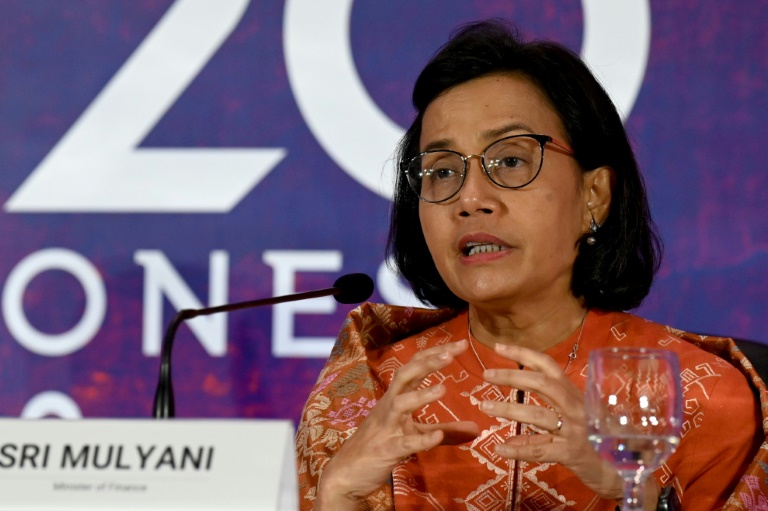
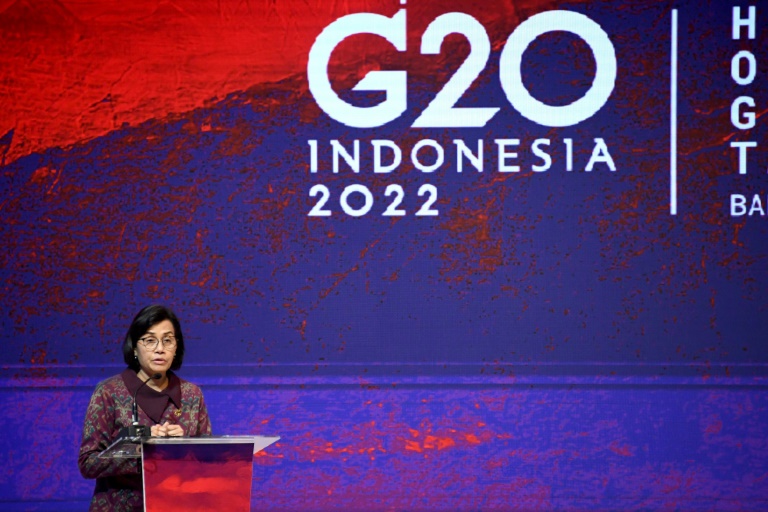
In place of a formal communique would be a 14-paragraph statement issued by Indonesia, the G20 chair’s Finance Minister Sri Mulyani Indrawati said in closing remarks.

She said there was consensus on most of the document but two paragraphs would focus on members’ differences regarding the war’s impacts and how to respond.

“I think this is the best result,” she said.

– No place at talks –

At the beginning of the second day of talks, Indonesian central bank governor Perry Warjiyo called on ministers and global finance leaders to concentrate on recovery in a world economy reeling from the Covid-19 pandemic.

The meeting took place after the International Monetary Fund slashed its global growth forecast, with another downgrade expected this month as US inflation stokes fears of a recession.

But the talks have been overshadowed by the Ukraine war after it roiled global markets, caused rising food prices and added to breakneck inflation.

Canada called Russia’s participation in the summit “inappropriate and frankly, just absurd.”

“That is because Russia is directly and solely responsible for the illegal invasion of Ukraine, and its economic consequences, which are being felt by us all,” Freeland told reporters Saturday.

The Kremlin calls the war a “special military operation” and blames retaliatory Western sanctions for blocking food shipments and rising energy prices.

Russian Finance Minister Anton Siluanov and Ukrainian Finance Minister Serhiy Marchenko participated virtually in the meeting.

Russian Deputy Finance Minister Timur Maksimov attended the talks in person a week after Foreign Minister Sergei Lavrov walked out of a G20 meeting over Western criticism of the invasion.

Maksimov was in the room as Western officials expressed their condemnation, according to a source present. Marchenko called for “more severe targeted sanctions” against Moscow.

– ‘Uncharted waters’ –

Indonesia has refrained from uninviting Russia from G20 meetings, including a leaders’ summit in November, even as Western nations repeated their calls for Moscow to be frozen out of the group.

Both Yellen and Freeland, who has Ukrainian heritage, said representatives of Russian President Vladimir Putin’s government had no place at talks.

Observers said the failure to agree on a joint communique would hinder coordinated efforts to solve rising inflation and food shortages.

“The lack of a G20 finance ministers’ communique means it will be more difficult for the G20 to forge a consensus on vital issues in the fall,” said Eric LeCompte, executive director of Jubilee USA Network, an NGO that lobbies for developing nation debt relief.

“Internal divisions hinder the G20’s ability to act decisively and leaves the world in uncharted waters.”

Yellen held bilateral meetings with counterparts from Indonesia, Saudi Arabia, South Africa, Australia, Singapore and Turkey, the Treasury said, lobbying their support for a price cap on Russian oil to cut off Putin’s war chest.

In response to the food crisis, the IMF, World Bank, World Food Programme, Food and Agriculture Organization and the World Trade Organization also called for action in four areas.

“Support the vulnerable, facilitate trade, boost food production & invest in climate-resilient agriculture,” IMF chief Kristalina Georgieva tweeted late Friday, summarising the call to action.

Members also discussed sustainable finance, cryptocurrencies and international taxation on Saturday.

Mulyani said “progress” was made on international tax rule changes that will set a global minimum corporate tax rate of 15 percent by 2024.

G20 finance talks overshadowed by Ukraine end without joint communique

A two-day meeting of finance ministers from the Group of 20 major economies ended Saturday in Indonesia without a joint communique after Russia’s war in Ukraine divided the global forum.

During talks on the Indonesian resort island Bali, the finance chiefs looked for solutions to food and energy crises, while accusing Russian technocrats of exacerbating the problems.

US Treasury Secretary Janet Yellen, Australian Treasurer Jim Chalmers and Canadian Finance Minister Chrystia Freeland on Friday blamed the invasion of Ukraine for sending a shockwave through the global economy.

In place of a formal communique would be a 14-paragraph statement issued by Indonesia, the G20 chair’s Finance Minister Sri Mulyani Indrawati said in closing remarks.

She said there was consensus on most of the document but two paragraphs would focus on members’ differences regarding the war’s impacts and how to respond.

“I think this is the best result,” she said.

– No place at talks –

At the beginning of the second day of talks, Indonesian central bank governor Perry Warjiyo called on ministers and global finance leaders to concentrate on recovery in a world economy reeling from the Covid-19 pandemic.

The meeting took place after the International Monetary Fund slashed its global growth forecast, with another downgrade expected this month as US inflation stokes fears of a recession.

But the talks have been overshadowed by the Ukraine war after it roiled global markets, caused rising food prices and added to breakneck inflation.

Canada called Russia’s participation in the summit “inappropriate and frankly, just absurd.”

“That is because Russia is directly and solely responsible for the illegal invasion of Ukraine, and its economic consequences, which are being felt by us all,” Freeland told reporters Saturday.

The Kremlin calls the war a “special military operation” and blames retaliatory Western sanctions for blocking food shipments and rising energy prices.

Russian Finance Minister Anton Siluanov and Ukrainian Finance Minister Serhiy Marchenko participated virtually in the meeting.

Russian Deputy Finance Minister Timur Maksimov attended the talks in person a week after Foreign Minister Sergei Lavrov walked out of a G20 meeting over Western criticism of the invasion.

Maksimov was in the room as Western officials expressed their condemnation, according to a source present. Marchenko called for “more severe targeted sanctions” against Moscow.

– ‘Uncharted waters’ –

Indonesia has refrained from uninviting Russia from G20 meetings, including a leaders’ summit in November, even as Western nations repeated their calls for Moscow to be frozen out of the group.

Both Yellen and Freeland, who has Ukrainian heritage, said representatives of Russian President Vladimir Putin’s government had no place at talks.

Observers said the failure to agree on a joint communique would hinder coordinated efforts to solve rising inflation and food shortages.

“The lack of a G20 finance ministers’ communique means it will be more difficult for the G20 to forge a consensus on vital issues in the fall,” said Eric LeCompte, executive director of Jubilee USA Network, an NGO that lobbies for developing nation debt relief.

“Internal divisions hinder the G20’s ability to act decisively and leaves the world in uncharted waters.”

Yellen held bilateral meetings with counterparts from Indonesia, Saudi Arabia, South Africa, Australia, Singapore and Turkey, the Treasury said, lobbying their support for a price cap on Russian oil to cut off Putin’s war chest.

In response to the food crisis, the IMF, World Bank, World Food Programme, Food and Agriculture Organization and the World Trade Organization also called for action in four areas.

“Support the vulnerable, facilitate trade, boost food production & invest in climate-resilient agriculture,” IMF chief Kristalina Georgieva tweeted late Friday, summarising the call to action.

Members also discussed sustainable finance, cryptocurrencies and international taxation on Saturday.

Mulyani said “progress” was made on international tax rule changes that will set a global minimum corporate tax rate of 15 percent by 2024.

Forest fires rage in scorching southwest Europe

Southwest Europe endured a sixth day of a summer heatwave on Saturday that has triggered devastating forest fires as parts of the continent braced for new temperature records early next week.

Firefighters in France, Portugal, Spain and Greece battled forest blazes that have ravaged thousands of hectares of land and killed several personnel since the start of the week.

It is the second heatwave engulfing parts of southwest Europe in weeks as scientists blame climate change and predict more frequent and intense episodes of extreme weather.

Firefighters in the coastal town of Arcachon in France’s southwestern Gironde region were fighting to control two forest blazes that have devoured more than 10,000 hectares (24,700 acres) since Tuesday.

“It’s a Herculean job,” said Lieutenant-Colonel Olivier Chavatte from the fire and rescue service, which has 1,200 firefighters and five planes in action.

Further evacuation orders were given on Saturday for a few hundred residents, firefighter spokesman Arnaud Mendousse told AFP.

Since Tuesday, more than 14,000 people in total — residents and tourists combined — have been forced to decamp with seven emergency shelters set up in order to receive evacuees.

Meteo France forecast temperatures of up to 41 degrees Celsius (105 degrees Fahrenheit) in parts of southern France on Sunday, as well as up to 35 in the northwest, with new heat records expected on Monday.

France late on Saturday placed 22 more departments, mainly down its Atlantic seaboard, on high orange alert, taking the current total to 38.

– ‘Extreme vigilance’ –

Authorities in the French Alps urged climbers bound for Mont Blanc, Europe’s highest mountain, to postpone their trip due to repeated rock falls caused by “exceptional climatic conditions” and “drought”.

The call comes after a section of Italy’s biggest Alpine glacier gave way at the start of the month, killing 11 people, in a disaster officials blamed on climate change.

In Portugal, the meteorological institute forecast temperatures of up to 42C with no respite before next week.

The civil defence, however, took advantage of a slight drop in temperatures after a July record of 47C on Thursday to try to stamp out one remaining major fire in Portugal’s north.

“The risk of fires remains very high,” civil defence chief Andre Fernandes warned, although media reports said mainland fires still active were down to 11 from 20 earlier.

“This is a weekend of extreme vigilance,” he added after a week which saw two people killed and more than 60 injured, and up to 15,000 hectares of forest and brushwood incinerated.

The Lisbon government was to decide on Sunday whether to extend a week-long state of contingency. 

In Spain, the national meteorological agency maintained various levels of alert across the nation, warning of up to 44C in some regions.

Dozens of forest fires were raging on Saturday in different parts of the country from the sweltering south to Galicia in the far northwest, which saw blazes lay waste to some 3,500 hectares, the regional government said.

– ‘So sad’ –

“So sad to see part of our natural heritage ablaze,” tweeted Spain’s Economy Minister and Deputy Prime Minister Nadia Calvino.

One blaze in the south caused the authorities to cordon off for more than 12 hours a section of a key highway connecting Madrid to the Portuguese capital Lisbon, before the road reopened.

The fires have scorched thousands of hectares in the Spanish region of Extremadura, while one near the southern city of Malaga forced the preventive evacuation of more than 3,000 people, rescue services said.

In Greece, the civil defence rushed to douse flames raging on the Mediterranean island of Crete, while Morocco was battling a deadly forest fire in its northern mountains.

In the United Kingdom, government ministers were to hold crisis talks after the state meteorological agency issued a first-ever “red” warning for extreme heat, cautioning there is a “risk to life”.

The Met Office said in southern England temperatures could exceed 40C on Monday or Tuesday for the first time, leading some schools to say they will stay closed next week.

Mayor Sadiq Khan advised Londoners to use public transport only if “absolutely necessary”. National train operators also warned passengers to avoid travel.

burs-cdw/raz

Forest fires rage in scorching southwest Europe

Southwest Europe endured a sixth day of a summer heatwave on Saturday that has triggered devastating forest fires as parts of the continent braced for new temperature records early next week.

Firefighters in France, Portugal, Spain and Greece battled forest blazes that have ravaged thousands of hectares of land and killed several personnel since the start of the week.

It is the second heatwave engulfing parts of southwest Europe in weeks as scientists blame climate change and predict more frequent and intense episodes of extreme weather.

Firefighters in the coastal town of Arcachon in France’s southwestern Gironde region were fighting to control two forest blazes that have devoured more than 10,000 hectares (24,700 acres) since Tuesday.

“It’s a Herculean job,” said Lieutenant-Colonel Olivier Chavatte from the fire and rescue service, which has 1,200 firefighters and five planes in action.

Further evacuation orders were given on Saturday for a few hundred residents, firefighter spokesman Arnaud Mendousse told AFP.

Since Tuesday, more than 14,000 people in total — residents and tourists combined — have been forced to decamp with seven emergency shelters set up in order to receive evacuees.

Meteo France forecast temperatures of up to 41 degrees Celsius (105 degrees Fahrenheit) in parts of southern France on Sunday, as well as up to 35 in the northwest, with new heat records expected on Monday.

France late on Saturday placed 22 more departments, mainly down its Atlantic seaboard, on high orange alert, taking the current total to 38.

– ‘Extreme vigilance’ –

Authorities in the French Alps urged climbers bound for Mont Blanc, Europe’s highest mountain, to postpone their trip due to repeated rock falls caused by “exceptional climatic conditions” and “drought”.

The call comes after a section of Italy’s biggest Alpine glacier gave way at the start of the month, killing 11 people, in a disaster officials blamed on climate change.

In Portugal, the meteorological institute forecast temperatures of up to 42C with no respite before next week.

The civil defence, however, took advantage of a slight drop in temperatures after a July record of 47C on Thursday to try to stamp out one remaining major fire in Portugal’s north.

“The risk of fires remains very high,” civil defence chief Andre Fernandes warned, although media reports said mainland fires still active were down to 11 from 20 earlier.

“This is a weekend of extreme vigilance,” he added after a week which saw two people killed and more than 60 injured, and up to 15,000 hectares of forest and brushwood incinerated.

The Lisbon government was to decide on Sunday whether to extend a week-long state of contingency. 

In Spain, the national meteorological agency maintained various levels of alert across the nation, warning of up to 44C in some regions.

Dozens of forest fires were raging on Saturday in different parts of the country from the sweltering south to Galicia in the far northwest, which saw blazes lay waste to some 3,500 hectares, the regional government said.

– ‘So sad’ –

“So sad to see part of our natural heritage ablaze,” tweeted Spain’s Economy Minister and Deputy Prime Minister Nadia Calvino.

One blaze in the south caused the authorities to cordon off for more than 12 hours a section of a key highway connecting Madrid to the Portuguese capital Lisbon, before the road reopened.

The fires have scorched thousands of hectares in the Spanish region of Extremadura, while one near the southern city of Malaga forced the preventive evacuation of more than 3,000 people, rescue services said.

In Greece, the civil defence rushed to douse flames raging on the Mediterranean island of Crete, while Morocco was battling a deadly forest fire in its northern mountains.

In the United Kingdom, government ministers were to hold crisis talks after the state meteorological agency issued a first-ever “red” warning for extreme heat, cautioning there is a “risk to life”.

The Met Office said in southern England temperatures could exceed 40C on Monday or Tuesday for the first time, leading some schools to say they will stay closed next week.

Mayor Sadiq Khan advised Londoners to use public transport only if “absolutely necessary”. National train operators also warned passengers to avoid travel.

burs-cdw/raz

Close Bitnami banner
Bitnami