World

China's Xi makes first Xinjiang visit since crackdown

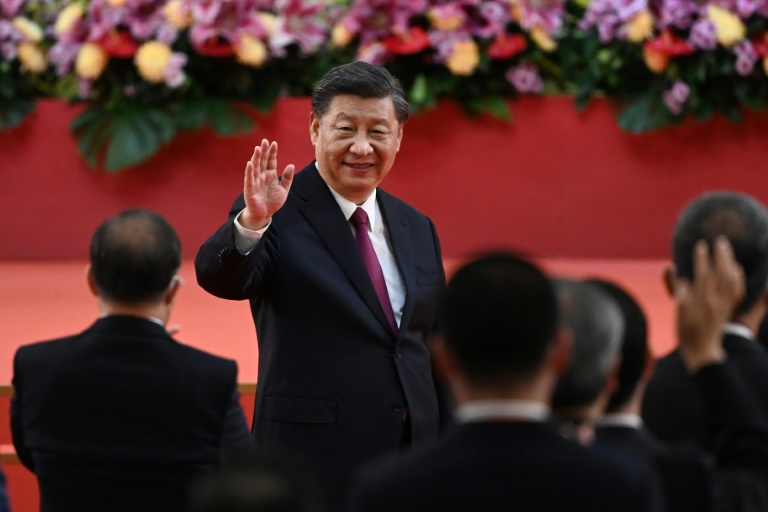
Chinese President Xi Jinping made a public visit to Xinjiang, state media reported Friday, his first since a crackdown in the region saw Beijing accused of detaining over a million Uyghurs and other Muslim minorities in camps.

The United States and lawmakers in other Western countries have labelled China’s actions in Xinjiang a “genocide”, imposing sanctions over the alleged human rights abuses.

Beijing has denied the allegations, calling them the “lie of the century” and insisting that its policies have helped combat the threat of Islamic extremism.

State news agency Xinhua said Xi hailed the strides made during an inspection tour of the far-western region — his first since 2014, when three people were killed in an attack that presaged the start of the mass detention campaign three years later. 

He also reportedly praised the work of the Xinjiang Production and Construction Corps (XPCC), a sprawling paramilitary organisation sanctioned by the United States for alleged human rights abuses.

The group had made “great progress” in reform and development, Xinhua reported Xi as saying during a Wednesday trip to the city of Shihezi in the region’s north.

State media footage showed Xi speaking to students and local officials, taking in a song and dance performance, and receiving rapturous applause from residents in traditional clothing.

The Chinese leader’s sojourn to Xinjiang comes after a similarly rare visit earlier this month to another formerly restive territory, Hong Kong, where authorities have come down hard on the city’s once-thriving pro-democracy movement.

It also comes ahead of a key party congress later this year, when Xi is widely expected to break with decades of Communist Party precedent and secure a third consecutive term at the helm of the world’s second-largest economy.

– ‘Arbitrary and indiscriminate’ –

Rights campaigners accuse China of a litany of abuses in Xinjiang, including mass incarceration, forced labour, compulsory sterilisation, and the destruction of Uyghur cultural and religious sites.

Beijing vehemently rejects the claims and insists the centres are vocational and voluntary training facilities.

It claims the allegations are part of a plot by the United States and other Western nations to smear China and contain its rise.

During a rare visit to China in May, Michelle Bachelet, the United Nations’ human rights chief, urged Beijing to avoid “arbitrary and indiscriminate” measures in Xinjiang.

But she acknowledged the harm caused by “violent acts of extremism” and declined to call her trip an “investigation”.

Bachelet’s remarks were criticised by campaigners and former detainees, who accused her of capitulating to a stage-managed tour of the region orchestrated by Beijing.

India reports first case of monkeypox

India has reported its first confirmed case of monkeypox after a 35-year-old man with a history of travel to the Middle East showed symptoms, officials said.

The federal government rushed a multi-disciplinary team to the southern state of Kerala in view of the confirmed case of monkeypox there, according to an official statement.

The man, who travelled from the United Arab Emirates to Kerala on Tuesday, was in stable condition and isolated at a hospital, the state’s health minister Veena George told reporters Thursday.

“He is stable and all his vital signs are normal. We have asked all districts to be on alert,” she said.

The patient’s primary contacts have also been isolated while passengers who came in contact with him on his flight have been told to monitor themselves for symptoms.

Monkeypox is an infectious disease caused by a virus transmitted to humans by infected animals. Human-to-human transmission is possible but considered rare.

A surge in monkeypox infections has been reported since early May outside the West and Central African countries where the disease has long been endemic.

So far, confirmed cases in non-endemic areas are generally mild and no deaths have been reported.

It is considered much less dangerous and contagious than smallpox, which was eradicated more than 40 years ago.

The first symptoms of monkeypox are a fever above 38.5 degrees Celsius, headaches, muscle pain and back pain during the course of five days. 

Rashes subsequently appear on the face, the palms of hands and soles of feet, followed by lesions, spots and finally scabs.

Transmission comes through close and prolonged contact between two people, principally via saliva or the pus of scabs formed during infection. 

Most monkeypox infections so far have been observed in men who have sex with men, of young age and chiefly in urban areas, according to the WHO.

The disease has a fatality rate of between one and 10 percent depending on the variant — there are two — in endemic countries. 

But medical care significantly reduces the risk. Most people recover on their own and outbreaks usually die out on their own due to low transmissibility of the virus.

G20 finance chiefs meet as Indonesia warns of energy, food catastrophe

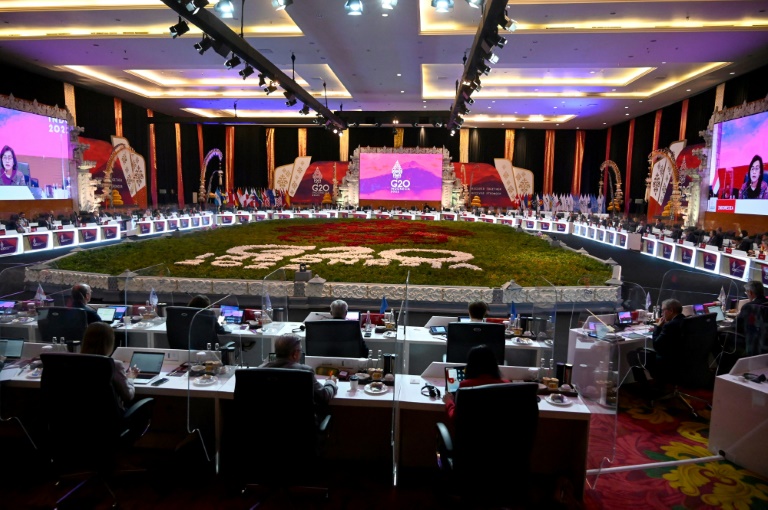
Group of 20 finance ministers and central bank chiefs met in Indonesia Friday for talks on the fallout from Russia’s invasion of Ukraine, with the host warning them failure to tackle energy and food crises would be catastrophic.

The two-day meeting on the resort island of Bali started under the shadow of a war that has roiled markets, spiked food prices and stoked breakneck inflation, a week after Moscow’s top diplomat walked out of talks with the forum’s foreign ministers.

In her opening remarks, Indonesian Finance Minister Sri Mulyani Indrawati called on ministers to work together with a spirit of “cooperation” because “the world is watching” for solutions.

“The cost of our failure is more than we can afford,” she told delegates. “The humanitarian consequences for the world and for many low-income countries would be catastrophic.”

Top global finance figures, including US Treasury Secretary Janet Yellen, were to discuss the rebound from the coronavirus pandemic, but the Ukraine war and its impact on an already brittle global recovery have dominated the agenda.

Canada’s Finance Minister Chrystia Freeland, who has Ukrainian heritage, told Russia’s delegation they were responsible for “war crimes” in Ukraine because of their support for the invasion, a Canadian official said. 

“It is not only generals who commit war crimes, it is the economic technocrats who allow the war to happen and to continue,” Freeland said in the opening session, according to the official. 

Both Russian Finance Minister Anton Siluanov and Ukrainian Finance Minister Serhiy Marchenko are participating virtually in the meeting. 

Moscow instead sent Russian Deputy Finance Minister Timur Maksimov and Bank of Russia official Elizaveta Danilova to attend the talks in person.

Freeland went on to say the war was currently “the single biggest threat” to the global economy, according to the official, echoing comments from Yellen a day earlier. 

Yellen called Russia’s war in Ukraine the “greatest challenge” to the global economy and said members of Putin’s government “have no place” at the talks.

After Russia’s delegation addressed the meeting, a Western official told AFP Moscow did not send their finance minister or central bank governor in person “after the very direct criticism” that Foreign Minister Sergei Lavrov faced last week at talks in Bali. 

– No walkout –

The meeting has largely focused on the food and energy crises that are hitting economies across the world as a result of the war.

Italian Minister for Economy Daniele Franco addressed the ministers with the message that they “have a key role in avoiding that food insecurity turns into a humanitarian crisis”, according to an Italian official.

Yellen is pressing G20 allies for a price cap on Russian oil to choke off President Vladimir Putin’s war chest and pressure Moscow to end its invasion while bringing down energy costs.

Yellen in April led a multinational walkout of finance officials as Russian delegates spoke at a G20 meeting in Washington.

But there was no walkout on Friday after Yellen would not be drawn on a possible repeat of that joint action a day earlier.

There is also unlikely to be a final communique issued when talks end on Saturday because of disagreements with Russia.

– ‘Act together’ – 

G20 chair Indonesia -– which pursues a neutral foreign policy –- has refrained from uninviting Russia despite Western pressure

“This is not an easy time given our diverse membership… and also the differences in our position and views,” said Indrawati.

“We need to act together to demonstrate why G20 deserves its reputation as the premier forum for international cooperation.” 

But it has been difficult to get all parties around the table in person. 

Alongisde Moscow and Kyiv’s ministers, Chinese Finance Minister Liu Kun and Britain’s new Finance Minister Nadhim Zahawi were only attending virtually.

International Monetary Fund chief Kristalina Georgieva will appear in person after saying Wednesday the global economic outlook had “darkened significantly” because of Moscow’s invasion.

European Central Bank president Christine Lagarde is participating virtually, but World Bank chief executive David Malpass will not attend.

The meeting is a prelude to the leaders’ summit on the Indonesian island in November that was meant to focus on the global recovery from the Covid-19 pandemic.

Other issues being tackled by the ministers included digital financial inclusion –- with more than a billion of the world’s population still without access to a bank account -– and the deadline for an international tax rules overhaul.

China growth falls to two-year low on Covid, property woes

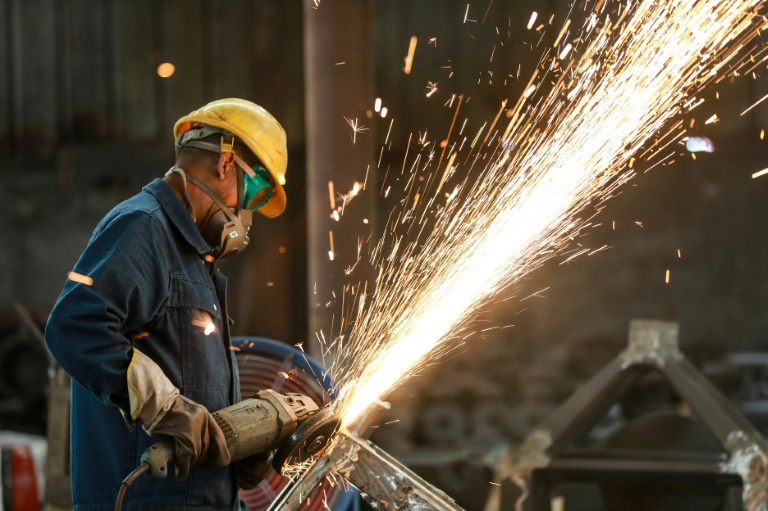
China logged its slowest economic growth since the initial Covid outbreak Friday, expanding just 0.4 percent in the second quarter with lockdowns and property market weakness pushing the government’s target further out of reach.

Beijing has dug its heels in on a zero-Covid policy of stamping out virus clusters as they emerge with snap lockdowns and long quarantines, but this has battered businesses and kept consumers jittery.

The slowdown comes after China’s biggest city Shanghai was sealed off for two months as it battled a resurgence of the virus, tangling supply chains and forcing factories to halt operations.

“Domestically, the impact of the epidemic is lingering,” National Bureau of Statistics spokesman Fu Linghui said Friday, noting shrinking demand and disrupted supplies.

“The risk of stagflation in the world economy is rising” as well, he told reporters, adding that external uncertainties were growing.

Economic expansion for April-June period in the world’s second-largest economy was also down 2.6 percent from the previous quarter, the NBS.

China has only logged a GDP contraction once in recent decades, and analysts expect the latest reading will drag further on full-year growth.

Still, industrial production rose 3.9 percent on-year in June, up from 0.7 percent in May as Covid controls eased, while retail sales picked up 3.1 percent after plummeting 6.7 percent the month before, in what analysts called an encouraging sign.

The economy is “on track for a slow recovery”, said Zhiwei Zhang of Pinpoint Asset Management.

“Nonetheless, economic growth is still much lower than its potential, as the fear of Covid outbreaks continues to hurt consumer and corporate sentiment,” he added in a note.

The urban unemployment rate ticked down to 5.5 percent in June, NBS data showed.

But the figure for those aged 16 to 24 was significantly higher at 19.3 percent, adding to challenges in a year with a record number of college graduates.

In Shanghai, where GDP plunged 13.7 percent in the second quarter, the jobless rate stood at 12.5 percent.

– ‘Hard to square’ –

Economists have long questioned the accuracy of official Chinese data, suspecting that figures are massaged for political purposes.

China’s second quarter growth is “hard to square with the large hit to activity from lockdowns”, said Julian Evans-Pritchard, senior China economist at Capital Economics.

“Even accounting for June’s strength, the data are consistent with negative year-on-year growth last quarter,” he added.

The data comes at a time of mounting challenges in China’s key real estate sector — which by some estimates accounts for a quarter of gross domestic product — with weak home sales in recent months. 

A growing number of homebuyers are also refusing to pay their mortgages over worries their properties will not be built on time.

“We remain cautious on growth outlook in the second half, as spread of the much more infectious Omicron variant across the country could trigger another round of widespread lockdowns,” Nomura chief China economist Ting Lu told AFP.

With homebuyers halting mortgage repayments, this “could result in a vicious cycle in the property sector, and a likely synchronised global slowdown will eventually hit the export sector”, he added.

The news piles pressure on the Communist Party’s leadership, which is gearing up for its 20th Congress, at which President Xi Jinping is expected to be handed a third five-year term.

Analysts expect that it is unlikely the government’s target of around 5.5 percent growth this year can be attained, given that it will require a huge pick-up in growth in the second half.

Sri Lankan speaker says president's resignation accepted

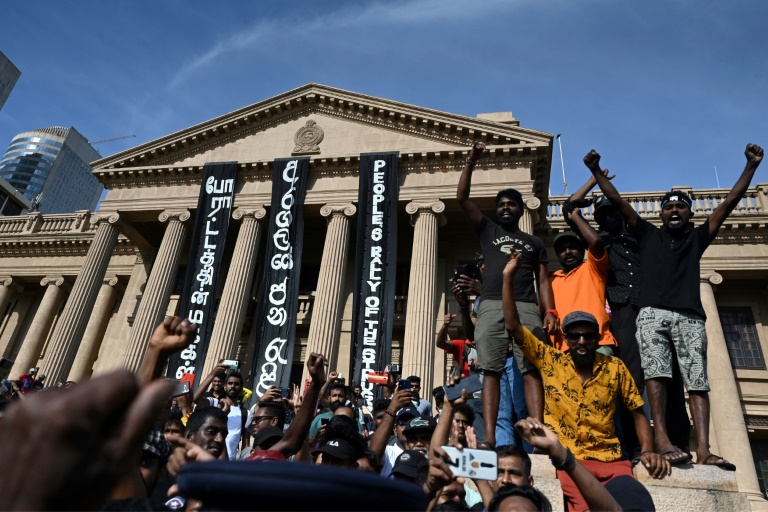
The resignation of Sri Lanka’s president has been accepted, the crisis-hit country’s parliamentary speaker announced Friday, after he fled the country earlier this week and notified him from Singapore that he was stepping down.

The formal declaration makes Gotabaya Rajapaksa — once known as ‘The Terminator’ for his ruthless crushing of Tamil rebels — the first Sri Lankan head of state to resign since it adopted an executive presidency in 1978.

He emailed in his resignation from Singapore after flying to the city-state from the Maldives, where he initially escaped after demonstrators overran his palace at the weekend. 

“Gotabaya has legally resigned” with effect from Thursday, speaker Mahinda Yapa Abeywardana told reporters. “I have accepted the resignation.”

Under Sri Lanka’s constitution, Prime Minister Ranil Wickremesinghe — whose departure is also being demanded by protesters — will automatically become acting president until parliament can elect an MP to succeed Rajapaksa for the rest of his term.

The legislature will be summoned on Saturday, Abeywardana told reporters at his residence, adding he hoped to complete the election process “within seven days”.

Rajapaksa’s departure came after months of protests over what critics said was his mismanagement of the island nation’s economy, leading to severe hardships for its 22 million people. 

At a seafront boulevard that has served as the headquarters of the protest movement that ousted him, a small crowd gathered its remaining strength late Thursday to celebrate his resignation.

Only a few hundred people were there to mark the milestone, with many veterans of the protest movement exhausted after enduring tear gas barrages and tense confrontations with security forces in the preceding days. 

“I certainly feel, I think the crowd here definitely does feel, quite happy about it,” activist Vraie Balthaazar told AFP.

– ‘Private visit’ to Singapore –

Rajapaksa, his wife Ioma and their two bodyguards arrived in Singapore from the Maldives on board a Saudia airline flight.

As president, Rajapaksa enjoyed immunity from arrest, and he is understood to have wanted to go abroad before stepping down to avoid the possibility of being detained. 

The former Maldivian president Mohamed Nasheed is believed to have played a behind-the-scenes role in getting him out of the country, and said Rajapaksa feared he would be killed if he remained.

“I believe the President would not have resigned if he were still in Sri Lanka, and fearful of losing his life,” Nasheed tweeted. 

Singapore’s foreign ministry confirmed Rajapaksa had been allowed to enter the city-state for a “private visit”, adding: “He has not asked for asylum and neither has he been granted any asylum.”

He is expected to look to stay in Singapore for some time, according to Sri Lankan security sources, before potentially moving to the United Arab Emirates.

The spiralling economic crisis led to Sri Lanka defaulting on its $51-billion foreign debt in April, and it is in talks with the IMF for a possible bailout.

But the talks have been thrown off course by the political upheaval, and an IMF spokesman said Thursday the fund hoped the unrest can be resolved soon so negotiations can resume. 

The island has nearly exhausted its already scarce supplies of petrol, with the government ordering the closure of non-essential offices and schools to reduce commuting and save fuel.

– Protesters exit –

In Colombo, demonstrators on Thursday left several of the emblematic state buildings they had occupied in recent days after Wickremesinghe instructed security forces to restore order and declared a state of emergency.

Witnesses saw dozens of activists leave Wickremesinghe’s office as armed police and security forces moved in. 

The capital was put under curfew and armoured personnel carriers patrolled some areas.

Hundreds of thousands of people had visited the prime minister’s compound since it was opened to the public after he fled and his security guards backed down. 

By Thursday afternoon, the gates were closed, with armed guards posted both inside and outside.

Police said a soldier and a constable were injured in clashes with protesters outside the national parliament as security forces beat back an attempt to storm the legislature.

Protesters also left the studios of the main state television station after breaking in on Wednesday.

The main hospital in Colombo said about 85 people were admitted with injuries on Wednesday, with one man suffocating to death after being tear-gassed at the premier’s office.

The military and the police were issued fresh orders Thursday to firmly put down any violence, and warned troublemakers they were “legitimately empowered to exercise their force”.

But student Chirath Chathuranga Jayalath, 26, said: “You cannot stop this protest by killing people. They’ll shoot our heads but we do this from our hearts.”

Morocco firefighters battle infernos as villagers flee

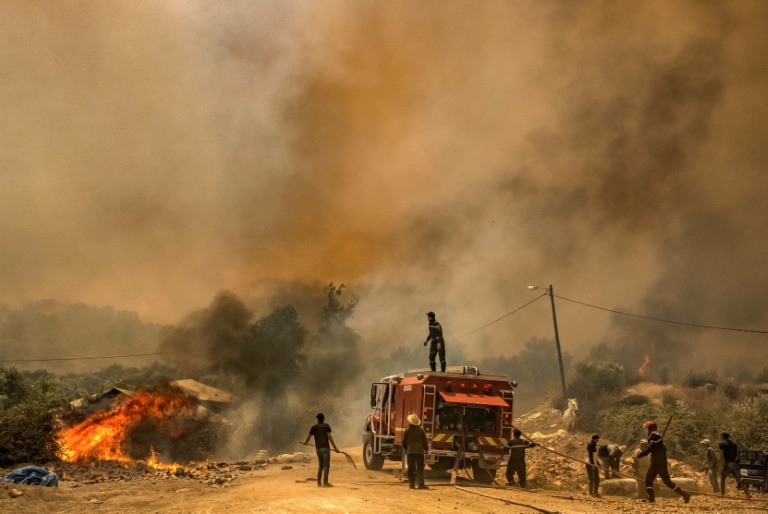
Hundreds of Moroccan firefighters and soldiers battled late Thursday to put out at least four infernos ripping through forests in the north of the kingdom, officials said.

The fires, fanned by strong winds in the four areas, have not resulted in any casualties so far, but nearly 500 families were evacuated “as a precaution” in the provinces of Larache and Taza, according to official statements.

Several villages that were evacuated also saw military planes dropping loads of water to extinguish fires tearing across the dry terrain, an AFP journalist said. 

Shocked by how fast the flames were spreading, residents fled their homes, with some families herding their cattle and horses — upon which their livelihoods depend — ahead of them.

“I was with my family, and at one point, we heard people shouting, ‘Fire! Fire!'” said Samir Boundad, from Larache. 

“We ran out to flee and fortunately, thanks to God, the fire moved up the mountain.”

A village in the Ksar El Kebir region was destroyed by the flames.

Hundreds of civil defence workers, as well as soldiers and police officers, are trying to stop the fires from causing more destruction.

In four provinces — Larache, Ouezzane, Tetouan and Taza — the fires ripped through forestland that is difficult to access, said Fouad Assali, head of the National Center for Forest Climate Risk Management.

“Efforts are continuing in the hope of bringing these fires under control,” Assali was quoted as saying by the official MAP news agency.

Since Wednesday night, at least 1,000 hectares (2,500 acres) of forest have burned in Larache and Ouezzane, according to initial reports, leaving burnt trees smouldering under a sky blanketed by plumes of smoke. 

– Intense droughts, soaring temperatures –

The North African nation, which is struggling under intense droughts, has in recent days been hit by soaring temperatures approaching 45 degrees Celsius (113 degrees Fahrenheit).

“It is the heat that causes this kind of fire. It was yesterday at dawn that the fire reached our village,” Ahmed Mezouar, 58, a resident of Larache, told AFP, adding that he was hopeful that firefighters would be able to contain it.

Still, he worried, as a neighbouring village had been completely surrounded by the flames. 

“We are afraid for our houses,” he said. “For the moment, we are safe.”

Across the Strait of Gibraltar, wildfires are also raging in southern Europe, from Portugal and Spain through to France and Greece.

Scientists say extreme weather events such as heatwaves and droughts, which make wildfires more likely, are linked to climate change.

They are expected to become even more frequent, more prolonged and more intense in the future.

Morocco firefighters battle infernos as villagers flee

Hundreds of Moroccan firefighters and soldiers battled late Thursday to put out at least four infernos ripping through forests in the north of the kingdom, officials said.

The fires, fanned by strong winds in the four areas, have not resulted in any casualties so far, but nearly 500 families were evacuated “as a precaution” in the provinces of Larache and Taza, according to official statements.

Several villages that were evacuated also saw military planes dropping loads of water to extinguish fires tearing across the dry terrain, an AFP journalist said. 

Shocked by how fast the flames were spreading, residents fled their homes, with some families herding their cattle and horses — upon which their livelihoods depend — ahead of them.

“I was with my family, and at one point, we heard people shouting, ‘Fire! Fire!'” said Samir Boundad, from Larache. 

“We ran out to flee and fortunately, thanks to God, the fire moved up the mountain.”

A village in the Ksar El Kebir region was destroyed by the flames.

Hundreds of civil defence workers, as well as soldiers and police officers, are trying to stop the fires from causing more destruction.

In four provinces — Larache, Ouezzane, Tetouan and Taza — the fires ripped through forestland that is difficult to access, said Fouad Assali, head of the National Center for Forest Climate Risk Management.

“Efforts are continuing in the hope of bringing these fires under control,” Assali was quoted as saying by the official MAP news agency.

Since Wednesday night, at least 1,000 hectares (2,500 acres) of forest have burned in Larache and Ouezzane, according to initial reports, leaving burnt trees smouldering under a sky blanketed by plumes of smoke. 

– Intense droughts, soaring temperatures –

The North African nation, which is struggling under intense droughts, has in recent days been hit by soaring temperatures approaching 45 degrees Celsius (113 degrees Fahrenheit).

“It is the heat that causes this kind of fire. It was yesterday at dawn that the fire reached our village,” Ahmed Mezouar, 58, a resident of Larache, told AFP, adding that he was hopeful that firefighters would be able to contain it.

Still, he worried, as a neighbouring village had been completely surrounded by the flames. 

“We are afraid for our houses,” he said. “For the moment, we are safe.”

Across the Strait of Gibraltar, wildfires are also raging in southern Europe, from Portugal and Spain through to France and Greece.

Scientists say extreme weather events such as heatwaves and droughts, which make wildfires more likely, are linked to climate change.

They are expected to become even more frequent, more prolonged and more intense in the future.

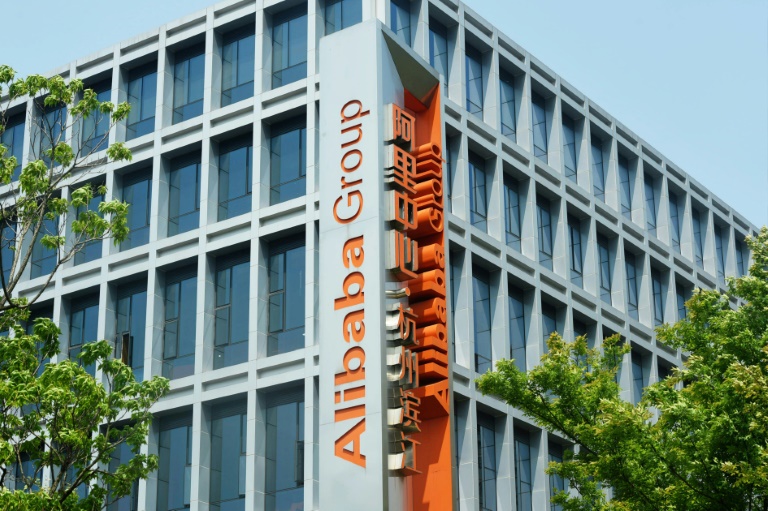
China officials haul in Alibaba execs over massive data heist: report

Alibaba shares sank on Friday after a report said the tech giant’s executives had been called in for meetings with Chinese officials over the theft of a vast police database.

A hacker last month put on sale what they claimed was the personal information of hundreds of millions of Chinese citizens — which, if true, would make it one of the biggest data heists in history.

Cybersecurity analysts subsequently confirmed that the data — partly verified by AFP — was stored on Alibaba’s cloud servers, apparently by the Shanghai police.

The company’s shares slumped 5.7 percent at the open in Hong Kong on Friday, hours after The Wall Street Journal reported that Shanghai authorities had called in its executives for talks in connection with the heist.

The Journal cited unnamed people familiar with the matter as saying the executives included Alibaba Cloud vice president Chen Xuesong, who heads the unit’s digital public security work.

The report added that senior managers from Alibaba and its cloud unit held a virtual meeting on July 1 after a seller advertised the stolen database in a cybercrime forum.

As part of an internal investigation, company engineers have cut access to the breached database and have started reviewing related code, the Journal said, citing employees familiar with Alibaba’s response to the hack.

The database is believed to have been stored on Alibaba’s servers using outdated and insecure technology.

Alibaba did not immediately respond to an AFP request to confirm the information in the report.

China maintains a sprawling nationwide surveillance network that collects huge amounts of data from its citizens, ostensibly for security purposes.

Beijing has passed stronger data protection laws in recent years as public awareness of data security and privacy issues has grown.

There are few ways, however, for ordinary citizens to stop the government from gathering information on them.

The sample of 750,000 entries posted online by the hacker showed citizens’ names, mobile phone numbers, national ID numbers, addresses, dates of birth and the police reports they had filed.

The hacker wanted 10 bitcoin — around $200,000 at the time — for the entire database.

Some of the information appeared to have been drawn from express delivery services, while other data included summaries of police incident reports in Shanghai over more than a decade until 2019.

At least four people out of more than a dozen contacted by AFP last week confirmed their details were listed in the database.

China growth at two-year low over Covid, property woes

China logged its slowest economic growth since the initial Covid outbreak, official data showed Friday, expanding just 0.4 percent in the second quarter with lockdowns and property market weakness nudging a government target further out of reach.

Beijing has dug its heels in on a zero-Covid policy of stamping out virus clusters as they emerge with snap lockdowns and long quarantines, but this has battered businesses and kept consumers jittery.

The slowdown comes after China’s biggest city Shanghai was sealed off for two months as it battled a Covid-19 resurgence, tangling supply chains and forcing factories to halt operations.

“Domestically, the impact of the epidemic is lingering,” NBS spokesman Fu Linghui said Friday, noting shrinking demand and disrupted supplies.

“The risk of stagflation in the world economy is rising” as well, he told reporters, saying that external uncertainties were growing.

GDP for the April to June period in the world’s second-biggest economy was also down 2.6 percent compared with the first three months of this year, the National Bureau of Statistics (NBS) said.

China has only logged a GDP contraction once in recent decades, and analysts expect the latest reading will drag further on full-year growth.

Industrial production rose 3.9 percent on-year in June, up from 0.7 percent in May as Covid controls eased.

But retail sales picked up 3.1 percent after plummeting 6.7 percent in May, in what analysts called an encouraging sign.

And the urban unemployment rate was down four points from 5.9 percent that month, the NBS said.

The economy is “on track for a slow recovery,” said Zhiwei Zhang of Pinpoint Asset Management.

“Nonetheless, economic growth is still much lower than its potential, as the fear of Covid outbreaks continues to hurt consumer and corporate sentiment,” he added in a note.

– ‘Hard to square’ –

Economists have long questioned the accuracy of official Chinese data, suspecting that figures are massaged for political purposes.

China’s second quarter growth is “hard to square with the large hit to activity from lockdowns,” said Julian Evans-Pritchard, senior China economist at Capital Economics.

“Even accounting for June’s strength, the data are consistent with negative year-on-year growth last quarter,” he added.

The data comes in the wake of mounting challenges in China’s key real estate sector — which by some estimates accounts for a quarter of gross domestic product — with weak home sales in recent months. 

A growing number of homebuyers are also refusing to pay their mortgages over worries their properties will not be built on time.

“We remain cautious on growth outlook in the second half, as spread of the much more infectious Omicron variant across the country could trigger another round of widespread lockdowns,” Nomura chief China economist Ting Lu told AFP.

With homebuyers halting mortgage repayments, this “could result in a vicious cycle in the property sector, and a likely synchronised global slowdown will eventually hit the export sector,” he said.

The news piles pressure on the Communist Party’s leadership, which is gearing up for its 20th Congress, at which President Xi Jinping is expected to be handed another five-year term.

Analysts expect that it is unlikely the government’s target of around 5.5 percent growth this year can be attained, given that it will require a huge pick-up in growth in the second half.

Sri Lankans queue at pumps for days with no promise of petrol

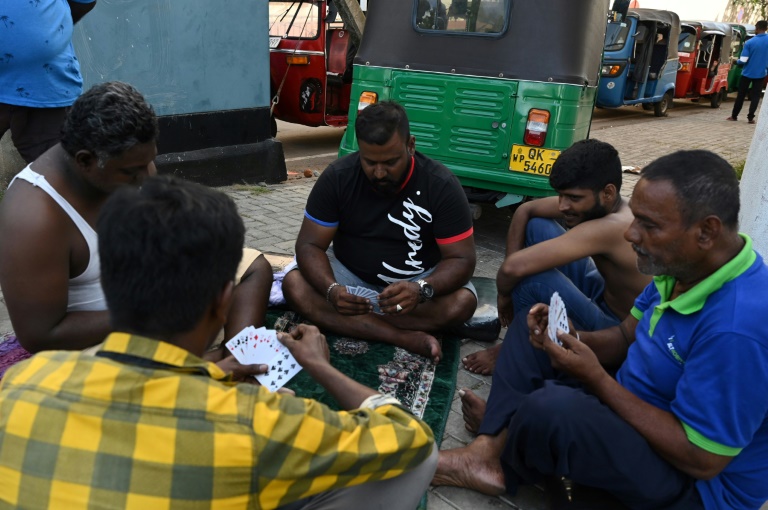
Out of gas and stuck in line for days, a group of motorists kick off their shoes and settle on a sidewalk in Sri Lanka’s capital for a round of cards.

Emergency curfews, tear gas plumes and the sudden departure and resignation of the president have all failed to budge the long vehicle queues snaking out of Colombo’s empty petrol stations.

Chronic fuel shortages have been a source of frustration for months but are now worse than ever, with some people waiting in line for days without any guarantee of a refill. 

“I have been here for four days,” said Vipul Dissanayaka, the driver of one of the city’s ubiquitous three-wheel motor taxis.

The 56-year-old would normally be ferrying people around the city, but in recent months, the increasing time spent waiting for fuel has made his work all but impossible.

“Innocent people are suffering,” he told AFP. “Petrol is how we live. This is how we feed our children.”

Car drivers nearby wait listlessly behind the steering wheel in the city’s tropical heat, while motorcyclists without the luxury of a reclining seat unfurl rattan mats to nap on the ground. 

No one wants to yield their spot after waiting for so long, even as unrest sparked by Sri Lanka’s painful financial crisis has convulsed nearby streets.

They stayed in place even as protesters — furious over the government’s economic mismanagement — braved tear gas barrages to storm the home of the president, who later fled the country in an early-hours military flight before emailing his resignation Thursday from Singapore. 

And they shrugged off a curfew directing people to return home so that troops could restore order.

– ‘Going backwards’ –

So far they have waited in vain, as Sri Lanka’s depleted reserves of foreign currency have left the country struggling to pay for fresh imports. 

The resulting shortages have been a huge source of public anger, with local media reporting sporadic clashes outside fuel stations and the deaths of more than a dozen people while waiting in line.

Weeks ago, troops opened fire to disperse a mob that was protesting members of the military jumping the queue for refills.

The government last month shut down non-essential public services to save fuel, ordered another hike in petrol costs, and then suspended petrol sales for two weeks.

Only a small fraction of vehicles remain on the road, including overcrowded commuter buses and motorists able to afford black market prices of up to 3000 rupees ($8.30) per litre.

Sri Lanka’s energy minister said this week another maritime petrol delivery from India would arrive in the country by next Tuesday at the latest, provided weather allowed it to dock at port.

But the resupply is unlikely to temper frustrations that have grown in tandem with the wait time between new shipments. 

“There is no fuel, children are not going to school, prices are very high,” Gihan Martyn, a resident of Colombo, told AFP.

“Day by day, the country is going backwards.”

Close Bitnami banner
Bitnami