World

Asian stocks mixed as recession fears grow, China data falls well short

Stocks were mixed in Asia on Friday as soaring inflation and a series of interest rate hikes around the world continued to fan recession fears, while a big miss on Chinese growth added to anxiety about the world’s biggest economies.

Below-par earnings from Wall Street titans JP Morgan and Morgan Stanley compounded worries that companies’ bottom lines would be hit by the economic fallout from a series of issues including rising prices, monetary policy tightening and the war in Ukraine.

After rate hikes by a number of countries this week, investors expect the Federal Reserve to lift rates this month by 75 basis points as officials battle to rein in decades-high inflation, though some observers suggest a one-percentage-point move could be on the cards.

The latest outsized US inflation print this week — caused by a spike in energy prices — followed last Friday’s news that jobs creation remained strong in June, giving the Fed room to press ahead with its campaign to suck cash out of the financial system.

However, while experts warn that raising rates too much risks hammering the economy, the bank has made it clear its number-one priority is bringing down prices.

This has sent the dollar racing higher across the board, and Steve Englander at Standard Chartered Bank warned there was no end in sight to the unit’s advance.

The currency’s strength is “largely a flight to safety”, he told Bloomberg TV.

“The problem is until we get to see some light at the end of the tunnel with respect to either inflation coming off or oil prices coming off because of supply creation rather than demand destruction, it’s hard to call a top to it.”

With investors increasingly pricing in a recession next year, equities are struggling to see any upward momentum.

Wall Street’s three main indexes mostly fell, with sentiment weighed by the disappointing reports from JPMorgan Chase & Co. and Morgan Stanley. They will be followed over the next few days by Citigroup, Goldman Sachs and Bank of America.

In early Asian trade, Hong Kong dropped and mainland Chinese markets fluctuated after data showed China’s economy grew just 0.4 percent in the second quarter as it was battered by Covid lockdowns in major cities including Shanghai and Beijing.

The reading was well off the 1.6 percent predicted by analysts in an AFP survey, though there is a hope that it will provide fresh impetus to authorities to unveil new stimulus measures.

Elsewhere, Tokyo, Singapore, Seoul and Taipei rose but Sydney, Wellington, Manila and Jakarta fell.

On currency markets the euro continues to hover around parity with the greenback as the European Central Bank grapples with a range of issues including an energy crisis amid fears Russia will cut off its gas supplies in retaliation for Ukraine war sanctions.

Meanwhile, policymakers have yet to lift interest rates — leaving the bank well behind the Fed — on concerns about the vast differences, or “fragmentation”, between the eurozone’s individual sovereign bond rates.

Added to that is new political upheaval in Italy as the government there teeters on the brink.

“With a weak currency, sky-high inflation, recession risk due to the energy crisis and political turmoil in Italy, the ECB is facing an impossible mission to solve all its problems simultaneously with monetary policy,” said SPI Asset Management’s Stephen Innes. 

“Front-loading a 50 basis point hike and revealing a solid anti-fragmentation tool seems the optimal solution for the central bank… but that is likely not enough to support a sustainable euro rebound.”

Traders are keeping tabs on the Middle East as Biden tours the region, with his visit to Riyadh later in the day the main focus as he tries to persuade the kingdom to help bring down crude prices by pumping more.

While both main contracts have fallen in recent weeks to below $100 owing to demand fears caused by a possible recession, there are disagreements over the outlook for the market, with some predicting it will surge to new highs and others warning it could fall to $65.

– Key figures at around 0230 GMT –

Tokyo – Nikkei 225: UP 0.6 percent at 26,797.47 (break)

Hong Kong – Hang Seng Index: DOWN 0.5 percent at 20638.71

Shanghai – Composite: UP 0.2 percent at 3,287.59

Euro/dollar: UP at $1.0033 from $1.0022 Thursday

Pound/dollar: UP at $1.1839 from $1.1826 

Euro/pound: UP at 84.75 pence from 84.72 pence

Dollar/yen: DOWN at 138.91 yen from 138.93 yen

West Texas Intermediate: UP 0.3 percent at $96.08 per barrel

Brent North Sea crude: UP 0.4 percent at $99.50 per barrel

New York – Dow: DOWN 0.5 percent at 30,630.17 (close)

London – FTSE 100: DOWN 1.6 percent at 7,039.81 (close) 

The Red Sea islands caught between Egypt, Saudi and Israel

As US President Joe Biden visits the Middle East this week, one issue on the table will be the status of two small Red Sea islands that are uninhabited but of key strategic value.

Resolving the tricky status that stems from their location and turbulent history would help build trust between Israel and Saudi Arabia, two US allies now taking gradual steps that Washington hopes could one day lead to diplomatic ties.

For now, the two barren desert islands — Tiran and Sanafir — are home only to some soldiers of a decades-old multinational peacekeeping force, their waters occasionally visited by divers for their coral reefs.

But the islands have been fought over in the past, thanks to their key location at the entrance to the Gulf of Aqaba, on which Jordan’s only seaport of the same name, and Israel’s Eilat harbour are located.

Egypt ceded the islands, located east of its resort town Sharm El-Sheikh, to Saudi Arabia in 2016. But the deal still requires Israel’s green light, at a time when the Jewish state and Saudi Arabia have no formal ties.

A senior Israeli official said late Thursday Israel would have “no objection” to greenlighting Egypt handing over the islands to Saudi Arabia as a step towards any normalisation of ties between Riyadh and the Jewish state.

The issue is set to be on the agenda Friday when Biden, after his Israel visit, meets Gulf leaders in Jeddah for a conference where Egypt’s President Abdel Fattah al-Sisi is also expected.

Tiran — which hosts a small airport for the peacekeepers — measures about 61 square kilometres (24 square miles), while Sanafir, to the east, is only about half that size.

The islands were under Egyptian sovereignty from 1950, but invaded by Israeli troops during the 1956 Suez Crisis that came after Egyptian president Gamal Abdel Nasser nationalised the canal that is key to trade between Europe and Asia.

– Deal in the making? –

Nasser’s 1967 closure of the Strait of Tiran, which cut off maritime access to Eilat and Aqaba, precipitated the Six Day War, after which Israel occupied the Sinai Peninsula and the two small islands. 

In 1979, the landmark Camp David peace agreement provided for Egypt to recover the territories. 

As part of the Sinai’s demilitarisation, Cairo was not allowed to station troops on the islands, where only peacekeepers were based for the so-called Multinational Force and Observers.

In 2016 a Cairo-Riyadh agreement ceded the islands to Saudi Arabia in a controversial decision that sparked nationalist protests in Egypt, which were quickly stifled.

Critics accused Sisi of ceding the islands in return for Saudi aid and investment largesse. The government argued the islands were originally Saudi but leased to Egypt in the 1950s.

Egyptian courts handed down a series of contradictory rulings before the Supreme Constitutional Court ruled in favour of the handover.

But because the issue is governed by the Camp David agreement, the status of the islands has yet to be finalised, requiring Israel to ratify the transfer of sovereignty.

It is this final hurdle that Biden could negotiate with Israeli, Saudi and Egyptian leaders this week, observers say.

The Israeli press has reported that Riyadh has pledged to keep the islands demilitarised, and to allow Israeli vessels to keep traversing the strait.

Experts have pointed to the significance of a potential deal as a step towards official normalisation of relations between Saudi Arabia and Israel, who along with the United States are fierce enemies of Iran.

Bot battle: The tech that could decide Twitter's Musk lawsuit

If Twitter’s lawsuit over Elon Musk’s $44 billion buyout bid ever reaches trial, the case will likely center on a ubiquitous and often unloved technology: bots.

The information Twitter has or has not provided on its tally of fake or spam accounts is Musk’s stated reason for backing away from the deal — a move that prompted the firm to sue him this week.

Here’s a closer look at the complications around bot accounts, and how they would be key in deciding the case.

– Good bot, bad bot –

At a basic level, “bots” are software programs that do automated tasks online, often with the aim of emulating how people behave.

Twitter tolerates some automated uses, like an account that tweets every time the Hubble space telescope crosses the sky over a given city.

But Twitter has rules about automated actions by accounts, including barring software from posting about hot topics, firing off spam, attempting to influence online conversations, and operating across multiple accounts.

The company says it wages a daily campaign against spam or fake accounts that keeps their number to less than five percent of users. 

Musk’s lawyers, in notifying Twitter on July 8 he was “terminating” the agreement to buy the company, alleged the platform made “false and misleading representations” about bots and had not provided details he needed to check its assertions. 

– Thorny question –

Determining the number of bots on the site is a bit of an art because the tally is determined in part by Twitter’s internal definitions and the workers who apply the rules.

While some cases are clear cut violations, some can require the judgement of people who have to weigh various facts.

“People can disagree on what should be considered a bot or a spam account,” said Edwin Chen, a former Twitter employee, who is now CEO of content moderation firm Surge AI. 

The figure would also be tricky for an outsider like Musk to confirm because the bot weeding process can include checking IP or email address or other sensitive user data.

“I think a lot of people, not even just my former colleagues but people just generally within the tech industry, know that this is a thorny, thorny question,” Chen added.

Twitter’s lawsuit, which urges a court to force Musk to honor his buyout offer, could result in a trial or settlement talks that would need to plunge into the finer points of things like the firm’s bot definitions and policies.

Musk’s lawyers said he has already asked for but had not received “Twitter’s methodology and performance data” about finding and suspending spam and fake accounts.

“In short, Twitter has not provided information that Mr. Musk has requested for nearly two months,” the lawyers wrote in laying out the argument for aiming to abandon the deal.

– The deal with Twitter –

Speculation has mounted that the bot issue — with its tricky, detailed and case-by-case aspects — is just a convenient route for Musk to abandon or renegotiate his proposal.

Yet, bots are a problem online.

“Bad actors have nearly infinite resources and incentives to use bots for nefarious purposes,” said Tamer Hassan, co-founder and chief of cybersecurity firm HUMAN.

Bots are used in more than three quarters of security and fraud incidents that happen online, from spreading socially divisive posts to snapping up hot concert tickets and hacking, Hassan told AFP. 

Also, Twitter makes its money from ads, and marketers pay for reaching people, not software.

Thus “advertising to bots isn’t going to have a good close rate because bots don’t buy products,” analyst Rob Enderle told AFP previously.

If advertisers are paying Twitter fees based on how many people see ads, and those numbers are inflated due to bots in the online audience, they are being overcharged, Enderle added.

If Twitter has way more bots than it is letting on, its revenue could plunge when those accounts are exposed and closed.

Or as Musk’s lawyers put it, Twitter’s true daily users who can be shown advertising are “a key component of the company’s business, given that approximately 90 percent of its revenues come from advertisements.” 

'True balance': Japan's quiet telework revolution

Posted far from home for his job at Japanese conglomerate Hitachi, father of two Tsutomu Kojima was “really lonely” until he began working remotely during the pandemic for the first time.

Covid-19 has upended office routines worldwide, but in Japan — where punishing hours and reliance on paper files, ink stamps and fax machines has long been the norm — some say the shake-up was sorely needed.

Pre-pandemic, just nine percent of the Japanese workforce had ever teleworked, compared with 32 percent in the United States and 22 percent in Germany, according to Tokyo-based consultancy firm Nomura Research Institute.

But a quiet revolution in the country’s rigid business culture is underway, with firms working to digitise operations and offer more flexibility to staff who were once expected to stay late, go drinking with the boss and accept far-flung transfers.

Kojima used to live alone in accommodation provided by Hitachi near Tokyo, an hour and a half by bullet train from his family in Nagoya.

Back then he would return only twice a month, but now the 44-year-old works exclusively from home, and says he is more productive and closer to his teenage daughters.

“I have more time to help them with their studies. My youngest told me she hopes things stay like this,” he told AFP.

“I used to feel really lonely” in Tokyo, Kojima said, but he has since realised that “true balance means not giving up on family”.

– Old habits –

Nearly a third of jobs in Japan were done remotely during the first Covid wave in spring 2020, the Japan Productivity Center says, even though the government never imposed strict stay-at-home orders.

The rate has since fallen to 20 percent, but that is still far higher than before the pandemic, according to quarterly surveys by the non-profit organisation.

To encourage telework, the government and some companies made efforts to phase out personalised ink stamps used to certify documents, as well as the ubiquitous fax machine.

Often in Japan, “business has to be done in person, on paper”, habits dating back to the 1970s and 80s, when the Japanese economy was booming, said Hiroshi Ono, a professor at Hitotsubashi University specialising in human resources.

“One of the things Covid has done is bring those barriers down: work doesn’t have to be done at the office, men can work at home,” he told AFP.

Companies are realising that new ways of working can be more efficient, he added.

“Before Covid, it was so important for employees to show that they’re working hard, instead of actually producing results.”

– ‘New balance’ –

Reflecting trends elsewhere, people are also fleeing the big city.

A record number of company headquarters moved out of Tokyo last year, according to Teikoku Databank, while the capital’s population decreased for the first time in 26 years.

Among those who have upped sticks are Kazuki and Shizuka Kimura, who left their cramped Tokyo apartment for a custom-built house near the sea.

The couple now mostly do their jobs in communication and marketing remotely from Fujisawa, southwest of the capital, having struggled to both work from home in Tokyo.

“It was really Covid that made us take this decision,” said Kazuki Kimura, who used to seek out other places to do meetings — at his parents’ home or in cafes, remote-work boxes set up in train stations, and even karaoke booths.

“Sometimes you could hear singing from the booth next door,” which made it difficult to concentrate, recalls the 33-year-old, who is now learning to surf.

Shizuka Kimura, 29, thinks “more and more people are now prioritising their wellbeing, rather than their job”, but questions how quickly things will change on a wider scale.

This is a concern shared by Hiromi Murata, an expert at Recruit Works Institute, who says smaller companies may be slower to adapt to new work styles than big firms like Hitachi, Panasonic or telecoms giant NTT.

Remote work can also pose a problem for training new recruits, because “you learn on the job”, Murata said.

“Before, it was so important to meet in the office… each business must find a new balance, in their own way and time.”

US Secret Service deleted text messages from Jan 6 insurrection: watchdog

The US Secret Service, the law enforcement agency that protects the president, deleted agents’ text messages sent during the January 6 Capitol riot, a government watchdog said in a letter published Thursday.

Joseph Cuffari, the inspector general of the Department of Homeland Security, told Congress in the letter dated Wednesday that his office has had difficulties obtaining records from the Secret Service from January 5 and 6, 2021.

The messages could be crucial to the House of Representatives and Justice Department investigations into whether Donald Trump and his close advisors encouraged the deadly insurrection by the former president’s supporters at the US Capitol, which aimed to prevent the certification of Democratic rival Joe Biden as the winner of the November 2020 election.

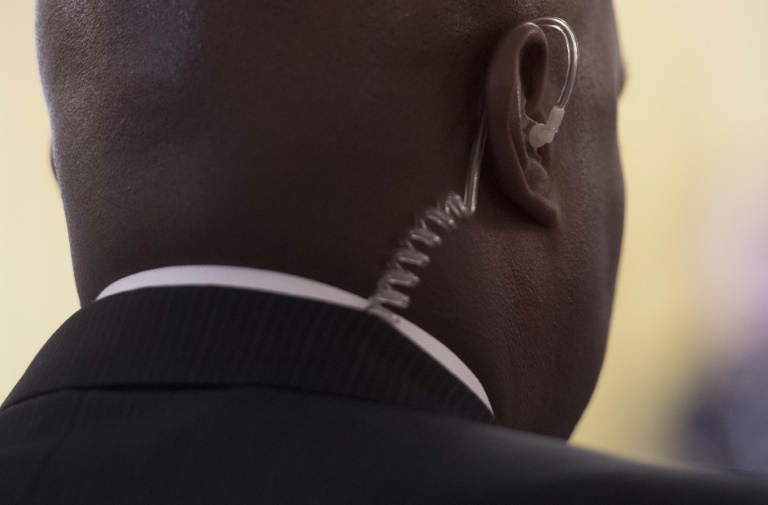
Secret Service agents were with Trump during the day of the uprising, and were also with vice president Mike Pence, who went into hiding at the Capitol after pro-Trump rioters called for him to be hanged.

On June 29 a former White House staffer told the House January 6 investigation that Trump had attempted to force the Secret Service to take him to the Capitol to join his supporters on that day. 

“The Department notified us that many US Secret Service (USSS) text messages, from January 5 and 6, 2021, were erased as part of a device replacement program,” Cuffari wrote in the letter first reported by The Intercept and later published by Politico.

“The USSS erased those text messages after OIG requested records of electronic communications” for a review of January 6, he said, referring to the Office of the Inspector General.

In addition, he said, the department has stalled on providing other records to the OIG.

In a statement, Secret Service spokesman Anthony Guglielmi rejected the inspector general’s allegation.

He said the agents’ phones were being wiped as part of a planned replacement program that began before the OIG requested the information six weeks after the insurrection.

“The Secret Service notified DHS OIG of the loss of certain phones’ data, but confirmed to OIG that none of the texts it was seeking had been lost in the migration,” he said.   

Cuffari’s letter was addressed to the leaders of the Senate and House Homeland Security Committees. 

The chairman of the House Homeland Security committee is Representative Bennie Thompson, who is also the chairman of the House committee investigating January 6.

Their investigation has sought to show that Trump knowingly incited the insurrection as an attempted “coup.”

The Secret Service has been criticized for not adequately anticipating the threat of the violent action by armed Trump supporters on January 6.

Trump had made a senior Secret Service official at the time, Tony Ornato, his personal deputy chief of staff.

Ornato has denied the account given to the January 6 committee by former Trump aide Cassidy Hutchinson that Trump tried to force the Secret Service to drive him to the Capitol as his supporters massed at the building, the seat of the US legislature.

But other then-White House officials have backed Hutchinson’s story.

Airlines' fragile recovery from Covid

Airlines are recovering from huge Covid fallout but face fresh turbulence from rocketing inflation while airports battle to cope with booming demand.

Here is an assessment of the state of airlines ahead of next week’s Farnborough airshow that traditionally witnesses big deals struck for new Airbus and Boeing planes.

– Flying back to profit –

Global airlines suffered cumulative losses of almost $190 billion between 2020 and 2022, according to industry body the International Air Transport Association (IATA).

However, particularly in Europe and the United States, carriers are now regaining customers with demand boosted by vaccinations and the lifting of Covid restrictions.

A return to profitability appears within reach for airlines in 2023, according to the IATA, predicting a rebound in passenger numbers this year to 83 percent of pre-pandemic levels.

– Consolidation –

There is rapid consolidation as the sector faces headwinds from historically-high fuel prices and big salary increases in the face of decades-high inflation.

Many carriers are also suffering from severe staff shortages, having slashed thousands of jobs in the pandemic.

A lack of staff is constraining capacity at the world’s biggest airports.

In the United States, Spirit Airlines is the subject of a takeover tussle between rival carriers JetBlue and Frontier.

In Europe, Air France and Lufthansa are vying for control of Italy’s ITA Airways, formerly known as Alitalia.

And in South America, Brazilian airline Gol and Colombia’s Avianca agreed to merge to create a regional titan.

– Air traffic recovery –

North America and Europe are soon expected to return to pre-pandemic levels of air traffic, but Asia is lagging behind as Beijing’s strict zero-Covid policy hampers recovery. 

The IATA forecasts the world’s domestic air traffic will return to pre-crisis levels by next year. 

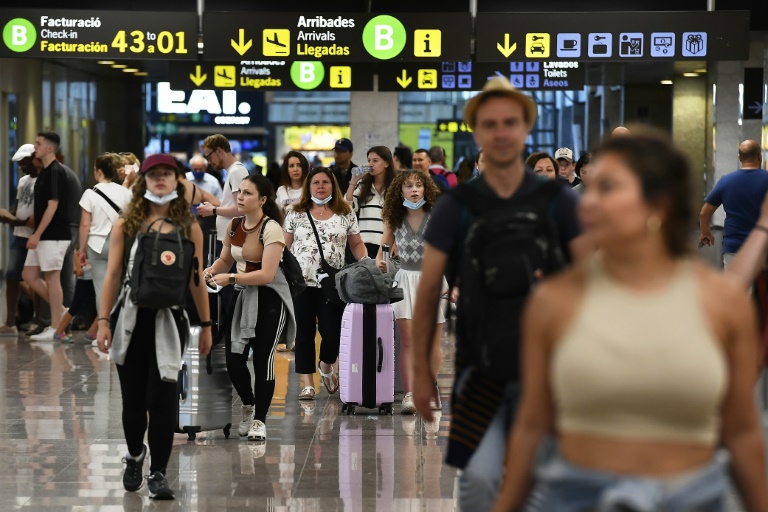
In the meantime, major European hubs — including Amsterdam, Dublin, Frankfurt, London and Paris — are suffering major travel chaos.

Top airports have been plagued by mountains of misplaced luggage and vast security queues, while some passengers have been stranded on planes owing to shortages of ground staff.

Airlines, including British Airways and Lufthansa, have been forced to axe thousands of flights owing to a lack of staff.

And air traffic control has faced delays, including as a result of planes being re-routed to avoid Belarusian, Russian and Ukrainian airspace because of the war.

– Eyeing takeoff –

European planemaker Airbus and its fierce US rival Boeing are experiencing a surge in orders, having slashed production during the early stages of the coronavirus pandemic.

Airlines are readying for a strong rebound in international travel following the lifting of Covid restrictions.

Carriers are urgently seeking to replace ageing fleets with greener, more fuel-efficient aircraft that emit less carbon dioxide — a key theme of this year’s Farnborough airshow.

Airbus had slashed its production rate by 40 percent in the initial stages of the pandemic.

But with recovery on track, it eyes record production of single-aisle A320 passenger jets of 65 per month for the second half of next year.

This despite Airbus and Boeing coming up against a global supply-chain crisis as economies reopen from pandemic lockdown.

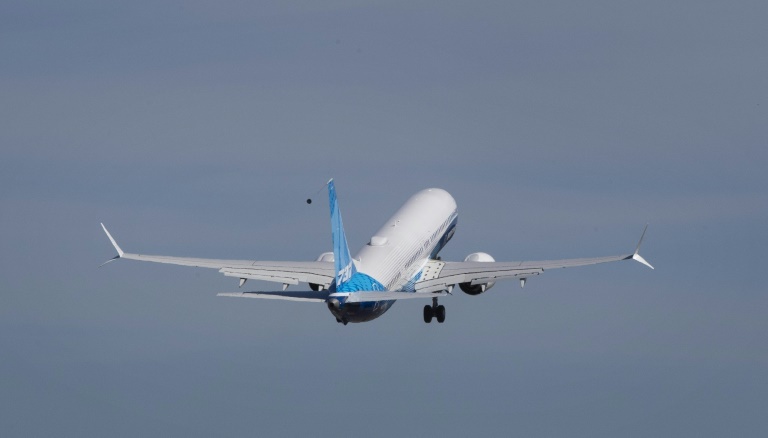
Boeing is meanwhile mired in problems and still seeking to transform the fortunes of its crisis-hit MAX jet after two deadly crashes in 2018 and 2019.

The US giant has not delivered a 787 long-haul plane for more than a year due to production issues, while its 77X has had its certification postponed until 2025.

Aviation buzzing for return of Farnborough airshow

Aviation’s biggest players descend on the renowned Farnborough airshow next week, buoyed by the travel sector’s nascent recovery from the Covid pandemic and as Russia’s invasion of Ukraine boosts defence spending.

Farnborough, southwest of London and one of the largest civilian and defence shows alongside Dubai and Paris, is abuzz with anticipation as the aerospace sector fires up its engines for the first time since being ravaged by the pandemic.

At the same time, however, the industry faces headwinds from rocketing inflation fuelled by historically high energy prices and higher wages, while staff shortages constrain airports.

At Farnborough, US titan Boeing and its European arch-rival Airbus will take to the skies to show off their latest hi-tech wares — and engage in their traditional dogfight for multi-billion-dollar jet orders.

– Celebration –

“This is the first major global airshow for three years since Paris 2019 and therefore there is definitely a bigger excitement and buzz than I have seen before about Farnborough,” airshow chief executive Gareth Rogers told AFP.

“People are excited to be coming back together and really looking forward to seeing each other. I think it’s going to be a bit of a celebration.”

Civil aerospace has been energised this year by the return of international travel after the lifting of Covid restrictions.

Farnborough was axed in 2020 owing to the deadly coronavirus pandemic and was last held in 2018.

An estimated 80,000 trade visitors will flock to the five-day event, which kicks off Monday and opens to the public Friday.

The show will this year zero in also on green themes of decarbonisation and sustainability, as the sector eyes future electric and hydrogen-fuelled flight.

– Dizzying air displays –

Farnborough visitors will be thrilled by dizzying air displays by Britain’s Red Arrows — and also by South Korea’s Black Eagles.

Other eye-catching aircraft taking to the skies include the US-made F-35 stealth fighter jet and Turkish drones, while Boeing’s pilotless electric air taxi will make its European debut.

Airbus and Boeing will meanwhile showcase their latest twin-aisle passenger aircraft, the A350-900 and the 777X.

A year after the last Farnborough airshow in 2018, Airbus canned production of its A380 superjumbo owing to collapsing demand for the double-decker jet.

The planemaker nevertheless forecasts the number of global aircraft will double over the next 20 years on a post-Covid travel boom and increasing demand for fuel-efficient jets.

Boeing, which will release its outlook at Farnborough, is seeking to revive the fortunes of its crisis-hit MAX jet after two deadly crashes in 2018 and 2019.

– Ukraine brings defence focus –

Russia’s assault on Ukraine has thrown the spotlight on defence aerospace, as governments worldwide seek to bolster capability of their armed forces.

Companies from Russia have been banned from Farnborough owing to the conflict.

“The war in Ukraine — it’s brought defence into sharp focus,” said Rogers, noting however that defence deals were not usually unveiled at the show, unlike big commercial agreements.

“Anecdotally we are certainly seeing a greater interest in the defence element of the show — it is becoming a wider and larger part of this event,” he added.

Rogers lamented that the civil aviation’s recovery was being hampered by forces outside of its control.

– Turbulent recovery –

“I definitely feel the recovery is underway,” added Rogers.

“The issue is how quickly can it go, and I think the staffing and workforce restraints are probably slowing that down more than the industry would like.”

Airlines have also been suffering strike action, as workers seek higher pay in the face of soaring inflation.

Global air transport is on course to return to profit in 2023 after two pandemic-battered years, the International Air Transport Association predicts.

The sector was sent reeling by the pandemic, with passenger numbers plunging more than half.

Airlines lost nearly $200 billion over two years, according to IATA estimates, forcing them to slash thousands of jobs.

Verdict due on German soldier accused of far-right plot

A German court on Friday is to hand down its verdict in the bizarre case of a soldier accused of plotting a far-right attack on senior politicians while successfully posing as a Syrian refugee.

The long-delayed trial shone a spotlight on neo-Nazi sympathies in the ranks of the German military and the effectiveness of the security services in standing up to right-wing extremism — described by the interior minister as the biggest threat facing the country.

“It is the first time in post-war Germany that a member of the armed forces stands accused of planning a terrorist attack,” Annette Ramelsberger, veteran court reporter for the daily Sueddeutsche Zeitung, said. 

Defendant Franco Albrecht, a 33-year-old father of three, has been in the dock before the regional superior court in the western city of Frankfurt since May 2021.

The Bundeswehr lieutenant is accused of plotting “a serious act of violence endangering the state” with cabinet ministers, MPs and a prominent Jewish human rights activist among his alleged targets.

“He wanted to stage an attack with a major political impact,” prosecutor Karin Weingast said in closing arguments.

Albrecht is accused of belonging to a loose network of far-right soldiers hoarding weapons and envisioning “Day X” when they would overthrow the German government in an extremist military coup.

– ‘Attitude problem’ –

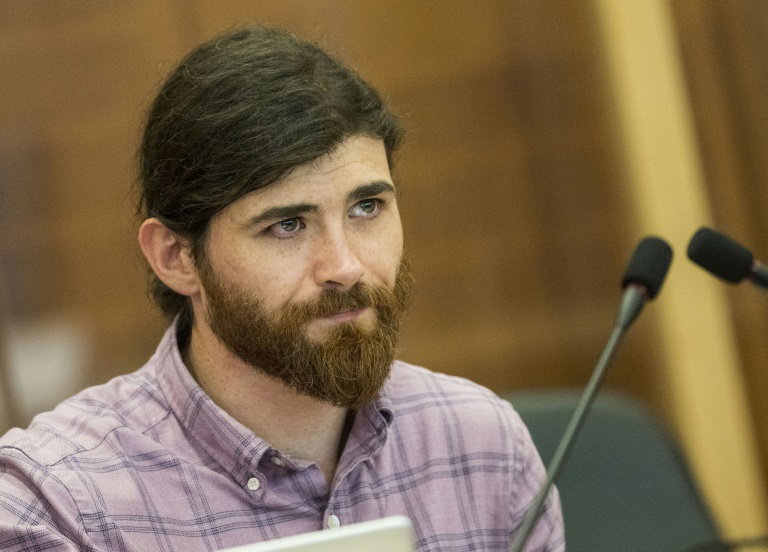
Albrecht, who has a full beard and wears his long hair tied in a ponytail, is alleged to have darkened his skin with makeup to pose as a penniless Syrian refugee and hoodwinked immigration officials for 15 months, despite speaking no Arabic.

He was arrested in 2017 while trying to retrieve a Nazi-era pistol he had hidden in a toilet at Vienna’s international airport, and his fraud was discovered when his fingerprints matched two separate identities.

“Neither Arabic nor details about my story were necessary,” Albrecht testified, describing his conversations with immigration authorities.

Soon after his arrest, then defence minister Ursula von der Leyen, now European Commission chief, said Albrecht’s case pointed to a much larger “attitude problem” in the German military.

Von der Leyen’s successor Annegret Kramp-Karrenbauer ordered the partial dissolution of the KSK commando force in 2020 after revelations that some of its members harboured neo-Nazi sympathies. 

Prosecutors said Albrecht planned to use both the pistol and other weapons and explosives he had taken from the German army in order to carry out an attack.

But they backed away for lack of evidence from an accusation that he plotted to use his false refugee identity to pin the crime on a Syrian.

Albrecht’s lawyers called for a suspended sentence based solely on weapons law violations, while prosecutors have demanded jail time of six years and three months. 

– ‘Mein Kampf’ –

Albrecht told the court he deceived authorities at the height of the 2015-16 migrant influx, in which more than one million asylum seekers entered Germany.

The soldier, the son of a German mother and an estranged Italian immigrant father, posed as a Christian fruit seller from Damascus called David Benjamin.

Albrecht, who repeatedly expressed anti-Semitic, racist and hard nationalist views before the court during his trial, testified that then-chancellor Angela Merkel had failed to uphold the constitution by welcoming the refugees.

Investigations showed he owned a copy of Adolf Hitler’s book “Mein Kampf” and stated that immigration was a form of “genocide”.

Albrecht had been free on bail as his trial began but was taken back into custody in February of this year when he was found with Nazi memorabilia and further weapons in his possession, including five machetes under his mattress. 

Mexican sex workers fight injustice with the pen

Paloma Paz puts on a wig and pink heels before heading onto Mexico City’s streets for sex work — a precarious profession that she combines with journalism to decry injustices.

She began writing articles after seeing fellow sex workers thrown onto the street when the hotels where they lived and worked closed due to the pandemic.

Journalism “is a way of shouting at society, at the authorities, about what’s happening to us,” the 28-year-old transgender woman said.

“It’s not a hobby,” she added, combing her long black wig at her home in the Mexican capital.

Paz and 10 other women write for a free monthly magazine called Noticalle published by the non-governmental organization Brigada Callejera (Street Brigade).

“It’s a means of communication mainly produced by sex workers for sex workers,” who felt misrepresented by the mass media, said the NGO’s founder, Elvira Madrid.

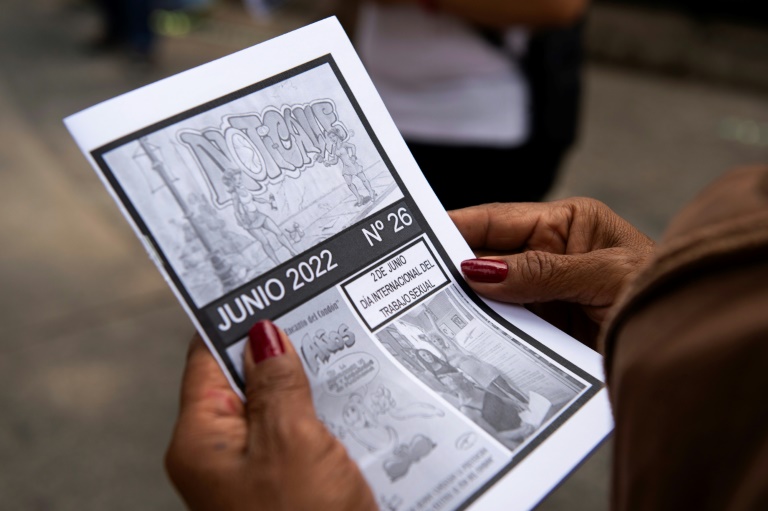
Around 1,000 copies of the magazine are printed each month, made of three letter-size sheets of paper folded in half and stapled together.

On the cover there is a cartoon of two sex workers with the word Noticalle in the background. The letter O is a represented by a condom.

– ‘Community journalism’ –

Members of the magazine’s team distribute copies each month by hand to sex workers in Mexico City.

“This is community journalism,” Paz told one women.

“We report everything that we see on a daily basis. Read it at your leisure,” she added.

Leaning against a wall perusing the latest issue, the woman welcomed the publication as a useful window into the lives of sex workers elsewhere in the city.

“It helps us to find out what’s happening in other areas where colleagues are,” she said, asking not to be named.

In its June issue — the 26th — the magazine reported that sex workers had lost up to 70 percent of their income due to the pandemic.

Other topics included extortion by organized crime and the case of an indigenous transgender sex worker sentenced to 14 years in prison after she was “unjustly” convicted of murdering her partner.

Madrid selects the articles that are published and an external collaborator acts as designer and proofreader.

Paz and her colleagues regularly hone their skills at a journalism workshop, Madrid said.

“You have to take care about the sources of information,” a teacher tells them in one class.

– ‘Sharper vision’ –

Krisna, a 51-year-old transgender sex worker, was trained at another journalism workshop and now sometimes reports for the digital media Disinformemonos.

On one recent day, she patiently interviewed displaced indigenous people outside the National Palace demanding housing from the government, tactfully extracting the information needed for her article.

Learning journalism “has given me a sharper vision of the news. I have the ability to analyze texts, to see the social and political situation in the world,” said Krisna.

One of the best things that the profession has given her is a different, peaceful way of defending against police abuse, she said.

In 2014, the Mexico City government began issuing credentials to sex workers to protect them from police officers who asked for money or sexual favors.

Using her new skills, Krisna also co-edited a book of interviews by sex workers of colleagues involved in journalism.

Reporting “helps me with my self-esteem and my value as a human being,” she said.

G20 finance chiefs meet as Indonesia warns of energy, food catastrophe

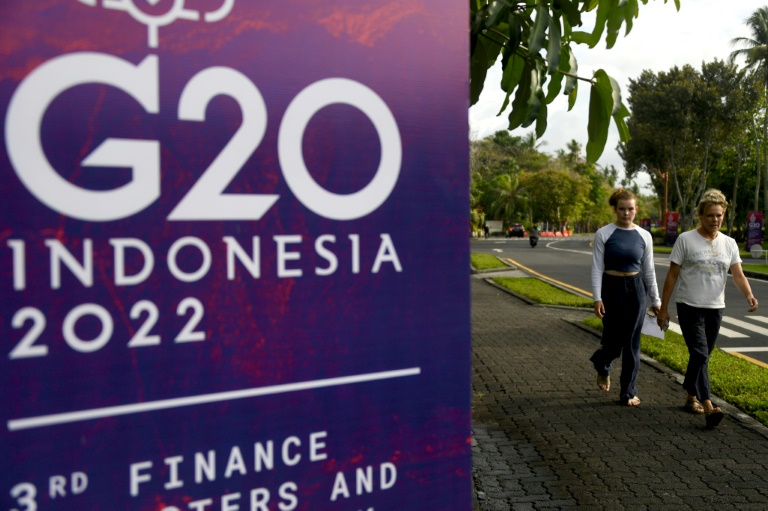
Group of 20 finance ministers and central bank chiefs from top economies met in Indonesia Friday for talks on the fallout from Russia’s invasion of Ukraine, with the host warning them failure to tackle energy and food crises would be catastrophic.

The two-day meeting on the resort island of Bali started under the shadow of a war that has roiled markets, spiked food prices and stoked breakneck inflation, a week after Moscow’s top diplomat walked out of talks with the forum’s foreign ministers.

In her opening remarks, Indonesian Finance Minister Sri Mulyani Indrawati called on ministers to work together with a spirit of “cooperation, collaboration and consensus” because “the world is watching” for solutions.

“The cost of our failure is more than we can afford,” she told delegates. “The humanitarian consequences for the world and for many low-income countries would be catastrophic.”

Top global finance figures, including US Treasury Secretary Janet Yellen, will discuss the rebound from the coronavirus pandemic. But the impact of the Ukraine war –- weighing on an already brittle global recovery –- will top the agenda.

A day before the meeting, Yellen set the tone, calling Russia’s war in Ukraine the “greatest challenge” to the global economy and saying members of Putin’s government “have no place” at the talks.

“We are seeing negative spillover effects from that war in every corner of the world, particularly with respect to higher energy prices and rising food insecurity,” she said.

Yellen is expected to press G20 allies for a price cap on Russian oil to choke off President Vladimir Putin’s war chest and pressure Moscow to end its invasion while bringing down energy costs.

Both Russian Finance Minister Anton Siluanov and Ukrainian Finance Minister Serhiy Marchenko are participating virtually in the meeting.

Yellen in April led a multinational walkout of finance officials as Russian delegates spoke at a G20 meeting in Washington. No communique was issued at the end of that meeting.

It is unclear if a similar walkout will take place at this meeting, after no foreign minister walked out last week, but Yellen would not be drawn on if they would repeat their joint action.

There is also unlikely to be a final communique issued when talks end on Saturday because of disagreements with Russia.

– World tax overhaul deadline set – 

G20 chair Indonesia -– which pursues a neutral foreign policy –- has refrained from uninviting Russia despite Western pressure.

Italy and Canada’s finance ministers are in attendance, but Chinese Finance Minister Liu Kun and Britain’s new Finance Minister Nadhim Zahawi are only attending virtually.

International Monetary Fund chief Kristalina Georgieva will appear in person after saying Wednesday the global economic outlook had “darkened significantly” because of Moscow’s invasion.

European Central Bank president Christine Lagarde is participating virtually, but World Bank chief executive David Malpass will not attend.

The meeting is a prelude to the leaders’ summit on the Indonesian island in November that was meant to focus on the global recovery from the Covid-19 pandemic.

Other issues to be tackled by the ministers include digital financial inclusion –- with more than a billion of the world’s population still without access to a bank account -– and the deadline for an international tax rules overhaul.

The Organisation for Economic Cooperation and Development (OECD) will present the ministers with an update on the progress of international tax changes that will set a global minimum corporate tax rate of 15 percent by 2024, a year later than originally planned.

The deadline for the passing of legislation underpinning the new rules was set at mid-2023, the OECD said.

Close Bitnami banner
Bitnami