World

China lockdown worries hit Asian equities, crude prices

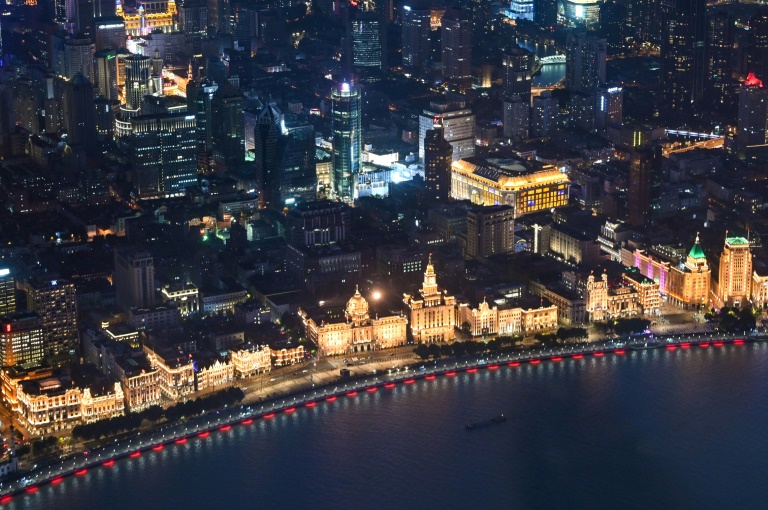
Asian markets and oil prices fell Monday with a fresh Covid flare-up in Shanghai fanning fears of another economically painful lockdown in China’s biggest city.

The news came after a forecast-busting US jobs report last week indicated the world’s top economy was coping so far with the Federal Reserve interest rate hikes, giving it room for more as it battles soaring inflation.

Traders are also keeping tabs on developments in Washington as President Joe Biden weighs removing some of the Donald Trump-era tariffs on Chinese goods worth hundreds of billions of dollars.

Shanghai recorded more than 120 virus cases at the weekend, having seen its first case of the highly contagious BA.5 Omicron strain, forcing officials to launch another mass testing drive.

With China fixated on its zero-Covid strategy of wiping out the disease, there is increasing concern that authorities will revert to another painful lockdown, with Shanghai residents having only emerged from a two-month confinement in June.

There have also been new infections uncovered in other parts of the country, including Beijing.

Data this week will provide a fresh update on the economic impact of those measures, as well as similar strict controls in Beijing.

The prospect of another lockdown sparked a sell-off in Hong Kong and Shanghai, with Chinese tech firms also taking a battering after authorities fined giant Tencent and Alibaba over not properly reporting past deals.

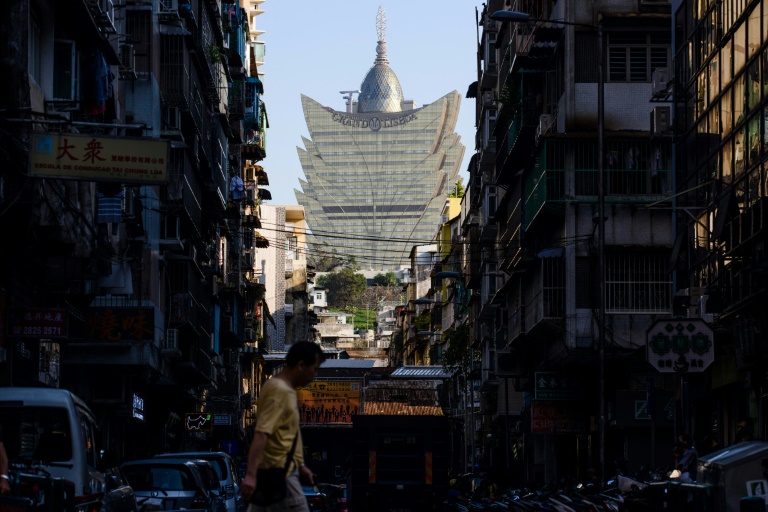
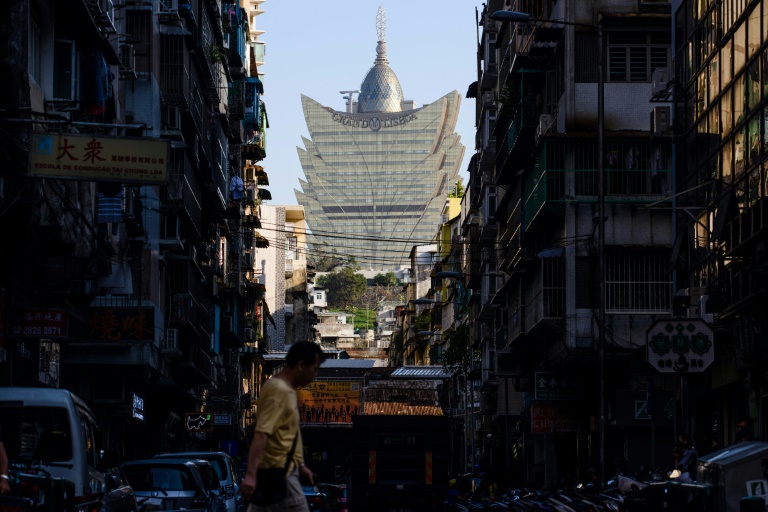
Hong Kong-listed casino operators were also sharply lower after officials in Macau embarked on a week-long lockdown to curb its worst coronavirus outbreak.

There were also losses in Sydney, Seoul, Taipei, Manila, Mumbai, Jakarta and Wellington.

However, there Tokyo rose as traders welcomed Japan’s ruling bloc securing a strong win in Sunday’s upper house election, held days after the assassination of former premier Shinzo Abe.

The result should provide the government with some stability, while there were also hopes for a cabinet reshuffle and economic stimulus.

London, Paris and Frankfurt were all sharply lower in the morning.

– Fed ‘must be resolute’ –

The weak start to the week followed a tepid lead from Wall Street, where the strong jobs reading ramped up bets on further big Fed rate hikes after officials said the economy was strong enough to withstand them.

“The resilience of the US labour market, with the unemployment rate at 3.6 percent, as well as jobs markets elsewhere, helps to offer a compelling narrative to those who think recession concerns are overblown,” said CMC Markets analyst Michael Hewson.

The central bank is predicted to announce a second successive 0.75 percentage point lift at its next meeting this month, while further big increases are also expected before the end of the year.

Policymakers have said they are determined to bring inflation down from four-decade highs, even if that means hurting growth.

On Friday, New York Fed president John Williams reiterated its determination, saying in a speech: “Inflation is sky-high, and it is the number one danger to the overall health and stability of a well-functioning economy.

“I want to be clear: this is not an easy task. We must be resolute, and we cannot fall short.”

Worries about another shock to the Chinese economy from possible shutdowns also dented oil markets as concerns about a hit to demand outweighed ongoing concerns about tight supplies.

Still, there is a view that prices will remain elevated for now.

“Covid numbers are ticking up again,” said SPI Asset Management’s Stephen Innes.

“Although the possible demand impact of a recession continues to weigh on sentiment, the prevailing view, at least for now, is that the longer-term structural issues facing the oil market will support prices.”

Investors will be keeping watch on Biden’s visit this week to Saudi Arabia, where he is expected to push for the crude giant to ramp up production to make up for the output lost to sanctions against Russia.

– Key figures at around 0810 GMT –

Tokyo – Nikkei 225: UP 1.1 percent at 26,812.80 (close)

Hong Kong – Hang Seng Index: DOWN 2.8 percent at 21,124.20 (close)

Shanghai – Composite: DOWN 1.3 percent at 3,313.58 (close)

London – FTSE 100: DOWN 1.2 percent at 7,113.73

West Texas Intermediate: DOWN 1.9 percent at $102.79 per barrel

Brent North Sea crude: DOWN 1.7 percent at $105.33 per barrel

Euro/dollar: DOWN at 1.0123 from 1.0183 on Friday

Pound/dollar: DOWN at 1.1967 from 1.2034 

Euro/pound: UP at 84.60 pence from 84.59 pence

Dollar/yen: UP at 136.80 yen from 136.10 yen

New York – Dow: DOWN 0.2 percent at 31,338.15
Ex-Trump advisor Bannon agrees to testify at Capitol riot hearings: reports

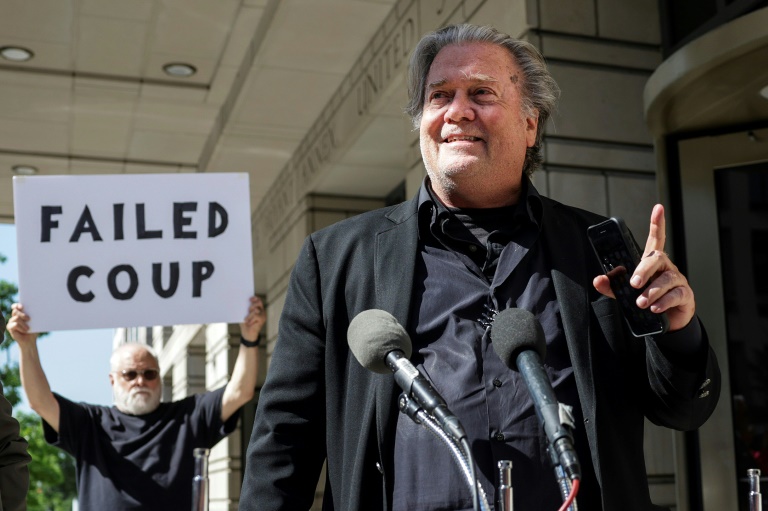
Former Trump advisor Steve Bannon has agreed to testify in the Capitol riot hearings, days before he was to face trial for defying a subpoena from the committee investigating the attack on Congress, US media reported Sunday.

“Mr. Bannon is willing to, and indeed prefers, to testify at your public hearing,” his lawyer Robert Costello wrote in a letter to the House Select Committee on Saturday, which was initially reported by The Guardian and cited by US media.

Bannon was among dozens of people called to testify on last year’s assault on the Capitol aimed at shutting down Congress over former president Donald Trump’s baseless claims that Joe Biden won the 2020 election due to voter fraud.

Investigators believe Bannon and other Trump advisors could have information on links between the White House and the mob that invaded the Capitol on the day it was due to certify Biden as winner.

Although he was not a White House employee or official Trump aide, Bannon’s attorneys had previously claimed he was protected by presidential executive privilege and did not have to cooperate with the committee.

According to the letter explaining his about-face, Bannon told the House Select Committee that “circumstances have now changed.”

“President Trump has decided that it would be in the best interests of the American people to waive executive privilege for Stephen K. Bannon, to allow Mr. Bannon to comply with the subpoena issued by your Committee.” 

In November last year, Bannon turned himself in to the FBI to face charges of contempt of Congress after refusing to testify on the January 6 Capitol assault.

“I’m never going to back down,” he told reporters at the time after appearing before a judge to hear the charges.

“We’re going on the offense on this. And stand by,” he said, repeating the phrase Trump used during the election in 2020 to encourage supporters of a far-right militia group.

Bannon, 68, was indicted by a grand jury with two misdemeanor counts of contempt, each one carrying a penalty of one month to one year in jail, and a fine of up to $100,000.

The attack, which left five people dead, succeeded in delaying the joint House-Senate election certification session for several hours.

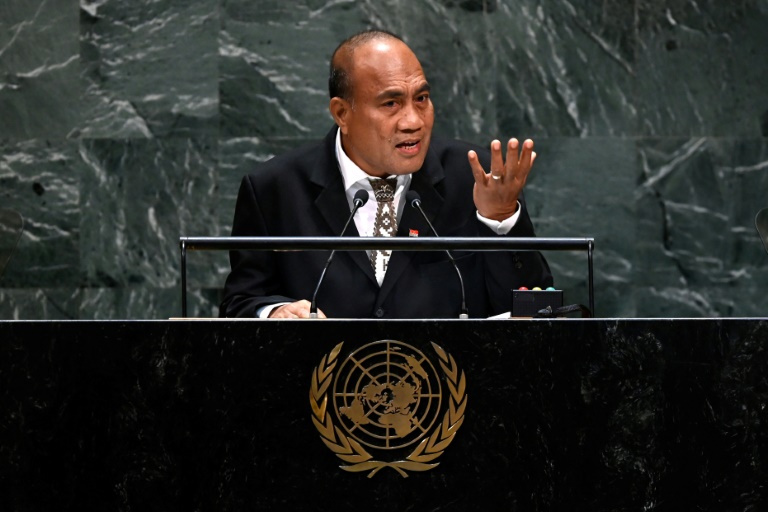
Kiribati quits key Pacific island bloc

Kiribati has quit the premier bloc of Pacific island nations, fracturing the group just as its leaders launch a summit to grapple with rising seas and China’s security ambitions in the region.

The central Pacific nation of 120,000 people said it had taken “the sovereign decision” to withdraw from the 51-year-old, Fiji-based Pacific Islands Forum “with immediate effect”.

In a July 9 letter obtained by AFP, Kiribati President Taneti Maamau cited the forum’s failure to honour a “gentlemen’s agreement” to appoint a Micronesian candidate to head the secretariat.

The spat had led to a threat by Micronesian countries to leave the bloc but it was patched up with a deal last month to rotate the top job, set to be discussed at this week’s summit.

The Kiribati leader cited his country’s national day celebrations on July 12 as another reason for not attending the summit.

Leaders from more than a dozen forum nations are meeting in Fiji’s capital Suva from July 12-14 — the first such in-person summit since the Covid-19 pandemic began almost three years ago.

It comes at a pivotal time when China is seeking to expand its diplomatic and security engagements in the region.

“Your meeting today is taking place in a rapidly evolving regional and international context,” Secretary General Henry Puna told leaders at a related event Monday.

“The development and security challenges that we face today, from Covid-19 to climate change and ocean pollution highlight the critical importance of regional and multilateral cooperation.”

Beijing’s increasing influence in the region — notably a secretive security pact with Solomon Islands in April — has fed concern in the United States and its allies about its intentions.

Regional powers Australia and New Zealand — both members of the Pacific Island Forum — have stressed the bloc’s importance in deciding the security strategy of the region.

– Strategic position –

Australia is working with Fiji to encourage Kiribati “not to go through with their formal decision to leave”, said Pat Conroy, minister for the Pacific.

The island forum “is the central architecture for our region and losing Kiribati would obviously not be a good thing, and that is why we are working hard to avoid that,” he told Australian national broadcaster ABC.

Conroy stressed that Kiribati’s stated concerns were about the leadership of the forum, not China.

Chinese Foreign Minister Wang Yi visited Kiribati during a whistle-stop tour of the Pacific in May, signing 10 agreements in areas such as the climate and the economy, but not security.

Low-lying Kiribati, at risk of sinking from rising seas in a changing climate, has a strategic position 3,000 kilometres (1,800) miles southwest of Hawaii with one of the largest exclusive economic zones in the world.

China’s South Pacific ambitions suffered a setback in late May when 10 Pacific island nations rebuffed its push for a wide-ranging regional security pact.

Behind the scenes, Pacific leaders expressed misgivings about being pulled into Beijing’s orbit.

Unification Church says Abe shooting suspect's mother is member

The mother of the man accused of murdering Japan’s former prime minister Shinzo Abe over a grudge against an organisation belongs to the Unification Church, the group said Monday.

Police investigating Tetsuya Yamagami on suspicion of murder have said he targeted Abe because he believed he was linked to a particular group, without naming the organisation.

Local media described the group as religious and said Yamagami resented it over large donations his mother made to the organisation that left the family in financial trouble.

On Monday, the Unification Church’s Japan branch confirmed that Yamagami’s mother, who has not been named, is a member, but said it had no information on any financial contributions.

“The mother of the suspect Yamagami belongs to our church and she has been attending our events about once a month,” Tomihiro Tanaka, president of the church in Japan, told reporters at a hastily organised press conference in Tokyo.

He said any donations she made were being investigated by police and he could not comment further, pledging to cooperate with investigators.

“There are people who donate large sums of money. We are grateful to them because they wouldn’t give such donations without being willing,” Tanaka said, denying there are donation “quotas” for individuals.

Officially called the Family Federation for World Peace and Unification, the church was founded in Korea in the 1950s by Sun Myung Moon, a divisive figure who died in 2012.

It is believed to have hundreds of thousands of followers worldwide, especially in Japan and the United States, and its teachings are based on the Bible but with new interpretations.

Yamagami’s mother joined the church in around 1998 and the organisation learned she had declared bankruptcy around 2002, Tanaka said.

“We don’t know the circumstances that led this family to bankruptcy.”

Tanaka said the church was horrified by Abe’s murder, calling it “heartrending”, and noted that the former prime minister was not a member though he had spoken at events organised by affiliated groups.

“Abe expressed his support for the world peace movement led by our leader… but he has never been a registered member or advisor of the religious group.”

Investigators have told local media that Yamagami originally wanted to kill the leader of the group he resented, but decided to target Abe instead in the belief he was linked to the organisation.

A wake for the former prime minister is being held on Monday ahead of his funeral on Tuesday.

Fleeing Rajapaksa's cash handed to Sri Lankan police

Millions of rupees in cash left behind by President Gotabaya Rajapaksa when he fled his official residence in the capital will be handed over to court on Monday, police said.

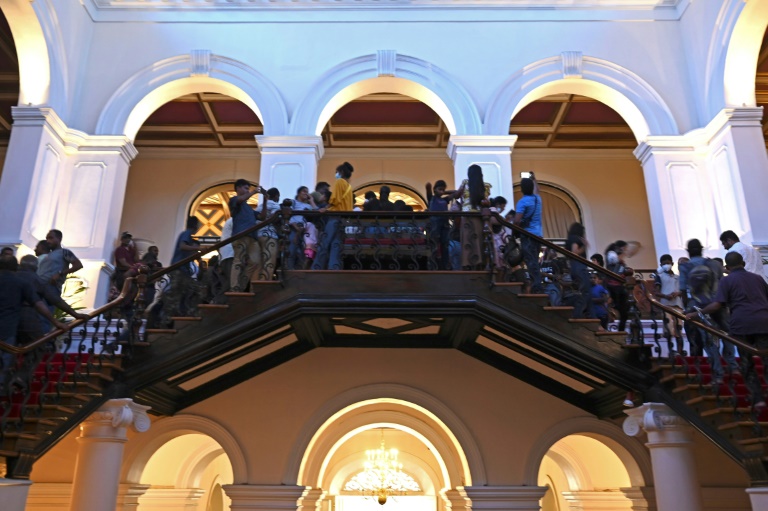
Protesters discovered 17.85 million rupees (about $50,000) in crisp new banknotes but turned it over to police following Saturday’s storming of the Presidential palace.

“The cash was taken over by the police and will be produced in court today,” a police spokesman said.

Official sources said a suitcase full of documents had also been left behind at the stately mansion.

Rajapaksa took up residence at the two-century-old building after he was driven out of his private home on March 31 when protesters tried to storm it.

The 73-year-old leader escaped through a back door under escort from naval personnel and was taken away by boat, heading to the northeast of the island, official sources told AFP.

His exact whereabouts were not known Monday morning, but Prime Minister Ranil Wickremesinghe said Rajapaksa had officially informed him of his intention to resign.

The 73-year-old Wickremesinghe will automatically become acting president in the event of Rajapaksa’s resignation, but has himself announced his willingness to step down if consensus is reached on forming a unity government.

Rajapaksa had already told parliamentary Speaker Mahinda Abeywardana that he will quit on Wednesday to allow a “peaceful transition”, hours after he was forced out of his official residence.

Tens of thousands of protesters captured Rajapaksa’s sea-front office shortly after overrunning the palace on Saturday. 

Protesters had been camping outside the Presidential Secretariat for over three months demanding his resignation over the country’s unprecedented economic crisis.

Rajapaksa is accused of mismanaging the economy to a point where the country has run out of foreign exchange to finance even the most essential imports leading to severe hardships for the 22 million population.

Thousands of men and women on Monday continued to occupy the state buildings they had taken over at the weekend, vowing to remain until Rajapaksa steps down.

The roads leading to the palace were choked with tens of thousands of people on Sunday visiting the mansion that had previously been the country’s most tightly-guarded  building.

An effigy of Rajapaksa was hung on a clock tower near the palace.

The protesters are also demanding the resignation of Wickremesinghe, an opposition legislator who was made premier in May to try and lead the country out of its economic crisis.

Sri Lanka defaulted on its $51 billion foreign debt in April and is in talks with the IMF for a possible bailout.

Sri Lanka has nearly exhausted its already scarce supplies of petrol. The government has ordered the closure of non-essential offices and schools to reduce commuting and save fuel.

US hails Abe as 'man of vision' ahead of family wake

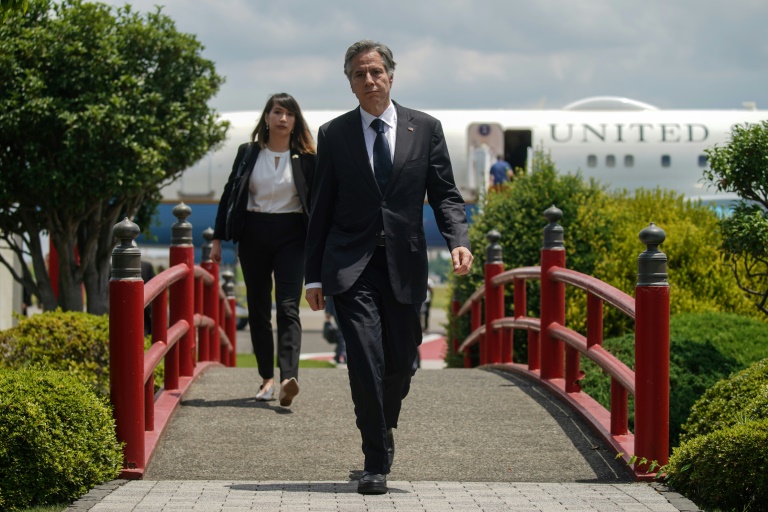
Washington’s top diplomat hailed assassinated former prime minister Shinzo Abe as a “man of vision” as he offered condolences Monday in Tokyo, where family will later hold a wake for the murdered politician.

Japan’s ruling coalition meanwhile declared victory in a sombre election held Sunday, just two days after Abe was gunned down on the campaign trail.

US Secretary of State Antony Blinken made a previously unscheduled trip to Japan while on an Asia tour because, he said, “we’re friends, and when one friend is hurting, the other friend shows up.”

Abe “did more than anyone to elevate the relationship between the United States and Japan,” Blinken added, calling him “a man of vision with the ability to realise that vision”.

He handed Prime Minister Fumio Kishida letters from US President Joe Biden for Abe’s family, who on Monday will hold a wake for the country’s longest-serving prime minister at a major Buddhist temple in Tokyo.

A hearse carrying Abe’s body arrived at Zojoji temple Monday afternoon for the private event, which top politicians and business figures are expected to attend.

A family funeral will be held at the same location on Tuesday, with public memorials to take place at a later date.

– Religious group –

The man accused of Abe’s murder, 41-year-old Tetsuya Yamagami, is in custody and has told police he targeted the former leader because he believed he was linked to a specific organisation that authorities have not yet named.

Japanese media reports said he blamed the group, described as a religious organisation, for his family’s financial troubles because his mother made large donations to it.

The Unification Church, a global religious movement founded in Korea in the 1950s, said on Monday that Yamagami’s mother was a member.

“She has been attending our events about once a month,” Tomihiro Tanaka, president of the church in Japan, told a hastily organised press conference in Tokyo, declining to comment on donations she may have made.

Tanaka said the church was horrified by Abe’s “barbaric” murder and would cooperate with police investigations.

Yamagami, believed to have spent three years in Japan’s navy, had watched YouTube videos to help learn how to build homemade guns like the one used in the attack, investigative sources told local media.

– Election victory –

Sunday’s election went ahead despite the assassination, with Kishida saying it was important to show violence would not defeat democracy.

Abe’s long-ruling Liberal Democratic Party and its coalition partner Komeito won 76 of the 125 upper house seats up for grabs, up from the 69 seats they previously held, according to national news outlets.

The victory had been widely expected even before the assassination.

Both parties belong to what is now a two-thirds supermajority open to amending the country’s pacifist constitution. Abe long sought to reform the charter to recognise the country’s military.

Kishida told reporters on Monday that the seats gained represented a chance to “protect Japan” and build on Abe’s achievements.

Kishida, who took office in September, has pledged to tackle the pandemic, inflation and issues related to Russia’s invasion of Ukraine, and there was speculation that Friday’s attack could bolster his support.

But turnout was up only marginally, and still low at a reported 52 percent.

A record 35 female candidates were elected, and some fringe candidates also won for the first time including one from an anti-vaccination party.

Abe was the scion of a political family and became the country’s youngest post-war prime minister when he took power for the first time in 2006, aged 52.

His hawkish, nationalist views were divisive, particularly his desire to reform the pacifist constitution, and he weathered a series of scandals, including allegations of cronyism.

But he was lauded by others for his economic strategy, dubbed “Abenomics,” and his efforts to put Japan firmly on the world stage, including by cultivating close ties with Biden’s predecessor Donald Trump.

Macau lockdown begins, Hong Kong mulls health code app

Macau casino shares plunged on Monday as the Chinese city embarked on a week-long lockdown to curb its worst coronavirus outbreak while neighbouring Hong Kong said it was mulling a mainland-style health code system.

Share prices of six gaming conglomerates — Sands China, Galaxy Entertainment, SJM Holdings, Melco International, MGM China and Wynn Macau — dropped by between six and nearly nine percent in Monday morning trade.

It is the first casino lockdown in more than two years, overriding a previous deal between the industry and the Macau government that only those found with infections would need to close temporarily.

Macau, the world’s biggest gambling hub, is the only place in China where casinos are legal but the pandemic has hammered the city’s fortunes as it sticks to Beijing’s zero-Covid model.

While casinos have remained open throughout most of the pandemic they have seen a fraction of pre-Covid business.

A Bloomberg gauge of the city’s six licensed casino operators is down 20 percent this year.

Authorities announced a week of lockdowns starting Monday after recording more than 1,500 infections in the past three weeks despite multiple rounds of compulsory mass testing of the city’s 650,000 people.

All residents must stay home except to go shopping for daily necessities and to get tested for the virus, with rule-breakers facing up to two years in jail.

Some public services and businesses such as supermarkets and pharmacies can stay open, and only people with special permission or a low-risk health code can use public transport.

China uses mandatory health code apps to trace people’s movements and coronavirus outbreaks. Only those with green codes can move freely.

It is a system that Hong Kong’s government is now considering employing, new health minister Lo Chung-mau said Monday.

“So-called freedom can sometimes be easily confused with selfishness,” Lo told RTHK radio.

“Infected people should not have the freedom to go wherever they want and affect our health.”

Hong Kong is being remoulded in the authoritarian mainland’s image after huge democracy protests three years ago.

The business hub has hewed to a lighter version of the zero-Covid model, which has battered the economy and left the city internationally cut off for more than two years.

The newly installed administration of chief executive John Lee, a former security official, has vowed to stamp out infections and restart travel to both the mainland and outside world.

To do that, authorities may need to deploy more mainland-style mass monitoring of the population.

Hong Kong currently uses a less restrictive mobile phone app than the mainland one, which keeps a resident’s vaccination record and is used to check into businesses and venues.

Macau lockdown begins, Hong Kong mulls health code app

Macau casino shares plunged on Monday as the Chinese city embarked on a week-long lockdown to curb its worst coronavirus outbreak while neighbouring Hong Kong said it was mulling a mainland-style health code system.

Share prices of six gaming conglomerates — Sands China, Galaxy Entertainment, SJM Holdings, Melco International, MGM China and Wynn Macau — dropped by between six and nearly nine percent in Monday morning trade.

It is the first casino lockdown in more than two years, overriding a previous deal between the industry and the Macau government that only those found with infections would need to close temporarily.

Macau, the world’s biggest gambling hub, is the only place in China where casinos are legal but the pandemic has hammered the city’s fortunes as it sticks to Beijing’s zero-Covid model.

While casinos have remained open throughout most of the pandemic they have seen a fraction of pre-Covid business.

A Bloomberg gauge of the city’s six licensed casino operators is down 20 percent this year.

Authorities announced a week of lockdowns starting Monday after recording more than 1,500 infections in the past three weeks despite multiple rounds of compulsory mass testing of the city’s 650,000 people.

All residents must stay home except to go shopping for daily necessities and to get tested for the virus, with rule-breakers facing up to two years in jail.

Some public services and businesses such as supermarkets and pharmacies can stay open, and only people with special permission or a low-risk health code can use public transport.

China uses mandatory health code apps to trace people’s movements and coronavirus outbreaks. Only those with green codes can move freely.

It is a system that Hong Kong’s government is now considering employing, new health minister Lo Chung-mau said Monday.

“So-called freedom can sometimes be easily confused with selfishness,” Lo told RTHK radio.

“Infected people should not have the freedom to go wherever they want and affect our health.”

Hong Kong is being remoulded in the authoritarian mainland’s image after huge democracy protests three years ago.

The business hub has hewed to a lighter version of the zero-Covid model, which has battered the economy and left the city internationally cut off for more than two years.

The newly installed administration of chief executive John Lee, a former security official, has vowed to stamp out infections and restart travel to both the mainland and outside world.

To do that, authorities may need to deploy more mainland-style mass monitoring of the population.

Hong Kong currently uses a less restrictive mobile phone app than the mainland one, which keeps a resident’s vaccination record and is used to check into businesses and venues.

Europe frets over reduced Russia gas supplies

Russian gaz giant Gazprom begins 10 days of routine maintenance on its Nord Stream 1 pipeline on Monday — with Germany and other European countries watching anxiously to see if the gas comes back on.

The annual work on the two pipelines was scheduled long in advance. The fear is however that — with relations between Russia and the West at their lowest in years because of the invasion of Ukraine — Gazprom might take the opportunity to simply shut off the valves.

“Putin is going to turn off the gas tap… but will he turn it back on one day?” German mass daily Bild asked on Sunday on its website.

“We are confronted by an unprecedented situation — anything is possible,” German vice-chancellor, Robert Habeck, told public radio over the weekend.

“It is possible that the gas will flow once more, even at a higher volume level than before.”

But, he warned, “it is possible that nothing comes through, and we still have to prepare for the worst” as Europe scrambles to transition away from Russia for energy supplies.

– Turbines row –

One issue at least, was resolved over the weekend, when Canada agreed to return to Germany turbines needed to maintain the Nord Stream 1 gas pipeline, despite the objections of Ukraine.

German Chancellor Olaf Scholz, via his spokesman, on Sunday “saluted the decision of our Canadian friends” to grant what Ottawa termed a time-limited and revocable permit for Siemens Canada to allow the machine’s return.

Russia had insisted it needed the machine’s return before it could ramp supplies back up after several weeks of significant cuts.

Ukraine, however, last week accused Berlin of having given in to Russian “blackmail” after Moscow blamed reduced supplies on the repairs, not market conditions caused by the Ukraine war.

Moscow had wound down supplies by 60 percent in recent weeks, blaming the absence of the turbine even as Berlin denounced what it terms a “political” decision.

Those cuts had a knock-on effect on supplies to a number of EU states, including Poland and Bulgaria, who have seen theirs stopped altogether.

Berlin has explained that for technical reasons it would be difficult for Gazprom entirely to stop deliveries via Nord Stream.

As Habeck put it, “it is not like a water tap” that can simply be turned on or off.

Nord Stream 1 is the longest subsea pipeline in the world, running under the Baltic Sea from Russia to Germany and has been in operation for a decade.

Following Russia’s invasion of Ukraine in February, Germany suspended certification of a second pipeline, Nord Stream 2, as fears grew over Europe’s massive dependence on Russian gas supplies.

But even now, a long-term shutdown of the pipeline would hit Germany and its EU neighbours hard, deepening an energy crisis in which uncertain supplies have pushed prices up ahead of Europe’s winter.

– Ration fears –

Germany imports some 35 percent of its gas from Russia compared with 55 percent before the Ukraine conflict started.

The website of Nord Stream indicates that gas arriving in the German town of Lubmin continues to be sent on to Belgium, Denmark and France as well as Britain and the Netherlands.

German industry is very vulnerable to shortages and chemical trade group VCI says it is preparing “for the worst” with authorities discussing the possibility of having to ration supply.

If deliveries cease altogether, German multinational chemical firm BASF is considering furloughing part of its roughly 100,000 workforce.

And Klaus Mueller, the head of Germany’s energy regulator, warned: “If we no longer receive Russian gas… current stocks will only last for one or two months.”

On Thursday, parliament adopted a plan which includes limiting winter heating to a maximum 20 Celsius (68 degrees Fahrenheit) and cutting hot water supplies in individual offices.

Habeck warned of “difficult societal choices” ahead.

Europe frets over reduced Russia gas supplies

Russian gaz giant Gazprom begins 10 days of routine maintenance on its Nord Stream 1 pipeline on Monday — with Germany and other European countries watching anxiously to see if the gas comes back on.

The annual work on the two pipelines was scheduled long in advance. The fear is however that — with relations between Russia and the West at their lowest in years because of the invasion of Ukraine — Gazprom might take the opportunity to simply shut off the valves.

“Putin is going to turn off the gas tap… but will he turn it back on one day?” German mass daily Bild asked on Sunday on its website.

“We are confronted by an unprecedented situation — anything is possible,” German vice-chancellor, Robert Habeck, told public radio over the weekend.

“It is possible that the gas will flow once more, even at a higher volume level than before.”

But, he warned, “it is possible that nothing comes through, and we still have to prepare for the worst” as Europe scrambles to transition away from Russia for energy supplies.

– Turbines row –

One issue at least, was resolved over the weekend, when Canada agreed to return to Germany turbines needed to maintain the Nord Stream 1 gas pipeline, despite the objections of Ukraine.

German Chancellor Olaf Scholz, via his spokesman, on Sunday “saluted the decision of our Canadian friends” to grant what Ottawa termed a time-limited and revocable permit for Siemens Canada to allow the machine’s return.

Russia had insisted it needed the machine’s return before it could ramp supplies back up after several weeks of significant cuts.

Ukraine, however, last week accused Berlin of having given in to Russian “blackmail” after Moscow blamed reduced supplies on the repairs, not market conditions caused by the Ukraine war.

Moscow had wound down supplies by 60 percent in recent weeks, blaming the absence of the turbine even as Berlin denounced what it terms a “political” decision.

Those cuts had a knock-on effect on supplies to a number of EU states, including Poland and Bulgaria, who have seen theirs stopped altogether.

Berlin has explained that for technical reasons it would be difficult for Gazprom entirely to stop deliveries via Nord Stream.

As Habeck put it, “it is not like a water tap” that can simply be turned on or off.

Nord Stream 1 is the longest subsea pipeline in the world, running under the Baltic Sea from Russia to Germany and has been in operation for a decade.

Following Russia’s invasion of Ukraine in February, Germany suspended certification of a second pipeline, Nord Stream 2, as fears grew over Europe’s massive dependence on Russian gas supplies.

But even now, a long-term shutdown of the pipeline would hit Germany and its EU neighbours hard, deepening an energy crisis in which uncertain supplies have pushed prices up ahead of Europe’s winter.

– Ration fears –

Germany imports some 35 percent of its gas from Russia compared with 55 percent before the Ukraine conflict started.

The website of Nord Stream indicates that gas arriving in the German town of Lubmin continues to be sent on to Belgium, Denmark and France as well as Britain and the Netherlands.

German industry is very vulnerable to shortages and chemical trade group VCI says it is preparing “for the worst” with authorities discussing the possibility of having to ration supply.

If deliveries cease altogether, German multinational chemical firm BASF is considering furloughing part of its roughly 100,000 workforce.

And Klaus Mueller, the head of Germany’s energy regulator, warned: “If we no longer receive Russian gas… current stocks will only last for one or two months.”

On Thursday, parliament adopted a plan which includes limiting winter heating to a maximum 20 Celsius (68 degrees Fahrenheit) and cutting hot water supplies in individual offices.

Habeck warned of “difficult societal choices” ahead.

Close Bitnami banner
Bitnami