World

Love letters and tax returns: Bolivia's sidewalk scribes prefer typewriters

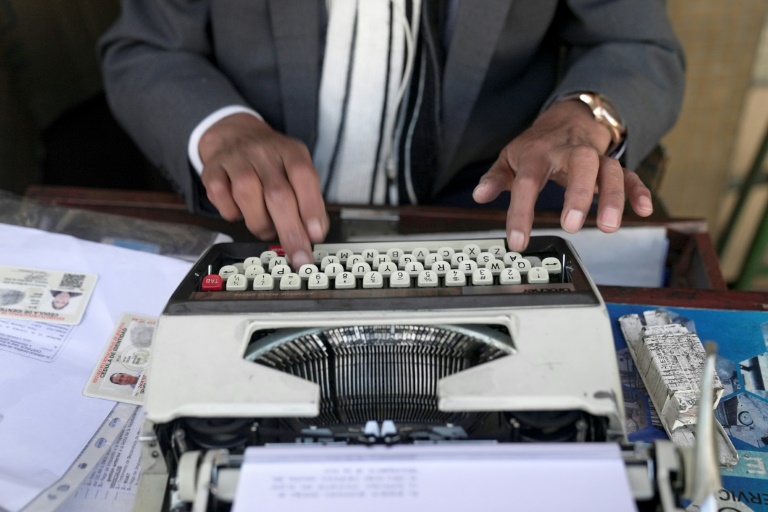
Dressed in a suit, a feather in his hat, Rogelio Condori sits bent over a small table on a sidewalk in La Paz, tapping on a typewriter with his index fingers.

As clients line up by his desk, which is perched at an angle, 61-year-old Condori fills out a tax form here, a divorce application there, on his Brother Deluxe 1350 vintage typewriter in the Bolivian capital.

For a fee of up to seven bolivianos (about $1) per page, “we handle everything related to national taxes,” he told AFP with obvious pride from behind a full-face plastic mask. 

Condori and his colleagues also dole out what advice they can.  

“We can’t complain,” he said of his livelihood, which covers “the bread of the day” in a poor country with a minimum monthly wage of about $320.

Condori competes with nine other typewriter scribes on the same street, but said he has regular clients.

In Bolivia, much administrative paperwork is unavailable online and must instead be submitted in typed form. 

About 60 percent of Bolivians have internet access, but connections are often slow.

“I have not had good experiences with accountants and lawyers,” said Lazario Cucho, a 56-year-old farmer who has used Condori’s services.

“And on top of that, they charge a lot.”

– Love letters –

As the sun climbs in the sky, Condori opens an umbrella to cast some shade over his workspace.

He looks up from his work to see a couple, both grim-faced, who have come for help with a divorce form.

Another client wants him to fill out a bank loan application.

“Every now and then, we do love letters,” Condori said, smiling amid the din of traffic and street vendors on the corner that has been his outdoor office for the last 37 years.

Once, a man approached him for help with a souring relationship.

“I wrote: ‘My love… let our years together not be in vain. Please reconsider our situation’,” Condori recounted the letter he composed for the man.

The man “sent the letter and came back a month later to say: ‘Mr Rogelio, we have reconciled thanks to the love letter,'” the typist said.

Condori recently set up an office complete with internet and a computer, but he much prefers his “exciting” sidewalk perch.

“Typewriters are easier to use, and they are fast,” he said. 

At 3:00 pm, Condori packs his mobile desk onto a cart, which he pushes to a nearby warehouse where it will stay overnight.

“I think this typewriting thing will continue,” said Condori of his craft.

“They will always come for love letters.”
Return to Kyiv by night train

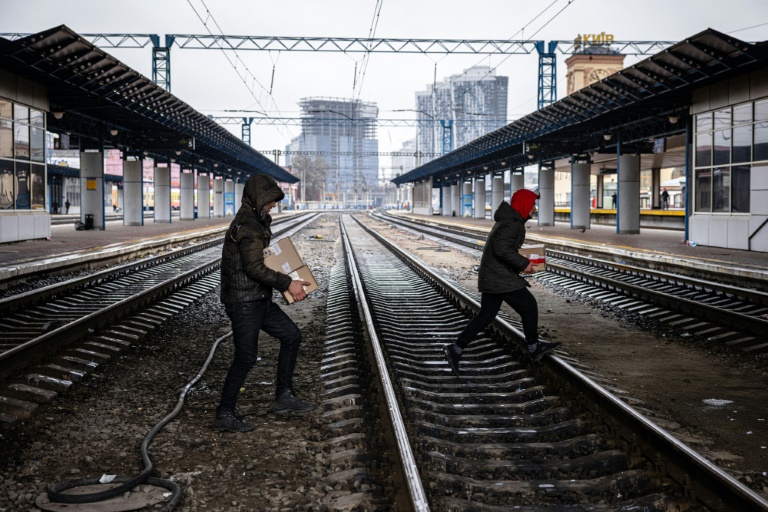
When the train slows to a halt just after the Polish border, Tatiana’s smile lights up her moon-shaped face. 

“Ukraine!”

Like the other passengers on the train linking the Polish city of Chelm to Kyiv, Tatiana and her mother, Valentina, have decided after four months in exile that it is time to come home, despite the war, despite the uncertainty.

The two women — who declined to give their surname — hail from Kryvyi Rig, President Volodymyr Zelensky’s hometown in central Ukraine.

They fled abroad right at the start of the Russian invasion on February 24 to join friends living in Izmir, in Turkey.

Tatiana, who worked in the capital, Kyiv, as a sales representative for a marketing firm, continued her job remotely from Turkey.

“Four months is enough, though. It’s not easy living in a country where you don’t know anything and you don’t speak the language,” she explained.

“I don’t know what’s going to happen or when the war will end, but we’re going home.”

A third of the 7.3 million people who have fled Ukraine since the start of the war have, like Tatiana and Valentina, decided to return.

In the capital — where a semblance of normality has resumed since Russian forces withdrew from the region in April — two-thirds of residents have decided to come back. 

– ‘If they’re not dead’ –

Many of the passengers on the sleeper train are women and children.

One of the handful of male travellers, a man in his 30s, spends long hours standing in the corridor gazing silently out of the window at the green Ukrainian countryside.

After two months away, Maxime is going to Donbas, the industrial region in the east that Russia is going all-out to seize and where the war rages without respite.

The shelling is relentless and the Russian forces are slowly but surely gaining territory at huge cost to human life. The destruction is massive.

“I’ve got some people to go and see there. If they’re not dead,” Maxime says baldly.

No one seems to bother much about the long hours of waiting on the Polish side of the border and then again on the Ukrainian side.

The journey is going to take more than 15 hours, so why get impatient?

The passengers appear to be joined by a subtle, intangible thread. Whatever their personal stories, whatever their reasons for coming back — and in most cases they don’t wish to elaborate — they are linked by this decision to return.

– Look after yourself – 

Two young women who didn’t know each other before talk quietly in the corridor until late into the night.

An Ed Sheeran song at low volume drifts from one of the carriages.

The blonde ticket collector, bossy but sympathetic, passes up and down taking orders for tea and water and checking everyone is comfortable.

The same calm reigns as the train approaches Kyiv in the early morning light.

But there are more damp eyes and the atmosphere becomes more solemn.

A good-natured supervisor, who made the journey in shorts and flipflops, changes into his white-shirted uniform.

The travellers carefully fold their beds away and empty their bins.

The train pulls into the station.

The guard unloads the cases and helps passengers down onto the platform, where husbands, fathers and brothers are waiting for their families, bouquets of flowers in hand.

Tatiana, still beaming, bids farewell to her travelling companions. She tells them to look after themselves.

'Faceless killer': Syria landmines keep sowing death

Family members from three generations were huddled on the back of a pickup truck for what started as a joyful ride through the Syrian countryside for Abdulaziz al-Oqab and his relatives.

They were planning to sample the long-forgotten peacetime pleasure of a simple family picnic when a landmine brought a bloody end to their outing, and to the lives of 21 family members.

Oqab walked away with relatively light wounds that day in February 2019, but the blast killed his wife, two of his sons, four of his siblings, an uncle and other family members, and left others maimed.

“It was a day of joy that turned into tragedy,” Oqab, 41, told AFP. “I’ve come to hate going out since then. People live in fear of this faceless killer that could be anywhere.”

The airstrikes and shelling responsible for many of the Syrian war’s half million deaths have decreased in recent years.

But remnants of explosives laid by all sides in the 11-year-old conflict are now claiming more lives in Syria than anywhere else in the world, says the United Nations.

Since 2015, landmines and other explosive remnants have on average killed or injured five people every day, according to UN data.

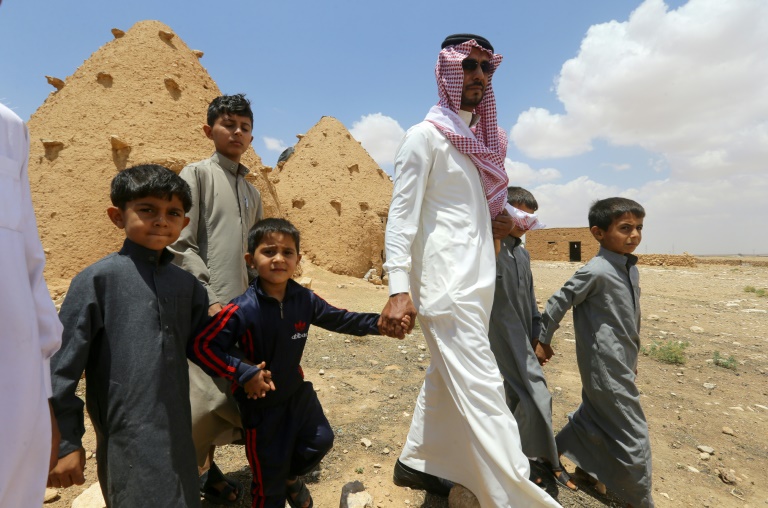
“An entire family was destroyed,” Oqab said about the fateful day more than three years ago, sitting outside his traditional beehive-style mud hut in his village in Hama province.

“Death awaited us from inside the earth,” he said, surrounded by his orphaned nephews. 

“This was our destiny.” 

– ‘Fatal’ mistakes –

The UN Mine Action Service said 15,000 people have been killed or injured by explosive devices in Syria since 2015.

This is a “huge number”, said Habibulhaq Javed, who heads Syria’s UNMAS team. “Currently, Syria is reporting the highest number of victims caused by explosive ordnance globally.”

Syria’s war is estimated to have killed almost 500,000 people and displaced millions since it began in 2011.

About 10.2 million people, or roughly half of all Syrians, live in areas contaminated with explosive devices, the UN says.

“Mines have a long lifespan,” said a Syrian army officer, who asked not to be named over security concerns. 

They stay lethal even longer if they are kept inside casings, he told AFP during a de-mining training exercise organised by the military near Damascus. 

Syrian authorities detonate ammunition and explosive remnants of war on a near-daily basis, especially in areas formerly held by rebel forces near the capital.

In Syria’s rebel-held north, it is rescue workers who take on the daunting task of sweeping for landmines and detonating them, in the absence of state support.

The White Helmets rescue group has even set up training and workshops to raise awareness on the dangers landmines pose.

Raed Hassoun of the White Helmets heads a de-mining centre in Syria’s northwest that has neutralised about 24,000 explosive devices since 2016.

“We deal with unexploded ordnance according to one principle,” he told AFP.

“Your first mistake is your last.”

– ‘Tore us apart’ –

A lack of resources is depriving most of Syria’s towns and villages of vital mine clearance work.

Last year, UNMAS carried out its first mine-clearing operation in government-held parts of Daraya, an area on the outskirts of Damascus that was once a rebel bastion and saw fierce fighting. 

UNMAS also carried out sweeps in the Yarmuk Palestinian refugee camp outside Damascus, which was held by rebels and then jihadists before its recapture by government forces in 2018.

Explosive remnants were found in about 200 out of 6,000 surveyed buildings, the UN said.

The world body is struggling with limited funding for its de-mining programmes, Javed said.

As a result, civilians have paid the price. 

They include the family of Zakia al-Boushi who, on a fateful day in 2017, went out with eight relatives in Aleppo province searching for the precious white truffles that grow in the desert sands in winter.

Only three of them returned alive.

The landmine that killed her relatives was the second one they came across that day.

Her brother was avoiding a device he had spotted when a second one went off and blew up their vehicle.

Boushi’s brother and mother were killed, while her daughter was left so shell-shocked she has not uttered a word in five years.

“The mine tore us apart,” Boushi said.

James Webb Space Telescope opens its eyes on the Universe

Space enthusiasts are holding their breath.

The James Webb Space Telescope, the most powerful ever sent into orbit, is set Tuesday to unveil breathtaking new views of the Universe with a clarity that’s never been seen before.

Distant galaxies, bright nebulae and a faraway giant gas planet are among the observatory’s first targets, US space agency NASA said Friday.

But the images themselves have been jealously guarded to build suspense ahead of the big reveal.

“I’m looking very much forward to not having to keep these secrets anymore, that will be a great relief,” Klaus Pontoppidan, an astronomer at the Space Telescope Science Institute (STSI) that oversees Webb, told AFP.

NASA chief Bill Nelson has promised the “deepest image of our Universe that has ever been taken.”

Webb’s infrared capabilities are what make it uniquely powerful — allowing it to both pierce through cosmic dust clouds and detect light from the earliest stars, which has been stretched into infrared wavelengths as the Universe expanded.

This lets it peer further back in time than any previous telescope, to the period shortly after the Big Bang, 13.8 billion years ago.

“When I first saw the images… I suddenly learned three things about the Universe that I didn’t know before,” Dan Coe, an STSI astronomer and expert on the early Universe, told AFP. “It’s totally blown my mind.”

– First targets –

An international committee decided the first wave of images would include the Carina Nebula, an enormous cloud of dust and gas 7,600 light years away.

Carina Nebula is famous for its towering pillars that include “Mystic Mountain,” a three-light-year-tall cosmic pinnacle captured in an iconic image by the Hubble Space Telescope, until now humanity’s premier space observatory.

Webb has also carried out a spectroscopy — an analysis of light that reveals detailed information — on a faraway gas giant called WASP-96 b, which was discovered in 2014.

Nearly 1,150 light-years from Earth, WASP-96 b is about half the mass of Jupiter and zips around its star in just 3.4 days.

Nestor Espinoza, an STSI astronomer, told AFP that previous exoplanet spectroscopies carried out using existing instruments were very limited compared to what Webb could do.

“It’s like being in a room that is very dark and you only have a little pinhole you can look through,” he said of the prior technology. Now, with Webb, “You’ve opened a huge window, you can see all the little details.”

Perhaps most enticing of all, Webb has gathered an image using foreground galaxy clusters called SMACS 0723 as a kind of cosmic magnifying glass for the extremely distant and faint objects behind it.

– Million miles from Earth –

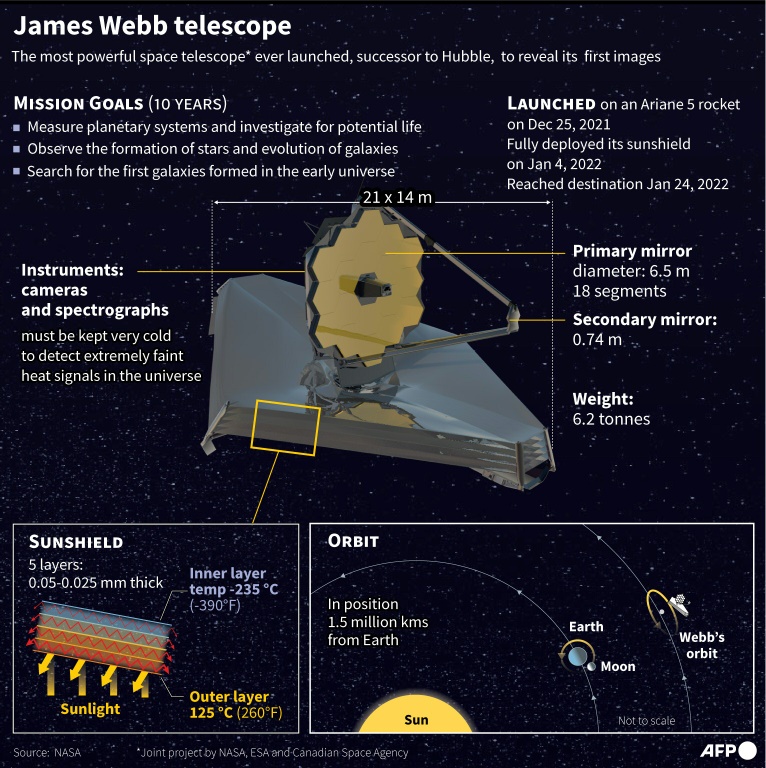
Launched in December 2021 from French Guiana on an Ariane 5 rocket, Webb is orbiting the Sun at a distance of a million miles (1.6 million kilometers) from Earth, in a region of space called the second Lagrange point.

Here, it remains in a fixed position relative to the Earth and Sun, with minimal fuel required for course corrections. 

A wonder of engineering, the total project cost is estimated at $10 billion, making it one of the most expensive scientific platforms ever built, comparable to the Large Hadron Collider at CERN.

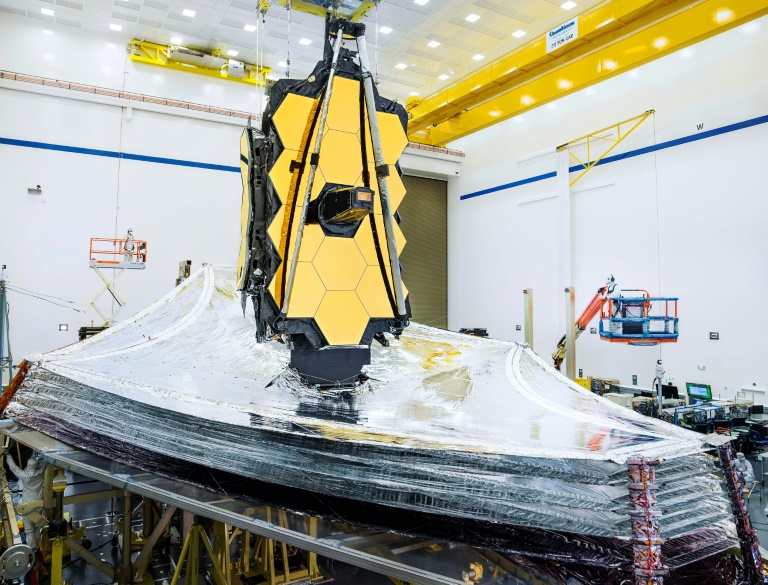
Webb’s primary mirror is over 21 feet (6.5 meters) wide and is made up of 18 gold-coated mirror segments. Like a camera held in one’s hand, the structure must remain as stable as possible to achieve the best shots.

Charlie Atkinson, chief engineer on the James Webb Space Telescope program at lead contractor Northrop Grumman, told AFP that it wobbles no more than 17 millionths of a millimeter.

Atkinson, who has been working on the program since 1998, said: “We knew it was going to require some of the best talents across the world, but it was doable.”

After the first images, astronomers around the globe will get shares of time on the telescope, with projects selected competitively through a process in which applicants and selectors don’t know each others’ identity, to minimize bias.

Thanks to an efficient launch, NASA estimates Webb has enough propellant for a 20-year life, as it works in concert with the Hubble and Spitzer space telescopes to answer fundamental questions about the cosmos.

James Webb Space Telescope opens its eyes on the Universe

Space enthusiasts are holding their breath.

The James Webb Space Telescope, the most powerful ever sent into orbit, is set Tuesday to unveil breathtaking new views of the Universe with a clarity that’s never been seen before.

Distant galaxies, bright nebulae and a faraway giant gas planet are among the observatory’s first targets, US space agency NASA said Friday.

But the images themselves have been jealously guarded to build suspense ahead of the big reveal.

“I’m looking very much forward to not having to keep these secrets anymore, that will be a great relief,” Klaus Pontoppidan, an astronomer at the Space Telescope Science Institute (STSI) that oversees Webb, told AFP.

NASA chief Bill Nelson has promised the “deepest image of our Universe that has ever been taken.”

Webb’s infrared capabilities are what make it uniquely powerful — allowing it to both pierce through cosmic dust clouds and detect light from the earliest stars, which has been stretched into infrared wavelengths as the Universe expanded.

This lets it peer further back in time than any previous telescope, to the period shortly after the Big Bang, 13.8 billion years ago.

“When I first saw the images… I suddenly learned three things about the Universe that I didn’t know before,” Dan Coe, an STSI astronomer and expert on the early Universe, told AFP. “It’s totally blown my mind.”

– First targets –

An international committee decided the first wave of images would include the Carina Nebula, an enormous cloud of dust and gas 7,600 light years away.

Carina Nebula is famous for its towering pillars that include “Mystic Mountain,” a three-light-year-tall cosmic pinnacle captured in an iconic image by the Hubble Space Telescope, until now humanity’s premier space observatory.

Webb has also carried out a spectroscopy — an analysis of light that reveals detailed information — on a faraway gas giant called WASP-96 b, which was discovered in 2014.

Nearly 1,150 light-years from Earth, WASP-96 b is about half the mass of Jupiter and zips around its star in just 3.4 days.

Nestor Espinoza, an STSI astronomer, told AFP that previous exoplanet spectroscopies carried out using existing instruments were very limited compared to what Webb could do.

“It’s like being in a room that is very dark and you only have a little pinhole you can look through,” he said of the prior technology. Now, with Webb, “You’ve opened a huge window, you can see all the little details.”

Perhaps most enticing of all, Webb has gathered an image using foreground galaxy clusters called SMACS 0723 as a kind of cosmic magnifying glass for the extremely distant and faint objects behind it.

– Million miles from Earth –

Launched in December 2021 from French Guiana on an Ariane 5 rocket, Webb is orbiting the Sun at a distance of a million miles (1.6 million kilometers) from Earth, in a region of space called the second Lagrange point.

Here, it remains in a fixed position relative to the Earth and Sun, with minimal fuel required for course corrections. 

A wonder of engineering, the total project cost is estimated at $10 billion, making it one of the most expensive scientific platforms ever built, comparable to the Large Hadron Collider at CERN.

Webb’s primary mirror is over 21 feet (6.5 meters) wide and is made up of 18 gold-coated mirror segments. Like a camera held in one’s hand, the structure must remain as stable as possible to achieve the best shots.

Charlie Atkinson, chief engineer on the James Webb Space Telescope program at lead contractor Northrop Grumman, told AFP that it wobbles no more than 17 millionths of a millimeter.

Atkinson, who has been working on the program since 1998, said: “We knew it was going to require some of the best talents across the world, but it was doable.”

After the first images, astronomers around the globe will get shares of time on the telescope, with projects selected competitively through a process in which applicants and selectors don’t know each others’ identity, to minimize bias.

Thanks to an efficient launch, NASA estimates Webb has enough propellant for a 20-year life, as it works in concert with the Hubble and Spitzer space telescopes to answer fundamental questions about the cosmos.

The James Webb Space Telescope, by the numbers

The most powerful space telescope ever built, James Webb is set to deliver its first full-color scientific images to the world Tuesday. 

Here is an overview of this feat of human ingenuity, in five key figures.

– More than 21 feet –

The centerpiece of the observatory is its huge main mirror, measuring more than 21 feet (6.5 meters) in diameter and made up of 18 smaller, hexagonal-shaped mirrors.

The observatory also has four scientific instruments: cameras to take pictures of the cosmos, and spectrographs, which break down light to study which elements and molecules make up objects.

The mirror and the instruments are protected from the light of our Sun by a tennis-court sized thermal shield, made up of five superimposed layers.

Each layer is hair thin, and together they ensure the telescope operates in the darkness needed to capture faint glimmers from the far reaches of the Universe.

– Million miles away –

Unlike the Hubble telescope which revolves around the Earth, Webb orbits around the Sun, nearly a million miles (1.6 million kilometers) from us, or four times the distance from our planet to the Moon. 

It took the spacecraft almost a month to reach this region, called Lagrange Point two, where it remains in a fixed position behind the Earth and Sun to give it a clear view of the cosmos.

Here, the gravity from the sun and Earth balance the centrifugal motion of a satellite, meaning it needs minimal fuel for course correction.

– 13.8 billion years –

In astronomy, the farther out you see, the deeper back in time you’re looking.

Webb’s infrared capabilities are what make it uniquely powerful — allowing it to detect light from the earliest stars, which has been stretched into infrared wavelengths as the Universe expanded.

This lets it peer further back in time than any previous telescope, to within a few hundred million years after the Big Bang, 13.8 billion years ago.

– Three-decade wait –

The project was first conceived in the 1990s, but construction did not begin until 2004. 

Then Webb’s launch date was repeatedly postponed. Initially set for 2007, it finally took place on December 25, 2021, aboard an Ariane 5 rocket, from French Guiana.

– $10 billion –

Webb is an international collaboration between US space agency NASA, the European Space Agency (ESA), and the Canadian Space Agency (CSA), involving more than 10,000 people.

The lifetime cost to NASA alone will be approximately $9.7 billion, according to an analysis by the Planetary Society, or $10.8 billion adjusted for inflation to 2020 dollars.

Leaked Uber docs reveal bare-knuckle expansion tactics: investigation

A leaked cache of confidential files from ride-sharing company Uber illustrates ethically dubious and potentially illegal tactics it used to fuel its frenetic global expansion beginning nearly a decade ago, a joint media investigation showed Sunday.

Dubbed the “Uber Files,” the investigation involving dozens of news organizations found that company officials leveraged the sometimes violent backlash from the taxi industry against drivers to garner support and evaded regulatory authorities as it looked to conquer new markets early in its history.

Culled from 124,000 documents from 2013-2017 initially obtained by British daily the Guardian and shared with the International Consortium of Investigative Journalists, the revelations are the latest hit for a company dogged by controversy as it exploded into a disruptive force in local transportation. 

The cache includes unvarnished text and email exchanges between executives, with standouts from co-founder and former chief executive Travis Kalanick, who was forced to resign in 2017 following accusations of brutal management practices and multiple episodes of sexual and psychological harassment at the company.

“Violence guarantee(s) success,” Kalanick messaged other company leaders as he pushed for a counter protest amid sometimes heated demonstrations in Paris in 2016 against Uber’s arrival in the market.

Uber’s rapid expansion leaned on subsidized drivers and discounted fares that undercut the taxi industry, and “often without seeking licenses to operate as a taxi and livery service,” reported The Washington Post, one of the media outlets involved in the probe.

Drivers across Europe had faced violent retaliation as taxi drivers felt their livelihoods threatened. The investigation found that “in some instances, when drivers were attacked, Uber executives pivoted quickly to capitalize” to seek public and regulatory support, the Post said.

According to the Guardian, Uber has adopted similar tactics in European countries including Belgium, the Netherlands, Spain and Italy, mobilizing drivers and encouraging them to complain to the police when they were victims of violence, in order to use media coverage to obtain concessions from the authorities.

A spokesperson for Kalanick strongly denied the findings as a “false agenda,” saying he “never suggested that Uber should take advantage of violence at the expense of driver safety.”

Uber, however, placed the blame Sunday on previously publicized “mistakes” made by leadership under Kalanick. 

“We’ve moved from an era of confrontation to one of collaboration, demonstrating a willingness to come to the table and find common ground with former opponents, including labor unions and taxi companies,” it said, noting that his replacement, Dara Khosrowshahi, “was tasked with transforming every aspect of how Uber operates.”

– ‘Kill switch’ –

The investigation also found that Uber worked to evade regulatory probes by leveraging a technological edge, the Post wrote.

It described an instance when Kalanick implemented a “kill switch” to remotely cut off access of devices in an Amsterdam office to Uber’s internal systems during a raid by authorities. 

“Please hit the kill switch ASAP,” he wrote in an email to an employee. “Access must be shut down in AMS (Amsterdam).”

Kalanick spokesperson Devon Spurgeon said the former chief executive “never authorized any actions or programs that would obstruct justice in any country.”

Kalanick “did not create, direct or oversee these systems set up by legal and compliance departments and has never been charged in any jurisdiction for obstruction of justice or any related offense,” she said.

But the investigation charged that Uber’s actions flouted laws and that executives were aware, citing one joking that they had become “pirates.”

The reports say the files reveal Uber also lobbied governments to aid its expansion, finding in particular an ally in France’s Emmanuel Macron, who was economy minister from 2014 to 2016 and is now the country’s president.  

The company believed Macron would encourage regulators “to be ‘less conservative’ in their interpretation of rules limiting the company’s operations,” the Post said.

Macron was an open supporter of Uber and the idea of turning France into a “start-up nation” in general, but the leaked documents suggest that the minister’s support even sometimes clashed with the leftist government’s policies. 

The revelations sparked indignation among leftist politicians, who denounced the Uber-Macron links as against “all our rules, all our social rights and against workers’ rights,” and condemned the “pillage of the country.” 

Leaked Uber docs reveal bare-knuckle expansion tactics: investigation

A leaked cache of confidential files from ride-sharing company Uber illustrates ethically dubious and potentially illegal tactics it used to fuel its frenetic global expansion beginning nearly a decade ago, a joint media investigation showed Sunday.

Dubbed the “Uber Files,” the investigation involving dozens of news organizations found that company officials leveraged the sometimes violent backlash from the taxi industry against drivers to garner support and evaded regulatory authorities as it looked to conquer new markets early in its history.

Culled from 124,000 documents from 2013-2017 initially obtained by British daily the Guardian and shared with the International Consortium of Investigative Journalists, the revelations are the latest hit for a company dogged by controversy as it exploded into a disruptive force in local transportation. 

The cache includes unvarnished text and email exchanges between executives, with standouts from co-founder and former chief executive Travis Kalanick, who was forced to resign in 2017 following accusations of brutal management practices and multiple episodes of sexual and psychological harassment at the company.

“Violence guarantee(s) success,” Kalanick messaged other company leaders as he pushed for a counter protest amid sometimes heated demonstrations in Paris in 2016 against Uber’s arrival in the market.

Uber’s rapid expansion leaned on subsidized drivers and discounted fares that undercut the taxi industry, and “often without seeking licenses to operate as a taxi and livery service,” reported The Washington Post, one of the media outlets involved in the probe.

Drivers across Europe had faced violent retaliation as taxi drivers felt their livelihoods threatened. The investigation found that “in some instances, when drivers were attacked, Uber executives pivoted quickly to capitalize” to seek public and regulatory support, the Post said.

According to the Guardian, Uber has adopted similar tactics in European countries including Belgium, the Netherlands, Spain and Italy, mobilizing drivers and encouraging them to complain to the police when they were victims of violence, in order to use media coverage to obtain concessions from the authorities.

A spokesperson for Kalanick strongly denied the findings as a “false agenda,” saying he “never suggested that Uber should take advantage of violence at the expense of driver safety.”

Uber, however, placed the blame Sunday on previously publicized “mistakes” made by leadership under Kalanick. 

“We’ve moved from an era of confrontation to one of collaboration, demonstrating a willingness to come to the table and find common ground with former opponents, including labor unions and taxi companies,” it said, noting that his replacement, Dara Khosrowshahi, “was tasked with transforming every aspect of how Uber operates.”

– ‘Kill switch’ –

The investigation also found that Uber worked to evade regulatory probes by leveraging a technological edge, the Post wrote.

It described an instance when Kalanick implemented a “kill switch” to remotely cut off access of devices in an Amsterdam office to Uber’s internal systems during a raid by authorities. 

“Please hit the kill switch ASAP,” he wrote in an email to an employee. “Access must be shut down in AMS (Amsterdam).”

Kalanick spokesperson Devon Spurgeon said the former chief executive “never authorized any actions or programs that would obstruct justice in any country.”

Kalanick “did not create, direct or oversee these systems set up by legal and compliance departments and has never been charged in any jurisdiction for obstruction of justice or any related offense,” she said.

But the investigation charged that Uber’s actions flouted laws and that executives were aware, citing one joking that they had become “pirates.”

The reports say the files reveal Uber also lobbied governments to aid its expansion, finding in particular an ally in France’s Emmanuel Macron, who was economy minister from 2014 to 2016 and is now the country’s president.  

The company believed Macron would encourage regulators “to be ‘less conservative’ in their interpretation of rules limiting the company’s operations,” the Post said.

Macron was an open supporter of Uber and the idea of turning France into a “start-up nation” in general, but the leaked documents suggest that the minister’s support even sometimes clashed with the leftist government’s policies. 

The revelations sparked indignation among leftist politicians, who denounced the Uber-Macron links as against “all our rules, all our social rights and against workers’ rights,” and condemned the “pillage of the country.” 

Japan's ruling party secures strong win after Abe assassination

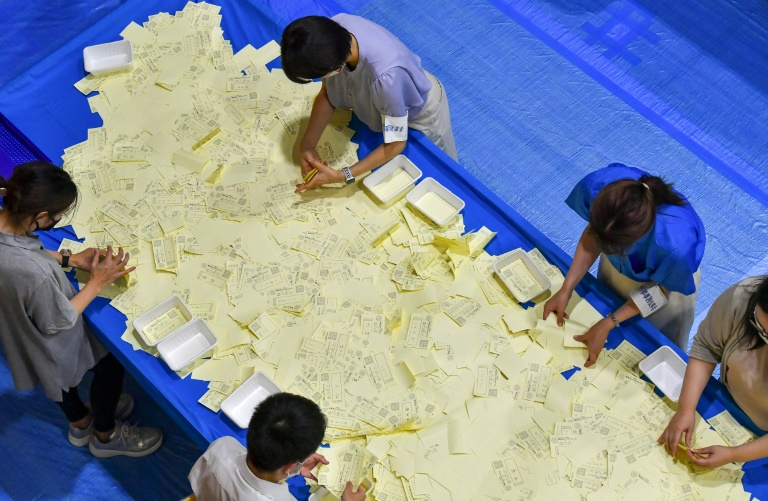
Japan’s ruling party and partners won enough votes to form a supermajority in an upper house election held just days after the assassination of former prime minister Shinzo Abe, local media said Monday.

The ex-premier’s ruling Liberal Democratic Party (LDP) and its coalition partner Komeito strengthened their hold by winning more than 75 of the 125 upper house seats up for grabs, according to national news outlets.

The parties are part of what is now a two-thirds supermajority willing to amend the country’s pacifist constitution, thereby strengthening its military role on the global stage — a longtime Abe goal.

Even before the former prime minister’s murder, the LDP and Komeito were expected to cement their majority, though the final number of seats will be scrutinised for signs of whether the attack bolstered support for them.

“I think it is significant we were able to complete the elections,” Prime Minister Fumio Kishida told NHK, adding he wants to tackle the pandemic, Ukraine-related issues and inflation.

Kishida had insisted the election proceed despite the assassination, saying “we must never allow violence to suppress speech.”

Conceding defeat, Kenta Izumi, leader of the opposition Constitutional Democratic Party, which was projected to have lost several seats, said it was clear “voters did not want to switch from the LDP and entrust us with running the government,” according to Kyodo News.

Despite the murder, turnout for the election remained low at only 52 percent, national outlets reported.

Abe was gunned down at close range on Friday in the western region of Nara, and died of blood loss at a local hospital. His body was brought to his family home in Tokyo on Saturday.

The assassination rattled the nation and sent shockwaves around the world, prompting an outpouring of sympathy even from nations with which the hawkish Abe had sometimes difficult relations, such as China and South Korea.

The man accused of his murder, 41-year-old Tetsuya Yamagami, is in custody and has told investigators he targeted Abe because he believed the politician was linked to an unnamed organisation.

Local media have described the organisation as religious and said Yamagami’s family had suffered financial trouble as a result of his mother’s donations to the group. 

He also reportedly visited the western region of Okayama on Thursday with the intent of killing Abe at a different event, but backed out because participants had to submit their names and addresses.

Additionally, Yamagami admitted to police to test-firing guns at a facility connected to the religious group beforehand, according to media.

– ‘No bigger regret’ –

With little violent crime and tough gun laws, security at Japanese campaign events can be relaxed, though in the wake of Abe’s murder, measures were beefed up for Kishida’s remaining appearances.

Security at polling stations on Sunday remained normal, however, with 79-year-old Takao Sueki saying he was voting with an eye on international instability, including Russia’s invasion of Ukraine.

“Watching the world now, I think every day about how Japan will manage with the situation,” he told AFP.

“This is a democratic country and I despise the use of violence to eliminate someone,” he added when asked about Abe’s murder.

“I strongly believe that if people have disagreements, they should dispute them with dialogue.”

Police have promised a “thorough investigation” into what the head of the Nara regional police called “problems with guarding and safety measures” for Abe.

“In all the years since I became a police officer in 1995… there is no greater remorse, no bigger regret than this,” chief Tomoaki Onizuka tearfully told reporters on Saturday evening.

– Wake, funeral planned –

Abe’s office told AFP that a wake would be held on Monday night, with a funeral for family and close friends only on Tuesday. Local media said both were expected to be held at Tokyo’s Zojoji Temple.

US Secretary of State Antony Blinken, who was in Asia for meetings, arrived in Tokyo on Monday to see Kishida and offer condolences in person.

Abe was the scion of a political family and became the country’s youngest post-war prime minister when he took power for the first time in 2006, aged 52.

His hawkish, nationalist views were divisive, particularly his desire to reform Japan’s pacifist constitution to recognise the country’s military, and he weathered a series of scandals, including allegations of cronyism.

But he was lauded by others for his economic strategy, dubbed “Abenomics,” and his efforts to put Japan firmly on the world stage, including by cultivating close ties with Biden’s predecessor Donald Trump.

Kishida, 64, was once described as among Abe’s favoured successors, and holds a solid majority in parliament with Komeito.

But he faces significant policy headwinds, including rising prices and energy shortages, particularly after an early summer heatwave that led to a power crunch.

Kishida is expected to reshuffle his cabinet in the coming months.

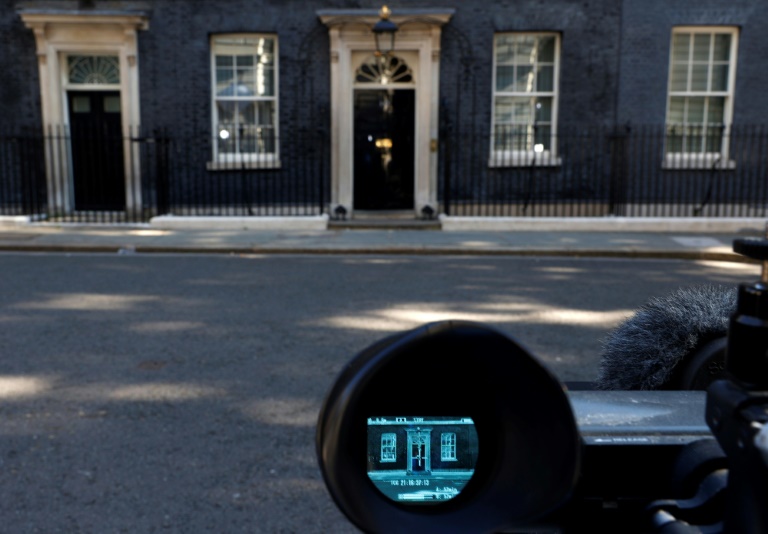
Foreign minister Truss joins 11-strong UK leader race

UK foreign minister Liz Truss on Sunday joined the race to succeed Boris Johnson as prime minister and leader of the ruling Conservative party, as the fractious contest focused on tax.

Truss, 46, announced her candidacy in the Daily Telegraph newspaper on Sunday evening, saying she had “a clear vision of where we need to be, and the experience and resolve to get us there”.

The bid by Truss, seen as a frontrunner in the Tory leadership contest, followed that of former defence minister Penny Mordaunt as the race expanded to 11 candidates.

Mordaunt, 49, an ex-navy reservist who has also held several senior ministerial roles, is not among the favourites to succeed Johnson in recent polls of Tory party members ultimately set to choose their new leader.

But such contests are notoriously unpredictable, and with more than a dozen lawmakers from multiple factions of the ruling party potentially set to run, political commentators say few contenders can be discounted.

The early favourite is former finance minister Rishi Sunak, who launched his campaign Friday after helping to kickstart the cabinet revolt that led to Johnson’s forced resignation Thursday. He is now drawing early fire from Johnson loyalists and rival candidates.

Sunak and former health minister Sajid Javid — who has also declared his candidacy — both resigned late Tuesday, prompting dozens of more junior colleagues to follow suit.

That forced Johnson to then quit as Tory leader 36 hours later.

But the 58-year-old leader, whose three-year premiership has been defined by scandal, the country’s departure from the European Union and the Covid pandemic, said he would stay on until his successor is selected.

– Crowded field –

Former foreign secretary Jeremy Hunt, who finished runner-up to Johnson in the last contest in 2019, announced late Saturday he will stand again.

Current finance minister Nadhim Zahawi — only appointed to the post Tuesday — and Transport Secretary Grant Shapps have also launched bids.

They join attorney general and arch-Brexiteer Suella Braverman, the relatively unknown former equalities minister Kemi Badenoch and backbench Tory MP Tom Tugendhat on the growing candidate list.

Another Tory lawmaker, Rehman Chishti, announced his leadership bid on Sunday evening to take the number of contenders to 11. 

But Defence Secretary Ben Wallace, who has impressed in the role and been one of Tory members’ favourites, said Saturday he would not stand after a discussion with colleagues and family.

Taxation is already a key dividing line in the race, as Britain faces the toxic combination of high inflation and rampant cost-of-living increases alongside stagnant growth and relatively high tax rates.

– Focus on tax –

Announcing their bids separately in the Sunday Telegraph, Javid and Hunt both vowed to cut corporation tax from 25 to 15 percent.

Javid said he would also slash or change other taxes, including reversing a recent rise in national insurance that is ringfenced to raise health service funding.

Hunt, Shapps and Tugendhat set out their stances for lower taxes in Sunday morning television appearances, while Truss also put cutting taxes at the heart of her pitch.

But declaring his candidacy in a slick video on social media before the weekend, Sunak struck a different tone, warning Tories not to believe “fairy tale” pledges.

Meanwhile, Zahawi’s campaign appeared in early danger following Sunday newspaper reports that his personal tax affairs are under investigation by revenue and customs officials — who are part of his treasury department. He has denied wrongdoing.

– Dirty dossiers? –

The likely months-long acrimonious campaign is set to be formalised Monday when a committee of backbenchers will meet to agree the timetable and rules.

A Tuesday evening deadline to register candidacies could be imposed, according to reports.

Geoffrey Clifton-Brown, the committee’s treasurer, told LBC radio he was “absolutely confident” the contest could be whittled down to two candidates to put to members within weeks, before parliament’s summer recess starting after July 21.

First, multiple rounds of voting by all 358 Tory MPs is likely, with elimination thresholds set for each stage.

The new leader then chosen by members could be in place ahead of the Conservatives’ annual conference in early October.

Conservative commentator Iain Dale said Sunday if a consensus candidate emerged, the contest could end without party members voting, as happened in 2016 with the selection of Theresa May.

In a sign of the potential peril of a protracted fight, the Sunday Times reported some of the leadership teams had compiled so-called dirty dossiers of compromising allegations against rival candidates and their aides.

Close Bitnami banner
Bitnami