World

Morocco king in first public appearance since Covid recovery

Morocco’s King Mohammed VI took part in rituals for the Muslim feast of Eid al-Adha on Sunday, official media said, in his first public appearance since recovering from Covid-19.

The 58-year-old monarch, accompanied by his son, Crown Prince Moulay El Hassan, 19, led prayers at the royal palace in Sale, adjacent to Rabat.

He then “continued on to the ritual of sacrifice”, the official MAP news agency said.

The ceremony took place “privately and with very limited participation” in order to respect Covid-19 preventive measures, it added.

Wearing a yellow robe and appearing thinner, the king was seen smiling at the end of the prayers next to his son and his brother Prince Moulay Rachid, 52, images broadcast on public television showed.

Muslims across the world celebrate Eid al-Adha by slaughtering livestock to commemorate the willingness of Abraham to sacrifice his son to show obedience to God.

The king is “the commander of the faithful” and Islam is the state religion in Morocco.

On June 16, the monarch’s personal doctor said King Mohammed VI had tested positive for Covid-19 but without exhibiting symptoms and recommended “a period of rest for a few days”.

The king continued to send protocol and other messages during his convalescence.

The monarch’s health is the subject of keen public interest in the North African kingdom, especially since he underwent heart surgery in February 2018 and in June 2020.

The Jeune Afrique weekly said the king contracted Covid-19 in France, where he had arrived for a private visit on June 1.

Since the outbreak of the coronavirus pandemic in March 2020, Mohammed VI had only taken one other overseas trip — to Gabon in December last year.

Mohammed VI has ruled Morocco since July 1999, when he inherited the throne from his father Hassan II.

Portugal battles forest fires amid heatwave

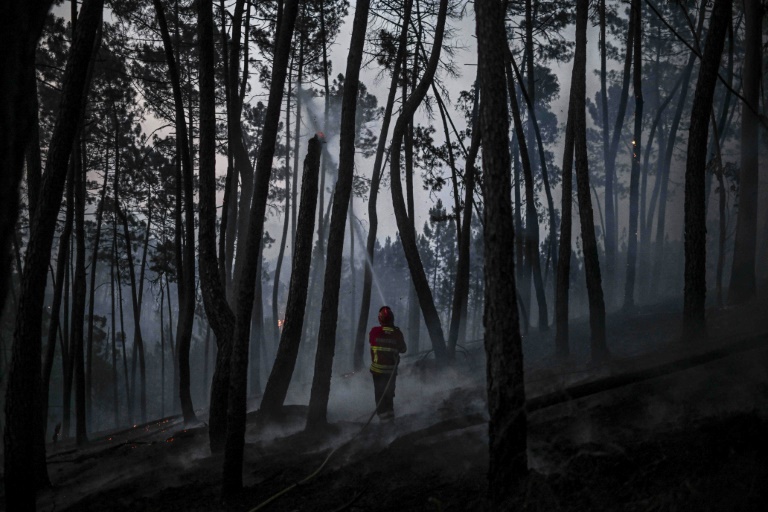
Around 1,5000 firefighters were battling multiple forest fires and several bush fires in central and northern Portugal Sunday following a punishing heatwave, prompting the government to implement a “state of contingency”.

The fires have been burning in several areas since Thursday, destroying at least two homes, as nearly 250 fires were reported to have started on Friday and Saturday. 

The blazes follow an intense heatwave in Portugal, with temperatures reaching over 40 degrees Celsius (104 Fahrenheit) this week, and expected to rise in the coming days. 

Scientists say climate change is linked to more extreme and more frequent weather events, including heatwaves and forest fires. 

The Portuguese government issued a national “state of contingency” as the latest fires raged Sunday, which puts rescue personnel on alert. It is above state of alert, but beneath state of calamity and state of emergency. 

The Civil Protection agency said there were some 1,500 firefighters battling blazes in Ourem, Pombal and Carrazeda de Ansiaes municipalities.

In the hamlet of Travessa de Almogadel in central Portugal, pensioner Donzilia Marques was relived to find her house was not damaged as she returned Sunday after being evacuated the night before. 

“The fire arrived 50 meters (165 feet) from the last house in the village… up there everything burned,” the 76-year-old told AFP, pointing to the hills between home and the town of Freixianda. 

More than 700 soldiers were dispatched to the area Sunday after the fires destroyed some 1,500 hectares (3,700 acres) of vegetation, the Civil Protection agency estimated. 

The fires have injured a dozen firefighters and about 20 civilians, but most were treated on the spot for breathing problems or exhaustion.

Prime Minister Antonio Costa cancelled a planned trip to Mozambique to follow the fires at home. 

The government has asked the European Union to activate its common civil protection mechanism, which will allow Portugal to access two water bomber planes stationed in Spain.

“We are facing an almost unprecedented situation in meteorological terms”, national commander of civil protection, Andre Fernandes said Saturday. 

Portugal has already seen extreme weather this year, with an extreme drought affecting around 28 percent of the country’s territory in June, compared to just one percent in May. 

Portugal battles forest fires amid heatwave

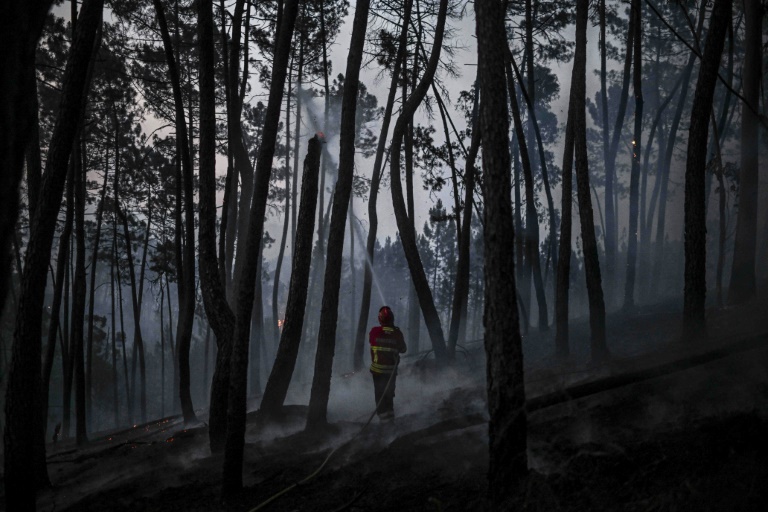
Around 1,5000 firefighters were battling multiple forest fires and several bush fires in central and northern Portugal Sunday following a punishing heatwave, prompting the government to implement a “state of contingency”.

The fires have been burning in several areas since Thursday, destroying at least two homes, as nearly 250 fires were reported to have started on Friday and Saturday. 

The blazes follow an intense heatwave in Portugal, with temperatures reaching over 40 degrees Celsius (104 Fahrenheit) this week, and expected to rise in the coming days. 

Scientists say climate change is linked to more extreme and more frequent weather events, including heatwaves and forest fires. 

The Portuguese government issued a national “state of contingency” as the latest fires raged Sunday, which puts rescue personnel on alert. It is above state of alert, but beneath state of calamity and state of emergency. 

The Civil Protection agency said there were some 1,500 firefighters battling blazes in Ourem, Pombal and Carrazeda de Ansiaes municipalities.

In the hamlet of Travessa de Almogadel in central Portugal, pensioner Donzilia Marques was relived to find her house was not damaged as she returned Sunday after being evacuated the night before. 

“The fire arrived 50 meters (165 feet) from the last house in the village… up there everything burned,” the 76-year-old told AFP, pointing to the hills between home and the town of Freixianda. 

More than 700 soldiers were dispatched to the area Sunday after the fires destroyed some 1,500 hectares (3,700 acres) of vegetation, the Civil Protection agency estimated. 

The fires have injured a dozen firefighters and about 20 civilians, but most were treated on the spot for breathing problems or exhaustion.

Prime Minister Antonio Costa cancelled a planned trip to Mozambique to follow the fires at home. 

The government has asked the European Union to activate its common civil protection mechanism, which will allow Portugal to access two water bomber planes stationed in Spain.

“We are facing an almost unprecedented situation in meteorological terms”, national commander of civil protection, Andre Fernandes said Saturday. 

Portugal has already seen extreme weather this year, with an extreme drought affecting around 28 percent of the country’s territory in June, compared to just one percent in May. 

Sri Lanka protesters won't budge till president leaves office

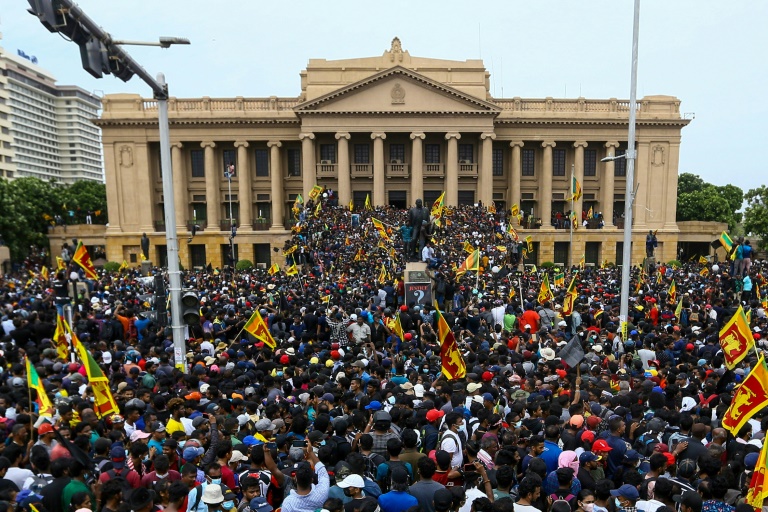
Sri Lankan protesters refused to budge from President Gotabaya Rajapaksa’s residence on Sunday, a day after they stormed his home, forcing him to flee with the navy and announce he would resign.

“Our struggle is not over,” student leader Lahiru Weerasekara told reporters the day after Rajapaksa, currently taking refuge on a vessel offshore, said he would step down on Wednesday.

“We won’t give up this struggle until he actually leaves.”

The dramatic events on Saturday were the culmination of months of protests by people enraged by the South Asian island nation’s unprecedented economic crisis and the Rajapaksa clan’s incompetence and corruption.

Hundreds of thousands massed in Colombo demanding Rajapaksa take responsibility for shortages of medicines, food and fuel that have brought the once-relatively rich economy to its knees and caused misery for ordinary people.

After storming the gates of the colonial-era presidential palace, protesters lounged in its opulent rooms, somersaulting into the compound’s pool and rummaging through Rajapaksa’s clothes.

At a clock tower near the palace, activists hung an effigy of Rajapaksa on Sunday evening as thousands of onlookers cheered.

The streets leading to the palace were choked with people, some carrying toddlers and wheeling along the elderly.

Troops had fired in the air to help Rajapaksa escape on Saturday. The president then boarded a naval craft which steamed to the safety of the island’s southern waters.

On Sunday the presidential palace was a free-for-all, with children and parents plonking on a grand piano, admiring the expensive artwork, picnicking and taking it in turns to sit in the president’s chair.

“When leaders live in such luxury, they have no idea how the commoners manage,” Buddhist monk Sri Sumeda told AFP. 

“This shows what can be done when people decide to exercise their power.”

Rajapaksa’s nearby seafront office was also overrun on Saturday, and Prime Minister Ranil Wickremesinghe’s residence was set on fire even after he too offered to resign. 

Police said they arrested three men in connection with the arson attack at the premier’s home.

– Resignation –

From the naval ship, 73-year-old Rajapaksa — who had clung to power even after deadly nationwide violence in May forced his brother Mahinda Rajapaksa to quit as prime minister — told the speaker of parliament he would step down on Wednesday.

Security forces on Saturday had attempted to disperse the huge crowds that mobbed Colombo’s administrative district, triggering clashes. 

Colombo National Hospital said 105 people were brought in Saturday and that 55 remained under treatment on Sunday, including one in a “very critical” state with a gunshot wound.

After midnight Sri Lanka’s top military officer, General Shavendra Silva, went on TV to appeal for calm and to “resolve the crisis situation peacefully and constitutionally”.

A defence source said Rajapaksa, along with one of his brothers — Basil — was heading to a naval base in the northeast of the island. However, there was no official word their whereabouts.

Washington urged Sri Lankan leaders to act quickly to address the situation “with a commitment to the betterment of the nation — not any one political party”.

US Secretary of State Antony Blinken said on Sunday that Russia’s restrictions on Ukrainian grain exports and the resulting rise in prices “may have contributed” to Sri Lanka’s economic turmoil.

The European Union urged “all parties to cooperate and focus on a peaceful, democratic and orderly transition”.

On Sunday it was unclear who, if anyone, would be able to garner enough support among lawmakers to succeed Rajapaksa.

“We are heading for dangerous uncertainty,” minority Tamil legislator Dharmalingam Sithadthan told AFP. “Gota should have resigned immediately without leaving a power vacuum.”

– Default, desperation –

The bankrupt government has defaulted on its $51 billion external debt and is seeking an International Monetary Fund bailout.

The IMF said Sunday that it hopes for “a resolution of the current situation that will allow for resumption of our dialogue”.

Demonstrators had maintained a months-long protest camp outside Rajapaksa’s office demanding his resignation. 

The camp was the scene of clashes in May when a gang of Rajapaksa loyalists attacked peaceful protesters. Nine people died.

– Cricket goes on –

The unrest comes at the tail end of Australia’s cricket tour of Sri Lanka, with Pakistan’s squad also on the island training for a series of matches beginning next Saturday. 

“Today obviously the country is in turmoil, (with) people outside having their say. We could obviously hear it, I mean we can still hear it now,” Australian player Steve Smith said on Saturday.

Cricket officials said there were no plans to change the Australia and Pakistan schedules and that the sport was unaffected by the political turmoil.

Japan's ruling party projected vote winner after Abe assassination

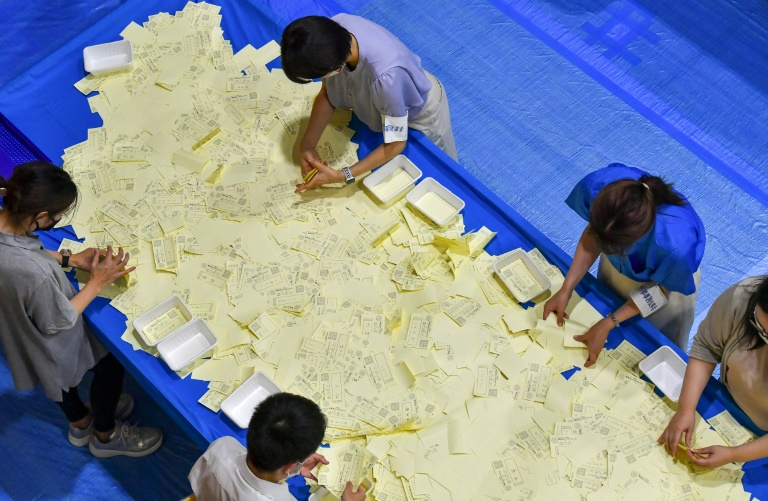
Japan’s ruling coalition is projected to have won the most votes in an election held just two days after the assassination of former prime minister Shinzo Abe, local media said Sunday.

The ex-premier’s ruling Liberal Democratic Party (LDP) and its coalition partner Komeito are expected to claim between 70 and 83 of the 125 upper house seats up for grabs, according to national broadcaster NHK.

Even before Abe’s murder, the LDP and Komeito were expected to cement their majority, though the final number of seats will be scrutinised for signs of whether the attack bolstered support for them.

“I think it is significant we were able to complete the elections,” Prime Minister Fumio Kishida told NHK, adding he wants to tackle the pandemic, Ukraine-related issues and inflation.

Kishida had insisted the election proceed despite the assassination, saying “we must never allow violence to suppress speech.”

Abe was gunned down at close range on Friday in the western region of Nara, and died of blood loss at a local hospital. His body was brought to his family home in Tokyo on Saturday.

The assassination rattled the nation and sent shockwaves around the world, prompting an outpouring of sympathy even from nations with which the hawkish Abe had sometimes difficult relations, like China and South Korea.

The man accused of his murder, 41-year-old Tetsuya Yamagami, is in custody and has told investigators he targeted Abe because he believed the politician was linked to an unnamed organisation.

Local media have described the organisation as religious and said Yamagami’s family had suffered financial trouble as a result of his mother’s donations to the group.

He reportedly visited the western region of Okayama on Thursday with the intent of killing Abe at a different event, but backed out because participants had to submit their names and addresses.

– ‘No bigger regret’ –

With little violent crime, and tough gun laws, security at Japanese campaign events can be relaxed, though in the wake of Abe’s murder, measures were beefed up for Kishida’s remaining appearances.

Security at polling stations on Sunday remained normal, however, with 79-year-old Takao Sueki saying he was voting with an eye on international instability, including Russia’s invasion of Ukraine.

“Watching the world now, I think every day about how Japan will manage with the situation,” he told AFP.

“This is a democratic country and I despise the use of violence to eliminate someone,” he added when asked about Abe’s murder.

“I strongly believe that if people have disagreements, they should dispute them with dialogue.”

Police have promised a “thorough investigation” into what the head of the Nara regional police called “problems with guarding and safety measures” for Abe.

“In all the years since I became a police officer in 1995… there is no greater remorse, no bigger regret than this,” chief Tomoaki Onizuka tearfully told reporters on Saturday evening.

– Wake, funeral planned –

Abe’s office told AFP that a wake would be held on Monday night, with a funeral for family and close friends only on Tuesday. Local media said both were expected to be held at Tokyo’s Zojoji Temple.

US Secretary of State Antony Blinken, who is in Asia for meetings, will stop in Tokyo on Monday to offer condolences in person, the State Department said.

Abe was the scion of a political family and became the country’s youngest post-war prime minister when he took power for the first time in 2006, aged 52.

His hawkish, nationalist views were divisive, particularly his desire to reform Japan’s pacifist constitution to recognise the country’s military, and he weathered a series of scandals, including allegations of cronyism.

But he was lauded by others for his economic strategy, dubbed “Abenomics” and his efforts to put Japan firmly on the world stage, including by cultivating close ties with Biden’s predecessor Donald Trump.

Kishida, 64, was once described as among Abe’s favoured successors, and holds a solid majority in parliament with Komeito.

But he faces significant policy headwinds, including rising prices and energy shortages, particularly after an early summer heatwave that led to a power crunch.

War in Ukraine: Latest developments

Here are the latest developments in the war in Ukraine:

– Strike on east Ukraine building kills 15 –

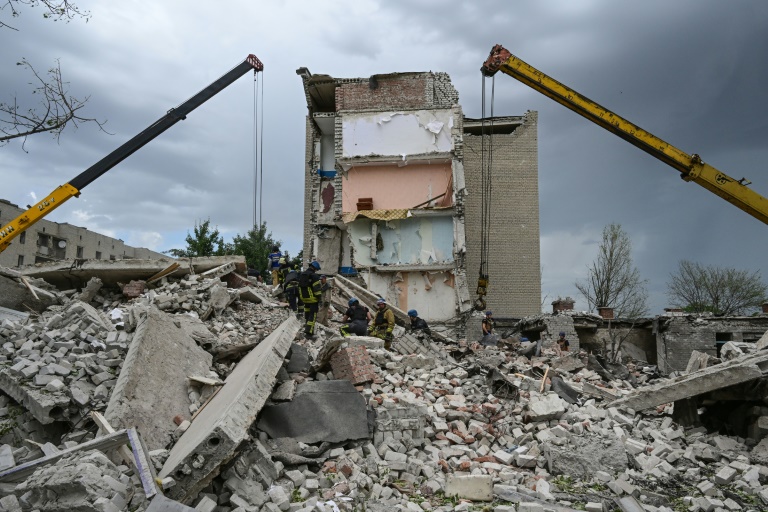
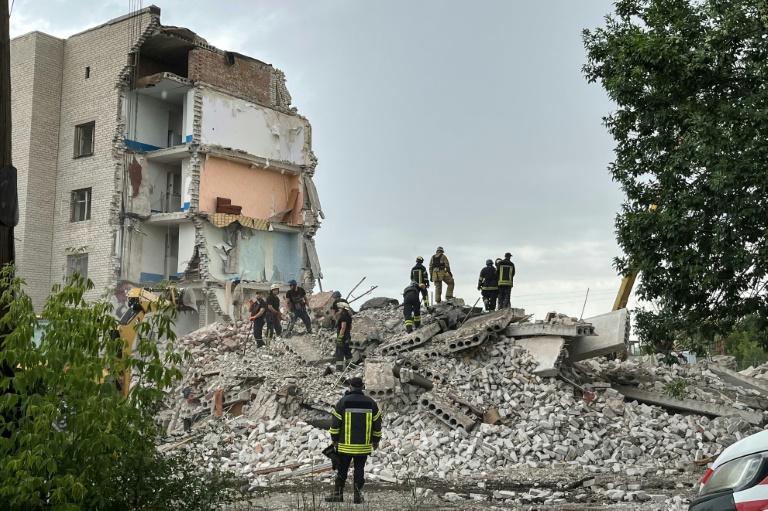
Rescuers recover 15 bodies after a Russian missile hits a residential building in the eastern Ukrainian town of Chasiv Yar, officials say.

During the rescue operation, “five people were pulled out of the rubble,” alive, the local branch of the Ukrainian emergency service says, adding that rescuers are in contact with three people alive under the rubble.

– ‘Deliberate’ strikes on east Ukraine homes – 

Russian troops pursue their shelling of Ukraine’s east, the country’s general staff reports, as Russia seeks to consolidate its hold over the entire Donbas region.  

The birthplace of President Volodymyr Zelensky, Kryvyi Rig — an industrial city in central Ukraine — was among the areas targeted.

Russian strikes “absolutely deliberately” and “purposefully” targeted the residential sector, hitting “ordinary houses, civilian objects, people”, says Zelensky.

– Canada to return Russian gas pipeline turbines –

Canada says it will return turbines needed to maintain the Nord Stream 1 gas pipeline to Germany, with Russia waiting on the equipment’s arrival before increasing supplies.

Germany is seeking to bolster waning energy supplies, but Ukraine has accused Berlin of giving in to Russian “blackmail” after Moscow blamed reduced supplies on  repairs, not market conditions amid the Ukraine war.

– Russia blocks German newspaper Die Welt website – 

Russia blocks the website of German daily Die Welt after it is added to a growing list of banned sites by the regulator, Russian news agencies report.

Access was denied to users after a request by the prosecutor, they add.

Since the start of the Russian military operation in Ukraine, the German newspaper published content in Russian, as most independent information has been suppressed in Russia.

– US sees Russia food blockage as factor in Sri Lanka –

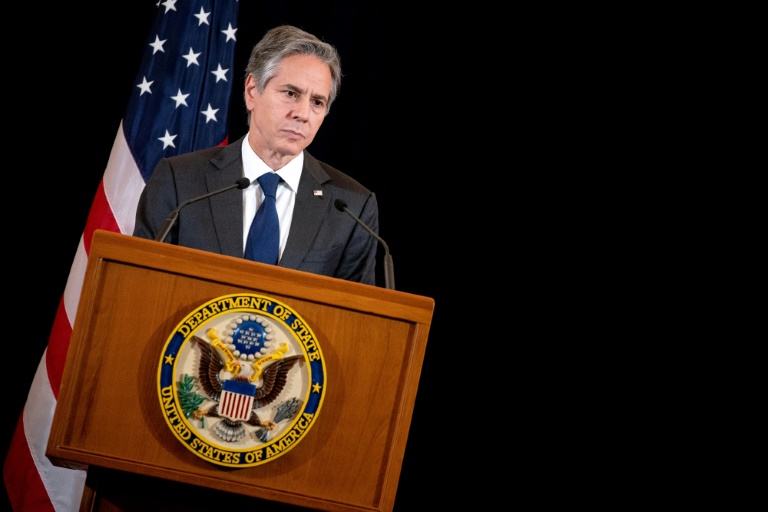
US Secretary of State Antony Blinken says Russia’s restriction on Ukrainian grain exports may have contributed to recent turmoil in Sri Lanka triggered by severe shortages of food and fuel.

“We’re seeing the impact of this Russian aggression playing out everywhere,” Blinken tells reporters in Bangkok.

Renewing a demand that he has made repeatedly, he calls on Russia to let an estimated 20 million tonnes of grain leave Ukraine, which Moscow invaded in February. 

burs-sea/bp

Russian shelling in east Ukraine kills at least 15

A Russian missile struck an apartment building in eastern Ukraine on Sunday, killing at least 15 people as Moscow’s forces sought to consolidate their control over the Donbas region. 

“During the rescue operation, 15 bodies were found at the scene and five people were pulled out of the rubble” alive in the town of Chasiv Yar, the local branch of the Ukrainian emergency service said on Facebook.

“At least 30 others are under the rubble” of the four-storey after it was hit by a Russian Uragan missile, Donetsk regional governor Pavlo Kyrylenko said earlier on Telegram.

The building was partially destroyed in the strike, AFP correspondents saw at the scene where rescuers were sifting through the rubble with a mechanical digger.

Rescuers had so far been able to establish contact with three people under the rubble, emergency services said.

Having fought long battles to capture the last areas of the neighbouring region of Lugansk, Russian troops are now turning their focus to Donetsk as they look to take control of the whole Donbas region.

“I was in the bedroom, I came out and everything started shaking, collapsing,” a Chasiv Yar resident who did not wish to give her name told AFP.

“What saved me was the force of the explosion pushing me into the bathroom, covered in blood. I barely got out,” she said.

– ‘Absolutely deliberately’ –

The Donetsk region was under persistent shelling, while Russian ground attacks were all but paused, the Ukrainian army general staff said Sunday.

On Saturday, three people were killed and a further 23 injured by shelling in Donetsk, governor Kyrylenko said. 

Strikes were also reported in Kharkiv, Ukraine’s second city in the northeast, where a “teaching establishment” and a house were hit, injuring one, according to regional governor Oleg Sinegubov.

Ukrainian President Volodymyr Zelensky condemned the widespread Russian bombardments in an address Saturday night.

“In just one day, Russia hit Mykolaiv, Kharkiv, Kryvyi Rig, the communities of the Zaporizhzhia region,” Zelensky said. 

Russian strikes “absolutely deliberately” and “purposefully” targeted the residential sector, hitting “ordinary houses, civilian objects, people”, he said.

“Such terrorist actions can really only be stopped with weapons, modern and powerful,” Zelensky added, thanking the United States for its latest military aid package.

In a boost to Kyiv, Washington has signed off on a $400 million package, including four additional High Mobility Artillery Rocket Systems to add to eight already in place and high-precision artillery ammunition not previously sent to Ukraine. 

“It’s a further evolution in our support for Ukraine in this battle in the Donbas,” a senior defence official was quoted by the US Department of Defense as saying.

On Sunday, US Secretary of State Antony Blinken said Russia’s restriction on Ukrainian grain exports may have contributed to  turmoil in Sri Lanka triggered by severe shortages of food and fuel.

“We’re seeing the impact of this Russian aggression playing out everywhere,” Blinken told reporters in Bangkok.

Renewing a demand that he has made repeatedly, Blinken called on Russia to let an estimated 20 million tonnes of grain leave Ukraine, which Moscow invaded in February. 

– Turbine return –

On Saturday, Canada agreed to deliver to Germany turbines needed to maintain the Nord Stream 1 gas pipeline, despite sanctions against Russia.

Ukraine had urged Canada not to return the turbines, currently undergoing maintenance at a Canadian site owned by German industrial giant Siemens.

Gazprom reduced deliveries via the pipeline, putting the move down to the delayed return of the components and raising fears of a gas shortage in Germany.

Canada would “grant a time-limited and revocable permit for Siemens Canada to allow the return of repaired Nord Stream 1 turbines”, said Natural Resources Minister Jonathan Wilkinson.

The Canadian minister also accused Russian President Vladimir Putin of wanting to “sow division” among Western allies by squeezing supplies.

In addition, Canada announced on Saturday its intention to extend its economic sanctions against Russia to industrial manufacturing. 

“These new sanctions will apply to land and pipeline transport and the manufacturing of metals and of transport, computer, electronic and electrical equipment, as well as of machinery,” Foreign Minister Melanie Joly said in a statement.

burs-sea/bp

Sri Lanka protesters won't budge till president leaves office

Sri Lankan protesters refused to budge from President Gotabaya Rajapaksa’s residence on Sunday, a day after they stormed his home, forcing him to flee with the navy and announce he would resign.

“Our struggle is not over,” student leader Lahiru Weerasekara told reporters the day after Rajapaksa, currently taking refuge on a vessel offshore, said he would step down on Wednesday.

“We won’t give up this struggle until he actually leaves.”

The dramatic events on Saturday were the culmination of months of protests by people enraged by the South Asian island nation’s unprecedented economic crisis and the Rajapaksa clan’s incompetence and corruption.

Hundreds of thousands massed in Colombo demanding Rajapaksa take responsibility for shortages of medicines, food and fuel that have brought the once-relatively rich economy to its knees and caused misery for ordinary people.

After storming the gates of the colonial-era presidential palace, protesters lounged in its opulent rooms, somersaulting into the compound’s pool and rummaging through Rajapaksa’s clothes.

Just before, troops had fired in the air to help Rajapaksa escape. The president then boarded a naval craft which steamed to the safety of the island’s southern waters.

On Sunday the presidential palace was a free-for-all, with children and parents plonking on a grand piano, admiring the expensive artwork, picnicking and taking it in turns to sit in the president’s chair.

“When leaders live in such luxury, they have no idea how the commoners manage,” Buddhist monk Sri Sumeda told AFP. 

“This shows what can be done when people decide to exercise their power.”

Rajapaksa’s nearby seafront office was also overrun on Saturday, and Prime Minister Ranil Wickremesinghe’s residence was set on fire even after he too offered to resign.

– Resignation –

From the naval ship, 73-year-old Rajapaksa — who had clung to power even after deadly nationwide violence in May forced his brother Mahinda Rajapaksa to quit as prime minister — told the speaker of parliament he would step down on Wednesday.

Security forces on Saturday had attempted to disperse the huge crowds that mobbed Colombo’s administrative district, triggering clashes. 

Colombo National Hospital said 105 people were brought in Saturday and that 55 remained under treatment on Sunday, including one in a “very critical” state with a gunshot wound.

After midnight Sri Lanka’s top military officer, General Shavendra Silva, went on TV to appeal for calm and to “resolve the crisis situation peacefully and constitutionally”.

A defence source said Rajapaksa would reach the Trincomalee naval base in the northeast of the island later on Sunday.

Washington urged Sri Lankan leaders to act quickly “with a commitment to the betterment of the nation — not any one political party”.

US Secretary of State Antony Blinken said on Sunday that Russia’s restrictions on Ukrainian grain exports and the resulting rise in prices “may have contributed” to Sri Lanka’s economic turmoil.

The European Union urged “all parties to cooperate and focus on a peaceful, democratic and orderly transition”.

On Sunday it was unclear who, if anyone, would be able to garner enough support among lawmakers to succeed Rajapaksa.

“We are heading for dangerous uncertainty,” minority Tamil legislator Dharmalingam Sithadthan told AFP. “Gota should have resigned immediately without leaving a power vacuum.”

– Default, desperation –

Sri Lanka has suffered months of shortages of basic goods, lengthy blackouts and galloping inflation after running out of foreign currency to import necessities.

The government has defaulted on its $51 billion external debt and is seeking an International Monetary Fund bailout.

The IMF said Sunday that it hopes for “a resolution of the current situation that will allow for resumption of our dialogue”.

Demonstrators had maintained a months-long protest camp outside Rajapaksa’s office demanding his resignation. 

The camp was the scene of clashes in May when a gang of Rajapaksa loyalists attacked peaceful protesters. Nine people died.

– Cricket goes on –

The unrest comes at the tail end of Australia’s cricket tour of Sri Lanka, with Pakistan’s squad also on the island training for a series of matches beginning next Saturday. 

On Saturday hundreds of protesters climbed the walls of the scenic Galle Fort overlooking where Sri Lanka and Australia were playing and chanted anti-Rajapaksa slogans.

“Today obviously the country is in turmoil, (with) people outside having their say. We could obviously hear it, I mean we can still hear it now,” Australian player Steve Smith said afterwards.

Cricket officials said there were no plans to change the Australia and Pakistan schedules and that the sport was unaffected by the political turmoil.

“There is no opposition to having the games. In fact, fans are supportive and we have no reason to reschedule,” a cricket board official told AFP.

Blinken vows pressure on Myanmar junta on visit to Thailand

Secretary of State Antony Blinken on Sunday vowed no let-up on pressuring Myanmar’s junta, and said China should be in agreement as he met democracy activists on a visit to neighbouring Thailand.

Blinken also met with Thailand’s leadership and hailed the kingdom’s role in a renewed US push in Southeast Asia, a key area of competition with China.

In a meeting held off-camera to protect family members, the top US diplomat heard from young democracy activists from Myanmar, whose military in February 2021 tossed out the civilian government, slamming the door on a decade-long democratic transition nurtured by Washington.

Blinken acknowledged that the US strategy of sanctions on the junta has not borne fruit but promised that Washington was still focused, even as it puts a priority on combatting Russia’s invasion of Ukraine.

“It’s unfortunately safe to say that we’ve seen no positive movement and on the contrary, we continue to see the repression of the Burmese people,” Blinken told reporters, using Myanmar’s former name of Burma.

“We will continue to look for ways that we can, and other countries can, effectively put pressure on them to move back to the democratic path.”

He called for the Association of Southeast Asian Nations, which in April 2021 reached a “consensus” with the junta that includes dialogue with the opposition, to “hold the regime accountable” over its pledges.

Blinken declined to criticise a recent visit to Myanmar by Chinese Foreign Minister Wang Yi — with whom the top US diplomat held rare talks Saturday in Bali — but called on Beijing to support the international calls for democracy.

“I think it’s also incumbent upon China and in China’s interest to see Burma move back to the path that it was on that it was so violently disrupted from by the coup,” Blinken said.

Tens of thousands of people have fled Myanmar, humanitarian conditions have deteriorated and ethnic conflicts have intensified since the military toppled and arrested civilian leader Aung San Suu Kyi.

– ’21-century’ ally –

Thailand is America’s oldest ally in Asia, famously offering elephants to Abraham Lincoln during the Civil War, but has also increasingly worked with China.

Blinken visited days after a stop by Wang, who has embarked on a more extensive tour of Southeast Asia in which he has highlighted Beijing’s lavish infrastructure spending.

Signing an agreement pledging to keep expanding ties, Blinken pointed to Thailand’s embrace of a new US-led economic plan for Asia as well as its efforts on climate change.

In Thailand, “we have an ally and partner in the Indo-Pacific of such importance to us in a region that is shaping the trajectory of the 21st century, and it is doing that every single day”, Blinken said.

The United States has identified China, with its authoritarian system and burgeoning technological and military resources, as its pre-eminent global rival but both nations have recently sought to lower the temperature, as seen in the unusually long five-hour meeting Saturday between Wang and Blinken.

In Bangkok, Blinken met with Prime Minister Prayut Chan-O-Cha, who called the trip a “happy occasion” and saluted the “close and cordial relations” with the United States.

Blinken’s trip marks a continued normalisation of the US relationship with Thailand under Prayut, who led a military coup that ousted the government in 2014, triggering US sanctions.

Prayut became prime minister in 2019 elections, which have ushered in a gradual return to open political discourse.

In a joint statement signed by Blinken and Foreign Minister Don Pramudwinai, the United States and Thailand called democracy “essential” to the two countries’ idea of Asia.

“Strong democratic institutions, independent civil society, and free and fair elections are central to this vision, allowing our respective societies to reach their full potential,” it said. 

Addressing one issue that is a high priority for President Joe Biden’s administration, the statement said Washington and Bangkok would promote “open and inclusive societies” for LGBTQ people.

Blinken also praised Thailand for signing up to a Biden plan to connect Southeast Asia with companies that are promoting green energy, saying that firms have already promised $2.7 billion in the country.

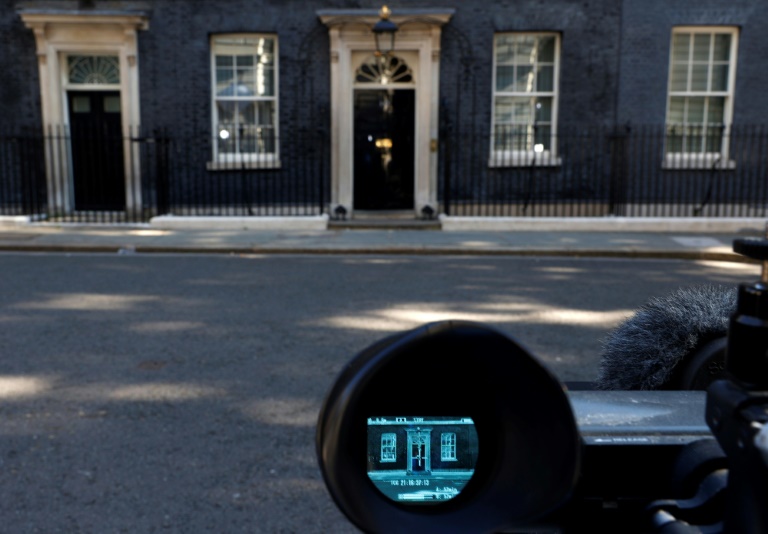
UK Tory leader race expands to nine, with early focus on tax

Former UK defence secretary Penny Mordaunt on Sunday became the ninth Conservative MP to launch a bid to replace Prime Minister Boris Johnson, as the already fractious race promptly focused on tax.

Mordaunt, 49, an ex-navy reservist who has also held several senior ministerial roles, is not among the frontrunners to succeed Johnson in recent polls of Tory party members ultimately set to choose their new leader.

But such contests are notoriously unpredictable, and with more than a dozen lawmakers from multiple factions of the ruling party potentially set to run, political commentators say few contenders can be discounted.

The early favourite is former finance minister Rishi Sunak, who launched his campaign Friday after helping to kickstart the cabinet revolt that led to Johnson’s forced resignation Thursday. He is now drawing early fire from Johnson loyalists and rival candidates.

Sunak and former health minister Sajid Javid — who has also declared his candidacy — both resigned late Tuesday, prompting dozens of more junior colleagues to follow suit.

That forced Johnson to then quit as Tory leader 36 hours later.

But the 58-year-old leader, whose three-year premiership has been defined by scandal, the country’s departure from the European Union and the Covid pandemic, said he would stay on until his successor is selected.

– Crowded field –

Former foreign secretary Jeremy Hunt, who finished runner-up to Johnson in the last contest in 2019, announced he will stand again late Saturday.

Current finance minister Nadhim Zahawi — only appointed to the post Tuesday — and Transport Secretary Grant Shapps have also launched bids.

They join attorney general and arch-Brexiteer Suella Braverman, the relatively unknown former equalities minister Kemi Badenoch, and backbench Tory MP Tom Tugendhat on the growing candidate list.

Foreign Secretary Liz Truss, a frontrunner in recent surveys, is among those expected to still announce.

But Defence Secretary Ben Wallace, who has impressed in the role and been one of Tory members’ favourites, said Saturday he would not stand after a discussion with colleagues and family.

Taxation is already a key dividing line in the race, as Britain faces the toxic combination of high inflation and rampant cost-of-living increases alongside stagnant growth and relatively high tax rates.

– ‘Low-growth trap’ –

Announcing their bids separately in the Sunday Telegraph, Javid and Hunt both vowed to cut corporation tax from 25 to 15 percent.

Javid said he would also slash or change other taxes, including reversing a recent rise in national insurance that is ringfenced to raise health service funding.

“We cannot fall into a low-growth trap like many other countries have across Europe — we must cut taxes,” he told the BBC on Sunday.

Hunt, Shapps and Tugendhat also set out their stances for lower taxes in Sunday morning television appearances.

But declaring his candidacy in a slick video on social media before the weekend, Sunak struck a different tone, warning Tories not to believe “fairytale” pledges.

Meanwhile, Zahawi’s campaign appeared in early danger following Sunday newspaper reports that his personal tax affairs are under investigation by revenue and customs officials — who are part of his treasury department. He has denied wrongdoing.

– Dirty dossiers? –

The likely months-long acrimonious campaign is set to be formalised Monday when a committee of backbenchers will meet to agree the timetable and rules.

They could opt for an accelerated initial contest with the final two-person shortlist to be put to members decided within weeks, before parliament’s summer recess starting after July 21.

Party members will eventually choose from a two-person shortlist whittled down in multiple rounds of voting by all 358 Tory MPs, with the new leader expected ahead of the Conservatives’ annual conference in early October.

The party has declined to say how many eligible members they have, but note it will be more than the 160,000 who voted at the last leadership contest in 2019.

Conservative commentator Iain Dale said Sunday if a consensus candidate emerged, the contest could end without party members voting, as happened in 2016 with the selection of Theresa May.

In a sign of the potential peril of a protracted fight, the Sunday Times reported some of the leadership teams had compiled so-called dirty dossiers of compromising allegations against rival candidates and their aides.

Close Bitnami banner
Bitnami