World

Leave means leave: UK PM faces calls to go now

Britain’s Labour party on Friday threatened a bid to force Prime Minister Boris Johnson out of Downing Street immediately, following his resignation in the face of a cabinet uprising.

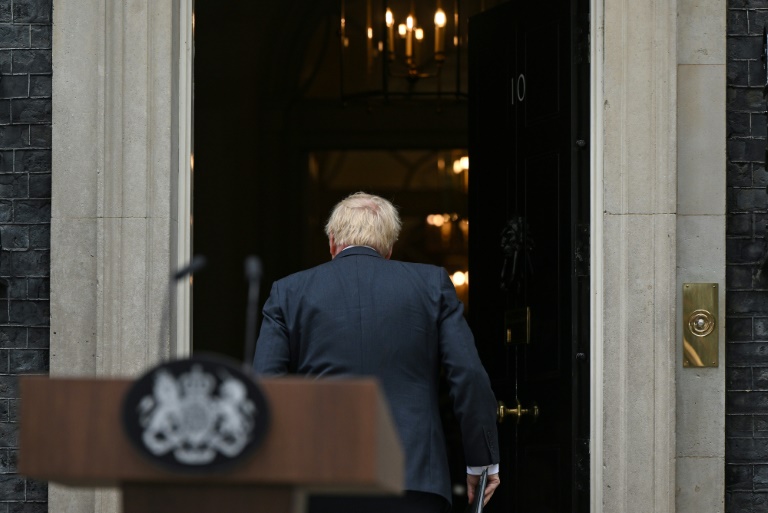
Johnson quit as leader of the ruling Conservative party on Thursday, after a frenzy of nearly 60 resignations in less than 48 hours in opposition to his scandal-hit reign.

But the 58-year-old, whose three-year premiership has been defined by Britain’s departure from the European Union and Covid, said he would stay on until his successor is found.

As candidates readied for a battle to replace him, calls mounted for Johnson to leave straight away and for an acting leader to be appointed in the interim.

Labour’s deputy leader Angela Rayner said the main opposition party aimed to trigger a vote of no confidence in parliament if the Tories do not get rid of Johnson immediately.

“He’s a proven liar who’s engulfed in sleaze and we can’t have another couple of months of this,” she told BBC radio.

“If they don’t, we will call a no-confidence vote because it’s pretty clear he hasn’t got the confidence of the House (of Commons) or the British public.”

To do so, Labour would need the support of dozens of Conservative MPs. But the strategy is fraught as it could trigger a general election, and the danger of Tory MPs losing their seats, if Johnson is defeated.

– Contenders –

Johnson’s spokesman said there was no question of deputy prime minister Dominic Raab taking over as caretaker.

“The prime minister is acting in line with convention. He remains prime minister until a new party leader is in place and the work of the government will continue whilst that takes place,” he told reporters.

A timetable for the leadership contest is expected on Monday, with the winner installed in time for the party’s annual conference in early October.

Defence minister Ben Wallace and Rishi Sunak — whose resignation as finance minister on Tuesday set off the chain of exits — were among the early frontrunners, a YouGov poll of Tories suggested.

So far, Conservative MP Tom Tugendhat and Attorney General Suella Braverman have both officially announced their candidatures, while Brexiteer Steve Baker has signalled interest.

Former health and foreign secretary Jeremy Hunt, who lost to Johnson in 2019, was “virtually certain” to run again, a source close to Hunt told British media.

– ‘Best job’ –

In a defiant resignation speech in Downing Street on Thursday, Johnson said he was “sad… to be giving up the best job in the world”.

But he said he initially refused to surrender to his “herd” of Tory critics by claiming a personal mandate he won by a landslide in December 2019.

Even while eyeing the exit, Johnson sought to steady the ship, making several appointments to replace departed cabinet members.

At a first meeting of his hastily convened new top team, Johnson confirmed his lame-duck status by saying “major fiscal decisions should be left for the next prime minister”, Downing Street said.

Sunak and health secretary Sajid Javid prompted the exodus by quitting late Tuesday, just as Johnson apologised for appointing a senior colleague facing sexual assault claims to a prominent role.

Chris Pincher resigned as deputy chief whip last week following accusations he had drunkenly groped two men.

Downing Street officials eventually conceded that Johnson had known about other allegations against Pincher back in 2019, and many ministers recoiled at having to defend the PM yet again.

– Legacy –

As late as Wednesday night, Johnson — whose landslide 2019 win was the biggest Tory victory since the heyday of Margaret Thatcher in the 1980s — had been defiantly clinging to power. 

But he was forced to concede his time was up after another round of resignations on Thursday morning and warnings of a second no-confidence vote next week by Tory MPs.

The Tory infighting erupted as millions of Britons battle the worst slump in living standards since the 1950s, fuelled by rocketing energy prices on the back of the war in Ukraine.

Johnson’s popularity had slumped since revelations about lockdown-breaking parties in Downing Street that saw him become the first prime minister to be fined in office.

Labour leader Keir Starmer and Rayner were themselves under investigation by police in northeast England over a gathering during lockdown, and had both vowed to resign if fined.

Durham police said Friday they were issuing no fines against Starmer, Rayner or 15 others at the April 2021 meeting, ruling it was a work event, not a party.
Billions of people rely on wild species for food, fuel, income: UN

Rampant exploitation of nature is a threat to the billions of people across the world who rely on wild species for food, energy and income, according to a new report from United Nations biodiversity experts published Friday. 

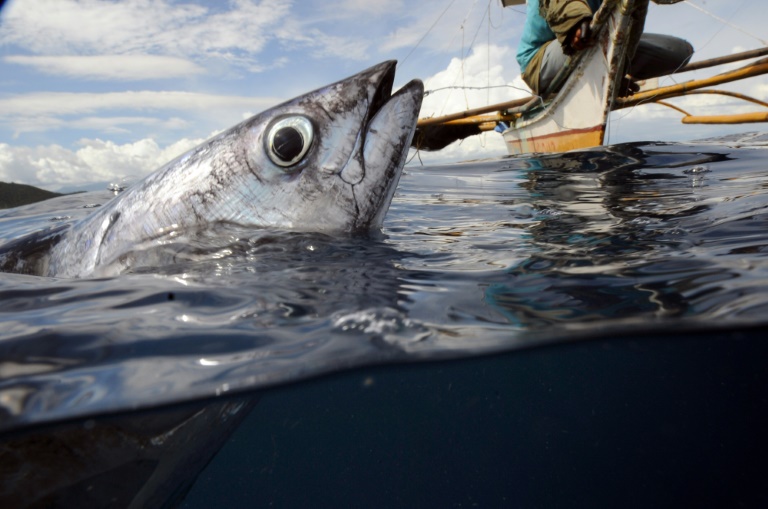
From fishing and logging to the use of wild plants in medicines and perfumes, societies across the planet are deeply dependent on species that have not been tamed or cultivated in farming, with annual global legal and illegal trade in the hundreds of billions of dollars. 

But as humans drive alarming biodiversity loss — and climate change threatens to accelerate the destruction — the UN’s science advisory panel for biodiversity, known as IPBES, called for “transformative changes” in our relationship with wild species. 

“Billions of people in all regions of the world rely on and benefit from the use of wild species for food, medicine, energy, income and many other purposes,” it said, adding that overexploitation and environmental degradation threaten resources, particularly for the most vulnerable.

The report, which took four years to produce and has been written by 85 experts from different specialist fields, comes as the UN steers a crucial international process to lay out a framework for protecting nature in the coming decades.  

IPBES, which has previously warned that a million species are at risk of extinction, said promoting sustainability and halting overexploitation was “critical to reverse the global trend in biodiversity decline”. 

The report recognises the fundamental role that these animals and plants play in people’s lives and in particular the crucial role of indigenous communities in protecting nature. 

“The use of wild species is absolutely crucial for humanity and nature,” report co-chair Jean-Marc Fromentin told AFP, adding that UN experts estimate “about 40 percent of humanity” relies in some way on wild species.

“It’s much bigger than you think.”

They are a “key issue for food security” around the world and also play a huge economic role, he said.

– Food and fuel –

Overall, 50,000 species are used for food, energy, medicine, material and other purposes around the world, the report said, with more than 10,000 different types harvested for human consumption.

Wild plants, algae and fungi provide food and income for one in five people globally, the report said, while some 2.4 billion people rely on wood for cooking. 

An estimated 70 percent of the world’s poor depend directly on wild species and businesses linked to them, the report found.

But it is not just rural communities in developing countries that use these species. 

“City dwellers in rich countries might not notice it, but wild plants are used in medicines or cosmetics, you eat wild fish and there is a good chance that your furniture comes from wild trees,” said Fromentin.   

– Big business –

Wild trees account for two thirds of global industrial roundwood, while trade in wild plants, algae and fungi is a billion-dollar industry. 

Even foraging remains an important activity for people in North America and Europe, with notably high rates in Eastern Europe, according to the research, which said there is “growing demand for wild foods” for high-end restaurants. 

But IPBES said global trade can become disconnected from sustainable local supply, with surging demand risks species and ecosystems, and said there was an “urgent” need for effective policies.  

One major issue is illicit trade in wild species, estimated to be worth between $69 billion and $199 billion a year, which IPBES said was the third largest illegal market after human trafficking and drugs. 

While this largely targets trees and fish, the report said even smaller scale trade in rarer animals and plants, like orchids, can have devastating effects, warning it often pushes species beyond their limits. 

– Citizen of nature –

But the report highlights that letting the natural world thrive is even bigger business. 

Tourism for example that is based on observing wild species, was a key reason that protected areas globally received eight billion visitors and generated $600 billion every year before the Covid-19 pandemic.

Meanwhile, fisheries that are well managed often have increasing abundance of fish, compared to areas that are unsustainably fished.

IPBES said overexploitation is the main threat to wild marine species and a key threat to land and freshwater ecosystems. 

The report authors said the concept in many societies that humans are separate from and dominant over nature has “led to major environmental crises, such as climate change and biodiversity decline”. 

Following the example of indigenous peoples, they said a more “respectful” relationship with the planet could be based on seeing humanity as “a member or a citizen of nature among others”.

Billions of people rely on wild species for food, fuel, income: UN

Rampant exploitation of nature is a threat to the billions of people across the world who rely on wild species for food, energy and income, according to a new report from United Nations biodiversity experts published Friday. 

From fishing and logging to the use of wild plants in medicines and perfumes, societies across the planet are deeply dependent on species that have not been tamed or cultivated in farming, with annual global legal and illegal trade in the hundreds of billions of dollars. 

But as humans drive alarming biodiversity loss — and climate change threatens to accelerate the destruction — the UN’s science advisory panel for biodiversity, known as IPBES, called for “transformative changes” in our relationship with wild species. 

“Billions of people in all regions of the world rely on and benefit from the use of wild species for food, medicine, energy, income and many other purposes,” it said, adding that overexploitation and environmental degradation threaten resources, particularly for the most vulnerable.

The report, which took four years to produce and has been written by 85 experts from different specialist fields, comes as the UN steers a crucial international process to lay out a framework for protecting nature in the coming decades.  

IPBES, which has previously warned that a million species are at risk of extinction, said promoting sustainability and halting overexploitation was “critical to reverse the global trend in biodiversity decline”. 

The report recognises the fundamental role that these animals and plants play in people’s lives and in particular the crucial role of indigenous communities in protecting nature. 

“The use of wild species is absolutely crucial for humanity and nature,” report co-chair Jean-Marc Fromentin told AFP, adding that UN experts estimate “about 40 percent of humanity” relies in some way on wild species.

“It’s much bigger than you think.”

They are a “key issue for food security” around the world and also play a huge economic role, he said.

– Food and fuel –

Overall, 50,000 species are used for food, energy, medicine, material and other purposes around the world, the report said, with more than 10,000 different types harvested for human consumption.

Wild plants, algae and fungi provide food and income for one in five people globally, the report said, while some 2.4 billion people rely on wood for cooking. 

An estimated 70 percent of the world’s poor depend directly on wild species and businesses linked to them, the report found.

But it is not just rural communities in developing countries that use these species. 

“City dwellers in rich countries might not notice it, but wild plants are used in medicines or cosmetics, you eat wild fish and there is a good chance that your furniture comes from wild trees,” said Fromentin.   

– Big business –

Wild trees account for two thirds of global industrial roundwood, while trade in wild plants, algae and fungi is a billion-dollar industry. 

Even foraging remains an important activity for people in North America and Europe, with notably high rates in Eastern Europe, according to the research, which said there is “growing demand for wild foods” for high-end restaurants. 

But IPBES said global trade can become disconnected from sustainable local supply, with surging demand risks species and ecosystems, and said there was an “urgent” need for effective policies.  

One major issue is illicit trade in wild species, estimated to be worth between $69 billion and $199 billion a year, which IPBES said was the third largest illegal market after human trafficking and drugs. 

While this largely targets trees and fish, the report said even smaller scale trade in rarer animals and plants, like orchids, can have devastating effects, warning it often pushes species beyond their limits. 

– Citizen of nature –

But the report highlights that letting the natural world thrive is even bigger business. 

Tourism for example that is based on observing wild species, was a key reason that protected areas globally received eight billion visitors and generated $600 billion every year before the Covid-19 pandemic.

Meanwhile, fisheries that are well managed often have increasing abundance of fish, compared to areas that are unsustainably fished.

IPBES said overexploitation is the main threat to wild marine species and a key threat to land and freshwater ecosystems. 

The report authors said the concept in many societies that humans are separate from and dominant over nature has “led to major environmental crises, such as climate change and biodiversity decline”. 

Following the example of indigenous peoples, they said a more “respectful” relationship with the planet could be based on seeing humanity as “a member or a citizen of nature among others”.

Euro closes in on dollar parity, yen up after Abe murder

The euro neared parity with the dollar on Friday, as traders bet on the prospect of a eurozone recession caused by soaring inflation.

The haven yen firmed against the dollar following the assassination of Japan’s former prime minister, Shinzo Abe.

Stock markets were mixed ahead of key US jobs data due on Friday that should provide more clues on the outlook for interest rates in the world’s biggest economy.

“A firm payroll… will reinforce the view that financial conditions are not tight enough, drive the dollar higher and send euro/dollar hurtling towards parity,” said independent analyst Stephen Innes.

The euro on Friday slumped to $1.0072, a fresh 20-year low, before recovering back above $1.01.

The European single currency is suffering also from the Federal Reserve hiking US interest rates more aggressively than the European Central Bank, traders said.

In commodities trading on Friday, world oil prices steadied at the end of yet another volatile week for crude and assets in general.

Asian stock markets closed higher, boosted by hopes that US President Joe Biden would remove some tariffs from Chinese goods.

Equities won a lift also from reports Beijing was considering a huge stimulus push to the struggling Chinese economy by allowing local governments to raise billions of dollars through bond issuance for infrastructure projects.

But surging inflation, rising interest rates and a fresh flare-up of Covid infections in Shanghai continued to keep investor sentiment grounded.

Traders were handed a strong lead from Wall Street overnight, where all three main indices climbed for a fourth straight day, helped by two top Federal Reserve officials who said the economy could withstand sharper rate hikes and maintain growth.

There has been growing talk that the fast pace of monetary tightening by the bank will tip the world’s top economy into recession.

– Political upheaval –

Markets are also tracking political unrest in Britain and Japan.

London’s benchmark FTSE 100 index was down about half-a-percent in early afternoon deals — and the pound retreated — one day after Prime Minister Boris Johnson said he was stepping down later this year following a string of scandals.

In Japan, Abe was assassinated on Friday by a gunman who opened fire at close range as the hugely influential politician delivered a campaign speech ahead of upper house elections. 

The murder of the 67-year-old, who had been Japan’s longest-serving leader, stunned the nation and prompted an international outpouring of grief and condemnation.

The killing “could be negative for markets if the government’s policy, including its stance on monetary easing, is affected, as it was evident that he was pulling the strings behind the scenes in many ways”, noted Masahiro Yamaguchi at SMBC Trust Bank.

“If it becomes possible for (current Prime Minister Fumio) Kishida to carry out policies he wanted to, such as financial tax and regulations on share buy-back, that would be negative for markets.”

– Key figures at around 1115 GMT –

Euro/dollar: DOWN at $1.0149 from $1.0162 Thursday

Pound/dollar: DOWN at $1.1994 from $1.2024 

Euro/pound: UP at 84.60 pence from 84.49 pence

Dollar/yen: DOWN at 135.84 yen from 136.01 yen

London – FTSE 100: DOWN 0.5 percent at 7,150.76 points

Frankfurt – DAX: UP 0.7 percent at 12,938.75

Paris – CAC 40: UP 0.1 percent at 6,014.49

EURO STOXX 50: FLAT at 3,488.57

Tokyo – Nikkei 225: UP 0.1 percent at 26,517.19 (close)

Hong Kong – Hang Seng Index: UP 0.4 percent at 21,725.78 (close)

Shanghai – Composite: DOWN 0.4 percent at 3,356.08 (close)

New York – Dow: UP 1.1 percent at 31,384.55 (close)

Brent North Sea crude: UP 0.1 percent at $104.77 per barrel

West Texas Intermediate: DOWN 0.3 at $102.41 per barrel

Lavrov walks out of G20 talks as West presses Moscow on Ukraine

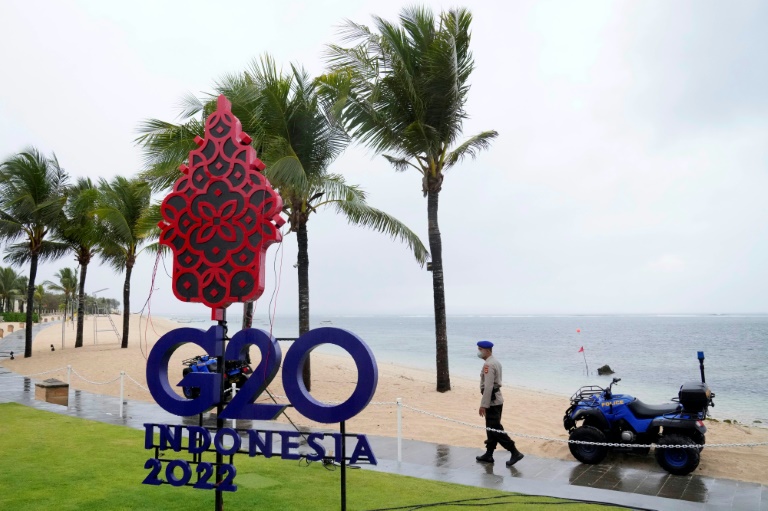
Russia’s top diplomat stormed out of talks with G20 foreign ministers meeting in Indonesia on Friday as Western powers criticised Moscow over its invasion of Ukraine.

Washington and allies condemned Russia’s assault ahead of the meeting before Foreign Minister Sergei Lavrov faced what US Secretary of State Antony Blinken called a barrage of Western criticism at the closed-door talks.

“What we’ve heard today already is a strong chorus from around the world… about the need for the aggression to end,” Blinken said from the meeting on the resort island of Bali.

Blinken and Lavrov had joined colleagues for day-long talks in their first meeting since the outbreak of war, with the host immediately telling them the conflict must end through negotiations.

But Lavrov walked out of a morning session as German counterpart Annalena Baerbock criticised Moscow over its invasion, diplomats said.

He also left an afternoon session before Ukrainian Foreign Minister Dmytro Kuleba addressed the ministers virtually and was not present as Blinken condemned Russia.

“Our Western partners are trying to avoid talking about global economic issues,” Lavrov told reporters outside the Mulia hotel. “From the moment they speak, they launch into fevered criticism of Russia.”

Blinken shunned a meeting with Lavrov and instead accused Russia of triggering a global food crisis, demanding Moscow allow grain shipments out of war-battered Ukraine.

“To our Russian colleagues: Ukraine is not your country. Its grain is not your grain. Why are you blocking the ports? You should let the grain out,” Blinken said in the closed-door talks, according to a Western official present.

Lavrov earlier told reporters he would not “go running” after Washington for talks.

“It was not us who abandoned contact, it was the United States,” he said.

– Abe killing overshadows meet –

Before the meeting, Blinken met his French and German counterparts and a senior British official to discuss “Russia’s unprovoked and unjustifiable war of choice” in Ukraine, the State Department said in a statement.

But the gathering was soon overshadowed by the killing of former Japanese Prime Minister Shinzo Abe at a campaign event on Friday.

After news of his death, Blinken mourned the longtime ally of Washington as a “leader with great vision” who boosted US-Japan relations.

“It is a shock. It’s profoundly disturbing,” he said.

Before the news of the attack emerged, Indonesian Foreign Minister Retno Marsudi addressed the Ukraine war in a speech to the ministers including Lavrov.

“It is our responsibility to end the war sooner than later and settle our differences at the negotiating table, not the battlefield,” Marsudi said.

In closing remarks, she said “participants expressed deep concern about the humanitarian impacts of the war” and “some members expressed condemnation” of the invasion.

She did not comment on Lavrov walking out of the sessions.

– No family photo –

A US official indicated Washington did not want to embarrass Indonesia at the meeting by walking out on Lavrov, who last met Blinken in July.

But there will be no family photo of the G20 ministers as is customary, an Indonesian government official told AFP.

The hosts have addressed US concerns about Lavrov attending in part by inviting Ukrainian President Volodymyr Zelensky to the G20 summit in November.

In his address, Kuleba told ministers to “remember about 344 families who have lost their children when listening to Russian lies”.

“The minister of the country responsible for their deaths appears in front of you today to share his thoughts on how Russia views cooperation in our globalised world,” he added. 

– British FM leaves –

Blinken’s efforts to have a powerful Western stance against Russia at the meeting were diluted after British Foreign Minister Liz Truss pulled out following Prime Minister Boris Johnson’s resignation as leader of his party on Thursday.

She flew out of Indonesia on Friday morning and was replaced by former British ambassador to the European Union Sir Tim Barrow, a British official told AFP.

While in Bali, Blinken will also seek to reopen dialogue with Beijing in talks on Saturday with his Chinese counterpart Wang Yi, the first in months after tensions became strained over issues including Taiwan.

The meeting comes as US President Joe Biden voices hope for a conversation in the coming weeks with Chinese President Xi Jinping, with whom he last spoke in March.

Lavrov met Wang on Thursday to discuss Russia’s invasion, which Moscow says it launched to stop Ukraine from joining the NATO military alliance.

The United States has condemned Beijing’s support for Russia, and Blinken is expected to reiterate those warnings in talks with Wang.

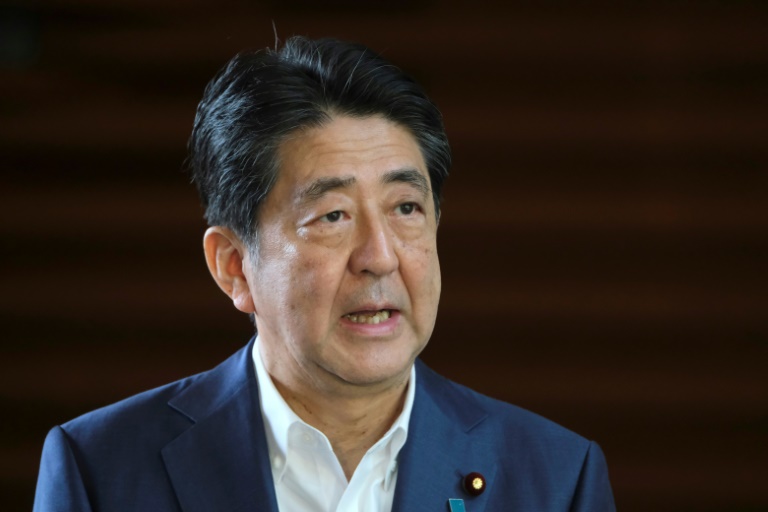
Former Japan PM Abe assassinated by gunman

Japan’s former prime minister Shinzo Abe was assassinated on Friday by a gunman who opened fire at close range as the hugely influential politician delivered a campaign speech.

The murder of the 67-year-old, who had been Japan’s longest-serving leader, stunned the nation and prompted an international outpouring of grief and condemnation.

It was all the more shocking given Japan’s strict gun laws and low rates of violent crime, with Prime Minister Fumio Kishida describing it as a “barbaric act” that was “absolutely unforgivable.”

Abe was shot shortly before noon while campaigning in the western region of Nara ahead of weekend upper house elections. 

He was flown by helicopter to the Nara Medical University hospital where he was pronounced dead several hours later.

“Shinzo Abe was transported to (the hospital) at 12:20 pm. He was in a state of cardiac arrest upon arrival,” said Hidetada Fukushima, professor of emergency medicine at the hospital.

“Resuscitation was administered. However, unfortunately he died at 5:03 pm.”

Fukushima said Abe had suffered two gunshot wounds to the neck and died of massive blood loss, despite being administered enormous transfusions.

A visibly emotional Kishida told reporters  after Abe’s death was confirmed that he was “lost for words”.

He earlier abandoned the campaign trail and flew to Tokyo by helicopter where in a quivering voice he condemned “a barbaric act during election campaigning, which is the foundation of democracy.”

“It is absolutely unforgivable. I condemn this act in the strongest terms.”

The attack occurred as Abe delivered a stump speech with security present, but spectators able to approach him easily.

Footage broadcast by NHK showed him standing on a stage when a man dressed in a grey shirt and brown trousers approached from behind, before drawing a weapon from a bag and firing.

At least two shots appear to be fired, each producing a cloud of smoke.

As spectators and reporters ducked, a man was shown being tackled to the ground by security and he was arrested. 

Local media identified the man as 41-year-old Tetsuya Yamagami, citing police sources, with several media outlets describing him as a former member of the Maritime Self-Defense Force, the country’s navy.

He was wielding a weapon described by local media as a “handmade gun”, and NHK said he told police after his arrest that he “targeted Abe with the intention of killing him”.

– ‘A large bang’ –

Witnesses at the scene described shock as the political event turned into chaos.

“The first shot sounded like a toy bazooka,” a woman told NHK. 

“He didn’t fall and there was a large bang. The second shot was more visible, you could see the spark and smoke.”

Officials from the local chapter of Abe’s Liberal Democratic Party said there had been no threats before the incident and that his speech had been announced publicly.

Several parties announced their senior members would halt campaigning in the wake of the attack, but the LDP and coalition partner Komeito later announcing that canvassing would resume on Saturday.

The attack prompted international shock, with European Commission chief Ursula von der Leyen tweeting that the “brutal and cowardly murder” had shocked the world.

“The deadly attack on Shinzo Abe has left me aghast and deeply sad,” German Chancellor Olaf Scholz said.

South Korean President Yoon Suk-yeol described the killing as an “unacceptable act of crime”.

– ‘Profoundly sad and shocking’ –

Abe held office in 2006 for one year and again from 2012 to 2020, when he was forced to step down due to the debilitating bowel condition ulcerative colitis.

He was a hawkish conservative who pushed for the revision of Japan’s pacifist constitution to recognise the country’s military and has stayed a prominent political figure even after his resignation.

Japan has some of the world’s toughest gun-control laws, and annual deaths from firearms in the country of 125 million people are regularly in single figures.

Getting a gun licence is a long and complicated process for Japanese citizens, who must first get a recommendation from a shooting association and then undergo strict police checks.

Corey Wallace, an assistant professor at Kanagawa University who focuses on Japanese politics, said the incident recalled the 1960 assassination of Inejiro Asanuma, the leader of the Japan Socialist Party, who was stabbed by a right-wing youth. 

He noted that Japanese politicians and voters were used to a personal and close-up style of campaigning.

“This could really change,” he said.

Pilgrims pack Mount Arafat for climax of biggest Covid-era hajj

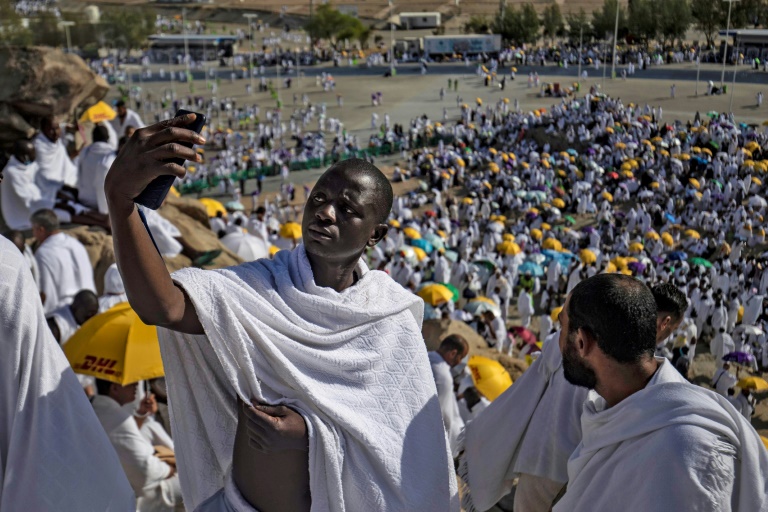
Huge crowds of robed Muslim pilgrims prayed on Saudi Arabia’s Mount Arafat on Friday, the climax of the biggest hajj pilgrimage since the pandemic forced drastic cuts in numbers two years in a row.

Groups of worshippers, many holding umbrellas against the fierce sun, recited verses from the Koran on the rocky rise, where the Prophet Mohammed is believed to have given his final sermon.

Prayers on Mount Arafat are the highlight of the pilgrimage, capped this year at one million people including 850,000 from abroad.

Pilgrims, many in white robes, chanted “Oh God, here I am” as they reached Mount Arafat on foot or in buses from their nearby tents.

After sunset, they will travel the short distance to Muzdalifah, where they will sleep under the stars before performing the symbolic “stoning of the devil” ceremony on Saturday. 

“I am so happy to be here… This is the biggest hajj in the coronavirus era, but it isn’t big enough yet,” Egyptian pilgrim Saad Farhat Khalil, 49, told AFP.

“There are one million here today, but if the Saudis allowed more, 10 million would have come,” he added.

Entry roads were packed with worshippers as helicopters buzzed overhead and volunteers handed out bottles of water and collected rubbish in green plastic bags. 

The hajj, usually one of the world’s largest annual religious gatherings, is among the five pillars of Islam and must be undertaken by all Muslims with the means at least once in their lives.

In 2019, as in previous years, some 2.5 million Muslims from around the world took part, a figure that dropped to a few thousand in 2020 and 60,000 in 2021.

A number of world leaders have participated this year, including Mauritania’s president and Indonesia’s vice president. State media on Friday reported that Chechen strongman Ramzan Kadyrov had arrived in the kingdom to perform the hajj.

– Covid fears –

At noon, thousands of pilgrims prayed in Namirah mosque, where the Prophet Mohammed gave sermons.

“In 2020 I thought I would never do hajj. It seemed like the end of time. But here we are today, God is great,” said Bassam Mohammed, another Egyptian pilgrim.

The large crowds have spurred fears that Covid will spread, especially after many pilgrims went without face masks at the Grand Mosque in Mecca, despite claims by Saudi authorities that masks would be mandatory. 

The hajj is taking place against the backdrop of a resurgence in the region, with some Gulf countries tightening restrictions to keep outbreaks in check.

All participants were required to submit proof of vaccination and negative PCR tests. On reaching their white-tent encampment at Mina on Thursday, they were handed bags containing masks and sanitiser.

Health ministry spokesman Dr Muhammad al-Abdulaali told a press conference Thursday evening that so far no Covid cases had been detected among the pilgrims, though it was unclear whether widespread testing was taking place. 

“The health status of the pilgrims is reassuring, and no disease outbreaks affecting public health have been recorded,” he said.

– Heat warnings –

The pilgrimage can be physically draining even in ideal conditions, but worshippers this year have faced an added challenge: scorching sun and temperatures well over 40 degrees Celsius (104 Fahrenheit).

On Friday, the temperature hit 44 degrees Celsius at Mount Arafat, state-run Al-Ekhbariya reported.

Islam forbids men from wearing hats once the rites start, and many have been seen shielding themselves with umbrellas, prayer mats and even, in one case, a small bucket filled with water. 

Women, meanwhile, are obliged to cover their heads with scarves.

“We can tolerate (the heat)… The more we tolerate, the more our pilgrimage is accepted,” Laila, a 64-year-old Iraqi pilgrim who gave only her first name, told AFP.

Saudi officials have touted their preparations for the extreme conditions, highlighting the hundreds of hospital beds allocated for heatstroke patients and the “large number of misting fans” they have provided. 

Dozens of trucks are distributing umbrellas, water bottles and small fans.

Nevertheless, the National Centre for Meteorology, which has set up an office in Mina, is sending warnings to pilgrims on their mobile phones, urging them to avoid outdoor rituals at certain times of the day, especially at noon.

On Saturday, Muslim pilgrims will take part in the “stoning”, the last major ritual of the hajj which has previously led to deadly stampedes, as hundreds of thousands converge on a small space.

After the stoning ritual, pilgrims return to the Grand Mosque in Mecca to perform a final “tawaf” or circling of the Kaaba, the cubic structure that is the focal point of Islam.

Eid al-Adha, the feast of the sacrifice that begins on Saturday, marks the end of hajj.

mah-rs/rcb/jsa

Cameroon's mushroom growers looking beyond the kitchen

Grilled on skewers, dried or used in hair oil: farmers at Bafoussam in western Cameroon are seeking to take the lowly mushroom, grown on agricultural waste, beyond the kitchen.

Fungiculture, or the cultivation of edible mushrooms, is long-developed in the West, while China has become by far the world’s largest producer. 

But it remains very rare in Africa, despite the advantages of being almost free and supplying “clean” food by recycling waste.

Cameroonians are particularly fond of mushrooms but have to wait for the rainy season to identify and gather the edible fungi in the wilds of the west-central African country.

In Bafoussam, capital of the Western region and fifth largest city, Jean-Claude Youbi saw an opportunity to exploit, like other small farmers around the nation of 28 million inhabitants.

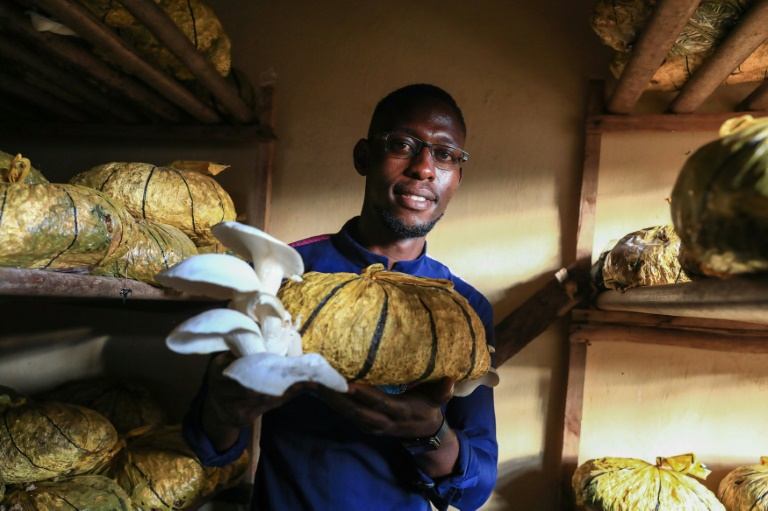
Youbi grows thousands of oyster mushrooms in a darkened room of the Common Initiatives Group — GIC Champignon — which he launched with associates in Maetur, a district of Bafoussam, four years ago.

“We are in the mushroom house of our GIC,” Youbi announces proudly amid the rows on rows of fungi growing on shelves on agricultural waste packaged in plastic bags.

“Some, like these, have passed the harvest period,” says one of his associates, Patrick Yaptieu, pushing aside a pile of mushrooms which have turned from the desired white colour to a yellowish hue. He then puts the good harvest of the day in bags headed for the GIC shop, near the city centre.

A kilo of oyster mushrooms sells in Bafoussam for 2,000 CFA francs (just over three euros / $3.11), while it costs up to 3,500 CFA in Yaounde, the capital, or Douala, the main port and economic capital.

— ‘Corn cobs … and ox blood’ —

The lack of official national data on the production and consumption of mushrooms makes it hard to gain an idea of the market value and extent of the sector.

Activity in the GIC Champignon premises is punctuated by constant comings and goings, while two young trainees in a little side room are shovelling a pile of agricultural residue.

To obtain the soil-free culture, “we mixed corn cobs with nutrients such as bran flour, wheat and ox blood,” explains production manager Brice Nono Djomo.

“We added a fungicide to it to avoid the bad mushrooms,” he says, adding that the effects of this precautionary treatment fade away after two weeks, well before the good crop grows.

Once the substrate mixture is ready, it is sterilised, placed in barrels and heated over a wood fire, then cooled down and placed in the plastic bags. Once the spores are introduced, the bags are placed in the mushroom house, where it takes 30 days to see the first stems appear.

“I was amazed to discover this way of cultivating mushrooms,” says Junior Leogip, a boy of 12 who is devoting his school holidays to do an internship at GIC Champignon.

“I learned to prepare the substrate… I want to know everything,” Leogip adds, his heart set on winning a place in an agricultural college after his baccalaureate.

“My ambition is to launch my own production and be independent,” says Lea Tona, another trainee who comes from Yaounde.

– ‘Mushroom whisky’ –

Every three months, the time it takes for a full growth cycle, the business in Bafoussam produces from 300 to 400 kilos (660 to 880 pounds) of mushrooms, 80 percent of which are sold directly to customers to be eaten.

The remainder is transformed into body and hair oils, soap, juice and even a liqueur that Youbi presents as “mushroom whisky”.

In a small laboratory at the GIC, Youbi grinds part of the harvest in a blender to obtain a juice which will be combined with other elements for the range of by-products.

“For beauty oils, we can add snail slime and a perfume to give a pleasant smell,” he says, guarding his secrets close his chest.

“We’re in a promotional phase. For the hair oil, we give boxes to some hairstylists to experiment with.”

“It softens the hair and makes it grow back, it treats dandruff, breakage,” says Josiane Sogo in her hairdressing salon.

Some people prefer simply to taste the fungi.

“I am a very big consumer of mushrooms, especially for their virtues. It is a vegetable meat that helps me steer clear of several risks,” affirms Barthelemy Tchoumtchoua, noting that his skewer is rich in protein and vitamins B2, B3, B5 and D.

Thanks to fungiculture, “we can eat them all year round”, he adds enthusiastically.

Philippines' Nobel laureate Ressa loses appeal of cyber libel conviction

Philippine Nobel Peace Prize winner Maria Ressa lost her appeal against a conviction for cyber libel, her news website Rappler said Friday, in the latest blow for the veteran journalist.  

Ressa, 58, and her former colleague Rey Santos Jr face lengthy jail sentences, but the company said they will “avail of all legal remedies available to them”, including taking the case to the Supreme Court. 

The ruling comes less than two weeks after Philippine authorities ordered Rappler to shut down ahead of former president Rodrigo Duterte’s last day in office. 

Rappler on Friday described the decision to uphold the 2020 conviction as “unfortunate”, saying it “weakens the ability of journalists to hold power to account”.

“What is ultimately at stake is our democracy whose strength rests on a media that is not threatened by the state nor intimidated by forces out to silence critical voices,” Rappler said. 

Ressa, who is currently in Manila, has long been a vocal critic of Duterte and the deadly drug war he launched in 2016, triggering what media advocates say is a grinding series of criminal charges, probes and online attacks against her and Rappler.

She and Russian journalist Dmitry Muratov were awarded the Nobel Peace Prize in October for their efforts to “safeguard freedom of expression”.

Ressa, who is also a US citizen, is fighting at least seven court cases, including the cyber libel case, for which she has been on bail and faces up to nearly seven years in prison. 

Rappler, which faces eight cases, had to fight for survival as Duterte’s government accused it of violating a constitutional ban on foreign ownership in securing funding, as well as tax evasion.

The cyber libel law was introduced in 2012, the same year Rappler was founded. 

Its use against journalists was “troubling”, said Jonathan de Santos, chairman of the National Union of Journalists of the Philippines.

He called on Congress to descriminalise cyber libel, arguing it was “no longer compatible with our constitution”.

– Rappler’s future? –

Just days before Duterte left office, the Philippine Securities and Exchange Commission (PSEC) ordered Rappler to shut down for violating “constitutional and statutory restrictions on foreign ownership in mass media”.

The news organisation is accused of allowing foreigners to take control of its website through its parent company Rappler Holdings’ issuance of “depositary receipts”.

Under the constitution, investment in media is reserved for Filipinos or Filipino-controlled entities.

Rappler said the PSEC’s decision “effectively confirmed the shutdown” of the company and vowed to appeal, describing the proceedings as “highly irregular”.

Ressa said the company would continue to operate as they followed the legal process, but expressed hope that the situation would improve under Duterte’s successor, Ferdinand Marcos Jr. 

But the company’s future and its battle in the country’s highly politicised legal system under Marcos Jr’s presidency is uncertain. 

Marcos Jr, who took over from Duterte on June 30, has given few clues about his views on the website and the broader issue of freedom of speech.

But activists fear he could worsen the situation for human rights and freedom of speech in the country.

900 firefighters battle 'mega-fire' in southern France

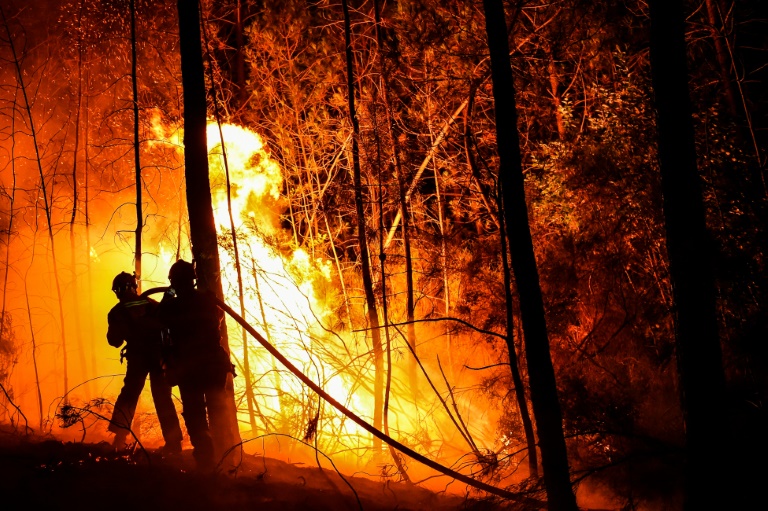
More than 900 firefighters backed by aircraft were deployed on Friday to battle a massive blaze in France’s southern Gard region that burned 600 hectares (1,500 acres) overnight.

“This fire is far from being done, there are fronts in hard-to-reach areas that we haven’t tackled and that are advancing freely,” said Eric Agrinier, a senior member of the fire service.

“It’s going to be a feat of endurance.”

Working into the night after the blaze began late Thursday, firefighters set backfires to protect inhabited areas.

“We burn some parts (of the forest) so when the fire spreads it reaches an already-burned zone and slows down, that makes it easier to stop its advance,” said Jacques Pages, standing in front of a line of flames lighting up the pitch-black forest.

Described by emergency responders as a “mega-fire”, the blaze started near the village of Bordezac and forced evacuations from nearby Besseges and other settlements on Thursday night.

The local prefect’s office said around 100 people had to be put up in holiday homes and restaurants in the area, which is about 90 kilometres (55 miles) north of Montpellier and the Mediterranean coast.

“I’ve been finding rooms for people and all the holiday homes are doing the same,” said Regine Marchand, manager of a restaurant in nearby Aujac, on Thursday night.

“We’ve made them pasta, people left quickly without bringing anything, but they’re keeping their spirits up, there’s a good atmosphere.”

By Friday, people’s homes were no longer in danger, with only a garage and a small hut damaged.

The Gard region fire service said Friday morning that 13 firefighters were slightly injured.

As well as personnel on the ground, two planes have been dumping water since the early morning.

On Thursday, the air deployment had stretched to 12 firefighting planes and two helicopters.

Roads were closed to traffic entering the Besseges area, while hundreds of firefighters remained on the scene, some drawn from neighbouring regions.

– Drought raises risk –

Like large swathes of the country, southeast France has suffered from drought this year, increasing the risk of fires.

During an unseasonable heatwave last month, around 600 hectares were burned in a fire started by shelling on an army artillery training range near the Mediterranean port city Marseille.

Firefighters in that Bouches-du-Rhone region were called out to 35 outbreaks on Thursday, many of them close to inhabited areas.

Four houses were destroyed near southern city Arles and 250 firefighters were called out to a brushfire in Saint-Mitre-les-Remparts.

Although several other fires began in southern France on Thursday, most were put out before nightfall.

The fire service said thousands of hectares of heavily wooded land were under threat, as winds gusting at up to 80 km/h (50 mph) fanned the flames through the dried-out trees.

Wind is “the worst enemy” of firefighters, Lieutenant Colonel Agrinier said.

Close Bitnami banner
Bitnami