World

Will Belarus join Moscow's Ukraine offensive?

Belarus has served as a staging ground for Russia’s intervention in Ukraine, but strongman Alexander Lukashenko has so far avoided becoming a party to the conflict.

Observers stress that there is no end in sight for Moscow’s more than four-month military campaign in Ukraine and do not rule out that Belarus could still be dragged into it, too.

Artyom Shraibman, a non-resident scholar at the Carnegie Endowment for International Peace, said that Lukashenko was keenly aware of the fact that most Belarusians do not support sending troops into Ukraine.

But that does not mean that President Vladimir Putin will not try to put pressure on Lukashenko and that Belarus will not join the offensive in the future.

“There are no rational reasons — or irrational reasons for that matter — for Minsk to join, for Lukashenko to join,” Shraibman told AFP.

“What is Putin capable of doing? Will he be able to force Lukashenko to join? It’s an open question.”

Lukashenko has sought to promote himself as Putin’s most faithful ally, welcoming Russian troops under the pretext of military exercises before Moscow launched its Ukraine offensive, trying and failing to take the capital Kyiv. 

He has also argued that had Moscow not intervened, Ukraine would have attacked Belarus. 

Despite officially being a non-belligerent, the Belarus strongman has demanded that his country be included in any talks and a deal to end the conflict.

Ukrainian President Volodymyr Zelensky said this week that Kyiv did not believe Minsk would be dragged into the conflict. 

“But there are and will be provocations,” Zelensky said. 

“There is a threat of Belarus getting involved.”

– ‘Zero combat experience’ – 

Tensions between Ukraine and Belarus have been growing.

In early July, Lukashenko said his army had shot down missiles fired into their territory from Ukraine and vowed to respond “instantly” to any enemy strike.

Putin has said that Moscow will deliver Iskander-M missiles capable of carrying nuclear weapons to Belarus “in the coming months”. 

Shraibman, who fled Lukashenko’s repressive regime in 2021, pointed out that the Belarusian strongman provided the necessary logistical support for Russia but has conspicuously refrained from sending troops to Ukraine.

“I’m not sure the Belarusian army would add much,” he said. 

“It’s way more reasonable to keep them on the border, to keep Ukrainians on alert on the border, rather than moving the few battalions Belarus has into war.” 

Russian military analyst Alexander Khramchikhin struck a similar note, saying Minsk’s involvement in the conflict was unlikely.

“The Belarusian army has zero combat experience compared to both the Ukrainian and Russian armies,” he said.

“Its combat value is very low.”

He said it was more useful for Putin to use Belarus to maintain “a certain tension” on the border with Poland.

Nevertheless, he said, if the Belarusian troops were to attack, “it will create quite significant additional stress for Ukraine, because it will be an attack from a new direction.”

Experts say Belarus’s role in the Ukraine offensive will ultimately depend on what Putin wants.

Lukashenko, 67, is heavily dependent on the Russian leader militarily and economically. 

When unprecedented protests rocked Belarus in 2020 over an election the opposition says he stole, the moustachioed leader relied on Moscow to stabilise his position.

– ‘Peaceful nation’ –

Political analysts say that if Lukashenko goes to war against Ukraine he risks reigniting the mass protests that shook his rule in 2020-2021.

“I think President Lukashenko is well aware that this will not be something that will strengthen his popularity in the country,” Kremlin-connected political analyst Fyodor Lukyanov told AFP.

According to a June poll by the British think-tank Chatham House, 43 percent of Belarusians do not support the Russian offensive in Ukraine. 

Only 4 percent would back the involvement of the Belarusian army.

Veronica Laputska, co-founder of the think-tank EAST Center in Warsaw, said that the Belarusian people sustained huge losses during World War II when around one in four died and were deeply averse to “any type of violence”.

“Belarusians are a very peaceful nation,” she said.

Argentina turmoil sparks panic buying and price hikes

A political crisis in inflation-ravaged Argentina that was sparked by the economy minister’s resignation has spooked markets and generated fears resulting in panic buying and hasty price hikes, as the informal exchange rate soars.

“Every day it’s like going out to hunt a lion,” Luis Sacco told AFP in front of his electronics store in the capital Buenos Aires.

Since Monday, prices have risen dramatically at shops and businesses across the country.

On Saturday, economy minister Martin Guzman resigned following months of pressure from inside President Alberto Fernandez’s center-left Frente de Todos (Everyone’s Front) governing coalition.

Guzman was the chief negotiator in Argentina’s haggling with the International Monetary Fund to restructure a $44 billion debt.

But he was collateral damage in a power struggle between Fernandez and his vice-president, the former president Cristina Kirchner.

Opposition to Guzman’s fiscal policies from the former president’s influential faction within the coalition resulted in him quitting and being replaced by Kirchner loyalist Silvina Batakis.

She is the one who must now steer agricultural powerhouse Argentina through its years-long economic crisis.

Inflation, which surpassed 60 percent in the last 12 months, is hurting ordinary Argentines, who have been gripped by the political soap opera.

“It was the longest Sunday of my life,” said Sacco, the electronics store owner who spent an anxious weekend “not knowing whether or not to lift the shutters, (and) a Monday thinking about catastrophe.”

The black market peso briefly dropped from 239 to the US dollar to 280 on Monday before stabilizing at 250. The official exchange rate is 132.

– ‘Prices not set by costs’ –

But amidst the uncertainty and panic, sales actually soared for many businesses with consumers afraid prices would soon increase.

That is a major concern in a country struggling with years of high inflation.

“There was no earthquake. There are sales, more than ever,” said Sacco.

But “people are also buying because they know that if they wait, the price will increase. It’s the time to sell stock.”

He pushed up his prices by 15 percent a few weeks ago, with another five percent increase this week, while he has now hiked prices on his imported goods by 30 percent.

Fernando Agote, who owns a hardware store, says “things are calming down” after some initial panic buying despite little change in prices.

But conversely, many suppliers have suspended their sales, waiting to see what happens to prices before taking new orders, so they do not get left short-changed.

“There was a lot of anxiety, a lot of speculation. No one knows where the real prices are, they’re not set by costs,” said Agote.

Luckily for him, only one of his suppliers suspended their sales on Monday.

At a paint shop in the Floresta neighborhood, prices were pushed up 20 percent with no drop in sales volume.

“Everything was sold,” said the manager, Leo. However, supplies were not replenished.

“Only one company delivered.”

Leo expects that next week suppliers “will change all their price and payment conditions.”

After 20 years in the business, Leo has lived through several economic crises in Argentina.

“This is unusual because people have money, they are consuming, these days we’ve been selling like crazy, online orders have exploded,” he added.

– Time for caution –

The change in government comes at a time when workers are receiving a biyearly salary bonus, leaving them flush with cash.

Even so, “you have to be cautious and not change things more than they are so you don’t spark an unnecessary inflation snowball. We’ve already had enough of those,” said Alberto Sorrentino, 60, who runs a construction materials company.

He expects prices of “domestic products will rise between six and 10 percent, and imports between 10 and 20 percent.”

The biggest price hikes have been in the food industry.

“What comes from abroad like banana, papaya and melon increased 30 percent since Monday,” said John Quinteros, who runs a fruit and vegetable shop in Floresta.

“People are still buying, but less.”

In the Villa Crespo neighborhood a shop selling natural products has a sign informing customers it had not pushed up prices.

“We’ve decided to maintain them for as long as we can,” said Liliana de los Santos, admitting that “it’s a risk.”

Argentina turmoil sparks panic buying and price hikes

A political crisis in inflation-ravaged Argentina that was sparked by the economy minister’s resignation has spooked markets and generated fears resulting in panic buying and hasty price hikes, as the informal exchange rate soars.

“Every day it’s like going out to hunt a lion,” Luis Sacco told AFP in front of his electronics store in the capital Buenos Aires.

Since Monday, prices have risen dramatically at shops and businesses across the country.

On Saturday, economy minister Martin Guzman resigned following months of pressure from inside President Alberto Fernandez’s center-left Frente de Todos (Everyone’s Front) governing coalition.

Guzman was the chief negotiator in Argentina’s haggling with the International Monetary Fund to restructure a $44 billion debt.

But he was collateral damage in a power struggle between Fernandez and his vice-president, the former president Cristina Kirchner.

Opposition to Guzman’s fiscal policies from the former president’s influential faction within the coalition resulted in him quitting and being replaced by Kirchner loyalist Silvina Batakis.

She is the one who must now steer agricultural powerhouse Argentina through its years-long economic crisis.

Inflation, which surpassed 60 percent in the last 12 months, is hurting ordinary Argentines, who have been gripped by the political soap opera.

“It was the longest Sunday of my life,” said Sacco, the electronics store owner who spent an anxious weekend “not knowing whether or not to lift the shutters, (and) a Monday thinking about catastrophe.”

The black market peso briefly dropped from 239 to the US dollar to 280 on Monday before stabilizing at 250. The official exchange rate is 132.

– ‘Prices not set by costs’ –

But amidst the uncertainty and panic, sales actually soared for many businesses with consumers afraid prices would soon increase.

That is a major concern in a country struggling with years of high inflation.

“There was no earthquake. There are sales, more than ever,” said Sacco.

But “people are also buying because they know that if they wait, the price will increase. It’s the time to sell stock.”

He pushed up his prices by 15 percent a few weeks ago, with another five percent increase this week, while he has now hiked prices on his imported goods by 30 percent.

Fernando Agote, who owns a hardware store, says “things are calming down” after some initial panic buying despite little change in prices.

But conversely, many suppliers have suspended their sales, waiting to see what happens to prices before taking new orders, so they do not get left short-changed.

“There was a lot of anxiety, a lot of speculation. No one knows where the real prices are, they’re not set by costs,” said Agote.

Luckily for him, only one of his suppliers suspended their sales on Monday.

At a paint shop in the Floresta neighborhood, prices were pushed up 20 percent with no drop in sales volume.

“Everything was sold,” said the manager, Leo. However, supplies were not replenished.

“Only one company delivered.”

Leo expects that next week suppliers “will change all their price and payment conditions.”

After 20 years in the business, Leo has lived through several economic crises in Argentina.

“This is unusual because people have money, they are consuming, these days we’ve been selling like crazy, online orders have exploded,” he added.

– Time for caution –

The change in government comes at a time when workers are receiving a biyearly salary bonus, leaving them flush with cash.

Even so, “you have to be cautious and not change things more than they are so you don’t spark an unnecessary inflation snowball. We’ve already had enough of those,” said Alberto Sorrentino, 60, who runs a construction materials company.

He expects prices of “domestic products will rise between six and 10 percent, and imports between 10 and 20 percent.”

The biggest price hikes have been in the food industry.

“What comes from abroad like banana, papaya and melon increased 30 percent since Monday,” said John Quinteros, who runs a fruit and vegetable shop in Floresta.

“People are still buying, but less.”

In the Villa Crespo neighborhood a shop selling natural products has a sign informing customers it had not pushed up prices.

“We’ve decided to maintain them for as long as we can,” said Liliana de los Santos, admitting that “it’s a risk.”

TikTok sued in US after girls die in 'Blackout Challenge'

Video-sharing sensation TikTok is being sued in California after children died while taking part in a “Blackout Challenge” that makes a sport of choking oneself until passing out.

The lawsuit filed in state court in Los Angeles last week accuses TikTok software of “intentionally and repeatedly” pushing the Blackout Challenge that led to the deaths of an eight-year-old girl in Texas and a nine-year-old girl in Wisconsin last year.

“TikTok needs to be held accountable for pushing deadly content to these two young girls,” said Matthew Bergman, an attorney at the Social Media Victims Law Center, which filed the suit.

“TikTok has invested billions of dollars to intentionally design products that push dangerous content that it knows are dangerous and can result in the deaths of its users.”

TikTok, owned by China-based ByteDance, did not immediately respond to a request for comment.

The suit alleges that  TikTok’s algorithm promoted the Blackout Challenge to each of the girls, who died from self-strangulation — one using rope and the other a dog leash.

It additionally listed children in Italy, Australia and elsewhere whose deaths have been linked to the TikTok Blackout Challenge.

TikTok has featured and promoted an array of challenges in which users film themselves taking part in themed acts that are sometimes dangerous.

Among the litany of TikTok challenges described in court documents was the “Skull Breaker Challenge” in which people have their legs kicked out from under them while jumping so they flip and hit their heads.

The “Coronavirus Challenge” involves licking random items and surfaces in public during the pandemic, and the “Fire Challenge” involves dousing things with flammable liquid and setting them ablaze, court documents said.

The suit calls for a judge to order TikTok to stop hooking children via its algorithm and promoting dangerous challenges, and to pay unspecified cash damages.

Would-be Johnson successors ready for race to become British PM

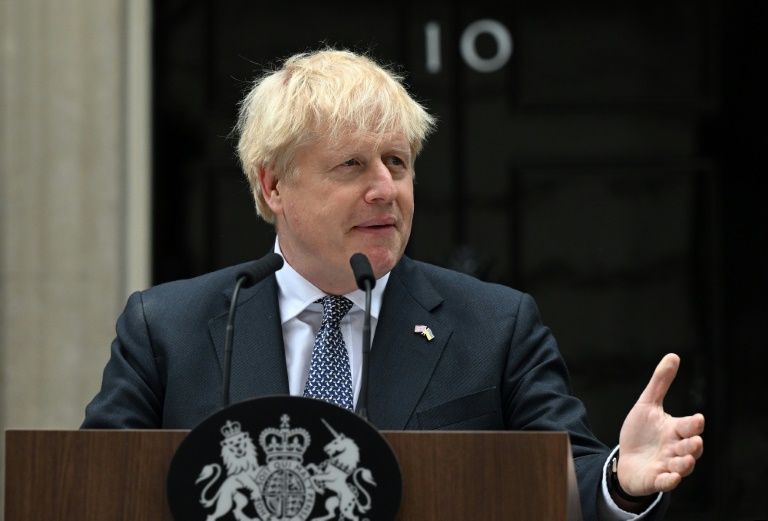
Would-be successors to scandal-ridden British Prime Minister Boris Johnson were readying Friday for what will be a prolonged battle, the day after an extraordinary exodus of Conservative ministers brought about their leader’s downfall. 

Johnson resigned on Thursday as Tory leader, acknowledging that it was “clearly the will of the parliamentary Conservative party that there should be a new leader of that party, and therefore a new prime minister”.

The leadership election is expected to take place over the coming months, and the victor will replace Johnson by the party’s annual conference in early October.

Defence minister Ben Wallace and Rishi Sunak — whose resignation as finance minister on Tuesday set off the chain of exits — were among the early frontrunners to take over, a YouGov survey of Tory members suggested.

Foreign Secretary Liz Truss, another potential contender, cut short a trip to Indonesia for a G20 meeting to fly back. 

So far Conservative MP Tom Tugendhat is the only person to officially announce their campaign, though Attorney General Suella Braverman and Brexiteer Steve Baker have both signalled interest.

In Johnson’s unrepentant resignation speech on Thursday he said he would stay on until his successor is found.

But calls are building for him to leave immediately, and for an acting leader to head the world’s fifth-largest economy.

Polling suggested most Britons favour his rapid exit, as claims surfaced that Johnson is only hanging on to enjoy a wedding party with wife Carrie at his government-funded country retreat.

“Clinging on for one last party,” blared the leftwing tabloid Daily Mirror on Friday morning, adding a pointed jab referencing a Brexit slogan: “Leave means leave, Boris”.

But on the other side of the political spectrum, the Daily Mail’s front page asked “What the hell have they done?” — characterising Johnson as “cast out by a party in the grip of collective hysteria”.  

– ‘Best job’ –

Johnson’s tumultuous three years in office were defined by Brexit, the Covid-19 pandemic and non-stop controversy about his reputation for mendacity.

On Thursday, the 58-year-old said he was “sad… to be giving up the best job in the world”, justifying his refusal initially to surrender to his “herd” of Tory critics by claiming a personal mandate in the Brexit-dominated general election of December 2019.

Even while eyeing the exit, Johnson sought to steady the ship, making several appointments to replace departed cabinet members.

They included Greg Clark, an arch “remainer” opposed to Britain’s divorce from the European Union, which Johnson had championed. 

The inexperienced Shailesh Vara was put in charge of Northern Ireland, with the government locked in battle with Brussels over post-Brexit trading rules for the tense territory.

Irish premier Micheal Martin said Johnson’s exit was a chance to reset “strained and challenged” relations.

Convening the new-look cabinet after his resignation speech, Johnson confirmed his lame-duck status by saying “major fiscal decisions should be left for the next prime minister”, according to Downing Street.

Sunak and health secretary Sajid Javid started the ministerial exodus when they quit late Tuesday, after Johnson apologised for his February appointment of a senior Conservative MP to a prominent role in parliament. 

Chris Pincher resigned as deputy chief whip last week following accusations he had drunkenly groped two men.

Downing Street officials eventually conceded that Johnson had known about other allegations against Pincher back in 2019, and many ministers recoiled at having to defend the leader yet again.

As late as Wednesday night, Johnson had been defiantly clinging to power despite a wave of more than 50 government resignations.

But a fresh round of high-profile departures early Thursday, and warnings of a second no-confidence vote next week by Tory MPs, tipped the balance.

– ‘Arrogant and delusional’ –

Johnson triumphed in 2019 with a vow to “get Brexit done” following Britain’s shock referendum decision three years prior. But for many, the populist, convention-defying leader had outstayed his welcome.

The Conservative infighting erupted at a time when millions of Britons are battling the worst slump in living standards since the 1950s, fuelled by rocketing energy prices on the back of the war in Ukraine.

Johnson’s popularity had already slumped over a series of lockdown-breaking parties in Downing Street, which saw him become the first prime minister to receive a police fine.

While Johnson ran a successful coronavirus vaccine campaign, the former journalist also oversaw one of Europe’s worst death tolls, and nearly died himself from Covid in April 2020.

“Boris Johnson’s legacy is the deaths of nearly 200,000 British people on his watch,” said Lobby Akinnola, from the campaign group Covid-19 Bereaved Families for Justice.

“Whilst Johnson will move on to a life of writing newspaper columns and being paid eye-watering amounts to give after-dinner speeches, there will be no moving on for the families like mine that have been ripped apart by his actions,” he said.

TikTok sued in US after girls die in 'Blackout Challenge'

Video-sharing sensation TikTok is being sued in California after children died while taking part in a “Blackout Challenge” that makes a sport of choking oneself until passing out.

The lawsuit filed in state court in Los Angeles last week accuses TikTok software of “intentionally and repeatedly” pushing the Blackout Challenge that led to the deaths of an eight-year-old girl in Texas and a nine-year-old girl in Wisconsin last year.

“TikTok needs to be held accountable for pushing deadly content to these two young girls,” said Matthew Bergman, an attorney at the Social Media Victims Law Center, which filed the suit.

“TikTok has invested billions of dollars to intentionally design products that push dangerous content that it knows are dangerous and can result in the deaths of its users.”

TikTok, owned by China-based ByteDance, did not immediately respond to a request for comment.

The suit alleges that  TikTok’s algorithm promoted the Blackout Challenge to each of the girls, who died from self-strangulation — one using rope and the other a dog leash.

It additionally listed children in Italy, Australia and elsewhere whose deaths have been linked to the TikTok Blackout Challenge.

TikTok has featured and promoted an array of challenges in which users film themselves taking part in themed acts that are sometimes dangerous.

Among the litany of TikTok challenges described in court documents was the “Skull Breaker Challenge” in which people have their legs kicked out from under them while jumping so they flip and hit their heads.

The “Coronavirus Challenge” involves licking random items and surfaces in public during the pandemic, and the “Fire Challenge” involves dousing things with flammable liquid and setting them ablaze, court documents said.

The suit calls for a judge to order TikTok to stop hooking children via its algorithm and promoting dangerous challenges, and to pay unspecified cash damages.

Using lasers and 'tow-trucks', Japanese firms target space debris

From laser beams and wooden satellites to galactic tow-truck services, start-ups in Japan are trying to imagine ways to deal with a growing environmental problem: space debris.

Junk like used satellites, parts of rockets and wreckage from collisions has been piling up since the space age began, with the problem accelerating in recent decades.

“We’re entering an era when many satellites will be launched one after another. Space will become more and more crowded,” said Miki Ito, general manager at Astroscale, a company dedicated to “space sustainability”.

“There are simulations suggesting space won’t be usable if we go on like this,” she told AFP. “So we must improve the celestial environment before it’s too late.”

The European Space Agency (ESA) estimates that around one million pieces of debris larger than a centimetre — big enough to “disable a spacecraft” — are in Earth’s orbit.

They are already causing problems, from a near-miss in January involving a Chinese satellite, to a five-millimetre hole knocked into a robotic arm on the International Space Station last year.

“It’s hard to predict exactly how fast the amount of space debris will increase,” said Toru Yamamoto, a senior researcher at the Japan Aerospace Exploration Agency (JAXA).

But “it’s an issue that raises real concerns about the sustainable use of space.”

With satellites now crucial for GPS, broadband and banking data, collisions pose significant risks on Earth.

Tadanori Fukushima has seen the scale of the problem in his job as an engineer with Tokyo-based satellite operator and broadcaster SKY Perfect JSAT.

“A stationary satellite would get roughly 100 ‘debris-approaching’ alerts a year,” he told AFP.

International “satellite disposal guidelines” include rules like moving used satellites to “graveyard orbit” — but the increase in debris means more is needed, specialists say.

– ‘No panacea’ –

Fukushima launched an in-house start-up in 2018 and envisions using a laser beam to vaporise the surface of space debris, creating a pulse of energy that pushes the object into a new orbit.

The irradiating laser means there’s no need to touch any debris, which is generally said to move about 7.5 kilometres per second — much faster than a bullet.

For now, the project is experimental, but Fukushima hopes to test the idea in space by spring 2025, working with several research institutions.

Japanese firms, along with some in Europe and the United States, are leading the way on developing solutions, according to Fukushima.

Some projects are further along, including Astroscale’s space “tow-truck”, which uses a magnet to collect out-of-service satellites.

“If a car breaks down, you call a tow-truck service. If a satellite breaks down and stays there, it faces the risk of collision with debris and needs to be collected quickly,” Ito explained.

The firm carried out a successful trial last year and imagines one day equipping customer satellites with a “docking plate” equivalent to a tow-truck’s hook, allowing collection later on.

Astroscale, which has a contract with the ESA, plans a second test by the end of 2024 and hopes to launch its service soon after.

Other efforts approach the problem at the source, by creating satellites that don’t produce debris.

Kyoto University and Sumitomo Forestry envisage a wooden satellite that goes into orbit in a rocket and burns up safely when it plunges to Earth.

That project is also in its infancy — in March, pieces of wood were sent to the International Space Station to test how they respond to cosmic rays.

Space agencies have their own programmes, with JAXA focusing on large debris over three tonnes.

And internationally, firms including US-based Orbit Fab and Australia’s Neumann Space have proposed ideas such as in-orbit refuelling to extend the life of satellites.

The problem is complex enough that a range of solutions will be needed, said JAXA’s Yamamoto.

“There is no panacea.”

Using lasers and 'tow-trucks', Japanese firms target space debris

From laser beams and wooden satellites to galactic tow-truck services, start-ups in Japan are trying to imagine ways to deal with a growing environmental problem: space debris.

Junk like used satellites, parts of rockets and wreckage from collisions has been piling up since the space age began, with the problem accelerating in recent decades.

“We’re entering an era when many satellites will be launched one after another. Space will become more and more crowded,” said Miki Ito, general manager at Astroscale, a company dedicated to “space sustainability”.

“There are simulations suggesting space won’t be usable if we go on like this,” she told AFP. “So we must improve the celestial environment before it’s too late.”

The European Space Agency (ESA) estimates that around one million pieces of debris larger than a centimetre — big enough to “disable a spacecraft” — are in Earth’s orbit.

They are already causing problems, from a near-miss in January involving a Chinese satellite, to a five-millimetre hole knocked into a robotic arm on the International Space Station last year.

“It’s hard to predict exactly how fast the amount of space debris will increase,” said Toru Yamamoto, a senior researcher at the Japan Aerospace Exploration Agency (JAXA).

But “it’s an issue that raises real concerns about the sustainable use of space.”

With satellites now crucial for GPS, broadband and banking data, collisions pose significant risks on Earth.

Tadanori Fukushima has seen the scale of the problem in his job as an engineer with Tokyo-based satellite operator and broadcaster SKY Perfect JSAT.

“A stationary satellite would get roughly 100 ‘debris-approaching’ alerts a year,” he told AFP.

International “satellite disposal guidelines” include rules like moving used satellites to “graveyard orbit” — but the increase in debris means more is needed, specialists say.

– ‘No panacea’ –

Fukushima launched an in-house start-up in 2018 and envisions using a laser beam to vaporise the surface of space debris, creating a pulse of energy that pushes the object into a new orbit.

The irradiating laser means there’s no need to touch any debris, which is generally said to move about 7.5 kilometres per second — much faster than a bullet.

For now, the project is experimental, but Fukushima hopes to test the idea in space by spring 2025, working with several research institutions.

Japanese firms, along with some in Europe and the United States, are leading the way on developing solutions, according to Fukushima.

Some projects are further along, including Astroscale’s space “tow-truck”, which uses a magnet to collect out-of-service satellites.

“If a car breaks down, you call a tow-truck service. If a satellite breaks down and stays there, it faces the risk of collision with debris and needs to be collected quickly,” Ito explained.

The firm carried out a successful trial last year and imagines one day equipping customer satellites with a “docking plate” equivalent to a tow-truck’s hook, allowing collection later on.

Astroscale, which has a contract with the ESA, plans a second test by the end of 2024 and hopes to launch its service soon after.

Other efforts approach the problem at the source, by creating satellites that don’t produce debris.

Kyoto University and Sumitomo Forestry envisage a wooden satellite that goes into orbit in a rocket and burns up safely when it plunges to Earth.

That project is also in its infancy — in March, pieces of wood were sent to the International Space Station to test how they respond to cosmic rays.

Space agencies have their own programmes, with JAXA focusing on large debris over three tonnes.

And internationally, firms including US-based Orbit Fab and Australia’s Neumann Space have proposed ideas such as in-orbit refuelling to extend the life of satellites.

The problem is complex enough that a range of solutions will be needed, said JAXA’s Yamamoto.

“There is no panacea.”

Asian stocks extend global rally as recession fears ease for now

Asian markets rose Friday on easing recession fears, while there were growing hopes that Joe Biden will remove some Trump-era tariffs from Chinese goods.

Buying was also boosted by reports that Beijing was considering a huge stimulus shot to the struggling economy by allowing local governments to raise billions of dollars through bond issuance for infrastructure projects.

However, surging inflation, rising interest rates and a fresh flare-up of Covid infections in Shanghai continued to keep investor sentiment grounded.

Traders were handed a strong lead from Wall Street, where all three main indexes climbed for a fourth straight day, helped by two top Federal Reserve officials who said the economy could withstand sharper rate hikes and maintain growth.

There has been growing talk that the fast pace of monetary tightening by the bank will tip the world’s top economy into recession.

But Christopher Waller, a member of the board of governors, said worries were overblown and that a strong jobs market would provide a buffer, adding that rates needed to go up sharply and quickly.

St Louis Fed president James Bullard also said there was “a good chance of a soft landing”.

And Brian Belski, at BMO Capital Markets, agreed that fears of a recession had gone too far.

“I’m calling this period right now a recession obsession,” he told Bloomberg Television. “Institutional investors are not positioned for any kind of upside move. That’s why you are seeing these sharp moves on a day like (Thursday). We remain positive and think people are way too negative.”

With the mood more upbeat, Asian equities advanced with Hong Kong, Shanghai, Tokyo, Sydney, Seoul, Singapore, Wellington, Taipei, Manila and Jakarta all in the green.

– Jobs market weakness –

The Fed’s policy plans will be in focus later Friday when US employment data is released, with a strong reading providing the central bank with evidence to stick to its hawkish line.

But Matt Simpson at StoneX Financial said there were indications the jobs market could be showing signs of weakness.

The report “is unlikely to deter the Fed from a 75 basis points hike this month. But when the precious non-farm payroll numbers begin to crumble, so does the Fed’s argument that the US economy is robust”, he said.

“And we’re seeing early signs of that across multiple employment metrics.”

“When we do see unemployment begin to rise and headline employment growth lose momentum it will be hard for the Fed to ignore,” he added. 

“And that could provide a reason for the Fed to at least pause their hiking cycle, because a crumbling jobs market is great for deflation. So I’d expect market fireworks if and when (non-farm payroll numbers) begins to disappoint.”

Biden is also reported to be holding a meeting later Friday with top advisers to discuss whether or not to lift some of the Trump-era tariffs imposed on around $300 billion of Chinese imports.

While he is also said to be considering another probe into other facets of Beijing’s trade policy, analysts said the removal of the levies could boost China’s export growth to the United States by about 20 percent.

The move could also help ease upward pressure on US inflation, which is running at a four-decade high.

Sterling extended Thursday’s rally that came after Boris Johnson resigned as leader of the ruling Conservatives, paving the way for a new prime minister and bringing an end to weeks of political uncertainty in the United Kingdom.

The euro remained stuck at a 20-year low against the greenback after minutes from the European Central Bank’s most recent meeting indicated that, unlike the Fed, it was happy to hike rates at a slower pace despite surging inflation.

– Key figures at around 0245 GMT –

Tokyo – Nikkei 225: UP 1.4 percent at 26,869.82 (break)

Hong Kong – Hang Seng Index: UP 0.9 percent at 21,841.61

Shanghai – Composite: UP 0.5 percent at 3,381.11

Pound/dollar: UP at $1.2041 from $1.2024 Thursday

Euro/dollar: UP at $1.0173 from $1.0162

Euro/pound: DOWN at 84.46 pence from 84.49 pence

Dollar/yen: DOWN at 135.72 yen from 136.01 yen 

West Texas Intermediate: DOWN 0.3 percent at $102.43 per barrel

Brent North Sea crude: DOWN 0.2 percent at $104.49 per barrel

New York – Dow: UP 1.1 percent at 31,384.55 (close)

London – FTSE 100: UP 1.1 percent at 7,189.08 (close)

Australia seeks end to trade rows in China meeting

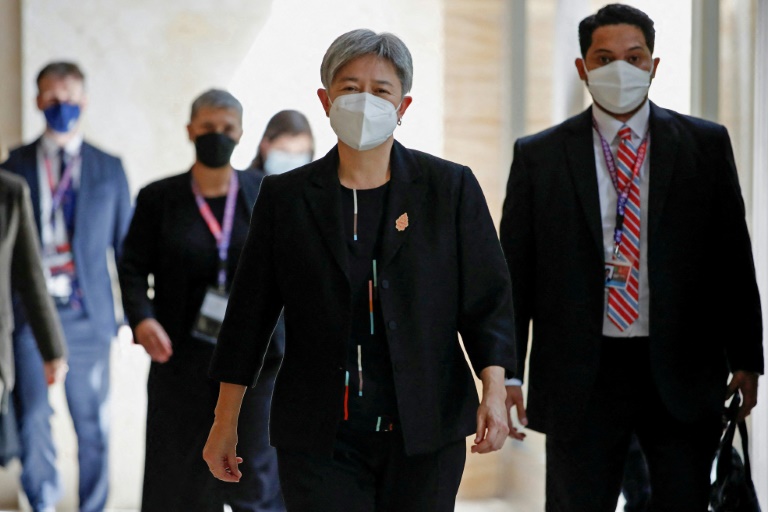
Australia will press China to end trade “blockages” Friday as the two nations seek to defrost icy relations with their first foreign ministers’ meeting since 2019.

Foreign Minister Penny Wong said she aimed to “stabilise” relations when she meets with Chinese Foreign Minister Wang Yi later in the day on the sidelines of a Group of 20 meeting in Bali, Indonesia.

“We all know we have our differences. There are challenges in the relationship. We believe engagement is necessary to stabilise the relationship,” Wong told reporters.

“We won’t be making any concessions when it comes to Australia’s interests,” she added.

The Australian minister said the first step to stabilising relations would be to resolve trade disputes between the two countries.

“We don’t believe those blockages are in our interests,” she said. “We would say to China, they are not in China’s interests.”

Prime Minister Anthony Albanese’s centre-left Labor government, which came to power in May, has called on Beijing to drop its trade tariffs to improve relations.

China — Australia’s biggest trading partner — imposed tariffs and disrupted more than a dozen key industries, including wine, barley and coal, as relations deteriorated in the past two years.

Canberra had irked Beijing by calling for an independent probe into the origins of the coronavirus pandemic and by banning telecoms giant Huawei from taking part in the construction of Australia’s 5G network.

Wong said both sides of Australian politics supported a “one-China” policy, which recognises Beijing, not Taipei, as the government of China.

China views the self-ruled democratic island of Taiwan as part of its territory to be reclaimed one day, by force if necessary.

“We support the status quo and we will work with others to urge that would be no unilateral change to that status quo,” Wong said.

Wong added that she would “diplomatically and directly” raise the cases of journalist Cheng Lei and democracy activist Yang Hengjun, Australian citizens detained in China.

Close Bitnami banner
Bitnami