World

Duminil-Copin, Fields-winning mathematician with 'aesthetic vision'

Hugo Duminil-Copin, a French mathematician whose visual approach helped him win the world’s most prestigious mathematics prize the Fields Medal on Tuesday, said he “doesn’t really fit into the cliches of a genius”.

The 36-year-old, who has a messy head of hair and bright eyes beaming from behind glasses, told AFP that he is a “very, very normal person” who loves sport, his family and quiet moments of reflection. 

But for Duminil-Copin, who specialises in probability theory, those quiet moments can lead to discoveries that won him the Fields Medal, the equivalent of the Nobel Prize for mathematics.

He accepted the prize, which is awarded every four years to mathematicians under 40, at a ceremony in Finland’s capital Helsinki. 

The other winners were Britain’s James Maynard of Oxford University, June Huh of Princeton in the United States and Ukraine’s Maryna Viazovska, who is only the second ever woman laureate.

Duminil-Copin described with unabashed enthusiasm the happiness he finds in working with others in the search for answers — whether or not they find one.

“It’s the best, especially since it’s a collective process, where all the beauty is in interacting with others,” he said in an interview a few days before the prize was announced.

– A visual mind –

Born on August 26, 1985, Duminil-Copin has collected a raft of mathematics awards over the last decade.

At the age of 31, he was appointed professor at France’s Institute of Advanced Scientific Studies in 2016.

“It’s a place that seems made for me, for my creative part,” he said of the green campus outside Paris. 

It gives the mathematician that most precious resource for deep thinkers: time.

“This slowness in everyday life is very fruitful because I need time for ideas to come, for them to settle quietly, for them to take shape,” he said.

At the campus, which is not far from where he grew up, Duminil-Copin uses his “very visual intuition” to take on the most complicated mathematical problems. 

“There are very few formulas and many drawings” in his mind when he thinks about such problems, he said.

That “aesthetic vision” allows him to view mathematics with a “certain elegance”, he added.

The Paris institute allows researchers to free themselves of all other obligations, including teaching.

But Duminil-Copin teaches anyway, retaining a professorship at the University of Geneva, saying that “in the end it is perhaps the most important aspect of this profession”.

He may have inherited this passion from his father, a sports teacher, and mother, a dancer who became a teacher later in life.

When he was younger, Duminil-Copin envisioned becoming a teacher himself — of maths, of course — but his talent propelled him towards research.

Collaboration is at the heart of his outlook. If he provides mathematical tools to physicists, their work in turn may allow someone else in the future to find new applications for them. 

“It’s the whole community that really produces scientific progress,” he said.

– Mental balance –

Duminil-Copin hailed the importance of two university professors to his career, Jean-Francois Le Gall, who also worked on probability theory, and fellow Fields Medal winner Wendelin Werner. 

He said he fell in “love at first sight” with percolation theory during a class Werner taught on the subject, which falls under the branch of statistical physics.

It was in that class that Duminil-Copin first encountered Nienhuis’s conjecture — a “beautiful, elegant and completely mysterious” problem, he said.

“I solved it a few years later, almost without doing it on purpose.”

As a child, Duminil-Copin preferred astronomy to mathematics.

He said he was “not pushed at all” by his parents to focus solely on his studies — instead they were keen to “confront him with a variety of things” such as sport, music and friends.

The lesson seems to have stuck. 

“When we talk about preparing to become a researcher we think of intelligence, academic training, but there is also a mental balance which is very important,” he said.

New ideas can strike him “anytime, in the middle of the night or in the shower”, he said.

But they will have to wait until he’s back at work.

“My priority is on the personal side, to spend time with my daughter and my wife.”
Police arrest suspect after gunman kills six at US July 4 parade

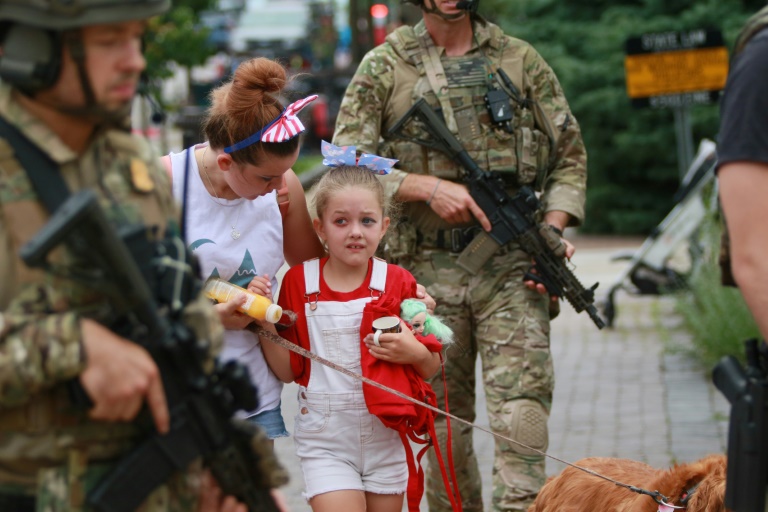
Police arrested a suspect Monday after a mass shooting left six dead at a US Independence Day parade in a wealthy Chicago suburb, casting a dark shadow over the country’s most patriotic holiday. 

Robert Crimo, 22, was identified as a “person of interest” and became the target of a massive manhunt across the town of Highland Park in Illinois, where a rooftop gunman with a high-powered rifle turned a family-focused July 4 parade celebration into a scene of death and trauma.

Firing into the holiday crowd, the shooter caused scenes of chaos as panicked onlookers ran for their lives, leaving behind a parade route strewn with chairs, abandoned balloons and personal belongings.

Emergency officials said around two dozen people, including children, were treated for gunshot injuries, with some in critical condition.

After a brief car chase, Crimo was taken into custody “without incident,” Highland Park police chief Lou Jogmen told reporters.

Earlier, police had warned that he was armed and “very dangerous.” 

Crimo bills himself as a musician, and goes by the online moniker “Awake the Rapper.” 

The shooting is part of a wave of gun violence plaguing the United States, where approximately 40,000 deaths a year are caused by firearms, according to the Gun Violence Archive website.

And it cast a pall over America’s Independence Day, in which towns and cities across the country hold similar parades and people — many dressed in variations on the US flag — hold barbecues, attend sports events and gather for firework displays.

In another July 4 shooting, two police officers were wounded when they came under fire during a fireworks display in Philadelphia, local officials said.

CBS News aired video taken from a high-rise building showing crowds fleeing in panic as fireworks burst in the sky. 

Philadelphia police commissioner Danielle Outlaw said both officers had been released from hospital after receiving treatment, and that authorities were still investigating the exact circumstances of the incident.

In Highland Park, Emily Prazak, who marched in the parade, described the mayhem.

“We were getting ready to march down the street and then all the sudden waves of these people started running after, like running towards us. And right before that happened, we heard the pop, pop, pop, pop, pop, and I thought it was fireworks,” Prazak told AFP.

She added: “This is the day that we celebrate our country. This is also a day that our freedom got stolen from us — because many of us residents here, in this building even, we’re all locked down.”

– Spectators ‘targeted’ –

Don Johnson, who attended the parade, said he initially thought the gunshots were a car backfiring.

“And finally, I heard the screams from a block down and people running and carrying their kids and everything, and we ran into the gas station, and we were in there for three hours,” he told AFP.

“I’ve seen scenes like this over and over again on the TV and in different communities, and didn’t think it was going to happen here ever,” he said.

Police officials said the shooting began at 10:14 am, when the parade was approximately three-quarters of the way through.

“It sounds like spectators were targeted… So, very random, very intentional and very sad,” said Lake County Major Crime Task Force spokesman Christopher Covelli.

Five of the six people killed, all adults, died at the scene. The sixth was taken to the hospital but succumbed to wounds there.

Dr Brigham Temple of Highland Park Hospital, where most of the victims were taken, said it had received 25 people with gunshot wounds aged eight to 85.

“Four or five” children were among them, he said, and that 16 people were later discharged.

Police said the shooter used a “high-powered rifle,” and “firearm evidence” had been located on the rooftop of a nearby business.

“All indications is he was discreet, he was very difficult to see,” said Covelli.

US media reported that Crimo’s online postings included violent content that alluded to guns and shootings. His YouTube and other social media accounts were not viewable Monday night.

One YouTube video posted eight months ago features images of a young man in a bedroom and a classroom along with cartoons of a gunman and people being shot, the Chicago Tribune reported.

A voice-over says “I need to just do it.”

It adds: “It is my destiny. Everything has led up to this. Nothing can stop me, not even myself,” the newspaper said.

– 311 mass shootings so far –

In a statement, Highland Park Mayor Nancy Rotering said the town had been “devastated” by the shooting. 

“A mass shooting such as this casts a much wider net of agony than what the public is typically exposed to; it’s a crisis that devastates entire families and communities in a single moment and we know will take time to heal,” she said.

President Joe Biden voiced his shock and vowed to keep fighting “the epidemic of gun violence” sweeping the country. 

“I’m not going to give up,” he said.

Last week, Biden signed the first significant federal bill on gun safety in decades, just days after the Supreme Court ruled that Americans have a fundamental right to carry a handgun in public.

The deeply divisive debate over gun control was reignited by two massacres in May that saw 10 Black supermarket shoppers gunned down in upstate New York and 21 people, mostly young children, slain at an elementary school in Uvalde, Texas.

According to the Gun Violence Archive, there have been 311 mass shootings carried out in the US so far in 2022 — including at least five other incidents on July 4.

Lebanon gas row tops agenda as Israel PM visits Paris

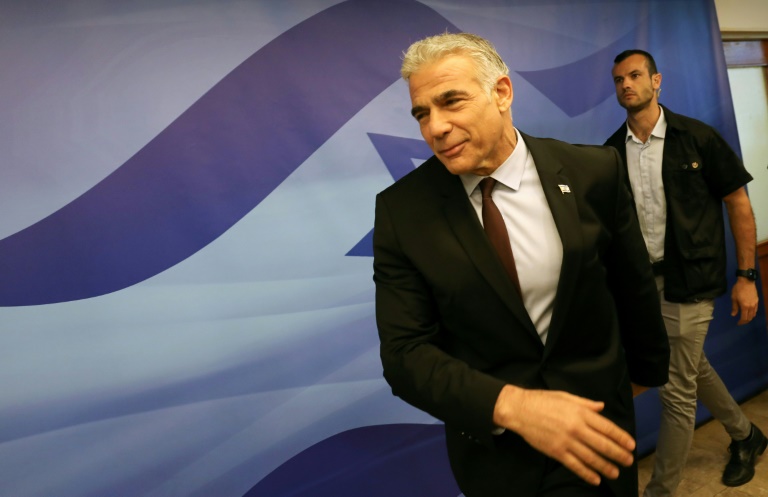
Israeli Prime Minister Yair Lapid makes his first foreign trip as premier on Tuesday to Paris, where he will ask President Emmanuel Macron to intervene in a gas dispute with Lebanon.

Lapid took over the premiership on Friday following the collapse of Israel’s coalition government, which will see the country return to the polls in November for its fifth election in less than four years.

The nascent leader was confronted with his first test a day later, when Lebanon’s Hezbollah movement launched three drones towards an offshore gas field in the eastern Mediterranean.

“Hezbollah is continuing on the path of terrorism and is hurting Lebanon’s ability to reach an agreement on a maritime border,” Lapid said Sunday.

Lebanon rejects Israel’s claim that the Karish gas field lies within its territorial waters.

Israel and Lebanon resumed negotiations on their maritime border in 2020, though the Karish site sits outside of the disputed area and is marked as Israeli on previous United Nations maps.

The US-backed talks have been stalled by Beirut’s demand that the UN maps must be modified. 

Hezbollah’s backers Iran will also be on the agenda at the bilateral talks in Paris, as Israel stands firmly opposed to international efforts to revive a nuclear accord with Tehran.

Israeli officials fear that giving Iran sanctions relief in exchange for curbs on its nuclear programme could allow Tehran to boost funding to Hezbollah, as well as the Palestinian militant group Hamas.

– Ukraine war prompts energy deal –

Lapid’s predecessor Naftali Bennett described Israel’s arch foe Iran as an “octopus”, which reaches its tentacles across the region.

The new Israeli premier has pledged to do “whatever we must” to prevent Iran “entrenching itself on our borders” or acquiring a nuclear weapon. 

Ahead of Lapid’s arrival in Paris, a senior Israeli official said the Lebanon gas issue will be high on agenda during talks at the Elysee Palace.

“We will ask France to intervene to secure the negotiations that we want to lead until the end of the gas issues,” the official told journalists travelling with the premier.

Lapid’s Paris visit comes days ahead of US President Joe Biden travelling to Israel and the Palestinian territories, before flying to Saudi Arabia for energy talks.

Washington is seeking to stabilise the global energy market following the Russian invasion of Ukraine, which led Moscow to cut its gas supplies to some European countries.

Israel and Egypt signed a deal last month to boost gas exports to the European Union, as the bloc attempts to end its dependency on Russian energy.

“The Lebanon issue is essential and Lapid will come back to the Israeli position, according to which Hezbollah is first and foremost a threat to the future of Lebanon,” said the Israeli official, who requested anonymity.

Families' pain still raw ahead of Italy bridge trial

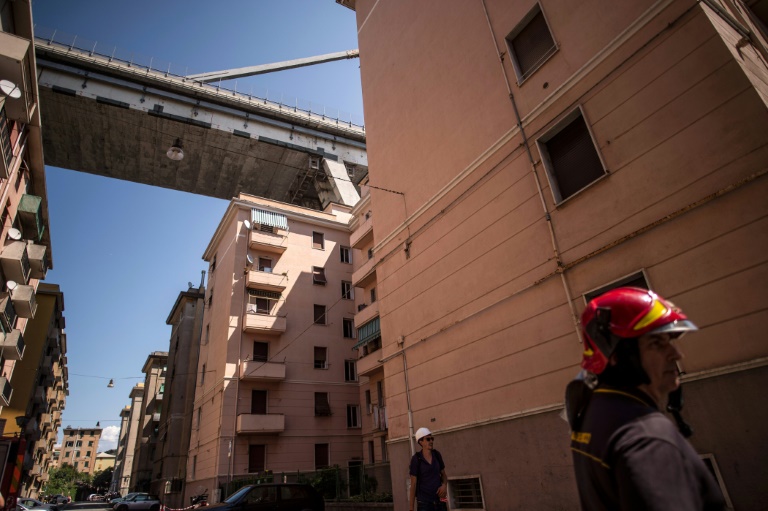
The screams of people trapped under a collapsed bridge in Genoa in 2018 still torment those who witnessed the deadly disaster, for which 59 people go on trial this week.

The Morandi highway in the northwestern Italian city gave way in torrential rain on August 14 four years ago, flinging cars and lorries into the abyss and killing 43 people.

“The sadness is unending,” Egle Possetti, who heads a committee for victims’ relatives, told AFP. Her sister Claudia died in the disaster, along with her family.

“My sister was so happy. She had married Andrea a few days before the tragedy. They had just returned from their honeymoon in the United States”, she said.

Claudia’s children, aged 16 and 12, and her new husband Andrea were in the car with her as the ground dropped beneath them.

– Screams for help –

The tragedy shone a spotlight on the state of Italy’s transport infrastructure. Autostrade per l’Italia (ASPI), which runs almost half Italy’s motorway network, is accused of failing to maintain the bridge.

ASPI belonged at the time to the Atlantia group, which is controlled by the wealthy Benetton family.

The family eventually bowed to pressure to sell its share to the state for eight billion euros ($8.4 billion).

The former head of Atlantia, Giovanni Castelluci, is among those standing in the trial which starts on Thursday.

Possetti, 57, said she was not banking on quick justice for those responsible for the disaster.

“In Italy, trials are long and unfortunately often have unfavourable outcomes for the victims,” she said.

Children play football in what will soon become a memorial park to mark the spot where pillar number nine of the old bridge collapsed.

Not far away, a footbridge dedicated to the tragedy spans the Polcevera river, into which some of the vehicles that dropped from the bridge fell and which is now bone dry due to drought.

“The cries from under the rubble of people screaming for help, the flattened cars floating there and the bodies will stay in my memory forever,” local authority head Federico Romeo told AFP.

– ‘Need for justice’ –

In the Certosa district nearby, many houses display “For Sale” signs.

“The historic shops have almost all closed” and property prices have plummeted, says Massimiliano Braibanti, who runs the neighbourhood watch scheme.

The area, which borders the site of the tragedy, was cut off for over a year due to road closures to allow the bridge to be rebuilt. It has not benefitted from the aid given to those left homeless by the collapse.

“I feel the need for justice, to know who is guilty of the deaths of my brother, nephew, sister-in-law and so many others — and that they will answer for their actions,” Giorgio Robbiano, 45, told AFP.

Robbiano’s brother Roberto had been on his way to their father’s house to celebrate his 44th birthday, along with his wife Ersilia and their eight-year-old son Samuele.

“They died because of a bridge that was never maintained, on which people were speculating to save on maintenance costs and make profits,” Robbiano said.

His father died last year.

“He never got over the pain. And sadly, he’ll never have the opportunity to look the person who killed his son and grandson in the eye”.

I.Coast eyes cassava for its bread as wheat prices surge

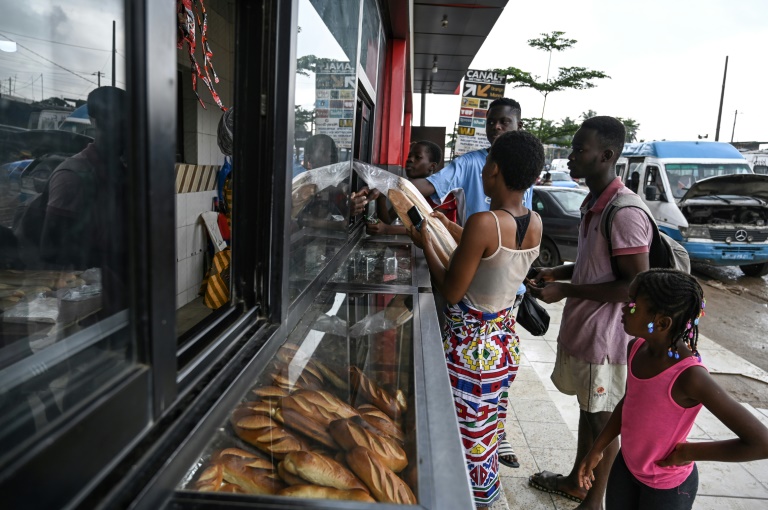
As wheat prices are driven upwards by the war in Ukraine, bakers in the West African state of Ivory Coast are starting to use locally produced cassava flour to bake bread.

The baguette, the stick of bread that is much loved in the former French colony, is commonly seen as a benchmark of the cost of living.

But Ivory Coast does not produce wheat domestically, instead importing up to a million tonnes of the grain per year, mainly from France.

Surging wheat prices have stoked concern about the impact in a country of 25 million where the average wage is less than 250,000 CFA francs ($400) per month, and which was shaken by a wave of violence less than two years ago.

Both Ukraine and Russia are large wheat producers, and lost harvests and other uncertainties have driven up prices of the global staple.

In response, Ivorian authorities have pegged the price of a baguette at between 150 and 200 CFA francs ($0.25 and $0.30) depending on weight, channelling subsidies worth 6.4 billion CFA francs (about $10 million) to the country’s 2,500 bakeries. 

Bakers, with the government’s support, are also starting to substitute a small portion of wheat flour with flour from cassava, a root vegetable.

Cassava, also called manioc, is Ivory Coast’s second largest crop after yam, with 6.4 million tonnes produced each year.

– ‘New flavours’ –

The cassava substitution plan ticks the boxes for economy and sustainability. But what do Ivorians think?

“Everything has become expensive in the market,” said Honorine Kouamee, a food vendor in Abidjan’s Blockhaus district who was cooking pancakes made of wheat mixed with coconut flour. 

“If we can make bread with local cassava flour it will be better. People are willing to eat local products.”

The national consumers’ confederation has thrown its support behind the cassava substitute.

“It will provide a stimulus for manioc producers and maintain the price of bread,” said its president, Jean-Baptiste Koffi.

But image and taste are important and some bakers are cautious.

“It’s not a done deal,” said Rene Diby, a baker.  

“For Ivorians, bread made with cassava is associated with poor-quality bread. Consumers will have to be made aware of these new flavours.”

The authorities will have to run a promotional campaign, he said.

Cassava is high in starch and is a good source of dietary fibre.

But high proportions of cassava flour lower the mineral and protein content in bread, compared with traditional wheat, a 2014 study in Nigeria found.

Financially, even using just a small portion of cassava flour would provide the government with some relief.

Last year, 10 percent of the national budget of around $16 billion was spent on food imports, despite the country’s fertile soil.

Ranie-Didice Bah Kone, executive secretary of the state-run National Council for the Fight against the High Cost of Living (CNLCV), says it is time to unlock Ivory Coast’s rch agricultural potential. 

“It’s a question of thinking long term, about our food security, it’s a question of thinking about how Ivory Coast will ensure it is less dependent on world prices,” she said.

During a visit to a cassava flour processing plant in Abidjan, she called for immediate measures to increase the supply of local flours, in addition to subsidies for the wheat sector.

– ‘Africanise baking’ –

Concerns in West Africa about dependence on imported wheat are not confined to Ivory Coast. 

On July 19, bakers from across West Africa will meet in Senegal’s capital Dakar to launch an association to lobby for setting a regional benchmark of up to 15 percent of local content in bread products.

Using local products in bread could “solve food crises,” said Marius Abe Ake, who leads a bakers’ association.

“We need to Africanise baking to help lower manufacturing costs, fight poverty and avoid damaging unrest.”

Ivory Coast has a history of turbulence.

In 2020 scores died in pre-election violence — an episode that revived traumatic memories of a brief civil conflict in 2011 in which several thousand people were killed. 

In 2008 riots broke out when the cost of rice, milk and meat soared.

I.Coast eyes cassava for its bread as wheat prices surge

As wheat prices are driven upwards by the war in Ukraine, bakers in the West African state of Ivory Coast are starting to use locally produced cassava flour to bake bread.

The baguette, the stick of bread that is much loved in the former French colony, is commonly seen as a benchmark of the cost of living.

But Ivory Coast does not produce wheat domestically, instead importing up to a million tonnes of the grain per year, mainly from France.

Surging wheat prices have stoked concern about the impact in a country of 25 million where the average wage is less than 250,000 CFA francs ($400) per month, and which was shaken by a wave of violence less than two years ago.

Both Ukraine and Russia are large wheat producers, and lost harvests and other uncertainties have driven up prices of the global staple.

In response, Ivorian authorities have pegged the price of a baguette at between 150 and 200 CFA francs ($0.25 and $0.30) depending on weight, channelling subsidies worth 6.4 billion CFA francs (about $10 million) to the country’s 2,500 bakeries. 

Bakers, with the government’s support, are also starting to substitute a small portion of wheat flour with flour from cassava, a root vegetable.

Cassava, also called manioc, is Ivory Coast’s second largest crop after yam, with 6.4 million tonnes produced each year.

– ‘New flavours’ –

The cassava substitution plan ticks the boxes for economy and sustainability. But what do Ivorians think?

“Everything has become expensive in the market,” said Honorine Kouamee, a food vendor in Abidjan’s Blockhaus district who was cooking pancakes made of wheat mixed with coconut flour. 

“If we can make bread with local cassava flour it will be better. People are willing to eat local products.”

The national consumers’ confederation has thrown its support behind the cassava substitute.

“It will provide a stimulus for manioc producers and maintain the price of bread,” said its president, Jean-Baptiste Koffi.

But image and taste are important and some bakers are cautious.

“It’s not a done deal,” said Rene Diby, a baker.  

“For Ivorians, bread made with cassava is associated with poor-quality bread. Consumers will have to be made aware of these new flavours.”

The authorities will have to run a promotional campaign, he said.

Cassava is high in starch and is a good source of dietary fibre.

But high proportions of cassava flour lower the mineral and protein content in bread, compared with traditional wheat, a 2014 study in Nigeria found.

Financially, even using just a small portion of cassava flour would provide the government with some relief.

Last year, 10 percent of the national budget of around $16 billion was spent on food imports, despite the country’s fertile soil.

Ranie-Didice Bah Kone, executive secretary of the state-run National Council for the Fight against the High Cost of Living (CNLCV), says it is time to unlock Ivory Coast’s rch agricultural potential. 

“It’s a question of thinking long term, about our food security, it’s a question of thinking about how Ivory Coast will ensure it is less dependent on world prices,” she said.

During a visit to a cassava flour processing plant in Abidjan, she called for immediate measures to increase the supply of local flours, in addition to subsidies for the wheat sector.

– ‘Africanise baking’ –

Concerns in West Africa about dependence on imported wheat are not confined to Ivory Coast. 

On July 19, bakers from across West Africa will meet in Senegal’s capital Dakar to launch an association to lobby for setting a regional benchmark of up to 15 percent of local content in bread products.

Using local products in bread could “solve food crises,” said Marius Abe Ake, who leads a bakers’ association.

“We need to Africanise baking to help lower manufacturing costs, fight poverty and avoid damaging unrest.”

Ivory Coast has a history of turbulence.

In 2020 scores died in pre-election violence — an episode that revived traumatic memories of a brief civil conflict in 2011 in which several thousand people were killed. 

In 2008 riots broke out when the cost of rice, milk and meat soared.

I.Coast eyes cassava for its bread as wheat prices surge

As wheat prices are driven upwards by the war in Ukraine, bakers in the West African state of Ivory Coast are starting to use locally produced cassava flour to bake bread.

The baguette, the stick of bread that is much loved in the former French colony, is commonly seen as a benchmark of the cost of living.

But Ivory Coast does not produce wheat domestically, instead importing up to a million tonnes of the grain per year, mainly from France.

Surging wheat prices have stoked concern about the impact in a country of 25 million where the average wage is less than 250,000 CFA francs ($400) per month, and which was shaken by a wave of violence less than two years ago.

Both Ukraine and Russia are large wheat producers, and lost harvests and other uncertainties have driven up prices of the global staple.

In response, Ivorian authorities have pegged the price of a baguette at between 150 and 200 CFA francs ($0.25 and $0.30) depending on weight, channelling subsidies worth 6.4 billion CFA francs (about $10 million) to the country’s 2,500 bakeries. 

Bakers, with the government’s support, are also starting to substitute a small portion of wheat flour with flour from cassava, a root vegetable.

Cassava, also called manioc, is Ivory Coast’s second largest crop after yam, with 6.4 million tonnes produced each year.

– ‘New flavours’ –

The cassava substitution plan ticks the boxes for economy and sustainability. But what do Ivorians think?

“Everything has become expensive in the market,” said Honorine Kouamee, a food vendor in Abidjan’s Blockhaus district who was cooking pancakes made of wheat mixed with coconut flour. 

“If we can make bread with local cassava flour it will be better. People are willing to eat local products.”

The national consumers’ confederation has thrown its support behind the cassava substitute.

“It will provide a stimulus for manioc producers and maintain the price of bread,” said its president, Jean-Baptiste Koffi.

But image and taste are important and some bakers are cautious.

“It’s not a done deal,” said Rene Diby, a baker.  

“For Ivorians, bread made with cassava is associated with poor-quality bread. Consumers will have to be made aware of these new flavours.”

The authorities will have to run a promotional campaign, he said.

Cassava is high in starch and is a good source of dietary fibre.

But high proportions of cassava flour lower the mineral and protein content in bread, compared with traditional wheat, a 2014 study in Nigeria found.

Financially, even using just a small portion of cassava flour would provide the government with some relief.

Last year, 10 percent of the national budget of around $16 billion was spent on food imports, despite the country’s fertile soil.

Ranie-Didice Bah Kone, executive secretary of the state-run National Council for the Fight against the High Cost of Living (CNLCV), says it is time to unlock Ivory Coast’s rch agricultural potential. 

“It’s a question of thinking long term, about our food security, it’s a question of thinking about how Ivory Coast will ensure it is less dependent on world prices,” she said.

During a visit to a cassava flour processing plant in Abidjan, she called for immediate measures to increase the supply of local flours, in addition to subsidies for the wheat sector.

– ‘Africanise baking’ –

Concerns in West Africa about dependence on imported wheat are not confined to Ivory Coast. 

On July 19, bakers from across West Africa will meet in Senegal’s capital Dakar to launch an association to lobby for setting a regional benchmark of setting up to 15 percent of local content in bread products.

Using local products in bread could “solve food crises,” said Marius Abe Ake, who leads a bakers’ association.

“We need to Africanise baking to help lower manufacturing costs, fight poverty and avoid damaging unrest.”

Ivory Coast has a history of turbulence.

In 2020 scores died in pre-election violence — an episode that revived traumatic memories of a brief civil conflict in 2011 in which several thousand people were killed. 

In 2008 riots broke out when the cost of rice, milk and meat soared.

Tunisia struggles to grow more wheat as Ukraine war bites

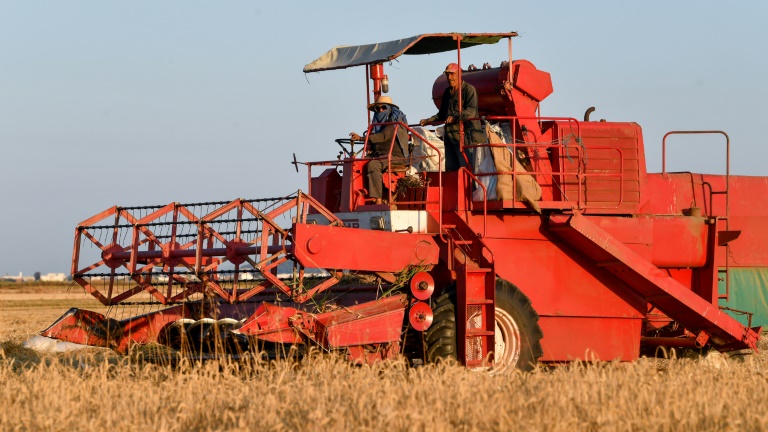
Tunisian farmer Mondher Mathali surveys a sea of swaying golden wheat and revs his combine harvester, a rumbling beast from 1976 which he fears could break down at any moment.

Since the Ukraine war sent global cereal prices soaring, import-dependent Tunisia has announced a push to grow all its own durum wheat, the basis for local staples like couscous and pasta.

The small North African country, like its neighbours, is desperate to prevent food shortages and social unrest — but for farmers on the sun-baked plains north of Tunis, even the basics are problematic.

“I’d love to buy a new combine harvester, but I could only do it with help from the government,” said Mathali, 65.

He reckons his outdated machine wastes almost a third of the crop. With spare parts hard to find, he fears a breakdown could cost him his entire harvest.

But even a second-hand replacement would cost him an unimaginable sum: $150,000.

“Our production and even the quality would go up by maybe 50 percent, even 90 percent” with government help, he said.

“But our situation is getting worse and the state isn’t helping us.”  

– ‘No continuity’ –

Tunisia’s wheat production has suffered from years of drought and a decade of political instability, with 10 governments since the country’s 2011 revolution.

That has exacerbated its reliance on imports. Last year, it bought almost two-thirds of its cereal from overseas, much of it from the Black Sea region.

Those supply chains have been rocked first by the coronavirus pandemic and then by the war in Ukraine, which last year provided around half of Tunisia’s imports of the soft wheat used in bread.

While it still plans to import soft wheat, the country is pushing for self-sufficiency in durum wheat by the 2023 harvest. 

That would be a valuable contribution to the national diet: the average Tunisian eats 17 kilograms (37 pounds) of pasta per year, second only to Italians.

In April, the government unveiled a programme to help farmers access better seeds, technical assistance and state-backed loans.

It also plans to devote 30 percent more farmland to wheat, and has dramatically boosted the prices it pays growers.

But the agriculture ministry’s chief of staff acknowledged Mathali’s problems.

“Tunisia has about 3,000 combine harvesters, 80 percent of which are old and very wasteful, which represents a major loss,” said Faten Khamassi. 

She said the state plans to fund farmers’ collectives to buy shared equipment.

– ‘Need to choose’ –

Agricultural technician Saida Beldi, who has worked with farmers in the northern Ariana governorate for three decades, says political instability has gutted the sector.

With each new minister, “the policy changes”, she said. “There’s no continuity.” 

She said many farmers struggled to obtain state-subsidised fertilisers, which trade on the black market at inflated prices.

Khamassi said it was “certainly possible to reach self-sufficiency in durum wheat”.

But she said Tunisia faces another dilemma: “develop cereal production to reach self-sufficiency, or develop other crops like strawberries and tomatoes for export? We need to choose.”

International organisations have long pushed poorer countries to focus on specific cash crops for export, rather than growing essentials.

A 2014 World Bank report argued that Tunisia “does not have a strong comparative advantage in cereals” and should instead focus on “labour intensive” crops because of cheap labour.

But in June, announcing a $130 million loan for emergency cereal imports, the lender said it was providing “incentives to sustainably increase domestic grain production” and cut import dependency.

Today, Khamassi said, comparative advantage is “no longer relevant”.

“We need to return to much more self-sufficient policies, local production,” she said.

– Changing times –

The ministry also said in June that it would allow foreign investors to own agricultural firms outright, instead of requiring at least one-third Tunisian ownership.

Khamassi said this would attract investment and create jobs.

But economist Fadhel Kaboub said this strategy would make Tunisia even more vulnerable.

“Small-scale Tunisian farmers operating on small plots of land will not be able to compete with big foreign investors with access to cheap loans from European banks,” he said. 

“These companies’ business model is to push for cash crops for export, to earn dollars and euros — not to produce wheat to sell for dinars in the local market.”

For farmer Mathali, who hopes to pass his business on to his son, the stakes couldn’t be higher.

“Tunisia was the Roman Empire’s main supplier of wheat,” he said, squinting under the summer sun.

“Why can’t we revive that?”

Tunisia struggles to grow more wheat as Ukraine war bites

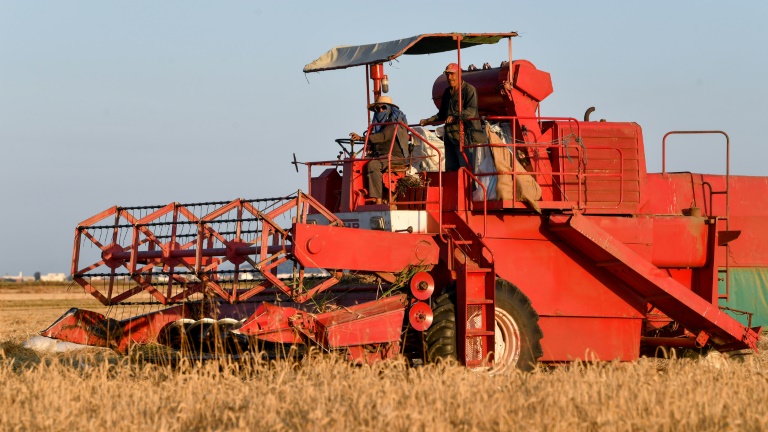
Tunisian farmer Mondher Mathali surveys a sea of swaying golden wheat and revs his combine harvester, a rumbling beast from 1976 which he fears could break down at any moment.

Since the Ukraine war sent global cereal prices soaring, import-dependent Tunisia has announced a push to grow all its own durum wheat, the basis for local staples like couscous and pasta.

The small North African country, like its neighbours, is desperate to prevent food shortages and social unrest — but for farmers on the sun-baked plains north of Tunis, even the basics are problematic.

“I’d love to buy a new combine harvester, but I could only do it with help from the government,” said Mathali, 65.

He reckons his outdated machine wastes almost a third of the crop. With spare parts hard to find, he fears a breakdown could cost him his entire harvest.

But even a second-hand replacement would cost him an unimaginable sum: $150,000.

“Our production and even the quality would go up by maybe 50 percent, even 90 percent” with government help, he said.

“But our situation is getting worse and the state isn’t helping us.”  

– ‘No continuity’ –

Tunisia’s wheat production has suffered from years of drought and a decade of political instability, with 10 governments since the country’s 2011 revolution.

That has exacerbated its reliance on imports. Last year, it bought almost two-thirds of its cereal from overseas, much of it from the Black Sea region.

Those supply chains have been rocked first by the coronavirus pandemic and then by the war in Ukraine, which last year provided around half of Tunisia’s imports of the soft wheat used in bread.

While it still plans to import soft wheat, the country is pushing for self-sufficiency in durum wheat by the 2023 harvest. 

That would be a valuable contribution to the national diet: the average Tunisian eats 17 kilograms (37 pounds) of pasta per year, second only to Italians.

In April, the government unveiled a programme to help farmers access better seeds, technical assistance and state-backed loans.

It also plans to devote 30 percent more farmland to wheat, and has dramatically boosted the prices it pays growers.

But the agriculture ministry’s chief of staff acknowledged Mathali’s problems.

“Tunisia has about 3,000 combine harvesters, 80 percent of which are old and very wasteful, which represents a major loss,” said Faten Khamassi. 

She said the state plans to fund farmers’ collectives to buy shared equipment.

– ‘Need to choose’ –

Agricultural technician Saida Beldi, who has worked with farmers in the northern Ariana governorate for three decades, says political instability has gutted the sector.

With each new minister, “the policy changes”, she said. “There’s no continuity.” 

She said many farmers struggled to obtain state-subsidised fertilisers, which trade on the black market at inflated prices.

Khamassi said it was “certainly possible to reach self-sufficiency in durum wheat”.

But she said Tunisia faces another dilemma: “develop cereal production to reach self-sufficiency, or develop other crops like strawberries and tomatoes for export? We need to choose.”

International organisations have long pushed poorer countries to focus on specific cash crops for export, rather than growing essentials.

A 2014 World Bank report argued that Tunisia “does not have a strong comparative advantage in cereals” and should instead focus on “labour intensive” crops because of cheap labour.

But in June, announcing a $130 million loan for emergency cereal imports, the lender said it was providing “incentives to sustainably increase domestic grain production” and cut import dependency.

Today, Khamassi said, comparative advantage is “no longer relevant”.

“We need to return to much more self-sufficient policies, local production,” she said.

– Changing times –

The ministry also said in June that it would allow foreign investors to own agricultural firms outright, instead of requiring at least one-third Tunisian ownership.

Khamassi said this would attract investment and create jobs.

But economist Fadhel Kaboub said this strategy would make Tunisia even more vulnerable.

“Small-scale Tunisian farmers operating on small plots of land will not be able to compete with big foreign investors with access to cheap loans from European banks,” he said. 

“These companies’ business model is to push for cash crops for export, to earn dollars and euros — not to produce wheat to sell for dinars in the local market.”

For farmer Mathali, who hopes to pass his business on to his son, the stakes couldn’t be higher.

“Tunisia was the Roman Empire’s main supplier of wheat,” he said, squinting under the summer sun.

“Why can’t we revive that?”

Police arrest suspect after gunman kills six at US July 4 parade

Police arrested a suspect Monday after a mass shooting left six dead at a US Independence Day parade in a wealthy Chicago suburb, casting a dark shadow over the country’s most patriotic holiday. 

Robert Crimo, 22, was identified as a “person of interest” and became the target of a massive manhunt across the town of Highland Park in Illinois, where a rooftop gunman with a high-powered rifle turned a family-focused July 4 parade celebration into a scene of death and trauma.

Firing into the holiday crowd, the shooter caused scenes of total chaos as panicked onlookers ran for their lives, leaving behind a parade route strewn with chairs, abandoned balloons and personal belongings.

Emergency officials said around two dozen people, including children, were treated for gunshot injuries, with some in critical condition.

After a brief car chase, Crimo was taken into custody “without incident,” Highland Park police chief Lou Jogmen told reporters.

Earlier, police had warned that he was armed and “very dangerous.” 

Crimo bills himself as a musician, and goes by the online moniker “Awake the Rapper.” 

The shooting is part of a wave of gun violence plaguing the United States, where approximately 40,000 deaths a year are caused by firearms, according to the Gun Violence Archive website.

And it cast a pall over America’s Independence Day, in which towns and cities across the country hold similar parades and people — many dressed in variations on the US flag — hold barbecues, attend sports events and gather for firework displays.

In another July 4 shooting, two police officers were wounded when they came under fire during a fireworks display in Philadelphia, major US news outlets reported.

CBS News aired video taken from a high-rise building showing crowds fleeing in panic as fireworks burst in the sky. The circumstances of that shooting were not immediately known and police were not reachable Monday night. 

In Highland Park, Emily Prazak, who marched in the parade, described the mayhem.

“We were getting ready to march down the street and then all the sudden waves of these people started running after, like running towards us. And right before that happened, we heard the pop, pop, pop, pop, pop, and I thought it was fireworks,” Prazak told AFP.

She added: “This is the day that we celebrate our country. This is also a day that our freedom got stolen from us — because many of us residents here, in this building even, we’re all locked down.”

– Spectators ‘targeted’ –

Don Johnson, who attended the parade, said he initially thought the gunshots were a car backfiring.

“And finally, I heard the screams from a block down and people running and carrying their kids and everything, and we ran into the gas station, and we were in there for three hours,” he told AFP.

“I’ve seen scenes like this over and over again on the TV and in different communities, and didn’t think it was going to happen here ever,” he said.

Police officials said the shooting began at 10:14 am, when the parade was approximately three-quarters of the way through.

“It sounds like spectators were targeted… So, very random, very intentional and very sad,” said Lake County Major Crime Task Force spokesman Christopher Covelli.

Five of the six people killed, all adults, died at the scene. The sixth was taken to the hospital but succumbed to wounds there.

Dr Brigham Temple of Highland Park Hospital, where most of the victims were taken, said it had received 25 people with gunshot wounds aged eight to 85.

“Four or five” children were among them, he said, and that 16 people were later discharged.

Police said the shooter used a “high-powered rifle,” and “firearm evidence” had been located on the rooftop of a nearby business.

“All indications is he was discreet, he was very difficult to see,” said Covelli.

US media reported that Crimo’s online postings included violent content that alluded to guns and shootings. His YouTube and other social media accounts were not viewable Monday night.

One YouTube video posted eight months ago features images of a young man in a bedroom and a classroom along with cartoons of a gunman and people being shot, the Chicago Tribune reported.

A voice-over says “I need to just do it.”

It adds: “It is my destiny. Everything has led up to this. Nothing can stop me, not even myself,” the newspaper said.

– 309 mass shootings so far –

President Joe Biden voiced his shock and vowed to keep fighting “the epidemic of gun violence” sweeping the country. 

“I’m not going to give up,” he said.

Last week, Biden signed the first significant federal bill on gun safety in decades, just days after the Supreme Court ruled that Americans have a fundamental right to carry a handgun in public.

The deeply divisive debate over gun control was reignited by two massacres in May that saw 10 Black supermarket shoppers gunned down in upstate New York and 21 people, mostly young children, slain at an elementary school in Uvalde, Texas.

According to the Gun Violence Archive, there have been 309 mass shootings carried out in the US so far in 2022 — including at least three others on July 4, though without any fatalities.

Close Bitnami banner
Bitnami