World

Ecuador government, Indigenous leaders sign deal to end protests

Thousands of Indigenous protesters left the Ecuadoran capital of Quito Thursday evening after their leaders and the government signed a deal that would cut fuel prices and end their cost-of-living demonstrations that largely paralyzed the country for 18 straight days.

The agreement, mediated by the Catholic Church and signed in Quito, provides for a five-cent-per-gallon reduction in the price of diesel and gasoline on top of a 10-cent cut already conceded by the government.

“Very likely we are tired… so it’s time to go home,” protest leader Leonidas Iza told a crowd of some 4,000 demonstrators after announcing an end to the protests earlier in the day.

The Indigenous protesters funneled out of the city peacefully in buses and trucks, many of them waving Ecuadoran and Indigenous multi-color wiphala flags.

President Guillermo Lasso, for his part, said on Twitter that the parties had achieved “the supreme value to which we all aspire: peace in our country.”

Later, in a radio and television broadcast, he said it was “time to heal wounds, to overcome the division between Ecuadorians and unite in a single objective: to rebuild Ecuador.”

Fast-rising fuel prices were the catalyst for the protests called by the powerful Confederation of Indigenous Nationalities (Conaie) and marked by burning roadblocks and sometimes violent clashes with the security forces.

Five civilians and a soldier have died since the protests started on June 13, hundreds were injured on both sides, and some 150 people have been arrested.

Signed by Conaie leader Iza and government minister Francisco Jimenez, the agreement foresees further negotiations between the two sides, an end to the disruptive roadblocks erected countrywide, and the lifting of a state of emergency in four of Ecuador’s 24 provinces.

It also provides for a review of government decrees on oil exploitation and mining in Indigenous lands.

– ‘Continue the fight’ –

An estimated 14,000 Ecuadorans — most of them in Quito — took part in the mass show of discontent against deepening hardship in an economy dealt a serious blow by the coronavirus pandemic.

Thursday’s agreement provides for “the cessation of the mobilizations and the gradual return (of the demonstrators) to the territories” where they came from to join the protest.

In a statement, the UN office in Ecuador welcomed the protests’ end and indicated that guarantees of peace were essential in “addressing polarization and exclusion, and in moving towards reconciliation.”

Indigenous people make up more than a million of the South American nation’s 17.7 million inhabitants. 

The protesters called for fuel price cuts, jobs, food price controls and more public spending on healthcare and education. 

Among the concessions made, Lasso increased from $50 to $55 the monthly aid for Ecuador’s poorest inhabitants, and cancelled small loans held by rural Ecuadorans with the public bank. 

Iza vowed Thursday that “we will continue the fight” for a better life, including for a raise in the fuel subsidy for rural Indigenous people.

– $50 million per day –

Thousands of Indigenous protesters who had gathered outside the negotiations venue with makeshift shields met the news that an agreement was struck with cheers, then dispersed peacefully.

Celebratory car horns were sounded on the streets of the capital, where many workers and business owners had been exasperated by the effect of the mobilization on their lives and livelihoods.

Talks to end the protests had started on Monday but were cut short the following day after the killing of a soldier that the government blamed on protesters.

On Wednesday, the government said it would re-enter the talks, but also imposed a fresh state of emergency as violence continued to mar the uprising.

The protests have been costly, with losses of some $50 million per day to the economy, according to the government, which has warned oil production  — already halved — could come to a complete halt soon. 

Crude is the South American country’s main export, but production has been halved from the pre-protest rate of some 520,000 barrels per day, the government said.

Lasso survived an impeachment vote Tuesday brought by opposition politicians blaming him for the “serious political crisis and internal commotion” caused by the standoff.

Protest instigator Conaie is credited with unseating three presidents between 1997 and 2005.

“Only the struggle has allowed us to secure rights!” the body tweeted on Thursday.

“We have… achieved measures to alleviate the economic situation, health and education of vulnerable rural and urban families,” it added.

Poverty affects more than a quarter of Ecuadorans, according to 2021 data, and only about one in three have adequate employment in a country with a large informal job sector.


World Bank creates fund to better prevent, respond to pandemics

The World Bank’s board on Thursday approved creation of a fund meant to finance investments in strengthening the fight against pandemics.

The fund will support prevention, preparedness and response (PPR), with a focus on low- and middle-income countries, the bank said in a statement.

“The devastating human, economic, and social cost of Covid-19 has highlighted the urgent need for coordinated action to build stronger health systems and mobilize additional resources,” it said.

The World Bank added that the fund, which it aims to open later this year, was developed under the leadership of the United States, Italy and Indonesia as part of their G20 presidencies, and with broad support from the G20.

It will be used in a number of areas, including disease surveillance, with more than $1 billion in commitments already announced.

“The World Bank is the largest provider of financing for PPR with active operations in over 100 developing countries to strengthen their health systems,” World Bank President David Malpass said in the statement.

The so-called financial intermediary fund (FIF) will provide financing to “complement the work of existing institutions in supporting low- and middle-income countries and regions to prepare for the next pandemic,” the World Bank said.

The World Health Organization is a stakeholder in the project and will provide technical expertise, its president Tedros Adhanom Ghebreyesus said.

US President Joe Biden said more than 1 million Americans and millions of people around the world have lost their lives to Covid-19, underscoring the importance of boosting investment in pandemic preparedness.

“When it comes to preparing for the next pandemic, the cost of inaction is greater than the cost of action,” Biden said in a statement late Thursday. “Investing in preparedness now is the right thing and the smart thing to do.”

In a separate statement earlier in the day, US Treasury Secretary Janet Yellen called the fund “a major achievement that will help low- and middle-income countries be better prepared for the next pandemic.”

“Even as we continue to work to end Covid-19, today’s decision by World Bank shareholders will help bolster capacity to prevent, detect, and respond to future pandemics,” she said.

A spokesperson for the World Bank told AFP that if the Covid-19 pandemic is still ongoing when the fund is implemented, it could be used to provide support against the current as well as future pandemics.

World Bank creates fund to better prevent, respond to pandemics

The World Bank’s board on Thursday approved creation of a fund meant to finance investments in strengthening the fight against pandemics.

The fund will support prevention, preparedness and response (PPR), with a focus on low- and middle-income countries, the bank said in a statement.

“The devastating human, economic, and social cost of Covid-19 has highlighted the urgent need for coordinated action to build stronger health systems and mobilize additional resources,” it said.

The World Bank added that the fund, which it aims to open later this year, was developed under the leadership of the United States, Italy and Indonesia as part of their G20 presidencies, and with broad support from the G20.

It will be used in a number of areas, including disease surveillance, with more than $1 billion in commitments already announced.

“The World Bank is the largest provider of financing for PPR with active operations in over 100 developing countries to strengthen their health systems,” World Bank President David Malpass said in the statement.

The so-called financial intermediary fund (FIF) will provide financing to “complement the work of existing institutions in supporting low- and middle-income countries and regions to prepare for the next pandemic,” the World Bank said.

The World Health Organization is a stakeholder in the project and will provide technical expertise, its president Tedros Adhanom Ghebreyesus said.

US President Joe Biden said more than 1 million Americans and millions of people around the world have lost their lives to Covid-19, underscoring the importance of boosting investment in pandemic preparedness.

“When it comes to preparing for the next pandemic, the cost of inaction is greater than the cost of action,” Biden said in a statement late Thursday. “Investing in preparedness now is the right thing and the smart thing to do.”

In a separate statement earlier in the day, US Treasury Secretary Janet Yellen called the fund “a major achievement that will help low- and middle-income countries be better prepared for the next pandemic.”

“Even as we continue to work to end Covid-19, today’s decision by World Bank shareholders will help bolster capacity to prevent, detect, and respond to future pandemics,” she said.

A spokesperson for the World Bank told AFP that if the Covid-19 pandemic is still ongoing when the fund is implemented, it could be used to provide support against the current as well as future pandemics.

Asian markets struggle as traders gripped by recession fear

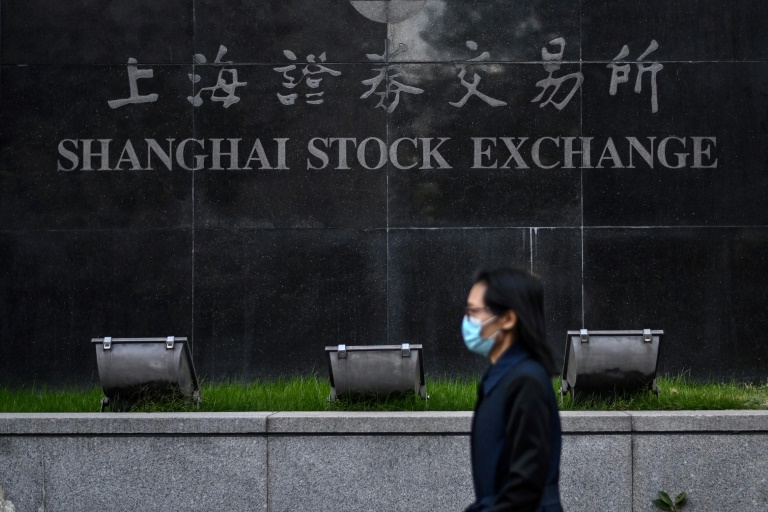
Asian markets struggled again Friday following another selloff on Wall Street fuelled by recession fears, with warnings of a bleak outlook for the global economy as central banks slam on the brakes to battle soaring inflation.

Data showing US consumers — the backbone of the world’s top economy — were growing increasingly reticent about spending dealt a fresh blow to equities Thursday, with the S&P 500 suffering its worst January-June since 1970.

With the war in Ukraine showing no sign of ending — keeping energy costs elevated — there is an expectation that borrowing costs will continue to rise and send economies into recession.

“If anyone thinks that equities can rally into the back of the year, they are making the assumption that the Fed is going to let go of its entire focus on price stability and step back from that,” Seema Shah, at Principal Global Investors, told Bloomberg Television.

“We have a very different view. We think things are going to get pretty tough.”

After a broad retreat on Thursday in Asia, markets battled to recover but with little conviction.

Tokyo, Shanghai, Seoul, Taipei and Bangkok all fell, though there were small gains in Sydney, Singapore, Manila and Jakarta.

Hong Kong was closed for a holiday.

Losses across world markets this week come after a rally last week fuelled by hopes that an economic slowdown or signs of recession would lead central banks to ease off their monetary tightening drive.

But comments from top finance chiefs, including Federal Reserve boss Jerome Powell, suggest they are willing to endure the pain of a contraction as long as they can rein in prices — which are rising at their fastest pace in 40 years.

“With central banks shifting towards accepting that monetary tightening is impossible without some economic damage, the market narrative has swung 180 degrees this week,” said SPI Asset Management’s Stephen Innes.

He added that sharp rate hikes by the Fed and other central banks were being front-loaded in the hope inflation will ease earlier and allow them to cut borrowing costs more quickly.

“The hope is that by the November midterm elections, when the economy has chilled enough, it will be possible to pause or at least significantly slow further hikes to allow investors to enjoy a Santa Claus rally; otherwise, it could be a winter of discontent,” Innes said.

However, markets strategist Louis Navellier suggested that the economy was not in as bad a shape as feared.

“The amazing thing is that we are not in an ‘earnings recession’ and the analyst community remains largely positive,” he said in a note.

“Frankly, the analyst community is smarter than the macro strategists that keep calling for a recession. The bottom line is fear sells, so negative news continues to overpower positive analyst comments.”

Oil prices ticked higher but still headed for a third successive week of losses owing to concerns that a recession will hit demand.

That has overshadowed a tight market caused by sanctions on Russia over its Ukraine invasion and an expected jump in demand from China as it emerges from its Covid lockdowns.

Innes added: “With energy bulls having a good run this year, investors seem more inclined to take money off the table in the face of growing uncertainty as the energy crisis moves onto the global recession phase.

“As the adage goes, the best cure for high prices is high prices.”

– Key figures at around 0230 GMT –

Tokyo – Nikkei 225: DOWN 0.9 percent at 26,159.53 (break)

Shanghai – Composite: DOWN percent at 3,394.99

Hong Kong – Hang Seng Index: Closed for a holiday

West Texas Intermediate: UP 0.5 percent at $106.26 per barrel

Brent North Sea crude: UP 0.6 percent at $119.66 per barrel

Dollar/yen: DOWN at 135.32 yen from 135.75 yen Thursday

Euro/dollar: DOWN at $1.0465 from $1.0487 

Pound/dollar: DOWN at $1.2144 from $1.2177

Euro/pound: UP at 86.18 pence from 86.08 pence

New York – Dow: DOWN 0.8 percent at 30,775.43 (close)

London – FTSE 100: DOWN 2.0 percent at 7,169.28 (close) 

Australian, French leaders meet to mend frayed ties

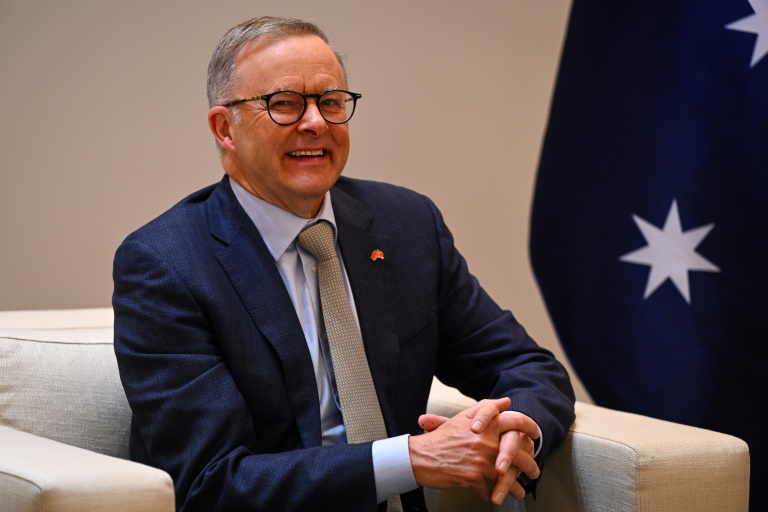
French President Emmanuel Macron will hold talks Friday in Paris with Australia’s new Prime Minister Anthony Albanese, seeking to repair ties badly damaged by the ditching of a submarine contract.

Macron and Albanese will have lunch at the Elysee Palace from 1100 GMT, the French presidency said, with talks focusing on “restoring confidence” and issues including stability in the Pacific and climate change.

It will be the first formal meeting between the Australian and French leaders since former Australian prime minister Scott Morrison ripped up in September last year a contract with France to build a dozen diesel-powered submarines.

It will also be the first face-to-face meeting between Albanese and Macron after telephone talks on May 26.

Albanese, who defeated the conservative Morrison in May elections, has made a priority of restoring Australia’s international image, particularly in the fight against climate change. 

Macron told reporters at the NATO summit in Madrid on Thursday that he was looking forward to the meeting, saying Albanese’s agenda on climate change as well as relations with China “has a lot more in common with France’s agenda… than was the case with his predecessor.”

“I approach these talks with a lot of optimism and determination, because Australia is a great partner and the situation inherited from past bad behaviour was not a good one,” he said.

The scrapping of the contract led to an unprecedented crisis between Canberra and Paris, with such bad blood that outgoing foreign minister Jean-Yves Le Drian applauded Morrison’s election loss to Albanese, saying it “suits me fine.”

Morrison’s actions were marked by “brutality and cynicism, and I would even be tempted to say of unequivocal incompetence”, Le Drian said as he handed over to his successor Catherine Colonna on May 21.

– ‘A big advantage’ –

The switch by Canberra came as it entered a new security pact with Britain and the United States, which will now supply Australia with nuclear-powered subs.

Macron recalled France’s envoys to both Australia and the US over the furore.

France was particularly ruffled because it considers itself to be a key Pacific power thanks to overseas territories including New Caledonia and French Polynesia.

It was also stung as Macron had hosted Morrison at the Elysee in June 2021, just months before the stunning about-turn, with French officials saying they were given no inkling even in private of what was to come. 

Albanese announced in early June that French submarine maker Naval Group had agreed to a “fair and an equitable settlement” of 555 million euros (US$584 million) for Australia’s ending the decade-old, multibillion-dollar submarine contract. 

“It is important that that reset occur,” Albanese told national broadcaster ABC in an interview on June 24. “France, of course, is central to power in Europe but it’s also a key power in the Pacific.”

Morrison’s predecessor as premier, Malcolm Turnbull, said the visit was a “big opportunity” to help Paris and Canberra get over a “very bad period” when the French government did not even “pick up the phone.”

Albanese “is not Scott Morrison, so that’s a big advantage”, he told French journalists at an event organised by the Institut Montaigne in Paris.

California passes sweeping law to reduce non-recyclable plastic

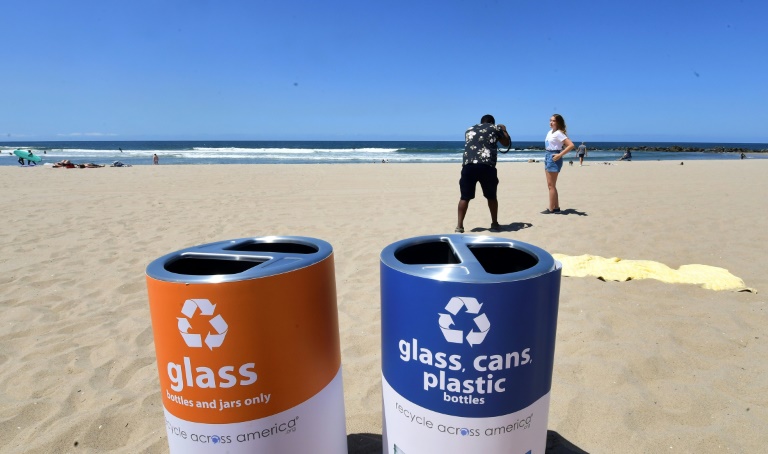
Garbage be gone: California Thursday passed an ambitious law mandating reduction of non-recyclable plastic by at least 30 percent in six years, while also placing responsibility on producers.

The measure is meant to tackle the persistent problem of plastic refuse — in California, about 85 percent of plastic waste ends up in landfills, according to the CalMatters publication.

“California won’t tolerate plastic waste that’s filling our waterways and making it harder to breathe. We’re holding polluters responsible and cutting plastics at the source,” Governor Gavin Newsom said after he signed the law Thursday.

Earlier in the day the bill had passed the state Senate unanimously and had passed the Assembly the day before.

The measure mandates that at least 30 percent of plastic packaging in the state be recyclable by January 1, 2028, and raises the amount to 65 percent by 2032.

It also requires a 25 percent reduction in non-recyclable expanded polystyrene, colloquially known as styrofoam, in three years, with a total ban to go in place if this goal is not met.

Single-use plastic containers, meanwhile, must decrease by 25 percent by 2032.

“This is the most comprehensive plastic waste reduction legislation in the nation,” The Nature Conservancy environmental nonprofit said.

The law, officially titled SB54, shifts the onus of responsibility for the plastic waste from users to producers, a move applauded by environmental organizations.

It clearly states that companies that do not comply with the measures will be fined up to $50,000 per day.

“Reducing plastic pollution at the source will cut emissions to air & water and reduce plastic that gets in our ocean,” tweeted the Oceana nonprofit.

“Countless hours of work have led to this moment,” state senator and bill author Ben Allen tweeted following his chamber’s vote.

“It’s time for California to lead the nation and world in curbing the plastic crisis. Our planet cannot wait.”

Nine anti-coup protesters killed in Sudan mass rallies

At least nine Sudanese demonstrators were killed Thursday as security forces sought to quash mass rallies of protesters demanding an end to military rule, pro-democracy medics said.

In one of the most violent days this year in an ongoing crackdown on the anti-coup movement, AFP correspondents reported security forces firing tear gas and stun grenades to disperse tens of thousands of protesters.

“Even if we die, the military will not rule us,” protesters chanted, urging the reversal of an October military coup by army chief Abdel Fattah al-Burhan that prompted foreign governments to slash aid, deepening a chronic economic crisis.

At least seven of the nine killed were shot in the chest or the head, the Central Committee of Sudan Doctors said, raising the overall death toll to 111 from protest-related violence since October.

One of them was a minor, the doctors said, killed by “a bullet in the chest”.

“Down with Burhan’s rule,” crowds chanted, with protests and violence flaring in both the capital Khartoum and its suburbs, including the twin city of Omdurman, on the other side of the Nile river.

Security forces fired powerful water cannons, as protesters set fire to tyres.

Medics also reported “several attempts to storm hospitals in Khartoum,” with security forces firing tear gas into one hospital, where some of those injured during the protests had been taken.

Protests in Khartoum were larger than normal, and beyond the capital, demonstrations also took place in Wad Madani in the south, the western Darfur region, the eastern states of Kassala and Gedaref as well as the city of Port Sudan, witnesses said.

Internet and phone lines had been disrupted since the early hours of Thursday, a measure the Sudanese authorities often impose to prevent mass gatherings.

By Thursday evening, communications were partially restored.

Security was tight in Khartoum despite the recent lifting of a state of emergency imposed after the coup.

Troops and police blocked roads leading to both army headquarters and the presidential palace, witnesses said. Shops around the capital were largely shuttered.

– ‘Violence needs to end’ –

Demonstrations continued in Omdurman as night fell with crowds trying to remove security barricades in a bid to cross bridges to reach Khartoum, witnesses said.

Thursday’s rallies showed a “change in the balance of power in favour of the mass movement and its goals of seizing complete civil authority and defeating the coup,” said the Forces for Freedom and Change, an alliance of civilian groups whose leaders were ousted in the coup.

UN special representative Volker Perthes said Thursday that “violence needs to end”, while the US embassy in Khartoum urged restraint and “the protection of civilians so that no more lives are lost”.

The latest protests come on the anniversary of a previous coup in 1989, that toppled the country’s last elected civilian government and ushered in three decades of iron-fisted rule by Islamist-backed General Omar al-Bashir.

It is also the anniversary of 2019 protests demanding that the generals, who had ousted Bashir in a palace coup earlier that year, cede power to civilians.

Those protests led to the formation of the mixed civilian-military transitional government which was toppled in last year’s coup.

Sudan has been roiled by near-weekly protests as the country’s economic woes have deepened since Burhan seized power last year.

Alongside the African Union and regional bloc IGAD, the United Nations has been attempting to facilitate talks between the generals and civilians, but they have been boycotted by the main civilian factions.

The UN has warned that the deepening economic and political crisis has pushed one-third of the country’s population of more than 40 million towards life-threatening food shortages.

Argentina's black market dollar trade: illegal but part of life

It is hard to come by but ever-present on the mind of average Argentines: the US dollar, whose value relative to the feeble peso is a barometer for an economy in crisis.

“Dollars! Change, change, doooolars!” The cries of unofficial money changers follow tourists, but also locals, down the streets of central Buenos Aires’ office district.

It is illegal, but part of life: These “arbolitos” (“small trees,” after the “green leaves” they sprout) offer a black market rate about double the official one. 

“It is a service to the community… part of the normalcy of the country,” one arbolito told AFP on condition of anonymity.

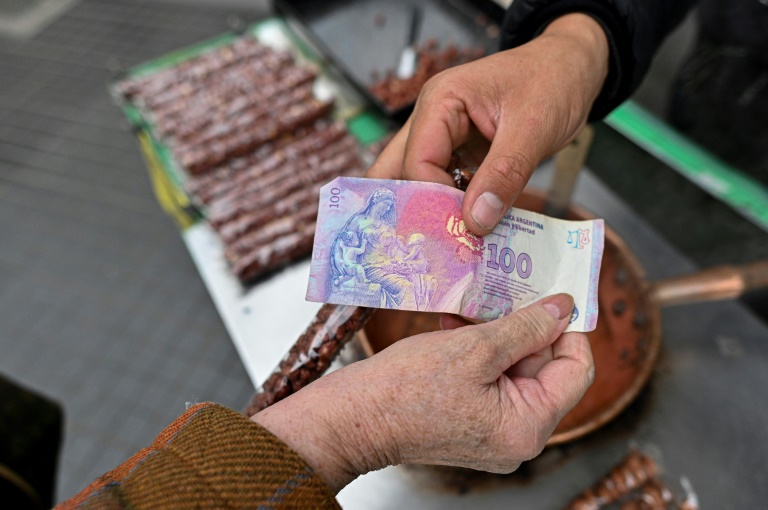
These days one dollar gets its bearer about 236 pesos at the unofficial or “blue rate,” instead of 130 at an official currency exchange. 

A year ago, the blue rate was 170 pesos to the official rate of 95.

The peso is Argentina’s official currency, but its high volatility means that dollar prices are quoted for big-ticket items from buying property or a car to renting an apartment or getting an expensive medical procedure.

To prevent a hemorrhage of foreign exchange reserves and stabilize the peso, Argentines have been prohibited by law since 2019 from buying more than $200 in greenback per month.

This, of course, fuels demand, and Argentines — also distrustful of savings accounts — hoard as much of the US currency as they can afford to buy on the streets.

Goods vendor Marcela Leiron said that “like an ant” collects food, she buys dollars, “from $20 to $50 per month, as much as I can.”

The 56-year-old told AFP she has resigned herself to living in dollar dependence “because of the economic mess that no government can fix.”

The black market trade, in turn, further fuels inflation which reached 60.7 percent for the year to May — one of the highest rates in the world.

– Always buy, never sell –

People like Leiron are so desperate for dollars that they pay to change pesos even knowing that they will have to change them back again later to pay for certain goods or services.

“In bi-monetary societies like Argentina, where the dollar is the reference and… reserve of value, people save in dollars,” said economist Andres Wainer of the Latin American Faculty of Social Sciences.

It is a double-edged sword: People might wish for a strong dollar as it means their savings are worth more, but to the detriment of Argentina’s own economy.

In 2021, economist Nicolas Gadano — a former Central Bank director — estimated that Argentines held about $200 billion in banknotes — 10 percent of all the dollars in circulation in the world and a fifth of those outside the United States.

In Buenos Aires, cafes and shops display the rate at which they give change for clients paying in dollars.

The signs are aimed at tourists, because every Argentine knows never to relinquish dollars in hand.

“The trick is to buy, always buy dollars!” said Marcela, who thinks and counts in greenback and has no idea how much her rent is in pesos.

“The Argentine saves in dollars and when a crisis hits, he sells. He will never regain confidence in the peso,” another arbolito told AFP.

The currency has lost 43 percent of its value to the dollar, at the official rate, over the last two years.

– ‘Fewer dollars’ –

“As long as there is this inflation, it is obvious to operate in dollars. We do not have a strong currency and controlled inflation,” Alejandro Bennazar, president of the Argentine Real Estate Chamber, told AFP. 

Despite the government’s attempts to prevent a dollar flight, gross foreign reserves dropped from $41.5 billion at the end of May — about the same level as a year earlier — to $38.1 billion this week.

In recent days, the Central Bank announced measures to limit certain imports to further protect foreign reserves amid a fast rise in food and fuel prices partly due to the war in Ukraine.

Sociologist Mariana Luzzi, author of a book on the topic, said the dollar was for all Argentines, regardless of social class, “a key to interpret the movements of the economy and politics of the country.”

“We Argentines know very well that if the dollar rises, it announces difficulties: This will result in price increases, but more profoundly, it means that something important is happening in the economy that the government cannot control.” 

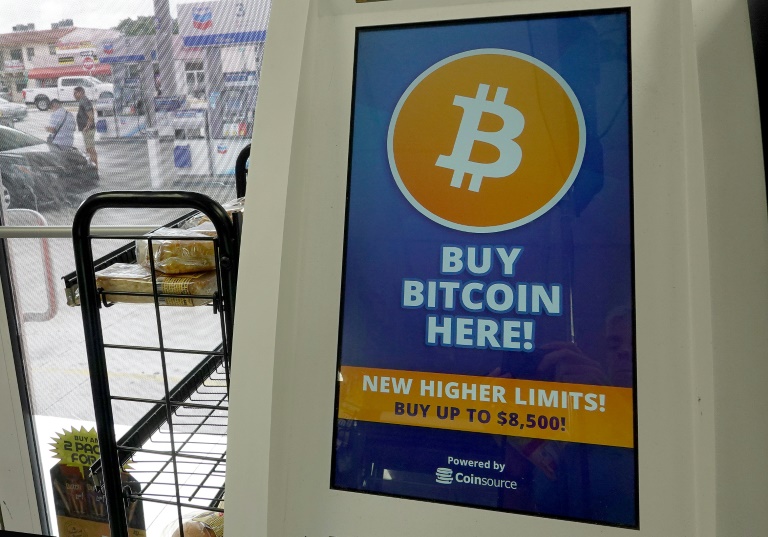
Crypto lending world sways under risk and turmoil

Starting with the lofty goal of competing with traditional banks, cryptocurrency lending giants and their clients now face financial ruin due to their appetite for risk and a paucity of regulatory guardrails.

Celsius Network, which suspended withdrawals in mid-June, had advertised a seemingly difficult-to-reconcile mix of interest rates, charging just 0.1 percent for loans, but paying more than 18 percent on deposits.  

Weeks later, savings accounts, that amounted to $11.8 billion in mid-May, remained frozen.

“Celsius is going bankrupt one way or another,” said Omid Malekan, a professor at Columbia University. “Even if they recoup 98 cents on the dollar for their depositors, no one would ever want to use it.” 

Since then, other operators have faced a similar fate, from CoinFlex to Babel Finance, which also tried their hand at lending and had to freeze withdrawals, while Voyager Digital had to limit them.

These platforms allowed clients to deposit cryptocurrencies, and either receive interest or borrow digital money by using their savings as collateral. 

“It’s a real shame things got to this point,” said one Celsius user contacted on the Reddit platform, who claimed to have over $350,000 tied up on with the lender.

“Clearly Celsius should have planned for this kind of scenario,” the user added, speaking on condition of anonymity.

The devastating sequence started with the sharp decline of cryptocurrencies, including bitcoin which lost nearly 60 percent of its value in the past six months.

The plummeting value — which dropped as global inflation accelerated and Russia’s invasion of Ukraine rattled the world economy — led to a chain reaction and forced borrowers to provide new financial guarantees or immediately repay loans.

Some borrowers, such as the Singaporean investment firm Three Arrows Capital which is now in liquidation, could not provide the creditors enough cash to cover withdrawals and froze client accounts.

“The majority of these companies had provided uncollateralized or undercollateralized loans,” said Antoni Trenchev, co-founder of Nexo, another crypto platform that he said avoided trouble by following a stricter lending policy and “prudent risk management.” 

Unlike banks, these lenders were not required to hold cash in reserve against bad loans.

– ‘Deep need for regulation’ –

A handful US states have opened or expanded investigations into Celsius, and some, including Alabama, last year ordered the platform to stop lending to their residents.

“I do expect there to be a very strong crackdown across the board,” Malekan said. “There’s a lot of fodder there for governments to go after.”

Despite the turbulence, most observers expect cryptocurrencies to recover from the current lending trouble and don’t believe this spells an end for loans in the sector. 

“It’s not the worst crisis crypto has had,” said Charles Jansen at S&P Global Ratings. 

Malekan said the situation offers an opportunity to weed out weaker firms.

“During a bear market, you learn which were the projects that have a core value proposition and solve an actual problem, versus which are the ones that were just a pipe dream.”

Some, like Trenchev, expect a major consolidation in the sector with healthy operators gobbling up those that are struggling.

The episode also has raised awareness of the risks of a lack of government oversight. 

“There is a deep need for regulation, which is something that everybody in the field agrees on,” said Jansen, whose company is vying to be recognized as risk assessor in the crypto world.

In the absence of a specific regulatory framework market watchdog, the Securities and Exchange Commission, has been taking the lead but largely with punitive steps.

Several bills have been introduced in the US Congress in recent months that aim to address the need for closer oversight, but a bipartisan Senate proposal from Republican Cynthia Lummis and Democrat Kirsten Gillibrand has been gaining momentum. 

The bill has been well received by the crypto community, especially because it empowers the sector’s preferred regulator, the Commodity Futures Trading Commission, over the SEC. 

Some critics see the proposal as too accommodating. 

“It’s bipartisan in the sense that senators from different parties are giving the crypto industry pretty much what it wants,” tweeted Hilary Allen, a professor at American University’s Washington College of Law. 

“It gives most jurisdiction over crypto assets to the CFTC, which has no investor protection mandate and far fewer resources than the SEC,” she added. 

Flight trouble: Strained US airlines face July 4 test

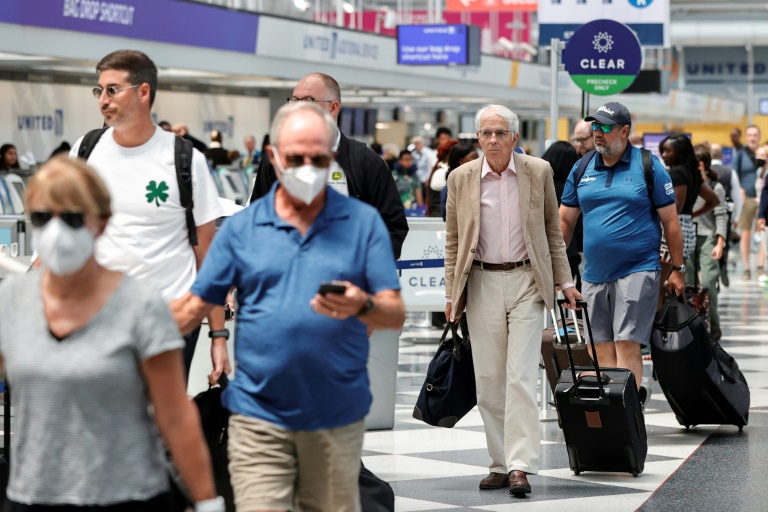
US airlines are bracing customers for what will probably be another bumpy holiday weekend as the industry struggles to manage a surge in travel demand that probably exceeds its current capacity.  

Yu Su, a computer science professor at Ohio State University, was stranded last Saturday night in Charlotte, North Carolina after his connecting flight home never left. 

The airline didn’t cancel the 8:30 pm flight until around midnight after numerous delays that created “the delusion of hope,” said Yu, who never got a clear explanation for the problem.

Such horror stories are common these days, sparking headlines that warn of airport chaos over the July 4th weekend and drawing scrutiny from Transportation Secretary Pete Buttigieg and others in Washington. 

In recent days, plane tracking sites have reported hundreds of flight cancelations and thousands of delays.

In an effort to steer passengers away from “potentially challenging weekend travel days,” Delta Air Lines announced Tuesday it would waive change fees for customers to shift one leg of their trip to within the July 1-8 period.

– Pilot shortage –

Although federal Covid-19 relief aid meant airlines didn’t need to lay off staff, tens of thousands of workers left the industry after carriers urged early retirements.

Today’s industry has about 15 percent less staff compared with the pre-pandemic period to handle about 90 percent of pre-2020 passenger volume, estimated analysts at Third Bridge, a consultancy.

Lack of crew was the problem for Crystal Fricker’s latest flight, which was canceled an hour before she and two other travelers were scheduled to depart Raleigh, North Carolina for Indianapolis. 

Unable to find different flights for all three, the group managed to track down a rental car — no small feat — and drove 10 1/2 hours, arriving at 1 am in time for meetings the next day.

“Pretty much every flight I’ve been on has had some kind of delay,” said Fricker, president of Pure Seed, an Oregon seed company.

Pilots are the most acute issue in a broad airline industry labor crunch, said Third Bridge analyst Peter McNally.

“There’s no short-term fix,” McNally told AFP. “The issue becomes most pronounced during these seasonal peaks.”

Airlines say they’re working to address the issue, recruiting pilots and other staff and trimming summer capacity by 15 percent compared with earlier plans.

While acknowledging the pilot supply problem, airline industry officials point to other exacerbating factors, including turbulent weather, increased staff absences due to Covid and insufficient personnel at flight traffic control at some key sites.

– Blame game? –

“The industry is actively and nimbly doing everything possible to create a positive customer experience,” said Airlines for America CEO Nicholas Calio in a follow-up letter to Buttigieg after a meeting earlier this month.

“Not every air traffic variable is within an airline’s control.” 

But the Federal Aviation Administration pushed back, saying it “acted on the agency staffing issues raised by airlines” by adding more controllers in high demand areas.

“People expect when they buy an airline ticket that they’ll get where they need to go safely, efficiently, reliably and affordably,” the agency said. “After receiving $54 billion in pandemic relief to help save the airlines from mass layoffs and bankruptcy, the American people deserve to have their expectations met.”

Senator Bernie Sanders, the Vermont progressive, called on Buttigieg to fine the airlines for delayed or canceled flights, blasting the industry for the messy travel season and “outrageously high” fares.

Airlines, meanwhile, are trying to reset expectations for customers.

In a message to frequent fliers Thursday, Delta Chief Executive Ed Bastian acknowledged “unacceptable” levels of disruption, but said additional hiring efforts and adding more buffer time for crews should help.

“Things won’t change overnight, but we’re on a path towards a steady recovery,” Bastian said.

United Airlines expects nearly 5.2 million customers over the Fourth of July period, a 24 percent increase from 2021 and 92 percent of its 2019 level.

“We anticipate the Fourth of July travel period to be amongst our busiest travel days of 2022 thus far,” said a United spokesperson.

United earlier this month announced it was trimming about 50 daily flights from its Newark, New Jersey hub. 

A company memo cited “many factors including airport construction,” adding that United had sufficient staff to meet the schedule.

Like United and Delta, American Airlines is midway through a recruitment campaign of pilots and other staff. The company has hired 800 new pilots this year, Chief Executive Robert Isom said earlier this month.

The company’s regional carrier, Envoy Air, is offering pilots triple pay for trips next month in an effort to avoid disruption, according to reports.

American Airlines did not respond to AFP questions about the upcoming July 4th weekend.

Close Bitnami banner
Bitnami