World

Horseshoe crabs: 'Living fossils' vital for vaccine safety

On a bright moonlit night, a team of scientists and volunteers head out to a protected beach along the Delaware Bay to survey horseshoe crabs that spawn in their millions along the US East Coast from late spring to early summer.

The group make their way up the shoreline laying a measuring frame on the sand, counting the individuals inside it to help generate a population estimate, and setting right those unfortunate enough to have been flipped onto their backs by the high tide.

With their helmet-like shells, tails that resemble spikes and five pairs of legs connected to their mouths, horseshoe crabs, or Limulidae, aren’t immediately endearing.

But if you’ve ever had a vaccine in your life, you have these weird sea animals to thank: their bright blue blood, which clots in the presence of harmful bacterial components called endotoxins, has been essential for testing the safety of biomedical products since the 1970s, when it replaced rabbit testing.

“They’re really easy to love, once you understand them,” Laurel Sullivan, who works for the state government to educate members of the public about the invertebrates, tells AFP.

“They’re not threatening at all. They’re just going about their day, trying to make more horseshoe crabs.”

For 450 million years, these otherworldly creatures have patrolled the planet’s oceans, while dinosaurs arose and went extinct, and early fish transitioned to the land animals that would eventually give rise to humans.

Now, though, the “living fossils” are listed as vulnerable in America and endangered in Asia, as a result of habitat loss and overharvesting for use in food, bait, and the pharmaceutical industry, which is on a major growth path, especially in the wake of the Covid pandemic.

Recruiting citizen scientists helps engage the public while also scaling up the government’s data collection efforts, explains the survey project’s environment scientist Taylor Beck.

– Vital ecological role- 

“Crabs” are something of a misnomer for the animals, which are in fact more closely related to spiders and scorpions, and are made up of four subspecies: one that inhabits the Eastern and Gulf coasts of North America, and the other three in Southeast Asia.

Atlantic horseshoe crabs have 10 eyes and feed by crushing up food, such as worms and clams, between their legs then passing the food to their mouths.

Males are noticeably smaller than females, whom they swarm in groups of up to 15 when breeding. Males grasp females as they head to shore, where the females deposit golf ball-size clusters of 5,000 eggs for the males to spray their sperm on.

Millions of these eggs, tiny green balls, are inadvertently churned up onto the beach surface, where they are a vital food source for migrating shorebirds, including the near-threatened Red Knot.

Nivette Perez-Perez, manager of community science at the Delaware Center for the Inland Bays, points out a vast band of eggs that stretch nearly the whole beach at the James Farm Ecological Preserve.

As she gestures, aptly-named laughing gulls with bright orange beaks swoop down to feast. 

Like others in the area, Perez-Perez long ago succumbed to the crabs’ charms. 

“You’re so cute,” she tells a female she has picked up to point out its anatomical features.

– Just flip ’em –


Breeding is a dangerous business for horseshoe crabs as it’s on the beach that they are at their most vulnerable: as the tide washes in, some end up on their backs, and while their long hard tails can help some right themselves, not all are so lucky. 

Around 10 percent of the population is lost each year  as their exposed undersides bake in the Sun.

In 1998, Glenn Gauvry, founder of the Ecological Research & Development Group, helped start the “Just flip ’em” campaign, encouraging members of the public to do their part by gently picking up upturned crabs that are still alive.

“Where it matters most of all, is changing the heart,” he tells AFP on Delaware Bay’s Pickering Beach, proudly sporting a “Just flip ’em” baseball cap festooned with horseshoe crab pins.

“If we can’t get people to care and to connect to these animals, then they’re less likely to want legislation to protect them.”

Every year around 500,000 horseshoe crabs are harvested and bled for a chemical called Limulus Amebocyte Lysate, vital for testing against a type of bacteria that can contaminate medications, needles and devices like hip replacements.

Estimates place the mortality rate of the process at 15 percent, with survivors released back to sea.

A new synthetic alternative called recombinant factor C appears promising, but faces regulatory challenges. 

Horseshoe crabs are a “finite source with a potentially infinite demand, and those two things are mutually exclusive,” Allen Burgenson, of Swiss biotech Lonza, which makes the new test, told AFP.  
Erdogan warns Turkey may still block Nordic NATO drive

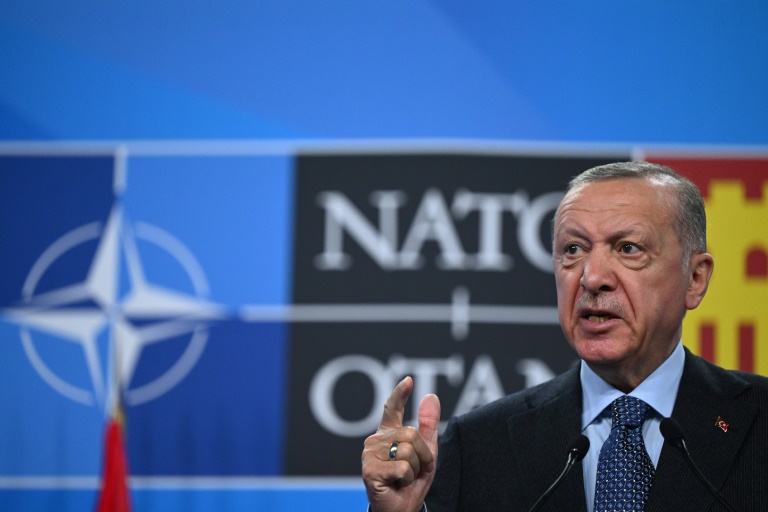
Turkish President Recep Tayyip Erdogan on Thursday told Sweden and Finland that he could still block their drives to join NATO if they fail to implement a new accession deal with Ankara.

Erdogan issued his blunt warning at the end of a NATO summit at which the US-led alliance formally invited the Nordic countries to join the 30-nation bloc.

The two nations dropped their history of military non-alignment and announced plans to join NATO in response to Russia’s invasion of Ukraine.

Their bids were headed for swift approval until Erdogan voiced concerns in May.

He accused the two of providing a haven for outlawed Kurdish militants and promoting “terrorism”.

Erdogan also demanded they lift arms embargoes imposed in response to Turkey’s 2019 military incursion into Syria.

A 10-point memorandum signed by the three sides on the sidelines of the NATO summit on Tuesday appeared to address many of Erdogan’s concerns.

Erdogan lifted his objections and then held a warm meeting with US President Joe Biden that was followed by a promise of new warplane sales to Turkey.

Yet Erdogan told reporters at an impromptu press conference held as the summit ended that the memorandum did not mean Turkey would automatically approve the two countries’ membership.

New countries’ applications must be approved by all members and ratified by their respective parliaments.

Erdogan warned Sweden and Finland’s future behaviour would decide whether he forwarded their application to the Turkish parliament.

“If they fulfil their duties, we will send it to the parliament. If they are not fulfilled, it is out of the question,” he said.

A senior Turkish diplomat in Washington said the ratification process could come at the very earliest in late September and may wait until 2023, with parliament going into recess from Friday. 

One Western diplomatic source in the hallways of the NATO summit accused Erdogan of engaging in “blackmail”.

– ’73 terrorists’ –

Erdogan delivered his message one day after Turkey said it would seek the extradition of 12 suspects from Finland and 21 from Sweden.

The 33 were all accused of being either outlawed Kurdish militants or members of a group led by a US-based preacher Turkey blames for a failed 2016 coup.

But Erdogan appeared to up the ante on Thursday by noting that Sweden had “promised” Turkey to extradite “73 terrorists”.

He did not explain when Sweden issued this promise or provide other details.

Officials in Stockholm said they did not understand Erdogan’s reference but stressed that Sweden strictly adhered to the rule of law.

“In Sweden, Swedish law is applied by independent courts,” Justice Minister Morgan Johansson said in a statement to AFP.

“Swedish citizens are not extradited. Non-Swedish citizens can be extradited at the request of other countries, but only if it is compatible with Swedish law and the European Convention,” Johansson said.

Finnish President Sauli Niinisto said on Wednesday that Erdogan appeared to be referring to cases that had already been processed by officials and the courts.

“I would guess that all of these cases have been solved in Finland. There are decisions made, and those decisions are partly made by our courts,” Niinisto told reporters in Madrid.

“I see no reason to take them up again.”

Most of Turkey’s demands and past negotiations have involved Sweden because of its more robust ties with the Kurdish diaspora.

Sweden keeps no official ethnicity statistics but is believed to have 100,000 Kurds living in the nation of 10 million people.

The Brookings Institution warned that Turkey’s “loose and often aggressive framing” of the term “terrorist” could lead to problems in the months to come.

“The complication arises from a definition of terrorism in Turkish law that goes beyond criminalising participation in violent acts and infringes on basic freedom of speech,” the US-based institute said in a report.

Ketanji Brown Jackson sworn in as first Black woman on US Supreme Court

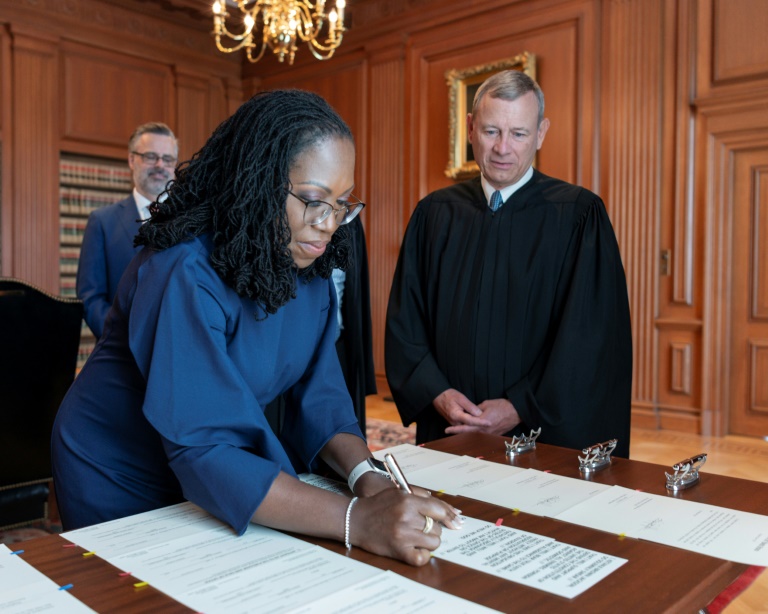
The United States made history on Thursday as Ketanji Brown Jackson was sworn in as the first Black woman to serve on the Supreme Court.

The 51-year-old’s appointment by Democratic President Joe Biden means white men are not in the majority on the nation’s highest court for the first time in 233 years.

While her confirmation is a milestone, it won’t change the 6-3 conservative majority on the court, which has come under fire for recent rulings broadening the right to bear arms, eviscerating abortion rights and limiting the government’s power to curb greenhouse gases.

Jackson’s “historic swearing in today represents a profound step forward for our nation, for all the young, Black girls who now see themselves reflected on our highest court, and for all of us as Americans,” Biden said in a statement Thursday.

“The Supreme Court just gained a colleague with a world-class intellect, the dignified temperament the American people expect of a justice, and the strongest credentials imaginable,” he said.

“Amid this court’s cruel assault on Americans’ health, freedom and security, she will be a much needed force for equal justice for all,” Nancy Pelosi, the top Democrat in Congress, said in a statement.

Jackson spoke only to say her oaths during Thursday’s brief ceremony.

She had picked up support from three Senate Republicans during a grueling and at times brutal confirmation process, delivering Biden a bipartisan 53-47 approval for his first Supreme Court nominee.

Jackson’s swearing-in marks a major moment for Biden, who chaired the Senate Judiciary Committee in the 1980s and ’90s, meaning he has the unprecedented distinction of both naming and overseeing the appointment of a Supreme Court justice.

The appointment presents an opportunity for his administration to pivot from a spate of bad news in recent months, with Biden’s poll ratings still languishing below 40 percent amid runaway inflation ahead of midterm elections in November.

Crucially, it has allowed Biden to show the Black voters who rescued his floundering 2020 primary campaign that he can deliver for them.

At 42 days from nomination to confirmation, the process was among the shortest in history, although longer than it took to seat Donald Trump’s last court pick during his presidency, Amy Coney Barrett.

Biden also thanked the justice who Jackson replaced, Steven Breyer, for his years on the court. 

“Justice Breyer’s integrity and his commitment to ensuring our nation’s laws worked for the people have made him beloved by his colleagues and deeply respected across our country. I thank him again for his many years of exemplary service,” Biden said in the statement released by the White House. 

As the final word on all civil and criminal legal disputes, as well as guardian and interpreter of the Constitution, the Supreme Court seeks to ensure equal justice under the law.

Four of the justices on the nine-member court are now women, making it the most diverse bench in history — although they all attended the elite law schools of Harvard or Yale.

Stocks and oil sink on recession fears

World stock markets mostly sank Thursday on intensifying recession fears, while oil prices receded after an OPEC decision to proceed with a limited boost to output.

London ended the day down two percent, with both Frankfurt and Paris close behind.

That followed a largely downbeat performance in Asia, although Shanghai rose after data showed a forecast-beating improvement in China’s services sector on easing Covid restrictions.

Later on, Wall Street joined the sell-off, with major indices falling around one percent, concluding the S&P 500’s worst first six months of a year since 1970.

Crude futures slumped as major oil producers led by Saudi Arabia and Russia kept to a decision on a limited boost to output despite the risk that high oil prices may help push the global economy into recession.

– ‘Terrible mood’ –

“Stock markets have fallen heavily in June so it seems only fitting that they’re ending the month with big losses as reality continues to bite,” said Craig Erlam, senior market analyst at trading platform OANDA.

Stock markets are “in a terrible mood across Europe,” said AJ Bell investment director Russ Mould.

“There really is a lack of good news for investors to cling onto, and the near-term outlook looks bleak.”

The threat of an extended period of elevated inflation and painful interest rate hikes has left traders fretting over the threat of a prolonged economic downturn, while the Ukraine war continues to sow uncertainty.

The surge in inflation to multi-decade highs has forced central banks to swiftly raise interest rates, dealing a hefty blow to equities as companies faces higher borrowing costs.

Sweden’s central bank on Thursday announced its biggest hike in 22 years, raising its main rate by 50 basis points to 0.75 percent.

There had been hope that policymakers would ease off their hikes as economies show signs of slowing, but analysts say some officials are less concerned about a recession than letting prices run out of control.

US data released Thursday showed that a key annual inflation measure held steady at 6.3 percent in May, but spending rose just 0.2 percent in May, less than half the increase in April and part of a steady downward drift as consumers pull back amid surging prices.

But when inflation is taken into account, the data show a decline in real consumer spending, analysts said.

Two weeks ago, the Federal Reserve enacted a supersized three-quarters of a point interest rate hike, the biggest increase in nearly 30 years. Markets are weighing whether to expect the same thing in July.

“Inflation came in a little bit better than expected today but probably not good enough to prevent the Federal Reserve to raise interest rates 75 basis at the next meeting,” said Tom Cahill of Ventura Wealth Management. 

“At the same time we had the personal spending coming in negative for the month in real terms,” Cahill said. “People are starting to get the sense that perhaps the Federal Reserve is going to push the economy into recession.”

– Key figures at around 2050 GMT –

New York – Dow: DOWN 0.8 percent at 30,775.43 (close)

New York – S&P 500: DOWN 0.9 percent at 11,028.74 (close)

New York – Nasdaq: DOWN 1.3 percent at 11,028.74 (close)

London – FTSE 100: DOWN 2.0 percent at 7,169.28 (close) 

Frankfurt – DAX: DOWN 1.7 percent at 12,783.77 (close)

Paris – CAC 40: DOWN 1.8 percent at 5,922.86 (close)

EURO STOXX 50: DOWN 1.7 percent at 3,443.86 (close)

Tokyo – Nikkei 225: DOWN 1.5 percent at 26,393.04 (close)

Hong Kong – Hang Seng Index: DOWN 0.6 percent at 21,859.79 (close)

Shanghai – Composite: UP 1.1 percent at 3,398.62 (close)

Brent North Sea crude: DOWN 1.5 percent at $116.26 per barrel

West Texas Intermediate: DOWN 1.8 percent at $109.78 per barrel

Euro/dollar: DOWN at $1.0487 from $1.0442 Wednesday

Pound/dollar: UP at $1.2177 from $1.2124

Euro/pound: DOWN at 86.08 pence from 86.12 pence

Dollar/yen: DOWN at 135.75 yen from 136.59 yen

burs-jmb/st

US Supreme Court limits government powers to curb greenhouse gases

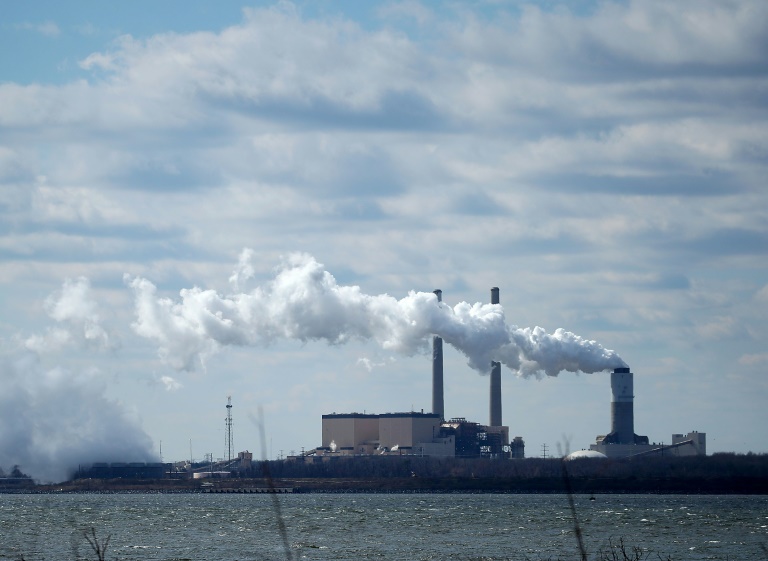
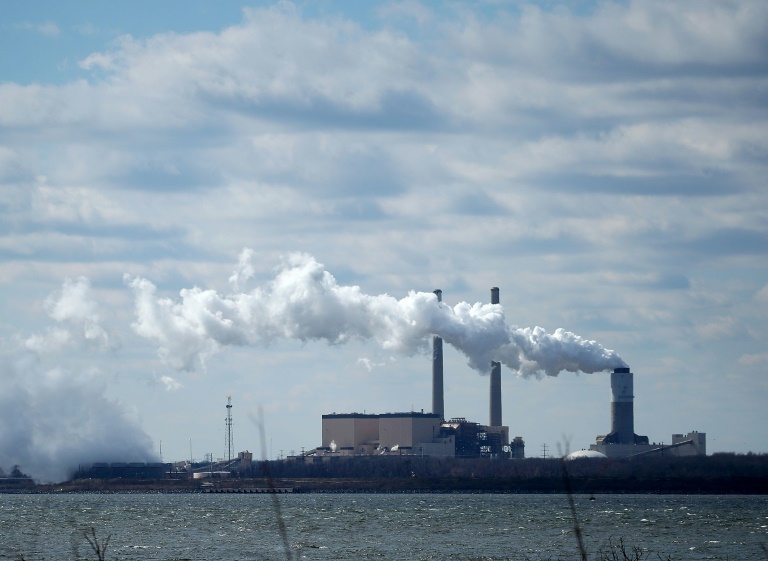
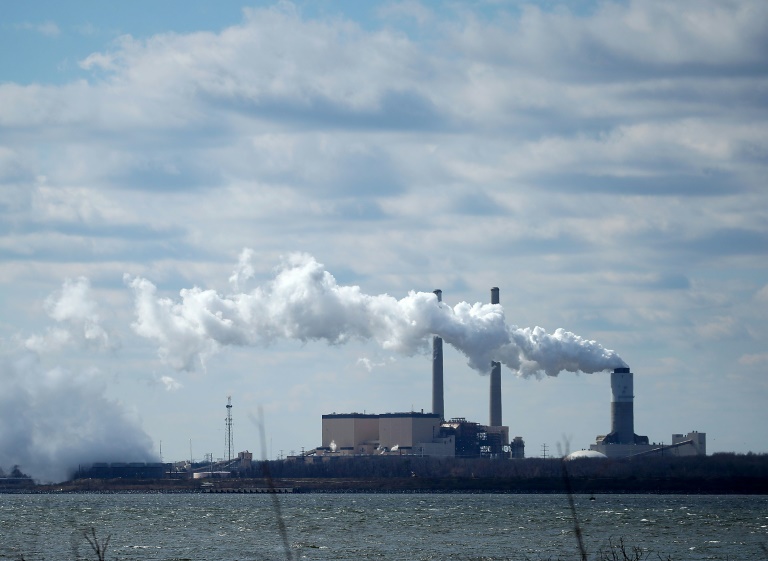
The US Supreme Court ruled Thursday that the government’s key environmental agency cannot issue broad limits on greenhouse gases, sharply curtailing the power of President Joe Biden’s administration to battle climate change.

By a majority of 6-3, the high court found that the Environmental Protection Agency did not have the power to set sweeping caps on emissions from coal-fired power plants, which produce nearly 20 percent of the electricity consumed in the United States.

The decision sets back Biden’s hopes of using the EPA to bring down emissions to meet global climate goals, set in 2015 under the Paris Agreement on climate change.

It was a significant victory for the coal mining and coal power industry, which was targeted that same year for tough limits by the administration of then-president Barack Obama in an effort to slash carbon pollution.

It also marked a victory for conservatives fighting government regulation of industry, with the court’s majority including three right-wing justices named by former president Donald Trump, who had sought to weaken the EPA.

Biden called it “another devastating decision that aims to take our country backwards.”

“We cannot and will not ignore the danger to public health and existential threat the climate crisis poses.”

Stephane Dujarric, spokesman for UN Secretary General Antonio Guterres, said it was “a setback in our fight against climate change.”

– Caps ‘may be sensible but …’ –

In the case pitting West Virginia and other coal-mining states against the government, the court said that while EPA had the power to regulate individual plants, Congress had not given it such expansive powers to set limits covering all electricity generating units.

The majority justices said they recognized that putting caps on carbon dioxide emissions to move away from coal power “may be a sensible solution” to global warming.

But they said the case involved a “major question” of US governance with broad consequences, and that the EPA would have to be specifically delegated such powers by the legislature.

The three-member liberal minority of the court castigated the majority for overruling powers they said EPA did in fact have to address “the most pressing environmental challenge of our time.” 

“The stakes here are high,” Justice Elena Kagan wrote. “Whatever else this court may know about, it does not have a clue about how to address climate change.”

– Excessive regulation –

Conservatives applauded the decision as a strike against overregulation.

“The Court has undone illegal regulations issued by the EPA without any clear congressional authorization and confirmed that only the people’s representatives in Congress —  not unelected, unaccountable bureaucrats — may write our nation’s laws,” wrote Senate Republican leader Mitch McConnell, who represents Kentucky, a state with a significant coal mining industry.

Michelle Bloodworth, president of America’s Power, a coal industry lobby, cheered  the ruling.

“We are pleased the court agreed with us that EPA does not have unlimited authority to do anything it wants to do,” she said in a statement.

“Coal-fired power plants provide affordable and reliable electricity,” she added.

But House Democratic leader Nancy Pelosi called it a “radical” decision by “pro-pollution justices.”

“By restricting the EPA’s authority, the Republican supermajority on the court has bowed to the dirty energy special interests who seek to poison the air our children breathe and the water they drink with impunity,” she said in a statement.

Environmental groups called on the Democratic-controlled Congress to take more action on climate change, with more investments in things like clean energy and public transit. 

“This means Congress has an even stronger imperative to act boldly — and fast,” the Sierra Club said.

– Court conservatives show muscle – 

Thursday’s decision capped a term for the court in which the new conservative majority flexed its muscles in ways that will have profound effects on American society.

Two similar 6-3 decisions last week shook the country. One expanded the rights of gun owners to wear their guns wherever they go, with few limitations.

The second ended a half-century-old constitutional right to abortion, setting off a chain reaction in which more than half of the 50 states are moving to ban or severely restrict the practice.

The EPA ruling, too, could have profound impacts. 

Conservative Justice Neil Gorsuch wrote separately that the decision was a statement that no government agency can make policies with far-reaching effect without express empowerment by Congress.

“When an agency claims the power to regulate vast swaths of American life, it not only risks intruding on Congress’s power, it also risks intruding on powers reserved to the States,” Gorsuch wrote.

But critics said that ignores the deep divisions in Congress that have stifled important policy debates.

“By insisting instead that an agency can promulgate an important and significant climate rule only by showing ‘clear congressional authorization’ at a time when the court knows that Congress is effectively dysfunctional, the court threatens to upend the national government’s ability to safeguard the public health and welfare,” said Richard Lazarus, a professor at Harvard law school.

US Supreme Court limits government powers to curb greenhouse gases

The US Supreme Court ruled Thursday that the government’s key environmental agency cannot issue broad limits on greenhouse gases, sharply curtailing the power of President Joe Biden’s administration to battle climate change.

By a majority of 6-3, the high court found that the Environmental Protection Agency did not have the power to set sweeping caps on emissions from coal-fired power plants, which produce nearly 20 percent of the electricity consumed in the United States.

The decision sets back Biden’s hopes of using the EPA to bring down emissions to meet global climate goals, set in 2015 under the Paris Agreement on climate change.

It was a significant victory for the coal mining and coal power industry, which was targeted that same year for tough limits by the administration of then-president Barack Obama in an effort to slash carbon pollution.

It also marked a victory for conservatives fighting government regulation of industry, with the court’s majority including three right-wing justices named by former president Donald Trump, who had sought to weaken the EPA.

Biden called it “another devastating decision that aims to take our country backwards.”

“We cannot and will not ignore the danger to public health and existential threat the climate crisis poses.”

Stephane Dujarric, spokesman for UN Secretary General Antonio Guterres, said it was “a setback in our fight against climate change.”

– Caps ‘may be sensible but …’ –

In the case pitting West Virginia and other coal-mining states against the government, the court said that while EPA had the power to regulate individual plants, Congress had not given it such expansive powers to set limits covering all electricity generating units.

The majority justices said they recognized that putting caps on carbon dioxide emissions to move away from coal power “may be a sensible solution” to global warming.

But they said the case involved a “major question” of US governance with broad consequences, and that the EPA would have to be specifically delegated such powers by the legislature.

The three-member liberal minority of the court castigated the majority for overruling powers they said EPA did in fact have to address “the most pressing environmental challenge of our time.” 

“The stakes here are high,” Justice Elena Kagan wrote. “Whatever else this court may know about, it does not have a clue about how to address climate change.”

– Excessive regulation –

Conservatives applauded the decision as a strike against overregulation.

“The Court has undone illegal regulations issued by the EPA without any clear congressional authorization and confirmed that only the people’s representatives in Congress —  not unelected, unaccountable bureaucrats — may write our nation’s laws,” wrote Senate Republican leader Mitch McConnell, who represents Kentucky, a state with a significant coal mining industry.

Michelle Bloodworth, president of America’s Power, a coal industry lobby, cheered  the ruling.

“We are pleased the court agreed with us that EPA does not have unlimited authority to do anything it wants to do,” she said in a statement.

“Coal-fired power plants provide affordable and reliable electricity,” she added.

But House Democratic leader Nancy Pelosi called it a “radical” decision by “pro-pollution justices.”

“By restricting the EPA’s authority, the Republican supermajority on the court has bowed to the dirty energy special interests who seek to poison the air our children breathe and the water they drink with impunity,” she said in a statement.

Environmental groups called on the Democratic-controlled Congress to take more action on climate change, with more investments in things like clean energy and public transit. 

“This means Congress has an even stronger imperative to act boldly — and fast,” the Sierra Club said.

– Court conservatives show muscle – 

Thursday’s decision capped a term for the court in which the new conservative majority flexed its muscles in ways that will have profound effects on American society.

Two similar 6-3 decisions last week shook the country. One expanded the rights of gun owners to wear their guns wherever they go, with few limitations.

The second ended a half-century-old constitutional right to abortion, setting off a chain reaction in which more than half of the 50 states are moving to ban or severely restrict the practice.

The EPA ruling, too, could have profound impacts. 

Conservative Justice Neil Gorsuch wrote separately that the decision was a statement that no government agency can make policies with far-reaching effect without express empowerment by Congress.

“When an agency claims the power to regulate vast swaths of American life, it not only risks intruding on Congress’s power, it also risks intruding on powers reserved to the States,” Gorsuch wrote.

But critics said that ignores the deep divisions in Congress that have stifled important policy debates.

“By insisting instead that an agency can promulgate an important and significant climate rule only by showing ‘clear congressional authorization’ at a time when the court knows that Congress is effectively dysfunctional, the court threatens to upend the national government’s ability to safeguard the public health and welfare,” said Richard Lazarus, a professor at Harvard law school.

US Supreme Court limits government powers to curb greenhouse gases

The US Supreme Court ruled Thursday that the government’s key environmental agency cannot issue broad limits on greenhouse gases, sharply curtailing the power of President Joe Biden’s administration to battle climate change.

By a majority of 6-3, the high court found that the Environmental Protection Agency did not have the power to set sweeping caps on emissions from coal-fired power plants, which produce nearly 20 percent of the electricity consumed in the United States.

The decision sets back Biden’s hopes of using the EPA to bring down emissions to meet global climate goals, set in 2015 under the Paris Agreement on climate change.

It was a significant victory for the coal mining and coal power industry, which was targeted that same year for tough limits by the administration of then-president Barack Obama in an effort to slash carbon pollution.

It also marked a victory for conservatives fighting government regulation of industry, with the court’s majority including three right-wing justices named by former president Donald Trump, who had sought to weaken the EPA.

Biden called it “another devastating decision that aims to take our country backwards.”

“We cannot and will not ignore the danger to public health and existential threat the climate crisis poses.”

Stephane Dujarric, spokesman for UN Secretary General Antonio Guterres, said it was “a setback in our fight against climate change.”

– Caps ‘may be sensible but …’ –

In the case pitting West Virginia and other coal-mining states against the government, the court said that while EPA had the power to regulate individual plants, Congress had not given it such expansive powers to set limits covering all electricity generating units.

The majority justices said they recognized that putting caps on carbon dioxide emissions to move away from coal power “may be a sensible solution” to global warming.

But they said the case involved a “major question” of US governance with broad consequences, and that the EPA would have to be specifically delegated such powers by the legislature.

The three-member liberal minority of the court castigated the majority for overruling powers they said EPA did in fact have to address “the most pressing environmental challenge of our time.” 

“The stakes here are high,” Justice Elena Kagan wrote. “Whatever else this court may know about, it does not have a clue about how to address climate change.”

– Excessive regulation –

Conservatives applauded the decision as a strike against overregulation.

“The Court has undone illegal regulations issued by the EPA without any clear congressional authorization and confirmed that only the people’s representatives in Congress —  not unelected, unaccountable bureaucrats — may write our nation’s laws,” wrote Senate Republican leader Mitch McConnell, who represents Kentucky, a state with a significant coal mining industry.

Michelle Bloodworth, president of America’s Power, a coal industry lobby, cheered  the ruling.

“We are pleased the court agreed with us that EPA does not have unlimited authority to do anything it wants to do,” she said in a statement.

“Coal-fired power plants provide affordable and reliable electricity,” she added.

But House Democratic leader Nancy Pelosi called it a “radical” decision by “pro-pollution justices.”

“By restricting the EPA’s authority, the Republican supermajority on the court has bowed to the dirty energy special interests who seek to poison the air our children breathe and the water they drink with impunity,” she said in a statement.

Environmental groups called on the Democratic-controlled Congress to take more action on climate change, with more investments in things like clean energy and public transit. 

“This means Congress has an even stronger imperative to act boldly — and fast,” the Sierra Club said.

– Court conservatives show muscle – 

Thursday’s decision capped a term for the court in which the new conservative majority flexed its muscles in ways that will have profound effects on American society.

Two similar 6-3 decisions last week shook the country. One expanded the rights of gun owners to wear their guns wherever they go, with few limitations.

The second ended a half-century-old constitutional right to abortion, setting off a chain reaction in which more than half of the 50 states are moving to ban or severely restrict the practice.

The EPA ruling, too, could have profound impacts. 

Conservative Justice Neil Gorsuch wrote separately that the decision was a statement that no government agency can make policies with far-reaching effect without express empowerment by Congress.

“When an agency claims the power to regulate vast swaths of American life, it not only risks intruding on Congress’s power, it also risks intruding on powers reserved to the States,” Gorsuch wrote.

But critics said that ignores the deep divisions in Congress that have stifled important policy debates.

“By insisting instead that an agency can promulgate an important and significant climate rule only by showing ‘clear congressional authorization’ at a time when the court knows that Congress is effectively dysfunctional, the court threatens to upend the national government’s ability to safeguard the public health and welfare,” said Richard Lazarus, a professor at Harvard law school.

FBI adds Bulgarian 'Crypto Queen' to most-wanted list

A Bulgarian woman dubbed the “Crypto Queen” after she raised billions of dollars in a fraudulent virtual currency scheme was placed on the FBI’s 10 most wanted list Thursday.

The Federal Bureau of Investigation put up a $100,000 reward for Ruja Ignatova, who disappeared in Greece in October 2017 around the time US authorities filed a sealed indictment and warrant for her arrest.

The 42-year-old, who is also a German citizen, was behind one of the most notorious scams in the frequently treacherous world of crypto currencies.

In 2014 she launched OneCoin, ostensibly aiming to replace Bitcoin as the world’s leading virtual money.

Tapping a global network to market the coin to friends and family in exchange for their own payouts, she and co-conspirators pulled in at least $3.4 billion and possibly over $4 billion, according to court documents.

Officials said that OneCoin was not backed by any secured, independent blockchain-type technology as other crypto currencies are.

Instead, they said, it was a classic Ponzi scheme, in which early investors are encouraged to find others and then paid out by receipts from later investors.

“OneCoin claimed to have a private blockchain,” said FBI Special Agent Ronald Shimko in a statement.

“This is in contrast to other virtual currencies, which have a decentralized and public blockchain. In this case, investors were just asked to trust OneCoin,” he said.

Ignatova disappeared in 2017 as international investigators began to close in on her group.

“Investigators believe Ignatova may have been tipped off that she was under investigation by US and international authorities,” the FBI said Thursday.

“She traveled from Sofia, Bulgaria, to Athens, Greece, on October 25, 2017, and has not been seen since.”

On May 11, Europol announced it had added Ignatova to its most wanted list, and offered a 5,000 euro ($5,200) reward for information on her whereabouts.

But on Thursday she was no longer on the list. It was not clear why or when she came off it, and authorities in Europe and the United States have not shown evidence of whether she is alive or dead.

Her brother Konstantin Ignatov was arrested at Los Angeles International Airport in March 2019, and later pleaded guilty to wire fraud in a deal with US authorities. 

His sentencing has been delayed for what the Justice Department said in court filings was ongoing cooperation in the investigation.

Another partner, Sebastian Greenwood, was detained in Thailand in 2018 and then extradited to the United States, where he remains in jail awaiting trial.

Another accomplice, US attorney Mark Scott, was convicted in November 2019 of laundering $400 million for the group.

Erdogan warns Turkey may still block Nordic NATO drive

Turkish President Recep Tayyip Erdogan on Thursday told Sweden and Finland that he could still block their drives to join NATO if they fail to implement a new accession deal with Ankara.

Erdogan issued his blunt warning at the end of a NATO summit at which the US-led alliance formally invited the Nordic countries to join the 30-nation bloc.

The two nations dropped their history of military non-alignment and announced plans to join NATO in response to Russia’s invasion of Ukraine.

Their bids were headed for swift approval until Erdogan voiced concerns in May.

He accused the two of providing a haven for outlawed Kurdish militants and promoting “terrorism”.

Erdogan also demanded they lift arms embargoes imposed in response to Turkey’s 2019 military incursion into Syria.

A 10-point memorandum signed by the three sides on the sidelines of the NATO summit on Tuesday appeared to address many of Erdogan’s concerns.

Erdogan lifted his objections and then held a warm meeting with US President Joe Biden that was followed by a promise of new warplane sales to Turkey.

Yet Erdogan told reporters at an impromptu press conference held as the summit ended that the memorandum did not mean Turkey would automatically approve the two countries’ membership.

New countries’ applications must be approved by all members and ratified by their respective parliaments.

Erdogan warned Sweden and Finland’s future behaviour would decide whether he forwarded their application to the Turkish parliament.

“If they fulfil their duties, we will send it to the parliament. If they are not fulfilled, it is out of the question,” he said.

One Western diplomatic source in the hallways of the NATO summit accused Erdogan of engaging in “blackmail”.

– ’73 terrorists’ –

Erdogan delivered his message one day after Turkey said it would seek the extradition of 12 suspects from Finland and 21 from Sweden.

The 33 were all accused of being either outlawed Kurdish militants or members of a group led by a US-based preacher Turkey blames for a failed 2016 coup.

But Erdogan appeared to up the ante on Thursday by noting that Sweden had “promised” Turkey to extradite “73 terrorists”.

He did not explain when Sweden issued this promise or provide other details.

Officials in Stockholm said they did not understand Erdogan’s reference but stressed that Sweden strictly adhered to the rule of law.

“In Sweden, Swedish law is applied by independent courts,” Justice Minister Morgan Johansson said in a statement to AFP.

“Swedish citizens are not extradited. Non-Swedish citizens can be extradited at the request of other countries, but only if it is compatible with Swedish law and the European Convention,” Johansson said.

Finnish President Sauli Niinisto said on Wednesday that Erdogan appeared to be referring to cases that had already been processed by officials and the courts.

“I would guess that all of these cases have been solved in Finland. There are decisions made, and those decisions are partly made by our courts,” Niinisto told reporters in Madrid.

“I see no reason to take them up again.”

Most of Turkey’s demands and past negotiations have involved Sweden because of its more robust ties with the Kurdish diaspora.

Sweden keeps no official ethnicity statistics but is believed to have 100,000 Kurds living in the nation of 10 million people.

The Brookings Institution warned that Turkey’s “loose and often aggressive framing” of the term “terrorist” could lead to problems in the months to come.

“The complication arises from a definition of terrorism in Turkish law that goes beyond criminalising participation in violent acts and infringes on basic freedom of speech,” the US-based institute said in a report.

Ecuador talks resume on 18th day of protest

Talks between Ecuador’s government and Indigenous leaders resumed Thursday, after an acrimonious suspension, to seek an end to cost-of-living protests that have largely paralyzed the country since June 13.

Negotiations resumed in the capital Quito at a church, which is mediating, with early indications of a possible breakthrough.

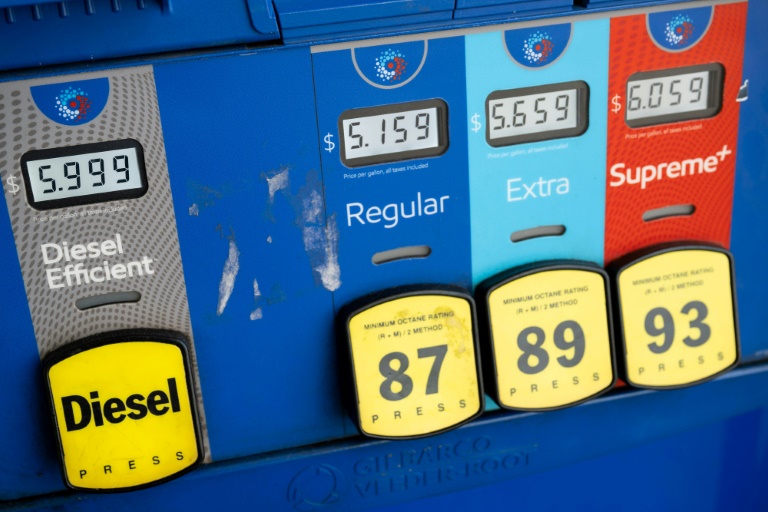
Church official Alfredo Espinoza said the mediators had proposed an extra five-cent-per-gallon reduction in the price of diesel and gasoline, on top of the 10-cent cut already implemented in response to the protesters’ complaints about fast-rising fuel prices.

Protesters had wanted a 40-cent cut.

Both parties had provisionally agreed to the proposal, said Espinoza, but a deal has yet to be signed.

The Indigenous delegation retired to consider its next move as thousands of supporters gathered outside the meeting venue.

An estimated 14,000 Ecuadorans — most of them in Quito — have taken part in a nationwide show of discontent against deepening hardship in an economy dealt a serious blow by the coronavirus pandemic

– Six dead –

The protests were called by the powerful Confederation of Indigenous Nationalities of Ecuador (Conaie), which is credited with unseating three presidents between 1997 and 2005.

Indigenous people make up more than a million of the South American nation’s 17.7 million inhabitants.  

Talks between the two parties started on Monday but were cut short the following day after the killing of a soldier the government blamed on protesters.

On Wednesday, the government said it would re-enter the talks, but also imposed a fresh state of emergency in four of the country’s 24 provinces as violence continued to mar the country-wide uprising.

Besides the soldier, five demonstrators have died and hundreds on both sides have been wounded in clashes between the security forces and protesters who have blockaded roads and disrupted supply lines. 

Some 150 people have been arrested, according to observers. 

The action has been costly, with losses of some $50 million per day to the economy, according to the government, which has warned oil production  — already halved — could come to a complete halt soon. 

Close Bitnami banner
Bitnami