World

Seven anti-coup protesters killed in Sudan mass rallies

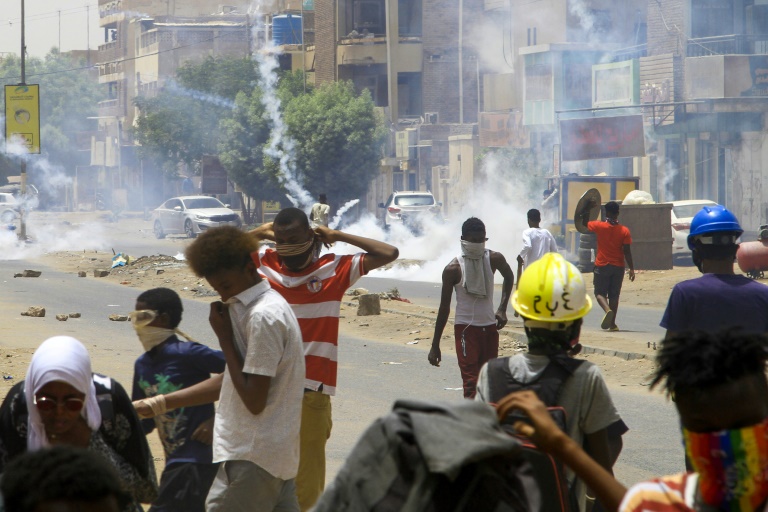
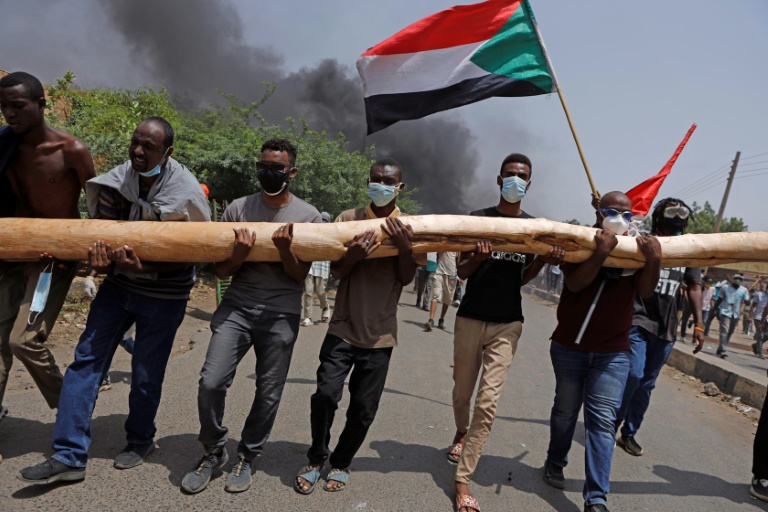
At least seven Sudanese demonstrators were killed Thursday as security forces sought to quash mass rallies of protesters demanding an end to military rule, pro-democracy medics said.

In one of the most violent days this year in an ongoing crackdown on the anti-coup movement, AFP correspondents reported security forces firing tear gas and stun grenades to disperse tens of thousands of protesters.

“Even if we die, the military will not rule us,” protesters chanted, urging the reversal of an October military coup by army chief Abdel Fattah al-Burhan that prompted foreign governments to slash aid, deepening a chronic economic crisis.

At least five of the seven killed were shot — two in the chest, two in the head, and another in the back — the Central Committee of Sudan Doctors said, raising the overall death toll to 110 from protest-related violence since October.

“Down with Burhan’s rule,” crowds chanted, with protests and violence flaring in both the capital Khartoum and its suburbs, including the twin city of Omdurman, on the other side of the Nile river.

Security forces fired powerful water cannons, as protesters set fire to burning tyres.

Medics also reported “several attempts to storm hospitals in Khartoum,” with security forces firing tear gas into one hospital, where some of those injured during the protests had been taken.

Protests in Khartoum were larger than normal, and beyond the capital, demonstrations also took place in Wad Madani in the south, the western Darfur region, the eastern states of Kassala and Gedaref as well as the city of Port Sudan, witnesses said.

Internet and phone lines had been disrupted since the early hours of Thursday, a measure the Sudanese authorities often impose to prevent mass gatherings.

By Thursday evening, communications were partially restored.

Security was tight in Khartoum despite the recent lifting of a state of emergency imposed after the coup.

Troops and police blocked roads leading to both army headquarters and the presidential palace, witnesses said. Shops around the capital were largely shuttered.

– ‘Violence needs to end’ –

Demonstrations continued in Omdurman as night fell with crowds trying to remove security barricades in a bid to cross bridges to reach Khartoum, witnesses said.

Thursday’s rallies showed a “change in the balance of power in favour of the mass movement and its goals of seizing complete civil authority and defeating the coup,” said the Forces for Freedom and Change, an alliance of civilian groups whose leaders were ousted in the coup.

UN special representative Volker Perthes said Thursday that “violence needs to end”, while the US embassy in Khartoum urged restraint and “the protection of civilians so that no more lives are lost”.

The latest protests come on the anniversary of a previous coup in 1989, that toppled the country’s last elected civilian government and ushered in three decades of iron-fisted rule by Islamist-backed General Omar al-Bashir.

They also come on the anniversary of 2019 protests demanding that the generals, who had ousted Bashir in a palace coup earlier that year, cede power to civilians.

Those protests led to the formation of the mixed civilian-military transitional government which was toppled in last year’s coup.

Sudan has been roiled by near-weekly protests as the country’s economic woes have deepened since Burhan seized power last year.

Alongside the African Union and regional bloc IGAD, the United Nations has been attempting to facilitate talks between the generals and civilians, but they have been boycotted by the main civilian factions.

The UN has warned that the deepening economic and political crisis has pushed one third of the country’s population of more than 40 million towards life-threatening food shortages.
Russia quits Snake Island, weakening blockade of Ukraine ports

Russian troops have abandoned their positions on a captured Ukrainian island, a major setback to their invasion effort that weakens their blockade of Ukraine’s ports, defence officials said on Thursday.

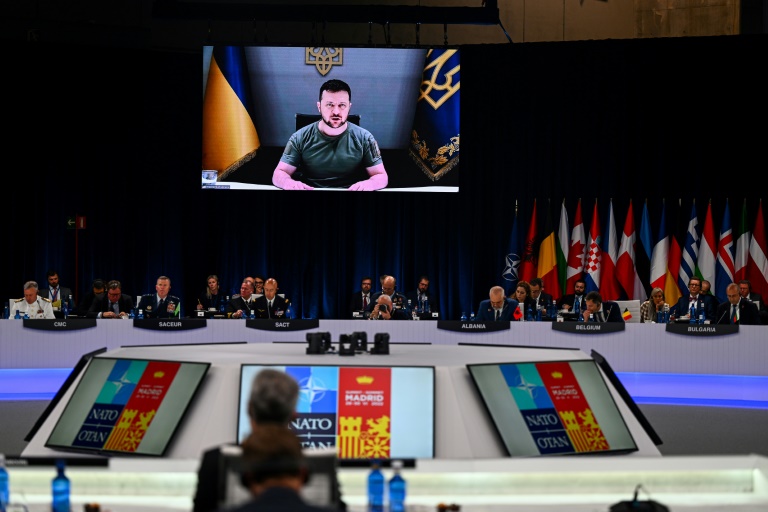
The news from the Black Sea came as NATO leaders wrapped up their summit in Madrid, with US President Joe Biden announcing $800 million in new weapons to help Ukraine fight off Russia’s invasion.

“We are going to stick with Ukraine, and all of the alliance are going to stick with Ukraine, as long as it takes to make sure they are not defeated by Russia,” he said.

Russian President Vladimir Putin’s foreign minister, Sergei Lavrov, compared the new diplomatic low to the return of the Cold War, telling reporters: “As far as an Iron Curtain is concerned, essentially it is already descending… The process has begun.”

But there may be a possible opening: Indonesia’s President Joko Widodo said, after meeting Putin in Moscow, that he had given the Russian leader a message from their Ukrainian counterpart, Volodymyr Zelensky.

Snake Island became a symbol of Ukrainian resistance in the first days of the war, when the rocky outcrop’s defenders told a Russian warship that called on them to surrender to “go f*ck yourself”, an incident that spurred a defiant meme.

It was also a strategic target, sitting aside shipping lanes near Ukraine’s port of Odessa. Russia had attempted to install missile and air defence batteries while under fire from drones.

Now, however, Ukraine has begun to receive longer range missiles and artillery, and the Russian position on Snake Island seems to have become untenable.

– ‘Strategically important’ –

British Prime Minister Boris Johnson warned the Russian president that any eventual peace deal would be on Ukraine’s terms.

“In the end, it will prove impossible for Putin to hold down a country that will not accept his rule,” he said.

“We’ve seen what Ukraine can do to drive the Russians back. We’ve seen what they did around Kyiv and Kharkiv, now on Snake Island.”

The Russian defence ministry statement described the retreat as “a gesture of goodwill” meant to demonstrate that Moscow will not interfere with UN efforts to organise protected grain exports from Ukraine.

But Kyiv claimed it as a win.

“They always downplay their defeats this way,” Ukraine’s Foreign Minister Dmytro Kuleba said on Twitter.

“I thank the defenders of Odessa region who took maximum measures to liberate a strategically important part of our territory,” Valeriy Zaluzhny, the Ukraine military’s commander-in-chief, said on Telegram.

In peacetime, Ukraine is a major agricultural exporter, but Russia’s invasion has damaged farmland and seen Ukraine’s ports seized, razed or blockaded — threatening grain importers in Africa with famine.

Western powers have accused Putin of using the trapped harvest as a weapon to increase pressure on the international community, and Russia has been accused of stealing grain. 

– ‘Direct threat’ –

On Thursday, a ship carrying 7,000 tonnes of grain sailed from Ukraine’s occupied port of Berdyansk, said the regional leader appointed by the Russian occupation forces.

Evgeny Balitsky, the head of the pro-Moscow administration, said Russia’s Black Sea ships “are ensuring the security” of the journey, adding that the port had been de-mined.

Separately, the Russian defence ministry said its forces are holding more than 6,000 Ukrainian prisoners of war who have been captured since the February 24 invasion.

The conflict in Ukraine has dominated the NATO summit in Madrid, where the leaders said Russia “is the most significant and direct threat to allies’ security and to peace and stability in the Euro-Atlantic area”.

This came as NATO officially invited Sweden and Finland to join the alliance, and Biden announced new deployments of US troops, ships and planes to Europe.

Biden said the US move was exactly what Putin “didn’t want” — and Moscow, facing fierce resistance from Ukrainian forces equipped with Western weapons, reacted with predictable fury.

Putin on Wednesday accused the alliance of seeking to assert its “supremacy”, telling journalists in the Turkmenistan capital of Ashgabat that Ukraine and its people are “a means” for NATO to “defend their own interests.”

“The NATO countries’ leaders wish to… assert their supremacy, their imperial ambitions,” Putin added.

– ‘As long as it takes’ –

German Chancellor Olaf Scholz dismissed Putin’s comments as “ridiculous” and said the Russian leader “has made imperialism the goal of his politics”.

NATO leaders have funnelled billions of dollars of arms to Ukraine and faced a renewed appeal from Zelensky for more long-range artillery.

“Ukraine can count on us for as long as it takes,” NATO chief Jens Stoltenberg told the summit, as he announced a new strategic overview that focuses on the Moscow threat.

The document, updated for the first time since 2010, warned the alliance “cannot discount the possibility” of an attack on its members.

Russian missiles continued to rain down on cities across Ukraine. 

In the southern city of Mykolaiv, rescuers found the bodies of seven slain civilians in the rubble of a destroyed building, emergency services said. 

The city of Lysychansk in the eastern Donbas region — the current focus of Russia’s offensive — is also facing sustained bombardment.

The situation in Lysychansk — the last major city the Russians need to take over in the Lugansk region — was “extremely difficult” with relentless shelling making it impossible to evacuate civilians, regional governor Sergiy Gaiday said. 

“There is a lot of shelling… The Russian army is approaching from different directions,” he said in a video posted on Telegram. 

Russia’s forces remain at the outskirts of the city where there is currently no street fighting, he said.

Gaiday dismissed claims by pro-Russian separatists fighting alongside Moscow’s forces who claim to control half of the city situated across the river from neighbouring Severodonetsk, which was captured by the Russian army last week.

The United Nations humanitarian coordinator in Ukraine said on Thursday 16 million people in Ukraine were in need of humanitarian aid.

– ‘Offensive’ remarks –

Also on Thursday, Russia summoned Britain’s ambassador to Moscow to protest at Johnson’s “offensive” remarks about Putin.

Johnson had said on Tuesday that Putin would not have started the war in Ukraine if he was a woman and said the military operation was “a perfect example of toxic masculinity”.

The Russian foreign ministry said: “In polite society, it is customary to apologise for remarks of this kind.” 

burs/spm/ah

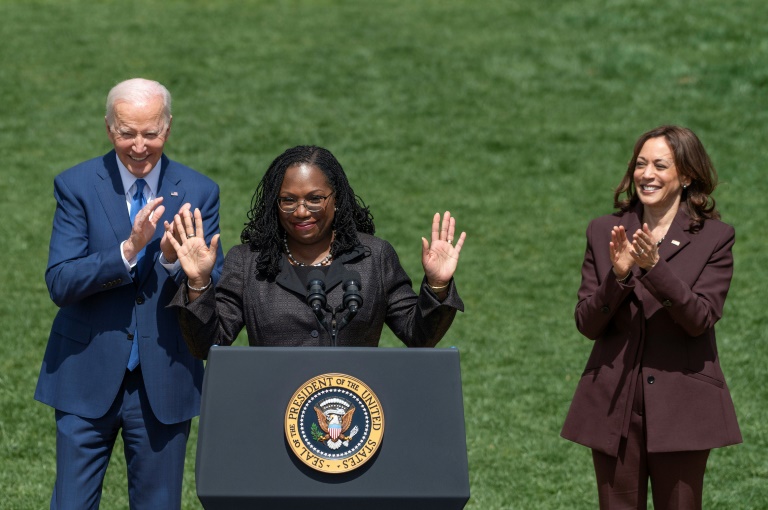
Ketanji Brown Jackson sworn in as first Black woman on US Supreme Court

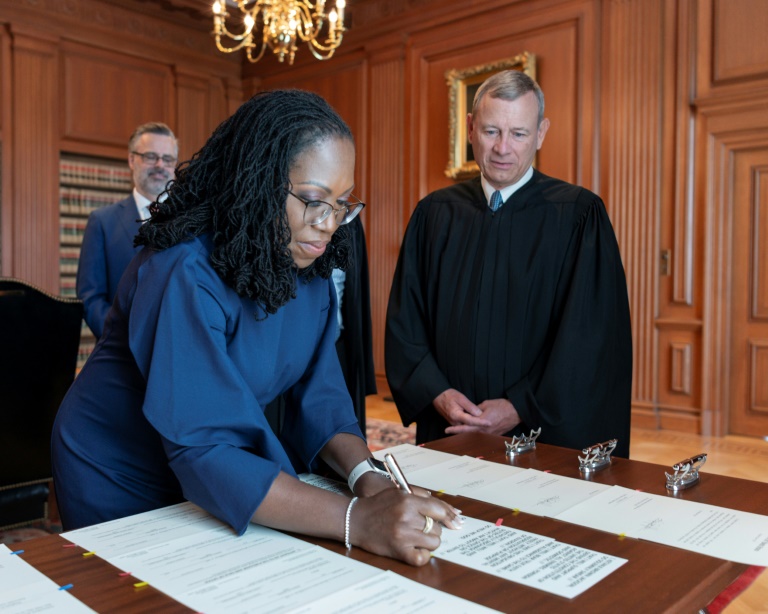
The United States made history on Thursday as Ketanji Brown Jackson was sworn in as the first Black woman to serve on the Supreme Court.

The 51-year-old’s appointment by Democratic President Joe Biden means white men are not in the majority on the nation’s highest court for the first time in 233 years.

While her confirmation is a milestone, it won’t change the 6-3 conservative majority on the court, which has come under fire for recent rulings broadening the right to bear arms, eviscerating abortion rights and limiting the government’s power to curb greenhouse gases.

“As Justice Ketanji Brown Jackson takes her seat on the Supreme Court, our nation takes an historic step toward realizing our highest ideals,” Nancy Pelosi, the top Democrat in Congress, said in a statement.

“Amid this court’s cruel assault on Americans’ health, freedom and security, she will be a much needed force for equal justice for all.”

Jackson spoke only to say her oaths during Thursday’s brief ceremony.

She had picked up support from three Senate Republicans during a grueling and at times brutal confirmation process, delivering Biden a bipartisan 53-47 approval for his first Supreme Court nominee.

Jackson’s swearing-in marks a major moment for Biden, who chaired the Senate Judiciary Committee in the 1980s and 90s, meaning he has the unprecedented distinction of both naming and overseeing the appointment of a Supreme Court justice.

The appointment presents an opportunity for his administration to pivot from a spate of bad news in recent months, with Biden’s poll ratings still languishing below 40 percent amid runaway inflation ahead of midterm elections in November.

Crucially, it has allowed Biden to show the Black voters who rescued his floundering 2020 primary campaign that he can deliver for them.

At 42 days, the confirmation was among the shortest in history, although longer than it took to seat Donald Trump’s last court pick during his presidency, Amy Coney Barrett.

As the final word on all civil and criminal legal disputes, as well as guardian and interpreter of the Constitution, the Supreme Court seeks to ensure equal justice under the law.

Four of the justices on the nine-member court are now women, making it the most diverse bench in history — although they all attended the elite law schools of Harvard or Yale.

Climate activists glue hands to Van Gogh frame in London gallery

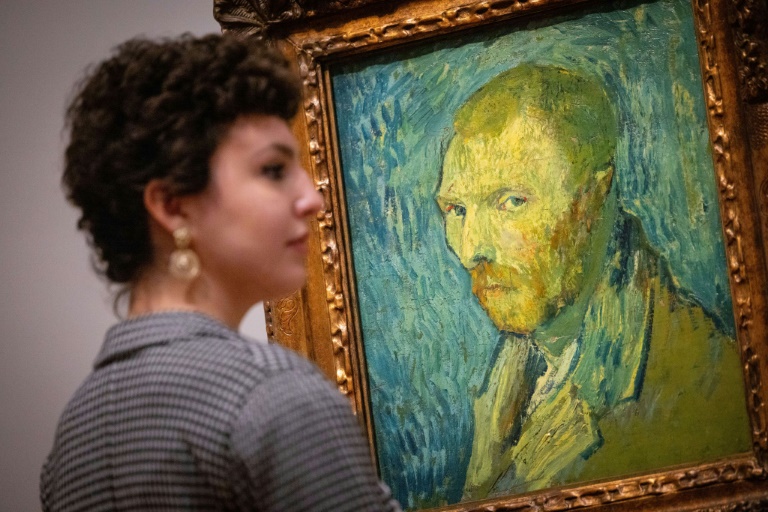
A pair of environmental protesters in Britain on Thursday glued themselves to the frame of a Vincent van Gogh painting on display at a London art gallery.

The stunt, the latest direct action demonstration by climate change activists, saw the duo from the “Just Stop Oil” group glue their fingers to the Dutch master’s “Peach Trees in Blossom”.

The oil on canvas work painted in 1889 is part of a Van Gogh collection hanging at the Courtauld Gallery at Somerset House in the British capital.

It comes the day after five members of the group, which wants a halt to all new UK fossil fuel projects, were arrested over a similarly disruptive protest at an art museum in Glasgow. 

“We don’t want to be doing this,” Louis McKechnie, one of the pair claiming to have attached himself to the Van Gogh work, told onlookers at the London gallery, according to footage shared by “Just Stop Oil”.  

“We’re here glued to this painting — this beautiful painting — because we’re terrified for our future,” the 21-year-old added, noting he and his fellow activist expected to be arrested. 

“If there was any other way of getting the change we need, we would’ve done it — we’ve tried everything else.”

The Courtauld confirmed the incident took place mid-afternoon and prompted the closure of the gallery in which the painting hangs for the rest of Thursday.

“We expect The Courtauld Gallery to reopen to the public as normal tomorrow,” it added in a statement.

McKechnie, a former engineering student who has already been arrested 20 times and spent six weeks in prison, is fast becoming one of the most recognisable faces among Britain’s climate change activists. 

In March, he risked the wrath of football fans when he tied himself to a goalpost in the middle of a match between Newcastle and Everton.

He told AFP earlier this month that he was prepared to become “public enemy number one” over his direct actions.

In the video from the gallery Thursday, McKechnie accused the UK government of “pushing through over 40 new fossil fuel projects” which were “like signing our death warrants”. 

“My generation has no other choice but to take this kind of action,” he added. 

On Wednesday, Britain’s independent Climate Change Committee (CCC) warned that the British government was failing to make adequate progress meeting targets in its new net-zero strategy to be carbon neutral by 2050.

That prompted campaign group Greenpeace UK, business groups and opposition politicians to urge ministers to ramp up delivering on climate change policies.

Prime Minister Boris Johnson’s Conservative government has recently reviewed its energy strategy, including provision of nuclear, wind and solar power.

But it is also examining fossil fuel projects in the North Sea, as part of attempts to safeguard domestic supplies after Russia’s invasion of Ukraine.

Washington blocks more than $1 bn in Russian oligarch's US assets

The United States on Thursday blocked a US-based company worth more than $1 billion linked to Russian oligarch Suleiman Kerimov, saying the ally of President Vladimir Putin used it to funnel and invest shadowy funds.

The Treasury Department said that Kerimov, a billionaire active in Russian politics, secretly managed the Delaware-based Heritage Trust which put its money into a number of large public companies.

Heritage Trust, set up in 2017, brought money into the United States through shell companies and under-the-radar foundations established in Europe, Treasury Department officials said. 

Treasury Secretary Janet Yellen vowed that the United States would keep taking action “even as Russian elites hide behind proxies and complex legal arrangements.” 

The United States will “actively implement the multilaterally coordinated sanctions imposed on those who fund and benefit from Russia’s war against Ukraine,” she said in a statement. 

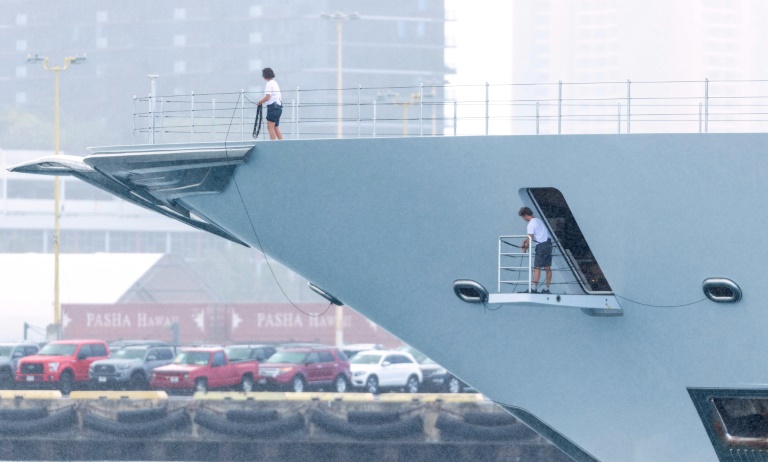
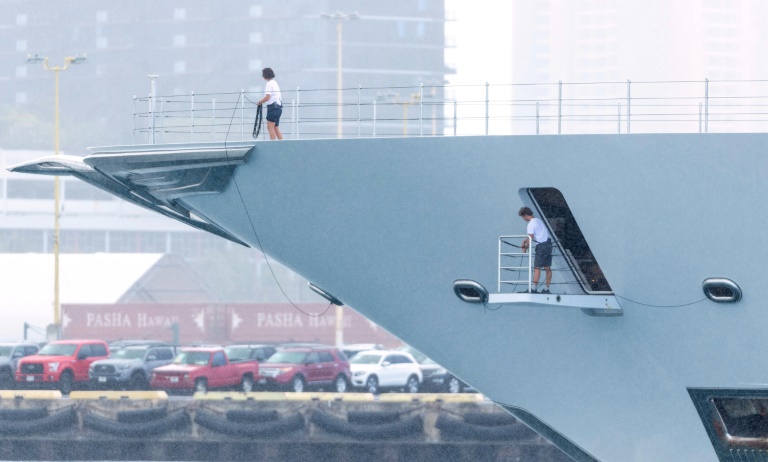
The action comes weeks after Fiji handed to the United States a $300 million superyacht linked to Kerimov, who has been under US sanctions since 2018 over alleged money laundering and his role in the Russian government. 

The United States and European nations have stepped up a crackdown on Russian oligarchs following Putin’s February 24 invasion of Ukraine, which triggered a slew of Western sanctions. 

Kerimov, originally from the Russian republic of Dagestan in the Caucasus, rose to become one of the world’s richest people after the fall of the Soviet Union. 

His family controls major gold producer Polyus. The Group of Seven industrial democracies on Sunday agreed on a ban on gold exports from Russia. 

The Bloomberg Billionaires Index, in newly updated figures, ranked him as the world’s 127th richest person with a worth of $13.3 billion.

Kerimov triggered an international incident in 2017 when he was arrested by French authorities upon flying to Nice, over allegations of tax fraud and the suspicious purchases of five luxury villas. 

Russia summoned a French envoy to protest and the charges were eventually dismissed but French prosecutors reopened an investigation in 2019. 

BBC News in April said it had seen leaked documents showing Kerimov’s elaborate efforts to hide his wealth, which allegedly included putting a Swiss tattoo artist in charge of a company that transferred more than $300 million.

Washington blocks more than $1 bn in Russian oligarch's US assets

The United States on Thursday blocked a US-based company worth more than $1 billion linked to Russian oligarch Suleiman Kerimov, saying the ally of President Vladimir Putin used it to funnel and invest shadowy funds.

The Treasury Department said that Kerimov, a billionaire active in Russian politics, secretly managed the Delaware-based Heritage Trust which put its money into a number of large public companies.

Heritage Trust, set up in 2017, brought money into the United States through shell companies and under-the-radar foundations established in Europe, Treasury Department officials said. 

Treasury Secretary Janet Yellen vowed that the United States would keep taking action “even as Russian elites hide behind proxies and complex legal arrangements.” 

The United States will “actively implement the multilaterally coordinated sanctions imposed on those who fund and benefit from Russia’s war against Ukraine,” she said in a statement. 

The action comes weeks after Fiji handed to the United States a $300 million superyacht linked to Kerimov, who has been under US sanctions since 2018 over alleged money laundering and his role in the Russian government. 

The United States and European nations have stepped up a crackdown on Russian oligarchs following Putin’s February 24 invasion of Ukraine, which triggered a slew of Western sanctions. 

Kerimov, originally from the Russian republic of Dagestan in the Caucasus, rose to become one of the world’s richest people after the fall of the Soviet Union. 

His family controls major gold producer Polyus. The Group of Seven industrial democracies on Sunday agreed on a ban on gold exports from Russia. 

The Bloomberg Billionaires Index, in newly updated figures, ranked him as the world’s 127th richest person with a worth of $13.3 billion.

Kerimov triggered an international incident in 2017 when he was arrested by French authorities upon flying to Nice, over allegations of tax fraud and the suspicious purchases of five luxury villas. 

Russia summoned a French envoy to protest and the charges were eventually dismissed but French prosecutors reopened an investigation in 2019. 

BBC News in April said it had seen leaked documents showing Kerimov’s elaborate efforts to hide his wealth, which allegedly included putting a Swiss tattoo artist in charge of a company that transferred more than $300 million.

France, Costa Rica eye next UN Ocean Conference

France and Costa Rica have jointly bid to host the next UN Ocean Conference, in 2025, French President Emmanuel Macron told some 7,000 diplomats, experts and advocates at this year’s meet in Lisbon.

“We should — as was done for climate in Paris in 2015 — set ambitious objectives for biodiversity, especially for oceans,” he said in plenary.

“In the coming years, we must rally the international community.”

Ending Friday, the week-long conference was attended by representatives from 140 countries and a score of world leaders, including the presidents of co-hosts Portugal and Kenya.

The second UN meet devoted to the oceans — which cover 71 percent of Earth’s surface — is not a negotiating forum for international policy.

But discussions and initiatives launched here will help set the agenda at two critical summits later this year: the COP27 UN climate talks in November, hosted by Egypt, followed by the long-delayed COP15 UN biodiversity negotiations, recently moved from China to Canada.

At the heart of the COP15 draft treaty is a provision to designate 30 percent of Earth’s land area and oceans as protected zones by 2030.

Currently, under eight percent of oceans have protected status.

In UN climate talks, oceans until recently have not even rated a mention despite global warming’s dire impact on seas, and the key role oceans play in soaking up atmospheric CO2.

“It took 21 COPs for oceans to work their way onto the climate agenda,” Sabine Roux de Mezieux, president of Fondation de la Mer, told AFP, referring to the yearly UN climate summits.

US inflation high but stable in May as spending slows

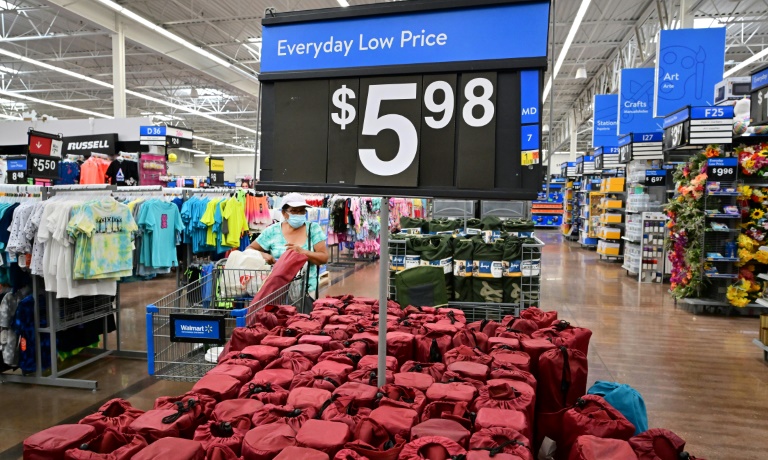
A key US inflation measure showed price increases held steady in the 12 months ended in May, while consumer spending growth slowed sharply, a good sign in the battle against soaring prices.

Any sign of moderation will be a boon to President Joe Biden whose approval ratings have tumbled, as his administration has struggled to find effective tools to help American families feeling the pain of surging gasoline, food and housing prices.

The trend also offers comfort to the Federal Reserve, showing its aggressive interest rate strategy is starting to have an impact to quell the fastest surge in inflation in more than 40 years.

The personal consumption expenditures (PCE) price index rose 6.3 percent compared to May 2021, still high but the same pace as in the prior month, the Commerce Department reported Thursday.

The index jumped 0.6 percent compared to April, much faster than in the prior month, but slightly below what economists had projected.

But spending edged up just 0.2 percent, less than half the increase in April and part of a steady downward drift as consumers pull back amid surging prices.

Buoyed by a stockpile of savings, helped by massive government aid, consumers have been the lynchpin in the rapid US recovery from the pandemic downturn.

But strong demand clashed with global supply chain snarls and the world’s largest economy has been battered for months by a cresting inflation wave, made more painful by the surge in energy prices sparked by the Russian invasion of Ukraine in late February.

Excluding volatile food and energy prices, “core” PCE rose 0.3 percent in the month, the same as in April, while the 12-month pace slowed slightly to 4.7 percent, the report said.

– Fed inflation battle –

Brian Deese, head of the White House National Economic Council, noted that the three-month annual average for core PCE fell to four percent from 5.2 percent.

“That is important moderation that we’re seeing,” he said on CNBC. 

However, he said the headline continues to be driven by higher energy prices.

Energy prices jumped four percent in the month, after dropping in April, and are 35.8 percent higher than May 2021, the data showed.

The PCE price index is the Federal Reserve’s preferred inflation gauge, as it reflects consumers’ actual spending, including shifts to lower cost items, unlike the more well-known consumer price index, which jumped 8.6 percent in May.

PCE also gives less weight to things like rent, vehicles and airline fares, which have contributed to the blistering pace of the CPI rise.

The Fed early this month announced the biggest hike in the benchmark lending rate in nearly 30 years, a three-quarter point increase that was the third step in its counteroffensive against rising inflation, as it aims to cool demand.

Policymakers have signaled there is a good chance of another similar increase in late July, followed by more big steps in coming months.

That has raised concerns the Fed could push the economy into a recession — a price Fed Chair Jerome Powell signaled the central bank is willing to pay to control inflation.

– Slower spending –

The signs of consumers pulling back will weigh on second quarter GDP growth, after the Commerce Department revised first-quarter consumer spending sharply lower, cutting it to 1.8 percent from 3.1 percent, as the economy contracted 1.6 percent.

Diane Swonk of Grant Thornton estimates that “consumers have drained about $600 billion of the excess $2.5 trillion in savings they amassed during the pandemic to deal with the bite of higher prices.”

The key driver of the slower consumption growth in May was the sharp drop in spending on big-ticket manufactured items, that economists note reflects a pull back on vehicle sales.

Spending on services rose 0.7 percent in the month, the same as in April.

Six anti-coup protesters killed in Sudan mass rallies

At least six Sudanese demonstrators were killed Thursday as security forces sought to quash mass rallies of protesters demanding an end to military rule, pro-democracy medics said.

In one of the most violent days this year in an ongoing crackdown on the anti-coup movement, AFP correspondents reported security forces firing tear gas and stun grenades to disperse tens of thousands of protesters.

“Even if we die, the military will not rule us,” protesters chanted, urging the reversal of an October military coup by army chief Abdel Fattah al-Burhan that prompted foreign governments to slash aid, deepening a chronic economic crisis.

At least four of the six killed were shot, two in the chest, another in the head, and one in the back, the medics said, raising the overall death toll to 109 from protest-related violence since October.

“Down with Burhan’s rule,” crowds chanted, with protests and violence flaring in both the capital Khartoum and its suburbs, including the twin city of Omdurman.

Medics also reported “several attempts to storm hospitals in Khartoum,” with security forces firing tear gas into one hospital, where some of those injured during the protests had been taken.

An AFP correspondent said internet and phone lines had been disrupted since the early hours of Thursday, a measure the Sudanese authorities often impose to prevent mass gatherings.

Security was tight in Khartoum despite the recent lifting of a state of emergency imposed after the coup.

Troops and police blocked roads leading to both army headquarters and the presidential palace, witnesses said. Shops around the capital were largely shuttered.

Activists have been calling for “million-strong” rallies.

– ‘Violence needs to end’ –

UN special representative Volker Perthes said Thursday that “violence needs to end”, while the US embassy in Khartoum urged restraint and “the protection of civilians so that no more lives are lost”.

Sudan’s foreign ministry has repeatedly criticised the UN envoy’s comments, saying they were built on “assumptions” and “contradict his role as facilitator” in troubled talks on ending Sudan’s political crisis.

The latest protests come on the anniversary of a previous coup in 1989, that toppled the country’s last elected civilian government and ushered in three decades of iron-fisted rule by Islamist-backed General Omar al-Bashir.

They also come on the anniversary of 2019 protests demanding that the generals, who had ousted Bashir in a palace coup earlier that year, cede power to civilians.

Those protests led to the formation of the mixed civilian-military transitional government which was toppled in last year’s coup.

Sudan has been roiled by near-weekly protests as the country’s economic woes have deepened since Burhan seized power last year.

“June 30 is our way to bring down the coup and block the path of any fake alternatives,” said the Forces for Freedom and Change, an alliance of civilian groups whose leaders were ousted in the coup.

Alongside the African Union and east African bloc IGAD, the United Nations has been attempting to broker talks between the generals and civilians, but they have been boycotted by all the main civilian factions.

The UN has warned that the deepening economic and political crisis has pushed one third of the country’s population of more than 40 million towards life-threatening food shortages.
Ketanji Brown Jackson sworn in as first Black woman on US Supreme Court

The United States made history on Thursday as Ketanji Brown Jackson was sworn in as the first Black woman to serve on the Supreme Court.

The 51-year-old’s appointment by Democratic President Joe Biden means white men are not in the majority on the nation’s highest court for the first time in 233 years.

While her confirmation is a milestone, it won’t change the 6-3 conservative majority on the court, which has come under fire for recent rulings broadening the right to bear arms and eviscerating abortion rights.

Jackson spoke only to say her oaths during Thursday’s brief ceremony.

She had picked up support from three Senate Republicans during a grueling and at times brutal confirmation process, delivering Biden a bipartisan 53-47 approval for his first Supreme Court nominee.

Jackson’s swearing-in marks a major moment for Biden, who chaired the Senate Judiciary Committee in the 1980s and 90s, meaning he has the unprecedented distinction of both naming and overseeing the appointment of a Supreme Court justice.

The appointment presents an opportunity for his administration to pivot from a spate of bad news in recent months, with Biden’s poll ratings still languishing below 40 percent amid runaway inflation ahead of midterm elections in November.

Crucially, it has allowed Biden to show the Black voters who rescued his floundering 2020 primary campaign that he can deliver for them.

At 42 days, the confirmation was among the shortest in history, although longer than it took to seat Donald Trump’s last court pick during his presidency, Amy Coney Barrett.

As the final word on all civil and criminal legal disputes, as well as guardian and interpreter of the Constitution, the Supreme Court seeks to ensure equal justice under the law.

Four of the justices on the nine-member court are now women, making it the most diverse bench in history — although they all attended the elite law schools of Harvard or Yale.

Close Bitnami banner
Bitnami