World

Ecuador to cut fuel prices that sparked protests

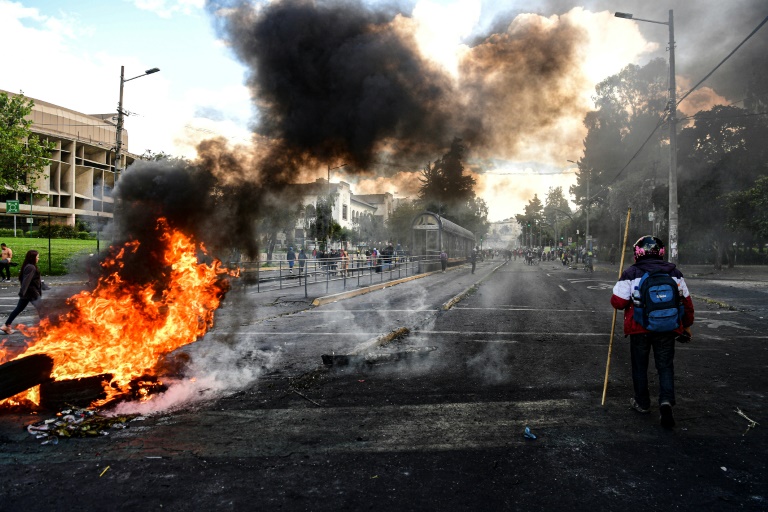
President Guillermo Lasso announced Sunday that Ecuador will cut fuel prices, which had sparked weeks of demonstrations, though not by as much as protesters have demanded.

“I have decided to reduce the price of gasoline by 10 cents per gallon and diesel also by 10 cents per gallon,” he said in a television and radio address.

The powerful Confederation of Indigenous Nationalities of Ecuador (Conaie), which since June 13 has been blocking roads and occupying oil wells in different parts of the country, had demanded a reduction in prices by an additional 30 cents and 35 cents, respectively.

Earlier on Sunday, the country’s energy ministry warned that oil production had reached a “critical” level and could be halted entirely within 48 hours if the protests and roadblocks continued.

The protests, which are also against rising living costs, have crippled transportation in Ecuador, with roadblocks set up in 19 of the oil-rich country’s 24 provinces.

“Oil production is at a critical level,” the ministry said in a statement.

“If this situation continues, the country’s oil production will be suspended in less than 48 hours as vandalism, the seizure of oil wells and road closures have prevented the transport of equipment and diesel needed to keep operations going.”

“Today, the figures show a decrease of more than 50 percent” in production, which was at roughly 520,000 barrels per day before the protests, it said.

Ecuador’s economy is highly dependent on oil revenues, with 65 percent of output exported in the first four months of 2022.

– Impeachment debate –

Late on Sunday, the country’s parliament suspended seven hours of debate over whether to impeach Lasso, with proceedings set to resume on Tuesday. At least 20 members of parliament are still due to speak.

The president’s impeachment would require 92 of the 137 possible votes in the National Assembly, where the opposition holds a fragmented majority. MPs will have a maximum of 72 hours to vote following the end of the debate. 

An estimated 14,000 protesters have taken part in the nationwide demonstrations, most of them in Quito.

Shortages are already being reported in the capital, where prices have soared.

Violence between police and demonstrators has reportedly left five dead, while about 500 people have been injured.

Earlier in the day, Production Minister Julio Jose Prado said that public-private economic losses from the protests totaled $500 million.

“Each additional day of downtime represents $40 to $50 million lost,” he said on Sunday.

Overall losses since the protests began include 8.5 million liters of milk worth $13 million as well as $90 million in agricultural goods and livestock.

The tourism industry has seen cancellations rise to 80 percent, with losses amounting to at least $50 million.

Additionally, “in the flower farm sector, 12 days of shutdown resulted in $30 million in losses and damage to trucks and farms,” Prado said.
Stampede at New York Pride parade after fireworks mistaken for gunfire

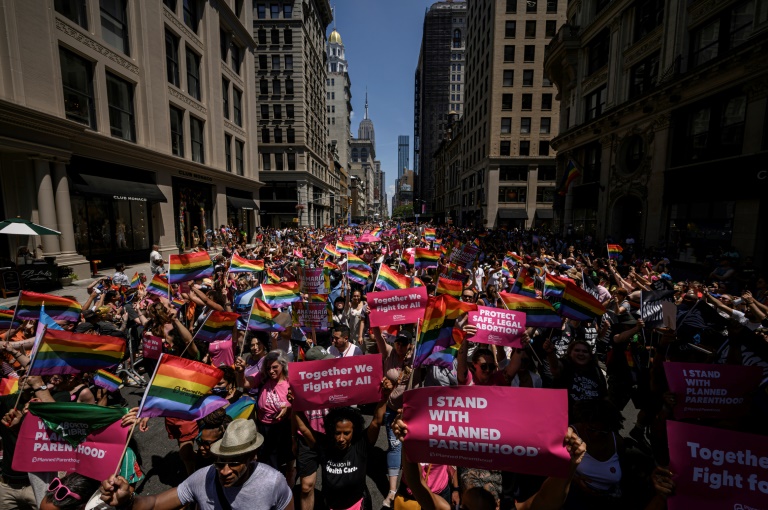
A stampede occurred at a Pride parade in the US city of New York on Sunday, with hundreds of people attempting to flee after mistaking the sound of fireworks for gunfire, police said.

“There were NO shots fired in Washington Square Park. After an investigation, it was determined that the sound was fireworks set off at the location,” the NYPD said in a tweet shortly after the incident. 

Police told AFP “there were no serious injuries” from the stampede.

Terrified people ran or walked briskly along a street adjacent to the square after the scare, videos on social media showed.

Tens of thousands of people attended Sunday’s LGBTQIA+ Pride parade, which wound its way through the streets of lower Manhattan under the blazing sun.

The atmosphere was largely festive, although the shadow of Friday’s US Supreme Court decision to abolish a constitutional right to abortion — leaving states to legislate on the matter themselves — loomed over proceedings.

New York’s Pride parade is the second-largest in the United States, after San Francisco, and Sunday’s gathering was the first time it had taken place since the Covid-19 pandemic began.

Organizers said the US Supreme Court decision on abortion was “devastating.”

“This dangerous decision puts millions in harm’s way, gives government control over our individual freedom to choose, and sets a disturbing precedent that puts many other constitutional rights and freedoms in jeopardy,” organizers said. 

Many rights groups fear that the verdict on abortion could be the beginning of a broader push by the Supreme Court, currently dominated by a conservative majority, to curtail other freedoms won in recent decades, such as rights to contraception or same-sex marriage. 

'Crime not to help': South Korean ex-SEAL has no Ukraine regrets

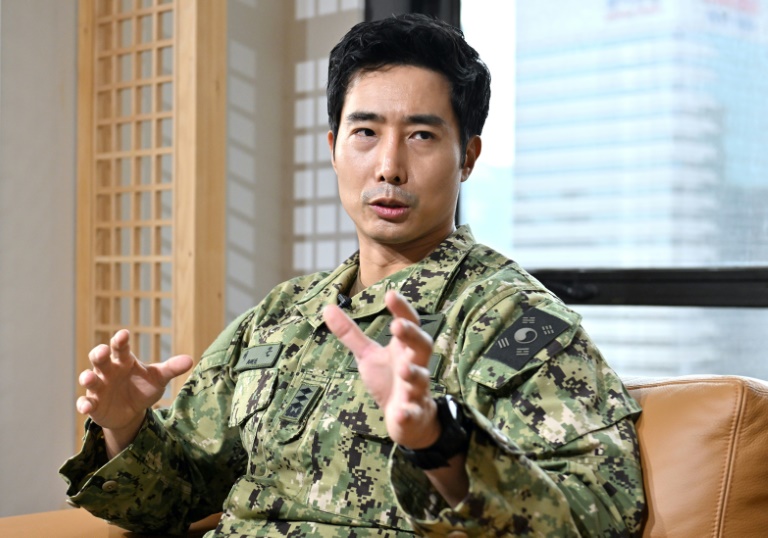
A former South Korean Navy SEAL turned YouTuber who risked jail time to leave Seoul and fight for Ukraine says it would have been a “crime” not to use his skills to help.

Ken Rhee, an ex-special warfare officer, signed up at the Ukrainian Embassy in Seoul the moment President Volodymyr Zelensky asked for global volunteers and was fighting on the front lines near Kyiv by early March.

To get there, he had to break South Korean law — Seoul banned its citizens from travelling to Ukraine, and Rhee, who was injured in a fall while leading a special operations patrol there, was met at the airport by 15 police officers on his return.

But the celebrity ex-soldier, who has a YouTube channel with 700,000 followers and documented much of his Ukraine experience on his popular Instagram account, says he has no regrets.

“You’re walking down the beach and you see a sign by the water saying ‘no swimming’ — but you see someone drowning. It’s a crime not to help. That’s how I see it,” he told AFP.

Rhee was born in South Korea but raised in the United States. He attended the Virginia Military Institute and planned to join the US Navy SEALS, but his father — a “patriot”, he says — convinced his son to return to South Korea to enlist.

He served for seven years, undergoing both US and Korean SEAL training and doing multiple stints in war zones in Somalia and Iraq before leaving to set up a defence consultancy.

“I have the skillset. I have the experience. I was in two different wars, and going to Ukraine, I knew I could help,” he said, adding that he viewed breaking South Korea’s passport law to leave as equivalent to a “traffic violation”.

– Backlash in Korea –

But the reaction in South Korea — where Rhee shot to fame as a trainer in the popular YouTube series “Fake Men” — was swift and unforgiving.

“It was instant. People in Korea, they just criticised me about breaking the law,” said Rhee.

His critics claim the 38-year-old’s decision was criminally irresponsible, and point to his posting of war footage on his YouTube and Instagram accounts as evidence of showboating.

Rhee says he tries not to let the furore get to him. “I think it’s pretty obvious who the good guys are and who the bad guys are,” he said of Russia and Ukraine. 

On his first day on the frontline in Irpin — which he describes as “the Wild West” and “chaos” — he says he witnessed Russian war crimes.

“I saw a civilian get shot. He was driving… and they shot him through the windshield and he died in front of us,” he said.

“It was like: there’s my proof. There’s definitely war crimes going on. It reminded me and my teammates what we were doing and why we were there,” he said.

Because of his military training, Rhee was told to set up his own team, so he recruited other volunteers with combat experience and set up a multi-national special operations group.

“I was eating Canadian MREs. My gun was from the Czech Republic. I have a Javelin missile from the United States. I have a rocket that’s from Germany… but nothing is Korean,” he said.

He tried to take his Korean-made night vision goggles but was not given government export permission. Seoul has provided non-lethal aid to Kyiv, but Rhee said they could do more.

“Korea has state-of-the-art equipment… they’re very good at making weapons,” he said.

– ‘See you in Taiwan’ –

Russia said earlier this month that 13 South Koreans had travelled to Ukraine — including four who were killed. Seoul said it was trying to verify the claims.

Although Rhee did not know the fate of all his teammates, he said “a lot of my friends have died”.

“I don’t want my friends’ sacrifices to be forgotten,” he said, adding that he plans to write a book — and maybe a screenplay — about his team’s experiences.

But first, he needs to deal with the official repercussions of his trip. He is quietly optimistic South Korea’s new conservative administration won’t put him in jail.

Rhee is not allowed to leave the country until his case is resolved, and is receiving treatment for his injuries. But he hopes one day to fight alongside his teammates again, for a cause they believe in.

The joke as people left the frontline was: “See you in Taiwan,” he said, referring darkly to the risk that Beijing will follow Moscow’s lead and invade a neighbouring democracy.

Japan swelters as heatwave prompts power crunch warning

Japan’s government warned Monday of a power crunch as extreme heat hits the country, with temperature records toppling and Tokyo’s rainy season declared over at the earliest date on record.

Residents in and around the capital have been asked to conserve energy, particularly in the early evening.

Temperatures of 35 degrees Celsius (95 degrees Fahrenheit) are forecast in Tokyo throughout Monday, and the mercury is not expected to drop below 34 until Sunday, according to the Japan Meteorological Agency (JMA).

“We ask the public to reduce energy consumption during the early evening hours when the reserve ratio falls,” Yoshihiko Isozaki, deputy chief cabinet secretary, told a regular press briefing.

But he warned that residents should do what was needed to stay cool and avoid heatstroke.

Much of Japan would normally be experiencing rainy season at this time of year, but the JMA on Monday declared the season over in the Kanto region, home to Tokyo, and neighbouring Koshin area.

It was the earliest end to the season since records began in 1951 and a full 22 days earlier than usual.

The agency also declared an end to rainy season in central Japan’s Tokai and part of southern Kyushu, saying this year’s rainy season in these areas and Kanto-Koshin was the shortest on record.

On Sunday, Isesaki city in Gunma prefecture north of Tokyo logged the hottest temperature ever seen in Japan in June, at 40.2C.

“Immediately after the rainy season ends, many people are yet to be fully acclimated to heat and face a greater risk of heat stroke,” the weather agency warned in a statement.

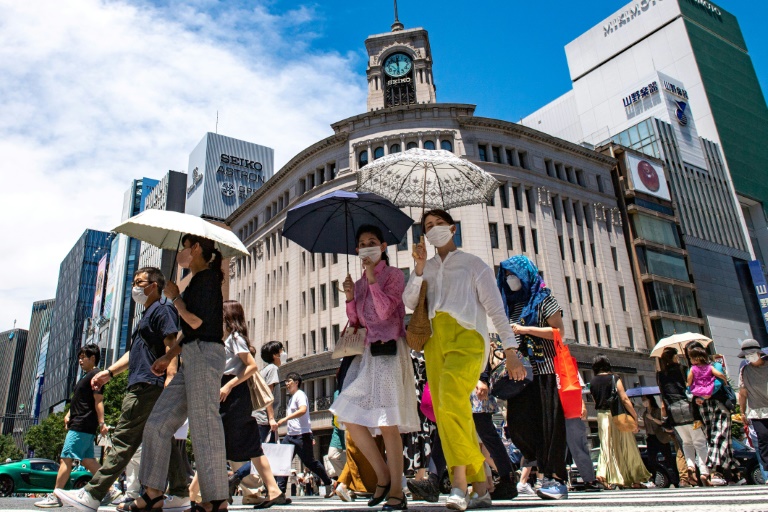
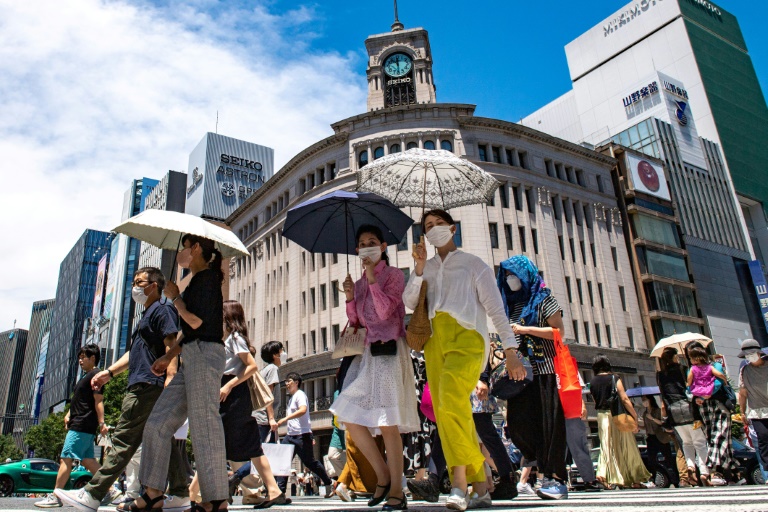
Asako Naruse, 58, was out sightseeing in Ginza alongside pedestrians carrying parasols for shade.

“Every year, July and August are this hot, but it’s the first time I’ve felt such heat in June,” she told AFP.

“I’m from northern Japan, so these temperatures seem really extreme.”

Japan swelters as heatwave prompts power crunch warning

Japan’s government warned Monday of a power crunch as extreme heat hits the country, with temperature records toppling and Tokyo’s rainy season declared over at the earliest date on record.

Residents in and around the capital have been asked to conserve energy, particularly in the early evening.

Temperatures of 35 degrees Celsius (95 degrees Fahrenheit) are forecast in Tokyo throughout Monday, and the mercury is not expected to drop below 34 until Sunday, according to the Japan Meteorological Agency (JMA).

“We ask the public to reduce energy consumption during the early evening hours when the reserve ratio falls,” Yoshihiko Isozaki, deputy chief cabinet secretary, told a regular press briefing.

But he warned that residents should do what was needed to stay cool and avoid heatstroke.

Much of Japan would normally be experiencing rainy season at this time of year, but the JMA on Monday declared the season over in the Kanto region, home to Tokyo, and neighbouring Koshin area.

It was the earliest end to the season since records began in 1951 and a full 22 days earlier than usual.

The agency also declared an end to rainy season in central Japan’s Tokai and part of southern Kyushu, saying this year’s rainy season in these areas and Kanto-Koshin was the shortest on record.

On Sunday, Isesaki city in Gunma prefecture north of Tokyo logged the hottest temperature ever seen in Japan in June, at 40.2C.

“Immediately after the rainy season ends, many people are yet to be fully acclimated to heat and face a greater risk of heat stroke,” the weather agency warned in a statement.

Asako Naruse, 58, was out sightseeing in Ginza alongside pedestrians carrying parasols for shade.

“Every year, July and August are this hot, but it’s the first time I’ve felt such heat in June,” she told AFP.

“I’m from northern Japan, so these temperatures seem really extreme.”

Ecuador to cut fuel prices that sparked protests

Ecuadoran President Guillermo Lasso announced Sunday that the country will cut fuel prices, which had sparked weeks of demonstrations, though not by as much as protesters have demanded.

“I have decided to reduce the price of gasoline by 10 cents per gallon and diesel also by 10 cents per gallon,” he said in a broadcasted address.

The powerful Confederation of Indigenous Nationalities of Ecuador (Conaie), which since June 13 has been blocking roads and occupying oil wells in different parts of the country, had demanded a reduction in prices by an additional 30 cents and 35 cents, respectively.

Earlier on Sunday, the country’s energy ministry warned that oil production had reached a “critical” level and could be halted entirely within 48 hours if the protests and roadblocks continued.

The protests, which are also against rising living costs, have crippled transportation in Ecuador, with roadblocks set up in 19 of the oil-rich country’s 24 provinces.

“Oil production is at a critical level,” the ministry said in a statement.

“If this situation continues, the country’s oil production will be suspended in less than 48 hours as vandalism, the seizure of oil wells and road closures have prevented the transport of equipment and diesel needed to keep operations going.”

“Today, the figures show a decrease of more than 50 percent” in production, which was at roughly 520,000 barrels per day before the protests, it said.

Ecuador’s economy is highly dependent on oil revenues, with 65 percent of output exported in the first four months of 2022.

An estimated 14,000 protesters have taken part in the nationwide demonstrations, most of them in Quito.

Shortages are already being reported in the capital, where prices have soared.

Violence between police and demonstrators has reportedly left five dead, while about 500 people have been injured, according to various sources.

Earlier in the day, Production Minister Julio Jose Prado said that public-private economic losses from the protests totaled $500 million.

“Each additional day of downtime represents $40 to $50 million lost,” he said on Sunday.

Overall losses since the protests began include 8.5 million liters of milk worth $13 million as well as $90 million in agricultural goods and livestock.

The tourism industry has seen cancellations rise to 80 percent, with losses amounting to at least $50 million.

Additionally, “in the flower farm sector, 12 days of shutdown resulted in $30 million in losses and damage to trucks and farms,” Prado said.
Fear and defiance for families of Philippine drug war dead

Six years after four policemen burst into her Manila slum shack and shot dead her husband and teenage son, Mary Ann Bonifacio fears for her own life as she fights for justice. 

Bonifacio is pursuing the men in court in the hope of proving they unlawfully killed her loved ones — a rare example of officers tasked with carrying out Philippine President Rodrigo Duterte’s drug war facing trial.

Official data show more than 6,200 people have died in police anti-narcotics operations since Duterte swept to power in 2016 promising to rid the country of drugs.

But rights groups estimate tens of thousands of mostly poor men have been killed by officers and vigilantes, even without proof they were linked to drugs.   

While the crackdown has been widely condemned and sparked an international investigation, only three policemen have been convicted for killing a drug suspect.

Lawyers say most families are too scared to go after their relatives’ killers or do not have the money or time to pursue a case in the Philippines’ creaky judicial system.  

For Bonifacio, who has five other children, the decision to take legal action meant giving up a normal life.

Fearing the officers, who are on bail, or their supporters could go after her and her family, Bonifacio has moved house several times and is always looking over her shoulder. 

“There is that possibility (of being killed),” she said, appearing older than her 48 years. 

Bonifacio, who washes clothes and cleans houses to make ends meet, added: “I also have to think about my children’s safety.”

She filed a criminal complaint for murder in 2017, insisting her husband Luis, an unemployed decorator, and son Gabriel, a waiter, were not involved in drugs and were unarmed when police opened fire.

But it took the Ombudsman four years to bring the lesser charge of homicide against the policemen after finding their actions “went beyond the call of (self-) preservation”.

The officers said they acted in “self-defence” after the men shot at them, and have asked the court to dismiss the case for lack of evidence. 

In court, Bonifacio sits next to the accused killers due to a lack of space. The men are set to give evidence on August 9.

“I do not wish them dead. I want to make them understand that what they did was wrong and ensure they will not do it to other people again,” Bonifacio said.

But accessing evidence held by the police, the same institution that prosecutes the drug war, is a major stumbling block, Bonifacio’s lawyer Kristina Conti said.

“For these kinds of crimes, the burden of accountability cannot simply fall upon the victims or survivors,” Conti added.

Raquel Fortun, one of only two forensic pathologists in the Philippines, has been working with a Catholic priest and families to gather evidence she hopes could be used in court.

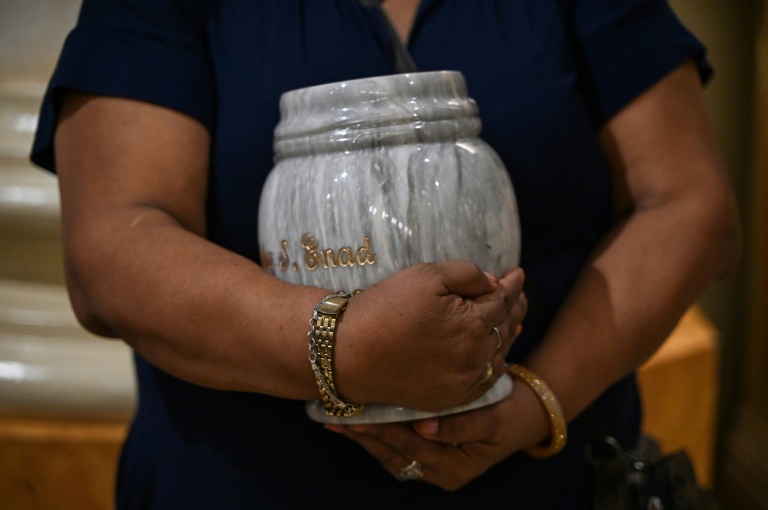
She has been examining some of the exhumed remains of drug war victims whose bodies are being removed from temporary burial sites and cremated.

Her findings cast doubt on the most common police claim that suspects “fought back”.

“I’m seeing some cases where you’ve got gunshot wounds on the wrists, on the forearms, on the hands, and these are what we would typically call defence-type injuries,” she told AFP. 

“So instinctively that individual must have put up an arm, a hand. So how can that person have fought back?”

– ‘We will continue to fight’ –

At the height of the drug war, Bonifacio said killings happened almost “every night” in her hardscrabble neighbourhood. 

Her traumatised youngest son, now 13, often wakes up crying from nightmares about being chased by police trying to kill him. 

He turns off the television when Duterte appears, and runs away when he sees an officer.

The family lock their front door from early evening, get off a bus if a man resembling a policeman boards, and makes only brief visits to the cemetery in case someone attacks them.

Bonifacio said the policemen who shot her husband and son should have followed “the proper process” in what the authorities described as a drug sting operation.

But she also blames Duterte for ordering them to kill suspects.

“I think he should go to jail as well,” she said.

Duterte, who will lose his protection from prosecution when he steps down as president on Thursday, openly ordered the police to kill drug suspects if officers’ lives were in danger.

He has said he hopes his successor, Ferdinand Marcos Jr, will pursue the crackdown that Duterte admits failed to wipe out drugs.

“We continue to suffer the drug problem. It won’t go away because of the lure of billions for traffickers,” the outgoing leader said recently.

Duterte has refused to cooperate with an International Criminal Court probe into the crackdown.

Justice Secretary Menardo Guevarra told the United Nations Human Rights Council in March that his office had reviewed around 300 cases of drug war operations that led to deaths.

So far charges have been filed in five of them, he told AFP Thursday.

Bonifacio is determined to continue her own quest for justice, if only to prevent another family from experiencing her anguish.

“We will continue to fight,” she said.

Rival camps dig in for fight after US abortion ruling

Elected leaders across the US political divide rallied Sunday for a long fight ahead on abortion — state by state and in Congress — with total bans in force or expected soon in half of the country.

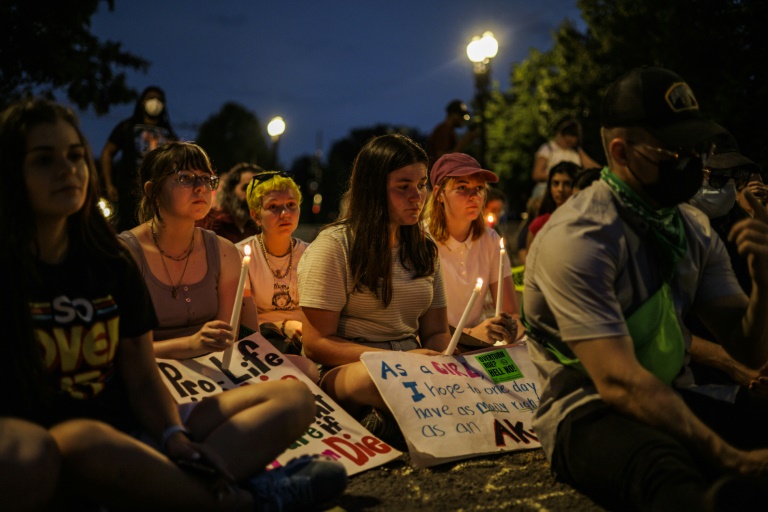
Two days after the US Supreme Court scrapped half-century constitutional protections for the procedure, abortion rights defenders kept up their mobilization, with several hundred gathered outside the high court during a candlelight vigil in Washington Sunday.

Dozens of arrests and some instances of vandalism were reported during a weekend of mostly peaceful protests that turned disorderly in places — as the country grapples with a new level of division: between states where abortion is or will soon be illegal, and those that still allow it.

Conservative-led US state legislatures have moved swiftly, with at least eight imposing immediate bans on abortion — many with exceptions only if a woman’s life is in danger — and a similar number to follow suit within weeks.

In a first glimpse of the legal battles ahead, the nation’s largest abortion provider Planned Parenthood filed suit in Utah seeking to block the state’s ban.

And Democratic governors in Michigan and Wisconsin have stepped in to try to keep abortion legal in their Midwestern states.

Defending the ban now in effect in South Dakota, which makes no exception for victims of rape or incest, Republican Governor Kristi Noem called the Supreme Court’s ruling “wonderful news in the defense of life.”

Speaking on ABC’s “This Week,” Noem also voiced support for legislation banning “telemedicine abortions” in which a doctor prescribes pills to end a pregnancy — set to become a key resource in many places where abortion is illegal.

Governor Asa Hutchinson of Arkansas likewise argued that “forcing someone to carry a child to term” in order to save an unborn baby was an “appropriate” use of government power.

States should now focus on helping mothers and newborns by expanding services including adoption, he said on NBC’s “Meet the Press.”

But the Republican also opposed calls to go further with a federal abortion ban — an ultimate goal of many on the religious right — or restrictions on contraception, which he said is “not going to be touched” in Arkansas.

Fears that the Supreme Court’s strong conservative majority — made possible by Donald Trump — will now seek to target other rights like same-sex marriage and contraception have fueled the nationwide mobilization since Friday.

– ‘Appalling’ –

President Joe Biden has condemned the Supreme Court’s ruling as a “tragic error” — but with power now resting with often anti-abortion state legislatures, he has also acknowledged his hands are largely tied.

The president’s main hope is for voters to turn out in defense of abortion rights in November’s midterm elections — and in the meantime, Biden’s Democrats have vowed to defend women’s reproductive rights every way they can.

In Wisconsin, where an 1849 law banning abortion except to save the life of the mother may go into effect, Governor Tony Evers vowed to offer clemency to any doctors who face prosecution, according to local media.

And Michigan’s Governor Gretchen Whitmer promised to “fight like hell,” saying a temporary injunction has been filed to keep abortion legal in her state.

Congresswoman Alexandria Ocasio-Cortez warned nightmare scenarios may soon come true — as women are forced to continue with unwanted pregnancies, travel long distances to states where abortion remains legal, or undergo clandestine abortions.

“Forcing women to carry pregnancies against their will will kill them. It will kill them,” the progressive lawmaker told NBC, urging Biden to explore opening health care clinics on federal lands in conservative states in order to help people access abortion services.

A CBS poll released Sunday showed that a solid majority — 59 percent — of Americans and 67 percent of women disapproved of the court’s ruling.

While thousands of people rallied peacefully through the weekend — most of them in protest, but many others celebrating — there were isolated incidents of violence. Police fired tear gas on protesters in Arizona and a pickup truck drove through a group of protesters in Iowa.

In the Virginia city of Lynchburg, police were investigating a case of vandalism Saturday at an anti-abortion pregnancy center — which was spray-painted with graffiti and had its windows smashed.

And in Colorado, police were probing a suspected arson attack Saturday at a similar anti-abortion center in the town of Longmont, which was painted with graffiti reading: “If abortions aren’t safe, neither are you.”

Four dead, hundreds hurt as stands collapse in Colombia bullring

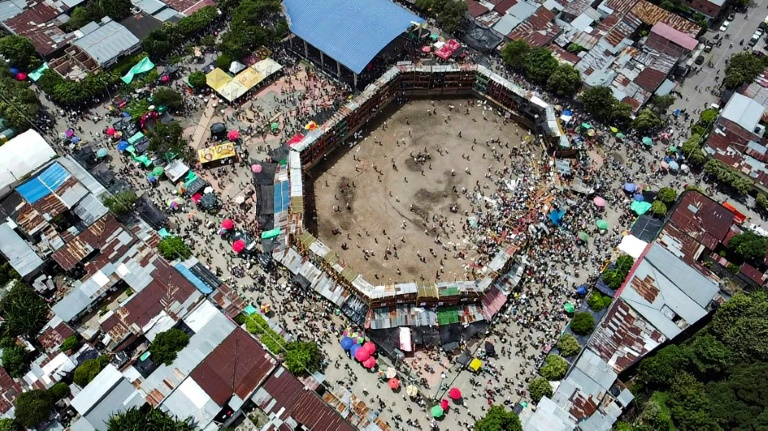
At least four people were killed and more than 300 injured on Sunday when the grandstand at a bullring in Colombia collapsed during a popular event at which members of the public face off with small bulls, officials said.

“There are four people dead at the moment — two women, a man and a child,” the governor of Tolima department, Jose Ricardo Orozco, told local radio after the incident in the central city of El Espinal.

A full three-story section of wooden stands filled with spectators collapsed, throwing dozens of people to the ground, according to images broadcast on social media.

Another video taken by someone at the scene showed people trying to escape from the stands while a bull continues to roam in the arena.

Hospitals in the region reported having treating about 322 injured people, four of whom are in intensive care, Tolima Health Secretary Martha Palacios said.

Local civil defense official Luis Fernando Velez said they did not know how many people were still buried in the debris, but noted that the section of stands was full when it collapsed.

The event was part of celebrations surrounding the San Pedro festival, the most popular in the region.

“We will request an investigation of the facts about what happened,” Colombia’s outgoing President Ivan Duque said on Twitter, expressing his solidarity with the families of those killed and hurt.

Orozco said the departmental government would move to ban the so-called “corralejas” in which residents try their luck in the ring, saying they were dangerous and promoted animal abuse.

On Saturday, several people were injured in accidents at the corralejas in El Espinal, which is home to about 78,000 people, and is located about 150 kilometers (93 miles) from the capital Bogota.

Another person died earlier this month after being gored by a bull during a corraleja in the town of Repelon.

President-Elect Gustavo Petro, who will take office on August 7, joined Orozco in calling for the amateur bullfights to be banned.

When he served as mayor of Bogota, the leftist Petro put a stop to bullfights in the city’s signature bullring, La Santamaria.

While animal abuse is a crime in Colombia, bullfights and cock fights are protected because of the cultural history behind them.

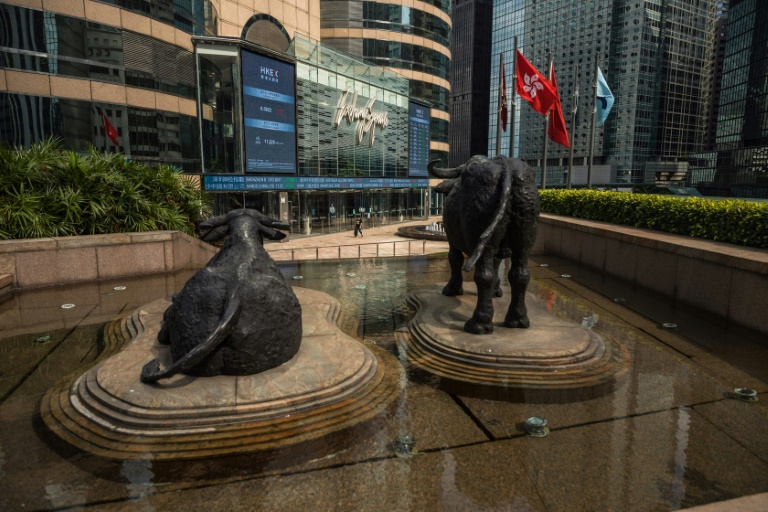
Asian markets extend rally as rate hike fears subside

Asian markets rallied again Monday, building on last week’s advances and following a strong performance on Wall Street as speculation that inflation may have peaked tempered expectations about central bank interest rate hikes.

With prices surging at a pace not seen in a generation, finance chiefs have been forced to lift borrowing costs and wind back their ultra-loose monetary policies in recent months, sending a chill across trading floors.

But a string of weak data has led many investors to believe that inflation may have plateaued or is about to, giving room for banks to be less hawkish.

The prospect that rates will not go as high as initially expected helped send Wall Street stocks higher Friday, with the S&P 500 and Nasdaq ending up more than three percent.

And Asia continued last week’s rally.

Hong Kong led gainers, climbing more than two percent thanks to a strong performance in Chinese tech firms. Indications that China’s crackdown on the sector could be coming to an end added to the upbeat mood in the city.

Tokyo, Shanghai, Seoul, Singapore, Sydney, Manila and Wellington were also well up.

“Market conviction that perhaps the Fed won’t now hike rates as aggressively as previously feared and/or that rate cuts before the end of 2023 are now an even more realistic prospect if recession-like conditions lay ahead, have had a big hand in last week’s improvement in risk sentiment,” said National Australia Bank’s Ray Attrill.

He added that the rally had helped pare about two-thirds of the losses suffered in a painful sell-off from June 9-16.

While Fed chiefs continue to flag further big interest rate hikes in the pipeline, expectations for a prolonged period of increases have waned, which has in turn taken some heat out of the dollar.

Bitcoin has also won some support, after falling to as low as $17,600 last week for the first time since December 2020.

“There’s a feeling that things aren’t as bad as we thought they were going to be,” Carol Pepper, of Pepper International, told Bloomberg Radio.

“There’s a hope that perhaps we’ve oversold, perhaps there’s not going to be a recession,” she said.

– Key figures at around 0230 GMT –

Tokyo – Nikkei 225: UP 1.0 percent at 26,768.77 (break)

Hong Kong – Hang Seng Index: UP 2.7 percent at 22,297.74

Shanghai – Composite: UP 0.8 percent at 3,377.22

Dollar/yen: DOWN at 134.63 yen from 135.17 yen late Friday

Pound/dollar: UP at $1.2282 from $1.2280

Euro/dollar: UP at $1.0563 from $1.0559

Euro/pound: UP at 86.01 pence from 85.95 pence

West Texas Intermediate: DOWN 0.2 percent at $107.41 per barrel

Brent North Sea crude: FLAT at $113.10 per barrel

New York – Dow: UP 2.7 percent at 31,500.68 (close)

London – FTSE 100: UP 2.7 percent at 7,208.81 (close)

Close Bitnami banner
Bitnami