World

Ecuador warns protests could force halt to oil production

Ecuador’s energy ministry warned Sunday that oil production had reached a “critical” level and could be halted entirely within 48 hours if protests and roadblocks continue in the crisis-wracked South American country.

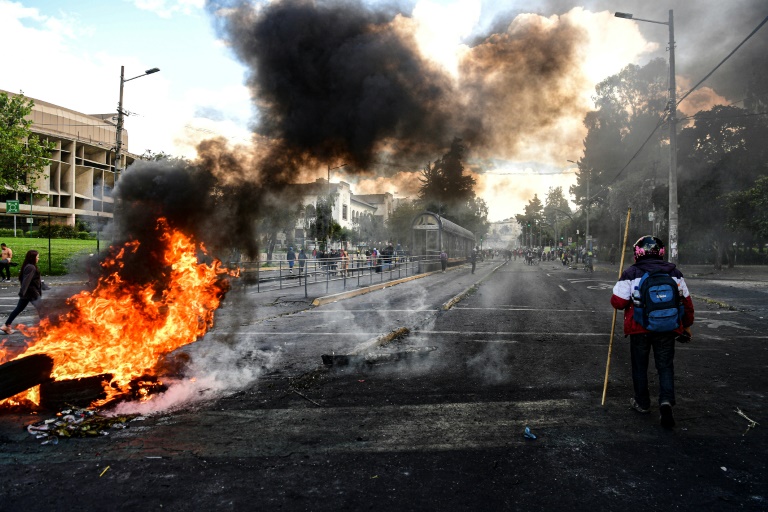
Nearly two weeks of Indigenous-led protests against rising fuel prices and living costs have crippled transportation in Ecuador, with roadblocks set up in 19 of the oil-rich country’s 24 provinces.

“Oil production is at a critical level,” the ministry said in a statement.

“If this situation continues, the country’s oil production will be suspended in less than 48 hours as vandalism, the seizure of oil wells and road closures have prevented the transport of equipment and diesel needed to keep operations going.”

“Today, the figures show a decrease of more than 50 percent” in production, which was at roughly 520,000 barrels per day before the protests, it said.

Ecuador’s economy is highly dependent on oil revenues, with 65 percent of output exported in the first four months of 2022.

An estimated 14,000 protesters are taking part in the nationwide demonstrations, most of them in Quito.

Shortages are already being reported in the capital, where prices have soared.

Violence between police and demonstrators has reportedly left five dead, while about 500 people have been injured, according to various sources.

The National Assembly will eventually vote on whether to oust President Guillermo Lasso over what opposition lawmakers say is his role in the protests, with a no-confidence hearing resuming for a second day late Sunday.

Earlier in the day, Production Minister Julio Jose Prado said that public-private economic losses from the protests totaled $500 million.

“Each additional day of downtime represents $40 to $50 million lost,” he said on Sunday.

Overall losses since the protests began include 8.5 million liters of milk worth $13 million as well as $90 million in agricultural goods and livestock.

The tourism industry has seen cancellations rise to 80 percent, with losses amounting to at least $50 million.

Additionally, “in the flower farm sector, 12 days of shutdown resulted in $30 million in losses and damage to trucks and farms,” Prado said.

Ecuador warns protests could force halt to oil production

Ecuador’s energy ministry warned Sunday that oil production had reached a “critical” level and could be halted entirely within 48 hours if protests and roadblocks continue in the crisis-wracked South American country.

Nearly two weeks of Indigenous-led protests against rising fuel prices and living costs have crippled transportation in Ecuador, with roadblocks set up in 19 of the oil-rich country’s 24 provinces.

“Oil production is at a critical level,” the ministry said in a statement.

“If this situation continues, the country’s oil production will be suspended in less than 48 hours as vandalism, the seizure of oil wells and road closures have prevented the transport of equipment and diesel needed to keep operations going.”

“Today, the figures show a decrease of more than 50 percent” in production, which was at roughly 520,000 barrels per day before the protests, it said.

Ecuador’s economy is highly dependent on oil revenues, with 65 percent of output exported in the first four months of 2022.

An estimated 14,000 protesters are taking part in the nationwide demonstrations, most of them in Quito.

Shortages are already being reported in the capital, where prices have soared.

Violence between police and demonstrators has reportedly left five dead, while about 500 people have been injured, according to various sources.

The National Assembly will eventually vote on whether to oust President Guillermo Lasso over what opposition lawmakers say is his role in the protests, with a no-confidence hearing resuming for a second day late Sunday.

Earlier in the day, Production Minister Julio Jose Prado said that public-private economic losses from the protests totaled $500 million.

“Each additional day of downtime represents $40 to $50 million lost,” he said on Sunday.

Overall losses since the protests began include 8.5 million liters of milk worth $13 million as well as $90 million in agricultural goods and livestock.

The tourism industry has seen cancellations rise to 80 percent, with losses amounting to at least $50 million.

Additionally, “in the flower farm sector, 12 days of shutdown resulted in $30 million in losses and damage to trucks and farms,” Prado said.

From pariah to president: Marcos Jr takes over Philippines' top job

Ferdinand Marcos Jr, whose dictator father and namesake plundered and brutalised the Philippines, has reached the end of a decades-long campaign to rehabilitate the family brand: the presidency.

Marcos Jr, known by his nickname “Bongbong”, will succeed Rodrigo Duterte in the top job on Thursday after his landslide victory in last month’s elections.

His win followed relentless whitewashing of the family’s past and leveraging of alliances with rival families that control large swathes of the country. 

In the 36 years since a popular uprising toppled the patriarch and chased the family into US exile, the Marcoses have been rebuilding their political fortunes. 

Despite his own father’s concerns about his “carefree and lazy” nature, Marcos Jr, 64, made it to the ultimate post.

After narrowly losing the vice-presidential race to Leni Robredo in the 2016 election, he was determined their rematch in the presidential contest on May 9 would end differently. 

Vowing to unify the country, Marcos Jr made sweeping promises on the campaign trail to boost jobs and tackle rising prices in the lower-middle-income country.

Marcos said last month he was “humbled” by his success at the ballot box and vowed to “always strive to perfection”.

“I want to do well, because when a president does well the country does well, and I want to do well for this country,” he told reporters after Congress formally ratified the results. 

– Polarising figure –

Growing up in the presidential palace in Manila, Marcos Jr wanted to be an astronaut before he followed his father’s footsteps into politics.

He served as vice governor and twice as governor of the family’s northern stronghold of Ilocos Norte province, and also had stints in the House of Representatives and the Senate.

His 92-year-old mother, Imelda, said she had dreamed of him becoming the country’s leader.

Marcos Jr’s links to his father, whose rule was marked by the bloody repression of the martial law years, have made him one of the nation’s most polarising politicians.

He has benefited from a deluge of misinformation on social media targeting a largely young electorate with no memory of the corruption, killings and other abuses committed during the elder Marcos’s 20-year rule. 

His campaign was bolstered by teaming up with Sara Duterte — who won even more votes than Marcos to easily secure the vice presidency — as well as the backing of other political elites.

Marcos Jr and Duterte’s shared history as the offspring of authoritarian leaders has alarmed rights groups and many in the clergy, who fear they will use their victory to entrench themselves in power.

– Political revival –

Marcos Jr was at boarding school in Britain in 1972 when his father declared martial law, unleashing large-scale corruption and a bloody crackdown on dissent.

He has defended his father’s rule by citing the initial surge of economic growth and government spending under martial law, which he said was necessary to save the country from communist and Muslim insurgencies.

While he describes his father as a “political genius”, Marcos Jr has distanced himself from the charges of pillaging state coffers and economic mismanagement that later impoverished the nation.

“To the world, he says: Judge me not by my ancestors, but by my actions,” Vic Rodriguez, a close aide, said in a statement after Marcos Jr claimed victory.

After the fallen dictator’s death in Hawaii in 1989, the Marcoses returned home and began their remarkable revival, getting elected to a succession of higher positions.

The family’s turnaround has been aided by public disenchantment over an enduring gulf between rich and poor, and graft allegations that marred post-Marcos administrations.

Seeking to avoid a repeat of the 2016 campaign when he was hounded by questions about his family’s past, Marcos Jr this time snubbed debates with rivals and gave few interviews.

Even since his election, Marcos Jr has rarely spoken to the media, preferring to communicate via Trixie Cruz-Angeles, a lawyer and blogger recently appointed his press secretary. 

Opponents tried in vain to have him disqualified from the race over a previous tax conviction. They have appealed to the Supreme Court, but appear to have little chance of winning.

They also accused him of exaggerating his educational qualifications, and the family of failing to pay nearly $4 billion in estate taxes.

Until recently, outgoing president Duterte was a supporter of Marcos Jr.

But although his party endorsed Marcos for president, Duterte called him a “weak” leader.

This fuelled speculation that Duterte, who faces an international probe into his deadly drug war, was trying to secure assurances from Marcos Jr for when he is out of office.

Ailing oceans in the spotlight at major UN meet

A long-delayed UN conference on how to restore the faltering health of global oceans kicks off in Lisbon Monday, with thousands of policymakers, experts and advocates on the case.

Humanity needs healthy oceans. They generate 50 percent of the oxygen we breathe and provide essential protein and nutrients to billions of people every day.

Covering more than two-thirds of Earth’s surface, the seven seas have also softened the impact of climate change for life on land. 

But at a terrible cost.

Absorbing around a quarter of CO2 pollution — even as emissions increased by half over the last 60 years — has turned sea water acidic, threatening aquatic food chains and the ocean’s capacity to pull down carbon. 

And soaking up more than 90 percent of the excess heat from global warming has spawned massive marine heatwaves that are killing off precious coral reefs and expanding dead zones bereft of oxygen.

“We have only begun to understand the extent to which climate change is going to wreak havoc on ocean health,” said Charlotte de Fontaubert, the World Bank’s global lead for the blue economy.

Making things worse is an unending torrent of pollution, including a garbage truck’s worth of plastic every minute, according the UN Environment Programme (UNEP). 

On current trends, yearly plastic waste will nearly triple to one billion tonnes by 2060, according to a recent OECD report.

– Wild fish stocks –

Microplastics — found inside Arctic ice and fish in the ocean’s deepest trenches — are estimated to kill more than a million seabirds and over 100,000 marine mammals each year.

Solutions on the table range from recycling to global caps on plastic production. 

Global fisheries will also be under the spotlight during the five-day UN Ocean Conference, originally slated for April 2020 and jointly hosted by Portugal and Kenya. 

“At least one-third of wild fish stocks are overfished and less than 10 percent of the ocean is protected,” Kathryn Matthews, chief scientist for US-based NGO Oceana, told AFP.

“Destructive and illegal fishing vessels operate with impunity in many coastal waters and on the high seas.”

One culprit is nearly $35 billion in subsidies. Baby steps taken last week by the World Trade Organization (WTO) to reduce handouts to industry will hardly make a dent, experts said.

The conference will also see a push for a moratorium on deep-sea mining of rare metals needed for a boom electric vehicle battery construction.

Scientists say poorly understood seabed ecosystems are fragile and could take decades or longer to heal once disrupted.

Another major focus will be “blue food”, the new watchword for ensuring that marine harvests from all sources are sustainable and socially responsible.

– Protected areas –

Rising aquaculture yields — from salmon and tuna to shellfish and algae — are on track to overtake wild marine harvests in decline since the 1990s, with each producing roughly 100 million tonnes per year.

If properly managed, “wild ocean fish can provide a climate-friendly, micro-nutrient protein source that can feed one billion people a healthy seafood meal every day — forever,” said Matthews.

The Lisbon meet will see ministers and even a few heads of state, including French President Emmanuel Macron, but is not a formal negotiating session.

But participants will push for a strong oceans agenda at two critical summits later this year: the COP27 UN climate talks in November, hosted by Egypt, followed by the long-delayed COP15 biodiversity negotiations, recently moved from China to Montreal.

Oceans are already at the heart of a draft biodiversity treaty tasked with halting what many scientists fear is the first “mass extinction” event in 65 million years.

Nearly 100 nations support a cornerstone provision that would designate 30 percent of the planet’s land and ocean as protected areas.

For climate change, the focus will be on carbon sequestration: boosting the ocean’s capacity to soak up CO2, whether by enhancing natural sinks such as mangroves or through geoengineering schemes.

At the same time, scientists warn, a drastic reduction of greenhouse gases is needed to restore ocean health.

Ailing oceans in the spotlight at major UN meet

A long-delayed UN conference on how to restore the faltering health of global oceans kicks off in Lisbon Monday, with thousands of policymakers, experts and advocates on the case.

Humanity needs healthy oceans. They generate 50 percent of the oxygen we breathe and provide essential protein and nutrients to billions of people every day.

Covering more than two-thirds of Earth’s surface, the seven seas have also softened the impact of climate change for life on land. 

But at a terrible cost.

Absorbing around a quarter of CO2 pollution — even as emissions increased by half over the last 60 years — has turned sea water acidic, threatening aquatic food chains and the ocean’s capacity to pull down carbon. 

And soaking up more than 90 percent of the excess heat from global warming has spawned massive marine heatwaves that are killing off precious coral reefs and expanding dead zones bereft of oxygen.

“We have only begun to understand the extent to which climate change is going to wreak havoc on ocean health,” said Charlotte de Fontaubert, the World Bank’s global lead for the blue economy.

Making things worse is an unending torrent of pollution, including a garbage truck’s worth of plastic every minute, according the UN Environment Programme (UNEP). 

On current trends, yearly plastic waste will nearly triple to one billion tonnes by 2060, according to a recent OECD report.

– Wild fish stocks –

Microplastics — found inside Arctic ice and fish in the ocean’s deepest trenches — are estimated to kill more than a million seabirds and over 100,000 marine mammals each year.

Solutions on the table range from recycling to global caps on plastic production. 

Global fisheries will also be under the spotlight during the five-day UN Ocean Conference, originally slated for April 2020 and jointly hosted by Portugal and Kenya. 

“At least one-third of wild fish stocks are overfished and less than 10 percent of the ocean is protected,” Kathryn Matthews, chief scientist for US-based NGO Oceana, told AFP.

“Destructive and illegal fishing vessels operate with impunity in many coastal waters and on the high seas.”

One culprit is nearly $35 billion in subsidies. Baby steps taken last week by the World Trade Organization (WTO) to reduce handouts to industry will hardly make a dent, experts said.

The conference will also see a push for a moratorium on deep-sea mining of rare metals needed for a boom electric vehicle battery construction.

Scientists say poorly understood seabed ecosystems are fragile and could take decades or longer to heal once disrupted.

Another major focus will be “blue food”, the new watchword for ensuring that marine harvests from all sources are sustainable and socially responsible.

– Protected areas –

Rising aquaculture yields — from salmon and tuna to shellfish and algae — are on track to overtake wild marine harvests in decline since the 1990s, with each producing roughly 100 million tonnes per year.

If properly managed, “wild ocean fish can provide a climate-friendly, micro-nutrient protein source that can feed one billion people a healthy seafood meal every day — forever,” said Matthews.

The Lisbon meet will see ministers and even a few heads of state, including French President Emmanuel Macron, but is not a formal negotiating session.

But participants will push for a strong oceans agenda at two critical summits later this year: the COP27 UN climate talks in November, hosted by Egypt, followed by the long-delayed COP15 biodiversity negotiations, recently moved from China to Montreal.

Oceans are already at the heart of a draft biodiversity treaty tasked with halting what many scientists fear is the first “mass extinction” event in 65 million years.

Nearly 100 nations support a cornerstone provision that would designate 30 percent of the planet’s land and ocean as protected areas.

For climate change, the focus will be on carbon sequestration: boosting the ocean’s capacity to soak up CO2, whether by enhancing natural sinks such as mangroves or through geoengineering schemes.

At the same time, scientists warn, a drastic reduction of greenhouse gases is needed to restore ocean health.

UK bill to override N.Ireland Brexit deal back in parliament

A UK government bill proposing an overhaul to a post-Brexit deal in Northern Ireland returns to parliament on Monday, despite EU warnings it is illegal and could spark a trade war.

Brussels threatened legal action after the UK government earlier this month introduced the Northern Ireland Protocol Bill to unilaterally change trading terms for the British province.

A day before it gets its second reading in parliament — the first opportunity for lawmakers to debate a proposal — the EU’s ambassador again warned London of reprisals if it is passed.

“We think it is both illegal and unrealistic. It is illegal because it’s a breach of international law, a breach of EU law and UK law,” Joao Vale de Almeida told Sky News on Sunday.

“We are committed to find the practical solutions on implementation, but we cannot start talking if the baseline is to say everything we have agreed before is to be put aside,” he added.

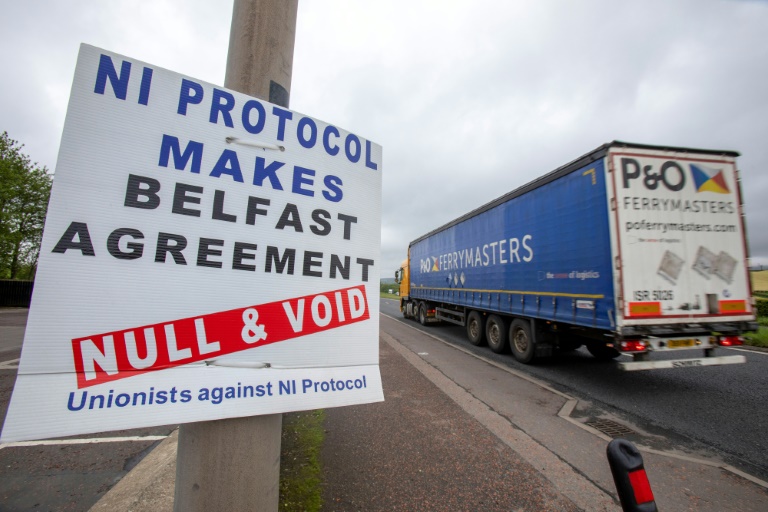
The protocol — signed separately from the wider trade and cooperation agreement — requires checks on goods arriving into Northern Ireland from England, Scotland and Wales, in order to track products that could be potentially headed to the EU via the Republic of Ireland.

This creates a customs border down the Irish Sea, keeping Northern Ireland in the EU’s customs orbit so as to avoid a politically sensitive hard border between it and EU member Ireland.

But pro-British parties in Northern Ireland say it is driving a wedge between London and Belfast and are refusing to join in a power-sharing government in the province until the protocol is changed.

– EU anger –

Unionist parties and the UK government argue the protocol is threatening the 1998 Good Friday Agreement that ended three decades of violence over British rule in Northern Ireland.

They want checks to be removed on goods and animal and plant products travelling from Great Britain.

“The problem (with) the protocol is the way the EU want to see it implemented,” the UK’s Northern Ireland minister Brandon Lewis told Sky News on Sunday.

“What we are doing is fixing the problems within the protocol, about how it’s being implemented, so that businesses can prosper again.

“I want to see the re-establishment of the Northern Ireland Assembly and the executive — the protocol is getting in the way of that and that’s why it’s breaching the Belfast Good Friday Agreement,” he added.

“We want to do this by agreement with the EU but to do that, they need to show some flexibility.”

Plans to unilaterally override parts of the protocol have provoked anger in European capitals, particularly Dublin, and have led to the EU threatening an all-out trade war if implemented.

“Unilateral action is damaging to mutual trust,” European Commission Vice President Maros Sefcovic told reporters in Brussels when the UK introduced the legislation.

Sefcovic said Brussels would now consider reopening a suspended “infringement procedure” against Britain, as well as opening fresh cases.

This would be to “protect the EU single market from risks that the violation of the protocol creates for the EU businesses and for the health and safety of EU citizens”, he added.

After Monday’s debate, the bill still has several hurdles to clear in both the House of Commons and upper House of Lords before it becomes law, and faces legal challenges.

Zelensky to press G7 for more help as war rages

President Volodymyr Zelensky will urge world powers to step up their support for Ukraine when he addresses the G7 summit on Monday, as Kyiv reels from the first Russian strikes on the capital in weeks.

US President Joe Biden and his counterparts from the Group of Seven wealthy democracies, meeting in the Bavarian Alps, have stressed their unity in the face of Russia’s aggression — even as the global fallout worsens.

Zelensky is set to join the leaders of the United States, Germany, Britain, France, Italy, Japan and Canada via video link at 10:00 am (0800 GMT).

In his daily address late Sunday, Zelensky renewed his calls for more weapons and air defence systems to be delivered to Ukraine and for fresh sanctions against Russia by G7 nations.

“We need a powerful air defence — modern, fully effective. Which can ensure complete protection against these missiles. We talk about this every day with our partners. There are already some agreements. And partners need to move faster if they are really partners, not observers,” he said.

“Delays in the transfer of weapons to our state, any restrictions are actually an invitation for Russia to strike again and again.”

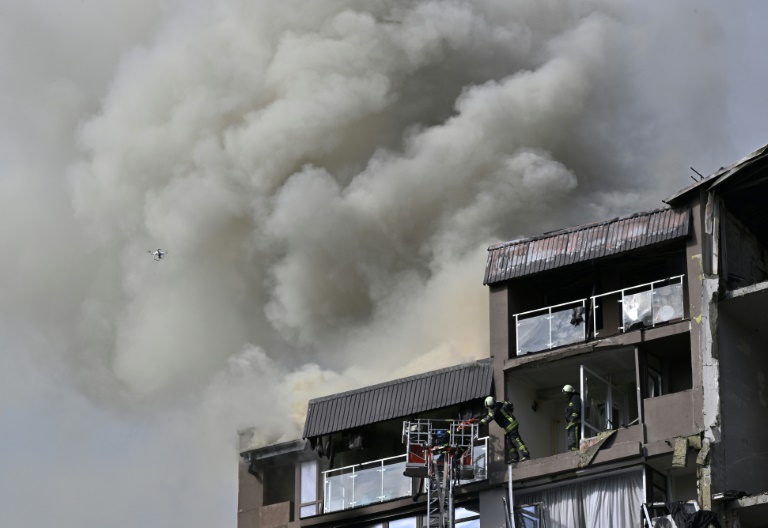
Zelensky’s appeal came after Russia struck a residential building in Kyiv, Ukraine said, leaving one person dead and wounding four others including a seven-year-old girl.

Biden condemned the strikes, the first on the Ukrainian capital in almost three weeks, as “barbarism”.

German Chancellor and G7 host Olaf Scholz said the attack showed again “that it is right to stand together and support Ukrainians”.

Russia denied it had hit a civilian target, however, saying its forces had struck the Artyom weapons factory in the neighbourhood.

The G7 summit, held at the picturesque Elmau Castle, runs until Tuesday. It will be followed by a meeting of NATO countries in Spain, which Zelensky is also expected to dial into.

Last week, the European Union showed its support by granting Kyiv candidate status.

– ‘Fatigue’ –

G7 members kicked off their gathering on Sunday by announcing a ban on imports of Russian gold, the latest in a series of sanctions aimed at crippling President Vladimir Putin’s war effort.

British Prime Minister Boris Johnson warned his fellow G7 leaders not to give in to “fatigue” and said Ukraine would need long-term help.

The conflict has already triggered a food and energy crisis that has sent inflation soaring and fanned recession fears, including among Kyiv’s Western allies.

Downing Street said Johnson on Monday would call for “urgent action” to get Ukraine’s vital cereal exports moving again, which have been held up by Russia’s blockade of key ports.

With millions of tonnes of grain trapped in silos, concerns are growing that countries in northern Africa and the Middle East that are highly reliant on Ukrainian exports could face famine.

Non-G7 countries Argentina, Indonesia, India, Senegal and South Africa have been invited to join the G7 summit from Monday.

Indonesian President Joko Widodo, who will host a G20 summit in November, has said he plans to use the trip to also visit Ukraine and Russia in the coming days to ask Putin and Zelensky to open a dialogue for peace.

Indonesia, like most major emerging economies, has tried to maintain a neutral position, and Widodo has not bowed to Western pressure to exclude Putin from the November meeting.

– ‘Intimidate Ukrainians’ –

On the ground in Ukraine, Kyiv mayor Vitali Klitschko said Sunday’s missile attack on the city was a Russian attempt to “intimidate Ukrainians” ahead of the NATO summit.

Tearful residents recounted the moment the missiles struck.

“I woke up at the first explosion, went to the balcony and saw missiles falling and heard a huge explosion — everything vibrated,” 38-year-old Yuri told AFP, declining to give his surname.

An AFP team said there was a fire on the top three floors of the building and its stairwell was completely destroyed.

But Russia’s defence ministry condemned as “fake” reports that it had targeted a residential building.

After failing to capture Kyiv early on after their February 24 invasion, Russian troops have shifted their focus to the eastern Donbas region, which has been partially under the control of pro-Moscow separatists since 2014.

– ‘Fully occupied’ –

The Russians made a strategic breakthrough Saturday when they took the industrial hub of Severodonetsk, the scene of weeks of fierce battles that have left it largely destroyed.

Severodonetsk’s mayor said it had been “fully occupied” by Russian troops after Ukrainian forces retreated to better defend the neighbouring city of Lysychansk.

Its capture would give Russia control of the entire Lugansk region in the Donbas, Ukraine’s industrial heartland.

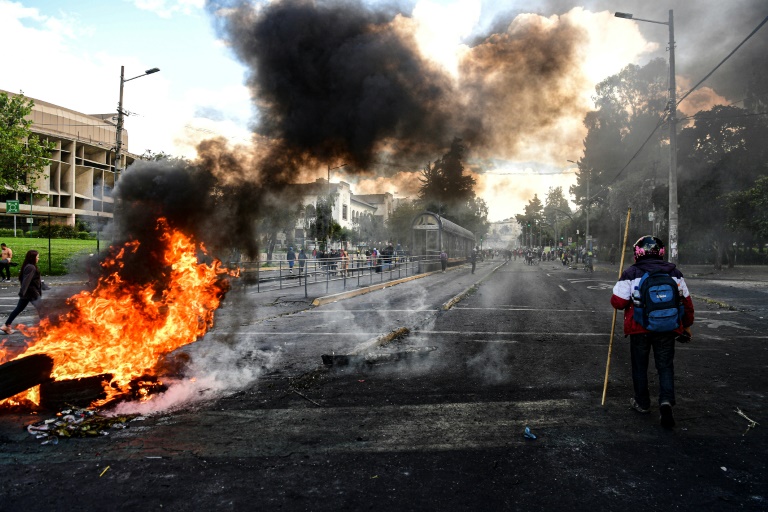
In protest-hit Ecuador, shortages of key goods start to bite

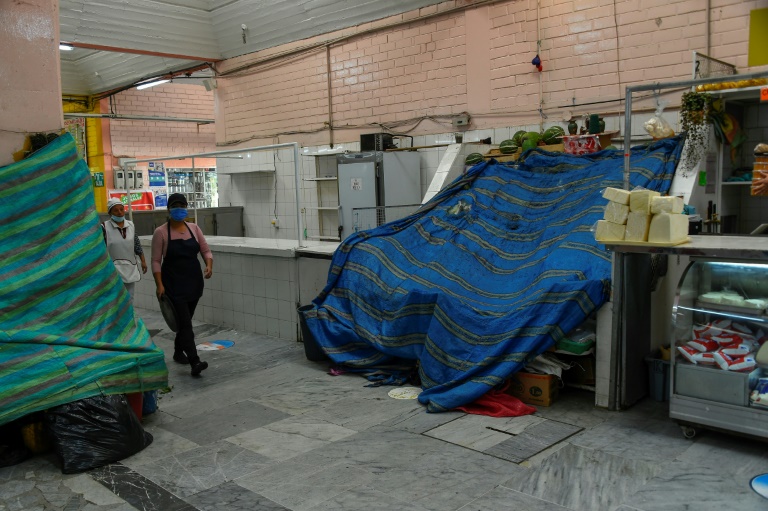
Holding rotten peppers in her hands, Mariana Morales says she has been unable to open her stall at the Santa Clara market north of Ecuador’s capital Quito for a week.

Usually overflowing with fruits and vegetables, the market now is home to tarp-covered display cases, empty trays and deserted stalls — the effects of two weeks of nationwide Indigenous-led protests that are being felt far and wide.

In Guayaquil, the country’s second largest city, Andean produce such as potatoes and corn are already in short supply.

“The situation is difficult because there is no one left to bring food from the highlands,” said Rosa, an Indigenous woman who has sold vegetables in a port market in the southwestern city for 15 years.

An estimated 14,000 protesters are taking part in the nationwide show of discontent against rising hardship, particularly increased fuel prices, in an economy dealt a serious blow by the coronavirus pandemic.

The ironic side effect of their demonstrations has been a worsening of several economic factors: rising prices, shortages and deserted markets.

While the largest mobilization has by far been in the capital, where the number of protesters is close to 10,000 — numerous checkpoints and barricades block the main roads throughout the country, in particular on the vital Panamerican highway.

The country’s energy ministry warned Sunday that those roadblocks and barricades could end up forcing a halt to oil production within 48 hours, which would be a dire development for an economy depending on oil exports.

– ‘Everything is too expensive’ – 

Since the beginning of the roadblocks, Guayaquil’s only wholesale market has been out of stock.

The supply center normally receives nearly 3,000 truckloads of food from the Andean highlands every day, but that figure has dropped by almost 70 percent.

In Quito, where main access roads are blocked intermittently, authorities are trying to organize protection for trucks by the army and police. 

On Thursday, an attack on one of these conveys left 17 soldiers injured.

Santa Clara, like five other markets in the capital, was forced to close for several days and only partially resumed operations on Saturday.

“The peppers were brand new and now it’s all wasted,” Morales said, plunging her fingers into the rotten produce.

Despite the ruined vegetables, the 69-year-old has not gone to the wholesale market to stock back up due to the explosion in prices, explaining: “A bag of carrots that used to cost $25 is now worth $100.”

Consumers are finding it difficult to afford a number of products, from eggs to chicken to cooking fuel.

Morales said it gives her a “guilty conscience” to charge customers a dollar for just one green onion stalk.

Silvana Quimi, a housewife in Guayaquil where food prices have doubled in one week, said that now “everything is too expensive.”

“Before, I was sold a kilo of tomatoes for half a dollar, now it costs me a dollar.”

Things are similar in the capital where a bunch of bananas, which used to cost $1.00, now costs $2.00. 

“What is available costs an arm and a leg,” said Agustin Pazmino, a 56-year-old trader.

Conservative President Guillermo Lasso “during his campaign promised us heaven, but we live in hell,” he said.

A no-confidence hearing over what opposition lawmakers say is Lasso’s role in the protests resumed in Congress for a second day late Sunday. Five people have died so far. 

The National Assembly will eventually vote on whether to oust Lasso, a former banker who took power a year ago.

Egypt tries man over murder of student who refused advances

A trial began Sunday for an Egyptian man accused of stabbing a woman to death in a public street after she rejected his advances — a case that has sparked widespread outrage.

A video went viral last week appearing to show the victim, identified as student Nayera Ashraf, being stabbed by a young man outside her university.

The crime has triggered widespread anger both in Egypt and beyond, having been followed a few days later by a similar incident in which Jordanian student Iman Irshaid was shot dead on a university campus.

Social media users immediately drew comparisons between the two murders, decrying cases of femicide in the Arab world.

At the Mansoura Criminal Court, 130 kilometres (80 miles) north of Cairo, Mohamed Adel was accused of “premeditated murder”, after confessing to intentionally killing the victim, an AFP correspondent said.

Ashraf had previously reported the alleged perpetrator to the authorities, fearing that he would attack her, according to her father and witnesses.

The maximum penalty for murder is death in Egypt, which carried out the third highest number of executions in the world in 2021, according to Amnesty International.

“He stabbed her several times,” said the prosecution, which found “messages threatening to cut her throat” on the victim’s phone.

The next hearing is set for Tuesday, the defendant’s lawyer, Ahmed Hamad, told AFP.

In a rare occurrence among cases involving violence against women, authorities allowed television cameras to film the hearing on Sunday.

On social media, many Jordanian and Egyptian users called for the perpetrator to be sentenced to death, while others said men must “learn to take no for an answer”.

Egyptian preacher Mabrouk Attia sparked outrage last week after suggesting that the victim would not have met the same fate had she been veiled.

Nearly eight million Egyptian women were victims of violence committed by their partners or relatives, or by strangers in public spaces, according to a United Nations survey conducted in 2015.

Ukraine war pushes France to rethink coal power station closure

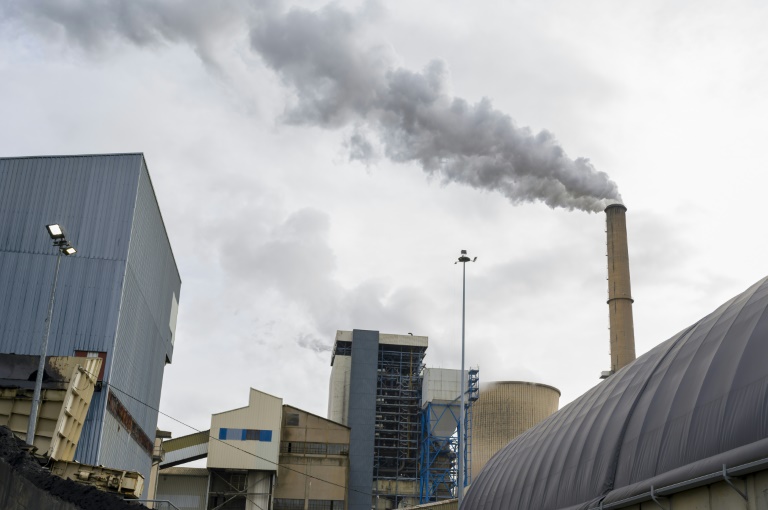
France has become the latest country to reconsider its energy options because of the war in Ukraine, announcing Sunday it was looking into reopening a recently closed coal-fired power station.

The energy transition ministry said it was considering reopening the station at Saint-Avold in eastern France this winter, “given the situation in Ukraine” and the effect it was having on the energy markets.

“We are keeping open the possibility of being able to put the Saint-Avold station back in action for a few hours more if we need it next winter,” said a ministry statement, confirming a report on RTL radio.

But France would still be producing less than one percent of its electricity through coal power, and no Russian coal would be used, the statement added.

President Emmanuel Macron’s commitment to eventually shut all France’s coal-fired stations remained unchanged, the ministry statement said.

Saint-Avold was only closed on March 31, and the only coal-fired power station still operating in France is in Cordemais, in the west of the country.

Most of France’s electricity production comes from nuclear power: 67 percent in 2020. In the same year, coal only accounted for 0.3 percent.

Austria, Germany and the Netherlands have all announced recently that they would be making greater use of coal for their energy needs because of the effects of Russia’s invasion of Ukraine.

The war there has sent global energy prices soaring and raised the prospect of shortages if supplies are cut off. 

Russian energy giant Gazprom has already stopped deliveries to a number of European countries, including Poland, Bulgaria, Finland and the Netherlands.

But the shift back towards fossil fuels has caused alarm in the European Commission, and among environmental campaigners.

They point to the risk that the European Union will miss its targets for cutting back on polluting energy sources, and potentially disastrous consequences for the climate.

Close Bitnami banner
Bitnami