World

US passes first major gun bill in decades

US lawmakers broke a decades-long stalemate on firearms control Friday, passing the first major safety regulations in almost 30 years, less than 24 hours after the Supreme Court bolstered the right to bear arms.

Gun regulation is a touchstone issue for both conservatives and liberals in the United States that has consumed national politics amid multiple mass shootings in recent years.

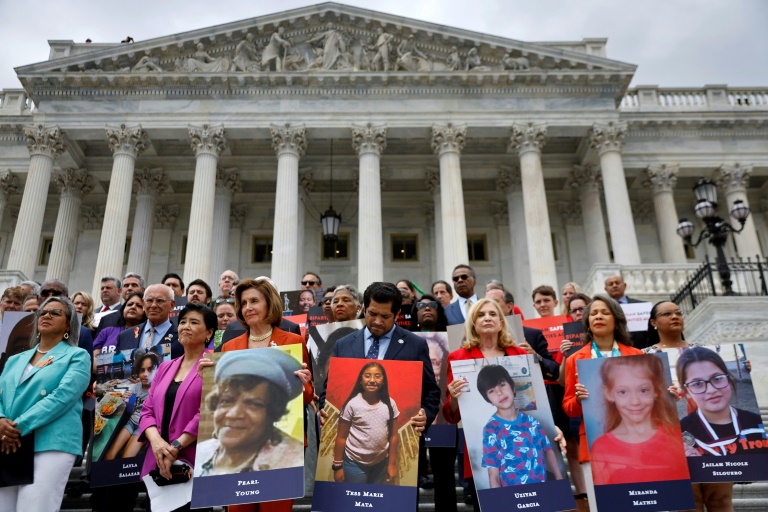
The Democratic-led House of Representatives voted to rubber-stamp a bipartisan Senate gun bill that — while modest — amounts to the first significant piece of legislation to regulate firearms since 1994.

Fourteen Republicans defied their leader Kevin McCarthy to cross the aisle and approve the 80-page package, which advanced from the evenly-divided upper chamber with cross-party backing late Thursday.

That vote came hours after the Supreme Court’s conservative majority had struck down a century-old New York law requiring permits for concealed-carry handguns.

The gun legislation includes enhanced background checks for younger buyers and federal cash for states introducing “red flag” laws that allow courts to temporarily remove weapons from those considered a threat.

Billions of dollars have been allocated to crack down on “straw purchasers” who buy firearms for people who are not allowed them and to curb gun trafficking.

– ‘Long-sought triumph’ –

The deeply-divisive issue of gun control was reignited by two massacres in May that saw 10 Black supermarket shoppers gunned down in upstate New York and 21 people, mostly young children, slain at a school in Texas.

The Supreme court had voted along party lines, with the six Republican appointees in favor of bolstering the constitutional right to bear arms and the three Democratic appointees dissenting.

The ruling was hailed by campaigners for boosted gun rights, but took the shine off what was expected to be a day of jubilation for weapons control activists.

Liberals had been celebrating the congressional action despite disappointment at the limited scope of the legislation, which doesn’t include universal background checks and omits any ban on semi-automatic weapons or high-capacity magazines.

“This decision won’t stop our grassroots army from doing what we’ve done for a decade: fighting to keep our families safe,” added Shannon Watts, founder of Moms Demand Action, said after the Supreme Court ruling was announced.

“Just as we’re breaking the logjam in Congress, we’re going to work day-in, day-out to mitigate the fallout in New York and any other states impacted by this decision and elect gun-sense lawmakers up and down the ballot.”

Eric Tirschwell, chief litigation counsel at legal non-profit Everytown Law, said the Supreme Court had misapplied fundamental constitutional principles, and added that the group was “ready to go to court” to defend restrictions.

Top Republicans celebrated the court’s decision.

“This is not just a long-sought triumph for lawful gun owners across America, it is a victory for all citizens and our constitutional order itself,” said Senate Minority Leader Mitch McConnell.

McCarthy hailed the ruling as a victory that “rightfully ensures the right of all law-abiding Americans to defend themselves without unnecessary government interference.”

“The decision comes at an important time — as the Senate considers legislation that undermines Second Amendment freedom,” Wayne LaPierre, the National Rifle Association’s executive vice president, said in a statement.

“This decision unequivocally validates the position of the NRA and should put lawmakers on notice: no law should be passed that impinges this individual freedom.”
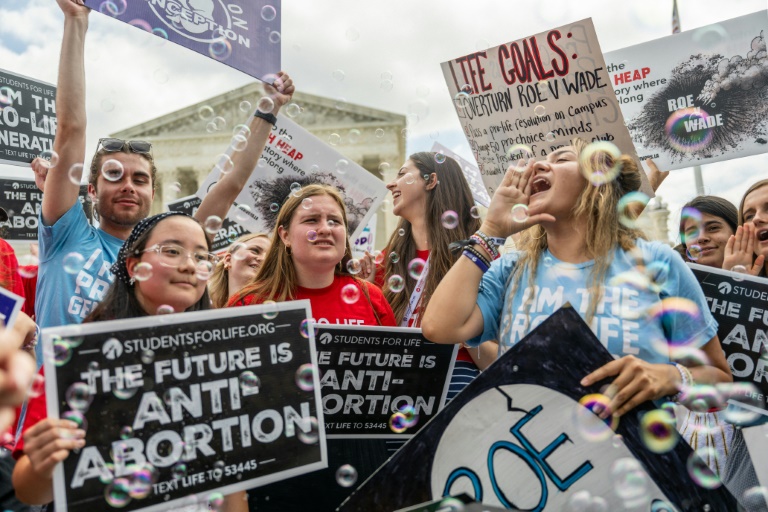
US Supreme Court strikes down right to abortion

The US Supreme Court on Friday struck down the right to abortion in a seismic ruling that shreds half a century of constitutional protections on one of America’s most divisive issues.

The conservative-dominated court overturned the landmark 1973 “Roe v. Wade” decision enshrining a woman’s right to an abortion, saying individual states can restrict or ban the procedure themselves — which half appear poised to do.

“The Constitution does not confer a right to abortion,” the court said in a 6-3 decision. “The authority to regulate abortion is returned to the people and their elected representatives.”

A somber President Joe Biden called the ruling a “tragic error” stemming from “extreme ideology” and said it was a “sad day for the court and the country.”

“The health and life of women in this nation are now at risk,” Biden said, warning that other rights could be threatened next, such as same-sex marriage and contraception.

The Democratic president urged Congress to restore abortion protections as federal law and said Roe will be “on the ballot” in midterm elections in November. 

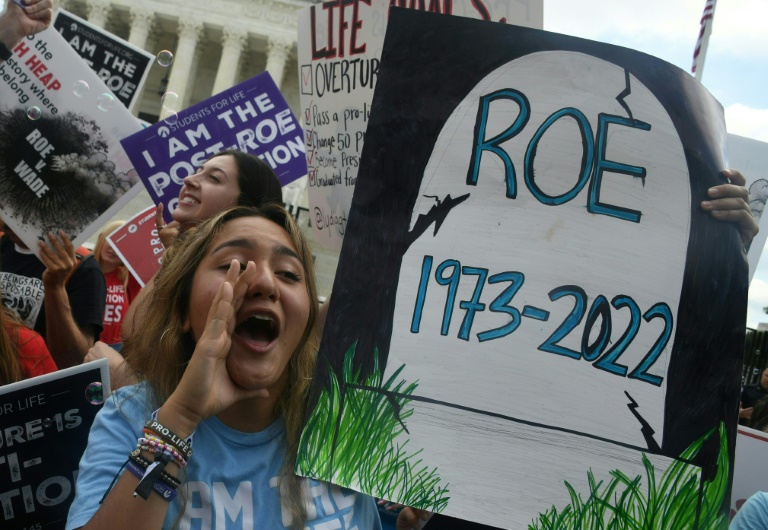
Hundreds of people — some weeping for joy and others with grief — gathered outside the fenced-off Supreme Court as the ruling came down.

“It’s hard to imagine living in a country that does not respect women as human beings and their right to control their bodies,” said Jennifer Lockwood-Shabat, 49, a mother of two daughters who was choking back tears.

But Gwen Charles, a 21-year-old opponent of abortion, was jubilant.

“This is the day that we have been waiting for,” Charles told AFP. “We get to usher in a new culture of life in the United States.”

The Supreme Court ruling will likely set into motion a cavalcade of new laws in roughly half of the 50 US states that will severely restrict or outright ban and criminalize abortions, forcing women to travel long distances to states that still permit the procedure.

Just hours later, Missouri banned abortion — making no exception for rape or incest — and so did South Dakota, except where the life of the mother is at risk.

“This is a monumental day for the sanctity of life,” Missouri attorney general Eric Schmitt said. 

– ‘Egregiously wrong’ –

In the majority opinion, Justice Samuel Alito said Roe v. Wade was “egregiously wrong.”

“Abortion presents a profound moral issue on which Americans hold sharply conflicting views,” he said. “The Constitution does not prohibit the citizens of each State from regulating or prohibiting abortion.”

The court tossed out the legal argument in Roe v. Wade that women had the right to abortion based on the constitutional right to privacy over their own bodies.

The ruling represents a victory of 50 years of struggle against abortion by the religious right — with campaigners now expected to push for an outright nationwide ban.

“God made the decision,” said former Republican president Donald Trump in praising the court’s decision.

Alito’s opinion largely mirrors his draft opinion that was the subject of an extraordinary leak in early May, sparking nationwide demonstrations, with an armed man arrested this month near the home of conservative justice Brett Kavanaugh.

Nancy Pelosi, the Democratic speaker of the House of Representatives, called the ruling “outrageous and heart-wrenching,” while leading abortion provider Planned Parenthood vowed to “never stop fighting.” 

Former president Barack Obama charged that the ruling “relegated the most intensely personal decision someone can make to the whims of politicians and ideologues — attacking the essential freedoms of millions of Americans.”

But Trump’s former vice president Mike Pence said the court had “righted a historic wrong,” consigning the US right to abortion to the “ash heap of history.”

– ‘Will not stop there’ –

The three liberal justices on the court dissented from the ruling — which came a day after the court ushered in a major expansion of US gun rights.

“One result of today’s decision is certain: the curtailment of women’s rights, and of their status as free and equal citizens,” they said.

Abortion providers could now face criminal penalties and “some States will not stop there,” they warned.

“Perhaps, in the wake of today’s decision, a state law will criminalize the woman’s conduct too, incarcerating or fining her for daring to seek or obtain an abortion,” they said.

The court’s ruling goes against an international trend of easing abortion laws, including in such countries as Ireland, Argentina, Mexico and Colombia where the Catholic Church continues to wield considerable influence.

It was made possible by Trump’s nomination of three conservative justices — Neil Gorsuch, Kavanaugh and Amy Coney Barrett.

The case before the court was a Mississippi law that would restrict abortion to 15 weeks but while hearing the case in December several justices indicated they were prepared to go further.

According to the Guttmacher Institute, 13 states have adopted so-called “trigger laws” that will ban abortion virtually immediately.

Ten others have pre-1973 laws that could go into force or legislation that would ban abortion after six weeks, before many women even know they are pregnant.

Women in states with strict anti-abortion laws will either have to continue with their pregnancy, undergo a clandestine abortion, obtain abortion pills, or travel to another state where the procedure remains legal.

Several Democratic-ruled states, anticipating an influx, have taken steps to facilitate abortion and three of them — California, Oregon and Washington — issued a joint pledge to defend access in the wake of the Supreme Court’s decision.

Ryanair, Brussels Airlines strikes disrupt Europe air travel

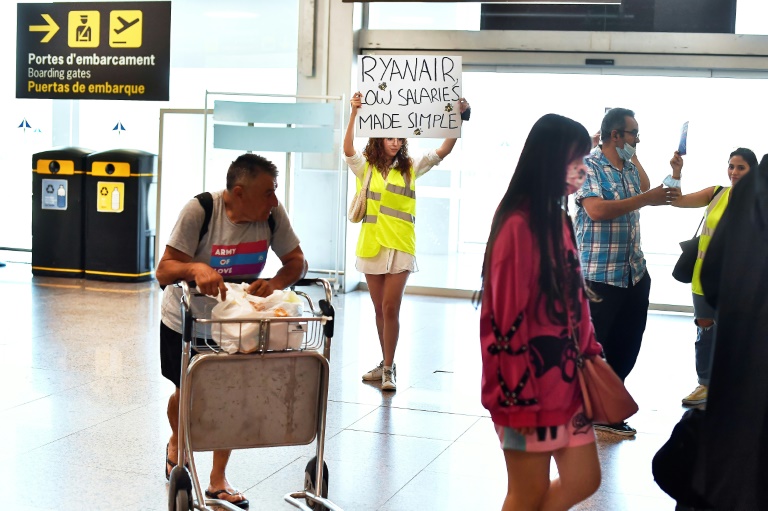
Strikes by staff at Ryanair and Brussels Airlines over pay and working conditions forced the cancelation of dozens of flights in Europe on Friday as the busy summer travel season gets underway.

The strikes are adding more headaches to passengers and the aviation sector, which has struggled with staff shortages as it struggles to recruit people after massive layoffs during the Covid pandemic.

Ryanair cabin crew unions in Spain, Portugal and Belgium called a three-day strike starting on Friday, and in Italy and France on Saturday.

The biggest impact was felt in Belgium, where the work stoppage led Europe’s biggest budget airline to cancel 127 flights to and from Charleroi airport near Brussels between Friday and Sunday.

Ryanair could only guarantee 30-40 percent of its scheduled flights at the airport, said a spokeswoman for Brussels South Charleroi Airport.

The situation in Belgium was further complicated by a three-day strike by staff at Brussels Airlines, a unit of German airline Lufthansa, which began on Thursday.

The company has cancelled 315 flights to and from Brussels’ international airport during the three-day strike.

The Ryanair strike had very little impact in Portugal and none in Spain where no flights were cancelled. 

“We didn’t even know there was a strike…we didn’t have any problem at all,” said Manuel Carrion, a Spanish passenger with a Ryanair flight at Madrid airport.

Spain’s transport ministry on Thursday ordered Ryanair to operate 73 percent to 82 percent of flights over the strike period to maintain minimum services.

It argued there needs to be a balance between the “right to strike” and the “interest of travellers”.

– ‘Threats’ –

But unions said Ryanair had gone beyond what was required and forced staff to maintain all 438 flights scheduled in Spain on Friday. 

“The company informed staff that all flights were subject to the minimum service, and threated them with disciplinary action,” Ernesto Iglesias of local USO told reporters at Madrid airport.

The airline was not “respecting the law,” he added.

Ryanair cabin crew unions in Spain have called another strike from June 30 to July 2.

A strike on the weekend of June 12 and 13 already prompted the cancellation of about 40 Ryanair flights in France, or about a quarter of the total.

Ryanair boss Michael O’Leary has been dismissive of the strikes, saying earlier this month that most of the company’s flights “will continue to operate even if there is a strike in Spain by some Mickey Mouse union or if the Belgian cabin crew unions want to go on strike.”

Less than two percent of the airline’s 3,000 flights on Friday have been affected by strikes, Ryanair said in a statement.

– ‘Pushed to the brink’ –

Ryanair’s low-cost rival easyJet also faces nine days of strikes on different days in July at the Barcelona, Malaga and Palma de Mallorca airports.

British Airways workers at London’s Heathrow airport have voted to strike over pay as the cost-of-living crisis worsens in the UK, though no dates were set yet.

The strikes come as air travel has rebounded since Covid-19 restrictions have been lifted.

But the staff shortages have forced airlines to cancel flights, with German carrier Lufthansa cancelling more than 3,000 of them during the summer holidays.

On Monday, the European Transport Workers’ Federation called “on passengers not to blame the workers for the disasters in the airports, the cancelled flights, the long queues and longer time for check-ins, and lost luggage or delays caused by decades of corporate greed and a removal of decent jobs in the sector.”

The Federation said it expects “the chaos the aviation sector is currently facing will only grow over the summer as workers are pushed to the brink.”

French PM reveals trauma over suicide of Holocaust survivor father

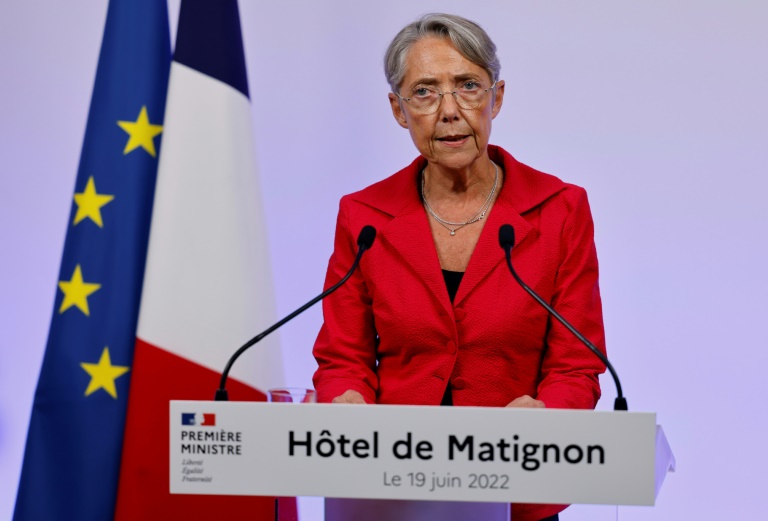
French Prime Minister Elisabeth Borne, under fire for a wooden performance in election campaigning, has sought to reveal a more human side in a series of interviews, notably over her family history.

In interviews with the Paris Match weekly and LCI television she spoke of the shock when as an 11-year-old she learned that her father Joseph, who had survived the Nazi death camp Auschwitz in the Holocaust, committed suicide.

Critics had accused Borne, named prime minister by President Emmanuel Macron last month, of lacking the human touch in France’s parliamentary election that cost the government its majority in the legislature.

She indicated it was this tragic history that at times led people to assume she was impervious to emotion.

“It’s shocking for an 11-year-old girl to lose her father in these conditions,” Borne, 61, told LCI. “And I think I closed up and that I avoid showing my emotions too much.” 

“I think… this closing up, maybe, goes a little far. Yes”, she acknowledged.

Borne’s family history has been widely known in French political and media circles but this is the first time she has chosen to speak about it in public.

But she expressed pride over how France had allowed her to study under a special programme for children who have lost parents, and eventually reach high office.

“We are a country where you can be the daughter of an immigrant, where you may have lost your father at 11, but the country reaches out to you to allow you to study,” she said.

“And then you are a prefect (senior local official), and then you are a minister and you are even prime minister,” she added.

Her father, who news reports have said was named Joseph Bornstein, fled to France from Poland in 1940 and then fought in the French resistance during World War II. He was captured and deported to Auschwitz in 1944 but survived.

Borne this week offered her resignation to Macron in the wake of their party’s parliamentary losses, but the president rejected it and has resisted pressure — even from some allies — for her removal.

A respected technocrat, Borne had no previous experience of election campaigning before the June elections, when she won her seat in the north of France even though critics sniped that the margin of victory was more narrow than expected. 

In her interview with LCI, she indicated she was not moving for now.

“My objective is to provide the best answers to the French and my conviction is that this is done through dialogue and that is what I have done throughout my professional life,” she said.

Five migrants die in mass attempt to enter Spain's Melilla

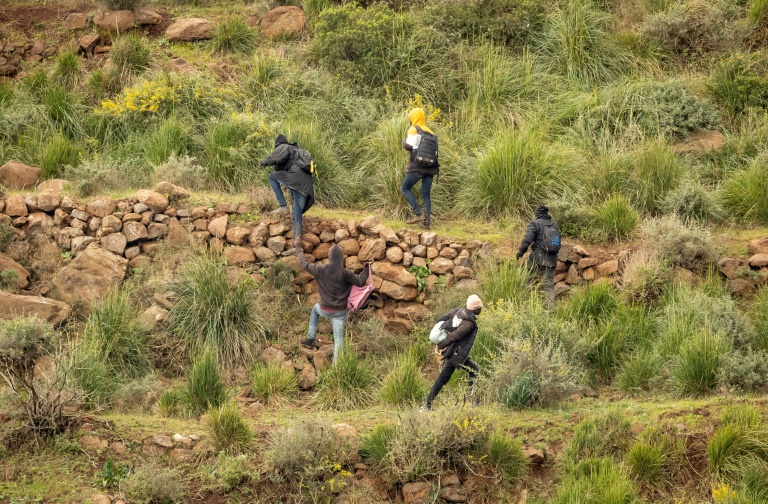
Five migrant were killed and dozens were injured when a huge crowd tried to cross from Morocco into Spain’s Melilla enclave on Friday, the latest migrant tragedy at the doors of Europe.

Some 2,000 migrants made approached Melilla at dawn over 500 managed to enter a border control area after cutting a fence with shears, the Spanish government’s local delegation said in a statement.

Of these 130 sub-Saharan African migrants, “all of them men and apparently adults”, managed to enter Melilla, it added.

A Moroccan official from the nearby border town of Nador said “five deaths were recorded after they stormed the border and some fell from the top of the barrier” separating the two sides.

He said 140 security personnel and 76 migrants were injured during the attempt to cross, the first such mass incursion since Spain and Morocco mended diplomatic relations last month.

The Spanish government’s local delegation said only that 49 Spanish police officers were lightly injured while 57 migrants suffered injuries of varying degrees, including three who were hospitalised.

Morocco had deployed a “large” number of forces to try to repel the assault on the border, who “cooperated actively” with Spain’s security forces, it said earlier in a statement.

Images on Spanish media showed exhausted migrants laying on the sidewalk in Melilla, some with bloodied hands and torn clothes.

Speaking in Brussels, Spanish Prime Minister Pedro Sanchez condemned the “violent assault” which he blamed on “mafias who traffic in human beings”.

– Migrant magnet –

Melilla and Ceuta, Spain’s other tiny North African enclave, have the European Union’s only land borders with Africa, making them a magnet for migrants. 

On Thursday night migrants and security forces “clashed” on the Moroccan side of the border, Omar Naji of Moroccan rights group AMDH told AFP. 

Several of them were hospitalised in Nador, he added.

In March this year, Spain ended a year-long diplomatic crisis by backing Morocco’s autonomy plan for Western Sahara going back on its decades-long stance of neutrality. 

Spanish Prime Minister Pedro Sanchez then visited Rabat, and the two governments hailed a “new stage” in relations.

The row began when Madrid allowed Brahim Ghali, leader of Western Sahara’s pro-independence Polisario Front, to be treated for Covid-19 in a Spanish hospital in April 2021.

A month later, some 10,000 migrants surged across the Moroccan border into Spain’s Ceuta enclave as border guards looked the other way, in what was widely seen as a punitive gesture by Rabat.

Rabat calls for the Western Sahara to have an autonomous status under Moroccan sovereignty but the Polisario wants a UN-supervised referendum on self-determination as agreed in a 1991 ceasefire agreement.

In the days just before Morocco and Spain patched up their ties, there were several attempted mass crossings of migrants into Melilla, including one involving 2,500 people, the largest such attempt on record. Nearly 500 made it across.

– ‘Means of pressure’ –

Patching up relationship with Morocco, the departure point for many migrants, has meant a drop in arrivals, notably in Spain’s Atlantic Canary Islands. 

The number of migrants who reached the Canary Islands in April was 70 percent lower than in February, government figures show. 

Sanchez earlier this month warned that “Spain will not tolerate any use of the tragedy of illegal immigration as a means of pressure.”

Spain will seek to have “irregular migration” listed as one of the security threats on the NATO’s southern flank when the alliance gathers for a summit in Madrid on June 29-30.

Over the years, thousands of migrants have attempted to cross the 12-kilometre (7.5-mile) border between Melilla and Morocco, or Ceuta’s eight-kilometre border, by climbing the fences, swimming along the coast or hiding in vehicles.

The two territories are protected by fences fortified with barbed wire, video cameras and watchtowers.

Migrants sometimes use hooks and sticks to try to climb the border fence, and throw stones at police.

US Supreme Court strikes down right to abortion

The US Supreme Court on Friday ended the right to abortion in a seismic ruling that shreds half a century of constitutional protections on one of America’s most divisive issues.

The conservative-dominated court overturned the landmark 1973 “Roe v. Wade” decision enshrining a woman’s right to an abortion, saying individual states can restrict or ban the procedure themselves — which half appear poised to do.

“The Constitution does not confer a right to abortion,” the court said in a 6-3 decision. “The authority to regulate abortion is returned to the people and their elected representatives.”

Hundreds of people — some shedding tears of joy and others of grief — gathered outside the fenced-off Supreme Court, where security was tightened ahead of the ruling.

“It’s hard to imagine living in a country that does not respect women as human beings and their right to control their bodies,” said Jennifer Lockwood-Shabat, 49, a mother of two daughters who was choking back tears.

But Gwen Charles, a 21-year-old opponent of abortion, was jubilant.

“This is the day that we have been waiting for,” Charles told AFP. “We get to usher in a new culture of life in the United States.”

The Supreme Court ruling will likely set into motion a cavalcade of new laws in roughly half of the 50 US states that will severely restrict or outright ban and criminalize abortions, forcing women to travel long distances to states that still permit the procedure.

Just hours after the decision, the midwestern state of Missouri banned abortion — making no exception for rape or incest.

“This is a monumental day for the sanctity of life,” state attorney general Eric Schmitt said on Twitter in announcing the move. 

– ‘Egregiously wrong’ –

In the majority opinion, Justice Samuel Alito said Roe v. Wade was “egregiously wrong.”

“Abortion presents a profound moral issue on which Americans hold sharply conflicting views,” he said. “The Constitution does not prohibit the citizens of each State from regulating or prohibiting abortion.”

The court tossed out the legal argument in Roe v. Wade that women had the right to abortion based on the constitutional right to privacy over their own bodies.

The ruling represents a victory of 50 years of struggle against abortion by the religious right — with campaigners now expected to keep pushing for an outright nationwide ban.

“God made the decision,” said the Republican former president Donald Trump in praising the ruling.

Alito’s opinion largely mirrors his draft opinion that was the subject of an extraordinary leak in early May, sparking demonstrations around the country, with an armed man arrested this month near the home of conservative justice Brett Kavanaugh.

Nancy Pelosi, the Democratic speaker of the House of Representatives, called the ruling “outrageous and heart-wrenching.” 

“But make no mistake: the rights of women and all Americans are on the ballot (in midterm elections) this November,” she said.

Leading abortion provider Planned Parenthood vowed to “never stop fighting.” 

Former Democratic president Barack Obama charged that the ruling “relegated the most intensely personal decision someone can make to the whims of politicians and ideologues — attacking the essential freedoms of millions of Americans.”

But former Republican vice president Mike Pence said the court had “righted a historic wrong,” consigning the US right to abortion to the “ash heap of history.”

– ‘Will not stop there’ –

The three liberal justices on the court dissented from the ruling — which came a day after the court ushered in a major expansion of US gun rights.

“One result of today’s decision is certain: the curtailment of women’s rights, and of their status as free and equal citizens,” they said.

Abortion providers could now face criminal penalties and “some States will not stop there,” they warned.

“Perhaps, in the wake of today’s decision, a state law will criminalize the woman’s conduct too, incarcerating or fining her for daring to seek or obtain an abortion,” they said.

The court’s ruling goes against an international trend of easing abortion laws, including in such countries as Ireland, Argentina, Mexico and Colombia where the Catholic Church continues to wield considerable influence.

It was made possible by Trump’s nomination of three conservative justices — Neil Gorsuch, Kavanaugh and Amy Coney Barrett.

The case before the court was a Mississippi law that would restrict abortion to 15 weeks but while hearing the case in December several justices indicated they were prepared to go further.

According to the Guttmacher Institute, 13 states have adopted so-called “trigger laws” that will ban abortion virtually immediately.

Ten others have pre-1973 laws that could go into force or legislation that would ban abortion after six weeks, before many women even know they are pregnant.

Women in states with strict anti-abortion laws will either have to continue with their pregnancy, undergo a clandestine abortion or obtain abortion pills, or travel to another state where the procedure remains legal.

Several Democratic-ruled states, anticipating an influx, have taken steps to facilitate abortion and three of them — California, Oregon and Washington — issued a joint pledge to defend access in the wake of the Supreme Court’s decision.

Travel is expensive, however, and abortion rights groups say any new restrictions will severely impact poor women, many of whom are Black or Hispanic.

Johnson in crisis after Tories crushed in UK parliamentary votes

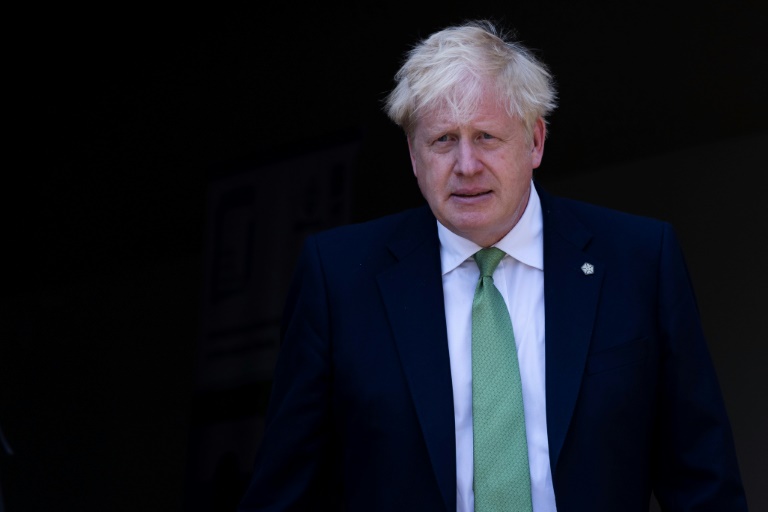
British Prime Minister Boris Johnson vowed on Friday to listen and learn but refused to quit, after his Conservatives suffered crushing defeats in two parliamentary elections and a staunch ally stepped down.

In a pointed resignation letter to Johnson, party chairman and cabinet member Oliver Dowden said “somebody” had to shoulder the blame for “recent events”.

That was widely seen as a reference to “Partygate” and other scandals dogging the prime minister, who only narrowly survived a no-confidence vote this month among Tory MPs.

But Johnson framed the election setbacks as mid-term blues for the Conservatives, as Britain contends with inflation reaching double-digit levels not seen since the 1970s, rising poverty and strikes. 

“I’m not going to pretend these are brilliant results. We’ve got to listen. We’ve got to learn,” Johnson told reporters in Rwanda, where he is attending a Commonwealth summit. 

“But I genuinely, genuinely don’t think the way forward in British politics is to focus on issues of personalities, whether they are mine or others,” he added.

“The way forward is to make arguments to people about change and improvement that we are delivering. And that is what I was elected to do.”

After his visit to Rwanda, Johnson travels to Germany and then Spain for G7 and NATO summits. He is not due back in Britain until late next week and is facing some calls to cut the trip short to deal with the by-election fallout.

If replicated in the next general election, due by 2024, the two results would consign the Conservatives to a historic national defeat. 

– ‘Pincer movement’ –

In the Tiverton and Honiton constituency, southwest England, the party saw its 2019 general election majority of more than 24,000 votes wiped out by the centrist Liberal Democrats, in one of the biggest upsets of UK electoral history. 

The main Labour opposition regained the parliamentary seat of Wakefield, in northern England, in a further sign of its resurgence after Johnson triumphed in 2019 on a vow to “get Brexit done”.

Since then, the impact of Brexit and the Covid pandemic have worsened the economic picture, and opinion polls show widespread disgust at Johnson’s leadership arising from lockdown-busting parties held in Downing Street.

The victorious Liberal Democrat candidate, Richard Foord, said voters in Tiverton and Honiton had sent a “shockwave through British politics”.

“It’s time for Boris Johnson to go, and go now,” he said.

Labour’s newly elected MP for Wakefield, Simon Lightwood, told Johnson: “Your contempt for this country is no longer tolerated.”

Tony Travers, politics professor at the London School of Economics and Political Science, said it was “almost inconceivable” that Johnson would willingly bow out.

But the results at opposite ends of England showed a “pincer movement” by Labour and the Liberal Democrats on Tory strongholds. “And that will significantly worry many Conservative MPs,” he told AFP.

– ‘Ravens leaving the Tower’ –

The reasons for the two by-elections were emblematic of Tory troubles.

The former MP for Tiverton and Honiton had to step down after he was seen watching pornography on his phone in parliament. 

In Wakefield, the MP quit after he was convicted of sexually assaulting a 15-year-old boy.

The “porn MP”, Neil Parish, rejected Johnson’s attempts to deflect blame after the Tories lost his rural area of southwest England for the first time since the early 19th century.

“It became a referendum on Boris Johnson and what is happening nationally,” he told BBC television.

Under current party rules, the prime minister should be safe from another leadership vote for 12 months.

But senior MP Geoffrey Clifton-Brown, who sits on the “1922 committee” of Tory backbenchers, indicated that the rules could change.

Johnson will have to defend himself anew to the party in the coming days, he said on BBC radio.

“We will then, in the parliamentary party, have to make a judgment as to whether we think that is a satisfactory explanation, or whether we should actually take steps to have a new prime minister.”

Dowden was an early backer of Johnson’s bid to unseat Theresa May as Conservative leader in June 2019.

“His departure is the ravens leaving the Tower of London,” Daniel Finkelstein, a Conservative lord and journalist, wrote in The Times newspaper.

Prince Charles says Commonwealth nations free to chart own course

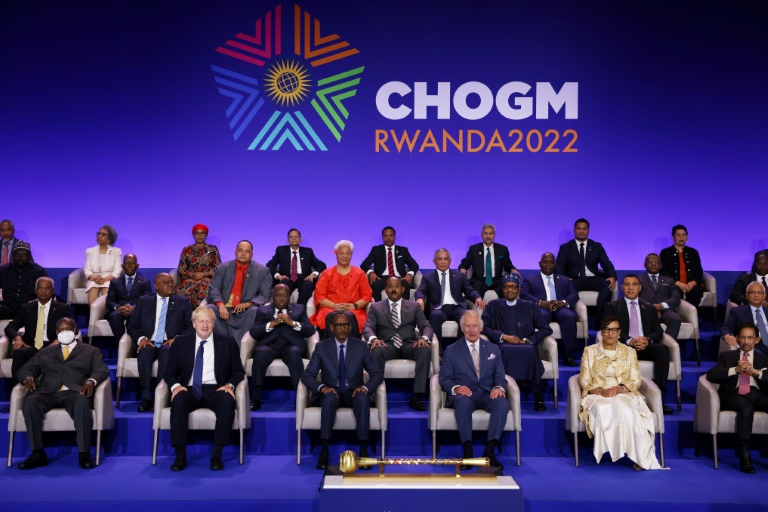
Prince Charles told Commonwealth leaders Friday that the choice to become a republic or abandon the queen as head of state was theirs alone, and expressed “personal sorrow” at Britain’s legacy of slavery.

The British heir to the throne addressed the opening of a Commonwealth Heads of Government Meeting (CHOGM) in Rwanda as the host nation faced scrutiny over its rights record and a much-criticised migrant deal with the UK.

Charles is representing Queen Elizabeth II as the 54-nation club of mostly former British colonies grapples with questions over its future relevance and modern profile.

Republican movements are taking root in a number of Commonwealth nations and some are seeking reparations for colonial-era injustices like slavery.

Charles acknowledged the change underfoot and said the Commonwealth — which represents one-third of humanity — would always be “a free association of independent, self-governing nations”.

“I want to say clearly, as I have said before, that each member’s constitutional arrangement, as republic or monarchy, is purely a matter for each member country to decide,” he told an audience of presidents and prime ministers.

He also acknowledged that the roots of the Commonwealth — which includes as members nations from Europe to Africa, Asia and the Americas — “run deep into the most painful period of our history”.

“I cannot describe the depths of my personal sorrow at the suffering of so many, as I continue to deepen my own understanding of slavery’s enduring impact,” he said.

– Migrant row –

Charles earlier Friday met British Prime Minister Boris Johnson, who has been defending his controversial deal to expel migrants from the UK thousands of miles away to Rwanda.

The scheme, which has stalled in the face of legal challenges, has been fiercely opposed by the UN, church leaders, rights groups and — reportedly — Charles himself.

“I’m confident that the migration aspect will work very well,” Johnson told British media in Kigali.

“We’re going to continue with the policy and… the Rwanda partnership offers a good way forward.”

He earlier heaped praise on President Paul Kagame for the “leaps and bounds” achieved in Rwanda, despite widespread concerns over a lack of political freedom and civil liberties in the tiny African nation.

Rights groups have openly questioned the suitability of Rwanda hosting the Commonwealth, which has a charter that enshrines respect for democracy and human rights as core shared values.

More than 20 rights groups and civil society organisations issued a letter before the summit saying a “climate of fear” exists under Kagame, whose party came to power after the horrors of the 1994 genocide.

The Democratic Republic of Congo has also called on Britain to condemn Rwanda over its alleged “aggression” in the mineral-rich eastern Congo, where Kigali has been accused of stoking a rebellion.

Johnson himself is facing a political crisis back home after his Conservatives suffered a crushing defeat in parliamentary by-elections.

– Leadership battle –

The Commonwealth’s closed-door summit meetings are missing some heavyweights, including Narendra Modi of India, South Africa’s Cyril Ramaphosa and Australia’s Anthony Albanese who sent envoys in their place.

The body has come under scrutiny over its relevance but supporters say the expansion of membership to nations with no historic ties to Britain underscores its value and prestige.

The two newest members are Mozambique and host Rwanda, while west African states Togo and Gabon are expected to join the club at the summit.

“The fact of holding this meeting in Rwanda, the new member with no historical connection to the British empire, expresses our choice to continue re-imagining the Commonwealth for a changing world,” Kagame said.

The secretary-general of the Commonwealth, Patricia Scotland, was narrowly re-elected Friday for another two years at the helm after a bruising campaign.

She defeated challenger Kamina Johnson Smith of Jamaica, who had the backing of the UK, which had expressed dissatisfaction with Scotland’s stewardship of the organisation.

Stocks and oil rally

Global stock markets and oil prices jumped higher on Friday following recent heavy losses on fears that interest rate hikes aimed at cooling decades-high inflation will spark a global recession.

With a spate of data pointing to an economic slowdown, market watchers are saying investors now believe central banks may need to deal out less punishing interest rate hikes, and thus the pushing of equity markets into bear market territory may have been an overreach.

London stocks rallied 2.7 percent with investors brushing aside news of bruising defeats for Britain’s ruling Conservatives in by-elections on Thursday. 

The pound firmed against the dollar, despite data showing a drop in UK retail sales volumes as inflation soars.

Paris stocks jumped 3.2 percent in eurozone trade, while Frankfurt rose 1.6 percent with gains tempered by news of the worsening German business climate.

“Stock markets are taking a breather after being beat up… as recession fears took their toll,” OANDA trading platform analyst Craig Erlam told AFP.

But he warned that stock markets remain “vulnerable to another onslaught if the news does not improve”.

Asian stock markets closed higher after Thursday’s gains on Wall Street.

Wall Street kept on rising on Friday, with all three major indices up over two percent in late morning trading.

The recoveries come after global markets have been thrown into turmoil for months owing to soaring inflation, interest-rate hikes, the Ukraine war and China lockdowns.

US equity markets tumbled into bear market territory — a drop of more than 20 percent from recent highs — as the US Federal Reserve began to aggressively raise interest rates.

Federal Reserve boss Jerome Powell this week told lawmakers a recession was “certainly a possibility”.

He suggested officials were ready to press on with big rate hikes, following last week’s three-quarter point increase for US borrowing costs that sent markets tanking.

Sentiment in Asia has meanwhile been boosted by comments from Chinese President Xi Jinping suggesting an end to China’s tech crackdown as well as possible new measures aimed at lifting the economy.

Hong Kong shares were among the biggest winners Friday thanks to a rally in tech giants including Alibaba, Tencent and NetEase.

Analysts have been pointing to falling commodity prices, a primary driver of inflation, in the face of a possible recession reducing the need for sharp interest rate hikes as one possible explanation for the renewed bullish sentiment on equity markets. 

“Falling interest rates and falling commodity prices, which typically go hand-in-hand with a growth slowdown, have been held out as developments working in favor of the rebound effort,” said Patrick O’Hare, analyst at Briefing.com.

“There is some truth to that, knowing that rising interest rates and rising commodity prices have been upsetting factors for most of the year, but one has to be careful stretching the credibility of those rally catalysts knowing that slower growth is going to translate into lower earnings growth prospects” for companies, he added.

Revised US consumer sentiment data — the initial reading of which may have helped push the US Fed into its massive 0.75 percentage point hike — also showed weaker inflation expectations and a new record low in consumer confidence.

“Today’s numbers would appear to suggest that the Federal Reserve may have overreacted,” said Michael Hewson at CMC Markets.

“This decline in inflation expectations has served to act as an additional tonic for markets as we headed towards the weekend,” he added.

– Key figures at around 1530 GMT –

New York – Dow: UP 2.2 percent at 31,338.15 points

EURO STOXX 50: UP 3.0 percent at 3,538.15

London – FTSE 100: UP 2.7 percent at 7,208.81 (close)

Frankfurt – DAX: UP 1.6 percent at 13,118.13 (close)

Paris – CAC 40: UP 3.2 percent at 6,073.35 (close)

Tokyo – Nikkei 225: UP 1.2 percent at 26,491.97 (close)

Hong Kong – Hang Seng Index: UP 2.1 percent at 21,719.06 (close)

Shanghai – Composite: UP 0.9 percent at 3,349.75 (close)

Euro/dollar: UNCHANGED from late Thursday at $1.0523

Pound/dollar: UP at $1.2290 from $1.2260

Euro/pound: UP at 85.85 pence from 85.83 pence

Dollar/yen: UP at 135.10 yen from 134.95 yen 

Brent North Sea crude: UP 3.5 percent at $113.85 per barrel

West Texas Intermediate: UP 3.9 percent at $108.34 per barrel

burs-rl/pvh

Afghan quake survivors without food and shelter as aid trickles in

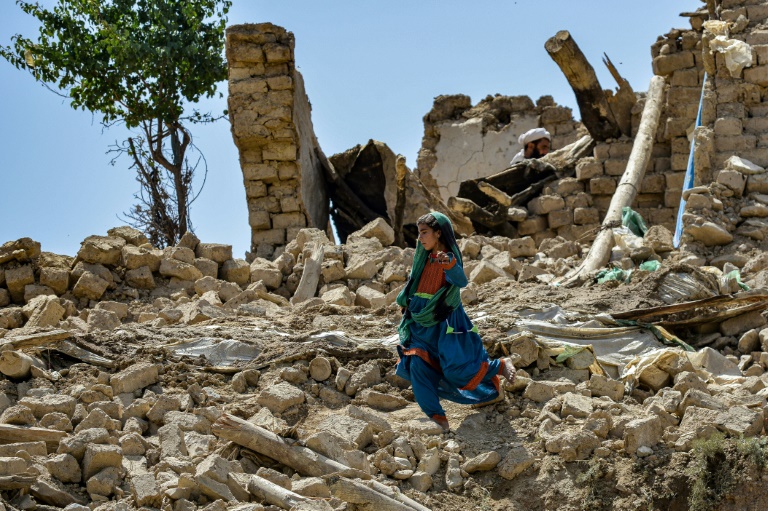
Aid trickled to devastated villages in remote parts of Afghanistan Friday but thousands of people remain with little food, shelter and water three days after the country’s deadliest earthquake in decades.

Wednesday’s 5.9-magnitude quake struck hardest in the rugged east along the border with Pakistan, as people slept, killing more than 1,000 and leaving thousands more homeless.

Entire villages have been levelled in some of the worst affected districts, where survivors said they were even struggling to find equipment to bury their dead.

“The tents, food and flour we have received for a few days are not enough,” said Raqim Jan, 23, near the ruins of his home in Gayan district.

“Currently, it’s summer, it’s too hot. In two months it will be winter, and we will face severe cold. If they could repair the roofs and houses, that would be the most helpful.”

The area was still being roiled by aftershocks that were sending frightened locals scurrying from whatever shelter they had sought in badly damaged dwellings.

One aftershock early Friday killed five people, according to Maqbool Luqmanzai, director of health in Gayan district.

Aid was starting to trickle through in some areas. AFP saw seven trucks from the United Nations World Food Programme trundle into the village of Wuchkai Friday morning, 24 hours after leaving Kabul, to distribute tents and emergency rations.

Two Doctors Without Borders trucks also arrived with medical supplies.

Mohammad Amin Huzaifa, head of information for Paktika province, said heavy rain and floods were hampering efforts to reach those affected.

Communications have also been hit as the quake toppled mobile phone towers and power lines.

The earthquake struck areas already suffering the effects of heavy rain, causing rockfalls and mudslides that wiped out hamlets perched precariously on mountain slopes.

Officials say nearly 10,000 houses were destroyed, an alarming number in an area where the average household size is more than 20 people.

“Seven in one room, five in the other room, four in another, and three in another have been killed in my family,” Bibi Hawa told AFP from a hospital bed in the Paktika capital Sharan.

At Wuchkai, a cemetery on a rise overlooking the village had 11 fresh graves — all members of the same family.

Save the Children said more than 118,000 children were impacted by the disaster.

“Many children are now most likely without clean drinking water, food and a safe place to sleep,” the international charity said.

– UN mobilises –

The disaster poses a huge logistical challenge for the Taliban government, which has isolated itself from much of the world by introducing hardline Islamic rule.

The aid-dependent country saw the bulk of its foreign assistance cut off following the Taliban takeover last August, and even before Wednesday’s disaster the United Nations warned of a humanitarian crisis that threatened the entire population.

But the quake has prompted an outpouring of sympathy from abroad — although many are wary of how any aid will be used.

“The aid distribution will be transparent,” government spokesman Bilal Karimi told AFP, adding “many countries have supported us and stood with us”.

UN Secretary-General Antonio Guterres said the global agency has “fully mobilised” to help. 

According to his office, refugee agency UNHCR has dispatched tents, blankets and plastic sheeting; the World Food Programme has delivered food stocks for about 14,000; and the World Health Organization has provided 10 tonnes of medical supplies sufficient for 5,400 surgeries.

Afghan government officials said Thursday that aid flights had landed from Qatar and Iran, while Pakistan had sent trucks carrying tents, medical supplies and food.

Even before the Taliban takeover, Afghanistan’s emergency response teams were stretched to deal with the natural disasters that frequently strike the country.

But with only a handful of airworthy planes and helicopters left since they returned to power, any immediate response to the latest catastrophe is further limited.

“We hope that the International Community & aid agencies will also help our people in this dire situation,” tweeted Anas Haqqani, a senior Taliban official.

Afghanistan is frequently hit by earthquakes, especially in the Hindu Kush mountain range, near the junction of the Eurasian and Indian tectonic plates.

Afghanistan’s deadliest recent earthquake killed 5,000 in 1998 in the northeastern provinces of Takhar and Badakhshan.

Close Bitnami banner
Bitnami