World

Indonesian designer's wheels behind leaders' bamboo bike bromance

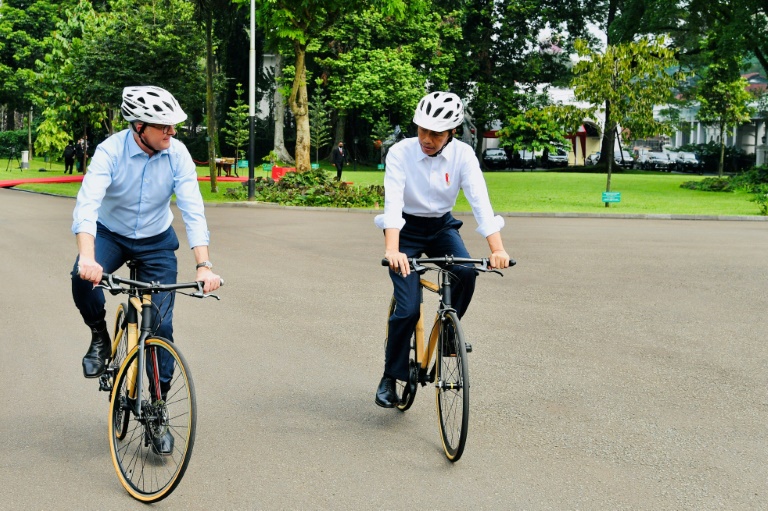
As Indonesian President Joko Widodo led Anthony Albanese around the lush gardens of a presidential palace south of Jakarta earlier this month, he presented the new Australian prime minister with an unusual gift: a bamboo bike.

The night before, designer Singgih Susilo Kartono learned it would be the Spedagi model he crafts in a small village on the island of Java that the leaders would ride side-by-side in a unique moment of bicycle diplomacy.

Prime Minister Albanese would tuck his trousers into his socks after the statesmen stripped off their jackets and ties and donned helmets, setting off on the light and environmentally friendly two-wheelers for the symbolic bike ride.

The 54-year-old designer told AFP the diplomatic gesture was a “special, magical moment” for him after years spent working on the bike.

“It’s not about the bike being bought by Jokowi, but the fact that it was used to welcome PM (Albanese),” he said.

When not arming world leaders with new bamboo wheels, Kartono is using his sustainable bike craftsmanship to bring jobs to locals and show Indonesian villagers how they can make use of the environment around them.

“I train youths here who lack skills. We have a system to train unskilled people until they can create quality products,” he said.

The model, named after the Indonesian words “sepeda” for bicycle and “pagi” for morning, is built by a team of 15 employees at a workshop in Kartono’s village in Central Java, where he saddles up for his own bike ride every day.

Fast-growing bamboo stalks are cut by his team, coated with preservatives, dried, then laminated before being combined with other parts to assemble the sturdy bike frame.

Pound for pound, bamboo is as strong as steel when used in lightweight structures, studies have shown, with a high tensile strength that makes it a worthy and environmentally friendly substitute.

A fully assembled Spedagi bamboo bike can take a week of intricate work, fetching up to 15 million rupiah ($1,000), and some have been sold as far away as Japan, company co-founder Tri Wahyuni told AFP.

– Friendship on wheels –

The green wheels used by the two leaders were built with more expensive parts, said Kartono, declining to disclose the price of their rides.

Widodo, famous at home for gifting bikes to ordinary Indonesians, is a Spedagi fan and bought one personally from Kartono in 2015. 

Albanese was similarly beaming about the bike, taking it back to Canberra and saying people would see him on the streets riding what might be “the only bamboo bike” in the Australian capital.

Both bicycles and bamboo — affordable and plentiful in Indonesia — are closely linked with the archipelago nation’s lower classes, something that struck a chord with the two leaders from humble backgrounds.

But while the Kartono creation merged two symbols of Indonesian heritage, it is now tied to a blossoming bromance cultivated in the first weeks of Albanese’s premiership.

“Every time I ride on the bike, I will remember the friendship with President Widodo,” he said.

With his own creation now crossing the Pacific, Kartono said it was seeing bamboo bikes being made where the plant is rarely found — such as in northern Europe — that first motivated him to craft his design.

“When I dug deep into bicycle products online, I found that bamboo bicycles are made in countries that do not have bamboo. That served as a slap for me,” said the entrepreneur.

“Bamboo is everywhere around my house.”
Swimming and surfing, Gazans savour a cleaner sea

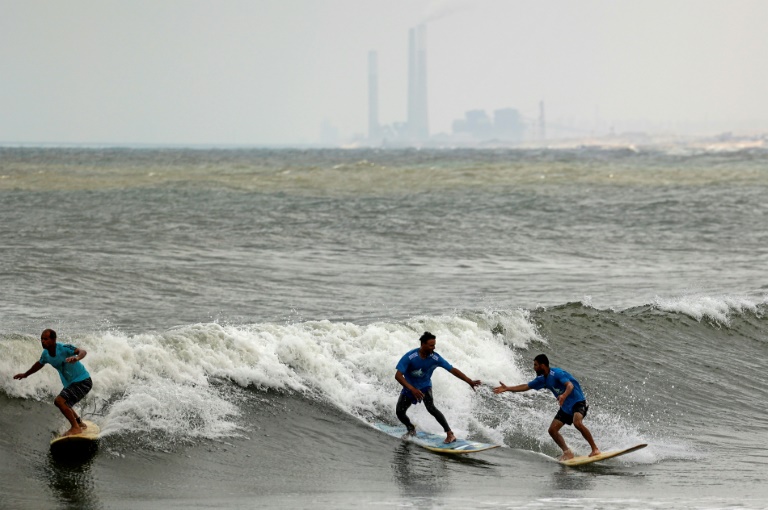
Palestinians in the Israeli-blockaded Gaza Strip are rediscovering the pleasures of the Mediterranean Sea, after authorities declared the end of a long period of hazardous marine pollution.

“It has been a year since I entered the water,” said 22-year-old surfer Sabah Abu Ghanem.

“As soon as I enter the water and ride the waves, I feel free and happy; all the negative energy is replaced with positive energy,” she told AFP.

Marine pollution has worsened in recent years in Gaza, where insufficient wastewater solutions have turned the Mediterranean into a dump.

The problem has been further exacerbated by the dilapidated infrastructure of the impoverished and overcrowded enclave.

The Gaza Strip is home to 2.3 million Palestinians who have been living under a strict land, sea and air blockade imposed by Israel since the Islamist movement Hamas seized power in 2007.

Only the Rafah crossing between Gaza and Egypt is outside Israeli control and it too has remained largely closed.

Gaza’s only power station, which supplies electricity to wastewater plants, has been repeatedly damaged by Israeli strikes.

But six months ago, a German-funded plant began operating in central Gaza, and now treats 60,000 cubic metres (more than 2 million cubic feet) of wastewater per day, which is half the enclave’s sewage, according to Mohammed Masleh, an official at Gaza’s environment ministry.

– ‘I missed swimming’ –

This is just the first phase of the project, and eventually, the plant could treat all wastewater in the territory.

The quality of marine water in Gaza has already improved significantly.

Now, according to samples collected by Gazan authorities, two-thirds of the enclave’s beaches are suitable for swimming, said Masleh.

With the start of school holidays and hot summer temperatures, the beach offers a refreshing solace for the residents of Gaza, a narrow sliver of land wedged between the Mediterranean, Israel and Egypt.

It’s a turning point for the enclave, where $300 million has gone into wastewater projects over the past decade, according to Maher Najjar, deputy director of the coastal waters authority.

The new treatment plant, located in Bureij, features generators and solar panels for electrical supply.

Najjar said it recovers 60 tonnes of solid waste each day, all of which would previously have ended up in the sea.

But although Sabah Abu Ghanem is back on her surfboard, she is still reluctant to bring along her children, who “have sensitive skin and could be infected.”

Sitting on the beach in Gaza City with her children and grandchildren, Umm Ibrahim Sider was also cautious.

“I said no one is to go in the water but when the kids saw all the people, they went in and we couldn’t stop them,” said the 64-year-old Palestinian.

One of her grandchildren, Ibrahim, 13, insisted on staying in the water despite his eyes having turned red from the salt.

“I have missed swimming in the sea,” he said.

Commonwealth meets in shadow of migrant, rights row

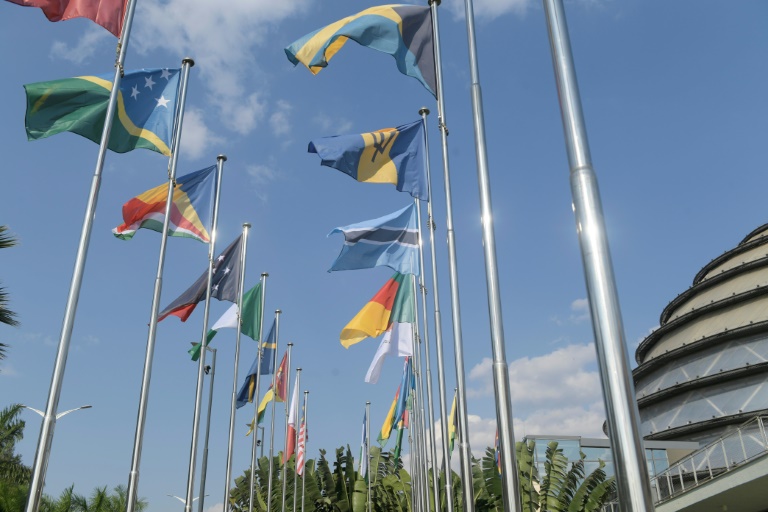
A summit of Commonwealth leaders opens Friday in Rwanda as the host nation comes under scrutiny over its rights record and a migrant deal with Britain threatens to overshadow the meeting.

A bitter contest is also looming for the leadership of the 54-nation club of mainly former British colonies as it grapples with its changing identity and future relevance.

The Commonwealth represents one-third of humanity spanning parts of Africa, Asia, Europe and the Americas but some of its most prominent leaders are skipping the summit, sending envoys in their place.

Prince Charles, representing Queen Elizabeth II as head of the Commonwealth, made the first visit of any British royal to Rwanda for the gathering, which culminates in two days of leadership meetings.

He will meet on the sidelines on Friday with British Prime Minister Boris Johnson, who has been promoting his much-criticised deal to expel migrants to Rwanda since arriving in Kigali Thursday.

The scheme involves Britain deporting asylum-seekers thousands of miles away to Rwanda and has been fiercely opposed by the church, rights groups and — reportedly — Charles himself.

Johnson — who discussed the plan with its other architect Paul Kagame at a meeting with the Rwandan president on Thursday — said he would defend the proposal to Charles and other critics.

“What the critics of the policy need to understand, and I have seen loads and loads of criticism, is that Rwanda has undergone an absolute transformation in the last couple of decades,” the British leader said.

– Rights scrutiny –

Johnson has vowed to press ahead with the deal, which has faced legal challenges in British and international courts, and loomed large ahead of the Commonwealth Heads of Government Meeting.

A first flight of asylum-seekers from the UK to Rwanda was due to take off last week but was halted following an intervention by the European Court of Human Rights.

Johnson also praised Kagame for the “leaps and bounds” achieved in Rwanda, despite widespread concerns over a lack of political freedom and civil liberties in the tiny African nation.

Rights groups have openly questioned the suitability of Rwanda hosting the Commonwealth, which has a charter that enshrines respect for democracy and human rights as core shared values.

More than 20 rights groups and civil society organisations have warned the Commonwealth risked credibility by staging the summit in Rwanda, where they said a “climate of fear” existed under long-ruling Kagame.

The Democratic Republic of Congo has also called on Britain to condemn Rwanda over its alleged “aggression” in the mineral-rich eastern Congo, where Kigali has been accused of stoking a rebellion.

– Leadership rumblings –

At least publicly these concerns have not been raised and a “ministerial action group” to scrutinise the behaviour of Commonwealth members released no statement after their meeting.

Forums ahead of the summit have addressed everything from trade and investment to malaria, climate change, and mental health.

The leaders’ meetings over the next two days behind closed doors will miss some heavyweights, including Narendra Modi of India, South Africa’s Cyril Ramaphosa and Australia’s Anthony Albanese.

Republican movements are taking root in some Commonwealth nations and there has been renewed discussion about the future role of the royal family in the club, and its broader purpose in a post-colonial world.

At the same time, the west African states of Togo and Gabon are set to become the latest members of the Commonwealth despite having no historic ties to Britain — like host Rwanda, which joined in 2009.

Friday will also bring to a head a tussle for the leadership of the Commonwealth that has turned ugly at times.

Kamina Johnson Smith is challenging Patricia Scotland for the post as secretary-general, despite Commonwealth convention dictating the incumbent should stand unopposed for a second term.

Smith, who is Jamaica’s foreign minister, has the backing of the UK, which has publicly expressed dissatisfaction with Scotland’s stewardship of the organisation.

Clashes, tear gas, even as Ecuador protesters win government concession

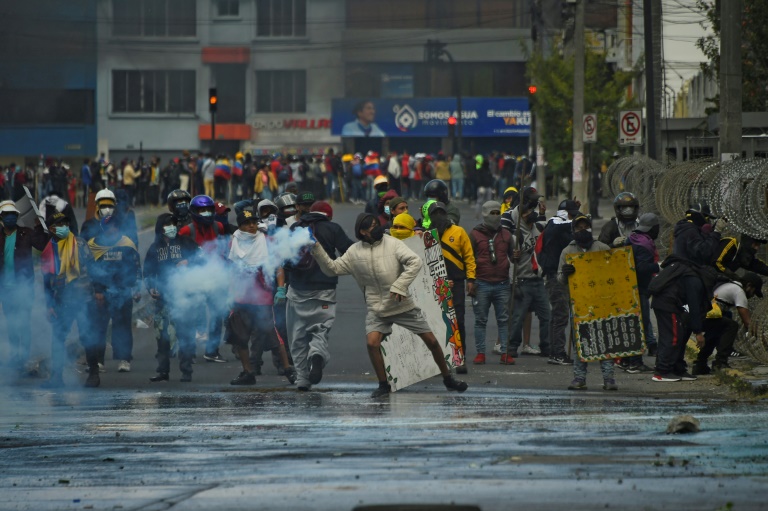
Police in Ecuador’s capital fired tear gas Thursday to disperse Indigenous protesters who tried to storm congress on the 11th day of crippling demonstrations over fuel prices and living costs.

Protesters had earlier won a concession from the Ecuadoran government when President Guillermo Lasso, isolating because of a Covid-19 infection, granted them access to a cultural center emblematic of the Indigenous struggle but commandeered by police over the weekend.

However, later in the day, a group of Indigenous protesters, led by women, headed towards congress only to be pushed back by police as violent clashes broke out.

Police fired tear gas while protesters threw rocks, fireworks, and Molotov cocktails.

“This is a very bad sign, given we asked our base to march peacefully,” said protest leader Leonidas Iza.

Thursday’s clashes, which spread to a neighboring park, left a 39-year-old protester dead by gunfire, according to the Alliance of Human Rights Organizations, bringing to four the total of number protest-related deaths since the marches began on June 13.

An estimated 14,000 protesters are taking part in the mass show of discontent, and some 10,000 of them are in Quito, which is under a night-time curfew.

Six of the country’s 24 provinces are under a state of emergency.

The protesters’ demands include a cut in already subsidized fuel prices which have risen sharply in recent months, as well as jobs, food price controls, and more public spending on healthcare and education.

– ‘For the sake of dialogue’ –

Francisco Jimenez, Ecuador’s minister of government, announced the concession earlier Thursday, saying it was made “for the sake of dialogue and peace.”

The aim, he said, was to “to stop roadblocks, violent demonstrations, and attacks.”

The protesters hailed the move.

“It is a triumph of the struggle,” Iza proclaimed over a megaphone, advancing on the center with hundreds of others in jubilatory mood.

The Alliance of Human Rights Organizations said a 38-year-old man died on Wednesday in the southern town of Tarqui in clashes between protesters and police, which it accused of violent tactics.

Dozens of people have also been injured in the countrywide demonstrations that Indigenous groups have vowed to continue until their demands are met.

The police, for its part, said the man had died of a medical condition that occurred “in the context of the demonstrations.”

Two other people died on Monday and Tuesday, according to the Alliance, which also reported 92 wounded and 94 civilians arrested in 11 days of protests.

Officials say 117 in the ranks of police and soldiers have been injured.

On Wednesday night, some 300 protesters occupied a power plant in southern Ecuador and briefly took its operators hostage, authorities said.

Ecuador, a small South American country riddled with drug trafficking and related violence, has been hard hit by rising inflation, unemployment and poverty — all exacerbated by the pandemic.

– $50 million per day –

The protests, which have involved the burning of tires and tree branches by vocal marchers brandishing sticks, spears and makeshift shields, have paralyzed the capital and severely harmed the economy with barricades of key roads.

The government has rejected demands to lift the state of emergency imposed in response to the sometimes violent demonstrations called by the powerful Confederation of Indigenous Nationalities of Ecuador (Conaie).

“I cry to see so many people mistreated by this… government,” protester Cecilia, an 80-year-old who did not give her full name, told AFP as she marched with an Ecuadoran flag and a banner reading: “Lasso, liar.”

Conaie led two weeks of protests in 2019 in which 11 people died and more than 1,000 were injured, causing economic losses of some $800 million before the then-president abandoned plans to reduce fuel price subsidies.

Lasso’s government has ruled out cutting fuel prices this time, as it would cost the State an unaffordable $1 billion per year.

Conaie — credited with ending three presidencies between 1997 and 2005 — insists the state of emergency be lifted before it will negotiate, but the government has said this “would leave the capital defenseless.”

It was unclear whether the group was ready to negotiate after Thursday’s concession.

Official data showed the economy was losing about $50 million per day due to the protests, not counting oil production — the country’s main export product — which has also been affected.

Producers of flowers, another of Ecuador’s main exports, have complained their wares are rotting as trucks cannot reach their destinations.

Dozens of Suriname villages await aid following unprecedented floods

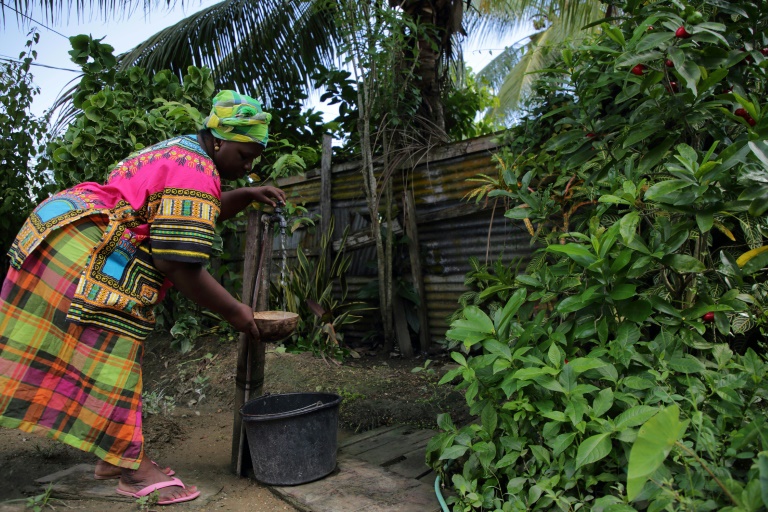
A boat meanders between the sheet metal roofs of houses in Baling Sula, one of numerous villages in central Suriname hit by devastating flooding.

Heavy rainfall since January led rivers to burst their banks in the small South American nation, forcing the state energy firm, Staatsolie Power Company Suriname, to open scuppers at a hydroelectric power station in early March to avoid an even greater catastrophe.

That, in turn, resulted in the flooding of several villages in Brokopondo district, around 100 kilometers south of the capital Paramaribo.

The waters have yet to recede.

More than 3,000 households in seven districts have been affected, but also businesses, farms and schools.

On a recent day, Elsy Poeketie, 48, who fled to the capital to stay with her daughter, showed her granddaughter pictures and videos of her hotel, the Bonanza River holiday resort that until three months ago had a nice sandy beach, cabins and an outdoor recreation hall.

“Now, all flooded, at some places two to three meters high. No beach, just water everywhere you look,” she sighed.

“It really hurts and stresses me. Where will I find the money to renovate?”

In the flooded village of Asigron, Patricia Menig has put up her brother, while their sister is living with an aunt after both their houses were submerged.

“The water started to rise on April 12 and within a week their house was filled with water, four to five meters high,” she told AFP by telephone.

And Menig lost all the crops at her 1.5 hectare agricultural plot, leaving her without income.

“Many of us depend on government aid now,” she said.

– Waiting for the dry season –

Last month, Suriname President Chan Santokhi declared seven of the country’s 10 districts to be disaster areas and asked international partners for help.

China donated $50,000 on Tuesday and the Netherlands, Suriname’s former colonial power, pledged 200,000 euros through UNICEF.

Nearby Venezuela, which has been ravaged by years of economic crisis, nonetheless delivered 40,000 tons of goods, including food and medicines, and distribution will begin this week.

Dry season isn’t expected until August and authorities proposed evacuating the area. But many residents chose to remain, with the government providing short-term shelter for them.

Remote villages in the interior have been cut off from road transport and are only reachable by boat or helicopter, making distribution of relief goods extra challenging, according to Colonel Jerry Slijngard from the National Disaster Management Coordination Center (NCCR).

A flight from Paramaribo to Kwamalasamutu, an Indigenous village near the Brazilian border, costs roughly $3,900.

“Per flight, I can only bring 40 food parcels and there are 400 households,” said Slijngard. 

– ‘I need money, not food’ –

Some former villagers now living in the capital set up an educational project to help children that cannot make it to school, with funding from a Canadian mining firm digging for gold in the area.

The project produces online videos in Dutch and the Aucan and Saramaccan Indigenous languages.

They also provide USB sticks for those without internet access.

The flooding has created other problems, not least a mosquito infestation.

And along the border with French Guiana, Indigenous Wayana villages that have not been flooded still have lost 60 percent of crops, after heavy rainfall has soaked the ground, causing vegetables to rot, said Jupta Itoewaki from the Wayana Mulokot Kawemhakan foundation, an advocacy group.

Some residents of Brokopondo complain that they are not receiving the help they need.

“I don’t need food parcels, my machines can’t eat. I need money,” said furniture maker Amania Nelthan.

Now he sees no other solution than to move.

“Climate change is a fact. Rains and floods will come. Renovating after the floods is not an option. I need to move to higher ground.”

Germany raises gas alert level after Russia cuts supply

Germany moved closer to rationing natural gas on Thursday as it raised the alert level under an emergency plan after Russia slashed supplies to the country.

“Gas is now a scarce commodity in Germany,” Economy Minister Robert Habeck told reporters at a press conference.

Russia was using gas “as a weapon” against Germany in retaliation for the West’s support for Ukraine following Moscow’s invasion, Habeck said, with the aim of “destroying” European unity.

But the Kremlin dismissed Germany’s suggestion there were political motives behind the limits to supply as “strange”.

Germany, like a number of other European countries, is highly reliant on Russian energy imports to meet its needs.

Triggering the “alarm” level — the second of three steps under the emergency plan — brings Germany a step closer to the final stage that could see gas rationing in Europe’s top economy.

The increased level reflected a “significant deterioration of the gas supply situation”, Habeck said.

“If we do nothing now, things will get worse,” Habeck said.

– Russian rebuttal –

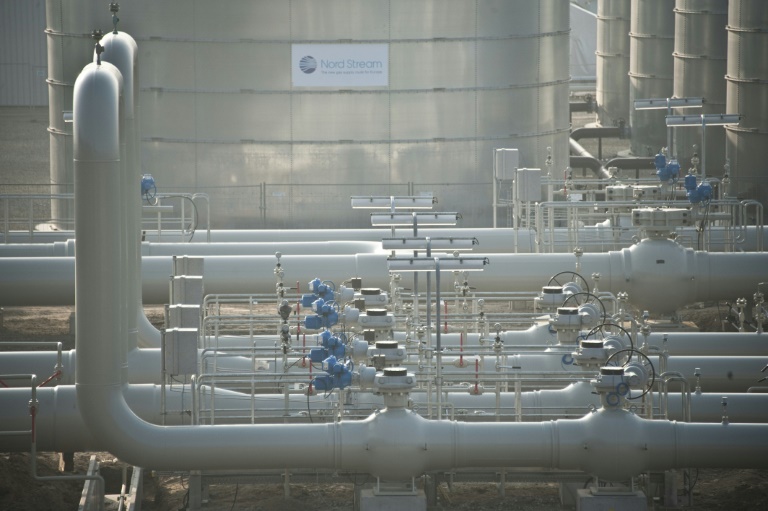
Russian energy giant Gazprom cut supplies to Germany via the Nord Stream pipeline by 60 percent last week, blaming the new limits on delayed repairs.

Germany has dismissed the technical justification provided by Gazprom, instead calling the move a “political decision”. 

Kremlin spokesman Dmitry Peskov said Thursday there was “no double meaning” in the supply decision.

“Our German partners are well aware of the technological servicing cycles of a pipeline,” he said.

“It’s strange to call it politics.”

In recent weeks, Gazprom has stopped deliveries to a number of European countries, including Poland, Bulgaria, Finland and the Netherlands.

Supplies of gas to Europe’s largest economy were “secure”, Habeck said, but action was still required to prepare for the winter ahead.

To mitigate the risks from a supply cut, the government mandated gas storage facilities be filled to 90 percent by the beginning of December.

Currently, the country’s stores stand just under 60 percent full, above the average level of previous years.

In France, the government said Thursday it aimed to fill its natural gas reserves by autumn as it too braces for a drop in supply from Russia.

France will also build a new floating terminal to receive more liquefied natural gas (LNG) supplies by ship, Prime Minister Elisabeth Borne announced.

The terminal is to be positioned off Le Havre on France’s northern coast.

“We can do without Russian gas,” French Energy Transition Minister Agnes Pannier-Runacher said later on BFM Business TV.

“This assumes that the LNG tankers arrive on time and that we can comfortably fill our strategic storage,” she added.

The European Bank for Reconstruction and Development (EBRD) meanwhile said it would lend 300 million euros to Moldova to for gas purchases.

– Supply stoppage –

The German government expects supply to stop between July 11 and July 25 for annual maintenance on the Nord Stream pipeline.

If deliveries do not resume after the service period, Germany could face a shortage of gas as soon as “mid-December”.

Since the outbreak of the war in Ukraine, Germany has managed to reduce the share of its natural gas supplied by Russia from 55 percent to around 35 percent.

The government has found new sources of supply, accelerated plans to import gas in the form of LNG by sea, and put aside 15 billion euros ($15.8 billion) to buy gas to fill storage facilities.

Germany also decided to reactivate mothballed coal-fired power plants to take the burden for electricity generation off gas.

In contrast, the government shrugged off calls to extend the operational lifetime of its nuclear power plants.

Prolonging the use of the final reactors set to be taken off the grid at the end of the year was “not an option”, it said Wednesday.

Germany had to look to see what “energy saving potential” existed, Habeck said Thursday. 

Households could “make a difference” by conserving energy, after Germany launched a campaign to encourage fuel-saving measures, he said, while industry could also make a further contribution.

Chile workers end strike at world's largest copper producer

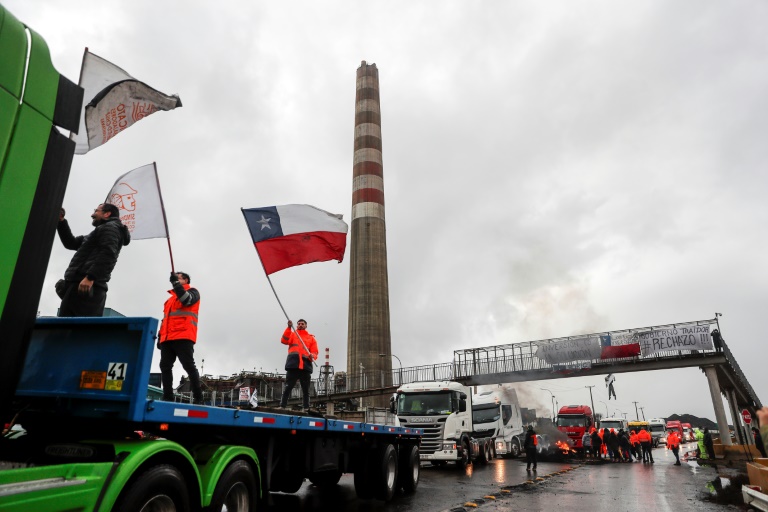
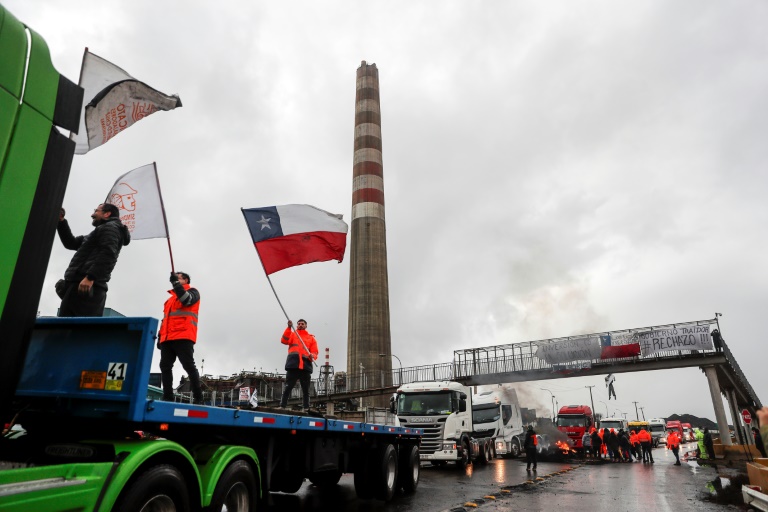
Workers at Chile’s state mining company Codelco, the world’s largest copper producer, called off an open-ended strike Thursday after reaching agreement with the government.

The strike by some 40,000 mine workers to protest the closure of a foundry in one of Chile’s most polluted regions, was ended after one day, the FTC labor federation announced.

The FTC had agreed with the company to work jointly towards closing the Ventanas foundry, over a period of time, in an area dubbed “Chile’s Chernobyl.”

Codelco announced it would close the Ventanas foundry after an incident on June 9 when 115 people, mostly school children, suffered sulfur dioxide poisoning released by heavy industry in the area around Quintero and Puchuncavi, home to some 50,000 people.

It was the second such incident in just three days.

Greenpeace described the area around the Ventanas plant as “Chile’s Chernobyl” following a serious incident in 2018 when around 600 people  received medical treatment for symptoms such as vomiting blood, headaches, dizziness and paralysis of the extremities.

Unions, however, described the announced closure as “arbitrary” and demanded the government spend money instead on bringing the plant up to environmental standards.

Pollution accumulated in the area of Quintero and Puchuncavi after the government decided in 1958 to convert it into an industrial center that now hosts four coal-fired power stations and oil and copper refineries.

Chile workers end strike at world's largest copper producer

Workers at Chile’s state mining company Codelco, the world’s largest copper producer, called off an open-ended strike Thursday after reaching agreement with the government.

The strike by some 40,000 mine workers to protest the closure of a foundry in one of Chile’s most polluted regions, was ended after one day, the FTC labor federation announced.

The FTC had agreed with the company to work jointly towards closing the Ventanas foundry, over a period of time, in an area dubbed “Chile’s Chernobyl.”

Codelco announced it would close the Ventanas foundry after an incident on June 9 when 115 people, mostly school children, suffered sulfur dioxide poisoning released by heavy industry in the area around Quintero and Puchuncavi, home to some 50,000 people.

It was the second such incident in just three days.

Greenpeace described the area around the Ventanas plant as “Chile’s Chernobyl” following a serious incident in 2018 when around 600 people  received medical treatment for symptoms such as vomiting blood, headaches, dizziness and paralysis of the extremities.

Unions, however, described the announced closure as “arbitrary” and demanded the government spend money instead on bringing the plant up to environmental standards.

Pollution accumulated in the area of Quintero and Puchuncavi after the government decided in 1958 to convert it into an industrial center that now hosts four coal-fired power stations and oil and copper refineries.

US justice officials outline Trump's 'brazen' takeover bid

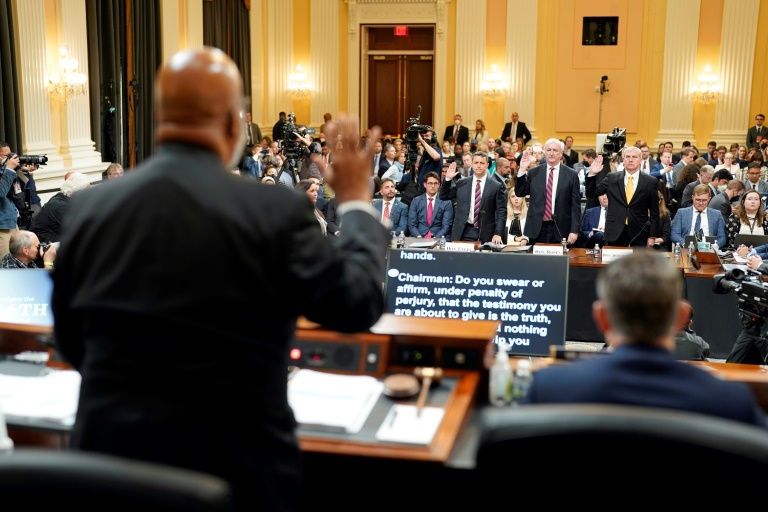
Lawmakers investigating the attack on the US Capitol on Thursday detailed Donald Trump’s efforts to recruit the Justice Department into his scheme to overturn his defeat to Joe Biden — attempting to replace its head with a loyalist who was “meddling in the outcome of a presidential election.”

At the fifth hearing into its year-long probe of the January 2021 insurrection, the House of Representatives panel described Trump’s pressure on officials to amplify his false claims that his presidency had been stolen by widespread voter fraud.

“Donald Trump didn’t just want the Justice Department to investigate. He wanted the Justice Department to help legitimize his lies, to baselessly call the election corrupt,” committee chairman Bennie Thompson said.

Lawmakers revisited tensions among government attorneys in the days leading to the violence, when Trump tried to install his own man at the top of the department.

“It was a brazen attempt to use the Justice Department to advance the president’s personal political agenda,” Thompson said.

Underscoring the intensity of Trump’s pressure on the department, acting attorney general Jeffrey Rosen said that in late December 2020 and early January 2021, the president contacted him almost daily.

“At one point, he had raised the question of having a special counsel for election fraud…. he raised whether the Justice Department would file a lawsuit in the Supreme Court,” Rosen said.

“At a couple of junctures, there were questions about making public statements or about holding a press conference.”

The DOJ pursued a deluge of Trump’s election fraud claims, but Rosen said officials were presented with no evidence. 

– Oval Office showdown –

At that point Trump began elevating a little-known mid-level department official named Jeffrey Clark, who embraced the outgoing president’s debunked theories.

Clark prepared a letter to the Georgia state assembly, the hearing was told, stating falsely that the department had found evidence of widespread voter fraud, but other officials refused to sign it. Other letters had also been prepared for other states.

Trump White House lawyer Eric Herschmann told the committee in a videotaped deposition that he had informed Clark that his plan would amount to “committing a felony.”

Trump pushed to install Clark as attorney general over Rosen, and having Clark reverse the department’s conclusion that there was no evidence of fraud that could sway the election.

But Trump was forced to back off by a rebellion in the department’s senior ranks at a January 4 Oval Office meeting outlined in detail by the witnesses.

Rosen, his deputy Richard Donoghue, another high-ranking official named Steven Engel and White House counsel Pat Cipollone threatened to resign en masse, warning that they would take “hundreds and hundreds” of top federal prosecutors with them if Trump went ahead with his plan.

“I made the point that Jeff Clark is not even competent to serve as the attorney general. He’s never been a criminal attorney. He’s never conducted a criminal investigation in his life,” Donoghue recalled telling Trump.

Donoghue said he told Clark: “You’re an environmental lawyer. How about you go back to your office, and we’ll call you when there’s an oil spill?”

He also recalled warning Clark that his mission to push Trump’s election fraud claims was “nothing less than the United States Justice Department meddling in the outcome of a presidential election.”

– ‘Facts, evidence and law’ –

Under live questioning, Donoghue confirmed that he had rebuffed Trump when the then-president insisted the department could simply “say that the election was corrupt” and “leave the rest to me.”

Rosen said Trump had asked him during a December 31 meeting to seize voting machines from state governments and again Rosen refused, explaining that there was no justification for doing so.

Donoghue recalled Trump being agitated and telling both officials he had been advised to fire them and promote Clark.

“I responded, as I think I had earlier… ‘Mr. President, you should have the leadership that you want, but understand the United States Justice Department functions on facts, evidence and law. And those are not going to change.'”

Clark didn’t appear before the committee and asserted his Fifth Amendment right to avoid incriminating himself more than 100 times during his deposition. 

In a headline-grabbing coda to the affair, federal investigators searched Clark’s home on Wednesday.

The US attorney in Washington did not comment on the reason for the action but the Center for Renewing America, where Clark works, confirmed the search, calling it a “weaponization of government.”

Adding to the drama, Hollywood actor Sean Penn was at Thursday’s hearing as a guest of former police officer Michael Fanone, who was seriously injured on January 6 and testified last year about his ordeal.

World's largest bacteria discovered in Guadeloupe

You can see it with the naked eye and pick it up with a pair of tweezers — not bad for a single bacteria.

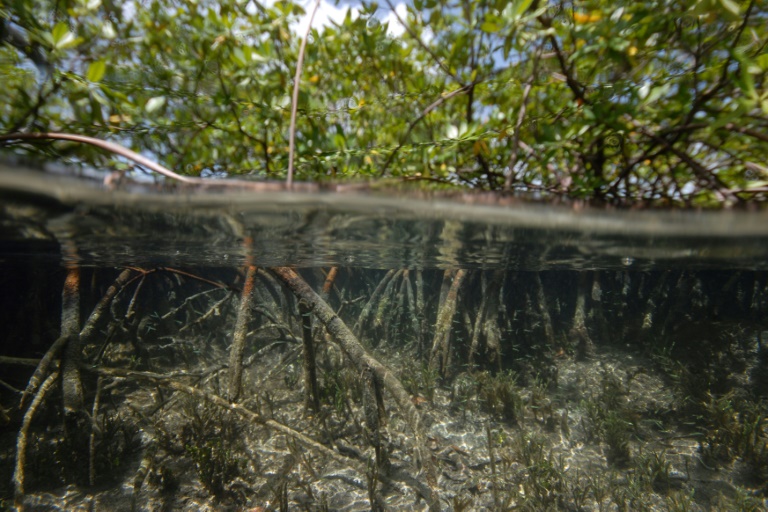
Scientists say they have discovered the world’s largest variety in the mangroves of Guadeloupe — and it puts its peers to shame.

At up to two centimetres (three-quarters of an inch), “Thiomargarita magnifica” is not only around 5,000 times bigger than most bacteria — it boasts a more complex structure, according to a study published in the journal Science on Thursday.

The discovery “shakes up a lot of knowledge” in microbiology, Olivier Gros, professor of biology at the University of the Antilles and co-author of the study, told AFP.

In his laboratory in the Caribbean island group city of Pointe-a-Pitre, he marvelled at a test tube containing strands that look like white eyelashes.

“At first I thought it was anything but a bacterium because something two centimetres (in size) just couldn’t be one”, he said.

The researcher first spotted the strange filaments in a patch of sulphur-rich mangrove sediment in 2009.

Techniques including electronic microscopy revealed it was a bacterial organism, but there was no guarantee it was a single cell.

– ‘As tall as Mount Everest’ –

Molecular biologist Silvina Gonzalez-Rizzo, from the same laboratory, found it belonged to the Thiomargarita family, a bacterial genus known to use sulphides to grow. And a researcher in Paris suggested they were indeed dealing with just one cell.

But a first attempt at publication in a scientific journal a few years later was aborted. 

“We were told: ‘This is interesting, but we lack the information to believe you’,” Gros said, adding that they needed stronger images to provide proof.

Then a young researcher, Jean-Marie Volland, managed to study the bacterium with the Lawrence Berkeley National Laboratory, run by the University of California.

With financial backing and access to some of the best tools in the field, Volland and his colleagues began building up a picture of the colossal bacteria.

It was clearly enormous by bacterial standards — scaled up to human proportions, it would be like meeting someone “as tall as Mount Everest”, Volland said.

Specialist 3D microscope images finally made it possible to prove that the entire filament was indeed a single cell.

But they also helped Volland make a “completely unexpected” discovery.

Normally, a bacterium’s DNA floats freely in the cell. But in the giant species, it is compacted in small structures surrounded by a membrane, he explained.

This DNA compartmentalisation is “normally a feature of human, animal and plant cells, complex organisms… but not bacteria,” Volland said.

Future research will have to determine if these characteristics are unique to Thiomargarita magnifica, or if they can be found in other species of bacteria, Gros said.

Close Bitnami banner
Bitnami