World

Fresh turmoil for Bulgaria as govt loses confidence vote

Bulgaria’s coalition government collapsed Wednesday after just six months when it lost a vote of confidence among MPs, bringing fresh political turmoil and the increased likelihood of an early general election.

But analysts say there is no guarantee that another national vote in this country of 6.5 million people, which last year went through three such polls, would end its political instability.

In the most recent elections last November, the party of liberal Kiril Petkov came out ahead and went on to form an unwieldy coalition government with three other parties.

An energetic, pro-European prime minister, Petkov promised to end Bulgaria’s endemic corruption after a decade of rule by the controversial conservative Boyko Borisov.

But cracks in the coalition began to appear soon after Russia’s invasion of Ukraine, and earlier this month the anti-establishment ITN party led by entertainer Slavi Trifonov withdrew its support.

Borisov’s conservative GERB party swiftly filed a no-confidence motion citing “the failure of the government’s economic and financial policy” as consumer inflation soared.

On Wednesday evening 123 MPs in the 240-seat chamber voted in favour of the motion, two more than it needed to succeed, while 116 voted against. One MP missed the vote through illness.

Petkov told MPs that “it was an honour for me to lead a government overthrown by Borisov, (Delyan) Peevski, Trifonov and (Eleonora) Mitrofanova,” referring to a well-known oligarch and the Russian ambassador to Sofia as well as the other party leaders.

“This vote is a small step on a long road. They did not understand that this is not the way to win the Bulgarian people,” Petkov said of his opponents, before promising to continue fighting for Bulgaria to be a “normal” European state.

Thousands of Bulgarians meanwhile took to the streets on Wednesday in a demonstration of support for Petkov’s drive for reforms — which now looks doomed.

– Aggravated tensions – 

In a country with strong historical ties with Moscow, the Ukraine conflict has “accentuated divisions and weakened the government”, said Ruslan Stefanov of the Center for the Study of Democracy think-tank.

Despite Bulgaria’s heavy dependence on Russian gas and oil, Petkov opposed Moscow’s demand to open a ruble account to pay for Russian gas — a response to European Union sanctions. The country faced a cut in supplies in response.

This meant “Bulgarian oligarchs who pocketed commissions” on energy deliveries found themselves deprived of income, said Ognyan Minchev, head of the Sofia-based Institute for Regional and International Studies.

And that, he said, “aggravated tensions within the coalition as well as between business circles and the government”.

Another source of tension was Ukraine’s appeal for arms to fight the Russian invasion.

While most of the parties in Petkov’s government were ready to authorise such deliveries, the Socialists — also part of the ruling coalition — remained opposed.

The final straw however came from the EU’s drive to settle longstanding historical and cultural disputes between Bulgaria and neighbouring North Macedonia.

It was Petkov’s advocacy of rapprochement with Skopje that the ITN says prompted them to quit the coalition.

– Fragmented landscape – 

President Rumen Radev will now have three attempts to see if any party can form a governing majority among MPs.

Petkov’s party is expected to receive the first mandate from Radev to try to gather a majority, followed by GERB and then another party of Radev’s choosing.

If no workable majority can be found, parliament will be dissolved and politicians will go back to campaigning for elections that would have to be held within two months.

But even if there are fresh elections, they would be unlikely to provide a durable solution to a political landscape that remains highly fragmented, says Dimitar Ganev of the Trend polling institute.
Dutch farmers protest livestock cuts to curb nitrogen

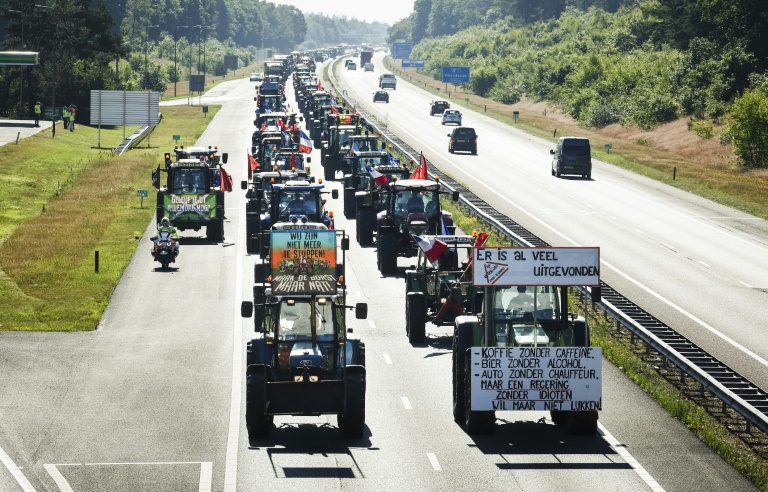
Thousands of tractor-driving farmers demonstrated in central Netherlands on Wednesday, causing widespread traffic chaos as they protested against the government’s far-reaching plans to cut nitrogen emissions.

In one of their largest-ever demonstrations, the farmers demanded the scrapping of recently announced plans by the Hague-based government, which could see a 30-percent reduction in livestock.

The Netherlands, the world’s second-largest agricultural exporter, is one of the top greenhouse gas emitters in Europe — especially of nitrogen — with much of this blamed on cattle-produced manure and fertiliser.

But farmers say they are being unfairly targeted as opposed to big business and industry, with many vowing to resist any plans to scale down or close farms.

Traffic came to a standstill for kilometres around the town of Stroe, east of Amsterdam, as farmers and their tractors arrived from across the country to protest.

Later, at least three people, including a child, were injured in an accident between a tractor and a truck on a highway as many farmers made their way home, Dutch police said.

– ‘Survival at stake’ –

“I see my future falling apart… Not in ten years but sooner,” Elsemieke van der Ham, 25, told AFP.

“I think they don’t quite get it in The Hague. You get up at quarter-past-four, seven days a week for your cows. We’re not just driving around with a tractor,” added Van der Ham, as hundreds of tractors gathered on a field, many with horns blaring and safety lights flashing.

Protesters carried signs saying “The future of farmers is being destroyed” and “Our children are afraid.”

“Our survival is now at stake. So we must make our voices heard today,” said Jurgen Kuijsten, 44, a pig farmer.

Despite the numbers involved and the anger on display, the demonstration remained peaceful as an official programme of speeches got under way.

Police however did intervene when a number of farmers drove onto the wrong side of the highway past a police road block, the NOS public broadcaster said. 

Emergency services handed out water to farmers and motorists trapped in traffic as temperatures rose.

Prime Minister Mark Rutte said earlier this month the government’s plan to cut nitrogen emissions “will have an enormous impact on farmers”. 

“This sector will change, but unfortunately there’s no choice, we have to bring down nitrogen emissions,” he said.

The Dutch government plans to cut greenhouse gas nitrogen by as much as 70 percent in 131 key areas — many of them close to nature reserves — to reach climate goals by 2030.

For farmers this means a 40-percent drop in emissions is expected, which would require around 30 percent less cattle, according to reports.

The country’s 12 provinces have now been tasked to come up with suggestions by next year to reduce emissions by livestock, construction and traffic.

Government too has set aside 24.3 billion euros ($25.5 billion) to help solve the problem including giving financial aid to farmers. 

The government’s announcement comes in the wake of a 2019 ruling by the country’s highest administrative court, saying the Netherlands was not doing enough to protect its natural areas.

Thousands of pro-environment protesters marched on Sunday in the port city of Rotterdam to hail measures to reach climate goals fixed in Paris in 2015.

Troubled Canada pipeline no longer profitable: budget watchdog

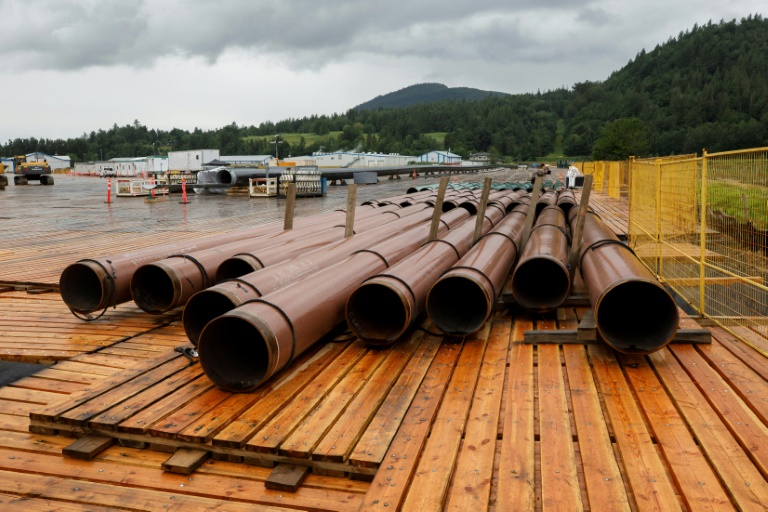
The controversial Trans Mountain pipeline expansion project, now under construction in western Canada after being nationalized, is no longer profitable as costs have spiralled, Parliament’s budget watchdog said Wednesday.

In a report, the office of the Parliamentary Budget Officer said a review of the project’s finances found “that the government’s 2018 decision to acquire, expand, operate, and eventually divest of the Trans Mountain assets will result in a net loss for the federal government.”

Ottawa purchased the pipeline for Can$4.4 billion (US$3.4 billion) from Kinder Morgan four years ago to salvage the troubled expansion project.

But its current value, the PBO estimated, is only Can$3.9 billion, after construction costs soared to $21.4 billion and its completion was pushed one year to late 2023. 

The negative valuation is based on the pipeline’s future cash flows over 40 years, minus construction costs.

The project is to replace an aging conduit built in 1953 to deliver 890,000 barrels of oil a day from landlocked Alberta to the Pacific coast for shipping to new markets in Asia and elsewhere.

Prior to the government taking over the project, it had been stalled by legal challenges and protests by Indigenous groups and environmental activists.

Recession fears send oil prices plunging, equities diverge

Wall Street stocks climbed Wednesday as the US Fed chief stressed the need to combat decades-high inflation, but elsewhere equities and oil prices tumbled on mounting recession fears as central banks hike interest rates.

Wall Street was moderately higher in late morning trading, while European and Asian markets closed in the red, a day after healthy gains.

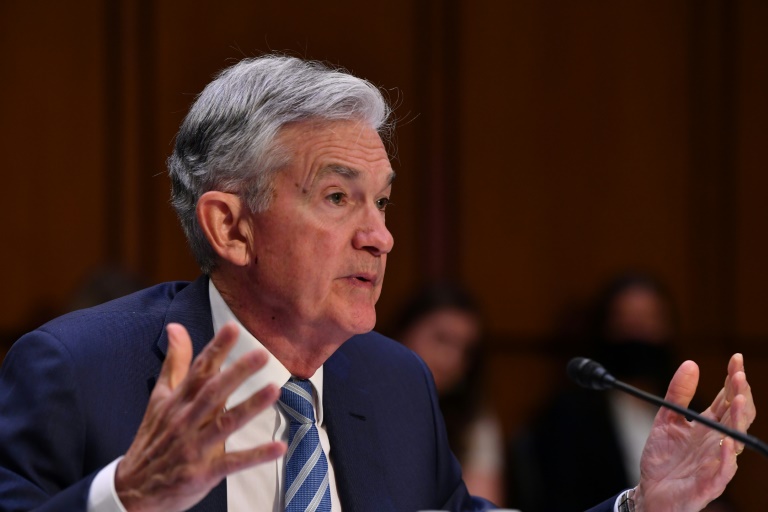
Federal Reserve boss Jerome Powell began two days of testimony to US lawmakers on Wednesday, warning that the US economy faced an “uncertain” global environment and could face further inflation “surprises”.

His testimony to Congress this week will be pored over for an idea about officials’ plans for fighting runaway prices, which are being fanned by supply chain snarls, China’s Covid lockdowns and the war in Ukraine.

Powell once again stressed that the Fed was committed to bringing down inflation — which has reached a 40-year high — with higher interest rates.

But the world’s largest economy “is very strong and well positioned to handle tighter monetary policy”, he said.

Most observers expect the Fed to aggressively hike US interest rates several more times this year, having recently carried out the sharpest lift in almost 30 years.

Powell said rapid interest rate increases were meant to cool demand and bring inflation down, but he acknowledged the risk that the hikes could trigger a US recession.

“It’s not our intended outcome at all, but it’s certainly a possibility,” Powell said in testimony to the Senate Banking Committee.

“The ‘R’ word is likely to come up a lot today and the Chairman will have a tough time dodging it, especially with mid-terms in five months,” said OANDA market analyst Craig Erlam, referring to recession.

“Naturally, he’ll do his best to remain apolitical but I’m not sure investors will be able to ignore so much recession chat,” he added.

Expectations of more rate hikes have been handing support to the dollar, which pushed the yen briefly to a fresh 24-year low Wednesday, before sliding against major rivals.

The Bank of Japan is holding back from lifting interest rates, in sharp contrast to other major central banks.

Oil prices were feeling the heat from recessionary fears, with both main contracts tanking more than six percent at one point.

“Concerns about a global slowdown appear to be outweighing any concern over supply issues derived from Russia’s invasion of Ukraine, and the prospect that Chinese demand could return,” said market analyst Michael Hewson at CMC Markets.

Crude and gas prices have soared in recent months after major economies lifted pandemic lockdowns and following the invasion of Ukraine by major energy producer Russia.

Surging energy costs are fuelling global inflation, with official data Wednesday showing the British annual rate hitting a fresh 40-year high above nine percent.

In the United States, President Joe Biden asked Congress on Wednesday to suspend the federal gas tax for three months as skyrocketing prices cause widespread anger among Americans just months before crucial mid-term elections.

A senior administration official noted that US gas prices — averaging near $5 per gallon — had jumped almost $2 since Russian President Vladimir Putin began building up forces on the Ukrainian border earlier this year.

– Key figures at around 1530 GMT –

Brent North Sea crude: DOWN 3.7 percent at $110.39 per barrel

West Texas Intermediate: DOWN 110.39 percent at $104.86 per barrel

New York – Dow: UP 0.3 percent at 30,623.29 points

EURO STOXX 50: DOWN 0.8 percent at 3,467.26

London – FTSE 100: DOWN 0.9 percent at 7,089.22 (close)

Frankfurt – DAX: DOWN 1.1 percent at 13,144.28 (close)

Paris – CAC 40: DOWN 0.8 percent at 5,916.63 (close)

Tokyo – Nikkei 225: DOWN 0.4 at 26,149.55 (close)

Hong Kong – Hang Seng Index: DOWN 2.6 percent at 21,008.34 (close)

Shanghai – Composite: DOWN 1.2 percent at 3,267.20 (close)

Euro/dollar: UP at $1.0594 from $1.0535 late Tuesday

Pound/dollar: UP at $1.2304 from $1.2273

Euro/pound: UP at 86.10 pence from 85.80 pence

Dollar/yen: DOWN at 135.89 yen from 136.64 yen

burs-rl/jj

UK inflation hits fresh 40-year high in cost-of-living crisis

British annual inflation has hit a fresh 40-year high, official data showed Wednesday, further eroding workers’ wages in a cost-of-living crisis, and heaping more pressuring the Bank of England to keep raising interest rates.

The inflation rate edged higher to 9.1 percent in May from 9.0 percent in April, remaining at the highest level since 1982, the Office for National Statistics (ONS) said.

UK inflation is set to top 11 percent before the end of the year according to the Bank of England, fuelled by soaring energy prices that have raised the prospect of a global recession.

Decades-high inflation is causing a cost-of-living crisis in Britain and elsewhere.

UK railway staff are this week staging the sector’s biggest strike action in more than 30 years, as soaring prices erode the value of wages.

Inflation increased in May on “continued steep food price rises and record high petrol prices”, said ONS chief economist Grant Fitzner.

This was offset by clothing costs rising by less than a year earlier and a drop in prices of computer games, he added.

– ‘Severe pressure’ –

“The further increase in Consumer Prices Index inflation to 9.1 percent underscores the severe pressure that businesses and households are under,” said David Bharier, head of research at the British Chambers of Commerce.

“This inflationary surge sits alongside a poor economic outlook and unless the government acts with urgency to encourage businesses to invest, the chances of a recession will only increase.”

Countries around the world are being hit by soaring inflation as the Ukraine war and the easing of Covid restrictions fuel energy and food price hikes.

That has forced central banks to hike interest rates, risking the prospect of recession as higher borrowing costs spark more pain for businesses and consumers.

The Bank of England has raised its key interest rate five times since December.

“The modest rise in CPI inflation… won’t prevent the Bank of England from raising interest rates further, but it may encourage it to opt again for a quarter-point rate hike at its next meeting in August rather than upping the ante” with a half-point rise, predicted Paul Dales, chief UK economist at Capital Economics.

– Strike action –

The rise comes as Britain faces strikes in several sectors.

Next week, senior lawyers in England and Wales begin a walkout in a row over legal aid funding.

Teaching staff, workers in the state-run National Health Service and the postal service are also mulling strike action.

The Rail, Maritime and Transport workers trade union confirmed Wednesday that rail staff will stage the second of three walkouts on Thursday after talks with Network Rail and train operators broke down.

A third strike is scheduled for Saturday, as a war of words escalated between the RMT and the government.

“We will continue with our industrial campaign until we get a negotiated settlement that delivers job security and a pay rise for our members that deals with the escalating cost of living crisis,” said RMT boss Mick Lynch.

Lynch accused Transport Secretary Grant Shapps of having “wrecked” the negotiations by not allowing Network Rail to withdraw a letter threatening redundancies of 2,900 RMT members.

But Shapps called that “a total lie”, accusing the RMT of trying to “deflect from the fact that the only people responsible for the massive public disruption this week is them”.

Key Ukrainian city under 'massive' Russian bombardment

“Massive” Russian bombardment of Ukraine’s battleground eastern Lugansk region and key city Severodonetsk has been “hell” for soldiers there, Kyiv said, while insisting that defenders would hold “as long as necessary”.

Moscow’s troops have been pummelling eastern Ukraine for weeks and are slowly advancing, despite fierce resistance from the outgunned Ukrainian military.

With President Vladimir Putin’s forces tightening their grip on the strategically important city of Severodonetsk in the Donbas, its twin city of Lysychansk is now coming under heavier bombardment.

“The Russian army is… just destroying everything” in Lysychansk, Sergiy Gaiday, governor of the Lugansk region, which includes both cities, wrote on Telegram.

“It’s just hell out there,” after four months of shelling in Severodonetsk, across the Donets river, he wrote later.

“Our boys are holding their positions and will continue to hold on as long as necessary,” he added.

Pro-Russian separatists claimed they were close to surrounding both Lysychansk and Severodonetsk.

“Over the past several days enormous work has been accomplished,” Andrei Marochko, an officer in the separatist army of Lugansk, told Russian state TV.

– ‘Outrageous lack of care’ –

Russian forces have been occupying villages in the area. Taking control of the two cities would give Moscow control of the whole of Lugansk, allowing them to press further into the Donbas.

After being pushed back from Kyiv and other parts of Ukraine following their February invasion, Moscow is seeking to seize a vast eastern swathe of the country.

In a briefing Wednesday, the Russian defence ministry claimed responsibility for a missile strike it said killed a number of Ukrainian troops in southern Mykolaiv.

City mayor Oleksandr Senkevych told Ukrainian television that the strike hit two firms and a school as well as starting a blaze that authorities could not put out.

In the central Ukrainian city of Zaporizhzhia, women were training to use Kalashnikov assault rifles in urban combat as Russian forces edged nearer.

“Of course, when you can do something, it’s not so scary to take a machine gun in your hands,” said Ulyana Kiyashko, 29, after moving through an improvised combat zone in a basement.

In his daily address Tuesday, Ukrainian President Volodymyr Zelensky accused the Russian army of “brutal and cynical” shelling in the eastern Kharkiv region, where the governor said 15 had been killed Tuesday.

Aid group Doctors Without Borders (MSF) said it had gathered accounts of an “outrageous lack of care to distinguish and protect civilians”.

Most patients it had evacuated by train blamed Russian or Russian-backed forces for a spectrum of gruesome injuries, it added.

– ‘Simply destroys’ –

On the Russian side, officials said Wednesday two drones had hit an oil refinery in the Ukraine-bordering Rostov region, causing an explosion and a fire but no casualties.

Away from the battlefield, Moscow summoned Brussels’ ambassador in a dispute with EU member Lithuania over the country’s restrictions on rail traffic to the Russian outpost of Kaliningrad.

The territory is around 1,000 miles (1,600 kilometres) from Moscow, bordering Lithuania and Poland.

By blocking goods arriving from Russia, Lithuania says it is simply adhering to European Union-wide sanctions on Moscow.

The United States made clear its commitment to Lithuania as an ally in NATO, which considers an attack against one member an attack on all.

And Germany urged Russia not to “violate international law” by retaliating against Lithuania.

Also Wednesday, a Turkish cargo ship left the Russian-occupied city of Mariupol on Ukraine’s Sea of Azov coast.

Although Moscow and Ankara have negotiated for weeks over getting millions of tonnes of desperately needed grain out of the warzone to worse-off countries in Africa and the Middle East, it was not immediately clear whether the Azov Concord was carrying wheat.

Turkey’s defence ministry said four-way talks would be held “in the coming weeks” between Russia, Turkey, Ukraine and the UN, with media reporting the meeting could happen next week.

– ‘Marshall Plan’ –

With US-Russia tensions soaring, the State Department on Tuesday confirmed a second American, 52-year-old Stephen Zabielski, was killed fighting for Ukraine.

A White House spokesman, John Kirby, voiced alarm at Russian statements that it would not apply the Geneva Conventions on the humane treatment of prisoners to two other Americans captured last week, calling suggestions of a death sentence “appalling”.

Reporters Without Borders (RSF) said in an investigation published Wednesday that a Ukrainian photojournalist, Maks Levin, had been killed and possibly tortured by Russian troops after his capture on March 13.

In Brussels, ministers unanimously agreed Tuesday to grant Ukraine and neighbour Moldova candidate status for membership in the European Union.

German Chancellor Olaf Scholz told parliament in Berlin on Wednesday that Ukraine “needs a Marshall Plan for its reconstruction”, a reference to the post-World War II aid from Washington that helped a devastated Europe get back on its feet.

Scholz added that Ukraine and Russia were “still far from negotiations… because Putin still believes in the possibility of a dictated peace”, urging Kyiv’s Western allies to keep up their military and financial support.

Moscow meanwhile complained that its delegates to an Organization for Security and Cooperation in Europe (OSCE) assembly in Britain next month had been refused UK visas.

The Kremlin was Wednesday turning to other members of the so-called “BRICS” grouping that also includes Brazil, India, China and South Africa.

Russia is “actively redirecting its trade flows and external economic contacts towards reliable international partners, above all the BRICS countries,” Putin told a business forum by video link ahead of a virtual leaders’ summit Thursday.

burs-sr/tgb/jh/jj

US Fed chair admits recession a 'possibility' after rate hikes

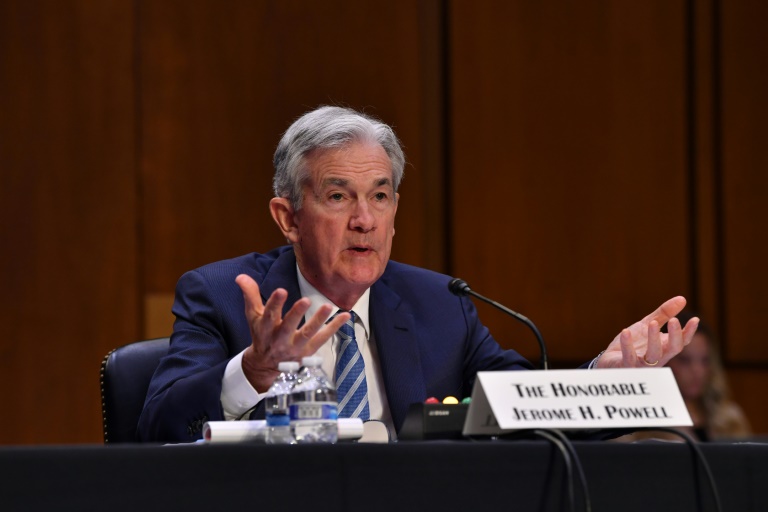
The US economy remains strong but a series of aggressive rate hikes meant to cool soaring inflation could eventually trigger a recession, Federal Reserve Chair Jerome Powell cautioned Wednesday.

Powell, whose testimony before senators was closely watched by investors and analysts, also said the world’s largest economy faces an “uncertain” global environment and could see further inflation “surprises.”

The Fed chair again stressed that the US central bank understands the hardship caused by rising prices and is committed to bringing down inflation, which has reached a 40-year high.

Last week, the Fed announced the sharpest interest rate increase in nearly 30 years and promised more action to combat the price surge, with gas and food costs skyrocketing and millions of Americans struggling to make ends meet.

But when peppered with questions about the prospect of a recession, Powell admitted it could not be ruled out.

“It’s not our intended outcome at all, but it’s certainly a possibility,” he told the Senate Banking Committee.

“And frankly, the events of the last few months around the world have made it more difficult for us to achieve what we want, which is two percent inflation and still a strong labor market.”

In his opening remarks, Powell insisted the US economy “is very strong and well positioned to handle tighter monetary policy.”

“Inflation has obviously surprised to the upside over the past year, and further surprises could be in store,” the Fed chief said in his semi-annual appearance before Congress.

Policymakers “will need to be nimble” given that the economy “often evolves in unexpected ways,” he said.

The Fed is facing intense criticism that it was too slow to react to the changing economy, which benefited from a flood of federal government stimulus.

Last week’s super-sized 0.75-percentage-point increase in the benchmark lending rate was the third since March, taking the policy rate up a total of 1.5 points. Powell at the time said more such increases were likely in July.

“I think it’s going to be very challenging. We’ve never said it was going to be easy or straightforward,” Powell said when asked about efforts to stave off recession.

– ‘Essential’ to curb inflation –

In addition to easing the financial strain on less-wealthy American families, the Fed chief said tamping down inflation was “essential… if we are to have a sustained period of strong labor market conditions that benefit all.”

The US economy recovered quickly from the Covid-19 pandemic, helped by robust consumer spending, and has continued to create jobs at a strong pace, averaging 408,000 in the past three months. 

Unemployment is near a 50-year low.

But the buoyant demand for homes, cars and other goods clashed with transportation and supply chain snarls in parts of the world where Covid-19 has remained a challenge.

That fueled inflation, which got dramatically worse after Russia invaded Ukraine in late February and Western nations imposed stiff sanctions on Moscow, sending food and fuel prices up at a blistering rate.

Powell said the fallout from the conflict “is creating additional upward pressure on inflation.”

In addition, “Covid-19-related lockdowns in China are likely to exacerbate ongoing supply chain disruptions.”

But he noted that the issue is not unique to the United States.

“Over the past year, inflation also increased rapidly in many foreign economies,” he said.

In fact, many major central banks have joined the Fed in beginning to tighten monetary policy — with the notable exception of the Bank of Japan.

Powell pointed to signs that rising rates are having an impact, as business investment slows and “activity in the housing sector looks to be softening, in part reflecting higher mortgage rates.”

Average home loan rates jumped to 5.23 percent in May for a 30-year, fixed-rate mortgage, from 4.98 percent in April, according to Freddie Mac, while the median price for homes topped $400,000 for the first time.

“The tightening in financial conditions that we have seen in recent months should continue to temper growth and help bring demand into better balance with supply,” Powell said.

US Fed chair admits recession a 'possibility' after rate hikes

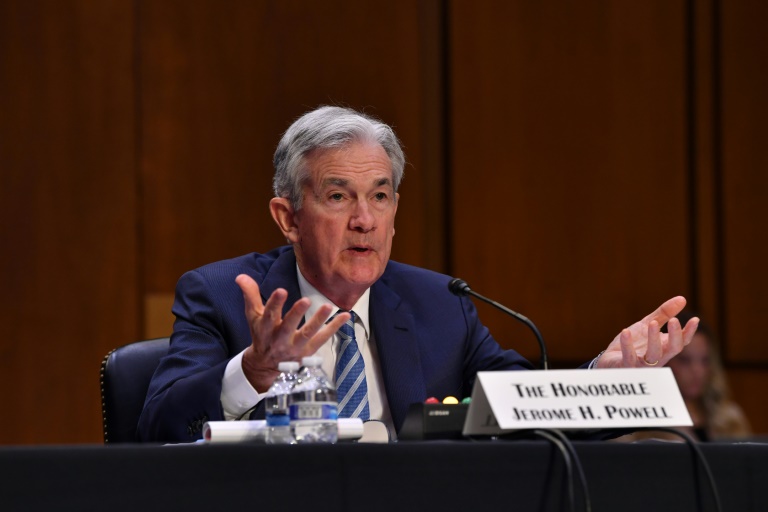
The US economy remains strong but a series of aggressive rate hikes meant to cool soaring inflation could eventually trigger a recession, Federal Reserve Chair Jerome Powell cautioned Wednesday.

Powell, whose testimony before senators was closely watched by investors and analysts, also said the world’s largest economy faces an “uncertain” global environment and could see further inflation “surprises.”

The Fed chair again stressed that the US central bank understands the hardship caused by rising prices and is committed to bringing down inflation, which has reached a 40-year high.

Last week, the Fed announced the sharpest interest rate increase in nearly 30 years and promised more action to combat the price surge, with gas and food costs skyrocketing and millions of Americans struggling to make ends meet.

But when peppered with questions about the prospect of a recession, Powell admitted it could not be ruled out.

“It’s not our intended outcome at all, but it’s certainly a possibility,” he told the Senate Banking Committee.

“And frankly, the events of the last few months around the world have made it more difficult for us to achieve what we want, which is two percent inflation and still a strong labor market.”

In his opening remarks, Powell insisted the US economy “is very strong and well positioned to handle tighter monetary policy.”

“Inflation has obviously surprised to the upside over the past year, and further surprises could be in store,” the Fed chief said in his semi-annual appearance before Congress.

Policymakers “will need to be nimble” given that the economy “often evolves in unexpected ways,” he said.

The Fed is facing intense criticism that it was too slow to react to the changing economy, which benefited from a flood of federal government stimulus.

Last week’s super-sized 0.75-percentage-point increase in the benchmark lending rate was the third since March, taking the policy rate up a total of 1.5 points. Powell at the time said more such increases were likely in July.

“I think it’s going to be very challenging. We’ve never said it was going to be easy or straightforward,” Powell said when asked about efforts to stave off recession.

– ‘Essential’ to curb inflation –

In addition to easing the financial strain on less-wealthy American families, the Fed chief said tamping down inflation was “essential… if we are to have a sustained period of strong labor market conditions that benefit all.”

The US economy recovered quickly from the Covid-19 pandemic, helped by robust consumer spending, and has continued to create jobs at a strong pace, averaging 408,000 in the past three months. 

Unemployment is near a 50-year low.

But the buoyant demand for homes, cars and other goods clashed with transportation and supply chain snarls in parts of the world where Covid-19 has remained a challenge.

That fueled inflation, which got dramatically worse after Russia invaded Ukraine in late February and Western nations imposed stiff sanctions on Moscow, sending food and fuel prices up at a blistering rate.

Powell said the fallout from the conflict “is creating additional upward pressure on inflation.”

In addition, “Covid-19-related lockdowns in China are likely to exacerbate ongoing supply chain disruptions.”

But he noted that the issue is not unique to the United States.

“Over the past year, inflation also increased rapidly in many foreign economies,” he said.

In fact, many major central banks have joined the Fed in beginning to tighten monetary policy — with the notable exception of the Bank of Japan.

Powell pointed to signs that rising rates are having an impact, as business investment slows and “activity in the housing sector looks to be softening, in part reflecting higher mortgage rates.”

Average home loan rates jumped to 5.23 percent in May for a 30-year, fixed-rate mortgage, from 4.98 percent in April, according to Freddie Mac, while the median price for homes topped $400,000 for the first time.

“The tightening in financial conditions that we have seen in recent months should continue to temper growth and help bring demand into better balance with supply,” Powell said.

New UK statue unveiled to post-war Caribbean migrants

Prince William on Wednesday unveiled a new national monument to the “Windrush” generation of Caribbean migrants who moved to Britain following World War II, praising their “immense contribution” to national life.

The 12-foot (3.65-metre) bronze statue, which depicts a man, woman and child standing on top of suitcases, will greet millions of rail commuters at London’s Waterloo station.

“Over the past seven decades, the Windrush Generation’s role in the fabric of our national life has been immense,” said William.

“Every part of British life is better for the half a million men and women of the Windrush Generation.

“I want to say a profound thank you to every member of that generation, and the generations that have followed,” he added.

The decision to erect a monument followed a scandal that first emerged in 2017 and caused much soul-searching about racism past and present in Britain.

Campaigners revealed that thousands of Britons of Caribbean origin, who arrived legally between 1948 and the early 1970s, had been wrongly detained or deported under the government’s hardline immigration policies.

The government then announced “Windrush Day” would be celebrated each year on June 22, and that it was contributing £1 million ($1.22 million) in funding for a national statue.

Jamaican artist Basil Watson was chosen by a Windrush Commemoration Committee from an initial long list of 16 artists to create the work.

The community is named after the MV Empire Windrush ship, one of the vessels that brought workers from Jamaica, Trinidad and Tobago, and other islands to help fill post-war UK labour shortages during that period.

One of the Windrush passengers, Alford Gardner, said the statue dedicated to his generation that “worked hard” was one of a kind.

“It means everything. I never expected anything like this,” the 96-year-old told AFP after the unveiling.

Gardner said while the statue was a “big contribution”, he called for government compensation over the scandal be delivered “quicker”.

The Guardian newspaper on Wednesday reported that only one in four applicants to a compensation scheme had received payments.

– ‘Wonderful acknowledgement’ –

The artist said the monument recognised the “dreams and aspirations, courage and dignity, skills and talents” of the Windrush generation.

“My parents, along with a great many others, took the long arduous voyage from the Caribbean with very little or nothing other than their aspirations, their courage and a promise of opportunity for advancement,” Watson said.

“This monument tells that story of hope, determination, a strong belief in selves and a vision for the future,” he added.

Watson’s own parents were members of the Windrush generation and he spent part of his childhood in Britain.

Angela Wilson, whose parents also came to the UK from the Caribbean, told AFP the statue was a “wonderful acknowledgement” of their contribution.

“It’s nice to know that every time someone walks past the statue, they will remember that the Windrush generation put on their best clothes… and set out for the UK to help rebuild what they considered to be our home.”

But she said she also “looked forward to the Home Office righting the wrongs to make sure everyone has the documentation they need to prove themselves to be British citizens and that they are compensated if they have suffered any loss or injustice”.

Biden seeks fuel tax suspension to help fight inflation pain

Joe Biden pitched a temporary fuel tax break Wednesday to help American drivers face the highest inflation in four decades, but critics called it attempted window dressing by an unpopular US president ahead of difficult midterm elections.

Biden is asking Congress to suspend the federal fuel tax for three months as price increases — in large part spurred by fallout from President Vladimir Putin’s invasion of Ukraine and subsequent Western sanctions on Russia — drive general inflation.

It seems unlikely so far that Congress will give the green light.

The White House wants to lift the 18 cents a gallon federal tax on gasoline and 24 cents a gallon on diesel until September, and will call on state governments to suspend their own taxes to “provide direct relief to American consumers who have been hit with Putin’s price hike,” a senior administration official said.

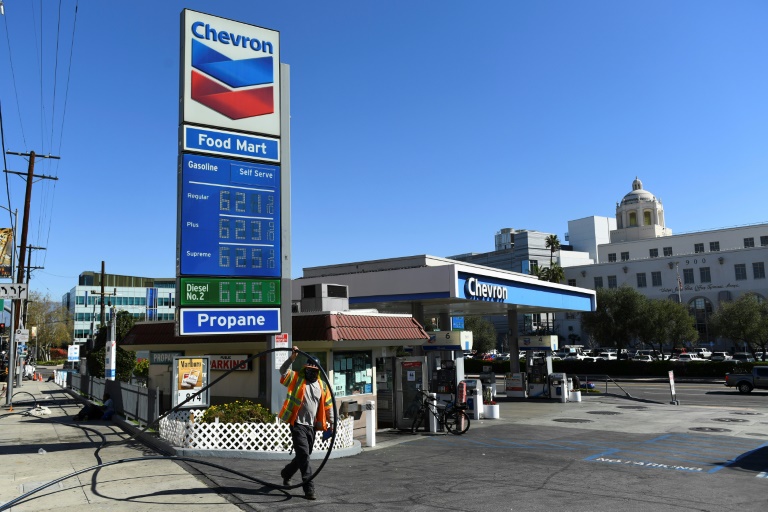
The official noted that gasoline prices — now averaging near $5 per gallon (3.78 liters) — had gone up almost $2 since the start of the Ukraine invasion.

“The president recognizes the significant challenge that high gas prices pose to working families,” the official said, while conceding the tax suspension alone would not offset household costs.

A handful of states including New York and Connecticut have already suspended fuel taxes or delayed planned tax increases.

But according to analysts, some 46 states have yet to act, including Democratic-governed California, where gasoline is the most taxed and the most expensive, at well over $6 a gallon.

Federal tax revenues on gas and diesel help pay for the Highway Trust Fund, which maintains roads and supports public transport, but Biden will call on Congress to ensure the estimated $10 billion gap that would be caused by a three month tax break is made up from other sources.

Whether Congress, where Democrats hold only a narrow majority over Republicans, will pass tax relief is a big question. Even Biden’s backers are lukewarm.

“I’ve not been a proponent,” Steny Hoyer, a senior leader of the Democratic party in Congress, told Politico. “I just don’t know that it gives much relief.”

Jason Furman, a former top economic adviser to president Barack Obama — who himself once dismissed so-called gas tax holidays as a “gimmick” — also said the move would not help regular people. 

“It would be very unlikely that gas prices would fall by more than a dime because of this change. And oil company profits would go up by billions of dollars,” he told NPR.

– Biden’s populist mission –

Biden will urge retailers at filling stations to apply any tax cuts immediately, as well as push refiners to expand their crude-processing capacity in hope that the combined measures could cut the price of gasoline by as much as a dollar a gallon.

He has previously tried other measures, including releasing a million barrels of oil a day from the Strategic Petroleum Reserve, negotiating the release of an additional 60 million barrels from international partners, and expanding access to biofuels.

Nothing so far has had an appreciable effect.

With Democrats fearing a severe defeat in November midterm elections — thereby leaving Biden weakened for the rest of his first term in office — the president has turned to an increasingly populist message, portraying himself as fighting for the middle class against profiteering big oil.

The White House recently called out groups including ExxonMobil and Chevron, denouncing their profit margins as “well above normal” and calling it their patriotic duty to increase output.

“Exxon has made more money than God this quarter,” Biden has said.

Energy Secretary Jennifer Granholm is due to meet with refiners Thursday to urge them to contribute to these measures, including increasing their production output.

On Tuesday, Biden dismissed a complaint from Chevron’s CEO that the industry was being vilified.

“I didn’t know they’d get their feelings hurt that quickly,” Biden said.

Close Bitnami banner
Bitnami