World

Italy's Eni joins giant Qatar gas project after Russian cuts

Italian company Eni on Sunday joined Qatar Energy’s $28.75 billion project to expand production from the world’s biggest natural gas field, days after Russia slashed supplies to Italy.

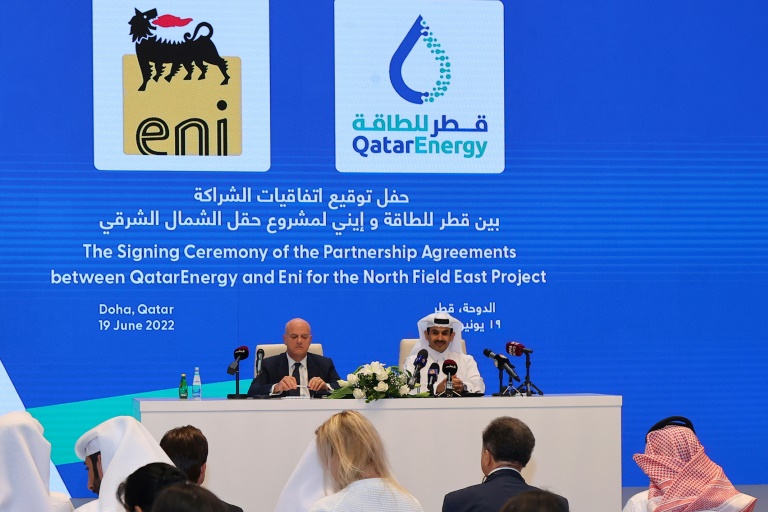
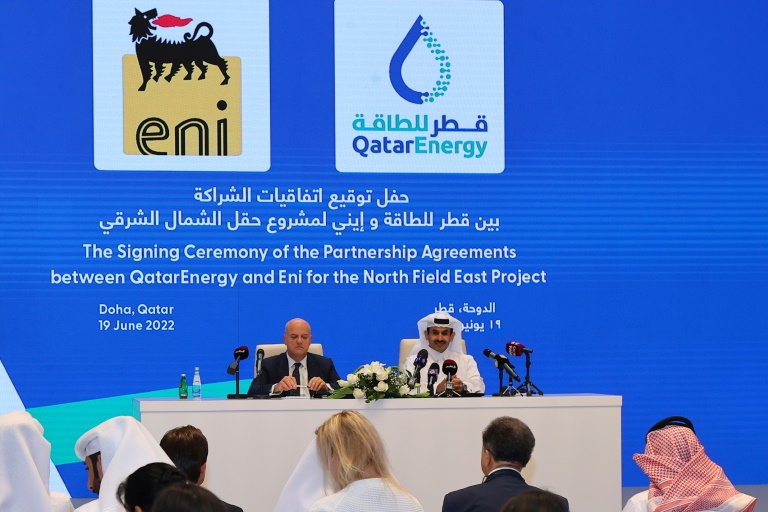
Eni will own a stake of just over three percent in the North Field East project, Qatar Energy’s CEO told a signing ceremony in Doha.

Qatar announced last week that France’s TotalEnergies will be its first, and largest, foreign partner on the development, with a 6.25 percent share. 

An unknown number of companies are also set to be named.

“Today I’m pleased… to announce the selection of Eni as a partner in this unique strategic project,” said Qatar’s Energy Minister Saad Sherida al-Kaabi, who is also president and CEO of state-owned Qatar Energy.

The project’s LNG — the cooled form of gas that makes it easier to transport — is expected to come on line in 2026. It will expand Qatar’s LNG production from 77 million tonnes a year to 110 million, Qatar Energy said.

The Qatari company estimates that the North Field, which extends under the Gulf sea into Iranian territory, holds about 10 percent of the world’s known gas reserves.

Russia’s invasion of Ukraine has injected urgency into efforts around the world to develop new energy sources as Western countries try to reduce their reliance on Russia.

On Friday, Eni said it would receive only 50 percent of the gas requested from Russia’s Gazprom, the third day running of reduced supplies. Rome has accused Gazprom of peddling “lies” over the cuts.

“We have a lot of things to learn from your leadership and also from your standards and from your ability to adapt to very difficult circumstances,” Eni CEO Claudio Descalzi told his Qatari counterpart.

– ‘Geopolitical vision’ –

Kaabi refused to divulge how many more partners will be announced. “We signed with everybody. We’re just not telling you,” he told reporters. 

More announcements are due this week. Industry sources have discussed ExxonMobil, Shell and ConocoPhillips, while Bloomberg has reported that Chinese companies are in talks.

Qatar, which is one of the world’s biggest LNG exporters, is “sharing the risks of commercialisation” by bringing partners on board, said Thierry Bros, a professor at Paris’s Sciences Po and an expert on energy and climate. 

“There could also be a geopolitical vision,” he added.

South Korea, Japan and China have been the main markets for Qatar’s LNG but since an energy crisis hit Europe last year, the Gulf state has helped Britain with extra supplies and also announced a cooperation deal with Germany.

Europe has in the past rejected the long-term deals that Qatar seeks for its energy but the Ukraine war has forced a change in attitude.

Poland, Bulgaria, Finland and The Netherlands have had their natural gas deliveries from Russia suspended for refusing to pay in rubles.

“In the near-term, we see LNG demand being all about Europe as those European buyers look to wean themselves off Russian gas,” Daniel Toleman, an analyst at resources consultancy Wood Mackenzie, told AFP.

“But in the longer term, it does switch back to Asia, and Qatar has a shipping advantage over those US projects and it will be able to supply the Asian (customers).”

Thousands of Rohingya refugees in Bangladesh rally to 'go home'

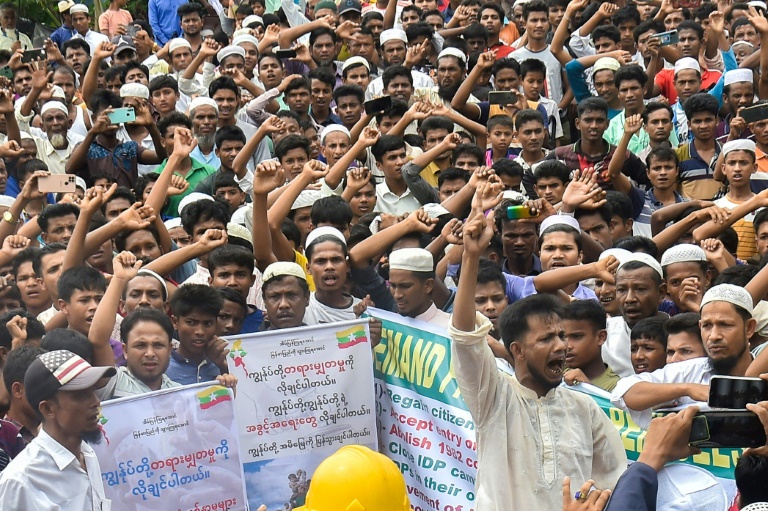
Tens of thousands of Rohingya refugees in Bangladesh staged demonstrations on Sunday demanding repatriation back to Myanmar, where they fled a brutal military crackdown five years ago.

Almost a million Rohingya are confined to bamboo and tarpaulin shacks in 34 squalid camps in southeast Bangladesh, with no work, poor sanitation and little access to education.

Their increasingly restrictive host country has banned them from holding rallies since they staged a massive 100,000-strong protest in August 2019.

But authorities allowed several groups of Rohingya to hold simultaneous “Go Home” marches and rallies ahead of World Refugee Day on Monday.

“We don’t want to stay in the camps. Being refugees is not easy. It’s hell. Enough is enough. Let’s go home,” top Rohingya community leader Sayed Ullah said in a speech at one rally.

In 2018, investigators from a United Nations fact-finding mission into the killings and forced mass exodus of Rohingya Muslims in Myanmar concluded that a criminal investigation and prosecution was warranted of top Myanmar generals for crimes against humanity and genocide.

Sunday’s demonstrations come after the foreign secretaries of Bangladesh and Myanmar last week held a meeting — their first in nearly three years — by video conference. 

A Bangladesh foreign ministry official told AFP that during the meeting Dhaka pressed Naypyidaw for the repatriation of Rohingya refugees to start this year.

“We are hopeful the repatriation will start after the monsoon this year at least in a limited scale,” he said on condition of anonymity.

Police said thousands of refugees, including young children, joined the marches and rallies, standing on roads and alleys with placards that read “Enough is Enough! Let’s Go Home”.

“Over 10,000 Rohingya took part in the rally in the camps under my jurisdiction,” police official Naimul Haque told AFP, referring to Kutupalong, the largest refugee settlement in the world.

Police and organisers said more than 1,000 Rohingya took part in each of the rallies in at least 29 camps. 

Authorities deployed extra security in the camps to prevent any violence, Haque said, adding that the demonstrations “passed off peacefully”.

– No guarantees –

Previous repatriation attempts have failed, with Rohingya refusing to go home until Myanmar gives the largely Muslim minority guarantees of rights and security.

With a dialect similar to that spoken in Chittagong in southeast Bangladesh, the Rohingya are seen by many in Myanmar as “illegal immigrants”, a characterisation the community does not agree with.

Rohingya leaders say they want to go back to their original villages in the Rakhine state of Myanmar, not to camps that Myanmar’s government has built for internally displaced people.

Refugee Rahmat Ullah, 69, said he wants to go back home. 

“We are Rohingya, not Bengalis. We want repatriation with full rights restored,” he told AFP.

Young refugee Mohammad Haris said he does not want to “die a refugee”. 

“I want my rights. I want to go home where I can study and think of a future,” he said.

Spanish PM faces regional election test in Andalusia

Andalusia votes Sunday in an early regional election that the incumbent conservative Popular Party is expected to win comfortably, dealing a blow to Spain’s Socialist Prime Minister Pedro Sanchez ahead of a national vote expected at the end of 2023.

Over six million people are eligible to vote in Spain’s most populous region where scorching temperatures are expected to cool slightly after a week of extreme heat which officials feared would hurt turnout.

Polling stations opened at 9:00 am (0700 GMT) and will close at 8:00 pm, with final results expected a few hours later.

Surveys suggest the conservative Popular Party (PP) will win around 50 seats in the 109-seat Andalusian parliament, more than all leftist parties combined.

It has governed the southern region known for its white-walled villages and popular Costa del Sol beach resorts since 2018 in a coalition with smaller centre-right party Ciudadanos.

The Socialists are predicted to win around 33 seats, the same number as at the last election in 2018 when they were ousted from power in Andalusia for the first time since the regional government was established in 1982.

A scandal over the misuse of public funds intended to fight unemployment was blamed for the party’s drubbing in its longstanding stronghold which is home to around 8.5 million people.

“All social advances that have taken place in Andalusia and in Spain were initiated by the Socialists. Never by the right,” Sanchez told a final campaign rally Friday in Seville, the region’s capital.

While the PP appears set to win Sunday’s election, it is not clear if it will secure an absolute majority which would allow it to govern alone.

If it doesn’t, the PP will likely need to seek support from the far-right Vox by bringing it into the regional government, as happened earlier this year in the northern region of Castilla y Leon.

Until now, Vox has supported the PP in Andalusia but from outside government.

Any deal with Vox would complicate efforts by the PP’s new national leader, Alberto Nunez Feijoo, to project a more moderate image.

– ‘Gaining momentum’ –

The head of the PP in Andalusia, Juan Manuel Moreno Bonilla, has urged voters to deliver him a “strong” government that is not “weighed down” by Vox.

After voting in Malaga Sunday, he appealed to voters to cast their ballot, saying a big turnout would “demonstrate we love our institutions” such as the regional government of Andalusia.

Vox has called for the abolition of Spain’s regional governments.

If the polls are right, this will be the Socialists’ third consecutive regional election loss to the PP after votes in Madrid in May 2021 and Castilla y Leon in February.

Losing in Andalusia would be a “severe blow” for the Socialists and would mean “Sanchez might face an uphill battle to get re-elected” next year, said Antonio Barroso, an analyst at political consultancy Teneo.

“The PP seems to be gaining increasing momentum, and voter concerns about inflation might only make it more challenging for Sanchez to sell his government’s achievements in the next legislative election,” he added.

Spain’s inflation rate hit 8.7 percent in May as the economic fallout from Russia’s invasion of Ukraine has fuelled inflation worldwide, especially through increasing energy prices.

The PP has sought to present itself in Andalusia as a “sensible alternative” from the centre, University of Granada political science professor Oscar Garcia Luengo told AFP.

The strategy appears to be working as the party is poised to win the support of nearly 17 percent of voters who cast their ballot for the Socialists in 2018, according to a Sigma dos survey for the El Mundo daily.

Macron's second term on line in parliamentary election

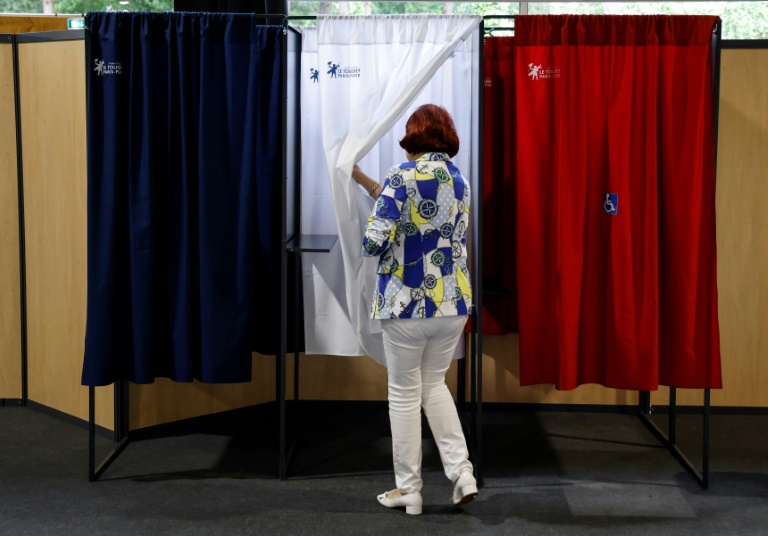
France began voting Sunday in the final round of parliamentary elections, with centrist President Emmanuel Macron’s coalition looking to hold off a challenge from a newly formed left-wing alliance.

At almost 19 percent by midday according to interior ministry figures, turnout was slightly higher than in last week’s first-round ballot, although forecasters suggest participation will remain below 50 percent by the time all polling stations close at 8:00 pm (1800 GMT).

The vote will be decisive for Macron’s second-term agenda following his re-election in April, with the 44-year-old needing a majority in order to push through promised tax cuts and welfare reform and raise the retirement age.

Projections from polling firms suggest his “Together” coalition is on course to be the biggest party in the next National Assembly, but possibly short of the 289 seats needed for a majority.

New left-wing coalition NUPES is hoping to spring a surprise, with the red-green collective promising to block Macron’s agenda after uniting behind 70-year-old figurehead Jean-Luc Melenchon.

“The vote is extremely open and it would be improper to say that things are settled one way or the other,” Melenchon told reporters Friday during a final campaign stop in Paris. 

Far-right leader Marine Le Pen is also eyeing major gains for her National Rally party, which had just eight seats in the outgoing parliament.

Macron was left disappointed last weekend after the first round placed Together and NUPES neck-and-neck at around 26 percent.

Surging inflation, lacklustre campaigning from newly named Prime Minister Elisabeth Borne, and Macron’s abrasive personality were all blamed for the under-performance.

“I really don’t believe we’ll get an overall majority,” one worried minister told AFP last week.

The first-round vote served to whittle down candidates in most of the country’s 577 constituencies to two finalists who are going head-to-head Sunday. 

The election caps an intense two-month sequence to elect a new president and parliament, with voter fatigue seen as one of the reasons for what is expected to be record-low turnout Sunday.

Parts of France also remain under a fierce heatwave that reached its peak on Saturday but could yet keep voters at home.

– ‘French disorder?’ –

The contest between Together and NUPES has turned increasingly bitter over the last week, with Macron’s allies seeking to paint their main opponents as dangerous far-leftists.

Senior MP Christophe Castaner has accused Melenchon of wanting a “Soviet revolution”, while Economy Minister Bruno Le Maire called him a “French Chavez” in reference to the late Venezuelan autocrat Hugo Chavez. 

The political mudslinging has put off some voters.

“Between the two rounds, I’ve found it really disappointing how some people have said unspeakable things about their opponents,” said 67-year-old Marie-Noelle at a polling station in Lyon.

Macron headed to Ukraine last week, hoping to remind voters of his foreign policy credentials and one of Melenchon’s perceived weaknesses — his anti-NATO and anti-EU views at a time of war in Europe.

“We need a solid majority to ensure order outside and inside our borders. Nothing would be worse than adding French disorder to global disorder,” Macron said.

As president, he would retain control of foreign and defence policy whatever the outcome, but his domestic agenda could be thwarted.

Melenchon has promised a break from “30 years of neo-liberalism” — meaning free-market capitalism — and has pledged minimum wage and public spending hikes, as well as nationalisations.

It has been 20 years since France last had a president and prime minister from different parties, when right-winger Jacques Chirac had to work with a Socialist-dominated parliament under premier Lionel Jospin.

– Turnout key – 

A final flurry of polls Friday suggested Macron’s Together allies were on track for 255-305 seats Sunday, with only the upper end of that range being a majority of more than 289.

NUPES would secure around 140-200 seats, making them the biggest opposition force, while Le Pen’s National Rally was seen to get around 20-45 seats.

If they secure more than 15 seats, Le Pen’s MPs would be able to form a formal group in parliament, giving them greater visibility and resources.

But after scoring 41.5 percent in the presidential election in April, Le Pen is still struggling to convert her huge national following into major representation in parliament.

Observers will be keeping a close eye on turnout figures following a historically low level last week of just 47.5 percent.

The three polls — from Elabe, Ifop-Fiducial and Ipsos — suggested turnout Sunday would be 44-47 percent.

A higher-than-expected turnout would most likely favour NUPES, which is banking on young people and the working classes voting.

In France’s Caribbean island of Guadeloupe — where the poll is held a day early — Justine Benin was defeated by NUPES candidate Christian Baptiste Saturday, a loss that jeopardises her role in the government as Secretary of State for Sea.

A government reshuffle is expected after the election.

burs-adp/tgb/raz

Italy's Eni joins giant Qatar gas project after Russian cuts

Italian company Eni on Sunday joined Qatar Energy’s project to expand production from the world’s biggest natural gas field, days after Russia slashed supplies to Italy.

Eni will own a stake of just over three percent in the $28 billion North Field East project, Qatar Energy’s CEO said at a signing ceremony in Doha.

Qatar announced France’s TotalEnergies as its first, and largest, foreign partner on the development last week, with a 6.25 percent share. 

More companies are set to be named. 

“Today I’m pleased… to announce the selection of Eni as a partner in this unique strategic project,” said Energy Minister Saad Sherida al-Kaabi, who is also president and CEO of state-owned Qatar Energy.

The project’s LNG — the cooled form of gas that makes it easier to transport — is expected to come on line in 2026. It will help Qatar increase its liquefied natural gas production by more than 60 percent by 2027, TotalEnergies chief executive Patrick Pouyanne told AFP last week.

Russia’s invasion of Ukraine has injected urgency into efforts around the world to develop new energy sources as Western countries try to reduce their reliance on Russia.

On Friday, Eni said it would receive only 50 percent of the gas requested from Russia’s Gazprom, the third day running of reduced supplies. Rome has accused Gazprom of peddling “lies” over the cuts.

“We have a lot of things to learn from your leadership and also from your standards and from your ability to adapt to very difficult circumstances,” Eni CEO Claudio Descalzi told his Qatari counterpart.

Qatar Energy estimates that the North Field, which extends under the Gulf sea into Iranian territory, holds about 10 percent of the world’s known gas reserves.

Kaabi refused to divulge how many more partners will be announced. Industry sources have discussed ExxonMobil, Shell and ConocoPhillips, while Bloomberg reported this week that Chinese companies were in talks.

South Korea, Japan and China have become the main markets for Qatar’s LNG but since an energy crisis hit Europe last year, the Gulf state has helped Britain with extra supplies and also announced a cooperation deal with Germany.

Europe has in the past rejected the long-term deals that Qatar seeks for its energy but the Ukraine conflict has forced a change in attitude.

“Qatar is the lowest cost source of supply at the moment and  therefore it’s attractive to the majors (companies),” Daniel Toleman, an analyst at resources consultancy Wood Mackenzie, told AFP.

“So these companies want to be involved in those projects.”

Italy's Eni joins giant Qatar gas project after Russian cuts

Italian company Eni on Sunday joined Qatar Energy’s project to expand production from the world’s biggest natural gas field, days after Russia slashed supplies to Italy.

Eni will own a stake of just over three percent in the $28 billion North Field East project, Qatar Energy’s CEO said at a signing ceremony in Doha.

Qatar announced France’s TotalEnergies as its first, and largest, foreign partner on the development last week, with a 6.25 percent share. 

More companies are set to be named. 

“Today I’m pleased… to announce the selection of Eni as a partner in this unique strategic project,” said Energy Minister Saad Sherida al-Kaabi, who is also president and CEO of state-owned Qatar Energy.

The project’s LNG — the cooled form of gas that makes it easier to transport — is expected to come on line in 2026. It will help Qatar increase its liquefied natural gas production by more than 60 percent by 2027, TotalEnergies chief executive Patrick Pouyanne told AFP last week.

Russia’s invasion of Ukraine has injected urgency into efforts around the world to develop new energy sources as Western countries try to reduce their reliance on Russia.

On Friday, Eni said it would receive only 50 percent of the gas requested from Russia’s Gazprom, the third day running of reduced supplies. Rome has accused Gazprom of peddling “lies” over the cuts.

“We have a lot of things to learn from your leadership and also from your standards and from your ability to adapt to very difficult circumstances,” Eni CEO Claudio Descalzi told his Qatari counterpart.

Qatar Energy estimates that the North Field, which extends under the Gulf sea into Iranian territory, holds about 10 percent of the world’s known gas reserves.

Kaabi refused to divulge how many more partners will be announced. Industry sources have discussed ExxonMobil, Shell and ConocoPhillips, while Bloomberg reported this week that Chinese companies were in talks.

South Korea, Japan and China have become the main markets for Qatar’s LNG but since an energy crisis hit Europe last year, the Gulf state has helped Britain with extra supplies and also announced a cooperation deal with Germany.

Europe has in the past rejected the long-term deals that Qatar seeks for its energy but the Ukraine conflict has forced a change in attitude.

“Qatar is the lowest cost source of supply at the moment and  therefore it’s attractive to the majors (companies),” Daniel Toleman, an analyst at resources consultancy Wood Mackenzie, told AFP.

“So these companies want to be involved in those projects.”

Ukraine war could last 'years', NATO chief warns

NATO’s chief warned that the war in Ukraine could last “for years” as President Volodymyr Zelensky vowed Sunday that his forces would not give up the south of the country to Russia after his first visit to the frontline there.

Ukraine said it had also repulsed fresh attacks by Russian forces on the eastern front, where there have been weeks of fierce battles as Moscow tries to seize the industrial Donbas region.

While Ukraine remained defiant, NATO Secretary-General Jens Stoltenberg warned Western countries must be ready to offer long-term support to Kyiv during a grinding war.

“We must be prepared for this to last for years,” Stoltenberg told German daily newspaper Bild.

“We must not weaken in our support of Ukraine, even if the costs are high — not only in terms of military support but also because of rising energy and food prices.”

British Prime Minister Boris Johnson issued a similar warning, urging sustained support for Kyiv or risk “the greatest victory for aggression” since World War II.

“Time is now the vital factor,” Johnson wrote in an article for the Sunday Times after making his second visit to Kyiv, calling for the West to ensure Ukraine has the “strategic endurance to survive and eventually prevail”.

– ‘Return everything’ –

Russian forces have directed their firepower at the east and south of Ukraine in recent weeks since failing in their bid to take the capital Kyiv after the lightning February 24 invasion. 

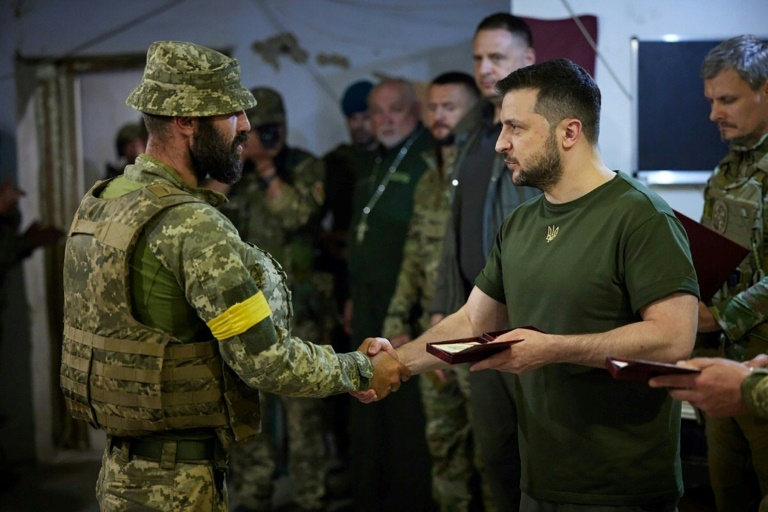
Zelensky made a rare trip outside Kyiv Saturday to the hold-out Black Sea city of Mykolaiv, and visited troops nearby and in the neighbouring Odessa region for the first time since the Russian invasion.

“We will not give away the south to anyone, we will return everything that’s ours and the sea will be Ukrainian and safe,” he said in a video posted on Telegram as he made his way back to Kyiv.

He said he talked with troops and police during his visit.

“Their mood is confident, and looking into their eyes it is obvious that they all do not doubt our victory,” he said.

But Zelensky admitted that losses were “significant”, adding: “Many houses were destroyed, civilian logistics were disrupted, there are many social issues.”

Mykolaiv is a key target for Russia as it lies on the way to the strategic Black Sea port of Odessa.

Blockaded by Russia, Odessa residents have turned their attention to rallying the home front effort.

“Every day, including the weekend, I come to make camouflage netting for the army,” said Natalia Pinchenkova, 49, behind a large Union flag, a show of thanks to Britain for its support for Ukraine since the conflict erupted.

Soldiers in Mykolaiv meanwhile were trying to keep their pre-war routines alive, with one saying he would not give up his vegan diet on the frontlines.

Oleksandr Zhuhan said he had received a package from a network of volunteers to keep up his plant-based diet. 

“There was pate and vegan sausages, hummus, soya milk… and all this for free,” the 37-year-old drama teacher said happily.

– ‘Hero’ –

Back in Kyiv, with shockwaves from the war continuing to reverberate around the world, thousands gathered to pay tribute to one young man — Roman Ratushny, a leading figure in Ukraine’s pro-European Maidan movement, who was killed fighting Russians in the country’s east earlier this month aged just 24.

In front of the coffin draped in a yellow and blue Ukrainian flag at the foot of a monument that overlooks the sprawling Independence Square in the capital, people of all ages saluted his memory.

“I think it is important to be here because he is a hero of Ukraine and we must remember him,” Dmytro Ostrovsky, a 17-year-old high school student, told AFP. 

The loss put a human face on the shared grief of Ukrainians, as the bloodshed continues.

The worst of the fighting continues to be in the eastern industrial Donbas region, with battles raging in villages outside the city of Severodonetsk, which Russia has been trying to seize for weeks.

“There’s an expression: prepare for the worst and the best will come by itself,” the governor of the eastern Lugansk region, Sergiy Gaiday, told AFP in an interview from the Ukrainian-controlled city of Lysychansk across the river from Severodonetsk.

“Of course, we need to prepare,” he said, wearing a flak jacket and carrying gun cartridges and a tourniquet.

Ukraine’s armed forces said Sunday they had pushed back Russian attacks on villages near Severodonetsk.

“Our units repulsed the assault in the area of Toshkivka,” the Ukrainian army said on Facebook. “The enemy has retreated and is regrouping.”

It said Russian forces were “storming” towards the village of Orikhove, but that it had “successfully repulsed” an assault near the village.

In Lysychansk, the governor Gaiday said watching his home city, Severodonetsk, be shelled and people he knew dying was “painful”.

“I’m a human being but I bury this deep inside me,” he said, adding that his task is to “help people as much as possible”.

burs-dk/raz

Indian commercial jet makes safe landing after engine fire

A New Delhi-bound flight carrying 185 passengers made an emergency landing on Sunday in the eastern Indian city of Patna, after its left engine caught fire while in flight, officials said.

The passengers aboard the domestic flight, operated by commercial carrier SpiceJet, were evacuated safely once the pilot returned to Patna airport shortly after take-off.

“The flight returned to Patna airport after locals (on the ground) noticed a fire on the left wing of the aircraft and informed airport officials,” district magistrate Chandrashekhar Singh told reporters.

“All 185 passengers were safely deboarded. Reason for the fire is a technical glitch. The engineering team is analysing,” Singh added.

A passenger told reporters that there was a lot of noise heard on board the plane in the first 15 minutes after take-off.

“The pilot announced there was some problem and that we would be going back to Patna…. it was quite scary,” said Pacifica, who gave only one name.

A bird hitting the engine may have sparked the fire, local news broadcaster NDTV quoted aviation sources as saying.

The no-frills SpiceJet airline has been in the news in recent weeks, with aviation authorities imposing a fine of one million Indian rupees (about 12,830 US dollars) for training its Boeing 737 MAX pilots on a faulty simulator.

In April, authorities barred 90 SpiceJet pilots from operating that aircraft, saying they were not properly trained, according to local media reports.

Spanish PM faces regional election test in Andalusia

Andalusia votes Sunday in an early regional election that the incumbent conservative Popular Party is expected to win comfortably, dealing a blow to Spain’s Socialist Prime Minister Pedro Sanchez ahead of a national vote expected at the end of 2023.

Over six million people are eligible to vote in Spain’s most populous region where scorching temperatures are expected to cool slightly after a week of extreme heat which officials feared would hurt turnout.

Polling stations opened at 9:00 am (0700 GMT) and will close at 8:00 pm, with final results expected a few hours later.

Surveys suggest the conservative Popular Party (PP) will win around 50 seats in the 109-seat Andalusian parliament, more than all leftist parties combined.

It has governed the southern region known for its white-walled villages and popular Costa del Sol beach resorts since 2018 in a coalition with smaller centre-right party Ciudadanos.

The Socialists are predicted to win around 33 seats, the same number as at the last election in 2018 when they were ousted from power in Andalusia for the first time since the regional government was established in 1982.

A scandal over the misuse of public funds intended to fight unemployment was blamed for the party’s drubbing in its longstanding stronghold which is home to around 8.5 million people.

“All social advances that have taken place in Andalusia and in Spain were initiated by the Socialists. Never by the right,” Sanchez told a final campaign rally Friday in Seville, the region’s capital.

While the PP appears set to win Sunday’s election, it is not clear if it will secure an absolute majority which would allow it to govern alone.

If it doesn’t, the PP will likely need to seek support from the far-right Vox by bringing it into the regional government, as happened earlier this year in the northern region of Castilla y Leon.

Until now, Vox has supported the PP in Andalusia but from outside government.

Any deal with Vox would complicate efforts by the PP’s new national leader, Alberto Nunez Feijoo, to project a more moderate image.

– ‘Gaining momentum’ –

The head of the PP in Andalusia, Juan Manuel Moreno Bonilla, has urged voters to deliver him a “strong” government that is not “weighed down” by Vox.

If the polls are right, this will be the Socialists’ third consecutive regional election loss to the PP after votes in Madrid in May 2021 and Castilla y Leon in February.

Losing in Andalusia would be a “severe blow” for the Socialists and would mean “Sanchez might face an uphill battle to get re-elected” next year, said Antonio Barroso, an analyst at political consultancy Teneo.

“The PP seems to be gaining increasing momentum, and voter concerns about inflation might only make it more challenging for Sanchez to sell his government’s achievements in the next legislative election,” he added.

Spain’s inflation rate hit 8.7 percent in May as the economic fallout from Russia’s invasion of Ukraine has fuelled inflation worldwide, especially through increasing energy prices.

The PP has sought to present itself in Andalusia as a “sensible alternative” from the centre, University of Granada political science professor Oscar Garcia Luengo told AFP.

The strategy appears to be working as the party is poised to win the support of nearly 17 percent of voters who cast their ballot for the Socialists in 2018, according to a Sigma dos survey for the El Mundo daily.

New Hong Kong cabinet includes four under US sanctions

Beijing on Sunday appointed a new Hong Kong administration that includes four senior officials under US sanctions its incoming leader has decried as an attempt to “bully” China. 

The United States hit 11 Hong Kong and Beijing officials with sanctions two years ago after a sweeping national security law was imposed to snuff out dissent in the semi-autonomous city following the massive, sometimes violent democracy protests of 2019. 

Seven were members of the Hong Kong government, and four will continue in the new administration, including leader-in-waiting John Lee, security minister Chris Tang, mainland affairs minister Erick Tsang and newly appointed chief secretary for administration Eric Chan.

The other three sanctioned were retired police chief Steven Lo, outgoing city leader Carrie Lam and Secretary for Justice Teresa Cheng, who will be replaced. 

Under the sanctions, Lam has said she was forced to receive her salary in cash due to banking restrictions.

Introducing his new cabinet to reporters Sunday, Lee said he “scoffed at the so-called sanctions” and paid them no attention. 

“Some countries of bullies tried to intimidate (Hong Kong) officials with measures like sanctions, especially after their plots to sabotage our national security failed because of the measures we deployed,” Lee said.

“This made us more determined in continuing to discharge our duties of defending national security.”

Sunday’s appointment of 26 principal officials comes less than two weeks before the new government assumes office on July 1, the 25th anniversary of Hong Kong’s transfer from British to Chinese rule and halfway point of the “One Country, Two Systems” political model.

While speculation has been rampant that Xi will visit Hong Kong for the anniversary celebrations in what would be a symbolic endorsement of Lee’s new administration, the trip has yet to be confirmed.

Such a visit would mark the first time Xi has travelled outside the Chinese mainland since the beginning of the Covid-19 pandemic.

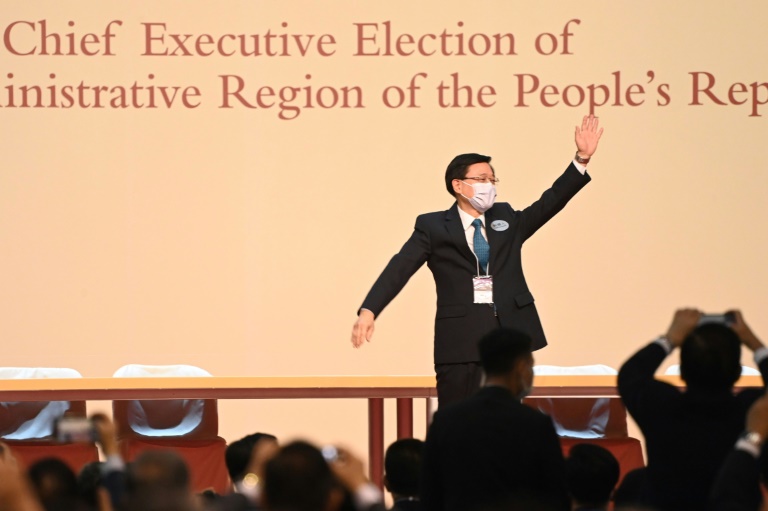
John Lee, 64, a former security chief who oversaw the crackdown on Hong Kong’s democracy movement, was chosen as the next chief executive by a small committee of Beijing loyalists in early May.

During Lee’s visit to Beijing for his formal appointment last month, Xi said Lee had the “courage to take responsibility” and “had made contributions to safeguarding national security and Hong Kong’s prosperity and stability”.

Lee was the sole candidate in the race and received 99 percent of the vote after China overhauled Hong Kong’s electoral system in 2021 to ensure anyone deemed unpatriotic would be ineligible to run.

Under a restructuring plan proposed by the outgoing Lam, Lee’s administration will be expanded, including the addition of two new policy bureaus and creation of three deputy secretary positions for administration, finance and justice.

Close Bitnami banner
Bitnami