World

Macron's second term on line in parliamentary election

France began voting Sunday in the final round of parliamentary elections, with centrist President Emmanuel Macron’s coalition looking to hold off a challenge from a newly formed left-wing alliance.

Forecasters predict a re-run of last week’s low turnout at polling stations, which opened at 8:00 am (0600 GMT) and will close at 8:00 pm.

The vote will be decisive for Macron’s second-term agenda following his re-election in April, with the 44-year-old needing a majority in order to push through promised tax cuts and welfare reform and raise the retirement age.

Projections from polling firms suggest his “Together” coalition is on course to be the biggest party in the next National Assembly, but possibly short of the 289 seats needed for a majority.

New left-wing coalition NUPES is hoping to spring a surprise, with the red-green collective promising to block Macron’s agenda after uniting behind 70-year-old figurehead Jean-Luc Melenchon.

“The vote is extremely open and it would be improper to say that things are settled one way or the other,” Melenchon told reporters Friday during a final campaign stop in Paris. 

Far-right leader Marine Le Pen is also eyeing major gains for her National Rally party, which had just eight seats in the outgoing parliament.

Macron was left disappointed by results last weekend after a first round of voting saw Together and NUPES finish neck-and-neck on around 26 percent.

Surging inflation, lacklustre campaigning from newly named Prime Minister Elisabeth Borne, and Macron’s abrasive personality were all seen as reasons for the under-performance.

“I really don’t believe we’ll get an overall majority,” one worried minister told AFP last week.

The first-round vote served to whittle down candidates in most of the country’s 577 constituencies to two finalists who will go head-to-head Sunday. 

The election caps an intense two-month sequence to elect a new president and parliament, with voter fatigue seen as one of the reasons for what is expected to be record-low turnout Sunday.

– ‘French disorder?’ –

The contest between Together and NUPES has turned increasingly bitter over the last week, with Macron’s allies seeking to paint their main opponents as dangerous far-leftists.

Senior MP Christophe Castaner has accused Melenchon of wanting a “Soviet revolution”, while Economy Minister Bruno Le Maire called him a “French Chavez” in reference to the late Venezuelan autocrat Hugo Chavez. 

Macron headed to Ukraine last week, hoping to remind voters of his foreign policy credentials and one of Melenchon’s perceived weaknesses — his anti-NATO and anti-EU views at a time of war in Europe.

“We need a solid majority to ensure order outside and inside our borders. Nothing would be worse than adding French disorder to global disorder,” Macron said.

As president, he would retain control of foreign and defence policy whatever the outcome, but his domestic agenda could be thwarted.

Melenchon has promised a break from “30 years of neo-liberalism” — meaning free-market capitalism — and has pledged minimum wage and public spending hikes, as well as nationalisations.

It has been 20 years since France last had a president and prime minister from different parties, when right-winger Jacques Chirac had to work with a Socialist-dominated parliament under premier Lionel Jospin.

– Turnout key – 

A final flurry of polls Friday suggested Macron’s Together allies were on track for 255-305 seats Sunday, with only the upper end of that range being a majority of more than 289.

NUPES would secure around 140-200 seats, making them the biggest opposition force, while Le Pen’s National Rally was seen to get around 20-45 seats.

If they secure more than 15 seats, Le Pen’s MPs would be able to form a formal group in parliament, giving them greater visibility and resources.

But after scoring 41.5 percent in the presidential election in April, Le Pen is still struggling to convert her huge national following into major representation in parliament.

“You can put an end to five years of toxic policies by Emmanuel Macron,” she said in a campaign video posted on social media Friday. 

“You also have the chance to protect the country from the far-left.”

Observers will be keeping a close eye on turnout figures following a historically low level last week of just 47.5 percent.

The three polls — from Elabe, Ifop-Fiducial and Ipsos — suggested turnout Sunday would be 44-47 percent.

Figures will be given throughout the day by the interior ministry and a higher-than-expected turnout would most likely favour NUPES, which is banking on young people and the working classes voting.

In France’s Caribbean island of Guadeloupe — where the poll is held a day early — Justine Benin was defeated by NUPES candidate Christian Baptiste Saturday, a loss that jeopardises her role in the government as Secretary of State for Sea.

A government reshuffle is expected after the election.

burs-adp/tgb/raz

Rock-around-Bangkok: Thai air guitar contestants give their all

What happens when Donald Trump, a Bangkok moto-taxi driver, and a Squid Games contestant take the stage in a Bangkok bar late on a Saturday night? It can only mean one thing: an air guitar battle for peace.

The cosplaying individuals were gathered at the second annual Thai air guitar championship for the chance to represent Thailand in the beloved World Championships in Finland later this year.

The hallowed international event, founded in Finland in 1996 to promote world peace — “hold air guitars, not guns” is the tongue-in-cheek motto — has given rise to good-natured and over-the-top competitions around the world.

“This is going to be the greatest thing you have never seen,” roared co-host and organiser Jacob “Airlectic Eel” Conga, bouncing across Brownstone venue’s stage following his exuberant performance to warm up the crowd.

For the first round, each of the nine contestants gave a 60-second performance marked by three judges with the top five progressing to the second and final round.

Contestants were marked on technical ability, stage presence and “airness” — “the ‘je ne sais quoi’ of air guitar, when it transcends a performance and becomes a true piece of art,” said Conga.

The eccentric and electric sets, performed to a medley of genres and tastes from Rihanna’s “Shut Up And Drive” to self-composed Thai rock-pop, eventually saw the strutting and pouting “Trump” win the night, despite fierce competition.

“He made Thailand great again, for sure,” judge and comedian Charles the French said.

Rob “Donald Trump” Palmer, who when not performing air guitar solos has lived and worked in Thailand for the past eight years, said the evening was “fantastic”.

“It’s a great idea, completely stupid but also totally awesome,” said the 61-year-old following his Trump-imbued performance of Green Day’s “American Idiot”.

Explaining his costume, most of which was chaotically thrown to the crowd during the final round, he said: “if you have to do this, you got to do something crazy, so let’s do the craziest man on the planet, to do Trump.”

Having won the 5,000 baht ($141) prize, and a trip to Finland to represent Thailand, Palmer grinned and said: “For most of us, it’s probably the only chance you have of becoming a national champion or even a world champion — so you got to do it.”

France, a 22-year-old spectator who gave only his nickname, had come along to support his friend but was totally unprepared for the “crazy” spectacle.

“I played guitar before and I do some air guitar, but I’ve never seen air guitar like this.”

Zelensky vows to retake south, NATO warns of long war

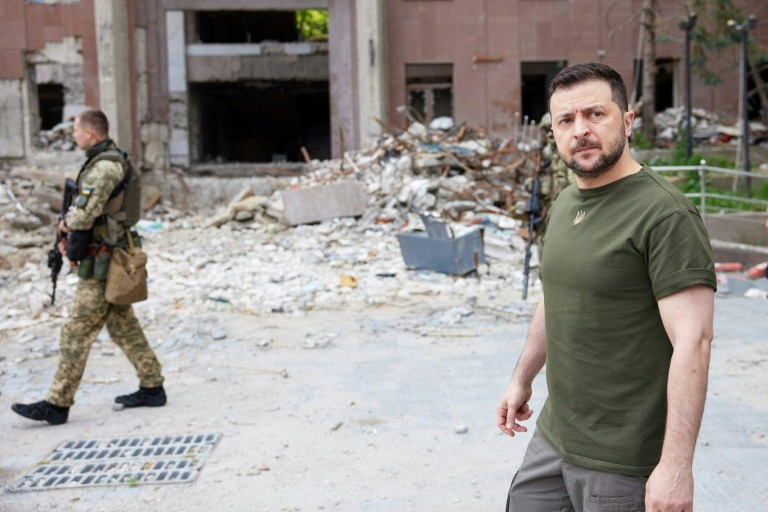
President Volodymyr Zelensky vowed Sunday that his forces “will not give away the south to anyone” after his first visit to the southern frontline, as NATO’s chief warned the war in Ukraine could last “for years”.

Making a rare trip outside Kyiv, where he is based for security reasons, Zelensky travelled to the hold-out Black Sea city of Mykolaiv and visited troops nearby and in the neighbouring Odessa region for the first time since the Russian invasion.

“We will not give away the south to anyone, we will return everything that’s ours and the sea will be Ukrainian and safe,” he said in a video posted on Telegram as he made his way back to Kyiv.

He said he talked with troops and police during his visit.

“Their mood is confident, and looking into their eyes it is obvious that they all do not doubt our victory,” he said.

While Zelensky remained defiant, NATO Secretary-General Jens Stoltenberg warned that “we must be prepared for this to last for years.”

Speaking to German daily newspaper Bild, Stoltenberg said “We must not weaken in our support of Ukraine, even if the costs are high — not only in terms of military support but also because of rising energy and food prices.”

Russian forces have directed their firepower at the east and south of Ukraine in recent weeks since failing in their bid to take the capital Kyiv after the lightning February 24 invasion. 

“The losses are significant. Many houses were destroyed, civilian logistics were disrupted, there are many social issues,” Zelensky said.

“I have commissioned to make assistance to people who have lost loved ones more systemic. We will definitely restore everything that was destroyed. Russia does not have as many missiles as our people have the desire to live.”

Mykolaiv is a key target for Russia as it lies on the way to the strategic Black Sea port of Odessa. 

Zelensky surveyed the city’s badly damaged regional administration building and met officials in what appeared to be a basement where he handed out awards to soldiers, in a video released by his office.

Soldiers in Mykolaiv meanwhile were trying to keep their pre-war routines alive, with one saying he would not give up his vegan diet on the frontlines.

Oleksandr Zhuhan said he had received a package from a network of volunteers to keep up his plant-based diet. 

“There was pate and vegan sausages, hummus, soya milk… and all this for free,” the 37-year-old drama teacher said happily.

– ‘Hero’ –

Back in Kyiv, with shockwaves from the war continuing to reverberate around the world, thousands gathered to pay tribute to one young man — Roman Ratushny, a leading figure in Ukraine’s pro-European Maidan movement, who was killed fighting Russians in the country’s east earlier this month aged just 24.

In front of the coffin draped in a yellow and blue Ukrainian flag at the foot of a monument that overlooks the sprawling Independence Square in the capital, people of all ages saluted his memory.

“I think it is important to be here because he is a hero of Ukraine and we must remember him,” Dmytro Ostrovsky, a 17-year-old high school student, told AFP. 

The loss put a human face on the shared grief of Ukrainians, as the bloodshed continues.

The worst of the fighting continues to be in the eastern industrial Donbas region, with battles raging in villages outside the city of Severodonetsk, which Russia has been trying to seize for weeks.

“There’s an expression: prepare for the worst and the best will come by itself,” the governor of the eastern Lugansk region, Sergiy Gaiday, told AFP in an interview from the Ukrainian-controlled city of Lysychansk across the river from Severodonetsk.

“Of course, we need to prepare.”

Wearing a flak jacket and carrying gun cartridges and a tourniquet, he said Russian forces “are just shelling our troop positions 24 hours a day.”

Earlier, Gaiday said on Telegram that there was “more destruction” at the besieged Azot chemical plant in Severodonetsk, where hundreds of civilians are sheltering.

He also said Lysychansk was being “heavily shelled”. 

There are signs of preparations for street fighting in the city: soldiers digging in, putting up barbed wire and police placing burnt-out vehicles sideways across roads to slow traffic, as residents were preparing to be evacuated. 

“We’re abandoning everything and going. No one can survive such a strike,” said history teacher Alla Bor, waiting with her son-in-law Volodymyr and 14-year-old grandson.

Meanwhile, pro-Russian officials in the eastern, separatist-held city of Donetsk said five civilians were killed and 12 injured by Ukrainian bombardment.

In Lysychansk, the governor Gaiday said watching his home city, Severodonetsk, be shelled and people he knew dying was “painful.”

“I’m a human being but I bury this deep inside me,” he said, adding that his task is to “help people as much as possible”.

burs-ssy/mtp

Sri Lanka troops open fire to contain fuel riots

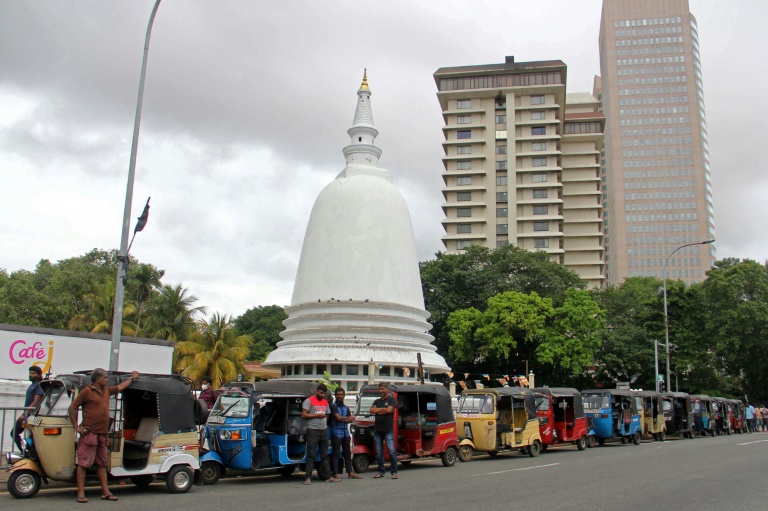
Sri Lanka’s military opened fire to contain rioting at a fuel station, officials said Sunday as unprecedented queues for petrol and diesel were seen across the bankrupt country.

Troops fired in Visuvamadu, 365 kilometres (228 miles) north of Colombo, on Saturday night as their guard point was pelted with stones, army spokesman Nilantha Premaratne said.

“A group of 20 to 30 people pelted stones and damaged an army truck,” Premaratne told AFP.

Police said four civilians and three soldiers were wounded when the army opened fire for the first time to quell unrest linked to the worsening economic crisis.

As the pump ran out of petrol, motorists began to protest and the situation escalated into a clash with troops, police said.

Sri Lanka is suffering its worst economic crisis since independence, with the country unable to find dollars to import essentials, including food, fuel and medicines.

The nation’s 22 million population has been enduring acute shortages and long queues for scarce supplies while President Gotabaya Rajapaksa has for months resisted calls to step down over mismanagement.

Sri Lanka has deployed armed police and troops to guard fuel stations.

A motorist was shot dead by police in April at the central town of Rambukkana when a clash erupted over the distribution of rationed petrol and diesel.

Police said clashes involving motorists erupted at three locations over the weekend. At least six constables were wounded in one clash while seven motorists were arrested.

The government declared a two-week shutdown of state institutions and schools in a bid to reduce commuting and conserve depleting fuel stocks in the impoverished nation.

The country is also facing record high inflation and lengthy power blackouts, all of which have contributed to months of protests.

Four out of five people in Sri Lanka have started skipping meals as they cannot afford to eat, the UN has said, warning of a looming “dire humanitarian crisis” with millions in need of aid.

The World Food Programme (WFP) began distributing food vouchers to about 2,000 pregnant women in Colombo’s “underserved” areas as part of “life-saving assistance” on Thursday.

The WFP is trying to raise $60 million for a food relief effort between June and December.

Sri Lanka defaulted on its $51 billion foreign debt in April, and is in talks with the International Monetary Fund for a bailout

With sea off-limits, Odessa rallies home-front war effort

Olga Jarova points to a nice spot on the restaurant terrace where President Volodymyr Zelensky sat on his visits to Odessa, Ukraine’s Black Sea port now under de facto Russian blockade.

Before the invasion, Datcha, the restaurant that Jarova manages in a 19th-century stately home, mirrored the atmosphere in this historic city of sailors founded by Catherine the Great: nostalgic and carefree.

Odessa has so far escaped capture but Russia warns that any ship venturing into its surrounding waters can expect to be met by its cannons. 

Kyiv mined the harbour as a preventative measure after the invasion began.

The city, a multicultural crossroads of a million inhabitants, has found itself isolated, forced to turn away from the sea and become more inward looking.

“Turbot, red mullet, goby… 80 percent of our fish used to come from the Black Sea,” Jarova told AFP.

“But now offshore fishing is banned.”

In the morning, volunteers get busy cooking to feed people in need in Ukraine for free. But as they can no longer get fresh fish from the Black Sea, they have to cook fish imported from Asia.

Because they only ever cooked locally caught fish before, they have had to learn how to prepare this new “catch”, says 47-year-old Jarova.

“With the catch from Asia, we didn’t know how to season it at the beginning,” she says with a smile.

An air-raid siren goes off, a harsh reminder that Odessa is living somewhat on borrowed time.

About 130 kilometres (80 miles) to the east, the city of Mykolaiv has been holding the defence of southern Ukraine.

Mykolaiv has been regularly targeted by Russian forces since the start of their invasion on February 24 but the Ukrainians have prevented them taking all the coast — despite near daily bombings.

Russian-speaking Odessa, known as the pearl of the Black Sea situated near Moldova and NATO member Romania, is a key economic hub.

It knows only too well that it is coveted by Russian President Vladimir Putin for historic as much as for strategic reasons.

– ‘Least we can do’ –

Residents are proud of their renowned city, with its pleasant climate, rich cultural life, and its French- and Italian-influenced architecture.

But its seabound activities are now off-limits.

“Every day, including the weekend, I come to make camouflage netting for the army,” says Natalia Pinchenkova, 49, behind a large Union flag, a show of thanks to Britain for its support for Ukraine since the conflict erupted.

That’s “the least we can do” compared to the “suffering of those in Mykolaiv”, she adds.

On every street corner, as well as in gymnasiums and theatres, volunteers are busily doing their bit for the war effort in temperatures of over 32 degrees Celsius (90 degrees Fahrenheit).

“People don’t want to stay at home alone listening to the bad news on the radio,” says 21-year-old Bogdan Halaida, who helps organise one of the volunteer groups.

“Here at least they can talk to someone and not worry too much about what’s coming next.”

Fevzi Mamoutov, 31, an ethnic Tatar, prepares the rice dish “plov” in a big cooking pot with about 40 volunteers in his former cultural centre, which has been transformed into a military mess.

“My family had to leave Crimea” after it was annexed by Russia in 2014 “so I know what the Ukrainians who are currently fleeing the Russian invasion are feeling”, says the former wrestler dressed in an orange T-shirt.

If Odessa faces an assault “I’ll fight because we have good weapons this time”, says Mamoutov, referring to the repression of the Tatars by Joseph Stalin after their forced displacement in 1944.

– No swimming! –

Journalist Yuriy Basijuk has converted his TV studio into a storage site. 

“At the start we delivered 10,000 pairs of socks to Kharkiv”, eastern Ukraine’s biggest city, he says, by way of illustrating the diverse needs in times of war.

“We send drinking water to Mykolaiv which is deprived of it, thanks to three daily rotations by bus,” adds Basijuk, who founded a widely followed internet site in southern Ukraine.

France says it is ready to assist in an operation to allow safe access to Odessa.

Senegalese President and African Union head Macky Sall has urged Ukraine to demine waters around the Odessa port to ease much needed grain exports.

But Kyiv still worries that Moscow will parachute in its forces.

“We don’t want to demine everything,” says former vice president of the region Yuriy Dimchoglo, referring to negotiations on the setting up of demined “corridors”.

He declines to give details on how many mines are littering the seabed, to the great regret of residents who stroll around well-known Arcadia beach enjoying an ice cream.

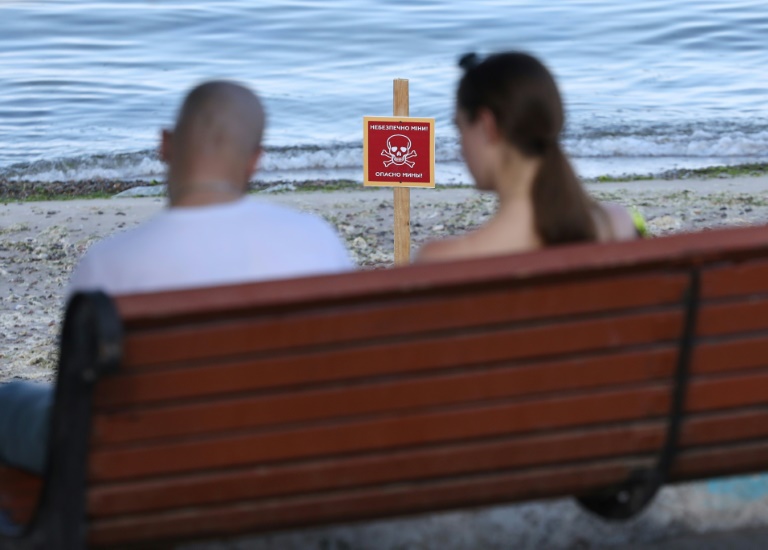
Putting even a little toe onto the beach is out of the question. Red signs bearing a skull on them warn people not to go swimming in the water.

Last week somebody was not careful — and the consequences were fatal.

Thousands do however take a dip a bit further around the coast where rumour has it there is no risk.

“We’re not going to let the Russians take the sea away from us,” insists Tatyana, who works for local authorities and declines to give her full name.

“Putting a swimsuit on is also our form of resistance!”

Uyghur-heritage candidate urges Japan to 'embrace diversity'

Arfiya Eri is a young, female, multilingual former United Nations official, all of which would already help her stand out as a Japanese political candidate, but she is also of Uyghur heritage.

While her campaign is not centred around her ethnic background, it is attracting attention — positive and negative — in a country where politics is still a largely homogenous affair.

Ethnic Uyghurs generally hail from China’s Xinjiang province, where the government is accused of detaining more than one million of them and other Muslim minorities in a years-long crackdown that rights groups say includes widespread “crimes against humanity”.

Eri, 33, is running for parliament’s upper house with the ruling Liberal Democratic Party, on a platform that emphasises bread-and-butter issues and her identity as a proud Japanese citizen.

As the first person of Uyghur origin to run as a major party candidate in Japan, Eri acknowledges her campaign is viewed by some through the prism of her family history.

“Instead of my vision and policies as a Japanese politician, people ask me about the Uyghur issue because of my ethnic background,” she told AFP.

“I can understand why this happens, but it feels a bit strange.”

That does not mean, however, that diversity is not a concern for a woman who speaks seven languages and was educated between Japan, China and the United States.

In fact, it helped inspire her to run, after she watched an election in her native Fukuoka region in southern Japan and observed the uniformity of the candidates.

“I see more and more people like myself visibly represented in Japan, with names that are not traditionally Japanese,” said Eri, whose family name is sometimes mistaken for her first name.

“Women are also more visibly active and successful… But when you look at the world of politics, that diversity is still not being represented, it’s not reflected.”

– ‘Unspeakable oppression’ –

Japan’s July 10 election will see more than 500 candidates running for half of the 248-seat upper house, known as the House of Councillors.

The LDP is expected to win, though Eri’s chances will be partly dictated by where she is eventually placed on the party list.

She plans to campaign for better work-life balance, gender equality and amending the pacifist constitution, which bars the use of force to settle international disputes and is interpreted by some as prohibiting the country from having any military force.

Eri endorses the LDP’s mainstream conservative politics, and insists Japan must “stand firm on our national security”.

Eri also declines to use the name Xinjiang for China’s Uyghur-majority region, and said her familiarity with alleged human rights abuses has shaped her views.

The candidate described “human rights violations at an unspeakable scale in places like the Uyghur region”, and said she believes even a minor rights violation “opens the door” to worse abuses.

– Diversity ‘vital’ –

Eri’s family moved from Japan to China when she was a teenager, after her father, an engineer, was transferred by his employer.

She graduated from an American international school before studying in the United States, and joined the United Nations in 2016 after a stint at the Bank of Japan.

Her international resume sets her apart from many election candidates, but “rather than my actual experiences and expertise or who I really am, my background has drawn more attention”.

Much of that has been positive, but there has also been online vitriol questioning Eri’s identity, her trustworthiness and even her patriotism.

Candidates like Eri have little to gain from putting their diversity front and centre in mostly mono-ethnic Japan, said Tomoaki Iwai, professor emeritus of Japanese politics at Nihon University.

They “can face an adverse voter reaction if they push their ethnicity too much”, he told AFP.

Things are beginning to change, Iwai said, particularly in urban areas, but the pace is gradual.

Eri said Japan must “build a country that embraces diversity”, though she admitted there is a long way to go, including in the LDP.

“I believe that this is vital for the future of Japan,” she said.

Layoffs and exits: Firms in China teeter under zero-Covid pressure

Fiona Shi lost her job twice during the pandemic — first, in 2020 when Covid ravaged the travel industry, and then this year as China’s strict virus controls hammered businesses in the world’s number two economy.

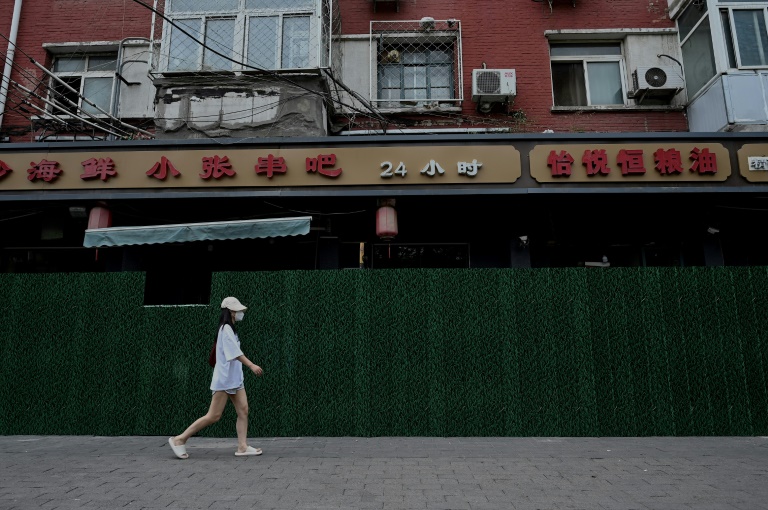
China is the last major economy welded to a zero-Covid strategy — putting firms and workers at risk of snap lockdowns, freezing activity in the services sector and tangling supply chains crucial for factories to sell their goods.

As the country battles its worst outbreak since 2020, its urban jobless rate has surged to the highest level in two years and the pain is being felt by both blue- and white-collar workers.

“Many places say they are not recruiting people aged above 35,” said Shi, 38, who pointed to the difficulty of returning to entry-level positions after managerial roles.

She worked in a management role in the hospitality industry in 2020 when the coronavirus brought nearly all travel to a halt as governments imposed social distancing and movement restrictions.

Two years later, the Beijinger found herself in the same position after losing her job at a multinational firm.

“The pandemic has also made it harder… many places have frozen headcounts,” she told AFP. “I’m really anxious.”

Months of unpredictable Covid restrictions — including snap lockdowns and severe travel curbs — have hit dozens of cities from business hub Shanghai to the northern breadbasket province of Jilin.

An American Chamber of Commerce survey released this week showed that almost all respondents cut their revenue projections, while in a separate study 11 percent of European firms said they would downsize their China operations because of Covid measures.

Domestic firms have also been tightening their purse strings.

Ride-hailing platform Caocao Chuxing has let go of staff, with Chinese media reports pegging the proportion at 40 percent.

Some staff at e-commerce giant Alibaba were also reportedly asked to leave, according to state outlet Legal Daily.

– ‘The situation is grim’ –

The imposition of restrictions to stamp out Covid outbreaks this year has intensified pressure on firms already grappling with a slowdown in the economy and regulatory crackdowns on sectors including property and tech.

Bai, 27, told AFP she was laid off by a US tech company that was preparing to end its business in China.

“In some ways, we saw it coming,” she said, only giving her surname. “Its China operations have been losing money.”

“It’s not the first to leave the China market and won’t be the last.”

Beijing-based Bai said it was the second time she lost her job because of the pandemic.

In 2020, as the virus raged in China, she was let go by a cruise line operator over fears tied to her nationality, she said.

Andrea Zhang, 24, who handled events planning, said his employer shuttered its clothing shops in March and April when outbreaks flared this year.

“Our bosses wanted to understand the situation at various stores (across the country) but realised they could not due to quarantine requirements,” said Zhang.

The company eventually closed its offline operations, and Zhang left.

Around 1.3 million entities cancelled their business registrations in China in March alone, a 24 percent spike on-year, according to official numbers.

With President Xi Jinping repeatedly backing the government’s zero-Covid strategy, observers do not expect authorities to pivot away from it even as the economy suffers.

But the restrictions have made life unbearable for some.

“Working from home, especially in an industry such as ours known for overtime practices, has made work-life boundaries even more blurred,” said Ning, who works in marketing at a tech firm in Beijing and only gave his surname.

The 26-year-old typically left work around 11 pm.

But his hours stretched past midnight and into weekends after the capital ordered people in his district to stay home last month as Covid cases surged.

“I was too exhausted, and left my job,” Ning said.

He has since submitted more than 200 job applications. Only three of these translated into job interviews.

“The situation is grim,” Ning told AFP. “But we will have to find a way to survive.”

Macron's second term on line in parliamentary election

French voters head to the polls Sunday for the final round of parliamentary elections, with centrist President Emmanuel Macron’s coalition looking to hold off a challenge from a newly formed leftwing alliance.

The vote will be decisive for Macron’s second-term agenda following his re-election in April, with the 44-year-old needing a majority in order to push through promised tax cuts, welfare reform and raise the retirement age.

Projections from polling firms suggest his “Together” coalition is on course to be the biggest party in the next National Assembly, but possibly short of the 289 seats needed for a majority.

New left-wing coalition NUPES is hoping to spring a surprise, with the red-green collective promising to block Macron’s agenda after uniting behind 70-year-old figurehead Jean-Luc Melenchon.

“The vote is extremely open and it would be improper to say that things are settled one way or the other,” Melenchon told reporters on Friday during a final campaign stop in Paris. 

Far-right leader Marine Le Pen is also eyeing major gains for her National Rally party, which had just eight seats in the outgoing parliament.

Macron was left disappointed by results last weekend after a first round of voting saw Together and NUPES finish neck-and-neck on around 26 percent.

Surging inflation, lacklustre campaigning from newly named Prime Minister Elisabeth Borne, and Macron’s abrasive personality were all seen as reasons for the under-performance.

“I really don’t believe we’ll get an overall majority,” one worried minister told AFP last week.

The first-round vote served to whittle down candidates in most of the country’s 577 constituencies to two finalists who will go head-to-head on Sunday. 

The election caps an intense two-month sequence to elect a new president and parliament, with voter fatigue seen as one of the reasons for what is expected to be record-low turn-out on Sunday.

– ‘French disorder?’ –

The contest between Together and NUPES has turned increasingly bitter over the last week, with Macron’s allies seeking to paint their main opponents as dangerous far-leftists.

Senior MP Christophe Castaner has accused Melenchon of wanting a “Soviet revolution”, while Economy Minister Bruno Le Maire called him a “French Chavez” in reference to the late Venezuelan autocrat Hugo Chavez. 

Macron headed to Ukraine last week, hoping to remind voters of his foreign policy credentials and one of Melenchon’s perceived weaknesses — his anti-NATO and anti-EU views at a time of war in Europe.

“We need a solid majority to ensure order outside and inside our borders. Nothing would be worse than adding French disorder to the world disorder,” Macron said.

As president, he would retain control of foreign and defence policy whatever the outcome, but his domestic agenda would be thwarted.

Melenchon has promised a break from “30 years of neo-liberalism” — meaning free-market capitalism — and has pledged minimum wage and public spending hikes, as well as nationalisations.

It has been 20 years since France last had a president and prime minister from different parties, when rightwinger Jacques Chirac had to work with a Socialist-dominated parliament under premier Lionel Jospin.

– Turnout key – 

A final flurry of polls on Friday suggested Macron’s Together allies were on track for 255-305 seats on Sunday, with only the upper end of that range being a majority of more than 289.

NUPES would secure around 140-200 seats, making them the biggest opposition force, while Le Pen’s National Rally was seen to get around 20-45 seats.

If they secure more than 15 seats, Le Pen’s MPs would be able to form a formal group in parliament, giving them greater visibility and resources.

But after scoring 41.5 percent in the presidential election in April, Le Pen is still struggling to convert her huge national following into major representation in parliament.

“You can put an end to five years of toxic policies by Emmanuel Macron,” she said in a campaign video posted on social media on Friday. 

“You also have the chance to protect the country from the far-left.”

Observers will be keeping a close eye on turn-out figures following a historically low level last week of just 47.5 percent.

The three polls — from Elabe, Ifop-Fiducial and Ipsos — suggested turnout Sunday would be 44-47 percent.

Figures will be given throughout the day by the interior ministry and a higher-than-expected turnout would most likely favour NUPES, which is banking on young people and the working classes voting.

In France’s Caribbean island of Guadeloupe — where the poll is held a day early — Justine Benin was defeated by NUPES candidate Christian Baptiste on Saturday, a loss that jeopardises her role in the government as Secretary of State for Sea.

A government reshuffle is expected after the election.

burs-adp/sjw/gw/dhc/lb

Central banks walk inflation-recession tightrope

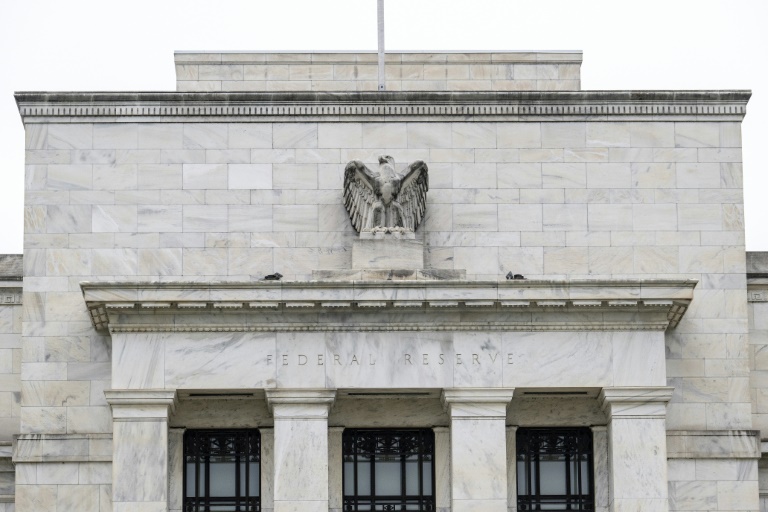
Central banks have ramped up their battle against runaway inflation, a necessary remedy that could have the adverse side effect of tipping countries into recession, analysts say.

Just this past week, the US Federal Reserve announced its biggest interest rate hike in almost 30 years, followed by the fifth straight increase by the Bank of England and the first in 15 years in Switzerland.

“This week was a first. The craziest in my experience,” said Frederick Ducrozet, chief economist at Pictet Wealth Management.

The moves rattled stock markets as investors fear that while the rate increases are needed, they could put the brakes on economic growth if the tightening of monetary policy becomes too aggressive.

“Recessions are increasingly likely as central banks race to dramatically raise rates before inflation spirals out of control,” said Craig Erlam, an analyst at online trading platform OANDA.

Capital Economics, a research group, said it does not anticipate a recession in the United States.

“But the Fed is deliberately tempering demand in order to reduce price pressures. This is a difficult line to tread and there is clearly a risk that it goes too far and the economy tips into recession,” it said in a note.

Emerging countries could be collateral victims from rate hikes. The dollar rises when the US Fed raises its rates.

“A strong dollar will complicate (debt repayments) of countries with deficits, which borrow often in that currency,” Ducrozet said.

– Swiss surprise –

Central banks had insisted last year that inflation was only “transitory” as prices were driven up by bottlenecks in supply chains after governments emerged from lockdowns.

But energy and food prices have soared in the wake of Russia’s invasion of Ukraine, pushing inflation higher and prompting economists to lower the world’s growth prospects for this year.

This has left central banks with no other choice but to move more aggressively than planned.

Australia’s central bank raised rates more than expected earlier this month while Brazil last week lifted its benchmark rate for the 11th straight time. More hikes are looming in the United States and Europe.

But it is the Swiss National Bank that caused the biggest shock on Thursday when it announced a rate increase of 0.5 percentage points, the first since 2007.

The SNB had focused on keeping the Swiss franc from being too strong until now.

“The actions of the SNB are notable in that they mark a significant shift in policy (away) from a very dovish position,” said Michael Hewson, chief market analyst at CMC Markets UK.

The European Central Bank has been slower to act than its peers. It is putting an end to its massive bond-buying scheme and will finally raise rates next month for the first time in a decade.

The eurozone faces another problem: The yields paid by its governments to borrow money have surged, with indebted countries such as Italy being charged a premium compared to Germany, a safer bet for investors.

This “spread” revived memories of the eurozone’s debt crisis, prompting the ECB to hold an emergency meeting on Thursday after which it said it would design a tool to prevent further stress in the bond market.

The Bank of Japan bucked the global trend on Friday as it stood by its decision not to raise its rate, sending the yen close to the lowest level against the dollar since 1998.

But even the Bank of Japan could adjust its policy, said Stephen Innes, managing partner at SPI Asset Management.

“BoJ members are considering public dissatisfaction with inflation and the rapid depreciation of the yen,” Innes said.

“While they plan to maintain the current easing policy, they may look to make some tweaks to support the currency,” he said.

– No immediate fix –

Consumers will have to be patient before they see the rate hikes have an effect on prices.

ECB chief Christine Lagarde said it bluntly when announcing plans for a rate increase next month: “Do we expect that July interest rate hikes will have an immediate effect on inflation? The answer to that is no.”

Central banks do not have control over some of the problems that are lifting inflation, such as soaring energy and food prices, and the supply chain snarls.

Capital Economics said energy and food prices accounted for 4.1 percentage points of the 7.9 percent rise in consumer prices in major advanced economies over the past year.

It expects oil, gas, and agricultural commodity prices to start falling later this year, which would bring inflation down sharply, but core inflation rates will remain elevated.

Store workers vote to form first US Apple union

A majority of employees at a US Apple store have voted to form the tech giant’s first union, in the wake of similar unionization drives at Starbucks and Amazon locations.

Of the 110 employees at the Towson, Maryland shop, 65 voted in favor and 33 against, according to a live count broadcast Saturday by the federal agency overseeing the vote.

The vote comes after a group of employees called AppleCORE (Coalition of Organized Retail Employees) campaigned for unionization, demanding a say in deciding on wages, hours and safety measures. 

“We did it Towson! We won our union vote! Thanks to all who worked so hard and all who supported! Now we celebrate… Tomorrow we keep organizing,” AppleCORE tweeted.

Saturday’s result means that the shop’s employees, who have been voting since Wednesday, should form their own branch of the International Association of Machinists and Aerospace Workers (IAM) union, once the agency has certified the results. 

Saturday’s vote result follows several symbolic victories — including among workers for giants such as Amazon and Starbucks — by the country’s unions, on the decline for decades, to which President Joe Biden has lent his support. 

It was not the first time employees at an Apple store have tried to unionize, but it was the first attempt that resulted in a vote. 

Apple’s director of distribution and human resources, Deirdre O’Brien, visited the shop in May to address employees.

“I want to start out by saying it’s your right to join a union, but it’s equally your right not to join a union,” O’Brien said, according to audio published by Vice. 

“If you’re faced with that decision, I want to encourage you to consult a wide range of people and sources to understand what it could be like to work at Apple under a collective bargaining agreement.” 

The presence of an intermediary would complicate relations between Apple and its employees, she said.

“I’m worried about what it would mean to put another organization in the middle of our relationship, an organization that does not have a deep understanding of Apple or our business,” O’Brien said. 

“And most importantly, one that I do not believe shares our commitment to you.”

– ‘Courage’ –

The vote comes in wake of a broader unionization push at some of the United States’ biggest companies. 

After a union was formed at two Starbucks coffee shops in December in the northern city of Buffalo, employees at more than 160 of the chain’s locations have filed for similar votes. 

At Amazon, employees at a New York warehouse surprised everyone in early April by voting overwhelmingly to form a union, a first for the online retail colossus in the United States.

But the company has asked for the result to be cancelled and a second vote to be held. 

Apple declined to comment on the news when reached by AFP.

The IAM union slammed the Silicon Valley giant’s efforts to discourage employees from voting yes. 

A video from the group, released by pro-union media outlet More Perfect Union, shows AppleCORE supporters in Maryland accusing the company of “union-busting” tactics, including “intimidation,” which the employees called “disgusting.”

IAM International President Robert Martinez Jr said he applauded the workers’ “courage.”

“They made a huge sacrifice for thousands of Apple employees across the nation who had all eyes on this election,” he said in a statement. “I ask Apple CEO Tim Cook to respect the election results and fast-track a first contract for the dedicated IAM CORE Apple employees in Towson.”

“This victory shows the growing demand for unions at Apple stores and different industries across our nation.”

Close Bitnami banner
Bitnami