World

WTO strikes landmark deals package after marathon talks

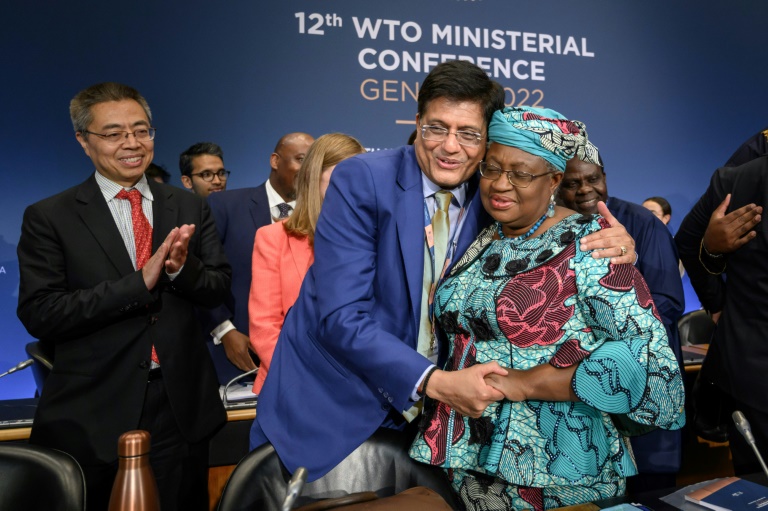
The World Trade Organization concluded a landmark bundle of deals Friday covering fishing subsidies, food insecurity and Covid-19 vaccines following hectic round-the-clock talks.

WTO director-general Ngozi Okonjo-Iweala said trade ministers had struck an “unprecedented” number of agreements that would affect the lives of people everywhere.

The talks in Geneva began Sunday and had been due to wrap up on Wednesday.

But instead the WTO’s 164 members went through two straight nights before getting the package over the line at around 5:00 am (0300 GMT) Friday.

“DEAL!” tweeted EU trade commissioner Valdis Dombrovskis after the conference went nearly 36 hours into overtime.

The WTO’s 12th ministerial conference (MC12) reeled in a deal to halt harmful fisheries subsidies after more than two decades of negotiations, and also reached agreements on e-commerce, responding to pandemics and reforming the organisation itself.

“Not in a long while has the WTO seen such a significant number of multilateral outcomes,” Okonjo-Iweala said.

“The package of agreements you have reached will make a difference to the lives of people around the world.”

But she acknowledged that “there were many moments when I feared we would come out of MC12 with nothing at all”.

As negotiations dragged on, delegates at one point had even danced to songs like “I will survive” and “Final Countdown” to blow off steam, US ambassador Maria Pagan told reporters.

– Fish deal netted –

The fisheries deal was the last one to get over the line, with negotiators hammering out the final points into the early hours of Friday.

Talks towards banning subsidies that encourage overfishing and threaten the sustainability of the planet’s fish stocks had been going on at the WTO since 2001.

The text was watered down significantly, but Okonjo-Iweala insisted it was better to get an agreement rather than keep negotiating for years to come.

Dombrovskis acknowledged to reporters that the agreement fell short of what the EU would have wanted, but “we decided that taking this first step… was better than not getting any agreement”.

US Trade Representative Katherine Tai also hailed the agreement, as “a positive step forward”, highlighting that countries had committed to continue talks towards a more ambitious text.

Myron Brilliant, head of international affairs at the US Chamber of Commerce, highlighted the importance of moving forward on banning harmful fisheries subsidies.

“This is a rare case where trade rules could make a huge contribution to addressing a major environmental problem,” he said.

– Consensus –

The fisheries agreement marks the first large multilateral deal agreed at the WTO in nearly a decade.

Okonjo-Iweala, who took over in March 2021, hinged her leadership on breathing new life into the sclerotic organisation.

She wanted to prove that the organisation could still make itself relevant in tackling the big global challenges.

The former foreign and finance minister of Nigeria positioned herself as someone who can bang heads together and get business done.

“I prefer to talk less and do more,” she said Friday.

As for why the discussions went on so long, some delegations accused India of being intransigent on every topic under discussion at the WTO — where decisions can only pass with the agreement of every member.

But Indian Commerce and Industry Minister Piyush Goyal insisted: “India is not a roadblock on anything… We were the ones who actually helped create the sole consensus.”

– Patents waiver –

The second major issue on the table was the plan for a Covid-19 vaccine patents waiver, aimed at providing more equitable access to the jabs.

After months of wrangling, and talks going down to the wire this week to win over some major players in pharmaceutical manufacturing to a compromise text, the United States and China finally clinched the deal by agreeing on which countries would benefit from the waiver. 

China provided a binding commitment not to take advantage of the waiver.

Tai hailed the deal, saying it would “get more safe and effective vaccines to those who need it most”. 

This agreement shows that we can work together to make the WTO more relevant to the needs of regular people.

The pharmaceutical industry organisation IFPMA however voiced “deep disappointment” at the deal, warning that “dismantling” patent protections would strangle innovation. 

Public interest groups meanwhile condemned the deal for not going far enough.

“It is a technocratic fudge aimed at saving reputations, not lives,” said  Max Lawson of the People’s Vaccine Alliance, while the Doctors Without Borders charity labelled it a “devastating global failure”.

WTO members also agreed to help ease supply shortages that some countries faced during the pandemic.

With Russia’s war in Ukraine fuelling a global food security crisis, ministers agreed on the importance of not imposing export restrictions.

But the need to secure consensus from all members, including from Moscow, meant their declaration did not mention Russia or its role in the crisis.
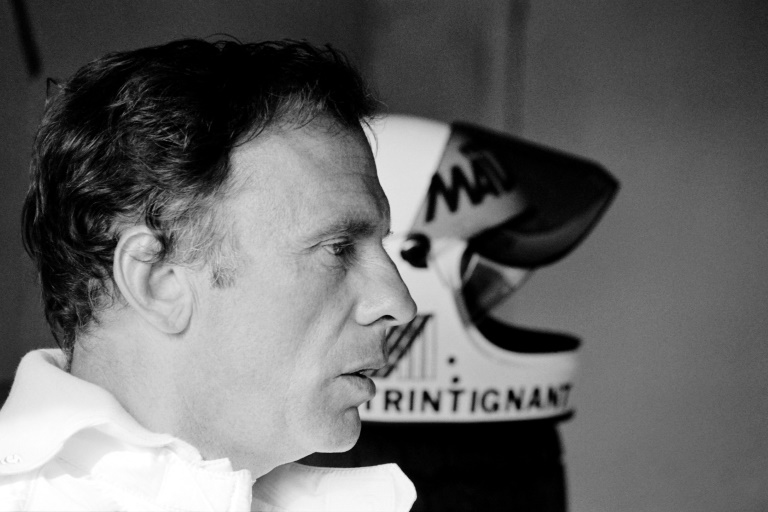
Jean-Louis Trintignant, 'wonderful talent' of French cinema, dies at 91

Jean-Louis Trintignant, one of France’s greatest actors, who died on Friday aged 91, was hailed by French President Emmanuel Macron as “a wonderful artistic talent and voice”. 

He died surrounded by his family in the Gard region of southern France, his wife said in a statement sent to AFP.

Trintignant’s career spanned six decades and some 130 films, including classics such as Krzysztof Kieslowski’s “Three Colours: Red,” Costa-Gavras’ “Z” and Bernardo Bertolucci’s “The Conformist”. 

But his life was hit by tragedy when his daughter Marie was beaten to death by rock star Bertrand Cantat in 2003.

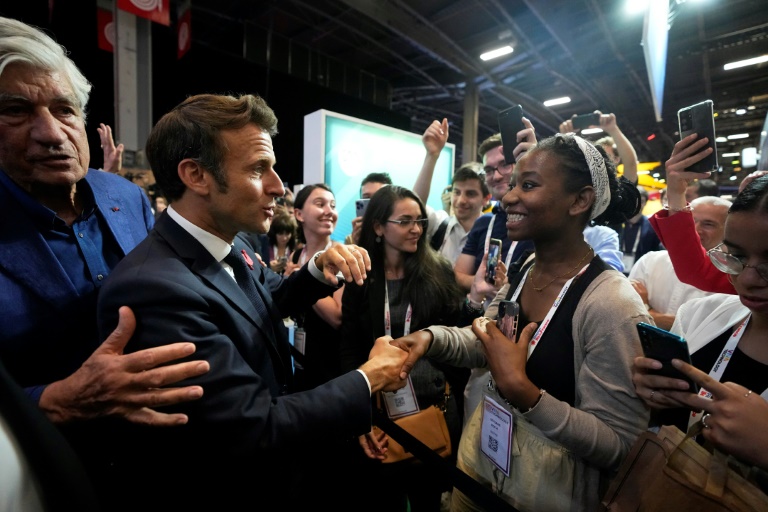
“He accompanied our lives through French cinema. It’s a page that turns on a wonderful artistic talent and voice,” said Macron after being informed of the death during a visit to a tech conference in Paris. 

No cause of death was immediately given, but Trintignant had been suffering from cancer in recent years. 

He had announced his retirement from cinema in 2017 but returned in 2019 for a sequel to the film that made his name, the 1966 classic “A Man and a Woman”. 

The New Wave love story starred Trintignant as a racing driver — a real-life passion for the actor — and turned him into an international star after it won Academy Awards for best screenplay and foreign-language film, as well as the Palme d’Or at the Cannes Film Festival.

– Traitors, thugs and crooks –

He won the best actor award at the festival three years later for political thriller “Z”.

“Trintignant was one of my all-time favourite actors: sexy, pensive, mischievous, capable of deep and searching sadness,” tweeted Variety film critic Guy Lodge. “What a body of work. What a face.”

Despite his screen success, Trintignant was known to say that he preferred the theatre. 

“I could have spent my whole life doing theatre,” he said in 2017, adding: “But cinema paid better!”

Trintignant continued to race cars after getting his breakthrough role alongside Brigitte Bardot in the then-notorious “And God Created Woman” in 1956. 

He went on to be seen as one of the most gifted actors of the postwar generation, playing an array of traitors, thugs and crooks or ambiguous and perverted types.

Trintignant refused to give in to bitterness over his daughter’s death and even forgave Cantat, the lead singer of the French band Noir Desir, when many others could not bring themselves to do so.

He returned to triumph just a few years later, starring in Michael Haneke’s Oscar-winning “Amour” as a man in his eighties struggling to look after his wife after a stroke. 

Trintignant first married actress Stephane Audran, then film director Nadine Marquand, with whom he had three children — Marie, Pauline and Vincent. The couple divorced and he then went on to marry Mariane Hoepfner, a former racing driver like himself.

Final polls cast doubt on Macron majority ahead of weekend vote

A final flurry of polls on Friday ahead of French parliamentary elections this weekend suggested President Emmanuel Macron’s allies would emerge as the biggest party in the new national assembly but possibly short of a majority.

The surveys from the Elabe, Ifop-Fiducial and Ipsos polling companies indicated Macron’s “Ensemble” (Together) coalition was on track for 255-305 seats on Sunday, uncertain of securing the 289 needed for a majority.

The figures indicated that voting intentions have remained largely unchanged since the first round of voting last weekend despite energetic campaigning by a new leftwing alliance, NUPES, that is promising to thwart Macron’s plans.

“The vote is extremely open and it would be improper to say that things are settled one way or the other,” NUPES leader Jean-Luc Melenchon told reporters on Friday as he campaigned in Paris with his EELV green party allies. 

The 70-year-old former Trotskyist has not given up on his objective of a securing a majority and being named prime minister, enabling him to block Macron’s plans to cut taxes, reform welfare and raise the retirement age. 

Forecasting the parliamentary elections in 577 constituencies is seen as a challenging task for polling firms and they have a mixed record.

NUPES candidates will need working-class and young voters to head to the polls in large numbers to stand any chance on Sunday after they abstained at record levels last weekend.

Friday’s surveys suggested they were on track for 140-200 seats.

– Ukraine –

Friday was the last day of legal campaigning, with all political activity banned from midnight and Saturday a day of calm before voting gets under way.

Macron returned home from a trip to Kyiv on Thursday, hoping that his trip to meet Ukrainian President Volodymyr Zelensky along with the leaders of Germany, Italy and Romania will help remind voters of his foreign policy credentials. 

“It was work for Europe, for our continent and French people,” he told BFM television while travelling back. “Because I don’t want this war to spread, and because this war is affecting our daily lives: in the price of things, geopolitical disorder, and it is going to affect us over the longterm.” 

Melenchon’s allies have slammed Macron’s trip, accusing him of using the Ukraine crisis to grandstand instead of addressing everyday French concerns including soaring inflation.

They pointed to a record heatwave that has struck France this week as another reason to reject the 44-year-old president, who they see as doing too little to combat climate change.

“If you don’t want to live episodes like this over and over again and that it becomes the norm, get rid of this government,” the head of the EELV green party, Julien Bayou, said Friday. 

Martin Quencez, a research fellow at the German Marshall Fund, said it would be crucial for Macron to mobilise right-wing voters to have any hopes of a majority on Sunday.

“If you compare the first round of presidential elections to the first round of the parliamentary elections, you find that Macron has lost about four million voters,” he said.

– Caricature? –

The first round of the election on June 12 painted an inconclusive picture, with Ensemble and NUPES neck-and-neck on around 26 percent of the popular vote each.

Just five MPs — four from NUPES and one from Together — were elected outright in the first round, leaving all to play for in Sunday’s run-off voting.

Turnout in the first round was a record low of 47.5 percent.

Macron and his allies have increasingly sought to portray Melenchon as an economic danger to the country, pointing to his plans for nationalisations as well as major hikes to the minimum wage and public spending.

Senior MP Christophe Castaner has accused the former Trotskyist of wanting a “Soviet revolution”, while Economy Minister Bruno Le Maire has called him a “French Chavez” in reference to late Venezuelan autocrat Hugo Chavez. 

Prime Minister Elisabeth Borne on Wednesday dismissed NUPES as “the alliance of circumstance” hiding Melenchon’s “extreme vision” that is “dangerous for our economy”.

But Manon Aubry, a European deputy for Melenchon’s party, accused Borne of “coming up with one lie after another”.

French daily Le Monde wrote Thursday that the campaign since the first round had descended into “caricature… rather than discussing the serious issues of the moment”.

US approves Pfizer and Moderna vaccines for youngest children

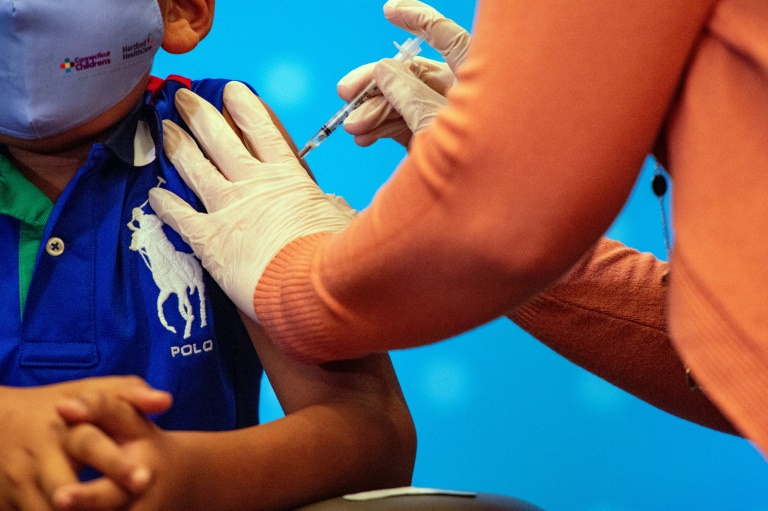
The US Food and Drug Administration granted emergency authorization Friday for the use of Pfizer and Moderna Covid-19 vaccines in the youngest children, the final age group awaiting immunization in most countries.

The agency, whose approval is considered the global gold standard, authorized Moderna’s two-dose vaccine for children aged six months to five years, and three doses of Pfizer’s shots for those between six months and four years old.

“Today is a day of huge relief for parents and families across America,” President Joe Biden said in a statement, adding that vaccinating young children will help “our nation continue to move forward safely.”

FDA chief Rober Califf similarly hailed the decision, saying “vaccines for younger children will provide protection from the most severe outcomes of Covid-19, such as hospitalization and death.”

Pfizer said it plans to submit requests for authorization to other regulators around the world, including the European Medicines Agency in early July.

“Parents in the US now have the option to vaccinate their children under 5 years of age, and we are working to ensure that other countries worldwide will follow,” said Ugur Sahin, CEO and co-founder of Germany’s BioNTech, which developed the vaccine together with Pfizer.

The Centers for Disease Control and Prevention (CDC) must now also recommend the vaccines before they are put into use in the United States — a final green light that will be given after a meeting of an advisory committee of experts that is expected to be held shortly.

But the government has said that as soon as the FDA decision was made, 10 million doses could immediately be sent around the country, followed by millions more in subsequent weeks.

– Successful trials –

Both vaccines are based on messenger RNA, which delivers genetic code for the coronavirus spike protein to human cells that then grow it on their surface, training the immune system to be ready. The technology is now considered the leading Covid vaccination platform.

The vaccines were tested in trials of thousands of children. They were found to cause similar levels of mild side effects as in older age groups and triggered similar levels of antibodies.

Efficacy against infection was higher for Pfizer, with the company placing it at 80 percent, compared to Moderna’s estimates of 51 percent for children aged six-months to two years old and 37 percent for those aged two to five years.

But the Pfizer figure is based on very few cases and is thus considered preliminary. It also takes three doses to achieve its protection, with the third shot given eight weeks after the second, which is given three weeks after the first.

Moderna’s vaccine should provide strong protection against severe disease after two doses, given four weeks apart, and the company is studying adding a booster that would raise efficacy levels against mild disease.

However, Moderna’s decision to go with a higher dose is associated with higher levels of fevers in reaction to the vaccine compared to Pfizer.

“We are thrilled that the FDA has granted Emergency Use Authorization of Moderna’s Covid-19 vaccine for children and adolescents, particularly for our vulnerable, youngest children,” said Moderna CEO Stephane Bancel.

“Children need to live highly social lives to develop and flourish,” Bancel added. “With this authorization, caregivers for young children ages 6 months through 5 years of age finally have a way to safeguard against Covid risks in classroom and daycare settings.”

The United States, home to 20 million children four years and under, has recorded 480 Covid deaths in that group in the pandemic — far higher than even a bad flu season, according to the FDA.

As of May 2022, there have been 45,000 hospitalizations in that group, nearly a quarter of which required intensive care.

Heatwave grips France and Spain as temps set to rise

A punishing heatwave broke a string of records in France and Britain on Friday as Spain battled to contain forest fires that forced hundreds from their homes. 

The hot weather is in line with warnings from scientists that heatwaves will be more intense and hit earlier than usual thanks to climate change. 

In Spain, forest fires burned nearly 9,000 hectares (22,240 acres) of land in the northwest Sierra de la Culebra region Friday, forcing some 200 people from their homes, regional authorities said.

And more than 3,000 people were evacuated from the Puy du Fou theme park in central Spain due to a fierce fire nearby.

Firefighters were battling fires in several other regions, including woodlands in Catalonia where weather conditions complicated the fight. 

Prime Minister Pedro Sanchez praised firefighters “who risk their lives on the frontline of fires” on Friday, which is also World Day to Combat Desertification and Drought. 

Temperatures were above 35 Celsius (95 Fahrenheit) Friday in most parts of the country and will top 40C in some areas.

– Hospitals full –

In France, temperatures also climbed Friday with more than half of French departments at the highest or second-highest heat alert level by the afternoon. 

Much of the country’s southwest will see thermometers top 40C, prompting warnings for the vulnerable. 

“Hospitals are at capacity, but are keeping up with demand,” Health Minister Brigitte Bourguignon told reporters in Vienne, near Lyon in the southeast.

Schoolchildren were told to stay at home in departments at alert level “red” and the health ministry activated a special heatwave hotline.

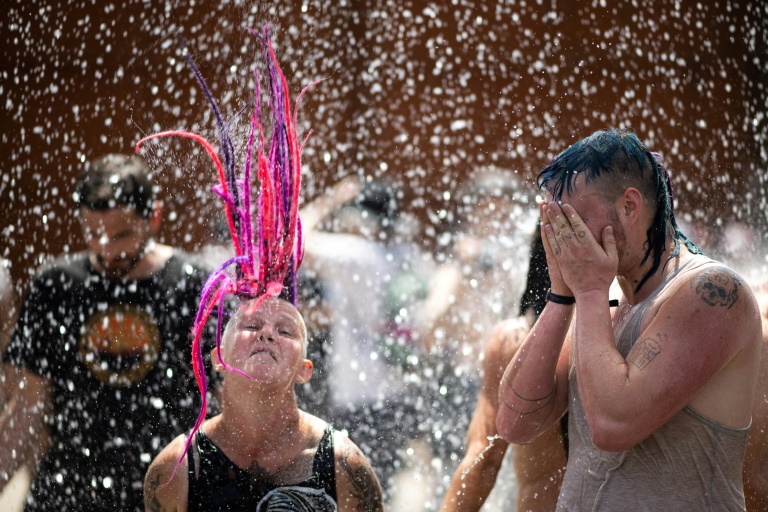
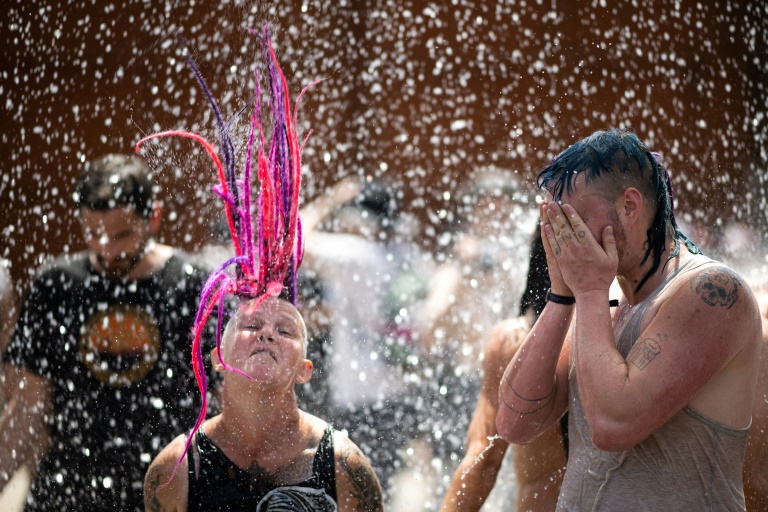
Meanwhile rock and metal fans at the giant Hellfest in western France were sprayed with water from hoses and enormous vaporisers in front of the stage as they headbanged or bounced to an opening-day line-up including Deftones and The Offspring.

“This is the earliest heatwave ever recorded in France” since 1947, said Matthieu Sorel, a climatologist at weather authority Meteo France.

With “many monthly or even all-time temperature records likely to be beaten in several regions,” he called the unseasonable weather a “marker of climate change”.

Meteo France said temperatures were expected to reach their peak on Saturday before slowly declining. 

The heatwave has spread up from north Africa through Spain, also affecting Italy and the United Kingdom. 

Several towns in northern Italy have announced water rationing and the Lombardy region may declare a state of emergency as a record drought threatens harvests.

The UK recorded its hottest day of the year on Friday with temperatures reaching over 30C in the early afternoon, meteorologists said. 

It was the third day in a row that temperature records had been broken in the UK, where it was over 28C on Wednesday and 29.5C on Thursday.

– Climate change –

Experts warned that the high temperatures were caused by worrying climate change trends.  

“As a result of climate change, heatwaves are starting earlier,” said Clare Nullis, a spokeswoman for the World Meteorological Organization in Geneva.

“What we’re witnessing today is unfortunately a foretaste of the future” if concentrations of greenhouse gases in the atmosphere continue to rise and push global warming towards 2C from pre-industrial levels, she added.

In France, special measures have been taken in care homes for elderly people, still marked by the memory of a deadly 2003 heatwave.

Buildings are being sprayed down with water to cool them and residents are being rotated through air-conditioned rooms.

“We’re taking even more care than usual with the old folks. It’s tough for them. They’re often alone, worn down physically and unable to act independently,” said Sarah Jalabert, a nurse making home visits in the Tarn department.

In the Gironde department, which includes Bordeaux, authorities said all public events outdoors or in non-air-conditioned venues would be banned from 2:00 pm (1200 GMT) on Friday, a measure set to be broadened across the region.

And speed limits in several regions, including around Paris, have been reduced to limit the concentration of harmful smog or ozone in the heat — although official air monitor Prev’Air reported levels ozone above recommended limits in several regions.

Paris police chief Didier Lallement said only the least polluting vehicles would be allowed to drive in the capital on Saturday due to fine particle pollution.

Electric grid operator RTE said increased use of fans and air-conditioners was also driving up power consumption.

burs-tgb/pvh/har

Heatwave grips France and Spain as temps set to rise

A punishing heatwave broke a string of records in France and Britain on Friday as Spain battled to contain forest fires that forced hundreds from their homes. 

The hot weather is in line with warnings from scientists that heatwaves will be more intense and hit earlier than usual thanks to climate change. 

In Spain, forest fires burned nearly 9,000 hectares (22,240 acres) of land in the northwest Sierra de la Culebra region Friday, forcing some 200 people from their homes, regional authorities said.

And more than 3,000 people were evacuated from the Puy du Fou theme park in central Spain due to a fierce fire nearby.

Firefighters were battling fires in several other regions, including woodlands in Catalonia where weather conditions complicated the fight. 

Prime Minister Pedro Sanchez praised firefighters “who risk their lives on the frontline of fires” on Friday, which is also World Day to Combat Desertification and Drought. 

Temperatures were above 35 Celsius (95 Fahrenheit) Friday in most parts of the country and will top 40C in some areas.

– Hospitals full –

In France, temperatures also climbed Friday with more than half of French departments at the highest or second-highest heat alert level by the afternoon. 

Much of the country’s southwest will see thermometers top 40C, prompting warnings for the vulnerable. 

“Hospitals are at capacity, but are keeping up with demand,” Health Minister Brigitte Bourguignon told reporters in Vienne, near Lyon in the southeast.

Schoolchildren were told to stay at home in departments at alert level “red” and the health ministry activated a special heatwave hotline.

Meanwhile rock and metal fans at the giant Hellfest in western France were sprayed with water from hoses and enormous vaporisers in front of the stage as they headbanged or bounced to an opening-day line-up including Deftones and The Offspring.

“This is the earliest heatwave ever recorded in France” since 1947, said Matthieu Sorel, a climatologist at weather authority Meteo France.

With “many monthly or even all-time temperature records likely to be beaten in several regions,” he called the unseasonable weather a “marker of climate change”.

Meteo France said temperatures were expected to reach their peak on Saturday before slowly declining. 

The heatwave has spread up from north Africa through Spain, also affecting Italy and the United Kingdom. 

Several towns in northern Italy have announced water rationing and the Lombardy region may declare a state of emergency as a record drought threatens harvests.

The UK recorded its hottest day of the year on Friday with temperatures reaching over 30C in the early afternoon, meteorologists said. 

It was the third day in a row that temperature records had been broken in the UK, where it was over 28C on Wednesday and 29.5C on Thursday.

– Climate change –

Experts warned that the high temperatures were caused by worrying climate change trends.  

“As a result of climate change, heatwaves are starting earlier,” said Clare Nullis, a spokeswoman for the World Meteorological Organization in Geneva.

“What we’re witnessing today is unfortunately a foretaste of the future” if concentrations of greenhouse gases in the atmosphere continue to rise and push global warming towards 2C from pre-industrial levels, she added.

In France, special measures have been taken in care homes for elderly people, still marked by the memory of a deadly 2003 heatwave.

Buildings are being sprayed down with water to cool them and residents are being rotated through air-conditioned rooms.

“We’re taking even more care than usual with the old folks. It’s tough for them. They’re often alone, worn down physically and unable to act independently,” said Sarah Jalabert, a nurse making home visits in the Tarn department.

In the Gironde department, which includes Bordeaux, authorities said all public events outdoors or in non-air-conditioned venues would be banned from 2:00 pm (1200 GMT) on Friday, a measure set to be broadened across the region.

And speed limits in several regions, including around Paris, have been reduced to limit the concentration of harmful smog or ozone in the heat — although official air monitor Prev’Air reported levels ozone above recommended limits in several regions.

Paris police chief Didier Lallement said only the least polluting vehicles would be allowed to drive in the capital on Saturday due to fine particle pollution.

Electric grid operator RTE said increased use of fans and air-conditioners was also driving up power consumption.

burs-tgb/pvh/har

Stocks waver, oil prices fall on recession fears

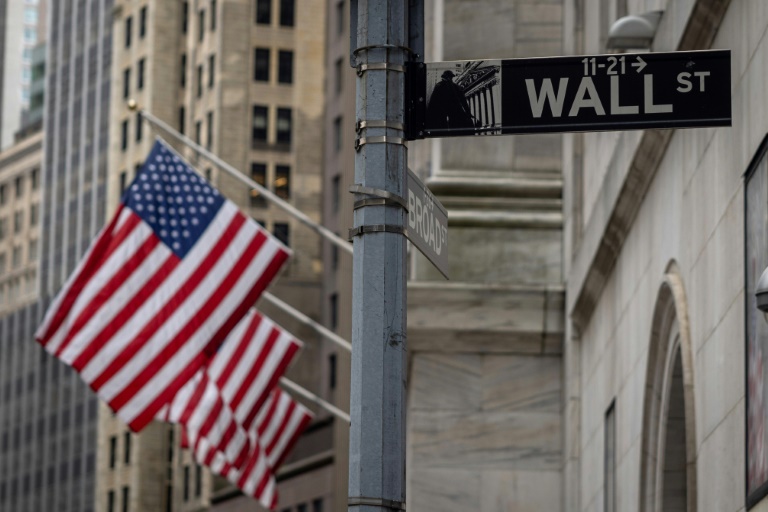
Stock markets wobbled and oil prices sank on Friday over growing fears that inflation-fighting interest rate hikes by central banks could trigger recessions.

Investors were shaken this week after the US Federal Reserve unleashed its biggest hike in borrowing costs for almost 30 years to tackle runaway consumer prices.

This was followed by the fifth straight hike by the Bank of England and the first in 15 years by the Swiss central bank, underscoring the growing global concerns about inflation.

The moves caused a global selloff on Thursday. US and European markets tried to stage a rebound on Friday, but some indices were back in the red later in the day.

On Wall Street, the Dow Industrial Average fell back under 30,000 points near midday while the broad-based S&P 500 was flat and the tech-heavy Nasdaq rose one percent.

European markets seesawed, with London finishing in the red, Paris almost flat and Frankfurt closing higher.

“Sentiment has been shattered and equities could suffer further,” Craig Erlam, analyst at online trading platform OANDA, told AFP.

Sentiment turned sour again as US official data showed industrial production in May had risen by just 0.2 percent, much slower than April and weaker than expected.

“We see that the positive attempts get rapidly killed as the market prices in a higher recession risk as inflation doesn’t ease,” Ipek Ozkardeskaya, analyst at Swissquote bank, told AFP.

Asian stock markets mostly closed lower Friday.

Recession fears also gripped the oil market as WTI, the US benchmark, fell by 5.6 percent to $108.83 per barrel. The international benchmark, Brent North Sea Crude, was down almost five percent at $114.08.

Energy prices have soared since Russia invaded Ukraine, driven inflation higher, which has prompted central banks to spring into action. 

– BoJ bucks the trend –

Investors worry that while the rate increases can help tame inflation, they can have the adverse side effect of crimping economic growth.

The Bank of Japan, however, bucked the global trend on Friday as it stood by its decision not to raise its rate, sending the yen close to the lowest level against the dollar since 1998.

Officials in Tokyo insist that low rates are still needed to nurture a struggling economy, though the BoJ did say it “was necessary to pay due attention to developments in financial and foreign exchange markets”.

Stock markets have been tumbling for months as traders contemplate the end of the era of cheap cash that had sent share prices to record or multi-year highs.

Inflation worldwide stands at levels not seen for decades owing in particular to surges in energy and food prices.

– Key figures at around 1510 GMT –

New York – Dow: DOWN 0.2 percent at 29,867.12 points

London – FTSE 100: DOWN 0.4 percent at 7,016.25 

Frankfurt – DAX: UP 0.7 percent at 13,126.26 

Paris – CAC 40: DOWN 0.1 percent at 5,882.65

EURO STOXX 50: UP 0.3 percent at 3,438.46

Tokyo – Nikkei 225: DOWN 1.8 percent at 25,963.00 (close)

Hong Kong – Hang Seng Index: UP 1.1 percent at 21,075.00 (close)

Shanghai – Composite: UP 1.0 percent at 3,316.79 (close)

Euro/dollar: DOWN at $1.0469 from $1.0549 late Thursday

Pound/dollar: DOWN at $1.2208 from $1.2353

Euro/pound: UP at 85.77 pence from 85.41 pence

Dollar/yen: UP at 135.07 yen from 132.21 yen

Brent North Sea crude: DOWN 4.8 percent at $114.08 per barrel

West Texas Intermediate: DOWN 5.6 percent at $108.83

burs-lth/har

EU backs Ukraine's 'European dream' as Russia cuts gas supplies

Europe sent a powerful symbol of solidarity with Ukraine on Friday, when Brussels backed Kyiv’s bid for EU candidate status, even as Russia shelled frontline Ukrainian cities and cut back gas supplies to the West.

With the European Commission’s backing, Ukraine could now be added to the list of countries vying for EU membership as early as next week, when member state leaders meet at their Brussels summit. 

All 27 EU leaders will have to agree to the candidacy, but the heads of the European Union’s biggest members — France, Germany and Italy — already gave their full-throated support to the idea on Thursday, on a trip to a war-torn suburb of Kyiv.

Then on Friday, the European Commission gave the executive’s formal backing to the bid, and EU chief Ursula von der Leyen made her position clear by donning a striking jacket in Ukraine’s national colours.

“We all know that Ukrainians are ready to die for the European perspective. We want them to live with us for the European dream,” she said.

Ukraine’s President Volodymyr Zelensky immediately welcomed the decision as a “first step on the EU membership path that’ll certainly bring our victory closer”.

He thanked von der Leyen for the commission’s “historic decision” and said he expected that EU leaders would give Ukraine a “positive result” at the June 23-24 summit.

As Brussels celebrated their breakthrough, British Prime Minister Boris Johnson — whose country has left the European Union — returned to Kyiv for his second visit since Russia’s February 24 invasion. 

“Many days of this war have proved that Great Britain’s support for Ukraine is firm and resolute,” Zelensky wrote on social media. Johnson’s office tweeted a picture of the premier meeting the Ukrainian leader, carrying a stack of books and paperwork under one arm.

“My visit today, in the depths of this war, is to send a clear and simple message to the Ukrainian people: the UK is with you, and we will be with you until you ultimately prevail,” Johnson said.

According to Downing Street, Johnson offered to launch a major training operation for Ukrainian forces, to train up to 10,000 soldiers every 120 days and “change the equation of the war”.

Each Ukrainian soldier would spend three weeks on the British training course, learning combat tactics, basic medical skills, cyber-security and counter explosive tactics.

Russia responded to Brussels’ decision with scorn, accusing the West of “manipulating” Ukraine with promises of integration. 

– Russian bombardment –

Foreign ministry spokeswoman Maria Zakharova said Ukraine “is not getting a bright future, for some reason, despite the promises becoming more and more sweet and alluring”.

Once Ukraine joins the EU candidates’ list — alongside several countries in the western Balkans — it could still take years to meet all the formal membership requirements, even if Kyiv prevails in the war.

“Yes, Ukraine should be welcomed as a candidate country — this is based on the understanding that good work has been done but important work also remains to be done,” von der Leyen said.

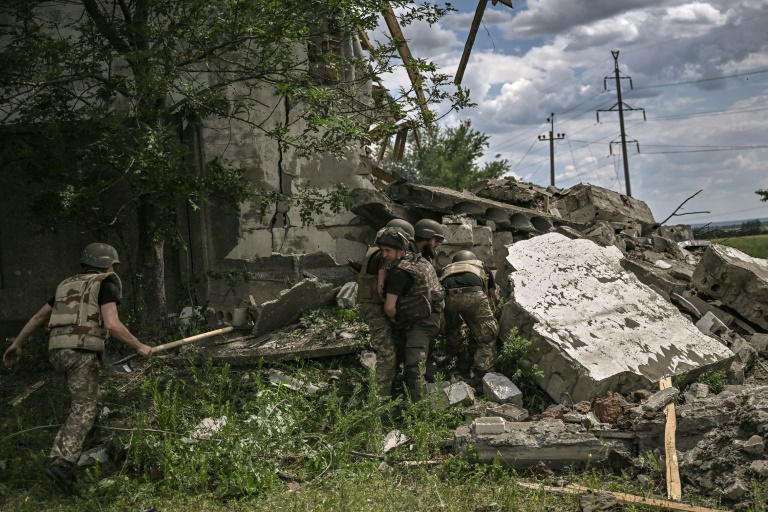
And in the meantime, the fighting continues, with Russian forces bombarding Ukrainian pockets of resistance in frontline Severodonetsk, including civilians holed up in a chemical plant in the eastern Ukrainian city.

And Moscow turned up the pressure on Western allies, sharply reducing flows of natural gas in its pipelines to Western Europe, driving up energy prices.

France’s network provider said it had not received any Russian gas by pipeline from Germany since June 15, and Italy’s Eni said it expected Russian firm Gazprom to cut its supplies by half on Friday.

Several European countries, including Italy and Germany, are highly reliant upon Russian gas for their energy needs and, as the West sides with Ukraine, Moscow is cutting supplies.

– ‘Extremely alarming’ –

Berlin and Rome have rejected Russia’s argument that technical issues have caused the drop in supplies, arguing that state-owned Gazprom’s move is political.

But western Europe is sweltering in a heatwave and energy prices are already soaring, adding to runaway inflation and industrial action in several economies.

The situation is, of course, starker in Ukraine itself, where Russian troops have occupied a swathe of the south and east of the country during the 113-day war, including much of the Donbas region.

“The humanitarian situation across Ukraine — particularly in the eastern Donbas — is extremely alarming and continues to deteriorate rapidly,” the UN humanitarian agency, OCHA, said.

The statement said the situation is “particularly worrying in and around Severodonetsk” — where bloody battles have raged for weeks. 

Severodonetsk is in the Lugansk region, where governor Sergiy Gaiday called for a ceasefire, stating hundreds of civilians were trapped in the besieged Azot chemical plant in the city.  

“It is now impossible and physically dangerous to get out of the plant due to constant shelling and fighting. There are 568 people in the shelter, including 38 children,” he said.

– ‘God’s will’ –

Gaiday said earlier this week that around 10,000 civilians remained in the city, which is controlled mostly by Russian forces.

In the frontline Donbas village of Adamivka near the city of Sloviansk, a community of Orthodox nuns have seen a rocket hole blasted into the wall of their well-tended garden.

Under near-constant bombardment by Russian forces, Sister Anastasi and a group of other black-clad nuns and pilgrims live day-to-day, praying for deliverance.

“We are all alive, yes. No one has left. This is our home,” she said quietly, her face framed by a black veil, as shells crashed in the distance.

“We trust in God’s will, in God’s help, in the help of all the saints and the Holy Virgin. This is our home, we have nowhere else to go.” 

At least two people were killed and 20 injured in a Russian strike on a residential area in the southern Ukrainian city of Mykolaiv, the local governor said.

Separately, Zelensky announced an end to the visa-free travel that Russian citizens, many of whom have Ukrainian relatives, have enjoyed since Ukraine became independent from the Soviet Union in 1991.

burs-dc/har

Ukraine's ferocious defence of cities dampens Russian ambitions

Since Russia rolled into their country Ukrainians have fought for their cities to the last breath, part of a strategy that has forced Russia to rein in its ambitions.

When Russia invaded in February, Western powers feared an onslaught that would see Ukrainian forces crumble within days, but Kyiv has dashed Russian hopes for a quick win. 

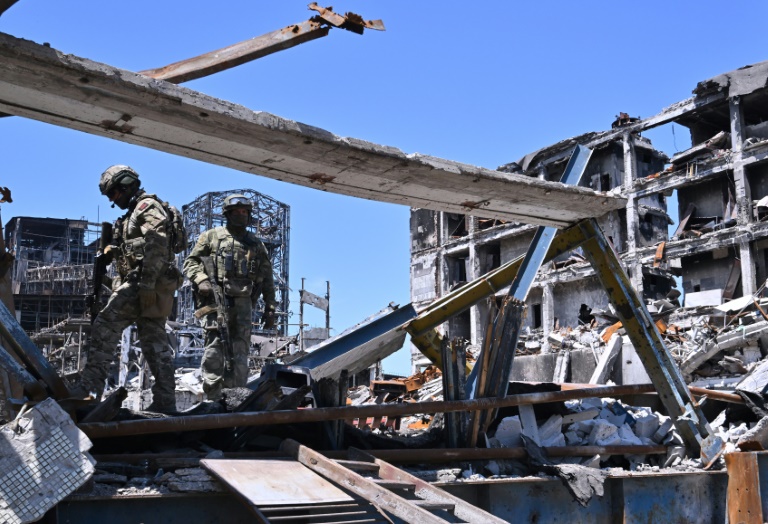
Crucial to that success has been Ukraine’s determination to struggle to the bitter end, epitomised by the weeks-long resistance first in the southeastern city of Mariupol, and now in Severodonetsk. 

“The strategy has been — overall — very effective,” Ivan Klyszcz, a researcher at Estonia’s University of Tartu, told AFP, crediting it with forcing Russia to leave the north after failing to seize Kyiv. 

The current stalemate on the eastern front is also the result of Ukraine’s ferocious defence of its cities, Klyszcz added. 

“Every time Russian troops were slowed down in a city, it stopped them from having a dynamic, from gaining territory or from quickly seizing a city,” a French military source who asked not to be named told AFP. 

Ukrainian troops held out under siege for weeks in the Azovstal steelworks in Mariupol while the rest of the city lay in ruins, before finally surrendering to Russian forces last month.

“The siege of Mariupol compelled Russia to allocate substantial forces” to try to take control of the port city, said William Schneider, a researcher at the Washington-based Hudson Institute. 

As a result, Moscow was forced to delay the deployment of more than 12 Russian battalions to the eastern Donbas region, Schneider told AFP.

-‘War of attrition’ – 

This week, Lugansk governor Sergiy Gaiday said around 10,000 civilians were trapped in the industrial city of Severodonetsk, where fighting with Russia has raged for weeks.

Capturing the city would allow Russian forces to advance further into the Donbas region, which Russia appears to want to annex, Schneider said, upping the importance of resisting the onslaught. 

Gustav Gressel, a researcher for the European Council on Foreign Relations, said it made sense for Ukraine to force much of the fighting to take place in cities. 

“Urban terrain favours the defender … if you can force the enemy to fight there, you stand better chances,” Gressel said.

“This is a long war of attrition. Small, incremental Russian gains are not the issue, but rather who erodes the other faster?” he added. 

In addition to the strategic benefits of die-hard resistance, a never-give-up attitude also crucially keeps morale up and dissuades Ukrainian forces from throwing in the towel.

“Even if it is desperate, it is a way of guaranteeing the consolidation of the units, more and more made up of young soldiers or volunteers who joined the war late and need to be encouraged by example,” the French military source said. 

-Fatigue-

Ukrainians’ image abroad may also benefit from a hero-like reputation as they come across as “martyrs”, especially in Mariupol, the military source added. 

After Mariupol and Severodonetsk, observers are on the lookout for the next fighting hotspot. 

“It’s hard to predict … but the Kherson area has witnessed many Ukrainian gains and may become a contested city in the coming days and weeks,” Klyszcz said.

But questions remain over the long-term sustainability of such an approach, as Moscow continues its onslaught. 

“As Ukraine’s resources, war materiel and manpower begin to dwindle, the strategy risks becoming unviable,” Klyszcz warned.

Kyiv recently admitted that around 100 Ukrainians were dying a day, and 500 injured — although the numbers may be even higher on the Russian side.

And the British Ministry of Defence said last week that some Ukrainians were deserting their armed forces. 

“We are beginning to see soldiers who are dropping out as a result of the pressure, fatigue, and intensity of the firepower befalling them,” the French military source said. 

Sri Lanka schools, govt offices to shut as transport grinds to halt

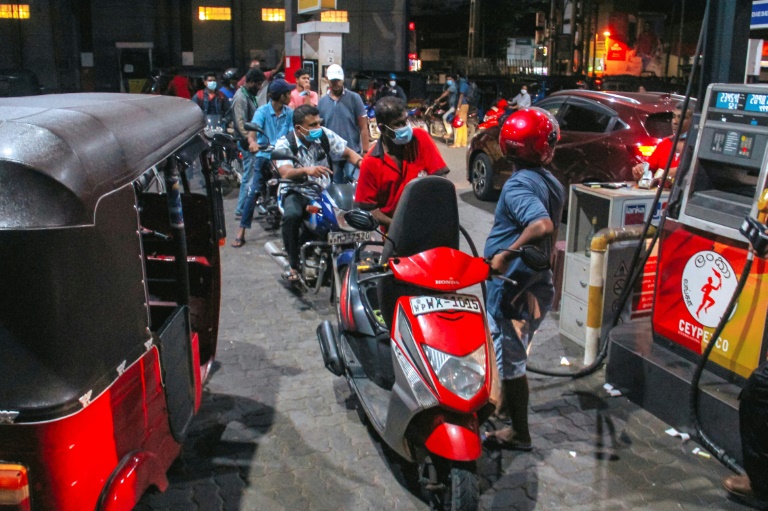
Sri Lankan authorities on Friday announced a two-week shutdown of government offices and schools, as public transport ground almost entirely to a halt due to a lack of dollars to pay for imported fuel.

The Public Administration ministry ordered all departments, public institutions and local councils to maintain skeleton services from Monday in response to the acute shortage of petrol and diesel.

“Due to scarce public transport as well as the inability to arrange private vehicles, it is decided to drastically curtail the number of employees reporting to work,” the ministry’s order said.

Sri Lanka is facing its worst economic crisis since gaining independence in 1948, and has been unable to finance the import of necessities such as food, medicines and fuel since late last year. 

The country is also facing record high inflation and lengthy power blackouts, all of which have contributed to months of protests — sometimes violent — calling on President Gotabaya Rajapaksa to step down. 

Earlier this week, authorities declared Friday a holiday, also in a bid to conserve fuel.

Despite that move, long queues were seen outside pumping stations on Friday, with many motorists saying they had waited for days to top up their tanks.

The education ministry said all schools have been asked to remain closed for two weeks from Monday and to ensure online teaching if students and teachers had access to electricity.

The shutdown order came a day after the United Nations launched its emergency response to the island’s unprecedented economic crisis by feeding thousands of pregnant women who were facing food shortages.

Four out of five people in Sri Lanka have started skipping meals as they cannot afford to eat, the UN has said, warning of a looming “dire humanitarian crisis” with millions in need of aid.

The World Food Programme (WFP) said it began distributing food vouchers to about 2,000 pregnant women in Colombo’s “underserved” areas as part of “life-saving assistance” on Thursday.

The WFP is trying to raise 60 million dollars for a food relief effort between June and December.

Sri Lanka defaulted on its 51 billion dollar foreign debt in April, and is in talks with the International Monetary Fund for a bailout.

Close Bitnami banner
Bitnami