World

Markets hit by recession fears, yen drops after BoJ decision

Equity markets mostly fell Friday after another hefty drop in New York as interest rate hikes by the world’s central banks fan fears of a recession, while the yen sank after the Bank of Japan refused to follow its peers in tightening policy.

Gone is the optimism that flowed through trading floors immediately after the Federal Reserve on Wednesday announced its biggest rate increase for 28 years as global finance chiefs followed suit, putting a squeeze on dealers’ ability to borrow.

Markets have been tumbling for months as traders contemplate the end of the era of cheap cash that sent valuations to record or multi-year highs, with inflation at levels not seen in decades owing to a surge in energy and food prices.

The Bank of England on Thursday lifted rates for a fifth straight time to their highest since 2009 during the financial crisis, just as the Swiss central bank shocked markets by unveiling its own half-point increase — its first rise in 15 years. 

The European Central Bank has also signalled it will announce a hike soon.

Equities plunged as expectations for recession continue to rise. The Dow ended below 30,000 for the first time in more than a year and the S&P 500 is now at its lowest since December 2020.

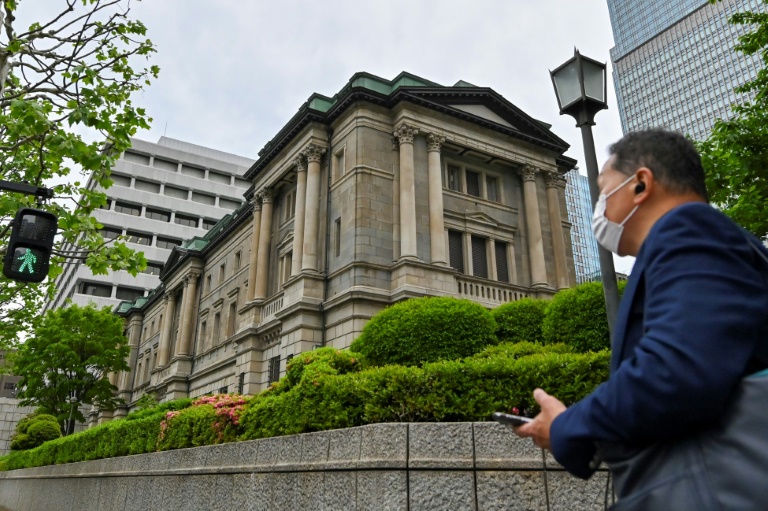
But with rates rising everywhere else, the Bank of Japan on Friday refused to move away from its ultra-loose monetary policy, despite inflation spiking and the yen sitting around a 24-year low.

Officials in Tokyo insist that low rates are still needed to nurture a struggling economy, though in a move away from its regular remarks in the post-meeting statement, the bank did say it “was necessary to pay due attention to developments in financial and foreign exchange markets”.

The yen tumbled to 134.63 against the dollar, from 133.37 before the decision, though it recouped some of those losses after the statement. Still, it is wallowing around a 24-year low and has lost around 13 percent this year.

“The BoJ added language about foreign exchange markets following the earlier statement from the three-party gathering. That tells me they are getting more cautious and don’t want the yen to tumble to 140,” Mari Iwashita, of Daiwa Securities, said. 

Ahead of the meeting, Stephen Innes at SPI Asset Management wrote in a note: “No central bankers worth their weight would put inflation-fighting credentials on the line and import higher energy inflation via a weaker currency.”

He added that “in what is a highly ominous signal for stock market investors, given the broader index’s sensitivity to rising bond yields… the global race to hike rates is nowhere near the finishing line”. 

Still, in reaction to the decision he said there was a sense of relief among traders as “as the last thing the market needed was another blowdown equity valve to give way”.

Equity markets in Tokyo, Sydney, Seoul, Singapore, Wellington, Taipei, Mumbai, Manila and Jakarta were all in the red, though Hong Kong was slightly higher after steep losses on Thursday.

London, Paris and Frankfurt edged up in the morning session.

OANDA’s Jeffrey Halley had a warning for investors looking to pick up bargains.

“Even the most ardent buy-the-dipper in the equity space is starting to realise inflation is a threat, with central bank banks prepared to hike the world into a slowdown and possible recession to get on top of it,” he said in a note.

– Key figures at around 0810 GMT –

Tokyo – Nikkei 225: DOWN 1.8 percent at 25,963.00 (close)

Hong Kong – Hang Seng Index: UP 1.1 percent at 21,075.00 (close)

Shanghai – Composite: UP 1.0 percent at 3,316.79 (close)

London – FTSE 100: UP 0.4 percent at 7,075.65

Dollar/yen: UP at 134.33 yen from 132.14 yen late Thursday

Euro/dollar: DOWN at $1.0513 from $1.0550

Pound/dollar: DOWN at $1.2298 from $1.2350

Euro/pound: UP at 85.50 pence from 85.40 pence

West Texas Intermediate: UP 0.7 percent at $118.42 per barrel

Brent North Sea crude: UP 0.7 percent at $120.63 per barrel

New York – Dow: DOWN 2.4 percent at 29,927.07 (close)

— Bloomberg News contributed to this story —

Bank of Japan keeps easing despite global rate hikes

The Bank of Japan on Friday stuck to its monetary easing policy even as other central banks raise interest rates to tame inflation, but said it would “pay due attention” to forex markets after the yen hit a 24-year low.

The bank will hold rates at minus 0.1 percent and continue buying unlimited government bonds to maintain a low cap on long-term yields — part of a decade-old plan to boost the world’s third-largest economy.

The decision, announced after a two-day policy meeting, bucks a global monetary tightening trend aimed at battling sky-high fuel and food prices caused by the Ukraine war and supply chain snarls.

Rate hikes have been led by the US Federal Reserve, which this week announced its most aggressive increase in nearly 30 years and signalled more were in the pipeline.

The European Central Bank has said it plans to start a series of increases next month, while the Bank of England announced a fifth straight increase on Thursday and Switzerland surprised markets with its own rate hike, the first since 2007.

The widening chasm between Japanese and US monetary policy this week pushed the yen to its lowest level against the dollar since 1998, a cause for increasing concern that even the central bank made reference to in its policy statement.

“It is necessary to pay due attention to developments in financial and foreign exchange markets and their impact on Japan’s economic activity and prices,” the BoJ said, in an unusual reference to forex movements.

After the announcement, one dollar bought 134.63 yen, up from 133.41 yen earlier in the day.

– ‘Targeting price stability’ –

Bank governor Haruhiko Kuroda told reporters that the yen’s rapid depreciation is “undesirable for the economy, because it has increased uncertainty about the future and made it difficult for companies to draft business plans”.

However, he added that “central banks do not target exchange rates. We run monetary policy targeting price stability”.

Kuroda said the BoJ was not considering expanding the trading range of 10-year bonds, a move analysts say could help support the yen.

A weaker currency helps Japanese exporters as it inflates repatriated profits, noted Yoshikiyo Shimamine, executive chief economist of Dai-ichi Life Research Institute.

For the BoJ, it may be that “these benefits overwhelm the negative aspects of a cheaper yen — high prices for imported goods, which causes people to suffer without sufficient pay rises,” he told AFP.

The bank’s ultra-loose monetary policy aims to achieve two-percent inflation, a target that has been stubbornly out of reach during years of price stagnation.

In April, core consumer prices hit the target for the first time since 2015, but the BoJ has cautioned that it sees recent rising prices as a temporary and volatile trend.

Inflation has been rising for months in the United States and elsewhere as buoyant demand for cars and other goods clashes with supply problems caused by Covid-19 lockdowns.

The problem became dramatically worse after Russia invaded Ukraine in February and Western nations imposed steep sanctions on Moscow, sending food and fuel prices soaring, a particular problem in resource-poor Japan.

Thailand to drop mask rule, foreign tourist registration

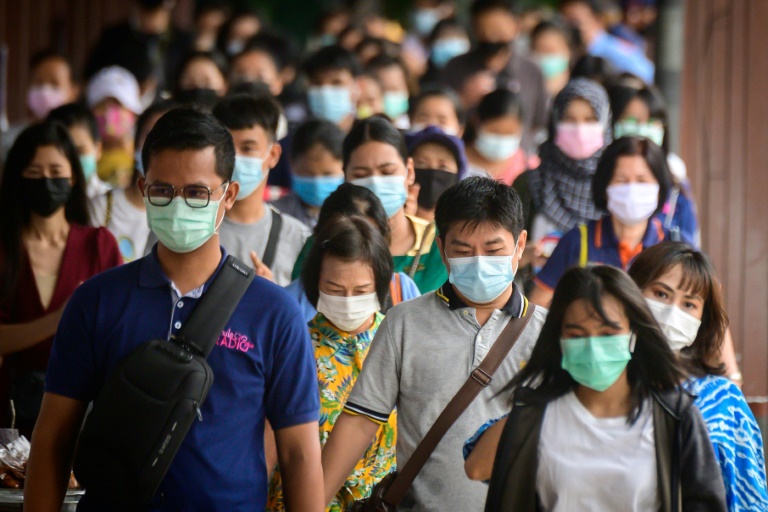
Thailand announced Friday it would drop rules requiring people to wear masks outdoors and no longer require foreign visitors to register before travel, as Covid-19 cases fall and the kingdom seeks to lure tourists back.

Facemasks have been compulsory in public in Thailand, including outdoors, since mid-2021 when the Delta variant was running rampant.

But as the pandemic has subsided, the tourism-dependent kingdom has gradually relaxed covid restrictions in a bid to boost visitor numbers.

Thailand’s relaxation on facemasks comes after similar moves by regional peers including Cambodia and Singapore.

Taweesin Visanuyothin, spokesman for the Thai Covid taskforce, said wearing masks outside would become voluntary, but was still recommended in crowded areas, entertainment venues and on public transport.

He said the health ministry would announce further details of the mask relaxation, including when it would come into force.

On July 1 the government will also end the “Thailand Pass” system, under which foreign tourists had to register and show proof of vaccination and health insurance before they could fly to the kingdom.

Visitors will have to carry vaccine certificates or take Covid tests on arrival. 

The move is seen as an attempt to bolster the sputtering economy, which has seen growth hammered by the pandemic and living costs rising. 

There were more than 1.6 million foreign tourist arrivals during the first six months of 2022, with foreign tourist receipts logged at 99.7 billion baht, according to government data.

This compares with around 40 million foreign tourists visiting Thailand in 2019, the last year before the pandemic.

Daily Covid-19 cases have hovered below 3,500 in recent weeks, with the number of deaths registering below 50 a day for a month.

More than three quarters of the population has been jabbed with two vaccine doses, with more than 40 percent also getting a booster dose.

A Chinese invasion of Taiwan: Too costly to countenance?

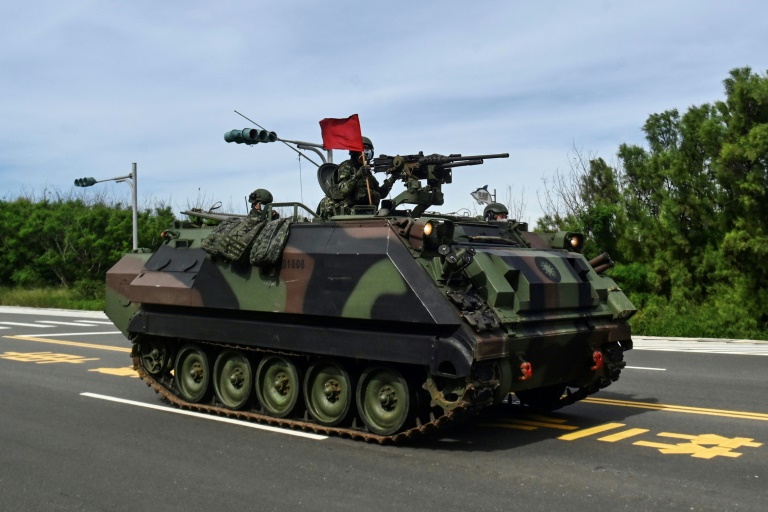
On Taiwan’s tiny Penghu islands, the missile bases that sit next to white-sand beaches and bustling fish markets are a visceral reminder of the constant threat of attack from China.

Despite the huge military discrepancy between the two sides, many analysts believe Taiwan’s location, inhospitable terrain and US support mean China would find a full-scale invasion extremely hard — and possibly too costly to countenance. 

Communist China and Taiwan split at the end of a civil war in 1949 with the losing Kuomintang forces retreating to the island. But Beijing insists now-democratically run Taiwan is part of its territory, and that it will one day re-take it, by force if necessary. 

Recent record Chinese fighter jet incursions into Taiwan’s air defence identification zone and increasingly aggressive rhetoric under President Xi Jinping have raised fears China might contemplate acting on that pledge sooner rather than later. 

The Chinese defence ministry last week said it would “not hesitate to start a war” to stop Taiwan becoming independent.

One US admiral has said an attack could come by 2027, the centenary of China’s People’s Liberation Army (PLA).

“If we were to go head to head militarily, we don’t stand a single chance,” retired admiral Lee Hsi-min, who was head of Taiwan’s armed forces until 2019, told AFP bluntly.

But Russia’s failure to quickly overrun Ukraine stands as a cautionary tale to Beijing, while simultaneously providing Taipei with both tactical blueprints and inspiration on how to hold off a much larger enemy.

“Our soldiers here are all Taiwanese and will be fighting to defend their homeland,” said Chen Ing-jin, a Penghu historian and architect. “That makes a difference. Just look at Ukraine.”

– ‘A defender’s dream’ – 

Taiwan’s biggest advantage is its geography.

Amphibious assaults are exceedingly difficult and if China was to invade Taiwan — and crucially hold it — Beijing would need to move hundreds of thousands of troops as well as equipment across the Taiwan Strait.

Even at its narrowest point the strait is 130 kilometres (80 miles) and weather conditions are notoriously unforgiving with two monsoon seasons. 

That leaves just two brief “windows of attack” — May to July and October — for such a large-scale operation, according to a US Naval War College report.

In addition, studded into the waters are outlying islands like the Penghu chain — bristling with radar and missiles pointing straight out into the strait.  

With the likely early warning, and the weaponry Taipei has at its disposal, the PLA would probably incur high losses even in that first stage of transit, said James Char, an Associate Research Fellow at Singapore’s S. Rajaratnam School of International Studies.

And while the small, flat outlying islands might in the end prove easy for Beijing to subdue, on Taiwan’s main island, the opposite applies.

The coastal terrain there “is a defender’s dream come true”, according to Ian Easton, author of “The Chinese Invasion Threat”.

He and his colleagues estimate that Taiwan only has 14 small beaches suitable for landing, and even they are bordered by mountains, cliffs or dense urban infrastructure. 

“Landing on Taiwan is only part of the problem,” Bonny Lin, director of the China Power Project at the Center for Strategic and International Studies (CSIS), told AFP. 

Progress through Taiwan’s wetlands, mountains and densely populated urban areas will require a huge range of different combat skills and weapons.

“How is it going to sustain those forces once they’re in position and advancing — how is it going to do the logistics?” Lin asked.

– Weapons –

China has spent hundreds of billions of dollars upgrading its military capabilities over the past decade, and its statistical dominance over Taiwan is enormous. 

The PLA has over one million ground force personnel to Taiwan’s 88,000, 6,300 tanks compared with 800, and 1,600 fighter jets to 400, according to the US Department of Defence.  

Washington also estimates Beijing has the world’s largest Navy by ship number. A recent US Naval War College paper described those ships as “increasingly sophisticated, capable vessels”.

But many experts, including both Char and Lin, question whether they are yet capable enough.

Atlantic Council senior advisor Harlan Ullman put it more forcefully in a February paper: “China simply lacks the military capability and capacity to launch a full-scale amphibious invasion of Taiwan for the foreseeable future”.  

In the meantime, Taiwan has plans to counter China’s might in numbers, with retired admiral Lee highlighting asymmetric warfare — an emphasis on mobility and precision attacks — an approach US officials are reportedly encouraging. 

Lee pointed to the success of the Ukrainian mobile missile launcher that sank Russia’s Black Sea flagship, the Moskva.

Taiwan has built up stockpiles of mobile missile batteries and shoulder-launched weapons but he said they needed lots more. 

– US support –

The factor that preoccupies Beijing most is who else might get involved in the conflict, Chinese military expert Song Zhongping told AFP. 

“The difficulty of liberating Taiwan lies in the potential intervention of the United States. It’s the biggest obstacle for the PLA to clear,” he said. 

The United States officially maintains a “strategic ambiguity” on whether it would intervene militarily in the event of an invasion. But it supplies Taiwan with military hardware and President Joe Biden has said multiple times that Washington would intervene. 

The “extent, depth and breadth” of US and other allies’ involvement would greatly determine how any conflict would play out, said Song. 

Some wargame scenarios see the PLA taking out US bases in the Pacific to kneecap its ability to respond. Washington would be heavily reliant on aircraft carriers operating far from home. 

To counter that threat China has prioritised the development of hypersonic “carrier killer” missiles and militarised multiple atolls in the disputed South China Sea.

But an attack on US forces could provoke a more determined backlash and draw American allies into a global conflict.

Even without a military intervention, Char said the threat of economic sanctions like those placed on Russia would give the Chinese leadership pause for thought.

– Political willpower –

The question of whether China would be prepared to cause mass casualties with an invasion, while risking its domestic and international image, is a fundamental one.

“You need to let China know that it will suffer tremendous losses, and even then it may still not be able to occupy Taiwan,” said Lee. 

“So that China will think that the best way to resolve the Taiwan problem is by peaceful means.”

There are a range of other options short of all-out invasion Beijing could use to bring Taipei to its knees — including a Taiwan Strait blockade, annexation of the outlying islands, or incapacitation of military and cyber systems.

“China might come up with other formulations or creative diplomatic strategic solutions to declare unification with Taiwan without actually having achieved that,” CSIS’ Lin said.  

Chinese analyst Song said Beijing has made its invasion trigger clear. 

“The timing depends on the behaviour of the Taiwanese separatists and if they insist on advocating for Taiwan’s independence,” he said.

The island’s 23 million people have increasingly embraced a distinct Taiwanese identity and President Tsai Ing-wen, who views the island as a sovereign state, has won two elections. 

The next presidential elections are due in 2024 and Ukraine’s fate has only further hardened attitudes towards China.

In a survey conducted in May, 61.4 percent of respondents said they were willing to take up arms in the event of an invasion. 

The decision ultimately rests with Xi Jinping, the most authoritarian Chinese leader since Mao Zedong, who has been central to the rising fears that China will invade Taiwan.

Xi is on the cusp of securing an unprecedented third term this year. And since he came to power, Char said, “there’s been a total shift from the previous mantra of peace and development” in China’s behaviour in the region.

Instead, he added, Xi has pushed the mantra “accomplish something magnificent and great”.

In a landmark 2019 speech on Taiwan, Xi said unification was “an inevitable requirement for the great rejuvenation of the Chinese people”.

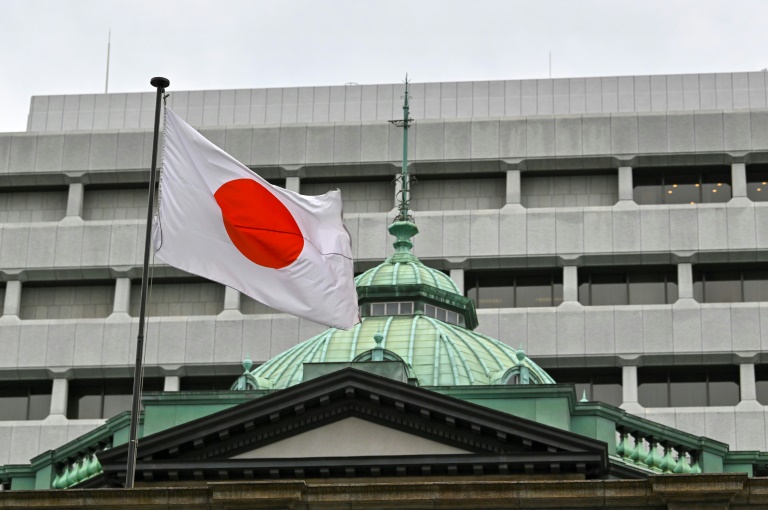
Asian markets hit by recession fears, yen drops after BoJ decision

Asian markets mostly fell Friday after another hefty drop in New York as interest rate hikes by the world’s central banks fan fears of a recession, while the yen sank after the Bank of Japan refused to follow its peers in tightening policy.

Gone is the optimism that flowed through trading floors immediately after the Federal Reserve on Wednesday announced its biggest rate increase for 28 years as global finance chiefs followed suit, putting a squeeze on dealers’ ability to borrow.

Markets have been tumbling for months as traders contemplate the end of the era of cheap cash that sent valuations to record or multi-year highs, with inflation at levels not seen in decades owing to a surge in energy and food prices.

The Bank of England on Thursday lifted rates for a fifth straight time to their highest since 2009 during the financial crisis, just as the Swiss central bank shocked markets by unveiling its own half-point increase — its first rise in 15 years. 

The European Central Bank has also signalled it will announce a hike soon.

Equities plunged as expectations for recession continue to rise. The Dow ended below 30,000 for the first time in more than a year and the S&P 500 is now at its lowest since December 2020.

But with rates rising everywhere else, the Bank of Japan on Friday refused to move away from its ultra-loose monetary policy, despite inflation spiking and the yen sitting around a 24-year low.

Officials in Tokyo insist that low rates are still needed to nurture a struggling economy, though in a move away from its regular remarks in the post-meeting statement, the bank did say it “was necessary to pay due attention to developments in financial and foreign exchange markets”.

The yen tumbled to 134.63 against the dollar, from 133.37 before the decision, though it recouped some of those losses after the statement. Still, it is wallowing around a 24-year low and has lost around 13 percent this year.

“The BoJ added language about foreign exchange markets following the earlier statement from the three-party gathering. That tells me they are getting more cautious and don’t want the yen to tumble to 140,” Mari Iwashita, of Daiwa Securities, said. 

Ahead of the meeting, Stephen Innes at SPI Asset Management wrote in a note: “No central bankers worth their weight would put inflation-fighting credentials on the line and import higher energy inflation via a weaker currency.”

He added that “in what is a highly ominous signal for stock market investors, given the broader index’s sensitivity to rising bond yields… the global race to hike rates is nowhere near the finishing line”. 

Still, in reaction to the decision he said there was a sense of relief among traders as “as the last thing the market needed was another blowdown equity valve to give way”.

Equity markets in Tokyo, Sydney, Seoul, Singapore, Wellington, Taipei, Mumbai, Manila and Jakarta were all in the red, though Hong Kong was slightly higher after steep losses on Thursday.

London opened lower while Paris and Frankfurt edged up. 

OANDA’s Jeffrey Halley had a warning for investors looking to pick-up bargains.

“Even the most ardent buy-the-dipper in the equity space is starting to realise inflation is a threat, with central bank banks prepared to hike the world into a slowdown and possible recession to get on top of it,” he said in a note.

– Key figures at around 0720 GMT –

Tokyo – Nikkei 225: DOWN 1.8 percent at 25,963.00 (close)

Hong Kong – Hang Seng Index: UP 1.1 percent at 21,070.83

Shanghai – Composite: UP 1.0 percent at 3,316.79 (close)

London – FTSE 100: DOWN 0.2 percent at 7,028.71

Dollar/yen: UP at 134.30 yen from 132.14 yen late Thursday

Euro/dollar: DOWN at $1.0503 from $1.0550

Pound/dollar: DOWN at $1.2261 from $1.2350

Euro/pound: UP at 85.66 pence from 85.40 pence

West Texas Intermediate: DOWN 0.2 percent at $117.36 per barrel

Brent North Sea crude: DOWN 0.1 percent at $119.71 per barrel

New York – Dow: DOWN 2.4 percent at 29,927.07 (close)

— Bloomberg News contributed to this story —

EU to give fast-tracked opinion on Ukraine membership bid

The European Commission will meet Friday to give its fast-tracked opinion on Ukraine’s bid for EU candidacy, a step closer to membership for the country a day after the bloc’s most powerful leaders visited Kyiv as it battles Russia’s invasion.

Never before has an opinion been given so quickly on EU candidacy, which must be approved by all 27 member states.

The opinion will serve as a basis for discussion at next week’s EU summit, where leaders are expected to approve Ukraine’s candidate status with strict conditions, though membership may take years or even decades.

France, Germany, Italy and Romania are in favour of Ukraine receiving “immediate” candidate status, French President Emmanuel Macron said in Kyiv Thursday. 

Macron, German Chancellor Olaf Scholz and Italian premier Mario Draghi arrived in Ukraine by train and were joined by Romania’s President Klaus Iohannis before meeting Ukrainian leader Volodymyr Zelensky, who has been lobbying allies for support.

“The most important message of our visit is that Italy wants Ukraine in the EU,” Draghi said at a joint press conference.

Scholz said Ukraine “belongs in the European family” and that Berlin would continue to send Kyiv weapons “for as long as it is needed”.

After meeting the visiting leaders, Zelensky said he explained “essential needs in the field of defence”.

“We are expecting new deliveries, above all heavy weapons, modern artillery, anti-aircraft defence systems,” he said, even as Macron said France would send six Caesar self-propelled howitzers to add to the 12 already deployed on Ukraine’s eastern front.

Zelensky promised Ukraine was ready to put in the work to become an EU member.

– ‘Dreadful mistake’ –

Think tank director Sebastien Maillard said he expects a positive opinion on Ukraine’s EU status, but with conditions and a deadline.

“This is a very delicate exercise for the Commission because it cannot be less demanding for Ukraine than for other countries for which it has given a favourable opinion in the past. Its credibility requires the maintenance of high standards,” the head of the Jacques Delors Institute said.

Russia has already “strategically lost” its war with Ukraine, suffering heavy losses and strengthening NATO, the UK’s chief of defence staff said in an interview published Friday.

“This is a dreadful mistake by Russia. Russia will never take control of Ukraine,” said Tony Radakin, the country’s highest-ranking military officer.

The admiral said Russian President Vladimir Putin had sacrificed a quarter of his country’s army power for “tiny” gains and was running out of troops and high-tech missiles.

“Russia is failing.”

– Nuns survive under shelling –

In eastern Ukraine, Russian forces edged closer to control of the twin cities of Severodonetsk and Lysychansk after weeks of battle.

Regional governor Sergiy Gaiday said Friday that airstrikes killed six in the area, including a mother and son, and that the number of shellings by the Russian army was growing daily.

Under near-constant bombardment by Russian forces, black-clad Sister Anastasia and a group of Orthodox nuns and pilgrims live in one of the villages closest to Ukraine’s frontline.

Entrance to the religious community, in the village of Adamivka near the city of Sloviansk, is only possible with permission from the Ukrainian military.

Their complex hasn’t had electricity for months, and its perimeter walls are pockmarked with shrapnel holes.

AFP journalists heard regular incoming fire from a few kilometres away, and soldiers said a cluster bomb had just fallen nearby.

Sloviansk was taken by Russia-backed separatists in 2014 but recaptured by Kyiv’s forces after a months-long siege.

“This is our home, we have nowhere else to go,” said Sister Anastasia.

– Grain standoff –

US Agriculture Secretary Tom Vilsack called on Russia Thursday to rapidly open Ukraine’s ports to permit the export of millions of tonnes of stockpiled grain.

“We shouldn’t be using food as a weapon,” Vilsack told reporters at the United Nations.

With global grain prices soaring and importers in the Middle East and Africa facing supply shortfalls, Moscow has demanded that economic sanctions on it be lifted in exchange for allowing the exports.

While Russia — the largest wheat exporter in the world — appears to be calling the shots in the grain standoff, experts say that its own agricultural sector is also bracing for tough times.

Yevgeny Shifanov, co-owner of an organic farm, says his business has felt the sting of Western sanctions and he is no longer able to sell his grain to Europe. 

But the 42-year-old puts on a brave face, saying he is pivoting to ex-Soviet countries such as Belarus as well as domestic clients.

“We are more interested in our internal market, our economy,” he told AFP.

burs-st/dva/je

WTO strikes landmark deals package after marathon talks

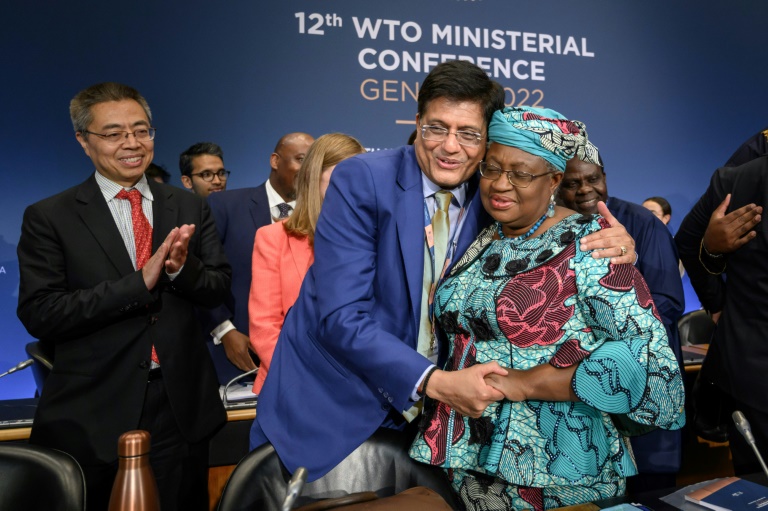
The World Trade Organization concluded a landmark bundle of deals Friday covering fishing subsidies, food insecurity and Covid-19 vaccines following hectic round-the-clock talks.

WTO director-general Ngozi Okonjo-Iweala said trade ministers had struck an “unprecedented package of deliverables” which would make a difference to people’s lives across the planet.

The talks at the global trade body’s Geneva headquarters began Sunday and were due to wrap up on Wednesday.

But instead the WTO’s 164 members went through two straight nights before getting the package over the line at around 5:00 am (0300 GMT) Friday.

The WTO’s 12th ministerial conference (MC12) reeled in a deal to halt harmful fisheries subsidies after more than two decades of negotiations, and also reached agreements on e-commerce, responding to pandemics and reforming the organisation itself.

“Not in a long while has the WTO seen such a significant number of multilateral outcomes,” Okonjo-Iweala said.

“The package of agreements you have reached will make a difference to the lives of people around the world. The outcomes demonstrate that the WTO is in fact capable of responding to the emergencies of our time.”

With ministers struggling to conclude agreements on each separate issue, countries began making trade-offs across the topics that ultimately kept several measures alive.

“There were many moments when I feared we would come out of MC12 with nothing at all,” Okonjo-Iweala later admitted.

But after the conference went nearly 36 hours into overtime, EU trade commissioner Valdis Dombrovskis tweeted “DEAL!”

The “ministerial succeeded in delivering important outcomes, despite unprecedented challenges.”

– Big fish deal netted –

The fisheries deal — the flagship issue thrashed out at the conference — was the last one to get over the line.

Delegations were hammering out the final points into the early hours of Friday.

Negotiations towards banning subsidies that encourage overfishing and threaten the sustainability of the planet’s fish stocks had been going on at the WTO since 2001.

The text was watered down compared to what had originally been envisaged, but Okonjo-Iweala insisted it was better to get an agreement rather than keep negotiating for years to come.

The last ministerial conference in Buenos Aires in December 2017 was seen as a flop after failing to strike any heavyweight deals.

Okonjo-Iweala, who took over in March 2021, hinged her leadership on breathing new life into the sclerotic organisation.

She wanted to prove that the organisation could still make itself relevant in tackling the big global challenges.

The former foreign and finance minister of Nigeria positioned herself as someone who can bang heads together and get business done.

“I prefer to talk less and do more,” she said Friday.

As for why the discussions went on so long, some delegations accused India of being intransigent on every topic under discussion at the WTO — where decisions can only pass with the agreement of every member.

But Indian Commerce and Industry Minister Piyush Goyal insisted: “India is not a roadblock on anything… People are realising that we were the ones who actually helped create the sole consensus.”

– Patents waiver –

The second major issue on the table was the plan for a Covid-19 vaccine patents waiver.

Some countries that host major pharmaceutical companies, like Britain and Switzerland, found the initial draft wording worrisome.

But once Britain got on board after securing clarifications, it was left to the United States and China, who agreed language that captured Beijing’s voluntary output.

US Trade Representative Katherine Tai hailed the deal, saying it would “get more safe and effective vaccines to those who need it most”.

The pharmaceutical industry organisation IFPMA however voiced “deep disappointment” at the deal, warning that “dismantling” patent protections would strangle innovation. 

Public interest groups meanwhile slammed the deal for not going far enough, with the medical charity Doctors Without Borders calling it a “devastating global failure” that would not help people access medical tools to fight the pandemic.

WTO members also agreed to help ease supply shortages that some countries faced during the pandemic.

With Russia’s war in Ukraine fuelling a global food security crisis, ministers agreed on the importance of not imposing export restrictions, while food purchases by the UN’s World Food Programme will be shielded from export bans.

Ministers also agreed to extend the moratorium on imposing customs duties on e-commerce transactions, seen by some countries as fundamental to protecting the digital economy.

WTO strikes landmark deals package after marathon talks

The World Trade Organization concluded a landmark bundle of deals Friday covering fishing subsidies, food insecurity and Covid-19 vaccines following hectic round-the-clock talks.

WTO director-general Ngozi Okonjo-Iweala said trade ministers had struck an “unprecedented package of deliverables” which would make a difference to people’s lives across the planet.

The talks at the global trade body’s Geneva headquarters began Sunday and were due to wrap up on Wednesday.

But instead the WTO’s 164 members went through two straight nights before getting the package over the line at around 5:00 am (0300 GMT) Friday.

The WTO’s 12th ministerial conference (MC12) reeled in a deal to halt harmful fisheries subsidies after more than two decades of negotiations, and also reached agreements on e-commerce, responding to pandemics and reforming the organisation itself.

“Not in a long while has the WTO seen such a significant number of multilateral outcomes,” Okonjo-Iweala said.

“The package of agreements you have reached will make a difference to the lives of people around the world. The outcomes demonstrate that the WTO is in fact capable of responding to the emergencies of our time.”

With ministers struggling to conclude agreements on each separate issue, countries began making trade-offs across the topics that ultimately kept several measures alive.

“There were many moments when I feared we would come out of MC12 with nothing at all,” Okonjo-Iweala later admitted.

But after the conference went nearly 36 hours into overtime, EU trade commissioner Valdis Dombrovskis tweeted “DEAL!”

The “ministerial succeeded in delivering important outcomes, despite unprecedented challenges.”

– Big fish deal netted –

The fisheries deal — the flagship issue thrashed out at the conference — was the last one to get over the line.

Delegations were hammering out the final points into the early hours of Friday.

Negotiations towards banning subsidies that encourage overfishing and threaten the sustainability of the planet’s fish stocks had been going on at the WTO since 2001.

The text was watered down compared to what had originally been envisaged, but Okonjo-Iweala insisted it was better to get an agreement rather than keep negotiating for years to come.

The last ministerial conference in Buenos Aires in December 2017 was seen as a flop after failing to strike any heavyweight deals.

Okonjo-Iweala, who took over in March 2021, hinged her leadership on breathing new life into the sclerotic organisation.

She wanted to prove that the organisation could still make itself relevant in tackling the big global challenges.

The former foreign and finance minister of Nigeria positioned herself as someone who can bang heads together and get business done.

“I prefer to talk less and do more,” she said Friday.

As for why the discussions went on so long, some delegations accused India of being intransigent on every topic under discussion at the WTO — where decisions can only pass with the agreement of every member.

But Indian Commerce and Industry Minister Piyush Goyal insisted: “India is not a roadblock on anything… People are realising that we were the ones who actually helped create the sole consensus.”

– Patents waiver –

The second major issue on the table was the plan for a Covid-19 vaccine patents waiver.

Some countries that host major pharmaceutical companies, like Britain and Switzerland, found the initial draft wording worrisome.

But once Britain got on board after securing clarifications, it was left to the United States and China, who agreed language that captured Beijing’s voluntary output.

US Trade Representative Katherine Tai hailed the deal, saying it would “get more safe and effective vaccines to those who need it most”.

The pharmaceutical industry organisation IFPMA however voiced “deep disappointment” at the deal, warning that “dismantling” patent protections would strangle innovation. 

Public interest groups meanwhile slammed the deal for not going far enough, with the medical charity Doctors Without Borders calling it a “devastating global failure” that would not help people access medical tools to fight the pandemic.

WTO members also agreed to help ease supply shortages that some countries faced during the pandemic.

With Russia’s war in Ukraine fuelling a global food security crisis, ministers agreed on the importance of not imposing export restrictions, while food purchases by the UN’s World Food Programme will be shielded from export bans.

Ministers also agreed to extend the moratorium on imposing customs duties on e-commerce transactions, seen by some countries as fundamental to protecting the digital economy.

Danube offers lifeline for Ukrainian grain exports

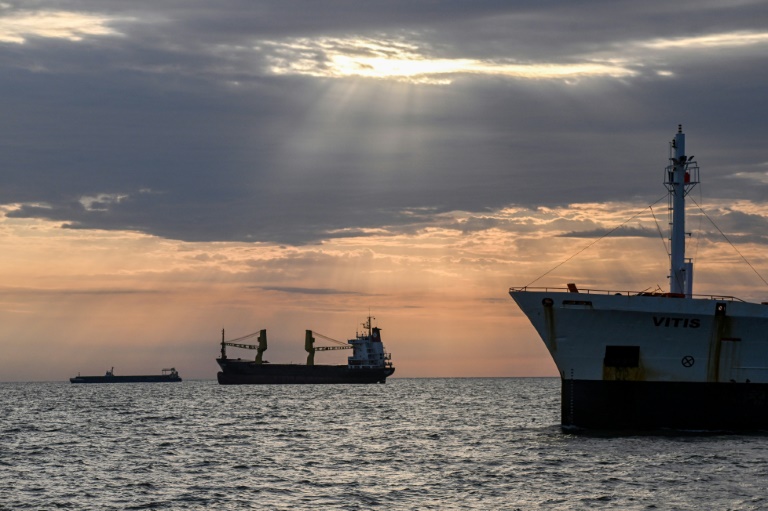
In the Ukrainian port of Izmail, on the Danube river that marks the border with Romania, rows of trucks filled with grain stand in line.

Dozens of kilometres (miles) from there, at Romania’s port of Sulina, where the river flows into the Black Sea, ships are waiting to be loaded. 

Sailors say there have never been so many ships of all kinds and under so many flags dotting the horizon at Sulina.

They are waiting to reach Ukraine to be loaded with food — ever since Moscow’s blockade of its neighbour’s seaports has paralysed grain exports from one of the world’s largest producers.

“The alternative is the Danube. The big problem is the capacity of the infrastructure on the river,” Yuriy Dimchoglo, former vice-president of the Odessa regional council, told AFP.

Since Russia invaded Ukraine in February, only 1.5 million tonnes of grain have been exported via the Danube, he said, while 20 to 25 million tonnes are blocked in the country, according to the government.

– ‘Feed the world’ –

Some 35 kilometres (20 miles) from Izmail port, farmer Vyacheslav Zyabkin said he had still not shipped any of his produce — “not even a kilogramme” — via the Danube because purchase prices were below operating costs.

He said shipping via the Danube was especially suitable for farmers who have small quantities to sell.

But even for those who do choose this route, the journey is strewn with obstacles.

As trucks converge from the south of Ukraine in the hope of unloading their cargo via the Danube, huge traffic jams have formed.

And Izmail too is very crowded.

“Before the war, it took one day, now it takes three days” to unload there, trucker Sergiy Gavrilenko told AFP.

“We take it upon ourselves because it’s for the good of the country and to feed the world,” said the 45-year-old as he poured a can of water over himself to cool off under the scorching hot temperature of 32 degrees Celsius (89.6 degrees Fahrenheit).

– ‘No respite’ –

The boats that take over, and transport the goods down the Danube before reaching the Black Sea, keep coming.

Off Sulina, nearly a hundred of them wait on average between seven and 10 days until they can take the canal to the Ukrainian ports.

“Our volume of work has increased a lot… We are hard at work from sunrise to sunset,” said Gabriel Danila-Mihalcea, 28, pilot of a boat plying between Sulina and the Black Sea.

His mission is crucial — he shuttles pilots to each of the ships in the harbour. Under a rule endorsed in 1948 by the Danube Convention such a pilot must steer ships through the Sulina canal.

“We have no respite,” one of the pilots said on condition of anonymity, while ship mechanic Mihai Calin, 48, said “a record” 400 boats passed through Sulina last month.

A senior transport ministry official Ion Popa confirmed traffic last month had tripled compared to May last year.

He told AFP that managing this increase was “an effort for Romania”, adding he hoped for help from Brussels.

After blaming each other for the backlog, Romania and Ukraine set up a joint command at the end of May that decides the order in which ships enter the Danube.

Those chartered for the transport of grain now have priority.

Separately, at the Romanian Black Sea port of Constanta, nearly 700,000 tonnes of Ukrainian agricultural produce have been loaded since the start of the conflict, arriving there on board barges, trains and trucks, Popa said.

But the queues at road and rail border crossings are getting longer every day.

Before the war, Ukraine was the fourth-largest wheat and corn exporter in the world.

Russia, too, is a grain superpower and 30 percent of the world’s grain exports originate from the warring countries.  

Since the Kremlin launched its invasion of Ukraine on February 24, grain and oil prices have soared. 

The UN fears a “hurricane of hunger” — mainly in African countries that import more than half of their wheat from either Russia or Ukraine. 

Russian farmers seek to ride out Western sanctions

Yevgeny Shifanov, co-owner of an organic farm, says his business has felt the sting of Western sanctions and he is no longer able to sell his grain to Europe. 

But the 42-year-old puts on a brave face, saying he is pivoting to ex-Soviet countries such as Belarus as well as domestic clients.

“We are more interested in our internal market, our economy,” the co-owner of Chyorny Khleb (“Black Bread”) told AFP.

Shifanov’s business — located in the village of Khatmanovo, some 150 kilometres (90 miles) south of Moscow on the banks of the Oka River — is one of numerous small farms that have mushroomed in Russia over the past decade. 

Moscow’s military intervention in Ukraine has devastated crops and farming in the pro-Western nation and disrupted crucial deliveries from Ukraine fuelling concern about hunger and food prices worldwide.

The military campaign also put a major focus on Russia’s own agriculture sector.

The country is the largest wheat exporter in the world and has been accused by the West of using grain as a geopolitical tool. 

While Russia appears to be calling the shots in the current grain standoff with the West, experts say that its own agricultural sector is also bracing for tough times.

At Chyorny Khleb, which cultivates cereals on just over 1,000 hectares of land, green wheat stalks are knee-high. The farmers are enjoying a relative lull before harvesting starts in late July.

“In March or April, we begin to prepare the land, then we plant. Soon we will reap the results of our work,” said Alexei Yershov, a 28-year-old tractor driver before climbing into his red-and-black tractor and setting off into a buckwheat field.

– New reality –

The outlook for the season is good, with the agriculture ministry forecasting a harvest of 130 million tonnes including a record 87 million tonnes of wheat.

But the farmers admit they have struggled since the onset of unprecedented Western sanctions. 

“We have faced logistical problems,” said Shifanov, adding that he has partners in Europe and Israel but the trucks carrying his farm’s produce abroad were blocked at the border.

“We have buyers abroad, but we can’t do anything, we can’t deliver there, now we can only make do with our domestic market,” he said.

He added that he was also searching for partners in Belarus, Armenia and Kazakhstan.

The farm is gradually adjusting to the new reality.

Like many other Russian businesses, the farm went on a “panic buying” spree in the first few weeks of the crisis, purchasing a year’s worth of packaging supplies that are now gathering dust.

One of Shifanov’s partners is now running out of glue needed to make labels. 

“It was imported from Europe,” said Shifanov, standing in a shed between mounds of wheat.

“They are trying to solve the problem via China but the logistics remain complicated,” he added.

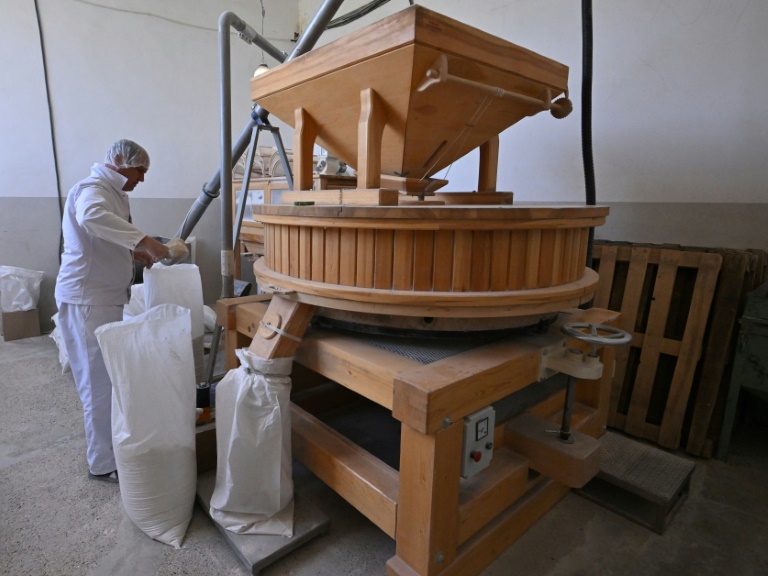
In a nearby building, Roman Tikhonov, 40, works on an Austrian-made wooden milling machine. 

The miller said that the farm is learning to operate without foreign-made spare parts.

“Recently, something broke, we found the material and fixed it,” he said. 

“Before the spare parts arrived from Austria, we waited a long time, now we make them ourselves, it’s faster.”

The Ukrainian-made milling machine next-door has been receiving its spare parts via Belarus since the outbreak of hostilities between Ukrainian forces and Moscow-backed separatists in 2014.

Shifanov nevertheless says he is relieved that his tractors were mainly made in Russia or Belarus.

– Trading at a discount –

The grain market is also adjusting to the new conditions. 

Before Russia’s military campaign, the price of wheat was already high at around $300 per tonne but now it is more than $400. 

Andrey Sizov, the head of Sovecon, a Russian agriculture consultancy, said that Russia is now selling its grain — just like its oil — at a discount.

“The war discount for Russian grain is $20 per tonne,” he told AFP. 

“Russian grain has become cheaper than, for example French grain, because you have to reflect and price in those additional costs like freight, insurance, problems with payments.”

Sizov also pointed out that not only do farmers face higher production costs due to inflation, authorities in 2021 introduced strict export taxes that take about “30 percent of farmers revenue”.

“The irony is current record high wheat prices were driven mainly by the Russian war but at the same time Russian farmers are not benefiting from them.”

Close Bitnami banner
Bitnami