World

Russian farmers seek to ride out Western sanctions

Yevgeny Shifanov, co-owner of an organic farm, says his business has felt the sting of Western sanctions and he is no longer able to sell his grain to Europe. 

But the 42-year-old puts on a brave face, saying he is pivoting to ex-Soviet countries such as Belarus as well as domestic clients.

“We are more interested in our internal market, our economy,” the co-owner of Chyorny Khleb (“Black Bread”) told AFP.

Shifanov’s business — located in the village of Khatmanovo, some 150 kilometres (90 miles) south of Moscow on the banks of the Oka River — is one of numerous small farms that have mushroomed in Russia over the past decade. 

Moscow’s military intervention in Ukraine has devastated crops and farming in the pro-Western nation and disrupted crucial deliveries from Ukraine fuelling concern about hunger and food prices worldwide.

The military campaign also put a major focus on Russia’s own agriculture sector.

The country is the largest wheat exporter in the world and has been accused by the West of using grain as a geopolitical tool. 

While Russia appears to be calling the shots in the current grain standoff with the West, experts say that its own agricultural sector is also bracing for tough times.

At Chyorny Khleb, which cultivates cereals on just over 1,000 hectares of land, green wheat stalks are knee-high. The farmers are enjoying a relative lull before harvesting starts in late July.

“In March or April, we begin to prepare the land, then we plant. Soon we will reap the results of our work,” said Alexei Yershov, a 28-year-old tractor driver before climbing into his red-and-black tractor and setting off into a buckwheat field.

– New reality –

The outlook for the season is good, with the agriculture ministry forecasting a harvest of 130 million tonnes including a record 87 million tonnes of wheat.

But the farmers admit they have struggled since the onset of unprecedented Western sanctions. 

“We have faced logistical problems,” said Shifanov, adding that he has partners in Europe and Israel but the trucks carrying his farm’s produce abroad were blocked at the border.

“We have buyers abroad, but we can’t do anything, we can’t deliver there, now we can only make do with our domestic market,” he said.

He added that he was also searching for partners in Belarus, Armenia and Kazakhstan.

The farm is gradually adjusting to the new reality.

Like many other Russian businesses, the farm went on a “panic buying” spree in the first few weeks of the crisis, purchasing a year’s worth of packaging supplies that are now gathering dust.

One of Shifanov’s partners is now running out of glue needed to make labels. 

“It was imported from Europe,” said Shifanov, standing in a shed between mounds of wheat.

“They are trying to solve the problem via China but the logistics remain complicated,” he added.

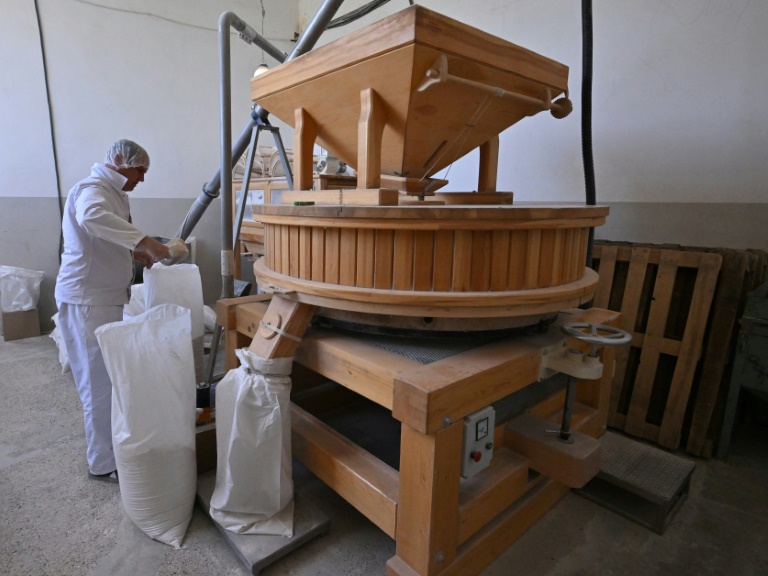
In a nearby building, Roman Tikhonov, 40, works on an Austrian-made wooden milling machine. 

The miller said that the farm is learning to operate without foreign-made spare parts.

“Recently, something broke, we found the material and fixed it,” he said. 

“Before the spare parts arrived from Austria, we waited a long time, now we make them ourselves, it’s faster.”

The Ukrainian-made milling machine next-door has been receiving its spare parts via Belarus since the outbreak of hostilities between Ukrainian forces and Moscow-backed separatists in 2014.

Shifanov nevertheless says he is relieved that his tractors were mainly made in Russia or Belarus.

– Trading at a discount –

The grain market is also adjusting to the new conditions. 

Before Russia’s military campaign, the price of wheat was already high at around $300 per tonne but now it is more than $400. 

Andrey Sizov, the head of Sovecon, a Russian agriculture consultancy, said that Russia is now selling its grain — just like its oil — at a discount.

“The war discount for Russian grain is $20 per tonne,” he told AFP. 

“Russian grain has become cheaper than, for example French grain, because you have to reflect and price in those additional costs like freight, insurance, problems with payments.”

Sizov also pointed out that not only do farmers face higher production costs due to inflation, authorities in 2021 introduced strict export taxes that take about “30 percent of farmers revenue”.

“The irony is current record high wheat prices were driven mainly by the Russian war but at the same time Russian farmers are not benefiting from them.”
China launches third aircraft carrier: state media

China on Friday launched its third aircraft carrier, the first designed and built entirely in the country, marking a major military advance for the Asian superpower.

The announcement comes as tensions between China and the United States have ramped up significantly in recent weeks over Beijing’s sabre-rattling towards self-ruled Taiwan, which it views as a breakaway province to be seized by force if necessary. 

Launched in a Shanghai shipyard to great fanfare, the Fujian is more technically advanced than the other Chinese carriers.

It is the “first catapult aircraft carrier wholly designed and built by China”, said state broadcaster CCTV.

The Fujian will take years before it reaches operational capacity, as the Ministry of Defence has not announced a date for entry into service.

“Sailing and mooring tests will be carried out as planned after the ship is launched,” CCTV reported.

China has two other aircraft carriers in service.

The Liaoning was commissioned in 2012, and the Shandong entering service in 2019.

Unlike the Fujian, they use a ski-jump style platform to launch aircraft and do not have a catapult launcher system.

The United States currently has by far the most aircraft carriers in service at 11 ships, followed by China and Britain at two each, according to defence magazine Janes.

Chinese warships have repeatedly sailed through the strait that separates the island from the mainland, and used fighter jets to repel freedom of navigation patrols from the United States and its allies.

Chinese defence minister Wei Fenghe last week warned his US counterpart that Beijing would “not hesitate to start a war, no matter the cost” if Taiwan declared independence. 

– Military modernisation –

Chinese President Xi Jinping has overseen a massive overhaul of the People’s Liberation Army (PLA) since coming to power in 2012, and has vowed to build a “fully modern” force rivalling the United States military by 2027.

The growth of China’s military comes at a time of ramped-up geopolitical tensions as Washington looks to shore up military alliances in the Asia-Pacific region.

Last year, the United States secured a historic deal with Britain to share nuclear submarine technology with Australia and has since made multiple arms sales to Taiwan, provoking angry responses from Beijing.

Meanwhile, China brokered an unprecedented security agreement with the Solomon Islands earlier this year which blindsided Washington and its allies, stoking fears of another Chinese military base in the Pacific.  

Bank of Japan keeps easing despite global rate hikes

The Bank of Japan on Friday stuck to its monetary easing policy even as other central banks raise interest rates to tame inflation, but said it would “pay due attention” to forex markets as the yen struggles at a 24-year low.

The decision to hold rates at minus 0.1 percent — part of a decade-old plan to boost the world’s third-largest economy — bucks a tightening trend by central banks globally aimed at battling sky-high fuel and food prices linked to the Ukraine war.

The hikes have been led by the US Federal Reserve, which this week announced its most aggressive increase in nearly 30 years and signalled more were in the pipeline.

The European Central Bank also plans to start a series of rate increases next month, the first in more than a decade, while the Bank of England announced a fifth straight increase on Thursday and Switzerland surprised markets with its own rate hike, the first since 2007.

The widening chasm between Japanese and US monetary policy this week pushed the yen to its lowest level against the dollar since 1998, a cause for increasing concern that even the central bank made reference to after its meeting Friday.

“It is necessary to pay due attention to developments in financial and foreign exchange markets and their impact on Japan’s economic activity and prices,” the BoJ said, in an unusual reference to forex movements.

After the announcement, one dollar bought 134.63 yen, up from 133.41 yen earlier in the day.

A weaker yen helps Japanese exporters as it inflates repatriated profits, noted Yoshikiyo Shimamine, executive chief economist of Dai-ichi Life Research Institute.

For the BoJ, it may be that “these benefits overwhelm the negative aspects of a cheaper yen — high prices for imported goods, which causes people to suffer without sufficient pay rises,” he told AFP.

The bank’s ultra-loose monetary policy aims to achieve two-percent inflation, a target that has been stubbornly out of reach during years of price stagnation.

In April, core consumer prices hit the target for the first time since 2015, but the BoJ has cautioned that it sees recent rising prices as a temporary and volatile trend.

Inflation has been rising for months in the United States and elsewhere as buoyant demand for homes, cars and other goods clashes with supply problems caused by Covid-19 lockdowns in China and other pandemic hold-ups.

The problem became dramatically worse after Russia invaded Ukraine in February and Western nations imposed steep sanctions on Moscow, sending food and fuel prices soaring, a particular problem in resource-poor Japan.

Stephen Innes at SPI Asset Management said the BoJ may have decided that a potential rout of Tokyo stocks caused by “a hawkish pivot… could see Japanese investors worse off than the current hit to purchasing power via a weaker currency.” 

The statement on forex is a nod to the government’s concerns over the yen’s weakness, but “does not, on its own, indicate an imminent change in policy”, he said.

Australia's new climate promise meets mining reality

Flood, fire and drought-battered Australia is trying to clean up its act on climate change, but dependence on fossil fuel riches could stymie the national makeover.

Centre-left Prime Minister Anthony Albanese swept to power in May promising weary Australians that he would tackle climate change.

He followed through on a key plank of that promise Thursday, nearly doubling the country’s 2030 emissions reduction target to 43 percent.

Albanese faces a thorny dilemma: Australians want real steps to slow global heating, but they live in a country that depends on exporting the fossil fuels that cause it.

Australia’s emissions — while high per person — account for just over one percent of global emissions.

Much more significant are the fossil fuels dug up in Australia and burned overseas.

Estimates differ, but these could account for anywhere between three and five percent of global emissions, making Australia one of the world’s largest carbon polluters. 

Another beneficiary of the May election wants to put an end to that. 

“You don’t end the climate wars by opening up new coal and gas mines,” said Australian Greens leader Adam Bandt, whose party now holds the balance of power in the Senate and wants radical energy reform in return for working with the government.

The sticking point for the Greens, Bandt told AFP, was that the government had pledged support for 114 new coal and gas projects already in Australia’s investment pipeline.

Modelling by the Greens found these projects would more than double Australia’s emissions.

“None of these new projects the government wants to open are factored into their climate modelling,” Bandt said.

– Wilder climate –

First discovered in 1791, Australia’s vast coal deposits make it the world’s second-largest exporter.

It is also one of the top exporters of gas — mostly natural gas and gas exploited from coal seams.

Fossil fuels account for about a quarter of Australian exports, with most destined for Japan, China and South Korea, according to Reserve Bank of Australia analysis.

Domestically, about 70 percent of electricity comes from coal and gas, according to official figures.

Given the economic sensitivities, the Albanese government has so far dodged calls to set a deadline for withdrawal from the sector, arguing international markets will decide when coal is no longer viable.

The approach may quell dissent from the coal and gas industry, used to getting its way after a decade of conservative governments.

But it could cause economic turmoil, with central bank analysts warning coal demand could fall by up to 80 percent by the middle of the century, leaving “stranded assets” that cannot be sold.

Already the strains are starting to show.

Mining giant BHP on Thursday announced it had been unable to sell its coal assets in the populous state of New South Wales.

The country’s largest energy producer and carbon emitter AGL is also facing an uncertain future.

When AGL tried to split off the most polluting parts of its business, green-minded tech billionaire Mike Cannon-Brookes sought to buy the company to stop the plan.

His bid was rejected, but Cannon-Brookes successfully lobbied fellow investors to block the demerger, arguing it would hurt shareholders and delay coal-fired power station closures.

Greenpeace Australia’s chief executive David Ritter said AGL’s experience was a lesson to listen to the call for climate action. 

“Every corporation that makes the same mistakes can expect to also run into real turbulence very, very quickly,” he told AFP.

This turbulence will come from activists, but also from the Australian public who have seen first-hand how a wilder climate can turn on them.

– After the ‘Black Summer’ –

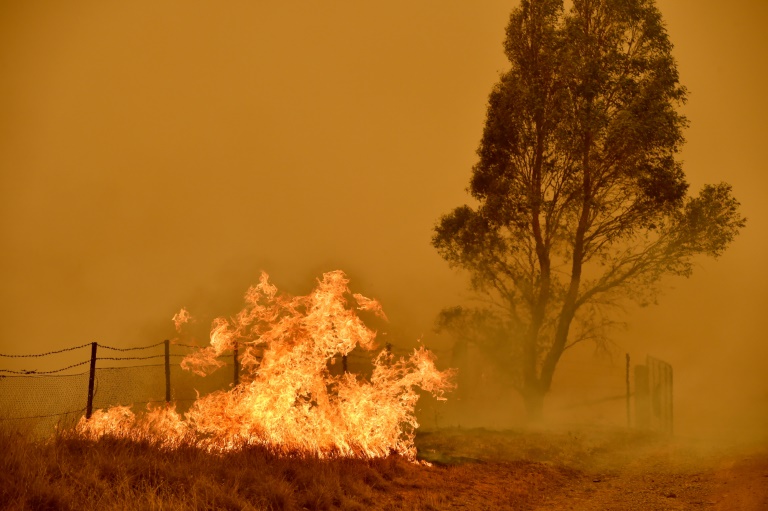
Australia’s 2019-20 “Black Summer” bushfires scorched 24 million hectares of land, cloaked cities in smoke, and killed more than 30 people along with an estimated tens of millions of wild animals.

In the two subsequent years, dramatic floods swamped Australia’s east coast, this year killing more than 20 people as waters reached rooftops and torrents swept cars off roads.

Before the bushfires, veteran firefighter Greg Mullins tried to warn the government it was not prepared for the infernos to come.

For 14 years, Mullins had led the fire service in Australia’s largest state, New South Wales, and he was joined by other retired emergency services leaders in sounding the alarm that climate change had dramatically escalated the fire threat.

“It was all political. Because we mentioned climate change, they just locked us out,” he told AFP.

He and fellow members of Emergency Leaders for Climate Action are calling for far more ambitious emissions cuts — 75 percent by 2030.

“We’ve lost the last decade of climate action, they’ve got to do a lot of catching up,” he said.

WTO strikes landmark deals package after tense talks

The World Trade Organization concluded hard-won deals Friday on fishing subsidies, food insecurity and Covid-19 vaccines in a landmark bundle of agreements secured through hectic round-the-clock talks.

WTO director-general Ngozi Okonjo-Iweala said the trade ministers’ conference had struck an “unprecedented package of deliverables” which would make a difference to people’s lives across the planet.

The talks at the global trade body’s Geneva headquarters began Sunday and were due to wrap up on Wednesday.

But instead the WTO’s 164 members went straight through on into Friday, finally concluding at around 5:00 am (0300 GMT).

The ministerial conference also agreed on deals on e-commerce, responding to pandemics and reforming the organisation itself.

“Not in a long while has the WTO seen such a significant number of multilateral outcomes,” Okonjo-Iweala said.

“The package of agreements you have reached will make a difference to the lives of people around the world. The outcomes demonstrate that the WTO is in fact capable of responding to the emergencies of our time.”

With ministers struggling to conclude agreements on each topic separately, countries began making trade-offs in a bid to get several measures through in a grand bargain.

– Big fish deal netted –

The fisheries deal was the last one to get over the line.

Delegations were frantically haggling in the early hours of Friday on the flagship issue being thrashed out at the WTO conference.

Negotiations towards banning subsidies that encourage overfishing and threaten the sustainability of the planet’s fish stocks have been going on at the WTO for more than 20 years.

Okonjo-Iweala, who took over in March 2021, hinged her leadership on breathing new life into the sclerotic organisation.

The former foreign and finance minister of Nigeria positioned herself as someone who can bang heads together and get business done.

The last ministerial conference in Buenos Aires in December 2017 was seen as a flop after failing to strike any heavyweight deals.

The new WTO chief wanted to prove that the organisation could still make itself relevant in tackling the big global challenges.

Some delegations accused India of being intransigent on every topic under discussion at the WTO — where decisions can only pass with the agreement of every member.

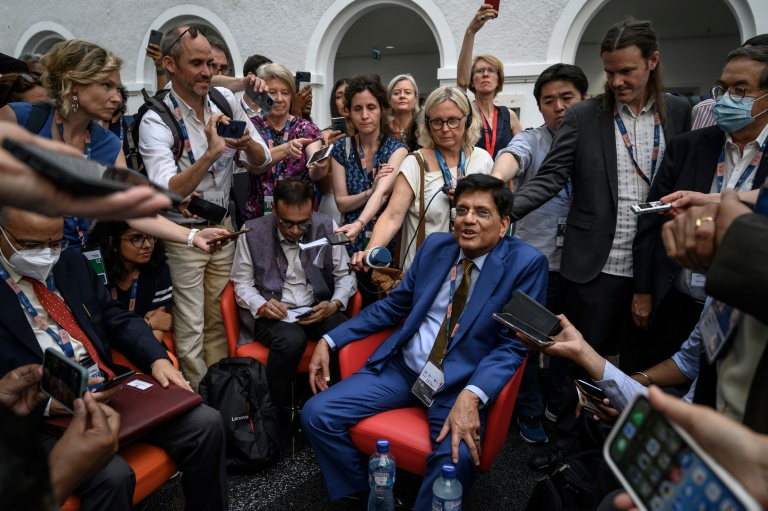
But Indian Commerce and Industry Minister Piyush Goyal insisted: “India is not a roadblock on anything… People are realising that we were the ones who actually helped create the sole consensus.”

The second major issue on the table was the plan for a Covid-19 vaccine patents waiver.

Some countries that host major pharmaceutical companies, like Britain and Switzerland, were finding some of the draft wording problematic, while big pharma feared a deal that would strangle innovation.

But Britain’s ambassador in Geneva, Simon Manley, told Okonjo-Iweala late Thursday that after clarification and improvements were achieved, London was “now ready to join the consensus”.

WTO strikes landmark deals package after tense talks

The World Trade Organization concluded hard-won deals Friday on fishing subsidies, food insecurity and Covid-19 vaccines in a landmark bundle of agreements secured through hectic round-the-clock talks.

WTO director-general Ngozi Okonjo-Iweala said the trade ministers’ conference had struck an “unprecedented package of deliverables” which would make a difference to people’s lives across the planet.

The talks at the global trade body’s Geneva headquarters began Sunday and were due to wrap up on Wednesday.

But instead the WTO’s 164 members went straight through on into Friday, finally concluding at around 5:00 am (0300 GMT).

The ministerial conference also agreed on deals on e-commerce, responding to pandemics and reforming the organisation itself.

“Not in a long while has the WTO seen such a significant number of multilateral outcomes,” Okonjo-Iweala said.

“The package of agreements you have reached will make a difference to the lives of people around the world. The outcomes demonstrate that the WTO is in fact capable of responding to the emergencies of our time.”

With ministers struggling to conclude agreements on each topic separately, countries began making trade-offs in a bid to get several measures through in a grand bargain.

– Big fish deal netted –

The fisheries deal was the last one to get over the line.

Delegations were frantically haggling in the early hours of Friday on the flagship issue being thrashed out at the WTO conference.

Negotiations towards banning subsidies that encourage overfishing and threaten the sustainability of the planet’s fish stocks have been going on at the WTO for more than 20 years.

Okonjo-Iweala, who took over in March 2021, hinged her leadership on breathing new life into the sclerotic organisation.

The former foreign and finance minister of Nigeria positioned herself as someone who can bang heads together and get business done.

The last ministerial conference in Buenos Aires in December 2017 was seen as a flop after failing to strike any heavyweight deals.

The new WTO chief wanted to prove that the organisation could still make itself relevant in tackling the big global challenges.

Some delegations accused India of being intransigent on every topic under discussion at the WTO — where decisions can only pass with the agreement of every member.

But Indian Commerce and Industry Minister Piyush Goyal insisted: “India is not a roadblock on anything… People are realising that we were the ones who actually helped create the sole consensus.”

The second major issue on the table was the plan for a Covid-19 vaccine patents waiver.

Some countries that host major pharmaceutical companies, like Britain and Switzerland, were finding some of the draft wording problematic, while big pharma feared a deal that would strangle innovation.

But Britain’s ambassador in Geneva, Simon Manley, told Okonjo-Iweala late Thursday that after clarification and improvements were achieved, London was “now ready to join the consensus”.

Control without invasion: Other actions China could take against Taiwan

As Xi Jinping’s China increasingly flexes its muscles on the global stage, concerns it may take military action against Taiwan have risen. 

Beijing claims all of the self-governed island as its own territory, and says it is determined to retake it by force if necessary.

But a full-scale invasion is by no means the only option China has to coerce Taiwan into submission. 

Here are some of the options Beijing could deploy: 

– Annexation of outlying islands –

China could choose to invade some, or all, of Taiwan’s outlying islands. 

Both the Kinmen and Matsu islands sit just 10 kilometres (6.2 miles) or so off the coast of the mainland, and were once frequently shelled by artillery in the decades after the end of the Chinese civil war. 

Beijing could also take aim at other Taiwanese interests in the South China Sea, such as the Pratas atoll, or even further away, Taiping island in the Spratly chain. 

A step further would be the seizure of the Penghu archipelago, which is much closer to Taiwan — about 50 kilometres from the main island.

“The strategic importance of Penghu is more than other island outposts,” retired admiral Lee Hsi-min, who was head of Taiwan’s armed forces until 2019, told AFP. 

“If the Peoples’ Liberation Army (PLA) were to occupy Penghu, it would serve as a foothold for short range assaults and obtaining air superiority.”

A US Naval War College report said that a “stepping-stone strategy” starting with the outlying islands offered Beijing “a number of important advantages”. 

But China could also choose to simply stop before attacking the main island, and use the annexations to put diplomatic and psychological pressure on Taipei. 

– Customs quarantine –

China could impose a “customs quarantine” — that is, effectively take control of Taiwan’s air and sea borders by screening incoming ships and aircraft, and allowing “innocent” traffic to pass while diverting “suspect” vessels to Chinese ports. 

“The Chinese government would allow the people of Taiwan to run their own affairs on the island, at least for some time, as China showed it controlled who came (and perhaps who went),” a Council on Foreign Relations report from 2021 said. 

In this scenario, food and energy imports would still be allowed through, as would passenger traffic like daily ferries. 

“The goal is to force Taiwan to accept a loss of control, cutting Taiwan off from, at least, transfers of military equipment and associated foreign experts,” the report said. 

– Blockade – 

Beijing could also choose to implement a full blockade of the Taiwan Strait, preventing anything from getting in and out. 

“At present, the PLA is capable of performing local joint blockade against our critical harbors, airports, and outbound flight routes, to cut off our air and sea lines of communication and impact the flow of our military supplies and logistic resources as well as our sustainability for operations,” the Taiwanese defence ministry wrote in a 2021 report. 

Lonnie Henley, a retired US intelligence officer, told the US-China Economic and Security Review Commission in February last year that China would be able to continue a blockade “indefinitely”, even with a severely diminished force.

– Bombing campaign –

The PLA could stop short of a full ground invasion, but use air and missile strikes to take out key military and civilian infrastructure, crippling Taiwan’s defences. 

It could also use cyber warfare to achieve the same aim. 

“If the PLA acts according to its doctrine, we would likely see a massive cyberattack supported by large-scale jamming and other forms of electronic warfare on the island to disable its critical infrastructure and military command links,” Andrew Krepinevich, an American defence policy analyst and former Pentagon official, told the Telegraph newspaper. 

China could also choose to bomb Taiwan’s population into submission, using their strength in numbers in the air to terrorise the island. 

But James Char, an associate research fellow at Singapore’s S. Rajaratnam School of International Studies, thinks the optics of raining down “bloodshed, destruction, on your own so-called fellow Chinese people” would prevent this course of action being taken.

'Life goes on' for unfazed Taiwanese on frontline islands

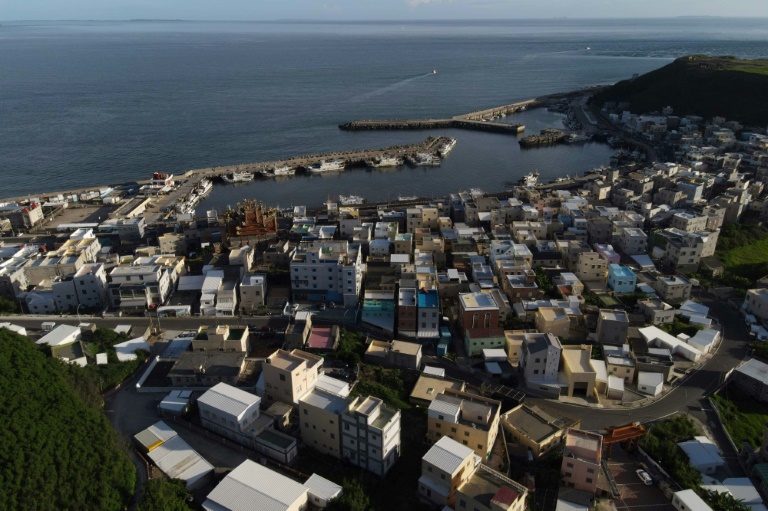
Since moving from Taiwan’s capital to the outlying Penghu islands for the peace and the fishing 11 years ago, Lin Chih-cheng has grown accustomed to the roar of Chinese fighter jets puncturing the lull of the surf.

“If there’s a day where they don’t take off, it feels weird,” laughed Lin, an affable 61-year-old who runs a juice stall with his wife on the western Xiyu Islet.

The archipelago’s location about 50 kilometres (30 miles) out in the Taiwan Strait means it is likely to be on the front line of any potential invasion by China — a perennial possibility that has loomed ever larger in the last few years.

Beijing claims all of Taiwan as its territory, and its pledge to take it by force if necessary has begun to seem less farfetched as China projects an increasingly aggressive stance on the world stage. 

But in the sleepy fishing towns on the islands, many locals are sanguine despite the frequent — and noisy — reminders of the military threat.

“Everyone says tension between both sides is high now, but I am not worried,” said Lin. “I have confidence that our government is not beating the war drum.”

Xiyu’s azure waters and twisting, heart-shaped stone weirs have made it an Instagrammer’s paradise. 

Business is good at the juice stall, where Lin and his wife blend cactus fruit and ice flower into sweet, cold drinks for a stream of thirsty tourists. 

Just down the road are a very different set of customers — the soldiers at a Sky Bow base, home to Taiwan’s surface-to-air anti-ballistic missile and anti-aircraft defence systems.

“I actually do a lot of deliveries to the base,” Lin said. “I have been inside. It feels quite normal to me.”

The presence of troops has been a fact of life for decades on the island, where they are seen more as a source of income than one of dread. 

“People from both sides (of the strait), we actually share the same language and culture,” Lin said. 

“Who wants war? We actually get along with each other. The affairs of those in power are none of our business.”

– ‘Nothing we can do’ –

But Penghu has found itself at the mercy of geopolitical forces many times throughout its history. 

“Penghu is a hard-to-defend place,” Chen Ing-jin, a 67-year-old local historian and architect, told AFP. “It’s flat and has many coastal areas, which makes it very hard to prevent possible landings.”

The Dutch, French and Japanese all invaded with little trouble, and signs of war — past and present — are everywhere. 

The historic forts, now there for tourists rather than defence, have been replaced by serious modern firepower.

In addition to Sky Bow, the islands also harbour Hsiung Feng II anti-ship cruise missile bases — Chen helped build one of them during his military service. 

Xiyu also hosts a radar station that would give vital early warning of any planned attack.

Those are all reasons Beijing might choose to take the islands before any attempt on Taiwan’s main island in a bid to disable the military instalments and gain a resupply base. 

Few locals think they would stand much chance against China’s People’s Liberation Army.  

“Their ships will surround the islands and that will be it. There’s nothing we can do about it but accept,” said Chen’s friend, Wang Hsu-sheng. 

– ‘Very uncomfortable’ –

Like many, Wang’s family history tracks the islands’ tumultuous changing of hands.

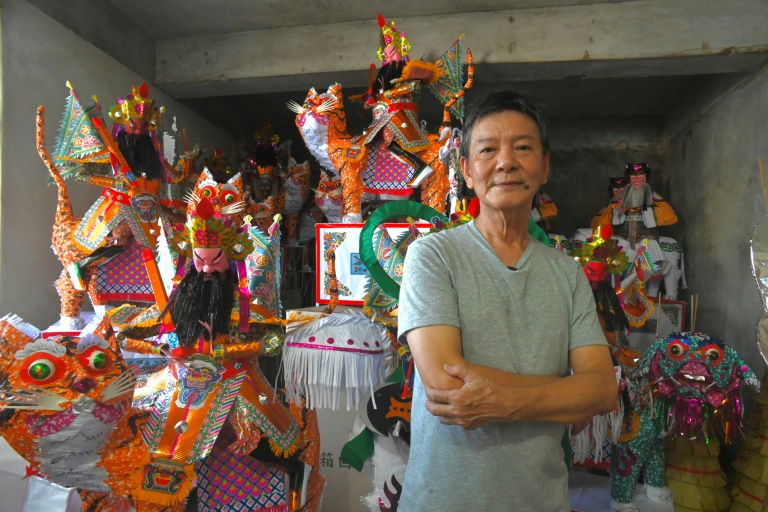
His father was put to work in naval yards under the Japanese occupation, and only returned to the family business — creating painstakingly detailed miniature paper deities for temples — after their withdrawal at the end of World War II. 

Wang, now 70, learned the craft from his dad, but calls it a “dying art” in this day and age. 

He said China’s actions over the last few years have made him “very uncomfortable”.

“The Chinese are like the Russians. What’s yours is mine. What’s mine is still mine,” he said, referencing the recent invasion of Ukraine.  

Andy Huang, who runs an ice cream shop in the main town of Magong, has more experience than most in facing Beijing’s belligerence. 

A former coastguard, the 29-year-old was based in the South China Sea’s contested Spratly Islands when a “3000-tonne Chinese coastguard ship was circling our island with their big guns pointing at us”. 

He and his colleagues were ordered into their far smaller boats to drive it away, though a confrontation never materialised. 

“I was really scared, scared of dying in a gunfight,” he said. 

That brush with war seems far away today as he hands out icy treats to sunburnt visitors. 

But Huang was clear he would fight to defend his home if need be. 

“I would be one of the first to be called up to serve if war breaks out,” he said stoically. 

“But until that happens, life goes on.” 

A Chinese invasion of Taiwan: Too costly to countenance?

On Taiwan’s tiny Penghu islands, the missile bases that sit next to white-sand beaches and bustling fish markets are a visceral reminder of the constant threat of attack from China.

Despite the huge military discrepancy between the two sides, many analysts believe Taiwan’s location, inhospitable terrain and US support mean China would find a full-scale invasion extremely hard — and possibly too costly to countenance. 

Communist China and Taiwan split at the end of a civil war in 1949 with the losing Kuomintang forces retreating to the island. But Beijing insists now-democratically run Taiwan is part of its territory, and that it will one day re-take it, by force if necessary. 

Recent record Chinese fighter jet incursions into Taiwan’s air defence identification zone and increasingly aggressive rhetoric under President Xi Jinping have raised fears China might contemplate acting on that pledge sooner rather than later. 

The Chinese defence ministry last week said it would “not hesitate to start a war” to stop Taiwan becoming independent.

One US admiral has said an attack could come by 2027, the centenary of China’s People’s Liberation Army (PLA).

“If we were to go head to head militarily, we don’t stand a single chance,” retired admiral Lee Hsi-min, who was head of Taiwan’s armed forces until 2019, told AFP bluntly.

But Russia’s failure to quickly overrun Ukraine stands as a cautionary tale to Beijing, while simultaneously providing Taipei with both tactical blueprints and inspiration on how to hold off a much larger enemy.

“Our soldiers here are all Taiwanese and will be fighting to defend their homeland,” said Chen Ing-jin, a Penghu historian and architect. “That makes a difference. Just look at Ukraine.”

– ‘A defender’s dream’ – 

Taiwan’s biggest advantage is its geography.

Amphibious assaults are exceedingly difficult and if China was to invade Taiwan — and crucially hold it — Beijing would need to move hundreds of thousands of troops as well as equipment across the Taiwan Strait.

Even at its narrowest point the strait is 130 kilometres (80 miles) and weather conditions are notoriously unforgiving with two monsoon seasons. 

That leaves just two brief “windows of attack” — May to July and October — for such a large-scale operation, according to a US Naval War College report.

In addition, studded into the waters are outlying islands like the Penghu chain — bristling with radar and missiles pointing straight out into the strait.  

With the likely early warning, and the weaponry Taipei has at its disposal, the PLA would probably incur high losses even in that first stage of transit, said James Char, an Associate Research Fellow at Singapore’s S. Rajaratnam School of International Studies.

And while the small, flat outlying islands might in the end prove easy for Beijing to subdue, on Taiwan’s main island, the opposite applies.

The coastal terrain there “is a defender’s dream come true”, according to Ian Easton, author of “The Chinese Invasion Threat”.

He and his colleagues estimate that Taiwan only has 14 small beaches suitable for landing, and even they are bordered by mountains, cliffs or dense urban infrastructure. 

“Landing on Taiwan is only part of the problem,” Bonny Lin, director of the China Power Project at the Center for Strategic and International Studies (CSIS), told AFP. 

Progress through Taiwan’s wetlands, mountains and densely populated urban areas will require a huge range of different combat skills and weapons.

“How is it going to sustain those forces once they’re in position and advancing — how is it going to do the logistics?” Lin asked.

– Weapons –

China has spent hundreds of billions of dollars upgrading its military capabilities over the past decade, and its statistical dominance over Taiwan is enormous. 

The PLA has over one million ground force personnel to Taiwan’s 88,000, 6,300 tanks compared with 800, and 1,600 fighter jets to 400, according to the US Department of Defence.  

Washington also estimates Beijing has the world’s largest Navy by ship number. A recent US Naval War College paper described those ships as “increasingly sophisticated, capable vessels”.

But many experts, including both Char and Lin, question whether they are yet capable enough.

Atlantic Council senior advisor Harlan Ullman put it more forcefully in a February paper: “China simply lacks the military capability and capacity to launch a full-scale amphibious invasion of Taiwan for the foreseeable future”.  

In the meantime, Taiwan has plans to counter China’s might in numbers, with retired admiral Lee highlighting asymmetric warfare — an emphasis on mobility and precision attacks — an approach US officials are reportedly encouraging. 

Lee pointed to the success of the Ukrainian mobile missile launcher that sank Russia’s Black Sea flagship, the Moskva.

Taiwan has built up stockpiles of mobile missile batteries and shoulder-launched weapons but he said they needed lots more. 

– US support –

The factor that preoccupies Beijing most is who else might get involved in the conflict, Chinese military expert Song Zhongping told AFP. 

“The difficulty of liberating Taiwan lies in the potential intervention of the United States. It’s the biggest obstacle for the PLA to clear,” he said. 

The United States officially maintains a “strategic ambiguity” on whether it would intervene militarily in the event of an invasion. But it supplies Taiwan with military hardware and President Joe Biden has said multiple times that Washington would intervene. 

The “extent, depth and breadth” of US and other allies’ involvement would greatly determine how any conflict would play out, said Song. 

Some wargame scenarios see the PLA taking out US bases in the Pacific to kneecap its ability to respond. Washington would be heavily reliant on aircraft carriers operating far from home. 

To counter that threat China has prioritised the development of hypersonic “carrier killer” missiles and militarised multiple atolls in the disputed South China Sea.

But an attack on US forces could provoke a more determined backlash and draw American allies into a global conflict.

Even without a military intervention, Char said the threat of economic sanctions like those placed on Russia would give the Chinese leadership pause for thought.

– Political willpower –

The question of whether China would be prepared to cause mass casualties with an invasion, while risking its domestic and international image, is a fundamental one.

“You need to let China know that it will suffer tremendous losses, and even then it may still not be able to occupy Taiwan,” said Lee. 

“So that China will think that the best way to resolve the Taiwan problem is by peaceful means.”

There are a range of other options short of all-out invasion Beijing could use to bring Taipei to its knees — including a Taiwan Strait blockade, annexation of the outlying islands, or incapacitation of military and cyber systems.

“China might come up with other formulations or creative diplomatic strategic solutions to declare unification with Taiwan without actually having achieved that,” CSIS’ Lin said.  

Chinese analyst Song said Beijing has made its invasion trigger clear. 

“The timing depends on the behaviour of the Taiwanese separatists and if they insist on advocating for Taiwan’s independence,” he said.

The island’s 23 million people have increasingly embraced a distinct Taiwanese identity and President Tsai Ing-wen, who views the island as a sovereign state, has won two elections. 

The next presidential elections are next due in 2024 and Ukraine’s fate has only further hardened attitudes towards China.

In a survey conducted in May, 61.4 percent of respondents said they were willing to take up arms in the event of an invasion. 

The decision ultimately rests with Xi Jinping, the most authoritarian Chinese leader since Mao Zedong, who has been central to the rising fears that China will invade Taiwan.

Xi is on the cusp of securing an unprecedented third term this year. And since he came to power, Char said, “there’s been a total shift from the previous mantra of peace and development” towards Taiwan.

Instead, he added, Xi has pushed the mantra “accomplish something magnificent and great”.

In a landmark 2019 speech on Taiwan, Xi said unification was “an inevitable requirement for the great rejuvenation of the Chinese people”.

RIP Internet Explorer: South Korean engineer's browser 'grave' goes viral

A South Korean engineer who built a grave for Internet Explorer — photos of which quickly went viral — told AFP Friday that the now-defunct web browser had made his life a misery.

South Korea, which has some of the world’s fastest average internet speeds, remained bizarrely wedded to Microsoft’s Internet Explorer, which was retired by the company earlier this week after 27 years.

In honour of the browser’s “death”, a gravestone marked with its signature “e” logo was set up on the rooftop of a cafe in South Korea’s southern city of Gyeongju by engineer Kiyoung Jung, 38.

“He was a good tool to use to download other browsers,” the gravestone’s inscription reads. 

Images of Jung’s joke tombstone quickly spread online, with users of social media site Reddit upvoting it tens of thousands of times.

Once dominant globally, Internet Explorer was widely reviled in recent years due to its slowness and glitches.

But in South Korea, it was mandatory for online banking and shopping until about 2014, as all such online activities required sites to use ActiveX — a plugin created by Microsoft. 

It remained the default browser for many Seoul government sites until very recently, local reports said.

The websites of the Korea Water Resources Corporation and the Korea Expressway Corporation only functioned properly in IE until at least June 10, according to a report by the Maeil Economic Daily.

– ‘Suffering’ for IE –

As a software engineer and web developer, Jung told AFP he constantly “suffered” at work because of compatibility issues involving the now-defunct browser. 

“In South Korea, when you are doing web development work, the expectation was always that it should look good in Internet Explorer, rather than Chrome,” he said.

Websites that look good in other browsers, such as Safari or Chrome, can look very wrong in IE, which often forced him to spend many extra hours working to ensure compatibility.

Jung said that he was “overjoyed” by IE’s retirement.

But he also said he felt genuinely nostalgic and emotional about the browser’s demise, as he remembers its heyday — one of the reasons he was inspired to erect the grave stone.

He quoted Japanese animator Hayao Miyazaki: “People are often relieved that machines don’t have souls, but we as human beings actually give our hearts to them,” Jung told AFP, explaining his feelings for IE.

He said he was pleased by the response to his joke grave and that he and his brother — who owns the cafe — plan to leave the monument on the rooftop in Gyeongju indefinitely.

“It’s been very exciting to make others laugh,” he said.

Close Bitnami banner
Bitnami