World

Problems soar for airlines despite pandemic recovery

Desperate to put the coronavirus pandemic behind them, airlines will hold talks on Sunday ahead of a potential summer of chaos with shortages and strikes that could threaten their recovery.

While trade is roaring back to life, representatives from the aviation sector meeting for three days in Qatar have a packed agenda with multiple geopolitical crises including the war in Ukraine and the environment.

Cracks are already showing in the sector’s recovery, though industry figures are optimistic about the future despite the issues.

In the past few weeks, delays and cancellations caused by a lack of staff at airports and strikes for better pay have wreaked havoc upon travellers.

The problems originate with the pandemic when airlines and airports laid off thousands of workers during its worst-ever crisis.

Now, they are scrambling for workers.

Passenger numbers dropped by 60 percent in 2020, and in 2021 it was still down 50 percent. Airlines lost nearly $200 billion over two years.

While some firms in the sector went bankrupt, others — backed often by states — have emerged from the pandemic with profits intact.

European airlines are excited about the prospect for a “beautiful summer”, with some data showing booking rates higher than in 2019. In the United States, the domestic market has almost returned to pre-pandemic levels.

“Airlines are generating cash again, which is a real positive,” said Willie Walsh, head of the International Air Transport Association, during a visit to Paris earlier this month.

The sector’s morale was buoyant after “a very long and barren two years”, he told reporters.

– ‘Not up to speed’ –

The International Air Transport Association (IATA), which represents 290 airlines accounting for 83 percent of global air traffic, will host its annual general meeting in Doha instead of Shanghai after record-high Covid case counts forced it to relocate the forum.

There will be cause for celebration during the event.

In terms of Revenue Passenger Kilometres (RPKs), a measure of total distance flown by paying passengers, activity in April reached 62.8 percent compared with the same month in 2019.

That was the best figure since March 2020. 

Domestic routes, meanwhile, hit 74.2 percent in April, better than international markets which reached 56.6 percent compared with the same period in 2019.

After the Easter holidays fiasco at European airports, Walsh admitted “the system is not up to speed”, but vowed the issues would be addressed.

He was hopeful despite the war in Ukraine and its wider impacts, surging inflation and record prices for jet fuel.

Fuel makes up 25 to 30 percent of companies’ spending, and given the still-fragile state of airlines’ balance sheets, higher costs will be passed on to customers to preserve their profits.

But the effects of Russia’s war in Ukraine are already being felt.

European flights to Asia are constrained by long diverted routes to avoid Russian airspace after having slapped heavy sanctions on Moscow.

– Costly decarbonisation –

With inflation eroding people’s purchasing power, higher costs could weaken demand at a time when companies need to make serious investments to cut their carbon dioxide emissions.

The IATA pledged last October to achieve net-zero carbon emissions by 2050.

The issue will be raised at a general assembly meeting of the International Civil Aviation Organization in the autumn, but a deal between countries is far from certain.

The IATA, which expects 10 billion air passengers annually by the middle of the century compared with 4.5 billion in 2019, refuses to consider any restrictions on growth in order to contain the effects of climate change.

Commercial air travel, often the target of environmental activists, is responsible for between 2.5 and 3 percent of global emissions.

Between “cleaner” planes and sustainable fuel, investment worth $1.5 trillion over 30 years is needed to improve the sector’s environmental impact. The costs will be most likely handed down to the customer, again.
EU to give fast-tracked opinion on Ukraine membership bid

The European Commission will meet Friday to give its fast-tracked opinion on Ukraine’s bid for EU candidacy, a step closer to membership for the country a day after the bloc’s most powerful leaders visited Kyiv as it battles Russia’s invasion.

Never before has an opinion been given so quickly on EU candidacy, which must be approved by all 27 member states.

The opinion will serve as a basis for discussion at next week’s EU summit, where leaders are expected to approve Ukraine’s candidate status, but with stern conditions attached, and membership may take years or even decades.

France, Germany, Italy and Romania are all in favour of Ukraine receiving “immediate” candidate status, French President Emmanuel Macron said in Kyiv Thursday. 

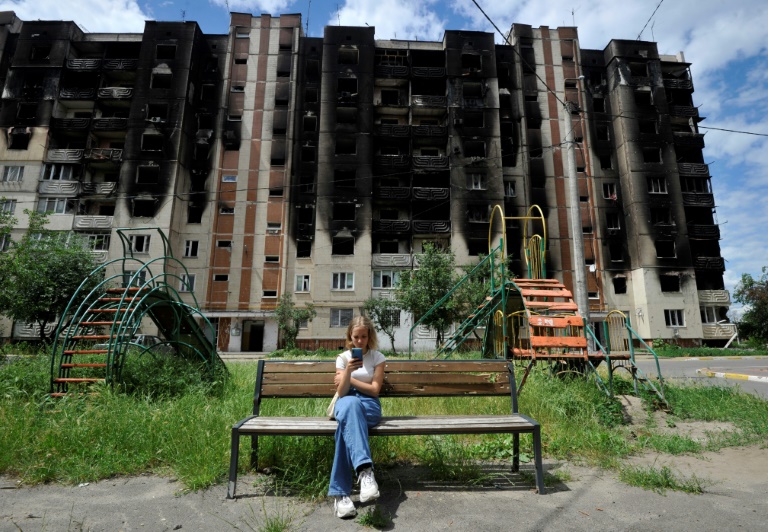
Macron, German Chancellor Olaf Scholz and Italian premier Mario Draghi arrived in Ukraine by train and headed to the Kyiv suburb of Irpin, scene of fierce battles early in the brutal war.

Later joined by Romania’s President Klaus Iohannis, they met Ukrainian leader Volodymyr Zelensky, who has been lobbying allies for more and faster weapons deliveries and the promise of a European future.

“The most important message of our visit is that Italy wants Ukraine in the EU,” Draghi said at a joint press conference.

Scholz said Ukraine “belongs in the European family” and that Berlin would continue to send Kyiv weapons “for as long as it is needed.” 

After meeting the visiting leaders, Zelensky said he explained to “our essential needs in the field of defence”.

“We are expecting new deliveries, above all heavy weapons, modern artillery, anti-aircraft defence systems,” he said, even as Macron said France would send six Caesar self-propelled howitzers to add to the 12 already deployed on Ukraine’s eastern front.

Zelensky promised Ukraine was ready to put in the work to become an EU member.

“Ukraine has gotten the closest to EU it has ever been in the history of its independence,” he said in his nightly address.

– ‘Dreadful mistake’ –

The Jacques Delors Institute think tank director said he expects a positive opinion on Ukraine’s EU status, but with conditions and a deadline.

“This is a very delicate exercise for the Commission because it cannot be less demanding for Ukraine than for other countries for which it has given a favorable opinion in the past. Its credibility requires the maintenance of high standards,” Sebastien Maillard said.

Russia has already “strategically lost” its war with Ukraine, suffering heavy losses and strengthening NATO, the UK’s chief of defence staff said in an interview published Friday.

“This is a dreadful mistake by Russia. Russia will never take control of Ukraine,” said Tony Radakin, the country’s highest-ranking military officer, adding it would emerge a “more diminished power”.

The admiral said Russian President Vladimir Putin may achieve “tactical successes” in the weeks to come, but had sacrificed a quarter of his country’s army power for “tiny” gains and was running out of troops and high-tech missiles.

“Russia is failing.”

– Fuel and food prices –

Moscow is stepping up energy pressure on Europe, with Russian gas giant Gazprom on Thursday defending cuts while prices soared. 

EU countries are rushing to reduce dependency on Russian energy but are divided about imposing a natural gas embargo as several member states are heavily reliant on Moscow.

Gazprom CEO Alexei Miller said that the state-run company will play by its own rules after cutting daily gas supplies to Germany and Italy.

Draghi and Zelensky both accused Russia of intentionally limiting supply, with the Italian leader accusing Gazprom of “lies” and of using its energy dominace for “political” ends. 

“We are seeing a political use of gas, just as we have seen a political use of wheat,” he said in reference to the millions of tons of wheat currently stuck in Ukrainian ports.

He spoke as the United States also called on Moscow to open the ports and allow the grain to be exported. 

“We shouldn’t be using food as a weapon,” US Agriculture Secretary Tom Vilsack told reporters at the United Nations.

With global grain prices soaring and importers in the Middle East and Africa facing supply shortfalls, Moscow has demanded that economic sanctions on it be lifted in exchange for allowing the exports.

Fighting in eastern Ukraine remained focused on the industrial city of Severodonetsk, where Russian forces edge closer to control after weeks of battle.

Regional governor Sergiy Gaiday said Thursday around 10,000 civilians remain trapped there, out of a pre-war population of some 100,000. 

Also on Thursday, Washington urged Russia to treat any American volunteers captured while fighting alongside Ukrainian troops as prisoners of war guaranteed humane treatment.

The State Department also said a third American was believed to be missing, in addition to two military veterans who were reportedly seized by Russian forces last week.

Also on Thursday, the European Court of Human Rights (ECHR) told Russia to prevent the execution of a Moroccan man sentenced to death along with two British men for fighting on behalf of Ukrainian forces.

burs-st/dva/jta

Asian markets hit by recession fears, yen drops after BoJ decision

Asian markets mostly fell Friday after another hefty drop in New York as central bank interest rate hikes fan fears of a recession, while the yen sank after the Bank of Japan said it would not yet follow its global peers in tightening policy.

Gone is the optimism that flowed through trading floors immediately after the Federal Reserve on Wednesday announced its biggest rate increase for 28 years as global finance chiefs followed suit, putting a squeeze on dealers’ ability to borrow.

Markets have been tumbling for months as traders contemplate the end of the era of cheap cash that sent valuations to record or multi-year highs, with inflation at levels not seen in decades owing to a surge in energy and food prices.

The Bank of England on Thursday lifted rates for a fifth straight time to their highest since 2009 during the financial crisis, just as the Swiss central bank shocked markets by unveiling its own half-point increase — its first rise in 15 years. 

The European Central Bank has also signalled it will announce a hike soon.

Equities plunged as expectations for recession continue to rise. The Dow ended below 30,000 for the first time in more than a year and the S&P 500 is now at its lowest since December 2020.

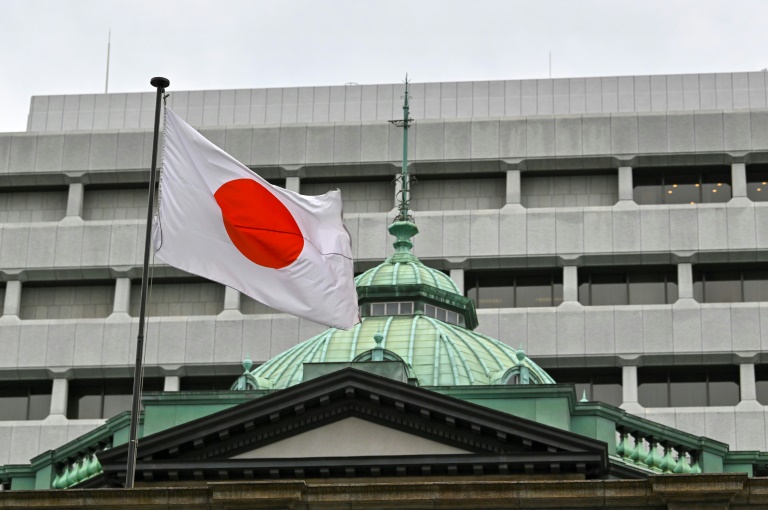
But with rates rising everywhere else, the Bank of Japan on Friday refused to move away from its ultra-loose monetary policy, despite inflation spiking and the yen sitting around a 24-year low.

Officials in Tokyo insist that low rates are still needed to nurture a struggling economy, though in a move away from its regular remarks in the post-meeting statement, the bank did say it “was necessary to pay due attention to developments in financial and foreign exchange markets”.

The yen tumbled to 134.63 against the dollar, from 133.37 before the decision, though it recouped some of those losses after the statement. Still, it is wallowing around a 24-year low and has lost around 13 percent this year.

But Stephen Innes at SPI Asset Management said: “No central bankers worth their weight would put inflation-fighting credentials on the line and import higher energy inflation via a weaker currency.”

He added that “in what is a highly ominous signal for stock market investors, given the broader index’s sensitivity to rising bond yields… the global race to hike rates is nowhere near the finishing line”. 

On equity markets, Tokyo, Shanghai, Sydney, Seoul, Singapore, Wellington, Taipei, Bangkok, Manila and Jakarta were all in the red, though Hong Kong was slightly higher after steep losses on Thursday.

– Key figures at around 0310 GMT –

Tokyo – Nikkei 225: DOWN 2.2 percent at 25,858.50 (break)

Hong Kong – Hang Seng Index: UP 0.5 percent at 20,958.37

Shanghai – Composite: DOWN 0.3 percent at 3,274.38

Dollar/yen: UP at 134.30 yen from 132.14 yen late Thursday

Euro/dollar: DOWN at $1.0527 from $1.0550

Pound/dollar: DOWN at $1.2307 from $1.2350

Euro/pound: UP at 85.54 pence from 85.40 pence

West Texas Intermediate: DOWN 0.5 percent at $117.00

Brent North Sea crude: DOWN 0.4 percent at $119.32 per barrel

New York – Dow: DOWN 2.4 percent at 29,927.07 (close)

London – FTSE 100: DOWN 3.1 percent at 7,044.98 (close)

— Bloomberg News contributed to this story —

Top Australian diplomat visits Solomons to address security concerns

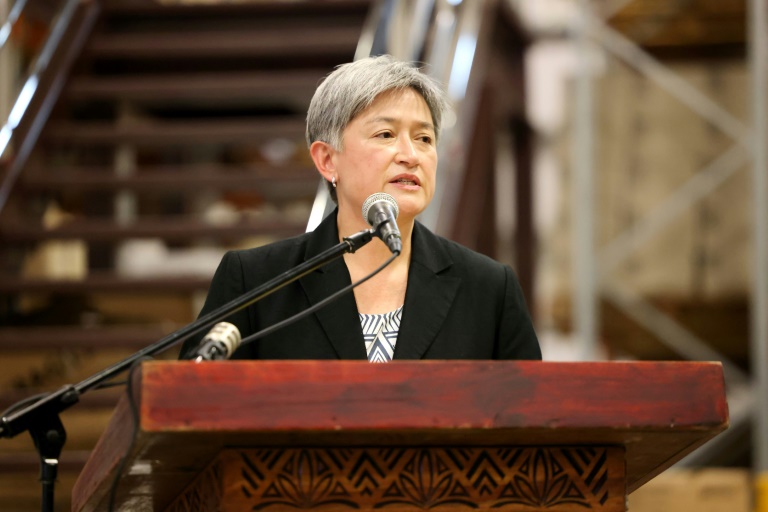
Australia’s foreign minister landed Friday in Solomon Islands to address relations frayed by the Pacific nation’s cosy ties and recent security pact with China.

It is the latest stop in a South Pacific travel blitz by Foreign Minister Penny Wong, who is seeking to shore up regional ties against China’s growing sway.

It marks the first visit to the Solomons by an Australian foreign minister since the island nation sealed a security pact in April with China, sparking alarm in the United States, Australia, New Zealand and Japan.

The agreement has not been made public, but a leaked draft showed it would allow Chinese naval deployments to the island, which lies less than 2,000 kilometres (1,200 miles) from Australia.

China and Solomon Islands have each dismissed fears among the United States and its allies that it could lead to the construction of a Chinese military base.

Ahead of her one-day visit to the Solomons’ capital Honiara, Wong said she looked forward to “addressing our shared security concerns”.

She also flagged better cooperation in areas such as climate change after her government nearly doubled Australia’s 2030 carbon-cutting targets.

Since the centre-left Labor government’s May 21 election victory in Australia, Wong has flown to Japan, Fiji, Tonga, Samoa and New Zealand to parry China’s growing military and diplomatic influence.

Wong is to meet with her Solomons’ counterpart and pay a visit to Prime Minister Manasseh Sogavare, who has fumed over foreign criticism of the China deal.

“We are being treated as kindergarten students walking around with Colt 45s in our hands, and therefore we need to be supervised,” he told parliament in early May of the foreign pressure, including from Australia’s former conservative government.

“We are insulted.”

China’s South Pacific ambitions suffered a setback in late May when 10 Pacific island nations rebuffed its push for a wide-ranging regional security pact.

Behind the scenes, Pacific leaders expressed misgivings about being pulled into Beijing’s orbit.

But China has secured strong relations with the Solomons, where Beijing has an embassy and is financing a national stadium complex reportedly worth $53 million to host the 2023 South Pacific Games.

The Solomon Islands government severed ties with Taiwan in September 2019 in favour of diplomatic relations with China, a switch that unlocked investment but stoked inter-island rivalries.

Last November, protests against Sogavare’s rule flared in Honiara, during which much of the city’s Chinatown was torched. Australia led an international peacekeeping mission to help restore calm.

When I get older: Paul McCartney going strong at 80

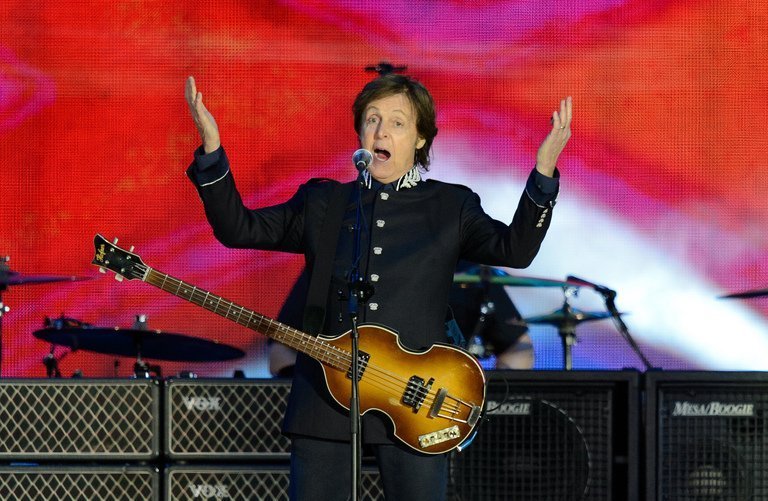
Paul McCartney turns 80 on Saturday and a week later becomes the oldest headliner to play at the Glastonbury Festival. There’s even been talk of the ex-Beatle being made a lord before the year is out.

Not bad for a kid from a working-class family in Liverpool after almost 60 years topping the charts.

Between his years with the Fab Four, his work with Wings and his solo career, McCartney has written or co-written more than 50 top 10 singles.

During lockdown in 2020, “Macca”, as he is affectionately known, recorded “McCartney III” on his own and it became his first UK solo number one album since 1989. 

McCartney and The Beatles returned to the spotlight last year thanks to director Peter Jackson’s eight-hour documentary “Get Back” about the making of their 1970 album “Let It Be”.

With a string of 80th birthday events planned in Liverpool, British media have reported that McCartney could be made a peer of the realm — 25 years after he was first knighted.

– ‘Grandude’ –

His knighthood from Queen Elizabeth II was upgraded five years ago to admit Sir Paul to the even rarer Order of the Companions of Honour, which recognises outstanding achievement throughout the Commonwealth.

A source told The Sun newspaper in March that “the idea of offering him the chance to sit as a cross-bencher in the House of Lords has been mooted.

“He has given incredible service to British culture, so it could be a very fitting tribute and mark of all that he has done for his country.”

McCartney married his third wife, US heiress Nancy Shevell, 62, in 2011, and has eight grandchildren, who he says call him “Grandude”. 

The Sunday Times Rich List estimates that the couple are together worth £861 million ($1.03 billion, 992 million euros).

That marriage came after his bitter divorce from model-turned-campaigner Heather Mills in 2008, who walked away from six years of wedlock with a settlement worth £24.3 million.

Born in the port city of Liverpool in northwest England, McCartney met John Lennon at the age of 15 and the pair formed the Quarrymen, the skiffle band that eventually metamorphosed into the Beatles.

McCartney, Lennon, George Harrison and Ringo Starr would become synonymous with mobs of screaming fans, mop-top haircuts, and an image of four men strolling over London’s Abbey Road at a zebra crossing.

Simply put, they were one of the most powerful cultural influences of their era. 

They are also the best-selling band in history, with their record label EMI estimating all-time sales of more than a billion discs and tapes.

Relentlessly imaginative, the band would develop the catchy tunes that sparked “Beatlemania” in 1964 into an evolving sound incorporating every influence from psychedelia to country and western.

– ‘Total heartbreak’ –

Lennon and McCartney formed one of the most celebrated songwriting partnerships of the 20th century, but their creative differences ultimately helped bring about the Beatles’ break-up in 1970.

McCartney formed Wings with his first wife Linda in 1971, and used his ingenious ear for melody — which had earlier given life to classics such as “Hey Jude” and “Blackbird” — to rack up a decade of hits with the new group.

Linda, a renowned photographer and animal rights activist, died of breast cancer in 1998. After 29 years of marriage, McCartney described the loss as “total heartbreak”.

But he was back late the next year with a new album, of mainly cover versions, and has continued the Beatles’ experimental tradition — a techno record and two classical works are among more than a dozen solo studio albums.

He has also famously duetted with the likes of Michael Jackson and Stevie Wonder, and in 2012 fronted a brief Nirvana reunion.

And his top-streaming song on Spotify, above any Beatles song, is his 2015 collaboration with Kanye West and Rihanna, “FourFiveSeconds”.

Away from music, the singer has dabbled in painting, directed the film “Give My Regards To Broad Street”, and campaigned on causes ranging from animal rights to peace between Israel and the Palestinians.

He has a son and four daughters — including high-profile fashion designer Stella, and Beatrice, born to Mills in 2003.

Of the four Beatles, two have since died: Lennon was shot dead in New York in 1980 and Harrison from cancer in 2001.

Drummer Ringo Starr is still very much alive and due to start touring again later this year, aged 81.

Putin's health: pivotal yet shrouded in uncertainty

Baths in blood extracted from the antlers of Siberian deer. Excrements scooped up by loyal officials to evade analysis. Mysterious absences for emergency medical treatment.

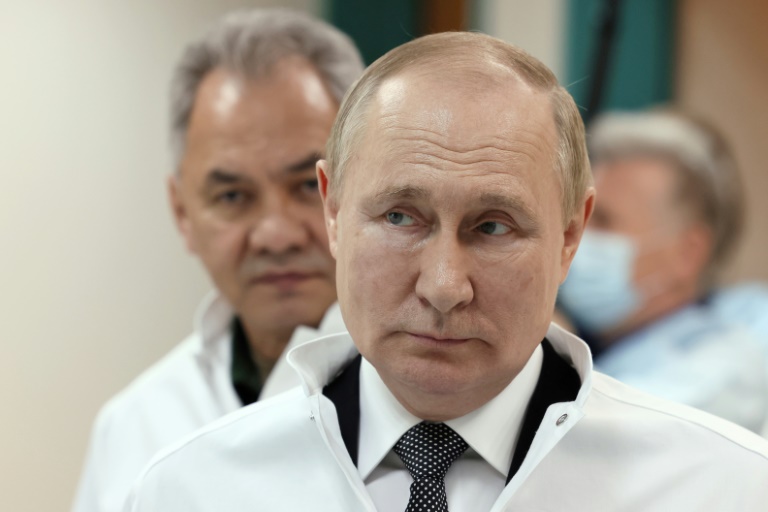
The claims made about the health of Russian President Vladimir Putin, who will be 70 in October, are lurid and macabre, as well as impossible to verify.

But they illustrate how little is known about the health of a leader whose medical condition is fundamental to the future of Europe, all the more so after he ordered Russia’s invasion of Ukraine.

Over the course of Putin’s two decades in power, remarkably little has emerged about his health, beyond the famous images provided by the Kremlin showing him bare-chested in a bid to project an image of macho strength.

But scrutiny has now increased with the war that Putin unleashed against Russia’s neighbour.

– What are the claims? – 

The most in-depth investigation into Putin’s health was published in April by the Russian-language news site Proekt, which used open-source data to conclude that the president’s trips to the southern resort city of Sochi were synchronised with those of a large number of doctors.

They included specialist in thyroid cancer Yevgeny Selivanov, whose visits to Sochi frequently coincided with Putin’s sudden absences from the public eye over the past years.

It also alleged that one of the methods used by Putin to ensure longevity were baths in blood extracted from deer antlers in Siberia, a method recommended by his friend Defence Minister Sergei Shoigu, who is from Siberia.

French weekly Paris Match this month said that on visits to Saudi Arabia in 2019 and France in 2017, Putin was accompanied by a team whenever he went to the toilet, to keep his excretions so no foreign power could medically analyse his urine or stools.

Even more sensationally, US publication Newsweek said in June that Putin had undergone treatment for advanced cancer in April, citing American intelligence. The US National Security Council denied the existence of such briefings.

Ukraine’s military intelligence chief, Major General Kyrylo Budanov, in a mid-May interview with Sky News claimed without evidence that Putin has cancer.

Proekt also alleged that the Kremlin set up a fake office in Sochi that purported to look like the one at his suburban Moscow residence to make it look like he was working in the Russian capital rather than resting at the Black Sea resort.

– What information is there?

The only time the Kremlin confirmed Putin was suffering a health problem was the fall of 2012, when he cancelled several meetings and vanished from public life after being seen moving awkwardly.

The Kremlin at the time said he had pulled a muscle and one newspaper said he aggravated a back problem during a stunt when he flew with cranes on a motorised hang-glider. But Proekt alleges it was here that his major health problems began.

The Covid-19 pandemic has also seen sometimes odd conduct from the Russian leader. 

The Kremlin said he had been vaccinated, but unlike almost all other world leaders, no images ever emerged of his jab. Those coming into close contact with him, including journalists, were subject to the most stringent precautions such as days of quarantine.

Visiting world leaders who did not accept the Kremlin’s stringent conditions — such as French President Emmanuel Macron and UN chief Antonio Guterres — were banished to the end of a now notoriously long table. 

Those who accepted the Kremlin’s demands, including a Russian Covid test, and possibly quarantine, such as Armenian Prime Minister Nikol Pashinyan were allowed a handshake and even an embrace.

A meeting with Shoigu on Ukraine in late April also fuelled rumours with Putin tightly gripping the table in what some saw a bid to stop body tremors. Numerous videos have also shown one of Putin’s feet fidgeting during meetings.

The Kremlin has meanwhile postponed Putin’s annual direct line phone-in with the Russian people, usually a fixture in June, to a later date without explanation.

Huge efforts appear to have been made to protect Putin. In his 2020 annual news conference only a handful of reporters — quarantined and tested beforehand — were allowed in the room with him, while others massed in another hall. 

In 2021, the event returned to its usual format but with a vast distance between the front row of journalists and Putin’s desk. Even now, with the business of government returning to normal in most of the world, Putin conducts most domestic business via video.

What does the Kremlin say?

The Kremlin, via Putin’s spokesman Dmitry Peskov, has vehemently denied all claims that the Russian president is suffering from any serious health problem.

Foreign Minister Sergei Lavrov took the highly unusual step in an interview with French television channel TF1 in late May to deny Putin was ill, saying “I don’t think that sane people can see in this person signs of some kind of illness or ailment” and claiming that the Russian leader appeared in public “every day”.

Belarus President Alexander Lukashenko, ostracised by the West but a frequent face-to-face interlocutor with Putin, insisted in a March interview with Japanese television that the Russian leader was in rude health. 

“If you think that something is wrong with President Putin or something happened, you are, as we say, the most pitiful person on earth,” he said.

In recent public appearances — including a forum on Peter the Great and a meeting with Turkmenistan President Serdar Berdymukhamedov — Putin has also shown no sign of physical frailty.

Why does it matter?

Putin remains the undisputed leader of Russia and most observers expect him to seek a third consecutive mandate in 2014, after recent controversial constitutional changes allowing him to do so.

There is no obvious successor and, as commander in chief of the Russian forces, it was the decision of Putin to invade Ukraine on February 24.

“The country does not know a word of truth about the physical and emotional health of the person who runs it,” said the editor-in-chief of Proekt, Roman Badanin.

“The whole planet does not know if a person who could destroy all of humanity by pressing a red button is healthy.”

French parliamentary election: what's at stake?

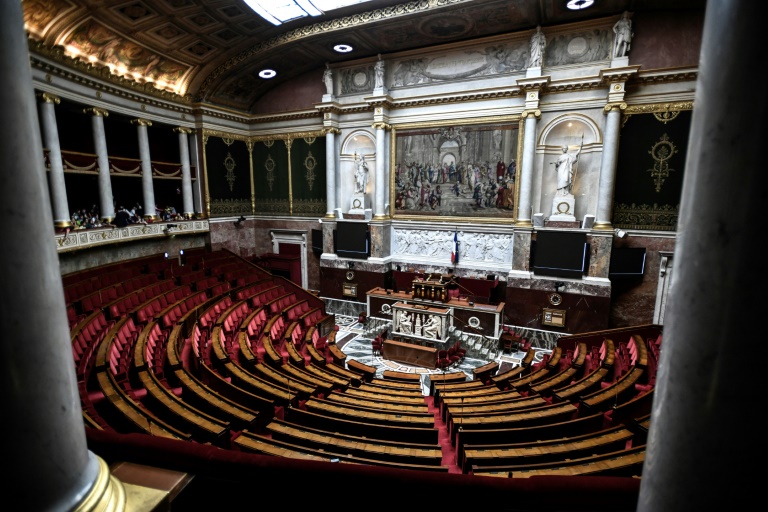
France goes to the polls on Sunday for the final round of parliamentary elections which are crucial for centrist President Emmanuel Macron’s plans for his second term.

Macron’s “Ensemble” (Together) coalition of centrist and centre-right parties is facing a challenge from a new left-wing alliance called NUPES.

In the first round of voting last Sunday, the two sides were neck-and-neck with 25.75 percent and 25.66 percent respectively.

In the second round, the initial field of candidates in almost all of the 577 constituencies has been whittled down to two contestants who go head-to-head.

Here are the possible outcomes:

– A majority for Macron? – 

Macron’s Together coalition is seen as the most likely of all the political movements to secure an outright majority of 289 seats.

Parties loyal to the former investment banker enjoyed a landslide victory in the last polls in 2017, but few expect them to get near the 350 seats secured then. 

Current projections from pollsters suggest Together is on course for between 255-310 MPs.

Only a performance at the upper end of that range would give Macron a majority and enable him to push through legislation almost without resistance. 

“There’s a feeling among some people that there’ll be a jump in support for us next Sunday,” one minister told AFP this week. “I don’t believe it.” 

– Slightly short? –

Many political analysts expect Macron’s Together coalition to fall short of a majority despite pleas to voters to give him a free hand.

He urged citizens not to add “French disorder to global disorder” and former prime minister Edouard Philippe said this week it would be “madness” to deprive the president of a majority.

Coalition negotiations are common in most parliamentary democracies, however, and a deal would have to be hammered out after the vote with new allies. 

If Together is only slightly short of the crucial 289 seats, a handful of opposition MPs or independents could be induced to join the ruling parties.

If the gap is larger, formal tie-ups would have to be concluded with opposition groups such as the rightwing Republicans or the centre-right UDI. 

Alternatively, Macron, 44, would have to rely on vote-by-vote support from rivals for each piece of legislation.

That would make for a messy and unstable legislature.

– Left surge? –

Seen as unlikely but not impossible, NUPES could outperform current expectations which see it winning from 150-220 seats.

Their leader, hard-left figure Jean-Luc Melenchon, 70, harbours hopes of forming the biggest group in parliament and then being named prime minister.

“Projections in terms of seats make no sense at this point, other than maintaining an illusion,” he said last Sunday. 

Forecasting the parliamentary elections and its 577 constituencies is a challenging task and polling firms have a mixed record.

The left performed better than expected in 1997 and 2007. 

NUPES candidates will need working-class and young people to head to the polls in large numbers to stand any chance.

Melenchon has spent all week encouraging them to cast a ballot after record-high abstention rates last weekend.

Higher-than-expected turnout figures would be a positive signal for his coalition and would upset the statistical models used by polling companies. 

“We’ve confounded predictions. Now the challenge is to prove the projections wrong,” Julien Bayou, whose EELV green party is a member of NUPES, said last Sunday.

– Far-right gains? –

French far-right leader Marine Le Pen achieved a historic high score in the presidential elections in April and is hoping to translate this support into seats in parliament.

Projections suggest her anti-immigration National Rally (RN) party is on course for 10-45 seats, an increase from the eight it currently holds. 

“There’s no defeatism on the ground… there are positive dynamics since 2017,” she said this week in northern France, where she is certain to be elected from her personal political fiefdom.

She has spoken of “dozens” of new MPs, while the head of her party Jordan Bardella has raised the possibility of 35-40.

More than 15 would enable the RN to create a formal parliamentary group, giving it significantly more visibility as well as resources. 

– Other things to watch –

The futures of several cabinet members are on the line, notably high-profile Europe Minister Clement Beaune and Environment Minister Amelie de Montchalin.

They both face tricky contests and would be expected to resign from the government if they fail to win, under a convention that Macron has promised to uphold.

Elsewhere, the prospects of a 53-year-old baker who went on hunger strike last year to prevent the deportation of his African apprentice are being closely followed.

Stephane Ravacley, a political novice, is standing for NUPES in Doubs in southeast France.

Bolsonaro blamed as UN, activists denounce Amazon murders

The United Nations as well as environmental and rights groups expressed outrage Thursday at the murder of British journalist Dom Phillips and Indigenous expert Bruno Pereira, which they linked to President Jair Bolsonaro’s willingness to allow commercial exploitation of the Brazilian Amazon.

Veteran correspondent Phillips, 57, and Pereira, 41, went missing on June 5 in a remote part of the rainforest rife with illegal mining, fishing and logging, as well as drug trafficking.

Ten days later, on Wednesday, a suspect named Amarildo da Costa de Oliveira took police to a place where he said he had buried bodies near the city of Atalaia do Norte, where the pair had been headed.

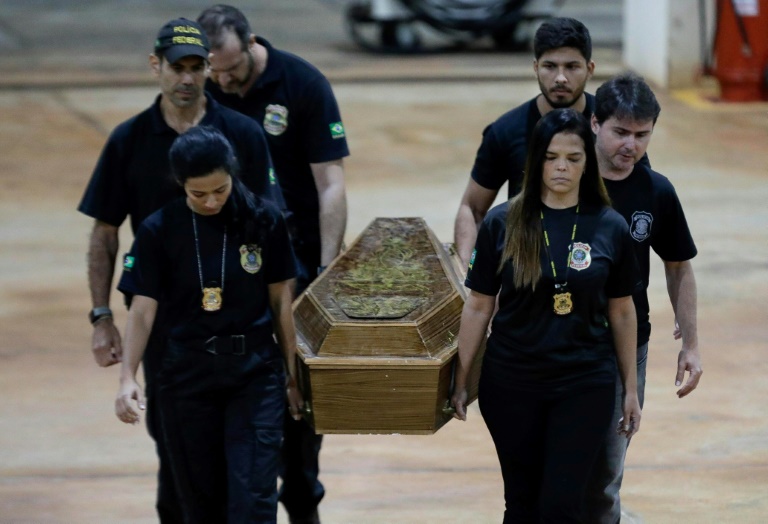
Human remains unearthed from the site arrived in Brasilia on Thursday evening for identification by experts, with members of the federal police seen carrying two brown coffins through a hangar. Official results are expected next week, according to local media.

Federal police said Thursday that traces of blood found in Oliveira’s boat belonged to a man, but not Phillips. Further analysis will be necessary to determine if it was that of Pereira.

There is still much to clarify in the case, including a motive and the circumstances surrounding the killings, apparently carried out by firearm. 

Late Wednesday, the federal police chief of Brazil’s northern Amazonas state said there was “a 99 percent probability” the unearthed remains corresponded to the missing men.

The UN human rights office said Thursday it was “deeply saddened by the information about the murder” of the two men.

“This brutal act of violence is appalling and we call on state authorities to ensure that investigations are impartial, transparent and thorough, and that redress is provided to the families of the victims,” spokeswoman Ravina Shamdasani said in Geneva.

Phillips, a longtime contributor to The Guardian and other leading international newspapers, was working on a book on sustainable development in the Amazon with Pereira as his guide, when they went missing.

Pereira, an expert at Brazil’s indigenous affairs agency FUNAI, had received multiple threats from loggers and miners with their eye on isolated Indigenous land.

– ‘Heartbroken’ –

Phillips’ family said in a statement they were “heartbroken” by the discovery of two bodies Wednesday, which they took as confirmation that the pair had been killed.

Beatriz Matos, the wife of Pereira, wrote on Twitter that “now that the spirits of Bruno are walking through the jungle and scattered among us, our strength is much greater.”

The Javari Valley where the men went missing — an area near the borders with Peru and Colombia — is home to about 20 isolated Indigenous groups where drug traffickers, loggers, miners and illegal fishermen operate. 

Greenpeace Brazil said the deaths were “a direct result of the agenda of President Jair Bolsonaro for the Amazon, which opens the way for predatory activities and crimes… in broad daylight.”

Bolsonaro, who took office in 2019, has pushed to develop the Amazon, the world’s largest tropical rainforest.

He drew fresh criticism Wednesday for saying Phillips was “disliked” for his reporting on the region and should have been more careful.

On Thursday, the far-right president tweeted “our condolences to the families” of the men.

In Brussels, seven Brazilian Indigenous leaders deplored the climate of violence and “impunity” in the Amazon in front of the European Union headquarters. 

One of them, Dinamam Tuxa, told AFP that “Bruno and Dom Phillips were victims of government policies.”

– ‘Political crime’ –

Shamdasani said attacks and threats against activists and Indigenous people in Brazil were “persistent” and urged the government to step up protections.

The Univaja association of Indigenous peoples, which had taken part in the search for the missing men, denounced the suspected killings as a “political crime,” while the Brazilian Association of Investigative Journalism said “the president and his allies have become protagonists of attacks on the press” uncovering environmental crimes.

“People dead for defending Indigenous lands and the environment. Brazil cannot be that,” added ex-president Luiz Inacio Lula da Silva, who will face Bolsonaro in October elections.

Investigations continue to look into the motive for the crime as well as the role played by Oliveira and fellow suspect Oseney da Costa de Oliveira. 

On the ground, civil police carried out three search warrants, but no arrests were made. Authorities said they had so far been unsuccessful in finding the boat in which Phillips and Pereira were traveling when they were last seen, an AFP journalist confirmed.

Brazilian media report there may be three more people involved. Police have not ruled out more arrests.

Bolsonaro blamed as UN, activists denounce Amazon murders

The United Nations as well as environmental and rights groups expressed outrage Thursday at the murder of British journalist Dom Phillips and Indigenous expert Bruno Pereira, which they linked to President Jair Bolsonaro’s willingness to allow commercial exploitation of the Brazilian Amazon.

Veteran correspondent Phillips, 57, and Pereira, 41, went missing on June 5 in a remote part of the rainforest rife with illegal mining, fishing and logging, as well as drug trafficking.

Ten days later, on Wednesday, a suspect named Amarildo da Costa de Oliveira took police to a place where he said he had buried bodies near the city of Atalaia do Norte, where the pair had been headed.

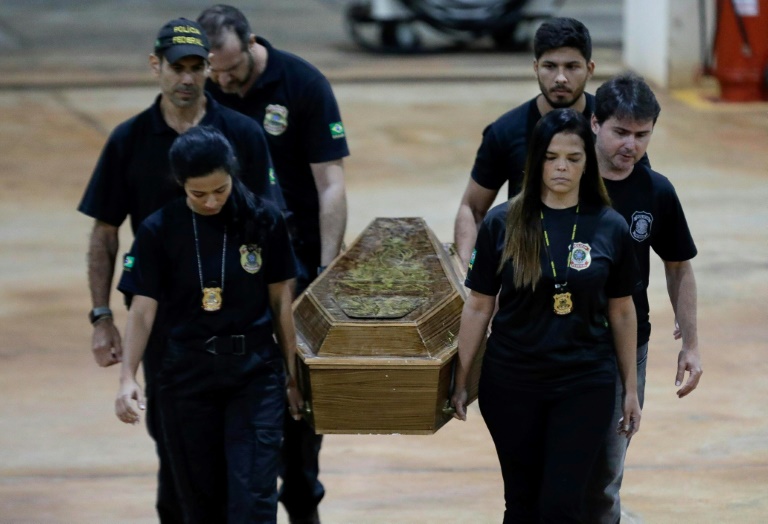
Human remains unearthed from the site arrived in Brasilia on Thursday evening for identification by experts, with members of the federal police seen carrying two brown coffins through a hangar. Official results are expected next week, according to local media.

Federal police said Thursday that traces of blood found in Oliveira’s boat belonged to a man, but not Phillips. Further analysis will be necessary to determine if it was that of Pereira.

There is still much to clarify in the case, including a motive and the circumstances surrounding the killings, apparently carried out by firearm. 

Late Wednesday, the federal police chief of Brazil’s northern Amazonas state said there was “a 99 percent probability” the unearthed remains corresponded to the missing men.

The UN human rights office said Thursday it was “deeply saddened by the information about the murder” of the two men.

“This brutal act of violence is appalling and we call on state authorities to ensure that investigations are impartial, transparent and thorough, and that redress is provided to the families of the victims,” spokeswoman Ravina Shamdasani said in Geneva.

Phillips, a longtime contributor to The Guardian and other leading international newspapers, was working on a book on sustainable development in the Amazon with Pereira as his guide, when they went missing.

Pereira, an expert at Brazil’s indigenous affairs agency FUNAI, had received multiple threats from loggers and miners with their eye on isolated Indigenous land.

– ‘Heartbroken’ –

Phillips’ family said in a statement they were “heartbroken” by the discovery of two bodies Wednesday, which they took as confirmation that the pair had been killed.

Beatriz Matos, the wife of Pereira, wrote on Twitter that “now that the spirits of Bruno are walking through the jungle and scattered among us, our strength is much greater.”

The Javari Valley where the men went missing — an area near the borders with Peru and Colombia — is home to about 20 isolated Indigenous groups where drug traffickers, loggers, miners and illegal fishermen operate. 

Greenpeace Brazil said the deaths were “a direct result of the agenda of President Jair Bolsonaro for the Amazon, which opens the way for predatory activities and crimes… in broad daylight.”

Bolsonaro, who took office in 2019, has pushed to develop the Amazon, the world’s largest tropical rainforest.

He drew fresh criticism Wednesday for saying Phillips was “disliked” for his reporting on the region and should have been more careful.

On Thursday, the far-right president tweeted “our condolences to the families” of the men.

In Brussels, seven Brazilian Indigenous leaders deplored the climate of violence and “impunity” in the Amazon in front of the European Union headquarters. 

One of them, Dinamam Tuxa, told AFP that “Bruno and Dom Phillips were victims of government policies.”

– ‘Political crime’ –

Shamdasani said attacks and threats against activists and Indigenous people in Brazil were “persistent” and urged the government to step up protections.

The Univaja association of Indigenous peoples, which had taken part in the search for the missing men, denounced the suspected killings as a “political crime,” while the Brazilian Association of Investigative Journalism said “the president and his allies have become protagonists of attacks on the press” uncovering environmental crimes.

“People dead for defending Indigenous lands and the environment. Brazil cannot be that,” added ex-president Luiz Inacio Lula da Silva, who will face Bolsonaro in October elections.

Investigations continue to look into the motive for the crime as well as the role played by Oliveira and fellow suspect Oseney da Costa de Oliveira. 

On the ground, civil police carried out three search warrants, but no arrests were made. Authorities said they had so far been unsuccessful in finding the boat in which Phillips and Pereira were traveling when they were last seen, an AFP journalist confirmed.

Brazilian media report there may be three more people involved. Police have not ruled out more arrests.

Ferrari says 80% of its models will be electric or hybrid by 2030

Ferrari unveiled Thursday plans to turn 80 percent of its production into all-electric or hybrid cars by 2030 in a major shift for an iconic brand renowned for its powerful combustion engines.

“Electrification is a way to improve performance,” new chief executive Benedetto Vigna said as he unveiled a four-year strategic plan at the brand’s historic Maranello site in northern Italy.

The 2022-2026 plan will be driven by the launch of new products — including Ferrari’s first 100 percent electric car, set to be presented in 2025.

“Ferrari’s first all-electric car will be 100 percent a sports car,” commercial director Enrico Galliera told AFP.

“We will develop an electric car that will deliver the same emotions as when you drive a (traditional) Ferrari,” he pledged, without revealing any technical details.

The Italian luxury carmaker plans to expand the Maranello plant and create a third production line for hybrid and electric vehicles.

Under the plan, some 60 percent of its production would be all-electric or hybrid models by 2026, rising to 80 percent by 2030.

Other upcoming new products include Ferrari’s first SUV, “Purosangue” (Thoroughbred), which will be unveiled in September, with deliveries from 2023.

Including the all-electric offer, another 15 new launches are expected between 2023 and 2026, Vigna said.

Ferrari, which celebrates its 75th anniversary this year, broke results records in 2021, delivering 11,155 cars — up 22.3 percent  — and generating revenue of 4.3 billion euros (up 23.4 percent).

It said Thursday it was setting an ambitious target for revenues. The 6.7-billion-euro ($7-billion) goal for 2026 is well above this year’s estimated revenue of around 4.8 billion euros.  

Vigna did not give many details of the new Purosangue, other than that it will be a sports car and will have a V12 engine, a trademark of the mythical brand.

But he said: “I am confident it will exceed all expectations.”

He emphasised its exclusivity, saying it would make up on average fewer than 20 percent of total deliveries.

Under the previous strategic plan unveiled in 2018, Ferrari had also promised the launch of 15 cars — a target Vigna said had been reached.

Close Bitnami banner
Bitnami