World

More crew of grounded plane prevented from leaving Argentina

The Venezuelan crew of a cargo plane grounded outside Buenos Aires since last week may not leave Argentina, a judge ruled Tuesday after their hotel was raided in a probe into possible Iran terror links.

Police searched the 14 Venezuelan and five Iranian crew members’ rooms the day after officials raised suspicions of a link to Iran’s Revolutionary Guards, which is listed as a terror group by the United States.

The Iranian crew had already had their passports temporarily seized, and on Tuesday the Venezuelans had their freedom curtailed after police seized cellphones, computers and documents in the seven-hour hotel raid.

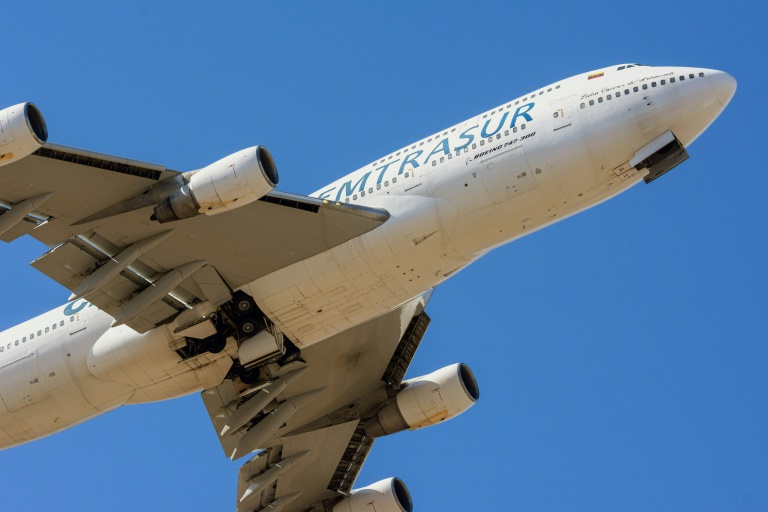
A Venezuelan Boeing 747 cargo plane reportedly carrying car parts came in from Mexico to land in Cordoba, Argentina on Monday last week, then tried to travel to neighboring Uruguay, but was denied entry and returned to Ezeiza outside Buenos Aires where it has been grounded since last Wednesday.

The plane belongs to Emtrasur, a subsidiary of Venezuela’s Conviasa, which is under US sanctions.

Police did not comment on the reason for the hotel search, but on Monday, Security Minister Anibal Fernandez said information had been received from “foreign organizations” that some among the crew may be linked to companies with ties to the Revolutionary Guards, Iran’s ideological army.

Fernandez said a smaller crew had been reported on the flight log than the number actually on the plane.

– ‘Terrorists’ –

Also Tuesday, Paraguay said two officials who had authorized the landing of the plane there in May had been dismissed and two anti-drug agents were under investigation.

Interior Minister Federico Gonzalez said the plane landed in Paraguay on a “commercial” entry permit with 18 crew — a number that raised suspicion.

It spent nearly three days at the Guarani international airport near the borders with Argentina and Brazil before departing on May 16 for the Caribbean island of Aruba with a load of Paraguayan cigarettes.

After it left, “we received a communication that the aircraft is sanctioned by the United States Treasury Department and that seven of the crew members are members of the Al Quds forces (of the Guards) and that the United States has them on a list of terrorists,” said the minister.

Paraguay alerted the intelligence services of other countries in the region.

Iran said Monday that Argentina’s move was part of a “propaganda” campaign against Tehran amid tensions with Western countries over negotiations to revive a 2015 nuclear deal.

The grounding of the cargo plane came days before Venezuelan President Nicolas Maduro visited Tehran on Saturday for the allies, both subject to US sanctions, to sign a 20-year cooperation pact.

Iran’s foreign ministry spokesman Saeed Khatibzadeh said the plane was sold by Iran’s Mahan Air to a Venezuelan company last year.

Mahan Air is accused by the United States of links with the Revolutionary Guards.

Interpol has arrest warrants out for former Iranian leaders suspected of involvement in an attack on a Jewish center in Buenos Aires in 1994 that killed 85 people and injured hundreds. 

burs-/nn/dga/mlr/bfm
What we know in case of missing British journalist and Amazon expert

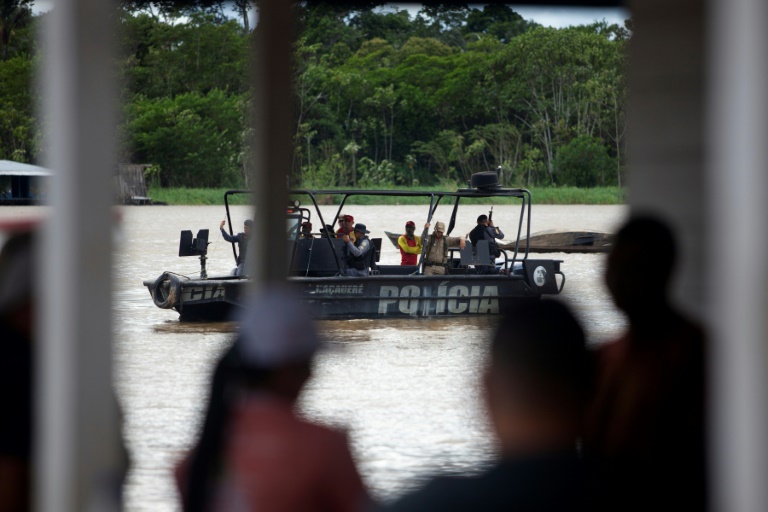
The search for a British journalist and a Brazilian indigenous expert who vanished deep in the Amazon went into its 10th day Tuesday amid fading hopes of finding them alive and persistent international pressure to resolve the case.

This is what we know so far:

– Two missing men –

Veteran freelance journalist Dom Phillips, 57, has worked in Brazil for the past 15 years, reporting for media including The New York Times, Washington Post, Financial Times and Guardian, where he is a regular contributor.

Phillips is an impassioned defender of the Amazon. He went missing in a remote region called the Javari Valley while doing research for a book on sustainable ways to protect the world’s largest rainforest.

Bruno Pereira, 41, is an expert who was on leave from his job with the Brazilian government’s Indigenous affairs agency, or Funai, and a well-known advocate for these communities. He was accompanying the Briton as a guide on Phillips’ second trip to the region since 2018.

Pereira was the regional coordinator of Funai in Atalaia do Norte, the town where Phillips was headed when the two of them vanished. The Javari Valley is rife with illegal fishing, logging, mining and drug trafficking. Pereira’s work defending Indigenous people drew frequent threats against him from criminal gangs operating in the area.

Both of the missing men are married and Pereira has three children.

– What happened? –

Phillips and Pereira were last seen on the morning of Sunday, June 5, in the village of Sao Gabriel, not far from Atalaia do Norte, where they were headed by way of the Itaquai River.

They were traveling in a new motorized boat with enough fuel to get where they were going. Their journey had started days earlier at Lake Jaburu, where they had interviewed local people.  

– A ‘complex’ region –

The Javari Valley, where the men disappeared, is a remote jungle region home to 26 different Indigenous peoples, many of which live in isolation.

Authorities warned that the region is “complex” because of the presence of rogue miners, loggers and fishermen who invade protected Indigenous lands to exploit their resources.

What is more, drug trafficking in the region has grown in recent years. The area is used as a conduit to transport drugs produced in Peru and Colombia, both of which border Brazil.

– One detainee, some evidence – 

The search is being led by Indigenous people and Brazilian security forces. 

On Sunday the security forces said they found personal items belonging to the two, including Pereira’s health card, pants and boots, as well as Phillips’s backpack and clothing.

Officials said these things were found in the water near the home of Amarildo da Costa Oliveira, the only person detained in the case so far.

Witnesses saw this 41-year-old fisherman in a motor boat following that of Phillips and Pereira at high speed before they disappeared.

Police found blood on a tarp in Oliveira’s boat. He denies any involvement.

Authorities are analyzing the blood and what are believed to be human remains found in the area, and results are expected this week.

President Jair Bolsonaro said Monday, “the evidence leads us to believe something bad was done to them, because human innards were found floating in the river, which are now undergoing DNA testing.”

It is not clear if he was referring to the same remains that the police said they had found.

– Criticism and confusion –

The search for the men and their boat continues.

Confusion arose Monday when relatives of the journalist said a Brazilian diplomat in London told them two bodies had been found and the remains were being analyzed to see if they belonged to Phillips or Pereira.

But Federal Police, who are the official spokesperson in this drama, denied that bodies had been found. Indigenous people taking part in the search also issued a denial.

The federal government has been criticized by environmental activists, international agencies and Brazilian justice officials for alleged slowness and lack of coordination in the search.

Bolsonaro at first said Phillips and Pereira had embarked on an “unadvisable adventure” by traveling in a dangerous area without protection. This drew a rebuke from civil society organizations which defended their work to preserve the Amazon.

Russia plans Severodonetsk plant evacuation as it bids to encircle city

Russia said Tuesday it would establish a humanitarian corridor to evacuate civilians from a chemical plant in Severodonetsk, as the two sides battled for control of the key city in Ukraine’s eastern Donbas region.

Russian forces have stepped up efforts to cut off the Ukrainian troops still in the industrial hub, destroying all three bridges which connect it across a river to Lysychansk.

Ukrainian President Volodymyr Zelensky meanwhile once again appealed for heavy weapons from the West, criticising the “restrained behaviour” of some European leaders.

Moscow has for weeks targeted the twin cities as the last areas in the Lugansk region of the Donbas still under Ukrainian control.

Communication with the city was “complicated” with the situation on the ground changing every hour, the head of Severodonetsk’s administration, Oleksandr Stryuk, told Ukrainian television.

Around 500 civilians were taking shelter under “heavy fire” in the Azot chemical plant in Severodonetsk, Stryuk said. 

The Russian defence ministry said it was “ready to organise a humanitarian operation” on Wednesday to evacuate from the plant to the separatist-controlled part of the Lugansk region.

– ‘Surrender or die’ –

Regional governor Sergiy Gaiday said Monday Ukraine’s forces had been pushed back from Severodonetsk’s centre with the Russians controlling 70 to 80 percent of the city in their attempt to “encircle it”.

Capturing Severodonetsk would open the road to Sloviansk and another major city, Kramatorsk, in Moscow’s push to conquer Donbas, a mainly Russian-speaking region partly held by pro-Kremlin separatists since 2014.

Zelensky, in comments to Danish journalists Tuesday, insisted that the war could only end once Ukrainians were the only ones left on its territory.

How long that took depended “very much” on international support, and “the personalities of the leaders of European states”.

He regretted what he called, “the restrained behaviour of some leaders” which, he said, had “slowed down arms supplies very much”.

Zelensky has repeatedly urged the West to deliver heavy weapons to Ukraine as quickly as possible.

Deputy Defence Minister Anna Malyar on Tuesday said Kyiv had only received 10 percent of the arms it had requested from the West.

– ‘Not safe anywhere’ –

From an elevated position in Lysychansk, an AFP team saw black smoke rising from the Azot factory in Severodonetsk and another area in the city.

The Ukrainian military is using the high ground to exchange fire with Russian forces fighting for control of Severodonetsk, just across the water.

Lysychansk pensioner Valentina sat on the porch of her ground floor apartment, where she lives alone, her two walking sticks to hand.

“I’m having a tough time,” said the 83-year-old former farm worker.

“It’s scary, very scary. Why can’t they agree at last, for God’s sake, just shake hands?”

Along the road from Lysychansk to Kramatorsk, Ukrainian forces were transporting more weapons systems to the front, while specialist vehicles carried tanks for repair.

In the town of Novodruzhesk, close to Lysychansk, there was still a smell of burning and smoke from a group of houses that had been destroyed by fire from shelling at the weekend, with just chimneys left.

“It’s not safe anywhere, it just depends on the time of day, that’s all,” said a soldier standing at the local fire station with a skull logo on his sleeve. 

“There are tons of people (still) here,” he added.

Further away in Sloviansk, Nataliya, 41, a now unemployed cleaner said she was trying to decide whether to evacuate. 

“People will leave again if they start bombing the town heavily,” she told AFP. 

“If it’s like Mariupol, they’ll give us buses. We’ll leave if the Russians enter Sloviansk.”

– ‘Positive signal’ –

The European Union needs to “give a positive signal” to Ukraine and be “open” to granting it candidate status, France’s Europe minister, Clement Beaune, said Tuesday. 

Ukraine has applied to become a member of the bloc, with the European Commission due to give its recommendation in the coming days. But some member states are sceptical about potentially fast-tracking Ukraine’s accession.

The process would “take time”, Beaune said, adding that the first priority was to “stop the war”.

“Ukraine is fighting and defending our shared European values, it must at least be a candidate for EU,” President Zelensky said Tuesday.

Russian energy giant Gazprom said Tuesday it would reduce gas deliveries to the EU via the Nord Stream pipeline by 40 percent, due to the delayed return of compressor units from German company Siemens.

Several European countries, including Germany, where the underwater pipeline makes land, are highly reliant on supplies of Russian gas for their energy needs.

The Kremlin meanwhile said it had not received a request from London to intervene in the case of two Britons sentenced to death by pro-Moscow separatist authorities in eastern Ukraine.

Aiden Aslin and Shaun Pinner, along with Moroccan Brahim Saadun, were convicted of acting as mercenaries for Ukraine by the self-proclaimed Donetsk People’s Republic.

Russia also announced it was blacklisting 49 UK citizens, including defence officials and prominent journalists from the BBC, The Financial Times and The Guardian.

burs-sea/imm/jj

Top Indigenous leader arrested in Ecuador amid protests

Ecuadoran police have arrested the leader of an Indigenous movement, pushing his organization to call Tuesday for a popular uprising a day after it led demonstrations that blocked roads to protest high fuel prices.

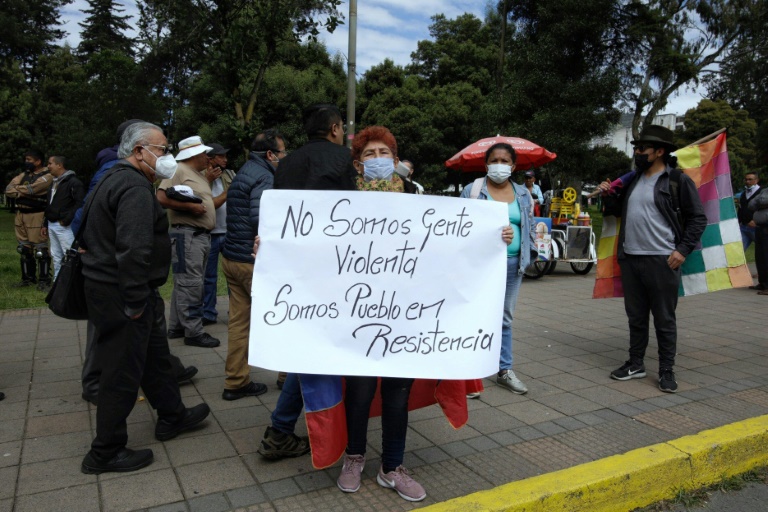
The arrest of Leonidas Iza, leader of the powerful Confederation of Indigenous Nationalities of Ecuador (Conaie), sparked outrage, with authorities deploying police in riot gear and soldiers to stand guard outside the public prosecutor’s office where he was in custody awaiting a hearing.

Demonstrators gathered outside the building, holding signs reading “Freedom for Iza!” and “We are not violent people, we are people in resistance.”

Iza, a leader of the Kichwa-Panzaleo community, had been arrested in Pastocalle, about 20 kilometers (12 miles) south of Quito, on suspicion of unspecified “offenses,” the police tweeted early Tuesday.

Pastocalle has been a flash point of protests called by Conaie against rising fuel prices and living costs, which saw demonstrators block roads across the country on Monday, some of which remained obstructed the next day.

Conaie confirmed the arrest of the 39-year-old Iza, condemning his detention as “arbitrary and illegal” and calling for a “radicalization” of the demonstrations in response.

“We call our organizational structure to a great Indigenous and popular uprising,” Conaie tweeted in the hours after Iza’s arrest. “Long live the social struggle!”

The Inredh human rights group, which confirmed Iza was being held at the public prosecutor’s office, warned that his detention “will provoke major indignation and a wave of violence.”

In 2019, Conaie-led protests resulted in 11 deaths and forced then-president Lenin Moreno to abandon plans to eliminate fuel subsidies. The group is also credited with helping topple three presidents between 1997 and 2005.

Oil producer Ecuador has been hit by rising inflation, unemployment and poverty, strains exacerbated by the coronavirus pandemic.

President Guillermo Lasso warned late Sunday that the government would not allow roads or Ecuador’s oil installations to be taken over by protesters.

But Iza insisted the demonstrations would continue for as long as was necessary.

Starting in the early hours of Monday, protesters set tires alight and built barricades of sand, rocks and tree branches across roads in at least 11 of Ecuador’s 24 provinces, authorities said, with access to the capital Quito partly cut off.

Authorities estimate that 6,000 people took part in Monday’s protests, although Iza had accused them of “minimizing” the demonstrations.

– Fruitless talks –

Lasso denounced “acts of vandalism” during the protests, including “the burning of patrol cars, invasions of farms, the breaking of windscreens on private and school vehicles, an attack on an oil pumping facility, the cutting off of community water supplies, the closure and serious damage to state roads.”

However, several security ministers denied there was an attack on the oil pumping facility in Ecuador’s Amazon region.

Interior Minister Patricio Carrillo said five people have been detained, including Iza.

Conaie has taken part in several rounds of fruitless talks with Lasso’s government.

Fuel prices have risen sharply since 2020, almost doubling for diesel from $1 to $1.90 per gallon (about 3.78 liters) and rising from $1.75 to $2.55 for gasoline.

Lasso froze prices at this level last October after a round of protests led by Conaie that saw dozens arrested and several people, including police, injured in clashes.

But the freeze failed to assuage simmering anger in a country that exports crude oil but imports much of the fuel it consumes.

Conaie wants the fuel price lowered to $1.50 per gallon for diesel and $2.10 for gasoline.

The protesters are also demanding the government address price controls on agricultural products that hurt farmers and mining concessions granted in Indigenous territories.

They have also called on the government to create more jobs and to renegotiate farmers’ debts with banks.

Indigenous peoples make up over a million of Ecuador’s 17.7 million inhabitants.

Echoes of WWI in Ukraine war's artillery duels and trenches

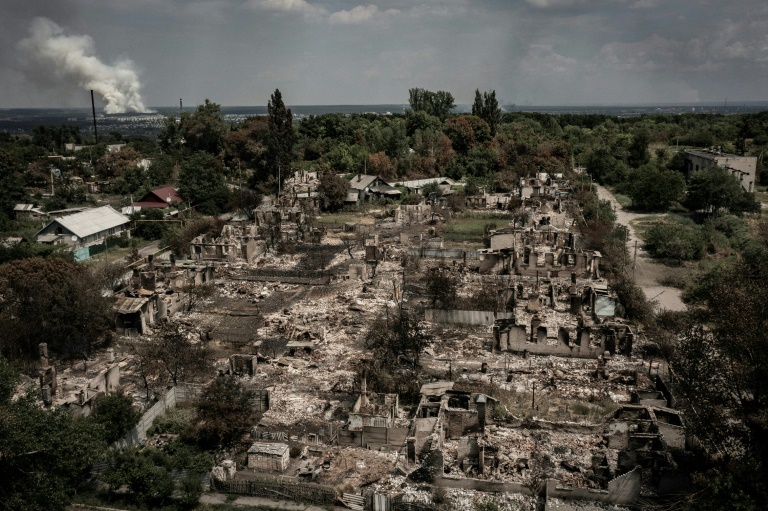
Looking at the shell-blasted, trench-marked landscapes of the front lines in Russia’s invasion of Ukraine from above, it’s easy to see why experts and leaders have drawn parallels with World War I.

Satellite images like those from US firm Maxar portray “war landscapes comparable to those visible during the First World War, totally destroyed villages all along the front line,” said Nicolas Beaupre, a board member at a French association for research into the 1914-18 conflict.

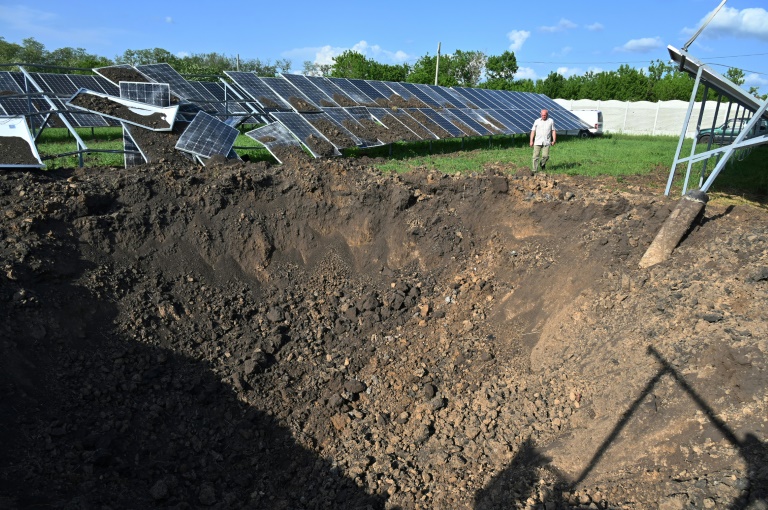
Pictures taken last week showed fields strewn with vast craters near the town of Sloviansk and evidence of shell blasts along the Siverskyi Donets river.

But beyond the visual similarities, the hopes and fears stoked internationally by the conflict and its difference from recent fighting elsewhere bear comparison with the “Great War” — even if the thousands of casualties in Ukraine over four months fall far short of the thousands per day seen over 100 years ago.

In 2022, many thought the fighting would be over in days or weeks as Russian forces advancing from Belarus threatened the capital Kiev — recalling the WWI mantra that things would be “over by Christmas”.

A quick war would have been in line with recent battles around the Russian periphery, including Moscow’s 2008 attack on Georgia, its 2014 occupation of Crimea or the Armenian-Azerbaijani conflict of 2020 over the Nagorno-Karabakh region.

But determined defence by the Ukrainians pushed back repeated assaults, forcing the attackers to reorient towards the present grinding war of attrition in the eastern Donbas region.

Those early days of the war generated their own heroic tales, like the defiant soldiers of Snake Island radioing expletives to a Russian warship demanding their surrender, or the legendary fighter pilot dubbed the “Ghost of Kyiv”.

In filling a need for a popular story to boost morale, these are not unlike the fleet of commandeered Paris taxis who supposedly helped save the capital by ferrying soldiers to the 1914 Battle of the Marne.

Evoking another French national memory, Ukrainian President Volodymyr Zelensky has compared the scene in his country’s east with “the ruins of Verdun”, the bitter 1916 defence against a German offensive that became a symbol for the entire war.

– Fear of escalation –

Meanwhile, a top preoccupation of leaders in Western capitals like Berlin has been avoiding an escalation that would lead to open conflict between Russia and NATO.

Some German politicians have even cited by name Christopher Clark’s book “The Sleepwalkers” on the causes of the First World War, fearing a rerun of the spiral of military move and counter-move resulting from the killing of Austrian Archduke Franz Ferdinand in June 1914.

Russian President Vladimir Putin has put a modern twist on the escalation scenario with his early, public order to place Russian nuclear forces on high alert — raising the spectre of the ultimate tit-for-tat with the West.

Citing reports about unease over the war among Putin’s entourage, Australian historian Clark told German broadcaster Deutsche Welle in May that “there’s a lot to suggest that the system would be robust enough to avoid such a risk” — unlike after the 1914 Sarajevo assassination.

The Ukraine war is also seeing the use on European soil, and at large scale, of battlefield weapons that have mostly been used in deployments far overseas.

NATO-made kit including drones and precision artillery systems are being used alongside large formations of tanks and infantry.

Back in WWI, many of the weapons suddenly mowing down European young men in their thousands had only previously been used in anger in colonial settings against technologically outmatched opponents.

Russia has also reached into the past for artillery shells that fling out metal darts known as flechettes, widely used in World War I and rarely since, Britain’s Guardian newspaper reported in April.

More broadly, “it’s obvious that the Ukraine conflict is on a large scale, with relatively fixed front lines that move slowly and where advances are mostly achieved through artillery duels,” said Olivier Kempf of the French Foundation for Strategic Research (FRS) think tank.

– Eternal trenches –

Still, there are huge differences between the two conflicts.

“People see a lot of trenches and tend to make the parallel with World War I, even though trenches are a fortification system seen in many other conflicts” like Nagorno-Karabakh, said war historian Camille Harle Vargas.

“When there’s shrapnel flying in all directions, it’s best to get your head down, and the best way to do that is to be at ground level,” said defence expert Joseph Henrotin.

Modern artillery has also come a long way in the last century, offering much longer ranges and higher precision — sometimes thanks to drones, which are far more effective than the early spotter planes used in 1914-18.

And with roughly 200,000 men on each side, the conflict remains far smaller.

Ukrainian forces are using up to 6,000 shells a day, according to deputy intelligence chief Vadym Skibitsky, where around 1.5 billion — or one million per day — were fired in WWI.

BTS going on 'hiatus' as band members pursue solo work

K-pop supergroup BTS on Tuesday announced they were taking an indefinite “hiatus” from one of the world’s most popular acts to focus on solo pursuits.

The seven members, who are credited with generating billions of dollars for the South Korean economy, dropped the bombshell during their streamed annual “FESTA” dinner, part of a celebration that marks their anniversary as a group.

Member RM, 27, said that after the Grammy-nominated BTS’ last few singles he “didn’t know what kind of group we were anymore,” adding later that group members were “exhausted.”

“I’ve always thought that BTS was different than other groups,” he continued. “But the problem with K-pop and the whole idol system is that they don’t give you time to mature.”

“You have to keep producing music and keep doing something… I’ve changed as a human over the past 10 years, so I needed to think and have some alone time,” RM said.

“Right now when we’re at our best I feel like I should be contributing something to the world, but I don’t know what that is.”

Jimin, 26, said the members are “slowly trying to figure things out now” and that “we’re starting to think about what kind of artists we each want to be remembered by our fans.”

“I think that’s why we’re going through a rough patch right now, we’re trying to find our identity and that’s an exhausting and long process.”

By the end of the dinner several of the members of the group behind “Dynamite” and “Butter” grew tearful as they voiced gratitude for their supporters, a fandom known online as the “ARMY.”

BTS has said they were going on short breaks before, first in 2019 and later in December 2021.

The news comes just days after the group released “Proof,” an anthology album that included a new single, “Yet To Come (The Most Beautiful Moment).”

J-Hope said that “change is what we need right now” but offered hope for the group’s return by adding “it’s important for BTS to start our second chapter.”

During the hour-long dinner that saw the members drink, joke and reflect on their history together, they said they were working on recording solo projects. J-Hope is slated to headline Chicago’s Lollapalooza on his own later this summer.

– ‘Embrace’ differences –

BTS’s label enjoyed a surge in profits despite holding fewer concerts during the pandemic.

The septet is the first all-South Korean act to reign over Billboard’s US top singles chart, a milestone they achieved with “Dynamite,” the first BTS song sung completely in English.

They’re also one of few acts since The Beatles to release four albums that hit number one stateside in less than two years.

The group has twice been nominated for a Grammy but has yet to win.

BTS recently made headlines for visiting the White House to deliver a message to Joe Biden on the fight against anti-Asian racism.

The floppy-haired stars, dressed in matching dark suits and ties, with white shirts, joined White House Press Secretary Karine Jean-Pierre at the briefing room podium before meeting Biden.

Member Suga appealed for tolerance, saying that “it’s not wrong to be different. I think equality begins when we open up and embrace all of our differences.”

The White House praised BTS as “youth ambassadors who spread a message of hope and positivity across the world.”

Anti-Asian sentiment and violence in America have grown in recent years in a phenomenon many blame on fallout from the Covid-19 pandemic.

BTS’ brief appearance before journalists reportedly garnered more than 10 times the usual traffic on the White House’s YouTube channel,

Footage the group recorded with Biden has notched nearly 3 million views on YouTube.

Yellowstone Park closed as swollen river destroys roads

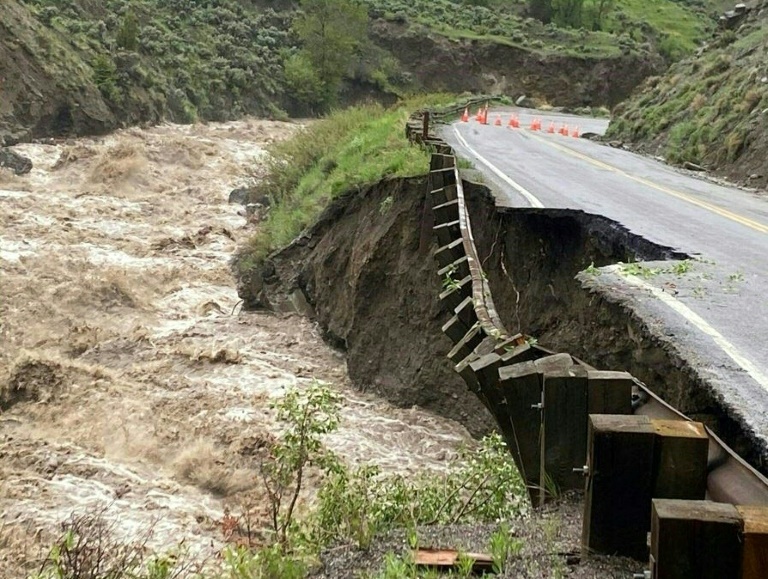
Yellowstone, one of the best-known national parks in the United States, has been shut because flooding and rockslides have cut roads, leaving some communities stranded.

All entrances to the park remained closed Tuesday, with rangers warning of “extremely hazardous conditions” brought about by a raging river and torrential rainfall.

Pictures and video released by the National Park Service show large sections of paved road have fallen into the Gardner River, one of a number of waterways that run through the huge park in Wyoming.

Footage posted on CNN showed a wooden house falling into a river.

“Due to record flooding events in the park and more precipitation in the forecast, we have made the decision to close Yellowstone to all inbound visitation,” Yellowstone superintendent Cam Sholly said Monday.

“Our first priority has been to evacuate the northern section of the park where we have multiple road and bridge failures, mudslides and other issues. 

“The community of Gardiner is currently isolated, and we are working with (local officials) to provide necessary support to residents, who are currently without water and power in some areas.”

“We will not know timing of the park’s reopening until flood waters subside and we’re able to assess the damage throughout the park.”

The northwestern United States has seen heavier than usual rain over the last few weeks.

The National Weather Service said this has combined with rapid snowmelt sparked by high temperatures, which has led to swollen rivers.

UK scraps subsidies for electric plug-in cars

Britain on Tuesday axed its £1,500 ($1,800) subsidy for buyers of new plug-in cars as it focuses on other types of electric vehicles, but the news drew anger from the auto sector.

“The government is today closing the plug-in car grant scheme to new orders after successfully kickstarting the UK’s electric car revolution,” the Department for Transport (DfT) said in a statement.

The grant was launched in 2011 to help encourage Britons to ditch high-polluting diesel and petrol cars.

It has since supported the sale of almost half a million electric cars, the DfT added, stressing that the subsidy was always a “temporary” policy.

Sales of fully electric cars rocketed from less than 1,000 in 2011 to almost 100,000 vehicles in the first five months of this year alone.

However, the government is now switching its focus to offer subsidies on sales of new plug-in electric taxis, motorcycles, vans, trucks and wheelchair-accessible vehicles.

Britain plans to ban new sales of diesel and petrol cars in the UK from 2030, as part of its goal to reach net zero carbon emissions by 2050.

Tuesday’s announcement drew stark criticism from industry body the Society of Motor Manufacturers & Traders (SMMT).

“The decision to scrap the plug-in car grant sends the wrong message to motorists and to an industry which remains committed to government’s net zero ambition,” said SMMT boss Mike Hawes.

“Whilst we welcome government’s continued support for new electric van, taxi and adapted vehicle buyers, we are now the only major European market to have zero upfront purchase incentives for EV car buyers.”

Britain’s automobile sector had stalled last year on pandemic fallout including a semiconductor shortage.

However, greener electric vehicles now account for one in six new car sales.

That rises to just over half of all new car sales, if hybrid vehicles are included.

UK scraps subsidies for electric plug-in cars

Britain on Tuesday axed its £1,500 ($1,800) subsidy for buyers of new plug-in cars as it focuses on other types of electric vehicles, but the news drew anger from the auto sector.

“The government is today closing the plug-in car grant scheme to new orders after successfully kickstarting the UK’s electric car revolution,” the Department for Transport (DfT) said in a statement.

The grant was launched in 2011 to help encourage Britons to ditch high-polluting diesel and petrol cars.

It has since supported the sale of almost half a million electric cars, the DfT added, stressing that the subsidy was always a “temporary” policy.

Sales of fully electric cars rocketed from less than 1,000 in 2011 to almost 100,000 vehicles in the first five months of this year alone.

However, the government is now switching its focus to offer subsidies on sales of new plug-in electric taxis, motorcycles, vans, trucks and wheelchair-accessible vehicles.

Britain plans to ban new sales of diesel and petrol cars in the UK from 2030, as part of its goal to reach net zero carbon emissions by 2050.

Tuesday’s announcement drew stark criticism from industry body the Society of Motor Manufacturers & Traders (SMMT).

“The decision to scrap the plug-in car grant sends the wrong message to motorists and to an industry which remains committed to government’s net zero ambition,” said SMMT boss Mike Hawes.

“Whilst we welcome government’s continued support for new electric van, taxi and adapted vehicle buyers, we are now the only major European market to have zero upfront purchase incentives for EV car buyers.”

Britain’s automobile sector had stalled last year on pandemic fallout including a semiconductor shortage.

However, greener electric vehicles now account for one in six new car sales.

That rises to just over half of all new car sales, if hybrid vehicles are included.

BTS going on 'hiatus' as band members pursue solo work

K-pop supergroup BTS on Tuesday announced they were taking an indefinite “hiatus” from one of the world’s most popular acts to focus on solo pursuits.

The seven members, who are credited with generating billions of dollars for the South Korean economy, dropped the bombshell during their streamed annual “FESTA” dinner, part of a celebration that marks their anniversary as a group.

Member RM, 27, said that after the Grammy-nominated BTS’ last few singles he “didn’t know what kind of group we were anymore,” adding later that group members were “exhausted.”

“I’ve always thought that BTS was different than other groups,” he continued. “But the problem with K-pop and the whole idol system is that they don’t give you time to mature.”

“You have to keep producing music and keep doing something… I’ve changed as a human over the past 10 years, so I needed to think and have some alone time,” RM said.

“Right now when we’re at our best I feel like I should be contributing something to the world, but I don’t know what that is.”

Jimin, 26, said the members are “slowly trying to figure things out now” and that “we’re starting to think about what kind of artists we each want to be remembered by our fans.”

“I think that’s why we’re going through a rough patch right now, we’re trying to find our identity and that’s an exhausting and long process.”

By the end of the dinner several of the members grew tearful as they voiced gratitude for their supporters, a fandom known online as the “ARMY.”

BTS has said they were going on short breaks before, first in 2019 and later in December 2021.

The news comes just days after the group released “Proof,” an anthology album that included a new single, “Yet To Come (The Most Beautiful Moment).”

J-Hope said that “change is what we need right now” but offered hope for the group’s return by adding “it’s important for BTS to start our second chapter.”

During the dinner that saw the members drink, joke and reflect on their history together, they said they were working on recording solo projects. J-Hope is slated to headline Chicago’s Lollapalooza on his own later this summer.

Close Bitnami banner
Bitnami