World

Human remains found in Amazon search for journalist, expert

Human remains have been found in the search for a British journalist and Brazilian indigenous expert who disappeared deep in the Amazon after receiving threats, Brazil’s president confirmed Monday.

Relatives of veteran correspondent Dom Phillips and respected indigenous specialist Bruno Pereira meanwhile said authorities informed them two bodies had been found — though police and local indigenous leaders denied that, adding to confusion around the case.

The families of Phillips, 57, and Pereira, 41, have endured an anguished wait for news since the pair disappeared a week ago Sunday during a reporting trip to Brazil’s Javari Valley, a remote jungle region rife with illegal fishing, logging, mining and drug trafficking.

“The evidence leads us to believe something bad was done to them, because human innards were found floating in the river, which are now undergoing DNA testing,” President Jair Bolsonaro said.

The development came a day after police said they had found personal items belonging to the two, including Pereira’s health card, pants and boots, as well as Phillips’s backpack and clothing.

Bolsonaro, whose government has faced accusations of failing to act urgently enough in the case, said hope was fading.

“Because of the time that’s passed — eight days now, approaching the ninth — it’s going to be very difficult to find them alive,” the president told CBN Recife radio.

“I pray to God for that to happen, but the information and evidence we’re getting suggest the opposite.”

– ‘Upset and distressed’ –

Phillips’s niece Dominique Davies told AFP via text message that authorities had informed the family two bodies had been found.

“We are waiting on confirmation from the federal police (in Brazil) as to whether they are Dom and Bruno. We all remain upset and distressed at this time,” she said.

Britain’s Guardian newspaper, where Phillips was a regular contributor, said the bodies were found tied to a tree, according to information given to Phillips’s family by an aide to Brazil’s ambassador in London.

Federal police said in a statement that reports that Phillips and Pereira’s bodies had been found were incorrect. And the Union of Indigenous Peoples of the Javari Valley (UNIVAJA), which is taking part in the search, denied two bodies had been found.

The police have confirmed they are analyzing a blood sample and suspected human remains found during the search to determine whether they are from the missing men.

They said the results of these analyzes are expected “during this week.” 

Pereira’s wife Beatriz Matos said Monday on Twitter that the police had confirmed “that no body was found.”

Brazilian police have arrested a suspect in the case, 41-year-old Amarildo Costa de Oliveira, nicknamed “Pelado.”

Witnesses say they saw him threaten Phillips and Pereira prior to their disappearance, then pursue them in his boat just before they disappeared.

The blood sample being analyzed was found on a tarp in Oliveira’s boat.

The search has been complicated given the difficult jungle terrain in the far-flung Javari Valley, where the men had traveled by boat gathering material for a book Phillips was writing about sustainable ways to protect the world’s biggest rainforest.

– U2 adds to pressure –

Brazil’s government faces pressure from international media organizations, rights groups and high-profile figures over the case — fueling criticism of Bolsonaro’s policies on the Amazon, where illegal deforestation and other environmental crimes have surged since he took office in 2019.

Dozens of indigenous protesters marched Monday in Atalaia do Norte, the small city Phillips and Pereira had been headed to, demanding answers on their whereabouts.

“It’s been a week… and every day brings conflicting reports,” Natalie Southwick, Latin America coordinator for the Committee to Protect Journalists (CPJ), said in a statement.

“CPJ remains deeply concerned about the government’s insufficient response and lack of transparency. Brazilian authorities must stop dragging their feet.”

Irish rock band U2 became the latest to rally to the cause, joining Brazilian football legend Pele and iconic singer Caetano Veloso.

“We are waiting to find out what has happened to these courageous men,” the band tweeted, along with a red-and-black drawing of the pair by artist Cristiano Siqueira that has gone viral.

“Where are Dom Phillips and Bruno Pereira?” it reads.

15 dead, half million impacted by heavy rains in Guatemala

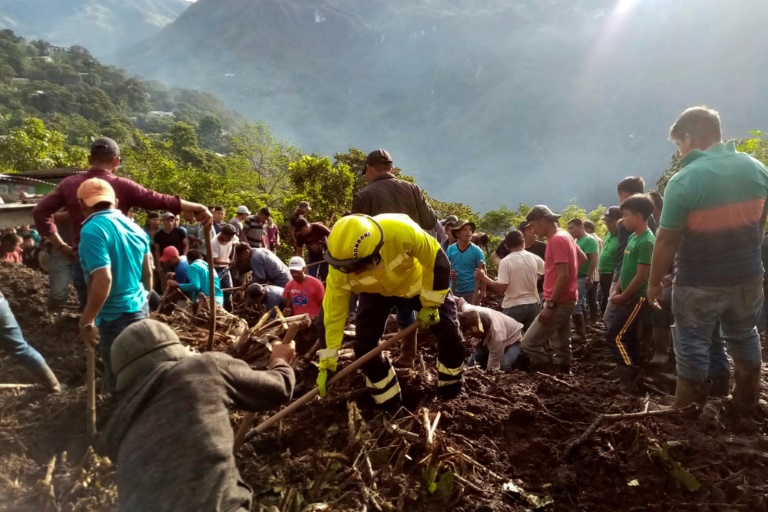
At least 15 people have died in a dozen mudslides caused by heavy rains that have fallen since early May in Guatemala, where more than 500,000 people have been  affected, officials said Monday. 

Among the 15 fatalities were a woman and her six children, as well as three brothers, all minors, from two indigenous villages, said the office of the Coordination for the Reduction of Natural Disasters (Conred).

Rains accompanied by strong winds caused landslides, floods, and the collapse of infrastructure across large swathes of the Central American country.

Conred said 930 homes had been damaged as well as eight schools, seven bridges and more than 80 roads. 

The regions most affected are those mainly inhabited by indigenous populations, whose communities are most vulnerable to natural disasters.

Nearly 60 percent of Guatemala’s 17 million people live in poverty. Last year rains caused the death of 35 people and impacted almost one in 10 Guatemalans. 

US approves first pill for treatment of alopecia

The Food and Drug Administration on Monday approved a drug called baricitinib as the first oral tablet for  treating severe alopecia areata, an autoimmune disorder affecting more than 300,000 people in the United States every year.

Alopecia causes either temporary or permanent patchy hair loss that can affect any hair-bearing site of the body, leading to emotional distress. The condition has come to the fore recently through high-profile cases including Hollywood actress Jada Pinkett Smith and congresswoman Ayanna Pressley.

“Access to safe and effective treatment options is crucial for the significant number of Americans affected by severe alopecia,” said FDA official Kendall Marcus in a statement. 

“Today’s approval will help fulfill a significant unmet need for patients with severe alopecia areata.”

Baricitinib, which is made by US pharmaceutical company Eli Lilly and known by the trade name Olumiant, belongs to a class of drugs called Janus kinase inhibitors. It works by interfering with the cellular pathway that leads to inflammation.

Its approval for use against alopecia was based on the results of two randomized, controlled clinical trials involving a total 1,200 adults with severe alopecia.

Each trial split participants into three groups: a placebo group, a group that received a two-milligram dose every day, and a group that received a four-milligram dose every day.

After 36 weeks, almost 40 percent of those on the higher dose grew back 80 percent of their scalp hair, compared to around 23 percent of the lower dose group, and five percent of the placebo group.

Around 45 percent of people in the higher dose group also saw significant eyebrow and eyelash regrowth.

The most common side effects included upper respiratory tract infections, headaches, acne, high cholesterol, and increase of an enzyme called creatine phosphokinase.

Prior treatments for alopecia included topical or oral drugs, but these have been considered experimental and none was approved.

Baricitinib was previously approved for treatment of rheumatoid arthritis, and during the Covid pandemic its license was extended to the treatment of hospitalized Covid patients.

Amazon to start delivering by drone in California town

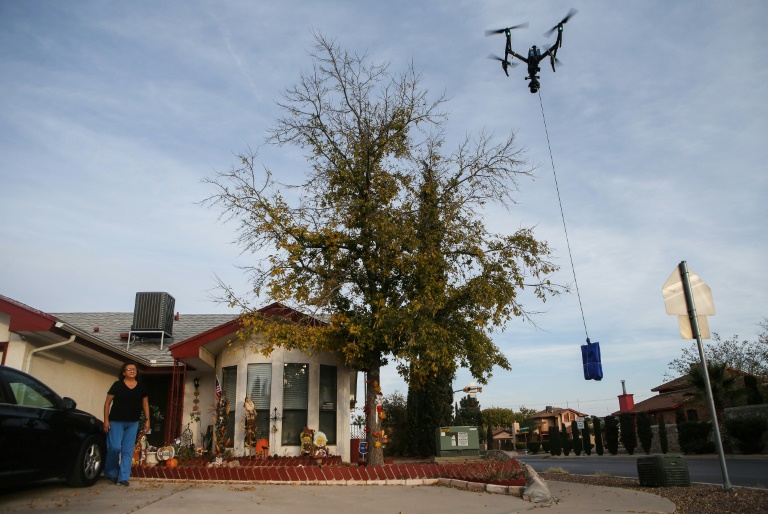
Amazon plans to start flying some purchases to customers later this year, the e-commerce giant said Monday, announcing drone delivery that will debut in a California town.

Retail rival Walmart already offers drone delivery and in May announced it is dramatically ramping up the service, expanding to six states by year-end with the potential to drop off one million packages annually.

Amazon customers in the Northern California town of Lockeford will be able to sign up for free delivery by “Prime Air” drones, the company said in a post.

“Air-eligible” items ordered at the retailer’s website will be packed into drones that will fly to the delivery addresses, deposit packages outside from safe heights, then fly away, according to Amazon.

The drones can carry loads as heavy as five pounds (2.2 kilograms) in packages about the size of a large shoe box, an Amazon spokesperson told AFP.

Items approved for drone delivery will include household products, beauty items, office supplies and tech gear, the spokesperson said.

Amazon said it has created a sophisticated system to enable its drones to detect and avoid aircraft, people, pets and other obstacles.

“We designed our sense-and-avoid system for two main scenarios: to be safe when in transit, and to be safe when approaching the ground,” the company said.

Feedback from the operations in California will be used to expand the drone service.

A variety of companies ranging from new startups to major tech firms such as Google-parent Alphabet are working on autonomous drone delivery.

Alphabet’s project Wing completed its first real-world drone deliveries in 2014 in rural Australia where they successfully transported first-aid supplies, candy bars, dog treats, and water to farmers, according to the company’s website.

Two years after that, Wing drones were used to deliver burritos to students at a university in Virginia.

“The logistics industry is abuzz with all-things drones,” the Amazon team said.

UN rights chief Bachelet won't seek second term

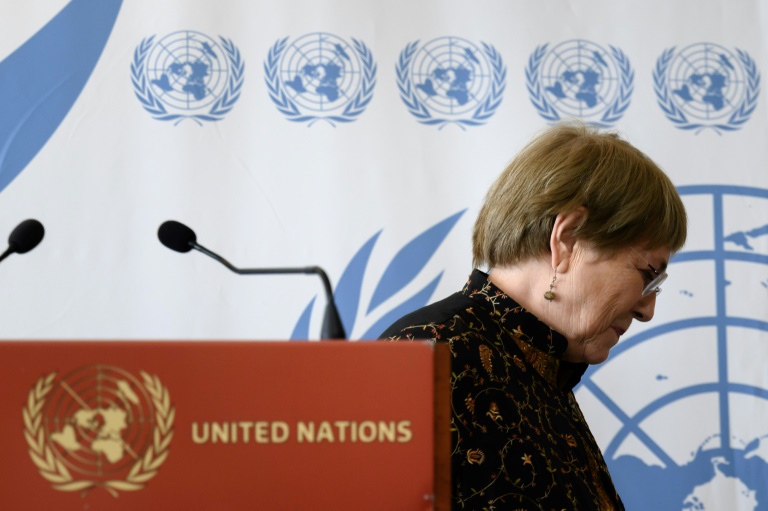
UN rights chief Michelle Bachelet said Monday she will not seek a second term, ending months of speculation, insisting she wanted to spend more time with her family in Chile.

Two major human rights organisations, Amnesty International and Human Rights Watch, used the opportunity to reiterate their criticism of Bachelet’s stance on China.

The surprise announcement came as the 70-year-old former Chilean president opened the United Nations Human Rights Council’s 50th session.

“As my term as High Commissioner draws to a close, this Council’s milestone 50th session will be the last which I brief,” Bachelet told the diplomats gathered in Geneva. 

Speculation has been rife for months about her plans.

But Bachelet told reporters “this is not something new,” saying she had informed UN Secretary General Antonio Guterres two months ago of her decision to leave “for personal reasons”.

“After a long and rich career, I want to go back to my country, to my family,” she said. 

Guterres said in a statement he was “deeply grateful to Michelle Bachelet for her relentless service” as rights chief.

Bachelet, he said, “lives and breathes human rights”, and “has moved the needle in an extremely challenging political context… She has made a profound difference for people around the globe.”

The post of High Commissioner for Human Rights typically faces heavy political pressure from countries around the world.

While it can be held for a maximum of two terms, nearly all of Bachelet’s predecessors have avoided staying on for more than one term.

– Discreet diplomacy –

But there had been speculation that Bachelet, who has largely avoided harsh public criticism of countries, might be eyeing more time.

When Guterres appointed her in 2018, it was clear she was meant to mark a break with the repeated declarations of outrage by her very outspoken predecessor Zeid Ra’ad Al Hussein of Jordan.

Bachelet, who went from torture victim under Augusto Pinochet to become the first woman to serve as president of Chile, has instead emphasised the importance of dialogue and discreet diplomacy in forwarding rights in various countries.

“Continue to seek dialogue,” she told the council Monday as she presented an overview of human rights concerns around the world.

“Be willing to hear the other, to understand respective points of view and to actively work towards identifying common ground.”

This approach has not sat well with some and she has faced significant pushback over her restraint, especially when it comes to China.

She has faced mounting criticism from countries and NGOs for not speaking out more forcefully against allegations of widespread rights abuses in the country, including during her long-awaited trip there last month — the first in 17 years by a UN rights chief.

– China criticism –

The criticism “has no relationship” with the decision not to take on a second term, she told journalists.

“Having been president twice, I have received a lot of criticism in my life,” she pointed out. “That’s not what makes me take certain positions.”

Bachelet meanwhile vowed that a long-awaited report on the rights situation in the Xinjiang region, where China is alleged to have detained more than one million Uyghurs and other Muslim minorities, will be published before she steps down on August 31.

She told the council that the report was currently “being updated”, and that it would “be shared with the government for factual comments before publication”.

Countries and NGOs have become increasingly impatient to see that report, which they say has been ready for months.

“It is important that she not let that process run out the clock on her term and hand the report to her successor,” Human Rights Watch chief Kenneth Roth told AFP Monday.

He warned that Bachelet’s focus on seeking dialogue with Chinese President Xi Jinping “lacks the pressure that alone might persuade him to ease his repression”. 

He urged Guterres to pick “a successor who is comfortable using the office’s most important tool to improve human rights practices — the willingness to speak out against even the most powerful human rights abusers”.

“Michelle Bachelet now has just two-and-a-half months to address her failures on China,” said Amnesty’s Secretary General Agnes Callamard. 

She urged Guterres to be “open and transparent” in choosing a successor, saying: “This important post requires a mandate holder who is principled and independent, and who has a proven record of deep commitment to human rights”.

Callamard called on Bachelet to “finish her term by acting with the courage and principles that the office of High Commissioner demands”.

'Bear' market: Inflation fears pummel global stocks

Equity markets dove again Monday, with Wall Street officially entering a bear market as investors bet on more aggressive Federal Reserve rate hikes to address runaway inflation.

Global markets churned in the aftermath of the latest US consumer price data, as bitcoin fell to an 18-month low, the dollar streaked higher and oil prices zig-zagged.

“The hangover from a higher-than-expected US inflation reading is continuing to cause scissoring pain throughout the markets, as it extinguishes the hope the US Federal Reserve might be able to take its foot off the pedal on interest rate rises,” noted AJ Bell investment director Russ Mould.

The S&P 500, the broad-based Wall Street equity index, plummeted 3.9 percent to finish the day at 3,749.53, a drop of more than 20 percent from its most recent peak on January 4 — the definition of a bear market.

Bourses in Paris, Frankfurt, Tokyo and Hong Kong all fell at least two percent.

The report Friday showed US consumer prices jumped 8.6 percent compared to May 2021, hitting a fresh 40-year high, topping expectations and dashing hopes that price pressures had peaked.

The Fed has signaled plans for a second large 0.5 percentage-point interest rate hike on Wednesday. 

But more voices are projecting a three-quarter point increase. Barclays said the more aggressive move was called for “to reinforce credibility and get ahead of inflationary pressures.”

The concerns sent the yield on the 10-year US Treasury note, a proxy for interest rates, above 3.3 percent, the highest level in more than 11 years.

“The market is now thinking much more about the Fed driving rates sharply higher to get on top of inflation and then having to cut back as growth drops,” said SPI Asset Management’s Stephen Innes.

The dollar, however, gained ground against major rivals, benefiting from its status as a haven investment and expectations of rapidly rising interest rates. 

The US currency struck a 24-year peak against the yen before retreating, while it broke above 78 Indian rupees for the first time, and jumped more than one percent versus the pound.

Oil prices shook off early weakness and edged higher despite fresh worries about China, where Beijing launched a new round of mass testing in the city following the latest Covid-19 outbreak.

– Bitcoin crash –

Bitcoin tumbled to an 18-month low of under $23,000 as investors shunned risky assets in the face of the vicious global market selloff. 

The unit took a heavy knock also from news that cryptocurrency lending platform Celsius Network paused withdrawals, citing volatile conditions.

“It is not very surprising to see such a strong downturn as we have noticed an increased correlation over the last few years between traditional stocks, which have also tanked recently, and the cryptocurrency market,” noted XTB chief market analyst Walid Koudmani.

Patrick O’Hare, analyst at Briefing.com, said the carnage in the crypto market “is compounding worries about growth prospects due to the reduced wealth effect that also incorporates falling stock and bond prices.”

– Key figures at around 2040 GMT –

New York – Dow: DOWN 2.8 percent at 30,516.74 (close)

New York – S&P 500 : DOWN 3.9 percent at 3,749.63 (close)

New York – Nasdaq: DOWN 4.7 percent at 10.809.23 (close)

London – FTSE 100: DOWN 1.5 percent at 7,205.81 (close)

Frankfurt – DAX: DOWN 2.4 percent at 13,427.03 (close)

Paris – CAC 40: DOWN 2.7 percent at 6,022.32 (close)

EURO STOXX 50: DOWN 2.7 percent at 3,502.50 (close)

Tokyo – Nikkei 225: DOWN 3.0 percent at 26,987.44 (close)

Hong Kong – Hang Seng Index: DOWN 3.4 percent at 21,067.58 (close)

Shanghai – Composite: DOWN 0.9 percent at 3,255.55 (close)

Dollar/yen: UP at 134.42 yen from 134.41 yen late Friday

Euro/dollar: DOWN at $1.0412 from $1.0519

Pound/dollar: DOWN at $1.2136 from $1.2493

Euro/pound: UP at 85.76 pence from 85.41 pence

Brent North Sea crude: UP 0.2 percent at $122.27 per barrel

West Texas Intermediate: UP 0.2 percent at $120.93 per barrel

burs-jmb/hs

WTO seeks shot in the arm with Covid jab IP idea

The WTO’s search for a role in fighting the pandemic sharpened up on Monday as ministers seek a compromise to lift intellectual property rights on Covid-19 vaccines.

The World Trade Organization’s first ministerial meeting since December 2017 is wrestling with the wording of a text that would temporarily waive patents on coronavirus jabs.

It is the main pandemic-combating idea being negotiated at MC12, the global trade body’s 12th ministerial conference, being held from Sunday to Wednesday at its headquarters in Geneva.

But serious objections remain from some of the countries that host major pharmaceutical companies, like Britain and Switzerland — a problem at the WTO, where decisions are taken by consensus rather than by majority.

The world’s big pharma firms are dead set against the idea, insisting that stripping patents will cripple investment and innovation.

They also say the plan has gone past its sell-by date as the world now has a surplus of vaccine doses rather than a shortage.

After Sunday’s opening ceremony and countries setting out their positions, ministers from the 164 WTO members went into rooms at the organisation’s grand, 1920s-era HQ on Lake Geneva to start talking it out face to face.

“There is continued cautious optimism about getting results at this ministerial conference,” WTO spokesman Daniel Pruzin told reporters at the close of Monday’s talks on a range of subjects.

An agreed text on the waiver is “getting closer but it needs a little bit more work” he said, describing the talks as still “problematic”.

– Birthday present? –

This week’s conference is a crunch moment for WTO chief Ngozi Okonjo-Iweala, who has staked her leadership on breathing new life into the crippled organisation, where progress has been stumbling for years.

The Nigerian former finance and foreign minister took over in March 2021 on a mission to make the WTO relevant again.

But on her 68th birthday Monday, there was no immediate sign of a breakthrough on vaccine patents.

“Pretending that a sweeping IP waiver would solve the problem does not correspond to reality. IP is not part of the problem but part of the solution,” Swiss ambassador Markus Schlagenhof told reporters.

British trade minister Anne-Marie Trevelyan said the challenge was to reach a “workable decision” on the waiver “which supports business and governments”.

Public interest groups say the draft text falls far short of what is needed, by time-limiting and complicating the vaccine patents waiver — and by leaving out Covid treatments and diagnostics.

Campaigners staged a protest in the WTO’s central atrium, chanting slogans and unfurling banners reading: “No monopolies on Covid-19 medical tools” and “End vaccine apartheid”.

“Folks have been campaigning on this for two years and it’s been a complete wall by a few countries,” demonstration organiser Deborah James told AFP.

“It’s an indictment of the WTO system: it’s completely broken, it can’t respond to a pandemic, it has no ability to put anything other than maximising profits for corporations ahead of anything else.”

– Agreement getting closer –

In October 2020, India and South Africa began pushing for the WTO to lift IP rights on Covid-19 vaccines, tests and treatments to help ensure more equitable access in poorer nations.

After multiple rounds of talks, the United States, the European Union, India and South Africa hammered out a compromise.

The text would allow most developing countries, although not China, to produce Covid vaccines without authorisation from patent holders.

Pruzin said the talks still needed to come up with a formulation on which countries would be eligible for the waiver.

Under discussion is whether countries that produce more than 10 percent of global vaccines would be ineligible to use the waiver, or whether countries would self-declare that the waiver should not apply to them.

Besides production, a second text being negotiated seeks to tackle supply constraints faced by certain countries in getting hold of Covid-fighting tools.

Pruzin said members were coming close to agreeing a text.

While many ministers said the draft on pandemic preparedness and response was “not ideal, nonetheless, broad convergence seems to be emerging for its adoption”, he told reporters.

Beyond the pandemic, the WTO faces pressure to eke out long-sought trade deals on a range of issues and show unity amid an impending global hunger crisis.

Wildfire tears through California forest as temperatures rocket

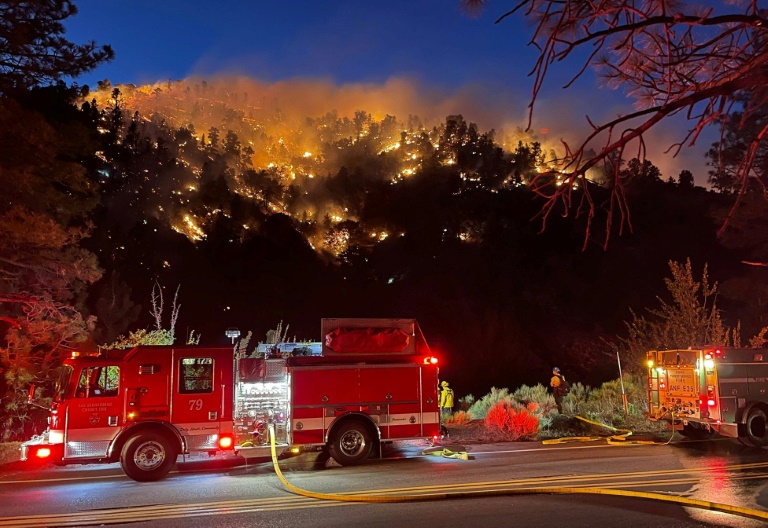
A wildfire was burning out of control Monday in forest outside Los Angeles after a weekend of record-breaking temperatures, and as forecasters warn of fire danger across the parched US West.

Almost 1,000 acres (400 hectares) had been charred by the Sheep fire since it erupted in the Los Angeles national forest on Saturday evening.

Thousands were warned to evacuate their homes in the community of Wrightwood, with the fire just five percent contained.

Firefighters battling the blaze said it was ripping through an area with thick vegetation. 

“The terrain is very steep — it’s a bad area,” Alison Hesterly of Cal Fire San Bernardino told the Los Angeles Times.

Over 200 firefighters were battling the blaze, including from the air.

“They’re really focusing hard on the edges on the northwest side and the south end to secure those edges, to hope that the wind won’t blow the fire out of the containment lines,” Hesterly said. 

“That’s a huge focus for today — securing those high-risk areas with hose lines and hand lines.”

Video on social media showed towering flames gripping trees and being fanned by strong winds.

The fire erupted as parts of California and the West were smothered in extreme heat, with temperatures in Palm Springs on Saturday hitting 114 Fahrenheit (45.5 Celsius), the highest for the day since records began.

The Southwest has been baked by a once-in-a-thousand-years drought that has left vegetation exceedingly dry and flammable.

Fire chiefs are warning that 2022 looks set to be a terrible year for wildfire.

“Given the fuel conditions, the fire conditions that we’re here talking about, I foresee a very tough four, five, six months in front of us,” Orange County Fire Authority Chief Brian Fennessy said last week.

The National Weather Service said Monday that fire danger was widespread across the region.

“An expansive area of critical fire weather conditions is expected across the Southwest into the southern and central Rockies and High Plains,” the NWS said on its website.

“Red Flag Warnings have been raised today for large portions of southeastern Utah, southwestern Colorado, northern and central Arizona and New Mexico today. 

“Dry and windy conditions will promote the rapid spread of fires across these areas.”

In New Mexico, hundreds of thousands of acres of forest have been consumed in wildfires that have been burning for months.

US President Joe Biden on Saturday flew over some of the blazes, before being briefed on efforts to combat the fires.

Temperature variations and wildfires are both expected parts of the natural cycle.

But global warming, driven chiefly by humanity’s unchecked burning of fossil fuels, has knocked the climate out of kilter.

Hot periods are hotter than they were and weather cycles are less stable.

This has exacerbated droughts and vastly increases the risk of disastrous wildfires.

'They bomb and they bomb': Anguish in Ukraine frontline city

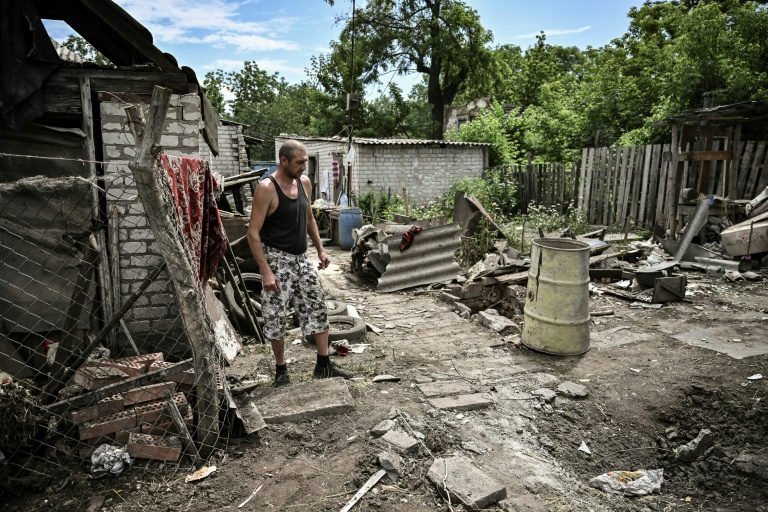
Maksym Katerin was red-eyed Monday as he showed the fresh graves of his mother and stepfather, scattered with rose petals, in his garden in Ukraine’s frontline city of Lysychansk.

On Sunday afternoon at around 5 pm, a shell ripped through his peaceful garden with its piglets and chickens, instantly killing his mother Nataliya and her husband Mykola, both 65, leaving their mutilated bodies on the ground.

“I don’t know who did this, but if I knew, I would tear off their arms,” said Katerin.

After months of shelling, the strategic city in eastern Ukraine is massively damaged with no water, electricity or phone signal.

Ukrainian artillery uses its high ground to exchange fire with Russian forces fighting for control of Severodonetsk, just across the river.

Katerin’s neighbour Yevgeniya Panicheva wept, saying Katerin’s mother “was lying here, her stomach was ripped and her guts were falling out. She was a very good, kind and helpful woman. Why did they do this to her?”

“They bomb and they bomb and we don’t know what to do.”

Their leafy street lined with mulberry and cherry trees lies close to Russian forces just across the river, with Ukrainian artillery positioned nearby. One house was completely obliterated by earlier shelling and an unexploded device could be seen sticking out of the road. 

They were not the only Lysychansk residents to die Sunday: a six-year-old boy was also killed, police told AFP, showing a photo of the crater from the shell, which scattered deadly shrapnel.

In the city centre, severed power cables lay in the street, with burnt-out shopping malls and the acrid smell of smoke in a yellow sky.

In one street, smoke rose from charred, roofless houses.

Soldiers and police drove cars with missing windows and AFP saw police haul in three youths with sacks full of looted goods.

– ‘The pits’ –

One policeman described the situation as “the pits”.

“Shells are flying in and hitting the city centre,” he said, while his colleague added: “It’s 24/7.”

“With every day, you see for yourself that the shelling doesn’t diminish, it is only intensifying,” Oleksandr Pokhna, a lieutenant-colonel in Lugansk region’s police special forces, told AFP.

Pokhna said police were trying to encourage as many residents as possible to go to evacuation points to be taken to safer parts of the country.

The boom of shelling was almost non-stop, and AFP journalists also heard the prolonged thundering of Russian multiple rocket launcher systems. 

At the entrance to the city, the roadside had craters from shelling and a cluster bomb stuck up from the ground. There were burnt-out cars at a checkpoint.

The few people out were on foot or bicycles.

Residents standing in line for greenish non-drinking water at the fire station said they were unable to leave, blaming lack of money or relatives, or the need to look after small children and pets.

“We have small (twin) babies of five months and so we can’t leave anywhere, we sit in the cellar,” said Sergiy, a metal worker.

Some called for negotiations to end the conflict.

“Can’t we come to an agreement, without weapons? We need to make an effort to make an agreement,” said a woman named Galina.

Many, seeing only Ukrainian forces and completely cut off from sources of information, insisted that Kyiv’s troops were responsible for the shelling.

One angry woman, who declined to give her name, said: “It’s the Ukrainians bombing us. They don’t consider us to be people. They call us separatists.”

“It was our own people — the Ukrainians,” an elderly man agreed.

Many locals in the Donbas coal-mining region feel little connection to Kyiv, and talk of taking “trips” to Ukraine.

Special forces police officer Pokhna acknowledged this mood but stressed: “The Ukrainian army is only defending itself.”

UK sets up EU battle with N.Ireland changes

The UK government on Monday introduced legislation to rip up post-Brexit trading rules for Northern Ireland, despite the possibility that could spark a trade war with the EU.

London says it still prefers a negotiated outcome with the European Union to reform the Northern Ireland Protocol.

But with talks stalled, the bill proposes overriding the EU withdrawal treaty that the UK signed, although the government in London insists it is not breaking international law.

The EU quickly threatened legal action in response while Dublin called it “a particular low point in the UK’s approach to Brexit”.

US Secretary of State Antony Blinken said any solution must not threaten the US-brokered 1998 deal that has largely brought peace to the territory.

He urged British Foreign Secretary Liz Truss “to continue good faith negotiations with the EU to reach a solution that preserves the gains of the Belfast/Good Friday Agreement,” a statement said.

The US has said any breach of the peace deal would threaten a bilateral trade deal with the UK.

That could not come at a worse time for the UK, which is grappling with inflation at 40-year highs and rising household bills that have left many Britons struggling to make ends meet.

London claims the new legislation  will address “burdensome customs processes, inflexible regulation, tax and spend discrepancies and democratic governance issues” that are “undermining” peace in Northern Ireland and have paralysed its power-sharing government.

– ‘Reasonable’ –

Truss spoke to European Commission Vice President Maros Sefcovic and Ireland counterpart Simon Coveney on Monday to inform them the bill was being introduced in parliament.

She called it a “reasonable, practical solution to the problems facing Northern Ireland”.

But Sefcovic said that the EU would not renegotiate its divorce deal and that Brussels would now consider reopening a suspended “infringement procedure” against Britain, as well as opening fresh cases.

“It is with significant concern that we take note of today’s decision by the UK Government to table legislation,” he said in a prepared statement to reporters in Brussels.

Sefcovic tweeted earlier that he had warned the UK minister that “unilateral action is damaging to mutual trust and a formula for uncertainty”.

Coveney told Truss the move marked “a particular low point in the UK’s approach to Brexit” and was “deeply damaging to relationships on these islands and between the UK and EU”.

“The UK’s unilateral approach is not in the best interest of Northern Ireland and does not have the consent or support of the majority of people or business in Northern Ireland,” he added.

But Prime Minister Boris Johnson insisted that the move was “the right way forward” and was needed to maintain the “balance and the symmetry” of the Good Friday peace agreement between pro-UK unionists and nationalists who want a united Ireland.

– Open border –

The pro-UK Democratic Unionist Party argues that the protocol’s creation of an effective border in the Irish Sea is jeopardising Northern Ireland’s status in the wider UK and makes a united Ireland more likely.

It is boycotting the local government in Belfast until the deal is scrapped or dramatically overhauled.

Northern Ireland’s first minister-elect, Michelle O’Neill, of Irish nationalists Sinn Fein, said Johnson was “in clear breach of international law”.

But DUP leader Jeffrey Donaldson welcomed the bill as “the kind of action that is required” to remove what he said were barriers to trade within the UK.

The protocol requires checks on goods arriving in Northern Ireland from England, Scotland and Wales, to prevent them from entering the EU’s single market via the Republic of Ireland and to avoid a return to a “hard border”.

Border infrastructure was a flashpoint during 30 years of violence over British rule in Northern Ireland and an open border was central to the peace deal.

– Green and red channels –

The UK bill proposes scrapping most of the checks, creating a “green channel” for British traders to send goods to Northern Ireland without making any customs declaration to the EU.

The EU would have access to more real-time UK data on the flow of goods, and only businesses intending to trade into the single market via Ireland would be required to make declarations via a “red channel”.

The EU would need to trust the UK to monitor the flow, London said, promising “robust penalties” for any companies seeking to abuse the new system. 

Close Bitnami banner
Bitnami