World

Argentina seizes passports of grounded plane's Iranian crew

Five Iranian crew of a cargo plane grounded in Argentina since last week have had their passports temporarily seized pending a probe into possible links to Iran’s Revolutionary Guards, officials said Monday.

A judge on Monday ordered their travel documents held for an additional 72 hours after Security Minister Anibal Fernandez said information had been received from “foreign organizations” that some among the crew may be linked to companies with ties to the Guards.

The Revolutionary Guards, Iran’s ideological army, is on a US blacklist of foreign “terrorist organizations.”

A routine check found “things that were not logical,” Fernandez told Perfil radio on Monday.

“They had declared a crew that was smaller than the one that traveled,” he said, adding the matter was “still under investigation.”

He said the five Iranians were in a hotel.

Officials originally said their passports had been taken but would be returned if they left the country on a scheduled flight while investigations continued into the plane’s origins. 

The Venezuelan Boeing 747 cargo plane reportedly carrying car parts first landed in Cordoba, Argentina on Monday last week, then tried to travel to neighboring Uruguay, but was denied entry and returned to Ezeiza outside Buenos Aires.

The crew also included 14 Venezuelans, who were free to go.

– ‘Propaganda’ –

Iran said Monday Argentina’s move was part of a “propaganda” campaign against Tehran amid tensions with Western countries over negotiations to revive a 2015 nuclear deal.

The grounding of the Emtrasur plane came days before Venezuelan President Nicolas Maduro visited Tehran on Saturday for the allies, both subject to US sanctions, to sign a 20-year cooperation pact.

Iran’s foreign ministry spokesman Saeed Khatibzadeh told reporters the grounding of the plane was part of efforts seeking to “cause a feeling of insecurity.”

The plane was sold by Iran’s Mahan Air to a Venezuelan company last year, he said.

Mahan Air is accused by the United States of links with Iran’s Revolutionary Guards.

“These recent weeks are filled with propaganda, are full of psychological operations, these wars of words that want to infiltrate the minds and composure of the people… this news is one of those,” said Khatibzadeh.

Monday’s court ruling to hold the crew’s passports came after a successful bid by the DAIA organization that represents Argentina’s Jewish community to be listed as a plaintiff in the investigation.

Interpol has arrest warrants out for former Iranian leaders suspected of involvement in an attack on a Jewish center in Buenos Aires in 1994 that killed 85 people and injured hundreds. 

It remains the deadliest terror attack in the country with South America’s largest Jewish population.

The grounding of the plane came as a resolution was adopted by the International Atomic Energy Agency’s Board of Governors to censure Iran.

Talks in Vienna, under way since April last year, aim to return the US to a nuclear deal known as the Joint Comprehensive Plan of Action (JCPOA) that it left in 2018.

The deal had given Iran sanctions relief in exchange for curbs on its nuclear program to guarantee that it could not develop a nuclear weapon — something Tehran has always denied wanting to do.

Iran said Monday that all measures it has taken to roll back on its commitments under the deal are “reversible”.
Amazon to start delivering by drone in California town

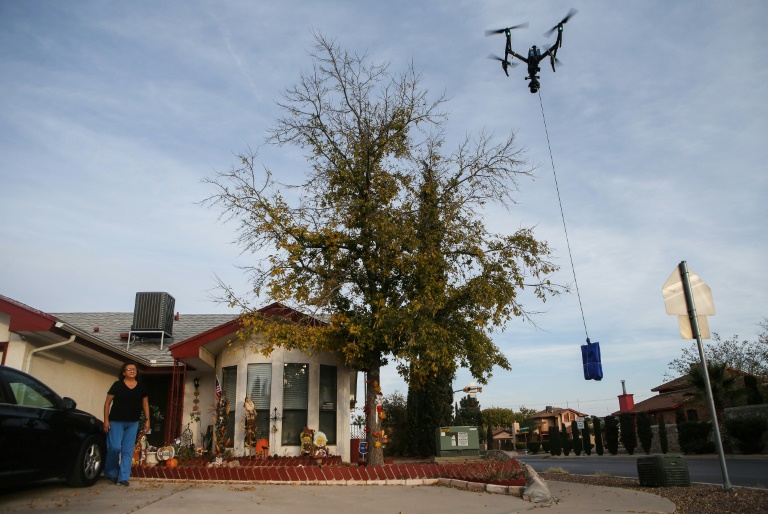
Amazon plans to start flying some purchases to customers later this year, the e-commerce giant said Monday, announcing drone delivery that will debut in a California town.

Retail rival Walmart already offers drone delivery and in May announced it is dramatically ramping up the service, expanding to six states by year-end with the potential to drop off one million packages annually.

Amazon customers in the Northern California town of Lockeford will be able to sign up for free delivery by “Prime Air” drones, the company said in a post.

“Air-eligible” items ordered at the retailer’s website will be packed into drones that will fly to the delivery addresses, deposit packages outside from safe heights, then fly away, according to Amazon.

Amazon said it has created a sophisticated system to enable its drones to detect and avoid aircraft, people, pets and other obstacles.

“We designed our sense-and-avoid system for two main scenarios: to be safe when in transit, and to be safe when approaching the ground,” the company said.

Feedback from the service in California will be used to expand the drone service.

A variety of companies ranging from new startups to major tech firms such as Google-parent Alphabet are working on autonomous drone delivery.

Alphabet’s drone project Wing completed its first real-world deliveries in 2014 in rural Australia where they successfully transported first-aid supplies, candy bars, dog treats, and water to farmers, according to the company’s website.

Two years after that, Wing drones were used to deliver burritos to students at a university in Virginia.

“The logistics industry is abuzz with all-things drones,” the Amazon team said.

EU chief, Italian PM in Israel for energy talks

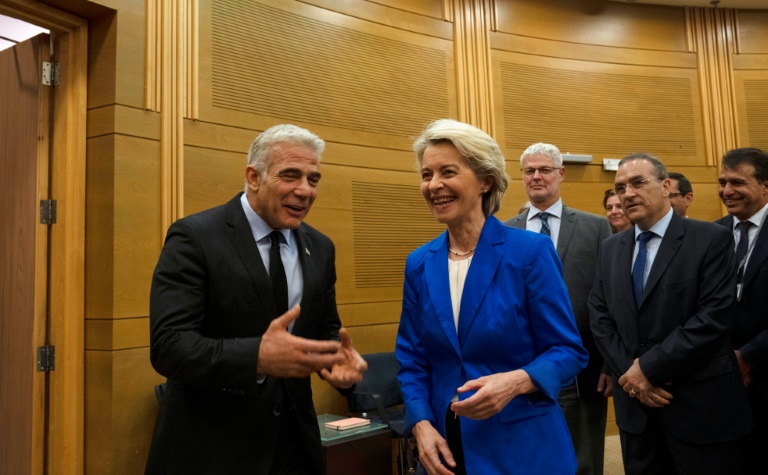
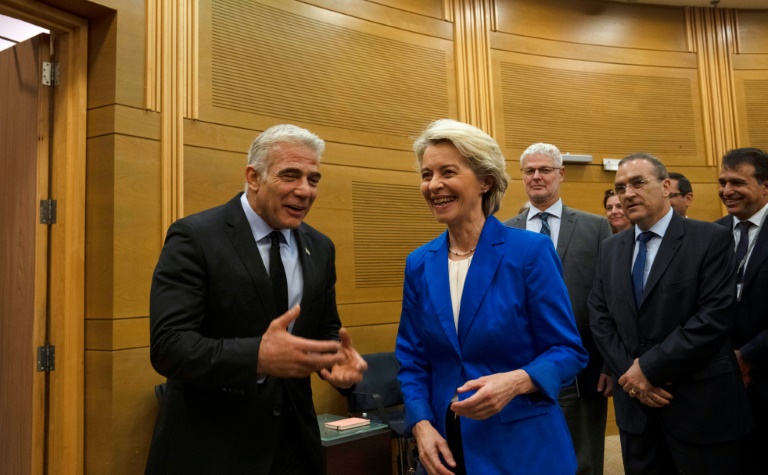
European Commission chief Ursula von der Leyen and Italian Prime Minister Mario Draghi began meetings in  Israel on Monday as the EU seeks to wean itself off Russian fossil fuel imports. 

Both leaders embarked on energy talks with Israel, which has turned from a natural gas importer into an exporter in recent years thanks to major offshore finds.

Von der Leyen was set to meet Prime Minister Naftali Bennett on Tuesday, with talks expected to focus “in particular on energy cooperation”, a commission statement said.

On Monday, she met with Foreign Minister Yaid Lapid, who said in a statement that Israel’s ties with the EU were a “strategic asset”, and later met with Energy Minister Karine Elharrar, whose spokesperson told AFP Von der Leyen reiterated “the EU need for Israeli gas.”

Draghi, on his first Middle East trip since taking office last year, will also discuss energy and food security during his two-day trip, Italian media reported.

He was also set to meet with Bennett on Tuesday, the Israeli premier’s office said.  

Speaking at a synagogue in Jerusalem shortly after landing, the Italian premier said his government was “committed to strengthening the memory of the Holocaust and to fighting against discrimination of all kinds against Jews”.

Draghi later met with Lapid, with the Israeli foreign minister’s office saying the “two discussed strengthening and deepening ties between Israel and Italy, the geopolitical situation in the wake of the war in Ukraine, and cooperation between their two countries.”

Draghi and Von der Leyen will on Tuesday meet Palestinian prime minister Mohammed Shtayyeh in the Israeli-occupied West Bank.

The EU this month formally adopted a ban on most Russian oil imports, its toughest sanctions yet over the war in Ukraine. Von der Leyen has said the bloc hopes to end its dependence on Russian hydrocarbons, including gas, by 2027.

Draghi and other EU leaders have warned European customers may need protection as energy costs continue to rise.  

Elharrar and other Israeli officials have said their country could help meet EU demand if it can deliver gas from its offshore reserves estimated at nearly 1,000 billion cubic metres.

– Export options –

Ahead of Von der Leyen’s visit, European Commission spokeswoman Dana Spinant told reporters to “stay tuned for announcements that we are going to make on energy cooperation with Israel and other partners in the region”.

For now, getting Israeli gas to Europe is fraught with challenges and would require major and long-term infrastructure investments. 

With no pipeline linking its offshore fields to Europe, one option for now is piping natural gas to Egypt, where it could be liquified for export by ship to Europe. 

Another possible scenario is building a pipeline to Turkey. 

Israel’s ties with Ankara have thawed after more than a decade of diplomatic rupture and experts have said Turkey’s desire for joint energy projects has partly triggered its outreach to Israel.  

That pipeline project would take $1.5 billion and two to three years to complete, according to Israel’s former energy minister Yuval Steizitz, now an opposition lawmaker. 

Option three is known as the EastMed project, a proposal for a seafloor pipeline linking Israel with Cyprus and Greece. 

Experts have, however, raised concerns about the cost and viability of the project, while Israel has said it would like to see Italy sign on. 

A spokesperson for the Israeli energy minister told AFP on Monday that there have been talks since March to create an agreement or legal framework to enable Israeli gas exports to Europe via Egypt.

Further complicating Israel’s offshore gas production is a long-running maritime border dispute with Lebanon. 

The neighbours technically remain at war but have agreed to US-mediated talks aimed at delineating the border to allow both countries to boost exploration. 

Talks broke down last year but Israel has urged Lebanon to re-engage. 

Tensions flared this month following a Lebanese claim that Israeli production was taking place in contested waters.

Israel countered that the area was clearly located south of the disputed zone. 

The US envoy mediating the maritime border talks, Amos Hochstein, was due in Lebanon on Monday. 

EU chief, Italian PM in Israel for energy talks

European Commission chief Ursula von der Leyen and Italian Prime Minister Mario Draghi began meetings in  Israel on Monday as the EU seeks to wean itself off Russian fossil fuel imports. 

Both leaders embarked on energy talks with Israel, which has turned from a natural gas importer into an exporter in recent years thanks to major offshore finds.

Von der Leyen was set to meet Prime Minister Naftali Bennett on Tuesday, with talks expected to focus “in particular on energy cooperation”, a commission statement said.

On Monday, she met with Foreign Minister Yaid Lapid, who said in a statement that Israel’s ties with the EU were a “strategic asset”, and later met with Energy Minister Karine Elharrar, whose spokesperson told AFP Von der Leyen reiterated “the EU need for Israeli gas.”

Draghi, on his first Middle East trip since taking office last year, will also discuss energy and food security during his two-day trip, Italian media reported.

He was also set to meet with Bennett on Tuesday, the Israeli premier’s office said.  

Speaking at a synagogue in Jerusalem shortly after landing, the Italian premier said his government was “committed to strengthening the memory of the Holocaust and to fighting against discrimination of all kinds against Jews”.

Draghi later met with Lapid, with the Israeli foreign minister’s office saying the “two discussed strengthening and deepening ties between Israel and Italy, the geopolitical situation in the wake of the war in Ukraine, and cooperation between their two countries.”

Draghi and Von der Leyen will on Tuesday meet Palestinian prime minister Mohammed Shtayyeh in the Israeli-occupied West Bank.

The EU this month formally adopted a ban on most Russian oil imports, its toughest sanctions yet over the war in Ukraine. Von der Leyen has said the bloc hopes to end its dependence on Russian hydrocarbons, including gas, by 2027.

Draghi and other EU leaders have warned European customers may need protection as energy costs continue to rise.  

Elharrar and other Israeli officials have said their country could help meet EU demand if it can deliver gas from its offshore reserves estimated at nearly 1,000 billion cubic metres.

– Export options –

Ahead of Von der Leyen’s visit, European Commission spokeswoman Dana Spinant told reporters to “stay tuned for announcements that we are going to make on energy cooperation with Israel and other partners in the region”.

For now, getting Israeli gas to Europe is fraught with challenges and would require major and long-term infrastructure investments. 

With no pipeline linking its offshore fields to Europe, one option for now is piping natural gas to Egypt, where it could be liquified for export by ship to Europe. 

Another possible scenario is building a pipeline to Turkey. 

Israel’s ties with Ankara have thawed after more than a decade of diplomatic rupture and experts have said Turkey’s desire for joint energy projects has partly triggered its outreach to Israel.  

That pipeline project would take $1.5 billion and two to three years to complete, according to Israel’s former energy minister Yuval Steizitz, now an opposition lawmaker. 

Option three is known as the EastMed project, a proposal for a seafloor pipeline linking Israel with Cyprus and Greece. 

Experts have, however, raised concerns about the cost and viability of the project, while Israel has said it would like to see Italy sign on. 

A spokesperson for the Israeli energy minister told AFP on Monday that there have been talks since March to create an agreement or legal framework to enable Israeli gas exports to Europe via Egypt.

Further complicating Israel’s offshore gas production is a long-running maritime border dispute with Lebanon. 

The neighbours technically remain at war but have agreed to US-mediated talks aimed at delineating the border to allow both countries to boost exploration. 

Talks broke down last year but Israel has urged Lebanon to re-engage. 

Tensions flared this month following a Lebanese claim that Israeli production was taking place in contested waters.

Israel countered that the area was clearly located south of the disputed zone. 

The US envoy mediating the maritime border talks, Amos Hochstein, was due in Lebanon on Monday. 

Cuba sentences 381 people over anti-government protests

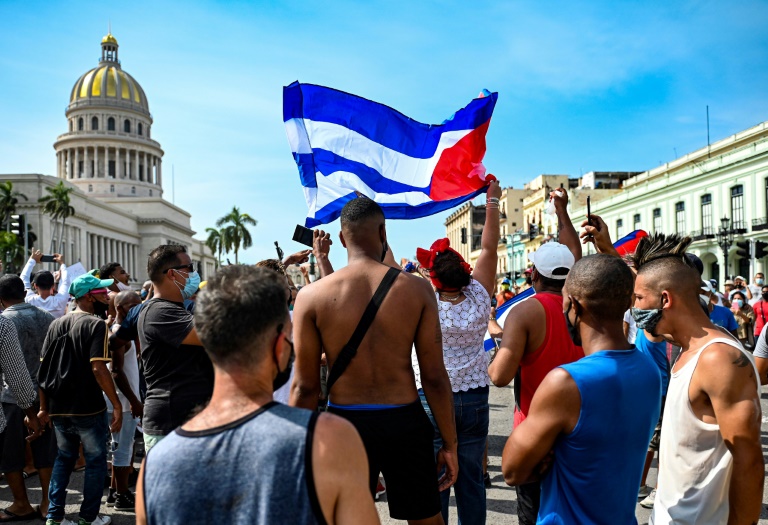
Cuban authorities have sentenced 381 people who took part in unprecedented anti-government protests last July, the public prosecutor said on Monday.

Of those, 36 people were sentenced to up to 25 years in prison for sedition.

Mass protests broke out across Cuba on July 11 and 12 with demonstrators demanding “freedom” amid economic strife, medical and food shortages, and anger at the government.

A crackdown by security forces left one dead, dozens injured and 1,300 people detained, according to the Justicia 11J civil organization.

The public prosecutor said those sentenced Monday were mostly facing “crimes of sedition, sabotage, robbery with force and violence, assault, contempt (of authority) and public disorder.”

Those sentenced included “16 young people aged 16 to 18.”

A total of 297 received prison sentences while the 84 others, including 15 youths, were given the option to commute their sentences with community service.

Although Cubans only legally reach adulthood at 18, criminal responsibility is applied from the age of 16.

In January, authorities said 790 people had been prosecuted over the demonstrations.

The government accused the United States of organizing the protests.

Washington has blasted Havana over the harshness of the sentences and has demanded the release of all those detained over the protests.

Ukraine forces pushed back from Severodonetsk centre

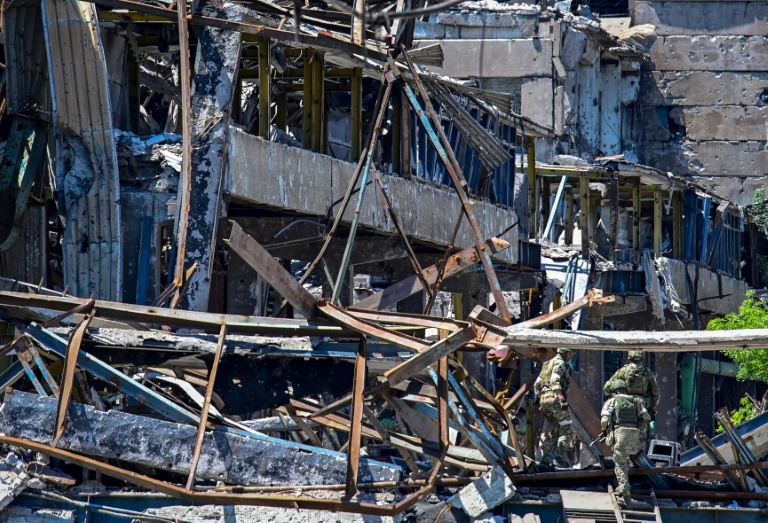
Ukraine said Monday its forces had been pushed back from the centre of key industrial city Severodonetsk, where President Volodymyr Zelensky described a fight for “literally every metre”.

The twin cities of Severodonetsk and Lysychansk have been targeted for weeks as the last areas still under Ukrainian control in the eastern Lugansk region.

Regional governor Sergiy Gaiday said Monday Russian forces control 70 to 80 percent of Severodonetsk but had not captured or encircled it.

“They destroyed all the bridges, and getting into the city is no longer possible. Evacuation is also not possible,” he told Radio Free Europe.

Ukrainian forces in the area had two choices, “to surrender or die”, said Eduard Basurin, a representative for pro-Russian separatists.

The capture of Severodonetsk would open the road to Sloviansk and another major city, Kramatorsk, in Moscow’s push to conquer Donbas, a mainly Russian-speaking region partly held by pro-Kremlin separatists since 2014.

Ukrainian forces were fighting for “every town and village where the occupiers came”, Zelensky said on Monday in a message to mark the eighth anniversary of the liberation of Mariupol in the earlier conflict.

In May, Russian troops captured the port city in southern Ukraine after a weeks-long siege.

“We are once again fighting for it and all of Ukraine,” Zelensky said.

– ‘War crimes’ –

On Monday, Amnesty International accused Russia of war crimes in Ukraine, saying that attacks on the northeastern city of Kharkiv — many using banned cluster bombs — had killed hundreds of civilians. 

“The repeated bombardments of residential neighbourhoods in Kharkiv are indiscriminate attacks which killed and injured hundreds of civilians, and as such constitute war crimes,” the rights group said in a report on Ukraine’s second-biggest city.

In Bucha, a town near Kyiv synonymous with war crimes allegations, local police said Monday they had discovered another seven bodies in a grave.

“Several victims had their hands tied and knees bound,” Kyiv regional police chief Andriy Nebytov said on Facebook.

Dozens of bodies in civilian clothing were found in the town in April after Russian troops withdrew from the area following a month-long occupation.

Elsewhere in northern Ukraine on Monday, Russian rocket strikes hit the town of Pryluky, local authorities said. 

Pryluky, which lies about 150 kilometres (90 miles) east of the capital, is home to a military airfield.

In Lysychansk, Russian bombardments killed three civilians in the last 24 hours, including a six-year-old boy, Lugansk governor Gaiday said Monday.

While in the city of Donetsk, separatist authorities said three people were killed and four wounded in Ukrainian shelling on a market.

– Weapons call –

Russia’s invasion of its neighbour has prompted Finland and Sweden to give up decades of military non-alignment and seek to join the NATO alliance. 

In terms of security, Sweden is now “in a better place now than before it applied”, NATO chief Jens Stoltenberg said on Monday, even though its application is in limbo with Turkey currently withholding its approval.

In a joint press conference with Swedish Prime Minister Magdalena Andersson, Stoltenberg said NATO was working “hard and actively” to resolve Ankara’s concerns “as soon as possible” ahead of a meeting on June 15.

It was at the summit in Brussels that Kyiv said Monday it was hoping for a decision on further Western arms deliveries to support its war effort.

“Being straightforward — to end the war we need heavy weapons,” Ukrainian presidential advisor Mykhaylo Podolyak said on Twitter.

Podolyak listed items he said the Ukrainian army requires, including hundreds of howitzers, tanks and armoured vehicles.

– WTO meeting –

Away from the battlefield, World Trade Organization members gathered in Geneva Sunday, with the threat posed to global food security by Russia’s war top of the agenda.

Tensions ran high during a closed-door session, in which around three dozen delegates “walked out” before a speech by Russia’s deputy economic development minister Vladimir Ilichev, WTO spokesman Dan Pruzin told journalists.

Ukraine’s deputy agriculture minister on Monday said a quarter of his country’s arable land had been lost but insisted national food security was not threatened.

On a farm near the southern Ukrainian city Mykolaiv, the harvest has been delayed by the need to undo the damage done by Russian troops that passed through the area in March.

“We planted really late because we needed to clear everything beforehand,” including bombshells, Nadiia Ivanova, 42, told AFP.

The farm’s warehouses currently hold 2,000 tonnes of last season’s grain but there are no takers.

The railways have been partially destroyed by the Russian army, while any ship that sails faces the threat of being sunk.

burs-sea/imm/pvh

WTO seeks shot in the arm with Covid jab IP idea

The WTO’s search for a role in fighting the pandemic sharpened up on Monday as ministers seek a compromise to lift intellectual property rights on Covid-19 vaccines.

The World Trade Organization’s first ministerial meeting since December 2017 is wrestling with the wording of a text that would temporarily waive patents on coronavirus jabs.

It is the main pandemic-combating idea being negotiated at MC12, the global trade body’s 12th ministerial conference, being held from Sunday to Wednesday at its headquarters in Geneva.

But serious objections remain from some of the countries that host major pharmaceutical companies, like Britain and Switzerland — a problem at the WTO, where decisions are taken by consensus rather than by majority.

The world’s big pharma firms are dead set against the idea, insisting that stripping patents will cripple investment and innovation.

They also say the plan — first proposed in October 2020 when the pandemic was raging and before jabs were even rolled out — has gone past its sell-by date as the world now has a surplus of vaccine doses rather than a dearth.

After Sunday’s opening ceremony and countries setting out their positions, ministers from the 164 WTO members went into rooms at the organisation’s HQ — the grand 1920s, classical Florentine-style Centre William Rappard on Lake Geneva — to start talking it out face to face.

– Birthday present? –

This week’s conference is a crunch moment for WTO chief Ngozi Okonjo-Iweala, who has staked her leadership on breathing new life into the crippled organisation, where progress has been stumbling for years.

The Nigerian former finance and foreign minister took over in March 2021 on a mission to make the WTO relevant again.

But on her 68th birthday Monday, there was no immediate sign of a breakthrough on vaccine patents.

“A broad-ranging IP waiver is a red line,” Swiss ambassador Markus Schlagenhof told reporters.

“Pretending that a sweeping IP waiver would solve the problem does not correspond to reality. IP is not part of the problem but part of the solution.”

British trade minister Anne-Marie Trevelyan said the challenge was to reach a “workable decision” on the waiver “which supports business and governments”.

Public interest groups say the draft text falls far short of what is needed, by time-limiting and complicating the vaccine patents waiver — and by leaving out Covid treatments and diagnostics.

Non-governmental organisations staged a protest in the WTO’s central atrium, chanting slogans and unfurling banners reading: “No monopolies on Covid-19 medical tools” and “End vaccine apartheid”.

“The WTO rules are contributing to exacerbating the pandemic, because it’s the WTO that enforces IP rules,” demonstration organiser Deborah James told AFP.

“Folks have been campaigning on this for two years and it’s been a complete wall by a few countries,” she said.

“It’s an indictment of the WTO system: it’s completely broken, it can’t respond to a pandemic, it has no ability to put anything other than maximising profits for corporations ahead of anything else.”

– ‘We are choosing death’ –

In October 2020, India and South Africa began pushing for the WTO to lift IP rights on Covid-19 vaccines, tests and treatments to help ensure more equitable access in poorer nations.

After multiple rounds of talks, the United States, the European Union, India and South Africa hammered out a compromise.

The text would allow most developing countries, although not China, to produce Covid vaccines without authorisation from patent holders.

Beijing has promised not to use the facilities granted to developing countries in the draft agreement, but, according to several diplomats, Washington wants this commitment in writing.

“In a pandemic, sharing technology is life or death and we are choosing death,” said the UNAIDS agency’s executive director Winnie Byanyima.

Besides production, a second text being negotiated seeks to tackle some of the supply constraints faced by certain countries in getting hold of Covid-fighting tools.

And beyond the pandemic, the WTO faces pressure to eke out long-sought trade deals on a range of issues and show unity amid an impending global hunger crisis.

Okonjo-Iweala voiced cautious optimism on Sunday that ministers could reach agreement on food security threatened by Russia’s invasion of Ukraine, overfishing and on Covid vaccines.

She said to expect a “rocky, bumpy road with a few landmines along the way”.

Last-gasp challenge fails against UK's Rwanda asylum plan

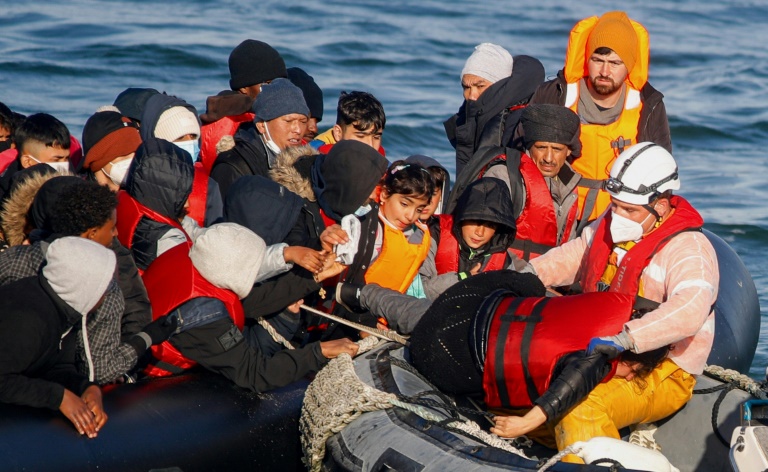
UK campaigners on Monday failed in a last-gasp bid to stop the government’s first flight of asylum seekers to Rwanda, as protests mounted against the policy.

Three judges at the Court of Appeal in London rejected a challenge to a High Court ruling last Friday that the deportations could go ahead.

Judges Rabinder Singh, Ingrid Simler and Jeremy Stuart-Smith dismissed claims the lower court judge should have waited to make a decision until a full hearing on the legality of the policy next month.

“He weighed all the factors and reached a conclusion which he was reasonably entitled to reach on the material before him,” Singh said.

“This court cannot therefore interfere with that conclusion.”

The government has vowed to push ahead with the removal of the migrants on a chartered flight on Tuesday from an undisclosed airport.

Thirty-one migrants had been due to be sent but one of the claimants, the NGO Care4Calais, tweeted that 21 of them had now had their tickets cancelled.

Other claimants include the Public and Commercial Services union, whose members will have to implement the removals and immigration support group Detention Action.

PCS chief Mark Serwotka said on Sunday it would be “an appalling situation” if Tuesday’s removals were subsequently found to be illegal at the full hearing.

Home Secretary Priti Patel should wait for the July hearing if she “had any respect, not just for the desperate people who come to this country, but for the workers she employs”, Serwotka told Sky News.

“We’re absolutely confident that in July, in line with what the UNHCR (UN Refugee Agency) said very graphically in court, we believe these proposals will be found to be unlawful.”

Protesters gathered outside the Royal Courts of Justice on Monday and further demonstrations were expected outside the Home Office.

In Geneva, UN refugee chief Filippo Grandi called the UK government policy “all wrong” and said it should not be “exporting its responsibility to another country”.

– ‘Hate speech and discrimination’ –

Patel and Prime Minister Boris Johnson insist the policy is needed to stop a flood of all-too-often deadly migrant crossings of the Channel from France.

“It’s very important that the criminal gangs who are putting people’s lives at risk in the Channel understand that their business model is going to be broken,” Johnson told LBC radio on Monday.

“They’re selling people falsely, luring them into something that is extremely risky and criminal.”

Under the agreement with Kigali, anyone landing in the UK illegally is liable to be given a one-way ticket for processing and resettlement in Rwanda.

The government says that the plan will target gangsters who charge would-be migrants thousands of dollars to undertake the perilous crossing for a new life in Britain.

Genuine asylum claimants should be content to stay in France, it says.

And contradicting the UNHCR, it insists that Rwanda is a safe destination with the capacity to absorb possibly tens of thousands of UK-bound claimants in future.

For now, the deportations will proceed “on a gradual basis”, Doris Uwicyeza, chief technical adviser to Rwanda’s justice ministry, told LBC radio.

Uwicyeza pushed back at criticism over the human rights record of President Paul Kagame’s government — which is set this month to host a Commonwealth summit attended by Prince Charles and Johnson.

Rwanda’s 1994 genocide made it particularly attentive to “protecting anybody from hate speech and discrimination”, including gay people, she said.

Rwanda’s High Commissioner to Britain, Johnston Busingye, wrote in the Daily Telegraph that Rwanda would be a “safe haven” for migrants.

But British critics are unconvinced. 

They include Prince Charles who dubbed the plan “appalling”, according to The Times newspaper on Saturday.

The reported comment prompted unnamed cabinet ministers to tell Queen Elizabeth II’s heir to stay out of politics.

International NGO Human Rights Watch issued a public letter warning that “to this day, serious human rights abuses continue to occur in Rwanda, including repression of free speech, arbitrary detention, ill-treatment, and torture”.

Ukraine forces pushed back from Severodonetsk centre

Ukraine said Monday its forces had been pushed back from the centre of key industrial city Severodonetsk, where President Volodymyr Zelensky described a fight for “literally every metre”.

The cities of Severodonetsk and Lysychansk, which are separated by a river, have been targeted for weeks as the last areas still under Ukrainian control in the eastern Lugansk region.

Regional governor Sergiy Gaiday said Monday Russian forces were “gathering more and more equipment” to “encircle” Severodonetsk.

Moscow’s troops had “pushed our units from the centre and continue to destroy our city”, he said.

Severodonetsk had been “de facto” blocked off after Russian forces blew up the “last” bridge connecting it to Lysychansk on Sunday, Eduard Basurin, a representative for pro-Russian separatists, said Monday.

Ukrainian forces in the area had two choices, he said, “to surrender or die”.

The capture of Severodonetsk would open the road for Moscow to Slovyansk and another major city, Kramatorsk, in their push to conquer the whole of Donbas, a mainly Russian-speaking region partly held by pro-Kremlin separatists since 2014.

Ukrainian forces were fighting for “every town and village where the occupiers came”, Zelensky said on Monday in a message to mark the eighth anniversary of the liberation of Mariupol in the earlier conflict.

In May, Russian troops captured the port city in southern Ukraine after a weeks-long siege.

“We are once again fighting for it and all of Ukraine,” Zelensky said.

– ‘War crimes’ –

On Monday, Amnesty International accused Russia of war crimes in Ukraine, saying that attacks on the northeastern city of Kharkiv — many using banned cluster bombs — had killed hundreds of civilians. 

“The repeated bombardments of residential neighbourhoods in Kharkiv are indiscriminate attacks which killed and injured hundreds of civilians, and as such constitute war crimes,” the rights group said in a report on Ukraine’s second biggest city.

In Bucha, a town near Kyiv synonymous with war crimes allegations, local police said Monday they had discovered another seven bodies in a grave.

“Several victims had their hands tied and knees bound,” Kyiv regional police chief Andriy Nebytov said on Facebook.

Dozens of bodies in civilian clothing were found in the town in April after Russian troops withdrew from the area following a month-long occupation.

Elsewhere in northern Ukraine on Monday, Russian rocket strikes hit the town of Pryluky, local authorities said. 

Pryluky, which lies about 150 kilometres (90 miles) east of the capital, is home to a military airfield.

In Lysychansk, Russian bombardments killed three civilians in the last 24 hours, including a six-year-old boy, Lugansk governor Gaiday said Monday.

While in the city of Donetsk, separatist authorities said three people were killed and four wounded in Ukrainian shelling on a market in the Budonivskyi district of the city.

– Weapons call –

Russia’s invasion of its neighbour has prompted Finland and Sweden to give up decades of military non-alignment and seek to join the NATO alliance. 

In terms of security, Sweden was “in a better place now than before it applied”, NATO chief Jens Stoltenberg said on Monday, even though its application is in limbo with Turkey currently withholding its approval.

In a joint press conference with Swedish Prime Minister Magdalena Andersson, Stoltenberg said NATO was working “hard and actively” to resolve Ankara’s concerns “as soon as possible” ahead of a meeting on June 15.

It was at the summit in Brussels that Kyiv said Monday it was hoping for a decision on further Western arms deliveries to support its war effort.

“Being straightforward — to end the war we need heavy weapons,” Ukrainian presidential advisor Mikhaylo Podolyak said on Twitter.

Podolyak listed items he said the Ukrainian army requires, including hundreds of howitzers, tanks and armoured vehicles.

Russian forces said Sunday they had struck a site in the town of Chortkiv in western Ukraine storing US- and EU-supplied weapons. 

The strike — a rare attack by Russia in the relatively calm west of Ukraine — left 22 people injured, regional governor Volodymyr Trush said.

– WTO meeting –

Away from the battlefield, World Trade Organization members gathered in Geneva Sunday, with the threat posed to global food security by Russia’s war top of the agenda.

Tensions ran high during a closed-door session, in which around three dozen delegates “walked out” before a speech by Russia’s deputy economic development minister Vladimir Ilichev, WTO spokesman Dan Pruzin told journalists.

On a farm near the southern Ukrainian city Mykolaiv, the harvest has been delayed by the need to undo the damage done by Russian troops that passed through the area in March.

“We planted really late because we needed to clear everything beforehand,” including bombshells, Nadiia Ivanova, 42, told AFP.

The farm’s warehouses currently hold 2,000 tonnes of last season’s grain but there are no takers.

The railways have been partially destroyed by the Russian army, while any ship that sails faces the threat of being sunk.

burs-sea/spm

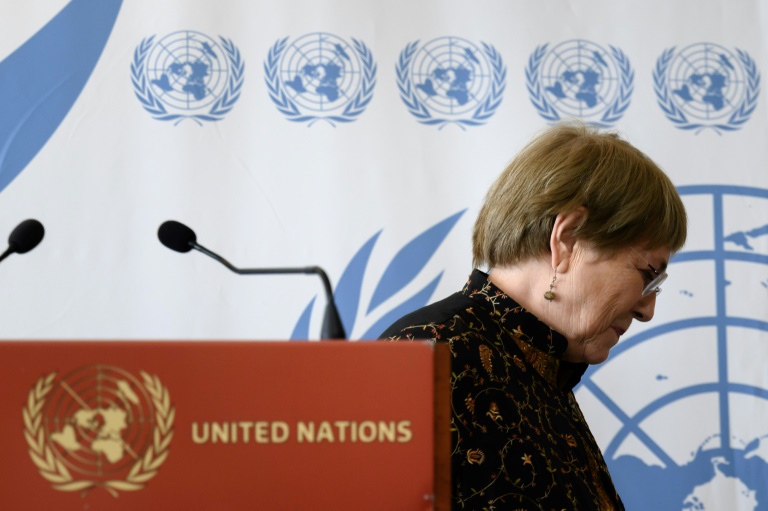
UN rights chief Bachelet won't seek second term

UN rights chief Michelle Bachelet said Monday she will not seek a second term, ending months of speculation, insisting she wanted to spend more time with her family in Chile.

The surprise announcement came as the 70-year-old former Chilean president opened the United Nations Human Rights Council’s 50th session.

“As my term as High Commissioner draws to a close, this Council’s milestone 50th session will be the last which I brief,” Bachelet told the diplomats gathered in Geneva. 

Speculation has been rife for months about her plans.

But Bachelet told reporters “this is not something new,” saying she had informed UN Secretary General Antonio Guterres two months ago of her decision to leave “for personal reasons”.

“After a long and rich career, I want to go back to my country, to my family,” she said. 

Guterres said in a statement he was “deeply grateful to Michelle Bachelet for her relentless service” as rights chief.

Bachelet, he said, “lives and breathes human rights,” and “has moved the needle in an extremely challenging political context… She has made a profound difference for people around the globe.”

The post of High Commissioner for Human Rights typically faces heavy political pressure from countries around the world, and while it can be held for a maximum of two terms, nearly all of Bachelet’s predecessors have avoided staying on for more than one term.

– Discreet diplomacy –

But there had been speculation that Bachelet, who has largely avoided harsh public criticism of countries, might be eying more time.

When Guterres appointed her in 2018, it was clear she was meant to mark a break with the repeated declarations of outrage by her very outspoken predecessor Zeid Ra’ad Al Hussein of Jordan.

Bachelet, who went from torture victim under Augusto Pinochet to become the first woman to serve as president of Chile, has instead emphasised the importance of dialogue and discreet diplomacy in forwarding rights in various countries.

“Continue to seek dialogue” she told the council Monday as she presented an overview of human rights concerns around the world.

“Be willing to hear the other, to understand respective points of view and to actively work towards identifying common ground.”

This approach has not sat well with some and she has faced significant pushback over her restraint, especially when it comes to China.

She has faced mounting criticism from countries and NGOs for not speaking out more forcefully against allegations of widespread rights abuses in the country, including during her long-awaited trip there last month — the first in 17 years by a UN rights chief.

– ‘Importance of dialogue’ –

The criticism “has no relationship” with the decision not to take on a second term, she told journalists.

“Having been president twice, I have received a lot of criticism in my life,” she pointed out. “That’s not what makes me take certain positions.”

Bachelet meanwhile vowed that a long-awaited report on the rights situation in the Xinjiang region, where China is alleged to have detained over a million Uyghurs and other Muslim minorities, will be published before she steps down on August 31.

She told the council that the report was currently “being updated”, and that it would “be shared with the government for factual comments before publication.”

Countries and NGOs have become increasingly impatient to see that report, which they say has been ready for months.

“It is important that she not let that process run out the clock on her term and hand the report to her successor,” Human Rights Watch chief Ken Roth told AFP Monday.

He warned that Bachelet’s focus on seeking dialogue with Chinese President Xi Jinping “lacks the pressure that alone might persuade him to ease his repression”. 

He urged Guterres to pick “a successor who is comfortable using the office’s most important tool to improve human rights practices –- the willingness to speak out against even the most powerful human rights abusers.”

Close Bitnami banner
Bitnami