World

Macron seeks bigger military budget in 'war economy'

French President Emmanuel Macron on Monday called for a boost to defence budgets following Russia’s invasion of Ukraine, saying France was now on a “war economy” footing. 

Speaking at Eurosatory, a weapons industry fair, Macron said Europe needed “a much larger defence industry” to avoid relying on suppliers elsewhere for its equipment needs.

Since Russia’s invasion of Ukraine in February, France “has entered into a war economy in which I believe we will find ourselves for a long time”.

Macron said he had asked the defence ministry and armed forces chiefs of staff to adjust a six-year framework defence spending plan running to 2025 to the new geopolitical situation, to “match the means to the threats”.

Even before Ukraine, French military spending had gradually increased since Macron came to power in 2017 to reach 41 billion euros ($43 billion) this year, and is currently scheduled to hit 50 billion euros in 2025.

“We didn’t wait for strategic changes to re-invest,” Macron said, but Russia’s war had created “an additional need to move faster and become stronger at a lower cost”.

Macron said that “anybody doubting the urgency of these efforts only needs to look to Ukraine, where soldiers are asking for quality weaponry and they are entitled to a response from us”.

According to Le Monde newspaper, the government’s armament agency DGA is considering a draft law that would allow the requisitioning of civilian equipment or civilian factories to make weapons.

As European governments bolster defence budgets, they need a larger EU-based defence industry to meet the new military needs, Macron said.

“Let’s not repeat the errors of the past going forward,” he said. “Spending large sums on purchases from elsewhere is not a good idea.”

Europe needs a defence industry that is “much stronger and much more ambitious” than now, he said, “or we will create our own future dependencies”.

A European fighter plan project is, according to experts, currently running about a decade late, while a new French-German battle tank project, MGCS, is not expected to be operational for nearly another two decades.

Space probe reveals secrets of 'restless' Milky Way

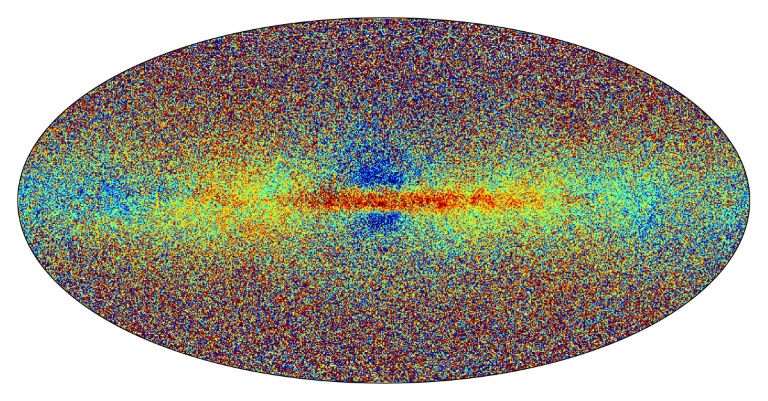
The Gaia space probe on Monday unveiled its latest discoveries in its quest to map the Milky Way in unprecedented detail, surveying nearly two million stars and revealing mysterious “starquakes” which sweep across the fiery giants like vast tsunamis.

The mission’s third data set, which was released to eagerly waiting astronomers around the world at 1000 GMT, “revolutionises our understanding of the galaxy,” the European Space Agency (ESA) said.

ESA Director-General Josef Aschbacher told a press conference that it was “a fantastic day for astronomy” because the data “will open the floodgates for new science, for new findings of our universe, of our Milky Way”.

Some of the map’s new insights came close to home, such as a catalogue of more than 156,000 asteroids in our Solar System “whose orbits the instrument has calculated with incomparable precision,” Francois Mignard, a member of the Gaia team, told AFP.

But Gaia also sees beyond the Milky Way, spotting 2.9 million other galaxies as well as 1.9 million quasars — the stunningly bright hearts of galaxies powered by supermassive black holes.

The Gaia spacecraft is nestled in a strategically positioned orbit 1.5 million kilometres (937,000 miles) from Earth, where it has been watching the skies since it was launched by the ESA in 2013.

The observation of starquakes, massive vibrations that change the shape of the distant stars, was “one of the most surprising discoveries coming out of the new data”, the ESA said.

Gaia was not built to observe starquakes but still detected the strange phenomenon on thousands of stars, including some that should not have any — at least according to our current understanding of the universe.

– ‘Turbulent’ galaxy –

“We have a fantastic new gold mine to do the asteroseismology of hundreds of thousands of stars in our Milky War galaxy,” said Gaia team member Conny Aerts.

Gaia has surveyed more than 1.8 billion stars but that only represents around one percent of the stars in the Milky Way, which is about 100,000 light years across.

The probe is equipped with two telescopes as well as a billion-pixel camera, which captures images sharp enough to gauge the diameter of a single strand of human hair 1,000 kilometres (620 miles) away.

It also has a range of other instruments that allow it to not just map the stars, but measure their movements, chemical compositions and ages.

The incredibly precise data “allows us to look more than 10 billion years into the past history of our own Milky Way,” said Anthony Brown, the chair of the Data Processing and Analysis Consortium which sifted through the massive amount of data.

The results from Gaia are already “far beyond what we expected” at this point, Mignard said.

They show that our galaxy is not moving smoothly through the universe as had been thought but is instead “turbulent” and “restless”, he said.

“It has had a lot of accidents in its life and still has them” as it interacts with other galaxies, he added. “Perhaps it will never be in a stationary state.”

“Our galaxy is indeed a living entity, where objects are born, where they die,” Aerts said. 

– ‘Tens of thousands of exoplanets’ –

“The surrounding galaxies are continuously interacting with our galaxy and sometimes also falling inside it”.

Around 50 scientific papers were published alongside the new data, with many more expected in the coming years. 

Gaia’s observations have fuelled thousands of studies since its first dataset was released in 2016.

The second dataset in 2018 allowed astronomers to show that the Milky Way merged with another galaxy in a violent collision around 10 billion years ago.

It took the team five years to deliver the latest data, which was observed from 2014 to 2017. 

The final dataset will be released in 2030, after Gaia finishes its mission surveying the skies in 2025.

Monday’s release confirmed only two new exoplanets — and 200 other potential candidates — but far more are expected in the future.

“In principle Gaia, especially when it goes on for the full 10 years, should be capable of detecting tens of thousands of exoplanets down to Jupiter’s mass,” Brown said.

Space probe reveals secrets of 'restless' Milky Way

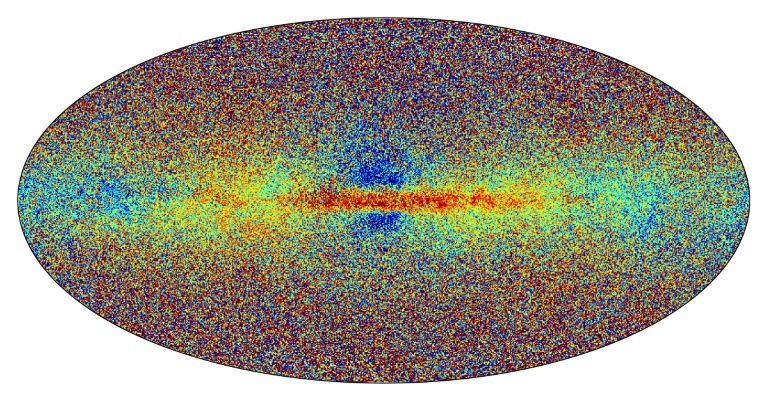
The Gaia space probe on Monday unveiled its latest discoveries in its quest to map the Milky Way in unprecedented detail, surveying nearly two million stars and revealing mysterious “starquakes” which sweep across the fiery giants like vast tsunamis.

The mission’s third data set, which was released to eagerly waiting astronomers around the world at 1000 GMT, “revolutionises our understanding of the galaxy,” the European Space Agency (ESA) said.

ESA Director-General Josef Aschbacher told a press conference that it was “a fantastic day for astronomy” because the data “will open the floodgates for new science, for new findings of our universe, of our Milky Way”.

Some of the map’s new insights came close to home, such as a catalogue of more than 156,000 asteroids in our Solar System “whose orbits the instrument has calculated with incomparable precision,” Francois Mignard, a member of the Gaia team, told AFP.

But Gaia also sees beyond the Milky Way, spotting 2.9 million other galaxies as well as 1.9 million quasars — the stunningly bright hearts of galaxies powered by supermassive black holes.

The Gaia spacecraft is nestled in a strategically positioned orbit 1.5 million kilometres (937,000 miles) from Earth, where it has been watching the skies since it was launched by the ESA in 2013.

The observation of starquakes, massive vibrations that change the shape of the distant stars, was “one of the most surprising discoveries coming out of the new data”, the ESA said.

Gaia was not built to observe starquakes but still detected the strange phenomenon on thousands of stars, including some that should not have any — at least according to our current understanding of the universe.

– ‘Turbulent’ galaxy –

“We have a fantastic new gold mine to do the asteroseismology of hundreds of thousands of stars in our Milky War galaxy,” said Gaia team member Conny Aerts.

Gaia has surveyed more than 1.8 billion stars but that only represents around one percent of the stars in the Milky Way, which is about 100,000 light years across.

The probe is equipped with two telescopes as well as a billion-pixel camera, which captures images sharp enough to gauge the diameter of a single strand of human hair 1,000 kilometres (620 miles) away.

It also has a range of other instruments that allow it to not just map the stars, but measure their movements, chemical compositions and ages.

The incredibly precise data “allows us to look more than 10 billion years into the past history of our own Milky Way,” said Anthony Brown, the chair of the Data Processing and Analysis Consortium which sifted through the massive amount of data.

The results from Gaia are already “far beyond what we expected” at this point, Mignard said.

They show that our galaxy is not moving smoothly through the universe as had been thought but is instead “turbulent” and “restless”, he said.

“It has had a lot of accidents in its life and still has them” as it interacts with other galaxies, he added. “Perhaps it will never be in a stationary state.”

“Our galaxy is indeed a living entity, where objects are born, where they die,” Aerts said. 

– ‘Tens of thousands of exoplanets’ –

“The surrounding galaxies are continuously interacting with our galaxy and sometimes also falling inside it”.

Around 50 scientific papers were published alongside the new data, with many more expected in the coming years. 

Gaia’s observations have fuelled thousands of studies since its first dataset was released in 2016.

The second dataset in 2018 allowed astronomers to show that the Milky Way merged with another galaxy in a violent collision around 10 billion years ago.

It took the team five years to deliver the latest data, which was observed from 2014 to 2017. 

The final dataset will be released in 2030, after Gaia finishes its mission surveying the skies in 2025.

Monday’s release confirmed only two new exoplanets — and 200 other potential candidates — but far more are expected in the future.

“In principle Gaia, especially when it goes on for the full 10 years, should be capable of detecting tens of thousands of exoplanets down to Jupiter’s mass,” Brown said.

Sandstorm brings Iraq to standstill, grounds flights

Iraq temporarily closed Baghdad airport Monday as choking clouds of dust blanketed the capital, the latest crippling sandstorm in a country that has warned climate change poses an “existential threat”.

It was the tenth duststorm since mid-April to hit Iraq, which has been battered by intense droughts, soil degradation, high temperatures and low rainfall linked to climate change.

Earlier this month, to mark World Environment Day, President Barham Saleh warned that tackling climate change “must become a national priority for Iraq as it is an existential threat to the future of our generations to come”.

On Monday morning, a thick white dust covered the Iraqi capital and surroundings areas, with visibility slashed to a few hundred metres (yards).

Officials at Baghdad airport announced the temporary suspension of flights for a few hours before they were restarted at around 10:30 am (0730 GMT).

In Najaf, a Shiite holy city in central Iraq, the airport briefly suspended operations in the morning before reopening a few hours later when the dust passed.

Airports have been forced to suspend flights several times due to sandstorms in recent weeks.

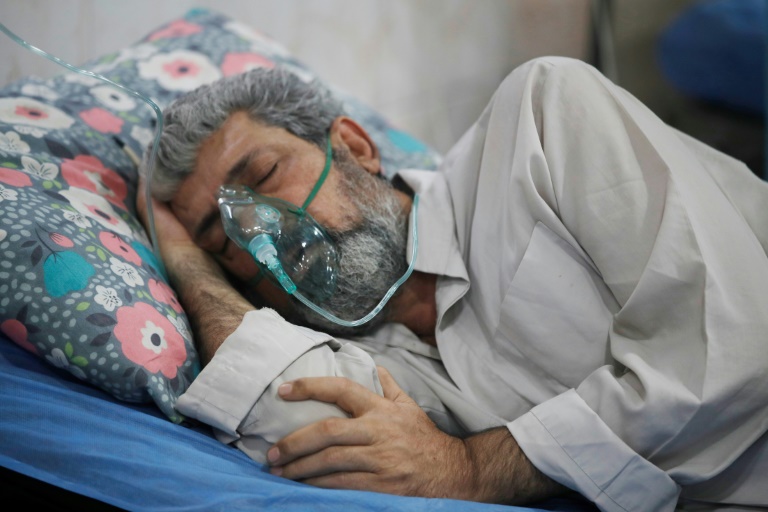
In May, sandstorms sent thousands of people to hospital with respiratory problems, and left one person dead.

Iraq, which is entering the scorching summer season when temperatures at times surpass 50 degrees Celsius (122 Fahrenheit), is ranked by the United Nations as one of the world’s five most vulnerable nations to climate change and desertification.

The environment ministry has warned that over the next two decades Iraq could endure an average of 272 days of sandstorms per year, rising to above 300 by 2050.

WTO seeks shot in the arm with Covid jab IP idea

The WTO’s search for a role in fighting the pandemic sharpened up on Monday as ministers seek a compromise to lift intellectual property rights on Covid-19 vaccines.

The World Trade Organization’s first ministerial meeting since December 2017 is wrestling with the wording of a text that would temporarily waive patents on coronavirus jabs.

It is the main pandemic-combating idea being negotiated at MC12, the global trade body’s 12th ministerial conference, being held from Sunday to Wednesday at its headquarters in Geneva.

But serious objections remain from some of the countries that host major pharmaceutical companies, like Britain and Switzerland — a problem at the WTO, where decisions are taken by consensus rather than by majority.

The world’s big pharma firms are dead set against the idea, insisting that stripping patents will cripple investment and innovation.

They also say the plan — first proposed in October 2020 when the pandemic was raging and before jabs were even rolled out — has gone past its sell-by date as the world now has a surplus of vaccine doses rather than a dearth.

After Sunday’s opening ceremony and countries setting out their positions, ministers from the 164 WTO members went into rooms at the organisation’s HQ — the grand 1920s, classical Florentine-style Centre William Rappard on Lake Geneva — to start talking it out face to face.

– Birthday present? –

This week’s conference is a crunch moment for WTO chief Ngozi Okonjo-Iweala, who has staked her leadership on breathing new life into the crippled organisation, where progress has been stumbling for years.

The Nigerian former finance and foreign minister took over in March 2021 on a mission to make the WTO relevant again.

But on her 68th birthday Monday, there was no immediate sign of a breakthrough on vaccine patents.

Public interest groups say the draft text falls far short of what is needed, by time-limiting and complicating the vaccine patents waiver — and by leaving out Covid treatments and diagnostics.

Non-governmental organisations staged a protest in the WTO’s central atrium, chanting slogans and unfurling banners reading: “No monopolies on Covid-19 medical tools” and “End vaccine apartheid”.

“The WTO rules are contributing to exacerbating the pandemic, because it’s the WTO that enforces IP rules,” demonstration organiser Deborah James told AFP.

“Folks have been campaigning on this for two years and it’s been a complete wall by a few countries,” she said.

“It’s an indictment of the WTO system: it’s completely broken, it can’t respond to a pandemic, it has no ability to put anything other than maximising profits for corporations ahead of anything else.”

– ‘We are choosing death’ –

In October 2020, India and South Africa began pushing for the WTO to lift IP rights on Covid-19 vaccines, tests and treatments to help ensure more equitable access in poorer nations.

After multiple rounds of talks, the United States, the European Union, India and South Africa hammered out a compromise.

The text would allow most developing countries, although not China, to produce Covid vaccines without authorisation from patent holders.

Beijing has promised not to use the facilities granted to developing countries in the draft agreement, but, according to several diplomats, Washington wants this commitment in writing.

“In a pandemic, sharing technology is life or death and we are choosing death,” said the UNAIDS agency’s executive director Winnie Byanyima.

Besides production, a second text being negotiated seeks to tackle some of the supply constraints faced by certain countries in getting hold of Covid-fighting tools.

And beyond the pandemic, the WTO faces pressure to eke out long-sought trade deals on a range of issues and show unity amid an impending global hunger crisis.

Okonjo-Iweala voiced cautious optimism on Sunday that ministers could reach agreement on food security threatened by Russia’s invasion of Ukraine, overfishing and on Covid vaccines.

She said to expect a “rocky, bumpy road with a few landmines along the way”.

Ukraine forces pushed back from Severodonetsk centre

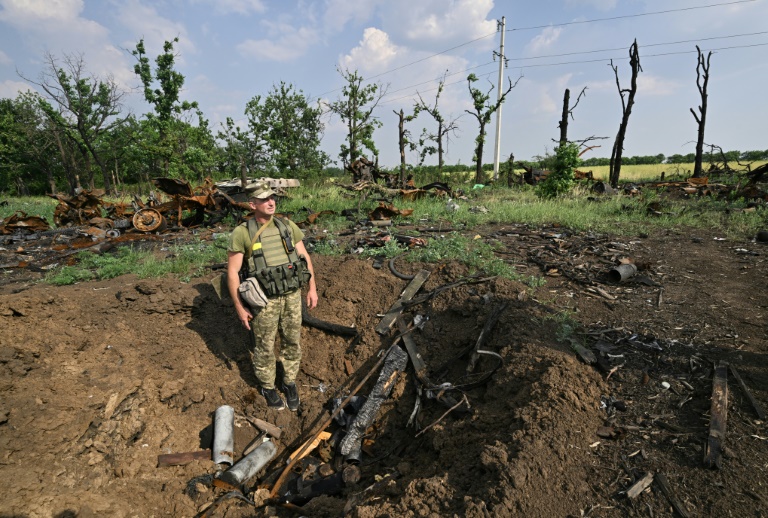
Ukraine said Monday its forces had been pushed back from the centre of key industrial city Severodonetsk, where President Volodymyr Zelensky described a fight for “literally every metre”.

The cities of Severodonetsk and Lysychansk, which are separated by a river, have been targeted for weeks as the last areas still under Ukrainian control in the eastern Lugansk region.

Regional governor Sergiy Gaiday said Monday Russian forces were “gathering more and more equipment” to “encircle” Severodonetsk, and that they had “pushed our troops from the centre and continue to destroy our city”.

The local Azot chemical plant, where hundreds of civilians have reportedly taken refuge, was being “heavily shelled”, Gaiday said.

In Lysychansk, bombardments killed three civilians, including a six-year-old boy, he said.

Severodonetsk had been “de facto” blocked off after Russian forces blew up the “last” bridge connecting it to Lysychansk Sunday, Eduard Basurin, a representative for pro-Russian separatists, said Monday.

“The Ukrainian units that are there, they are there forever. They have two options: to surrender or die,” Basurin said.

On Sunday, Zelensky said the latest fighting in Severodonetsk was “very fierce”, adding that Russia was deploying undertrained troops and using its young men as “cannon fodder”.

Russia’s massed artillery in that region gave it a tenfold advantage, the commander-in-chief of the Ukrainian military, Valeriy Zaluzhny, said Sunday. 

“Every metre of Ukrainian land there is covered in blood — but not only ours, but also the occupier’s.”

The capture of Severodonetsk would open the road for Moscow to another major city, Kramatorsk, in their steps toward conquering the whole of Donbas, a mainly Russian-speaking region partly held by pro-Russian separatists since 2014.

– ‘War crimes’ –

On Monday, Amnesty International accused Russia of war crimes in Ukraine, saying that attacks on the northeastern city of Kharkiv — many using banned cluster bombs — had killed hundreds of civilians. 

“The repeated bombardments of residential neighbourhoods in Kharkiv are indiscriminate attacks which killed and injured hundreds of civilians, and as such constitute war crimes,” the rights group said in a report on Ukraine’s second biggest city.

Away from the battlefield, World Trade Organization members gathered in Geneva Sunday, with the threat posed to global food security by Russia’s war in wheat-producing Ukraine top of the agenda.

Tensions ran high during a closed-door session, where several delegates took the floor to condemn Russia’s war, including Kyiv’s envoy who was met with a standing ovation, WTO spokesman Dan Pruzin told journalists.

Just before Russian Minister of Economic Development Maxim Reshetnikov spoke, around three dozen delegates “walked out”, the spokesman said.

On a farm near the city of Mykolaiv in the south, the harvest has been delayed by the need to undo the damage done by Russian troops that passed through the area in March.

“We planted really late because we needed to clear everything beforehand,” including bombshells, Nadiia Ivanova, 42, told AFP.

The farm’s warehouses currently hold 2,000 tonnes of last season’s grain but there are no takers.

The railways have been partially destroyed by the Russian army, while any ship that sails faces the threat of being sunk.

– ‘Out of it’ –

The war has prompted Finland and Sweden to give up decades of military non-alignment and seek to join the NATO alliance.

But Turkey is blocking their bids and NATO chief Jens Stoltenberg said Sunday the issue may not be resolved in time for an alliance summit later this month.

Speaking to AFP, Mikhail Kasyanov, Russia’s prime minister from 2000 to 2004, said he thought President Vladimir Putin was “out of it”, after seeing the Russian leader summon the country’s top brass for a theatrical meeting three days before the invasion on February 24.

“I knew a different Putin,” said Kasyanov, 64, who served under Putin but has become one of the Kremlin’s most vocal critics.

Kasyanov predicted the war could last for up to two years and said it is imperative that Ukraine win.

“If Ukraine falls, the Baltic states will be next,” he said.

– Chortkiv strike –

The United States and Europe have sent weapons and cash to help Ukraine blunt Russia’s advance, alongside punishing Moscow with unprecedented economic sanctions. 

Russian forces said Sunday they had struck a site in the town of Chortkiv in western Ukraine storing US- and EU-supplied weapons.

Russia’s defence ministry said the strike destroyed a “large depot of anti-tank missile systems, portable air defence systems and shells provided to the Kyiv regime by the US and European countries”.

The strike — a rare attack by Russia in the relatively calm west of Ukraine — left 22 people injured, regional governor Volodymyr Trush said.

Concerns eased Sunday over Ukraine’s largest nuclear power plant in Zaporizhzhia. Captured months ago by Russian forces but still operated by Ukrainians, the station had ceased transmitting vital safeguards data two weeks ago.

But plant officials working with the International Atomic Energy Agency have succeeded in restoring transmission, the IAEA said. 

Rafael Grossi, director general of the UN agency, said it still wanted to send inspectors to the plant “as soon as possible”.

burs-sea/raz

War in Ukraine: Latest developments

Here are the latest developments in the war in Ukraine:

– Ukraine forces driven from central Severodonetsk –

The governor of the eastern Lugansk, Sergiy Gaiday, says Ukraine’s forces have been driven from the centre of the key eastern city of Severodonetsk, after a weeks-long Russian offensive for the industrial hub.

Ukrainian President Volodymyr Zelensky says his forces are fighting for “literally every meter” of one of the last cities in Lugansk that had yet to fall to Russian forces.

Gaiday says that the Russians have destroyed a second bridge into the city on the Donets river and that the Azot chemical plant, where hundreds of civilians are taking shelter, is being “heavily shelled”.

Britain’s defence intelligence says that “river crossing operations are likely to be amongst the most important determining factors in the course of the war” in the coming months. 

Ukraine has regularly blown up bridges to halt the Russians’ advance.

– Baltic states could be next, says ex-PM –

One of Russian President Vladimir Putin’s former prime ministers warns that the war could last up to two years and says it is imperative that Ukraine wins.

“If Ukraine falls, the Baltic states will be next,” says Mikhail Kasyanov, who was Putin’s first prime minister before being sacked in 2004 and is now one of the Kremlin’s chief critics.

In an interview with AFP, Kasyanov, who has left Russia, disagrees with French President Emmanuel Macron’s suggestion that Putin should not be humiliated and also rejects calls for Ukraine to cede territory to end the war.

“I believe this is wrong and hope that the West won’t go down that path,” he says.

– ‘Shocking’ use of cluster bombs: Amnesty –

Amnesty International accuses Russia of the repeated use of cluster bombs in attacks on residential neighbourhoods of Ukraine’s second city, Kharkiv. 

The London-based NGO says it has uncovered proof of the use of 9N210 and 9N235 cluster bombs and scatterable land mines, all of which are banned under international conventions.

“The repeated use of widely banned cluster munitions is shocking, and a further indication of utter disregard for civilian lives,” Donatella Rovera, Amnesty International’s Senior Crisis Response Adviser, says.

– Russian oil revenues soar –

A report shows Russia’s revenues from exports of oil and gas reaching record highs during the first 100 days of the war, with Moscow taking in 93 billion euros ($98 billion), most of it from European Union customers

The report from the independent, Finland-based Centre for Research on Energy and Clean Air (CREA) shows the top clients for Russian oil, gas and coal being China with 12.6 billion euros,  followed by Germany (12.1 billion) and Italy (7.8 billion).

The EU last month agreed to halt most Russian oil imports but an embargo on Russian gas is not on the cards at present.

Russia’s exports have plummeted but high global fossil fuel prices have helped offset the declines, the report showed.

– WTO walkout  –

The war spills over into a meeting of the World Trade Organization in Geneva, where dozens of delegates walk out during a speech by Russia’s Minister of Economic Development Maxim Reshetnikov. Ukraine’s envoy, by contrast, receives a standing ovation.

The food crisis sparked by the war in Ukraine, one of the world’s biggest grain producers, is top of the agenda of the four-day session.

– Long queues for Russian McDonald’s –

Long queues form outside a former McDonald’s restaurant in central Moscow that reopened Sunday a month after the US fast-food giant pulled out of Russia.

Russia’s answer to McDonald’s is called “Vkusno i tochka” (“Delicious. Full Stop”). A new logo depicting a burger and two fries has replaced McDonald’s iconic Golden Arches.

The queues at the restaurant on Pushkin Square draw comparisons with the excitement generated by the opening of the first McDonald’s in Russia in January 1990, which was hailed as a sign of Soviet detente with the West.

Fifty more of the burger joints are to be opened on Monday, the chain’s management says.

burs-cb/kjm

Bitcoin slumps under $25,000, lowest in 18 months

Bitcoin tumbled Monday to an 18-month low under $25,000 as investors shunned risky assets in the face of a vicious global markets selloff, months after the cryptocurrency hit a record high.

The unit took a heavy knock also from news that cryptocurrency lending platform Celsius Network paused withdrawals, citing volatile conditions.

World stock markets have plunged since Friday when data showed US inflation at a fresh four-decade high, increasing recession fears and sending investors running for safer assets like the dollar.

“It is not very surprising to see such a strong downturn as we have noticed an increased correlation over the last few years between traditional stocks, which have also tanked recently, and the cryptocurrency market,” noted XTB chief market analyst Walid Koudmani.

The world’s most popular cryptocurrency dived about 10 percent to hit $23,794 in morning London deals, striking a level last seen in December 2020.

The virtual unit has collapsed by 65 percent in value since striking a record peak $68,991.85 in November.

Investors on Monday sought safety with the US central bank seen likely to aggressively ramp up borrowing costs further to combat runaway inflation.

Bitcoin’s decline accelerated after the news from Celsius Network. 

“Today we are announcing that Celsius is pausing all withdrawals, swap, and transfers between accounts,” the platform said in a statement.

Celsius made the move “due to extreme market conditions”, it added.

The total value of customer deposits had already shrunk by more than half to under $12 billion in May compared with the end of last year.

– $1 trillion market –

Koudmani said further falls for bitcoin “may trigger a cascading effect of liquidations of hedging positions” taken against the cryptocurrency. 

The global crypto market, comprising other virtual currencies which are tanking such as Ethereum, is worth about $1 trillion, according to crypto data aggregator CoinGecko.

That is down from a level of more than $3 trillion at its peak seven months ago, when the market rode a wave of massive investor demand amid growing acceptance from large financial institutions.

In a sign of the growing importance of cryptocurrencies, two countries, El Salvador and the Central African Republic, have taken the gamble of adopting bitcoin as legal tender — despite strong criticism from international financial institutions.

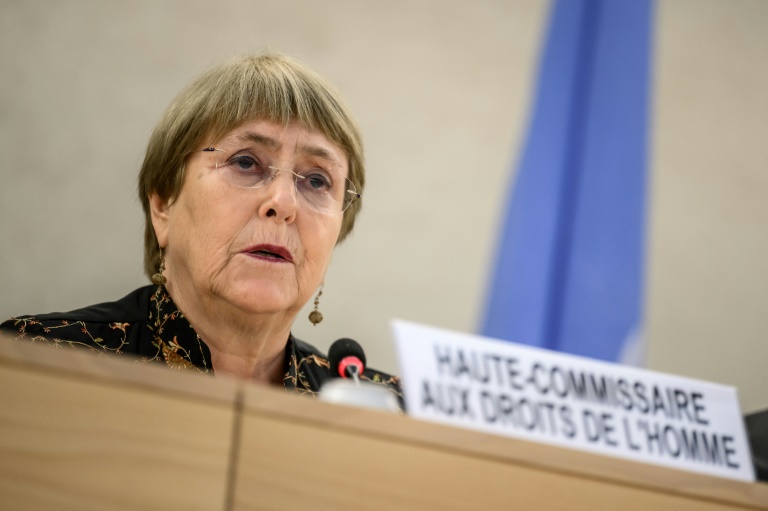
UN rights chief Bachelet won't seek second term

UN rights chief Michelle Bachelet said Monday she will not seek a second term, ending months of speculation amid growing criticism of her lax stance on rights abuses in China.

“As my term as High Commissioner draws to a close, this Council’s milestone 50th session will be the last which I brief,” Bachelet told the UN Human Rights Council as it opened a four-week sitting.

She provided no explanation for her decision.

The 70-year-old former Chilean president, who will wrap up her four-year mandate at the end of August, had until now remained mum about whether she would seek to stay on for a second term.

Speculation has been rife for months, with a wide range of diplomats in Geneva telling AFP in recent weeks that she had yet to provide clues to her plans.

The post of High Commissioner for Human Rights typically faces heavy political pressure from countries around the world, and while it can be held for a maximum of two terms, nearly all of Bachelet’s predecessors have avoided staying on for more than one term.

– Discrete diplomacy –

Bachelet has faced mounting criticism from countries and NGOs for not speaking out more forcefully against allegations of widespread rights abuses in some countries, most notably in China.

When she was appointed in 2018 by UN Secretary-General Antonio Guterres, it was clear she was meant to mark a break with the repeated declarations of outrage by her very outspoken predecessor Zeid Ra’ad Al Hussein of Jordan.

Bachelet, who went from torture victim under Augusto Pinochet to become the first woman to serve as president of Chile, has instead emphasised the importance of dialogue and discrete diplomacy in forwarding rights in various countries.

This approach has not sat well with some and she has faced significant pushback over her restraint, especially when it comes to China.

She did take a long-awaited trip to the country last month — the first in 17 years by a UN rights chief.

The trip took her to the far-western Xinjiang region, where China is alleged to have detained over a million Uyghurs and other Muslim minorities, as well as carried out forced sterilisation of women and coerced labour. 

The United States has labelled China’s actions in Xinjiang a “genocide” and “crimes against humanity”, allegations vehemently denied by Beijing which says its security crackdown in the region was a necessary response to extremism.

– ‘Seek dialogue’ –

While there, Bachelet did raise concerns about the situation, but NGOs said had not gone far enough and had “legitimised Beijing’s attempt to cover up its crimes”.

In her statement to the Rights Council Monday, Bachelet stressed that she had “raised concerns regarding the human rights situation of the Uyghur and other predominantly Muslim minorities in Xinjiang, including broad arbitrary detention and patterns of abuse.”

Bachelet, who has faced harsh criticism for so far failing to release a report on the rights situation in Xinjiang, said the report was now “being updated”.

“It will be shared with the government for factual comments before publication,” she said.

At the same time, she hailed the opening of dialogue with China, saying there was now an agreement to “hold an annual senior meeting on human rights and to continue exchanges on “specific human rights issues of concern”.

“We are now elaborating concrete steps to put the agreements into action.”

Presenting an overview of a long line of rights situations of concern around the world, Bachelet appealed Monday to the rights council to “continue to seek dialogue”.

“Be willing to hear the other, to understand respective points of view and to actively work towards identifying common ground,” she said.

UK's Rwanda asylum plan faces last-gasp challenge

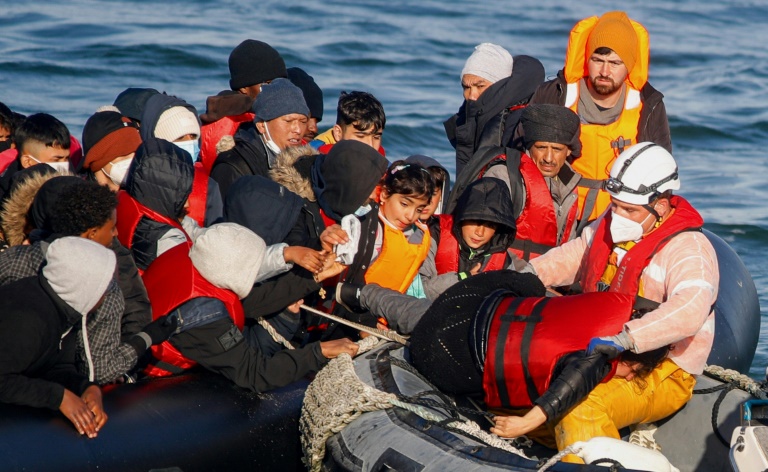
UK campaigners get their last chance in court on Monday to stop the government’s first flight of asylum seekers to Rwanda, as protests mount against the policy.

The government is vowing to push ahead with the planeload of 31 claimants, on a chartered flight on Tuesday from an undisclosed airport.

It defeated an attempt to halt the plan on Friday in the High Court, brought by refugee charities and a trade union which called it immoral, dangerous and counter-productive.

But the same groups have filed an emergency appeal for Monday, alongside a separate legal challenge, and have been heartened by Prince Charles reportedly dubbing the plan “appalling”.

The claimants include the Public and Commercial Services Union (PCS), whose members in the UK Border Force agency are tasked with executing the deportations. 

NGO Care4Calais tweeted that 20 of those due to be on the flight had had their tickets cancelled, but that 11 were still set to leave on Tuesday.

These include four Iranians, two Iraqis, two Albanians and one Syrian, they added.

PCS chief Mark Serwotka noted that as part of its judgment on Friday, the High Court had scheduled a fuller hearing for next month on the legality of the plan overall.

“Imagine if you’re told to do something on Tuesday, that in July is subsequently found to be illegal. That would be an appalling situation,” he told Sky News on Sunday. 

Home Secretary Priti Patel should wait for the July hearing if she “had any respect, not just for the desperate people who come to this country, but for the workers she employs”, Serwotka added.

“We’re absolutely confident that in July, in line with what the UNHCR (UN Refugee Agency) said very graphically in court, we believe these proposals will be found to be unlawful.”

Protests were held outside a detention centre on Sunday and more are expected outside the Home Office on Monday.

– ‘Hate speech and discrimination’ –

However, Patel and Prime Minister Boris Johnson are unbowed, insisting the policy is needed to stop a flood of all-too-often deadly migrant crossings of the Channel from France.

“It’s very important that the criminal gangs who are putting people’s lives at risk in the Channel understand that their business model is going to be broken,” Johnson told LBC radio on Monday.

“They’re selling people falsely, luring them into something that is extremely risky and criminal.”

Under the agreement with Kigali, anyone landing in the UK illegally is liable to be given a one-way ticket for processing and resettlement in Rwanda.

The government says that the plan will target gangsters who charge would-be migrants thousands of dollars to undertake the perilous crossing for a new life in Britain.

Genuine asylum claimants should be content to stay in France, it says.

And contradicting the UN refugee agency, it insists that Rwanda is a safe destination with the capacity to absorb possibly tens of thousands of UK-bound claimants in future.

For now, the deportations will proceed “on a gradual basis”, Doris Uwicyeza, chief technical adviser to Rwanda’s justice ministry, told LBC radio.

Uwicyeza pushed back at criticism over the human rights record of President Paul Kagame’s government — which is set this month to host a Commonwealth summit attended by Prince Charles and Johnson.

Rwanda’s 1994 genocide made it particularly attentive to “protecting anybody from hate speech and discrimination”, including gay people, she said.

Rwanda’s High Commissioner to Britain, Johnston Busingye, wrote in the Daily Telegraph that Rwanda would be a “safe haven” for migrants.

But British critics of the new policy are unconvinced. 

They include Prince Charles, according to The Times newspaper on Saturday, prompting unnamed cabinet ministers to tell Queen Elizabeth II’s heir to stay out of politics.

International NGO Human Rights Watch issued a public letter warning that “to this day, serious human rights abuses continue to occur in Rwanda, including repression of free speech, arbitrary detention, ill-treatment, and torture”.

Close Bitnami banner
Bitnami