World

French astronaut Pesquet calls for European space independence

French astronaut Thomas Pesquet on Tuesday urged Europe to seize the momentum created by its newfound diplomatic unity and “start moving now” to develop its own human spaceflight capacity.

The charismatic engineer and pilot, 44, recently completed his second deployment to the International Space Station on the NASA-SpaceX Crew-2 mission, and has arguably the highest profile among the European Astronaut Corps, in addition to being a celebrity in his native France.

Though he has long extolled international cooperation in space and remains in the mix to possibly go to the Moon as part of the NASA-led Artemis missions, Pesquet said it was vital for Europe’s leaders to give the European Space Agency (ESA) the funding and mandate it needs to launch its own people, too.

“That topic is gaining momentum now,” he told AFP at NASA headquarters in Washington.

“In the late eighties and early nineties, we had this goal of becoming more independent as far as space access for humans, and then it didn’t pan out. Several things happened, Germany had to reunite, they had to redirect budgets etc.”

Russia’s invasion of Ukraine has now unified Europe’s once fractious member states, and Pesquest said he hoped ESA member countries will capitalize on the continent’s new clout.

“These topics like European diplomacy, European defense are coming back on the table, and part of that process is also that independent human access to space,” he argued.

Currently, only the United States, Russia and China have independent launch capacity, while India is looking to acquire the same.

One potential option for ESA is launching crew on a spaceship fixed to the Ariane 6 rocket, which is currently under development and is expected to make its debut launch from French Guiana by the end of this year.

“We have to start moving now, because the development cycles are long. You don’t want this to happen in 15 to 20 years,” he said.

– Commercial space benefits and challenges –

Pesquet was also keen to push back against the idea that the rise of the commercial space sector was making national space agencies obsolete.

“There’s a general perception among the public that the private sector, or Elon Musk, or SpaceX, are calling the shots, which is not true at all.”

In fact, said Pesquet, private industry had always been involved — from building the Space Shuttle to Ariane rockets. “What we’ve done now is give them more autonomy and say, ‘Hey, we need the service. You provide the service at an efficient cost,’ which they’ve been delivering.”

Musk might grab headlines for his bombastic announcements about colonizing Mars, but “the small print says, when all the agencies put together the budget to go to Mars, then the private sector is going to deliver the hardware,” said Pesquet.

While the private sector was bringing a new level of speed and innovation to the table, Pesquet said there were some challenges — for example in working with the private, ticket-paying citizens now visiting the ISS with increasing frequency.

“If you mix up professional astronauts… and the spaceflight participants, obviously, it kind of impacts the work that we’re doing, because we have to take care of them, because they’re less trained, they have less experience on the board,” he said, something agencies will need to consider moving forward.
War in Ukraine: Latest developments

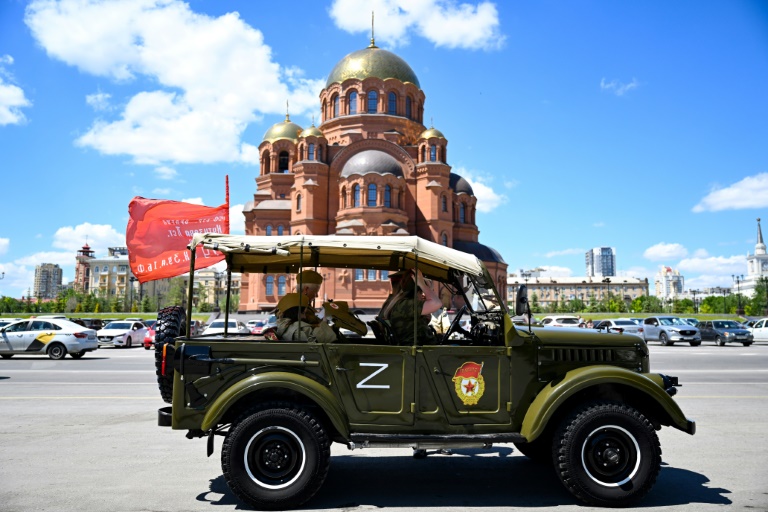
Here are the latest developments in the war in Ukraine:

– Russia has ‘liberated’ residential areas of Severodonetsk –

Fighting continues for Severodonetsk, a key city in Ukraine’s east, which is the focus of a major Russian offensive.

Russian Defence Minister Sergei Shoigu says his country’s troops have “fully liberated” the city’s residential areas but that Ukrainian forces still hold the industrial zone and surrounding settlements.

Ukrainian President Volodymyr Zelensky says government forces are “holding out” against the invaders, but “there are more of them and they are stronger”.

– Hundreds held prisoner in occupied south: Kyiv –

Ukraine says some 600 people are being held prisoner for resisting Russian rule in the occupied southern Ukrainian region of Kherson and claims they are being tortured.

“According to our information, some 600 people are … being held in specially converted basements in the region of Kherson,” said Tamila Tasheva, the Ukraine presidency’s permanent representative in Crimea, the peninsula south of Kherson which Moscow annexed in 2014.

Tasheva said the bulk of those being held were “journalists and militants” who organised “pro-Ukrainian gatherings” in the city of Kherson and surrounding region.

Kherson was the first major city to fall to Russian forces in early March and videos have emerged of residents staging defiant protests.

– Russia, Turkey discuss stalled grain exports –

Russian Foreign Minister Sergei Lavrov begins a two-day visit to Turkey for talks on unblocking grain exports from Ukraine, which have been stalled by the war.

Turkey has offered its services to escort shipments out of Ukrainian ports that are blockaded by Russian forces.

The New York Times reported Monday that a number of freight vessels had set sail from Russian-controlled Ukrainian ports for Africa with what US officials have described as “stolen Ukrainian grain”. 

US Secretary of State Antony Blinken says the reports that Russia has been stealing Ukrainian grain are “credible”.

– Ukraine opposes visit to occupied atomic plant –

Ukraine says it opposes any visit by Rafael Grossi, head of the UN’s nuclear watchdog to its nuclear plant at Zaporizhzhia while it is under Russian occupation.

Russian forces occupied Europe’s biggest atomic power plant in the early weeks of the war.

“The visit to the plant will only become possible when Ukraine takes back control of the site,” Energoatom, Ukraine’s nuclear agency, writes on Telegram.

International Atomic Energy Agency (IAEA) chief Grossi has been arguing the need for an inspection to ensure the plant’s safety.

– Russia votes to quit Europe rights court –

Russian lawmakers pass legislation that finalises Moscow’s exit from the jurisdiction of the European Court of Human Rights (ECHR). 

Russia was expelled from the body that founded the court in March for invading Ukraine.

Campaigners have warned that the fact that the court’s rulings will no longer apply to Russia could embolden Moscow to clamp down even harder on civil rights.

– Russian superyacht handed to US –

A Fiji court hands over a superyacht linked by the US to a sanctioned Russian oligarch.

The $300-million Amadea, linked by the US to billionaire politician Suleiman Kerimov was impounded in Fiji in April at Washington’s request.

On Tuesday, Fiji’s Supreme Court dismissed a case taken by the boat’s registered owners against its seizure, meaning the yacht, which comes with a helipad, pool, jacuzzi and “winter garden”, can now leave Fiji for the US.

– Another Russian general killed –

Pro-Kremlin separatists in Ukraine confirm the death of another Russian general in the war in Ukraine.

Separatist leader Denis Pushilin sends his “sincere condolences to the family and friends” of Major General Roman Kutuzov “who showed by example how to serve the fatherland”.

Since Moscow sent troops into Ukraine on February 24, Ukraine’s forces claimed to have killed around a dozen generals but Russian media have confirmed only a few deaths among the top brass.

– World Bank warns of ‘stagflation’ –

The global economy risks falling into a harmful period of 1970s-style “stagflation,” sparked chiefly by Russia’s invasion of Ukraine, the World Bank warns as it slashes its annual growth forecast.

The toxic combination of weak growth and rising prices could trigger widespread suffering in dozens of poorer countries still struggling to recover from the upheaval of the Covid-19 pandemic.

burs-cb/ach 

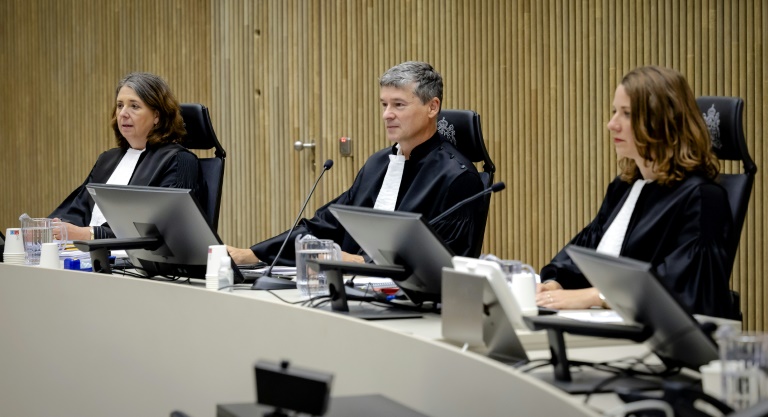
Dutch reporter's children confront alleged killers in court

The children of a leading Dutch crime reporter confronted his alleged killers in court on Tuesday accusing the two men of gunning down their “hero” father from behind.

Journalist Peter R. de Vries, 64, was shot in the head outside an Amsterdam television studio in July 2021 in a crime that prosecutors say was linked to his role in the trial of a Dutch drugs mafia kingpin. 

Dutch man Delano G., 22, is accused of fatally shooting de Vries, while Polish national Kamil E., 36, allegedly drove their getaway car and carried out surveillance prior to the shooting.

Prosecutors demanded at Tuesday’s opening of the trial at Amsterdam District Court that both men be jailed for life  for murder.

“I am looking at you, like you didn’t dare to look at my father when you shot him down from behind,” the journalist’s daughter Kelly told Delano G..

The suspect looked back across the room without showing any emotion.

“Why did you shoot him? For money? Because you didn’t agree with him?” she asked both men.

The murder of de Vries in broad daylight stunned the Netherlands, where he was a household name with his own TV show, and sparked outrage across Europe.

A verdict is due on July 14. The pair face possible life sentences for murder, as well as for illegal possession of guns and ammunition.

– ‘A hero’ –

Kelly de Vries told the accused “I hate you” but added she could “bring myself to treat you with humanity”.

“Your children will realise what their fathers have done — at least I can be proud of mine. People will say that he was a hero,” she said.

The journalist’s daughter had earlier asked to leave the room, as the court watched  video of the murder.

Images from various vantage points in the city, including a nearby cafe, appeared to show Delano G. and Kamil E. walking around the area shortly before de Vries was shot.

The court then saw images at a distance of de Vries crossing the street, a figure running behind him and then the moment when he was shot and fell to the ground.

De Vries died in hospital nine days later.

“I invoke my right to silence,” Delano G. answered when judge Gert Oldekamp asked him directly if he had shot de Vries.

“I did not murder this man,” Kamil E. told the judges in Polish.

– ‘Life sentences’ –

The court also heard about a message sent shortly after the killing from a phone on which Delano G’s DNA was found, which said: “He is dead, KK, dead.”

“The bullet went right through his head. Everything spurted. Everybody screamed,” the transcript read.

Police stopped a car on a motorway near The Hague less than an hour after the shooting and arrested the pair. Four shell casings found at the scene allegedly came from a pistol with Delano G.’s DNA on it that was found in the car.

Gunshot residue was found on both men’s hands, the court heard.

Prosecutors showed a detailed animated graphic of De Vries’ and the suspects’ movements on the day — and how Kamil E.  previously tailed him in the run-up to the assassination.

There was but one conclusion, that Delano G. and Kamil E. “knew exactly who to murder”, said one of the prosecutors, who for security reasons can not be identified.

De Vries was “murdered in broad daylight, in the heart of Amsterdam, within view of the terraces,” filled with patrons, he said.

“They have forfeited their right to liberty and therefore we demand life sentences,” for both suspects.

De Vries first won fame for reporting on the 1983 kidnapping of Heineken millionaire Freddy Heineken.

Prosecutors say they suspect de Vries was killed because of his role as adviser to a state witness, Nabil B., in the trial of the Netherlands’ most wanted man, alleged drugs baron Ridouan Taghi, who was arrested in Dubai in 2019.

The brother and lawyer of Nabil B. have both been shot since he turned state’s witness.

Fears that the Netherlands is turning into a ‘narco-state’ were fuelled when it emerged that even Prime Minister Mark Rutte was believed to have been targeted for assassination or abduction by drug mafia.

US says NKorea ignores multiple overtures for talks

North Korea, believed poised to test a new nuclear weapon, has ignored multiple US overtures for discussions as well as offers to help in its Covid-19 outbreak, a US diplomat said Tuesday.

Speaking after Pyongyang test-launched eight ballistic missiles in a single day Sunday, Sung Kim, the US Special Representative to North Korea, said the country has not responded to months of public and private communications seeking to engage over tensions.

President Joe Biden and Secretary of State Antony Blinken have repeatedly said publicly that Washington seeks diplomatic talks with the Democratic People’s Republic of Korea “without preconditions,” Kim said.

“We have also reached out to pass this message through private channels as well. This includes high-level personal messages from senior US officials to senior DPRK officials,” he told reporters in a briefing.

“Over the past year, we have sent such messages in multiple ways, through third parties, directly in writing,” he added, noting that included North Korea neighbor China.

Such messages included specific proposals on humanitarian cooperation and assistance with the recent Covid-19 outbreak in North Korea, said Kim.

“However, to date, the DPRK has not responded and continues to show no indication that is interested in engaging,” he said.

US officials have showing growing concerns about Pyongyang’s increased nuclear-related activities.

Kim said that Washington believes it will soon conduct its seventh test of a nuclear weapons, after a nearly five-year hiatus.

He also said that North Korean officials have made comments that suggested a willingness to use tactical or small-sized nuclear weapons.

Kim did not say how the US would react to a new nuclear test.

US Deputy Secretary of State Wendy Sherman, speaking in Seoul early Tuesday, warned there would be a “swift and forceful” response.

“Any nuclear test would be in complete violation of UN Security Council resolutions,” she said.

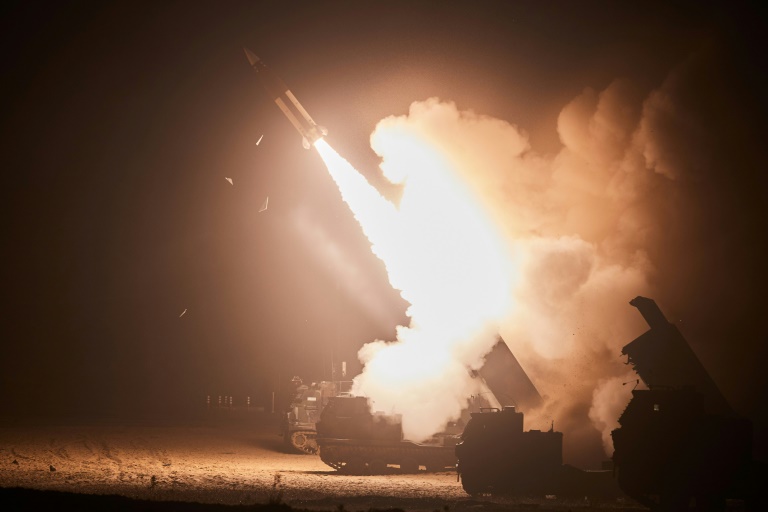
On Monday South Korea and the United States fired eight ballistic missiles in response to the North Korean missile launches.

“The United States has always been very clear: we seek dialogue with Pyongyang without preconditions,” Kim said.

“We continue to remain committed to diplomacy, even as the DPRK launches an unprecedented number of ballistic missiles.”

'Stagflation' risk as Ukraine war chokes global growth: World Bank

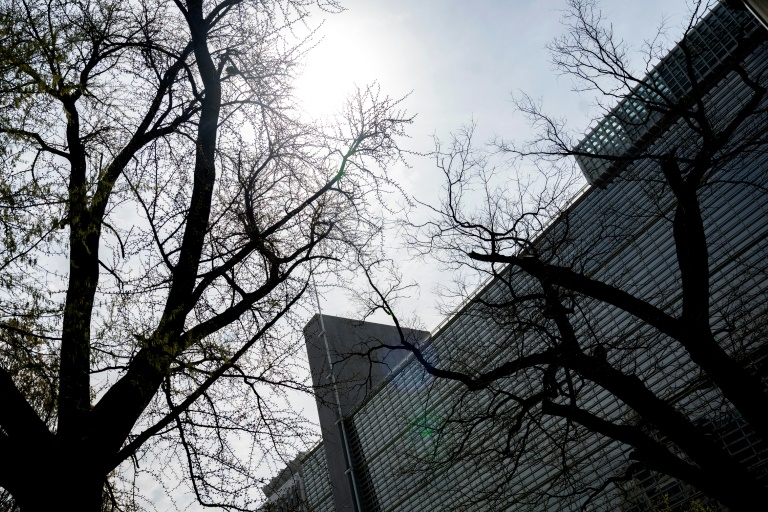
The global economy risks falling into a harmful period of 1970s-style “stagflation,” sparked chiefly by Russia’s invasion of Ukraine, the World Bank warned Tuesday as it slashed its annual growth forecast.

The toxic combination of weak growth and rising prices could trigger widespread suffering in dozens of poorer countries still struggling to recover from the upheaval of the Covid-19 pandemic.

The stark forecast came as the international development lender cut its global growth estimate to 2.9 percent, 1.2 percentage points below the January forecast, due to the severe downturn caused by the war.

“The risk from stagflation is considerable with potentially destabilizing consequences for low and middle income economies,” World Bank President David Malpass told reporters.

“For many countries recession will be hard to avoid.”

And if risks to the outlook materialize, global growth could slow even more sharply — triggering a worldwide recession, Malpass warned.

The bank’s Global Economic Prospects report said the Ukraine war is compounding the damage from the pandemic and magnifying the slowdown in the global economy, “which is entering what could become a protracted period of feeble growth and elevated inflation.” 

The slump comes after growth recovered to 5.7 percent in 2021 following the pandemic downturn — marking the “sharpest deceleration following an initial recovery from global recession in more than 80 years.”

The report notes similarities to the 1970s when growth stalled and inflation skyrocketed with supply factors fueling price hikes and following a long period of low interest rates.

But in contrast to that period, the US dollar is strong, and major financial institutions are in solid position.

– Global recession risk –

The Russian invasion and Western sanctions on Moscow have sent grain and oil prices soaring, threatening to worsen hunger in poor countries and causing drivers around the world to face eye-popping prices at the pump.

The World Bank chief stressed the need to increase production to combat rising prices, especially for energy, as short supplies of natural gas and fertilizer are harming food production.

Malpass also said it was “crucial” to avoid export restrictions and subsidies that “magnify the rise in prices and distort markets.” 

Likewise, the bank warned against trying to resolve the inflation spike with price controls or export restrictions which would only worsen the damage.

Given the widespread uncertainty, the situation could deteriorate further due to a series of “interlinked” risks, including the possibility of further geopolitical tensions, steep interest rates hikes to contain inflation and rising wages, and the potential for Covid-19 to reassert itself, according to the forecast.

The US Federal Reserve has embarked on an aggressive drive to raise borrowing rates to cool demand and combat rising prices, and the World Bank notes that higher rates have played a prominent role in previous financial crises in emerging market and developing economies (EMDEs), straining resources and causing outflows of cash from those countries.

The simultaneous materialization of these risks could result in a much sharper and more prolonged global slowdown.

If faster US rate hikes were to cause “acute financial stress” in EMDEs, the European Union were to face a sudden ban on energy imports, and China were to experience renewed pandemic-related lockdowns, “global growth could fall more sharply in 2022 and nearly halve in 2023 — declining to 2.1 percent and 1.5 percent, respectively,” the report said.

Malpass said that would cause per capita income growth to fall to zero, and “that certainly would qualify as a global recession.”

Even without that dire outcome, per capita income in developing economies this year will be nearly five percent below its pre-pandemic trend.

The report cut the US growth estimate by 1.2 points to 2.5 percent, and the forecast for China was lowered 0.8 point to an unusually low 4.3 percent.

Meanwhile the euro area forecast was cut to 2.5 percent, and Japan to 1.7 percent.

Russia’s economy is expected to contract this year by 11.3 percent.

'No choice': The Ukrainians forced to flee to Russia

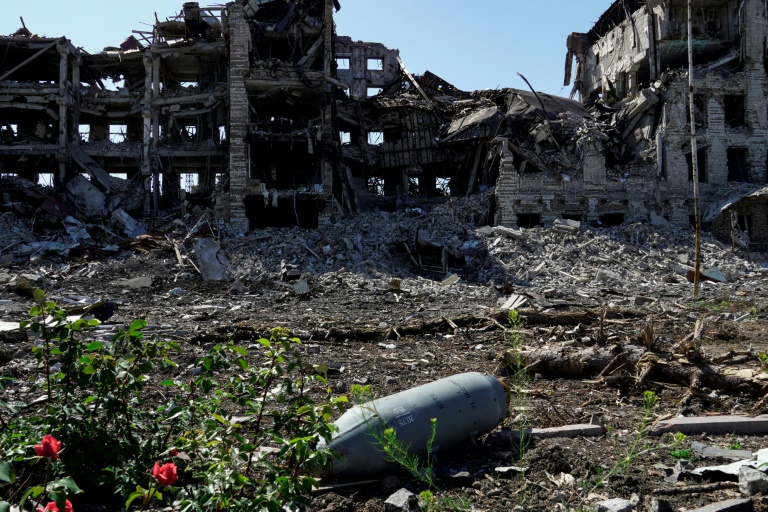
Some residents of the devastated Ukrainian city of Mariupol who managed to escape are saying they were given no choice but to travel to Russia in what the Kyiv government regards as “deportations”.

After spending weeks in a Mariupol basement and following the death of her father, who was killed in a rocket attack, Tetyana decided to leave her city to try to save her nine-year-old daughter.

With no mobile network or any possibility of communicating, she took advantage of a lull in the shelling to go to an assembly point arranged by pro-Russian authorities to find out about exit routes.

There, she was told going to Russia was the only option.

“We were in shock. We did not want to go to Russia,” the 38-year-old accountant said on the phone from Riga in Latvia where she has since sought refuge with her family.

“How can you go to a country that wants to kill you?”

For several weeks, Ukrainian authorities have been accusing Moscow of “illegally transferring” more than a million Ukrainians to Russia or to the parts of Ukraine currently controlled by Russian forces.

A Russian defence ministry official, Mikhail Mizintsev, confirmed the one million number but said the transfers of civilians was only being done to “evacuate” them away from “dangerous areas”.

Some civilians have indeed been forced to go towards Russia because travel to Ukrainian-held areas was blocked by fighting. 

Speaking to AFP after crossing from Russia into Estonia, Yelyzaveta, originally from Izyum, a city in the east currently held by Russian forces, said this was the case for her.

“It was impossible to go towards Ukraine,” Yelyzaveta told AFP.

– ‘You can’t really say no’ –

Like Tetyana, two other families from Mariupol — where the Ukrainian government says 20,000 people were killed, said they too were forced to go to Russia.

Svitlana, an employee in a large industrial concern, also hid in a basement with her husband and parents-in-law in Mariupol until some Russian soldiers ordered them to a part of the city fully in Russian hands.

“When an armed man tells you that, you can’t really say no,” said the 46-year-old, who has since been able to travel to Lviv in western Ukraine.

Her family was initially taken to Novoazovsk, a small town near Mariupol that is in the hands of Russia-backed separatists.

There they stayed for four days in a school.

They were then transferred to Starobesheve, where they were put up in a crowded community centre where people slept on the floor.

“The worst was the smell of dirty feet, dirty bodies. It stayed on our things even after we washed them many times,” Svitlana said.

Three days later, the family was interrogated in a building occupied by separatist police.

They had to answer written questions about whether they had relatives in the Ukrainian army, their fingerprints were taken, and they had to hand over their phones for checks.

In a separate room, the men had to undress to show they did not have any Ukrainian patriotic tattoos or combat wounds — a sign that they might be in the military.

“My husband had to take off everything except his underwear and his socks,” Svitlana said.

“We also deleted all photos and social media from our phones,” she said, fearing possible repercussions because of her “pro-Ukrainian position”.

– ‘We finally felt free’ –

Ivan Druz, 23, who left Mariupol with his half-brother in April, suffered the same treatment in Starobesheve.

He was then hoping to go to territory controlled by Ukraine but after a lot of moving around within Russian-occupied areas, Druz, who is now in Riga, was told it was not possible.

“At first they tire you out and then they tell you that you can only leave in one direction,” he said.

After arriving at the Russian border, he had to undress and answer questions about chats with his aunt in Ukrainian.

“They asked me why she was writing to me in Ukrainian” and “wanted to check that I was not a Nazi,” he said.

Once in Russia, the families of Tetyana and Druz were sent to Taganrog, around 100 kilometres (62 miles) from Mariupol.

Just after arriving, they were told by officials that they had to travel by train to Vladimir — around 1,000 kilometres further north.

From there, Ivan and his half-brother had to leave again, this time to the city of Murom, 130 kilometres to the southeast, where they were put up in a hostel for refugees.

Thanks to Russian friends, the families of Ivan, Tetyana and Svitlana eventually travelled to Moscow and took buses for Latvia or Estonia where Ukrainian refugees are being welcomed.

“Once in Latvia, we finally felt free,” Tetyana said.

Yellen says new Biden investments can counter inflation

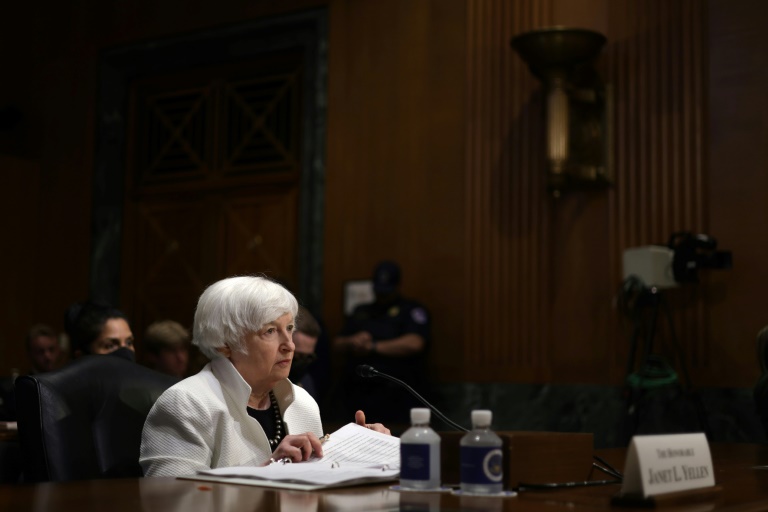
US Treasury Secretary Janet Yellen urged lawmakers to approve additional investments in renewable energy and higher taxes on the wealthy on Tuesday, as she defended the administration’s efforts to blunt the impact of inflation.

“I believe there’s lot that Congress can do to ease the cost burdens that households are experiencing,” Yellen told the Senate Finance Committee in the first of two days of testimony on President Joe Biden’s budget for the 2023 fiscal year.

Besides renewable energy investments — which Yellen said could help address high gasoline prices — the Treasury secretary backed more spending on affordable housing and efforts to rein in pharmaceutical prices.

She also highlighted the Biden administration’s historically large release of oil from the Strategic Petroleum Reserve to ease prices drivers are facing at the pump, which have skyrocketed since the Russian invasion of Ukraine, hitting new records daily, with the national average at $4.92 a gallon Tuesday.

“Gas prices, while very high … would be higher without that,” Yellen said.

The hearings come as Biden contends with a low favorability rating ahead of key midterm elections, with the pain from higher gasoline and food prices outweighing a strong job market and 3.6 percent unemployment.

Yellen was warmly received by Senate Democrats, but Republicans pointed to the Biden administration’s energy and climate policies as a reason for the energy crunch and characterized the Biden administration’s 2021 American Rescue Plan as a main reason for inflation.

“What I heard you say is that it is okay to raise taxes right now and that it is proper to have more stimulus spending to deal with this crisis,” said Senator Mike Crapo, a Republican representing Idaho.

“I just have to say I disagree with you on that.”

Yellen defended the American Rescue Plan, saying the administration took action in response to forecasts that unemployment could top nine percent given the headwinds amid the Covid-19 upheaval.

At the time, she said, “The overwhelming risk was that Americans would be scarred by a deep and long recession.”

Stocks lower as World Bank slashes global growth forecast

Major stock markets fell Tuesday as investors fretted over central bank moves to rein in inflation and the World Bank cut its global economic growth forecast following Russia’s invasion of Ukraine.

The World Bank slashed its growth estimate from 4.1 percent to 2.9 percent, warning that “recession will be hard to avoid” in many countries.

“The world economy is expected to experience its sharpest deceleration following an initial recovery from global recession in more than 80 years,” the Washington-based institution said in its Global Economic Prospects report.

Craig Erlam, analyst at online trading platform OANDA, said the markets had given back most of the gains seen on Monday “in a sign of ongoing uncertainty as to the direction of equity markets and the economy”. 

Stock markets in London, Paris and Frankfurt, all ended the day in negative territory. And Wall Street was also in the red at around mid-session.

Forex.com analyst Fawad Razaqzada warned that markets would continue on their downward trend for some time to come as central banks wind down easy money policies in efforts to combat soaring inflation.

“We are still in a bear market and with central banks ending (quantitative easing) and reducing their balance sheets, the good days of the stock markets may well be behind us,” he said. 

“Keep your seat belts fastened because there will be more turbulence ahead, as central banks are forced to withdraw support.”

Earlier in Asia, Sydney’s stock market had closed down more than one percent after the Australian central bank announced a bigger-than-forecast rate hike to quell inflation.

– UK PM’s no confidence vote –

Elsewhere, the pound fell against both the dollar and euro, even though British Prime Minister Boris Johnson survived a vote of no confidence from his own Conservative MPs.

“Although the leader came out victorious, the triggering of the confidence vote itself along with the fact that 41 percent of Tory MPs failed to back him are both politically corrosive, leaving the prime minister wounded,” said Victoria Scholar, head of investment at Interactive Investor.

“History suggests that this could mark the beginning of the end of his time as prime minister.”

Johnson has been under fire for months after a string of scandals, including the so-called “Partygate” controversy over Covid lockdown-breaking events at Downing Street, where the prime minister was found to have broken the law.

His Conservative government is also under pressure over its handling of a cost-of-living crisis in the UK after the country’s inflation rate soared to the highest level in four decades.

An easing of Covid lockdown measures in China is helping to offset some of the worries over inflation, which is being fuelled by high oil prices following the invasion of Ukraine by key crude producer Russia.

– Key figures at around 1540 GMT –

New York – Dow: DOWN 0.1 percent to 32,882.21 points 

London – FTSE 100: DOWN 0.1 percent at 7,598.93 (close)

Frankfurt – DAX: DOWN 0.7 percent at 14,556.62 (close)

Paris – CAC 40: DOWN 0.7 percent at 6,500.35 (close)

EURO STOXX 50: DOWN 0.8 percent at 3,806.74

Tokyo – Nikkei 225: UP 0.1 percent at 27,943.95 (close)

Hong Kong – Hang Seng Index: DOWN 0.6 percent at 21,531.67 (close)

Shanghai – Composite: UP 0.2 percent at 3,241.76 (close)

Dollar/yen: UP at 132.58 yen from 131.88 yen late Monday

Euro/dollar: DOWN at $1.0696 from $1.0699 

Pound/dollar: UP at $1.2584 from $1.2528

Euro/pound: DOWN at 85.03 pence from 85.37 pence

Brent North Sea crude: UP 0.5 percent at $120.09 per barrel

West Texas Intermediate: UP 0.4 percent at $118.99 per barrel

burs/spm/jj

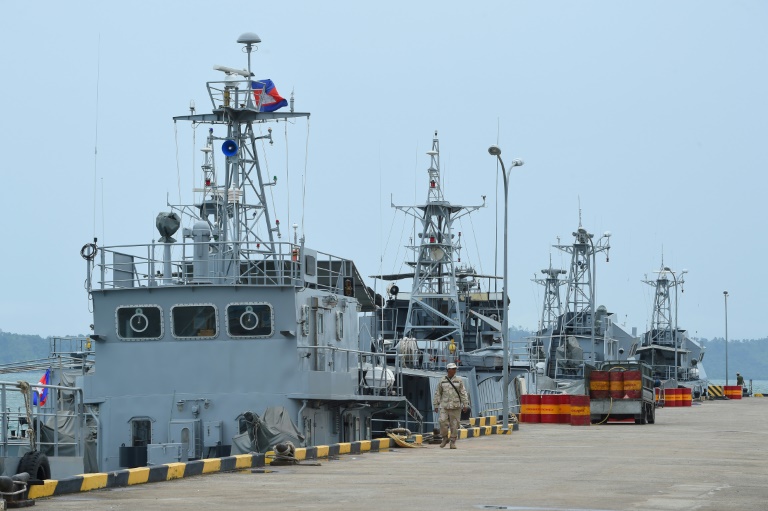
Cambodia, China deny naval base reports as Australia voices concern

Cambodia and Beijing on Tuesday denied a report that they are building a secret naval facility for the Chinese fleet, as Australia’s new prime minister voiced concern and called for transparency.

The Washington Post, citing unnamed Western officials, said a new facility at Cambodia’s Ream base — strategically located on the Gulf of Thailand — was being built for the “exclusive” use of the Chinese navy.

The base has been a running sore spot in US-Cambodian relations for years, with Washington long suspecting it is being converted for use by China as it seeks to buttress its international influence with a network of military outposts.

Cambodia’s Deputy Prime Minister Prak Sokhonn rejected the report as “groundless accusations” in a call with Australia’s foreign minister Penny Wong, according to a statement released late Tuesday by Phnom Penh.

Earlier a spokesman had said the base’s development was “not a secret”.

“Cambodia won’t allow the Chinese military to use it exclusively or to develop the site as its military base,” government spokesman Phay Siphan told AFP.

The Cambodian defence minister and China’s ambassador will be attending a ground-breaking ceremony Wednesday for new facilities at Ream, including a boat repair shop and a pier.

But Australia’s new Prime Minister Anthony Albanese, in Indonesia for a visit to shore up diplomatic ties to counter growing Chinese assertiveness in the region, labelled the reports “concerning”.

“We encourage Beijing to be transparent about its intent and to ensure that its activities support regional security and stability,” he told reporters, saying Cambodia had assured Canberra that no foreign military would be given exclusive access to the Ream base.

Australia has grown increasingly worried about Beijing’s growing influence in the Pacific region.

A leaked draft of a Soloman Islands-China pact in April raised concerns that it would allow Chinese naval deployments to the Pacific island nation — less than 2,000 kilometres (1,200 miles) from Australia.

– Denials from China, Cambodia –

Prime Minister Hun Sen has repeatedly insisted the work is nothing more than modernising the base with a new boat maintenance facility developed with Chinese aid.

“Cambodia doesn’t need the presence of a foreign military on its territory,” he said in a speech last month.

China also denied that the base would be solely for their navy’s use.

“The transformation of Ream Naval Base is only to strengthen Cambodian naval forces’ capabilities to uphold maritime territorial sovereignty and crack down on sea crimes,” foreign ministry spokesman Zhao Lijian told reporters in Beijing Tuesday.

He added that Washington’s criticisms were “malicious conjectures to attack and smear” Cambodia.

Concerns about the base go back as far as 2019, when the Wall Street Journal reported a secret draft deal allowing Beijing to dock warships there.

Cambodia has since dismantled facilities at the base that were built partly with American money and played host to US exercises.

US opposes dictators? Yes! Except when it supports them

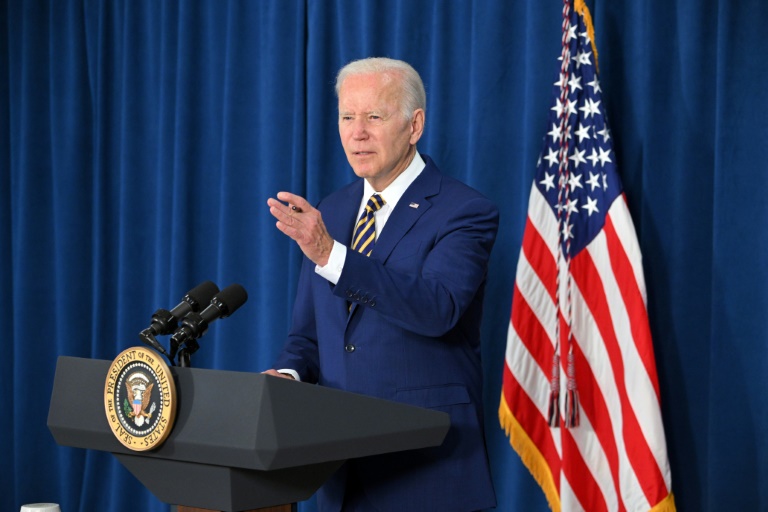
Dictators are bad, except, well, when they’re kind of OK: welcome to the moral gymnastics that Joe Biden is only the latest US president to embrace in a complicated world.

Biden’s decision to exclude the far-left leaders of Cuba, Nicaragua and Venezuela from this week’s regional Summit of the Americas in Los Angeles is being touted as US defense of democracy in action.

“We just don’t believe dictators should be invited and… and so we don’t regret that,” White House Press Secretary Karine Jean-Pierre said. “The president will stand by his principle.”

Except when he doesn’t.

Biden’s determination to bar the trio of self-proclaimed Latin American socialist revolutionaries from US soil came at the expense of a rift with Mexican President Andres Manuel Lopez Obrador, a key partner who snubbed the Los Angeles gathering in protest.

But there’s a whole lot more flexibility when it comes to the other side of the world, where Biden is preparing to visit Saudi Arabia and meet de facto leader Crown Prince Mohammed bin Salman.

The prince, often referred to as MBS, presides over a country with no elections, few rights for women, or many other norms considered basic in the West. In 2018, according to US intelligence, MBS orchestrated the gruesome murder and dismemberment of a prominent dissident, Jamal Khashoggi, who was both a US resident and columnist for The Washington Post.

As a presidential candidate, Biden said the brazen assassination made Saudi Arabia a “pariah.”

Now, though, he’s ready to meet with the alleged murder mastermind.

Why? Because that would be good for the United States, Jean-Pierre said.

“If he determines that it’s in the interest of the United States to engage with a foreign leader and that such an engagement can deliver results, then he’ll do so,” she said. 

Saudi Arabia “has been a strategic partner of the United States for nearly 80 years.”

– ‘Our son of a bitch’ –

The contradictory messaging is causing a stir, particularly against the backdrop of Biden’s frequent, passionate argument that his presidency marks an “inflection point” in a titanic struggle between the world’s democracies and a growing band of ruthless autocracies.

But really there’s nothing new.

Back in 1939, President Franklin Roosevelt supposedly commented that Nicaraguan dictator Anastasio Somoza “may be a son of a bitch, but he’s our son of a bitch.”

Other accounts ascribe the phrase to different US presidents and different dictators. The point, though, is clear: the White House has always been able to hold its nose with one hand, while using the other to embrace distasteful partners.

US support for right-wing leaders across Latin America during the Cold War struggle against Soviet influence was infamous.

In Asia, the United States long battled communist regimes yet there too displays flexibility when it suits. At an ASEAN regional summit last month, Biden shunned Myanmar while inviting less-than-democratic leaders from the likes of Cambodia and Vietnam.

Then there was Biden’s predecessor Donald Trump.

The Republican railed against China yet became friendly with Russia’s Vladimir Putin. Trump was also chummy with the full range of unelected Middle Eastern rulers, not least in Saudi Arabia, which he chose for his first foreign trip as president.

“Where’s my favorite dictator?” a jovial Trump once called out at a 2019 summit while waiting for Egyptian President Abdel Fattah Al Sisi to show up.

Robert Guttman, who teaches politics at Johns Hopkins University, said the consistent inconsistency boils down to “cynical” self-interest.

Facing the risk of devastating losses for Democrats in November midterm elections, Biden is desperate to get soaring domestic fuel prices down, which is what leads him to the Saudis.

And with US-based Latin American communities often fiercely opposed to communism, Biden has little room to maneuver when it comes to the likes of Cuba.

“All you have to think about is Florida in 2024 and they need their votes,” Guttman said.

Guttman said the United States does historically try to support democracy — a fight that Ukraine’s war with Russia has put in dramatic focus.

But with exceptions.

“We talk about great ideals but we’re more pragmatic when it comes to reality,” he said.

“The bottom line is we need oil and we support people who have the oil. For natural resources we need, we bend our ideals, and in an election campaign the president’s all over the board.”

Close Bitnami banner
Bitnami