World

Sheeran to crown queen's four-day jubilee party in day of pomp and pop

British superstar Ed Sheeran brings the curtain down on Sunday on four days of momentous nationwide celebrations of Queen Elizabeth II’s historic Platinum Jubilee, in a finale filled with picnics, pomp and pop.

The multi-award-winning singer-songwriter will wrap up a day-long pageant lauding the 96-year-old monarch’s record seven decades on the throne, as the long weekend of festivities featuring a multitude of tributes across the UK concludes.

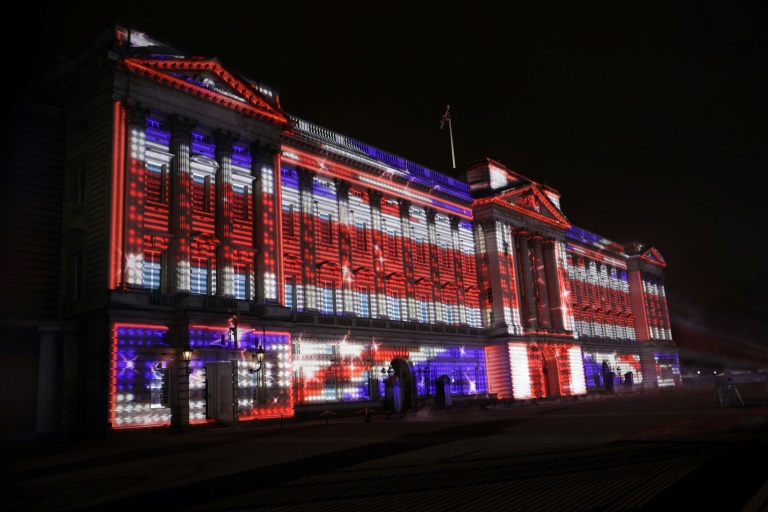
Sheeran is one of numerous “national treasures” poised to perform a “special tribute” to the queen against the backdrop of Buckingham Palace to mark a milestone never previously reached by a British sovereign.

Meanwhile, millions of people are expected to defy gloomy weather forecasts for much of the country and attend “Big Jubilee Lunch” picnics, including an attempted world record for the longest street party.

It remains unclear if the queen will attend any parts of the pageant in person, after being forced to skip several Platinum Jubilee celebration appearances due to mobility issues.

At a music concert outside the palace on Saturday night, the monarch made a surprise on-screen appearance, taking tea with the beloved children’s book and film character Paddington Bear.

In the pre-recorded scene she tapped out the drumbeat of rock band Queen’s “We Will Rock You” — the concert’s opening number — on a fine china teacup and saucer to get the party started.

– ‘Mummy’ –

The four days of royal celebrations saw Thursday and Friday designated public holidays.

Longer pub opening hours, street parties and other events heralding the queen have been credited with temporarily lifting the gloom of Britain’s worsening cost-of-living crisis.

The official programme kicked off on Thursday with the pomp-filled Trooping the Colour military parade. The queen made two public appearances to huge crowds on the Buckingham Palace balcony, followed by another later in Windsor.

Friday’s focus was a traditional Church of England service of thanksgiving led by senior royals — including returning Prince Harry and his wife Meghan — in St Paul’s Cathedral in London.

Then on Saturday the tone turned more celebratory as Motown diva Diana Ross and Italian opera legend Andrea Bocelli led the star-studded “Platinum Party” outside Buckingham Palace.

Prince Charles and his son Prince William paid highly personal tributes to the queen during the nearly three-hour concert, which she watched on TV from Windsor.

“You pledged to serve your whole life — you continue to deliver,” Charles said in his poignant message to “Mummy”, which he capped by calling for “three cheers to Her Majesty”.

Sunday newspapers applauded the spectacle. “Nobody does pomp, ceremony and flypasts as we do,” The Sunday Times wrote.

“Anybody selling holidays to foreign tourists will have had a field day. The images of Britain sent around the world have been priceless.”

The Sunday Telegraph said the jubilee had “a valedictory feel” but added: “There is also keen awareness that we will never see the likes of this monarch again.”

The Observer called it “part of a long goodbye” that began with her husband Prince Philip’s funeral last year.

– Spectacle –

Sunday’s four-part “Platinum Jubilee Pageant” starts with a military spectacle celebrating the armed forces, along with personnel from many of the other 53 Commonwealth countries that the queen heads.

The Mounted Band of the Household Cavalry — the largest regular military band in the UK — will lead the 260-year-old Gold State Coach along a crowd-thronged route to Buckingham Palace.

A cast of 10,000 then stages a street performance showcasing popular culture over the seven decades, featuring music, dance, fashion, youth culture and classic cars.

Performers from street theatre, carnival and other genres also join in to celebrate Elizabeth II’s extraordinary life.

Highlights include an aerial artist suspended under a vast helium balloon, known as a heliosphere, bearing the sovereign’s image.

The carnival will include a giant oak tree flanked with maypole dancers, a huge moving wedding cake sounding out Bollywood hits, a towering dragon and beasts three storeys tall.

The spectacle will culminate in the singing of Britain’s national anthem, “God Save the Queen”, and Sheeran.

– ‘Full circle’ –

Earlier on Sunday, up to 10 million people are expected to take part in the Big Jubilee Lunch picnics nationwide.

More than 70,000 have registered to host such picnics in villages, town and cities, with families, neighbours and entire communities set to come together to share food and drink.

More than 600 lunches have also been planned throughout the Commonwealth and beyond, from Canada to Brazil, New Zealand to Japan and South Africa to Switzerland.

A flagship feast with specially invited guests will take place at The Oval cricket ground in London. 

Sheeran, 31, will then crown things off by singing his 2017 hit “Perfect”.

Ahead of his appearance, the “Shape of You” singer-songwriter revealed that the 2002 “Party at the Palace” to mark the queen’s Golden Jubilee actually inspired his phenomenally successful musical career.

Watching on television, he saw Eric Clapton play his classic song “Layla” and decided “That’s what I wanna do”, he wrote on Instagram.

Sheeran went on to perform at the queen’s Diamond Jubilee concert 10 years ago. 

“Life is weird how it keeps coming full circle in lovely ways,” he added.
War in Ukraine: Latest developments

Here are the latest developments in the war in Ukraine.

– Putin warns against missiles for Ukraine –

Russian President Vladimir Putin warns Moscow will strike new targets if the West supplies long-range missiles to Ukraine and says new arms deliveries to Kyiv are aimed at “prolonging the conflict”. 

If Kyiv is supplied with long-range missiles, “we will draw the appropriate conclusions and use our arms…. to strike targets we haven’t hit before,” Putin is quoted by Russian news agencies as saying, without specifying which targets he means.

– Strikes on Kyiv –

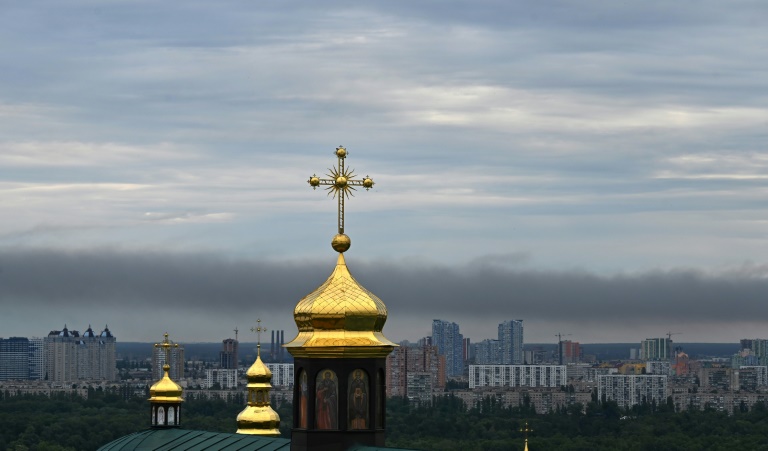
Ukrainian officials say Russian missiles have hit railway infrastructure sites in Kyiv, in the first such strikes on the capital since April 28.

“The strikes targeted the infrastructure of Ukrainian Railways,” says Serhiy Leshchenko, a member of the company’s supervisory board and adviser to the Ukrainian presidency.

Russia claims it destroyed “T-72 tanks supplied by eastern European countries and other armoured vehicles that were in hangars” on the city’s outskirts.

– Ukraine says Russians losing ground –

A regional governor says Russian forces have lost ground in Severodonetsk, a key city in eastern Ukraine.

“The Russians were in control of about 70 percent of the city, but have been forced back over the past two days,” Lugansk regional governor Sergiy Gaiday writes on Telegram. 

The region of Lugansk has been partly controlled by pro-Russian separatists since 2014, and Severodonetsk is the administrative capital of the Ukrainian part.

– Zelensky blames Russia for church blaze –

Ukrainian President Zelensky says a wooden church on one of Ukraine’s most sacred Orthodox sites has been destroyed by Russian bombing. 

“Russian artillery again hit” the All Saints Skete of the Holy Dormition Sviatogirsk Lavra, Zelensky says on Telegram, with a video showing the church in eastern Ukraine ablaze.

The Ukrainian leader says 300 civilians including 60 children had sought shelter from bombs at the church amid fierce fighting in the Donbas region.

Russia’s defence ministry blames “Ukrainian nationalists”.

– Ukraine seeks football World Cup berth –

Away from the battlefield, Ukraine is to play against Wales in Sunday’s play-off final as they aim to reach their first football World Cup since 2006.

“Everyone will fight to the end and give their all, because we will play for our country,” Ukraine player Oleksandr Zinchenko says.

But Wales captain Gareth Bale says any sympathy with Ukraine will be set aside: “We understand what it would do for Ukraine, but we want to get to a World Cup.”

burs-arp/ah

Putin warns of strikes over missile supplies as blasts rock Kyiv

Russian President Vladimir Putin warned Sunday that Moscow will hit new targets if the West supplies Ukraine with long-range missiles, hours after several explosions rocked the Ukrainian capital Kyiv.

If Kyiv is provided with such missiles “we will draw the appropriate conclusions and use our arms… to strike targets we haven’t hit before,” Putin was quoted by Russian news agencies as saying.

He did not specify which targets he meant.

Putin’s comments came after the United States last week announced that it would supply Ukraine with advanced missile systems.

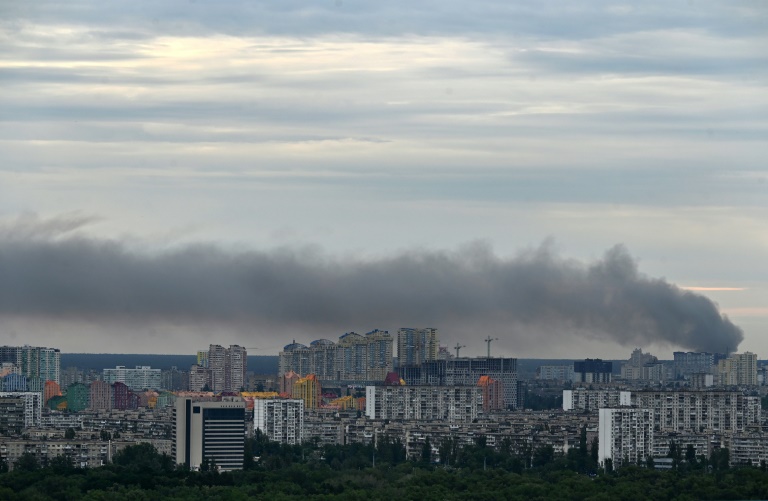
Ukrainian officials earlier on Sunday said Russian missiles hit railway infrastructure sites in the first such strikes on Kyiv since April 28.

Russia said that it had destroyed tanks supplied to Ukraine by eastern European countries during the strikes.

“High-precision, long-range missiles fired by the Russian Aerospace Forces on the outskirts of Kyiv destroyed T-72 tanks supplied by eastern European countries and other armoured vehicles that were in hangars,” Russian defence ministry spokesman Igor Konashenkov said.

One person was wounded and AFP reporters saw several buildings with blown-out windows near one of the sites that was targeted.

Leonid, a 63-year-old local resident who used to work at the facility, said he heard three or four explosions.

“There is nothing military there but they are bombing everything,” he said.

Vasyl, 43, said he heard five blasts.

“People are afraid now,” he said, walking back to his damaged home with two loaves of bread.

Ukrainian authorities did not want to identify the precise locations of the explosions for security reasons.

– Severodonetsk ‘divided’ –

Meanwhile, in the east of the country, the battle for control of Severodonetsk raged on.

The city is the largest still in Ukrainian hands in the Lugansk region of the Donbas, where Russian forces have been advancing gradually after retreating or being beaten back from other parts of the country, including Kyiv.

Lugansk regional governor Sergiy Gaiday said that Russian forces had lost ground in the city and it was now “divided in two”.

“The Russians were in control of about 70 percent of the city, but have been forced back over the past two days,” he said on Telegram.

“They are afraid to move freely around the city.”

Russia’s army on Saturday claimed some Ukrainian military units were withdrawing from Severodonetsk, but Mayor Oleksandr Striuk said Ukrainian forces were fighting to retake the city.

“We are currently doing everything necessary to re-establish total control” of the city, he said in an interview broadcast on Telegram.

– ‘Put Russia in its place’ –

Tens of thousands of people have been killed, millions forced to flee and towns turned into rubble since Russian President Vladimir Putin ordered an all-out assault on his pro-Western neighbour on February 24.

Western powers have imposed increasingly stringent sanctions on Russia and supplied arms to Ukraine, but divisions have emerged on how to react.

French President Emmanuel Macron said Friday Putin had committed a “fundamental error” but that Russia should not be “humiliated” so that a diplomatic solution could be found.

Ukrainian Foreign Minister Dmytro Kuleba reacted Saturday by saying such calls “only humiliate France” and any country taking a similar position.

“It is Russia that humiliates itself. We all better focus on how to put Russia in its place,” he said.

Despite diplomatic efforts, the conflict has raged in the south and east of the country.

The press service of the Ukrainian president’s office on Sunday reported nine civilians killed in the Donetsk and Lugansk regions from shelling.

– Fears over food –

Apart from the human toll, the conflict has caused widespread damage to Ukraine’s cultural heritage.

On Saturday, Ukrainian officials reported a large Orthodox wooden monastery, a popular pilgrim site, had burnt down and blamed Russia shelling.

Moscow continues to prove “its inability to be part of the civilised world,” Culture Minister Oleksandr Tkachenko said in a statement.

Russia’s defence ministry blamed “Ukrainian nationalists” for the blaze.

Russian troops now occupy a fifth of Ukraine’s territory, according to Kyiv, and Moscow has imposed a blockade on its Black Sea ports, sparking fears of a global food crisis. Ukraine and Russia are among the top wheat exporters in the world.

The United Nations said it was leading intense negotiations with Russia to allow Ukraine’s grain harvest to leave the country.

The UN has warned that African countries, which normally import over half of their wheat consumption from Ukraine and Russia, face an “unprecedented” crisis.

Food prices in Africa have already exceeded those in the aftermath of the 2011 Arab Spring uprisings and the 2008 food riots.

– ‘Game of survival’ –

Away from the battlefield, Ukraine will be fighting for victory over Wales in Sunday’s play-off final as the war-torn country aims to reach its first football World Cup since 2006.

“We all understand that the game with Wales will no longer be about physical condition or tactics, it will be a game of survival,” said Ukraine player Oleksandr Zinchenko.

“Everyone will fight to the end and give their all, because we will play for our country.”

burs-dt/ah

Bangladesh port depot fire kills 49, injures 300

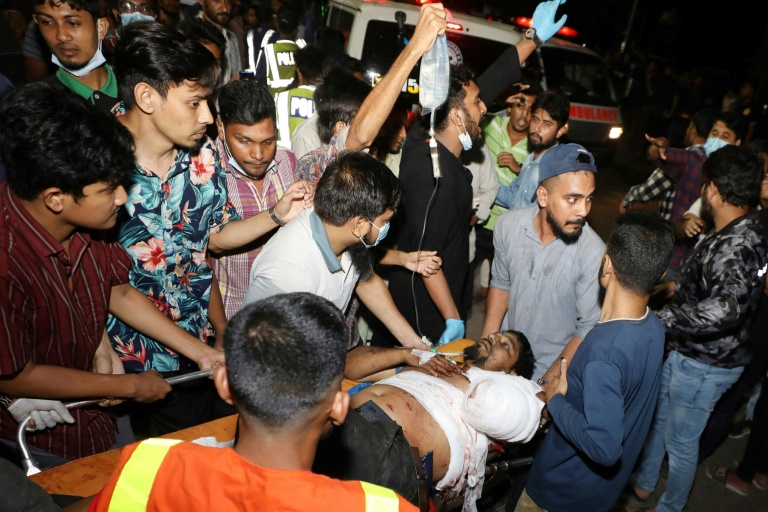
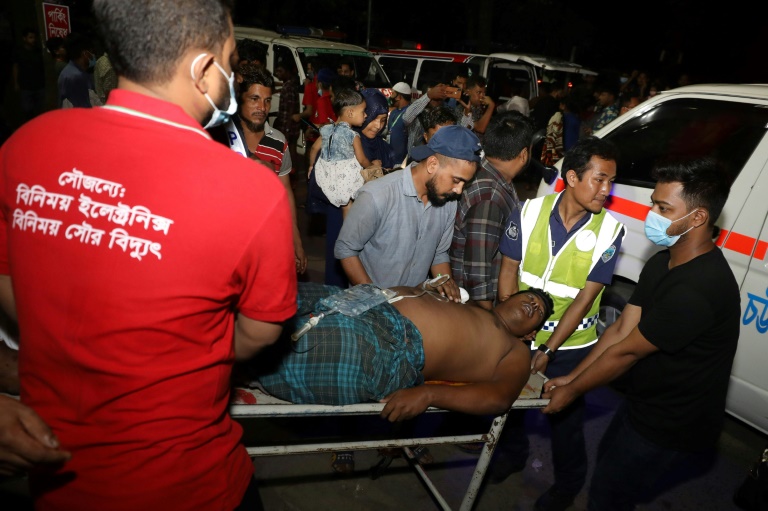
At least 49 people died and hundreds were injured after a fire sparked a huge chemical explosion at a shipping container depot in Bangladesh, officials said on Sunday.

The toll was expected to rise, with some of the more than 300 people injured in serious condition, officials said, while volunteers reported that there were more bodies inside the smouldering, wreckage-strewn facility.

The fire started late on Saturday at the depot in Sitakunda, which stores around 4,000 containers, many of them filled with garments destined for Western retailers. The facility is about 40 kilometres (25 miles) from the major southern port of Chittagong.

Following the fire, containers holding chemicals exploded, engulfing firefighters, volunteers and journalists in an inferno, hurtling people and debris through the air, and turning the night sky a blazing orange.

Buildings located kilometres away rattled with the force of the blast.

Elias Chowdhury, regional chief doctor, told AFP that the number of dead was 49 but would increase. Firefighters continued to douse pockets of fire with hoses on Sunday. 

“The death toll will rise as the rescue work has not been completed yet,” Chowdhury said.

“These people — including several journalists who were doing Facebook lives — are still not accounted for.”

Reazul Karim, operations director of the fire department, said that at least seven firefighters died and that at least four others were missing.

“Never in our fire department history have we lost so many firefighters in a single incident,” Bharat Chandra, a former senior firefighter, told AFP.

“There are still some bodies inside the fire-affected places. I saw eight or 10 bodies,” one volunteer told reporters.

Mujibur Rahman, the director of B.M. Container Depot, the firm operating the facility with around 600 workers, said that the cause of the initial fire was still unknown.

The container depot held hydrogen peroxide, fire service chief Brigadier General Main Uddin told reporters. 

“We still could not control the fire because of the existence of this chemical,” he said.

– ‘Fireballs falling like rain’ –

Mohammad Ali, 60, who runs a nearby grocery store, said the blast was deafening.

“A cylinder flew around half a kilometre from the fire spot to our small pond when the explosion occurred,” he told AFP.

“The explosion sent fireballs into the sky. Fireballs were falling like rain. We were so afraid we immediately left our home to find refuge… We thought the fire would spread to our locality as it is very densely populated,” he added.

Lorry driver Tofael Ahmed was standing inside the depot when the explosion occurred. 

“The explosion just threw me some 10 metres from where I was standing,” he said. “My hands and legs are burned.”

Chowdhury, the chief doctor in Chittagong, said the injured had been rushed to different hospitals as doctors were brought back from holiday to help.

Requests for blood donations for the injured flooded social media. 

– Army choppers –

The army said it had deployed 250 troops to prevent chemicals flowing into the Indian Ocean by using sandbags.

Mominur Rahman, chief administrator of Chittagong district, said that while the fire was largely under control, there were “still several pockets” that were active. 

“Firefighters are trying to control these pockets of fires. The fire has spread to at least seven acres of land inside the depot,” he said. 

Fires are common in Bangladesh due to lax enforcement of safety rules. 

Around 90 percent of Bangladesh’s roughly 100 billion dollars in trade — including clothes for H&M, Walmart and others — passes through the Chittagong port at the northern end of the Bay of Bengal.

Exports have been booming since late last year, as the global economy recovers from the pandemic. In the first five months of the year, shipments were up more than 40 percent.

Residents return home as Athens firefighters bring blaze under control

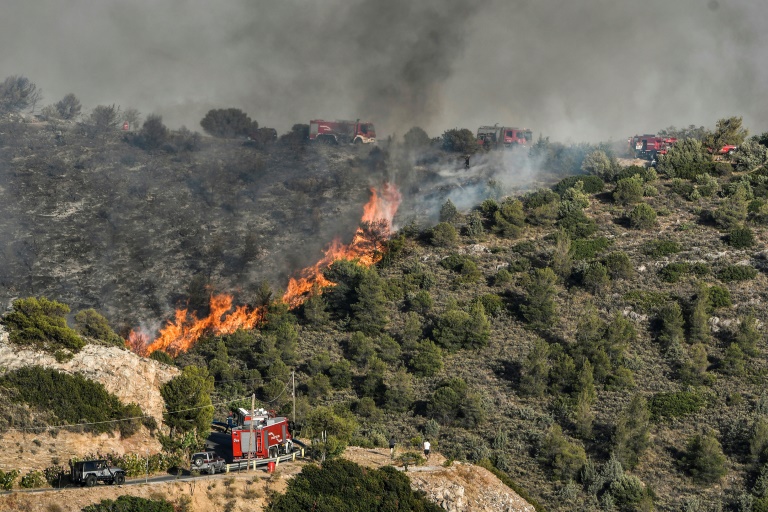
Residents of a southern suburb of Athens returned to their homes on Sunday after firefighters managed to bring under control a wildfire that had forced them to evacuate the day before, the emergency services said. 

“At this point, the fire has been demarcated, the residents are back in their houses,” deputy civil protection minister, Evangelos Tournas, told a news briefing. 

A substantial number of firefighters remained in the area “and will remain as long as it is needed, while aircrafts will continue dropping water protectively,” he said. 

A total of 283 firefighters in 65 vehicles, with the help of groups of bystanders, had battled overnight to bring the fire under control.

And two firefighting planes and two helicopters were still in operation early Sunday. 

While the fire is in remission, with no burning spots, authorities said they remain on high alert in case it breaks out again. 

On Saturday, the Greek Civil Protection agency had issued an emergency appeal via SMS for people to leave the suburb of Ano Voula. 

Officials reported no casualties, but four more neighbourhoods were evacuated as the wind changed direction and drove the fire front towards the town of Vari later on Saturday evening. 

Giorgos Papanikolaou, the mayor of Glyfada, where the fire first broke out, said that it started at a high voltage electricity power station. 

Last summer, Greece’s most severe heatwave in decades, which authorities blamed on climate change, saw fires destroy more than 100,000 hectares of forest and farmland, the country’s worst wildfire damage since 2007. 

More than 200 firefighters and technical equipment provided by European Union countries will be soon deployed to Greece to help boost the battle against large wildfires.

Bulgaria, Finland, France, Germany, Romania and Norway will take part in the deployment, coordinated by the EU’s Civil Protection Mechanism.

Cambodians vote in local polls as revived opposition vies for seats

Cambodians voted in local polls on Sunday as a revived opposition party attempted to dent Prime Minister Hun Sen’s decades-long grip on power ahead of national elections next year.

Hun Sen, one of the world’s longest-serving leaders, has ruled Cambodia for more than 37 years and turned the country into a one-party state in 2018 when his party won every seat in a national election.

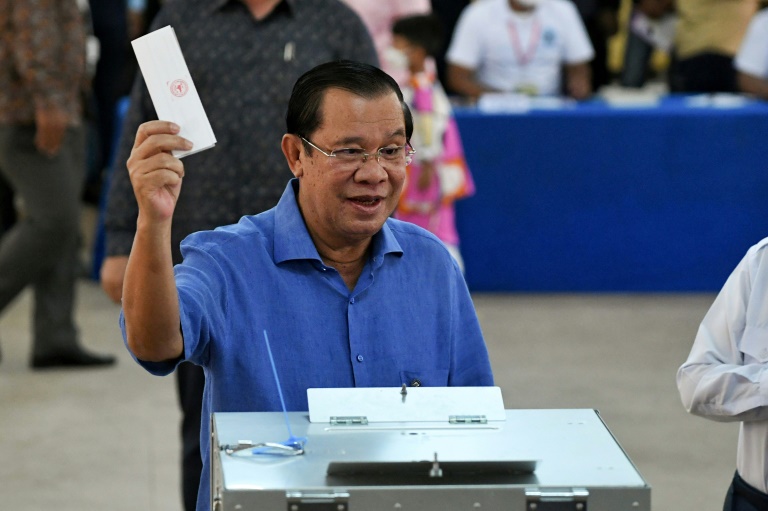
Voting shortly after polls opened at 7 am (0000 GMT), the prime minister was all smiles as he entered a school polling station on Phnom Penh’s outskirts with his wife Bun Rany — but declined to speak to media.

Critics and rights groups have accused him of creating a climate of fear by locking up scores of political opponents and activists.

The opposition Cambodia National Rescue Party (CNRP) — which won 44 percent of the popular vote in local elections in 2017 — was forced to forfeit its positions after a court dissolved it later that year.

Scores of opposition figures have since fled the country, while others have been arrested.

Opposition leader Kem Sokha, who was arrested and jailed for more than a year, is facing a treason trial, while CNRP co-founder Sam Rainsy is living in France to escape convictions he says are politically motivated.

Sunday’s vote in 1,652 communes, or village clusters, will take the country’s political pulse ahead of the national elections in 2023.

Hun Sen’s ruling Cambodian People’s Party (CPP) made a show of strength in Phnom Penh on Friday with a massive parade of cars, trucks, motorcycles and tuk-tuks.

And many voters appeared persuaded — citing peace and development in the country as they cast their ballot for his party inside schools or Buddhist temples.

“I picked the same old candidate, I did not change. We have been working together since the beginning, so we know who is good and who is bad,” Srey Chan Samuth, 76, said.

A total of 17 parties are running in the local election, with more than 11,600 positions up for grabs — the majority of which are presently controlled by the ruling party.

But all eyes are on the performance of the Candlelight Party (CP) — founded by Rainsy in 1995 — which has registered candidates to contest nearly all communes and has been gaining strong support.

– ‘Last hope’ –

“The Candlelight Party is the last hope for the people, although we are suffering from intimidation and threats, and political harassment,” party secretary-general Lee Sothearayuth told AFP.

UN Human Rights Office spokeswoman Liz Throssell said she was disturbed by patterns of obstruction targeting opposition candidates ahead of the poll.

She warned that the CP “faces a paralysing political environment” after at least six candidates and activists were arrested in the run-up to the vote.

The CP is well-positioned to attract supporters and is the only party that “poses a realistic threat” to Hun Sen’s CPP, according to Sebastian Strangio, a Cambodian politics expert.

“A strong opposition showing would demonstrate that the popular discontent with CPP rule continues to simmer beneath the surface of Cambodian politics,” he told AFP.

CPP spokesman Sok Eysan downplayed the threat, telling AFP his party would “overwhelmingly” win.

But some voters said they wanted new faces to lead their communities.

“I voted for a change and social justice,” one 35-year-old, who asked not to be named, told AFP.

An estimated 9.2 million people are registered to cast ballots on Sunday, with polls closing at 3 pm (0800 GMT).

Athens wildfire losing intensity, firefighters say

A wildfire whipped up by gale-force winds in a southern suburb of Athens on Saturday, forcing residents to evacuate and damaging properties, has faded in intensity as the winds have dropped, the fire brigade said on Sunday.

A total of 283 firefighters in 65 vehicles, with the help of groups of bystanders, had battled overnight to bring the fire under control.

And two firefighting planes and two helicopters were still in operation early Sunday. 

On Saturday, the Greek Civil Protection agency had issued an emergency appeal via SMS for people to leave the suburb of Ano Voula. 

Officials reported no casualties, but four more neighbourhoods were evacuated as the wind changed direction and drove the fire front towards the town of Vari later on Saturday evening. 

Giorgos Papanikolaou, the mayor of Glyfada, where the fire first broke out, said that it started at a high voltage electricity power station. 

Last summer, Greece’s most severe heatwave in decades, which authorities blamed on climate change, saw fires destroy more than 100,000 hectares of forest and farmland, the country’s worst wildfire damage since 2007. 

More than 200 firefighters and technical equipment provided by European Union countries will be soon deployed to Greece to help boost the battle against large wildfires.

Bulgaria, Finland, France, Germany, Romania and Norway will take part in the deployment, coordinated by the EU’s Civil Protection Mechanism.

Bangladesh port depot fire kills 34, injures 300

At least 34 people have died after a fire that sparked a huge chemical explosion and was still blazing on Sunday at a shipping container depot in Bangladesh, officials said.

The toll was expected to rise with over 300 people injured, some of them seriously, and eyewitnesses said they had seen unrecovered bodies in the facility near the major southern port of Chittagong.

Several hundred rescuers were battling the blaze that broke out late Saturday in Sitakunda, about 40 kilometres (25 miles) from Chittagong, when a number of containers holding chemicals exploded, the fire brigade told reporters.

“The death toll from the fire has risen to 34,” Elias Chowdhury, chief doctor of the region, told AFP as firefighters continued to battle the blaze. “More than 300 people are injured.”

“These people — including several journalists who were doing Facebook lives — are still not accounted for,” he said.

“There are still some bodies inside the fire-affected places. I saw eight or 10 bodies,” one volunteer told reporters.

The injured include at least 40 firefighters and 10 police officers, Chittagong regional police chief Anwar Hossain told AFP. At least five firefighters were among those killed.

“The number of fatalities is expected to rise as some of the injured are in critical condition,” Hossain said.

Eyewitnesses said that the blast engulfed people who had been battling the fire.

“I was standing inside the depot. The explosion just threw me some 10 metres (yards) from where I was standing. My hands and legs are burnt,” lorry driver Tofael Ahmed said.   

The explosion was so loud that it shook residential buildings several kilometres from the depot, said Mohammad Ali, 60, who has a nearby grocery store.

“A cylinder flew around half a kilometre from the fire spot to our small pond when the explosion occurred,” he said. 

“The explosion sent fireballs in the sky. Fireballs were falling like rain. We were so afraid we immediately left our home to find refuge… We thought the fire would spread to our locality as it is very densely populated,” he said. 

The container depot held hydrogen peroxide, fire service chief Brigadier General Main Uddin told reporters. “We still could not control the fire because of the existence of this chemical,” he said.

Chowdhury, the chief doctor in Chittagong, said the injured had been rushed to different hospitals in the region as doctors were brought back from holiday to help.

Requests for blood donations for the injured flooded social media. 

Emergency crews were still working to put out the fire Sunday morning and military clinics were helping to treat the injured.

Mominur Rahman, chief administrator of Chittagong district, said the government has deployed some 200 army troops to the depot to prevent chemicals flowing into the sea.

He said while the fire was largely under control, there were “still several pockets of fire”. 

“Firefighters are trying to control these pockets of fires. The fire has spread to at least seven acres of land inside the depot,” he said. 

Rahman said a probe has been ordered.

He added that the depot contained millions of dollars of garments waiting to be exported to Western retailers, for whom Bangladesh is a key supplier.

Ruhul Amin Sikder, spokesman for the Bangladesh Inland Container Association (BICA), said some of the containers at the 30-acre private depot contained chemicals, including hydrogen peroxide.

The director of the B.M. Container Depot, Mujibur Rahman, said the fire’s cause was still unknown. He added the facility employs about 600 people.

Fires are common in Bangladesh due to lax enforcement of safety rules. In July 2021, 54 people died when a blaze ripped through a massive food-processing factory outside the capital Dhaka. 

In February 2020, 70 people were killed when another fire engulfed several Dhaka apartment blocks.

Ukrainian jobseekers collide with German language barrier

Ganna Nikolska comes back dejected from the stand of an insurer ready to hire Ukrainian refugees in Berlin: “I don’t speak German,” she explains in halting English.

The 42-year-old trained doctor fled Kharkiv in eastern Ukraine in March “with her backpack and her daughter”, her sister Olena Nikitoshkina, 36, who speaks fluent German, told AFP.

Nikolska would like to stay in Germany, but is having trouble finding work in her field “because her degree would need to be recognised and she’d need to speak German but that takes a long time”, Nikitoshkina said.

Around 1,000 Ukrainian new arrivals showed up this week at the stands of companies gathered at the Berlin Chamber of Commerce and Industry (IHK) for a job fair.

Three months after the start of the Russian invasion of Ukraine which touched off a mass exodus of more than six million people, Germany has taken in more Ukrainians than any other nation apart from the bordering countries, according to the United Nations.  

German authorities estimate that more than 700,000 people have arrived from Ukraine since February 24, without knowing how many have continued on to third countries. 

– Manpower shortage –

In Berlin, some 44,000 Ukrainians have applied for a permanent residence permit. 

Following the hectic first few weeks getting settled, the refugees — the vast majority of them women — now aim to integrate and earn a living. 

A wide range of around 60 employers including hotels, private clinics and construction companies took part in the job fair, said Yvonne Meyer of the IHK.

As Europe’s biggest economy with its ageing population and low unemployment faces a manpower shortage across many sectors, Ukrainian newcomers are seen as an attractive option in industry, retail jobs and healthcare.

The Institute for Employment Research at Germany’s Federal Employment Agency reports that there are currently 1.69 million jobs unfilled in the country — a new record.

“We are still searching for personnel so it’s a very good opportunity for us,” a recruiter from the Berlin street cleaning service (BSR) said at the fair. 

Some companies including the Grill Royal group of upscale restaurants and Policum health clinics have started offering new staff German courses.   

But none of the jobs that interest Yuliia Bokk provide this possibility.

“It’s not enough that I speak English. I ask everybody and they all say to me ‘learn basic German and come back’,” said the 24-year-old woman, who had a good job in retail back in Kyiv.

– The Syrian precedent –

Bokk nevertheless considers herself lucky to be in Germany.

Since June 1, Ukrainian refugees have been able to benefit from state assistance of up to 449 euros ($481) per month and are registered with the social security service.

She has also started a free “integration course” offering a six-month introduction to the German language and culture. Around 80,000 Ukrainians have already been enrolled, according to the Office for Migration and Refugees (BAMF).

“The courses are very in demand and because a lot of refugees arrived in Germany in 2015 from Syria or Afghanistan, the structures were already in place,” said Martin Eckermann, a consultant at the BAMF. 

In 2015, Germany left its borders open to more than one million people fleeing war and misery so the number of asylum seekers working in Germany has increased more than sixfold since then.

Daria Tatarenko, a 23-year-old with a degree in management and energy sector economics, applied for a job at a bakery “because you don’t need to speak German”. 

It’s a temporary solution for the young woman who fled Kyiv in March.

“I feel gratitude for the German people because they helped us a lot, but I want to go home when the war is over. Because it is my home, it is my country,” she said. 

North Korea fires eight ballistic missiles, Seoul says

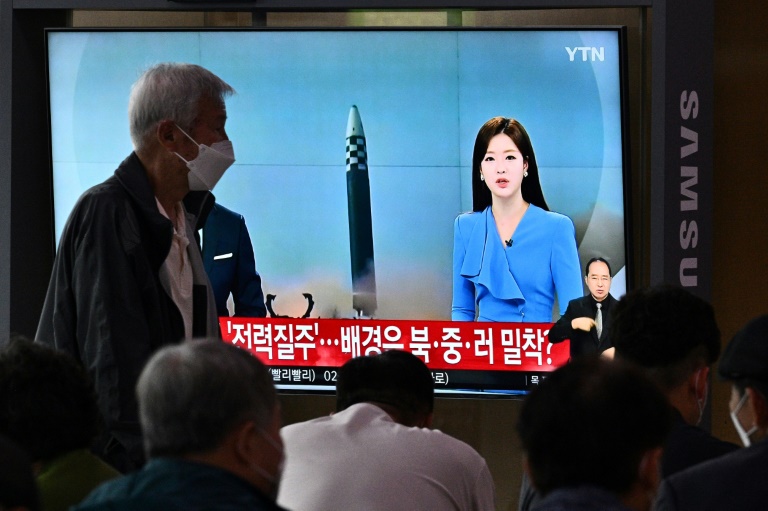
North Korea launched eight ballistic missiles from multiple locations Sunday, South Korea’s military said, a day after Seoul and Washington completed their first joint drills involving a US aircraft carrier in more than four years.

Pyongyang has doubled down on upgrading its weapons programme this year, despite facing crippling economic sanctions, with officials and analysts warning that the regime is preparing to carry out a fresh nuclear test.

“Our military detected eight short-range ballistic missiles fired by North Korea,” Seoul’s Joint Chiefs of Staff said.

The missiles were launched from multiple locations over a 30-minute period, including Sunan in capital Pyongyang, Tongchang-ri in North Pyongan province, and Hamhung in South Hamgyong province, they said.

They travelled different distances — from 110 kilometres (68 miles) to 670 kilometres — and flew at different altitudes of up to 90 kilometres, it added.

Japanese Defence Minister Nobuo Kishi said the simultaneous test-firing from multiple locations was “unusual”.

“This is absolutely unacceptable,” he added.

According to local reports, two missiles were shot from each site, likely from transporter erector launchers (TELs) — the largest number of ballistic missiles North Korea has recently launched on a single day and occasion.

Analysts say the volley of missile launches Sunday — one of nearly 20 weapons tests by Pyongyang so far this year — is a pointed message for Seoul and Washington.

“It shows North Korea’s intention to neutralise the missile defence system of South Korea and the United States with multiple simultaneous attacks during emergency,” said Cheong Seong-jang, a researcher at the Sejong Institute.

The move comes barely a day after South Korea and the United States wrapped up large-scale, three-day exercises involving the USS Ronald Reagan, a 100,000-tonne nuclear-powered aircraft carrier.

The exercises were the allies’ first joint military drills since South Korea’s hawkish new President Yoon Suk-yeol took office last month, and the first involving an aircraft carrier since November 2017.

Pyongyang has long protested against the joint exercises, calling them rehearsals for invasion.

“The exercise consolidated the two countries’ determination to sternly respond to any North Korean provocations while demonstrating the US commitment to provide extended deterrence,” Seoul’s Joint Chiefs of Staff said in a statement.

Go Myong-hyun, a researcher at the Asan Institute for Policy Studies, said Sunday’s launch was likely a response to the US-South Korea manoeuvres.

“It seems that they fired eight missiles because the scale of the joint drills has expanded in their view,” he told AFP.

– Nuclear test –

Last month, during a summit with Yoon, US President Joe Biden said Washington would deploy “strategic assets” to the South if necessary as part of efforts to bolster deterrence.

Pyongyang test-fired three missiles, including possibly its largest intercontinental ballistic missile, the Hwasong-17, just days after Biden left South Korea following his summit with Yoon.

US and South Korean officials have warned for weeks that Pyongyang may conduct a seventh nuclear test.

Last month, a US bid to impose fresh UN sanctions on Pyongyang over its missile launches was vetoed by Russia and China.

Despite struggling with a recent Covid-19 outbreak, North Korea has resumed construction on a long-dormant nuclear reactor, new satellite imagery has indicated.

South Korea’s presidential office said last month that Pyongyang had carried out tests of a nuclear detonation device in preparation for its first nuclear test since 2017.

Long-range and nuclear tests have been paused since North Korean leader Kim Jong Un met then-US president Donald Trump for a bout of high-profile negotiations that collapsed in 2019.

But Pyongyang has since abandoned this self-imposed moratorium, carrying out a blitz of sanctions-busting weapons tests this year, including firing an intercontinental ballistic missile (ICBM) at full range.

Analysts have warned Kim could speed up nuclear testing plans to distract North Korea’s population from the disastrous coronavirus outbreak.

Close Bitnami banner
Bitnami