World

Asian markets drop on recession fears, output report drags oil down

Equities fell in Asia on Thursday as traders grow increasingly worried that central bank moves to rein in inflation could tip economies into recession.

However, price pressures were eased by a drop in crude following a report saying Saudi Arabia had indicated it was willing to pump more if Russia was unable to fulfil pledges to boost production.

Having enjoyed a healthy start to the week, markets are again on the back foot owing to bank policymakers’ plans to tighten their belts to prevent inflation running out of control.

The Bank of Canada ramped up its key lending rate by half a percentage point Wednesday and warned of further tough measures down the line as energy and food costs spike.

The move came as several top Federal Reserve officials said they were in favour of similar increases in the United States. Wednesday also saw the central bank begin to offload its vast bond holdings that were bought as part of its quantitative easing programme to bring rates down to near zero.

Now observers fear that the increasingly hawkish moves by finance heads — combined with China’s lockdown-induced weakness and the Ukraine war — will cause economies to contract.

“We do see the rise in probability of a recession in the second half of this year, potentially persisting into 2023 as the Fed continues to battle inflation,” Tracie McMillion, of Wells Fargo Investment Institute, told Bloomberg Television.

She added that traders may not have completely taken into account the Fed’s balance sheet reduction.

“The impact of quantitative tightening starting to roll off the Fed’s balance sheet this month is really untested and unprecedented. Our guess is that it’s probably not fully priced into markets,” she said.

– ‘Brace yourself’ –

After a weak lead from Wall Street, Asia was in negative territory. Hong Kong shed more than one percent, while Tokyo, Shanghai, Sydney, Seoul, Singapore, Wellington, Manila and Taipei were also well down.

Concern over the outlook was shared by Wall Street titan Jamie Dimon, who warned that the wave of unprecedented crises were combining to cause an economic superstorm. 

“That hurricane is right out there down the road coming our way,” the JPMorgan Chase & Co boss said. “We don’t know if it’s a minor one or Superstorm Sandy. You better brace yourself.”

However, in sign of the huge uncertainty coursing through markets, a top strategist at the bank, Marko Kolanovic, painted a more positive picture, forecasting a market recovery through 2022.

“We remain positive on risky assets due to near record-low positioning, bearish sentiment, and our view that there will be no recession given support from US consumers, global post-Covid reopening, and China stimulus and recovery,” he wrote in a note.

There was some relief for those concerned about inflation as oil sank more than two percent on a Financial Times report that Saudi Arabia was considering a plan to boost output as Russia struggles to meet targets owing to Ukraine war-linked sanctions.

The bans imposed on Moscow have sent crude soaring this year, just as demand picks up owing to the reopening of economies but Riyadh has ignored previous calls to pump more. But with supplies increasingly strained, the OPEC linchpin could be coming round.

“This will be well received by Western leaders given inflation — and inflation expectations — remain eye-wateringly high, and central banks try to raise rates at the risk of tipping their economies into a recession,” said Matt Simpson of StoneX Financial.

“More supply essentially soothes some of those inflationary fears, even if there is a lot more work to do when it comes to fighting inflation.”

The FT report follows a Wall Street Journal article saying OPEC was considering removing Russia from an agreement that has locked producers into limited output increases, which analysts said could lead to an early end of the pact and allow nations to open the taps more.

OPEC is due to hold its monthly meeting Thursday to discuss output, though it is considered unlikely the group will make any changes yet.

– Key figures at around 0230 GMT –

Tokyo – Nikkei 225: DOWN 0.2 percent at 21,411.58

Hong Kong – Hang Seng Index: DOWN 1.4 percent at 20,994.42

Shanghai – Composite: DOWN 0.1 percent at 3,178.92

Euro/dollar: DOWN at $1.0654 from $1.0658 on Wednesday

Pound/dollar: DOWN at $1.2481 from $1.2492

Euro/pound: UP at 85.37 pence from 85.25 pence

Dollar/yen: DOWN at 130.09 yen from 130.15 yen

Brent North Sea crude: DOWN 2.2 percent at $113.70 per barrel

West Texas Intermediate: DOWN 2.4 percent at $112.55 per barrel

New York – Dow: DOWN 0.5 percent at 32,813.23 (close)

London – FTSE 100: DOWN 1.0 percent at 7,532.95 (close)

Paraguay police quiz vehicle owner in case of missing German girls

The owner of a vehicle used by a couple traveling through Paraguay with two missing German girls was questioned Wednesday by police, as representatives of distraught parents urged the fugitives to turn themselves in.

The owner, identified as Diego Martinez, confirmed having lent a truck a month ago to the wanted couple, Paraguayan Andreas Rainer Egler, 46, and his wife Anna Maria Egler, 35.

They disappeared after traveling to Paraguay late last year with his daughter Clara, 10, and her daughter Lara Valentina Blank, 11.

But neither Clara’s mother nor Lara’s father had given their consent to the journey, and now the girls are officially listed in Germany as missing.

“The suspect made several contradictory statements,” said Commissioner Cristian Caceres of the police’s anti-kidnapping unit, which brought Martinez to the capital Asuncion for questioning. 

“First, he said the couple was introduced to him by a relative, but then he said it was a client,” Caceres said, describing him as a car mechanic in the city of Villarrica, 150 kilometers (95 miles) southeast of the capital. 

Martinez was eventually released in the afternoon, said Carina Sanchez of a unit specializing in human trafficking and sexual exploitation of minors. 

“The man provided a lot of information,” she said. “There were some issues that forced us to arrest him, but it was for the sole purpose of providing all the information he has regarding this couple.” 

Martinez’s vehicle, a Nissan pickup, was rented by Egler, a German citizen who is accused of illegally taking the girls last November to Paraguay, where they were last seen in January.

Egler is now listed as a fugitive along with his new wife. Anna Maria. 

Clara’s mother, Anne Maja Reiniger-Egler, is in Asuncion leading the search. At a Monday press conference she gave permission for details of the case to be published in local media.

– Life on the run –

Reiniger’s lawyer said Wednesday the tactic had already borne fruit and that the fugitives had sent a post on messaging app Telegram calling on Clara’s mother to stop the search.

“You demand that our clients agree to abandon and leave their children behind. Mrs Anne Maja Reiniger and (Lara’s father) Mr Filip Blank hardly recognize their girls in the videos,” said lawyer Stephan Schultheiss, addressing the couple in German and Spanish.

In the message to the fugitives, the lawyer warned that the search was being carried out whether his client wanted it or not.

“The authorities are investigating in Paraguay, Germany and through Interpol, all over the world,” he said. 

“The well-being of the girls is not compatible with a life on the run that you have chosen. End this extremely stressful situation for everyone. Please show yourselves,” Schultheiss said.

The lawyer reiterated that Clara’s mother and Lara’s father were not seeking punishment.

“They want to find a solution that allows everyone a peaceful future and a return to normal life. The opportunity is open to you,” he declared.

Schultheiss has said it was believed the couple could have hidden among anti-vaccine German colonies in Paraguay.

“We are convinced that the girls and the couple are still in Paraguay,” said Mario Vallejos, head of the anti-kidnapping unit. He feared, however, that they could leave for Argentina or Brazil through the joint border at Iguazu. 

UN peacekeeper killed in Mali 'terrorist' attack

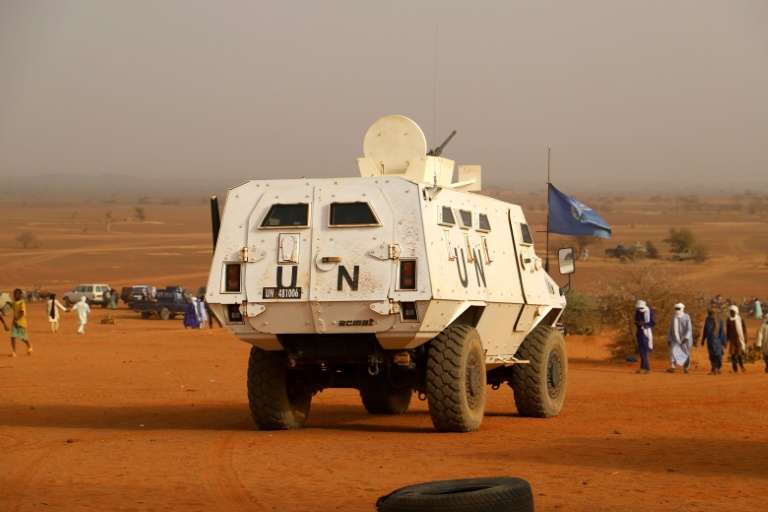
A UN peacekeeper was killed and three others wounded Wednesday in a “terrorist attack” on their convoy in Kidal, northern Mali, the MINUSMA mission said.

The casualties were members of the mission’s Jordanian contingent, a security official said separately on condition of anonymity.

The convoy was hit by small-arms fire and rocket-propelled grenades in an attack that lasted about an hour, MINUSMA spokesman Olivier Salgado tweeted.

“Unfortunately, one of the blue helmets succumbed to his wounds following the attack,” he posted in French.

No details were given about the suspected attackers.

In a statement, the UN’s special representative for Mali and head of MINUSMA, El-Ghassim Wane, said the peacekeepers repelled the assailants, who were heavily armed.

“I strongly condemn this attack, which is another desperate attempt by terrorist groups to hamper the quest for peace in Mali and the implementation of MINUSMA’s mandate,” he said.

The attack was the fifth incident to occur in Mali’s Kidal region in a week, the statement said.

UN Secretary-General Antonio Guterres condemned the attack, according to a spokesperson, saying attacks on peacekeepers “may constitute war crimes under international law.”

“He calls on the Malian authorities to spare no effort in identifying the perpetrators of this attack so that they can be brought to justice swiftly,” the spokesperson said.

MINUSMA — the United Nations Multidimensional Integrated Stabilization Mission in Mali — was deployed in 2013 to help shore up the fragile Sahel state in the face of jihadist attacks.

With 13,000 members, the mission is one of the UN’s biggest peacekeeping operations, and also one of its most dangerous. It says 172 troops have died from hostile acts.

One of the poorest countries in the world, Mali is struggling with a decade-long jihadist insurgency that has claimed thousands of lives and driven hundreds of thousands from their homes.

The ruling junta has turned away from France and towards Russia in its efforts to stem violence that began in the north of the country and spread to the centre, and then to neighbouring Burkina Faso and Niger.

OPEC debates oil output boost amid Russian isolation

Major oil producers led by Saudi Arabia and Russia hold talks Thursday on whether to adjust output, hard on the heels of an EU ban on Russian oil imports.

Analysts had expected OPEC+ producers to likely stick to their policy of only increasing output modestly, as they have done since May 2021.

However, a Wall Street Journal report on Monday that said OPEC was considering suspending Russia from the output deal has sown doubts.

“Such a move would effectively bring a premature end to the group’s supply agreement and pave the way for an unrestricted increase in output,” Stephen Brennock, an analyst at PVM Energy, said.

The 13 members of the Organization of the Petroleum Exporting Countries, chaired by Saudi Arabia, and their 10 partners, led by Russia, drastically slashed output in 2020 as demand slumped because of the coronavirus pandemic and worldwide lockdowns.

They have increased output modestly to the tune of around 400,000 barrels per day each month since last year, resisting pressure by top consumers, including the United States, to open the taps wider.

The expectation was that output would increase by another 432,000 barrels per day in July.

“So far, the market has been assuming that OPEC+ would raise the planned production volume… Russia is still being included in this,” analyst Carsten Fritsch of Commerzbank said.

Talks by videoconference begin at the technical level at 1200 GMT at OPEC headquarters in Vienna, before moving into a plenary session.

– Russia a ‘pariah’ –

European Union leaders agreed on Monday to ban more than two-thirds of Russian oil imports as part of a sixth package of sanctions on Moscow over its offensive in Ukraine.

Britain has already said it plans to phase out Russian oil imports by the end of 2022 and eventually stop importing its gas.  

The United States, too, banned Russian oil and gas days after Russia’s invasion began on February 24.

“Russia has now transformed into a pariah,” Seb analyst Bjarne Schieldrop commented, saying OPEC+ may break up or the agreed quota system will be placed on hold amid Moscow’s international isolation.

“Apparent elevated US-Saudi shuttle diplomacy lately may indicate that change in OPEC+ may be near.”

That, he added, would enable Saudi Arabia and the United Arab Emirates to use their spare capacity and lift oil production.

“More oil from Saudi and the UAE will allow the West to implement sharper bans forcing Russian oil exports lower while not blowing up the oil price,” Schieldrop added.

– OPEC ‘reticence’ –

Russia’s invasion of Ukraine has exacerbated concerns about oil supplies, sending prices to record highs this year.

As the economic screws have tightened around Russia, prices have further soared, putting pressure on the cartel to open the valves more widely and relieve the market.

But Saudi Arabia, OPEC+’s de facto leader, has given no indication it is inclined to make such a move.

Saudi Foreign Minister Prince Faisal bin Farhan told last week’s World Economic Forum in Davos that the kingdom had “done what it could” for the oil market.

“It’s more complex than simply adding barrels to the market,” he added.

Members of the G7 club of industrialised nations last week underlined OPEC+’s “key role” in the face of the tightening of international markets.

“Yet this latest attempt by the West to temper energy-driven inflation fell on deaf ears, again. Instead, Saudi Arabia signalled its allegiance to fellow OPEC+ producer Russia,” said Brennock.

Soaring oil prices have stimulated the Gulf region’s economies, with Saudi Arabia recording its highest growth rate in 10 years in the first quarter of 2022.

Susannah Streeter, an analyst at Hargreaves Lansdown, said there “is likely to still be reticence about turning on the taps too freely” as a result.

“OPEC has also previously warned that it will be impossible to replace all the volumes lost from Russia due to sanctions, which is still likely to stem further significant drops in crude prices.”

Partner concerned for health of journalist detained in China

The partner of Chinese-Australian journalist Cheng Lei — detained by Beijing authorities since August 2020 — said he has serious concerns about her declining health behind bars in an interview aired Thursday.

Cheng, a mother of two and former anchor at Chinese state broadcaster CGTN, was formally arrested in February 2021, when she was charged with “supplying state secrets overseas”.

Nick Coyle, described by Sky News Australia as Cheng’s longtime boyfriend, said he was concerned about a “range of health issues” his partner faced in prison, which were exacerbated by food restrictions.

He said monthly consular visits between Cheng and Australian officials had also been suspended because of China’s strict Covid-19 protocols.

Cheng was tried secretly in March behind closed doors, with even Australia’s ambassador to China, Graham Fletcher, blocked from entering the court to observe proceedings.

The court deferred its verdict and Cheng’s sentence, which could be life in prison for cases deemed the most serious.

Coyle, who is the chief executive of the China-Australia Chamber of Commerce, said he reported Cheng missing in August 2020 after visiting her apartment when she did not reply to his messages. 

“Everything looked normal until I could see all the electronic devices, computers, all those sorts of things, were gone and then it was pretty obvious to me what had happened,” he said.

Cheng’s detention came as relations between Australia and China cratered, raising speculation it was politically motivated.

Coyle told Sky News Australia that Cheng “wasn’t involved in politics” but may have been targeted because she was a high-profile Australian person in China.

Russia braces for economic upheaval as sanctions start to bite

At his garage in the south of Moscow, 35-year-old mechanic Ivan is starting to worry.

With billions of dollars in financial reserves and money still coming in from oil and gas exports, Russia has yet to feel the full impact of the barrage of Western sanctions imposed over its offensive in Ukraine.

But Ivan sees storm clouds on the horizon.

The foreign parts he needs to fix his clients’ cars are getting harder to find, and prices have jumped by at least 30 percent after many brands halted exports to Russia.

“We’re running out of stock. At some point, there won’t be anything left,” said Ivan, who declined to give his last name when speaking to international media.

“People who have foreign cars are worried, they are wondering what to do in the future,” he said.

Faced with a shortage of imported parts in factories, authorities eased safety and emission standards for locally produced cars in May — including dropping the requirement for airbags.

President Vladimir Putin has been defiant in the face of Western sanctions, insisting that the Russian economy will emerge stronger, and pointing to “chaotic measures” in Europe that have boosted global energy prices.

Officials say the damage from sanctions will be temporary, with the economy expected to shrink by eight percent this year and then bounce back to growth in 2024.

– VAT points to spending drop –

But Russia is heavily reliant on imports of everything from manufacturing equipment to consumer goods, and economists believe the worst effects of the sanctions are still to come.

Now almost 100 days into the conflict, officials and ordinary Russians are reporting a litany of problems, including shortages of everything from paper to medicine. 

Authorities have stopped releasing key data, making it difficult to assess the impact of sanctions.

But the few available economic indicators point to significant problems.

Strict capital controls, high energy prices and a collapse in imports have led to a surge in the ruble, prompting Russia’s central bank to slash its key rate last week in a bid to rein in the currency.

Inflation meanwhile hit 17.8 percent year-on-year in April, the highest for 20 years.

And revenues from domestic value-added or sales tax collapsed by more than a half in April, VAT fees on imported goods dropping by a third compared to the same month in 2021.

“In April, the revenues of the overwhelming majority of companies in Russia took a hit,” Andrei Grachev, head of tax practice at Birch Legal, told The Bell, an independent Russian business website.

“This didn’t merely affect those who ceased operations in Russia, but also those who continued to work but lost clients and profits.”

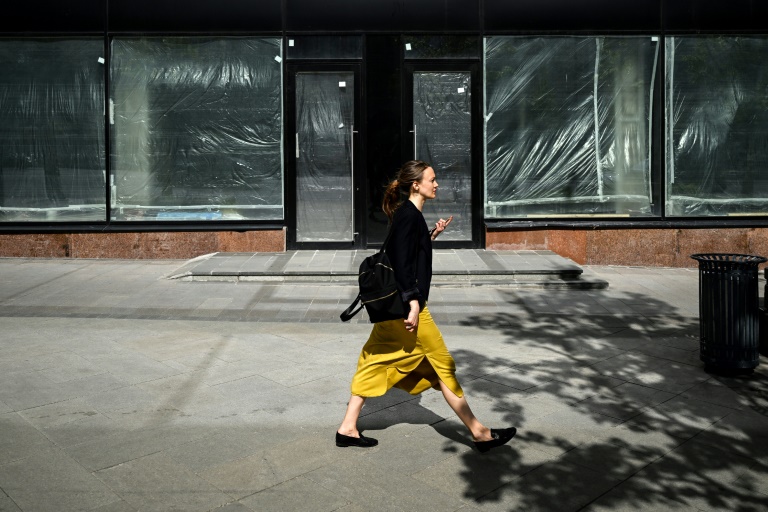
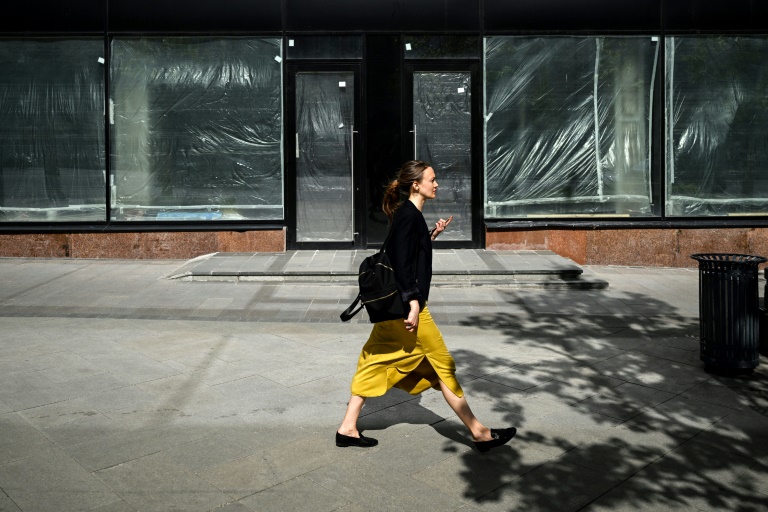
That hit is evident on the streets of Moscow, which are now lined with shuttered shops: from McDonald’s and Starbucks to clothing retailers H&M and Zara. 

Central bank chief Elvira Nabiullina warned in April that problems were emerging “in all sectors, both in large and small companies.”

– Button, paper shortages –

Textile manufacturers are having trouble buying buttons, while paper producers are struggling with a shortage of bleaching agents, Nabiullina said.

Prices for white paper have skyrocketed and some businesses in Moscow have started printing out receipts on unbleached beige paper. 

The aviation and tourism sectors have been hit especially hard. Direct air links with Europe have been severed and Russians are unable to use their bank cards abroad.

Authorities are trying to convince Russians to holiday at home, but the country’s balmy Black Sea coast has become hard to reach due to the closure of airspace in the south over the fighting in Ukraine.

Russian Railways has launched additional train services to compensate for the absence of flights.

For now, the surge in oil and gas prices prompted by the Ukraine conflict is helping to keep the Russian economy afloat, despite the tens of thousands out of work or put on leave and paid a reduced salary while factories halt production for lack of foreign components.

Chris Weafer, the founder of consultancy Macro-Advisory and a long-time observer of the Russian economy, said sanctions mainly hit the financial system in March and April.

“What will start in the next few months are pay cuts,” Weafer told AFP. 

“There will be a drop in income, and that combined with inflation will cut very deeply into people’s disposable income.”

Weafer said Russia was in a strong financial position and the authorities could still keep the economy going.

The EU’s decision this week to ban more than two-thirds of Russian oil imports will not have as much impact as many hoped, he said.

“By the time oil sanctions kick in, Russia should be able to replicate the EU market elsewhere,” in particular in Asia, Weafer said.

But further Western moves against Russia’s energy sector could cause serious harm, he said, “if sanctions were to move into more damaging territory: gas.”

Russia braces for economic upheaval as sanctions start to bite

At his garage in the south of Moscow, 35-year-old mechanic Ivan is starting to worry.

With billions of dollars in financial reserves and money still coming in from oil and gas exports, Russia has yet to feel the full impact of the barrage of Western sanctions imposed over its offensive in Ukraine.

But Ivan sees storm clouds on the horizon.

The foreign parts he needs to fix his clients’ cars are getting harder to find, and prices have jumped by at least 30 percent after many brands halted exports to Russia.

“We’re running out of stock. At some point, there won’t be anything left,” said Ivan, who declined to give his last name when speaking to international media.

“People who have foreign cars are worried, they are wondering what to do in the future,” he said.

Faced with a shortage of imported parts in factories, authorities eased safety and emission standards for locally produced cars in May — including dropping the requirement for airbags.

President Vladimir Putin has been defiant in the face of Western sanctions, insisting that the Russian economy will emerge stronger, and pointing to “chaotic measures” in Europe that have boosted global energy prices.

Officials say the damage from sanctions will be temporary, with the economy expected to shrink by eight percent this year and then bounce back to growth in 2024.

– VAT points to spending drop –

But Russia is heavily reliant on imports of everything from manufacturing equipment to consumer goods, and economists believe the worst effects of the sanctions are still to come.

Now almost 100 days into the conflict, officials and ordinary Russians are reporting a litany of problems, including shortages of everything from paper to medicine. 

Authorities have stopped releasing key data, making it difficult to assess the impact of sanctions.

But the few available economic indicators point to significant problems.

Strict capital controls, high energy prices and a collapse in imports have led to a surge in the ruble, prompting Russia’s central bank to slash its key rate last week in a bid to rein in the currency.

Inflation meanwhile hit 17.8 percent year-on-year in April, the highest for 20 years.

And revenues from domestic value-added or sales tax collapsed by more than a half in April, VAT fees on imported goods dropping by a third compared to the same month in 2021.

“In April, the revenues of the overwhelming majority of companies in Russia took a hit,” Andrei Grachev, head of tax practice at Birch Legal, told The Bell, an independent Russian business website.

“This didn’t merely affect those who ceased operations in Russia, but also those who continued to work but lost clients and profits.”

That hit is evident on the streets of Moscow, which are now lined with shuttered shops: from McDonald’s and Starbucks to clothing retailers H&M and Zara. 

Central bank chief Elvira Nabiullina warned in April that problems were emerging “in all sectors, both in large and small companies.”

– Button, paper shortages –

Textile manufacturers are having trouble buying buttons, while paper producers are struggling with a shortage of bleaching agents, Nabiullina said.

Prices for white paper have skyrocketed and some businesses in Moscow have started printing out receipts on unbleached beige paper. 

The aviation and tourism sectors have been hit especially hard. Direct air links with Europe have been severed and Russians are unable to use their bank cards abroad.

Authorities are trying to convince Russians to holiday at home, but the country’s balmy Black Sea coast has become hard to reach due to the closure of airspace in the south over the fighting in Ukraine.

Russian Railways has launched additional train services to compensate for the absence of flights.

For now, the surge in oil and gas prices prompted by the Ukraine conflict is helping to keep the Russian economy afloat, despite the tens of thousands out of work or put on leave and paid a reduced salary while factories halt production for lack of foreign components.

Chris Weafer, the founder of consultancy Macro-Advisory and a long-time observer of the Russian economy, said sanctions mainly hit the financial system in March and April.

“What will start in the next few months are pay cuts,” Weafer told AFP. 

“There will be a drop in income, and that combined with inflation will cut very deeply into people’s disposable income.”

Weafer said Russia was in a strong financial position and the authorities could still keep the economy going.

The EU’s decision this week to ban more than two-thirds of Russian oil imports will not have as much impact as many hoped, he said.

“By the time oil sanctions kick in, Russia should be able to replicate the EU market elsewhere,” in particular in Asia, Weafer said.

But further Western moves against Russia’s energy sector could cause serious harm, he said, “if sanctions were to move into more damaging territory: gas.”

100 days of war in Ukraine: A timeline

Russia invaded Ukraine in the early hours of February 24, setting off the worst conflict in Europe in decades.

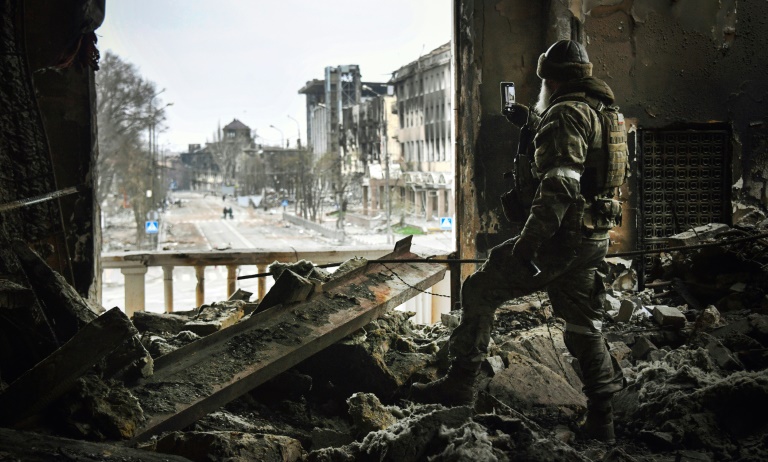
As Russia extends its grip over the east, we look back on 100 days of fighting that has killed tens of thousands of civilians and reduced entire cities to rubble.

– February 24: Russia invades – 

Russian President Vladimir Putin announces a “special military operation” to “demilitarise” and “de-Nazify” the former Soviet state and protect Russian speakers there.

A full-scale invasion starts with air and missile strikes on several cities. Ukrainian President Volodymyr Zelensky pledges to stay in Kyiv to lead the resistance.

– February 26: Massive sanctions –

The West adopts unprecedented sanctions against Russia and offers Ukraine military aid. 

Air spaces are closed to Russian aircraft and Russia is kicked out of sporting and cultural events.

– February 27: Nuclear threat –

Putin puts Russia’s nuclear forces on high alert, in what is seen as a warning to the West not to intervene in Ukraine. 

– February 28: First talks – 

During the first peace talks between Kyiv and Moscow, Russia demands recognition of its sovereignty over Crimea, the “demilitarisation” and “de-Nazification” of Ukraine and a guarantee Ukraine will never join NATO. Ukraine demands a complete Russian withdrawal.

– March 3: Kherson falls –

Russian troops attack Ukraine’s south coast to try to link up territory held by pro-Moscow rebels in eastern Ukraine with the Russian-annexed Crimea peninsula. 

On March 3, Kherson in the south becomes the first city to fall. Russian forces relentlessly shell the port of Mariupol.

– March 4: Media crackdown –

Russia passes a law punishing what it calls “fake news” about its offensive — such as referring to its “special military operation” as an invasion — with up to 15 years in prison.

– March 16: Mariupol theatre razed – 

Russian air strikes raze a Mariupol theatre killing an estimated 300 people sheltering inside. Moscow blames the attack on Ukraine’s nationalist Azov battalion.

– March 16: Zelensky lobbies Congress – 

Zelensky tells the US Congress to “remember Pearl Harbor” and lobbies Western parliaments for more help. 

– April 2-3: Horror in Bucha –

After a month of fighting, Russia withdraws from northern Ukraine, announcing it will focus its efforts on conquering the eastern Donbas region.

On April 2 and 3, Ukrainians find dozens of corpses of civilians scattered on the street or buried in shallow graves in the Kyiv suburb of Bucha, which Russian forces had occupied.

Moscow dismisses accusations of Russian war crimes, saying the images of the bodies are fakes.

– April 8: Train station carnage –

A rocket attack on a train station in the eastern city of Kramatorsk kills at least 57 civilians being evacuated from Donbas.

– April 12: Biden speaks of ‘genocide’ –

Biden accuses Russia of “genocide”, saying Putin appears intent on “trying to wipe out the idea of even being able to be a Ukrainian”.

– April 14: Flagship sinks –

Ukrainian missiles hit and sink Russia’s missile cruiser Moskva in the Black Sea, a major setback for Moscow.

– May 11: $40 billion in US aid –

US lawmakers back a huge $40-billion package of military, economic and humanitarian aid for Ukraine.

– May 16: Kharkiv retreat –

Ukraine says its troops have driven Russian forces back from the outskirts of the country’s second-largest city, Kharkiv, to the Russian border.

– May 18: Sweden, Finland apply to NATO –

Finland and Sweden apply to join NATO, reversing decades of military non-alignment because of Russia’s invasion of Ukraine. 

– May 23: First war crimes conviction –

A Ukrainian court finds a 21-year-old Russian soldier guilty of war crimes and hands down a life sentence for shooting dead a 62-year-old civilian in northeastern Ukraine in the opening days of the war. He has appealed.

– May 21: Battle for Mariupol ends – 

Russia declares it is in full control of Mariupol after Ukraine ordered troops holding out for weeks in the Azovstal steelworks to lay down their arms to save their lives.

Nearly 2,500 soldiers surrender and are taken prisoner by Russia. 

– May 30: EU bans most Russian oil –

EU leaders overcome resistance from Hungary to agree a partial ban on most Russian oil imports as part of a sixth wave of sanctions.

The deal bans oil imports delivered by tanker but allows landlocked countries such as Hungary to continue receiving Russian oil by pipeline.

– May 31: Russia seizes part of eastern city –

Russian troops seize part of the key eastern Ukrainian city of Severodonetsk, its governor says. 

Taking the city would give Russia de-facto control over Lugansk, one of two regions that make up the Donbas, Ukraine’s industrial heartland.

doc-jmy-cb-cdw/jj/oho

Bread factory holds tough as Ukraine hopes for recovery

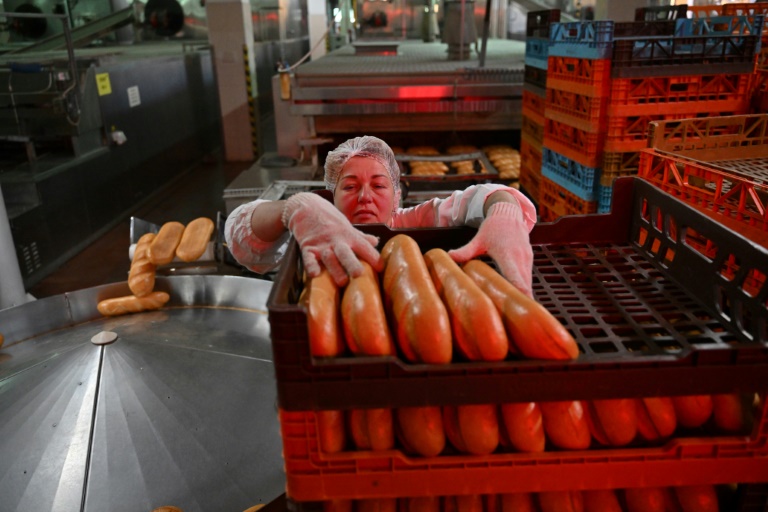
Balls of dough file past on the assembly line and a sweet scent fills the air at a bread factory that embodies Ukraine’s determination and its tentative recovery 100 days on from Russia’s invasion.

Located near the capital Kyiv, the Tsar-Khlib factory continued production even as Russian troops advanced, keeping city residents fed despite a missile attack on a neighbouring facility.

Tsar-Khlib had to contend with extreme challenges.

At one point, the factory was less than eight kilometres (five miles) from the front line, and many of the factory’s workers were stranded in territory held by Russian forces. Most of its clients had fled to safety.

“But we quickly realised that we had to keep producing because some people were staying on,” said Anton Paliy, the 43-year-old head of production.

In the end, the immediate crisis passed, as Russian troops withdrew from the area at the end of March.

Operating with just a fraction of its 800 employees, the factory continued producing 16 tons of fresh bread a day, compared to its normal level of 100 tons.

When the air raid sirens sounded, workers would run into the basement. When they returned, they would find messy piles of fresh bread outside the oven.

Paliy said the sound of the machinery drowned out the noises of war in the background, making the situation a little more bearable “psychologically”.

– Kyiv residents returning –

The state-of-the-art Shanta factory, just a few hundred metres away, was not so lucky. Russian missiles destroyed the building on March 16.

Oleksandr Tarenenko, the director of Khlibni Investizii, which owns both facilities, said the attack was a war crime because Russian forces had targeted civilian infrastructure.

A missile shot down by Ukraine’s air defence forces can still be seen outside the building.

Reconstruction could be lengthy and costly, and the facility’s 140 workers are unemployed.

But at Tsar-Khlib, activity is picking up as Kyiv residents return to the city.

Demand “is increasing every week”, said Tarenenko.

The International Monetary Fund expects Ukraine’s economy to shrink by 35 percent this year, but parts of the country are slowly recovering despite the ongoing conflict in the south and east.

In Kyiv and the surrounding region, “consumer demand is increasing, connections are being restored”, Finance Minister Sergiy Marchenko told AFP.

Even the return of foreign embassies was sending a signal to the public that the capital is open for business and residents were returning to “re-launch their economic activities”, Marchenko said.

– ‘We did our job’ –

Even in Ukraine’s second biggest city, Kharkiv, whose outskirts are still being shelled by Russian forces, there are some signs of recovery.

The popular Cafe Crystal, in a central park, re-opened its doors at the end of April after two months, although the menu is limited, and the staff are down to seven or eight from 30 or 40 before the war.

“We have to keep jobs. The city is gradually reviving. People want to come out and have a coffee,” said Alyona Kostrova, the manager.

“After staying in bomb shelters, they want to live a little.”

At Tsar-Khlib, production has gone up to 50 tons a day and Paliy said he felt at least some comfort in “feeling useful in these difficult times”.

“It’s not that I want a medal, but we did our job — we helped people,” he said.

“And we will continue to do it.”

Ancient Mayan maize god sculpture found in Mexico

Archaeologists have uncovered a roughly 1,300-year-old sculpture representing the head of a Mayan maize god in ruins in southeastern Mexico, the National Institute of Anthropology and History said.

The artefact was found in Palenque facing east to west, “which would symbolize the birth of the maize plant with the first rays of the sun,” it said in a statement Tuesday.

The sculpture was part of “an offering that was placed on a pond, emulating the entrance of the deity to the underworld, in an aquatic environment,” the institute added.

The discovery “allows us to begin to know how the ancient Maya of Palenque constantly relived the mythical passage of the birth, death and resurrection of the maize deity,” said researcher Arnoldo Gonzalez Cruz.

As the piece was found in humid conditions, it is in the process of gradually drying out before it is restored, the institute said.

Close Bitnami banner
Bitnami