World

Markets waver on inflation worry; oil rebounds from losses

Asian and European stock markets wavered on Wednesday, as traders digested Wall Street losses and data showing that runaway inflation shows no sign of easing.

Oil however rallied after sinking sharply on reports that OPEC was considering suspending Russia from an output deal, which observers said could allow producers to pump more.

Equities have enjoyed a largely healthy run of late on hopes that inflation could be nearing a peak and a sell-off across markets may have run its course.

The easing of some lockdown measures in China added to the optimism.

Yet investors were brought down to earth with a bump Tuesday after data showed that eurozone inflation hit a record high in May on rocketing energy costs.

The news puts extra pressure on the European Central Bank to act quicker to rein in prices by hiking interest rates, along with the Bank of England and the US Federal Reserve.

Markets remain fearful as the Ukraine conflict fuels massive price gains for energy and food, translating into spiking inflation — and damaging the post-pandemic global economic recovery.

“There are heightened concerns around inflation and where central banks are likely to go trying to combat inflation,” Kristina Hooper, of Invesco Advisers, told Bloomberg Radio.

“This has gone from just an inflation scare to a growth scare. Uncertainty has grown.”

– Oil rebounds – 

Equities were also mixed in Asia, with traders shrugging off a further easing of lockdown restrictions in China that many hope will give a much-needed boost to the world’s number two economy.

Hong Kong and Shanghai slipped along with Taipei, Bangkok, Mumbai and Manila, though Tokyo, Sydney, Singapore and Wellington rose.

Back in Europe, London fell and Frankfurt rose, while Paris flatlined.

The oil market rebounded somewhat after tanking by more than four percent late Tuesday in reaction to a Wall Street Journal report that OPEC was considering removing Russia from an agreement that has locked producers into limited output increases.

Moscow’s removal would mean an early end to the pact and allow major crude nations such as Saudi Arabia to open the taps, analysts said.

“If there’s any confirmation from OPEC+ members that the absence of Russia is being discussed, then prices can drop to as low as $100,” said Will Sungchil Yun, at VI Investment Corp. 

– Key figures at around 1115 GMT –

London – FTSE 100: DOWN 0.4 percent at 7,580.33 points

Frankfurt – DAX: UP 0.3 percent at 14,431.51

Paris – CAC 40: FLAT at 6,468.99

EURO STOXX 50: FLAT at 3,788.16

Tokyo – Nikkei 225: UP 0.7 percent at 27,457.89 (close)

Hong Kong – Hang Seng Index: DOWN 0.6 percent at 21,294.94 (close)

Shanghai – Composite: DOWN 0.1 percent at 3,182.16 (close)

New York – Dow: DOWN 0.7 percent at 32,990.12 (close)

Euro/dollar: DOWN at $1.0720 from $1.0734 on Tuesday

Pound/dollar: DOWN at $1.2586 from $1.2602

Euro/pound: UNCHANGED at 85.18 pence

Dollar/yen: UP at 129.39 yen from 128.67 yen

Brent North Sea crude: UP 1.5 percent at $117.33 per barrel

West Texas Intermediate: UP 1.5 percent at $116.35
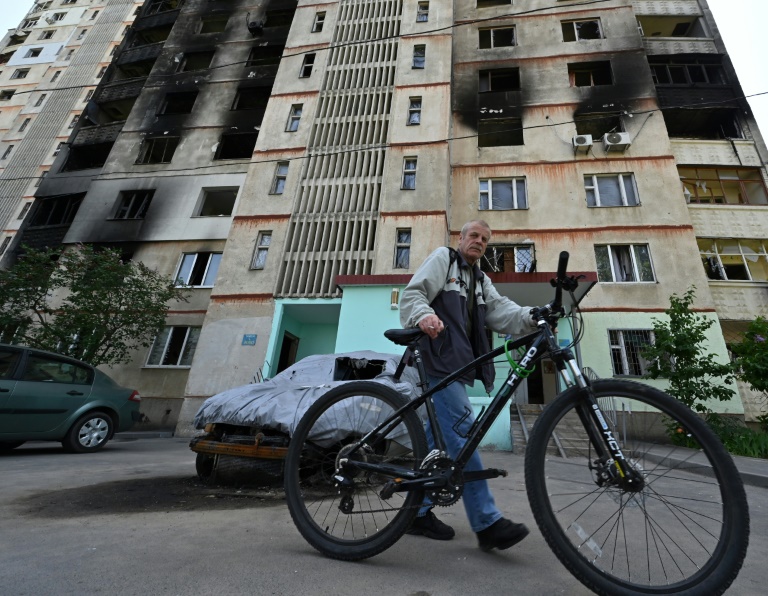
In a bombed-out building, Ukraine investigators take stock

As investigators surveyed the damage in a bombed-out block of buildings in Saltivka, on the outskirts of the eastern city of Kharkiv, residents gathered around them.

They were dispatched to decide if this attack constituted a war crime: some of the locals were hoping in vain for a quick answer as to who might compensate them for their devastated homes.

While the investigators were not able to provide clarity on that issue, they nevertheless took note of the immense destruction around them.

Floor by floor, they went through the building, accompanied by its former residents.

Seventy-year-old Mykola Tymchenko’s flat was a complete ruin after a fire started by a Russian strike swept through it: furniture, bedding, decorations, all reduced to ashes.

“The kitchen was here,” he said. “The bathroom and the toilet were here.

“I lost my wife before New Year. Now I’ve lost my flat,” he added. “I took years to pay for it and in one moment…”

– ‘Can’t live here any more’ –

In the neighbouring stairwell, the damage was less visible.

One flat belonging to Oleksandr Ryabokon, 30, had had its windows blown out by the force of a Russian strike, glass and bits of wall scattered all over.

Having got his wife and children to safety, he was now gathering up their affairs in bags to keep out of the hands of “thieves and looters”, he said.

One of the recovered treasures was a painting of his great-grandmother wrapped in a film of plastic to keep out the dust.

“It’s impossible to live here,” he said.

He did not yet know whether the building would be patched up or condemned as beyond repair and demolished. He did not know if he would be compensated.

He did have hopes, however, that the authorities would allocate him new housing.

– Assessing the damage –

At the top of the building, meanwhile, the investigators continued to take stock.

They inspected a gaping hole in a wall and the remains of a projectile.

“An expert will decide what type of shell it was,” said 33-year-old Oleksandr Glebov, one of the Kharkiv investigators from the prosecutor’s office.

At the beginning of the invasion in late February, Russian troops got as close as the outskirts of Kharkiv — including Saltivka — before being pushed back by Ukrainian forces.

It was at that point that many buildings here were hit.

Since then, Russian forces have focussed their attacks elsewhere, but the artillery duel between the two sides has thundered on, shells falling regularly on this working-class district.

Before the war, half-a-million people lived here. Most of them have since fled.

Glebov explained how the prosecutors proceeded.

“During the investigation, we ask the victims the same question: ‘Were there any military objectives next to your house?'”

At this stage, he added, he could not say for sure whether the Russians had been targeting civilians or whether it was just inaccurate fire, military error.

His colleague, Oleksandr Arseni, had fewer doubts.

The district bears the traces of hundreds of projectiles having fallen since the beginning of Russia’s invasion.

They had talked to the owners on every floor, he said.

“These are war crimes. We are recording them.”

Yemen truce hangs in balance as extension talks falter

A fragile UN-brokered truce between the Yemeni government and Huthi rebels hung in the balance Wednesday as talks on renewing it hit trouble, threatening the humanitarian gains of the past two months.

Aid agencies and Western governments have urged Yemen’s warring parties to extend the truce, which has significantly reduced the intensity of fighting in a conflict the United Nations says has triggered the world’s worst humanitarian crisis.

But with just one day before the truce expires, there was no sign of any breakthrough in UN-backed talks.

A Yemeni aircraft left the rebel-held capital Sanaa for Cairo on the first commercial flight between the two cities since 2016, the latest gain from the truce deal.

The office of the United Nations special envoy for Yemen told AFP there were 77 people on board the Yemenia flight from Sanaa airport, which has been closed to commercial flights for nearly six years. 

It is the seventh such flight since the truce went into effect on April 2. The six previous flights had all been to the Jordanian capital Amman.

Yemen has been gripped by conflict since the rebels overran Sanaa in 2014, triggering a Saudi-led military intervention in support of the beleaguered government the following year.

On May 16, a Yemenia plane carrying 126 passengers, including critically ill hospital patients and their relatives, became the first commercial flight to leave Sanaa since August 2016.

Air traffic into the rebel-held capital has been largely halted by a Saudi-led blockade, but there have been exemptions for aid flights that are a key lifeline for the population.

Despite accusations of violations from both the Saudi-led coalition and the Huthi rebels, the truce has significantly reduced levels of violence.

– Talks in ‘trouble’ –

The Huthis have said they are considering renewing the ceasefire amid UN efforts to extend the truce.

But on Tuesday, the United States warned the truce talks were in “trouble” as it pushed for an extension to help support millions of people at risk.

Talks on extending the ceasefire “haven’t ended yet but seem to be in a bit of trouble”, the US ambassador to the United Nations, Linda Thomas-Greenfield, said.

Aid agencies have urged Yemen’s warring parties to extend the truce, saying it had “positive humanitarian impacts”.

“As organisations working across Yemen, we have seen the positive humanitarian impacts of the truce,” more than 30 aid agencies, including Save The Children, Oxfam and the Norwegian Refugee Council, said in a joint statement.

They said the reopening of Sanaa airport to commercial flights had allowed hundreds of patients in “critical need of lifesaving medical treatment outside of the country” to finally receive it.

The truce has also seen oil tankers docking in the rebel-held port of Hodeida, potentially easing fuel shortages in Sanaa and elsewhere. 

But a provision for the rebels to ease their siege of Yemen’s third-largest city Taez has yet to be implemented, to the anger of both the government and residents, who have held repeated protests in recent weeks.

The head of Yemen’s presidential leadership council, Rashad al-Alimi, discussed the implementation of the truce with UN chief Antonio Guterres by telephone on Tuesday. 

He urged the UN chief to “redouble the pressure on the Huthi militia to abide by its commitments to the truce, including opening roads to Taez”, the official Saba news agency reported. 

Taez has been largely cut off from the rest of government-held territory since 2015, with all supplies coming in by a single tortuous road through the mountains.

The war in Yemen has killed more than 150,000 people and displaced millions of civilians, according to the UN.

China says not competing for influence in South Pacific

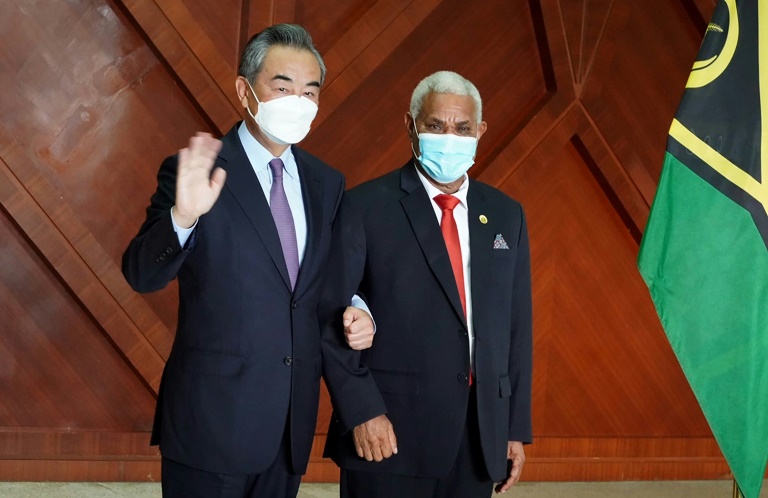
China has insisted it has “no intention to compete” for influence in the South Pacific as foreign minister Wang Yi and his Australian counterpart Penny Wong again jetted around the region Wednesday on duelling diplomatic charm offensives.

In a statement distributed by the Chinese embassy in Canberra, Beijing said it “does not seek exclusive rights” in the region and “we have no intention to compete with others”.

The claim comes as Wang nears the end of a contentious 10-day visit to Pacific Island nations that has seen China pitch a radically increased role in regional security, much to the concern of the United States and Australia.

“China respects Australia’s historical and traditional ties in the region and there is enough space in the vast Pacific Ocean for China, Australia and all island countries to share peace, development and prosperity,” the statement said.

Although Wang failed to secure support for a regional security deal that would have seen Beijing play a much bigger role in sensitive areas including policing and cybersecurity, he has inked a series of country-specific agreements on his trip.

In Vanuatu on Wednesday, agreements were announced on deepening economic ties and sending Chinese medical teams to the country.

In Tonga on Tuesday, Wang pledged China’s support for sports stadium and wind power projects, according to Chinese state media, while signing deals on disaster prevention and mitigation, agriculture, fisheries and health care. 

Wang’s South Pacific trip concludes with a stop in Papua New Guinea on Thursday and Friday.

– Australian blitz –

The visit has prompted the newly elected Australian government to embark on a diplomatic blitz to shore up decades-old alliances.

Australia’s new foreign minister Penny Wong said she was heading back to the Pacific Islands, travelling to Samoa and Tonga just days after Wang visited.

Since being sworn in nine days ago, Wong has already visited Japan — for a meeting of Quad countries the United States, India, Japan and Australia — and Fiji. 

Australia’s new centre-left government is playing catch-up after years of relations with the Pacific being hampered by the former conservative administration’s foot-dragging on climate change.

Rising sea levels are seen as an existential threat by many of the low-lying Pacific Island nations.

Visiting Fiji, Wong said Australia would set new, more ambitious emissions targets and bid to co-host a future UN climate conference with Pacific Island countries. 

There would be no more “disrespecting” Pacific nations or “ignoring” their calls to act on climate change, she said.

Danes begin voting on joining EU's common defence policy

Traditionally eurosceptic Denmark began voting Wednesday in a referendum on whether to overturn its opt-out on the EU’s common defence policy after Russia’s invasion of Ukraine.

The vote comes on the heels of neighbouring Finland’s and Sweden’s historic applications for NATO membership, as the Ukraine war forces countries in Europe to rethink their security policies.

More than 65 percent of Denmark’s 4.3 million eligible voters are expected to vote in favour of dropping the exemption, an opinion poll published on Sunday suggested.

Analysts’ predictions have, however, been cautious, given the low voter turnout expected in a country that has often said “no” to more EU integration, most recently in 2015.

Polls opened across the country at 8:00 am (0600 GMT), and were set to close at 8:00 pm. Final results were due around 11:00 pm (2100 GMT).

At Copenhagen’s city hall, voting was busy in the early morning as residents of the capital hurried to cast their ballots on their way to work.

“I think that these kinds of votes are even more important than earlier. In times of war it’s obviously important to state if you feel that you want to join this type of community or not,” Molly Stensgaard, a 55-year-old scriptwriter, told AFP. 

Mads Adam, a 24-year-old political science student, agreed.

“History changes and it affects us here in Denmark, and obviously we have to react to that.”

Danish Prime Minister Mette Frederiksen had urged Danes to vote in a final televised debate on Sunday.

“I believe with all my heart that we have to vote ‘yes’. At a time when we need to fight for security in Europe, we need to be more united with our neighbours”, she said.

Denmark has been an EU member since 1973, but it put the brakes on transferring more power to Brussels in 1992 when 50.7 percent of Danes rejected the Maastricht Treaty, the EU’s founding treaty.

It needed to be ratified by all member states to enter into force. In order to persuade Danes to approve the treaty, Copenhagen negotiated a series of exemptions and Danes finally approved it the following year.

Since then, Denmark has remained outside the European single currency, the euro — which it rejected in a 2000 referendum — as well as the bloc’s common policies on justice and home affairs, and defence.

– ‘Ukraine the major reason’-

The defence opt-out means that the Scandinavian country, a founding member of NATO, does not participate in EU foreign policy where defence is concerned and does not contribute troops to EU military missions.

Copenhagen has exercised its opt-out 235 times in 29 years, according to a tally by the Europa think tank.

Danish PM Frederiksen called the referendum just two weeks after Russia’s invasion of Ukraine, and after having reached an agreement with a majority of parties in Denmark’s parliament, the Folketing.

At the same time, she also announced plans to increase defence spending to two percent of gross domestic product, in line with NATO membership requirements, by 2033.

“It was a big surprise”, said the director of the Europa think tank, Lykke Friis. 

“For the past many, many years, nobody thought that the government would put the defence opt-out to a national referendum”, she said.

“There’s no doubt that Ukraine was the major reason for calling the referendum.”

Eleven of Denmark’s 14 parties have urged voters to say “yes” to dropping the opt-out, representing more than three-quarters of seats in parliament. 

Two far-right eurosceptic parties and a far-left party have meanwhile called for Danes to say “no”.

They have argued that a joint European defence would come at the expense of NATO, which has been the cornerstone of Denmark’s defence since its creation in 1949.

In December 2015, Danes voted “no” to strengthening their cooperation with the European Union on police and security matters for fear of losing their sovereignty over immigration.

Asian markets mixed on inflation worry, oil bounces after drop

Asian markets fluctuated Wednesday following losses on Wall Street and data reminding traders that inflation shows no sign of easing.

Oil rallied after seeing a sharp drop earlier on reports that OPEC was considering suspending Russia from an output deal, which observers said could allow producers to pump more.

Regional equities have enjoyed a largely healthy run of late on hopes that inflation could be nearing a peak and a sell-off across markets may have run its course, while the easing of some lockdown measures in China added to the optimism.

However, investors were brought down to earth with a bump Tuesday with figures showing eurozone inflation hit a record high in May owing to rocketing energy costs.

The news puts extra pressure on the European Central Bank to act quicker to rein in prices by hiking interest rates along with the Federal Reserve.

There is a fear that acting too late could mean policymakers will have to announce harder, more painful increases later on.

“There are heightened concerns around inflation and where central banks are likely to go trying to combat inflation,” Kristina Hooper, of Invesco Advisers, told Bloomberg Radio.

“This has gone from just an inflation scare to a growth scare. Uncertainty has grown.”

Equity markets were mixed in Asian trade, with traders shrugging off a further easing of lockdown restrictions in China that many hope will give a much-needed boost to the world’s number two economy.

Hong Kong and Shanghai slipped along with Taipei, Bangkok, Mumbai and Manila, though Tokyo, Sydney, Singapore and Wellington rose. London fell in early trade but Paris and Frankfurt were in the green.

But ACY Securities chief economies Clifford Bennett remained wary.

“After this brief euphoria stock prices are again vulnerable to a mass ‘get-out’ frenzy as the reality of the already in full swing global slow-down accompanied by ever-higher interest rates begin to take their toll,” he said in a commentary.

Oil prices struggled to rebound after falling more than four percent late Tuesday in reaction to a Wall Street Journal report that OPEC was considering removing Russia from an agreement that has locked producers into limited output increases.

Moscow’s removal would mean an early end to the pact and allow major crude nations such as Saudi Arabia to open the taps, analysts said.

“If there’s any confirmation from OPEC+ members that the absence of Russia is being discussed, then prices can drop to as low as $100,” said Will Sungchil Yun, at VI Investment Corp. 

“There’s a need for OPEC+ to come up with a plan, as oil prices are likely to keep surging and boost inflationary pressure.”

Matthew Simpson of StoneX Financial said that it was debatable whether such a move would offset a partial European Union embargo on Russia and the expected pick-up in Chinese demand as lockdowns are eased.

But he added that “it can also be argued that much of the drivers behind oil’s recent rally has been priced in. Regardless, we can see that some wind has been taken out of the oil rally sails”.

– Key figures at around 0810 GMT –

Tokyo – Nikkei 225: UP 0.7 percent at 27,457.89 (close)

Hong Kong – Hang Seng Index: DOWN 0.6 percent at 21,294.94 (close)

Shanghai – Composite: DOWN 0.1 percent at 3,182.16 (close)

London – FTSE 100: DOWN 0.1 percent at 7,599.78

Euro/dollar: DOWN at $1.0731 from $1.0739 on Tuesday

Pound/dollar: UP at $1.2605 from $1.2603

Euro/pound: DOWN at 85.14 pence from 85.18 pence

Dollar/yen: UP at 129.24 yen from 128.72 yen

Brent North Sea crude: UP 1.9 percent at $117.76 per barrel

West Texas Intermediate: UP 1.9 percent at $116.87 per barrel

New York – Dow: DOWN 0.7 percent at 32,990.12 (close)

— Bloomberg News contributed to this story —

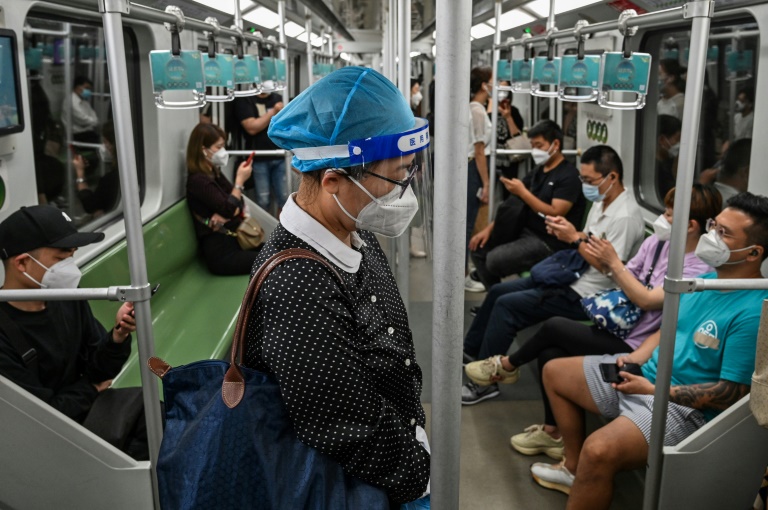
Shanghai euphoria tempered by deep wound to China's economy

Orders have evaporated at Zhou’s textile company based just outside Shanghai, a city now stumbling free from a two-month lockdown that has left small businesses on life support.

Sales are on “a very serious downward slope” and layoffs are imminent at his factory, owner Zhou told AFP, asking for his company to remain unidentified.

The firm is based in Zhejiang province, the anteroom to Shanghai’s cavernous consumer and manufacturing market.  

His is one of tens of thousands of small enterprises clinging to life as China’s strict zero-Covid policies drive a crippling economic slowdown.

Shanghai, a city of 25 million, is the centre for innumerable supply lines that radiate across the country’s eastern seaboard, including Tesla cars and iPhones.

For Zhou, survival will be his only thought over the next two months in an economy whose growth forecast has been clipped by rating agencies.

“I will have to fire people,” Zhou said, as he scours for customers to fill his order book.

– Supply chains chained –

Beijing is tied to a strategy of eliminating Covid outbreaks through harsh lockdowns and mass testing, even as most of the rest of the world has chosen to live with the virus.

That has meant closing factories, disrupting logistics, and squeezing travel to almost zero for weeks on end in major manufacturing hubs including Shenzhen and Shanghai, home to the world’s busiest container port.

Factory activity nationwide plummeted to a two-year low in April after Shanghai shut its 25 million residents at home while multiple Omicron-driven outbreaks bubbled up elsewhere, with activity continuing to shrink — albeit at a slower pace — into May.

The slowdown has choked entire supply lines.

“Downstream factories, stores and businesses are all affected,” Xu Xuebing, owner of Shanghai-based wood supplier Sam Wood told AFP.

“The impact is big… I didn’t even (try to) evaluate how much I have lost during the lockdown,” Xu said, adding he hopes the next two to three months could see a bounce-back.

Shanghai’s lockdown has calcified businesses across China, analysts say, with fears any new virus clusters could see swathes of the country once more plunged into lockdown.

“Lingering uncertainties” are bad for business confidence, Peiqian Liu, China Economist at NatWest Markets, told AFP.

 – Constant uncertainty –

Reopening also does not guarantee total recovery, Zhaopeng Xing, senior China strategist at ANZ Research, warned.

“Mobility inside Shanghai is lifted,” Xing said. 

“But the restrictions when you go outside of Shanghai are still there.” 

“A lot of logistics issues haven’t been restored 100 percent to previous levels,” Xing said, adding “the losses of the past two months” would not be easy to recover from.

Spooked by the unpredictability and harshness of the Shanghai lockdown, foreign businesses have also raised fears over their futures in China.

Meanwhile, experts say smaller enterprises will shy away from hiring “due to the uncertainty of business environment from future lockdowns,” Iris Pang, chief economist for Greater China at ING, told AFP. 

China’s urban youth unemployment rate hit 18.2 percent in April, according to the National Bureau of Statistics.

– Staying alive –

Sagging economic indicators have alarmed Chinese authorities, who are now rushing to inflate confidence and prop up ailing sectors.

The central government has said it will offer tax relief and a bond drive to help industries while increasing government procurement from smaller businesses.

But analysts are cautious about China’s growth in the coming months, with Moody’s on Monday lowering its annual growth forecast to 4.5 percent. 

Beijing is likely to “hand out its stimulus as fast as possible”, Natixis economist Gary Ng said.

“But the rebound may not arrive in Q3 2022 and it is unlikely to see a big change in the Covid-19 policy until the year-end,” he added.

For Zhou the textile maker, survival trumps profit in zero-Covid China.

“I don’t need to make more money than my competitors, but I need to be able to hold on for longer than them over this difficult period,” he said. “This is my short-term plan.”

Shanghai euphoria tempered by deep wound to China's economy

Orders have evaporated at Zhou’s textile company based just outside Shanghai, a city now stumbling free from a two-month lockdown that has left small businesses on life support.

Sales are on “a very serious downward slope” and layoffs are imminent at his factory, owner Zhou told AFP, asking for his company to remain unidentified.

The firm is based in Zhejiang province, the anteroom to Shanghai’s cavernous consumer and manufacturing market.  

His is one of tens of thousands of small enterprises clinging to life as China’s strict zero-Covid policies drive a crippling economic slowdown.

Shanghai, a city of 25 million, is the centre for innumerable supply lines that radiate across the country’s eastern seaboard, including Tesla cars and iPhones.

For Zhou, survival will be his only thought over the next two months in an economy whose growth forecast has been clipped by rating agencies.

“I will have to fire people,” Zhou said, as he scours for customers to fill his order book.

– Supply chains chained –

Beijing is tied to a strategy of eliminating Covid outbreaks through harsh lockdowns and mass testing, even as most of the rest of the world has chosen to live with the virus.

That has meant closing factories, disrupting logistics, and squeezing travel to almost zero for weeks on end in major manufacturing hubs including Shenzhen and Shanghai, home to the world’s busiest container port.

Factory activity nationwide plummeted to a two-year low in April after Shanghai shut its 25 million residents at home while multiple Omicron-driven outbreaks bubbled up elsewhere, with activity continuing to shrink — albeit at a slower pace — into May.

The slowdown has choked entire supply lines.

“Downstream factories, stores and businesses are all affected,” Xu Xuebing, owner of Shanghai-based wood supplier Sam Wood told AFP.

“The impact is big… I didn’t even (try to) evaluate how much I have lost during the lockdown,” Xu said, adding he hopes the next two to three months could see a bounce-back.

Shanghai’s lockdown has calcified businesses across China, analysts say, with fears any new virus clusters could see swathes of the country once more plunged into lockdown.

“Lingering uncertainties” are bad for business confidence, Peiqian Liu, China Economist at NatWest Markets, told AFP.

 – Constant uncertainty –

Reopening also does not guarantee total recovery, Zhaopeng Xing, senior China strategist at ANZ Research, warned.

“Mobility inside Shanghai is lifted,” Xing said. 

“But the restrictions when you go outside of Shanghai are still there.” 

“A lot of logistics issues haven’t been restored 100 percent to previous levels,” Xing said, adding “the losses of the past two months” would not be easy to recover from.

Spooked by the unpredictability and harshness of the Shanghai lockdown, foreign businesses have also raised fears over their futures in China.

Meanwhile, experts say smaller enterprises will shy away from hiring “due to the uncertainty of business environment from future lockdowns,” Iris Pang, chief economist for Greater China at ING, told AFP. 

China’s urban youth unemployment rate hit 18.2 percent in April, according to the National Bureau of Statistics.

– Staying alive –

Sagging economic indicators have alarmed Chinese authorities, who are now rushing to inflate confidence and prop up ailing sectors.

The central government has said it will offer tax relief and a bond drive to help industries while increasing government procurement from smaller businesses.

But analysts are cautious about China’s growth in the coming months, with Moody’s on Monday lowering its annual growth forecast to 4.5 percent. 

Beijing is likely to “hand out its stimulus as fast as possible”, Natixis economist Gary Ng said.

“But the rebound may not arrive in Q3 2022 and it is unlikely to see a big change in the Covid-19 policy until the year-end,” he added.

For Zhou the textile maker, survival trumps profit in zero-Covid China.

“I don’t need to make more money than my competitors, but I need to be able to hold on for longer than them over this difficult period,” he said. “This is my short-term plan.”

War in Ukraine: Latest developments

Here are the latest developments in the war in Ukraine:

– Ukraine to get medium-range US rockets –


President Joe Biden says the US will send more advanced rocket systems to Ukraine to help its troops repel Russian forces, who are gaining ground in the east.

Washington says the HIMARS multiple rocket launchers will allow Ukrainian forces to “more precisely strike targets on the battlefield from greater distance inside Ukraine”, but not attack Russian territory.

Kyiv’s outgunned military had been pleading for more advanced weapons to help it fend off Russia’s offensive in the eastern Donbas region.

– Russians seize ‘most’ of key eastern city –

Russian forces seize control of most of the eastern Ukrainian city of Severodonetsk, after weeks of fighting for the key industrial hub in Lugansk, one of two administrative regions that make up Donbas.

“Unfortunately, today, Russian troops control most of the city,” Lugansk governor Sergiy Gaiday says in a video.

Evacuations from the city have been halted by the fighting. On Monday, a French journalist accompanying a bus of evacuees was killed by Russian shelling.

– Chemical plant ‘hit’ –

Gaiday also says Russian forces struck a tank containing nitric acid at a Severodonetsk chemical plant, calling on residents to stay in shelters.

“For the Russian military, for Russian commanders, for Russian soldiers, any madness is absolutely acceptable,” Ukrainian President Volodymyr Zelensky says in a video address on Telegram.

– Ukraine to Macron: Please visit us –

Ukraine’s foreign minister asks French President Emmanuel Macron to visit the country before the end of June, when France’s presidency of the EU ends.

“It would be good that Macron came during the French EU presidency, and the best thing would be that he comes with more weapons deliveries for Ukraine,” he tells French news channel LCI.

British Prime Minister Boris Johnson, Canadian leader Justin Trudeau, European Commission president Ursula von der Leyen and a host of other high-ranking European and US officials have visited Kyiv since early April.

The first senior French official to visit was new foreign minister Catherine Colonna on Monday. 

– Danish, Dutch gas supplies cut –

Danish energy company Orsted says Russian gas giant Gazprom Export will cut supplies to Denmark on Wednesday after the Danish company refused to pay in rubles.

Gazprom has cut gas supplies to the Netherlands, Finland, Bulgaria and Poland for the same reason.

– ‘Thousands’ of alleged war crimes in Donbas –

Ukraine is investigating several thousand cases of suspected war crimes in the Donbas region, Kyiv’s chief prosecutor says.

On a visit to The Hague, Ukraine’s prosecutor general Iryna Venediktova says some 15,000 cases of alleged war crimes have been reported countrywide since Russia’s invasion on February 24.

– Mariupol port resumes business – 

A Russia-bound cargo ship has left occupied Mariupol, less than two weeks after the last Ukrainian defenders of the strategic port city surrendered, the city’s new rulers say.

Dozens of container ships are blocked in Ukrainian ports which have been blockaded by Russian vessels. Russia is in talks with Turkey about creating a secure corridor for shipping companies.

Macron says he and German Chancellor Olaf Scholz have urged Vladimir Putin to end Russia’s blockade of the major Ukrainian Black Sea port of Odessa under the terms of a UN resolution.

– Two more Russian soldiers convicted –

Two Russian soldiers are sentenced to more than 11 years in jail in Ukraine for breaching the rules of war by shelling civilian areas in the northeastern Kharkiv region.

Their convictions come a week after a Kyiv court sentenced a 21-year-old Russian soldier to life in prison for shooting dead an unarmed civilian on his bicycle.

burs-cb/spm

Australia's top diplomat to visit Samoa, Tonga trailing Chinese counterpart

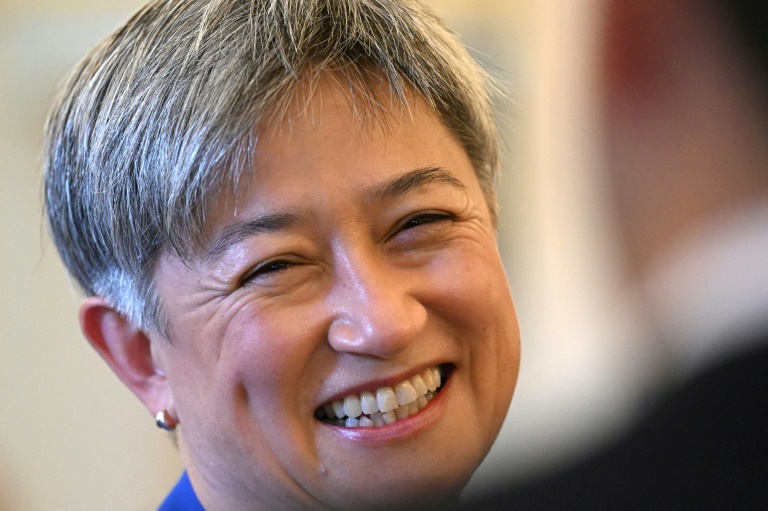
Australia’s recently sworn-in Foreign Minister Penny Wong is heading back to the Pacific Islands Wednesday, travelling to Samoa and Tonga just days after her Chinese counterpart Wang Yi. 

As Australia and China duel for influence in the vast region, Wong announced she was getting back on a plane to “renew and strengthen Australia’s deep ties of friendship and family”. 

Since being sworn in nine days ago, Wong has already visited Japan — for a meeting of Quad countries the United States, India, Japan and Australia — and Fiji. 

Her latest trip comes as China’s foreign minister Wang Yi barnstorms through the region, looking to significantly deepen Beijing’s influence. 

Although Wang failed to secure support for a regional security deal that would have seen Beijing play a bigger role in sensitive areas like policing and cybersecurity, Wang has been inking a series of agreements on each of his stops. 

In Tonga on Tuesday, he pledged China’s support for sports stadiums and wind power projects, according to state media, while signing a series of deals on disaster prevention and mitigation, agriculture, fisheries and healthcare. 

In Samoa late last month, Wang signed a bilateral agreement that included a plan to build a police fingerprinting lab, in addition to an already announced police academy in the country.

Wang’s ten-day trip concludes with stops in Vanuatu on Wednesday and Papua New Guinea on Thursday and Friday. 

Australia’s new centre-left government is playing catch-up after years of relations with the Pacific Islands being hampered by the conservative government’s foot-dragging on climate change. 

Rising sea levels are seen as an existential threat by many of the low-lying Pacific Island nations. 

Visiting Fiji, Wong said Australia would set new, more ambitious emissions targets and bid to co-host a future UN climate conference with Pacific Island countries. 

There would be no more “disrespecting” Pacific nations or “ignoring” their calls to act on climate change, she said. 

Close Bitnami banner
Bitnami