World

Trudeau announces Canada handgun 'freeze'

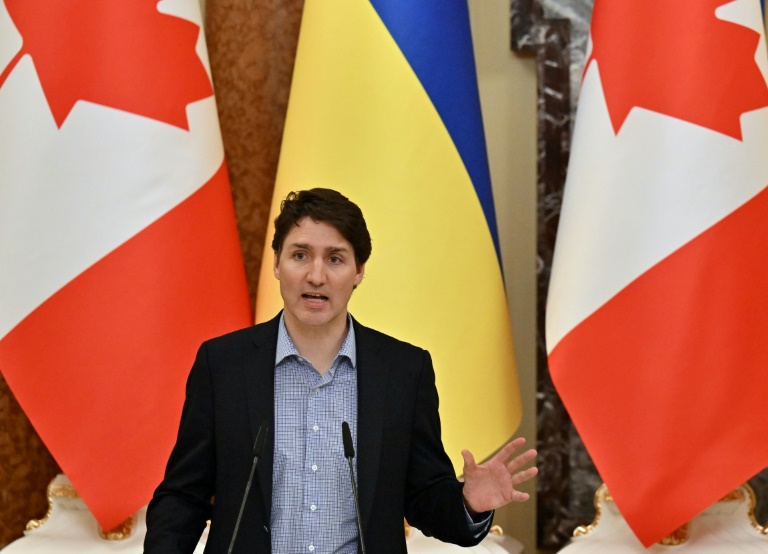
Prime Minister Justin Trudeau announced Monday a proposed freeze on handgun ownership in Canada that would effectively ban their importation and sale, following recent mass shootings in the United States.

The bill must still be passed by Parliament, with the ruling Liberals holding only a minority of seats.

“We’re introducing legislation to implement a national freeze on handgun ownership,” Trudeau told a news conference, joined by dozens of families and friends of victims of gun violence.

“What this means is that it will no longer be possible to buy, sell, transfer or import handguns anywhere in Canada,” he said. “In other words, we’re capping the market for handguns.”

Days after Canada’s worst mass shooting left 23 dead in rural Nova Scotia in April 2020, the government banned 1,500 types of military-grade or assault-style firearms.

But Trudeau acknowledged Monday that gun violence continues to rise.

The government statistical agency reported last week that firearms-related violent crimes account for less than three percent of all violent crimes in Canada.

But since 2009 the per capita rate of guns being pointed at someone has nearly tripled, while the rate at which a gun was fired with an intent to kill or wound is up five-fold.

Almost two-thirds of gun crimes in urban areas involved handguns.

Police often point to smuggling from the United States — which is reeling from recent shootings at a school in Texas and at a supermarket in New York state — as the main source of handguns.

Public Safety Minister Marco Mendicino estimated there are about one million handguns in this country — up significantly from a decade ago.

– ‘Complex problem’ –

“People should be free to go to the supermarket, their school or their place of worship without fear,” Trudeau said. 

“People should be free to go to the park or to a birthday party without worrying about what might happen from a stray bullet.

“Gun violence is a complex problem,” he said. “But at the end of the day, the math is really quite simple: the fewer the guns in our communities, the safer everyone will be.”

New Democratic public safety critic, MP Alistair MacGregor, indicated his party would be willing to work with the Liberals to get the proposed law passed.

“We want to believe that today’s announcement on gun violence is an urgent priority and not just another political stunt from this government, but there is a pattern of behavior from the Liberals to only use gun violence as a means to score political points,” he said in a statement. 

But many in the Conservative Party criticized the proposal as unhelpful. 

“The real problem in this country is not the law-abiding firearms owners, who are heavily regulated, heavily licensed,” John Brassard, minority leader in the House of Commons, told the CBC. 

“The real problem in this country has to do with gangs and criminals who are importing firearms, mostly from the United States, using illegal guns on our streets,” he said. 

And Conservative MP Raquel Dancho, her party’s parliamentary critic for public safety, echoed the same sentiment. 

“Today’s announcement fails to focus on the root cause of gun violence in our cities: illegal guns smuggled into Canada by criminal gangs,” she tweeted. 

The proposed law would also strip anyone involved in domestic violence or stalking of their firearms license, and take away guns from those deemed to be a risk to themselves or others, as well as strengthen border security and criminal penalties for gun trafficking.

It would also ban long-gun magazines capable of holding more than five bullets.

Canada’s Coalition for Gun Control, founded after 14 women were killed at a university in Montreal in 1989, praised Trudeau’s proposal.

“The proposed phasing out of private handgun ownership, is a major step forward and shows that the Government has been listening to the voices of victims,” organization president Wendy Cukier said in a statement. 

Asian markets swing on new inflation, rates concerns

Asian markets fluctuated Tuesday as investors struggled to maintain a global rally, with inflation continuing to niggle owing to a pick-up in oil prices while a top Federal Reserve official pressed for a series of sharp interest rate hikes.

With Wall Street closed for a holiday there were few catalysts to help extend the gains enjoyed in recent days, allowing inflation and borrowing costs to take centre stage.

Crude prices built on Monday’s advance after the European Union reached a deal on a partial embargo of Russian imports as part of a punishment for its invasion of Ukraine.

Brent broke above $122 for the first time in two months and WTI was sitting around $117 as European chiefs said the latest sanction would ban purchases of Russian oil delivered by sea, though there would be a temporary exemption for pipelines.

While widely expected, the agreement adds further upside to crude just as China begins to ease Covid restrictions in Shanghai and Beijing, raising the likelihood of a jump in demand from the world’s number two economy.

The lift in oil prices will help fan already elevated inflation and pile further pressure on central banks to tighten monetary policy to prevent it running out of control.

In a sign of the struggle policymakers face, German prices are rising at their fastest pace ever while Spain’s topped forecasts. 

In the United States, the chances of an extended period of rate hikes were increased after Federal Reserve Governor Christopher Waller said he favoured half-point hikes “for several meetings” until inflation slows towards the bank’s two percent target. 

He added that his goal was in line with market expectations, which is about 2.75 percent in December. 

Joe Biden is due to hold talks with Fed boss Jerome Powell on Tuesday to discuss the inflation situation. US jobs data Friday will provide an update on the state of the US economy in light of soaring prices and rising rates.

The prospect of a period of rates rising higher for longer lifted the dollar against the euro, pound and yen as well as other currencies. 

Asian equity markets swung through the morning, though there was some cheer from data showing China’s manufacturing shrunk in May at a slower rate than expected.

Hong Kong edged slightly lower after two days of gains that saw it put on around five percent, while Shanghai was also marginally off.

Sydney, Taipei and Manila were also in the red, though Tokyo, Seoul, Singapore, Jakarta and Wellington rose.

But AXA Investment Managers’ Chris Iggo warned that another 10-15 percent retreat for stocks could still be a possibility.

“The mood is temporarily better in markets,” he said, adding that “I think the worst is over for bond markets but picking the bottom in equities is trickier.”

– Key figures at around 0230 GMT –

Tokyo – Nikkei 225: UP 0.1 percent at 27,404.14 (break)

Hong Kong – Hang Seng Index: DOWN 0.2 percent at 21,092.51

Shanghai – Composite: DOWN 0.1 percent at 3,147.12

Euro/dollar: DOWN at $1.0754 from $1.0779 on Monday

Pound/dollar: DOWN at $1.2621 from $1.2650

Euro/pound: DOWN at 85.20 pence from 85.21 pence

Dollar/yen: UP at 128.10 yen from 127.59 yen

Brent North Sea crude: UP 0.4 percent at $122.20 per barrel

West Texas Intermediate: UP 2.2 percent at $117.54

New York – Dow: Closed for a holiday

London – FTSE 100: UP 0.2 percent at 7,600.06 points (close)

Kozo Okamoto's long life after Israel suicide mission

Kozo Okamoto’s life should have ended in 1972 when he took part in a suicide attack on Israel’s Lod airport that killed 26 people.

Yet half a century and two stints in prison later, he is still alive, leading an uneventful existence as Lebanon’s first and only political refugee.

Now a frail, grey-haired man, Kozo Okamoto is still wanted in his native Japan but remains something of a folk hero in Lebanon’s Palestinian refugee camps.

When he boarded the Air France flight from Rome on May 30, 1972, the name he was given by the Japanese Red Army (JRA) on his fake passport was Daisuke Namba, a man who tried to assassinate Crown Prince Hirohito in 1923.

But Ahmad was the nom de guerre he went by in the Popular Front for the Liberation of Palestine, the leftist organisation that trained him and planned the attack for the JRA.

Prior PFLP hijackings had led to increased passenger screening by airlines but inspection of check-in luggage was still rare.

Kozo Okamoto and his two accomplices passed through immigration untroubled at what is now the high-security Ben Gurion airport near Tel Aviv.

They picked up their baggage from the carousel, whipped out assault rifles and grenades to sow carnage around them.

– Israel trial –

Among the 26 killed were one Canadian and eight Israelis.

All 17 others were Christian pilgrims from Puerto Rico. To this day, a remembrance ceremony is held every May 30 in San Juan.

The massacre was planned as a suicide attack and all three Japanese militants had intended to mutilate their faces with their grenades to make identification more difficult.

Two of them died but Okamoto was wounded and captured.

In detention, he was tricked out of his side of a deal he allegedly struck with an Israeli general, whereby he would provide information in exchange for a weapon with which to kill himself.

During his high-profile trial, he consistently angled for the death penalty, a punishment Israel only implemented once — against Nazi war criminal Adolf Eichmann.

“Okamoto was working for the prosecution,” was how his court-appointed Israeli lawyer put it, according to a 1976 interview by academic Patricia Steinhoff.

He was eventually sentenced to life.

By the time he was released as part of a massive prisoner exchange in May 1985, Okamoto was not dead but he seemed barely alive.

– ‘Like a corpse’ –

On an AFP photo shot at Tripoli airport in Libya, his eyes are glazed into a dull stare as Palestinian fighters hoist him on their shoulders in triumph.

“When he was released, he looked like a corpse,” said Abu Yusef, a PFLP official in Beirut who provides for Okamoto’s needs, from accommodation to food and health care. 

Okamoto had spent much of his Israeli jail time in solitary, forced to eat from the ground like a dog, with his hands cuffed behind his back, according to the PFLP.

Long after his release, Abu Yusef told AFP in an interview, he would still lean over the table and finish his plate by licking it clean.

After years in JRA camps in Lebanon’s Bekaa Valley, Okamoto was arrested in 1997 on forgery charges.

Under pressure from Tokyo, four other JRA members were extradited in 2000, but Okamoto was released and granted asylum after weeks of demonstrations by pro-Palestinian groups.

He has since lived in the care of the PFLP, whose influence has dwindled since its terrorist operations made headlines decades ago but still treats Okamoto with the respect owed to elders from a bygone era.

For a 50th anniversary commemoration on Monday, Okamoto made a rare public appearance.

– Semi-hiding –

PFLP militants walked him to a cemetery on the edge of the Shatila Palestinian refugee camp in Beirut.

During a brief wreath-laying ceremony for the two JRA commandos who died when he didn’t, he smiled to the cameras, flashed a V-sign and was escorted back.

Born the youngest of six children in a middle class family of southern Japan, Okamoto had no particular connection to the Palestinian cause growing up.

But “until today, he speaks of Palestine and refuses the occupier,” Abu Yusef said.

However, without travel documents, Kozo Okamoto has led a sedate life.

His minders used to give him little bundles of eight cigarettes three times a day but the 74-year-old quit smoking recently.

Okamoto eats his meals at set times and spends hours watching “Tom and Jerry” or other cartoons on television.

He lives in semi-hiding, with limited knowledge of the outside world.

“He is not going to be any threat to Israel or Japan,” said May Shigenobu, daughter of JRA founder Fusako Shigenobu who was freed on Saturday after 20 years in a Japanese jail.

“But the Japanese are still demanding his extradition every year, so there is attention on him despite his physical and mental condition,” she told AFP.

“I cannot dismiss the possibility that his life is still under threat,” said Shigenobu, who was raised in Lebanon and is familiar with Okamoto’s situation.

Boards against boredom: Libya rolls out first skatepark

Libyan Mohamed Abderraouf put a foot on his board and launched himself across Tripoli’s first skatepark, a welcome break in the conflict-battered capital with few facilities for bored young people.

“I can’t describe the joy,” said the 18-year-old, who bought his first skateboard in 2020 and had only been able to practice on street corners — until now. “I’m going to come a couple of times a week.”

The free, open-air facility opened over the weekend in central Tripoli, to the delight of young skaters who spent the afternoon sweeping up and down the halfpipes and taking selfies with their friends.

“I’m really happy, because before there wasn’t a dedicated place for skating,” said Rayan al-Omar, 18, who has been skating for a year.

The United States-funded facility was built by Make Life Skate Life, a charity that has set up “free-of-charge, community-built concrete skateparks” in Iraq, Bolivia and India.

Australian Wade Trevean, who designed the 800-square-metre Tripoli site, said volunteers had come from far and wide to help build it, a process that took about six weeks.

“There are people from New York, people from Belgium, Germany or Australia,” Trevean said. “The happiness and positivity here are amazing.”

– Built on Kadhafi bodyguard base –

Local skaters played a role in the project too, part of a seaside park that also includes a cycling route and five-a-side football pitches.

The rest of the complex was completed a year ago on the site of a former base of the “Amazons”, the entourage of female bodyguards of deposed dictator Moamer Kadhafi, and seen as a symbol of the tyrant’s extravagance.

Since he was overthrown and killed in a 2011 revolt, Tripoli has endured successive waves of violence, meaning few resources were put into leisure and cultural facilities — already almost non-existent under Kadhafi.

So almost two years since the guns fell silent following the last major battle on the edges of the capital, the opening of a skatepark in Tripoli generated a lot of attention.

For young Libyan skateboarders, interest in the sport reflects a yearning for normality, to be like other nations and other young people.

Abderraouf said such a project would have been “unimaginable” until recently.

“Thank God it is here now,” he said.

For Make Life Skate Life, the “overall goal” of the skatepark is “to create a safe community space where people from different backgrounds can come together and positively interact in a playful way”, the organisation said.

“Apart from creating immediate local employment, the skatepark aims to contribute to a healthier, more active, more engaged, and happier society,” it added.

The group say they will hold free weekly skate classes of 60 girls and boys — split equally  — who would otherwise not be able to skate, with boards and safety gear available to use.

Trevean extolled the virtues of skateparks for building community.

“People are skateboarding but also people come here to hang out, exchange ideas, have conversation, meet new people,” he said.

“I know the benefits of skateparks, and I truly believe in them.”

Denmark votes on scrapping EU defence opt-out

After staying out of the European Union’s common defence policy for 30 years, Denmark votes Wednesday in a referendum on whether to overturn its opt-out after Russia’s invasion of Ukraine.

More than 65 percent of the country’s 4.3 million eligible voters are expected to vote in favour of dropping the exemption, the latest opinion poll published on Sunday suggested.

Analysts’ predictions have however been cautious, given the low voter turnout expected in a country that has often said “no” to further EU integration, most recently in 2015.

“We must always cast our ballots when there is a vote”, Prime Minister Mette Frederiksen urged Danes in the final televised debate of the campaign on Sunday.

“I believe with all my heart that we have to vote yes. At a time when we need to fight for security in Europe, we need to be more united with our neighbours”, she said.

Denmark has been an EU member since 1973, but it put the brakes on transferring more power to Brussels in 1992 when 50.7 percent of Danes rejected the Maastricht Treaty, the EU’s founding treaty.

It needed to be ratified by all member states to enter into force. In order to persuade Danes to approve the treaty, Copenhagen negotiated a series of exemptions and Danes finally approved it the following year.

Since then, Denmark has remained outside the European single currency, the euro — which it rejected in a 2000 referendum — as well as the bloc’s common policies on justice and home affairs, and defence.

– ‘Ukraine the major reason’-

The defence opt-out means that the Scandinavian country, a founding member of NATO, does not participate in EU foreign policy where defence is concerned and does not contribute troops to EU military missions.

Denmark is the only country to have negotiated a defence opt-out, though Malta remains de facto outside as well. Copenhagen has exercised its opt-out 235 times in 29 years, according to a tally by the Europa think tank.

Danish PM Frederiksen called the referendum just two weeks after Russia’s invasion of Ukraine, and after having reached an agreement with a majority of parties in Denmark’s parliament, the Folketing.

At the same time, she also announced plans to increase defence spending to two percent of GDP, in line with NATO membership requirements, by 2033.

“It was a big surprise”, said the director of the Europa think tank, Lykke Friis. 

“For the past many, many years, nobody thought that the government would put the defence opt-out to a national referendum”, she said.

“There’s no doubt that Ukraine was the major reason for calling the referendum.”

Berlin’s announcement that it was reversing decades of defence policy by massively hiking its military spending also played a key role in the Danish decision, Friis said.

Germany is Denmark’s closest ally, along with the United States. 

“The very fact that they stepped up their game put Denmark in a position where we could not hide behind Germany any more”.

– ‘NATO is enough’ –

Eleven of Denmark’s 14 parties have urged voters to say “yes” to dropping the opt-out, representing more than three-quarters of seats in parliament. 

Two far-right eurosceptic parties — the Danish People’s Party and The New Right — as well as the far-left Unity List, have meanwhile called for Danes to say “no”.

One of their main arguments is that the emergence of a joint European defence would come at the expense of NATO, which has been the cornerstone of Denmark’s defence since its creation in 1949.

“NATO is the guarantor of Denmark’s security. It would be totally different if it were decided in Brussels,” the head of the Danish People’s Party Morten Messerschmitt argued during Sunday’s debate.

After Finland and Sweden recently reversed decades of military non-alignment to apply for membership in NATO, and the Danish referendum, the three Nordic neighbours could all suddenly find themselves doubled up on European defence policy and NATO membership.

The results of the referendum are expected around 11:00 pm (2100 GMT) on Wednesday.

Denmark’s autonomous territories of Greenland — which is not in the EU — and the Faroe Islands are not participating in the referendum. 

In December 2015, Danes voted “no” to strengthening their cooperation with the European Union on police and security matters for fear of losing their sovereignty over immigration.

2TK, Canada's migratory bird that fell for Uruguayan resort

The first cold winds announce the arrival of winter in Uruguay’s jet setters’ playground, Punta del Este.

It’s time for “2TK” to set flight from the plush seaside resort and return to Canada, a feat of endurance that fascinates scientists and delights local birdwatchers.

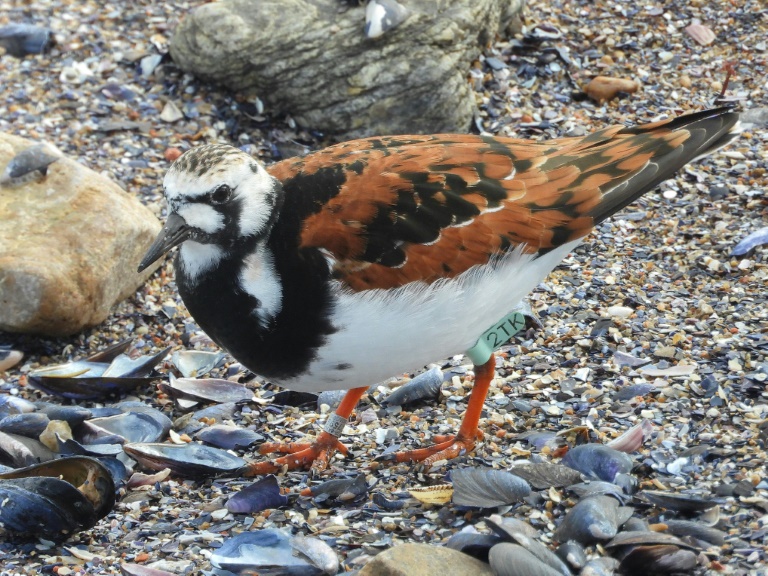
Identifiable by a plastic band on one ankle bearing the name 2TK and a metal one with nine digits on the other, this ruddy turnstone (Arenaria interpres) has spent the southern hemisphere summer on the rocks off Uruguay’s Atlantic coast feeding off mussels, alongside oystercatchers and other birds.

When the food became scarce in Canada’s artic tundra as winter swept in, the turnstone migrated 15,000 kilometers (9,300 miles) to South America.

By April, 2TK had become “fatter” and ditched his grey plumage for one tinged with brown and orange ahead of his return to his native lands to reproduce, said Alvaro Perez Tort, 48, an amateur photographer and member of the Punta del Este birdwatching society that has been documenting the bird’s trips to Uruguay since 2016.

“2TK stole my heart,” Perez told AFP.

Every year he waits for the male turnstone’s return to document him “as much as possible” to share on reportband.gov — the continental database for observing banded birds run by the United States Geological Survey.

“What’s interesting is that a banded bird has a history: there’s a city, a country or faraway place, a journey and people,” said Perez.

By photographing the bird “we feel like we’re a part” of that history, he added, noting he has seen 2TK eight times at Uruguay’s southernmost tip.

– Bird ‘jigsaw puzzle’ –

2TK is around 14 years old, according to the Bird Banding Laboratory, which organises the banding of one million birds annually in North America for conservation purposes.

He was banded in 2012 in Delaware Bay on the US Atlantic coast, an important stopover for many migratory species.

For laboratory chief Antonio Celis-Murillo, information provided by amateur birdwatchers is vital to “build the jigsaw puzzle” of each bird’s movements.

“Our work is successful thanks to the general public — every person who reports a banded bird,” he told AFP. 

“The reported information is so simple but valuable, because scientifically it tells us a lot.

“Especially those reports from South America that we lack,” he added.

These details allow scientists to plot the behavior of every species: their migration routes, where they stop, how long they stay there, how they live.

It all helps to refine conservation projects.

According to a 2019 study published in Science magazine, some 3,000 species of wild birds have disappeared from North America since 1970.

– ‘Lots of food’ –

Loss of habitat affecting all biodiversity “clearly shows its impact on migratory birds,” who face ever-greater difficulties in their extraordinary journeys, said Adrian Azpiroz, a biologist and ornithologist who promotes ecotourism initiatives.

And while turnstones are not threatened like other waders, their population is nonetheless shrinking.

Of the estimated 300,000 on the continent, only several hundred or thousand winter on the Uruguayan coast. Others prefer southern Brazil or Argentina.

Scientists believe these long-distance migratory birds have favorite winter retreats and are remarkably loyal, returning year after year — just like 2TK.

Uruguay’s many coastal lagunas are “very productive from a nourishment point of view” for waders, said Azpiroz.

That is why 2TK is likely to have traveled some 350,000 kilometers in his life — the equivalent of nine times around the planet.

That’s a truly staggering accomplishment for a bird measuring little more than 20 centimeters (eight inches).

Experts are still studying the sophisticated physiological and neurological mechanisms that allow him to recognize a location with such precision following a weeks-long air journey of thousands of kilometers.

Many Uruguayan birdwatchers like to think the same thing that attracts them to return time and again to Punta del Este is what also caught 2TK’s attention.

Hurricane Agatha drenches Mexican beach resorts

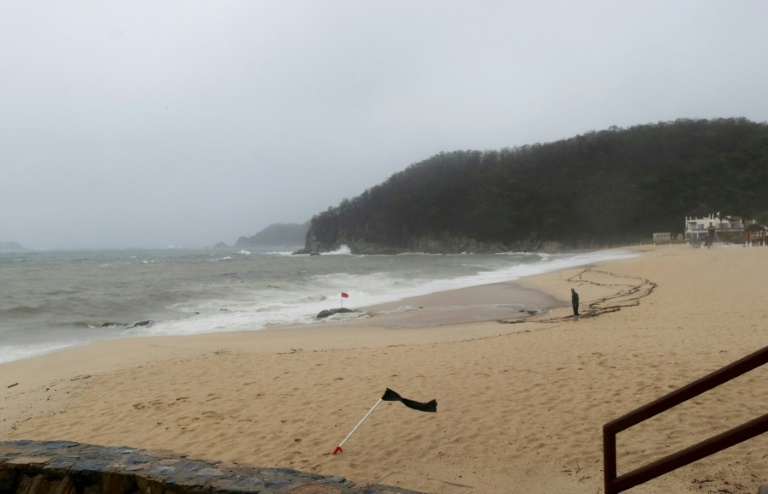
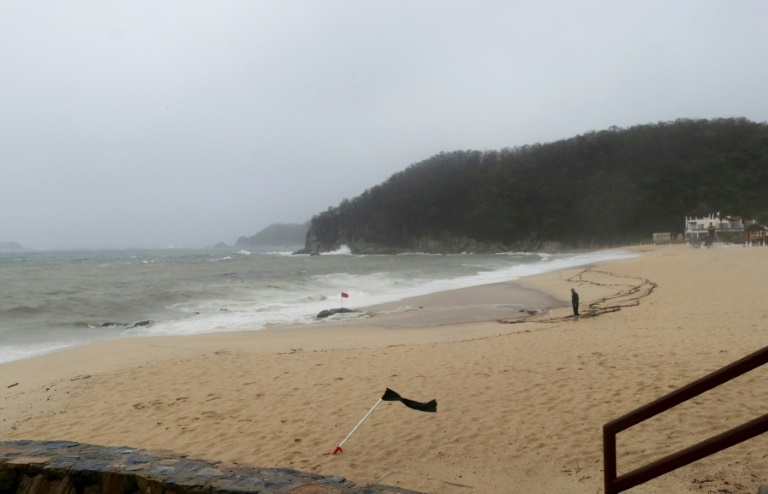
Hurricane Agatha, the first of the season, lashed a string of beach resorts on Mexico’s Pacific Coast as it barreled ashore Monday, bringing strong winds, heavy rain and flood warnings.

Agatha was the strongest storm to make landfall along Mexico’s Pacific coast in May since record keeping began in 1949, the US National Hurricane Center (NHC) said.

It touched land near Puerto Angel in the southern state of Oaxaca as a Category 2 hurricane — the second lowest on a scale of five.

Agatha later weakened to a Category 1 storm, but still packed maximum sustained winds of 130 kilometers (80 miles) per hour, the NHC said.

“Rapid weakening is expected as the hurricane moves farther inland. Agatha is forecast to weaken to a tropical storm tonight, and dissipate over southeastern Mexico by late Tuesday,” it said.

Small landslides were reported in parts of Oaxaca, civil protection coordinator Oscar Valencia told the Milenio television channel.

Residents along the coast had stocked up on food and water and boarded up windows of homes and businesses as Agatha approached.

Seaports in the area closed and airlines canceled flights to the region.

Authorities opened around 200 storm shelters with room for up to 26,800 people, while hotels provided refuge to the estimated 5,200 national and foreign tourists in the danger zone.

“We are already on red alert. This is coming and it is coming strong,” Roberto Castillo, a civil protection official in Huatulco, told AFP as the storm neared.

A hurricane warning was issued for a stretch of coastline including Puerto Escondido and other surf towns popular with Mexican and foreign tourists, leaving normally busy beaches deserted.

“Storm surge is expected to produce extremely dangerous coastal flooding” and will be accompanied by “large and destructive waves,” the NHC said.

“Agatha will produce heavy rains over portions of southern Mexico through Tuesday night,” as well as “life-threatening surf and rip current conditions,” it predicted.

In Oaxaca and neighboring Chiapas state, “life-threatening flash flooding and mudslides may occur,” the NHC added.

The region is home to several major rivers and Mexico’s meteorological service warned of possible overflows and landslides.

Mexico is regularly lashed by tropical storms on both its Pacific and Atlantic coasts, generally between the months of May and November.

The deadliest storm to hit Mexico last year was a Category 3 hurricane called Grace that killed 11 people in the eastern states of Veracruz and Puebla in August.

Hurricane Agatha drenches Mexican beach resorts

Hurricane Agatha, the first of the season, lashed a string of beach resorts on Mexico’s Pacific Coast as it barreled ashore Monday, bringing strong winds, heavy rain and flood warnings.

Agatha was the strongest storm to make landfall along Mexico’s Pacific coast in May since record keeping began in 1949, the US National Hurricane Center (NHC) said.

It touched land near Puerto Angel in the southern state of Oaxaca as a Category 2 hurricane — the second lowest on a scale of five.

Agatha later weakened to a Category 1 storm, but still packed maximum sustained winds of 130 kilometers (80 miles) per hour, the NHC said.

“Rapid weakening is expected as the hurricane moves farther inland. Agatha is forecast to weaken to a tropical storm tonight, and dissipate over southeastern Mexico by late Tuesday,” it said.

Small landslides were reported in parts of Oaxaca, civil protection coordinator Oscar Valencia told the Milenio television channel.

Residents along the coast had stocked up on food and water and boarded up windows of homes and businesses as Agatha approached.

Seaports in the area closed and airlines canceled flights to the region.

Authorities opened around 200 storm shelters with room for up to 26,800 people, while hotels provided refuge to the estimated 5,200 national and foreign tourists in the danger zone.

“We are already on red alert. This is coming and it is coming strong,” Roberto Castillo, a civil protection official in Huatulco, told AFP as the storm neared.

A hurricane warning was issued for a stretch of coastline including Puerto Escondido and other surf towns popular with Mexican and foreign tourists, leaving normally busy beaches deserted.

“Storm surge is expected to produce extremely dangerous coastal flooding” and will be accompanied by “large and destructive waves,” the NHC said.

“Agatha will produce heavy rains over portions of southern Mexico through Tuesday night,” as well as “life-threatening surf and rip current conditions,” it predicted.

In Oaxaca and neighboring Chiapas state, “life-threatening flash flooding and mudslides may occur,” the NHC added.

The region is home to several major rivers and Mexico’s meteorological service warned of possible overflows and landslides.

Mexico is regularly lashed by tropical storms on both its Pacific and Atlantic coasts, generally between the months of May and November.

The deadliest storm to hit Mexico last year was a Category 3 hurricane called Grace that killed 11 people in the eastern states of Veracruz and Puebla in August.

Mexico president's tourist train suffers new legal blow

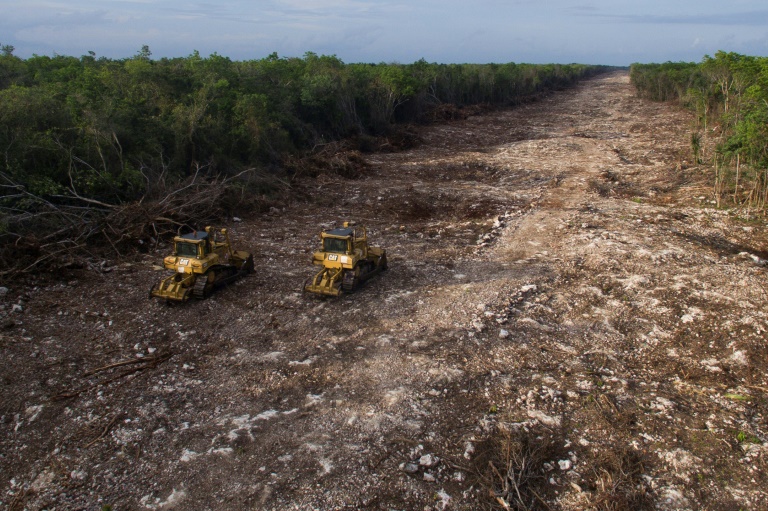
A Mexican judge has indefinitely suspended construction of part of President Andres Manuel Lopez Obrador’s flagship tourist train project in the Yucatan peninsula on environmental grounds, campaigners said Monday.

The ruling follows a legal challenge brought by opponents, including scuba divers, who are concerned about the impact of the Mayan Train on wildlife, caves and water-filled sinkholes known as cenotes.

The indefinite halt to work on the 60-kilometer (37-mile) section between the resorts of Playa del Carmen and Tulum goes a step further than a provisional suspension order issued in April.

The federal judge cited the “imminent danger” of causing “irreversible damage” to ecosystems, according to one of the plaintiffs, the non-governmental group Defending the Right to a Healthy Environment.

Authorities were found to have failed to carry out the necessary environmental impact studies before starting construction of the section, one of several being built by the military, it said in a statement.

The National Fund for the Promotion of Tourism, the government agency overseeing the project, said that it expected the work to be allowed to continue after the environmental impact statement is finalized.

It said the document would contain “numerous mitigation actions in favor of the environment.”

Lopez Obrador hopes to inaugurate the roughly 1,500-kilometer (950 mile) rail loop linking popular Caribbean beach resorts and archeological ruins by the end of 2023.

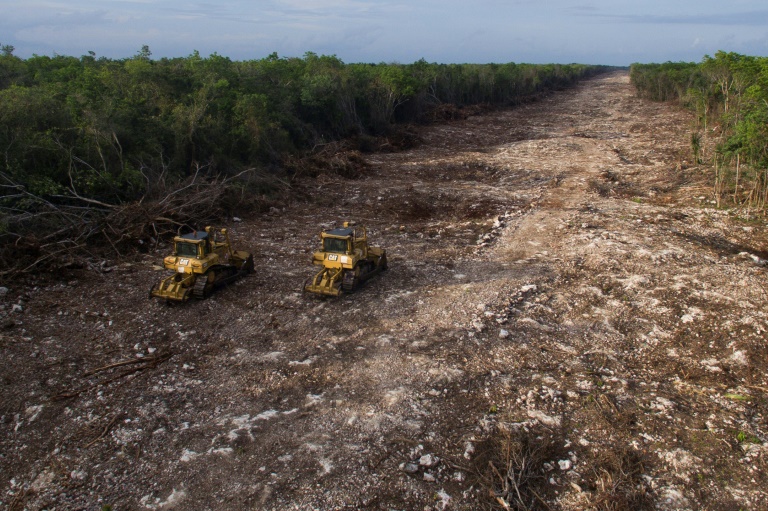
The original plan for the disputed section was for an overpass over a highway, but the route was modified early this year to go through jungle at ground level.

Opponents fear that the construction will cause irreparable damage to a subterranean network of caves, rivers and freshwater sinkholes connected to the Caribbean Sea.

Lopez Obrador has insisted the railroad will not affect the cenotes and alleged that environmentalists have been infiltrated by “impostors.”

Mexico president's tourist train suffers new legal blow

A Mexican judge has indefinitely suspended construction of part of President Andres Manuel Lopez Obrador’s flagship tourist train project in the Yucatan peninsula on environmental grounds, campaigners said Monday.

The ruling follows a legal challenge brought by opponents, including scuba divers, who are concerned about the impact of the Mayan Train on wildlife, caves and water-filled sinkholes known as cenotes.

The indefinite halt to work on the 60-kilometer (37-mile) section between the resorts of Playa del Carmen and Tulum goes a step further than a provisional suspension order issued in April.

The federal judge cited the “imminent danger” of causing “irreversible damage” to ecosystems, according to one of the plaintiffs, the non-governmental group Defending the Right to a Healthy Environment.

Authorities were found to have failed to carry out the necessary environmental impact studies before starting construction of the section, one of several being built by the military, it said in a statement.

The National Fund for the Promotion of Tourism, the government agency overseeing the project, said that it expected the work to be allowed to continue after the environmental impact statement is finalized.

It said the document would contain “numerous mitigation actions in favor of the environment.”

Lopez Obrador hopes to inaugurate the roughly 1,500-kilometer (950 mile) rail loop linking popular Caribbean beach resorts and archeological ruins by the end of 2023.

The original plan for the disputed section was for an overpass over a highway, but the route was modified early this year to go through jungle at ground level.

Opponents fear that the construction will cause irreparable damage to a subterranean network of caves, rivers and freshwater sinkholes connected to the Caribbean Sea.

Lopez Obrador has insisted the railroad will not affect the cenotes and alleged that environmentalists have been infiltrated by “impostors.”

Close Bitnami banner
Bitnami