World

EU leaders agree ban on most Russian oil imports

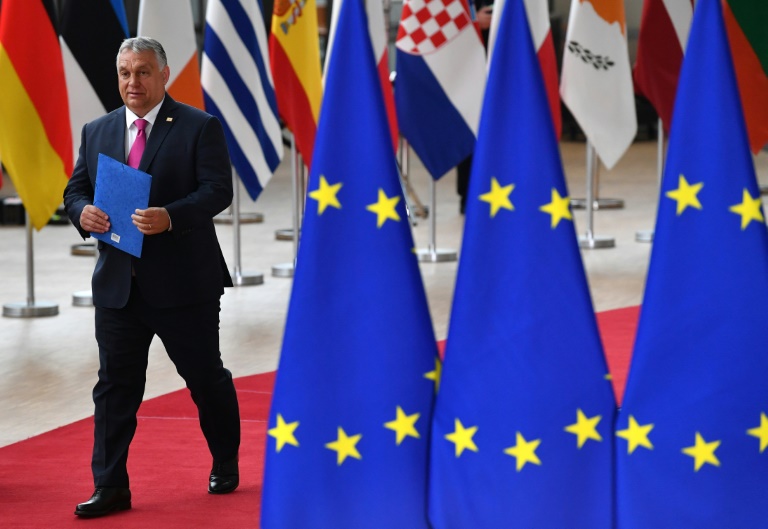
EU leaders on Monday backed a ban on most Russian oil imports, after a compromise deal with Hungary to punish Moscow for the war in Ukraine.

The 27-nation bloc has spent weeks haggling over a proposed total embargo on Russian oil but came up against stubborn resistance from Hungarian Prime Minister Viktor Orban.

EU leaders meeting in Brussels hatched a compromise deal to exempt deliveries arriving in Europe by pipeline from the ban, after Budapest warned halting supplies would wreck its economy.

“Agreement to ban export of Russian oil to the EU. This immediately covers more than two thirds of oil imports from Russia, cutting a huge source of financing for its war machine,” European Council chief Charles Michel tweeted during the summit. 

“Maximum pressure on Russia to end the war.”

The head of the EU’s executive, Ursula von der Leyen, said the move “will effectively cut around 90 percent of oil imports from Russia to the EU by the end of the year” as Germany and Poland had committed to renounce deliveries via a pipeline to their territory. 

“Russia has chosen to continue its war in Ukraine. Tonight, as Europeans, united and in solidarity with the Ukrainian people, we are taking new decisive sanctions,” French President Emmanuel Macron tweeted, echoing the figure of 90 percent by the end of 2022. 

The wrangling over the sixth package of sanctions has rocked European unity in the face of the Kremlin’s attack on Ukraine after five waves of unprecedented economic punishment on Russia.

The compromise excluded the Druzhba pipeline from the oil embargo and only imposed sanctions on crude shipped to the EU by tanker vessel.

Despite the gap in the embargo left by Hungary’s opposition, the latest round of sanctions represents some of the most damaging measures taken by the EU so far.

The EU imports some 26 percent of its oil from Russia and has been criticised for keeping money flowing to Moscow’s coffers at the same time as it seeks to halt the Kremlin’s war. 

Michel said the sanctions package also involved disconnecting Russia’s biggest bank Sberbank from the global SWIFT system, banning three state broadcasters and blacklisting individuals blamed for war crimes.

He also said that the EU had agreed to to send Ukraine nine billion euros ($9.7 billion) to support Kyiv’s “immediate liquidity needs” as it grapples with Russia’s invasion. 

– Stop ‘quarrels’ –

The negotiations over the oil ban had dogged the EU for weeks and the bloc’s leaders got chivvied along Monday by Ukraine’s President Volodymyr Zelensky.

Zelensky, in a video address, called on them to adopt “effective” sanctions against Russian oil to make the Kremlin pay the price for its war on Ukraine.

“All quarrels in Europe must end, internal disputes that only encourage Russia to put more and more pressure on you,” Zelensky told the EU summit.

“It is time for you to be not separate, not fragments, but one whole.”

Orban, often the odd man out in EU decision making, had called the proposal only to stop oil deliveries to the EU by ship a “good solution” before the talks began.

“It means that an atomic bomb won’t be thrown on the Hungarian economy,” he said. 

But he warned that Budapest needed a “guarantee” it could keep on receiving Russian oil by sea if anything happened to the pipeline crossing Ukraine.

Michel said the EU had “decided to take the appropriate measures to react and to make sure that we will protect the security of supply”.

– Return to Hungary issue? –

Landlocked Hungary imports 65 percent of its oil from Russia through the Druzhba pipeline and, along with Slovakia and the Czech Republic, had asked for an exception from the import ban.

Diplomats said a two-year delay to the embargo had been offered to the countries concerned, but that Budapest wanted at least four years and nearly 800 million euros ($860 million) in EU funding to adapt its refineries.

Von der Leyen said that the EU would return “as soon as possible in one way or the other” to the issue of trying to ban oil through the Druzhba pipeline to Hungary.

Budapest’s intransigence came on the back of Orban’s recent resounding re-election to a fourth term and some experts are sceptical about the official claims of alarm over a Russian oil ban.

Further complicating the stand-off had been Hungary’s share of the EU’s 800-billion-euro recovery fund, which Brussels has yet to approve due to disagreements over Budapest’s respect for the rule of law.

burs-del/dc/mtp
EU leaders agree ban on most Russian oil imports

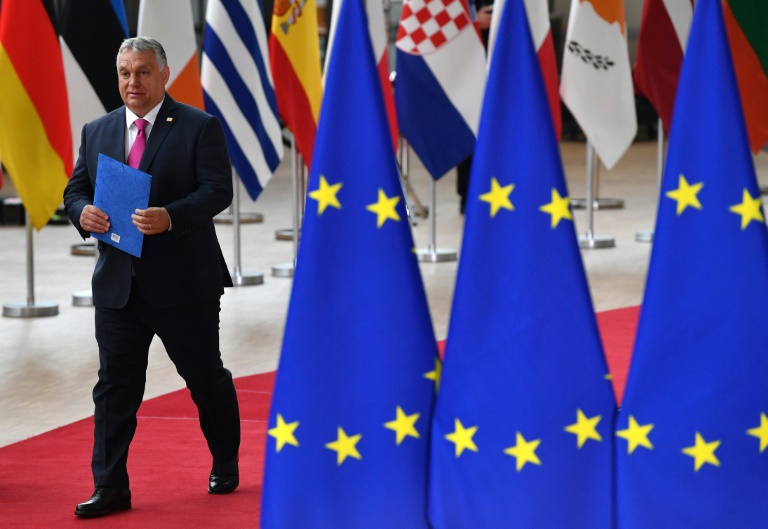
EU leaders on Monday backed a ban on most Russian oil imports, after a compromise deal with Hungary to punish Moscow for the war in Ukraine.

The 27-nation bloc has spent weeks haggling over a proposed total embargo on Russian oil but came up against stubborn resistance from Hungarian Prime Minister Viktor Orban.

EU leaders meeting in Brussels hatched a compromise deal to exempt deliveries arriving in Europe by pipeline from the ban, after Budapest warned halting supplies would wreck its economy.

“Agreement to ban export of Russian oil to the EU. This immediately covers more than two thirds of oil imports from Russia, cutting a huge source of financing for its war machine,” European Council chief Charles Michel tweeted during the summit. 

“Maximum pressure on Russia to end the war.”

The head of the EU’s executive, Ursula von der Leyen, said the move “will effectively cut around 90 percent of oil imports from Russia to the EU by the end of the year” as Germany and Poland had committed to renounce deliveries via a pipeline to their territory. 

“Russia has chosen to continue its war in Ukraine. Tonight, as Europeans, united and in solidarity with the Ukrainian people, we are taking new decisive sanctions,” French President Emmanuel Macron tweeted, echoing the figure of 90 percent by the end of 2022. 

The wrangling over the sixth package of sanctions has rocked European unity in the face of the Kremlin’s attack on Ukraine after five waves of unprecedented economic punishment on Russia.

The compromise excluded the Druzhba pipeline from the oil embargo and only imposed sanctions on crude shipped to the EU by tanker vessel.

Despite the gap in the embargo left by Hungary’s opposition, the latest round of sanctions represents some of the most damaging measures taken by the EU so far.

The EU imports some 26 percent of its oil from Russia and has been criticised for keeping money flowing to Moscow’s coffers at the same time as it seeks to halt the Kremlin’s war. 

Michel said the sanctions package also involved disconnecting Russia’s biggest bank Sberbank from the global SWIFT system, banning three state broadcasters and blacklisting individuals blamed for war crimes.

He also said that the EU had agreed to to send Ukraine nine billion euros ($9.7 billion) to support Kyiv’s “immediate liquidity needs” as it grapples with Russia’s invasion. 

– Stop ‘quarrels’ –

The negotiations over the oil ban had dogged the EU for weeks and the bloc’s leaders got chivvied along Monday by Ukraine’s President Volodymyr Zelensky.

Zelensky, in a video address, called on them to adopt “effective” sanctions against Russian oil to make the Kremlin pay the price for its war on Ukraine.

“All quarrels in Europe must end, internal disputes that only encourage Russia to put more and more pressure on you,” Zelensky told the EU summit.

“It is time for you to be not separate, not fragments, but one whole.”

Orban, often the odd man out in EU decision making, had called the proposal only to stop oil deliveries to the EU by ship a “good solution” before the talks began.

“It means that an atomic bomb won’t be thrown on the Hungarian economy,” he said. 

But he warned that Budapest needed a “guarantee” it could keep on receiving Russian oil by sea if anything happened to the pipeline crossing Ukraine.

Michel said the EU had “decided to take the appropriate measures to react and to make sure that we will protect the security of supply”.

– Return to Hungary issue? –

Landlocked Hungary imports 65 percent of its oil from Russia through the Druzhba pipeline and, along with Slovakia and the Czech Republic, had asked for an exception from the import ban.

Diplomats said a two-year delay to the embargo had been offered to the countries concerned, but that Budapest wanted at least four years and nearly 800 million euros ($860 million) in EU funding to adapt its refineries.

Von der Leyen said that the EU would return “as soon as possible in one way or the other” to the issue of trying to ban oil through the Druzhba pipeline to Hungary.

Budapest’s intransigence came on the back of Orban’s recent resounding re-election to a fourth term and some experts are sceptical about the official claims of alarm over a Russian oil ban.

Further complicating the stand-off had been Hungary’s share of the EU’s 800-billion-euro recovery fund, which Brussels has yet to approve due to disagreements over Budapest’s respect for the rule of law.

burs-del/dc/mtp
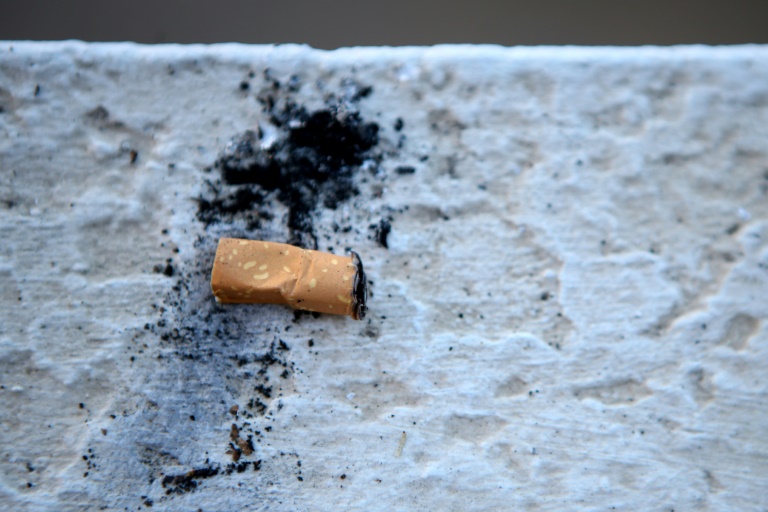
Big tobacco's environmental impact is 'devastating': WHO

The tobacco industry is a far greater threat than many realise as it is one of the world’s biggest polluters, from leaving mountains of waste to driving global warming, the WHO charged Tuesday.

The World Health Organization accused the industry of causing widespread deforestation, diverting badly needed land and water in poor countries away from food production, spewing out plastic and chemical waste as well as emitting millions of tonnes of carbon dioxide. 

In its report released on World No Tobacco Day, the UN agency called for the tobacco industry to be held to account and foot the bill for the cleanup.

The report, “Tobacco: poisoning our planet”, looks at the impacts of the whole cycle, from the growth of plants to the manufacturing of tobacco products, to consumption and waste.

While tobacco’s health impacts have been well documented for decades — with smoking still causing more than eight million deaths worldwide every year — the report focuses on its broader environmental consequences.

The findings are “quite devastating,” Ruediger Krech, WHO director of health promotion, told AFP, slamming the industry as “one of the biggest polluters that we know of.”

The industry is responsible for the loss of some 600 million trees each year, while tobacco growing and production uses 200,000 hectares of land and 22 billion tonnes of water annually, the report found.

It also emits around 84 million tonnes of carbon dioxide, it said.

– 4.5 trillion cigarette butts –

In addition, “tobacco products are the most littered item on the planet, containing over 7,000 toxic chemicals, which leech into our environment when discarded,” Krech said.

He pointed out that each one of the estimated 4.5 trillion cigarette butts that end up in our oceans, rivers, sidewalks and beaches every year can pollute 100 litres of water. 

And up to a quarter of all tobacco farmers contract so-called green tobacco sickness, or poisoning from the nicotine they absorb through the skin.

Farmers who handle tobacco leaves all day consume the equivalent of 50 cigarettes worth of nicotine a day, Krech said.

This is especially worrying for the many children involved in tobacco farming.

“Just imagine a 12-year-old being exposed to 50 cigarettes a day,” he said.

Most tobacco is grown in poorer countries, where water and farmland are often in short supply, and where such crops are often grown at the expense of vital food production, the report said.

Tobacco farming also accounts for about five percent of global deforestation, and drives depletion of precious water resources.

– Plastic pollution –

At the same time the processing and transportation of tobacco account for a significant share of global greenhouse gas emissions — with the equivalent of one-fifth of the global airline industry’s carbon footprint.

In addition, products like cigarettes, smokeless tobacco and e-cigarettes also contribute significantly to the global build-up of plastic pollution, WHO warned.

Cigarette filters contain microplastics — the tiny fragments that have been detected in every ocean and even at the bottom of the world’s deepest trench — and make up the second-highest form of plastic pollution worldwide, the report said.

And yet, despite tobacco industry marketing, WHO stressed that there is no evidence filters provide any proven health benefits over smoking non-filtered cigarettes.

The UN agency urged policy makers worldwide to treat cigarette filters as single-use plastics, and to consider banning them.

It also decried that taxpayers around the world had been covering the towering costs of cleaning up the tobacco industry’s mess.

Each year, China for instance dishes out around $2.6 billion and India around $766 million, while Brazil and Germany pay some $200 million each to clean up littered tobacco products, the report found.

WHO insisted that more countries should follow the so-called Polluter Pays Principle, as in France and Spain.

It is important, Krech said, that “the industry pay actually for the mess that they are creating.”

Bolsonaro views disaster zone from air after deadly Brazil rains

President Jair Bolsonaro sent his condolences Monday to the families of 91 people who died in torrential rains in northeastern Brazil, as rescue workers continued a grim search for victims.

Releasing an updated toll, authorities said 26 people remained missing in the region around the city of Recife, where days of downpours triggered flooding and landslides that swept away virtually everything in their path.

Bolsonaro posted a video on Twitter that showed him flying in a helicopter over a disaster zone where brown floodwater still inundated large areas and gashes of mud scarred hillsides where houses once stood.

“I tried to land, but the pilots’ recommendation was that, given the instability of the soil, we could have an accident. So we decided against it,” the far-right president told a news conference.

He recalled a string of devastating floods in Brazil that have killed hundreds of people in recent months, and which experts say are being aggravated by climate change.

“We send our condolences to the families. Our top priority is comforting the families and getting aid to the population,” he said.

– ‘Can’t eat or sleep’ –

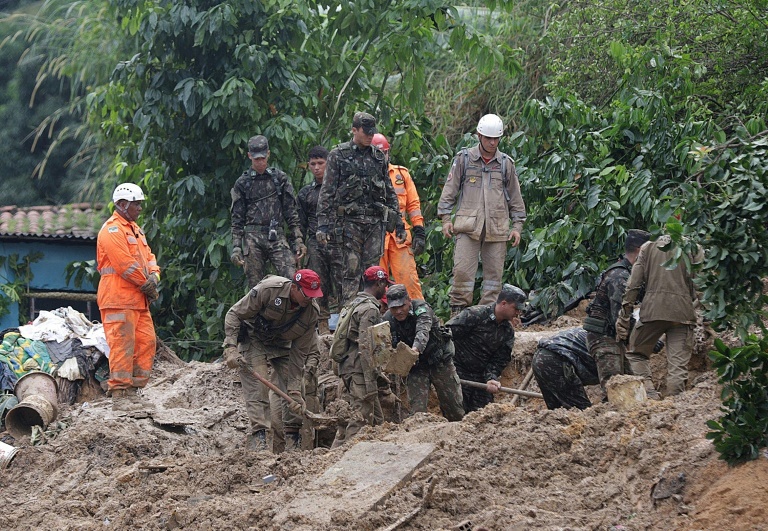
The force of the landslides ripped apart houses in neighborhoods including Jardim Monteverde, a poor community just outside Recife.

Rescue workers have found more than 20 bodies buried in the mud that tore through the neighborhood Saturday, and said they expect to find more.

“I can’t eat or sleep. It’s just so much pain,” said Maria Lucia da Silva, a 56-year-old resident whose neighbors’ house was destroyed, killing 11 people. A 12th member of the family remains missing.

“I’ve lived here for 40 years. They were like my family. I watched a lot of them grow up,” Da Silva told AFP, crying behind her sunglasses.

Dozens of emergency workers are still digging through the ocean of muck, as clean-up crews in yellow uniforms clear the streets, slowly working their way through the wreckage, an AFP photographer saw.

In just hours on Friday and Saturday, parts of Pernambuco received 70 percent of the rain they usually get in the entire month of May.

“We never saw so much rain fall in so little time,” said 60-year-old retiree Mario Guadalupe.

“I saw the landslide happen. First part of the hill gave way, then it was just a tsunami of mud. It nearly took out my house.”

– ‘Screaming for help’ –

Such tragedies are becoming a familiar script in Brazil.

They tend to hit hardest in poor neighborhoods, especially hillside favelas, or slums.

In February, 233 people were killed in floods and landslides in the southeastern city of Petropolis, in Rio de Janeiro state.

In January, torrential rains claimed at least 28 lives in southeastern Brazil, mostly in Sao Paulo state.

And in December, storms killed 24 people in the northeastern state of Bahia.

On that occasion, Bolsonaro — who trails leftist ex-president Luiz Inacio Lula da Silva in polling ahead of elections in October — faced criticism for not interrupting his year-end beach vacation to visit the disaster zone.

“Unfortunately these tragedies happen, a country the size of a continent has its share of problems,” Bolsonaro said Monday.

On the ground, many residents were angry.

“A lot of people lost everything — even their lives. We’re screaming for help. We need food, houses, clothing. So don’t just come here to campaign. We need action,” said Jardim Monteverde resident Jailson Gomes de Souza, 34.

Bolsonaro’s government announced it has allocated one billion reais ($210 million) in emergency and reconstruction funds for areas hit by the latest storms.

Meteorologists say the heavy rains lashing Brazil’s northeast are the product of a typical seasonal phenomenon called “eastern waves” — areas of atmospheric disturbance that move from Africa to Brazil’s northeastern coastal region.

The region remains at “very high” risk for further floods, said the national disaster monitoring center, Cemaden.

“We urge people to respect the alerts issued by the authorities” and evacuate if necessary, said Regional Development Minister Daniel Ferreira.

Bolsonaro views disaster zone from air after deadly Brazil rains

President Jair Bolsonaro sent his condolences Monday to the families of 91 people who died in torrential rains in northeastern Brazil, as rescue workers continued a grim search for victims.

Releasing an updated toll, authorities said 26 people remained missing in the region around the city of Recife, where days of downpours triggered flooding and landslides that swept away virtually everything in their path.

Bolsonaro posted a video on Twitter that showed him flying in a helicopter over a disaster zone where brown floodwater still inundated large areas and gashes of mud scarred hillsides where houses once stood.

“I tried to land, but the pilots’ recommendation was that, given the instability of the soil, we could have an accident. So we decided against it,” the far-right president told a news conference.

He recalled a string of devastating floods in Brazil that have killed hundreds of people in recent months, and which experts say are being aggravated by climate change.

“We send our condolences to the families. Our top priority is comforting the families and getting aid to the population,” he said.

– ‘Can’t eat or sleep’ –

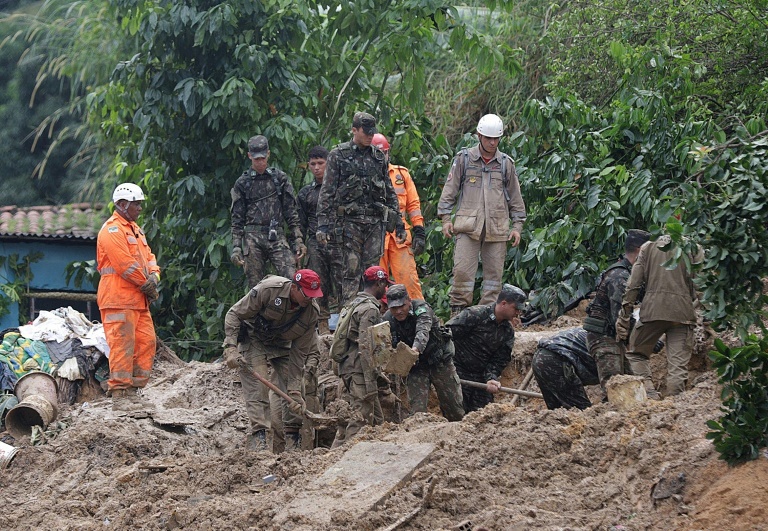
The force of the landslides ripped apart houses in neighborhoods including Jardim Monteverde, a poor community just outside Recife.

Rescue workers have found more than 20 bodies buried in the mud that tore through the neighborhood Saturday, and said they expect to find more.

“I can’t eat or sleep. It’s just so much pain,” said Maria Lucia da Silva, a 56-year-old resident whose neighbors’ house was destroyed, killing 11 people. A 12th member of the family remains missing.

“I’ve lived here for 40 years. They were like my family. I watched a lot of them grow up,” Da Silva told AFP, crying behind her sunglasses.

Dozens of emergency workers are still digging through the ocean of muck, as clean-up crews in yellow uniforms clear the streets, slowly working their way through the wreckage, an AFP photographer saw.

In just hours on Friday and Saturday, parts of Pernambuco received 70 percent of the rain they usually get in the entire month of May.

“We never saw so much rain fall in so little time,” said 60-year-old retiree Mario Guadalupe.

“I saw the landslide happen. First part of the hill gave way, then it was just a tsunami of mud. It nearly took out my house.”

– ‘Screaming for help’ –

Such tragedies are becoming a familiar script in Brazil.

They tend to hit hardest in poor neighborhoods, especially hillside favelas, or slums.

In February, 233 people were killed in floods and landslides in the southeastern city of Petropolis, in Rio de Janeiro state.

In January, torrential rains claimed at least 28 lives in southeastern Brazil, mostly in Sao Paulo state.

And in December, storms killed 24 people in the northeastern state of Bahia.

On that occasion, Bolsonaro — who trails leftist ex-president Luiz Inacio Lula da Silva in polling ahead of elections in October — faced criticism for not interrupting his year-end beach vacation to visit the disaster zone.

“Unfortunately these tragedies happen, a country the size of a continent has its share of problems,” Bolsonaro said Monday.

On the ground, many residents were angry.

“A lot of people lost everything — even their lives. We’re screaming for help. We need food, houses, clothing. So don’t just come here to campaign. We need action,” said Jardim Monteverde resident Jailson Gomes de Souza, 34.

Bolsonaro’s government announced it has allocated one billion reais ($210 million) in emergency and reconstruction funds for areas hit by the latest storms.

Meteorologists say the heavy rains lashing Brazil’s northeast are the product of a typical seasonal phenomenon called “eastern waves” — areas of atmospheric disturbance that move from Africa to Brazil’s northeastern coastal region.

The region remains at “very high” risk for further floods, said the national disaster monitoring center, Cemaden.

“We urge people to respect the alerts issued by the authorities” and evacuate if necessary, said Regional Development Minister Daniel Ferreira.

Iran's enriched uranium stockpile 18 times over 2015 deal limit: IAEA

The UN nuclear watchdog said Monday that it estimated Iran’s stockpile of enriched uranium had grown to more than 18 times the limit laid down in Tehran’s 2015 deal with world powers.

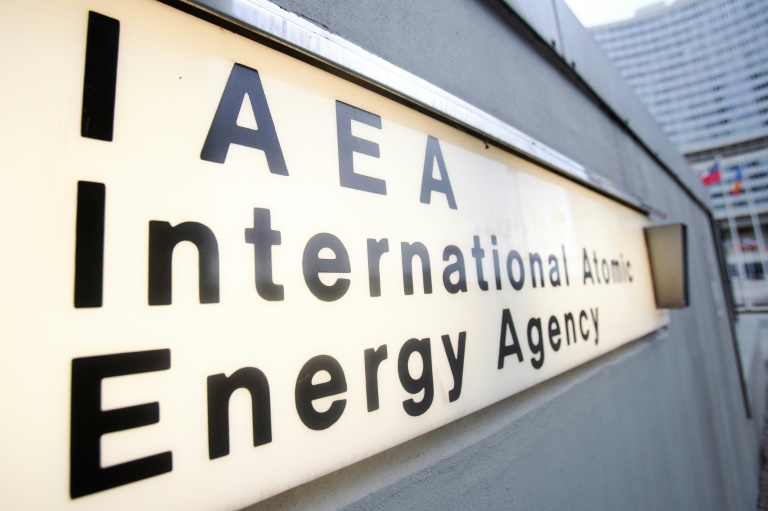
The International Atomic Energy Agency said in its latest report on Iran’s nuclear programme that it “estimated that, as of May 15, 2022, Iran’s total enriched stockpile was 3,809.3 kilograms.” 

The limit in the 2015 deal was set at 300 kg (660 pounds) of a specific compound, the equivalent of 202.8 kg of uranium.

The report also says that Iran is continuing its enrichment of uranium to levels higher than the 3.67 percent limit in the deal.

The stockpile of uranium enriched up to 20 percent is now estimated to be 238.4 kg, up 56.3 kg since the last report in March, while the amount enriched to 60 percent stands at 43.1 kg, an increase of 9.9 kg. 

Enrichment levels of around 90 percent are required for use in a nuclear weapon.

Iran has always insisted its nuclear programme is peaceful.

A diplomatic source said the amount of uranium enriched to 60 percent now exceeded the IAEA’s threshold of a “significant quantity”, defined by the agency as an approximate amount above which “the possibility of manufacturing a nuclear explosive cannot be excluded”.

However, the same source pointed out that some uranium would be lost during the process of further enrichment, meaning that in reality “you would need more than 55 kilograms” for that purpose.

In a separate report also issued on Monday, the IAEA reiterated that it still had questions which were “not clarified” regarding previous undeclared nuclear material at three sites named as Marivan, Varamin and Turquzabad.

This is despite a long-running series of attempts by the IAEA to get Iranian officials to explain the presence of this material. 

The report said Iran has offered the explanation of an “act of sabotage by a third party to contaminate” the sites, but added no proof had been provided to corroborate this.

The diplomatic source said that an act of sabotage was “not easy to believe” given “the distribution of the material” that had led to the IAEA’s questions.

The latest reports come as talks to revive the landmark 2015 nuclear deal between Iran and world powers remain deadlocked after stalling in March.

EU leaders seek to break oil ban deadlock as Russia advances in Donbas

European Union leaders met in Brussels on Monday seeking to overcome Hungarian opposition to an embargo on Russian oil, as Moscow’s forces made gains in the eastern Donbas region of Ukraine.

Ukrainian President Volodymyr Zelensky urged the 27-nation bloc to end internal “quarrels” and adopt more sanctions against Moscow, including an embargo on Russian oil.

“All quarrels in Europe must end, internal disputes that only encourage Russia to put more and more pressure on you,” he told the emergency EU summit via video-link.

“It is time for you to be not separate, not fragments, but one whole.” 

In Washington, US President Joe Biden said he would not send rocket systems to Ukraine that could hit Russian territory, despite urgent requests from Kyiv for such weapons and extensive US military aid for Ukraine since the war began.

EU diplomats have drafted a watered-down agreement that would see pipeline oil exempted from the ban, in the hopes of unblocking talks on the bloc’s sixth round of Russian sanctions.

Ahead of the meeting, Hungarian Prime Minister Viktor Orban told reporters the proposal was a “good solution” but warned there was “no agreement at all” as things stood.

On the ground, Russian forces pressed their offensive in Donbas.

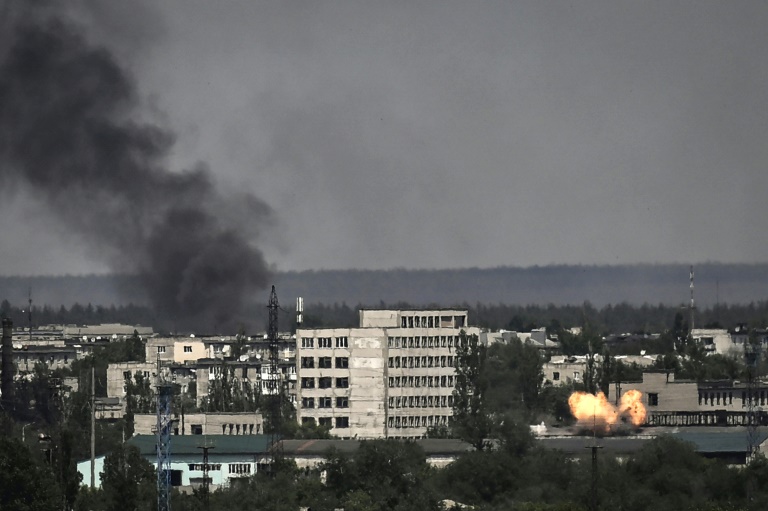
“The situation in Severodonetsk is as complicated as possible,” Lugansk regional governor Sergiy Gaiday said on Telegram, saying the whole region was under continuous bombardment — “air bombs, and artillery, and tanks. Everything”.

In Severodonetsk, street battles were being fought as the Russians advanced into the city, he added.

– Weapons supplies –

In Washington, Biden told reporters: “We are not going to send to Ukraine rocket systems that can strike into Russia.”

Ukraine has received extensive US military aid since with legislators approving another $40 billion (37.1 billion euros) assistance package earlier in May.

France’s new foreign minister Catherine Colonna said on a visit to Kyiv that Paris was ready to boost military aid to Ukraine to help it counter Russia’s invasion.

France will “continue to reinforce arms deliveries,” Colonna said at a news conference with her Ukrainian counterpart Dmytro Kuleba.

The arms would arrive “in the coming weeks”, she said.

The highest-ranking French official to visit the capital since Russia invaded Ukraine on February 24, Colonna also visited Bucha, near Kyiv, where Russian troops have been accused of committing war crimes against civilians.

“This should never have happened,” Colonna told reporters after visiting an Orthodox church in the town. “It must never happen again.”

Her visit came as a French journalist was killed while working in Ukraine.

Frederic Leclerc-Imhoff was “on board a humanitarian bus” when “he was mortally wounded,” French president Emmanuel Macron wrote on Twitter on Monday.

Governor Gaiday said evacuations there had been halted after the death of the journalist.

– Oil sanctions –

A sixth wave of EU measures against Moscow was put on the table weeks ago, but has been rejected by Orban and resisted by neighbouring countries also reliant on pipelined Russia oil.

Macron cautiously told reporters that a long-sought-after deal was “getting closer”, but others doubted that the Hungarian leader was ready to sign on at this stage.

“I don’t think we’ll reach an agreement today,” Estonian Prime Minister Kaja Kallas said at a political meeting ahead of the summit

Hungary has asked for at least four years and 800 million euros ($860 million) in EU funds to adapt its refineries and increase pipeline capacity for alternative suppliers, like Croatia.

But under the compromise proposal the Druzhba pipeline could be excluded from a sanctions package “for the time being”, an EU official told AFP.

– ‘We’re close!’ –

Since failing to capture Kyiv in the war’s early stages, Russia’s army has narrowed its focus, hammering Donbas cities with relentless artillery and missile barrages as it seeks to consolidate its control.

But Ukrainian forces pushed back over the weekend in the southern region of Kherson, the country’s military leadership said.

The Ukrainian general staff claimed the move had put their adversary into “unfavourable positions” around the villages of Andriyivka, Lozovo and Bilohorka and forced Moscow to send reserves to the area.

“Kherson, hold on. We’re close!” it tweeted Sunday.

At the same time, two people were injured following an explosion in the Moscow-controlled city of Melitopol in south-eastern Ukraine, with local pro-Kremlin authorities blaming Kyiv.

Russia-installed authorities said the city had been targeted by a “terrorist attack”.

“The Ukrainian government continues its war on the civilian population and the infrastructure of cities,” a statement said.

At least five people died following strikes on civilian infrastructure in Ukraine’s separatist-controlled city of Donetsk, according to Russian investigators.

Authorities in the DNR said on Telegram that two apartment blocks and three schools were hit in the attack, accusing Kyiv of using artillery and rockets with cluster munitions.

burs-sea/imm/jj

Zelensky urges EU end 'quarrels', adopt oil sanctions on Russia

Ukraine’s President Volodymyr Zelensky urged the European Union Monday to stop its “quarrels” and adopt fresh sanctions on Russia as the bloc’s leaders sought a compromise deal with Hungary to target Moscow’s key oil exports.

The 27-nation EU has spent weeks haggling over a proposed embargo on Russian oil but come up against stubborn resistance from Hungarian premier Viktor Orban.

Leaders meeting in Brussels were hoping to persuade Orban to accept a watered-down version of the ban that would keep the oil flowing by pipeline to a handful of countries, including Hungary. 

Zelensky, in a video address, called on them to adopt “effective” sanctions against Russian oil to make the Kremlin pay the price for its war on Ukraine.

“All quarrels in Europe must end, internal disputes that only encourage Russia to put more and more pressure on you,” Zelensky told the EU summit. 

“It is time for you to be not separate, not fragments, but one whole.”

Orban, often the odd man out in EU decision making, said a proposal only to stop oil deliveries to the EU by ship was a “good solution” as he arrived for the talks.

“It means that an atomic bomb won’t be thrown on the Hungarian economy,” he said. 

But he warned that Budapest still needed a “guarantee” it could keep on receiving Russian oil by sea if anything happened to the pipeline crossing Ukraine.

Orban said “there is no agreement at all” yet. 

He did not, however, threaten to veto the leaders’ planned summit statement, arguing that it was the European Commission’s job to fine-tune the sanctions package.

– ‘Getting closer’ –

A sixth wave of EU measures against Moscow was put on the table four weeks ago, but EU unity shown in implementing five earlier waves of unprecedented sanctions on Moscow appeared to have hit its limit.

The latest proposed compromise would exclude the Druzhba pipeline from the oil embargo and only impose sanctions on crude shipped to the EU by tanker vessel, which counts for two-thirds of Russian oil imports.

While French President Emmanuel Macron told reporters that a long-sought-after deal was “getting closer”, others doubted that.

“I don’t think we’ll reach an agreement today,” Estonian Prime Minister Kaja Kallas said ahead of the summit.

“Of course, we’re going to have discussions, but everybody needs to be on board,” she said, adding that she did not expect a solution before another summit to be held in late June. 

An EU official said the leaders would attempt to find a “political agreement” on the Russian oil ban, with exceptions for specific countries worked out “as soon as possible”.

EU sanctions require the backing of all member states and ambassadors fell short of finalising a deal just hours before the start of the summit. 

– ‘Orban’s antics’ –

Landlocked Hungary imports 65 percent of its oil from Russia through the Druzhba pipeline and, along with Slovakia and the Czech Republic, has asked for an exception from the import ban.

Diplomats said a two-year delay to the embargo had been granted to the countries concerned, but that Budapest wanted at least four years and nearly 800 million euros ($860 million) in EU funding to adapt its refineries.

“There is quite a lot of sympathy for Hungary’s oil supply issues, which are great, despite the antics by Orban,” an EU diplomat said on condition of anonymity.

Hungary’s intransigence comes on the back of Orban’s recent resounding re-election to a fourth term and some experts are sceptical about the official claims of alarm over a Russian oil ban.

Further complicating the stand-off is Hungary’s share of the EU’s 800-billion-euro recovery fund, which Brussels has yet to approve due to disagreements over Budapest’s respect for the rule of law.

burs-del/rmb/jj

Biden rules out sending rocket systems 'that can strike into Russia' to Ukraine

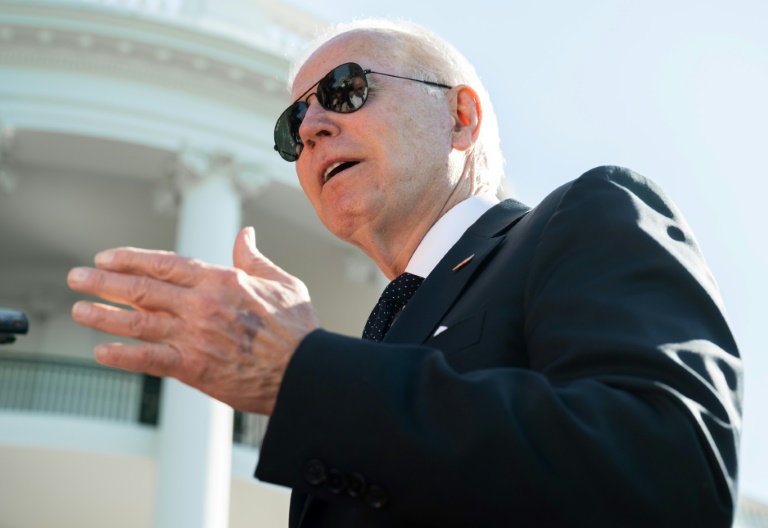
US President Joe Biden said Monday he would not send rocket systems to Ukraine that could hit targets well inside Russian territory, despite urgent requests from Kyiv for long-range weapons. 

“We are not going to send to Ukraine rocket systems that can strike into Russia,” Biden told reporters in Washington. 

Pro-Western Ukraine has received extensive US military aid since Russia invaded its outgunned neighbor in late February, but says it needs long-range rockets equivalent to what Moscow’s forces use.

Kyiv has asked the United States for mobile batteries of long-range rockets, the M270 MLRS and the M142 Himars, which can launch multiple rockets at the same time with a range of up to 187 miles (300 kilometers), eight times or more the distance of artillery in the field. 

This could give Ukrainian forces the ability to reach, with great precision, targets far behind Russian lines, though it is unclear if that is their intent.

The MLRS “is really the weapon that we badly need,” Ukrainian Foreign Minister Dmytro Kuleba said last week at the World Economic Forum in the Swiss Alps, where he pressed Western allies for heavy weapons.

Ukrainian President Volodymyr Zelensky’s advisor Mykhailo Podoliak echoed the call in a recent tweet, saying, “It is hard to fight when you are attacked from a 70 km (43 miles) distance and have nothing to fight back with.”

The United States earlier in May announced another $40 billion assistance package amid speculation it included such weapons. 

Republican Senator Lindsey Graham said Monday that the Biden administration’s “decision not to send these weapons is a betrayal of Ukraine and democracy itself.”

“Apparently, once again the Biden Administration is intimidated by Russian rhetoric,” he said on Twitter.

A US official said later that dispatching MLRS was still under consideration, but without long-range strike capabilities.

Since failing to capture Kyiv in the war’s early stages, Russia’s army has narrowed its focus and has been hammering cities with relentless artillery and missile barrages as it seeks to consolidate its control.

Moscow’s forces have continued a push in the eastern Donbas region, upping the pressure on the twin cities of Severodonetsk and Lysychansk.

Ukrainian forces pushed back over the weekend in the southern region around Kherson as Zelensky seeks to crank up already hefty international pressure on Moscow.

Dissident Cuban artists' disorder trial begins

Two dissident Cuban artists who have been classified as prisoners of conscience by Amnesty International went on trial Monday, with foreign press and diplomats excluded.

Prosecutors have accused Luis Manuel Otero Alcantara and Maykel Osorbo of disturbing public order and want them sentenced to seven and 10 years in prison, respectively.

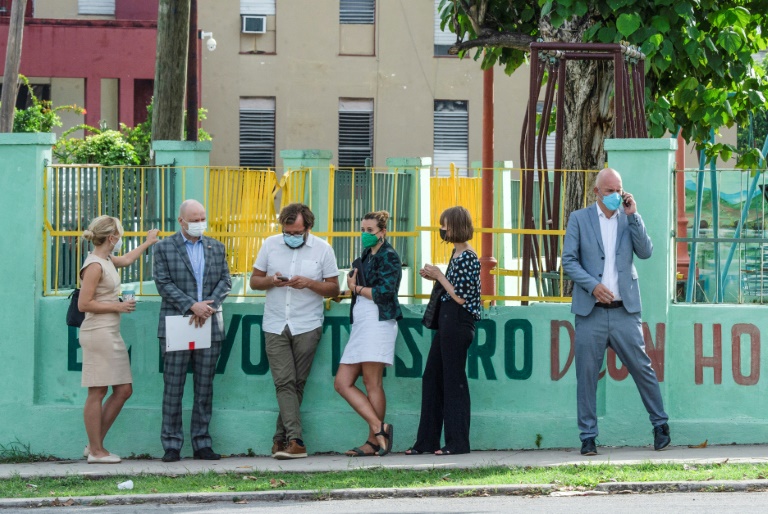
“We have officially made a request in the name of the European Union but so far we have not received a response,” a diplomat who identified himself only as a representative of the German Embassy told journalists outside the court in Havana.

Alongside diplomats from Sweden, the Czech Republic, the Netherlands, Norway and the United Kingdom, he said it was not just the artists on trial but “basic human rights such as freedom, freedom of expression and freedom of assembly.”

Otero Alcantara, 34, was arrested on July 11, 2021 when tens of thousands of Cubans took part in unprecedented anti-government protests throughout the country demanding freedom and shouting “We’re hungry!”

He is a leader of the so-called San Isidro collective, comprising artists who are also activists.

Held in the high security Guanajay prison in central Artemisa province, he is accused of multiple offenses such as incitement to commit crime, aggravated contempt and public disorder, although these all pre-date his arrest during the July 11 demonstrations.

According to an audio recording released last week on social media by fellow activists, authorities offered to release Otero Alcantara if he left the country, but he refused.

Osorbo, 39, was arrested in May 2021 and is accused of public disorder, assisting the escape of prisoners or detainees, and assault.

He is the co-author of the song “Homeland and Life,” which has become a symbol of anti-government protests in Cuba and won a Latin Grammy.

Both artists have been declared prisoners of conscience by Amnesty International, and Washington has persistently demanded their release.

The government crackdown on the July 11 protests left one person dead, dozens injured and almost 1,400 in jail, more than 700 of whom remain in detention, according to the Miami-based Cubalex NGO.

Close Bitnami banner
Bitnami