World

EU leaders plead with Orban to back Russian oil ban

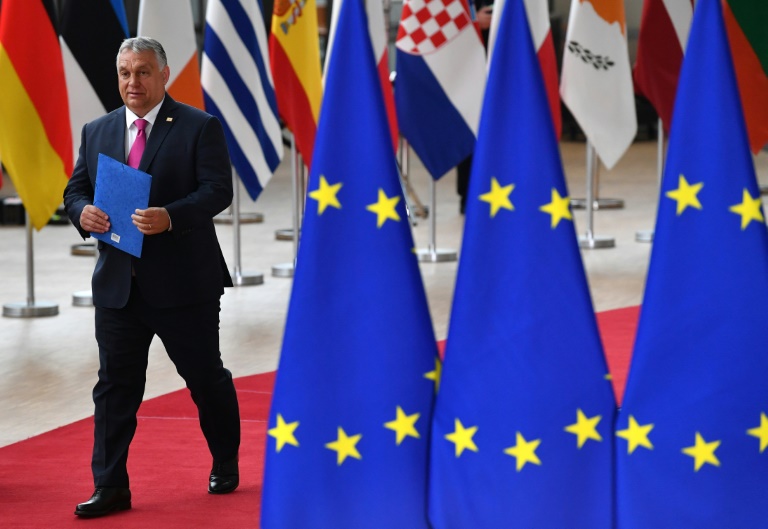
EU leaders were hoping Monday to persuade Prime Minister Viktor Orban to back a watered-down oil embargo against Russia after a month of haggling over a blocked sanctions package.

But the Hungarian leader, who has demanded an exemption from the ban and guarantees for his country’s energy supply, warned on arrival at the EU summit that no compromise had yet been reached.

Orban confirmed that the proposal on the table would see Russian oil arriving in the EU and in Hungary by pipeline, rather than by sea, exempted from the sanctions.

“For Hungary this is a good solution, it means that an atomic bomb won’t be thrown on the Hungarian economy,” he said. But he warned that this would not be enough to guarantee supply.

“What causes us a problem is that in the case that something happens to the pipeline carrying Russian oil, which is something that the Ukrainians and others have spoken about,” he said. 

“If Russian oil does not arrive by pipeline, then we would have the right to receive oil by sea, and have it arrive from elsewhere, that is the guarantee that we need.”

Orban said “there is no agreement at all”. He did not, however, threaten to veto the leaders’ planned summit statement, arguing that it was the European Commission’s job to fine-tune the sanctions package.

— ‘Exceptions’ being negotiated —

A sixth wave of EU measures against Moscow was put on the table weeks ago, but has been rejected by Orban and resisted by neighbouring countries also reliant on pipelined Russia oil.

French President Emmanuel Macron cautiously told reporters that a long-sought-after deal was “getting closer”, but others doubted that.

“I don’t think we’ll reach an agreement today,” Estonian Prime Minister Kaja Kallas said at a political meeting Monday ahead of the summit.

“Of course, we’re going to have discussions, but everybody needs to be on board,” she said, adding that she did not expect a solution before a summit in late June. 

EU sanctions require the backing of all 27 member states and ambassadors fell short of finalising a deal just hours before the start of the summit. 

A senior EU diplomat described the failure as the “elephant in the room”, especially given that Ukrainian President Volodymyr Zelensky was also slated to address the leaders by video link.

An EU official said the leaders would attempt to find a “political agreement” on the Russian oil ban, with exceptions for specific countries worked out “as soon as possible”.

– ‘Orban’s antics’ –

Landlocked Hungary imports 65 percent of its oil from Russia through the Druzhba pipeline and, along with Slovakia and the Czech Republic, have asked for an exception from the import ban.

Diplomats said a two-year delay to the embargo has been granted to the countries concerned, but that Budapest wants at least four years and nearly 800 million euros ($860 million) in EU funding to adapt its refineries.

“There is quite a lot of sympathy for Hungary’s oil supply issues, which are great, despite the antics by Orban,” an EU diplomat said on condition of anonymity.

The latest compromise solution would exclude the Druzhba pipeline from the embargo and only impose sanctions on oil shipped to the EU by tanker vessel, which counts for two-thirds of Russian oil imports.

“The European Council aims to reach a political agreement today on an embargo on Russian oil,” an EU official told reporters.

“Some temporary exceptions have been granted to ensure security of supply for certain member states.”

Hungary’s intransigence comes on the back of Orban’s recent resounding re-election to a fourth term and some experts are sceptical about the official claims of alarm over a Russian oil ban.  

Also complicating the stand-off is Hungary’s share of the EU’s 800-billion-euro recovery fund, which Brussels has yet to approve due to disagreements over Budapest’s respect for the rule of law and human rights.

A senior diplomat warned that some leaders had accused negotiators of going too far in their efforts to placate Orban, who before the war was Russian President Vladimir Putin’s closest EU ally.

The question of how we answer Russia is always “emotional” for certain member states and will be “one of the most sensitive issues” at the summit, the diplomat added.
Covid-hit Archbishop of Canterbury to miss queen's service

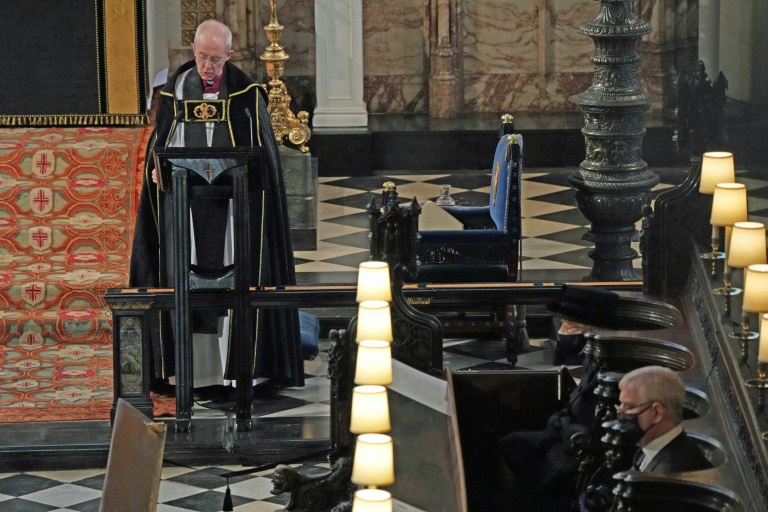
The Archbishop of Canterbury said Monday he would miss a national service of thanksgiving for Queen Elizabeth II’s Platinum Jubilee after testing positive for Covid.

Justin Welby, who leads the worldwide Anglican communion, said he was “deeply saddened” at missing Friday’s service in St Paul’s Cathedral, central London.

He was diagnosed with mild pneumonia on Thursday and developed coronavirus symptoms over the weekend, and has cancelled all engagements this week.

“However, I will be praying for the queen and giving thanks for her extraordinary 70 years of service to us all,” the archbishop said.

“I will also be praying for our nation at this time of celebration and thanksgiving. May the queen’s example bring us together in unity and care for one another.” 

The Church of England’s second-highest ranking cleric, Archbishop of York Stephen Cottrell, will deliver the sermon instead.

Buckingham Palace has yet to confirm if the 96-year-old monarch will attend the Anglican service herself. 

She has restricted her public engagements in recent months after complaining of mobility problems. She contracted Covid-19 in February.

Two figures set to attend on Friday are Prince Harry and his wife Meghan, according to their biographer Omid Scobie.

The Duke and Duchess of Sussex stepped down from royal duties and moved to North America early in 2021. They have visited the UK together only once, after a series of disputes with the royal family.

Around 100 dead in clashes between Chad gold miners

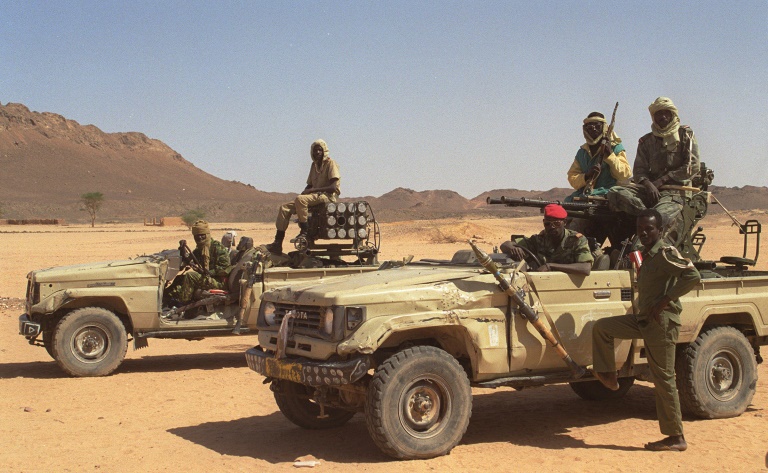
Around 100 people have died in clashes between gold miners in northern Chad, Defence Minister General Daoud Yaya Brahim said on Monday.

Violence broke out on May 23 at Kouri Bougoudi near the Libyan border, sparked by a “mundane dispute between two people which degenerated,” he said, adding that the toll was “around 100 dead and at least 40 wounded.”

The clashes occurred in the Tibesti Mountains, a rugged and lawless region in the central Sahara some 1,000 kilometres (600 miles) from the capital N’Djamena.

The discovery of gold there 10 years ago sparked a rush of miners from across Chad and neighbouring countries, and tensions often run high.

The latest clashes were between Mauritanians and Libyans, Yaya Brahim said.

He spoke to AFP by phone from the area, where he said he was with a large military contingent sent to help restore order.

“This isn’t the first time that there’s been violence among gold miners in the region, and we have decided to suspend all gold mining at Kouri until further notice,” he said, adding that “the great majority (of mines in the area) are illegal.”

The incident was first announced last Wednesday, when Communications Minister Abderaman Koulamallah said in a statement there had been “loss of human life and several wounded,” but gave no further details.

The same day, the head of Chad’s National Human Rights Commission, Mahamat Nour Ibedou, told AFP that after the fighting broke out, “the government sent in a force to intervene, which fired on people”.

“According to our information, there are at least 200 dead,” he said, adding that he had no evidence to support this figure.

Succes Masra, who heads an opposition party called The Transformers, and Chad’s main armed rebel movement, the Front for Change and Concord in Chad (FACT), also gave a toll of some 200 dead.

But Yaya Brahim denied this figure and said the authorities were not to blame.

“The defence and security forces absolutely did not open fire, and there were not 200 deaths,” he said.

On Monday, another rebel group in the region, the Military Command Council for the Salvation of the Republic (CCMSR), said in a statement there had been “carnage,” which had unfolded “under the complicit gaze of the security forces.”

– Troubled region –

The Tibesti region is notorious for ethnic troubles and for fostering revolts that have marked Chad’s history since the vast central West African country gained independence from France in 1960.

In January 2019, several dozen people died in Kouri when fighting erupted between Libyan Arabs and people from the eastern Chadian region of Ouaddai.

Koulamallah, in comments to AFP last Wednesday, described the gold-mining area as a “hostile zone, almost lawless, it’s the Far West. They all go there because there’s gold, so there’s conflict.”

The impoverished Sahel state last year lost its 30-year ruler, Idriss Deby Itno, who was killed during an operation against rebels.

His place was taken by his son, General Mahamat Idriss Deby Itno, at the head of a 15-member military junta.

Killer whale stranded in France's River Seine dies

A killer whale stranded for weeks in France’s River Seine was found dead Monday after attempts to guide it back to sea failed and revealed it was severely sick, local authorities said.

Regional officials had already decided to euthanise the killer whale — also known as an orca — to end its suffering, but a sailor spotted the animal lying on its side Monday morning. 

Sea Shepherd France, who went out to the animal and confirmed its death, said on Twitter they were watching over the orca’s body to prevent it from being hit by a ship, which would compromise the autopsy.

The investigation will try to establish why the orca got stranded and how it died, as well as gather information on its illness, local authorities said. 

A group of experts attempted to use sonar techniques to help guide the animal back into its natural salt-water habitat this weekend, after its appearance in the iconic French river that flows through Paris astonished onlookers.

But the operation seeking to save the animal encountered “a lack of alertness, inconsistent reactions to sound stimuli and erratic and disoriented behaviour,” regional authorities said in a statement. 

“The sound recordings also revealed vocal calls similar to cries of distress,” it said, adding that the animal appeared to be in a “critical state of health”.

“Her skin was so ulcerated… She must have been in agony. Pieces of skin were falling off, there was nothing that could be done,” said Gerard Mauger, vice-president of GECC, a Cherbourg-based association for the conservation of marine animals in the Channel.

“Everything was ready to euthanise her” when she was found dead, Mauger added. 

The animal appeared to be suffering from mucormycosis, a fungal infection increasingly seen among marine mammals and which causes them severe distress.

Killer whales, which, despite their name belong to the dolphin family, are occasionally spotted in the English Channel but such sightings are considered rare, and even rarer in a river.

Experts said that while being in a river helped the animal to conserve energy, it also complicated its search for prey, especially for a species known to hunt in packs.

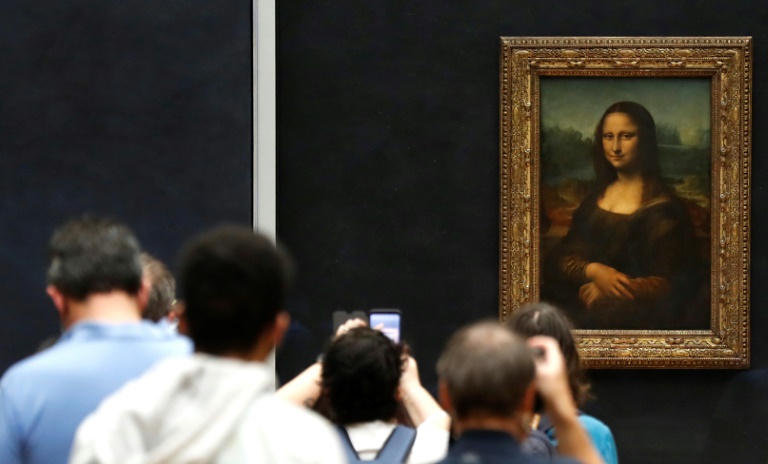
Man arrested after smearing Mona Lisa with cake at Louvre

A 36-year-old man has been arrested and placed in psychiatric care after he smeared a glass screen encasing the Mona Lisa with cake, prosecutors said Monday, in a purported protest against artists not focusing enough on “the planet”.

Officials at the Louvre Museum in Paris, where the enigmatic portrait holds pride of place, declined to comment on the bizarre incident on Sunday, which was captured on several phones and circulated widely on social media.

The treasured work by Leonardo da Vinci, which has been the target of vandalism attempts in the past, was unharmed thanks to its bulletproof glass case.

A Twitter user identified as Lukeee posted a video showing a museum employee wiping a mess off the glass and another showing a man dressed in white being escorted away by security guards.

“A man dressed as an old lady jumps out of a wheelchair and attempted to smash the bulletproof glass of the Mona Lisa. Then proceeds to smear cake on the glass and throws roses everywhere, all before being tackled by security,” Lukeee wrote.

Speaking French, the man says: “There are people who are destroying the Earth… All artists, think about the Earth. That’s why I did this. Think of the planet.” 

No image have emerged showing the actual incident.

An inquiry into “an attempt to vandalise a cultural work” has been opened, the Paris prosecutor’s office said.

The Mona Lisa has been behind glass since a Bolivian man threw a rock at the painting in December 1956, damaging her left elbow. In 2005, it was placed in a reinforced case that also controls temperature and humidity.

In 2009, a Russian woman threw an empty teacup at the painting, which slightly scratched the case.

The Louvre is the largest museum in the world, housing hundreds of thousands of works that attracted some 10 million visitors a year before the Covid-19 pandemic.

Xi hails 'new atmosphere' in Hong Kong, welcomes next leader

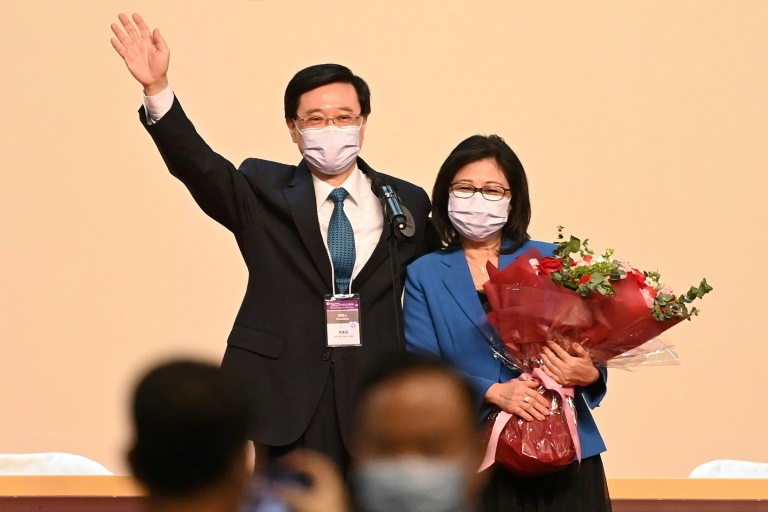
Chinese President Xi Jinping has met with Hong Kong’s next leader in Beijing, telling John Lee he has the full trust of the central government, state media said Monday.

Lee travelled to the capital on Saturday to receive Beijing’s blessing as he prepares to take office in a month.

The 64-year-old former security chief, who oversaw a crackdown on Hong Kong’s democracy movement, was chosen as the next chief executive by a small committee of Beijing loyalists in early May.

“I believe that the administration of the new government will definitely bring forth a new atmosphere, and compose a new chapter in Hong Kong’s development,” Xi said, according to official news agency Xinhua.

Lee will assume office on July 1, which is the 25th anniversary of Hong Kong’s transfer from British to Chinese rule and the halfway point of its “One Country, Two Systems” political model.

Hong Kong has never been a democracy — the source of years of public frustration and protests — but China agreed that Hong Kong could maintain certain freedoms and autonomy for 50 years after its handover.

According to Xinhua, Xi said Lee has the “courage to take responsibility” and “had made contributions to safeguarding national security and Hong Kong’s prosperity and stability”.

“The central government fully affirms and fully trusts you,” Xi added.

Lee was the sole candidate in the race to succeed outgoing leader Carrie Lam at a time when Hong Kong is being remoulded in China’s authoritarian image.

According to a statement from the Hong Kong government, Lee said in the meeting that he was “deeply honoured by the appointment and fully aware of the great responsibility upon me”.

He promised to “unite all sectors” and bring the government and people together to “strive for the well-being of Hong Kong and its people”.

“Together, we will build Hong Kong into a city with long-term prosperity and a caring and inclusive society,” he added.

– Selection controversy –

China imposed a national security law on Hong Kong that has clamped down on dissent after widespread and sometimes violent pro-democracy protests rocked the city in 2019.

The elevation of Lee, who is under US sanctions, places a security official in Hong Kong’s top job for the first time after a tumultuous few years for a city battered by the unrest and economically debilitating pandemic controls.

Lee spent 35 years in the police before jumping to the government in 2012, serving in the Security Bureau and then leading it before becoming the city’s number two official last year.

He won the top role this month with more than 99 percent of votes from the 1,461-member committee.

Under the slogan “Starting a new chapter for Hong Kong together”, Lee has vowed to bring in “result-oriented” governance, forge unity and reboot the city’s economy. 

Insiders told AFP at the time of Lee’s selection that his unwavering commitment won China’s confidence when other Hong Kong elites were seen as insufficiently loyal or competent.

This month countries including Canada, France, Germany, Italy, Japan, Britain and the United States joined the European Union in voicing alarm over the selection process for the new leader, which they called a “continued assault on political pluralism and fundamental freedoms”.

But Beijing hailed the process as “a real demonstration of democratic spirit” and said it was the culmination of a strategy to ensure only “patriots” run Hong Kong.

Outgoing leader Lam is on track to leave office with record-low approval ratings. 

Irish court finds ex-soldier Lisa Smith guilty of joining IS

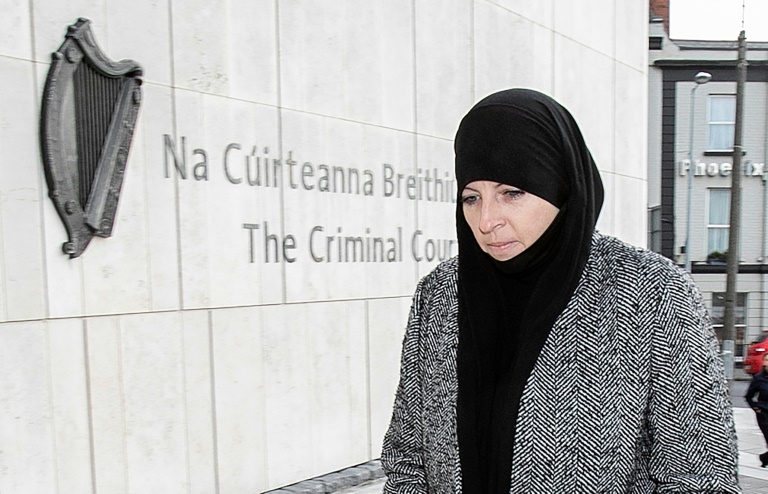
Three judges at the Special Criminal Court in Dublin on Monday found former soldier Lisa Smith guilty of joining the so-called Islamic State group in Syria.

Smith, 40, wept in the dock as judge Tony Hunt read the panel’s decision, which was delivered after a nine-week trial.

The Muslim convert, who wore a hijab to court, pleaded not guilty to membership of an unlawful terrorist group between October 28, 2015 and December 1, 2019.

Judge Hunt said the prosecution had established beyond reasonable doubt that she travelled to Syria “with her eyes open” and pledged allegiance to the group, led by Abu Bakr al-Baghdadi.

She was acquitted of a separate charge of financing terrorism by sending 800 euros ($900) to aid medical treatment for a Syrian man in Turkey.

Hunt said there was reasonable doubt that she intended the money to be used for humanitarian purposes rather than to fund terrorism.

He granted her bail until a sentencing hearing on July 11.

During the trial, which began in January, prosecutors detailed how Smith, who was a member of the Irish Defence Forces from 2001 to 2011, travelled to IS controlled territory in 2015 after converting to Islam.

In 2012, she went on pilgrimage to Mecca, and expressed a desire on an Islamic Facebook page to live under Sharia law and to die a martyr.

The court was told that she bought a one-way ticket from Dublin to Turkey, crossing the border into Syria and living in Raqqa, the capital of the Islamic State’s self-styled caliphate.

At the time, the hardline Islamists ruled over vast swathes of Syria and Iraq, attracting thousands of foreign fighters to their cause before the group’s territorial defeat in the region.

After failing to convince her husband to join her, Smith divorced him in 2016 and married a UK national involved in the group’s armed patrols.

As IS lost ground to a US-led coalition on the battlefield and towns and cities under its sway fell, Smith was forced to flee Raqqa and then Baghouz, their last remaining stronghold, before returning to Ireland.

She was arrested on arrival at Dublin airport on December 1, 2019 with her young daughter.

Defence lawyers argued that Smith’s presence in IS territory did not make her a de facto member of the extremist Sunni group.

They have said it could only be argued “at a stretch” that she provided some sort of assistance to the group because she had kept a home for her husband.

The three judges sat without a jury at the Special Criminal Court, which adjudicates on cases involving terrorism and organised crime offences. 

Bodies pulled from wreckage of Nepal plane

Nepali rescuers have retrieved the bodies of all but one of 22 people on board a plane that crashed into a Himalayan mountainside over the weekend, the army said Monday.

Air traffic control lost contact with the Twin Otter plane operated by Nepali carrier Tara Air shortly after it took off from Pokhara in western Nepal on Sunday morning headed for Jomsom, a popular trekking destination.

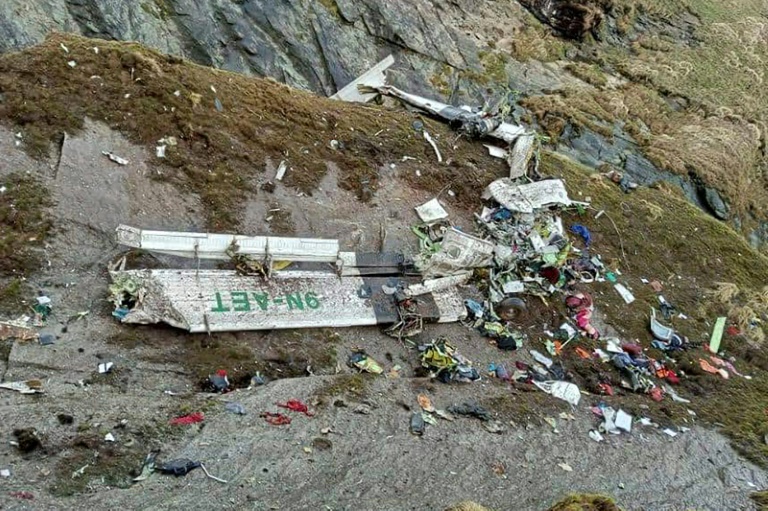
Resuming a search on Monday after failing to find any trace a day earlier, the army shared on social media a photo of aircraft parts and other debris littering a sheer mountainside, including a wing with the registration number 9N-AET clearly visible.

“Twenty-one bodies have been recovered and teams are searching for the remaining one,” Nepal Army spokesman Narayan Silwal told AFP.

“It is a very difficult area to work. The aircraft is several pieces scattered all over the slope,” a police official at the crash site said.

About 60 people were involved in the operation, including the army, police, mountain guides and locals, most of whom trekked uphill for miles on foot to get there.

The civil aviation authority said the plane “met an accident” at 14,500 feet (4,420 metres) in the Sanosware area of Thasang municipality.

“Analysing the pictures we received, it seems that the flight did not catch fire. Everything is scattered in the site. The flight seems to have collided with a big rock on the hill,” said Pokhara Airport spokesman Dev Raj Subedi.

– Families –

Four Indians were onboard, as well as two Germans, with the remainder Nepalis including a computer engineer, his wife and their two daughters who had just returned from the United States.

The four Indians were a divorced couple and their daughter and son, aged 15 and 22, going on a family holiday, Indian police official Uttam Sonawane told AFP.

“There was a court order for (the father) to spend time with the family for 10 days every year, so they were taking a trip,” Sonawane said.

According to the Aviation Safety Network website, the aircraft was made by Canada’s de Havilland and made its first flight more than 40 years ago.

– Past crashes –

Tara Air is a subsidiary of Yeti Airlines, a privately owned domestic carrier that services many remote destinations across Nepal. 

It suffered its last fatal accident in 2016 on the same route when a plane with 23 on board crashed into a mountainside in Myagdi district. 

Nepal’s air industry has boomed in recent years, carrying goods and people between hard-to-reach areas as well as foreign trekkers and climbers. 

But it has long been plagued by poor safety due to insufficient training and maintenance. 

The European Union has banned all Nepali airlines from its airspace over safety concerns.

The Himalayan country also has some of the world’s most remote and tricky runways, flanked by snow-capped peaks with approaches that pose a challenge even for accomplished pilots.

The weather can also change quickly in the mountains, creating treacherous flying conditions.

In March 2018, a US-Bangla Airlines plane crash-landed near Kathmandu’s notoriously difficult international airport, killing 51 people and seriously injuring 20.

That accident was Nepal’s deadliest since 1992, when all 167 people aboard a Pakistan International Airlines plane died when it crashed on approach to Kathmandu airport.

Just two months earlier a Thai Airways aircraft had crashed near the same airport, killing 113 people.

Norwegian buys 50 Boeing 737 MAX, ending dispute

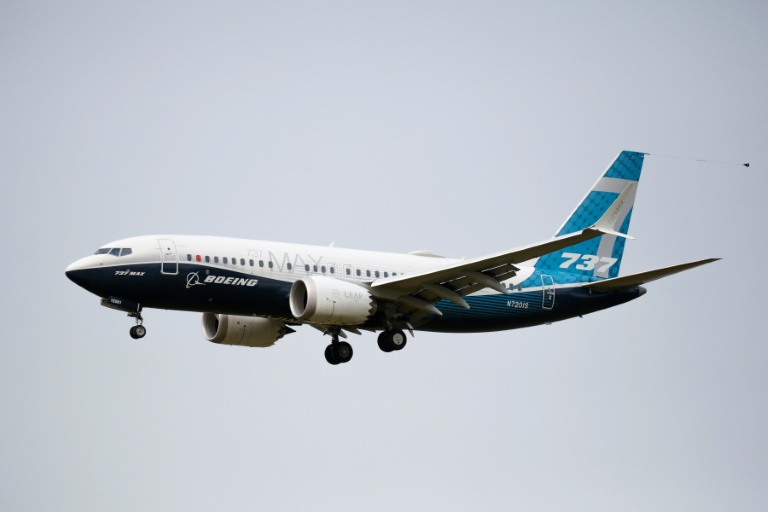
Low-cost carrier Norwegian Air Shuttle said Monday it would buy 50 Boeing 737 MAX 8 planes, ending a dispute between the companies and helping revive the US-made aircraft after two deadly crashes.

The jets will be delivered between 2025 and 2028, or around the same time that Norwegian’s aircraft leasing deals come to an end, and the contract includes an option for 30 more, the company said in a statement.

The order is welcome news for the US manufacturer’s flagship Boeing 737 MAX 8, which was grounded for 20 months following two fatal accidents and has been gradually returning to service since late 2020. 

Norwegian’s order is part of “the resolution of a dispute we have” with Boeing, the company’s chief executive Geir Karlsen told broadcaster TV2.

The Nordic low-cost carrier and Boeing have been locked in a legal battle for several years, with the Norwegian carrier launching legal proceedings against the US giant for compensation following setbacks related to its 737 MAX and 787 Dreamliner long-range jets.

Without giving further details, Karlsen mentioned “a compensation of two billion kroner ($212 million, 197 million euros) that we used to buy planes under advantageous conditions.

Norwegian said the deal remains subject to “various closing conditions” that it hopes will be concluded by the end of June.

Norwegian, which currently operates 61 aircraft, plans to ramp operations to have 70 in service this summer and 85 in the summer of 2023. 

Plagued by over-ambitious expansion, technical problems and the Covid pandemic, the company narrowly avoided bankruptcy last year via an extensive restructuring that led it, among other things, to give up its long-haul flight, reduce its fleet and cancel numerous orders.

Securing the 50 aircraft, means Norwegian is also returning to fully owning its own fleet after it was forced to rely on leased aircraft due to its financial woes.

For Boeing, this order solidifies the revival of the 737 MAX aircraft.

The 737 MAX was temporarily grounded worldwide following two crashes in Indonesia and Ethiopia, in 2018 and 2019, that killed a combined 346 people.

After Caribbean Arajet and  American Allegiant Air put in orders for the aircraft, British carrier IAG — parent company of British Airways — also just ordered 50 planes with an option for 100 more.

Norwegian on Monday also noted that the Boeing 737 MAX 8 is “approximately 14 percent more fuel-efficient compared to the previous-generation aircraft,” thus limiting emissions and cutting energy costs in view of rising fuel prices.

Xi hails 'new atmosphere' in Hong Kong, welcomes next leader

Chinese President Xi Jinping met Hong Kong’s next leader in Beijing, telling John Lee he has the full trust of the central government, state media said Monday.

Lee travelled to Beijing on Saturday to receive the central government’s blessing as he prepares to take office in a month.

The 64-year-old former security chief, who oversaw the crackdown on Hong Kong’s democracy movement, was chosen as the next chief executive by a small committee of Beijing loyalists in early May.

“I believe that the administration of the new government will definitely bring forth a new atmosphere, and compose a new chapter in Hong Kong’s development,” Xi said, according to official news agency Xinhua.

Lee will assume office on July 1, which coincides with the 25th anniversary of Hong Kong’s transfer from British to Chinese rule and the halfway point of the “One Country, Two Systems” political model.

According to Xinhua, Xi said Lee has the “courage to take responsibility” and “had made contributions to safeguarding national security and Hong Kong’s prosperity and stability”.

“The central government fully affirms and fully trusts you,” Xi added.

Lee was the sole candidate in the race to succeed outgoing leader Carrie Lam at a time when Hong Kong is being remoulded in China’s authoritarian image.

According to a statement from the Hong Kong government, Lee said in the meeting that he was “deeply honoured by the appointment and fully aware of the great responsibility upon me”.

He promised to “unite all sectors” and bring the government and people together to “strive for the well-being of Hong Kong and its people”.

“Together, we will build Hong Kong into a city with long-term prosperity and a caring and inclusive society,” he added.

Beijing imposed a national security law that has clamped down on dissent after widespread and sometimes violent pro-democracy protests rocked the city in 2019.

The elevation of Lee, who is under US sanctions, places a security official in Hong Kong’s top job for the first time after a tumultuous few years for a city battered by the unrest and economically debilitating pandemic controls.

Earlier this month countries including Canada, France, Germany, Italy, Japan, the UK and the United States joined the European Union in voicing alarm over the selection process of the new leader, which they called a “continued assault on political pluralism and fundamental freedoms”.

But Beijing hailed the process as “a real demonstration of democratic spirit” and said it was the culmination of a strategy to ensure only “patriots” run Hong Kong.

Close Bitnami banner
Bitnami