World

Russia advances in east Ukraine as EU meets on oil ban

Russian forces edged toward the centre of the eastern Ukrainian city of Severodonetsk Monday, while President Volodymyr Zelensky prepared to appeal to EU leaders at an emergency summit where a ban on Russian oil imports is on the agenda. 

Zelensky is expected to press EU officials at the summit “to kill Russian exports” as he seeks to crank up international pressure on Moscow.

Member states are searching for a compromise on a sixth round of sanctions, which has been delayed by resistance from within the bloc, namely from Hungary.

Meanwhile, Russia forces continued their push in the eastern Donbas region, upping the pressure on the twin cities of Severodonetsk and Lysychansk.

Since failing to capture Kyiv in the war’s early stages, Russia’s army has narrowed its focus, hammering cities with relentless artillery and missile barrages as it seeks to consolidate its control.

The situation in Severodonetsk, just across the Donets river from Lysychansk, was “very difficult”, the local Lugansk regional governor Sergiy Gaiday said in a statement on social media.

“The Russians are advancing into the middle of Severodonetsk”, while the fighting continued, Gaiday said.

– Pressure on the east –

While Russia concentrated its efforts in the east, Ukrainian forces pushed back over the weekend in the southern region of Kherson, the country’s military leadership said.

At the same time, two people were injured following an explosion in the Moscow-controlled city of Melitopol in southeastern Ukraine, with local pro-Kremlin authorities said pinning the blame on Kyiv.

Newly appointed French Foreign Minister Catherine Colonna also made the journey to the Ukrainian capital Monday for talks with Zelensky.

The highest-ranking French official to visit Kyiv since Russia invaded Ukraine on February 24, Colonna also visited the town of Bucha, where Russian troops have been accused of committing war crimes against the civilian population.

In the eastern Donbas region, Moscow’s forces were making slow progress towards taking the city of Severodonetsk.

Zelensky, in his daily address Sunday, described a scene of devastation in Severodonetsk. 

“All critical infrastructure has already been destroyed… More than two-thirds of the city’s housing stock has been completely destroyed,” he said. 

– ‘Constant shelling’ –

In Severodonetsk, where an estimated 15,000 civilians remain, a local official said “constant shelling” made it increasingly difficult to get in or out while the water supply is increasingly unstable.

Ukrainian forces counterattacked in the region of Kherson, the only region of the country fully controlled by Russian troops.

Russia gained control over most of Kherson, which borders Crimea, in the early stages of the war and Moscow-backed officials in the region have recently pushed for annexation.

While limited in nature, the attack could have the effect of stretching Russian forces. 

The Ukrainian general staff claimed the move had put their adversary into “unfavourable positions” around the villages of Andriyivka, Lozovo and Bilohorka and forced Moscow to send reserves to the area.

“Kherson, hold on. We’re close!” it tweeted Sunday.

In Melitopol, Russia-installed authorities said in a statement the city had been targeted by a “terrorist attack”.

According to the statement, car packed with explosives exploded in the city centre, injuring two “humanitarian aid” volunteers, a 28-year-old woman and a 25-year-old man.

“The Ukrainian government continues its war on the civilian population and the infrastructure of cities,” the officials said.

– Oil sanctions –

A new, sixth round of European sanctions has been held up by Hungary, whose Prime Minister Viktor Orban has close relations with Russian leader Vladimir Putin.

EU ambassadors made a final push ahead of the summit to persuade Hungary to accept a watered-down oil embargo against Russia.

The landlocked country is heavily dependent on Russian crude oil supplied via the Druzhba pipeline.

Hungary has asked for at least four years and 800 million euros ($860 million) in EU funds to adapt its refineries and increase pipeline capacity for alternative suppliers, like Croatia.

But under the compromise proposal the Druzhba pipeline could be excluded from a sanctions package “for the time being”, an EU official told AFP.

– ‘New face’ –

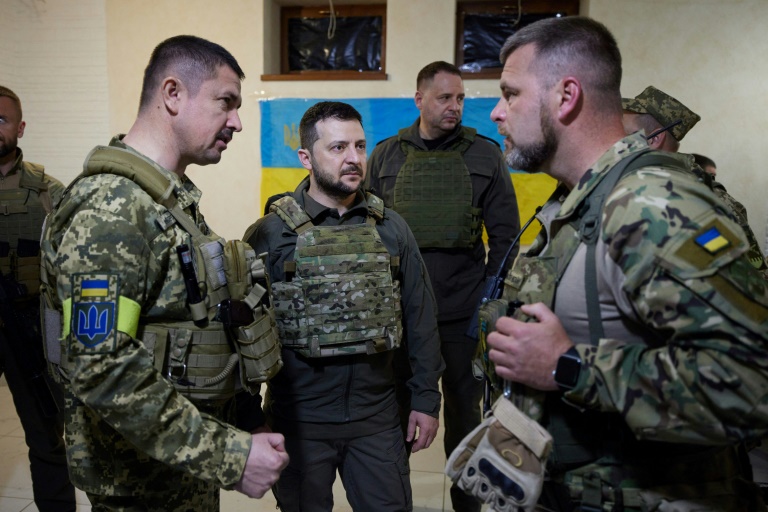
Meanwhile Zelensky on Sunday made his first visit to the embattled east since the start of the war, walking the streets of the Kharkiv region’s devastated capital in a bullet-proof vest.

While in Kharkiv, Zelensky discussed reconstruction plans with local officials, saying there was a chance for areas wrecked by Russian attacks to “have a new face”.

Despite an estimated 2,000 apartment blocks having been wholly or partially destroyed by shelling, the city has returned to a degree of normality in recent weeks.

While one-third of the northeastern region remains under Russian control, “we will for sure liberate the entire area,” the Ukrainian president said after the visit.

burs-sea/jv
Gabon takes grassroots approach in anti-poaching drive

A whistle blows. The car stops, and the driver is politely asked to turn off the engine and get out.

A team from Gabon’s anti-poaching brigade then searches the vehicle from top to bottom, looking in every cranny for guns or game. Nothing is found, and the driver is allowed to move on.

The unit’s task is to help guard Gabon’s rich biodiversity.

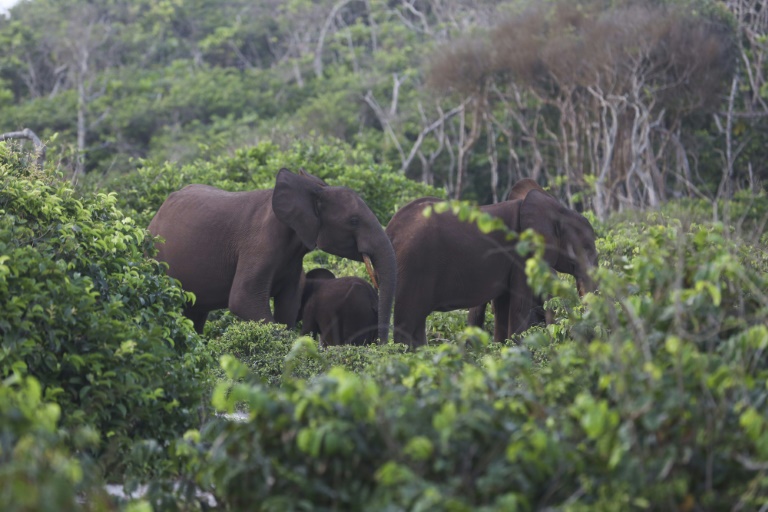
Forests cover 88 percent of the surface of this small central African nation, providing a haven — and a tourism magnet — for species ranging from tropical hardwoods and plants to panthers, elephants and chimps.

The team was on patrol close to a small village called Lastourville, 500 kilometres (300 miles) southeast of the capital Libreville.

The area has been badly hit by poaching, and tracks dug into the forest floor by logging vehicles are also used by illegal hunters to enter and shoot game.

– ‘Everyone poaches’ –

“There’s no standard profile of a poacher. Everyone poaches — from the villager who is looking for something to eat to some big guy in the city who has an international network,” the brigade’s commander, Jerry Ibala Mayombo, told AFP.

The unarmed unit sees its role as “educating, awareness-building and, as a last resort, punishing,” he said. The heaviest sentences are for ivory smuggling, which can carry a 10-year jail term.

The two-year-old service was created by a partnership between Gabon’s ministry for water and forests, a Belgian NGO called Conservation Justice and a Swiss-Gabonese sustainable forestry firm, Precious Woods CEB.

“At the start, the overall feeling towards us was mistrust. But that’s not the case today, because we have got the message across to people about what we do,” said Ibala Mayombo. 

“We sometimes face violent poachers who threaten us, sometimes with their guns,” he said. The team can be given a police escort when necessary.

Last year, the unit seized 26 weapons, several dozen items of game and arrested eight individuals for ivory smuggling.

“The trend is downward,” said Ibala Mayombo.

– Daily challenges –

Gabon, an oil-rich former French colony, is putting itself forward as a major advocate for conservation in central Africa, where wildlife has been battered by wars, habitat destruction and the bushmeat trade.

In 2002, Gabon set up a network of 13 national parks covering 11 percent of its territory.

In 2017, it created 20 marine sanctuaries covering 53,000 square kilometres (20,500 square miles) — the biggest ocean haven in Africa, and equivalent to more than a quarter of its territorial waters.

These initiatives have helped to place Gabon firmly on the map for lucrative eco-tourism.

But beneath the applause, there is the daily challenge of managing problems when humans and animals collide.

Gabon has a huge success story in its conservation of African forest elephants.

Across Africa, numbers of this species have fallen by 86 percent in 30 years — the animal is now in the Critically Endangered category on the Red List compiled by the International Union for Conservation of Nature (IUCN).

But in Gabon, the forest elephant population has doubled in a decade to 90,000 animals — although this has also come at a cost of frequent conflict between animals and farmers.

In one of the villages, Helene Benga, 67, was in tears over what to do.

“You go into the field in the morning and you see he’s eaten a bit (of the crop). You go the following day, and he’s eaten another bit. Within a few days, all the crop will be gone. I’ve got no money and nothing left to eat. What am I going to do?” she asked.

– ‘We hunt to live’ –

In the village of Bouma, around 30 local people attended a meeting to promote awareness about hunting restrictions — which species could be hunted and at what dates, areas where hunting was banned, how to obtain a permit, and so on.

The mood was tense. 

“What can we do when animals invade our fields?” asked one person. “How can you tell the difference between a protected species and a (non-protected) one when you’re hunting at night?” said another.

“I do understand that we have to protect wildlife,” said Leon Ndjanganoye, a man in his 50s.

“But here, in the village, what do we do to live? We hunt. The laws are a vexation.” 

War in Ukraine: Latest developments

Here are the latest developments in the war in Ukraine:

– Russians advance into eastern city –

Russian forces advance closer to the centre of the eastern Ukrainian city of Severodonetsk, which has been under bombardment for weeks in the battle for Ukraine’s industrial heartland, the Donbas.

“The Russians are advancing into the middle of Severodonetsk. The fighting continues. The situation is very difficult,” Luhansk governor Sergiy Gaiday says on Telegram.

Severodonetsk is the easternmost city still in Ukrainian hands. Capturing it would give Russia de-facto control over Luhansk, one of two eastern regions that make up the coveted Donbas.

Gaiday says the city’s critical infrastructure has been “destroyed” and 60 percent of its housing is damaged beyond repair.

– Zelensky visits Kharkiv –

Ukrainian President Volodymyr Zelensky leaves the Kyiv region for the first time since the invasion started to visit the northeastern city of Kharkiv, where Ukrainian troops beat Russian forces into retreat in recent weeks.

Zelensky’s office posts a video of him wearing a bulletproof vest and being shown heavily destroyed buildings in Ukraine’s second-biggest city, which came under relentless attack for nearly three months.

He sacks Kharkiv’s security chief, “for not working to defend the city from the first days of the full-scale war but thinking only of himself”.

– Eurovision trophy auctioned for army –

Ukraine’s Kalush Orchestra, which won the Eurovision song contest this year, auctions off its trophy on Facebook to raise funds for the Ukrainian army.

The trophy — a large crystal microphone with the song contest’s logo — nets $900,000 (836,000 euros) after a bidding war won by Ukrainian bitcoin company WhiteBIT

“You guys are amazing!” Kalush Orchestra says on Facebook, announcing the winner.

– Ukraine counterattack in Kherson –

Ukrainian forces counterattack in the south, claiming to have pushed back Russian troops in Kherson, the only region fully controlled by Russian forces.

“Kherson, hold on. We’re close!” Ukraine’s general staff tweets.

Kherson, which borders Crimea, was taken by Russian forces in March and Moscow-backed officials in the region have recently pushed for its annexation.

– French foreign minister in Kyiv –

French Foreign Minister Catherine Colonna visits Kyiv for talks with Zelensky, the first visit by a French minister to Ukraine since the invasion.

Paris says her visit aims to show solidarity with Ukraine, “from a humanitarian and financial point of view as well as in terms of supplying defence equipment”.

Zelensky has at time been critical of French President Emmanuel Macron, accusing him of pressuring Ukraine to offer territorial concessions to Russia in return for peace, claims France rejects.

– Lavrov denies Putin is ill –

Russian Foreign Minister Sergei Lavrov denies speculation that President Vladimir Putin is ill, saying there are no signs pointing to any ailment.

Putin’s health and private life are taboo subjects in Russia and are almost never discussed in public.

Answering a question from France’s broadcaster TF1, Russia’s top diplomat says: “I don’t think that sane people can see in this person signs of some kind of illness or ailment,” adding that Putin appears in public “every day”.

– Germany OKs fund to modernise military –

Germany’s government and conservative opposition agree on an amendment to the constitution to allow the creation of a special 100-billion-euro fund to modernise the army in the face of the Russian threat.

The deal will allow Berlin to achieve NATO’s target of spending two percent of GDP on defence “on average over several years”, according to the text of the agreement obtained by AFP.

burs/cb

Pacific nations reject China security pact

Ten Pacific island nations rebuffed China’s push for a wide-ranging regional security pact Monday, amid worries the proposal was designed to pull them into Beijing’s orbit.

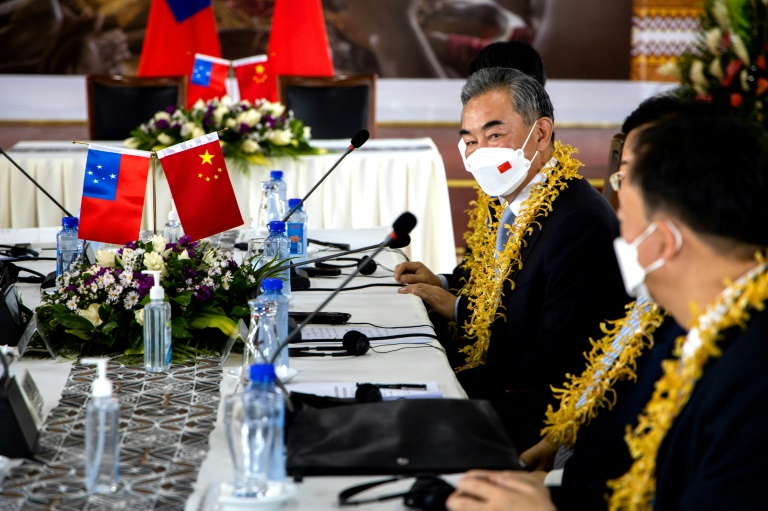
Talks in Fiji between Chinese Foreign Minister Wang Yi and leaders from the small island nations failed to reach an agreement, in a high-profile diplomatic setback for Beijing.

China is offering to radically ramp up its activities in the South Pacific, directly challenging the influence of the United States and its allies in the strategically vital region.

The proposed pact would see Beijing train Pacific island police, become involved in cybersecurity, expand political ties, conduct sensitive marine mapping and gain greater access to natural resources on land and in the water.

As an enticement, Beijing is offering millions of dollars in financial assistance, the prospect of a potentially lucrative China-Pacific islands free trade agreement and access to China’s vast market of 1.4 billion people.

Behind the scenes, Pacific leaders have voiced deep misgivings about the offer.

In a recent letter to fellow leaders, David Panuelo, the President of the Federated States of Micronesia, warned the offer was “disingenuous” and would “ensure Chinese influence in government” and “economic control” of key industries. 

A more soft-spoken public rebuke came after the talks, when leaders said they could not agree to Beijing’s proposed “Common Development Vision” due to a lack of regional consensus.

“As always, we put consensus first,” co-host and Fijian Prime Minister Frank Bainimarama said after the meeting, indicating that broad accord would be needed before inking any “new regional agreements”.

Papua New Guinea, Samoa and the Federated States of Micronesia were said to be among those concerned about the proposals, along with Taiwan-recognising Palau, which was not invited.

“We would rather deal with our own security issues with China”, Papua New Guinea Foreign Minister Soroi Eoe told AFP, indicating concern about any region-wide pact.

Chinese officials — working frantically to secure support during Wang’s 10-day diplomatic blitz of the region — admitted their entreaties had fallen short.

“There has been general support from the 10 countries,” Chinese ambassador to Fiji Qian Bo told reporters in Suva. “But of course, there are some concerns on some specific issues and we have agreed that these two documents will be discussed afterwards until we have reached an agreement.”

Speaking from Suva, Wang made the face-saving announcement that the 10 countries had agreed to memorandums of understanding on China’s “Belt and Road” infrastructure initiative. 

The two sides will “continue to have ongoing and in-depth discussions and consultations to shape more consensus on cooperation”, he said, urging those worried by Beijing’s intentions not to be “too anxious and don’t be too nervous”.

The full proposal has not been made public, but was leaked to media including AFP ahead of Monday’s meeting. 

China has said it will release a “position paper” highlighting the proposals to the public in the coming weeks. 

– Balancing act –

Western powers have bristled against China’s move into the region, with the US State Department warning South Pacific nations to be wary of “shadowy, vague deals with little transparency”.

Australia joined the United States in urging a spurning of China’s attempts to expand its security reach deep into the region, with the country’s new foreign minister warning of the “consequences” of such deals.

Many in the Pacific are uneasy at being thrust to the centre of a geopolitical tussle between China and US allies.

Most capitals are keen to maintain amicable ties with China, balancing relations between Beijing, Washington, Canberra and Wellington, while focusing on the more urgent threat of climate change and day-to-day economic issues.

During a joint appearance with Wang, Bainimarama hit out at those engaged in “geopolitical point-scoring”.

It “means less than little to anyone whose community is slipping beneath the rising seas, whose job has been lost to a pandemic or whose family is impacted by the rapid rise in the price of commodities”, he said.

All but a few of the Pacific Islands are low-lying and deeply vulnerable to sea-level rises caused by climate change.

Before the meeting, President Xi Jinping sent a message that China would be “a good brother” to the region and that they shared a “common destiny”, according to state broadcaster CCTV.

Hardliner, China hawk elected Australian opposition leader

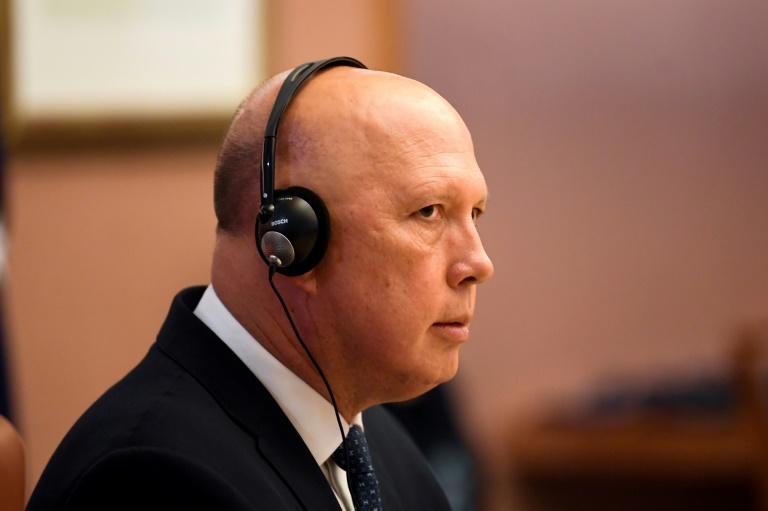
Australia’s conservatives elected hardliner and China hawk Peter Dutton as the country’s new opposition leader Monday, an outcome many will see as a lurch to the right for his party.

Dutton came out swinging after accepting the top spot, saying the country’s newly elected Labor government was not “ready to govern and we are already seeing their inexperience on display”.

Elected unopposed, the former police officer inherits a Liberal party decimated by Australia’s May 21 election, when many of its long-time voters swung to independent candidates who promised action on climate change.

The new opposition leader will have to rebuild his shattered party and try to unite its fiercely divided moderate and conservative wings, with climate a key sticking point.

Dutton described himself Monday as “a very passionate believer” in Australia’s need for an “appropriate response” to emissions reduction.

During his two decades in politics, the Queenslander has made a name for himself with tough talk and a penchant for headline-grabbing commentary.

On election day, he tweeted out a Border Force statement about the interception of an asylum seeker boat, adding his comment: “Don’t risk Australia’s national security with Labor.”

In previous posts as defence minister, Dutton often likened China’s expansionist ambitions to Nazi Germany.

“The only way you can preserve peace is to prepare for war,” he said in one.

During Monday’s speech, he described China under Xi Jinping as “the biggest issue our country will face in our lifetime”.

Dutton served as Australia’s immigration minister for nearly four years, overseeing the country’s widely criticised offshore detention regime.

He sparked outrage when he claimed some asylum seekers who said they had been raped in Australia’s offshore detention centres were “trying it on” by seeking an abortion on the mainland.

He also had to apologise after a quip about the threat climate change poses to the Pacific was picked up by a microphone.

“Time doesn’t mean anything when you’re about to be, you know, have water lapping at your door,” Dutton was caught saying.

Dutton and his allies in the Liberal party have sought to play down his right-wing past since the election, saying Australians will see his softer side.

The new opposition leader said Monday his policies would be “squarely aimed at the forgotten Australians, in the suburbs, across regional Australia”.

He also expressed regret about a decision earlier in his political career to boycott a national apology to Aboriginal Australians forcibly separated from their families.

At the time he believed “the apology should be given when the problems were resolved, and the problems are not resolved”, Dutton said, citing the welfare issues many Indigenous Australians face.

Ousted Prime Minister Scott Morrison, who stepped down from the Liberal leadership after the election drubbing, offered his “full support” to Dutton on Monday.

Australia’s newly elected Prime Minister Anthony Albanese last week praised Dutton, saying he had a better relationship with him than Morrison.

“Peter Dutton has never broken a confidence that I’ve had with him,” Albanese said.

Equity markets extend Wall St rally as China eases curbs

Markets rose Monday as investors rediscovered some verve after the release of healthy US data and as China eases some of its strict Covid curbs in Shanghai and Beijing, lifting hopes for the world’s number two economy.

The gains extended a positive end to last week for global equities with some commentators saying there was a growing hope that the months-long sell-off may have run its course.

Wall Street provided a strong lead and snapped a series of weekly losses, with Friday’s rally supported by data showing an easing of the key personal consumption expenditures (PCE) price index.

Markets have been pummelled this year as soaring prices — caused by the Ukraine war, supply chain snags and China’s lockdowns among other things — forced central banks to hike interest rates and warn of more to come.

The US reading lent hope that the worst of the inflation surge may have passed and could allow the Federal Reserve to ease back from its hawkish rate hike drive later in the year.

May jobs data — due for release on Friday — should provide a fresh snapshot of the economy and possibly an idea about the Fed’s next policy moves.

Asian investors followed the lead from their US counterparts.

Hong Kong put on more than two percent after a strong Friday performance fuelled by a rally in tech firms, while Tokyo, Sydney, Shanghai, Seoul, Mumbai, Taipei, Manila, Bangkok and Wellington were also well up.

London, Paris and Frankfurt all rallied at the open.

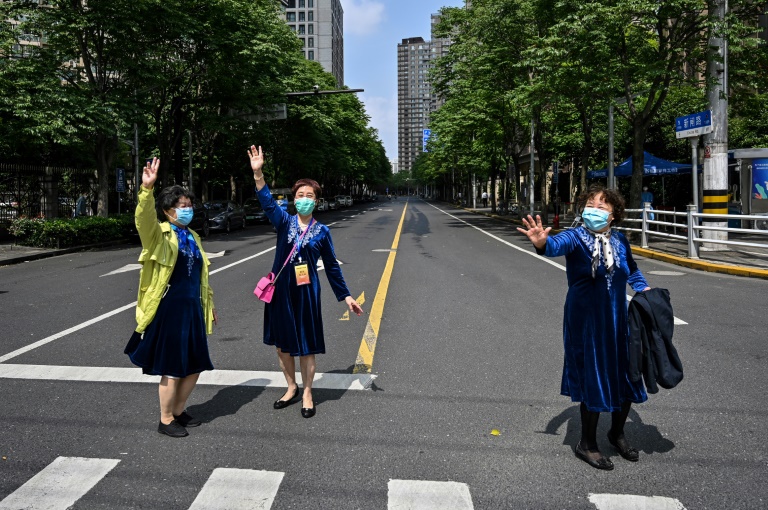
An easing of long-running lockdown measures in Shanghai provided a much-needed lift to sentiment, with China’s biggest city seeing a drop in Covid cases, while some curbs were also being lifted in Beijing.

Officials have also announced measures to ease the impact on the world’s number two economy, which has been hammered by the restrictions.

Still, OANDA’s Jeffrey Halley said: “The devil is in the detail of course, and workers in both cities still face challenges either going to work, or even being allowed to leave the house.”

He added that traders were also aware another flare-up could see the reimposition of tightened restrictions. 

“Such minutiae are usually ignored by markets when it doesn’t suit the preferred narrative, and so it is today. Asia is pricing in peak virus in China and a recovery in growth,” he said.

The possibility that the measures could be gradually removed helped oil prices rise, with Brent topping $120 for the first time in two months as traders bet on a pick-up in demand.

That comes as European leaders are said to be edging towards a deal to impose sanctions on imports of crude from Russia in retaliation for its invasion of Ukraine.

Still, while optimism is higher on trading floors at the moment, it remains at a premium with inflation still elevated and borrowing costs expected to rise further, while the war in Ukraine and China’s still-struggling economy continue to drag.

“We are in the middle of a bear market rally,” Mahjabeen Zaman, of Citigroup Australia, told Bloomberg Television. “I think the market is going to be trading range bound trying to figure out how soon is that recession coming or how quickly is inflation going down.”

– Key figures at around 0720 GMT –

Tokyo – Nikkei 225: UP 2.2 percent at 27,369.43 (close)

Hong Kong – Hang Seng Index: UP 2.2 percent at 21,145.89

Shanghai – Composite: UP 0.6 percent at 3,149.06 (close)

London – FTSE 100: UP 0.4 percent at 7,613.50

Euro/dollar: UP at $1.0754 from $1.0739 on Friday

Pound/dollar: UP at $1.2644 from $1.2631

Euro/pound: UP at 85.05 pence from 84.99 pence

Dollar/yen: UP at 127.11 yen from 127.09 yen 

Brent North Sea crude: UP 0.5 percent at $120.03 per barrel

West Texas Intermediate: UP 0.7 percent at $115.91 per barrel

New York – Dow: UP 1.8 percent at 33,212.96 (close)

China fails to ink security pact with Pacific nations

Talks between Chinese Foreign Minister Wang Yi and 10 Pacific Island nations failed to reach an agreement on a wide-ranging security deal Monday, after sharp warnings the proposal would push the region into “Beijing’s orbit”.

A virtual summit of leaders and foreign ministers was expected to discuss proposals to radically increase China’s involvement in the security, economy and politics of the South Pacific.

But the effort appeared to have fallen short after some regional leaders voiced deep concern.

“As always, we put consensus first,” co-host and Fijian Prime Minister Frank Bainimarama said after the meeting, indicating that broad agreement would be needed before inking any “new regional agreements”.

Wang is in the Fijian capital Suva as part of a 10-day diplomatic blitz, as Beijing jostles with Washington and its allies over influence in the strategically vital Pacific.

Ahead of his visit, China proposed a pact that would see Beijing train Pacific Island police, become involved in cybersecurity, expand political ties, conduct sensitive marine mapping and gain greater access to natural resources on land and in the water.

As an enticement, Beijing offered millions of dollars in financial assistance, the prospect of a China-Pacific Islands free trade agreement and access to China’s vast market of 1.4 billion people.

China has pitched itself to the South Pacific as a “major developing country” that stands shoulder to shoulder with small and medium-sized nations.

Before the meeting, President Xi Jinping sent a message that China would be “a good brother” to the region and that they shared a “common destiny”, according to state broadcaster CCTV.

But in a letter to other regional leaders, President of the Federated States of Micronesia David Panuelo warned the proposed agreement was “disingenuous” and would “ensure Chinese influence in government” and “economic control” of key industries.  

Following Monday’s closed-door meeting, Wang did not cite the proposed “Common Development Vision” document directly, but said the two sides would “continue to have ongoing and in-depth discussions and consultations to shape more consensus on cooperation.”

He added: “China will release its own position paper” highlighting “our own positions and propositions and cooperation proposals with Pacific Island countries”.

Wang instead announced that 10 Pacific Island nations had agreed on memorandums of understanding on China’s “Belt and Road” infrastructure initiative and urged those worried by Beijing’s intentions not to be “too anxious and don’t be too nervous”.

– Balancing act –

Western powers have bristled against China’s move into the region, with the US State Department warning South Pacific nations to be wary of “shadowy, vague deals with little transparency”.

Australia joined the United States in urging a spurning of China’s attempts to expand its security reach deep into the region, with the country’s new foreign minister warning of the “consequences” of such deals.

Many in the Pacific are keen to maintain amicable ties with China, balancing relations between Beijing and Washington while focusing on the more urgent threat of climate change and day-to-day economic issues.

During a joint appearance with Wang, Bainimarama hit out at those engaged in “geopolitical point-scoring” that “means less than little to anyone whose community is slipping beneath the rising seas, whose job has been lost to a pandemic or whose family is impacted by the rapid rise in the price of commodities”.

All but a few of the Pacific Islands are low-lying and deeply vulnerable to sea-level rises caused by climate change.

High-tech race to map Ukraine's damaged historic buildings

Many of Ukraine’s historic monuments have been destroyed in the three months since Russia invaded, but cultural experts are working to conserve their memory using cutting-edge technology and 3D scans.

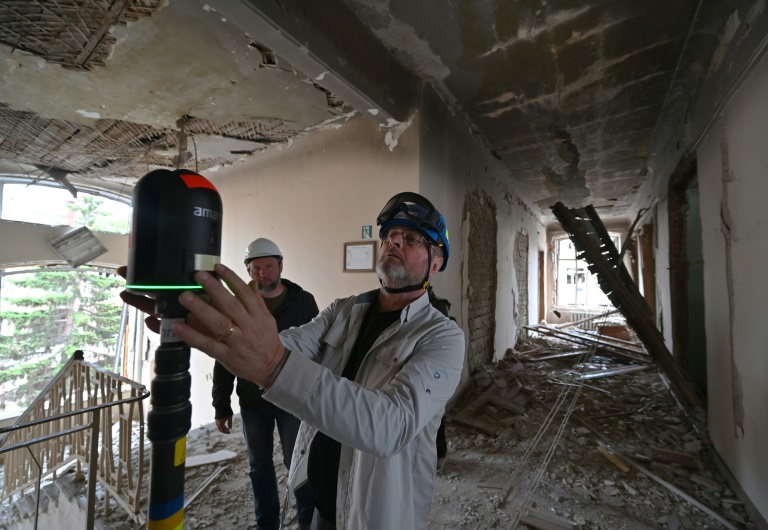
One of them is volunteer French engineer Emmanuel Durand, a specialist in 3D data acquisition, who is assisting a bevy of architects, engineers, historic building experts and a museum director to record buildings in Kyiv, Lviv, Chernigiv and Kharkiv.

Durand steps over a jumbled pile of beams and crunches over the rubble that was once Kharkiv’s 19th-century fire station.

He plants his laser scanner, a sort of tripod with a pivoting head, in a strategic corner of the severely damaged building.

The redbrick fire station and its watchtower, built in 1887, are a monument to Kharkiv’s industrial revolution.

Durand’s gadget records the building from all angles.

“The scanner records 500,000 points per second. We’ll get 10 million points from this location. Then we’ll change location and go round the whole building, outside and inside. A billion points in all,” he explains.

At the end of the day, Durand assembles all the data on a computer “like the pieces of a jigsaw” to digitally reconstruct the building. 

The result is a perfect reproduction, accurate to within five millimetres (a fraction of an inch) that can be rotated in any direction or sliced into sections. You can even see the holes where blast waves from explosions have damaged the structure.

“This enables us to map out the building for the future. That could help us work out if anything has moved, which is important for safety purposes, and see what can be restored and what can’t. It’s also useful from a historical point of view,” he says.

“We’ve got the actual missile-damaged building and an exact replica of how it used to look.”

– ‘Cultural genocide’-

In Kharkiv alone, around 500 buildings are listed as being of historic architectural significance. Most are in the dense historic city centre, on which Russian airstrikes are concentrated, according to architect Kateryna Kuplytska, a member of the body documenting damaged heritage sites.

She estimates that over a hundred of them have been hit already.

And while Russian troops have loosened their noose around Ukraine’s second city, shells still rain down with regular monotony.

New explosions and blast waves, inclement weather, construction work and site visits will all contribute to hastening the destruction of these already weakened buildings, Kuplytska says.

“That’s why it’s essential to record them in accurate detail so we can plan urgent interventions that will stabilise the structures” and preserve their memory, she explains. 

“Recording the destruction will also assist in criminal proceedings. We see serious damage to heritage across the whole country. It’s genocide towards Ukrainian people and genocide towards Ukrainian culture,” she says.

After two days at the fire station, Durand moves on to the economics faculty at the Karazin National University in Kharkiv. It is located right next to the imposing headquarters of the Ukrainian secret services, which is being targeted by the Russians and has been hit on numerous occasions. 

The current iteration of the economics faculty was built in Soviet times. It was designed by Serhiy Tymoshenko, the father of the  “modern Ukrainian” style of architecture of the early 20th-century, and is one of the country’s first reinforced concrete structures.

Some critics suggest it is futile to document historic buildings in such meticulous detail while the war is still raging and people are dying every day.

But Tetyana Pylyptshuk, the director of the Kharkiv literary museum, begs to disagree.

“Culture is the basis of everything. If culture had developed well, people probably wouldn’t be dying and there wouldn’t be a war,” she said.

Pylyptshuk, who also sits on the commission on damaged historical sites, has sent most of her museum collections to western Ukraine to protect them from damage — and from looting, should Russian troops overrun Kharkiv.

“Today, everyone realises this. Maybe they were not so attentive to our cultural heritage before… but when you lose it, it hurts.”

Race to save undersea Stone Age cave art masterpieces

To reach the only place in the world where cave paintings of prehistoric marine life have been found, archaeologists have to dive to the bottom of the Mediterranean off southern France.

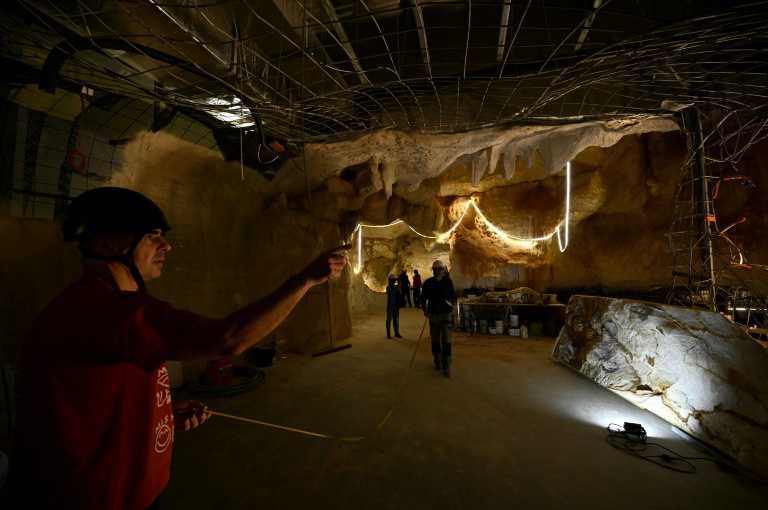
Then they have to negotiate a 137-metre (yard) natural tunnel into the rock, passing through the mouth of the cave until they emerge into a huge cavern, much of it now submerged.

Three men died trying to discover this “underwater Lascaux” as rumours spread of a cave to match the one in southwestern France that completely changed the way we see our Stone Age ancestors.

Lascaux — which Picasso visited in 1940 — proved the urge to make art is as old as humanity itself.

Archaeologist Luc Vanrell’s life changed the second he surfaced inside the Cosquer cavern and saw its staggering images. Even now, 30 years on, he remembers the “aesthetic shock”.

But the cave and its treasures, some dating back more than 30,000 years, are in grave danger. Climate change and water and plastic pollution are threatening to wash away the art prehistoric men and women created over 15 millennia.

Since a sudden 12-centimetre (near-five-inch) rise in the sea level there in 2011, Vanrell and his colleagues have been in a race against time to record everything they can.

Every year the high water mark rises a few more millimetres, eating away a little more of the ancient paintings and carvings.

– Prehistoric wonders –

Vanrell and the diver-archaeologists he leads are having to work faster and faster to explore the last corners of the 2,500 square metre (27,000 square feet) grotto to preserve a trace of its neolithic wonders before they are lost.

An almost life-sized recreation of the Cosquer cavern will open this week a few kilometres (miles) away in Marseille.

AFP joined the dive team earlier this year as they raced to finish the digital mapping for a 3D reconstruction of the cave. 

Around 600 signs, images and carvings — some of aquatic life never before seen in cave paintings — have been found on the walls of the immense cave 37 metres below the azure waters of the breathtaking Calanques inlets east of Marseille.

“We fantasised about bringing the cave to the surface,” said diver Bertrand Chazaly, who is in charge of the operation to digitalise the cave. 

“When it is finished, our virtual Cosquer cavern — which is accurate to within millimetres — will be indispensable for researchers and archaeologists who will not be able to physically get inside.”

– Children’s hands –

The cave was some “10 kilometres from the coast” when it was in use, archaeologist Michel Olive told AFP. “At the time we were in the middle of an ice age and the sea was 135 metres lower” than it is today.

From the dive boat, Olive, who is in charge of studying the cave, draws with his finger a vast plain where the Mediterranean now is. “The entrance to the cave was on a little promontory facing south over grassland protected by cliffs. It was an extremely good place for prehistoric man,” he said.

The walls of the cave show the coastal plain was teeming with wildlife — horses, deer, bison, ibex, prehistoric auroch cows, saiga antelopes but also seals, penguins, fish and a cat and a bear.

The 229 figures depicted on the walls cover 13 different species.

But neolithic men and women also left a mark of themselves on the walls, with 69 red or black hand prints as well as three left by mistake, including by children.

And that does not count the hundreds of geometric signs and the eight sexual depictions of male and female body parts.

What also stands out about the cave is the length of time it was occupied, said Vanrell, “from 33,000 to 18,500 years ago”.

The sheer density of its graphics puts “Cosquer among the four biggest cave art sites in the world alongside Lascaux, Altamira in Spain and Chauvet,” which is also in southern France.

“And because the cave walls that are today underwater were probably also once decorated, nothing else in Europe compares to its size,” he added.

Exploring Cosquer is also “addictive”, the 62-year-old insisted, with a twinkle in his eye. “Some people who have been working on the site get depressed if they haven’t been down in a while. They miss their favourite bison,” he smiled.

For Vanrell, diving down is like a “journey into oneself”. The spirit “of the place seeps into you”.

– Discovery and death –

Henri Cosquer, a professional deep sea diver running a diving school, said he found the cave by chance in 1985, just 15 metres off the bare limestone cliffs.

Little by little he dared to venture further and further into 137-metre-long breach in the cliff until one day he came out through a cavity cut out by the sea.

“I came up in a pitch-dark cave. You are soaking, you come out of the mud and you slide around… It took me a few trips to go right around it,” he told AFP.

“At the start, I saw nothing with my lamp and then I came across a hand print,” the diver said.

While the law dictates that such discoveries must be declared immediately to the authorities so they can be preserved, Cosquer kept the news to himself and a few close friends.

“Nobody owned the cave. When you find a good spot for mushrooms, you don’t tell everyone about it, do you?” he said.

But rumours of this aquatic Lascaux drew other divers and three died in the tunnel leading to the cave. Marked by the tragedies, Cosquer owned up to his discovery in 1991. The cave which bears his name is now sealed off by a railing. Only scientific teams are allowed inside.

Dozens of archeological research missions have been carried out since to study and preserve the site and make an inventory of the paintings and carvings. But resources began to drain away when Chauvet, which is much easier to access, was discovered in the Ardeche region in 1994.

– Climate change damage –

Only in 2011 did things begin to change when Olive and Vanrell raised the alarm after the rapid rise in the sea level led to irreparable damage to some images.

“It was a catastrophe, and it really shook us psychologically,” Vanrell recalled, particularly the enormous damage to the horse drawings. 

“All the data shows that the sea level is rising faster and faster,” said geologist Stephanie Touron, a specialist in prehistoric painted caves at France’s historic monuments research laboratory. 

“The sea rises and falls in the cavity with variations in climate, washing the walls and leeching out soil and materials that are rich in information,” she said.

Microplastic pollution is making the damage to the paintings even worse. 

In the face of such an existential threat, the French government has launched a major push to record everything about the cavern, with archaeologist Cyril Montoya tasked with trying to better understand the prehistoric communities who used it.

– Mysteries –

One of the mysteries he and his team will try to solve will be the trace of cloth on the cave wall, which might confirm a theory that hunter gatherers were making clothes at the time when the cave was occupied.

Images of the horses with long manes also raises another major question. Vanrell suspects this might indicate that they may have been already domesticated, at least partly, since wild horses have shorter manes, shorn down by galloping through bushes and vegetation. A drawing of what might be a harness may back up his theory.

Areas preserved under a layer of translucent calcite also show the “remains of coal”, Montoya believes, which could have been used for painting or for heating or lighting. They may even have burned the coal on top of stalagmites, turning them into “lamps to light the cavern”.

But the central question of what the cave was used for remains an enigma, Olive admitted.

While archaeologists agree that people did not live there, Olive said some believe it was a “sanctuary, or a meeting place, or somewhere they mined moonmilk, the white substance on (limestone) cave walls that was used for body paint and for the background for paintings and carving.”

– Replica –

The idea of making a replica of the site was first mooted soon after the cave was discovered. But it wasn’t until 2016 that the regional government decided that it would be in a renovated modern building in Marseille next to Mucem, the museum of European and Mediterranean civilisations at the mouth of the city’s Old Port.  

Using the 3D data gathered by the archaeological teams, the 23-million-euro ($24-million) replica is slightly smaller than the original cave but includes copies of all the paintings and 90 percent of the carvings, said Laurent Delbos from Klebert Rossillon, the company which copied the Chauvet cave in 2015.

Artist Gilles Tosello is one of the craftspeople who has been copying the paintings using the same charcoal and tools that his Stone Age forerunners used.

“The prehistoric artists wrote the score long ago and now I am playing it,” he said sitting in the dark in his studio, a detail of a horse lit up before him on the recreated cave wall. 

Clearly moved, he hailed the great mastery and “spontaneity” of his prehistoric predecessors, whose confident brush strokes clearly came from “great knowledge and experience. That liberty of gesture and sureness never ceases to amaze me,” he said.

Bodies pulled from wreckage of missing Nepal plane

Nepali rescuers pulled 14 bodies on Monday from the mangled wreckage of a passenger plane strewn across a mountainside that went missing in the Himalayas with 22 people on board. 

Air traffic control lost contact with the Twin Otter aircraft operated by Nepali carrier Tara Air shortly after taking off from Pokhara in western Nepal on Sunday morning headed for Jomsom, a popular trekking destination.

Helicopters operated by the military and private firms scoured the remote mountainous area all day Sunday, aided by teams on foot, but called off the search when night fell, as bad weather hampered the recovery operation at around 3,800-4,000 metres (12,500-13,000 feet) above sea level.

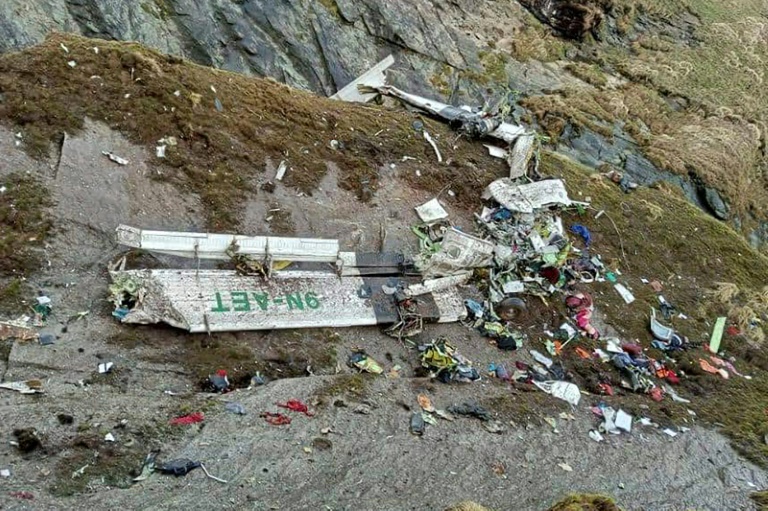
After the search resumed on Monday, the army shared on social media a photo of aircraft parts and other debris littering a sheer mountainside including a wing with the registration number 9N-AET clearly visible.

Four Indians were on board as well as two Germans, with the remainder Nepalis. There was no word on the cause of the crash. 

The Civil Aviation Authority confirmed that the plane “met an accident” at 14,500 feet (4,420 metres) in the Sanosware area of Thasang rural municipality in Mustang district.

“Fourteen bodies have been recovered so far, search continues for the remaining. The weather is very bad but we were able to take a team to the crash site. No other flight has been possible,” authority spokesman Deo Chandra Lal Karn told AFP.

Pokhara Airport spokesman Dev Raj Subedi told AFP the rescuers had followed GPS, mobile and satellite signals to narrow down the location. 

Pradeep Gauchan, a local official, said that the wreckage was at a height of around 3,800-4,000 metres (12,500-13,000 feet) above sea level.

“It is very difficult to reach there by foot. One team has been dropped close to the area by a helicopter but it is cloudy right now so flights have not been possible,” Gauchan told AFP earlier in the day.

“Helicopters are on standby waiting for the clouds to clear,” he said.

According to the Aviation Safety Network website, the aircraft was made by Canada’s de Havilland and made its first flight more than 40 years ago in 1979.

– Past crashes –

Tara Air is a subsidiary of Yeti Airlines, a privately owned domestic carrier that services many remote destinations across Nepal. 

It suffered its last fatal accident in 2016 on the same route when a plane with 23 on board crashed into a mountainside in Myagdi district. 

Nepal’s air industry has boomed in recent years, carrying goods and people between hard-to-reach areas as well as foreign trekkers and climbers. 

But it has long been plagued by poor safety due to insufficient training and maintenance. 

The European Union has banned all Nepali airlines from its airspace over safety concerns. 

The Himalayan country also has some of the world’s most remote and tricky runways, flanked by snow-capped peaks with approaches that pose a challenge even for accomplished pilots. 

The weather can also change quickly in the mountains, creating treacherous flying conditions.

In March 2018, a US-Bangla Airlines plane crash-landed near Kathmandu’s notoriously difficult international airport, skidded into a football field and burst into flames.

Fifty-one people died and 20 miraculously escaped the burning wreckage but sustained serious injuries.

That accident was Nepal’s deadliest since 1992, when all 167 people aboard a Pakistan International Airlines plane died when it crashed on approach to Kathmandu airport.

Just two months earlier a Thai Airways aircraft had crashed near the same airport, killing 113 people.

Close Bitnami banner
Bitnami