World

China eyes security pact in Pacific Island summit

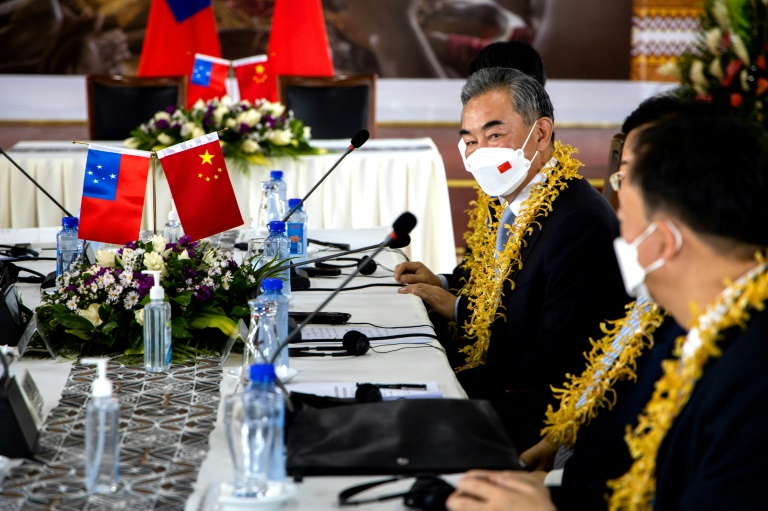
Chinese Foreign Minister Wang Yi holds talks with leaders and top officials from ten Pacific Island nations Monday, part of a regional diplomatic blitz that has stirred deep Western concern.

The virtual summit is expected to discuss leaked proposals for China to radically increase its involvement in the security, economy and politics of the South Pacific.

Wang is in the Fijian capital Suva, where he will co-host a virtual meeting with regional foreign ministers — many of whom are also leaders of the small island states.

On the table is a secret deal — obtained by AFP — that would see China train local police, become involved in cybersecurity, expand political ties, conduct sensitive marine mapping and gain greater access to natural resources on land and in the water.

As an enticement, Beijing is offering millions of dollars in financial assistance, the prospect of a China-Pacific Islands free trade agreement and access to China’s vast market of 1.4 billion people.

Ahead of the meeting, President Xi Jinping sent a message that China would be “a good brother” to the region and that they shared a “common destiny”, according to state broadcaster CCTV.

Only Pacific nations that recognise China over Taiwan will attend today’s summit, including those Wang has already visited on his regional whistle-stop — Solomon Islands, Kiribati, Samoa and Fiji.

The proposal comes as Beijing jostles with Washington and its allies over influence in the strategically vital Pacific.

– Balancing act –

Analysts say the deal is unlikely to be unanimously approved by Pacific Island leaders today.

A recent security deal between the Solomon Islands and China caused deep unease in a region that is usually more concerned by climate change than superpower politics.

“The Solomons came off as an outlier, there wasn’t a rush of interest,” said Richard Herr, an academic at the University of Tasmania who has decades of experience working in the Pacific Islands.

The region will be hesitant about “being dragged into geostrategic competition,” he said.

There has already been some pushback to Beijing’s latest proposal, including from President of the Federated States of Micronesia David Panuelo, who warned other Pacific leaders it could cause “the fracturing of regional peace, security, and stability”.

The president of Palau, a Pacific nation that maintains diplomatic ties with Taiwan, told the ABC Monday that the region “should be concerned” about the proposed deals.

Western powers have bristled against the deals, with the US State Department warning the Pacific to be wary of “shadowy, vague deals with little transparency” with China.

Australia joined the United States in urging South Pacific nations to spurn China’s attempts to expand its security reach deep into the region, with the country’s new foreign minister warning of the “consequences” of such deals.

But many Pacific nations are also keen to maintain amicable ties with China, balancing relations between Beijing and Washington or playing each off against the other.

So it is far from clear what Pacific Island leaders will tell Wang Monday or in a series of closed-door meetings around the South Pacific.

“It’s hard to believe that the Chinese foreign minister will come to the region and be told to go home,” said Herr. 

“It could be an embarrassment. Every Chinese diplomat in the region will be working on that.”

– ‘Traditional influence –

Wang said Sunday that Beijing was willing to work with other major powers in the Pacific region to help island nations develop.

“China is willing to carry out more tripartite cooperation with other countries, especially countries with traditional influence in the region,” he said when he met with Pacific Islands Forum Secretary General Henry Puna.

He described his Pacific tour as “a trip of peace, friendship and cooperation,” according to a statement by the Chinese foreign ministry. 

Wang is expected to remain in Fiji’s capital until at least Tuesday, meeting with the country’s leaders and hosting the second China-Pacific Island Countries Foreign Ministers’ meeting.

The Chinese foreign minister will visit Vanuatu, Papua New Guinea and Tonga — just months after the island nation was devastated by a deadly earthquake and tsunami — to round out his tour.

Tiananmen masses axed as crackdown memorials erased in Hong Kong

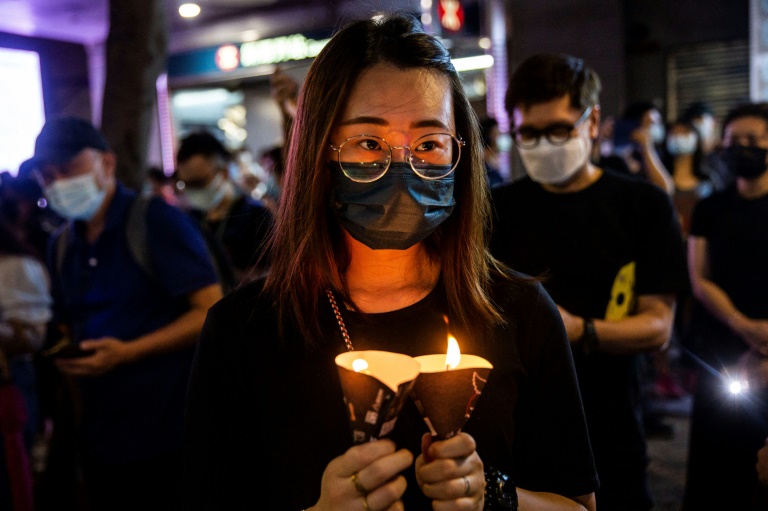
For the first time in 33 years, church services to commemorate the Tiananmen crackdown will not be held in Hong Kong, erasing one of the last reminders of China’s bloody suppression of the 1989 protests.

Since Beijing imposed a sweeping national security law in 2020 to snuff out pro-democracy demonstrations, once-packed candlelit vigils have been banned, a Tiananmen museum has been forced to close, and statues have been pulled down.

The annual Catholic masses were one of the last ways for Hong Kongers to come together publicly to remember the deadly clampdown in Beijing on June 4, 1989, when the Chinese government set tanks and troops on peaceful demonstrators.

But this year, they too have been cancelled over fears of falling foul of Hong Kong authorities.

“We find it very difficult under the current social atmosphere,” said Reverend Martin Ip, chaplain of the Hong Kong Federation of Catholic Students — one of the organisers.

“Our bottom line is that we don’t want to breach any law in Hong Kong,” he told AFP.

The Diocese, whose Justice and Peace Commission was a co-organiser, said its frontline colleagues were concerned they might violate Hong Kong law.

– Decades erased in months –

Discussion of the 1989 crackdown is all but forbidden in mainland China.

But in semi-autonomous Hong Kong, its history was often taught in schools and advocacy for ending the rule of the Chinese Communist Party was alive and kicking — until the imposition of the security law.

In the space of months, decades of commemoration have been wiped out as authorities wield the law to refashion Hong Kong in Beijing’s authoritarian image.

The Hong Kong Alliance, the most prominent Tiananmen advocacy group and the candlelight vigil organiser, was prosecuted as a “foreign agent” over incitement to subversion.

Last September, its leaders were arrested, their June 4 Museum was shuttered after a police raid, and digital records of the crackdown were deleted overnight under a police order to close the group’s website and social media accounts. 

For others, much like the organisers of the masses, uncertainty over where the new red lines fall has been enough to make them pull back.

Six universities removed June 4 monuments that had stood on their campuses for years — just before Christmas last year, three were whisked away within 48 hours.

The “Pillar of Shame” in the University of Hong Kong (HKU), an eight-metre-high sculpture by Danish artist Jens Galschiot, was dismantled, tucked into a cargo container and left on an HKU-owned plot of rural land.

At Lingnan University, a wall relief by artist Chen Weiming was banished to an underground storage room.

His “Goddess of Democracy” statue at the Chinese University of Hong Kong was sent to a secretive “safe place”.

“They are trying to wipe out a shameful episode in history when the state committed a crime on its people,” Chen told AFP.  

The universities said they had never consented to the statues’ presence, and that their removal was based on an assessment of legal risk.

– Overseas vigils –

Where the Goddess used to stand, only a faint mark from her square pedestal can now be seen.

The Pillar has been replaced by a new sitting-out area with pebble-shaped chairs and potted flowers. 

“This is the meaning… after a few years nobody knows what happened there,” the sculptor Galschiot told AFP.

He has been trying to take the Pillar back to Europe, but such is the sensitivity around it that the university refused to lend him its crew, and logistics companies dare not get involved.

They say “it’s too complicated and it’s too dangerous”, Galschiot said. 

The drive to remove all trace of Tiananmen is ongoing — earlier this year, HKU covered a painted June 4 slogan on campus with cement and called it “regular maintenance”. 

In the city’s public libraries, 57 Tiananmen books are restricted from general borrowers — nearly double the amount since local news outlet Hong Kong Free Press counted last November.

Instead, the space for remembering the crackdown now lies outside Hong Kong, with exiled dissidents setting up their own museums in the United States and activists planning to resurrect the Pillar of Shame in Taiwan.

On June 4, vigils will be held globally, with rights group Amnesty International coordinating candlelit ones in 20 cities “to demand justice and show solidarity for Hong Kong”. 

Tiananmen survivor Zhou Fengsuo, who lives in the United States, told AFP that in recent years he has seen more people joining such events in the West, including recently emigrated young Hong Kongers.

“I am grateful that Hong Kong for the last 30 or so years has carried the torch of commemorating Tiananmen,” Zhou said. 

“Now it’s our job to do it outside of Hong Kong.”

Ukraine pushes back in Kherson as Zelensky visits east

Ukrainian forces have counterattacked in the country’s south, claiming to have pushed back Russian troops near three villages in the Kherson region, as President Volodymyr Zelensky made his first visit to the embattled east since the start of the war.

Zelensky, who on Monday will press EU leaders to break a deadlock on a new round of sanctions against Russia, a day earlier walked the streets of the devastated Kharkiv region’s capital in a bullet-proof vest.

While one-third of the northeastern region remains under Russian control, “We will for sure liberate the entire area,” Zelensky said after the visit, also revealing he had fired the city’s security chief in a rare public rebuke.

Since failing to capture Kyiv in the war’s early stages, Russia’s army has narrowed its focus to eastern Ukraine, hammering cities with relentless artillery and missile barrages as it seeks to consolidate areas under its control.

But Ukrainian forces pushed back on the weekend, forcing Russian troops into “unfavourable positions” around the villages of Andriyivka, Lozovo and Bilohorka in Kherson, the country’s military leadership said in a statement.

“Kherson, hold on. We’re close!” Ukraine’s general staff tweeted Sunday as their forces counterattacked in the only region of the country fully controlled by Russian troops.

Kherson, which borders Crimea, was taken by Russian forces in March and Moscow-backed officials in the region have recently pushed for annexation.

While limited in nature, the attack could have the effect of stretching Russian forces, with the general staff claiming the move had forced Moscow to send reserves to the area.

Zelensky, meanwhile, said Kharkiv’s security chief had been sacked “for not working to defend the city from the first days of the full-scale war, but thinking only of himself,” and that while others had toiled “very effectively”, the former chief had not.

Although the president did not name the official, Ukrainian media reports identified him as Roman Dudin, head of the Kharkiv region’s SBU security service.

With the war devastating much of his country, the Ukrainian president is set to speak by video link Monday to an emergency summit of European Union leaders in Brussels as they seek to break a deadlock on new Russian sanctions.

– ‘Kill Russian exports’ –

Zelensky is expected to press EU officials at the summit “to kill Russian exports” as he seeks to crank up international pressure on Moscow.

A new, sixth round of European sanctions has been held up by Hungary, whose Prime Minister Viktor Orban has close relations with Russian leader Vladimir Putin.

The landlocked country is heavily dependent on Russian crude oil supplied via the Druzhba pipeline.

Hungary has asked for at least four years and 800 million euros ($860 million) in EU funds to adapt its refineries and increase pipeline capacity for alternative suppliers, like Croatia.

But under a new proposal put to national negotiators on Sunday, the Druzhba pipeline could be excluded from a sanctions package.

– Pressure on the east –

Moscow’s forces in the eastern Donbas region are continuing to up the pressure on the twin cities of Severodonetsk and Lysychansk.

A day after Russian forces claimed to have captured the town of Lyman, the situation in Lysychansk had become “significantly worse”, Lugansk regional governor Sergiy Gaiday said on Telegram.

“A Russian shell fell on a residential building, a girl died and four people were hospitalised,” he said.

On the other bank of the Donets river, Russian forces “carried out assault operations in the area of the city of Severodonetsk,” according to the Ukrainian general staff.

Fighting in the city was advancing street by street, Gaiday said.

Zelensky, in his daily address, described a scene of devastation in Severodonetsk, saying, “All critical infrastructure has already been destroyed… More than two-thirds of the city’s housing stock has been completely destroyed.”

In the embattled city, where an estimated 15,000 civilians remain, a local official said “constant shelling” made it increasingly difficult to get in or out while the water supply is increasingly unstable.

– ‘New face’ –

While in Kharkiv, Zelensky discussed reconstruction plans with local officials, saying there was a chance for areas devastated by Russian attacks to “have a new face”.

Despite an estimated 2,000 apartment blocks having been wholly or partially destroyed by shelling, the city has returned to a degree of normalcy in recent weeks, with customers returning to the well-known Crystal Cafe in the central public park.

Residents come by for a coffee, a bite to eat or to sample the “Biloshka” ice cream, a Crystal specialty the vendor has been serving since the 1960s. 

“We need to keep employment. The city is coming back little by little,” the cafe’s manager, Alyona Kostrova, 36, told AFP.

Far from the city centre in the neighbourhood of Saltivska, however, where Russian shells continue to fall, the atmosphere is different.

“I would not say that people are buying a lot. People have no money,” said Vitaly Kozlov, 41, who peddles eggs, meat and vegetables locally.

Volodymyr Svidlo, 82, told AFP he “has no pension”, and comes “once a week” to the neighbourhood to sell onions, dill and flowers from his garden to make ends meet. 

burs-sea/cwl/mtp

Hardliner, China hawk elected Australian opposition leader

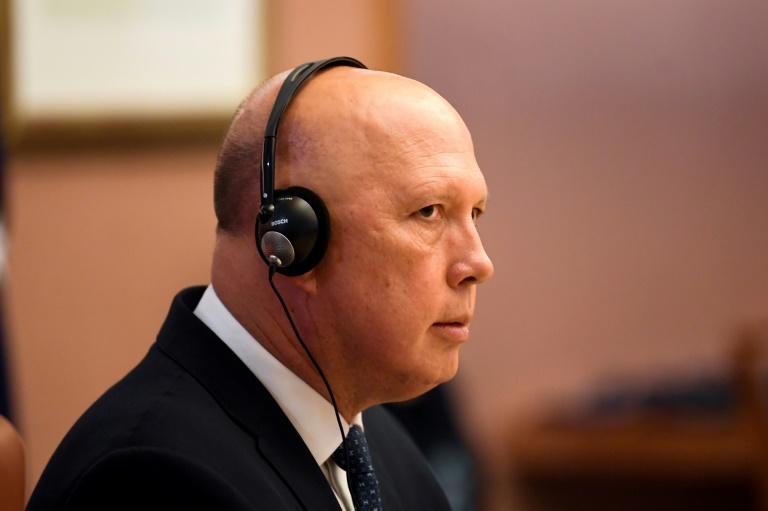
Australia’s conservatives elected hardliner and China hawk Peter Dutton as the country’s new opposition leader Monday, an outcome many will see as a lurch to the right for his party.

Dutton came out swinging after accepting the top spot, saying the country’s newly elected Labor government was not “ready to govern and we are already seeing their inexperience on display”.

He promised his party will go to the next election, due in 2025, with a plan to “clean up Labor’s inevitable mess”.

Elected unopposed, Dutton inherits a Liberal party decimated by Australia’s May 21 election, when many of its long-time voters swung to independent candidates who promised action on climate change.

The new opposition leader will have to rebuild his shattered party and try to unite its fiercely divided moderate and conservative wings, with climate a key sticking point.

Dutton described himself Monday as “a very passionate believer” in Australia’s need for an “appropriate response” to emissions reduction.

A former police officer, Dutton made a name for himself in politics with tough talk and a penchant for headline-grabbing commentary.

As defence minister, he often likened China’s expansionist ambitions to Nazi Germany in the 1930s.

“The only way you can preserve peace is to prepare for war,” he said at the time.

“The issue of China under President Xi is the biggest issue our country will face in our lifetime,” he said Monday.

He also expressed regret for his decision to boycott a national apology to Aboriginal Australians forcibly separated from their families.

At the time he believed “the apology should be given when the problems were resolved and the problems are not resolved”, Dutton said, citing the welfare issues many Indigenous Australians face.

Dutton and his allies in the Liberal party have sought to play down his right-wing past since the election, saying Australians will see his softer side.

The new opposition leader said Monday his policies would be “squarely aimed at the forgotten Australians, in the suburbs, across regional Australia”.

Ousted Prime Minister Scott Morrison, who stepped down from the Liberal leadership after the election drubbing, offered his “full support” to Dutton on Monday.

Australia’s newly elected Prime Minister Anthony Albanese last week praised Dutton, saying he had a better relationship with him than Morrison.

“Peter Dutton has never broken a confidence that I’ve had with him,” Albanese said.

Asian markets extend Wall St rally as China eases curbs

Asian markets rose Monday as investors rediscovered some verve after the release of healthy US data and as China eases some of its strict Covid curbs in Shanghai and Beijing, lifting hopes for the world’s number two economy.

The gains extended a positive end to last week for global equities with some commentators saying there was a growing hope that the months-long sell-off may have run its course.

Wall Street provided a strong lead and snapped a series of weekly losses, with Friday’s rally supported by data showing an easing of the key personal consumption expenditures (PCE) price index.

Markets have been pummelled this year as soaring prices — caused by the Ukraine war, supply chain snags and China’s lockdowns among other things — forced central banks to hike interest rates and warn of more to come.

The US reading lent hope that the worst of the inflation surge may have passed and could allow the Federal Reserve to ease back from its hawkish rate hike drive later in the year.

May jobs data — due for release on Friday — should provide a fresh snapshot of the economy and possibly provide an idea about the Fed’s next policy moves.

Asian investors followed the lead from their US counterparts.

Hong Kong put on more than two percent after a strong Friday performance fuelled by a rally in tech firms, while Tokyo, Sydney, Shanghai, Seoul, Taipei, Manila and Wellington were also well up.

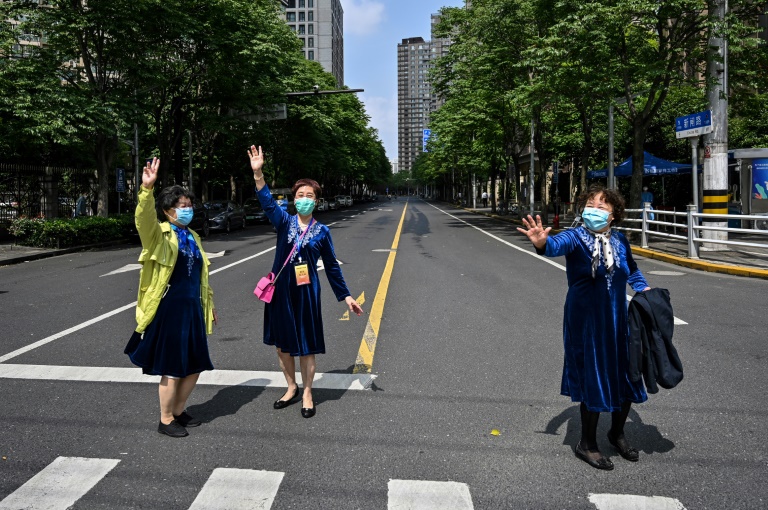
An easing of long-running lockdown measures in Shanghai provided a much-needed lift to sentiment, with China’s biggest city seeing a drop in Covid cases, while some curbs were also being lifted in Beijing.

Officials have also announced measures to ease the impact on the world’s number two economy, which has been hammered by the restrictions.

The possibility that the measures could be gradually removed helped oil prices rise, with Brent topping $120 for the first time in two months as traders bet on a pick-up in demand.

That comes as European leaders are said to be edging towards a deal to impose sanctions on imports of crude from Russia in retaliation for its invasion of Ukraine.

Still, while optimism is higher on trading floors at the moment, it remains at a premium with inflation still elevated and borrowing costs expected to rise further, while the war in Ukraine and China’s still-struggling economy continue to drag.

“We are in the middle of a bear market rally,” Mahjabeen Zaman, of Citigroup Australia, told Bloomberg Television. “I think the market is going to be trading range bound trying to figure out how soon is that recession coming or how quickly is inflation going down.”

– Key figures at around 0240 GMT –

Tokyo – Nikkei 225: UP 2.0 percent at 27,309.35 (break)

Hong Kong – Hang Seng Index: UP 2.1 percent at 21,124.09 

Shanghai – Composite: UP 0.5 percent at 3,147.15

Euro/dollar: UP at $1.0750 from $1.0739 on Friday

Pound/dollar: UP at $1.2649 from $1.2631

Euro/pound: DOWN at 84.97 pence from 84.99 pence

Dollar/yen: DOWN at 127.00 yen from 127.09 yen 

Brent North Sea crude: UP 0.8 percent at $120.36 per barrel

West Texas Intermediate: UP 1.0 percent at $116.20 per barrel

New York – Dow: UP 1.8 percent at 33,212.96 (close)

London – FTSE 100: UP 0.3 percent at 7,585.46 (close)

Nepal army finds wreckage of missing plane

Nepali rescuers found on Monday the crash site of a missing passenger plane that went down with 22 people on board, the army said. 

“A search team has located the wreckage of the plane and shared a picture. Additional teams are heading there so we can get details,” said Nepal Army spokesman Narayan Silwal.

An image shared by Silwal on Twitter showed debris from the wreckage of the flight strewn across a mountainside. Its registration number 9N-AET was clearly visible on what appeared to be a piece of a wing.

The search operation had only resumed earlier in the day after rescuers paused after dark on Sunday. 

There were 19 passengers and three crew members on board the Twin Otter aircraft, operated by Nepali carrier Tara Air, airline spokesman Sudarshan Bartaula told AFP. The passengers included two Germans and four Indians, with the remainder Nepali.

Before the wreckage was found, Pokhara Airport spokesman Dev Raj Subedi told AFP early Monday morning that rescue helicopters and army troops on the ground had shifted their search to a suspected crash site. 

“The search operation has resumed… There has not been any significant improvement in the weather. Two helicopters have flown toward the area but they have not been able to land yet,” he said. 

Subedi said that they had followed GPS, mobile and satellite signals to the location. 

The flight took off from the western town of Pokhara for Jomsom on Sunday at 9:55 am (0410 GMT), but air traffic control lost contact after 15 minutes, the airline said.

Jomsom is a popular trekking destination in the Himalayas about 20 minutes by plane from Pokhara, which lies 200 kilometres (120 miles) west of the capital Kathmandu. 

Flight operator Tara Air is a subsidiary of Yeti Airlines, a privately owned domestic carrier that services many remote destinations across Nepal. 

It suffered its last fatal accident in 2016 on the same route when a plane with 23 on board crashed into a mountainside in Myagdi district. 

Nepal’s air industry has boomed in recent years, carrying goods and people between hard-to-reach areas as well as foreign trekkers and climbers. But it has long been plagued by poor safety due to insufficient training and maintenance. 

The European Union has banned all Nepali airlines from its airspace over safety concerns. 

The Himalayan country also has some of the world’s most remote and tricky runways, flanked by snow-capped peaks with approaches that pose a challenge even for accomplished pilots. 

The weather can also change quickly in the mountains, creating treacherous flying conditions.

Irish judges to rule on ex-soldier accused of IS membership

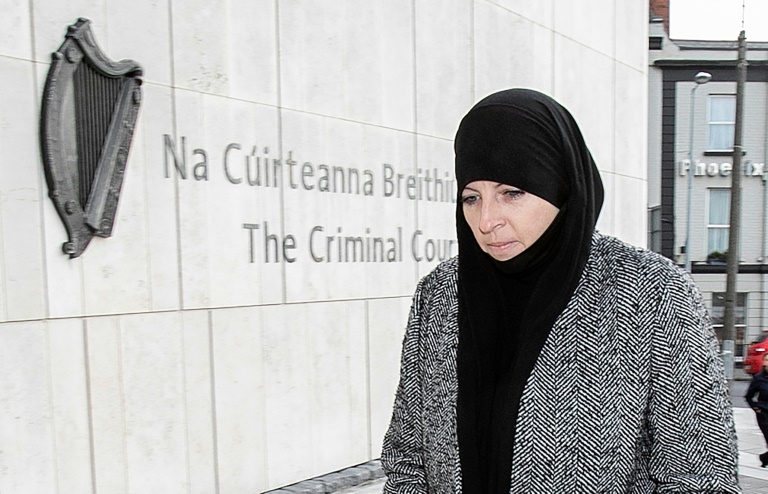
An Irish court will rule on Monday in the trial of a former soldier accused of being a member of the Islamic State jihadist group in Syria who had expressed a desire to live under sharia law and die a martyr.

Lisa Smith, 40, from Dundalk on Ireland’s east coast, pleaded not guilty to membership of an unlawful terrorist group between October 28, 2015 and December 1, 2019.

She also denied funding terrorism by sending 800 euros ($900) to aid medical treatment for a Syrian man in Turkey.

During the nine-week trial, prosecutors have detailed how Smith, a member of the Irish Defence Forces from 2001 to 2011, travelled to IS controlled territory in 2015 after converting to Islam.

In 2012, she went on pilgrimage to Mecca, and expressed a desire to live under sharia law and to die a martyr on an Islamic Facebook page.

Smith bought a one-way ticket from the Irish capital to Turkey, crossing the border into Syria and living in Raqqa, the capital of the Islamic State’s self-styled caliphate.

The militant Islamists ruled over vast swathes of Syria and Iraq, attracting thousands of foreign fighters to their cause before the group’s territorial defeat in the region.

After failing to convince her husband to join her, Smith divorced him in 2016 and married a UK national involved in the group’s armed patrols.

As IS lost ground to a US-led coalition on the battlefield and towns and cities under its sway fell, Smith was forced to flee Raqqa and then Baghouz, their last remaining stronghold, before returning to Ireland.

She was arrested on arrival at Dublin airport on December 1, 2019 with her young daughter.

Defence lawyers have argued that Smith’s presence in IS territory did not make her a de facto member of the extremist Sunni group.

They have said it could only be argued “at a stretch” that she provided some sort of assistance to the group because she had kept a home for her husband.

Smith’s sentence will be decided by three judges, rather than a jury, through the Special Criminal Court, which adjudicates on cases involving terrorism and organised crime offences.

The case was listed for judgment at 0930 GMT in court documents.

Tech giant Grab's female co-founder blazes a trail

As co-founder of multi-billion dollar ride-hailing and food delivery firm Grab, Tan Hooi Ling is already smashing stereotypes in tech but she’s also trying to blaze a trail for the next generation of female entrepreneurs in the industry.

This month the company announced it will raise the proportion of women in leadership positions to 40 percent by 2030 — up from 34 percent now -– and is committed to ensuring equal pay.  

The key weapon in her arsenal for gender equality? Data.

“Data helps keep us honest,” the 38-year-old tells AFP.

“Right now, we have monthly and quarterly reports that help us look at how many female ‘Grabbers’ we have in different teams to ensure there is no unintentional bias and whether our pay parity is equal.”

Globally, tech firms suffer from a serious gender imbalance, with a study from consultancy Accenture and NGO Girls Who Code showing the proportion of women working in the sector is now smaller than in 1984.

While male tech executives such as Meta’s Mark Zuckerberg and Alibaba co-founder Jack Ma are well-known, top female tech leaders remain more lower profile.

Tan co-founded Singapore-headquartered Grab, a household name in Southeast Asia, in 2012 and now oversees hundreds of engineers. 

She hopes to be a catalyst for change in the male-dominated sector.

She insists she did not face discrimination as she built up her company, but recognises others have.

“That’s the role I’m hoping to play — to help create more of these environments where I was fortunate enough to grow up,” she adds.

– Battling sexism and inequality –

But industry experts say tech faces significant challenges in its bid for gender equality with reports of sexism and toxic cultures in some firms.

A total of 44 percent of female tech founders said they had been harassed, according to a global poll by NGO Women Who Tech, which surveyed more than a thousand people.

Last year, a female employee at Alibaba alleged she had been sexually assaulted on a work trip by her manager and a client. The Chinese e-commerce giant fired the manager — but later police dropped the case and the employee was also sacked.

And in the United States, video game giant Activision Blizzard is under investigation over accusations the firm condoned a culture of sexual harassment and discrimination.

For the climate to improve across the sector, critics say addressing gender imbalance is vital.

In Southeast Asia, 32 percent of the technology workforce is female, higher than the global average, but still lower than the 38 percent in other industries, according to a Boston Consulting Group study.

Some issues around gender diversity are a “by-product of history” Tan says — girls have not been encouraged enough to pursue science, technology, engineering and mathematics (STEM).

According to the 2017 UNESCO report Cracking the code: girls’ and women’s education in STEM, only 35 percent of students of these subjects in higher education globally are female. 

“We believe in ‘normalising’ women in tech. This starts by exposing females to many examples of women who have built their careers in tech,” Tan says. 

The company holds women’s leadership events and runs mentoring schemes to guide new female entrants to the industry.

Girls should be motivated to take up courses such as software development and data science to help drive change, she adds.

“We need to help break that bias,” she argues, adding that it is crucial to ensure a fair hiring process and female representation on interview shortlists.

Grab’s role in the growth of Asia’s gig economy has created opportunities for women who might previously not have been able to join the workforce, Tan suggests.

“Not everybody in the world can do a nine to five job, five days a week. Some of them need flexibility because they’re moms, they are parents.”

Tan adds that companies need to improve conditions for working mothers in order to ensure there’s no brain drain of female talent.  

“Being a working mother is not easy. And whether it’s in tech roles, or just in general leadership roles, I think we need to be more empathetic of the situations that they’re in and see if there are ways we can, you know, help, again, break biases.”

– Harvard to $10 billion firm – 

Tan grew up in a middle-class Malaysian family, the daughter of a civil engineer. She studied mechanical engineering in the UK, before joining McKinsey in Kuala Lumpur.

She went on to study for an MBA at Harvard, where she met Antony Tan — no relation — and the pair came up with the idea behind Grab. He is now the company’s CEO.

A decade on, the company is now worth about US$10 billion and offers services ranging from digital payments to courier deliveries.

Operating in diverse markets, from developed, orderly Singapore to the traffic-clogged streets of Jakarta and Manila, the company faces unique challenges. 

Tan, who has shadowed Grab’s drivers and spent time on the complaints desk in a bid to get to know all elements of the business, describes herself as the company’s “plumber”. 

And her firm’s local knowledge helped it to beat Uber in the region’s ride-hailing battle, and it bought its US rival’s Southeast Asian operations in 2018. 

The company does face challenges. Since listing on the Nasdaq stock exchange last year, the firm has lost nearly three-quarters of its value after reporting falls in its earnings. 

Despite the short-term challenges, Tan says Grab is committed to developing talent “for multiple generations”, and hopes women will play a leading role in the tech sector in future.

“Female empowerment has taken generations to change and it’s on a good trajectory, but it will take a bit of time,” she says. 

“I think we’re all in a better position to have more diverse teams, and diverse leadership teams as well.”

Germany agrees $107 bn fund to modernise military in face of Russia threat

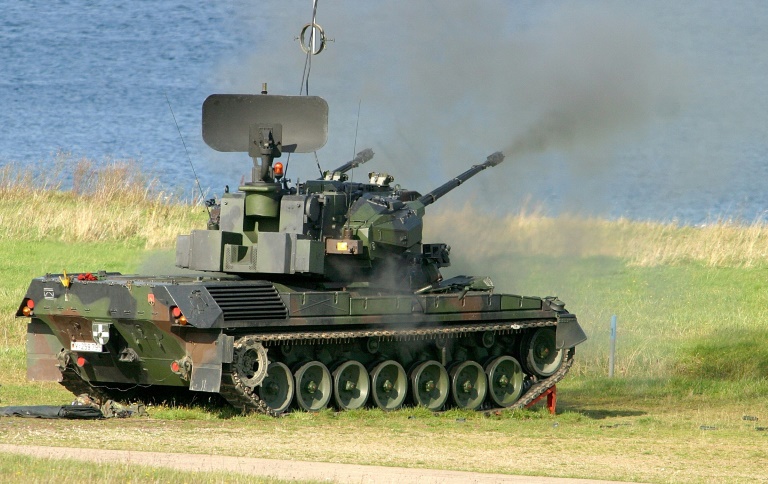
Germany’s government and conservative opposition have agreed a deal that will release 100 billion euros ($107 billion) to modernise the army in the face of the Russian threat.

An agreement was reached late Sunday to create a special fund for military procurement that will also allow Berlin to achieve NATO’s target of spending two percent of GDP on defence.

The deal, which involves amending budgetary rules in the national constitution, was struck after weeks of difficult negotiations between the parties in the governing coalition and the conservatives of former chancellor Angela Merkel, representatives of these groups told AFP.

Three days after the Russian invasion of Ukraine in February, Chancellor Olaf Scholz pledged a special budget of 100 billion euros to rearm the German military and modernise its outdated equipment over the next few years.

But critics have since accused Scholz of timidity in his support for Kyiv and failing to take enough concrete action in terms of arms deliveries.

The agreement will allow Berlin to achieve NATO’s target of spending 2.0 percent of GDP on defence “on average over several years”, according to the text of the agreement obtained by AFP.

The exceptional fund will be financed by additional debt.

For that it was necessary to circumvent the “debt brake” rule enshrined in the constitution, which caps government borrowing.

This was why the government needed the support of the conservative opposition to muster the two-thirds majority in parliament needed to pass the constitutional amendment.

The 100 billion euros will be paid into a special fund outside the national budget.

Release of the funds for the military is a major reversal for Germany, which in recent years has dragged its feet on complying with its NATO spending commitments, drawing criticism from Washington in particular.

Since the end of the Cold War, Germany has significantly reduced the size of its army, from around 500,000 in 1990 to just 200,000 today.

Fewer than 30 percent of German naval ships were “fully operational” according to a report published December on the state of the military. Many of the country’s fighter aircraft are unfit to fly.

But the invasion of Ukraine has jolted into action a country steeped in pacifism since the horrors of the Nazi era.

France holds meeting to prevent repeat of Champions League chaos

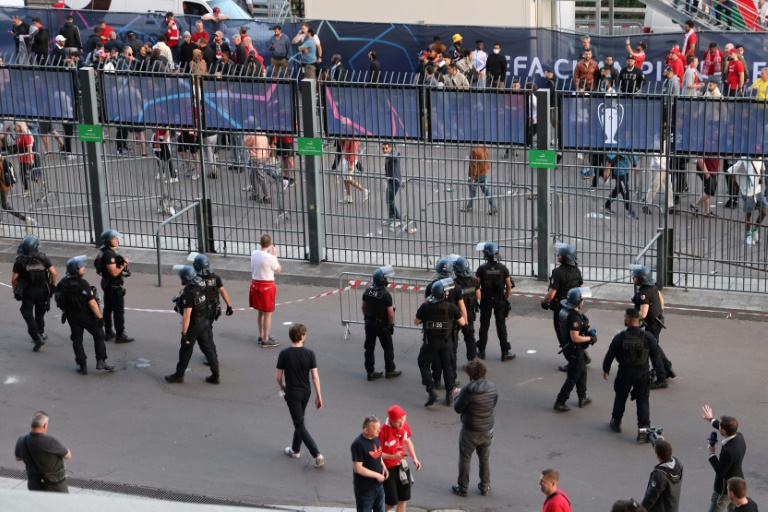
France’s sports ministry will host a meeting of security and football officials Monday following the chaos that marred the Champions League final between Liverpool and Real Madrid, as Paris prepares to host the 2024 Olympics.

Sports Minister Amelie Oudea-Castera said they want to identify what went wrong to avoid a repeat of Saturday’s scenes outside Paris’ Stade de France.

The Liverpool club said it has called for an investigation into the treatment of its supporters ahead of the game, when thousands of ticket holders struggled to enter the stadium.

Police used tear gas and pepper spray on fans outside, while others managed to scale fences to access the stadium.

The scenes tarnished the image of the French capital, raising questions about its ability to host sporting events as it gears up for the 2024 sporting showpiece, as well as the 2023 Rugby World Cup.

Oudea-Castera expressed regret that “some supporters who had tickets were not able to access the match”. 

Monday’s meeting at the sports ministry, due to start at 0900 GMT, will involve European football governing body UEFA, French football chiefs and the French police.

“The priority now is to identify very precisely what went wrong… in order to learn all the lessons so that such incidents do not happen again at our future major international sporting events,” said Oudea-Castera.

– ‘Shameless attempts’ –

Her admission of possible shortcomings by the French authorities marked a more conciliatory stance, after officials initially lashed out at the Liverpool fans for the chaos.

French Interior Minister Gerald Darmanin said Saturday “thousands of British ‘supporters’ either without tickets or with fake ones forced their way through and sometimes behaved violently towards the stewards”.

But political foes of the government and President Emmanuel Macron said the scenes pointed to wider problems in France and shamed the country.

“The image this gives is lamentable and it is also worrying because we see that we are not prepared for events like the Olympic Games,” far-left French politician Jean-Luc Melenchon told BFM-TV.

The scenes caused outrage in the UK where the press and the politicians lined up to denounce scenes of mayhem they argued were caused by heavy-handed French police tactics more akin to controlling a violent demonstration.

Liverpool said they were “hugely disappointed” that their supporters had been subjected to an “unacceptable” breakdown of the security perimeter.

“We have officially requested a formal investigation into the causes of these unacceptable issues,” the club said.

The Liverpool Echo newspaper argued that poor organisation and not the Liverpool fans were to blame.

Britain’s Culture Secretary Nadine Dorries urged UEFA to launch “a formal investigation into what went wrong and why”.

– ‘Absolute disgrace’ –

The French interior ministry said 105 people had been detained, of whom 39 were placed under arrest and remanded in custody, meaning they could face charges.

Aurore Berge, a deputy for Macron’s ruling party, said Paris had “barely three months” to get ready for the final, which it was awarded after Saint Petersburg was stripped of the event due to Russia’s invasion of Ukraine.

Police fired tear gas after several dozen people attempted to climb over barriers, according to an AFP reporter on the scene. Security staff had to round up about 20 fans who had scaled the fence and got into the ground.

UEFA blamed “fake tickets which did not work in the turnstiles” for the chaos, which caused a 35-minute delay to the final, eventually won by Real Madrid.

Paris police chief Didier Lallement has called for a formal investigation into the production of fake tickets, which he said had helped caused the problems.

With half an hour to go to kick-off, thousands of Liverpool supporters were still massed outside the stadium, inevitably bringing back memories for a club haunted by the 1989 Hillsborough stadium disaster where 97 people were killed in a crush.

One fan, Paul Machin, said on YouTube that what he had witnessed in Paris was “unlike anything I’ve seen at a football match before”, condemning “totally and utterly reprehensible behaviour from the French police who were an absolute disgrace”.

Close Bitnami banner
Bitnami