World

Death toll mounts from Brazil downpours as search continues

Torrential rains in northeastern Brazil have left at least 79 people dead and dozens missing, civil defense officials said Sunday, as rescuers capitalized on a lull in downpours to search for survivors.

“As of 6:00 pm (2100 GMT) this Sunday, the number of people killed as a result of the rains has reached 79,” the civil defense authority of Pernambuco state, where the affected communities of Recife and Olinda are located, said in a statement. 

The disaster is the latest in a recent series of deadly landslides and floods triggered by extreme weather in Brazil.

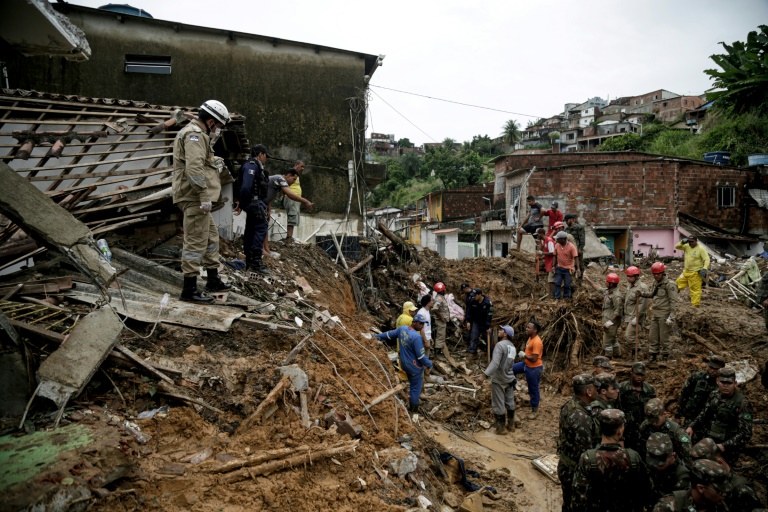
The number of dead has mounted steadily over the weekend, including dozens in landslides, as heavy rains caused rivers to overflow and torrents of mud swept away everything in their path.

The latest statement from the civil defense did not offer an update on the number of people missing, though the agency had earlier reported 56 people still unaccounted for and nearly 4,000 who had lost their homes. 

“We still don’t have an exact number, but there are still reports of victims… who have not been found,” Pernambuco Governor Paulo Camara said during a press conference. 

“The search will continue until we can identify all the missing people,” he said. 

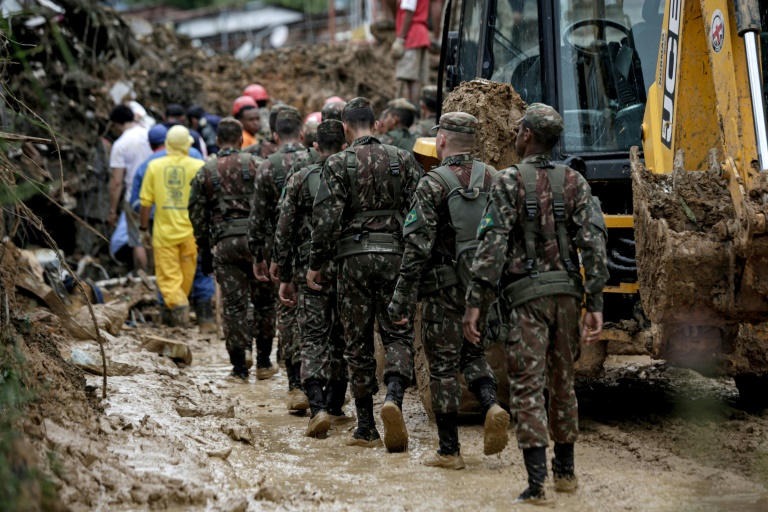
Authorities warned that rain was forecast to continue Monday, but in the meantime while the storm subsided some 1,200 personnel — some in boats or helicopters — resumed search and rescue work, state officials said. 

Minister of Regional Development Daniel Ferreira urged caution in a press conference Sunday in Recife, the capital of hard-hit northeastern Pernambuco state.

“Although it has stopped raining now, we are forecasting heavy rains for the next few days,” he said. 

“So the first thing is to maintain self-protection measures.”

Between Friday night and Saturday morning, rainfall volume reached 70 percent of what was forecast for all of May in some parts of Recife.

– ‘Difficult’ –

Images circulated on local media showed rescue workers and volunteers clearing heaps of debris in Jardim Monteverde, on the border between Recife and the municipality of Jaboatao dos Guararapes, where 19 died Saturday morning in a landslide that ripped through precariously built homes.

Luiz Estevao Aguiar, who lives in a different municipality, lost 11 relatives in the disaster, he told TV Globo.

“My sister, my brother-in-law, 11 people from my family died. It was difficult… I did not expect this,” he said tearfully.

Nearby, Flavio Jose da Silva has been desperately looking for his stepfather Gilvan in the rubble of what was once his house. 

Shortly after it collapsed, he heard Gilvan say, “I’m here, under the ground.”

“We hope to find him alive,” an emotional da Silva said, pointing to a mountain of debris.

Brazilian President Jair Bolsonaro said Sunday he would travel to Recife on Monday.

Over the past year, hundreds of Brazilians have died in flooding and landslides brought on by torrential downpours. 

In February, more than 230 people were killed in the city of Petropolis, the Brazilian then-empire’s 19th-century summer capital, in Rio de Janeiro state.

Early last month 14 more were killed by flooding and landslides in the state.

Experts say Brazil’s rainy-season downpours are being augmented by La Nina — the cyclical cooling of the Pacific Ocean — and by climate change.

Because a hotter atmosphere holds more water, global warming increases the risk and intensity of flooding from extreme rainfall.

Risks from heavy rains are augmented by topography and poor construction in shantytowns built in steep areas.  

According to meteorologist Estael Sias of the MetSul agency, the heavy rains lashing Pernambuco and, to a lesser extent, four other northeastern states, are the product of a typical seasonal phenomenon called “eastern waves.”

He explained that those are areas of atmospheric disturbance that move from Africa to Brazil’s northeastern coastal region.

“In other areas of the Atlantic this instability forms hurricanes, but in northeastern Brazil it has the potential for a lot of rain and even thunderstorms,” he said.
Sri Lanka police tear-gas students in fresh clashes

Police fired tear gas to disperse thousands of students trying to storm the Sri Lankan president’s home Sunday as the government offered an olive branch to demonstrators demanding his resignation.

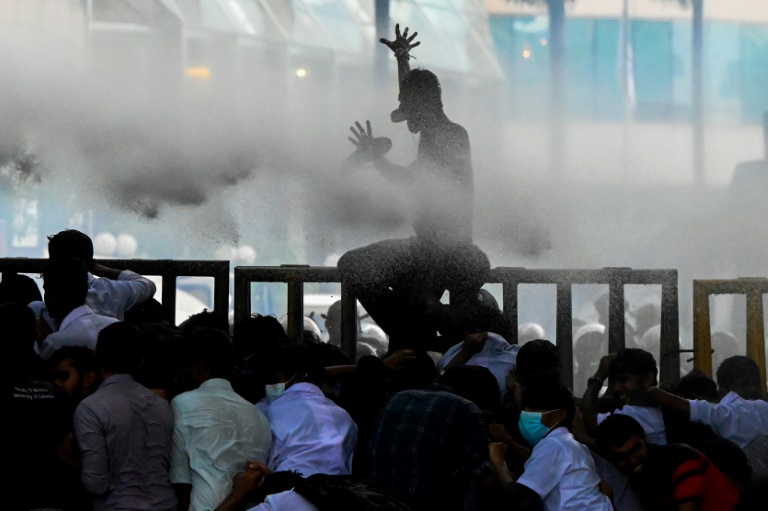
Anti-riot squads used water cannon followed by tear gas, as furious protesters pulled down yellow iron barricades across a road leading to President Gotabaya Rajapaksa’s official residence in Colombo.

Nearby, thousands of men and women demonstrated for the 51st straight day outside Rajapaksa’s seafront office, demanding he step down over the country’s worst economic crisis since independence.

Prime Minister Ranil Wickremesinghe went on national television on Sunday evening offering young protesters a greater say in how the country is administered.

“The youth are calling for a change in the existing system,” Wickremesinghe said, laying out plans for 15 committees that would work with parliament to decide national policies.

“I propose to appoint four youth representatives to each of the 15 committees,” he said, adding that they could be drawn from the current protesters.

The demonstrations led to tense scenes in Colombo, where authorities struggled to disperse large crowds and chemical irritants hung over the streets.

Several men were seen picking up canisters spewing tear gas and throwing them back towards the police who fired them.

Female medical and science students joined the protests, with many running for cover when authorities unleashed water cannon.

Wickremesinghe is not from Rajapaksa’s party, but was given the job after the president’s elder brother Mahinda resigned as prime minister on May 9 following weeks of protests, and when no other legislator agreed to step in.

Wickremesinghe is the sole parliamentary representative of the United National Party, a once-powerful political force that was nearly wiped out in Sri Lanka’s last elections. 

Rajapaksa’s party, which has a majority in the legislature, has offered to provide him with the necessary support to run a government.

Sunday’s student action came a day after a similar clash when protesters tried to storm Rajapaksa’s heavily guarded colonial-era official residence, where he has bunkered down since thousands surrounded his private home on March 31.

An unprecedented shortage of foreign exchange to import even the most essential supplies, including food, fuel and medicines, has led to severe hardships for the country’s 22 million people.

The government last month asked the International Monetary Fund for urgent financial assistance. Talks are continuing. 

The country has defaulted on its $51 billion foreign debt. 

Its currency has depreciated by 44.2 percent against the US dollar this year, while inflation hit a record 33.8 percent last month.

Left eyes historic presidential win as Colombians vote for change

Colombians clamoring for “change” voted Sunday in a first round of presidential elections with a leftist poised for an historic victory.

Polls opened for eight hours at 8:00 am (1300 GMT) in a tense atmosphere, a year after a brutal security crackdown on street protests fueled by deepening socioeconomic woes.

Opinion polls show many Colombians pinning their hopes on 62-year-old Gustavo Petro, a onetime guerrilla and former mayor of Bogota, to address poverty, rural violence, urban crime and endemic corruption in a country historically governed by rightist elites.

“For many years the people who have run the country have torn it apart. We must change,” said security guard Luis Hernan Alvarez, 59, a Petro voter in the capital.

“There is too much poverty. There are resources, but they are lost to corruption,” he told AFP. “We need new leaders.”

In the morning, dissidents of the disbanded FARC guerrilla group detonated three explosive devices in the southeast, where armed groups are engaged in running battles with drug gangs in a country long plagued by violence.

A soldier was wounded but the defense ministry said there was no impact on voting.

At Cucuta on the Venezuelan border, hundreds of Colombians who live on the other side were held up at the crossing as they sought passage, chanting “We want to vote” and flashing their identity cards at security forces.

Only those registered to vote at polling stations on the border were being allowed through. The two countries have no diplomatic ties.

Some 300,000 armed police and soldiers were deployed to keep the peace, with observers from the Organization of American States and the European Union on the ground.

Petro is hoping to avoid a June 19 run-off against 47-year-old Federico Gutierrez, a former mayor of second city Medellin who represents an alliance of right-wing parties.

To do so, he would need to garner more than 50 percent of first-round votes cast.

– ‘We all want change’ –

Ivan Duque — who beat Petro to the presidency in 2018 — leaves office with record disapproval numbers after a constitutionally-limited single, four-year term.

About 40 percent of Colombia’s 50 million people live in poverty, and the country has one of the highest levels of income inequality in the world, according to the World Bank.

Problems were worsened by the coronavirus pandemic, and one in six city dwellers is unemployed.

The Duque government’s image was not helped by its internationally denounced response to weeks of anti-poverty protests last year that saw dozens of civilians killed.

“We all want change,” said hotel porter Elison Beltran, 34, for whom the solution is 77-year-old anti-corruption candidate Rodolfo Hernandez, with an outside chance in third place, according to opinion polls.

Petro, in his third presidential race, has promised to address poverty and make Colombia’s economy more environmentally friendly, including by phasing out exploration for crude oil — one of the country’s main income generators.

A focus of Gutierrez has been on a “strong state” response to a flare-up of violence in spite of a 2016 peace agreement that officially ended a near six-decade civil conflict in the world’s biggest cocaine producer.

Crime is a problem in the cities too, where residents complain of a rise in robberies they blame largely on an influx of nearly two million migrants from Venezuela.

– Pushback –

In a country marked by a deep-rooted fear of the political left — associated with guerrilla groups that sowed decades of misery — the pushback against Petro has been fierce, with rivals seeking to paint him as a radical, Hugo Chavez-style populist.

After voting in Bogota, Petro said: “There are only two alternatives: to leave things as they are in Colombia, which in my opinion is more corruption, more violence, more hunger. Or change Colombia and direct it towards… prosperity and democracy.”

For his part, Gutierrez reiterated a commitment to constructing “a different country, without hunger, without corruption, without violence.”

The campaign has been marred by suspicions of tampering following counting irregularities reported in a primary voting round in March.

Petro and Gutierrez have both received death threats, as has the leftist’s running mate Francia Marquez, who could become Colombia’s first ever black woman vice president.

Israeli nationalists march through Jerusalem's Old City

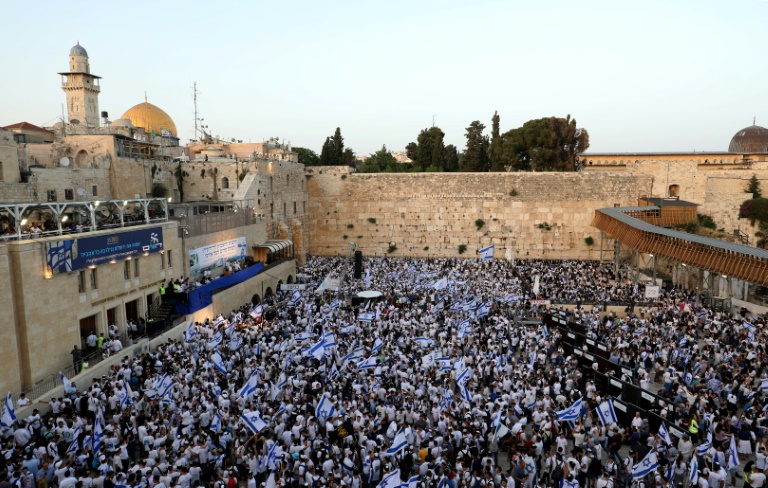
Thousands of flag-waving Israelis on Sunday marched through Jerusalem’s Old City during a nationalist procession that regularly stokes Palestinian anger, a year after Jerusalem tensions exploded into war.

About 70,000 Jewish Israelis paraded through the streets, police said, for an annual “flag march” marking Israel’s 1967 capture of east Jerusalem. Some marchers chanted “death to Arabs”, as a number of Palestinians hurled projectiles from the rooftops.

Israel’s Foreign Minister Yair Lapid described far-right Jewish groups who taunted Arabs — specifically the Lehava and La Familia extremist organisations — as a “disgrace”, saying they “aren’t worthy of holding the Israeli flag”.

Prime Minister Naftali Bennett ordered police to show “zero tolerance” towards Jewish extremists who planned to “incite” tensions, singling out La Familia. 

More than 3,000 police officers were deployed across Jerusalem, reporting more than 60 arrests over “disorderly conduct”.

The Palestinian Red Crescent said 79 Palestinians were injured in and around the Old City.

Around annexed east Jerusalem, many Palestinians flew flags, with police clashing with the protesters carrying them.

Above one of the Old City gates, a Palestinian flag was flown from a drone, which police shot down, an AFP photographer said.

During the march, thousands of Jewish Israelis — overwhelmingly men, and many of them youths — poured through Damascus Gate, the main Old City thoroughfare used by Palestinians and of huge symbolic importance.

“This is our country, and that’s it,” 18-year-old Jewish Israeli Ofer Amar told AFP at Damascus Gate. “The Palestinians are guests in our country.”

Dozens of Israelis hoisted flags on the gate, while others sang and danced on the surrounding steps, where isolated clashes were reported ahead of the march.

Jonathan Bnidik, another marcher, said the purpose of the rally was “to tell the whole world that (Jerusalem) is our ancient and historical national capital”.

Most of the international community does not recognise Israeli control over east Jerusalem, which Palestinians see as the capital of a future state.

– West Bank protests –

There were also counter rallies held in the occupied West Bank, with Israeli security forces clashing at several sites with Palestinians, who set tyres alight. 

The Red Crescent reported more than 100 Palestinians were wounded across the West Bank. 

Earlier, Jewish nationalists chanting pro-Israel slogans had visited Jerusalem’s Al-Aqsa compound, located on Old City land that Jews revere as the Temple Mount.

Police reported that Palestinians had thrown rocks towards them from inside the mosque.

Police said that some 2,600 people had ascended to the compound during Sunday’s regular visitation windows — a figure that is higher than normal and includes tourists.

Some Jews had “violated visitation rules” and several people were detained, police said without providing further details, before the day’s visits concluded.

Far-right nationalist lawmaker Itamar Ben Gvir, who was among those who went to Al-Aqsa, later said his visit aimed “to reaffirm that we, the State of Israel, are sovereign” in the Holy City.

Ben Gvir was thronged by extremist supporters as he entered Damascus Gate and walked to the Western Wall, the holy Jewish prayer site below Al-Aqsa where the Jerusalem Day rally culminated.

Celebrations continued there throughout the evening, with sporadic clashes between Palestinians and Jews taking place across east Jerusalem.

– Fear of war –

The march comes a year after tensions and unrest in Jerusalem led the Islamist armed group Hamas to fire rockets at Israel from the blockaded Gaza Strip, triggering an 11-day war.

Hamas warned last week that marchers must not pass through the Al-Aqsa mosque compound, saying it would use all means to confront them.

Public Security Minister Omer Bar-Lev said late Sunday that letting the march go ahead was a message of force to Israel’s enemies.

“If we succumb to terror threats to not wave the Israeli flag in our capital, we won’t have a day of quiet, and will find ourselves attacked in the future too,” he said.

Israel has since late March been hit by a series of attacks targeting mostly civilians, and has in turn launched military raids targeting armed groups in the occupied West Bank.

Despite the recent violence, tensions have been more muted in the run-up to Sunday’s rally compared to last year.

Security analyst Shlomo Mofaz judged that Bennett was betting on the likelihood that for now “Hamas does not have any interest in another war” as it seeks to rebuild Gaza following last year’s conflict. 

bur-jjm/jsa/pjm

Death toll mounts from Brazil downpours as search continues

Torrential rains in northeastern Brazil have left at least 56 people dead and dozens missing, civil defense officials said Sunday, as rescuers capitalized on a lull in downpours to search for survivors.

“As of this Sunday, 56 people were confirmed dead, and another 56 remain missing in the municipalities of Recife and Olinda,” in Pernambuco state, the civil defense said in a statement, adding that a further 3,957 people had lost their homes.

The disaster is the latest in a recent series of deadly landslides and floods triggered by extreme weather in Brazil.

The number of dead has mounted steadily over the weekend, with at least 28 killed in landslides, as heavy rains caused rivers to overflow and torrents of mud swept away everything in their path.

Authorities warned that heavy rain was forecast to continue Sunday, but the storm subsided in the morning.

As the weather broke, some 1,200 personnel — some in boats or helicopters — resumed search and rescue work, state officials said. But Minister of Regional Development Daniel Ferreira urged caution in a press conference earlier Sunday in Recife, the capital of hard-hit northeastern Pernambuco state.

“Although it has stopped raining now, we are forecasting heavy rains for the next few days,” he said. 

“So the first thing is to maintain self-protection measures.”

Between Friday night and Saturday morning, rainfall volume reached 70 percent of what was forecast for all of May in some parts of Recife.

– ‘Tragedy’ –

Images circulated on local media showed rescue workers and volunteers clearing heaps of debris in Jardim Monteverde, on the border between Recife and the municipality of Jaboatao dos Guararapes, where 19 died Saturday morning in a landslide that ripped through precariously built homes.

Luiz Estevao Aguiar, who lives in a different municipality, lost 11 relatives in the disaster, he told TV Globo.

“My sister, my brother-in-law, 11 people from my family died. It was difficult… I did not expect this,” he said tearfully.

Nearby, Flavio Jose da Silva has been desperately looking for his stepfather Gilvan in the rubble of what was once his house. 

Shortly after it collapsed, he heard Gilvan say, “I’m here, under the ground.”

“We hope to find him alive,” an emotional da Silva said, pointing to a mountain of debris.

Brazilian President Jair Bolsonaro said Sunday he would travel to Recife on Monday.

Over the past year, hundreds of Brazilians have died in flooding and landslides brought on by torrential downpours. 

In February, more than 230 people were killed in the city of Petropolis, the Brazilian then-empire’s 19th-century summer capital, in Rio de Janeiro state.

Early last month 14 more were killed by flooding and landslides in the state.

Experts say Brazil’s rainy-season downpours are being augmented by La Nina — the cyclical cooling of the Pacific Ocean — and by climate change.

Because a hotter atmosphere holds more water, global warming increases the risk and intensity of flooding from extreme rainfall.

Risks from heavy rains are augmented by topography and poor construction in shantytowns built in steep areas.  

According to meteorologist Estael Sias, of the MetSul agency, the heavy rains lashing Pernambuco and, to a lesser extent, four other northeastern states, are the product of a typical seasonal phenomenon called “eastern waves.”

He explained that those are areas of atmospheric disturbance that move from Africa to Brazil’s northeastern coastal region.

“In other areas of the Atlantic this instability forms hurricanes, but in northeastern Brazil it has the potential for a lot of rain and even thunderstorms,” he said.
Death toll mounts from Brazil downpours as search continues

Torrential rains in northeastern Brazil have left at least 56 people dead and dozens missing, civil defense officials said Sunday, as rescuers capitalized on a lull in downpours to search for survivors.

“As of this Sunday, 56 people were confirmed dead, and another 56 remain missing in the municipalities of Recife and Olinda,” in Pernambuco state, the civil defense said in a statement, adding that a further 3,957 people had lost their homes.

The disaster is the latest in a recent series of deadly landslides and floods triggered by extreme weather in Brazil.

The number of dead has mounted steadily over the weekend, with at least 28 killed in landslides, as heavy rains caused rivers to overflow and torrents of mud swept away everything in their path.

Authorities warned that heavy rain was forecast to continue Sunday, but the storm subsided in the morning.

As the weather broke, some 1,200 personnel — some in boats or helicopters — resumed search and rescue work, state officials said. But Minister of Regional Development Daniel Ferreira urged caution in a press conference earlier Sunday in Recife, the capital of hard-hit northeastern Pernambuco state.

“Although it has stopped raining now, we are forecasting heavy rains for the next few days,” he said. 

“So the first thing is to maintain self-protection measures.”

Between Friday night and Saturday morning, rainfall volume reached 70 percent of what was forecast for all of May in some parts of Recife.

– ‘Tragedy’ –

Images circulated on local media showed rescue workers and volunteers clearing heaps of debris in Jardim Monteverde, on the border between Recife and the municipality of Jaboatao dos Guararapes, where 19 died Saturday morning in a landslide that ripped through precariously built homes.

Luiz Estevao Aguiar, who lives in a different municipality, lost 11 relatives in the disaster, he told TV Globo.

“My sister, my brother-in-law, 11 people from my family died. It was difficult… I did not expect this,” he said tearfully.

Nearby, Flavio Jose da Silva has been desperately looking for his stepfather Gilvan in the rubble of what was once his house. 

Shortly after it collapsed, he heard Gilvan say, “I’m here, under the ground.”

“We hope to find him alive,” an emotional da Silva said, pointing to a mountain of debris.

Brazilian President Jair Bolsonaro said Sunday he would travel to Recife on Monday.

Over the past year, hundreds of Brazilians have died in flooding and landslides brought on by torrential downpours. 

In February, more than 230 people were killed in the city of Petropolis, the Brazilian then-empire’s 19th-century summer capital, in Rio de Janeiro state.

Early last month 14 more were killed by flooding and landslides in the state.

Experts say Brazil’s rainy-season downpours are being augmented by La Nina — the cyclical cooling of the Pacific Ocean — and by climate change.

Because a hotter atmosphere holds more water, global warming increases the risk and intensity of flooding from extreme rainfall.

Risks from heavy rains are augmented by topography and poor construction in shantytowns built in steep areas.  

According to meteorologist Estael Sias, of the MetSul agency, the heavy rains lashing Pernambuco and, to a lesser extent, four other northeastern states, are the product of a typical seasonal phenomenon called “eastern waves.”

He explained that those are areas of atmospheric disturbance that move from Africa to Brazil’s northeastern coastal region.

“In other areas of the Atlantic this instability forms hurricanes, but in northeastern Brazil it has the potential for a lot of rain and even thunderstorms,” he said.
EU struggles to break deadlock on Russian oil ban before summit

Ambassadors from the 27 European Union member states on Sunday examined a compromise mooted to enable them to break the deadlock on a Russian oil embargo ahead of an emergency summit in Brussels.

The bloc’s officials fear the absence of an agreement would cast a shadow over the two-day meeting starting Monday between European leaders.

Ukrainian President Volodymyr Zelensky will address the gathering by video link to press the bloc to “kill Russian exports” three months after the invasion of Ukraine.

The latest round of proposed sanctions by the EU has been blocked by landlocked Hungary, which has no access to seafaring oil cargo ships.

Hungary is dependent for 65 percent of its oil needs on Russian crude supplied via the Druzhba pipeline, which runs from Russia to various points in eastern and central Europe.

Budapest has rejected as inadequate a proposal to allow it two years longer than other EU states to wean itself off Russian oil. 

It wants at least four years and at least 800 million euros ($860 million) in EU funds to adapt its refineries to process non-Russian crude and boost pipeline capacity to neighbouring Croatia.

Slovakia and the Czech Republic, also supplied by the Druzhba pipeline, accepted exemptions of two and half years, diplomatic sources said.

The compromise solution put to national negotiators on Sunday consists in excluding the Druzhba pipeline from a future oil embargo and only imposing sanctions on oil shipped to the EU by tanker vessel, European sources said.

The Druzhba pipeline accounts for a third of all EU oil supplies from Russia. Maritime cargos account for the remaining two thirds.

– No agreement –

The compromise was tabled by France, which currently holds the rotating EU presidency, and by the European Council, which represents the governments of the EU nations. 

Oil pumped in via the Druzhba pipeline would be excluded “for the time being”, said one EU official.

The aim is to break a stalemate that has, since early May, prevented the EU from imposing a sixth round of sanctions on Moscow over its war in Ukraine.

The proposal envisages ending the purchases of Russian crude within six months and Russian petroleum products by the end of the year.

It would also impose additional sanctions on Russian banks and expand the list of Russian individuals blacklisted by the bloc.

Yet EU ambassadors did not find agreement on the compromise, with one EU official saying a “difficult and complex discussion” failed to bridge disaccord.

Another EU official said the mooted compromise raised questions of fairness on the sanctions burden shouldered by member states.

An EU diplomat said it was hoped an agreement could still be reached in time for Monday’s summit, though that was far from certain.

“It might not work, it might work, but I think we have a duty to try,” the official said. 

“There is a willingness from all member states to work on oil and to ban (Russian) oil from from European markets. The question is, how to do it and how to cater for national specificities,” he added.

“To be frank, the question of sanctions will be in the room” when EU leaders meet, the official said.

Another option under consideration would be to postpone the entire package of new sanctions until a solution can be found to provide Hungary with alternative oil supplies, the sources said.

The EU wants to cut funding for the Kremlin’s war effort. Last year’s bill for Russian oil imports was 80 billion euros ($86 billion), four times greater than it was for gas in 2021.

EU mulls compromise to break deadlock on Russian oil embargo

Ambassadors from the 27 European Union member states will on Sunday examine a compromise that could enable them to break the deadlock on a sixth round of economic sanctions against Russia, including a landmark halt to Russian oil imports, EU sources told AFP.

The latest round of proposed sanctions has been blocked by landlocked Hungary, which has no access to seafaring oil cargo ships and is dependent for 65 percent of its oil needs on Russian crude supplied via the Druzhba pipeline. 

Budapest has rejected as inadequate a proposal to allow it two years longer than other EU states to wean itself off Russian oil. 

It wants at least four years and at least 800 million euros ($860 million) in EU funds to adapt its refineries to process non-Russian crude and boost pipeline capacity to neighbouring Croatia.

The compromise solution put to national negotiators on Sunday consists in excluding the Druzhba pipeline from a future oil embargo and only imposing sanctions on oil shipped to the EU by tanker vessel, the sources said.

The Druzhba pipeline accounts for a third of all EU oil supplies from Russia. Maritime cargos account for the remaining two thirds.

The compromise was tabled by France, which currently holds the rotating EU presidency, and by the European Council, which represents the governments of the EU nations. 

Its aim is to break a stalemate that has, since early May, prevented the EU from imposing a sixth round of sanctions on Moscow over its war in Ukraine.

It would end the purchases of Russian crude within six months and Russian petroleum products by the end of the year. It would also impose additional sanctions on Russian banks and expand the list of Russian individuals blacklisted by the bloc.

Another option under consideration would be to postpone the entire package of new sanctions until a solution can be found to provide Hungary with alternative oil supplies, the sources said.

The search for a compromise has accelerated in recent days to avoid divisions over Russia clouding the summit of EU heads of state and government due to take place in Brussels on Monday and Tuesday.

Ukrainian President Volodymyr Zelensky is to address the summit by video link when it begins on Monday afternoon.

If EU ambassadors succeed on Sunday in reaching a compromise on an oil embargo, it will still need to be approved by their governments before it can be put to the summit.

Israeli nationalists march through Jerusalem's Old City

Thousands of flag-waving Israelis on Sunday marched into the Muslim quarter of Jerusalem’s Old City during a nationalist procession that regularly stokes Palestinian anger, a year after Jerusalem tensions exploded into war.

As Jewish crowds, some chanting “death to Arabs”, marched through the streets for an annual “flag march” marking Israel’s 1967 capture of east Jerusalem, some Palestinians hurled projectiles from the rooftops.

More than 2,000 police officers were deployed across Jerusalem, reporting more than 20 arrests over “disorderly conduct”.

The Palestinian Red Crescent said 40 Palestinians were injured across the Old City.

Across annexed east Jerusalem, many Palestinian flew flags, with police clashing with the protesters carrying them.

During the march, thousands of Jewish Israelis — overwhelmingly men, and many of them youths — poured through Damascus Gate, the main Old City thoroughfare used by Palestinians and of huge symbolic importance.

Dozens of Israelis hoisted flags on the gate, while others sang and celebrated on the surrounding steps, where isolated clashes were reported ahead of the march.

Other Jewish nationalists danced in front of Palestinians, one of whom raised his shoe in an Arab insult.

There were also counter rallies held in the occupied West Bank, with Israeli security forces clashing with Palestinians in several sites.

The Red Crescent reported a total of 58 Palestinians wounded, including in Ramallah and the Nablus area.

– Pro-Israel chants –

Earlier, Jewish nationalists chanting pro-Israel slogans, among them a far-right lawmaker, had visited Jerusalem’s Al-Aqsa compound, located on Old City land that Jews revere as the Temple Mount.

Police reported that Palestinians had thrown rocks towards them from inside the mosque.

Police said that some 2,600 people had ascended to the compound during Sunday’s regular visitation windows — a figure that is higher than normal and includes tourists.

Some Jews had “violated visitation rules” and several people were detained, police said without providing further details, before the day’s visits concluded. 

One group sang pro-Israel chants, shouting “Jerusalem belongs to us only”.

Far-right nationalist lawmaker Itamar Ben Gvir, who was among those who went to Al-Aqsa, later said his visit aimed “to reaffirm that we, the State of Israel, are sovereign” in the Holy City.

The march comes a year after tensions and unrest in Jerusalem led the Islamist armed group Hamas to fire rockets at Israel from the blockaded Gaza Strip, triggering an 11-day war.

Hamas warned last week that marchers must not pass through the Al-Aqsa mosque compound, saying it would use all means to confront them.

The route of the march has never included Al-Aqsa, a site which Jewish groups are permitted to visit but where they are not allowed to pray.

Prime Minister Naftali Bennett approved what he termed the “regular” route for the march, and urged participants to be “respectful.”

The march is scheduled to culminate at the Western Wall plaza, which lies below Al-Aqsa and is the holiest site where Jews can pray.

– Fear of war –

Most of the international community does not recognise Israeli control over east Jerusalem, which Palestinians see as the capital of a future state. 

Israel has since April been hit by a series of attacks targeting mostly civilians, and has in turn launched military raids targeting armed groups in the occupied West Bank.

Despite the recent violence, tensions have been more muted in the run-up to Sunday’s rally compared to last year.

Security analyst Shlomo Mofaz judged that Bennett was betting on the likelihood that for now “Hamas does not have any interest in another war”.

“The main policy of Hamas today is to encourage people inside Israel (to attack), while they continue to reconstruct the Gaza Strip,” said the former intelligence officer.

Gaza resident Mohamed Al Moughrabi, 20, said that although fear of a new war was high, he expected that “the situation will not be like last year”.

Left eyes historic presidential win as Colombians vote for 'change'

Colombians headed to the polls Sunday in a first round of presidential elections with a leftist poised for victory for the first time ever, as voters clamor for “change.”

Polls opened at 8:00 am (1300 GMT) amid a tense atmosphere, a year after a brutal security crackdown on street protests fueled by deepening socioeconomic woes.

Opinion polls show that many Colombians are pinning their hopes on Gustavo Petro, an ex-guerrilla and former mayor of Bogota, to address poverty, rural violence, urban crime and endemic corruption in a country historically governed by the right.

“For many years the people who have run the country have torn it apart. We must change,” said security guard Luis Hernan Alvarez, 59, who intends to vote for Petro in the capital Bogota, where rain greeted early voters.

“There is too much poverty. There are resources, but they are lost to corruption… We need new leaders,” he told AFP.

About 39 million of Colombia’s 50 million people are eligible to cast their ballot, though the recent abstention rate has been high, at around 50 percent.

About 300,000 armed police and soldiers were deployed to keep the peace, as voters headed to some 12,000 polling stations countrywide under the watchful eye of observers from the Organization of American States and the European Union.

Petro, 62, is hoping to avoid a June 19 run-off against 47-year-old Federico Gutierrez, a former mayor of second city Medellin who represents an alliance of right-wing parties.

To do so, he would need to garner more than 50 percent of first-round votes cast.

– ‘We all want change’ –

Ivan Duque — who beat Petro in a runoff election in 2018 — leaves office with record disapproval numbers. Colombian presidents serve only one four-year term.

About 40 percent of Colombians live in poverty, and the country has one of the highest levels of income inequality in the world, according to the World Bank.

The economy was hard hit by the coronavirus pandemic, and one in six city dwellers is unemployed.

The Duque government’s image was not helped by its internationally denounced response to weeks of anti-poverty protests last year that saw dozens of civilians killed.

“We all want change,” said hotel porter Elison Beltran, 34, for whom the solution is 77-year-old anti-corruption candidate Rodolfo Hernandez, in with an outside chance in third place, according to opinion polls.

“These last years we have had governments that honestly have not been ideal for the country, and we have had much repression,” Beltran told AFP.

Petro, in his third presidential race, has promised to address poverty and to make Colombia’s economy more environmentally friendly, including by phasing out exploration for crude oil — one of the country’s main income generators. 

Gutierrez’s focus has been on a “strong state” response to crime in a country that is the world’s biggest cocaine producer.

A key voter concern is a flare-up of rural violence between armed groups — with civilians in the crossfire — despite a 2016 peace agreement that officially ended a near six-decade civil conflict.

Petro, a former member of the M-19 urban rebel group that laid down arms in 1990, has vowed to pursue peace talks with Colombia’s last guerrilla group, the ELN, which were suspended under Duque.

Crime is a problem in the cities too, where residents complain of a rise in robberies they blame in large part on an influx of nearly two million migrants from neighboring Venezuela.

– Pushback –

In a country marked by a deep-rooted fear of the political left — associated with guerrilla groups that sowed decades of misery — the pushback against Petro has been fierce, with rivals seeking to paint him as a radical, Hugo Chavez-style populist.

After voting in Bogota Sunday, Petro said: “There are only two alternatives: to leave things as they are in Colombia, which in my opinion is more corruption, more violence, more hunger. Or change Colombia and direct it towards… prosperity and democracy.”

The campaign has been marred by suspicions of tampering following counting irregularities reported in a primary voting round in March.

Days before Sunday’s vote, Petro expressed fresh concerns about the software used by Colombia’s vote count body.

Petro and Gutierrez have both received death threats, as has the leftist’s running mate Francia Marquez, who could become Colombia’s first ever black woman vice-president.

Five presidential candidates were assassinated by opponents, drug traffickers or paramilitary groups in Colombia in the 20th century.

Close Bitnami banner
Bitnami