World

UK companies to trial four-day workweek

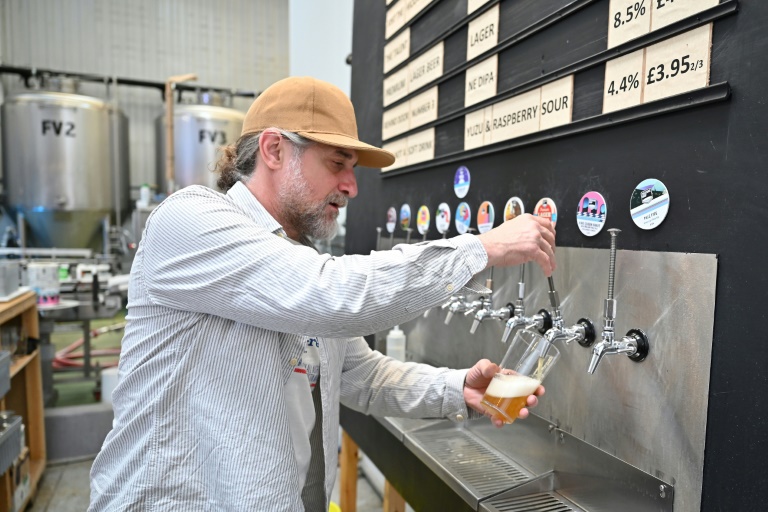
Louis Bloomsfield inspects the kegs of beer at his brewery in north London, eagerly awaiting June, when he will get an extra day off every week.

The 36-year-old brewer plans to use the time to get involved in charity work, start a long-overdue course in particle physics, and spend more time with family.

He and colleagues at the Pressure Drop brewery are taking part in a six-month trial of a four-day working week, with 3,000 others from 60 UK companies.

The pilot — touted as the world’s biggest so far — aims to help companies shorten their working hours without cutting salaries or sacrificing revenues.

Similar trials have also taken place in Spain, Iceland, the United States and Canada. Australia and New Zealand are scheduled to start theirs in August. 

Alex Soojung-Kim Pang, a programme manager at 4 Day Week Global, the campaign group behind the trial, said it will give firms “more time” to work through challenges, experiment with new practices and gather data.

Smaller organisations should find it easier to adapt, as they can make big changes more readily, he told AFP.

Pressure Drop, based in Tottenham Hale, is hoping the experiment will not only improve their employees’ productivity but also their well-being.

At the same time, it will reduce their carbon footprint.

The Royal Society of Biology, another participant in the trial, says it wants to give employees “more autonomy over their time and working patterns”.

Both hope a shorter working week could help them retain employees, at a time when UK businesses are confronted with severe staff shortages, and job vacancies hitting a record 1.3 million. 

– Not all rosy –

Pressure Drop brewery’s co-founder Sam Smith said the new way of working would be a learning process.

“It will be difficult for a company like us which needs to be kept running all the time, but that’s what we will experiment with in this trial,” he said.

Smith is mulling giving different days off in the week to his employees and deploying them into two teams to keep the brewery functioning throughout. 

When Unilever trialled a shorter working week for its 81 employees in New Zealand, it was able to do so only because no manufacturing takes place in its Auckland office and all staff work in sales or marketing.

The service industry plays a huge role in the UK economy, contributing 80 percent to the country’s GDP.

A shorter working week is therefore easier to adopt, said Jonathan Boys, a labour economist at the Chartered Institute of Personnel and Development. 

But for sectors such as retail, food and beverage, healthcare and education, it’s more problematic.

Boys said the biggest challenge will be how to measure productivity, especially in an economy where a lot of work is qualitative, as opposed to that in a factory.

Indeed, since salaries will stay the same in this trial, for a company to not lose out, employees will have to be as productive in four days as they are five.

Yet Aidan Harper, author of “The Case for a Four Day Week”, said countries working fewer hours tend to have higher productivity.

“Denmark, Sweden, the Netherlands work fewer hours than the UK, yet have higher levels of productivity,” he told AFP. 

“Within Europe, Greece works more hours than anyone, and yet have the lowest levels of productivity.”

– ‘Hiring superpower’ –

Employees in the UK work roughly 36.5 hours every week, against counterparts in Greece who clock in upwards of 40 hours, according to database company Statista. 

Phil McParlane, founder of Glasgow-based recruitment company 4dayweek.io, says offering a shorter workweek is a win-win, and even calls it “a hiring superpower”.

His company only advertises four-day week and flexible jobs.

They have seen the number of companies looking to hire through the platform rise from 30 to 120 in the past two years, as many workers reconsidered their priorities and work-life balance in the pandemic. 
Deadly nose-bleed fever shocks Iraq as cases surge

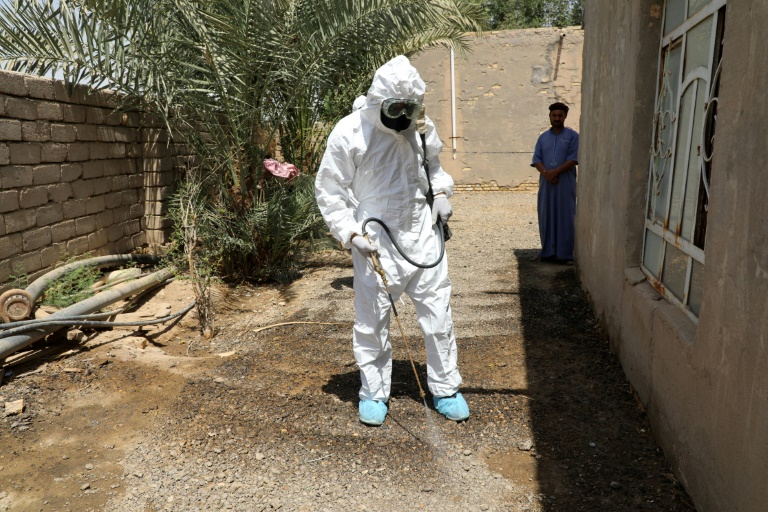
Spraying a cow with pesticides, health workers target blood-sucking ticks at the heart of Iraq’s worst detected outbreak of a fever that causes people to bleed to death.

The sight of the health workers, dressed in full protective kit, is one that has become common in the Iraqi countryside, as the Crimean-Congo haemorrhagic fever spreads, jumping from animals to humans.

This year Iraq has recorded 19 deaths among 111 CCHF cases in humans, according to the Word Health Organization.

The virus has no vaccine and onset can be swift, causing severe bleeding both internally and externally and especially from the nose. It causes death in as many as two-fifths of cases, according to medics.

“The number of cases recorded is unprecedented,” said Haidar Hantouche, a health official in Dhi Qar province.

A poor farming region in southern Iraq, the province accounts for nearly half of Iraq’s cases.

In previous years, cases could be counted “on the fingers of one hand”, he added.

Transmitted by ticks, hosts of the virus include both wild and farmed animals such as buffalo, cattle, goats and sheep, all of which are common in Dhi Qar.

– Tick bites –

In the village of Al-Bujari, a team disinfects animals in a stable next to a house where a woman was infected. Wearing masks, goggles and overalls, the workers spray a cow and her two calves with pesticides.

A worker displays ticks that have fallen from the cow and been gathered into a container.

“Animals become infected by the bite of infected ticks,” according to the World Health Organization.

“The CCHF virus is transmitted to people either by tick bites or through contact with infected animal blood or tissues during and immediately after slaughter,” it adds.

The surge of cases this year has shocked officials, since numbers far exceed recorded cases in the 43 years since the virus was first documented in Iraq in 1979.

In his province, only 16 cases resulting in seven deaths had been recorded in 2021, Hantouche said. But this year Dhi Qar has recorded 43 cases, including eight deaths.

The numbers are still tiny compared with the Covid-19 pandemic — where Iraq has registered over 25,200 deaths and 2.3 million recorded cases, according to WHO figures — but health workers are worried.

Endemic in Africa, Asia, the Middle East and the Balkans, CCHF’s fatality rate is between 10 and 40 percent, the WHO says.

The WHO’s representative in Iraq, Ahmed Zouiten, said there were several “hypotheses” for the country’s outbreak.

They included the spread of ticks in the absence of livestock spraying campaigns during Covid in 2020 and 2021.

And “very cautiously, we attribute part of this outbreak to global warming, which has lengthened the period of multiplication of ticks,” he said.

But “mortality seems to be declining”, he added, as Iraq had mounted a spraying campaign while new hospital treatments had shown “good results”.

– Slaughterhouses under scrutiny –

Since the virus is “primarily transmitted” to people via ticks on livestock, most cases are among farmers, slaughterhouse workers and veterinarians, the WHO says.

“Human-to-human transmission can occur resulting from close contact with the blood, secretions, organs or other bodily fluids of infected persons,” it adds.

Alongside uncontrolled bleeding, the virus causes intense fever and vomiting.

Medics fear there may be an explosion of cases following the Muslim festival of Eid al-Adha in July, when families traditionally slaughter an animal to feed guests.

“With the increase in the slaughter of animals, and more contact with meat, there are fears of an increase in cases during Eid,” said Azhar al-Assadi, a doctor specialising in haematological diseases in a hospital in Nasiriya.

Most of those infected were “around 33 years old”, he said, although their age ranges from 12 to 75.

Authorities have put in place disinfection campaigns and are cracking down on abattoirs that do not follow hygiene protocols. Several provinces have also banned livestock movement across their borders.

Near Najaf, a city in the south, slaughterhouses are monitored by the authorities.

The virus has adversely hit meat consumption, according to workers and officials there.

“I used to slaughter 15 or 16 animals a day — now it is more like seven or eight,” said butcher Hamid Mohsen.

Fares Mansour, director of Najaf Veterinary Hospital, which oversees the abattoirs, meanwhile noted that the number of cattle arriving for slaughter had fallen to around half normal levels.

“People are afraid of red meat and think it can transmit infection,” he said.

Cost-of-living crisis forces more Brits to foodbanks

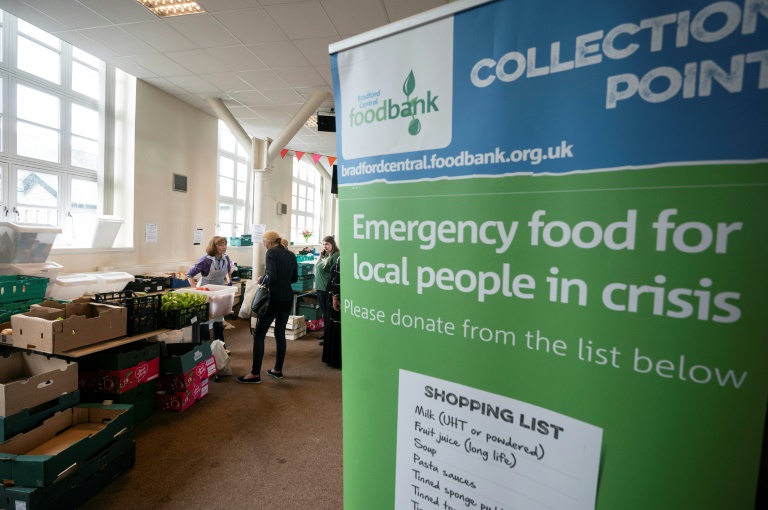
On an overcast morning in Bradford, northern England, a steady stream of locals arrive at a foodbank to collect produce parcels described as “a lifesaver” during the worst cost-of-living crisis in a generation.

Bradford Central Foodbank is helping twice as many people compared to pre-pandemic, as spiralling prices for energy, food and other basics leave a growing number of Britons struggling.

“The numbers since I’ve been a volunteer have only multiplied and I can only see it getting worse,” said Karl Carroll, 33, who has relied on the parcels since 2019 and is now volunteering at the foodbank.

“I’ve barely got £40 ($50, 47 euros) by the time I’ve paid everything out, so I imagine families are struggling in more ways,” he told AFP.

Simon Jackson, 43, an unemployed former supermarket worker who is accessing long-term government sickness benefits, has been a foodbank user since February.

“It is a tougher time at the minute… the cost of living’s skyrocketed to a point of we’re having to use foodbanks a bit more,” he said.

Jackson currently gets around £900 a month in various government support payments but, like Carroll, once his bills are paid, there is little left over for food.

Rising prices are exacerbating the situation.

“Places like (this) here in Bradford are a lifesaver. They can really help balance your decisions — sometimes between the heating and eating,” he said.

– Survival –

One of the clearest signs of the crisis is the surge in foodbank use.

The Trussell Trust charity says its more than 1,400 affiliated sites handed out 2.1 million parcels in the past year — 830,000 of them to children — in a 14 percent increase on pre-pandemic levels.

Its central Bradford operation is hosted three days a week by a local church organisation, and can supply people with only three parcels within six months to manage demand.

They contain basics such as cereal, tinned soup, meat and fish, pasta, sauces, vegetables, biscuits, sugar, tea and coffee.

Started in 2011, it is one of around 30 free food providers now in the city of just over half a million residents, and currently helps around 1,000 people a month, said manager Josie Barlow. 

Greater Bradford’s population — the sixth biggest metropolitan area in England — is the fifth most income-deprived and sixth most employment-deprived nationwide, according to the government’s last poverty index published in 2019.

That leaves it particularly vulnerable in the current climate.

“It’s people that are on the lowest incomes that’ll suffer the most… they have to buy the essentials but they’re the things that are really going up by a lot,” Barlow explained.

She greets arrivals with a warm smile and upbeat energy, directing them to collection tables as well as welfare, housing and other advisors. 

“We want to give a food parcel, but we also really want to help people with the root causes of their food crisis,” Barlow noted.

She said they receive “a whole spread of society”, which includes working as well as unemployed people.

“You do a budget with people and you’re like: ‘yeah, you just can’t live on that, can you?’ And there’s no real way out of that,” she added. 

“You can’t expect people to live like that, in crisis, just trying to survive in the long-term.”

– Winter fears –

The government announced Thursday a new £15 billion support package aimed at the most vulnerable, ahead of an expected 42 percent jump in energy bills in October — which follows a 54 percent hike last month.

Three-quarters of the money is directed at government benefits recipients, with a £650 “cost-of-living payment” to most alongside £300 for pensioners and an extra £150 for those on disability support. 

But in Bradford, as elsewhere, it cannot allay fears that worse to come.

The current nine percent inflation rate is predicted to surge even higher, which would swamp any additional support.

“I’m quite scared by this winter coming up,” admitted Barlow, noting summer allows people to get by without heating.

“Come this winter, when you really do need it on… I just don’t know how people are going to survive.”

Jackson predicted the biggest squeeze could come at Christmas, as families in particular grapple with giving presents as well as putting food on the table.

“It might not be so much for me, because I’m on my own — I’ll just put an extra blanket on or something,” he said.

“But for those with small kids that have Christmas presents and other needs… it’s really going to be tough.” 

Simone Hillhands, 34, is one. She has three children aged 10, 13 and 15. One of them has a disability, which prevents her from working full time.

Her children’s school directed her to the foodbank.

“I need to care for them,” she explained.

Reluctant to reveal too much of her personal circumstances, Hillhands confided that her sister had recently been made homeless and the wider family’s situation was “really, really hard” with prices rising.

“They’ve gone through the roof… it’s crazy!” she said, adding that despite the pandemic, “last year was a lot easier”.

Jordan's plastic trash turned into art with a message

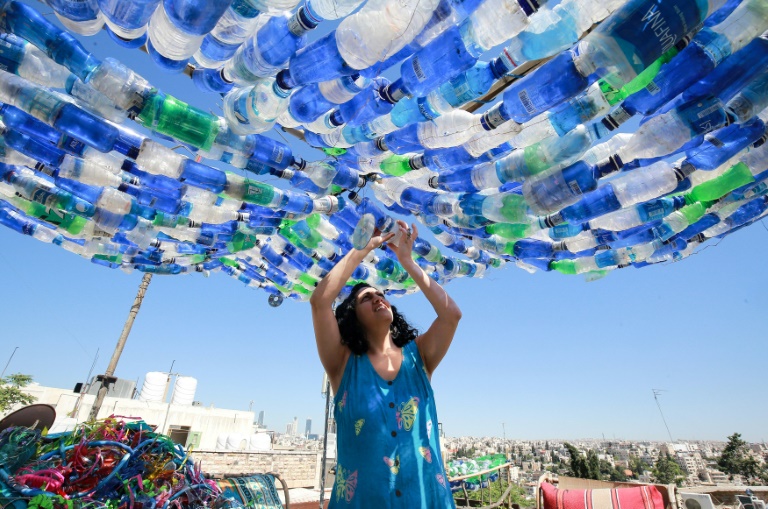
Jordan-based artist Maria Nissan is on a mission: to rid the world of single-use plastics and to raise public awareness about the environmental scourge through eye-catching art.

One of her best-known murals graces the side of a building in the capital Amman, a giant work made from more than 2,000 plastic bottles, almost 1,000 shopping bags and over 150 hookah pipe hoses.

A US citizen of Iraqi origin, Nissan said she became enchanted with Amman when she first visited three years ago, but also felt “frustration and anger” at the piles of garbage on the streets and in areas of natural beauty. 

“Despite the beauty of the city, walking its streets can be a journey filled with all kinds of trash,” the 35-year-old said.

“My eyes cannot turn away from the abundant shiny plastic bags, glass bottles, soda cans, candy bar wrappers,” said Nissan, who occasionally sports a dress made from a sturdy blue Ikea bag.

Trained in painting and drawing in the United States and Italy, Nissan decided to collect and repurpose the trash to create art — often collages themed on women’s faces, flowers and Oriental motifs.

Her home, where she has a rooftop workspace under a large canopy, is filled with every imaginable kind of discarded plastic object, from razors and toothbrushes to lighters, pens and plastic spoons.

“Art made of plastic is a concrete and powerful way to raise concerns on environmental issues that affect Jordanians, their children, their communities and natural environments in the kingdom,” she said.

– ‘Everybody’s problem’ –

“A bottle littered in a valley will take up to 450 years to decompose,” said Nissan, pointing out that the effect is “micro-plastics polluting the soils, water and the wildlife.

“Because plastics are littered indiscriminately in fields and water, livestock and fish feed themselves indirectly with plastic pieces that we will ultimately find on our plates.” 

Nissan’s work has been exhibited in 12 shows in Jordan as well as in Italy and Greece, and features on her Instagram channel @marianissanart, all with the purpose of changing minds and habits.

Jordanians use three billion plastic bags every year, part of the country’s annual solid waste load of 2.2 million tonnes, of which only seven percent is recycled, according to the UN Development Programme.

Nissan urges people to avoid buying plastic products and to go shopping with reusable bags, and also advocates a tax on single-use plastics.

“The consequences of single-use plastic pollution are often delayed, and therefore it is difficult to have people feel accountable and responsible for their own acts,” she said.

“Plastic comes back to us in one way or another … It’s nobody’s responsibility until it becomes everybody’s problem.”

Jerusalem on high alert ahead of Israeli 'flag march'

Jerusalem is bracing for a controversial “flag march” by Israelis on Sunday that has sparked warnings of a new escalation from Palestinian factions.

The “March of the Flags” threatens to exacerbate weeks of tensions between Israelis and Palestinians, and comes as Israel marks “Jerusalem Day”, commemorating the city’s unification following the capture of east Jerusalem in 1967.

Some 3,000 policemen are to be deployed ahead of the march, due to begin at 4:00 pm (1300 GMT).

Clashes surrounding the Jewish calendar date for Jerusalem Day last year led to an 11-day conflict after Hamas fired rockets at Israel, prompting Israel to launch strikes in response. The war cost the lives of 260 Palestinians, including 66 children, while 14 people were killed in Israel, including one child.

Hamas, the Palestinian Islamist movement that rules the blockaded Gaza Strip, warned last week against the march passing through the Al-Aqsa mosque compound, saying it would use “all possibilities” to confront them.

Israeli marchers are expected to enter the Old City via Damascus Gate, heavily used by Palestinians, before making their way to the Western Wall.

But Israeli authorities have not approved requests to enter the flashpoint Al-Aqsa compound.

The path of the march has never included Al-Aqsa.

The Al-Aqsa mosque compound is Islam’s third-holiest site, which is also the most holy site for Jews, who call it the Temple Mount. By long-held convention, Jews are allowed to enter the compound but not to pray there.

On the eve of the march, Hamas called on Palestinians to gather at Al-Aqsa to “thwart the occupation’s Judaisation schemes”.

“We will not hesitate to use all means to stop the incursion of our holy places, and Israel will pay a big price,” Ghazi Hamad, a member of the Islamist group’s political bureau, told AFP.

– ‘Calculated policy’ –

Israeli Prime Minister Naftali Bennett has nonetheless confirmed the march would “take place according to the planned route, as it has for decades”.

The march has been described by leading Israeli daily Yediot Aharonot as a “personal test” for Bennett, marking a departure in strategy compared with that of his predecessor Benjamin Netanyahu.

Whereas Netanyahu chose a “noisy policy of capitulation” that ended with Hamas firing rockets at Israel, Bennett was adopting a “calm and calculated policy”, the daily said.

According to security analyst Shlomo Mofaz, Bennett was betting on the likelihood that “Hamas does not have any interest in another war”.

“The main policy of Hamas today is to encourage people inside Israel (to attack), while they continue to reconstruct the Gaza Strip,” added the former intelligence officer.

But there is another factor at play — Iran, the Jewish state’s arch-nemesis and a supporter of armed factions in Gaza.

According to the New York Times, Israel has informed the United States that it was responsible for an attack in which Iranian Revolutionary Guards colonel Sayyad Khodai was gunned down in Tehran last week.

As a result, Mofaz said, Iran may “encourage” Palestinian armed factions to launch rockets at Israel.

The United Nations envoy for Middle East peace, Tor Wennesland, on Friday appealed to “all sides to exercise maximum restraint… to avoid another violent conflict that will only claim more lives”.

“The message of the international community is clear; to avoid such an escalation,” he said.

Despite some sharp wage rises, low-paid US workers have far to go

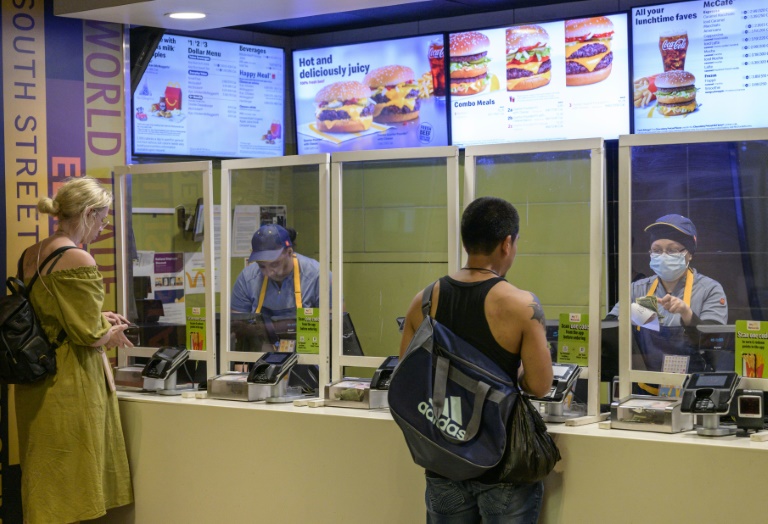
Fast-food employees in Manhattan demonstrating for a wage of $20 an hour: a demand unthinkable before the Covid-19 pandemic has become unexceptional, as short-handed companies offer big wage increases without, however, doing much to narrow a yawning income gap.

The upward wage pressure has come from several sources, including an unusually tight labor market and child-care challenges linked to the pandemic, as well as chronically underpaid workers unwilling to return to pre-pandemic conditions.

Employers have not only had to raise wages but in some cases have offered improved health care insurance and bonuses.

“The country’s major employers have understood that they need to bring wages up to scratch if they want to attract reliable workers who can help them navigate this period of major uncertainty,” said Gregory Daco, chief economist at Ernst & Young Parthenon.

Apple, after announcing it was raising its hourly minimum wage to $22, said in a statement, “Supporting and retaining the best team members in the world enables us to deliver the best, most innovative products and services for our customers.”

The tech giant said that in addition to sector-leading wages, it was providing “a robust range of benefits” for full- and part-time employees.

Higher wages may also help Apple in its efforts, like Amazon, to discourage unionization efforts. 

Apple’s $22 hourly minimum represents a 45 percent increase from the company’s minimum in 2018, the group said.

– Winning workers’ loyalty –

In the summer of 2021, facing serious labor shortages, several major companies including Amazon, Target and Chipotle pushed their base hourly wage past $15, more than double the federal minimum of $7.25, a figure unchanged since 2009. 

Bank of America announced this week that it was lifting its hourly minimum to $22, a figure set to rise to $25 by 2025.

Across the US, some of the biggest wage increases have gone to some of the lowest-paid workers — people unafraid in the Covid era to make their demands known. 

While there have been wage increases at all salary levels, only the lowest-paid workers saw rises big enough to compensate for today’s high inflation rates, according to Mahir Rasheed, an economist with Oxford Economics.

Put another way, he said, “Even with stronger incomes, most consumers are actually seeing wages down in real terms.”

– Deceptive wage hikes –

So even if the increases might appear significant — particularly for restaurant and hotel employees — workers in that sector are still earning less than the national median salary.

“The increases look huge, with some workers going from $7 to $10, from $10 to $12, from $12 to $15 or even from $15 to $20,” said Daco.

And yet, he added, “$15 an hour is $30,000 a year, considerably less than the (US) median salary of $50,000 to $60,000.”

What’s more, the increases might be a one-time affair.

“It’s unlikely that these wage gains will continue to increase at a persistent clip over the next year,” said Rasheed, even if some companies make occasional raises in a bid to attract qualified workers.

The increases are bound to slow, he added, as more and more people return to work.

As the labor market opens up, workers’ negotiating power will erode, Daco said.

“Unfortunately, I don’t expect those gains to be durable in the long term, because we haven’t seen increases in the federal minimum wage,” said Elise Gould, an economist with the Economic Policy Institute, an American think tank.  

She predicted “a decided slowdown in wage gains.”

In a study published last month, she noted that average wages rose by 4.4 percent in the first year of the pandemic in the US, but declined by 1.7 percent in the second year.

And despite the recent increases, “wage levels remain vastly unequal across the US labor market, with disparities among workers by wage level, gender and race/ethnicity remaining stark,” Gould wrote.

Downpours in Brazil leave at least 34 dead

Torrential rains that have plagued Brazil’s northeastern Pernambuco state since Tuesday have left at least 34 dead, 29 of which occurred over the previous day, according to the latest official update.

“From last Wednesday until midday this Saturday, 34 deaths were recorded in the state,” said the Civil Defense in a statement.

The most dramatic event occurred early Saturday morning when 19 people died in a major landslide in the Jardim Monteverde community, on the border between state capital Recife and the municipality of Jaboatao dos Guararapes.

Six others were killed in another landslide in the municipality of Camaragibe. Two died in Recife and another in Jaboatao dos Guararapes. 

Five others died earlier in the week, according to the Civil Defense.

Local press reports said three were killed by a landslide in Olinda, and a fourth person died after falling into a canal, also in Olinda.

The heavy rains have also forced almost 1,000 people to flee their homes due to the flooding and landslides.

President Jair Bolsonaro, in a tweet, expressed his “sorrow and solidarity to the victims of this sad disaster” and said his government will do everything possible “to alleviate the suffering.”

He added that teams from the Armed Forces, the Ministry of Defense and the Ministry of Citizenship are being deployed “to assist in relief operations and provide the necessary aid to affected families.”

Videos posted on social media show wide flooded avenues in several municipalities, collapsing houses and landslides.

According to meteorologist Estael Sias, of the MetSul agency, the heavy rains lashing Pernambuco and, to a lesser extent, four other northeastern states, are the product of a typical seasonal phenomenon called “eastern waves.”

He explained that those are areas of “atmospheric disturbance” that move from the African continent to Brazil’s northeastern coastal region.

“In other areas of the Atlantic this instability forms hurricanes, but in northeastern Brazil it has the potential for a lot of rain and even thunderstorms,” he said.

— ‘Red alert’ —

The National Institute of Meteorology (Inmet) maintained its “red alert” through Sunday in Pernambuco, its highest level of warning for flooding and landslides.

Between Friday night and Saturday morning, the volume of rainfall reached 236 millimetres (nine inches) in some parts of the Pernambuco capital, according to the mayor’s office.

That is equivalent to more than 70 percent of the forecast for the whole month of May in the city. 

The Pernambuco Water and Climate Agency said the situation could worsen as rain will continue for the next 24 hours in the state.

Over the past year, hundreds of Brazilians have died in flooding and landslides brought on by torrential downpours.

In February, more than 230 people were killed in the city of Petropolis, the Brazilian empire’s 19th-century summer capital, in Rio de Janeiro state.

Heavy rainfall turned streets in the area to gushing rivers and triggered landslides in poor hillside neighborhoods that wiped out virtually everything in their path.

Early last month 14 more people were killed, also by flooding and landslides in Rio de Janeiro state.

The victims included a mother and six of her children, who were buried when a landslide swept away their home, officials said.

Experts say rainy season downpours in Brazil are being augmented by La Nina — the cyclical cooling of the Pacific Ocean — and by climate change.

Because a hotter atmosphere holds more water, global warming increases the risk and intensity of flooding from extreme rainfall.

Downpours in Brazil leave at least 34 dead

Torrential rains that have plagued Brazil’s northeastern Pernambuco state since Tuesday have left at least 34 dead, 29 of which occurred over the previous day, according to the latest official update.

“From last Wednesday until midday this Saturday, 34 deaths were recorded in the state,” said the Civil Defense in a statement.

The most dramatic event occurred early Saturday morning when 19 people died in a major landslide in the Jardim Monteverde community, on the border between state capital Recife and the municipality of Jaboatao dos Guararapes.

Six others were killed in another landslide in the municipality of Camaragibe. Two died in Recife and another in Jaboatao dos Guararapes. 

Five others died earlier in the week, according to the Civil Defense.

Local press reports said three were killed by a landslide in Olinda, and a fourth person died after falling into a canal, also in Olinda.

The heavy rains have also forced almost 1,000 people to flee their homes due to the flooding and landslides.

President Jair Bolsonaro, in a tweet, expressed his “sorrow and solidarity to the victims of this sad disaster” and said his government will do everything possible “to alleviate the suffering.”

He added that teams from the Armed Forces, the Ministry of Defense and the Ministry of Citizenship are being deployed “to assist in relief operations and provide the necessary aid to affected families.”

Videos posted on social media show wide flooded avenues in several municipalities, collapsing houses and landslides.

According to meteorologist Estael Sias, of the MetSul agency, the heavy rains lashing Pernambuco and, to a lesser extent, four other northeastern states, are the product of a typical seasonal phenomenon called “eastern waves.”

He explained that those are areas of “atmospheric disturbance” that move from the African continent to Brazil’s northeastern coastal region.

“In other areas of the Atlantic this instability forms hurricanes, but in northeastern Brazil it has the potential for a lot of rain and even thunderstorms,” he said.

— ‘Red alert’ —

The National Institute of Meteorology (Inmet) maintained its “red alert” through Sunday in Pernambuco, its highest level of warning for flooding and landslides.

Between Friday night and Saturday morning, the volume of rainfall reached 236 millimetres (nine inches) in some parts of the Pernambuco capital, according to the mayor’s office.

That is equivalent to more than 70 percent of the forecast for the whole month of May in the city. 

The Pernambuco Water and Climate Agency said the situation could worsen as rain will continue for the next 24 hours in the state.

Over the past year, hundreds of Brazilians have died in flooding and landslides brought on by torrential downpours.

In February, more than 230 people were killed in the city of Petropolis, the Brazilian empire’s 19th-century summer capital, in Rio de Janeiro state.

Heavy rainfall turned streets in the area to gushing rivers and triggered landslides in poor hillside neighborhoods that wiped out virtually everything in their path.

Early last month 14 more people were killed, also by flooding and landslides in Rio de Janeiro state.

The victims included a mother and six of her children, who were buried when a landslide swept away their home, officials said.

Experts say rainy season downpours in Brazil are being augmented by La Nina — the cyclical cooling of the Pacific Ocean — and by climate change.

Because a hotter atmosphere holds more water, global warming increases the risk and intensity of flooding from extreme rainfall.

'Polarized election' – Bogota voters weigh presidential options

Six men will contest Sunday’s first-round presidential election in Colombia, but most voters are zooming in on one of three frontrunners they hope holds the answers to the country’s many pressing problems.

For residents of the capital Bogota, a city of eight million, those issues include violent crime, deep-rooted inequality and fast-rising consumer prices.

Leftist former Bogota mayor and ex-guerrilla Gustavo Petro, 62, holds a seemingly unassailable lead in opinion polls, followed by right-wing candidate Federico Gutierrez, 47 — an erstwhile mayor of second city Medellin.

Rising in the polls, but never higher than third place, is anti-corruption candidate Rodolfo Hernandez, a 77-year-old businessman.

Here is a sample of voters in their own words:

– For Petro –

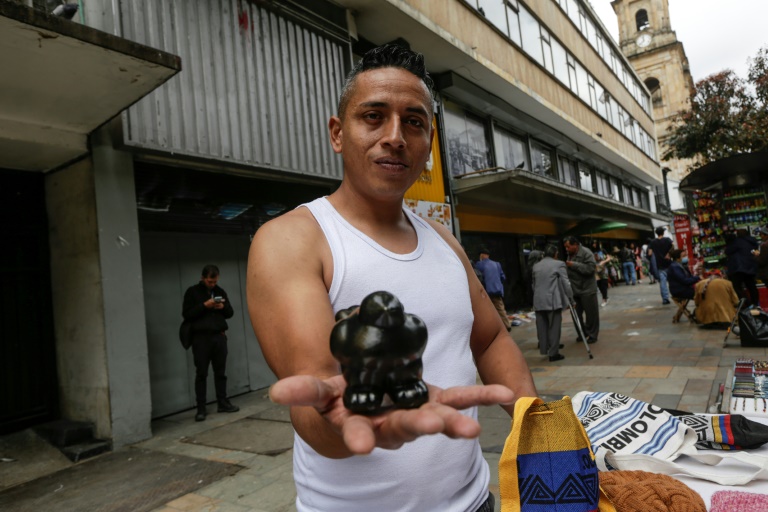
Jhon Richard Pejendino, 33, sells art on the streets of Bogota but would have liked to be a lawyer.

He did not have money to go to university.

“There are public universities but you have to have very good marks to get in. If you don’t have the marks you must pay, and if you do not have money, you do not get educated.”

Pejendino supports Petro, who he believes “is for us, the poor.”

The World Bank says Colombia is one of the countries of Latin American with the worst income inequality and biggest underground labor markets.

Shoe shiner Jaime Guerrero, 55, said crime and scant public transport were his main concerns.

“When he (Petro) was mayor, he did good things for the people, and we are hopeful he will do better as president,” he said with a broad smile revealing many missing teeth.

Jewelery store worker Rosa Empera Alvis, 60, said she hoped Petro would negotiate with Colombia’s last guerrilla group, the ELN — as he has promised — and finally bring lasting peace to the violence-plagued country.

And office cleaner Petrona Guzman, 43, said that as president, Petro should take steps to “bring down the cost of the basket of basic goods, which is very expensive, especially food.”

She said she also believed Colombians deserved better access to health care, pensions and unemployment benefits.

“And we have to change education. Many people send their children out to work rather than university, because they do not have the money.”

– For Gutierrez –

Maria Elvira Almanzar, a 71-year-old retired industrial designer, has put her faith in Gutierrez’s “strong state” anti-crime stance.

“Security is the most important thing. One should be able to walk in the street without looking over your shoulder for who is going to rob you,” she told AFP as she did exactly that.

Fear of crime is a common complaint for people of all social classes.

According to official data, Bogota registered 8.4 murders per 100,000 inhabitants in 2021, a percentage point higher than the previous year but not among the highest in the world.

There were also 108,000 reported muggings — often committed with guns– in 2021, an increase of 24,000 in one year.

For Almanzar, like many other Colombians, the political left “is an extremist thing” historically associated with the guerrilla groups that she said sowed murder and mayhem for decades until a 2016 peace deal ended a near six-decade civil conflict.

Wilson, a hotel porter of 40 who did not want to give his full name for fear of getting into trouble at work, said he, too, was distrustful of the left.

“This is one of the most polarized elections yet,” he told AFP while on a break outside his place of work on the eve of elections.

“There is a saying that people deserve the leader they have, so if people want to elect him (Petro), they have to accept the consequences.”

– For Hernandez – 

Businessman Freddy Montoya, 42, said he preferred Hernandez’s focus on fighting corruption, and was distrustful of Petro’s leftist leanings: “He is very close to communism.”

– Undecided –

Carlos Caisedo, 78, sells cleaning rags on the street to make enough money to eat and rent a room for the night.

He has not decided who to vote for because “everyone makes promises but in the end, no one fulfils them.”

Caisedo is clear, though, on what the main issues are: “Insecurity and the lack of employment opportunities.”

“For example, in my case: why am I in the street at this age? Because I need to pay rent. I do not have help from the state.”

– Staying away –

Andrea Perez, 30, sells trinkets on the streets of Bogota and is one the many who abstain from voting — some 50 percent in recent elections.

“I do not vote because it is always the criminals who win,” she told AFP.

Harrowing new accounts emerge from Uvalde's young survivors

Fresh harrowing accounts emerged Saturday of the ordeal faced by survivors of the school shooting in Uvalde, Texas, fanning public fury over the massacre ahead of a visit Sunday by US President Joe Biden.

As residents gathered Saturday in a central square to pay homage to the victims, haunting stories told by young students who played dead while a gunman killed 19 classmates and two teachers were underscored by accounts of the slow reaction to the spree by police. 

Ten-year-old Samuel Salinas was sitting in his fourth-grade classroom when the shooter, later identified as Salvador Ramos, 18, barged in with a chilling announcement: “You’re all going to die.”

Then “he just started shooting,” Salinas told ABC News.

Texas authorities belatedly admitted Friday that as many as 19 police officers were in the school hallway for more than an hour without acting, thinking the shooter had ended his killing, calling it the “wrong decision.”

Ramos, who carried two assault-style rifles, was finally killed by police.

Uvalde survivors have described making desperate, whispered pleas for help in 911 phone calls during his assault. Many played dead to avoid drawing the shooter’s attention.

Eleven-year-old Miah Cerrillo even smeared the blood of a dead friend on herself as she feigned death. 

Samuel Salinas said he thinks Ramos fired at him, but the bullet struck a chair, sending shrapnel into the boy’s leg. “I played dead so he wouldn’t shoot me,” he said.

Another student, Daniel, whose mother would not provide his last name, said he saw Ramos fire through the glass in the classroom door, striking his teacher.

The bullets were “hot,” he told the Washington Post, and when another bullet ricocheted and struck a fellow student in the nose, he said he could hear the sickening sound it made.

Though his teacher lay on the floor bleeding, she repeatedly told the students, “‘Stay calm. Stay where you are. Don’t move,'” Daniel recalled.

He was finally rescued by police who broke the windows of his classroom. Since then, he has had recurrent nightmares.

By mid-morning Saturday, several dozen people had gathered at Uvalde’s courthouse square, which has become a somber place of homage to victims and survivors. 

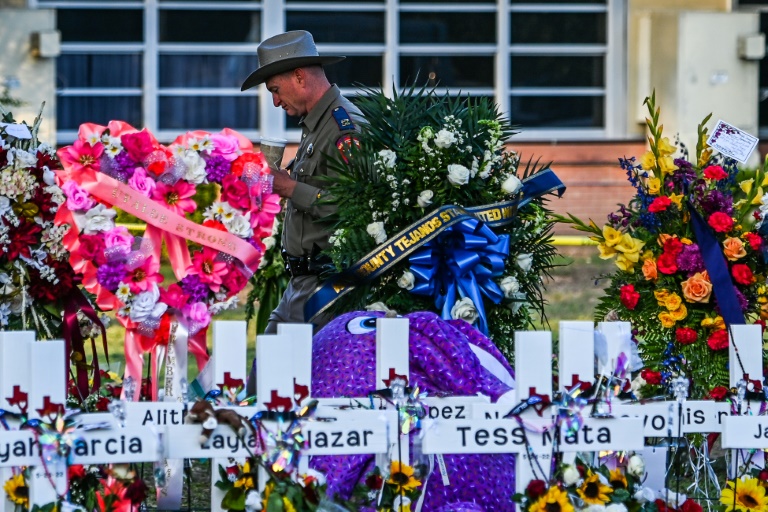
Twenty-one simple white crosses have been erected around a fountain — one for each victim. 

People have left growing piles of stuffed animals and flowers, as well as heart-rending messages: “Love you” and “You will be missed.”

Local resident Humberto Renovato, 33, asked those present to hold hands, form a circle around the crosses, and pray. 

– ‘Too much fear. Too much grief’ –

President Joe Biden will visit Uvalde on Sunday to again make the case for gun control, as activists set about galvanizing voters on the issue in the run-up to November’s midterm election.

Despite the scourge of mass shootings, efforts at nationwide gun control have repeatedly failed, though polls show broad support from Americans.

Speaking at a University of Delaware commencement on Saturday, Biden — himself a grieving father twice over — evoked the image of parents preparing to bury their children in Texas, and lamented “too much violence. Too much fear. Too much grief.”

“We have to stand stronger,” he told the graduates at his alma mater. 

Biden’s deputy, Vice President Kamala Harris, issued a similar call Saturday as she attended the funeral of another mass shooting victim — Ruth Whitfield, who was among the 10 killed when a white supremacist opened fire in a supermarket in Buffalo on May 14.

“We will not let those people who are motivated by hate to separate us or make us feal fear,” Harris said at the funeral for the 86-year-old.

Back in Texas, the state Senate Democratic caucus issued a call Saturday for Governor Greg Abbott to convene an emergency session of the state legislature to pass legislation to raise the minimum age for firearm purchases, among other measures. 

Chances of substantive change there appeared slim, however. Texas has long been one of the most gun-friendly states.

The Uvalde shooting was the deadliest school attack since 20 children and six staff were killed at the Sandy Hook school in Newtown, Connecticut in 2012.

Texas public safety department director Steven McCraw on Friday revealed a series of emergency calls — including by a child begging for police help — that were made from two adjoining classrooms where the gunman was barricaded.

But, explaining the delayed reaction by law enforcement, he said the on-scene commander believed at the time that Ramos was in there alone, with no survivors, after his initial assault.

McCraw separately told reporters, however, that a 911 call received at 12:16 pm reported eight or nine children still alive. 

As many as 19 officers were outside the classroom door at that time, according to McCraw’s timeline.

McCraw said one caller — a child who dialed 911 multiple times — begged for police to come. Her final call was cut off as she made it outside.

Meantime in Uvalde, Humberto Renovato urged those gathered at the courthouse square to help survivors overcome “the trauma, the pain, the suffering” they had endured.

“As a community,” he said, “we have to develop strategies of how we’re going to help these kids to get out of that trauma, to get out of that pain.”

Close Bitnami banner
Bitnami