World

Vanuatu declares climate emergency

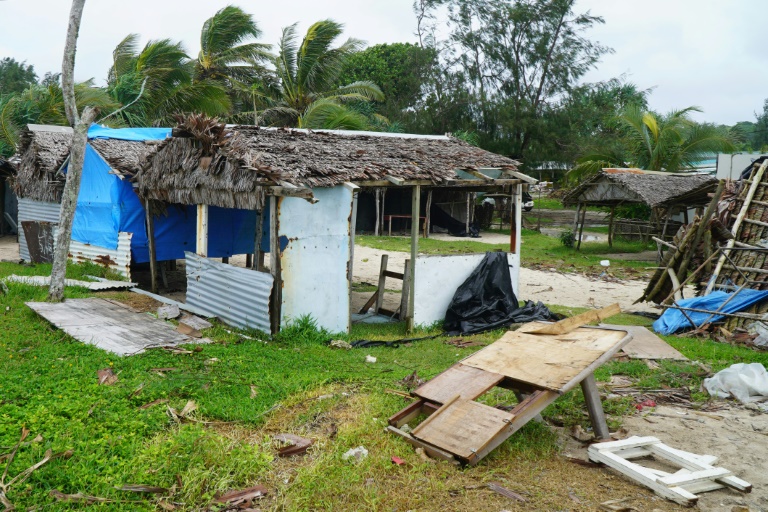
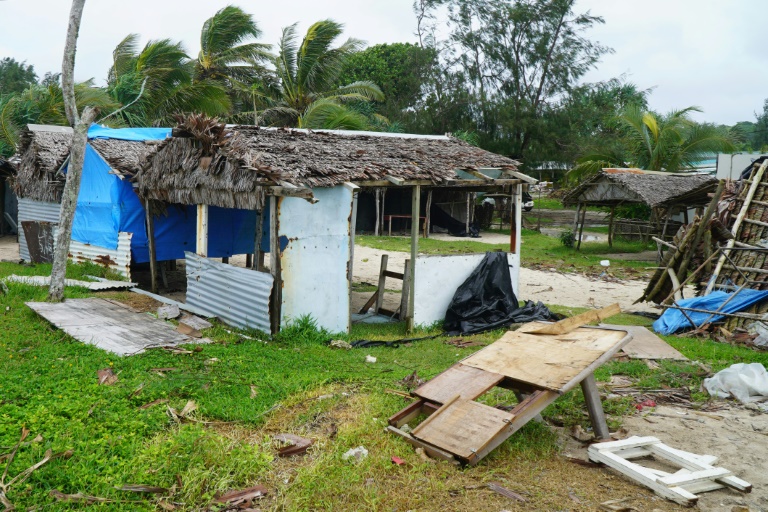
Vanuatu’s parliament has declared a climate emergency, with the low-lying island nation’s prime minister flagging a US$1.2 billion cost to cushion climate change’s impacts on his country.

Speaking to parliament in Port Vila on Friday, Prime Minister Bob Loughman said rising sea levels and severe weather were already disproportionately affecting the Pacific — highlighting two devastating tropical cyclones and a hard-hitting drought in the last decade.

“The Earth is already too hot and unsafe,” Loughman said. 

“We are in danger now, not just in the future.”

The parliament unanimously supported the motion, and it follows similar declarations by dozens of other countries, including Britain, Canada and South Pacific neighbour Fiji. 

“Vanuatu’s responsibility is to push responsible nations to match action to the size and urgency of the crisis,” the leader said.

“The use of the term emergency is a way of signalling the need to go beyond reform as usual.”

The declaration was part of a “climate diplomacy push” ahead of a UN vote on his government’s application to have the International Court of Justice move to protect vulnerable nations from climate change. 

Last year, the nation of around 300,000 said it would seek a legal opinion from one of the world’s highest judicial authorities to weigh in on the climate crisis.

Though a legal opinion by the court would not be binding, Vanuatu hopes it would shape international law for generations to come on the damage, loss and human rights implications of climate change.

He also outlined the country’s enhanced commitment to the Paris agreement to be reached by 2030 at the cost of at least US$1.2 billion — in a draft plan primarily focused on adapting to climate change, mitigating its impacts and covering damages. 

Most of the funding would need to be from donor countries, he said.

This week, Australia’s new Foreign Minister Penny Wong used a trip to Fiji to promise Pacific nations a reset on climate policy after a “lost decade” under conservative rule.

“We will end the climate wars in our country; this is a different Australian government and a different Australia. And we will stand shoulder to shoulder with you, our Pacific family, in response to this crisis,” Wong told a Pacific Island Forum event.

Vanuatu declares climate emergency

Vanuatu’s parliament has declared a climate emergency, with the low-lying island nation’s prime minister flagging a US$1.2 billion cost to cushion climate change’s impacts on his country.

Speaking to parliament in Port Vila on Friday, Prime Minister Bob Loughman said rising sea levels and severe weather were already disproportionately affecting the Pacific — highlighting two devastating tropical cyclones and a hard-hitting drought in the last decade.

“The Earth is already too hot and unsafe,” Loughman said. 

“We are in danger now, not just in the future.”

The parliament unanimously supported the motion, and it follows similar declarations by dozens of other countries, including Britain, Canada and South Pacific neighbour Fiji. 

“Vanuatu’s responsibility is to push responsible nations to match action to the size and urgency of the crisis,” the leader said.

“The use of the term emergency is a way of signalling the need to go beyond reform as usual.”

The declaration was part of a “climate diplomacy push” ahead of a UN vote on his government’s application to have the International Court of Justice move to protect vulnerable nations from climate change. 

Last year, the nation of around 300,000 said it would seek a legal opinion from one of the world’s highest judicial authorities to weigh in on the climate crisis.

Though a legal opinion by the court would not be binding, Vanuatu hopes it would shape international law for generations to come on the damage, loss and human rights implications of climate change.

He also outlined the country’s enhanced commitment to the Paris agreement to be reached by 2030 at the cost of at least US$1.2 billion — in a draft plan primarily focused on adapting to climate change, mitigating its impacts and covering damages. 

Most of the funding would need to be from donor countries, he said.

This week, Australia’s new Foreign Minister Penny Wong used a trip to Fiji to promise Pacific nations a reset on climate policy after a “lost decade” under conservative rule.

“We will end the climate wars in our country; this is a different Australian government and a different Australia. And we will stand shoulder to shoulder with you, our Pacific family, in response to this crisis,” Wong told a Pacific Island Forum event.

Cannes set to pick Palme d'Or from 'wildly divisive' entries

The 75th edition of the Cannes Film Festival draws to a close on Saturday with one of the tightest races in recent memory and critics fiercely divided over the 21 films competing for the Palme d’Or.

The 12 days of the world’s foremost film fest has been a blast of technicolour grandeur, kickstarted by Tom Cruise with his first trip to Cannes in 30 years to launch “Top Gun: Maverick”, accompanied by a French Air Force display team.

It was a great year for music-lovers — Baz Luhrmann shaking things up with his much-anticipated rock’n’roll biopic, “Elvis” and critics blown away by an ultra-immersive documentary about David Bowie, “Moonage Daydream”.

In the main competition, the most searing images were no doubt in “Triangle of Sadness” with its extended sequence of projectile vomiting and violent diarrhoea on a cruise ship, that left audiences either howling with laughter or turning green. 

Elsewhere, the entries tackled everything from a serial killer “cleansing” an Iranian holy city of prostitutes (“Holy Spider”) to the difficulties faced by migrants in Romania (“RMN”) and Belgium (“Tori and Lokita”) to a film told entirely from the point of view of a donkey (“EO”).

There was a wealth of Korean talent on the red carpet, with “Squid Game” star Lee Jung-Jae showing his directorial debut, “Hunt”, while Song Kang-ho (“Parasite”) and K-pop superstar Lee Ji-eun starred in touching adoption tale “Broker”. 

– ‘Wildly divisive’ –

There was also bitter debate over the nomination of a Russian director, Kirill Serebrennikov, for his film “Tchaikovsky’s Wife”. 

Even though he explicitly condemned the war, some Ukrainians at the festival argued there was no such thing as “a good Russian” in the current context, while others — such as documentary-maker Sergei Loznitsa — said such attitudes were “inhumane”.

Critics seemed unable to coalesce around any of the films in competition. 

The possible exceptions were “Armageddon Time”, a story about the friendship between a young Jewish American boy and his Black schoolmate in 1980s Queens, starring Anthony Hopkins and Anne Hathaway 

Also gaining mostly strong reviews was “Decision to Leave” — another Korean entry. The Hitchcockian tale about a detective falling for a murder suspect comes from Park Chan-wook, known for his wild thriller “Oldboy”.

There was also a huge amount of buzz around one of the last films to show at the festival, “Close”, the tender story of two young boys learning to grapple with their budding sexuality.  

“Kind of loving that there’s barely a film in Cannes (competition) this year which isn’t wildly divisive,” tweeted Britain’s Telegraph critic Tim Robey, listing eight entries that were “despised AND adored”. 

It falls to a different jury of film professionals each year to decide the Palme d’Or and other prizes, which will be announced on Saturday night. 

This year, the jury is led by French actor Vincent Lindon, who starred in last year’s popular and gory winner, “Titane”, only the second time the top prize went to a woman — French director Julia Ducournau. 

Among the eight other jury members are two-time Oscar-winning Iranian director Asghar Farhadi, Indian superstar Deepika Padukone and British-American actress-director Rebecca Hall. 

Samoa signs China agreement amid South Pacific push

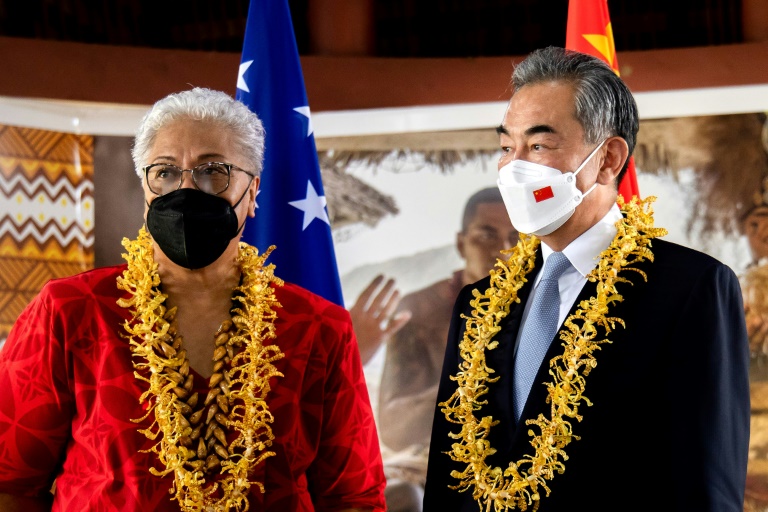
Samoa signed a bilateral agreement with China on Saturday, promising “greater collaboration” as Beijing’s foreign minister continues a tour of the South Pacific that has sparked concern among Western allies.

The deal’s details are unclear, coming midway through a Chinese delegation’s eight-nation trip — but an earlier leaked draft agreement sent to several Pacific countries outlined plans to expand security and economic engagement.

The mission has prompted Western leaders to urge regional counterparts to spurn any Chinese attempt to extend its security reach across the region.

A press release from the Samoan government confirmed that Chinese Foreign Minister Wang Yi and Samoan Prime Minister Fiame Naomi Mata’afa had met and discussed “climate change, the pandemic and peace and security”.

Local media were invited to witness the signing of a deal, but no questions were taken.

The release said that China would continue to provide infrastructural development support to various Samoan sectors and there would be a new framework for future projects “to be determined and mutually agreed”.

“Samoa and the People’s Republic of China will continue to pursue greater collaboration that will deliver on joint interests and commitments,” the release said.

The Chinese delegation has already visited the Solomon Islands and Kiribati this week.

It arrived in Samoa on Friday night and was to depart for Fiji on Saturday afternoon, with other stops expected to be Tonga, Vanuatu, Papua New Guinea and East Timor.

In a duel for influence, Australia’s new Foreign Minister Penny Wong was in Fiji on Friday, seeking to woo island states after the Solomon Islands took Canberra by surprise last month by signing a wide-ranging security pact with China.

“We have expressed our concerns publicly about the security agreement,” Wong told reporters in the capital of Suva.

“As do other Pacific islands, we think there are consequences. We think that it’s important that the security of the region be determined by the region. And historically, that has been the case. And we think that is a good thing.”

At the first stop in Honiara on Thursday, Wang lashed out at “smears and attacks” against the security pact already signed with the Solomon Islands.

While the wide-ranging draft agreement and a five-year plan circulated to several pacific nations, both obtained by AFP, would give China a larger security footprint in a region seen as crucial to the interests of the United States and its allies.

In a stark letter to fellow Pacific leaders, Federated States of Micronesia President David Panuelo warned the agreement seems “attractive” at first glance but would allow China to “acquire access and control of our region”.

Ukraine says 'everything' being done to defend Donbas from Russian onslaught

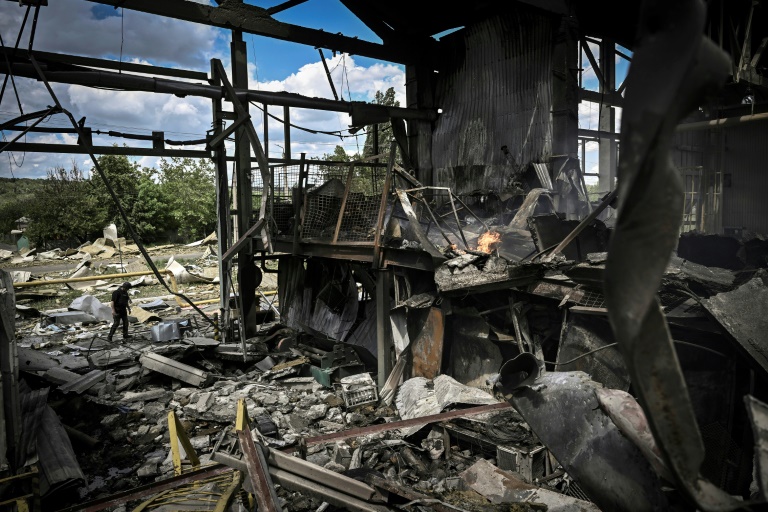
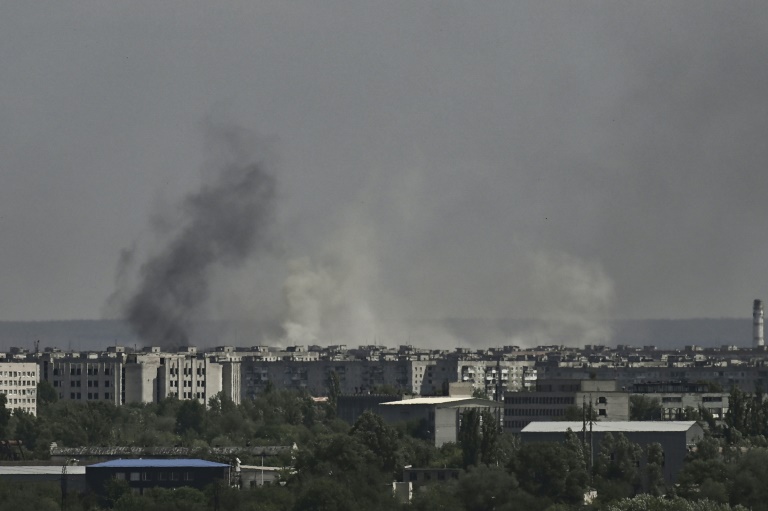
Ukraine has pledged to do “everything” to defend Donbas, where an intensifying Russian offensive is prompting Kyiv’s forces to consider a strategic retreat from some key areas to avoid being surrounded.

Russia is waging all-out war for the eastern Donetsk and Lugansk regions that make up Donbas — the country’s industrial heartland — where Ukraine’s President Volodymyr Zelensky has accused Moscow of carrying out a “genocide”.

In his daily address to Ukrainians, Zelensky said the Russians had “concentrated maximum artillery, maximum reserves in Donbas.”

“There are missile strikes and aircraft attacks — everything,” he said. 

“We are protecting our land in the way that our current defense resources allow,” he added. “We are doing everything to increase them.”

Pro-Russian separatists said Friday they had captured the town of Lyman between Severodonetsk and Kramatorsk, on the road leading to the key cities still under Kyiv’s control.

Russian forces are also closing in on Severodonetsk and Lysychansk in the Lugansk province, with conflicting reports about the extent of their advance.

Regional governor Sergiy Gaiday insisted that the Russian forces would not be able to seize the entire region within two to three days — but said that Ukraine’s troops may have to withdraw from some areas to avoid being surrounded. 

“Most probably they will not seize (Lugansk), because there’s enough strength and means to hold the defence,” he said on Telegram.

“Maybe even to avoid encircling there might be a command to our troops to retreat.”

– Escalation –

A Lugansk police official, cited by Russia’s state news agency RIA Novosti, said Severodonetsk was “now surrounded” and Ukrainian troops could no longer leave the city.

That was denied by senior city official Oleksandr Stryuk, though he acknowledged the situation was “very difficult” with incessant bombing.

“People are willing to risk everything to get food and water,” said the head of the main aid distribution centre in Lysychansk, Oleksandr Kozyr.

“They are so psychologically depressed that they are no longer scared. All they care about is finding food.” 

Three months after Russia launched its invasion on February 24, leaving thousands dead on both sides and forcing 6.6 million people out of the country, Moscow has gained control over swathes of eastern and southern Ukraine, including port cities Kherson and Mariupol.

“Russian forces have made steady, incremental gains in heavy fighting in eastern Ukraine in the past several days, though Ukrainian defenses remain effective overall,” said the US-based Institute for the Study of War.

To further help Ukraine fight back against the invasion, Washington was preparing to send advanced long-range rocket systems, according to US media reports.

Pentagon spokesman John Kirby did not confirm the plans to deliver the M270 Multiple Launch Rocket System (MLRS) to Ukraine, a highly mobile system that can fire up to 300 kilometres (186 miles) which Kyiv has said it badly needs.

“We are still committed to helping them succeed on the battlefield,” he said.

Mykhaylo Podolyak, an adviser to President Zelensky, referring to the rocket systems, said on Twitter that some of the country’s partners “avoid giving the necessary weapons because of fear of the escalation. Escalation, really?” 

– ‘Suffering’ –

In a historic move against Russia’s spiritual authorities, the Moscow branch of Kyiv’s Orthodox Church said Friday it was cutting ties with Russia over its invasion of Ukraine, declaring “full independence”

A church council that focused on Russia’s “aggression” condemned the pro-war stance of Patriarch Kirill of the Russian Orthodox Church.

“Not only did he (Kirill) fail to condemn Russia’s military aggression but he also failed to find words for the suffering Ukrainian people,” church spokesman Archbishop Kliment told AFP.

Ukraine has been under Moscow’s spiritual leadership since at least the 17th century, but part of its Orthodox Church broke with Moscow in 2019 over Russia’s annexation of Crimea and support for separatists in Donbas.

Seeking to build on the international pressure on Russia, Zelensky will speak with EU leaders at an emergency summit Monday as they try to agree on an embargo on Russian oil, which is being held up by Hungary, whose Prime Minister Viktor Orban has close relations with Russian President Vladimir Putin.

“Rather than continue trading with (Russia), we need to act until they stop their policy of aggression,” Zelensky told a think tank in Indonesia.

But in Moscow, Finance Minister Anton Siluanov said the country expects to receive one trillion rubles ($15 billion) in additional oil and gas revenues this year, a windfall from the sharp rise in oil prices caused in part by its invasion of Ukraine.

As his navy blockades Ukrainian ports, Putin also rejected accusations that he was using food shortages as a weapon. Russia and Ukraine supply some 30 percent of the wheat traded on global markets.

Russia has tightened its own exports and Ukraine has vast amounts stuck in storage, driving up prices and cutting availability for importers across the globe.

In a call Friday with Austrian Chancellor Karl Nehammer, Putin put the blame on “anti-Russian sanctions by the United States and the European Union, among other things,” according to the Kremlin.

He also accused Kyiv of “sabotaging” negotiations and urged Ukraine to de-mine ports “as soon as possible” to allow the passage of grain-carrying vessels, the Kremlin said.

burs-oho/dhc

Japanese Red Army founder Shigenobu freed from prison

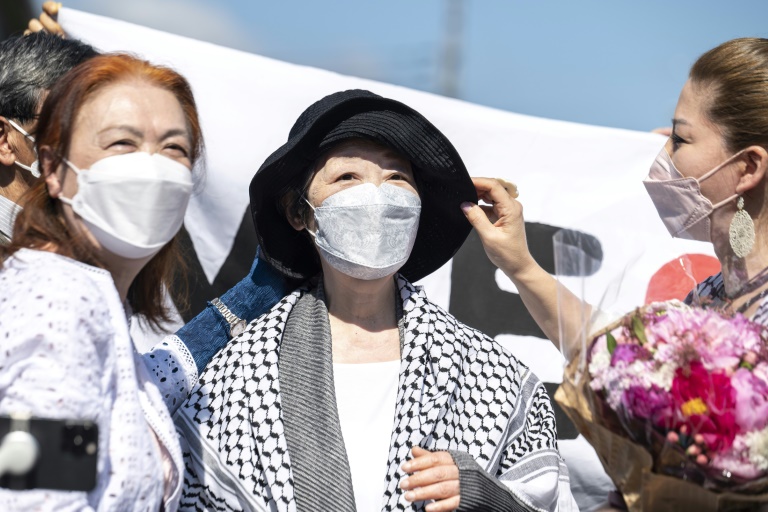
Fusako Shigenobu, the 76-year-old female founder of the once-feared Japanese Red Army, walked free from prison Saturday after completing a 20-year sentence for a 1974 embassy siege.

Shigenobu was one of the world’s most notorious women during the 1970s and 1980s, when her radical leftist group carried out armed attacks worldwide in support of the Palestinian cause.

Shigenobu left the prison in Tokyo in a black car with her daughter as several supporters held a banner saying “We love Fusako”. 

“I apologise for the inconvenience my arrest has caused to so many people,” Shigenobu told reporters after the release.

“It’s half a century ago… but we caused damage to innocent people who were strangers to us by prioritising our battle, such as by hostage-taking,” she said.

She is believed to have masterminded the 1972 machine gun and grenade attack on Tel Aviv’s Lod Airport, which left 26 people dead and injured about 80.

The former soy-sauce company worker turned militant was arrested in Japan in 2000 and sentenced to two decades behind bars six years later for her part in a siege of the French embassy in the Netherlands.

She had lived as a fugitive in the Middle East for around 30 years before resurfacing in Japan.

Shigenobu’s daughter May, born in 1973 to a father from the militant Popular Front for the Liberation of Palestine (PFLP), hailed her mother’s release on social media.

Shigenobu maintained her innocence over the siege, in which three Red Army militants stormed into the French embassy, taking the ambassador and 10 other staff hostage for 100 hours.

Two police officers were shot and seriously wounded. France ended the standoff by freeing a jailed Red Army guerilla, who flew off with the hostage-takers in a plane to Syria.

Shigenobu did not take part in the attack personally but the court said she coordinated the operation with the PFLP.

Born into poverty in post-war Tokyo, Shigenobu was the daughter of a World War II major who became a grocer after Japan’s defeat.

Her odyssey into Middle Eastern extremism began by accident when she passed a sit-in protest at a Tokyo university when she was 20.

Japan was in the midst of campus tumult in the 1960s and 70s to protest the Vietnam War and the Japanese government’s plans to let the US military remain stationed in the country.

Shigenobu quickly became involved in the leftist movement and decided to leave Japan aged 25.

She announced the Red Army’s disbanding from prison in April 2001, and in 2008 was diagnosed with colon and intestinal cancer, undergoing several operations.

Shigenobu said on Saturday she will first focus on her treatment and explained she will not be able to “contribute to the society” given her frail condition.

But she told reporters: “I want to continue to reflect (on my past) and live more and more with curiosity.”

In a letter to a Japan Times reporter in 2017 she admitted the group had failed in its aims.

“Our hopes were not fulfilled and it came to an ugly end,” she wrote.

Turkey shows off drones at Azerbaijan air show

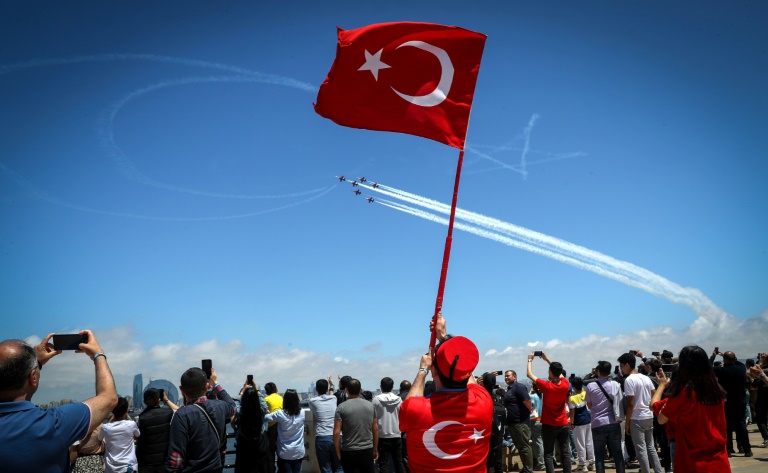
Looping in the air at lightning speed, Turkish drones like those used against Russian forces in Ukraine draw cheers from the crowd at an air show in Azerbaijan.

Turkey is showcasing its defence technology at the aerospace and technology festival “Teknofest” that started in Azerbaijan’s capital Baku this week.

Turkish President Recep Tayyip Erdogan is expected to attend on Saturday.

Turkey’s TB2 drones are manufactured by aerospace company Baykar Defence, where Erdogan’s increasingly prominent son-in-law Selcuk Bayraktar is chief technology officer.

On Wednesday, Bayraktar flew over Baku aboard an Azerbaijani air force Mikoyan MiG-29 plane. One of his combat drones, the “Akinci”, accompanied the flight. 

A video showing Bayraktar in command of the warplane, dressed in a pilot’s uniform decorated with Turkish and Azerbaijani flag patches, went viral on social media. 

“This has been a childhood dream for me,” Bayraktar told reporters after the flight. 

– Proximity to ‘threats’ –

Turkey’s drones first attracted attention in 2019 when they were used during the war in Libya to thwart an advance by rebel commander, General Khalifa Haftar, against the government in Tripoli. 

They were then again put into action the following year when Turkey-backed Azerbaijan in recapturing most of the land it lost to separatist Armenian forces in the disputed Nagorno-Karabakh region. 

Azerbaijani audience members at the aviation festival applauded during a display of TB2 drones, which are now playing a prominent role against invading Russian forces in Ukraine.

A senior official from the Turkish defence industry said his country was facing a wide spectrum of “threats”, including the Kurdistan Workers’ Party (PKK) and Islamic State group jihadists.  

The PKK is listed as a terror group by Ankara and its Western allies.

But with NATO allies — including the United States — having imposed embargoes on Turkey, Ankara was forced to take matters into its own hands to build defence equipment, the official told AFP.

“The situation is changing now with the war in Ukraine,” the official said.

Turkey has been looking to modernise its air force after it was kicked out of the F-35 fighter jet programme because of its purchase of Russia’s S-400 missile defence system.

But Ankara’s role in trying to mediate an end to the Ukraine conflict through direct negotiations may have helped improve its relations with Washington in the past months.

In April, US President Joe Biden’s administration said it now believed that supplying Turkey with F-16 fighter jets would serve Washington’s strategic interests.

– Exports to 25 countries –

Michael Boyle, of the Rutgers University-Camden in the United States, said Turkish drones such as Bayraktar TB2 drones were “increasingly important to modern conflicts because they have spread so widely”.

For years, leading exporters like the United States and Israel limited the number of countries they would sell to, and also limited the models they were willing to sell, he told AFP. 

“This created an opening in the export market which other countries, notably Turkey and China, have been willing to fill,” added the author of the book “The Drone Age: How Drone Technology Will Change War and Peace”.

The Turkish official said Turkey has been investing in the defence industry since the 2000s, but the real leap came in 2014 after serious investments in advanced technologies and a shift towards using locally made goods. 

While Turkey’s export of defence technologies amounted to $248 million in early 2000, it surpassed $3 billion in 2021 and was expected to reach $4 billion in 2022, he said. 

Today Turkey exports its relatively cheap and effective drones to more than 25 countries.

Boyle said these drones could be used “for direct strikes, particularly against insurgent and terrorist forces, but also for battlefield reconnaissance to increase the accuracy and lethality of strikes”. 

“So they are an enabler of ground forces, and this makes them particularly useful for countries like Ukraine which are fighting a militarily superior enemy,” he said.

Turkey shows off drones at Azerbaijan air show

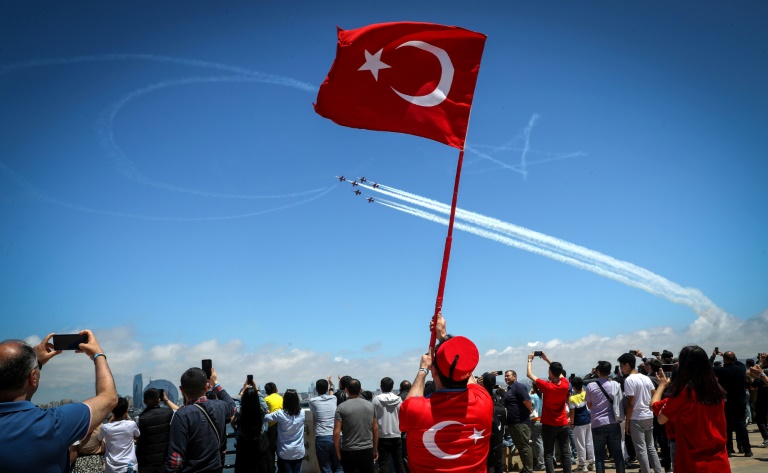
Looping in the air at lightning speed, Turkish drones like those used against Russian forces in Ukraine draw cheers from the crowd at an air show in Azerbaijan.

Turkey is showcasing its defence technology at the aerospace and technology festival “Teknofest” that started in Azerbaijan’s capital Baku this week.

Turkish President Recep Tayyip Erdogan is expected to attend on Saturday.

Turkey’s TB2 drones are manufactured by aerospace company Baykar Defence, where Erdogan’s increasingly prominent son-in-law Selcuk Bayraktar is chief technology officer.

On Wednesday, Bayraktar flew over Baku aboard an Azerbaijani air force Mikoyan MiG-29 plane. One of his combat drones, the “Akinci”, accompanied the flight. 

A video showing Bayraktar in command of the warplane, dressed in a pilot’s uniform decorated with Turkish and Azerbaijani flag patches, went viral on social media. 

“This has been a childhood dream for me,” Bayraktar told reporters after the flight. 

– Proximity to ‘threats’ –

Turkey’s drones first attracted attention in 2019 when they were used during the war in Libya to thwart an advance by rebel commander, General Khalifa Haftar, against the government in Tripoli. 

They were then again put into action the following year when Turkey-backed Azerbaijan in recapturing most of the land it lost to separatist Armenian forces in the disputed Nagorno-Karabakh region. 

Azerbaijani audience members at the aviation festival applauded during a display of TB2 drones, which are now playing a prominent role against invading Russian forces in Ukraine.

A senior official from the Turkish defence industry said his country was facing a wide spectrum of “threats”, including the Kurdistan Workers’ Party (PKK) and Islamic State group jihadists.  

The PKK is listed as a terror group by Ankara and its Western allies.

But with NATO allies — including the United States — having imposed embargoes on Turkey, Ankara was forced to take matters into its own hands to build defence equipment, the official told AFP.

“The situation is changing now with the war in Ukraine,” the official said.

Turkey has been looking to modernise its air force after it was kicked out of the F-35 fighter jet programme because of its purchase of Russia’s S-400 missile defence system.

But Ankara’s role in trying to mediate an end to the Ukraine conflict through direct negotiations may have helped improve its relations with Washington in the past months.

In April, US President Joe Biden’s administration said it now believed that supplying Turkey with F-16 fighter jets would serve Washington’s strategic interests.

– Exports to 25 countries –

Michael Boyle, of the Rutgers University-Camden in the United States, said Turkish drones such as Bayraktar TB2 drones were “increasingly important to modern conflicts because they have spread so widely”.

For years, leading exporters like the United States and Israel limited the number of countries they would sell to, and also limited the models they were willing to sell, he told AFP. 

“This created an opening in the export market which other countries, notably Turkey and China, have been willing to fill,” added the author of the book “The Drone Age: How Drone Technology Will Change War and Peace”.

The Turkish official said Turkey has been investing in the defence industry since the 2000s, but the real leap came in 2014 after serious investments in advanced technologies and a shift towards using locally made goods. 

While Turkey’s export of defence technologies amounted to $248 million in early 2000, it surpassed $3 billion in 2021 and was expected to reach $4 billion in 2022, he said. 

Today Turkey exports its relatively cheap and effective drones to more than 25 countries.

Boyle said these drones could be used “for direct strikes, particularly against insurgent and terrorist forces, but also for battlefield reconnaissance to increase the accuracy and lethality of strikes”. 

“So they are an enabler of ground forces, and this makes them particularly useful for countries like Ukraine which are fighting a militarily superior enemy,” he said.

Police 'wrong' not to breach door during Texas shooting

A top Texas security official said Friday that police were wrong to delay storming the classroom where a teen gunman was holed up with dead and wounded children — fueling fears that police inaction cost lives in Uvalde.

Police have come under intense criticism since Tuesday’s tragedy over why it took well over an hour to neutralize the gunman — who ultimately killed 19 children and two teachers at Robb Elementary School.

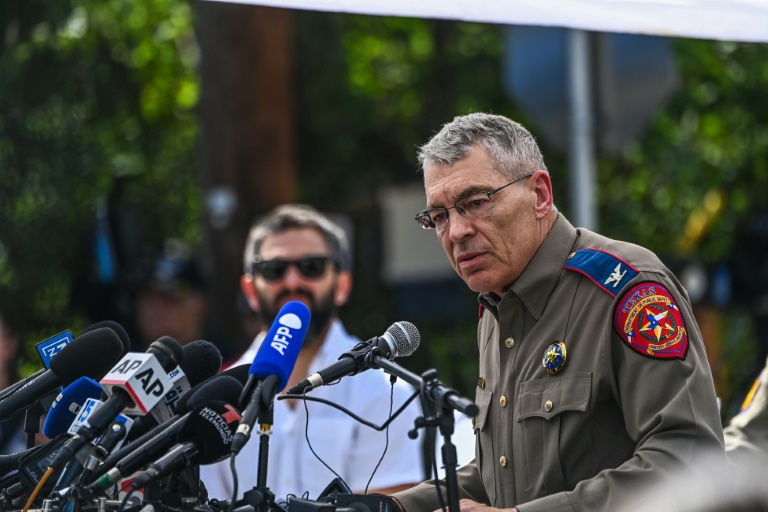
“From the benefit of hindsight… it was the wrong decision, period,” Texas Department of Public Safety director Steven McCraw told an emotional news conference, at which his voice broke repeatedly as he was assailed by questions over the delay.

“From what we know, we believe there should have been an entry as soon as you can,” McCraw said, adding: “If I thought it would help, I’d apologize.”

McCraw revealed in harrowing detail a series of emergency calls — including by a child begging for police help — that were made from the two adjoining classrooms where the gunman was barricaded.

But in seeking to explain the delay, he also said the on-scene commander believed at the time that the 18-year-old gunman Salvador Ramos was in there alone, with no survivors, after his initial assault.

“I’m not defending anything, but you go back in the timeline, there was a barrage, hundreds of rounds were pumped in in four minutes, okay, into those two classrooms,” McCraw said.

“Any firing afterwards was sporadic and it was at the door. So the belief is that there may not be anybody living anymore.”

McCraw separately told reporters, however, that a 911 call received at 12:16 pm — one of several made from inside the classrooms — reported eight or nine children still alive. 

As many as 19 officers were outside the classroom door at that time, plus an unknown number of tactical team members who had just arrived, according to McCraw’s timeline.

The door was eventually opened at 12:50 pm with keys provided by a janitor.

McCraw said the caller — a child who dialed 911 multiple times — begged for police to come. Her final call was cut off as she made it outside.

Texas Governor Gregg Abbott meanwhile told journalists who grilled him during a testy news conference Friday that he was given inaccurate information in the wake of the massacre.

“I was misled,” Abbott said. “The information that I was given turned out in part to be inaccurate, and I’m absolutely livid about that.”

– NRA convention –

The powerful National Rifle Association kicked off a major convention in Houston Friday, but a string of high-profile no-shows underscored deep unease at the timing of the gun lobby event.

Former president Donald Trump criticized calls for tightened gun controls in remarks at the three-day annual convention, held around four hours’ drive from Uvalde.

“The existence of evil in our world is not a reason to disarm law-abiding citizens,” Trump said. “The existence of evil is one of the very best reasons to arm law-abiding citizens.” 

Thousands of gun enthusiasts descended on the event, filling a vast convention hall packed with booths displaying guns, walls of semi-automatic rifles and hunting products.

“This is it, this is the mega,” said a man in his 60s, as he handled a new rifle he was considering purchasing.

But with millions of Americans grieving and angry following the Uvalde shooting, “American Pie” singer Don McLean led a wave of dropouts from the event, while Abbott said he would no longer appear in person.

McLean said it would be “disrespectful and hurtful” to perform at the “Grand Ole Night of Freedom” concert scheduled during the convention on Saturday. At least five other country music stars, including Lee Greenwood and Larry Gatlin, have also reportedly pulled out.

Facing mounting scrutiny, the gun manufacturer Daniel Defense — which made the assault rifle purchased by Ramos — also decided to stay away.

– Horror and trauma –

The Uvalde shooting was the deadliest since 20 children and six staff were killed at the Sandy Hook school in Newtown, Connecticut in 2012.

Highlighting the horror and trauma of the Uvalde massacre, 11-year-old Miah Cerrillo described smearing herself with the blood of a dead classmate in a bid to hide from the gunman, saying she lay there for what felt like hours until help finally came.

Cerrillo, whose hair has begun to fall out in clumps since the massacre, also told CNN that she and a friend scrabbled for their dead teacher’s cellphone and used it to make an urgent plea to 911 operators for help.

President Joe Biden will visit Uvalde on Sunday to once again make the case for gun control, as activists set about galvanizing voters on the issue in the run-up to November’s midterm election.

Despite the scourge of mass shootings, efforts at nationwide gun control — from banning assault rifles to mandating mental health and criminal background checks on buyers — have repeatedly failed, although polls show support from a majority of Americans.

War in Ukraine: Latest developments

Here are the latest developments in the war in Ukraine:

– Pro-Russian forces claim key eastern town – 

Moscow-backed separatist forces in eastern Ukraine say they have captured Lyman, a strategic town between the city of Severodonetsk and the eastern administrative centre of Kramatorsk, which remain under Kyiv’s control.

The pro-Russian separatists in the Donetsk region say they have “liberated and taken full control of 220 settlements, including Krasny Liman”, using an old name for Lyman.

Ukrainian forces are also battling to hold onto Severodonetsk as Russia wages all-out war for the Donetsk and Lugansk regions, which make up Donbas, Ukraine’s industrial heartland.

– Orthodox Church cuts Russia ties –

The Moscow branch of Kyiv’s Orthodox Church says it is cutting ties with Russia over the invasion, declaring “full independence” in a historic move against Russia’s spiritual authorities.

After holding a council focused on Russia’s “aggression”, the church declares “full independence” from Russian Patriarch Kirill, the second Orthodox schism in Ukraine in recent years.

Ukraine has been under Moscow’s spiritual leadership since at least the 17th century.

– 10 killed in central city – 

Ukraine’s national guard says around 10 people have been killed in strikes on a military facility in the central city of Dnipro, which had so far been relatively spared by the fighting.

– Zelensky warns of Donbas ‘genocide’ –

Ukraine’s President Volodymyr Zelensky accuses Moscow of carrying out a “genocide” in Donbas, where Russian forces are closing in on the cities of Severodonetsk and Lysychansk.

In his daily televised address, Zelensky warns that Russia’s offensive could empty Donbas of its population.

“All this, including the deportation of our people and the mass killings of civilians, is an obvious policy of genocide pursued by Russia,” he says.

– Ukraine flag removed from Putin Peak –

Kyrgyzstan’s climbing federation says it has removed a Ukrainian flag from a mountain named after Russian President Vladimir Putin, following a police investigation of the stunt, and replaced it with the Kyrgyz flag.

A climber earlier this week posted a video of the flag on the mountain dubbed Putin Peak, which rises 4,446 metres (14,587 feet) above sea level.

– Russian lawmakers urge ‘immediate withdrawal’ –

Two Communist lawmakers in Russia’s far east urge Putin to put an end to Moscow’s offensive in Ukraine in a rare public show of dissent.

Lawmaker Leonid Vasyukevich warns “there will be even more orphans in our country” if troops are not immediately withdrawn. He is backed by another lawmaker in the assembly of the Primorsky Krai region.

The head of the local Communist faction says the statement had not been agreed with the party and promises to take “the toughest measures” against the pair.

– Russian to boost grain exports –

Russia says it plans to ramp up grain exports against the backdrop of a looming global food crisis exacerbated by the war in Ukraine. 

Agriculture Minister Dmitry Patrushev says Russia will increase its grain exports from over 37 million tonnes in the 2021-2022 season ending June 30 to 50 million tonnes in the new season starting July 1.

Kyiv and the West blames Russia’s blockade of Ukrainian ports for stalling grain exports from Europe’s breadbasket.

Putin tells Austrian Chancellor Karl Nehammer in a telephone call that the accusations are “groundless” and blamed Western sanctions on Russia for spiralling food prices.

– Ukraine’s debt rating cut –

S&P Global Ratings cuts Ukraine’s debt rating and says the outlook is negative, due to the ongoing fallout from the Russian invasion and the expectation the conflict will not end any time soon.

The agency lowers the grade on Ukraine’s long- and short-term foreign currency debt to ‘CCC+/C’ from ‘B-/B’ due to the “expectation of a prolonged period of macroeconomic instability in the country.”

– Russia expects energy revenue windfall –

Russia expects to receive $14.4 billion in additional oil and gas revenues this year, the finance minister says, adding that part of the windfall will be spent on Moscow’s offensive in Ukraine.

“We expect to receive up to a trillion rubles in additional oil and gas revenues, according to the forecast that we have developed with the ministry of economic development,” Finance Minister Anton Siluanov said in remarks broadcast on state television.

burs-cb/imm/ach 

Close Bitnami banner
Bitnami