World

Stock markets chase Wall Street higher

Asian and European stocks rose Friday, after a strong performance on Wall Street, as investors hoped that rising global interest rates would curtail sky-high inflation.

The positive mood came after Federal Reserve minutes indicated the US central bank could take a breather in hiking interest rates if inflation shows signs of easing later in the year.

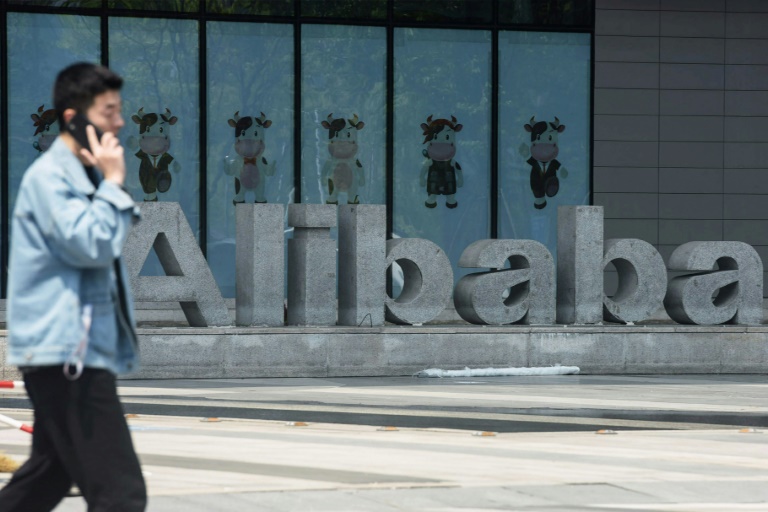
Hong Kong led the way in Asia as forecast-beating earnings reports by tech titans Alibaba and Baidu sent their shares soaring.

Gains remain capped by a range of crises also including China’s Covid-19 lockdowns and Russia’s invasion of Ukraine.

Yet investors remain soothed by hopes that rising global interest rates will help bring down sky-high consumer prices that threaten the post-pandemic recovery.

– ‘Tentative green shoots’ –

“After a torrid few months, there are some tentative signs of green shoots emerging as investors become more comfortable with the stance of the central banks in tackling inflation,” said Richard Hunter, head of markets at Interactive Investor.

Back in Asia, investors were in a buying mood as Hong Kong jumped more than two percent, with market heavyweight Alibaba piling on more than 11 percent and search engine Baidu advancing 15 percent.

The two firms posted better-than-expected sales growth in the January-March quarter, soothing fears about the impact of Covid and inflation on their bottom lines.

Hong Kong’s tech index jumped nearly three percent, with other giants also enjoying buying interest with JD.com and Meituan sharply up.

The reports were much-needed pieces of good news out of the world’s second-biggest economy, which is being battered by lockdowns in major cities as leaders refuse to budge from their zero-Covid strategy.

– ‘Welcome tonic’ –

Asian investors took the lead from Wall Street, where all three main indexes enjoyed a second day of gains after strong earnings from retailers including discount firm Dollar Tree, department store Macy’s and the more upscale Williams-Sonoma.

The readings bolstered hopes consumers were more resilient to inflation and rising rates, and came as a Federal Reserve Bank of New York survey showed US shoppers largely expect upward price pressures to be temporary with gains easing in the long term.

“With all the doom and gloom surrounding US retail over the past couple of weeks the numbers were a welcome tonic,” said CMC Markets analyst Michael Hewson.

Earlier in the week, markets rose as minutes from the Fed’s May meeting suggested policymakers could temper their campaign of rate hikes later in the year if inflation looks to be plateauing.

– Key figures at around 1115 GMT –

London – FTSE 100: UP 0.2 percent at 7,581.00 points

Frankfurt – DAX: UP 0.8 percent at 14,351.27

Paris – CAC 40: UP 0.9 percent at 6,470.70

EURO STOXX 50: UP 1.0 percent at 3,775.98

Tokyo – Nikkei 225: UP 0.7 percent at 26,7781.68 (close)

Hong Kong – Hang Seng Index: UP 2.9 percent at 20,697.36 (close)

Shanghai – Composite: UP 0.2 percent at 3,130.24 (close)

New York – Dow: UP 1.6 percent at 32,637.19 (close)

Euro/dollar: DOWN at $1.0724 from $1.0725 on Thursday

Pound/dollar: UP at $1.2603 from $1.2600

Euro/pound: DOWN at 85.09 pence from 85.12 pence

Dollar/yen: DOWN at 127.07 yen from 127.12 yen 

Brent North Sea crude: UP 1.0 percent at $118.60 per barrel

West Texas Intermediate: UP 0.7 percent at $114.89
Russia presses Donbas assault, claims capture of key town

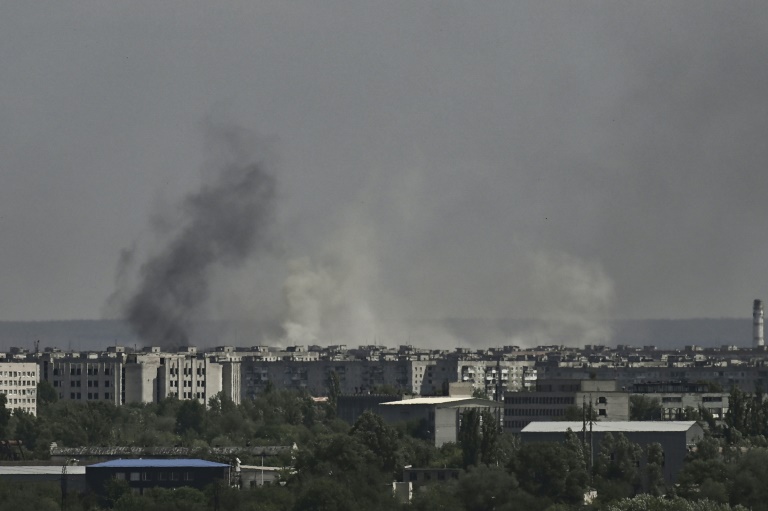
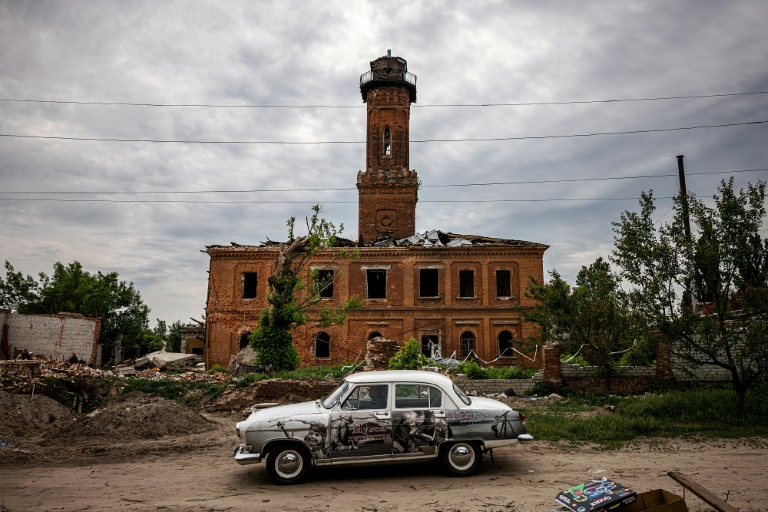
Russia on Friday pressed its deadly offensive to capture key points in the eastern Donbas region of Ukraine, with more bombing of residential areas and pro-Moscow forces claiming the capture of a key town on the way to Kyiv-controlled territory.

At least nine people were killed in shelling of Ukraine’s second-largest city of Kharkiv, raising fears that Russia had not lost interest in the northeastern hub even after Ukraine took back control following fierce battles.

And around 10 people were also killed in Russian strikes on a military facility in the central Ukrainian city of Dnipro, well away from the frontline of the offensive, the regional head of the national guard said.

Three months after Russia launched its invasion on February 24, leaving thousands dead on both sides and displacing millions of Ukrainian civilians, Moscow is focusing on the east of Ukraine after failing in its initial ambition to capture Kyiv. 

Ukraine’s President Volodymyr Zelensky reiterated accusations that Moscow was carrying out a “genocide” in Donbas, saying its bombardment could leave the entire region “uninhabited.”

Russian forces were closing in on several cities in the region including strategically located Severodonetsk and Lysychansk, which stand on the crucial route to Ukraine’s eastern administrative centre in Kramatorsk.

“Russia is pressuring the Severodonetsk pocket although Ukraine retains control of multiple defended sectors, denying Russia full control of the Donbas,” the British defence ministry said in its latest briefing.

Pro-Russian separatists said they had captured the town of Lyman that lies between Severodonetsk and Kramatorsk and is on the road leading to the key cities that are still under Kyiv’s control.

Lugansk regional governor Sergiy Gaiday said in a video on Telegram that at least five civilians had been killed in his region — part of Donbas — in the last 24 hours alone.

Four had been killed in Severodonetsk and one in Komyshovakha, 50 kilometres (30 miles) outside Severodonetsk, he said, accusing Russia of “ceaselessly shelling residential areas.”

“People are willing to risk everything to get food and water,” said Oleksandr Kozyr, the head of the main aid distribution centre in Lysychansk, outside Severodonetsk.

“They are so psychologically depressed that they are no longer scared. All they care about is finding food,” he said.

– ‘Won’t stop the metro’ –

Oleg Sinegubov, the regional governor of Kharkiv, north of Donbas, said that nine civilians had been killed in the Russian shelling on Thursday.

A five-month-old child and her father were among the dead, while her mother was gravely wounded, he said on social media channels.

An AFP reporter in the city said the northern residential district of Pavlove Pole was hit, with plumes of smoke rising from the area.

The reporter saw several people wounded near a shuttered shopping centre, while an elderly man with injuries to his arm and leg was carried away by medics.

Kharkiv’s mayor, Igor Terekhov, said the northeastern city’s metro system, which resumed work this week after being used mainly as a shelter since the Russian invasion, would continue operating, while still providing a safe space for residents.

“We will not stop the metro, but we will allocate special sectors where you can stay and shelter from bombing,” Terekhov said.

Observers believe that Russia’s gains in over three months of war have been far more paltry than President Vladimir Putin hoped, though Moscow has gained control over a handful of cities in southern Ukraine such as Kherson and Mariupol.

The Kremlin is now seeking to tighten its grip over the parts of Ukraine it occupies, including fast-tracking citizenship for residents of areas under Russian control.

Russian authorities in Mariupol, which was taken over this month after a devastating siege that left thousands dead and reduced the city to rubble, cancelled school holidays to prepare students to switch to a Russian curriculum, according to Kyiv.

There has been speculation that Russia could seek to annex areas of eastern and southern Ukraine it now controls, possibly in purported referendums during Russian regional elections held nationwide in September.

– ‘Fear of escalation’ –

There have been tensions between Kyiv and some Western nations, in particular Germany, over a perceived reluctance to supply more weapons to Ukraine lest the conflict intensify further.

Ukraine has also been irritated by suggestions that Putin should be offered an “off ramp” to save face in a compromise deal that would see Kyiv concede some territory.

“Some partners avoid giving the necessary weapons because of fear of the escalation. Escalation, really?” Zelensky’s adviser Mykhailo Podolyak wrote on Twitter, saying it was “time to respond” by giving Kyiv multiple launch rocket systems (MLRS).

Prime Minister Boris Johnson of Britain, one of Ukraine’s staunchest supporters, said he feared that Putin was “continuing to chew through ground in Donbas.”

“And therefore, it is absolutely vital that we continue to support the Ukrainians militarily,” he said.

Concerns are also growing over global food shortages due to the conflict, exacerbating problems for the world’s poor at a time of rising energy prices.

Russia and Ukraine alone produce 30 percent of the global wheat supply, with grain-carrying vessels unable to leave ports in Ukraine.

Putin said in a telephone call with Italy’s Prime Minister Mario Draghi that Moscow was ready to make a “significant contribution” to averting a looming food crisis if the West lifts sanctions imposed on his country over Ukraine.

Agriculture Minister Dmitry Patrushev said Friday that Russia was looking to ramp up its production of grain to export in the coming season.

But the United States scoffed at Putin’s offer, with Pentagon spokesman John Kirby accusing Moscow of “weaponizing economic assistance.” 

US Southern Baptist church group releases list of alleged sex abusers

Leaders of the Southern Baptist Convention (SBC), the United States’ largest Protestant denomination, published a 205-page list on Thursday of ministers and other church workers who have been accused of sexual abuse.

The public release of the list comes days after an independent investigation said the church had for years suppressed reports of sexual abuse against priests and church staff. 

“This list is being made public for the first time as an initial, but important, step towards addressing the scourge of sexual abuse and implementing reform in the Convention,” the SBC said in a statement on its website. 

Investigative firm Guidepost’s probe, published Sunday, found that for nearly two decades, survivors and advocates who sounded the alarm over sexual misconduct faced “resistance, stonewalling, and even outright hostility” from members of the church’s executive committee. 

On Thursday, the SBC said that it hoped “that churches will utilize this list proactively to protect and care for the most vulnerable among us.”

The newly released list contains hundreds of entries — some of them partially or fully redacted — detailing allegations, convictions and some cases that were not reported to the police. 

Some of the allegations in the list relate to the sexual abuse of children as young as five years old. 

In 2019, a bombshell investigation by two Texas newspapers revealed hundreds of predators and more than 700 victims of sexual abuse within the SBC since 1998.

The SBC has thousands of churches and 15 million members, mostly in the southern United States.

Beijing says Blinken speech 'smears China'

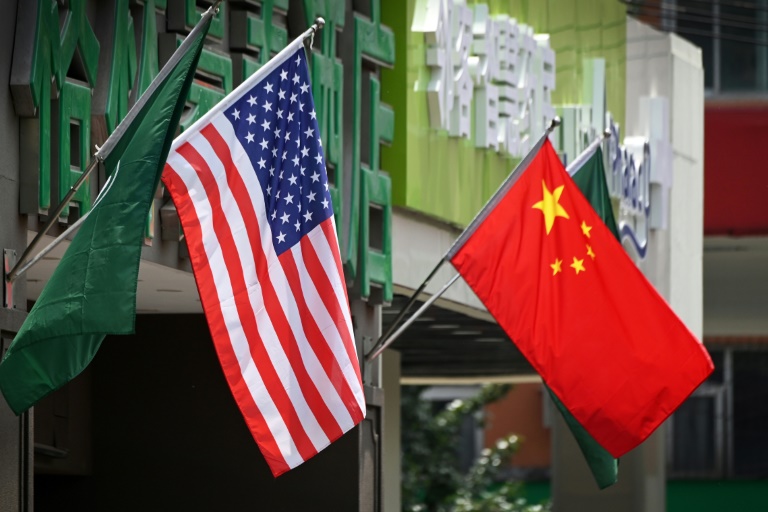
China’s foreign ministry on Friday accused US Secretary of State Antony Blinken of “smearing” the country, after America’s top diplomat delivered a landmark policy speech calling for action to counterbalance Beijing’s influence.

In the most comprehensive statement to date on China by US President Joe Biden’s administration, Blinken said on Thursday the Asian power posed “the most serious long-term challenge to the international order”.

China has faced a chorus of warnings from the United States and Western allies in recent days over its growing influence and global ambitions.

Blinken warned on Thursday of China’s “intent to reshape the international order” and called on countries to defend the status quo.

He also accused Beijing of raising tensions over Taiwan — a self-ruled island China claims as its territory — and said Beijing has “cut off Taiwan’s relations with countries around the world and (is) blocking it from participating in international organisations”.

Beijing hit out angrily at the speech on Friday, saying it “spreads false information, exaggerates the China threat, interferes in China’s internal affairs and smears China’s domestic and foreign policies”.

Foreign ministry spokesman Wang Wenbin told reporters that China “firmly opposed” the speech and it showed Washington sought to “contain and suppress China’s development and maintain US hegemony and power”.

The United State recently launched a loose new trade framework across Asia and has set up a forum with the European Union to set technological standards.

The efforts are aimed at uniting like-minded nations as China dominates new fields, such as artificial intelligence.

Blinken acknowledged a growing consensus that other nations cannot change the trajectory of China, saying that under President Xi Jinping it has become “more repressive at home, more aggressive abroad”.

“There is growing convergence about the need to approach relations with Beijing with more realism,” he said.

– ‘Coexist and cooperate’ –

The speech by the US secretary of state contrasted with the approach under former president Donald Trump, whose administration spoke in stark terms of an all-out global conflict with China.

On trips to Africa and Latin America, where China has invested billions of dollars in infrastructure, Blinken has downplayed US-China competition and has not asked nations to take sides.

“We are not looking for conflict or a new Cold War. To the contrary, we’re determined to avoid both,” he said in his speech.

“We don’t seek to block China from its role as a major power, nor to stop China — or any other country for that matter — from growing their economy or advancing the interests of their people.”

But he said that defending the current global order, including international law and agreements, would “make it possible for all countries — including the United States and China — to coexist and cooperate”.

Biden on Monday made waves by offering the most explicit pledge in decades that the United States would militarily defend Taiwan from any invasion by Beijing.

The pledge angered Beijing, which warned Washington not to “underestimate” China’s resolve and capabilities.

On Thursday, Biden insisted that Washington was not deviating from its longstanding stance on Taiwan and said it was Beijing that had raised tensions, including with near-daily military flights close to the island.

“While our policy has not changed, what has changed is Beijing’s growing coercion,” Blinken said.

Governments including Australia and New Zealand have also sounded alarm this week over leaked documents that appeared to show a plan to build broad security cooperation between China and the Pacific Islands.

China, which insists its cooperation with Pacific Island countries “does not target any country,” has sent its Foreign Minister Wang Yi on a trip across the region this week to discuss dramatic expansion of Beijing’s security and economic engagement.

Pro-gun NRA to hold convention in US state where school shooting killed 21

US gun lobby group the National Rifle Association (NRA) will hold its annual convention in Texas on Friday, days after a horrific school shooting in the state killed 19 children and two teachers. 

The meeting will be held in Houston, a few hours drive east of the elementary school in the small town of Uvalde where an 18-year-old gunman used an assault rifle to carry out the massacre on Tuesday.

Former US president Donald Trump on Wednesday confirmed that he will attend the NRA meeting, saying that the United States “needs real solutions and real leadership in this time, not politicians and partisan considerations.” 

In a statement on its website, the NRA — which has been instrumental in preventing the passage of stricter firearms regulations — said the mass murder in Uvalde was “the act of a lone, deranged criminal.”

On Thursday, Texas police faced angry questions over why it took an hour to neutralize the gunman, as video emerged of desperate parents begging officers to storm the school.

In one jolty, nearly seven-minute clip posted on YouTube, parents are seen screaming expletives at police trying to keep them away from Robb Elementary School.

“It’s my daughter!” one woman bellows in chaotic scenes of crying and shoving.

Angeli Rose Gomez, whose children were inside, told The Wall Street Journal she was handcuffed by federal marshals after she and others pushed police to intervene.

In another video, parents at what is apparently the rear of the building complain angrily that police are doing nothing as the country’s worst school shooting in a decade unfolds.

One woman, frantic about her son, yells to police: “If they’ve got a shot, shoot him or something. Go on.”

Jacinto Cazares, whose daughter Jacklyn died on Tuesday, said he raced to the school when he heard about the shooting.

“There was at least 40 lawmen armed to the teeth but didn’t do a darn thing (until) it was far too late,” Cazares told ABC News Wednesday.

Daniel Myers and his wife Matilda — both local pastors — told AFP they saw parents at the scene growing frantic as police seemed to wait on reinforcements before entering the school.

“Parents were desperate,” said Daniel Myers, 72. “One family member, he says: ‘I was in the military, just give me a gun, I’ll go in. I’m not going to hesitate. I’ll go in.'”

– ‘Approximately an hour’ –

The tight-knit Latino community was changed forever when Salvador Ramos, an 18-year-old with a history of being bullied, entered the school and gunned down students and teachers with an assault rifle.

Relatives said the husband of one of the teachers killed in the attack died Thursday from a medical emergency — caused by grief over the loss of his wife. The couple had four children.

Facing rapid-fire questioning by journalists on the police response, Victor Escalon of the Texas Department of Public Safety said investigators were still working to piece together exactly what happened.

After shooting his own grandmother, Ramos crashed her vehicle near the school, Escalon said, then fired on bystanders before entering the school through a door that was apparently unlocked.

Officers went in minutes later, but were held back by gunfire and called for backup. A tactical team including US Border Patrol agents entered and killed the gunman “approximately an hour later.”

In the interim, officers evacuated students and teachers and unsuccessfully tried to negotiate with the gunman, who held them back with rifle fire, Escalon said.

– ‘I have no words’ –

Speaking out for the first time, Ramos’ mother Adriana Reyes told ABC News her son could be aggressive when angry but was “not a monster” — and that she was not aware he had been buying weapons.

“I had an uneasy feeling sometimes, like ‘what are you up to?'” she told ABC Wednesday evening. “We all have a rage, that some people have it more than others.”

“Those kids… I have no words,” Reyes said through tears. “I don’t know what to say about those poor kids.”

Students who went to high school with Ramos said he bullied others as well as being on the receiving end of abuse.

“I do vividly remember him being a bully in school. It wasn’t just that he was getting bullied, he was also the bully,” 18-year-old Jaime Cruz told AFP.

The Uvalde shooting was the deadliest since 20 elementary-age children and six staff were killed at the Sandy Hook school in Newtown, Connecticut in 2012.

– ‘Common sense’ –

Gun manufacturer Daniel Defense, which made the assault rifle used in Uvalde, told AFP it will not attend the NRA’s convention in Houston in light of the “horrifying tragedy.”

“We believe this week is not the appropriate time to be promoting our products in Texas at the NRA meeting,” said the company, which stated its gun had been “criminally misused” in the attack. 

Texas Governor Greg Abbott has brushed aside calls for tougher gun laws in his state — where attachment to the right to bear arms runs deep.

US President Joe Biden — who will head to Uvalde on Sunday — has called on lawmakers to take on the gun lobby and enact “common sense gun reforms.”

Gun control activists and lawmakers gathered outside the US Capitol Thursday, vowing no letup in their efforts in the run-up to November’s midterm elections.

“Gun violence prevention is going to be on the ballot,” said the Democratic senator from Connecticut, Richard Blumenthal.

The March for Our Lives advocacy group — founded by survivors of the 2018 Parkland school shooting in Florida — has called for nationwide protests on June 11 to press for gun control.

War in Ukraine: Latest developments

Here are the latest developments in the war in Ukraine:

– Pro-Russian forces claim capture of key town – 

Moscow-backed separatist forces in eastern Ukraine say they have captured Lyman, a strategic town connecting key cities in the east.

The pro-Russian rebels in the Donetsk region said they had “liberated and taken full control of 220 settlements, including Krasny Liman”, using an old name for Lyman.

After failing to take Kyiv and being driven back from the outskirts of the second city of Kharkiv, Russia is waging all-out war for the Donetsk and Lugansk regions, which together make up Donbas, Ukraine’s industrial heartland.

In a sign that Kharkiv is not yet out of harm’s way, nine people were killed in shelling of the northeastern city on Thursday.

– Zelensky warns of ‘genocide’ in Donbas –

Ukraine’s President Volodymyr Zelensky accuses Moscow of carrying out a “genocide” in Donbas, where Russian forces are also closing in on the cities of Severodonetsk and Lysychansk.

In his daily televised address, Zelensky warns that Russia’s offensive could empty Donbas of its population.

“All this, including the deportation of our people and the mass killings of civilians, is an obvious policy of genocide pursued by Russia,” he says.

Foreign Minister Dmytro Kuleba accuses allies of dragging their feet on arms deliveries, telling his German counterpart that Ukraine needs heavy weapons “as soon as possible.”

– Russian to boost grain exports –

Russia says it plans to ramp up grain exports against the backdrop of a looming global food crisis exacerbated by the war in Ukraine. 

Agriculture Minister Dmitry Patrushev says Russia will increase its grain exports from over 37 million tonnes in the 2021-2022 season ending June 30 to 50 million tonnes in the new season starting July 1.

Kyiv and the West blames Russia’s blockade of Ukrainian ports for stalling grain exports from Europe’s breadbasket.

President Vladimir Putin told Italy’s Prime Minister Mario Draghi in a telephone call he was ready to make a “significant contribution” to averting a global food crisis if the West lifts sanctions imposed on Russia.

– German ‘train lift’ –

A top US defence official says Germany is working on a plan to get up to 22 million tonnes of Ukrainian grain, currently blocked in ports, out of the country by rail.

General Christopher Cavoli tells US lawmakers that Germany’s railway company has dedicated a special train service to get the exports out.

“They are doing what they call a Berlin train lift, an analogy to the Berlin Airlift (an Allied plan to overcome a Soviet blockade of west Berlin in 1949) to dedicate trains to pulling wheat right out of Ukraine into western Europe,” he says.

– Russian guards sacked for refusing to fight –

A Russian court confirms the dismissal of 115 national guardsmen who were sacked after refusing to take part in the war in Ukraine.

The case heard by a military court in Russia’s southern Kabardino-Balkaria republic appears to be the first involving troops refusing to be part of Russia’s offensive in Ukraine.

The case was heard behind closed doors.

– Mariupol ‘to get Russian curriculum’ –

A Ukrainian official says Russian troops occupying Mariupol have cancelled school summer holidays in the southeastern port city to prepare pupils for switching to a Russian curriculum.

“The occupiers have announced the extension of the school year until September 1,” city official Petro Andryushchenko wrote on social media.

“Throughout the summer, children will have to study Russian language, literature and history as well as maths classes in Russian,” Andryushchenko said. 

There was no confirmation of the announcement from the Russian side.

burs-cb/jv

UN rights chief falls under wheels of China's propaganda machine

Beijing’s propaganda machine has outwitted the UN human rights chief on her visit to China, campaigners say, leaving the envoy accused of playing a role in whitewashing abuses against minorities in Xinjiang.

Michelle Bachelet’s long-planned trip this week has taken her to the far-western region where Beijing is accused of imprisoning over one million Uyghurs and other Muslim minorities, forcibly sterlising women and running labour camps that fuel global supply chains.

The United States and multiple western lawmakers have labelled the actions a “genocide”, allegations vehemently denied by China which says it has only conducted necessary security operations to squash extremism and beef up development.

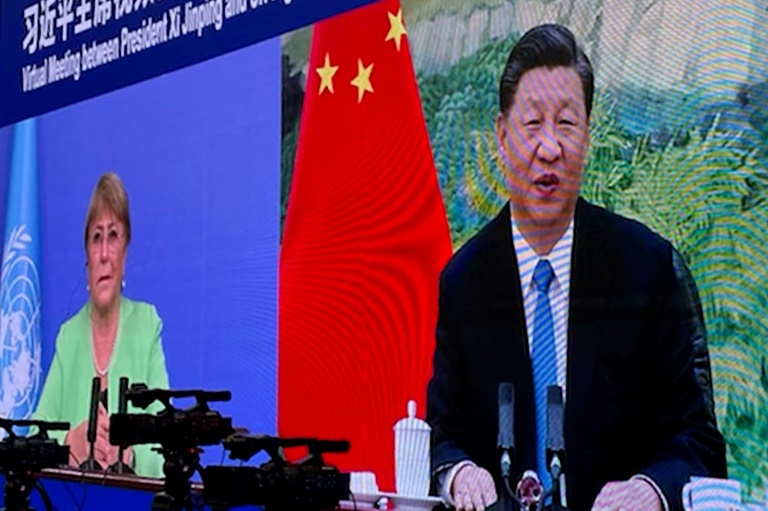
Bachelet has come under fire from rights groups and Uyghurs overseas, who say she has been suckered into a slickly choreographed Communist Party tour including a conversation with President Xi Jinping later portrayed in state media as a mutual endorsement of China’s high ideals on rights.

The UN envoy is due to give press briefing late Saturday as her trip ends.

She is expected to be quizzed on her access to Uyghur residents and detention facilities in Xinjiang, giving her a final chance while inside China to address the allegations of abuse. 

It is “as clear as day” that China has so far used the visit “to promote its own narrative and defend its poor human rights record”, said Alkan Akad, a China researcher at Amnesty.

The goal is “to show the world that it can bend a top UN human rights official — and thus the very concept of human rights — to its will,” said Maya Wang, senior China researcher at Human Rights Watch.

London-based Uyghur activist Rahima Mahmut slammed the visit as “window dressing”.

“This is not the neutral, independent, unfettered investigation that we were promised,” she told AFP.

Instead, Beijing was seeking “a free pass to continue carrying out repression, surveillance, torture and genocide against communities like mine”, she added.

– Speak out, or stay away  –

Bachelet has been in Xinjiang since Tuesday with her office saying she planned to visit the regional capital Urumqi and the ancient Silk Road city of Kashgar.

Yet the hard details of what she saw and who she met have been largely withheld on a trip carried out in a “closed loop” by order of Beijing, ostensibly due to Covid risks. 

China has filled the information vacuum, with state media running gleeful readouts of meetings between her and Xi as well as foreign minster Wang Yi.

They reported that Bachelet said she “admired China’s efforts and achievements in … protecting human rights” during the virtual call with Xi.

A spokesperson for Bachelet did not confirm whether the reports were accurate when contacted by AFP, instead saying the UN would not publish readouts of bilateral meetings.

A later, hurried “clarification” by the UN stopped short of denying that she had praised China’s rights record. But neither side mentioned Xinjiang in their readouts.

Norway-based Uyghur activist Abduweli Ayup said he was “disappointed” that Bachelet had appeared to allow Beijing to “misinterpret” her words.

“They have already used (her) for propaganda,” he told AFP. 

While it is unclear what she was able to see in Xinjiang, Bachelet was presented with a book of Xi’s quotations on human rights — images that were circulated widely across Chinese media.

A steady drip-feed of state media articles timed with her visit have also lauded Xinjiang’s economic development and rising incomes.

China rejects all criticism of its policies in Xinjiang and frequently slams those it deems to have waded into its internal affairs.

Beijing has denied that Bachelet’s trip is an investigation, saying it is a chance to “clarify misinformation”.

It is the first trip to China by the UN’s top rights envoy in 17 years and comes after painstaking negotiations over the parameters of her visit, which the UN says is neither a fact-finding mission nor a probe. 

The notion that Beijing would not use the visit to “put forth its own narrative” on human rights is “for the birds”, said Steve Tsang, director of the SOAS China Institute.

“She must have the political courage and integrity to speak out when her words and her visit are being distorted,” he said. “If she is not prepared and able to do so, she should not visit.”

Strawberry farms threaten Spanish wetlands

Standing in the middle of a stretch of land surrounded by dunes and pine forest, Juan Romero examines the cracked ground then stares at the dusty horizon.

“It’s dry… really dry,” the retired teacher said at the huge Donana National Park in southern Spain, home to one of Europe’s largest wetlands, which is threatened by intensive farming.

“At this time of the year this should be covered with water and full of flamingos,” added Romero, a member of Save Donana, a group that has been fighting for years to protect the park.

Water supplies to the park have declined dramatically due to climate change and the over-extraction of water by neighbouring strawberry farms, often through illegal wells, scientists say.

The situation could soon get worse as the regional government of Andalusia, where Donana is located, has proposed expanding irrigation rights for strawberry farmers near the park.

It’s a battle pitting environmentalists against politicians and farmers, and the proposal to widen irrigation rights has drawn backlash from the EU, the UN and major European grocery store chains.

The proposal would regularise nearly 1,900 hectares (4,700 acres) of berry farmland currently irrigated by illegal wells, said Juanjo Carmona of the local branch of the World Wildlife Fund for Nature (WWF).

“For Donana it would be a disaster,” he added.

The park, whose diverse ecosystem of lagoons, marshes, forests and dunes stretch across 100,000 hectares, is on the migratory route of millions of birds each year and is home to many rare species such as the Iberian lynx.

“Donana is a paradise for migrating birds. But this ecosystem is threatened,” said Romero.

The driving force behind the plan to extend irrigation rights is the conservative Popular Party (PP), which governs the southern region of Andalusia with the support of far-right party Vox.

The plan’s fate will be decided after a snap poll in Andalusia on June 19 but with both parties riding high in the polls the controversial proposal looks set to go head.

– ‘Red gold’ –

Defenders of the proposal argue it will aid those who unfairly missed out during a previous regularisation of farms in the area put in place in 2014 under a Socialist government.

About 9,000 hectares of farms were regularised but another 2,000 hectares that started being farmed after 2004 were deemed illegal.

“This plan was badly done. It should have used 2014 as the cut-off date,” said Rafael Segovia, a lawmaker with Vox in Andalusia’s outgoing regional parliament.

The proposed amnesty “does not present any danger for Donana”, Segovia said, adding people should take into account the “economic importance of the sector”.

Huelva, the drought-prone province where the park is located, produces 300,000 tonnes of strawberries a year, 90 percent of Spain’s output.

Known locally as “red gold”, strawberry farming employs some 100,000 people and accounts for nearly eight percent of Andalusia’s economic output.

UNESCO, the UN’s cultural agency, has designated the park one of its World Heritage sites and has called for illegal farms near Donana to be dismantled.

It has warned that the regional government’s plan would have an impact that would be “difficult to reverse”.

The European Commission has also weighed in. 

It has threatened to impose “hefty fines” if any steps were taken to extract more water from Donana park after a European court ruling last year scolded Spain for not protecting its ecosystem.

And around 20 European supermarket chains, including Lidl, Aldi and Sainsbury’s, sent the regional government a letter urging it to abandon the plan.

– ‘Ruin us’ –

Consumers may get the impression that all strawberries in Huelva come from illegal farms, said Manuel Delgado, the spokesman of an association that represents some 300 local farms.

“This situation will likely cause a major reputational problem,” he said.

The group, the association of farmers Puerta de Donana, argues the plan to extend irrigation rights would “only serve the interests of a minority”. 

“Water resources are limited,” said Delgado, who fears farms will be forced to drastically reduce the amount of land they cultivate due to a lack of water.

“That would ruin us,” he said.

Backers of the plan, including other larger farmers’ associations, reject these concerns.

“There is no water problem in Huelva, it’s a lie,” said Segovia, the Vox lawmaker.

He said water could be diverted to the province’s farms from the Guadiana River on the border with Portugal, a solution rejected as “not sustainable” by the WWF.

“When there is no rain, there is no rain everywhere,” said the WWF’s Carmona, adding Spain should instead rethink its agricultural model.

Passions are running high. Romero said ecologists who oppose the plan have received death threats.

“Without radical changes to curb the overexploitation of water resources, Donana will be a desert,” he said.

Asian markets track Wall St higher, tech fuels Hong Kong rally

Asian markets climbed Friday following a strong performance on Wall Street, with Hong Kong leading the way as forecast-beating earnings reports by tech titans Alibaba and Baidu sent their shares soaring.

The positive mood put the region on course to end the week on a healthy note, and came after Federal Reserve minutes indicated the US central bank could take a breather in hiking interest rates if inflation shows signs of easing later in the year.

Still, confidence on trading floors remains at a premium owing to a range of crises including soaring prices, tighter monetary policy, China’s Covid-19 lockdowns and the war in Ukraine.

Investors were in a buying mood Friday as Hong Kong jumped more than two percent, with market heavyweight Alibaba piling on more than 11 percent and search engine Baidu advancing 15 percent.

The two firms posted better-than-expected sales growth in the January-March quarter, soothing fears about the impact of Covid and inflation on their bottom lines.

Hong Kong’s tech index jumped nearly three percent, with other giants also enjoying buying interest with JD.com and Meituan sharply up.

The reports were much-needed pieces of good news out of the world’s second-biggest economy, which is being battered by lockdowns in major cities as leaders refuse to budge from their zero-Covid strategy.

Ronald Keung, at Goldman Sachs, sounded an upbeat note.

“We do expect the second quarter to mark the bottom in growth for our companies,” he told Bloomberg TV.

“Depending on the Covid policies and the government’s policies in helping to drive back consumption confidence, we do expect easier comparables for China tech companies, particularly as you enter into September and December quarter.” 

Shanghai, Tokyo, Seoul, Sydney, Singapore, Taipei, Manila, Jakarta, Bangkok and Mumbai were also well up.

London was dipped in early trade, while Paris and Frankfurt edged up.

– ‘Welcome tonic’ –

Asian investors took the lead from Wall Street, where all three main indexes enjoyed a second day of gains after strong earnings from retailers including discount firm Dollar Tree, department store Macy’s and the more upscale Williams-Sonoma.

The readings bolstered hopes consumers were more resilient to inflation and rising rates, and came as a Federal Reserve Bank of New York survey showed US shoppers largely expect upward price pressures to be temporary with gains easing in the long term.

“With all the doom and gloom surrounding US retail over the past couple of weeks the numbers were a welcome tonic,” said Michael Hewson of CMC Markets.

Earlier in the week, markets rose as minutes from the Fed’s May meeting suggested policymakers could temper their campaign of rate hikes later in the year if inflation looks to be plateauing.

“We may see a little bit more stability here because we have repriced the stocks so much already,” said iCapital’s Anastasia Amoroso.

“I don’t know how much this move higher is going to go because I don’t think the fundamentals really justify it near term. In the next three to six months it’s still going to be a constrained market environment.”

– Key figures at around 0810 GMT –

Tokyo – Nikkei 225: UP 0.7 percent at 26,7781.68 (close)

Hong Kong – Hang Seng Index: UP 2.9 percent at 20,697.36 (close)

Shanghai – Composite: UP 0.2 percent at 3,130.24 (close)

London – FTSE 100: DOWN 0.1 percent at 7,558.09

Euro/dollar: UP at $1.0738 from $1.0732 on Thursday

Pound/dollar: UP at $1.2620 from $1.2607

Euro/pound: DOWN at 85.09 pence from 85.11 pence

Dollar/yen: UP at 127.07 yen from 127.05 yen 

Brent North Sea crude: UP 0.2 percent at $117.67 per barrel

West Texas Intermediate: UP 0.1 percent at $114.19 per barrel

New York – Dow: UP 1.6 percent at 32,637.19 (close)

Military redeployment turns Chile's Mapuche areas into powder keg

With military troops once again patrolling their ancestral lands, members of the Mapuche indigenous community in Chile’s south are angry.

Failure to resolve a conflict over the group’s land claims has led to a surge in violence and arson over the last decade, with property owned by logging companies often the target.

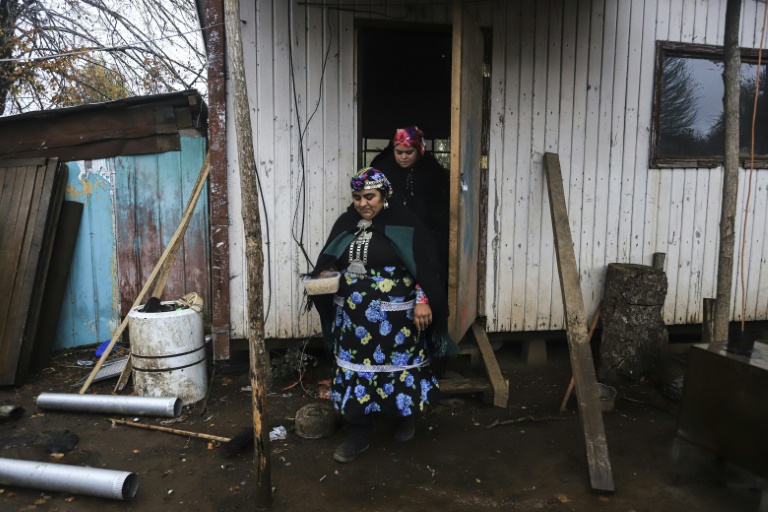
Carolina Soto, a Mapuche woman who occupies state-owned land near the city of Temuco, said that “the violence came from outside, with the military.”

In response to mounting unrest, troops returned last week to the southern La Araucania region and also to parts of neighboring Biobio, areas with the largest Mapuche populations in Chile.

The decision marked a shift in policy by newly elected leftist President Gabriel Boric, who initially said he would put dialogue first and withdraw troops from the area.

He bowed to pressure earlier this month, however, in the face of a 122 percent increase in arson attacks since troops withdrew in late March.

Nonetheless, the attacks continue. A 66-year-old forestry employee was killed and two others wounded on Tuesday when a minibus they were traveling in came under fire on a country road near the town of Lumaco.

“We will not tolerate violence being used as a way to resolve conflicts in the country,” Boric said.

– Dialogue ‘not possible’ –

Soon after taking power, Boric doubled the budget to buy land to be handed over to the Mapuche, a practice that had been suspended under his conservative predecessor Sebastian Pinera.

He also called for dialogue, but many Mapuche are suspicious.

“As long as we are not recognized as the Mapuche people-nation, dialogue will not be possible,” Soto said.

Soto was forced to leave her city of Temuco when she could no longer make ends meet, and now lives off the state-owned land that she occupies along with around 15 others.

Chile’s new constitution, which will be put to a referendum in September, defines the country as a “plurinational state” and establishes greater indigenous autonomy, including a special judiciary.

One of the most radical indigenous organizations, Arauco-Malleco Coordination (CAM), has traditionally encouraged sabotaging logging companies while refraining from hurting any people.

But its long-time leader Hector Llaitul recently urged supporters “to prepare forces and to organize an armed resistance.”

Despite the presence of such militant groups, a significant part of the population welcomes the military’s presence, particularly to provide security on roads.

“We need more security here,” said trucker Raul Jara, 55. “It has been many years and nothing has changed.”

Incessant attacks on trucks and forestry machinery have made certain roads no-go areas, and many drivers say they are desperate to get home before nightfall.

“We hoped that they would tackle the problem differently under this government,” said Juan Paillafil, the mayor of the small town of Puerto Saavedra, whose population is 80 percent Mapuche.

He said the military deployment “radicalizes” the conflicting sides.

Opposition legislator Mauricio Ojeda said the conflict “has become a business” in which people simply steal wood under the guise of social action.

Close Bitnami banner
Bitnami