World

UK readies for Queen Elizabeth II's Platinum Jubilee

Britain brings out the bunting next week for Queen Elizabeth II’s Platinum Jubilee, with four days of public events to mark her 70 years on the throne. 

Across the country, red, white and blue Union Jack are being hung for street parties, picnics and barbecues over four days from Thursday to Sunday.

With two public holidays and the weekend, retailers and the hospitality sector in particular are hoping for a sales boost, after a difficult few years.

Harvir Dhillon, an economist at the British Retail Consortium, predicted a rush to stock up on party food and booze.

“Fresh food, sales of alcohol and particularly items adorned with the Union Jack are expected to perform well,” he told AFP.

The British Beer and Pub Association estimated that 90 million pints will be sold, giving a 105-million-pound ($132 million, 124 million euros) boost to the trade.

Closing time has been extended from 11:00 pm to 1:00 am from Thursday to Saturday night.

Jason Smith, who runs the White Swan pub in Otley, near Leeds, northern England, said Covid restrictions and closures had been a “real blow” to business.

“But this will be an opportunity to bounce back, so we’re keeping fingers crossed for nice weather as well to lift spirits and celebrations even more.”

– Health –

Events begin on Thursday with Trooping the Colour, the military parade that has officially marked the British monarch’s birthday for more than 250 years.

In previous years, the queen has taken the salute herself on horseback at Horse Guards Parade, near her central London home at Buckingham Palace.

But at 96, and with well-documented problems walking and standing, senior royals will deputise.

Heir to the throne Prince Charles, 73, most recently stood in for his mother at the State Opening of Parliament — a key ceremonial engagement.

The queen has been largely out of action at public engagements since last October, when she spent a night in hospital after unspecified tests.

Last-minute cancellations and a bout of Covid earlier this year cast doubt on whether she would participate in full at the landmark jubilee.

No other British monarch in history has reigned for 70 years.

“If we don’t see the queen over the jubilee, there’ll be millions of people disappointed,” veteran royal photographer Arthur Edwards told AFP recently.

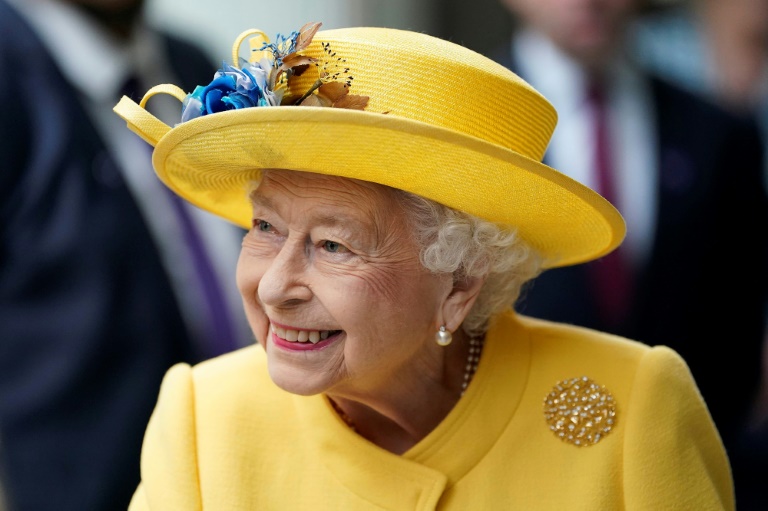
But she has made several surprise appearances in recent weeks, at the opening of a new east-west rail link in London that bears her name, and at the Windsor Horse Show.

She walked with a stick on those occasions and toured exhibits at the Chelsea Flower Show this week in a deluxe chauffeur-driven buggy.

– Balcony –

The pomp and pageantry of the Trooping the Colour has typically ended with an appearance on the balcony of Buckingham Palace and a ceremonial fly-past.

But numbers have been limited to working royals only, leaving no place for self-exiled grandson Prince Harry and his American wife Meghan, nor her disgraced second son Prince Andrew.

But reports have claimed Andrew — who in February settled a US civil claim for sexual assault — could be involved in the jubilee in some form.

Harry and Meghan have also promised to fly in from the United States with their young children Archie and Lilibet to take part in the wider celebrations.

Andrew’s appearance in March supporting his mother at her late husband Prince Philip’s memorial service caused outrage, and royal officials are reportedly concerned about a media circus around Harry and Meghan.

– Society –

As in previous jubilees, events have been designed to reflect the queen’s position as head of state and a national figurehead representing tradition and history.

The whole event is characteristically British, such as a pudding competition, and quirky world record attempts for the biggest cream tea party and longest picnic.

Participants in a giant public parade that tops off the events on Sunday will be familiar to anyone acquainted with British popular culture since 1952.

But Bollywood dancers and a Caribbean carnival will also reflect the changing nature of British society since the start of her reign from one predominantly white and Christian to multicultural and multi-faith.

The most recent YouGov poll gave the queen a 75-percent approval rating, maintaining her position as Britain’s most favoured royal.

But British Future, a think-tank, said the monarchy she heads and will soon pass on needs to do more to broaden its appeal to the young and ethnic minorities to remain relevant.
China offers South Pacific nations security, free trade agreements

China has put forward plans to dramatically expand security and economic cooperation with South Pacific nations, in what one regional leader called a thinly veiled effort to lock them into “Beijing’s orbit”

The wide-ranging draft agreement and a five-year plan, both obtained by AFP, will be the subject of discussion during Chinese Foreign Minister Wang Yi’s tour of Pacific nations, which began Thursday.

The package would offer 10 small island states millions of dollars in Chinese assistance, the prospect of a China-Pacific Islands free trade agreement and access to China’s lucrative market of 1.4 billion people.

It would also offer China the chance to train local police, become involved in local cybersecurity, expand political ties, conduct sensitive marine mapping and gain greater access to natural resources.

The “comprehensive development vision” is believed to be up for approval when Wang meets regional foreign ministers on May 30 in Fiji.

The South Pacific is increasingly a theatre for competition between China and the United States — which has been the primary power in the region for the last century.

Beijing has sought to develop a greater military, political and economic foothold, but until now has made only limited and uneven progress.

– ‘Shadowy’ –

“This is China seeking to increase its influence in the region of the world where Australia has been the security partner of choice since the Second World War,” new Australian Prime Minister Anthony Albanese warned Thursday.

Australia “needs to respond”, he said in an interview, outlining plans for a “step-up” in Pacific engagement, with about Aus$500 million (US$350 million) in aid for defence training, maritime security and infrastructure to combat the effects of climate change.

Australian Foreign Minister Penny Wong was on a flight to Fiji to consult the government about Canberra’s plans, he said.

US State Department spokesman Ned Price warned the countries in question to be wary of “shadowy” agreements with China.

“We are concerned that these reported agreements may be negotiated in a rushed, non-transparent process,” Price told reporters Wednesday, adding that Pacific nations would make their own sovereign choices.

The Chinese plan, if approved, would represent a significant change, facilitating everything from the deployment of Chinese police to visits by Chinese “art troupes”.

Flights between China and the Pacific Islands would increase. Beijing would appoint a regional envoy, supply training for young Pacific diplomats and provide 2,500 government “scholarships”.

But it is also raising alarm bells in regional capitals.

– ‘Control of our region’ –

In a stark letter to fellow Pacific leaders, Federated States of Micronesia President David Panuelo warned the agreement seems “attractive” at first glance, but would allow China to “acquire access and control of our region”.

Calling the proposals “disingenuous”, Panuelo said they would deliver Chinese influence over government and industries, and allow “mass surveillance” of calls and email.  

“The result”, he said, would be “the fracturing of regional peace, security and stability”. 

Micronesia has a compact of free association with the United States, making it one of the region’s closest US allies.

But other Pacific leaders may see the Chinese proposal as possibly lucrative or beneficial.

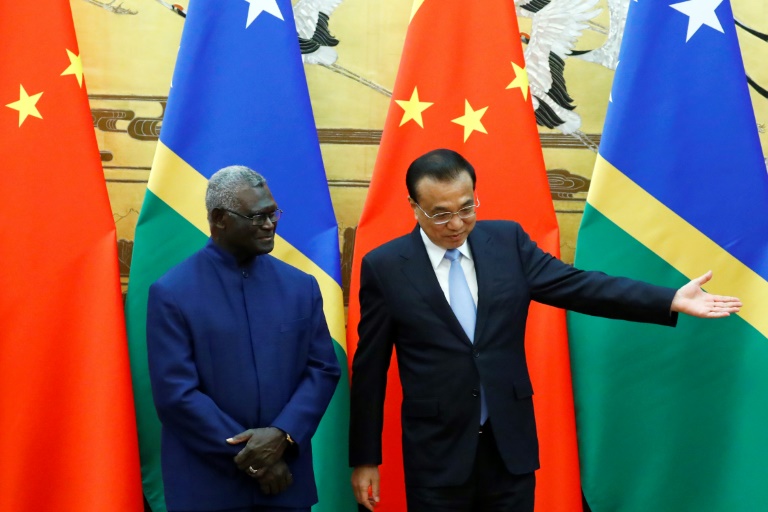
Policymakers in the United States, Australia, New Zealand and Japan are still reeling from revelations in April that the Solomon Islands secretly negotiated a security agreement with Beijing.

A leaked draft of the agreement contained a provision allowing Chinese naval deployments to the island nation, which lies less than 2,000 kilometres (1,200 miles) from Australia.

The Solomon Islands has said it will not host Chinese bases, but it is also prohibited from speaking publicly about the deal without China’s permission.

Beijing’s latest proposal would effectively extend key elements of the Solomon Islands agreement to nine other small Pacific nations.

– Regional fears –

For Washington and its allies, the presence of Chinese forces in the South Pacific would spell an end to decades of efforts to contain China inside the “first island chain”.

It could also require a dramatic repositioning of US forces.

For Beijing, a base or even port access would challenge US hegemony in the region and ease what it sees as encirclement by the West.

Wang touched down in the Solomon Islands’ capital Honiara on Thursday, kicking off a lengthy, eight-nation regional tour.

He is scheduled to sign draft agreements, details of which have not been made public, as well as meet with the country’s prime minister and foreign minister.

Travelling until June 4, Wang will also stop in Papua New Guinea, Fiji, Kiribati and Samoa, as well as hold video calls with Micronesia and the Cook Islands — a self-governing part of New Zealand. 

Boeing Starliner completes key test mission to ISS, with some hiccups

Boeing’s Starliner capsule returned to Earth Wednesday in the final step of a key uncrewed test flight to prove itself worthy of providing rides for NASA astronauts to the International Space Station.

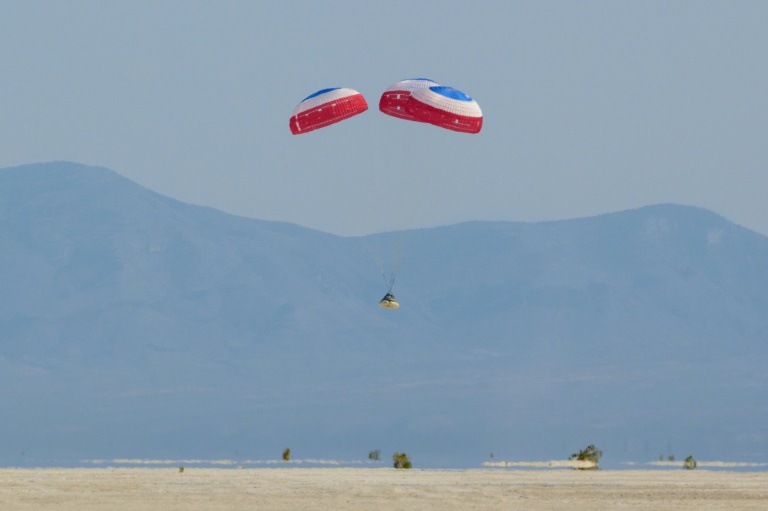
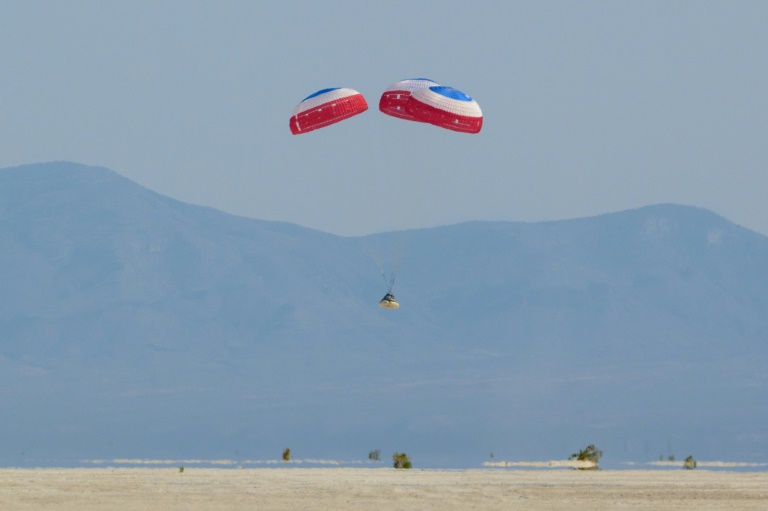
The gumdrop-shaped spaceship landed in a puff of sand at 4:49 pm local time (2249 GMT) in the New Mexico desert, wrapping up a six-day mission crucial to restoring Boeing’s reputation after past failures.

“Just a beautiful touchdown in White Sands this evening,” said an announcer on a NASA live feed, as ground control reacted with applause, and a recovery team raced to the landing site.

Orbital Flight Test-2 (OFT-2) was the last hurdle for Starliner to clear before it carries humans in another test flight due to take place by the end of this year. If that succeeds, the spaceship will begin regular service.

Addressing reporters at a post-touchdown briefing, NASA’s Steve Stich, who oversees the commercial crew program, summed up: “We have a few things to work on…but I don’t really see any showstoppers.”

“We really do have the crewed flight test next on our focus,” he added.

NASA is looking to certify Starliner as a second “taxi” service for its astronauts to the space station — a role that Elon Musk’s SpaceX has provided since succeeding in a test mission for its Dragon capsule in 2020.

Both companies were awarded fixed-price contracts — $4.2 billion to Boeing and $2.6 billion to SpaceX — in 2014, shortly after the end of the Space Shuttle program, during a time when the United States was left reliant on Russian Soyuz rockets for rides to the ISS.

– Landing airbags –

Starliner docked with the orbital outpost on Friday, a day after blasting off from the Kennedy Space Center in Florida.

Over the weekend, astronauts living aboard the station  opened the hatch and “greeted” the capsule’s passengers: Rosie the Rocketeer, a mannequin equipped with sensors to see what astronauts would have experienced, and a plush toy named Jebediah Kerman, the ship’s zero-g indicator.

The spacecraft brought back more than 600 pounds (270 kilograms) of cargo, including tanks that provide breathable air to station crew members, which will be refurbished and taken back up on a future flight.

As it flew over the Pacific Ocean, Starliner initiated a de-orbital maneuver, and then ejected its expendable service module, leaving the remaining crew module to withstand temperatures of around 3000 degrees Fahrenheit (1650 Celsius) during atmospheric re-entry.

Having shed most of its velocity, it deployed a sequence of parachutes culminating in its three giant main chutes, colored red, white and blue. At 3,000 feet (915 meters), it jettisoned its base heat shield — revealing airbags that inflated to aid a gentle landing.

The mission wasn’t without its hiccups, which NASA and Boeing teams are now going to probe thoroughly in case they could cause future problems.

Early on, two thrusters responsible for placing Starliner in a stable orbit failed, though officials insisted there was plenty of redundancy built into the system to overcome the problem.

On the day of docking, the vessel missed its scheduled contact time by more than an hour, after a ring responsible for latching on to the station failed to deploy correctly. Engineers had to retract the ring and pop it out again before it worked the second time.

After touchdown, recovery teams detected hydrazine vapor around Starliner and had to back off until it cleared. Stich later explained that this sometimes occurs when a spaceship doesn’t burn all its propellant, and there was no evidence of a leak.

– ‘Really happy’ –

Overall, the glitches were minor compared to the troubles Starliner saw during its first test launch, back in 2019, when one software bug caused it to burn too much fuel to reach its destination, and another almost meant that the vehicle was destroyed during re-entry.

The second error was caught in time to upload a patch, and the vessel was able to land safely at White Sands Space Harbor — the same spaceport where the Space Shuttle Columbia once landed, and where Starliner touched down once more on Wednesday.

Boeing and NASA also tried to launch Starliner in August 2021, but the capsule was rolled back from the launchpad to address sticky valves that did not open as they should.

On Wednesday night, however, both NASA and Boeing officials were all smiles.

“There’s lots of emotion,” said Mark Nappi of Boeing. “(I’m) really happy for this team of people who have been working on this for years, and waiting for today.”

Boeing Starliner completes key test mission to ISS, with some hiccups

Boeing’s Starliner capsule returned to Earth Wednesday in the final step of a key uncrewed test flight to prove itself worthy of providing rides for NASA astronauts to the International Space Station.

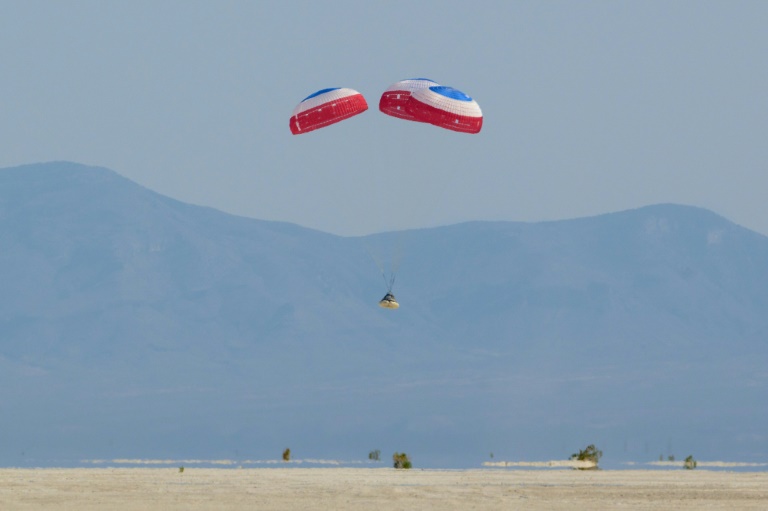
The gumdrop-shaped spaceship landed in a puff of sand at 4:49 pm local time (2249 GMT) in the New Mexico desert, wrapping up a six-day mission crucial to restoring Boeing’s reputation after past failures.

“Just a beautiful touchdown in White Sands this evening,” said an announcer on a NASA live feed, as ground control reacted with applause, and a recovery team raced to the landing site.

Orbital Flight Test-2 (OFT-2) was the last hurdle for Starliner to clear before it carries humans in another test flight due to take place by the end of this year. If that succeeds, the spaceship will begin regular service.

Addressing reporters at a post-touchdown briefing, NASA’s Steve Stich, who oversees the commercial crew program, summed up: “We have a few things to work on…but I don’t really see any showstoppers.”

“We really do have the crewed flight test next on our focus,” he added.

NASA is looking to certify Starliner as a second “taxi” service for its astronauts to the space station — a role that Elon Musk’s SpaceX has provided since succeeding in a test mission for its Dragon capsule in 2020.

Both companies were awarded fixed-price contracts — $4.2 billion to Boeing and $2.6 billion to SpaceX — in 2014, shortly after the end of the Space Shuttle program, during a time when the United States was left reliant on Russian Soyuz rockets for rides to the ISS.

– Landing airbags –

Starliner docked with the orbital outpost on Friday, a day after blasting off from the Kennedy Space Center in Florida.

Over the weekend, astronauts living aboard the station  opened the hatch and “greeted” the capsule’s passengers: Rosie the Rocketeer, a mannequin equipped with sensors to see what astronauts would have experienced, and a plush toy named Jebediah Kerman, the ship’s zero-g indicator.

The spacecraft brought back more than 600 pounds (270 kilograms) of cargo, including tanks that provide breathable air to station crew members, which will be refurbished and taken back up on a future flight.

As it flew over the Pacific Ocean, Starliner initiated a de-orbital maneuver, and then ejected its expendable service module, leaving the remaining crew module to withstand temperatures of around 3000 degrees Fahrenheit (1650 Celsius) during atmospheric re-entry.

Having shed most of its velocity, it deployed a sequence of parachutes culminating in its three giant main chutes, colored red, white and blue. At 3,000 feet (915 meters), it jettisoned its base heat shield — revealing airbags that inflated to aid a gentle landing.

The mission wasn’t without its hiccups, which NASA and Boeing teams are now going to probe thoroughly in case they could cause future problems.

Early on, two thrusters responsible for placing Starliner in a stable orbit failed, though officials insisted there was plenty of redundancy built into the system to overcome the problem.

On the day of docking, the vessel missed its scheduled contact time by more than an hour, after a ring responsible for latching on to the station failed to deploy correctly. Engineers had to retract the ring and pop it out again before it worked the second time.

After touchdown, recovery teams detected hydrazine vapor around Starliner and had to back off until it cleared. Stich later explained that this sometimes occurs when a spaceship doesn’t burn all its propellant, and there was no evidence of a leak.

– ‘Really happy’ –

Overall, the glitches were minor compared to the troubles Starliner saw during its first test launch, back in 2019, when one software bug caused it to burn too much fuel to reach its destination, and another almost meant that the vehicle was destroyed during re-entry.

The second error was caught in time to upload a patch, and the vessel was able to land safely at White Sands Space Harbor — the same spaceport where the Space Shuttle Columbia once landed, and where Starliner touched down once more on Wednesday.

Boeing and NASA also tried to launch Starliner in August 2021, but the capsule was rolled back from the launchpad to address sticky valves that did not open as they should.

On Wednesday night, however, both NASA and Boeing officials were all smiles.

“There’s lots of emotion,” said Mark Nappi of Boeing. “(I’m) really happy for this team of people who have been working on this for years, and waiting for today.”

Boeing Starliner completes key test mission to ISS, with some hiccups

Boeing’s Starliner capsule returned to Earth Wednesday in the final step of a key uncrewed test flight to prove itself worthy of providing rides for NASA astronauts to the International Space Station.

The gumdrop-shaped spaceship landed in a puff of sand at 4:49 pm local time (2249 GMT) in the New Mexico desert, wrapping up a six-day mission crucial to restoring Boeing’s reputation after past failures.

“Just a beautiful touchdown in White Sands this evening,” said an announcer on a NASA live feed, as ground control reacted with applause, and a recovery team raced to the landing site.

Orbital Flight Test-2 (OFT-2) was the last hurdle for Starliner to clear before it carries humans in another test flight due to take place by the end of this year. If that succeeds, the spaceship will begin regular service.

Addressing reporters at a post-touchdown briefing, NASA’s Steve Stich, who oversees the commercial crew program, summed up: “We have a few things to work on…but I don’t really see any showstoppers.”

“We really do have the crewed flight test next on our focus,” he added.

NASA is looking to certify Starliner as a second “taxi” service for its astronauts to the space station — a role that Elon Musk’s SpaceX has provided since succeeding in a test mission for its Dragon capsule in 2020.

Both companies were awarded fixed-price contracts — $4.2 billion to Boeing and $2.6 billion to SpaceX — in 2014, shortly after the end of the Space Shuttle program, during a time when the United States was left reliant on Russian Soyuz rockets for rides to the ISS.

– Landing airbags –

Starliner docked with the orbital outpost on Friday, a day after blasting off from the Kennedy Space Center in Florida.

Over the weekend, astronauts living aboard the station  opened the hatch and “greeted” the capsule’s passengers: Rosie the Rocketeer, a mannequin equipped with sensors to see what astronauts would have experienced, and a plush toy named Jebediah Kerman, the ship’s zero-g indicator.

The spacecraft brought back more than 600 pounds (270 kilograms) of cargo, including tanks that provide breathable air to station crew members, which will be refurbished and taken back up on a future flight.

As it flew over the Pacific Ocean, Starliner initiated a de-orbital maneuver, and then ejected its expendable service module, leaving the remaining crew module to withstand temperatures of around 3000 degrees Fahrenheit (1650 Celsius) during atmospheric re-entry.

Having shed most of its velocity, it deployed a sequence of parachutes culminating in its three giant main chutes, colored red, white and blue. At 3,000 feet (915 meters), it jettisoned its base heat shield — revealing airbags that inflated to aid a gentle landing.

The mission wasn’t without its hiccups, which NASA and Boeing teams are now going to probe thoroughly in case they could cause future problems.

Early on, two thrusters responsible for placing Starliner in a stable orbit failed, though officials insisted there was plenty of redundancy built into the system to overcome the problem.

On the day of docking, the vessel missed its scheduled contact time by more than an hour, after a ring responsible for latching on to the station failed to deploy correctly. Engineers had to retract the ring and pop it out again before it worked the second time.

After touchdown, recovery teams detected hydrazine vapor around Starliner and had to back off until it cleared. Stich later explained that this sometimes occurs when a spaceship doesn’t burn all its propellant, and there was no evidence of a leak.

– ‘Really happy’ –

Overall, the glitches were minor compared to the troubles Starliner saw during its first test launch, back in 2019, when one software bug caused it to burn too much fuel to reach its destination, and another almost meant that the vehicle was destroyed during re-entry.

The second error was caught in time to upload a patch, and the vessel was able to land safely at White Sands Space Harbor — the same spaceport where the Space Shuttle Columbia once landed, and where Starliner touched down once more on Wednesday.

Boeing and NASA also tried to launch Starliner in August 2021, but the capsule was rolled back from the launchpad to address sticky valves that did not open as they should.

On Wednesday night, however, both NASA and Boeing officials were all smiles.

“There’s lots of emotion,” said Mark Nappi of Boeing. “(I’m) really happy for this team of people who have been working on this for years, and waiting for today.”

No slump for pump and dump cryptocurrency gangs

In a sleepy corner of the crypto-economy, the value of an obscure coin called Enzyme was tumbling downwards along with its peers earlier this month — but then something unusual happened on May 15.

Enzyme, also known as MLN, rocketed from 30 cents to 47 cents in just minutes and daily trading volumes exploded from around $3 million to more than $100 million, according to CoinGecko.

A few hours later, it crashed back down to 35 cents.

The coin had just been “pumped and dumped”, an age-old scam when traders get together and orchestrate a price hike to bag a quick profit.

“In the stock market, pump and dump is illegal, which is why criminals take advantage of the less robust regulatory framework around crypto assets,” said Mircea Mihaescu of compliance outfit Coinfirm.

The crypto economy has been torn to shreds in recent weeks with hundreds of billions knocked off the value of the sector and some currencies completely collapsing.

The scamming industry — worth some $7.8 billion last year according to Chainalysis data — has not given up though.

Scammers continue to find fertile ground on the Telegram app and Twitter, positioning themselves as benevolent heroes helping those who have lost out in the crash.

The rationale preys on the cult-like nature of crypto investing, but experts say it is far from the truth.

– ‘Shill it on Twitter’ –

The May 15 call to arms came on a Telegram group called WallStreetBets – Pumps.

After several messages building the hype, the group wrote: “The coin we are buying is $MLN… Shill it on Twitter to make it trending.”

Twitter immediately lit up.

“Whales accumulating, worth a shot!” tweeted a user called CryptoSanta, referring to the nickname of mega-rich investors.

Enzyme Finance, the firm that owns the MLN coin but has no link to the Telegram channel, quickly tried to calm things down.

“Please be careful of fake accounts looking to operate pump and dump schemes,” the firm tweeted, distancing itself from the feeding frenzy.

But everyone who saw the Telegram messages or the hype on Twitter knew their only chance to make a profit was to get in and out fast.

In reality, almost all of them would have lost. The price spike lasted for just minutes and the only ones guaranteed success were those organising the scam. 

“In any pump and dump scheme, everyone is convinced they are the pumper,” said behavioural economist Stuart Mills from the London School of Economics.

AFP was unable to reach WallStreetBets – Pumps for comment.

But it is far from the only group openly pumping coins on Telegram.

Kucoin Crypto Pumps Trading, for example, is already advertising a pump timed for next week. Monaco Pump Group claims to be run by “two of the richest whales in Monaco”.

– ‘Mega whales’ –

In fact, data scientist Matt Ranger reckons most of these schemes are run by groups of chancers and low-level career scammers with one main skill — marketing.

“You don’t have to know how to write a line of code,” he said of the pump and dump schemes.

The Telegram groups churn out messages that tap into the sense of grievance at the heart of the crypto-economy — the feeling that mainstream economic institutions have failed young people.

“This signal was meant for everyone to recover from the recent Luna events,” the WallStreetBets group said, referring to the failure of a major crypto project called terra/luna.

And the group thanked “mega whales” for helping to pump up the value.

The insular world of crypto creates its own fictions, where billionaires sacrifice themselves for the good of the community.

It goes hand-in-glove with currently popular conspiracy theories that the crash in the crypto economy was engineered by investment firms like BlackRock or Citadel.

These companies, the theory goes, deliberately crashed bitcoin so they could buy into the space at a lower price.

Stuart Mills points out that this helps the pump and dump groups to de-humanise their victims and boost their own sense of grievance.

“All of a sudden these unethical means become more justified,” said Mills. “I was screwed, so time to screw the bad guys over.”

However, Matt Ranger points out that during slumps like the current one, such scams quickly become unsustainable.

“The only buy orders are the people on that Telegram group or on Twitter,” he said. “As soon as you hit the last one, it collapses, because there’s nothing else, there’s no organic real demand.”

Filing says Elon Musk to borrow less in Twitter bid

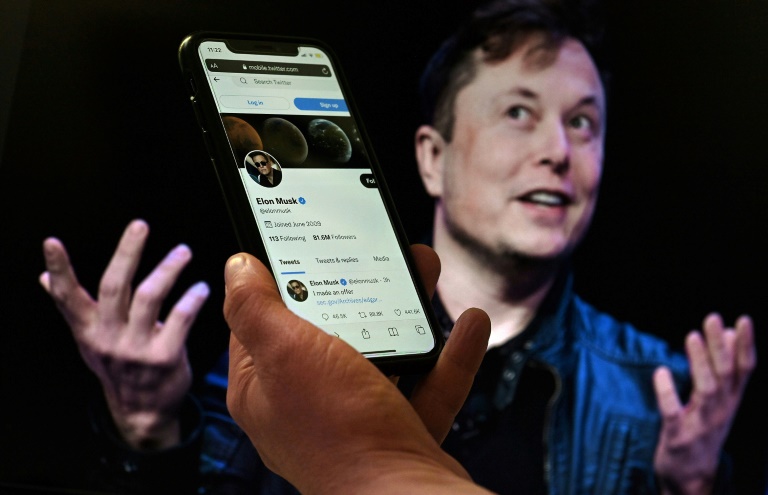
Elon Musk notified US regulators on Wednesday that he will rely less on loans in his bid to buy Twitter, as he and partners put $33.5 billion into the deal.

Twitter shares climbed more than 5 percent on the news, as the market evidently took it as a sign the acquisition is moving forward despite Musk declaring it on “hold” due to his concerns about the number of accounts that might be software “bots” instead of real people.

The Tesla chief said in a filing with the US Securities and Exchange Commission that he would seek $13 billion in loans for the Twitter buy instead of using nearly double that much debt as previously indicated.

Musk has been courting major Twitter investors including co-founder Jack Dorsey in the hope of getting them to partner with him in taking the San Francisco-based company private.

Musk said in the regulatory filing that he had new commitments that will allow him to rely less on loans to buy Twitter, but did not specify whether he was reaching into his own pocket for money or had won over others with big stakes in the company.

Analysts were concerned about Musk using billions of dollars worth of his Tesla shares to back loans, meaning the electric car company’s stock price would be affected by the fortunes of Twitter.

Wedbush analyst Dan Ives said in a tweet that Musk changing the Twitter buy financing structure was a “good move” but that the buyout “game of high stakes poker continues.”

Wedbush estimated the chances of the Musk buy of Twitter happening as even odds, Ives said in the tweet.

Twitter’s share price has fallen on signs Musk might not complete his buy of the company for the offered $54.20 per share, and risen on indications the deal is moving forward.

Twitter shares were just shy of $40 each in after-market trades on Wednesday, signaling a lack of faith by investors in the original deal being culminated.

US securities regulators unveil proposal to fight 'greenwashing'

US securities regulators unveiled Wednesday a proposed rule to tighten disclosure requirements on the rising number of investments that tout their commitment to environmental, social and governance (ESG) goals.

Seeking to address the problem of “greenwashing,” where financial investments may fall short of marketing statements, the Securities and Exchange Commission said the measure was meant to standardize disclosure and avoid cases where a fund “could exaggerate its actual consideration of ESG factors.”

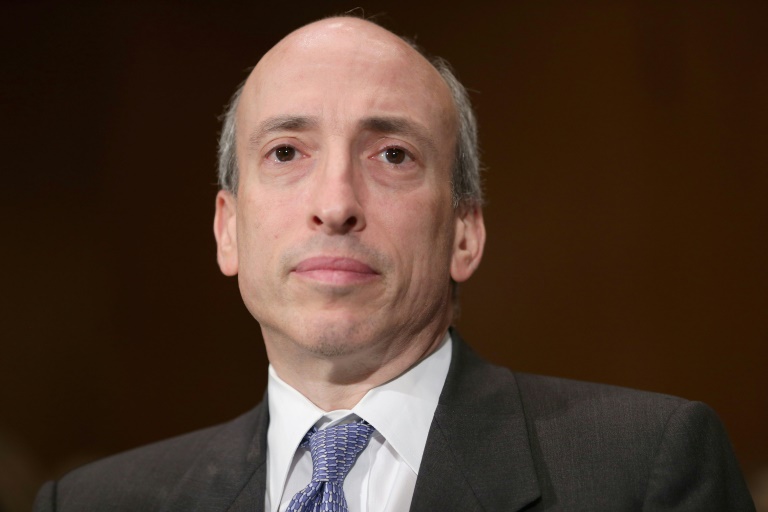
SEC Chairman Gary Gensler said the rule was needed as the scale of the so-called “US sustainable investment universe” has grown to $17.1 trillion, according to one estimate.

“When an investor reads current disclosures, though, it can be very difficult to understand what some funds mean when they say they’re an ESG fund,” Gensler said. “There also is a risk that funds and investment advisers mislead investors by overstating their ESG focus.”

Funds that integrate ESG factors alongside non-ESG factors would be required to say how ESG is incorporated into the investment process, while ESG impact funds would need to say how they measure progress, the SEC said of the proposed rule.

Funds that emphasize the environment would need to disclose the carbon footprint of their investments.

Opposing the proposal was SEC Commissioner Hester Peirce, a Republican commissioner who said she supported the idea of tightening standards but that the new rules did not adequately define ESG.

The proposal “avoids explicitly defining E, S and G, yet implicitly uses disclosure requirements to induce substantive changes in funds’ and advisers’ ESG practices,” she said. “Investors will pick up the tab for our latest ESG exploits without seeing much benefit.”

The SEC plans a 60-day public comment period on the proposal.

Zelensky rebukes West as Russia closes in on key Ukraine city

Fierce battles raged in eastern Ukraine on Wednesday, with Russian troops on the verge of encircling a key industrial city, as President Volodymyr Zelensky issued a bitter rebuke of the West for not doing enough to help Kyiv win the war.

Lugansk regional governor Sergiy Gaiday described fighting outside of the industrial city of Severodonetsk, a key military goal for Russia, as “very difficult,” saying Russian troops were shelling the city from the outskirts with mortars.

“The coming week will be decisive,” Gaiday said in a video posted on Telegram, adding he believes Russia’s goal is to “capture the Lugansk region no matter what cost”.

“There is a colossal amount of shelling,” he added. 

Earlier in the day, addressing the World Economic Forum in Davos, Ukraine’s Foreign Ministry Dmytro Kuleba compared the battle for Donbass to the epic battles fought in World War II and said his country “badly” needs multiple launch rocket systems to match Russian firepower.

In Kyiv, Zelensky echoed that plea.

“We need the help of our partners — above all, weapons for Ukraine. Full help, without exceptions, without limits, enough to win,” Zelensky said in his daily address to the nation.

And he called out the international community for paying too much attention to Russia’s interests and too little to Ukraine’s.

The Ukrainian president blasted a recent New York Times editorial and other similar statements by influential Western figures suggesting that Ukraine might have to sacrifice some territory to end the conflict.

“We must do everything in our power so that the world develops a firm habit to take Ukraine into consideration, so that the interests of Ukrainians don’t get overtaken by the interests of those rushing to yet another meeting with the dictator,” Zelensky said.

– ‘Clear blackmail’ –

Russia’s February 24 invasion of its pro-Western neighbour has caused global shockwaves, with the latest being fears of food shortages, particularly in Africa.

Moscow blamed the international sanctions imposed after the invasion, while the West says the shortage is mainly down to Russia’s blockade of Ukrainian ports.

“Solving the food problem requires a comprehensive approach, including the removal of sanctions that have been imposed on Russian exports and financial transactions,” said Russian deputy foreign minister Andrey Rudenko.

But Kuleba urged the West not to give in.

“This is clear blackmail. You could not find a better example of blackmail in international relations,” Kuleba said in Davos.

Kuleba also slammed the western military alliance NATO for “doing literally nothing” to stop Russia.

– ‘Extremely heavy shelling’ –

Moscow’s army has plotted a slow but steady course deeper into Ukraine’s eastern Donbas region since withdrawing forces from central and northern regions.

In the eastern town of Soledar, Ukraine’s salt manufacturing hub, the ground shook moments after Natalia Timofeyenko climbed out of her bunker.

“I go outside just to see people. I know that there is shelling out there but I go,” the 47-year-old said after a thundering blast smashed apart a chunk of a salt mine where she worked with most of her friends and neighbours.

Ghostly frontline towns like Soledar are being hammered by Russian artillery as they sit along the crucial road that leads out of besieged Severodonetsk and its sister city Lysychansk.

Twelve people were killed by “extremely heavy shelling and attacks” in the neighbouring region of Donetsk, which also forms part of Donbas, the Ukrainian presidency said.

In a sign that the rest of the country remains at risk, Russian cruise missiles struck the major southern rail hub of Zaporizhzhia, killing one person and damaging dozens of houses, the presidency added.

– ‘It is just war’ –

Russia also sought to tighten its grip over the parts of southern Ukraine that it occupies.

President Vladimir Putin on Wednesday signed a decree simplifying a procedure to obtain a Russian passport for residents of the southern Ukrainian regions of Kherson, under the full control of Russian troops, and partly-occupied Zaporizhzhia.

Kyiv said the plan was a “flagrant violation” of Ukraine’s sovereignty.

Moscow-backed officials are pushing for formal annexation by Russia.

“People are very apprehensive,” Kherson trolleybus driver Alexander Loginov, 47, told AFP from the cabin of his vehicle, during a press trip organised by the Russian defence ministry. 

Day-to-day life remains marked by uncertainty, especially over payment of salaries as “Ukrainian banks are closing,” he said. “To be honest, it is just war.”

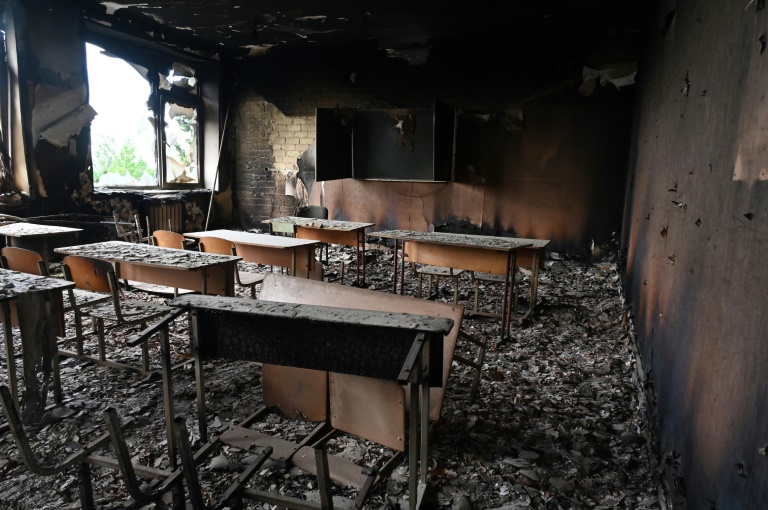
Underlining the human cost, about 200 bodies were found in the basement of a destroyed building of the port city of Mariupol, which fell to Moscow recently after a devastating siege, Ukrainian authorities said.

“It is impossible to be within the area due to the corpse smell,” Ukrainian ombudswoman Lyudmyla Denisova wrote on Telegram Wednesday. “The occupiers turned the entire Mariupol into a cemetery.”

burs-dk/spm/md/bgs

US to urge tougher sanctions after North Korea fires likely ICBM

The United States said Wednesday it would seek new sanctions on North Korea at the United Nations after Kim Jong Un’s regime fired a volley of missiles, including possibly its largest intercontinental ballistic missile.

The launch came just hours after US President Joe Biden left Asia following a trip overshadowed by Pyongyang’s sabre-rattling.

North Korea has also been conducting “operational tests” of a nuclear detonation device, Kim Tae-hyo, Seoul’s first deputy director of the National Security Office, said, adding a test could come “imminently”.

His warning adds to the drumbeat of predictions from US and South Korean officials, who have been saying for weeks that Kim’s regime is close to conducting its seventh nuclear test.

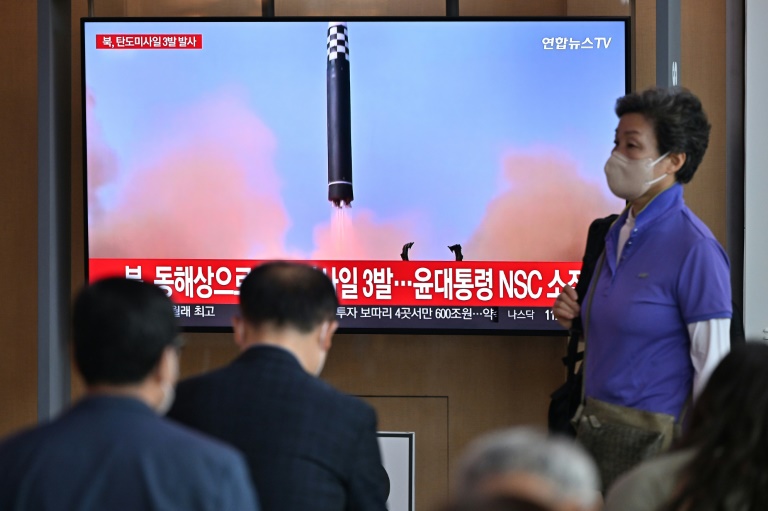
Three missiles, including one ICBM, were fired from the Sunan area in Pyongyang, Seoul said — one of nearly 20 weapons tests by North Korea so far this year — prompting joint US-South Korea live-fire missile drills in response.

Washington plans to call for a UN Security Council vote on tougher sanctions on Pyongyang after the tests, a senior US official said. 

The official expected a vote “in the coming days” and noted that a previous Security Council resolution called for further consequences in the event of a further ICBM launch.

“That was a provision of that resolution. That’s precisely what happened and so we feel it’s now time to take action,” the official said on condition of anonymity.

Earlier, US Secretary of State Antony Blinken and his South Korean and Japanese counterparts “strongly condemned the DPRK’s ballistic missile launches as a clear violation of multiple UN Security Council resolutions”, according to State Department spokesman Ned Price, using another name for North Korea.

The three early-morning ballistic missile launches came within an hour of each other, South Korea’s Joint Chiefs of Staff said in a statement.

“The first ballistic missile (suspected ICBM) had a range of around 360 kilometres (225 miles) and an altitude of around 540km,” Seoul’s Joint Chiefs of Staff said in a statement.

This could have been North Korea’s largest ICBM, the Hwasong-17, Kim Tae-hyo said later.

The second ballistic missile “disappeared at an altitude of 20km” and the third — a suspected short-range ballistic missile — travelled around 760km at an altitude of around 60km.

– Response to Biden –

The Wednesday launches are the latest in a blitz of sanctions-busting weapons tests by Pyongyang this year, including test-firing intercontinental ballistic missiles at full range for the first time since 2017.

The latest apparent test come just days after Biden left South Korea Sunday.

The tests were “clearly timed for President Biden’s return after his visit to South Korea and Japan”, Ewha University professor Park Won-gon said, adding that Biden had not even touched down in the United States when they happened.

During Biden’s visit, Seoul and Washington announced they would look at ramping up joint military exercises, which had been scaled back for Covid-19 and during a bout of failed diplomacy with the North.

They also discussed deploying more US tactical assets to the peninsula — measures that would likely enrage Pyongyang, which views the drills as rehearsals for invasion.

“North Korea’s objections against these announcements was expressed through the missile launches,” Park said.

On his last day in Seoul, Biden told reporters he had only a short message for Kim: “Hello. Period.”

– Covid and missiles –

“Pyongyang appears to have launched different types of missiles, probably in the process of improving related military capabilities,” said Leif-Eric Easley, a professor at Ewha University.

“But this also looks like a statement that the Kim regime has many different ways of striking an adversary.”

Kim has recently doubled down on his programme of military modernisation.

Despite struggling with a recent Covid-19 outbreak, the North has resumed construction at a long-dormant nuclear reactor, new satellite imagery has indicated.

Earlier this month, North Korea confirmed its first-ever Omicron cases in Pyongyang, and the virus has since torn through its unvaccinated population of 25 million.

More than 3.1 million people have been sick with “fever”, North Korean state media said early Thursday, with 68 deaths since the outbreak began in late April.

North Korea has continued to conduct missile tests since it declared a national emergency over the Covid outbreak.

“It shows Pyongyang’s intent to achieve two objectives simultaneously: overcoming the outbreak and enhancing its nuclear arsenal,” said Yang Moo-jin, a professor at the University of North Korean Studies. 

“Kim seems to be saying that the North is in charge of the security issues that are affecting the Korean peninsula, not Washington.”

Close Bitnami banner
Bitnami