World

Boeing's Starliner faces one more challenge as it returns to Earth

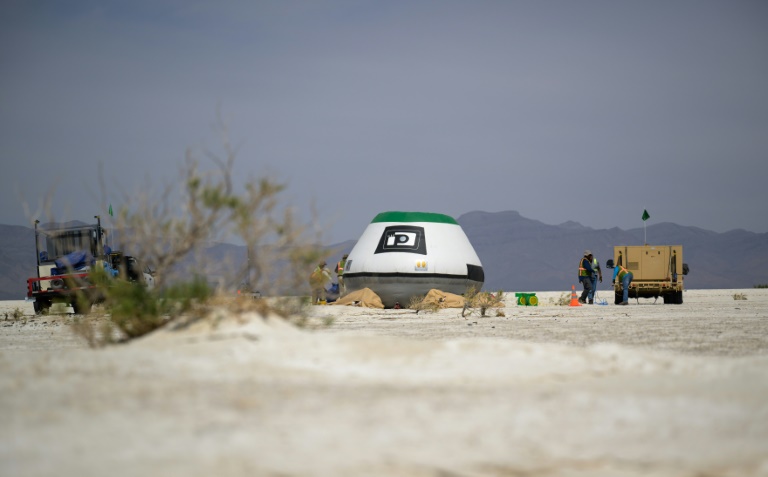
Boeing’s Starliner capsule headed back to Earth Wednesday in the final step of a key test flight to prove itself worthy of providing rides for NASA astronauts to the International Space Station.

The spaceship autonomously undocked at 2:36 pm Eastern time (1836 GMT) and was set to touch down in New Mexico just over four hours later, at 2249 GMT, wrapping up a six-day mission crucial to restoring Boeing’s reputation after past failures.

“#Starliner separation confirmed,” tweeted Boeing Space.

Orbital Flight Test-2 (OFT-2) is the last hurdle for Starliner to clear before it carries humans in another test flight that could take place by the end of this year.

Starliner docked with the ISS on Friday, a day after blasting off from the Kennedy Space Center in Florida.

Over the weekend, astronauts living aboard the research platform opened the hatch and “greeted” the capsule’s passengers: Rosie the Rocketeer, a sensor-equipped mannequin, and a plush toy named Jebediah Kerman, a video game character and the ship’s zero-g indicator.

The mission hasn’t been without its hiccups.

Two thrusters responsible for placing Starliner in a stable orbit failed, though officials insisted there was plenty of redundancy built into the system to overcome the problem.

On the day of docking, the vessel missed its scheduled contact time by more than an hour, after a ring responsible for latching on to the station failed to deploy correctly. Engineers had to retract the ring and pop it out again before it worked the second time.

– Second taxi service –

Still, the glitches are minor compared to the troubles Starliner saw during its first test launch, back in 2019, when one software bug caused it to burn too much fuel to reach its destination, and another almost meant that the vehicle was destroyed during re-entry.

The second error was caught in time to upload a patch, and the vessel was able to achieve a gentle landing, slowed by its enormous parachutes, at White Sands Space Harbor — the same spaceport where the space shuttle Columbia once landed, and where Starliner is once more expected for touchdown.

The spacecraft will bring back more than 600 pounds (270 kilograms) of cargo, including reusable tanks that provide breathable air to station crew members, which will be refurbished and taken back up on a future flight.

Boeing and NASA also tried to launch Starliner in August 2021, but the capsule was rolled back from the launchpad to address sticky valves that did not open as they should, and the ship was eventually sent back to the factory for fixes.

NASA is looking to certify Starliner as a second “taxi” service for its astronauts to the space station — a role that Elon Musk’s SpaceX has provided since succeeding in a test mission for its Dragon capsule in 2020.

Both companies were awarded fixed-price contracts — $4.2 billion to Boeing and $2.6 billion to SpaceX — in 2014, shortly after the end of the space shuttle program, during a time when the United States was left reliant on Russian Soyuz rockets for rides to the orbital outpost.
Boeing's Starliner faces one more challenge as it returns to Earth

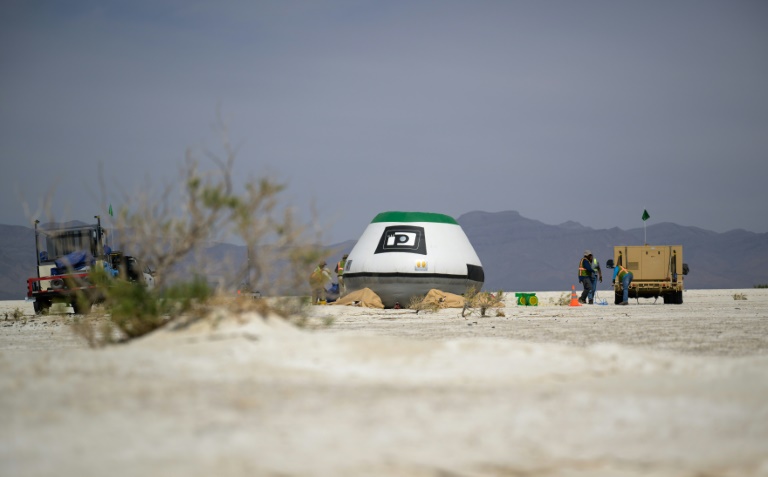
Boeing’s Starliner capsule headed back to Earth Wednesday in the final step of a key test flight to prove itself worthy of providing rides for NASA astronauts to the International Space Station.

The spaceship autonomously undocked at 2:36 pm Eastern time (1836 GMT) and was set to touch down in New Mexico just over four hours later, at 2249 GMT, wrapping up a six-day mission crucial to restoring Boeing’s reputation after past failures.

“#Starliner separation confirmed,” tweeted Boeing Space.

Orbital Flight Test-2 (OFT-2) is the last hurdle for Starliner to clear before it carries humans in another test flight that could take place by the end of this year.

Starliner docked with the ISS on Friday, a day after blasting off from the Kennedy Space Center in Florida.

Over the weekend, astronauts living aboard the research platform opened the hatch and “greeted” the capsule’s passengers: Rosie the Rocketeer, a sensor-equipped mannequin, and a plush toy named Jebediah Kerman, a video game character and the ship’s zero-g indicator.

The mission hasn’t been without its hiccups.

Two thrusters responsible for placing Starliner in a stable orbit failed, though officials insisted there was plenty of redundancy built into the system to overcome the problem.

On the day of docking, the vessel missed its scheduled contact time by more than an hour, after a ring responsible for latching on to the station failed to deploy correctly. Engineers had to retract the ring and pop it out again before it worked the second time.

– Second taxi service –

Still, the glitches are minor compared to the troubles Starliner saw during its first test launch, back in 2019, when one software bug caused it to burn too much fuel to reach its destination, and another almost meant that the vehicle was destroyed during re-entry.

The second error was caught in time to upload a patch, and the vessel was able to achieve a gentle landing, slowed by its enormous parachutes, at White Sands Space Harbor — the same spaceport where the space shuttle Columbia once landed, and where Starliner is once more expected for touchdown.

The spacecraft will bring back more than 600 pounds (270 kilograms) of cargo, including reusable tanks that provide breathable air to station crew members, which will be refurbished and taken back up on a future flight.

Boeing and NASA also tried to launch Starliner in August 2021, but the capsule was rolled back from the launchpad to address sticky valves that did not open as they should, and the ship was eventually sent back to the factory for fixes.

NASA is looking to certify Starliner as a second “taxi” service for its astronauts to the space station — a role that Elon Musk’s SpaceX has provided since succeeding in a test mission for its Dragon capsule in 2020.

Both companies were awarded fixed-price contracts — $4.2 billion to Boeing and $2.6 billion to SpaceX — in 2014, shortly after the end of the space shuttle program, during a time when the United States was left reliant on Russian Soyuz rockets for rides to the orbital outpost.
War in Ukraine: Latest developments

Here are the latest developments in the war in Ukraine:

– Residents of occupied cities to get Russian passports – 

Russian President Vladimir Putin signs a decree making it easier for residents of Russian-occupied parts of southern Ukraine to get a Russian passport.

The move targets people in the city of Kherson, which was the first to fall to Russian forces, and in the region of Zaporizhzhia, which is partially controlled by Moscow.

Moscow has said both regions could become part of Russia. 

Ukraine slams the passport plan, which was devised in 2019 for parts of eastern Ukraine controlled by pro-Russian separatists, as a “flagrant violation of Ukraine’s sovereignty and territorial integrity.”

The US State Department says the plan is part of “Russia’s attempt to subjugate the people of Ukraine — to impose their will by force.” 

– Putin meets injured soldiers –

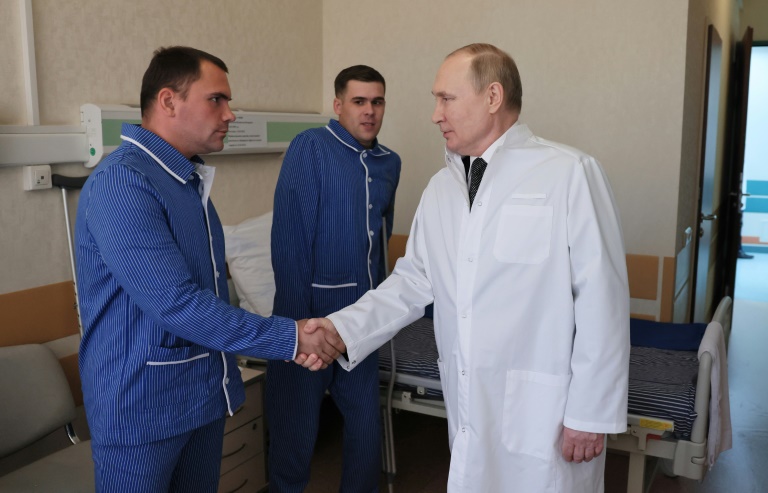
President Putin visits soldiers wounded in Ukraine for the first time since the invasion.

Clad in a white medical coat he shakes their hands and tells one man his baby son “will be proud of his dad”.

At a meeting with government officials afterwards Putin acclaims the injured as “heroes”, saying: “These are people who are risking their health and lives for the sake of the people and children of Donbas, for the sake of Russia.”

Russia said on March 25 that 1,351 soldiers had been killed and 3,825 wounded in Ukraine. Four days earlier Ukraine claimed Russia had lost 28,850 troops.

– Russian forces at gates of Severodonetsk –

Fighting between Russian and Ukrainian forces has reached the outskirts of the key eastern city of Severodonetsk, the regional governor says.

“Russian troops have advanced far enough that they can already fire mortars” on the city, Lugansk governor Sergiy Gaiday says in a statement on social media.

Severodonetsk, which had a pre-war population of around 100,000 people, has been under relentless Russian shelling for weeks.

It is one of the key goals in Russia’s offensive in the industrial Donbas region, which consists of Donetsk and Lugansk.

In a video later Wednesday, he governor says Russia now controls “around 95 percent” of the Lugansk region.

– Zelensky blasts Western disunity – 

Ukrainian President Volodymyr Zelensky blasts the West for lacking unity on the war during an address by videolink to an event held on the sidelines of the World Economic Forum in Davos.

He renews calls for heavy weapons from foreign partners, saying the billions of dollars’ worth already put up are not enough to help Ukraine’s outgunned forces.

– And FM lashes NATO –

Ukraine’s top diplomat Dmytro Kuleba accuses NATO of “doing literally nothing” in the face of Russia’s invasion, while praising the EU for its “revolutionary” decisions to back Kyiv. 

“NATO as an alliance, as an institution, is completely sidelined and doing literally nothing. I’m sorry to say it,” Kuleba tells the World Economic Forum.

– Russian army eyes over-40s –

Russia’s parliament passes a law scrapping the upper age limit for people joining the army, in a sign Moscow may be looking to recruit more troops for its military campaign in Ukraine.

Under current legislation, only Russians aged 18 to 40 and foreign nationals aged 18 to 30 have the right to sign their first military service contract.

– Chelsea FC takeover approved –

The UK government approves the proposed takeover of Chelsea football club from Roman Abramovich, saying it is satisfied the deal “will not benefit” the sanctioned Russian oligarch.

Abramovich put Chelsea on the market in early March.

A consortium led by Todd Boehly, a co-owner of baseball’s Los Angeles Dodgers, has agreed to buy the club for a record £4.25 billion ($5.3 billion). The Premier League has also agreed to the deal.

burs-cb-jmy/pvh

World voices horror as latest massacre dents US image

The world voiced revulsion Wednesday at the massacre of Texas schoolchildren, which for some raised new questions on whether the United States can effectively promote itself as a global model.

President Joe Biden, who has made championing democracy a key priority, appeared conscious of the damage to the US reputation in an impassioned plea for action late Tuesday moments after returning from Asia.

“What struck me on that 17-hour flight, what struck me, was these kinds of mass shootings rarely happen anywhere else in the world,” said Biden, who had mourned victims of another mass shooting in Buffalo on the eve of his trip.

US allies as well as UN Secretary-General Antonio Guterres, who rarely weigh in on US domestic affairs, all voiced horror over a teenage gunman’s killing of 19 children and two teachers in Uvalde, Texas.

Ukrainian President Volodymyr Zelensky — who has been relying on US weapons to repel a Russian invasion — called such peacetime deaths “terrible,” while French President Emmanuel Macron said he shared “the rage of those who are fighting to end the violence.”

Some allies questioned, politely, why the United States — with its constitutional right to bear arms and powerful gun lobby — cannot tackle gun violence, which claims on average 111 lives a day.

New Zealand’s Prime Minister Jacinda Adern, who was visiting the United States, pointed to how her government tightened gun laws after a white supremacist killed 51 people at two mosques in Christchurch in 2019.

“We are a very pragmatic people. When we saw something like that happen, everyone said, ‘Never again,'” she told the CBS “Late Show.”

– ‘Hard to imagine’ –

In Australia, which quickly banned semi-automatic weapons after a mass shooting in 1996, a minister in the new left-leaning government mourned “another senseless act of gun violence in the United States.”

“It is hard to imagine that a great country like the United States can go on like this, with this gun violence, these mass atrocities,” Treasurer Jim Chalmers told reporters.

Like during other recent episodes in the United States, including the attack on the US Capitol by supporters of Donald Trump and the police killing of George Floyd, US adversaries went on the offensive.

China — which faces constant US criticism on human rights, including over what Washington considers “genocide” against the Uyghur minority — said it was “unacceptable” that the United States has not addressed gun violence or racial discrimination.

“How can one expect the US government, (which) doesn’t even care about the human rights of its people, to genuinely concern itself with the human rights situation in other countries?” foreign ministry spokesman Wang Wenbin said.

The Global Times, a nationalist state-controlled newspaper, said the Texas shooting exposed the “failure” of the United States which is “the most dangerous place in the world.”

– ‘Dysfunctional’ democracy –

The United States has long faced accusations of double standards in boasting of its democracy.

During the Cold War, the Soviet Union pointed to Jim Crow systemic racism and, more recently, allies have voiced revulsion that the United States is the last Western nation to practice capital punishment.

Jeremi Suri, a professor of history and public affairs at the University of Texas at Austin, said it was commonplace for authoritarians to say they keep citizens safe, pointing to arguments presented by Russian President Vladimir Putin.

But he said the level of gun violence made it increasingly difficult to dismiss the issue as just “one of the oddities of American society, that we’re cowboys and carry guns.”

“The inability to manage basic safety for citizens contributes to an image that we are, unfortunately, seeing more and more evidence of, of people in foreign societies who believe that democracy is a dysfunctional form of government,” he said.

“Even though we’ve always fallen short at home, democracy nonetheless is an important part of our international brand, and this definitely diminishes that.”

Gerard Araud, the outspoken former French ambassador to the United States, on Twitter described gun violence as a “craziness without any prospect of improvement.”

“Nothing. Nothing will happen. There will be more massacres,” he wrote.

War in Ukraine: Latest developments

Here are the latest developments in the war in Ukraine:

– Residents of occupied cities to get Russian passports – 

Russian President Vladimir Putin signs a decree making it easier for residents of Russian-occupied parts of southern Ukraine to get a Russian passport.

The move targets people in the city of Kherson, which was the first to fall to Russian forces, and in the region of Zaporizhzhia, which is partially controlled by Moscow.

Moscow has said both regions could become part of Russia. 

Ukraine slams the passport plan, which was devised in 2019 for parts of eastern Ukraine controlled by pro-Russian separatists, as a “flagrant violation of Ukraine’s sovereignty and territorial integrity.”

– Putin meets injured soldiers –

President Putin visits soldiers wounded in Ukraine for the first time since the invasion.

Clad in a white medical coat he shakes their hands and tells one man his baby son “will be proud of his dad”.

At a meeting with government officials afterwards he acclaims the injured as “heroes”, saying: “These are people who are risking their health and lives for the sake of the people and children of Donbas, for the sake of Russia.”

Russia said on March 25 that 1,351 soldiers had been killed and 3,825 wounded in Ukraine. Four days earlier Ukraine claimed Russia had lost 28,850 troops.

– Russian forces at gates of Severodonetsk –

Fighting between Russian and Ukrainian forces has reached the outskirts of the key eastern city of Severodonetsk, the regional governor says.

“Russian troops have advanced far enough that they can already fire mortars” on the city, Lugansk governor Sergiy Gaiday says in a statement on social media.

Severodonetsk, which had a pre-war population of around 100,000 people, has been under relentless Russian shelling for weeks.

It is one of the key goals in Russia’s offensive in the industrial Donbas region.

– Zelensky blasts Western disunity – 

Ukrainian President Volodymyr Zelensky blasts the West for lacking unity on the war during an address by videolink to an event held on the sidelines of the World Economic Forum in Davos.

He renews calls for heavy weapons from foreign partners, saying the billions of dollars’ worth already put up are not enough to help Ukraine’s outgunned forces.

He also urges Hungary to stop blocking an EU embargo on Russian oil.

– Russian army eyes over-40s –

Russia’s parliament passes a law scrapping the upper age limit for people joining the army, in a sign Moscow may be looking to recruit more troops for its military campaign in Ukraine.

Under current legislation, only Russians aged 18 to 40 and foreign nationals aged 18 to 30 have the right to sign their first military service contract.

– Sanctions causing food shortages: Moscow – 

Russia blames Western sanctions for causing food shortages around the world.

“Solving the food problem requires a comprehensive approach, including the removal of sanctions that have been imposed on Russian exports and financial transactions,” says Russian deputy foreign minister Andrey Rudenko.

He says Russia is prepared to escort vessels bearing grain shipments to safety if Ukrainian demines its ports. 

The war in Ukraine has pushed global food prices to an all-time high. The West blames Russia for the situation.

Russia’s defence ministry says it has finished demining the port of the destroyed city of Mariupol and that foreign ships stuck in the harbour will be able to leave.

– Chelsea FC takeover approved –

The UK government approves the proposed takeover of Chelsea football club from Roman Abramovich, saying it is satisfied the deal “will not benefit” the sanctioned Russian oligarch.

Abramovich put Chelsea on the market in early March.

A consortium led by Todd Boehly, a co-owner of baseball’s Los Angeles Dodgers, has agreed to buy the club for a record £4.25 billion ($5.3 billion). The Premier League has also agreed to the deal.

burs-cb-jmy/spm/pvh

Russia bears down on key eastern Ukraine city

Russian forces threatened to encircle a crucial eastern Ukrainian city on Wednesday as Moscow said the West must drop sanctions over its invasion to end a global food crisis.

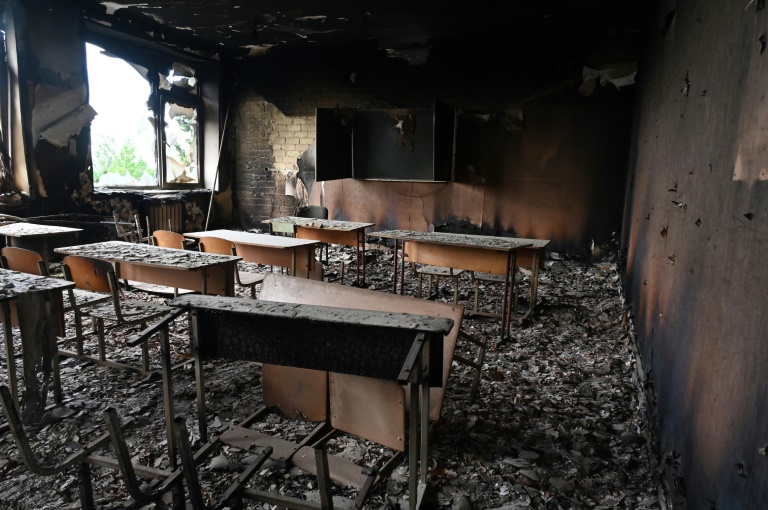
Ukrainian officials said fierce fighting had reached the edge of the industrial hub of Severodonetsk, under relentless bombardment by Russian forces trying to seize control of the Donbas region.

Ukraine’s President Volodymyr Zelensky called for Western more support for his outgunned troops as the Russian invasion entered its fourth month, while his foreign minister blasting NATO for doing “nothing”.

Kyiv meanwhile accused Moscow of “blackmail” over its proposal to allow grain exports if the West lifts sanctions, as the war between two of the world’s big wheat producers creates growing food shortages.

The governor of the eastern Ukrainian region of Lugansk, Sergiy Gaiday, described the situation around of Severodonetsk as “very difficult” and said there was “already fighting on the outskirts”.

“Russian troops have advanced far enough that they can already fire mortars” on the city, he said.

Western funds and weapons have helped Ukraine hold off its neighbour’s advances in many areas, including the capital Kyiv.

But Russia is now focused on expanding its gains in eastern Donbas, home to pro-Russian separatists, as well as the southern coast. Donbas comprises Lugansk and the region of Donetsk.

– ‘Clear blackmail’ –

Russia’s February 24 invasion of its pro-Western neighbour has caused global shockwaves, with the latest being fears of food shortages, particularly in Africa.

Moscow blamed the international sanctions imposed after the invasion, while the West says the shortage is mainly down to Russia’s blockade of Ukrainian ports.

“Solving the food problem requires a comprehensive approach, including the removal of sanctions that have been imposed on Russian exports and financial transactions,” said Russian deputy foreign minister Andrey Rudenko.

Ukrainian Foreign Minister Dmytro Kuleba urged the West not to give in.

“This is clear blackmail. You could not find a better example of blackmail in international relations,” Kuleba said at the World Economic Forum in Davos.

Kuleba also slammed the western military alliance NATO for “doing literally nothing” to stop Russia.

Ukraine’s Zelensky urged the West to send more heavy weapons, and urged Hungary to stop blocking an EU-wide embargo on Russian oil.

“Unity is about weapons. My question is, is there this unity in practice? I can’t see it. Our huge advantage over Russia would be when we are truly united,” Zelensky said via videolink to an event on the Davos sidelines.

He said in daily address to the nation late Tuesday that Russian forces “want to destroy everything” in eastern Ukraine.

– ‘Extremely heavy shelling’ –

In the eastern town of Soledar, Ukraine’s salt manufacturing hub, the ground shook moments after Natalia Timofeyenko climbed out of her bunker to reassure herself that she was not alone.

“I go outside just to see people. I know that there is shelling out there but I go,” the 47-year-old said after a thundering blast smashed apart a chunk of a mammoth salt mine where she worked with most of her friends and neighbours.

Ghostly frontline towns like Soledar are being hammered by Russian artillery as they sit along the crucial road that leads out of besieged Severodonetsk and its sister city Lysychansk.

Twelve people were killed by “extremely heavy shelling and attacks” in the neighbouring region of Donetsk, which also forms part of Donbas, the Ukrainian presidency said.

In a sign that the rest of the country remains at risk, Russian cruise missiles struck the major southern rail hub of Zaporizhzhia, killing one person and damaging dozens of houses, the presidency added.

– ‘It is just war’ –

Russia meanwhile sought to tighten its grip over the parts of southern Ukraine that it occupies.

President Vladimir Putin on Wednesday signed a decree simplifying a procedure to obtain a Russian passport for residents of the southern Ukrainian regions of Kherson, under the full control of Russian troops, and partly-occupied Zaporizhzhia.

Kyiv said the plan was a “flagrant violation” of Ukraine’s sovereignty.

Residents expressed concerns about the future in Kherson. Moscow-backed officials are pushing for formal annexation by Russia.

“People are very apprehensive,” trolleybus driver Alexander Loginov, 47, told AFP from the cabin of his vehicle, during a press trip organised by the Russian defence ministry. 

Day-to-day life remains marked by uncertainty, especially over payment of salaries as “Ukrainian banks are closing”.

“To be honest, it is just war,” Loginov added.

And 200 bodies were found in the basement of a destroyed building of the port city of Mariupol, which fell to Moscow recently after a devastating siege, Ukrainian authorities said.

As the locals refused to collect and pack the heavily decomposed bodies, the Russian emergency workers just left the scene, Ukrainian ombudswoman Lyudmyla Denisova said on Telegram Wednesday.

“It is impossible to be within the area due to the corpse smell,” she wrote. “The occupiers turned the entire Mariupol into a cemetery.”

burs-dk/spm

UK PM defies calls to quit over 'Partygate'

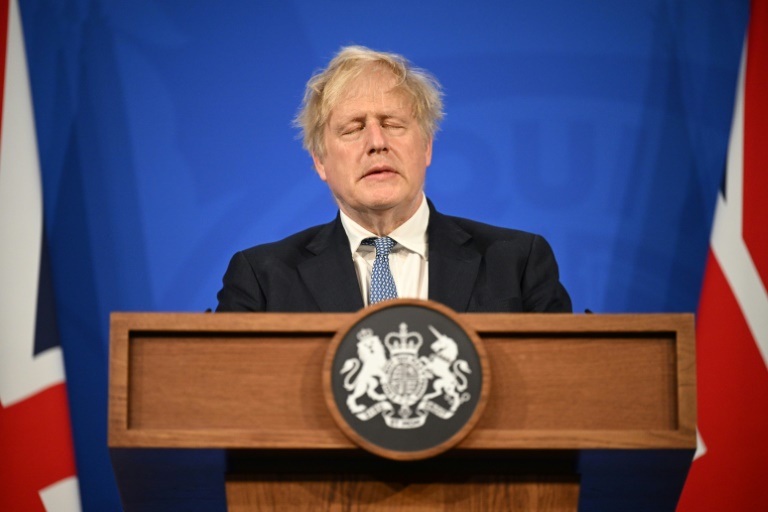
UK Prime Minister Boris Johnson defiantly rejected calls to resign after an internal inquiry Wednesday found he presided over a culture of lockdown-breaking parties that ran late into the night and even featured a drunken fight among staff.

Johnson is among dozens of people in Downing Street to have received police fines for breaching Covid regulations — making Number 10 the most penalised address in Britain.

“I really think that given everything that’s going on right now, it’s my job to get on and serve the people of this country,” Johnson said at a press conference. He had already rebuffed calls to quit after receiving the police fine in April.

“That does not mean that I don’t accept responsibility for the totality of what happened and, yes, I bitterly regret it,” he noted.

But he said it was now time to focus on people’s “priorities”, including Ukraine and a spiralling cost-of-living crisis in Britain.

– ‘Pack his bags’ –

Hours earlier, he faced a barrage of criticism from opposition MPs in parliament in response to the long-awaited report by senior civil servant Sue Gray, insisting: “I am humbled, and I have learned.”

Johnson argued he was absent from most of the events probed, and denied ever lying to lawmakers or urging Gray privately to bury her 37-page report.

But the main opposition Labour party said the “catalogue of criminality” revealed by her report vindicated its demands for the prime minister to quit.

“You cannot be a lawmaker and a law-breaker,” Labour leader Keir Starmer told Johnson.

“It’s time to pack his bags,” added Starmer, who has vowed to quit himself if fined by police in northeast England for an alleged breach of the Covid regulations during an election campaign meeting.

– ‘Responsibility’ –

Gray’s damning account of the so-called “Partygate” scandal included photographs of Johnson toasting staff with wine and described revelling that sometimes stretched into the early hours to music from a karaoke machine.

“Many of these events should not have been allowed to happen,” Gray wrote, revealing that Downing Street security and cleaning staff were mocked when they tried to protest at the staff conduct.

The report found that junior staffers who ended up fined by London’s Metropolitan police — most of them women — had been told to attend events by their bosses.

“The senior leadership at the centre, both political and official, must bear responsibility for this culture,” Gray added, noting the painful sacrifices made by the UK public to respect the rules set by Johnson’s government.

Despite the fact that the severity of those rules required even the queen to sit alone at her late husband’s funeral in April 2021, Johnson insisted Wednesday that he saw attending some of the leaving drinks for departing staff as part of his job.

“It didn’t occur to me that this was anything except what I think was my duty to do as prime minister during a pandemic and that’s why I did it,” he told reporters.

– Trust ‘erosion’ –

Opinion polls indicated deep public disapproval, with a snap survey Wednesday finding three in five people think Johnson should resign and three-quarters that he knowingly lied about “Partygate”.

But Conservative MPs — the only people able to force Johnson from office outside an election — are showing few signs of willingness to move against him, despite heavy defeats at recent local polls.

One senior Tory, Tobias Ellwood, was one of a few Conservatives to reiterate demands for Johnson to go, warning his colleagues that the party could lose the next general election due by 2024.

“Can we continue to govern without distraction given the erosion of the trust with the British people?” he said in parliament.

– ‘Wine-Time Friday’ –

In her findings, Gray said the Downing Street press office organised regular “WTF” (“Wine-Time Friday”) drinks starting at 4:00 pm.

She also showed senior officials discussing how to handle various invitations.

In one WhatsApp exchange, Johnson’s former communications director Lee Cain noted the “rather substantial comms risks” of holding a leaving party for an official in June 2020.

Gray said the party went ahead, lasting hours.

“There was excessive alcohol consumption by some individuals. One individual was sick,” she wrote. “There was a minor altercation between two other individuals.”

In another exchange following a garden party in May 2020 where senior official Martin Reynolds invited staff to “bring your own booze”, Reynolds told an unnamed colleague that the media were focused on an unspecified “non-story”.

But he said that was “better than them focusing on our drinks (which we seem to have got away with)”.

Stock markets drift higher before Fed minutes

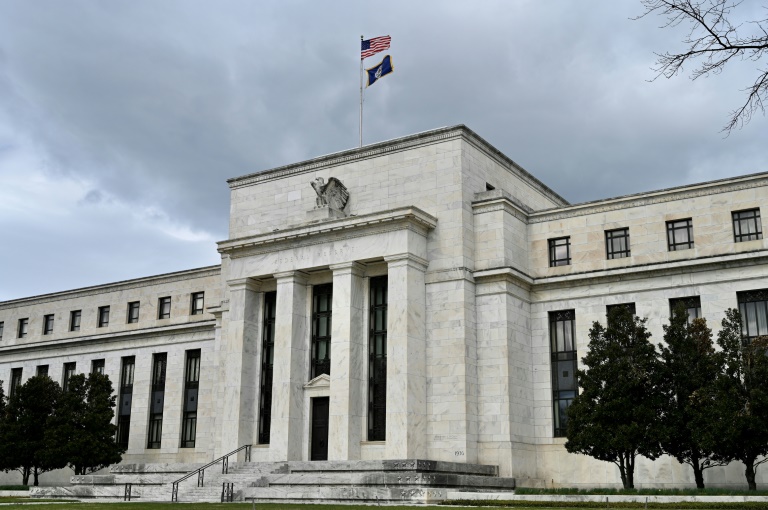
Stocks rose Wednesday ahead of the release of the minutes of the latest Federal Reserve meeting in a break in the bearish sentiment that has gripped equity markets.

Stock markets had retreated Tuesday following a series of weak indicators around the world and downbeat forecasts from big firms that chilled trading floors.

Worries have been mounting that the surge in prices is beginning to drag on consumer confidence, with warnings now swirling of a possible global recession.

But with the minutes of the Fed meeting held earlier this month due out later Wednesday, stocks pushed higher.

“I’m not sure what exactly investors are holding out for,” said Craig Erlam, senior market analyst at Oanda.

“A lot has changed in the markets over the last few weeks, and we’ve had a lot of Fed commentary in that time that is arguably more relevant than almost anything we can take from the minutes,” he added.

Investors expect the Fed to continue with more half-point hikes to bring inflation down from four-decade highs.

But the Fed also has vast holdings of government and corporate bonds on its balance sheet, and a reduction would also crimp borrowing markets. 

“Tonight’s minutes could offer clues on policymakers’ thinking around balance sheet run-off,” said Michael Hewson, chief market analyst at CMC Markets UK.

The Dow had edged 0.2 percent higher in late morning trading.

ECB policymakers have also indicated they plan to begin raising rates soon as well. 

“It’s clear that they are united in their desire to start raising rates in July and again probably in September,” said Erlam.

London stocks closed 0.5 percent higher, with Frankfurt rising 0.6 percent and Paris 0.7 percent. 

Traders are also closely watching China, which continues to struggle with the fast-spreading Omicron coronavirus variant.

The world’s second-biggest economy is sticking to its zero-Covid strategy despite the dire impact of lockdowns on growth.

And with no easing of that policy in sight, observers warned that a series of recent support measures would not be enough to lift optimism.

“Fiscal multipliers will be minimal in an economy where economic interaction and activity have slowed sharply,” said Stephen Innes of SPI Asset Management.

“Moving beyond mobility restrictions in short order is a pre-condition, but not a guarantee, for an Asia-led economic recovery.”

Russia’s invasion of Ukraine has meanwhile put financial markets under renewed stress by driving up prices and impeding growth, the European Central Bank said in a report published Wednesday.

Inflation in the eurozone, as elsewhere, has accelerated as costs for energy, agricultural goods and raw materials have risen sharply.

– Key figures at around 1530 GMT –

New York – Dow: UP 0.2 percent at 31,998.33 points

EURO STOXX 50: DOWN 0.2 percent at 3,603.82

London – FTSE 100: UP 0.5 percent at 7,522.75 (close) 

Frankfurt – DAX: UP 0.6 percent at 14,007.93 (close)

Paris – CAC 40: UP 0.7 percent at 6,298.64 (close)

Tokyo – Nikkei 225: DOWN 0.3 percent at 26,677.80 (close)

Hong Kong – Hang Seng Index: UP 0.3 percent at 20,171.27 (close)

Shanghai – Composite: UP 1.2 percent at 3,107.46 (close)

Euro/dollar: DOWN at $1.0678 from $1.0739 on Tuesday

Pound/dollar: UP at $1.2552 from $1.2535

Euro/pound: DOWN at 85.06 pence from 85.64 pence

Dollar/yen: UP at 127.26 yen from 126.86 yen 

Brent North Sea crude: DOWN 0.1 percent at $110.54 per barrel

West Texas Intermediate: DOWN 0.2 percent at $109.57 per barrel

burs-rl/jj

'Nightmare' as gunman murders 19 children, two teachers in Texas

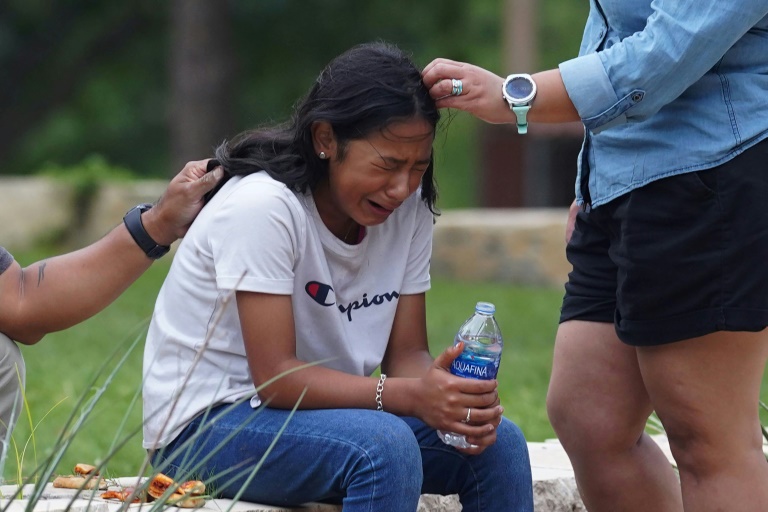
A tight-knit Latino community in Texas was wracked with grief Wednesday after a teenager wearing body armor marched into an elementary school and killed 19 children and two teachers — the latest spasm of America’s gun violence crisis.

Details of the atrocity, the victims and the 18-year-old gunman — who was killed by police — emerged as America grappled with its deadliest school shooting since the Sandy Hook tragedy in Connecticut a decade ago.

“This town is heartbroken, devastated,” said Adolfo Hernandez, whose nephew was at Robb Elementary in Uvalde, a small mainly Hispanic town about an hour from the Mexican border, during the Tuesday shooting.

“We feel like there’s a black cloud above this town,” he told AFP. “You just want to pinch yourself and wake up from that horrible nightmare.” 

Grief-stricken and angry, President Joe Biden addressed the nation in the hours after the attack, calling on lawmakers to take on America’s powerful gun lobby and enact tougher laws to curb gun violence. 

“When in God’s name will we do what we all know in our gut needs to be done?” Biden asked, his voice slow and heavy with emotion.

In Uvalde, police blocked off the area around the school on Wednesday and there was little traffic or pedestrian movement. The neighborhood is one of modest single-story homes, with small yards and often a swing set and an outdoor grill for barbecues.

Identified as Salvador Ramos, the gunman was a resident of the town and a US citizen.

According to Texan officials, Ramos shot his grandmother before heading to Robb Elementary School around noon where he abandoned his vehicle and entered with a rifle.

Law enforcement officers at the school engaged Ramos with gunfire but he managed to get into a classroom and lock it to barricade himself, then started shooting kids and the two teachers, said Chris Olivarez of the Texas Department of Public Safety.

All the fatalities occurred in the one classroom, until police managed to shoot and killed Ramos.

“Just goes to show you complete evil from this shooter,” Olivarez told CNN.

– Gunman’s troubled past –

Details have emerged of the gunman as a deeply troubled teen — he was repeatedly bullied over a speech impediment that included a stutter and a lisp and once cut up his own face “just for fun,” a former friend of Ramos, Santos Valdez, told The Washington Post. 

Days after he turned 18 this month, Ramos legally purchased two assault rifles and 375 rounds of ammunition, CNN said, quoting Texas state Senator John Whitmore.

As shattered families shared the news on social media, the names of the murdered children, most of them of Latino heritage, began coming out: they included Ellie Garcia, Jayce Carmelo Luevanos, Uziyah Garcia. 

“My little love is now flying high with the angels above,” Angel Garza, whose daughter Amerie Jo Garza had just celebrated her 10th birthday, posted on Facebook.

“I love you Amerie jo,” he wrote. “I will never be happy or complete again.”

More than a dozen children were also wounded in the attack at the school, attended by more than 500 students aged around seven to 10 years old, most of them economically disadvantaged.

– ‘Going to be missed’ –

Fourth-grade teacher Eva Mireles was shot and killed while trying to protect her students, her aunt Lydia Martinez Delgado told the New York Times. She said Mireles was proud of teaching kids of Latino heritage.

A cousin of Mireles, Amber Ybarra, called her a hero.

“Her cooking was amazing. Her laughter was contagious, and she’s going to be missed,” Ybarra told NBC’s “Today” show. “She put her heart into everything that she did.”

There have been more mass shootings — in which four or more people were wounded or killed — in 2022 than days so far this year, according to the non-profit Gun Violence Archive which recorded 213 such incidents.

The Uvalde shooting was the deadliest such incident since the 2012 Sandy Hook shooting in Connecticut, in which 20 elementary school children and six staff were killed.

– ‘Happens nowhere else’ –

Senator Chris Murphy, a Democrat from Connecticut, where the Sandy Hook shooting took place, made an impassioned appeal for concrete action to prevent further violence.

“This isn’t inevitable, these kids weren’t unlucky. This only happens in this country and nowhere else,” Murphy said on the Senate floor in Washington.

The deadly assault in Texas follows a series of deadly mass shootings in the United States this month: most recently on May 14 when an 18-year-old self-declared white supremacist shot 10 people dead at a grovery store in Buffalo, New York.

Despite recurring mass-casualty shootings, multiple initiatives to reform gun regulations have failed in the US Congress, leaving states and local councils to strengthen — or weaken — their own restrictions.

US negotiator says odds against reviving Iran deal

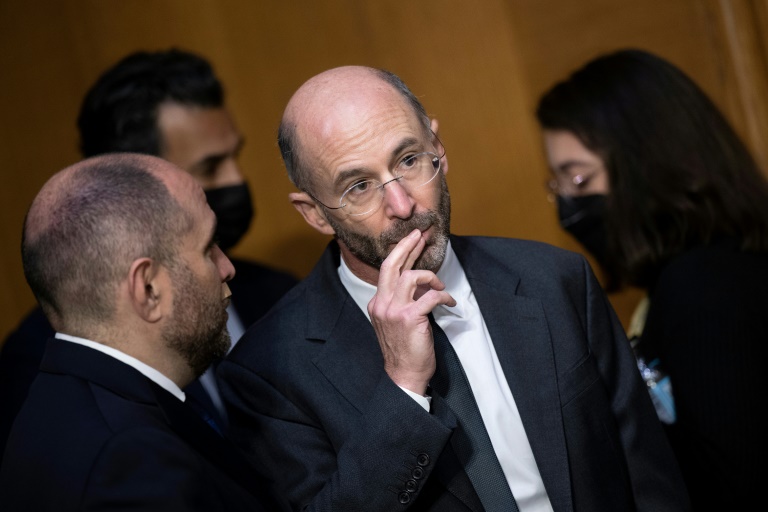
The US pointman on Iran warned Wednesday it was more likely than not that talks would fail to revive a nuclear deal as he vowed no let-up in pressure if Tehran clings to its demands.

Rob Malley, who has led more than a year of indirect talks with Iran in Vienna, nonetheless told lawmakers that President Joe Biden’s administration still supported the 2015 nuclear accord and was ready to lift sanctions if it secures an agreement.

“As of today the odds of a successful negotiation are lower than the odds of failure and that is because of excessive Iranian demands to which we will not succumb,” Malley told the Senate Foreign Relations Committee.

He said the United States would reject “demands that go beyond the scope of the JCPOA,” using the official name for the Joint Comprehensive Plan of Action.

“We are fully prepared to live with and confront that reality if that is Iran’s choice,” Malley said.

He was likely referring to the clerical state’s demands to remove a terrorism blacklisting of the elite Revolutionary Guards, a step rejected by Biden and bitterly opposed by many in Congress.

But Malley made clear that Biden did not support military action — an option loudly mulled by Israel, which is suspected in a shadowy campaign of assassination against Iranian nuclear scientists.

“All options are on the table,” Malley said, while adding that military action would only “set back” Iran’s nuclear program.

Referring to the US history of war in the Middle East, Malley said, “We know that it costs.”

“But let’s leave it at this — the only solution here is a diplomatic one.”

– More economic pressure –

Malley, however, warned of greater economic pressure if talks fail — and said the United States would have the support of the Europeans, unlike under former president Donald Trump.

The Treasury Department said Wednesday it was imposing sanctions on a network backed by Revolutionary Guard and Russian officials that has shipped hundreds of millions of dollars of oil in defiance of unilateral US sanctions.

The JCPOA — brokered under then president Barack Obama with the blessing of European powers, Russia and China — promised economic relief for Iran which, inspectors said, had been complying with the accord’s severe curbs on its nuclear program.

Trump withdrew in 2018 and imposed sweeping unilateral sanctions including on Iran’s oil, vowing to bring Tehran to its knees.

Malley said that Trump’s approach had demonstrably failed, with Iran stepping up nuclear work since the US pullout.

Senators including some from Biden’s Democratic Party voiced exasperation, noting that Secretary of State Antony Blinken had warned in January that only “a few weeks” were left before Iran had advanced to the point that the JCPOA was no longer beneficial.

“We continue to wait and hope. But hope is not a national security strategy,” said Senator Bob Menendez, the Democratic chairman of the committee.

Menendez said Iran had convinced the world “that the United States wants the JCPOA more than the Iranian regime does.”

Malley replied that technical assessments remain “that the nonproliferation benefits of the deal are worth the sanctions relief that we would provide.”

He also offered strong criticism of Iran’s crackdown on recent protests against austerity measures.

“I don’t think this is a strong regime that is basking in being able to circumvent sanctions,” Malley said.

“It is a regime under duress and that’s because of its own mismanagement and our sanctions.”

Close Bitnami banner
Bitnami