World

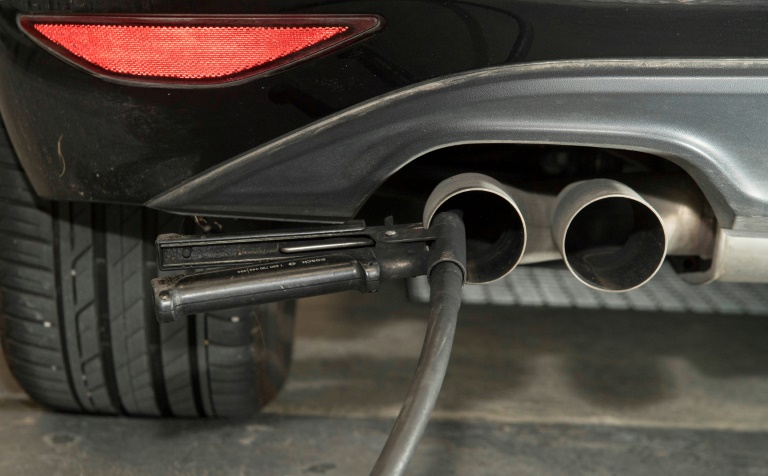
VW Group to settle UK 'dieselgate' claims for £193 mn

Volkswagen on Wednesday said it would pay £193 million ($242 million, 226 million euros) to British claimants over its 2015 diesel emissions tests cheating scandal.

The German company has faced claims around the world since revelations that it cheated pollution tests by installing devices to reduce nitrogen oxide readings.

A class action was brought on behalf of some 91,000 claimants in England and Wales but Volkswagen settled out of court, avoiding a lengthy, potentially costly trial and any appeal.

“No admissions in respect of liability, causation or loss have been made by any of the defendants in the group action as part of the settlement,” VW said.

Terms and conditions of the settlement against Volkswagen Group outlets and dealers were confidential, it added in a statement.

But it said: “A payment of £193 million is being made to the claimants by the Volkswagen Group. A separate contribution is being made by the Volkswagen Group towards the claimants’ legal costs and other fees.”

Chief legal officer Philip Haarmann called the settlement “another important milestone” as the carmaker tries to rebuild trust after the “deeply regrettable events”.

In September 2015, the US Environmental Protection Agency found many VW cars being sold in the country were fitted with software in diesel engines to give better emissions results when tested.

Volkswagen admitted fitting 11 million vehicles with software to make engines appear less polluting in regulatory tests.

That has seen it pay tens of billions of dollars in damages, refunds and court fees, most of them in the United States and Germany.

The High Court in London ruled in April 2020 that Volkswagen was liable to pay compensation in England and Wales to the owners of some 1.2 million VW, Audi, Seat and Skoda vehicles.

India jails Kashmir independence leader for life

A former militant and campaigner for Kashmir independence was sentenced to life imprisonment on terrorism charges Wednesday by an Indian court.

Mohammad Yasin Malik renounced violence in 1994 to campaign peacefully for the “liberation” of Kashmir, which has been split between India and Pakistan since 1947 and which both claim in full.

Last week, an Indian court convicted the 56-year-old, who has spent years in prison and has been in custody since 2019, of terrorism and funding acts of terror.

The National Investigation Agency (NIA), India’s top anti-terrorism investigation body, had asked that Malik be given the death sentence, but the court instead sentenced him to life.

“We will take a decision on what strategy we have to adopt following the life imprisonment of our leader,” Khawaja Saif Din, vice-chairman of the Jammu and Kashmir Liberation Front (JKLF), which Malik heads, told AFP by phone.

“Our group was holding negotiations with the Indian government for the solution of the Kashmir issue. But today, India has compelled Kashmiris to again take up arms against it.”

Crowds of several hundred gathered in Pakistan-administered Kashmir before the sentence was announced to call for Malik’s release.

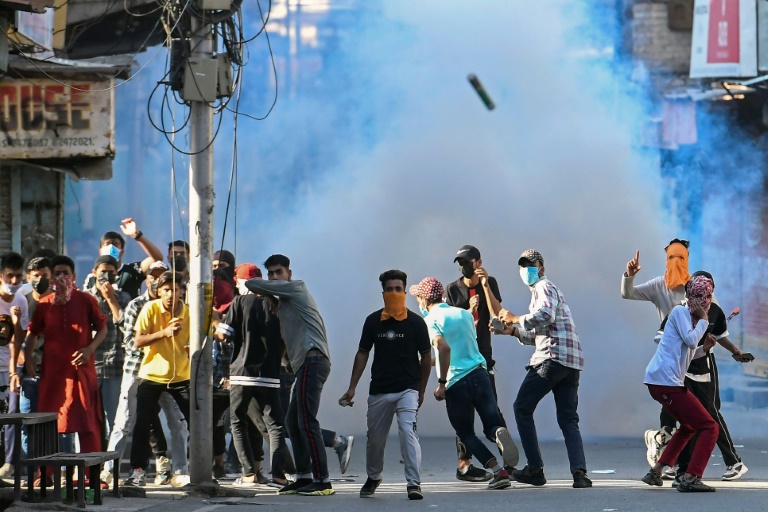
Large parts of Srinagar in the Indian-controlled part of the disputed region were deserted following a shutdown call by the JKLF.

Authorities severed internet connections in the city and police fired tear gas near Malik’s home to disperse scattered groups of protesters, who shouted slogans demanding his freedom.

– Wars –

“Today is a black day for Indian democracy,” Pakistani Prime Minister Shehbaz Sharif tweeted in reaction to the verdict. 

“India can imprison Yasin Malik physically but it can never imprison (the) idea of freedom he symbolises.”

Kashmir has long been a source of tension between India and Pakistan and has been the spark for two of their three wars.

In the part of Kashmir controlled by India, militants — wanting either to be part of Pakistan or independence — have fought the Indian military for three decades.

Tens of thousands of people have died in the violence, most of them non-combatants. India accuses Pakistan of arming and backing the rebels, a charge Islamabad denies.

In 2019, Indian Prime Minister Narendra Modi’s Hindu nationalist government imposed direct rule on the Muslim-majority region, arresting hundreds of people and shutting down the internet for months.

– Chief commander –

A former student activist from humble roots, Malik led one of the first groups of Kashmiri fighters who crossed to Pakistan-administered Kashmir for arms training, and returned to the Indian-controlled part of the territory as chief commander of the JKLF in 1989.

That year, members of the JKLF under Malik’s leadership abducted the daughter of India’s home minister at the time — a Kashmiri politician — and had five of its top fighters freed from jail in a swap.

He was first arrested in 1990 by Indian forces and has spent several years in different jails since. He has alleged he was tortured for years in various Indian detention centres.

Malik led hundreds of armed fighters until 1994 when he renounced violence and adopted peaceful, “Gandhian” ways to become the chairman of the JKLF. He has since campaigned for Kashmir’s right to self-determination.

He has had talks several times with the New Delhi government, including with two previous prime ministers.

Ousted PM Khan leads protest march on blockaded Pakistan capital

Pakistan’s ousted prime minister Imran Khan on Wednesday led a convoy of thousands of supporters towards the capital Islamabad in a show of force the new government has attempted to shut down, with clashes breaking out between police and protesters.

Since being removed from power through a no-confidence vote last month, the cricket star turned politician has heaped pressure on the country’s fragile new coalition rulers by staging mass rallies, touting a claim he was turned out from office in a “foreign conspiracy”.

In a centrepiece showdown with his rivals, Khan had called for supporters of his Pakistan Tehreek-e-Insaf (PTI) party to gather in Islamabad and stage a sit-in until fresh elections are called.

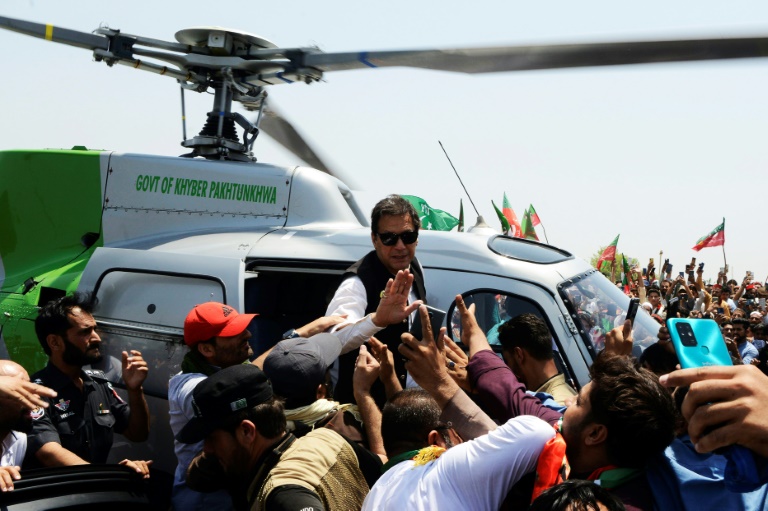
“No obstacle can stop us, we will cross all the barriers and will reach… Islamabad,” Khan declared, flanked by more than 20,000 supporters. 

The government headed by Prime Minister Shehbaz Sharif has pledged to stop the convoy from entering the city, calling the rally an attempt to “divide the nation and promote chaos”.

All major roads surrounding Islamabad, where a heavy security presence is in place, were blocked off with shipping containers while entry and exit points of major nearby cities were also cut off.

Sporadic clashes broke out between police and protesters who have tried to clear the roads, with tear gas fired in several cities. 

Khan joined the march in dramatic fashion, arriving in a helicopter that touched down on a motorway clogged with supporters outside the city of Mardan, 100 kilometres (62 miles) northwest of Islamabad.

The convoy later crossed a bridge that straddles PTI-run Khyber Pakhtunkhwa province and government-run Punjab province, where shipping containers blocking the route were pushed to the side of the road by protesters.

“When we reached here, we had a tough clash with the police. But they fled and we were able to clear the bridge for Imran Khan,” said Zulfiqar Khan, a 42 year-old labourer, in Attock.

– Major disruption –

The Supreme Court on Wednesday held an emergency session, ordering the government and PTI leaders to hold urgent negotiations.

It also ordered the release of supporters detained by police. 

More than 1,700 people have been arrested since police began raiding the homes of PTI supporters on Monday night, said the interior minister Rana Sanaullah, who has previously accused protesters of planning to carry weapons at the march.

Schools in the capital and neighbouring Rawalpindi were closed and all exams cancelled, while a state of emergency was declared at all hospitals, with staff put on alert.

“We have seen the capital blocked before but this is something unprecedented,” Islamabad private school worker Allah Ditta, 52, told AFP.

Salon worker Sawera Masih complained that the wide-scale disruption was falling hardest on daily wage workers like herself.

“Whoever is in power doesn’t make a difference to us, but not earning even for a single day affects me and my family,” the 23-year-old said.

Khan came to power in 2018, voted in by an electorate weary of the dynastic politics of the country’s two major parties.

The former popular sports star — who enjoyed the backing of the nation’s powerful military — had promised to sweep away decades of entrenched corruption and cronyism but is believed to have fallen out with Pakistan’s generals.

He was brought down in part by his failure to rectify the country’s dire economic situation, including its crippling debt, shrinking foreign currency reserves and soaring inflation.

But he retains mass support throughout the country, particularly among the youth. 

Pfizer offers to sell medicines at cost to poorest countries

US pharmaceutical giant Pfizer on Wednesday said it would sell its patented drugs on a not-for-profit basis to the world’s poorest countries, as part of a new initiative announced at the World Economic Forum in Davos.

“The time is now to begin closing this gap” between people with access to the latest treatments and those going without, chief executive Albert Bourla told a press conference at the exclusive Swiss mountain resort gathering.

“An Accord for a Healthier World” focuses on five areas: infectious diseases, cancer, inflammation, rare diseases and women’s health — where Pfizer currently holds 23 patents, including the likes of Comirnaty and Paxlovid, its Covid vaccine and oral treatment.

“This transformational commitment will increase access to Pfizer-patented medicines and vaccines available in the United States and the European Union to nearly 1.2 billion people,” Angela Hwang, group president of the Pfizer Biopharmaceuticals Group, told AFP.

Five countries: Rwanda, Ghana, Malawi, Senegal and Uganda have committed to joining, with a further 40 countries — 27 low-income and 18 lower-middle-income — eligible to sign bilateral agreements to participate.

“Pfizer’s commitment sets a new standard, which we hope to see emulated by others,” Rwanda’s President Paul Kagame said.

But he added that “additional investments and strengthening of Africa’s health systems and pharmaceutical regulators” would also be needed.

– Seven years behind –

Developing countries experience 70 percent of the world’s disease burden but receive only 15 percent of global health spending, leading to devastating outcomes.

Across sub-Saharan Africa, one child in 13 dies before their fifth birthday, compared to one in 199 in high-income countries.

Cancer-related mortality rates are also far higher in low and middle-income countries — causing more fatalities in Africa every year than malaria.

All this is set to a backdrop of limited access to the latest drugs. 

Essential medicines and vaccines typically take four to seven years longer to reach the poorest countries, and supply chain issues and poorly resourced health systems make it difficult for patients to receive them once approved. 

“The Covid-19 pandemic further highlighted the complexities of access to quality healthcare and the resulting inequities,” said Hwang.

“We know there are a number of hurdles that countries have to overcome to gain access to our medicines. That is why we have initially selected five pilot countries to identify and come up with operational solutions and then share those learnings with the remaining countries.”

– ‘Very good model’ –

Specifically, the focus will be on overcoming regulatory and procurement challenges in the countries, while ensuring adequate levels of supply from Pfizer’s side.

The “not-for-profit” price tag takes into account the cost to manufacture and transport each product to an agreed upon port of entry, with Pfizer charging only manufacturing and minimum distribution costs.

If a country already has access to a product at a lower price tier, for example vaccines supplied by GAVI, a public-private global partnership, that lower price will be maintained.

Hwang acknowledged that even an at-cost approach could be challenging for the most cash-strapped countries, and “this is why we have reached out to financial institutions to brief them on the accord and ask them to help support country level financing.”

Pfizer will also invite other stakeholders — including governments, multilateral organisations, NGOs and even other pharmaceuticals — to join the accord.

It is also using funding from the Bill & Melinda Gates Foundation to advance work on a vaccine against Group B Streptococcus (GBS), the leading cause of stillbirth and newborn mortality in low-income countries.

“This type of accord is a very good model, it’s going to help get medicines out,” Gates told the Davos conference, adding that “partnerships with companies like Pfizer have been key to the progress we have made” on efforts like vaccines.

But University of East Anglia health economist Farasat Bokhari said that “the devil is in the detail”, asking “what is it that the countries have to agree to in this accord?”

Bokhari told AFP he would want to know if the agreements entailed commitments to volume, or exclusionary deals that would prevent other companies bringing equivalent drugs to market in the future.

Pfizer offers to sell medicines at cost to poorest countries

US pharmaceutical giant Pfizer on Wednesday said it would sell its patented drugs on a not-for-profit basis to the world’s poorest countries, as part of a new initiative announced at the World Economic Forum in Davos.

“The time is now to begin closing this gap” between people with access to the latest treatments and those going without, chief executive Albert Bourla told a press conference at the exclusive Swiss mountain resort gathering.

“An Accord for a Healthier World” focuses on five areas: infectious diseases, cancer, inflammation, rare diseases and women’s health — where Pfizer currently holds 23 patents, including the likes of Comirnaty and Paxlovid, its Covid vaccine and oral treatment.

“This transformational commitment will increase access to Pfizer-patented medicines and vaccines available in the United States and the European Union to nearly 1.2 billion people,” Angela Hwang, group president of the Pfizer Biopharmaceuticals Group, told AFP.

Five countries: Rwanda, Ghana, Malawi, Senegal and Uganda have committed to joining, with a further 40 countries — 27 low-income and 18 lower-middle-income — eligible to sign bilateral agreements to participate.

“Pfizer’s commitment sets a new standard, which we hope to see emulated by others,” Rwanda’s President Paul Kagame said.

But he added that “additional investments and strengthening of Africa’s health systems and pharmaceutical regulators” would also be needed.

– Seven years behind –

Developing countries experience 70 percent of the world’s disease burden but receive only 15 percent of global health spending, leading to devastating outcomes.

Across sub-Saharan Africa, one child in 13 dies before their fifth birthday, compared to one in 199 in high-income countries.

Cancer-related mortality rates are also far higher in low and middle-income countries — causing more fatalities in Africa every year than malaria.

All this is set to a backdrop of limited access to the latest drugs. 

Essential medicines and vaccines typically take four to seven years longer to reach the poorest countries, and supply chain issues and poorly resourced health systems make it difficult for patients to receive them once approved. 

“The Covid-19 pandemic further highlighted the complexities of access to quality healthcare and the resulting inequities,” said Hwang.

“We know there are a number of hurdles that countries have to overcome to gain access to our medicines. That is why we have initially selected five pilot countries to identify and come up with operational solutions and then share those learnings with the remaining countries.”

– ‘Very good model’ –

Specifically, the focus will be on overcoming regulatory and procurement challenges in the countries, while ensuring adequate levels of supply from Pfizer’s side.

The “not-for-profit” price tag takes into account the cost to manufacture and transport each product to an agreed upon port of entry, with Pfizer charging only manufacturing and minimum distribution costs.

If a country already has access to a product at a lower price tier, for example vaccines supplied by GAVI, a public-private global partnership, that lower price will be maintained.

Hwang acknowledged that even an at-cost approach could be challenging for the most cash-strapped countries, and “this is why we have reached out to financial institutions to brief them on the accord and ask them to help support country level financing.”

Pfizer will also invite other stakeholders — including governments, multilateral organisations, NGOs and even other pharmaceuticals — to join the accord.

It is also using funding from the Bill & Melinda Gates Foundation to advance work on a vaccine against Group B Streptococcus (GBS), the leading cause of stillbirth and newborn mortality in low-income countries.

“This type of accord is a very good model, it’s going to help get medicines out,” Gates told the Davos conference, adding that “partnerships with companies like Pfizer have been key to the progress we have made” on efforts like vaccines.

But University of East Anglia health economist Farasat Bokhari said that “the devil is in the detail”, asking “what is it that the countries have to agree to in this accord?”

Bokhari told AFP he would want to know if the agreements entailed commitments to volume, or exclusionary deals that would prevent other companies bringing equivalent drugs to market in the future.

Nike halts sales to retailers in Russia

Nike will not renew licensing agreements in Russia, the company said Wednesday, joining a growing list of Western companies pulling back from the country following the invasion of Ukraine.

The move affects licensed retailers as Nike shuttered company-owned stores two months ago soon after Moscow sent troops into the neighboring country.

“Due to operational challenges in Russia, Nike has made the decision not to renew or enter into any new business commitments, including with our franchisee Up&Run,” the company said.

“Our business remains on pause and we are providing pay continuity to our employees.” 

Nike’s statement was in response to an AFP inquiry into the status after Russian newspaper Vedomisti reported that Up & Run’s parent, Inventive Retail Group (IRG), would shutter its retail locations in Russia because of lack of access to merchandise.

IRG’s website shows 37 Nike locations, nine of which are listed as “temporarily closed.”

“As you can see from our stores, deliveries are suspended and the goods are in short supply,” IRG spokeswoman Lyudmila Semushina told AFP. “In the current realities, we cannot continue to support the work of Nike mono-brand stores and will be forced to close them.” 

Nike’s move comes just two days after Starbucks said it was shuttering its 130 cafes in the country, and last week, McDonald’s announced its exit from Russia, where it had 850 restaurants employing 62,000 workers.

Russia’s President Vladimir Putin ordered troops into pro-Western Ukraine on February 24, triggering unprecedented sanctions and sparking an exodus of foreign corporations including H&M, Adidas  and Ikea.

North Korea fires likely ICBM hours after Biden leaves Asia

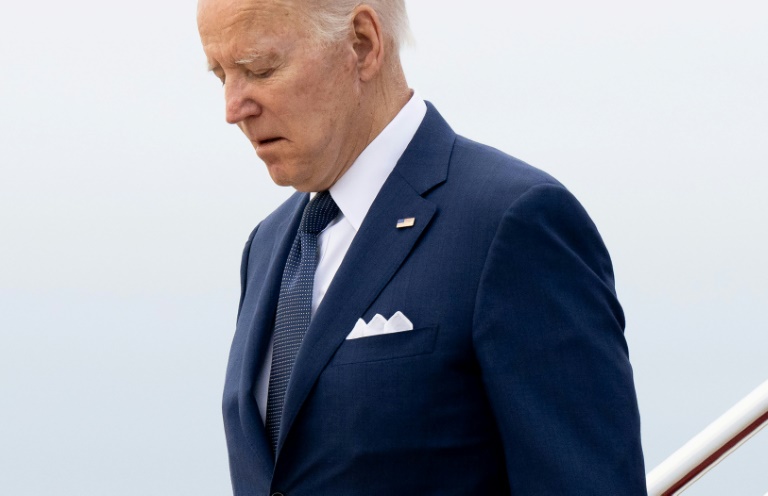
North Korea fired a volley of missiles Wednesday, including possibly its largest intercontinental ballistic missile, just hours after US President Joe Biden left Asia after a trip overshadowed by Pyongyang’s sabre-rattling.

North Korea has also been conducting “operational tests” of a nuclear detonation device, Kim Tae-hyo, Seoul’s first deputy director of the National Security Office, said, adding a test could come “imminently”.

His warning adds to the drumbeat of predictions from US and South Korean officials, who have been saying for weeks that Kim Jong Un’s regime is close to conducting its seventh nuclear test.

Three missiles, including one ICBM, were fired from the Sunan area in Pyongyang, Seoul said — one of nearly 20 weapons tests by North Korea so far this year — prompting joint US-South Korea live-fire missile drills in response.

Pyongyang’s missile launches are “an illegal act in direct violation of UN Security Council resolutions”, Seoul’s government said after a National Security Council meeting chaired by President Yoon Suk-yeol.

US Secretary of State Antony Blinken and his South Korean and Japanese counterparts “strongly condemned the DPRK’s ballistic missile launches as a clear violation of multiple UN Security Council resolutions”, according to State Department Spokesperson Ned Price, using another name for North Korea.

Washington had earlier called for Pyongyang to “engage in sustained and substantive dialogue”.

The three early-morning ballistic missile launches came within an hour of each other, South Korea’s Joint Chiefs of Staff said in a statement.

“The first ballistic missile (suspected ICBM) had a range of around 360 kilometres (225 miles) and an altitude of around 540km,” Seoul’s Joint Chiefs of Staff said in a statement.

This could have been North Korea’s largest ICBM, the Hwasong-17, Kim Tae-hyo said later.

The second ballistic missile “disappeared at an altitude of 20km” and the third — a suspected short-range ballistic missile — travelled around 760km at an altitude of around 60km.

– Response to Biden –

The Wednesday launches are the latest in a blitz of sanctions-busting weapons tests by Pyongyang this year, including test-firing intercontinental ballistic missiles at full range for the first time since 2017.

The latest apparent test come just days after Biden left South Korea Sunday.

The tests were “clearly timed for President Biden’s return after his visit to South Korea and Japan”, Ewha University professor Park Won-gon said, adding that Biden had not even touched down in the US when they happened.

During Biden’s visit, South Korea and the US announced they would look at ramping up joint military exercises, which had been scaled back for Covid-19 and during a bout of failed diplomacy with the North.

They also discussed deploying more US tactical assets to the peninsula — measures that would likely enrage Pyongyang, which views the drills as rehearsals for invasion.

“North Korea’s objections against these announcements was expressed through the missile launches,” Park said.

On his last day in Seoul, Biden told reporters he had only a short message for Kim: “Hello. Period.”

– Covid and missiles –

“Pyongyang appears to have launched different types of missiles, probably in the process of improving related military capabilities,” said Leif-Eric Easley, a professor at Ewha University.

“But this also looks like a statement that the Kim regime has many different ways of striking an adversary.”

Kim has recently doubled down on his programme of military modernisation.

Despite struggling with a recent Covid-19 outbreak, the North has resumed construction at a long-dormant nuclear reactor, new satellite imagery has indicated.

Earlier this month, North Korea confirmed its first-ever Omicron cases in Pyongyang, and the virus has since torn through its unvaccinated population of 25 million.

More than three million people have been sick with “fever”, North Korean state media said Wednesday, with 68 deaths since the outbreak began in late April.

North Korea has continued to conduct missile tests since it declared a national emergency over the Covid outbreak.

“It shows Pyongyang’s intent to achieve two objectives simultaneously: overcoming the outbreak and enhancing its nuclear arsenal,” said Yang Moo-jin, a professor at the University of North Korean Studies. 

“Kim seems to be saying that the North is in charge of the security issues that are affecting the Korean peninsula, not Washington.”

China offers South Pacific nations security, free trade agreements

China has put forward plans to dramatically expand security and economic cooperation with South Pacific nations, with one regional leader calling it a thinly veiled effort to lock them into “Beijing’s orbit”.

The wide-ranging draft agreement and a five-year plan, both obtained by AFP Wednesday, will be the subject of discussion when Chinese foreign minister Wang Yi visits Pacific nations from Thursday.

It would offer ten small island-states millions of dollars in Chinese assistance, the prospect of a China-Pacific Islands free trade agreement and access to China’s lucrative market of 1.4 billion people.

China would in return train local police, become involved in local cybersecurity, expand political ties, conduct sensitive marine mapping and gain greater access to natural resources.

The “comprehensive development vision” is believed to be up for approval when Wang meets regional foreign ministers on May 30 in Fiji.

The South Pacific is increasingly a theatre for competition between China and the United States — which has been the primary power in the region for the last century.

Beijing has sought to develop a greater military, political and economic foothold, but until now has made only limited and uneven progress.

The plan, if agreed, would represent a step change, facilitating everything from the deployment of Chinese police to visits by Chinese “art troupes.”

Flights between China and the Pacific Islands would increase, Beijing would appoint a regional envoy, supply training for young Pacific diplomats and provide 2,500 government “scholarships”.

But it is already raising alarm bells in regional capitals.

– ‘Control of our region’ –

In a stark letter to fellow Pacific leaders, Federated States of Micronesia President David Panuelo warned the agreement seems “attractive” at first glance, but would allow China to “acquire access and control of our region”.

Calling the proposals “disingenuous,” Panuelo said they would “ensure Chinese influence in government”, Chinese “economic control” of key industries and allow “mass surveillance” of calls and email.  

It was, he said, “demonstrative of China’s intention to shift Pacific allegiances in their direction”.

“The result,” he said, would be “the fracturing of regional peace, security and stability.” 

Micronesia has a compact of free association with the United States, making it one of the region’s closest US allies.

But other Pacific leaders may see the Chinese proposal as possibly lucrative or beneficial.

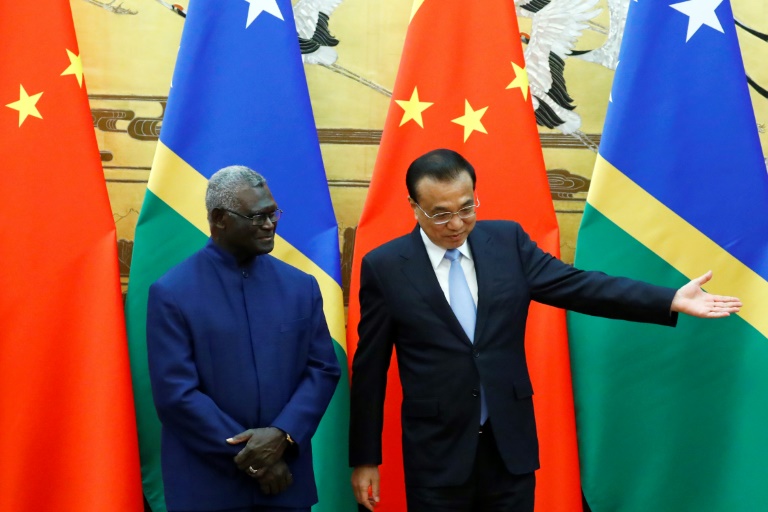
The document is certain to cause consternation in Washington, Canberra and Wellington, where policymakers are still reeling from revelations that the Solomon Islands secretly negotiated a security agreement with Beijing.

A leaked draft of the agreement contained a provision allowing Chinese naval deployments to the island nation, which lies less than 2,000 kilometres (1,200 miles) from Australia.

It also prohibited the Solomon Islands from speaking publicly about the deal’s contents without China’s permission.

News of the deal — which the United States and its allies fear could lead to a Chinese military presence in the region — sparked a frantic round of telephone and shuttle diplomacy to limit implementation.

Beijing’s latest proposal would effectively expand key elements of the Solomon Islands deal to nine other small Pacific nations.

For Washington and its allies, the presence of Chinese forces in the South Pacific would spell an end to decades of efforts to contain China inside the “first island chain”.

It could also require a dramatic repositioning of US forces.  

In a sign of how seriously the South Pacific is now being treated, Australia’s Foreign Minister Penny Wong will visit Fiji on Thursday, her first solo foreign visit since taking office just days ago.

New Zealand’s foreign minister on Wednesday held talks with her Solomon Islands’ counterpart, winning assurances “that the agreement will not lead to a Chinese military base”. 

But there is still widespread unease.

US Assistant Secretary of State for East Asian and Pacific Affairs Daniel Kritenbrink recently slammed the “complete lack of transparency” around the China-Solomon Islands agreement.

“We do know that (China) is seeking to establish a more robust overseas logistics and basing infrastructure that would allow the PLA [People’s Liberation Army] to project and sustain military power at greater distances.” 

For Beijing, a base or even port access would challenge US hegemony in the region and ease what it sees as encirclement by the West.

Top Chinese diplomat Wang is expected to arrive in Solomon Island’s capital Honiara on Thursday. kicking off a lengthy, eight-nation regional tour.

Travelling until June 4, Wang will also stop in Papua New Guinea, Fiji, Kiribati and Samoa, as well as hold video calls with Micronesia and the Cook Islands — a self-governing part of New Zealand. 

In Honiara, the trip has already stirred local controversy. 

Solomon Islands’ journalists are threatening to boycott coverage after a “joint press conference” planned for Thursday evening was to feature only questions from state media.

UK's PM urged to quit over drunken 'Partygate' culture

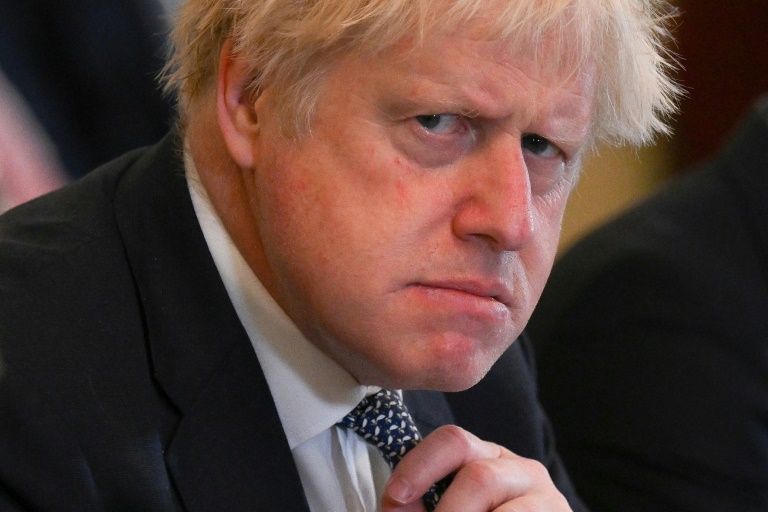
UK Prime Minister Boris Johnson rejected calls to resign after an inquiry Wednesday found that he presided over a culture of lockdown-breaking parties that featured drunken fighting among staff.

Johnson is among dozens of people in Downing Street who have received police fines for breaching Covid regulations since 2020 — making Number 10 the most penalised address in the entire country.

“I take full responsibility for everything that took place on my watch,” he told MPs in response to the long-awaited report by senior civil servant Sue Gray, insisting: “I am humbled, and I have learned.”

But Johnson said he was absent from most of the events, and denied ever lying to parliament, or urging Gray privately to bury her 37-page report.

He expressed hope that with the investigation now over, “we will be able to move on” in addressing priorities including the war in Ukraine and a spiralling cost-of-living crisis in Britain.

Gray published photographs of Johnson toasting staff with wine and described revelling that sometimes stretched into the early hours to music from a karaoke machine.

“Many of these events should not have been allowed to happen,” Gray wrote, revealing that Downing Street security and cleaning staff were mocked when they tried to protest at the staff conduct.

Junior staffers who ended up fined by London’s Metropolitan police — most of them women — had been told to attend events by their bosses, the report found.

“The senior leadership at the centre, both political and official, must bear responsibility for this culture,” Gray added, noting the painful sacrifices made by the UK public to respect the rules set by Johnson’s government.

– ‘Pack your bags’ –

The report came out as a different photograph published by the Daily Mirror newspaper showed a Downing Street table laden with wine bottles and doughnuts. 

It said an accompanying WhatsApp message told staff: “Time to open the Covid secure bar.”

The prime minister defied calls to resign after he received the police fine in April.

The main opposition Labour party said the “catalogue of criminality” revealed by Gray’s report vindicated its demands for Johnson to quit.

“You cannot be a lawmaker and a law-breaker,” Labour leader Keir Starmer told Johnson in the House of Commons.

“It’s time to pack his bags,” added Starmer, who has vowed to quit himself if fined by police in northeast England for an alleged breach of the Covid regulations during an election campaign meeting.

With opinion polls showing deep public disapproval of “Partygate”, Conservative MPs must calculate whether Johnson remains an electoral asset or is now a liability heading into two important by-elections next month.

Last month, the Conservatives lost hundreds of council seats in local elections, although anger at the eye-watering rise in the cost of living was seen as the main issue at the ballot box.

Johnson was due later to hold a news conference, before attending a meeting of backbench Tories, some of whom have written to demand a no-confidence vote.

Senior Conservative Tobias Ellwood reiterated his demands for Johnson to go, warning his colleagues that the party could lose the next general election due by 2024.

“Can we continue to govern without distraction given the erosion of the trust with the British people?” he said in parliament.

But Johnson replied “emphatically yes, we are going to go on and win the next general election because we’re going to get on with the job”.

– Vomiting –

In her findings, Gray said the Downing Street press office organised regular “WTF” (“Wine-Time Friday”) drinks starting at 4:00 pm.

She showed senior officials discussing how to handle various invitations.

In one WhatsApp exchange, Johnson’s former communications director Lee Cain noted the “rather substantial comms risks” of holding a leaving party for an official in June 2020.

Gray said the party went ahead, lasting hours.

“There was excessive alcohol consumption by some individuals. One individual was sick,” she wrote. “There was a minor altercation between two other individuals.”

In another exchange following a garden party in May 2020 where senior official Martin Reynolds invited staff to “bring your own booze”, Reynolds told an unnamed colleague that the media were focused on an unspecified “non-story”.

But he said that was “better than them focusing on our drinks (which we seem to have got away with)”.

European and US stock markets struggle to recover

European and US stock markets struggled to mount a rebound Wednesday as investors weighed the fallout from surging inflation, higher interest rates, China’s economic slowdown and the Ukraine war.

The day before, global equities had retreated as volatility grips financial markets.

A series of weak indicators around the world and downbeat forecasts from big firms have chilled trading floors in recent weeks as the surge in prices begins to drag on consumer confidence, with warnings now swirling of a possible global recession.

The tech sector was again in the firing line after Snap, the parent of social media app Snapchat, provided a gloomy economic outlook, sending its shares diving more than 40 percent on Wall Street Tuesday.

Wall Street titans followed Snap down, with Facebook-parent Meta and Google-parent Alphabet tanking.

“The feel-good factor from earlier in the week has fizzed away, but there is still some element of relief washing through the financial markets that the crutch of cheap money isn’t going to be withdrawn quite so quickly,” said Susannah Streeter, investment and markets analyst at Hargreaves Lansdown. 

She said expectations that the Federal Reserve would avoid hiking US interest rates by as much as 0.75 percent in one go to bring down inflation “helped lift the Dow Jones (Tuesday)… and has steadied overall market sentiment”.

Investors are awaiting the Fed’s next move on interest rates, with expectations for more half-point hikes to come as officials struggle to bring inflation down from four-decade highs.

With minutes from the Fed’s most recent policy meeting due out later Wednesday, Wall Street’s main stock indices opened lower, with the Dow shedding 0.4 percent. 

The broader S&P 500 as well as the tech-heavy Nasdaq were down by a similar amount.

With numerous Fed officials having spoken since the meeting, “the minutes released today may not move today’s trading dial much, unless they convey some more aggressive-minded thinking on the pace of balance sheet reduction,” said Patrick J. O’Hare at Briefing.com.

European stocks made modest gains in afternoon trading.

Traders are also closely watching China, which continues to struggle with the fast-spreading Omicron coronavirus variant.

The world’s second-biggest economy is sticking to its zero-Covid strategy despite the dire impact of lockdowns on growth.

And with no easing of that policy in sight, observers warned that a series of recent support measures would not be enough to lift optimism.

“Fiscal multipliers will be minimal in an economy where economic interaction and activity have slowed sharply,” said Stephen Innes of SPI Asset Management.

“Moving beyond mobility restrictions in short order is a pre-condition, but not a guarantee, for an Asia-led economic recovery.”

Russia’s invasion of Ukraine has meanwhile put financial markets under renewed stress by driving up prices and impeding growth, the European Central Bank said in a report published Wednesday.

Inflation in the eurozone, as elsewhere, has accelerated as costs for energy, agricultural goods and raw materials have risen sharply.

– Key figures at around 1330 GMT –

London – FTSE 100: UP 0.5 percent at 7,517.96 points

Frankfurt – DAX: UP 0.2 percent at 13,947.77

Paris – CAC 40: UP 0.3 percent at 6,271.73

EURO STOXX 50: DOWN 0.4 percent at 3,598.53

New York – Dow: DOWN 0.4 percent at 31,797.63

Tokyo – Nikkei 225: DOWN 0.3 percent at 26,677.80 (close)

Hong Kong – Hang Seng Index: UP 0.3 percent at 20,171.27 (close)

Shanghai – Composite: UP 1.2 percent at 3,107.46 (close)

Euro/dollar: DOWN at $1.0666 from $1.0739 on Tuesday

Pound/dollar: DOWN at $1.2517 from $1.2535

Euro/pound: DOWN at 85.20 pence from 85.64 pence

Dollar/yen: UP at 127.11 yen from 126.86 yen 

Brent North Sea crude: UP 0.8 percent at $111.55 per barrel

West Texas Intermediate: UP 0.9 percent at $110.72 per barrel

burs-rl/spm

Close Bitnami banner
Bitnami