World

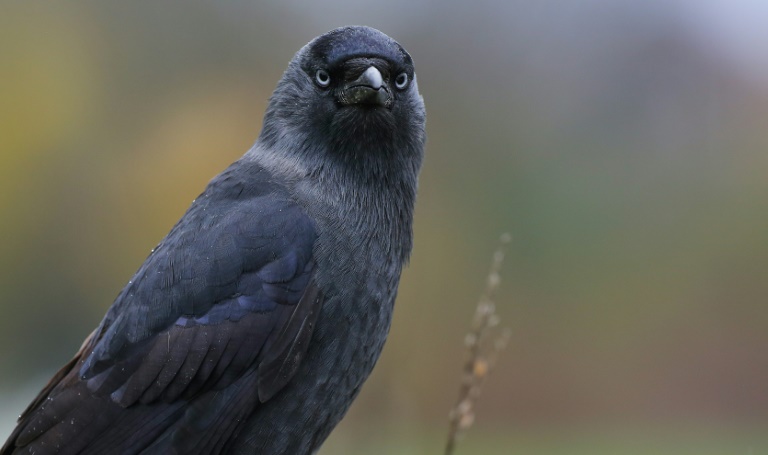
Birdocracy: Noisy jackdaws take a 'vote' before flying

A crescendo of calls from hundreds of noisy jackdaws can often be heard right before they take to the sky all at once, right around sunrise on cold winter mornings.

Now, scientists who studied their daily activities in detail say these small black crows rely on “democratic” decision-making to coordinate their actions for the collective good.

The findings were published Monday in Current Biology.

“By establishing consensus to leave the roost early and in large flocks, birds may reduce predation risk, facilitate access to useful foraging information” and increase access to mates, wrote the authors.

Jackdaws — which may get their name from their brief “Jack”-like squawk — are found across Europe, North Africa and Asia, and form large groups known as “clatterings.”

Prior research on consensus decision-making in animals had focused on small groups or members of a family.

Jackdaw roosts were interesting for size as well as diversity, comprising individuals of different ages, sexes, family groups and colonies spread across treetops.

It’s likely individuals would have varying preferences about when to take off. But sticking together offers advantages, such as lowered risk of being hunted by birds of prey or small mammals.

To investigate, the team from the University of Exeter and other institutions recorded hours of audio and video of six different jackdaw roosts in Cornwall, Britain, with roost sizes varying from 160 to nearly 1,500 birds.

They found that the timing of departure was tightly linked to calling intensity with the group. 

Occasionally, the birds left in dribs and drabs across 20 minutes, but most of the time they set out en masse, with hundreds of birds taking off within a span of four seconds.

On most mornings, the call intensity rose in the hour leading up to the biggest group departure — but sometimes got delayed by rain or heavy cloud cover — which led the team to conclude the vocalizations were a reliable source of information.

To confirm cause and effect, the researchers played recordings to the birds to see if they could get them to take off earlier than they would otherwise — and succeeded in engineering departures that were on average 6.5 minutes earlier.

“Through their calls, jackdaws appear to effectively signal their willingness to leave, providing large groups with a means of achieving consensus to perform cohesive, collective departures from the roost,” the team concluded.

On the few times the birds left in a steady stream, rather than in a big group, the calls did not crescendo to a high, indicating the birds had failed to reach consensus.

In future, the team wants to study how human activity — such as noise pollution — may hinder bird dynamics and their ability to communicate.

In Davos, Ukrainians host "Russian War Crimes House"

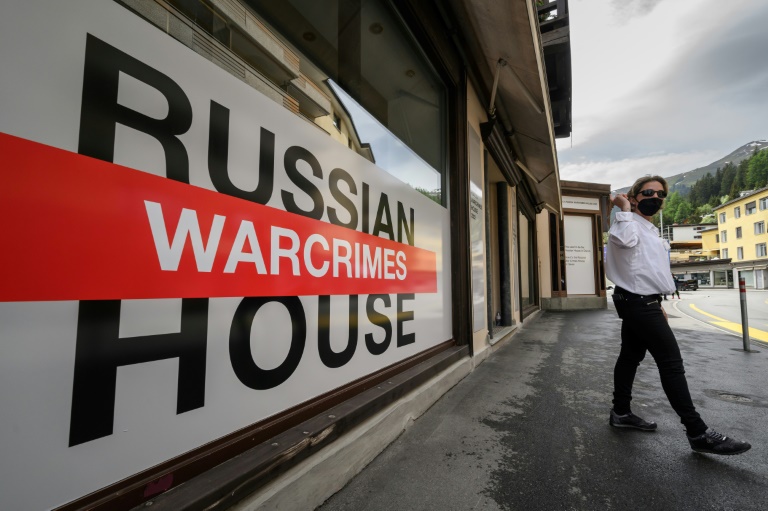
With Russians banned from Davos, their den in the Swiss mountain resort was taken over by Ukraine and given a new name: “Russian War Crimes House”.

The “Russia House” was traditionally used by Russians to hold events and network during the annual World Economic Forum in the Swiss Alps.

But organisers excluded them from the meeting of the world’s business and political elite following Moscow’s invasion of Ukraine.

Instead of a place to entertain, the house with red shutters on Davos’ main street is now used by Ukrainians to display the atrocities the say Russia is committing.

It features photos of cemeteries, people in body bags, a bloodied hand on a pavement, a child in a respirators in a hospital, a baby in a soldier’s arms, buildings in ruins.

Ukrainians are using the building to hold several events during the four-day Davos summit as part of efforts to win more support against Russia, three months after the invasion began.

“If we tell the story of this tragedy as wide as possible, maybe it will save some lives,” said Ukrainian oligarch Viktor Pinchuk, whose foundation is among the organisers of the event.

After the presentation at the “House of Russian War Crimes”, Ukrainian President Volodymyr Zelenksy used the WEF congress to plead for more weapons for his country, and more sanctions against Russia.

A parade of Ukrainian lawmakers and officials attended other events on the summit’s first day to hammer home the need for weapons and sanctions to defeat Russia.

– Map of horrors –

At the “Russian War Crimes House”, the goal is to bring attention to the alleged atrocities committed by Russia.

Next to the photos, an entire wall is covered by a map that lists the “war crimes” committed by Russia.

On top, a toll as of May 6: 4,177 civilians killed, including 226 children, and 4,378 wounded, including 417 children.

Detailed figures for each region are written across the map, except in some places such as Mariupol, where there are only question marks following Russia’s relentless assault on the southeastern port city.

Ukrainian authorities say the weeks-long Russian siege of Mariupol left 20,000 civilians dead.

“Today we need you,” Andriy Yermak, head of the Ukrainian presidential administration, said in a video appearance at the “Russian War Crims House”.

“We are fighting not just for ourselves. The fate of Europe and the world is a stake,” Yermak said.

– ‘Most awful day’ –

Doctor Oksana Kyrsanova travelled to Davos to testify about her last days in a Mariupol hospital that no longer had any heat or medicine.

“Small children were brought in very critical condition … and we couldn’t help them,” she said.

She recalled the death of a pregnant woman.

“Can you imagine: how (do) you put in a black sack a young woman and a baby?” she said. “It was the most awful day.”

The mayor of Bucha also made it to Davos.

His town became synonymous with allegations of war crimes by Russian troops since dozens of bodies in civilian clothing were found lying in the streets, some with their hands tied, after Russian forces left on March 31. 

“Why would they kill the peaceful civilians of our town?” said Mayor Anatoliy Fedoruk.

“I believe the WEF is the platform where Ukraine should be present and talk of the crimes of the Russian federation,” he said.

This happened, he added, “because the crimes weren’t punished in the past”

“We sincerely hope that there will be justice.”

Six dead, dozens injured in Iran tower-block collapse

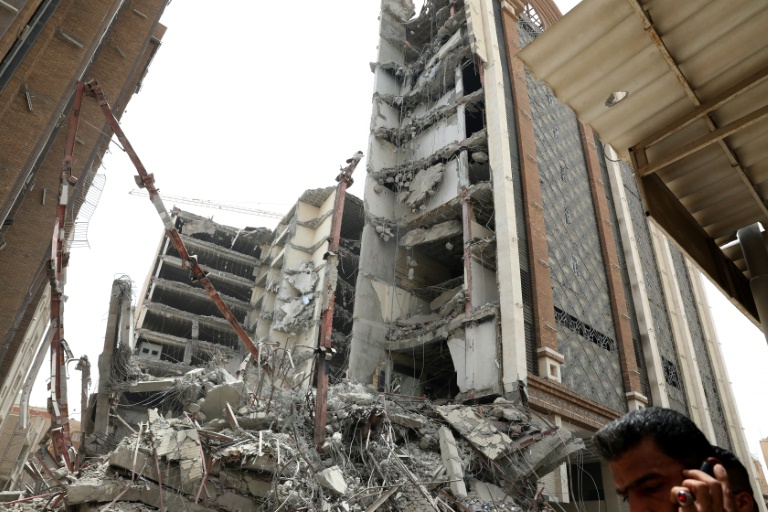
At least six people died and dozens were injured or missing under rubble after an unfinished high-rise building collapsed in southwestern Iran, officials said.

More than 30 people were pulled out alive from the debris, but some 50 more are feared still trapped, with locals calling it a “day of mourning”.

Choking white dust swirled from where the tower-block had stood, covering surrounding vehicles, as shocked onlookers stared at the wreckage in horror, some screaming.

“Parts of the 10-storey Metropol building, located in Abadan in Khuzestan province, collapsed,” state television said. “Six people lost their lives and 27 others were injured in the disaster.”

Rescuers clambered over huge slabs of shattered concrete and tangles of twisted metal bars. Sniffer dogs were being used to search for dozens believed to be trapped.

Mehdi Valipour, head of rescue and emergency operations for Iran’s Red Crescent, said that 32 people had been freed from under the rubble, the ILNA news agency reported.

But Jafar Miadfar, head of the national emergency service, said that “according to witnesses, 50 people are still under the rubble,” according to the official IRNA news agency.

“Today is a day of mourning for poor Abadan,” residents shouted in a video posted on social media.

– Cars squashed flat – 

Rescuers were seen on television rushing out some of the wounded who had been pulled from the wreckage on stretchers.

Several cars were crushed by blocks of falling debris — some apparently with their occupants still inside, according to images.

A crane began work to try to clear some of the debris, including picking up a car squashed flat by the falling tonnes of concrete.

Authorities have not provided further details about the victims.

“About 40 percent of the building has been destroyed, and (the rest) is in danger of completely collapsing,” city governor Ehsan Abbaspour said on television, ordering the evacuation of neighbouring buildings.

The rest of the building still standing, with floors sagging, towered over the pile of debris.

– Shattered concrete –

State television broadcast live images of the tragedy, showing several teams of firefighters clearing twisted metal.

The building is located on Abadan’s busiest street where “commercial, medical and office” buildings predominate, according to state television. 

President Ebrahim Raisi, on a visit to Oman, ordered the fire brigade to “immediately deploy rescue forces and equipment necessary for the removal of debris” in Abadan, IRNA reported.

The cause of the collapse was under investigation, and the owner of the tower-block and the building contractor have been arrested, city prosecutor Hamid Maranipour said.

Abadan, a city of some 230,000 people, lies 660 kilometres (410 miles) southwest of the capital Tehran.

In January 2017, 22 people — including 16 firefighters — died after fire engulfed the Plasco building, a 15-storey shopping centre and the oldest high-rise in Iran’s capital.

Kyiv court convicts Russian of war crimes as Zelensky woos Davos

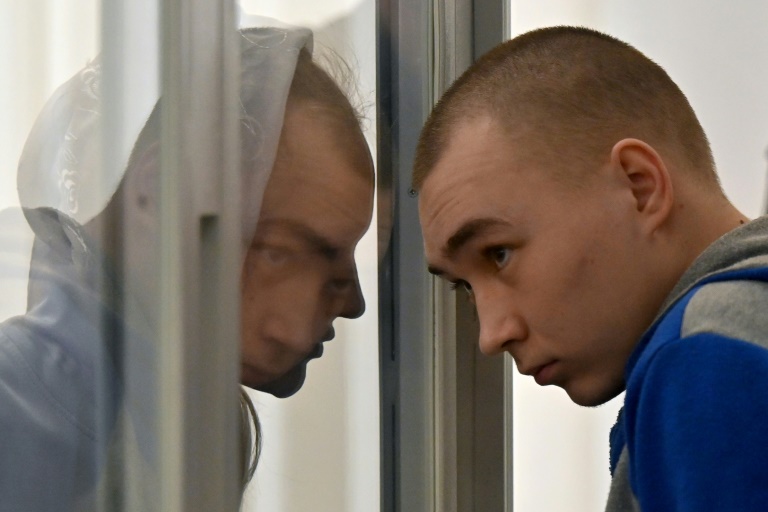
A Ukrainian court found a young Russian soldier guilty of war crimes Monday for killing a civilian and handed him a life sentence, in the first verdict of its kind since Russia’s invasion three months ago.

The judgement came as President Volodymyr Zelensky urged political and business elites at the World Economic Forum to end all trade with Russia and keep supplying his country with weapons.

Russian attacks are pummelling eastern Ukraine as they have for weeks, but all eyes Monday were on the capital Kyiv, in the landmark trial against 21-year-old Russian serviceman Vadim Shishimarin.

The sergeant from Siberia had admitted in court to killing a 62-year-old civilian, Oleksandr Shelipov, in the village of Chupakhivka in northeast Ukraine.

He claimed he shot Shelipov under pressure from another soldier as they tried to retreat and escape back into Russia in a stolen car on February 28, the fourth day of Moscow’s invasion.

Shishimarin apologised and asked Shelipov’s widow for forgiveness, adding: “I was nervous about what was going on. I didn’t want to kill.”

But prosecutors claimed he shot between three and four bullets with the intention of killing the civilian.

“The court has found that Shishimarin is guilty (of war crimes) and sentences him to life imprisonment,” Judge Sergiy Agafonov announced, as the Russian looked on from the glass defence box.

– Davos appeal –

He was also found guilty of premeditated murder, which Agafonov said was “committed with direct intent.”

“Shishimarin violated the laws and customs of war,” the judge said.

Shishimarin’s lawyer Viktor Ovsyannikov said he will appeal the “most severe” verdict, adding that “you can feel societal pressure” on the decision.

The landmark ruling is expected to be followed by others, with Ukraine opening thousands of war crimes cases since Moscow’s invasion.

International institutions are also probing abuses allegedly committed by Russian forces in cities like Bucha and Mariupol, which have become emblematic of the destruction and suffering of the war.

At the World Economic Forum in Davos, from which Russians have been barred this year, Zelensky made the latest in a string of appeals to Western gatherings and parliaments in a bid to maintain support for his country.

He revealed that 87 people were killed in a Russian attack earlier this month on a military base in northern Ukraine, in what would be one of the largest single recorded strikes of the war.

Ukraine, he said via videolink, “is paying dearly for freedom and independence and for this struggle”. 

– Destroying territory –

Western countries have sent huge amounts of weapons and cash to Ukraine to help it repel Russia’s assault, and punished Moscow with unprecedented economic sanctions.

But Zelensky said tens of thousands of lives would have been saved if Kyiv had received “100 percent of our needs at once back in February”, when Russia invaded.

“This is why Ukraine needs all the weapons that we ask (for), not just the ones that have been provided,” said Zelensky, flanked by Ukrainian flags and wearing an olive-green T-shirt.

He also called for an oil embargo on Russia, punitive measures against all its banks and the shunning of its IT sector, adding that all foreign companies should leave the country.

Numerous firms have already abandoned Russia, and US coffee giant Starbucks on Monday said it would close all its 130 cafes there, following a similar move by McDonald’s last week.

Western support has helped Ukraine in many areas hold off Russia forces which, after initially circling Kyiv, are now focused on securing and expanding their gains in the eastern Donbas region and on Ukraine’s southern coast.

Ukraine’s defence ministry on Monday reported “active hostilities” as Russia advanced towards the eastern city of Severodonetsk, and said there was also heavy fighting towards nearby Bakhmut.

“Popasna (near Severodonetsk), Bakhmut, Mariupol: Russia is simply destroying territory with artillery and aircraft, and then (Russian) troops enter,” spokesman Oleksandr Motuzyanyk told reporters.

In some areas taken by the Russians, Moscow is seeking to enforcing its authority. In Kherson, the first major city to fall, the local administration announced the introduction of the ruble as the official currency, alongside the Ukrainian hryvnia.

– Morning prayer –

More than six million people have fled Ukraine and eight million have been internally displaced since the war broke out, according to the United Nations.

For the civilians left behind near the front, prayer is often the only comfort left.

In Bakhmut, Maria Mayashlapak scanned the devastation of her home, where a missile imploded her kitchen and cratered her vegetable garden.

“I was reciting my morning prayer for God to keep me from getting hurt,” the 82-year-old recalled, as the family’s kitten mewed from somewhere in the rubble.

Zelensky’s wife, Olena Zelenska, warned at the World Health Organization’s annual assembly that the mental health effects of Russia’s war could last for decades.

“Following what Ukrainians have experienced during the occupation, at the front, in bomb shelters, under shelling… they need rehabilitation in the same way as those who are physically wounded,” she said.

The impact of the war is also being felt far beyond Ukraine, particularly the impact of a Russian blockade that has left one of the world’s breadbaskets unable to export its grain.

“It’s savagery for one country to have food spoiling like this and for other people to be left poor and hungry,” said Dmitriy Matulyak, a farmer near the Black Sea port of Odessa.

UN Secretary-General Antonio Guterres said last week that the war “threatens to tip tens of millions of people over the edge into food insecurity”.

On Monday, the African Development Bank (AfDB) said it had approved a $1.5 billion emergency programme to alleviate the impact of worsening food insecurity, as the continent faces a shortage of at least 30 million metric tonnes of food.

burs-ar/ach 

Iraq sandstorm grounds flights, sends 1,000 to hospitals

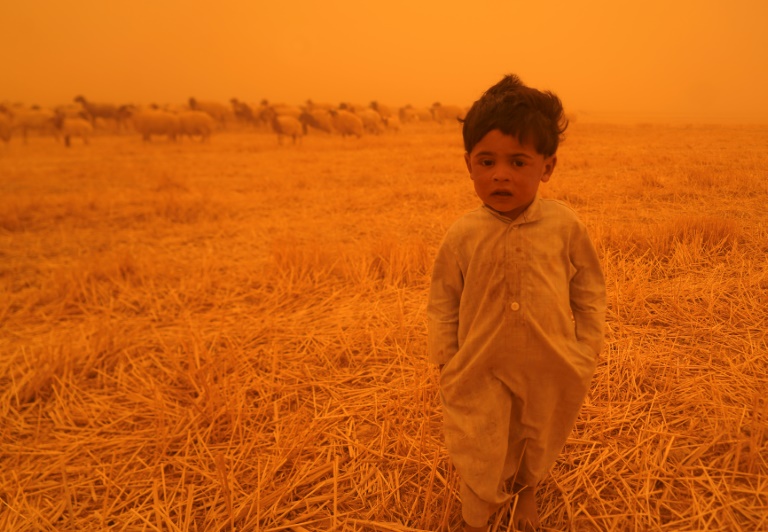
Iraq closed public buildings and temporarily shut airports Monday as another sandstorm — the ninth since mid-April — hit the country.

More than 1,000 people were hospitalised across the nation with respiratory problems, health ministry spokesman Seif al-Badr told AFP.

Flights were also grounded in neighbouring Kuwait for a second time this month, as the region grapples with the increasingly frequent weather phenomenon. 

Later the same day, the second heavy sandstorm in less than a week descended on Saudi Arabia’s capital Riyadh, obscuring iconic buildings like the Kingdom Centre in a grey haze.

The Iraqi capital Baghdad was enveloped in a giant dust cloud that left usually traffic-choked streets largely deserted and bathed in an eery orange light, AFP correspondents said.

Prime Minister Mustafa al-Kadhemi ordered all work to cease in state-run institutions, except for health and security services, citing “poor climatic conditions and the arrival of violent sandstorms”.

Air traffic was suspended at the international airports in Baghdad, Arbil and Najaf, before flights resumed in the capital and Arbil.

Iraq is ranked as one of the world’s five most vulnerable nations to climate change and desertification.  

The environment ministry has warned that over the next two decades Iraq could endure an average of 272 days of sandstorms per year, rising to above 300 by 2050. 

Iraq’s previous two sandstorms sent nearly 10,000 people to hospital with respiratory problems and killed one person.

– More trees needed –

The Middle East has always been battered by sandstorms, but they have become more frequent and intense in recent years.

The trend is associated with rising temperatures and water scarcity, the overuse and damming of rivers as well as overgrazing and deforestation.

Oil-rich Iraq is known in Arabic as the land of the two rivers, the Tigris and Euphrates, where the ancient civilisations of Mesopotamia flourished.

Iraq’s environment ministry has said the increased sandstorms could be countered with more vegetation cover including trees that act as windbreaks.

A major duststorm last week swept across the region, also reaching Iran and the United Arab Emirates.

In Dubai, the world’s tallest building was engulfed in a cloud of dust, while more than 1,200 people were hospitalised in Riyadh alone.

Saudi authorities warned Monday of persistent heavy sandstorm conditions until after nightfall in Riyadh and surrounding areas.

Experts predict the phenomenon will worsen as climate change warps regional weather patterns, further dries out and degrades soils and speeds up desertification across much of the Middle East.

lk/tgg/rcb/hc

Starbucks to completely exit Russia after Ukraine invasion

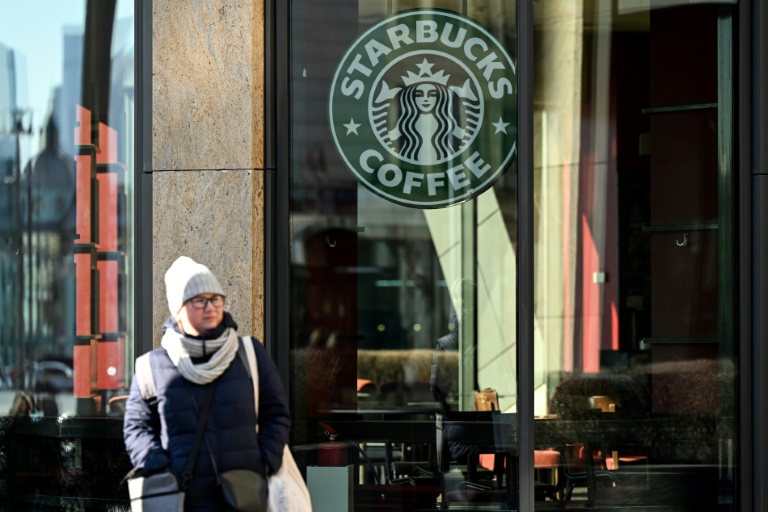
Starbucks said Monday it will cease operations in Russia, shuttering its 130 cafes in the country in the aftermath of the invasion of Ukraine.

The move comes a week after another iconic US brand, McDonald’s, also departed Russia, part of a wave of Western companies cutting the country off following the assault.

“Starbucks has made the decision to exit and no longer have a brand presence in the market,” the company said.

“We will continue to support the nearly 2,000 green apron partners in Russia, including pay for six months and assistance for partners to transition to new opportunities outside of Starbucks.”

The coffee chain suspended its operations in early March after Russia sent troops across the border into Ukraine in late February. 

Former chief executive Kevin Johnson at the time condemned Russia’s “unprovoked, unjust and horrific attacks on Ukraine.”

Starbucks had a relatively modest operation in Russia compared with McDonald’s, which owned 850 restaurants in the country employing 62,000 workers.

McDonald’s, which had operated in Russia since 1990, said its exit would result in one-time costs of $1.2 billion to $1.4 billion. The fast-food chain on Thursday said it reached a deal to sell the business to Russian investor Alexander Govor, a McDonald’s licensee.

French automaker Renault also left the country last week, handing over its assets in the country to the Russian government.

– Pariah –

Retail analyst Neil Saunders of GlobalData said the actions show “that Russia will become more of a commercial pariah as companies turn their backs on a country that represents things they do not wish to be associated with.”

But he predicted some other brands would probably stay put.

“Some will follow, but other consumer packaged goods and retail firms will likely hold out as, unlike Starbucks and McDonald’s, they have extensive exposure to, and interests in, Russia,” he said. “This includes luxury brands which, before the invasion of Ukraine, made good money from the lucrative market for high-end goods.”

Starbucks opened in Russia in 2007, with operations managed by a Kuwait-based licensing company.

In December 2010, executives highlighted the country as a key emerging market for the brand, along with China, Brazil and India.

Starbucks did not disclose the financial impact of leaving the country, but  Saunders said the chain’s limited operation in Russia means the hit to the bottom line likely will be modest.

Shares of Starbucks rose 0.8 percent to $73.96 near midday Monday.

Zelensky tells Davos: send us weapons, stop Russia trade

Ukrainian President Volodymyr Zelensky used the Davos summit Monday to appeal for more weapons and “maximum” sanctions against Russia, lamenting that tens of thousands of lives would have been saved had countries acted faster.

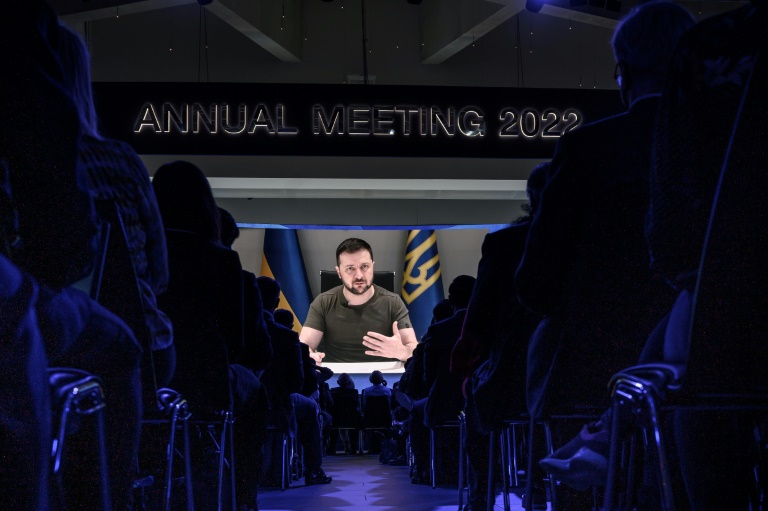
Appearing by video-link, Zelensky delivered the headline speech to the first World Economic Forum to be held in the Swiss Alps in more than two years after the Covid pandemic derailed the event.

The conflict shows “that support to the country under attack is more valuable the sooner it is provided: weapons, funding, political support and sanctions against Russia,” said Zelensky, who received a standing ovation.

Flanked by Ukrainian flags and wearing an olive-green T-shirt, he said through an interpreter that if Kyiv had received “100 percent of our needs at once back in February, the result would have been tens of thousands of lives saved”.

“This is why Ukraine needs all the weapons that we ask for, not just the ones that have been provided,” he said, adding that 87 people were killed in a May 17 strike by Russia on a military base in northern Ukraine.

Anastasia Radina, a Ukrainian lawmaker, told AFP that her country needs “NATO-style” weapons, including tanks and ground-based air defence systems.

“What we are looking for most importantly are fighter jets and this has been the most difficult discussion,” she said. 

“Three months into the war, and tens of thousands lives lost, we are still at the point of discussing if we need fighter jets. Frankly speaking this is outrageous.”

Ukraine is receiving howitzers “but that is not yet enough”, she said.

– End all Russia trade –

Zelensky called for an oil embargo on Russia, punitive measures against all its banks and the shunning of its IT sector, adding that all foreign companies should leave the country.

“There should not be any trade with Russia,” he told the gathering.

“I believe there are still no such sanctions against Russia — and there should be.”

WEF founder Klaus Schwab praised Zelensky for his “courageous leadership” and said Davos participants were eager to hear how they could assist Ukraine “because everybody is affected by what’s happening in your country”.

Western powers have imposed a slew of sanctions on Russia.

But while the United States, Britain and Canada have moved to ban Russian oil and gas, the European Union has been divided over imposing similar measures.

The war is dominating the four-day meeting of the world’s business and political elites, with Ukraine sending a strong contingent of officials, including the foreign minister, to plead for more aid.

Russian business and political leaders, who used to participate in debates and mingle with other A-listers at champagne parties, were excluded from this year’s gathering.

The Ukrainians have transformed the “Russia House” in Davos –- normally used by the Russian delegation — into the “Russia War Crimes House” to promote their cause.

More than 50 heads of state or government are among the 2,500 delegates at the WEF under the title “History at a Turning Point”.

– ‘Bonanza’ for billionaires –

When the WEF last took place in Davos in January 2020, the coronavirus was just brewing in China before morphing into a devastating pandemic.

A Davos forum took place virtually last year, with Russian President Vladimir Putin among the speakers.

While the summit is back, it lacks its usual snowy backdrop after the Omicron variant forced this year’s January meeting to be postponed until now. Instead, rain is forecast all week.

Climate change and concerns about the economic recovery from the pandemic are also at the forefront of the Davos talks.

Inflation has become a major concern as energy and food prices have soared further since Russia invaded major grain-exporter Ukraine, raising fears of hunger in countries dependent on wheat from the region.

A Russian blockade is preventing Ukraine from using its ports to export its agricultural goods, and Zelensky accused Russia of stealing grains on a daily basis.

He said he has talked with European Union, UK, Turkish and UN officials to look into establishing a “corridor which would allow exports of our wheat, sunflowers and other grains”.

Qatar’s emir Tamim bin Hamad Al-Thani, meanwhile, stepped up his offers at Davos to act as a mediator.

“We are in touch with all parties concerned in the Ukrainian crisis, and I am ready to contribute to every international and regional effort, to find an immediate, peaceful solution to the conflict,” he said.

Facebook's Zuckerberg targeted in US privacy lawsuit

Facebook founder Mark Zuckerberg was named personally in a Washington lawsuit Monday alleging he played a direct role in decisions that set the stage for the Cambridge Analytica privacy scandal.

The US capital’s attorney general argues that Zuckerberg was closely involved in conceiving the framework that allowed the Britain-based consulting firm to harvest over 70 million US Facebook users data

A whistleblower revealed in 2018 that Cambridge Analytica went on to use that data for political purposes, including trying to rally support for Donald Trump.

“Zuckerberg is not just a figurehead at Facebook; he is personally involved in nearly every decision the company makes,” Washington Attorney General Karl Racine wrote in the suit.

He added that Zuckerberg’s control is baked into the structure of the company, where the founder and CEO holds a majority of voting shares.

Racine’s office sued Facebook over its data privacy practices in 2018 as part of a case that is ongoing.

Facebook’s parent company Meta did not immediately respond to the new lawsuit’s allegations, but spokesman Andy Stone noted on Twitter that a judge had previously rejected Racine’s bid to add Zuckerberg as a defendant in the privacy case. 

US authorities imposed what they described as a “historic” $5 billion fine on Facebook in the wake of the scandal, and also required Facebook to ramp up privacy protections, provide detailed quarterly reports on compliance with the deal, and have an independent oversight board. 

Since the Cambridge Analytica scandal broke, Facebook has removed access to its data from thousands of apps suspected of abusing it, restricted the amount of information available to developers in general, and made it easier for users to calibrate restrictions on personal data sharing. 

Risk of monkeypox spreading widely 'very low'

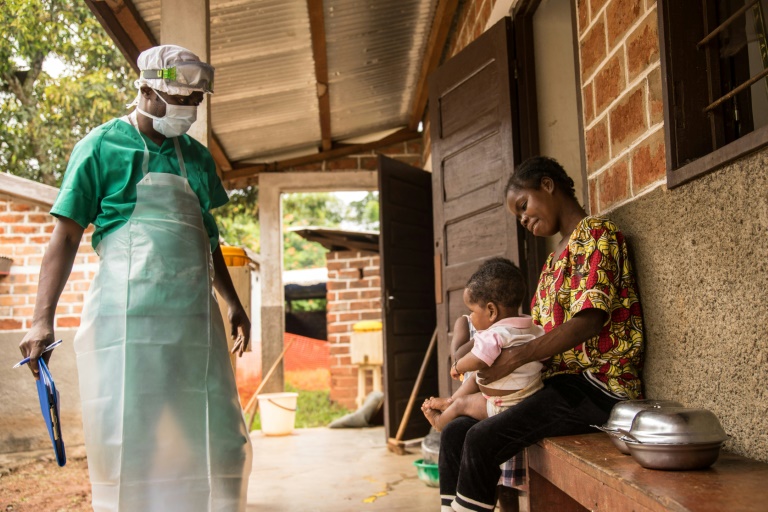
The risk of monkeypox spreading widely among the general population is very low and transmission can be stopped outside endemic countries in Central and West Africa, health officials said Monday, after cases exploded this month in Europe and North America.

Fewer than 200 confirmed and suspected cases had been recorded since early May in Australia, Europe and North America, the World Health Organization (WHO) said, sparking fears over the spread of the disease.

Although monkeypox has been known for 40 years, WHO said it was the first time there had been several cases across many countries simultaneously and among people who had not travelled to the endemic regions in Africa.

But the UN agency said the outbreaks in non-endemic countries could be brought under control and human-to-human transmission of monkeypox stopped.

The EU’s European Centre for Disease Prevention and Control (ECDC) also played down fears of a spread among the wider public.

Monkeypox, which is not usually fatal, can cause a fever, muscle aches, swollen lymph nodes, chills, exhaustion and a chickenpox-like rash on the hands and face. 

The virus can be transmitted through contact with skin lesions or droplets of bodily fluid from an infected person.

No treatment exists, but the symptoms usually clear up after two to four weeks. The disease is considered endemic in 11 African nations.

US President Joe Biden insisted Monday “extra efforts” would not be needed to prevent the spread.

– ‘Remain vigilant’ –

“This is a containable situation, particularly in the countries where we are seeing these outbreaks that are happening across Europe, in North America as well,” the WHO’s emerging disease lead Maria Van Kerkhove said Monday via the UN health agency’s social media channels.

“We want to stop human-to-human transmission. We can do this in the non-endemic countries,” she said.

Meanwhile, the European Centre for Disease Prevention and Control (ECDC) director, Andrea Ammon, said most of the cases had mild symptoms.

“For the broader population, the likelihood of spread is very low,” Ammon added in a statement.

“However, the likelihood of further spread of the virus through close contact, for example during sexual activities among persons with multiple sexual partners, is considered to be high,” she said.

Stella Kyriakides, European Commissioner for Health and Food Safety, said it was important to “remain vigilant” despite the low risk, ensuring contact tracing and adequate diagnostics capacity.

According to the ECDC, the virus can cause severe disease among certain groups such as “young children, pregnant women and immunosuppressed persons”.

The agency also pointed to the risk of “human-to-animal transmission”, and said if the virus is spread to animals “there is a risk that the disease could become endemic in Europe”.

burs-raz/ach 

War in Ukraine: Latest developments

Here are the latest developments in the war in Ukraine:

– Russian soldier convicted – 

A Ukrainian court convicts a 21-year-old Russian soldier of war crimes and sentences him to life in prison at the first trial held over Russia’s invasion of its neighbour.

Vadim Shishimarin admitted to shooting dead 62-year-old civilian Oleksandr Shelipov in the early stages of Moscow’s invasion. His lawyer says he will appeal.

– Stop Russia trade: Zelensky –

Ukrainian President Volodymyr Zelensky urges the international community to halt all trade with Russia, shun its banks and IT sector and impose an oil embargo.

In an address by video-link to political and business leaders attending the World Economic Forum in Davos, he tells delegates: “There should not be any trade with Russia.”

He also argues that tens of thousands of lives could have been saved if Kyiv had received “100 percent” of its weapon requests.

– Russia must ‘pay long-term price’ –

US President Joe Biden says Russia must “pay a long-term price” for its “barbarism in Ukraine”. 

Polish President Andrzej Duda, on a visit to Kyiv on Sunday, also says there can be no “business as usual” with Russia after the massacre of civilians in places such as the Kyiv suburb of Bucha and the southeastern port of Mariupol.

– Eastern onslaught – 

In the eastern city of Severodonetsk Lugansk regional governor Sergiy Gaiday accuses Russian forces of “using scorched-earth tactics, deliberately destroying” the city.

Gaiday says Russia is redeploying forces from the northeastern Kharkiv region and the siege of the conquered city of Mariupol as well as pro-Russian separatist militias and troops mobilised from Siberia to the fight for the Lugansk and neighbouring Donetsk regions, which have become the focus of Moscow’s campaign.

– Mental health challenge –

Ukraine’s First Lady urges the World Health Organization to help tackle the country’s vast mental health crisis, warning that the effects of the three-month-old war could last for decades.

“Following what Ukrainians have experienced during the occupation, at the front, in bomb shelters, under shelling… they need rehabilitation in the same way as those who are physically wounded,” Olena Zelenska tells the WHO’s annual assembly.

– Starbucks leaves Russia –

Starbucks says it will cease operations in Russia, shuttering its 130 cafes in the country.

Last week, McDonald’s announced it was leaving Russia after more than 30 years.

– Ukraine extends martial law –

Ukraine extends martial law and the general mobilisation of the population for three months through to August 23.

– Seized region adopts ruble –

Authorities in the Moscow-controlled southern Ukrainian region of Kherson announce the introduction of the ruble as an official currency alongside the Ukrainian hryvnia.

The region’s capital Kherson was the first major city to fall to Russian forces.

burs-cb/jmy/jj

Close Bitnami banner
Bitnami